Kennedy v. Braidwood: The Supreme Court Upheld ACA Preventive Services but That’s Not the End of the Story

Published: Jun 27, 2025

On June 27, 2025, the U.S. Supreme Court issued the most recent opinion in a long history of challenges to different elements of the Affordable Care Act (ACA). In this case, Kennedy v. Braidwood Management, the Court ruled (6-3) that the ACA requirement that most private insurers and Medicaid expansion programs cover preventive services recommended by the United States Preventive Services Preventive Task Force (USPSTF) with no cost-sharing is constitutional. This means that these services continue to remain available without cost-sharing to most individuals with private coverage. About 100 million privately insured people get preventive services each year without cost-sharing under the ACA’s requirement.

Box 1: Preventive Services Coverage Requirements under the ACA

Section 2713 of the ACA requires most private health insurance plans and Medicaid expansion programs to cover recommended preventive services without any patient cost-sharing. Preventive services include a range of services such as screening tests, immunizations, behavioral counseling, and medications that can prevent the development or worsening of diseases and health conditions.

Preventive services that must be covered are:

All of these entities review new recommendations and conduct periodic updates of existing recommendations.

In this case, the only question before the Court was whether the process for appointing USPSTF members by the Secretary of Health and Human Services violated the Constitution’s Appointments Clause in Article II, which provides that “officers of the United States” may only be appointed by the president, subject to the advice and consent of the Senate. The respondents (Braidwood et al.) contended it did while the petitioners (Health and Human Services Agency) claimed the opposite. The court writes, “that question turns on whether the Task Force members are principal officers or inferior officers.” Inferior officer the Court writes, “are those ‘whose work is directed and supervised at some level by others who were appointed by Presidential nomination with the advice and consent of the Senate.’”

In its ruling, the Supreme Court held that the structure of the USPSTF does not violate the Constitution’s appointment clause. The Court agreed with the federal government, finding that the HHS Secretary has the power to remove USPSTF members at will and to review the recommendations they issue. The court writes “The Secretary of HHS has the power to appoint (and has appointed) the Task Force members… and no statute restricts removal of Task Force members. Therefore, ‘there can be no doubt’ that the Secretary may remove Task Force members at will.”

While the Court’s decision upholds the current ACA USPSTF coverage requirements, it will likely not be the final word on the preventive services that the ACA requires plans to cover free of cost-sharing. The Trump administration could change the membership of the USPSTF in ways that may significantly alter the recommendations it issues or ask the USPSTF re-consider earlier recommendations that it disagrees with. If members were removed and no new members appointed, this could delay review of new services or updates to existing services which would have implications for access under the ACA provision and for providers who look to USPSTF recommendations as clinical guidance.

In their briefs, the Trump administration also raised that they have the authority to indefinitely delay the implementation of recommendations issued by USPSTF and that the Secretary may have additional authority to supervise and veto Task Force recommendations, something that no prior administrations has ever done. In their brief, the administration stated, “In addition to removing Task Force members at will, the Secretary may supervise and review their recommendations directly.”

Demonstrating this authority earlier this month, albeit for a separate but somewhat similar body, Secretary Kennedy fired all 17 ACIP members and appointed eight new committee members. In a very short time, the newly formed committee has begun to not only review the recommendations for new and updated immunizations, it has said it will also re-evaluate the long-standing childhood vaccine schedule and reconsider its approval of vaccines that have been recommended for decades, and in the case of a type of flu vaccine, already has done so.

Box 2: The Challenge to USPTSF Recommendation to Cover PrEP for HIV Prevention

One service that could have been impacted by the court’s decision is pre-exposure prophylaxis (PrEP), a drug recommended by the USPSTF that reduces the risk of acquiring HIV by approximately 99% through sex and 74% through injection drug. While the decision preserves coverage of a range of services, the PrEP coverage requirement was a key element of the Braidwood dispute. In the original case, filed in 2022, the plaintiffs objected to the coverage requirement stating that covering PrEP “imposes a substantial burden on the religious freedom of those who oppose homosexual behavior on religious grounds” claiming further that PrEP drugs “facilitate and encourage homosexual behavior, prostitution, sexual promiscuity, and intravenous drug use.”

The Court ruling means that those with private insurance can continue to have access to PrEP and associated services (provider visits and necessary labs) without cost-sharing. Given that over 80% of PrEP users are covered by commercial insurance, the decision impacts the majority of PrEP users. Actual and perceived costs have historically been one of many barriers to PrEP use. As a very costly drug, with branded versions costing tens of thousands of dollars annually, along with sometimes expensive ancillary services, these cost-sharing protections stand to have a substantial protective impact on consumers.

Currently just 36% of those who might benefit from PrEP are prescribed it and racial/ethnic and gender disparities persist.

In this case, the Supreme Court narrowly considered whether the structure of the USPSTF violates the Appointments Clause, but did not review the litigants’ other claims about ACIP or HRSA. The federal district court will now resume briefing on the consideration of the plaintiffs’ claim that the Secretary of Health and Human Services’ ratification of HRSA and ACIP recommendations violates the Administrative Procedure Act. In addition, the original plaintiffs prevailed in the lower court on their claims that the requirement to cover PrEP violated their religious rights. While the Supreme Court did not review the religious claims brought by the original plaintiffs in this case, the Court has ruled in other cases brought on religious grounds challenging the ACA’s contraceptive coverage requirement, a recommendation from HRSA’s preventive services for women. In those cases, the Supreme Court ruled that exceptions are needed to accommodate employers with religious objections to contraception. Given the ongoing litigation in the lower courts and the Trump administration’s recent actions on vaccine recommendations, the Braidwood case is not likely to be the last word on the ACA preventive services coverage requirements.


Pregnancy-Related Preventive Services for Adults Covered by the ACA

The Affordable Care Act (ACA) requires most private health insurance plans and  Medicaid ACA expansion programs to cover many recommended preventive services without any patient cost-sharing, including pregnancy-related services and supports such as: prenatal visits, folic acid, anxiety and depression screenings, screenings and medication for preeclampsia, STI tests, smoking cessation support, and breastfeeding and lactation counseling and supplies.

The required services are recommended by the U.S. Preventive Services Task Force (USPSTF)and the Health Resources and Services Administration (HRSA) based on recommendations issued by the Women’s Preventive Services Initiative. The Advisory Committee on Immunization Practices recommends vaccines for adults and children that must also be covered without cost-sharing. 

The table below presents detailed information on pregnancy-related preventive services for adults covered under the ACA, including a summary of the recommendation, the target population, effective date of coverage, and related coverage clarifications.

Pregnancy Related

Sexual and Reproductive Health Related Preventive Services for Adults Covered by the ACA

The Affordable Care Act (ACA) requires most private health insurance plans and Medicaid ACA expansion programs to cover preventive services related to sexual and reproductive health with no cost-sharing.  These include—but are not limited to—contraceptive services and supplies for women, as well as counseling and testing for sexually transmitted infections (STIs) and human immunodeficiency virus (HIV), and pre-exposure prophylaxis (PrEP) for HIV prevention.

The required services are recommended by the U.S. Preventive Services Task Force (USPSTF) and the Health Resources and Services Administration (HRSA) based on recommendations issued by the Women’s Preventive Services Initiative. The Advisory Committee on Immunization Practices recommends vaccines for adults and children that must also be covered without cost-sharing. 

The table below presents detailed information on sexual and reproductive health related preventive services that are covered under the ACA, including a summary of the recommendation, the target population, effective date of coverage, and related coverage clarifications. 

Sexual Health

Immunizations for Adults Covered by the ACA

Federal law requires most private health insurance plans and Medicaid programs to cover the full cost of recommended immunizations for adults with no cost-sharing. Vaccine and booster recommendations may vary by age and population. Some of the recommended vaccines that are covered in full, at least for some population groups, are for COVID-19, Human papillomavirus (HPV), measles-mumps-rubella (MMR), and Influenza along with many of the traditional childhood vaccinations.

The Advisory Committee on Immunization Practices (ACIP) develops recommendations for vaccine use to prevent the spread of diseases caused by infections and viruses.

The table below presents detailed information on immunizations for adults covered under the ACA, including a summary of the recommendation, the target population, effective date of coverage, and related coverage clarifications. Ongoing litigation over the scope of the preventive services requirement in the case, Braidwood Management Inc. v. Becerra, could affect coverage policy of preventive health services in the future. 

Immunizations

Health Promotion Preventive Services for Adults Covered by the ACA

The Affordable Care Act (ACA) requires most private health insurance plans and Medicaid ACA expansion programs to cover the full cost of several preventive services related to health promotion, such as counseling on healthy diet, obesity prevention, and alcohol use. Plans must also cover screening for intimate partner violence, urinary incontinence, and checkup visits for women.

The required services are recommended by the U.S. Preventive Services Task Force (USPSTF)and the Health Resources and Services Administration (HRSA) based on recommendations issued by the Women’s Preventive Services Initiative.  The Advisory Committee on Immunization Practices recommends vaccines for adults and children that must also be covered without cost-sharing. 

The table below presents detailed information on clinical preventive services related to health promotion for adults covered under the ACA, including a summary of the recommendation, the target population, effective date of coverage, and related coverage clarifications.

Chronic Conditions

Chronic Condition Preventive Health Services for Adults Covered by the ACA

The Affordable Care Act (ACA) requires most private health insurance plans and Medicaid ACA expansion programs to cover many recommended preventive services without any patient cost-sharing, including services  for prevention and early detection of risks associated with chronic conditions, such as heart disease, diabetes, obesity, hepatitis, anxiety, and depression.

The required services for adults are recommended by the U.S. Preventive Services Task Force (USPSTF)and the Health Resources and Services Administration (HRSA) based on recommendations issued by the Women’s Preventive Services Initiative. The Advisory Committee on Immunization Practices recommends vaccines for adults and children that must also be covered without cost-sharing. 

The table below presents detailed information on preventive health services related to chronic conditions for adults covered under the ACA, including a summary of the recommendation, the target population, effective date of coverage, and related coverage clarifications.  

Chronic Conditions

How Might the House-Passed Reconciliation Bill’s Medicaid Cuts Affect Rural Areas?

Published: Jun 27, 2025

Editorial Note: An analysis of how the Senate-passed bill’s Medicaid cuts could affect rural areas is available here.

Approximately 66 million people – about 20% of the U.S. population – live in rural areas, where Medicaid covers 1 in 4 adults (a higher share than in urban areas) and plays large part in financing health care services. In rural communities, Medicaid covers nearly half of all births and one fifth of inpatient discharges. The Congressional Budget Office (CBO) estimates that the Medicaid changes in the House-passed budget reconciliation bill—the One Big Beautiful Bill Act—will reduce federal Medicaid spending by $793 billion, decrease Medicaid enrollment by 10.3 million people, and increase the number of uninsured people by 7.8 million. Senators from both parties have raised concerns about potential impacts on rural hospitals and other providers, particularly given the ongoing trend of rural hospital closures.

To address those concerns, Senate Republicans have proposed adding a rural health fund to the reconciliation bill. Initial reports have pegged the size of the fund at $15 billion, though some Republican Senators have argued it should be bigger. The fund would provide $3 billion per year in fiscal years 2027 through 2031, with half distributed equally across all states and half to be distributed by the Centers for Medicare and Medicaid Services (CMS) based at least in part on states’ rural populations, percent of providers located in rural areas, and the situation of hospitals who serve low-income patients. It is unclear how the funds will be distributed across hospitals, other providers, and various state initiatives and whether the funds would be enough to offset any losses for providers under the bill.

This policy watch estimates how the House-passed reconciliation bill would affect federal Medicaid spending in rural areas and the number of rural Medicaid enrollees.

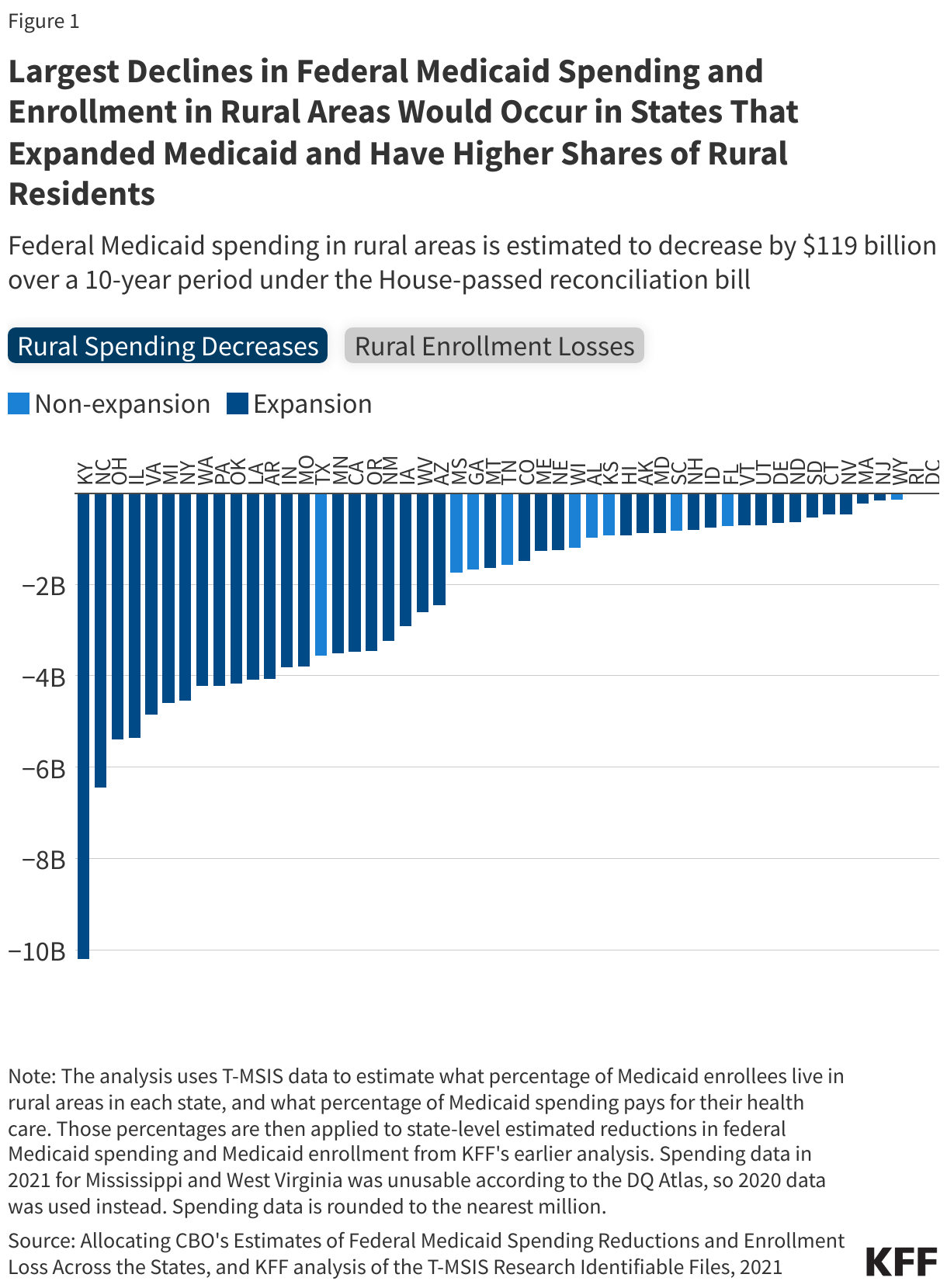
Building on KFF’s earlier estimates of state-by-state Medicaid cuts, this analysis estimates that Medicaid spending in rural areas could decrease by $119 billion over 10 years (Figure 1). The analysis allocates each state’s estimated spending reductions from the earlier analysis of the One Big Beautiful Bill Act to urban and rural areas using the percentage of Medicaid spending that paid for services used by rural enrollees within each state.

Overall, federal Medicaid spending in rural areas could decrease by 15% ($119 billion), which is far more than the $15 billion that has been suggested for the rural health fund. These estimates may underestimate the effects on rural areas because they do not account for the full change in total Medicaid spending, which would include the federal spending reductions and the associated reduction in state Medicaid spending stemming from lower enrollment. The estimates also do not account for the 8.2 million people who are expected to be uninsured because of changes in the Affordable Care Act. Those coverage losses stem from $268 billion in cuts to Affordable Care Act (ACA) Marketplace coverage from the reconciliation bill, the expiration of enhanced ACA subsidies that were enacted during the COVID-19 pandemic, and the impact of proposed Marketplace integrity rules. Federal spending cuts and coverage losses could have implications for rural hospitals and other providers, including increases in uncompensated care. While providers could potentially offset some of the cuts, financial pressure on hospitals and other providers could lead to layoffs of staff, more limited investments in quality improvements, fewer services, or additional rural hospital closures.

Largest Rural Declines in Federal Medicaid Spending and Enrollment Would Occur in States That Expanded Medicaid and Have Higher Shares of Rural Residents

Over half of the spending reductions in rural areas are among 12 states that have large rural populations and have expanded Medicaid under the ACA, each of which could see rural federal Medicaid spending decline by $4 billion or more. Those states include Kentucky, North Carolina, Ohio, Illinois, Virginia, Michigan, New York, Washington, Pennsylvania, Oklahoma, Louisiana, and Arkansas. Kentucky would experience the largest rural Medicaid spending reduction, with an estimated drop of over $10 billion over 10 years. Larger effects in expansion states reflect the fact that expansion states would experience spending reductions under the House-passed reconciliation bill equal to 13% of their projected Medicaid spending, compared with only 6% in non-expansion states. Over half of the estimated federal spending cuts stem from provisions that only apply to states that have adopted the ACA expansions, including work requirements, more frequent eligibility determinations, and new cost sharing requirements. As a result, the effects of the reconciliation bill in rural areas will be larger for expansion than non-expansion states. The $119 billion decline in federal spending does not account for any changes in states’ Medicaid spending.

Building on KFF’s earlier estimates of state-by-state Medicaid enrollment declines, an estimated 1.5 million fewer people could be covered by Medicaid in rural areas under the reconciliation bill in 2034. The analysis allocates each state’s estimated enrollment loss from the earlier analysis of the One Big Beautiful Bill Act to urban and rural areas using the percentage of Medicaid enrollees in rural areas within each state. The same 12 states with the largest spending reductions account for over half of the estimated enrollment losses, each of which could experience enrollment declines of 50,000 or more rural enrollees in 2034. Currently, the uninsured rate is lower in expansion states than in non-expansion states, but it’s unclear whether that could change if the reconciliation bill passes. Research consistently links health coverage to improved health and to reduced mortality. The 1.5 million people who lose Medicaid in rural areas does not account for other increases in the uninsured rate stemming from reconciliation provisions affecting the number of people with coverage purchased through the ACA Marketplaces. It also does not account for the expiration of enhanced premiums tax credits, which were temporarily established during the COVID-19 pandemic, and the impact of proposed Marketplace integrity rules.

SCOTUS Ruling on Medina v. Planned Parenthood Will Limit Access to Care for Patients in South Carolina and Beyond

Published: Jun 27, 2025

On June 26th, 2025, the Supreme Court of the United States issued its decision in Medina v. Planned Parenthood South Atlantic, finding that Medicaid enrollees cannot seek relief in federal court to enforce Medicaid’s “free-choice of provider provision.” This provision allows Medicaid enrollees to seek care from any provider that is qualified and willing to participate in the program. South Carolina’s policy barring Medicaid patients from obtaining care from clinics that provide abortion care is part of broader efforts by anti-abortion policymakers to exclude Planned Parenthood clinics from the Medicaid program, and ultimately, eliminate all federal payments to Planned Parenthood centers. Medicaid pays health care providers, including Planned Parenthood, for the delivery of health care services, but the program does not pay for abortion care except under very limited circumstances (abortions for pregnancies resulting from rape, incest or that are life-threatening).

This decision means that people enrolled in Medicaid in South Carolina, and in other states that exclude Planned Parenthood going forward, will not be able to use their Medicaid coverage to obtain any preventive services, such as contraceptive care, STI treatment and cancer screenings, at Planned Parenthood clinics. Medicaid is a major source of revenue for Planned Parenthood clinics. The loss of this revenue could result in the closure of many sites or scaling back service hours or staff and affect access for all patients, not only Medicaid enrollees. Nationally, one in three (32%) women and one in ten men (11%) have received health services from a Planned Parenthood clinic.

This case stems from a 2018 executive order issued by South Carolina’s governor that prohibited any clinic that provides abortion care from participating in the state’s Medicaid program. Planned Parenthood South Atlantic, which operates two clinics in South Carolina, and Julie Edwards, a patient who wanted Planned Parenthood to be her provider, challenged this decision to block Medicaid patients from having Planned Parenthood as their provider. The Court ruled that the “free-choice of provider” provision does not create a right enforceable by individuals under the civil right statute Section 1983 because the statute does not clearly confer an individual right. The majority opinion distinguished this case from the Court’s 2023 Talevski decision, which found a private right of action for nursing home residents, because the Federal Nursing Home Reform Act (FNHRA) includes explicit language giving residents’ rights. Without the word “right” in the Medicaid “free choice of provider” provision, the Court concluded that the provision is about states’ duties under Medicaid, but it does not confer individual rights to Medicaid enrollees to sue to get services from the participating provider of their choice.

Justice Jackson wrote a dissent, joined by Justices Kagan and Sotomayor, criticizing the majority and contesting their conclusion that because the word “right” does not appear in the free choice of provider provision, the section does not confer individual rights.

Enforcement of Free-Choice of Provider is Now Limited

The Court states that Planned Parenthood could challenge their exclusion from South Carolina’s Medicaid program through South Carolina’s administrative process and then appeal to state courts and ultimately seek review at the Supreme Court. However, the administrative process at the state level could be prolonged, and in the meantime, patients enrolled in Medicaid would not be covered for care at Planned Parenthood clinics. As a result, the clinics would likely close or reduce the scope or availability of services before the administrative process concludes.

How will this impact access to care for Medicaid patients across the country?

Many states have tried to exclude Planned Parenthood clinics from their Medicaid program, largely due to opposition to including a health care provider that also provides abortion. In the past decade, at least 14 states (AL, AR, AZ, FL, IA, ID, KS, LA, MO, MS, OK, SC, TN, TX) have used state-level policies or sought federal permission to block the provider from participating in their state Medicaid programs, though they have often been blocked by court action, until this ruling (Figure 1).

People Living in Many States May Be Affected by State Efforts to Exclude Planned Parenthood from Medicaid

While the high court’s ruling opens the door for South Carolina and other states to disqualify Planned Parenthood from their Medicaid program, the House-approved reconciliation bill could have an even broader impact if passed by the Senate. It would ban federal health care payments by Medicaid for any services to Planned Parenthood and other providers who also offer abortion care (which is currently not covered by Medicaid) in every state. The Senate Parliamentarian is still reviewing the provision to see whether it can be included in the final Senate version of the bill or whether it runs afoul of the “Byrd Rule” and would therefore require 60 votes to pass. Regardless of the outcome, as a result of the Medina case, patients who rely on Planned Parenthood sites for their contraceptive, STI, and preventive care will be likely in some states to find themselves with fewer or no options to get that care, especially in rural or medically underserved communities where there are far fewer providers.

How Might Changes to the ACA Marketplace Impact Enrollees with Mental Health Conditions?

Published: Jun 27, 2025

Marketplace enrollment has grown substantially in recent years, increasing from 11.4 million people in 2020 to 24.3 million in 2025. Insurance coverage is a key determinant in accessing health care services, including mental health services. However, several pending policy changes, such as the One Big Beautiful Bill Act (OBBBA) and the expiration of enhanced premium tax credits, may lead to an additional 8.2 million people losing their Marketplace coverage and becoming uninsured by 2034, according to the Congressional Budget Office (CBO). This potential coverage loss raises concerns about access to mental health care services. One in five Marketplace enrollees report that their mental health is “fair” or “poor”, based on a KFF survey. This brief estimates the number of current Marketplace enrollees with a mental health diagnosis – identified as individuals with a health care claim that included at least one mental health diagnosis – to understand what changes in enrollment may mean for access to services, using 2022 health care claims data from the Center for Medicare and Medicaid Service.

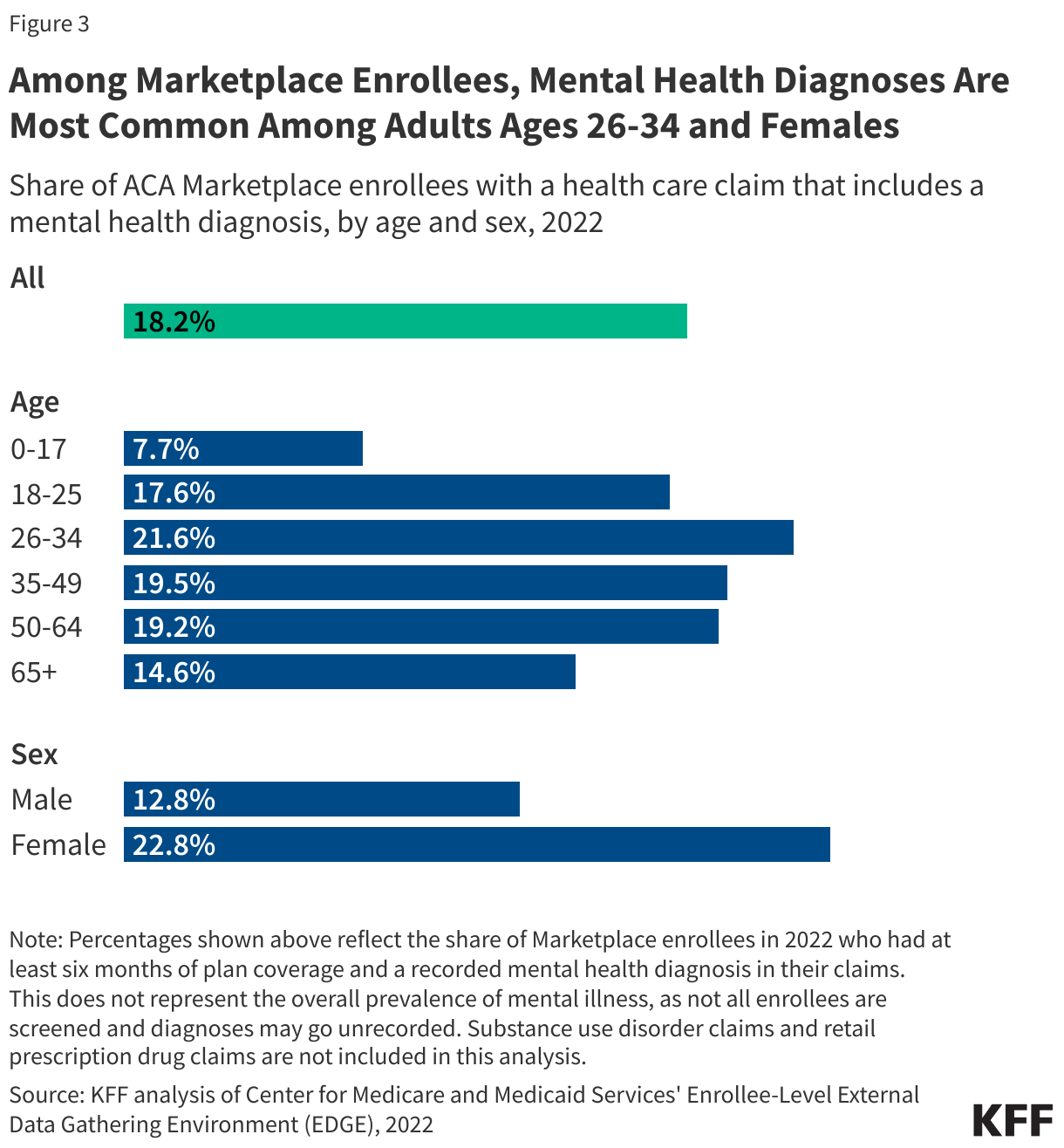
Among Marketplace enrollees, more than 1 in 6 (18.2%) had at least one mental health diagnosis on a health care claim in 2022 (Figure 1). However, the share of Marketplace enrollees with a mental health condition is likely higher. This estimate only captures diagnoses for people with a mental illness diagnosis recorded in their medical claims. This estimate does not account for enrollees with only prescription drug claims for a mental health condition, enrollees with undiagnosed mental health conditions, enrollees in remission from mental health conditions, or those who did not seek treatment for their mental health conditions. Additionally, not all individuals are screened for mental illness, and diagnoses are not always recorded on healthcare claims. Prevalence rates estimated through surveys are generally higher than the prevalence rates observed in claims data. A prior KFF analysis found that among adults – regardless of insurance status – reporting moderate or severe symptoms of anxiety and/or depression, 39% did not receive treatment.

1 in 6 Marketplace Enrollees Had a Mental Health Diagnosis

Among the 24.3 million Marketplace enrollees in 2025, over 4.4 million individuals are estimated to have at least one mental health diagnosis on a health care claim (Figure 2). Given that 18.2% of Marketplace enrollees had a health care claim with a mental health diagnosis in 2022, approximately 4.4 million enrollees may seek services associated with a mental health diagnosis in 2025. These mental health diagnoses include, but are not limited to, anxiety disorders (3.0 million), depression disorders (2.0 million), trauma and stressor related disorders (0.9 million), and bipolar disorders (0.3 million). Further, mental health conditions often co-occur. Among Marketplace enrollees with at least one mental health diagnosis, 39% will have health care claims that include two or more mental health diagnoses.

Over 4.4 Million Marketplace Enrollees Are Estimated to Have at Least One Mental Health Diagnosis

Among Marketplace enrollees, mental health diagnoses were most common among adults ages 26-34 and females (Figure 3). Female Marketplace enrollees were more likely to have a health care claim that included a mental health diagnosis than males (22.8% vs. 12.8%). A prior KFF analysis found that men with moderate to severe symptoms of anxiety and/or depressive disorder were more likely than women to not receive mental health treatment, and as a result not receive a mental health diagnosis in the year. Over one-in-five enrollees ages 26-34 (21.6%) had a health care claim that included a mental health diagnosis, followed by enrollees ages 35-49 and 50-64 (19.5% and 19.2% respectively).

Among Marketplace Enrollees, Mental Health Diagnoses Are Most Common Among Adults Ages 26-34 and Females

The Congressional Budget Office estimates that up to 8.2 million more people will be uninsured in 2034 as a result of changes to Marketplace coverage, which may affect many enrollees with mental health conditions. Several aspects of Marketplace plans created under the Affordable Care Act have allowed for improved access to mental health and substance use services, including classifying these services as essential health benefits, providing coverage for individuals with pre-existing conditions, including mental health conditions, and parity protections. Access to these Marketplace plans has increased with record enrollment in recent years driven in part by enhanced premium tax credits that lowered costs for most enrollees, as well as policy changes that made it easier to sign up for coverage. However, several pending policy changes, including the OBBBA, recently passed by the House, along with the expiration of enhanced premium tax credits, and provisions in a new CMS Marketplace Integrity and Affordability rule may lead to an additional 8.2 million people losing their Marketplace coverage and becoming uninsured by 2034. This would mean if enrollees with mental health conditions lose coverage at a similar rate as other Marketplace enrollees, over one million more people with a mental health diagnosis could be uninsured in 2034. Separately, CBO estimates that changes to Medicaid via the OBBBA would further increase the number of uninsured people by 7.8 million. Medicaid plays a large part in coverage and treatment of behavioral health conditions, covering nearly one-third of all adults with mental health disorders.

Health care expenditures for those with mental health conditions are higher than those without, making insurance an important part of affording treatment for people with mental health conditions. Insured adults with moderate to severe symptoms of anxiety and/or depression are significantly more likely to receive mental health care compared to their uninsured counterparts (64% vs. 38%) in 2019, highlighting the key role insurance coverage plays in linking individuals to mental health care. Among privately insured individuals, those with anxiety and/or depression face higher out-of-pocket costs annually than their peers without a mental health diagnosis ($1,501 vs. $863 in 2021). Reflecting these financial burdens, a 2023 KFF survey found that 43% of insured adults with “fair” or “poor” mental health said they didn’t get needed mental health care because they couldn’t afford the cost. Loss of insurance coverage would further exacerbate the financial burden of seeking mental health treatment.

Methods

Data from the 2022 Enrollee-Level External Data Gathering Environment (EDGE) limited dataset were analyzed to understand how common mental health diagnoses are among Marketplace enrollees. After determining the percentage of enrollees with one or more mental health diagnoses, the results were scaled to the size of the 2025 Marketplace enrollment. Mental health diagnoses were identified using the Clinical Classifications Software Refined (CCSR) from the Agency for Healthcare Research and Quality. Specifically, diagnoses in categories MBD001 through MBD013 and MBD027 were included. Two related categories—suicidal ideation/attempt/intentional self-harm (MBD012) and suicide attempt/intentional self-harm; subsequent encounter (MBD027)—were grouped together. Diagnoses were based on all available medical claims, including updates from the supplemental claims file (submitted in the risk adjustment data collection process). These claims were mapped to mental health diagnoses where appropriate. This analysis did not include retail prescription drug claims. Further, claims for treating substance use conditions are not included in the public use EDGE dataset; some enrollees may have mental health diagnoses on SUD claims.

Reconciliation Language Could Lead To Cuts in Medicaid State-Directed Payments to Hospitals and Nursing Facilities

Published: Jun 27, 2025

On May 22, the House passed the One Big Beautiful Bill Act, which the Congressional Budget Office (CBO) estimated would reduce federal Medicaid spending by $793 billion over 10 years. Almost 10% of those savings came from a provision that would limit state-directed payments to hospitals and nursing facilities in future years. State-directed payments (SDPs) require managed care organizations (MCOs) to make certain types of payments to health care providers, generally aimed at increasing provider payment rates to increase access to or quality of care (see Box 1). The House reconciliation bill would require future SDPs for hospitals and nursing facilities to be limited to 100% of Medicare rates in expansion states and 110% of Medicare rates in non-expansion states but would allow existing SDPs to remain at current rates. The Senate Finance Committee’s draft reconciliation language expands on the SDP provision by reducing existing SDPs 10% each year until they reach the statutory limits applicable to new SDPs.

If Congress passes the reconciliation bill with the Finance Committee’s requirements for SDPs, the required payments to hospitals or nursing facilities would likely decrease in 29 states, and possibly, in more than 31. KFF identified the potentially affected states by reviewing SDP arrangements that have been approved by the Centers for Medicare and Medicaid Services (CMS). Although the focus of this issue brief is payments to hospitals or nursing facilities, which combined account for a major source of Medicaid spending, payment rates for other providers could be affected, and some SDPs apply to multiple provider types but set different payment limits for different types of providers. Payments to other providers are included in this analysis when they are included in an SDP that also targets hospitals and/or nursing facilities (see Methods). Further, this analysis does not consider whether affected states would have to reduce payments to hospitals, nursing facilities, or both. This analysis also does not attempt to project the effects of the provision that will limit any future SDPs to levels that are lower than today’s or for the proposed limits on provider taxes which are one of the ways that SDPs can be funded and the new limits could prompt states to reduce SDPs.

Box 1: What are state-directed payments?

Managed care is the dominant delivery system for people enrolled in Medicaid, with 75% of Medicaid beneficiaries enrolled in comprehensive managed care organizations (MCOs) throughout 42 states. States are generally prohibited from directing how MCOs pay providers but may do so in certain circumstances through “state-directed payments” (SDPs).  Federal regulations govern permissible SPDs (42 CFR 438.6(C)), which specify that states may direct MCO payments for the following purposes:

  • To adopt minimum or maximum fee schedules,
  • To provide uniform payment increases for specific services,
  • To implement value-based purchasing models for provider reimbursement, or
  • To participate in a multi-payer or Medicaid-specific delivery system reform or performance improvement initiative.

Before implementing SDPs, states must receive approval from the Centers for Medicare & Medicaid Services (CMS) unless the SDP uses a minimum fee schedule that is equivalent to the Medicare or Medicaid fee-for-service payment rates.

Most states that have SDPs for hospitals or nursing facilities use average commercial rates to benchmark at least one state-directed payment (Figure 1).  The pre-approval documents states submit to CMS before implementing SDPs (“preprints”) generally require states to indicate the payment level required of comprehensive managed care organizations (MCOs), which is sometimes described as a benchmark. Benchmarks are generally established using Medicare or Medicaid fee-for-service rates, or commercial rates and a state can use one or more of these when establishing SDPs. Benchmarks are generally established for specific types of providers and specified categories of services. State-directed payments are often higher than the levels that would be permissible under the reconciliation bill: 24 states have at least one SDP which raises reimbursement to more than 90% of average commercial rates. One state (North Carolina) benchmarks against average commercial rates but its specific rates are only disclosed in attachments to its preprints that are not publicly available. About one fifth (11) of states have at least one payment rate benchmarked to Medicare (half of those payment rates are benchmarked to at least 92% of Medicare rates with one as high as 202%), and relatively few (3) states have at least one payment benchmarked to Medicaid fee-for-service rates.

Most States Use Average Commercial Rates to Benchmark Directed Payments to Hospitals or Nursing Facilities

Tying payments to average commercial rates was intended to ensure access to adequate provider networks and increase the use of value-based payment methods. A 2024 rule on Medicaid managed care codified CMS’ previously informal practice that the maximum payment rate on total payments after accounting for SDPs for hospital services, nursing facility services, and qualified practitioner services at academic medical facilities was the average commercial payment rate (ACR). There is no upper payment limit on SDPs for other types of services, but CMS indicated that it would use the average commercial rate as a standard when considering states’ applications for approval. The change was intended to help Medicaid compete with commercial insurers and to ensure robust access to Medicaid enrollees. Base rates paid to hospitals by Medicaid, without accounting for supplemental payments like SDPs, are often quite low.

Average commercial rates tend to be higher than Medicaid or Medicare rates and SDPs have been a driver of increased federal spending. There have been numerous proposals to restrain commercial prices for hospital care, which have contributed to higher premiums and reduced wage growth, among other effects.  The Congressional Budget Office (CBO) updated its Medicaid spending projections for 2025-2034 to reflect a 4% (or $267 billion) increase with half of the increase attributed to expected growth in directed payments in Medicaid managed care (driven in part by the rule change allowing states to pay at the average commercial rates). The Government Accountability Office noted that the rapid spending growth suggested the need for enhanced oversight and transparency.

Most states would likely need to reduce payments to hospitals or nursing facilities to comply with the Senate Finance Committee’s proposed caps on state-directed payments (Figure 2). The list of potentially affected states includes any state with an SDP benchmark that exceeds 100% of Medicare fee-for-service rates in expansion states, and 110% of Medicare rates in non-expansion states. For SDPs that benchmark rates to commercial payment rates, KFF converted those rates to a percentage of Medicare rates using data from RAND about the relationship between commercial and Medicare payment rates for hospitals (see Methods).

Among the 42 states with comprehensive managed care plans, 36 states had SDPs starting on January 1, 2024 or later, of which 33 states had SDPs targeting hospitals or nursing facilities (in addition to Vermont’s SDP which is through their All-Payer Accountable Organization Model). Among those 34 states:

  • 29 states would likely be affected because they have at least one SDP benchmarked to Medicare or average commercial rates that are estimated to be higher than the proposed caps (see Methods). Eleven of these states (Georgia, Iowa, Kentucky, Minnesota, Nevada, Oklahoma, Oregon, South Carolina, Tennessee, Washington, and New Mexico) have at least one SDP raising payments to 100% of average commercial rates.
  • Two states, North Carolina and Wisconsin, could possibly be affected by the proposed caps. North Carolina benchmarks some SDPs to commercial rates but does not document the adjusted rate within the preprint. For other SDPs, North Carolina benchmarked payment rates between 146% of Medicaid fee-for services rates (hospital outpatient laboratory services) and 256% of Medicaid rates (for inpatient hospital services). There are no publicly available data to compare states’ Medicaid rates to Medicare rates, so it’s difficult to discern whether benchmarks above 100% of Medicaid rates would also be above the new Medicare-based statutory limits specified in the reconciliation bill. Wisconsin has an SDP that benchmarks payment rates against providers’ costs (up to 124%), which is also difficult to compare to Medicare rates.
  • Three states (Indiana, Missouri, and Vermont) have SDPs that would likely not be affected because their SDP rates are estimated to be below the proposed caps.

Among the remaining states, 3 states (Nebraska, Utah, and West Virginia) have SDPs that do not target hospitals or nursing homes, and 13 states and DC do not have any SDPs in this time period.

Senate Reconciliation Bill Likely to Reduce Hospital and Nursing Facility Payments in Most States

Reduced payments to hospitals or nursing facilities could potentially lead to reduced access to or quality of care. Increased payments through SDPs are permitted under federal law, with the goal to help ensure sufficient access to care and promote improved quality. They can help support hospitals serving a large percentage of Medicaid patients and rural hospitals, which are more likely to have negative operating margins and could face larger financial challenges with cuts to Medicaid financing and increasing the number of people without health insurance by nearly 11 million. These reductions could also have implications for nursing facilities because Medicaid is the primary payer for over 6 in 10 residents, paying for nearly half of the total spending on institutional long-term care. For both types of providers, they may have to offer fewer services or reduce the quality of care to work with the reduced payment rates expected under the bill, and in some cases, may be unable to remain open.

The effects of limiting SDPs in the reconciliation bill will amplify the effects of limiting provider taxes, a mechanism that many states use to help fund hospital and nursing facility payment rates. Both the House and Senate reconciliation language establishes a moratorium on provider taxes that is expected to save money in future years by limiting the amount of future Medicaid spending growth (some health care provisions of the Senate bill have been ruled out of order by the Senate parliamentarian and may need to be revised or removed from the legislation to pass with a simple majority). That provision is similar to the House’s proposed SDP limits that apply to new SDPs but permit existing SDPs to remain in place. In both cases, the Senate Finance Committee’s language makes deeper Medicaid cuts: by limiting existing SDPs and by reducing existing provider taxes in states that adopted the Medicaid expansion if they exceed new limits. KFF estimates that 22 states would be required to cut provider taxes on hospitals or managed care organizations under the Finance Committee language, which would exacerbate the effects of cutting existing SDPs for the states that are jointly affected. Because provider taxes often fund SDPs, even states with SDPs below permissible levels could be forced to cut their provider payment rates if they are affected by the lower provider tax thresholds.

Methods

This analysis examined 172 approved state-directed payment (SDP) “preprints” that were published online by CMS as of June 25, 2025, and started on or after January 1, 2024. The analysis is limited to the 50 states and DC, and to preprints that direct one or more payments to inpatient or outpatient hospital services or nursing facility services. A single SDP may contain one or more payment rates, which may vary in terms of their level (what the rate is set at), what measure is used a benchmark (e.g., average commercial rates or Medicare rates), and providers to which the rate applies. Payment rates benchmarked to average commercial rates were converted to estimates of Medicare-equivalent rates using RAND Price Transparency Study, Round 5.1 data on prices for hospital services, by state. RAND data are based on commercial claims for employer-sponsored health insurance plan enrollees collected from participating self-insured employers and health plans as well as from all-payer claims databases (APCDs) from 12 states. States may calculate commercial benchmarks differently than RAND and commercial to Medicare ratios could be higher or lower for specific hospital services as well as for other providers.

The analysis compares the preprint payment rates to the proposed caps on SDP payment rates, which equal 100% of Medicare rates in expansion states (determined using KFF’s Status of State Medicaid Expansion Decisions) and 110% of Medicare rates in non-expansion states. Each payment rate was classified in one of the following three buckets:

  • “Likely affected” payments are those where the SDP rate (benchmarked to Medicare or commercial) exceeds the state’s proposed cap;
  • “Possibly affected” payments are those benchmarking against Medicaid but that exceed Medicaid fee-for-service payment rates or against another measure for which a comparison to Medicare rates was not possible (such as providers’ costs); and
  •  “Likely not affected” payments are those that fall below the proposed caps.

If a state had at least one payment rate that was classified as “likely affected,” the state was classified as “likely affected.”  States that had no payment rates that were “likely affected” were classified as “possibility affected” if they had at least one payment rate that was “possibly affected.” It is possible that some states received their classification based on payment rates to providers besides hospitals and nursing facilities (for instance, if a single preprint contains payments to both hospital and physician services, payment rates for physician services would be included). However, when restricting the sample to preprints that were only targeted to hospitals and/or nursing facilities, 24 states were still classified as “likely affected.”

CMS sometimes publishes preprints before the start date and sometimes publishes them after; states may have SDPs that could be affected that have not yet been approved or published.  At the time of writing this, CMS has been publishing, updating, and removing preprints from its website frequently.

This work was supported in part by Arnold Ventures. KFF maintains full editorial control over all of its policy analysis, polling, and journalism activities.

Patrick Drake, an independent consultant at Data, et cetera, aggregated the preprint data for this analysis.