

A Current Snapshot of the Medicare Part D Prescription Drug Benefit

Published: Oct 7, 2025

Medicare Part D is a voluntary outpatient prescription drug benefit for people with Medicare provided through private plans that contract with the federal government. Beneficiaries can choose to enroll in either a stand-alone prescription drug plan (PDP) to supplement traditional Medicare or a Medicare Advantage drug plan (MA-PD) that includes drug coverage and all other Medicare-covered benefits. This brief provides an overview of the Medicare Part D program, plan availability, enrollment, and spending and financing, based on KFF analysis of data from the Centers for Medicare & Medicaid Services (CMS) and other sources. It also provides an overview of changes to the Part D benefit based on provisions in the Inflation Reduction Act. (A separate KFF analysis provides more detail about Part D plan availability, premiums, and cost sharing.)

Takeaways

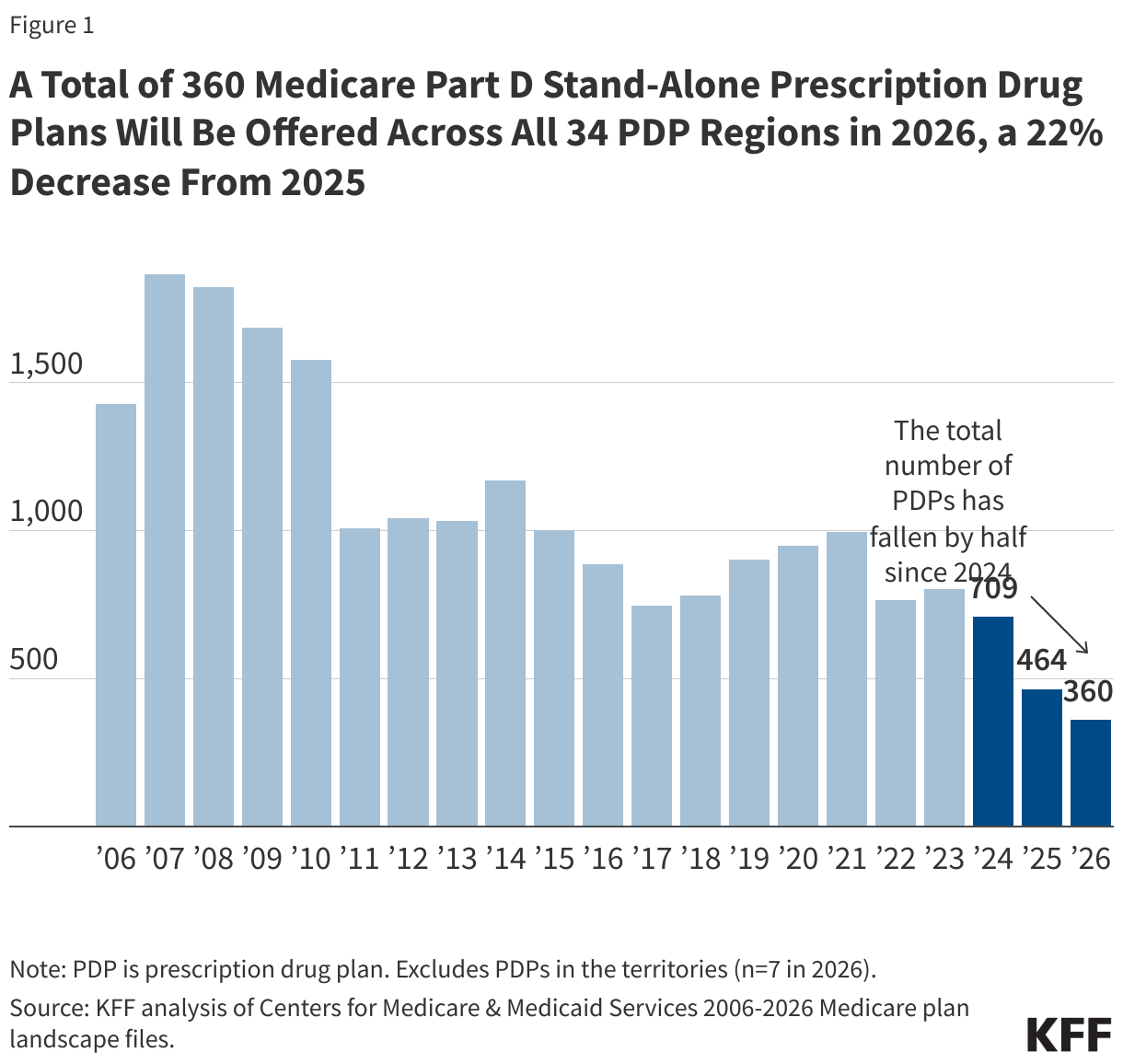
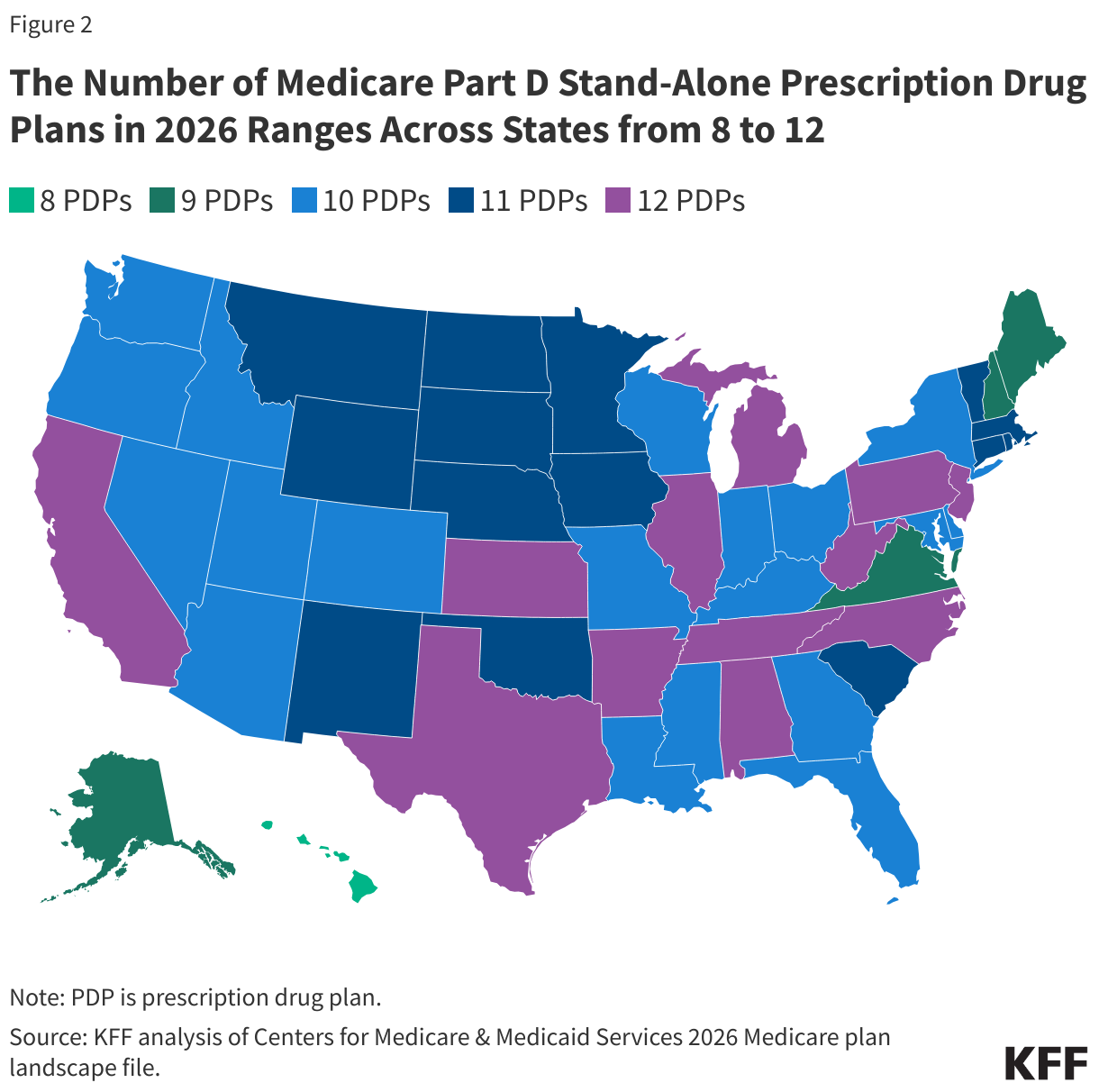
  • In 2026, beneficiaries in each state will have a choice of between 8 and 12 Medicare Part D stand-alone prescription drug plans, plus many Medicare Advantage drug plans. A total of 360 PDPs will be offered by 17 different parent organizations across the 34 PDP regions nationwide (excluding 7 PDPs in the territories), a 22% decrease in PDPs from 2025 and 2 fewer parent organizations.
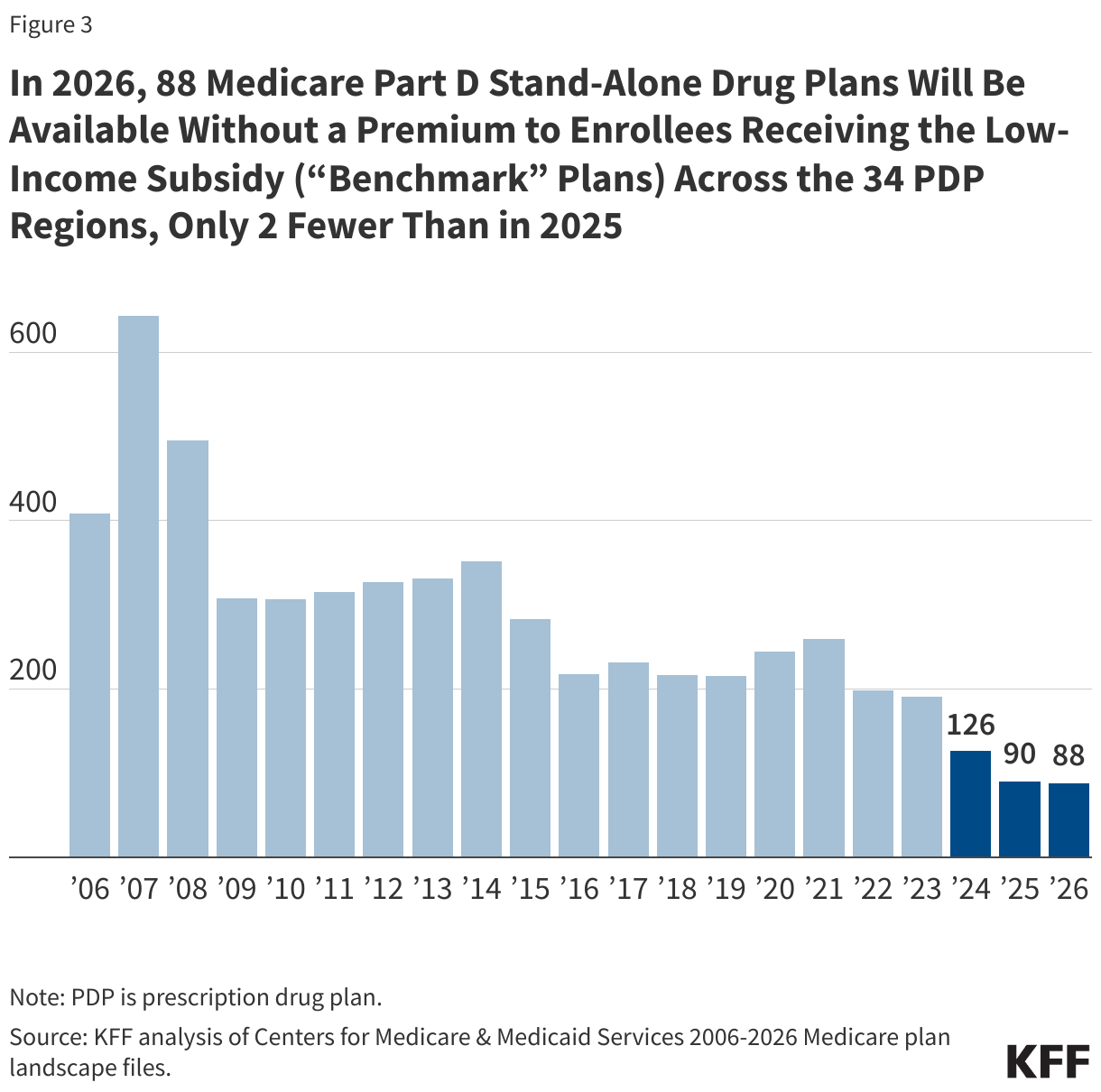
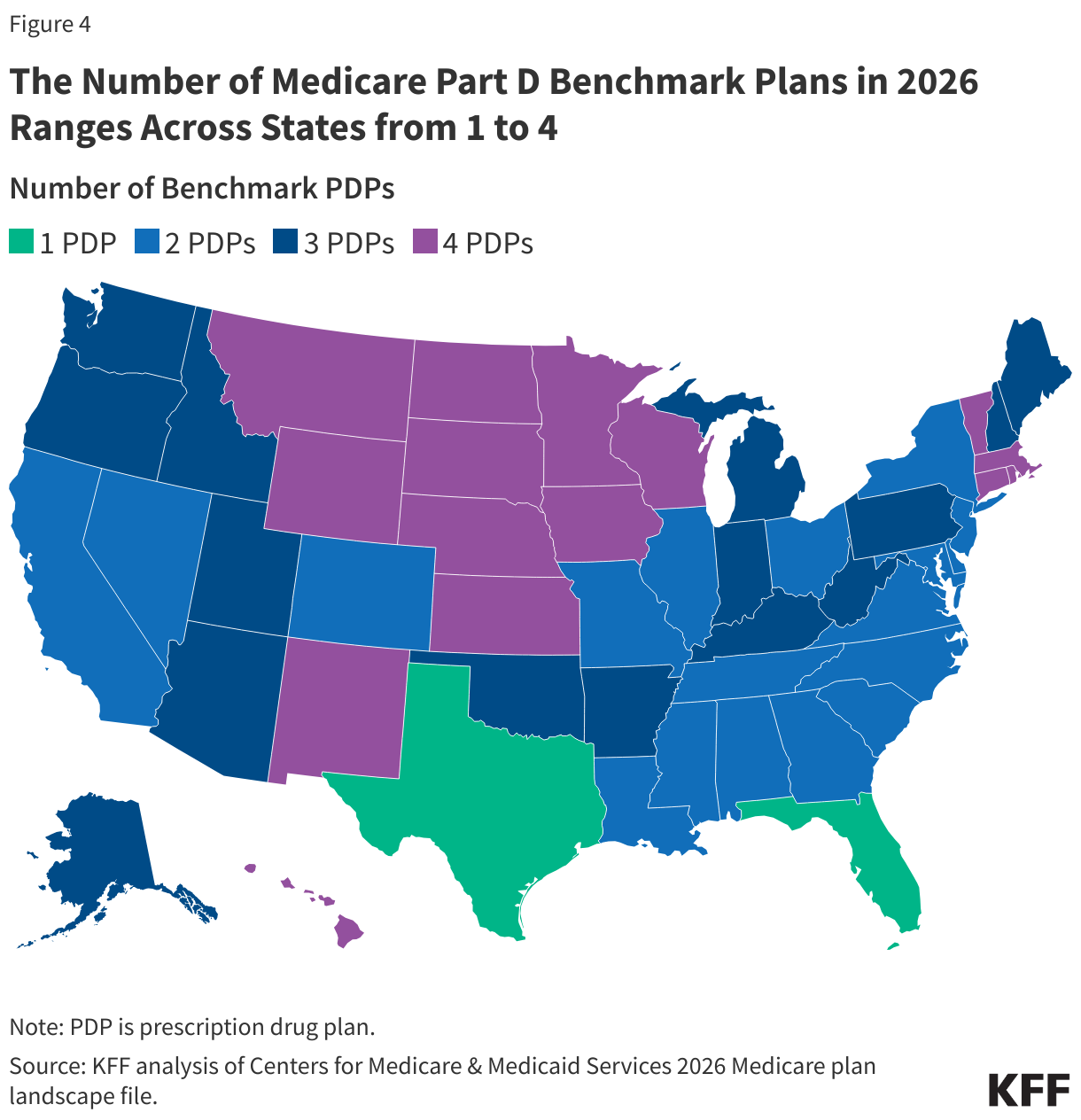
  • Roughly the same number of PDPs will be available for enrollment of Part D Low-Income Subsidy (LIS) beneficiaries for no premium (“benchmark” plans) in 2026, varying from 1 to 4 PDPs across states. A total of 88 PDPs will be benchmark plans in 2026, 2 fewer than in 2025.
  • Several changes to the Medicare Part D benefit under the Inflation Reduction Act have taken effect, including a cap on out-of-pocket drug spending, which will be set at $2,100 in 2026; an increase in the share of drug costs above the cap paid for by Part D plans and drug manufacturers; and a reduction in Medicare’s share of these costs.
  • In 2025, 54.8 million of the 68.8 million Medicare beneficiaries in total are enrolled in Medicare Part D plans, including employer-only group plans; among Part D enrollees, 58% are enrolled in MA-PDs and 42% are enrolled in stand-alone PDPs. As of May 2025, 13.9 million Part D enrollees receive premium and cost-sharing assistance through the LIS program.
  • Medicare’s actuaries estimate that spending on Part D benefits (net of premiums paid by enrollees) will total $140 billion in 2026, representing 11% of total spending on all Medicare-covered benefits. Funding for Part D comes from federal government contributions (75%), beneficiary premiums (13%), and state contributions (12%).
  • Medicare’s payments to Part D plans to subsidize the cost of basic Part D benefits per enrollee are projected to account for roughly three-fourths of Medicare’s total reimbursement per enrollee in 2026, while reinsurance payments (to subsidize a portion of drug spending for enrollees with high drug costs) will equal one-fourth. This is a reversal from 2024, when reinsurance accounted for three-fourths of total reimbursement per enrollee. This change reflects the increased generosity of the standard Part D benefit with the addition of an out-of-pocket spending cap in 2025, along with the reduction in Medicare’s liability for catastrophic drug costs from 80% in 2024 to 20% for brands and 40% for generics in 2025. Part D plans and drug manufacturers now bear greater responsibility for catastrophic coverage costs.

Medicare Prescription Drug Plan Availability in 2026

In 2026, a total of 360 PDPs will be offered by 17 different parent organizations across the 34 PDP regions nationwide (excluding the territories), a 22% decrease in PDPs from 2025 (and nearly half as many as in 2024) and 2 fewer parent organizations (Figure 1). While the availability of stand-alone PDPs has been trending downward over time, the availability of Medicare Advantage drug plans has expanded in recent years, and more people in Medicare are now getting Part D drug coverage through Medicare Advantage plans.

A Total of 360 Medicare Part D Stand-Alone Prescription Drug Plans Will Be Offered Across All 34 PDP Regions in 2026, a 22% Decrease From 2025 (Column Chart)

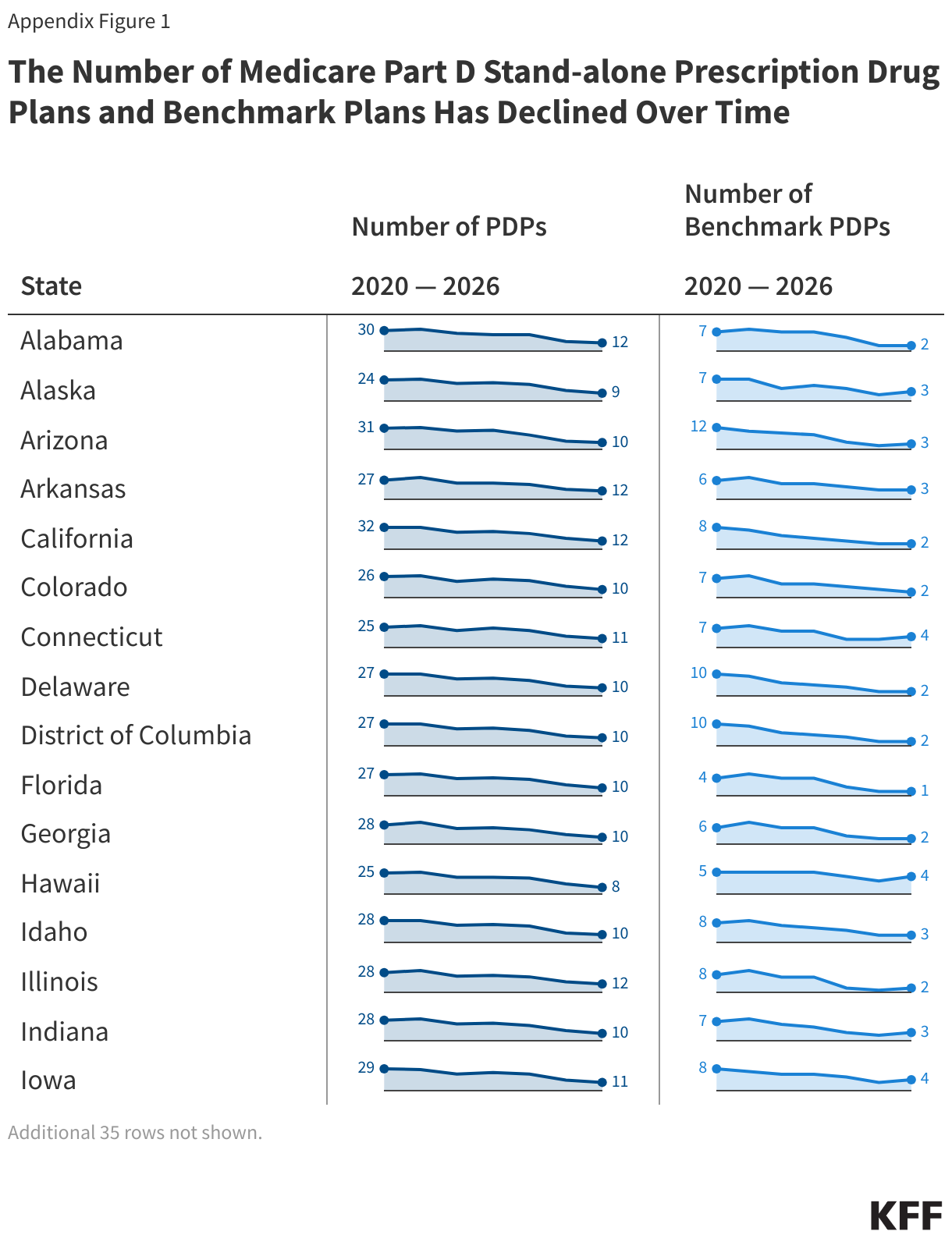
Despite a reduction in the number of PDPs overall, beneficiaries in each state will have a choice of between 8 and 12 stand-alone PDPs offered by between 4 and 6 parent organizations in each state (Figure 2, Appendix Figure 1). In addition, beneficiaries will be able to choose from among many MA-PDs available at the county level.

The Number of Medicare Part D Stand-Alone Prescription Drug Plans in 2026 Ranges Across States from 8 to 12 (Choropleth map)

Low-Income Subsidy Plan Availability in 2026

Beneficiaries with low incomes and modest assets are eligible for assistance (“extra help”) with Part D plan premiums and cost sharing. Through the Part D Low-Income Subsidy (LIS) program, additional premium and cost-sharing assistance is available for Part D enrollees with low incomes (less than 150% of poverty, or $23,475 for individuals/$31,725 for married couples in 2025) and modest assets (up to $17,600 for individuals/$35,1300 for couples in 2025). People who qualify for the LIS program pay modest copayments for prescription drugs, no drug deductible, and no premium for drug coverage in premium-free “benchmark” plans.

In 2026, roughly the same number of plans will be available for enrollment of LIS beneficiaries for no premium (benchmark plans) compared to 2025 – 88 plans (2 fewer than in 2025), but the lowest number of benchmark plans available since Part D started (Figure 3). Overall, one quarter (24%) of PDPs in 2026 are benchmark plans.

In 2026, 88 Medicare Part D Stand-Alone Drug Plans Will Be Available Without a Premium to Enrollees Receiving the Low-Income Subsidy (“Benchmark” Plans) Across the 34 PDP Regions, Only 2 Fewer Than in 2025 (Column Chart)

At the PDP region level, the number of PDP choices overall remains more robust than the number of premium-free benchmark PDPs. In 2026, the number of premium-free PDPs ranges across states from 1 plan in 2 states (Florida and Texas) to 4 plans in 15 states (Figure 4, Appendix Figure 1). LIS enrollees can select any plan offered in their area, but if they are enrolled in a non-benchmark plan, they may be required to pay some portion of their plan’s monthly premium.

The Number of Medicare Part D Benchmark Plans in 2026 Ranges Across States from 1 to 4 (Choropleth map)

Changes to Part D Under the Inflation Reduction Act

The Inflation Reduction Act of 2022 contained several provisions to lower prescription drug spending by Medicare and beneficiaries, including major changes to the Medicare Part D program, which started to take effect in 2023. These changes were designed to address several concerns, including the lack of a hard cap on out-of-pocket spending for Part D enrollees; the inability of the federal government to negotiate drug prices with manufacturers; a significant increase in Medicare “reinsurance” spending for Part D enrollees with high drug costs; prices for many Part D covered drugs rising faster than the rate of inflation; and the relatively weak financial incentives faced by Part D plan sponsors to control high drug costs. Provisions in the law include:

  • Limiting the price of insulin products to no more than $35 per month in all Part D plans and makes adult vaccines covered under Part D available for free, as of 2023.
  • Requiring drug manufacturers to pay a rebate to the federal government if prices for drugs covered under Part D and Part B increase faster than the rate of inflation, with the initial period for measuring Part D drug price increases running from October 2022-September 2023.
  • Expanding eligibility for full benefits under the Part D Low-Income Subsidy program in 2024.
  • Adding a hard cap on out-of-pocket drug spending under Part D by eliminating the 5% coinsurance requirement for catastrophic coverage in 2024 and capping out-of-pocket spending at $2,000 in 2025 (increasing to $2,100 in 2026).
  • Shifting more of the responsibility for catastrophic coverage costs to Part D plans and drug manufacturers, starting in 2025.
  • Authorizing the Secretary of the Department of Health and Human Services to negotiate the price of some drugs covered under Medicare, with negotiated prices first available for 10 Part D drugs in 2026.

Part D Plan Premiums and Benefits in 2026

Premiums

The 2026 Part D base beneficiary premium – which is based on bids submitted by both PDPs and MA-PDs and is not weighted by enrollment – is $38.99, a 6% increase from 2025. Annual growth in the base beneficiary premium is capped at 6% due to a provision in the Inflation Reduction Act. Because the base premium is an average across both types of plans and reflects the cost of basic benefits only, this amount does not equal what a Part D enrollee will pay for coverage in any given Part D plan.

Because the monthly amount that Part D enrollees pay for individual Part D plans is different from the base beneficiary premium, enrollees may see their premium increase by more or less than 6%, or even decrease, if they stay in the same plan for 2026. A Part D premium stabilization demonstration for PDPs is also helping to moderate premium increases that Part D enrollees might otherwise have faced in 2026, as insurers continue to adjust to higher costs associated with the new out-of-pocket spending cap and increased liability for drug costs above the cap. The Part D premium demonstration was established in 2024 by the Biden administration ahead of the major redesign of the Part D benefit that took effect in 2025. For the first year of the demonstration, the federal government provided participating PDPs with an across-the-board monthly premium subsidy of up to $15 and limited the monthly premium increase for 2025 to $35, along with a narrowing of the risk corridors to mitigate the risk of losses for participating PDPs. For 2026, the Trump administration reduced the monthly premium subsidy from $15 to $10, raised the limit on the PDP monthly premium increase to $50, and eliminated the risk corridor component of the demonstration.

Actual monthly premiums paid by Part D enrollees in stand-alone PDPs in 2026 will vary considerably, ranging from $0 to $100 or more in most regions. In addition to the monthly premium, Part D enrollees with higher incomes ($106,000/individual; $212,000/couple) pay an income-related premium surcharge, ranging from $13.70 to $85.80 per month in 2025 (depending on income).

Most MA-PD enrollees pay no premium beyond the monthly Part B premium (although high-income MA enrollees are required to pay a premium surcharge). MA-PD sponsors can use rebate dollars from Medicare payments to lower or eliminate their Part D premiums, so the average premium for drug coverage in MA-PDs is heavily weighted by zero-premium plans. In 2025, the enrollment-weighted average monthly portion of the premium for drug coverage in MA-PDs is substantially lower than the average monthly PDP premium ($7 versus $39).

Benefits

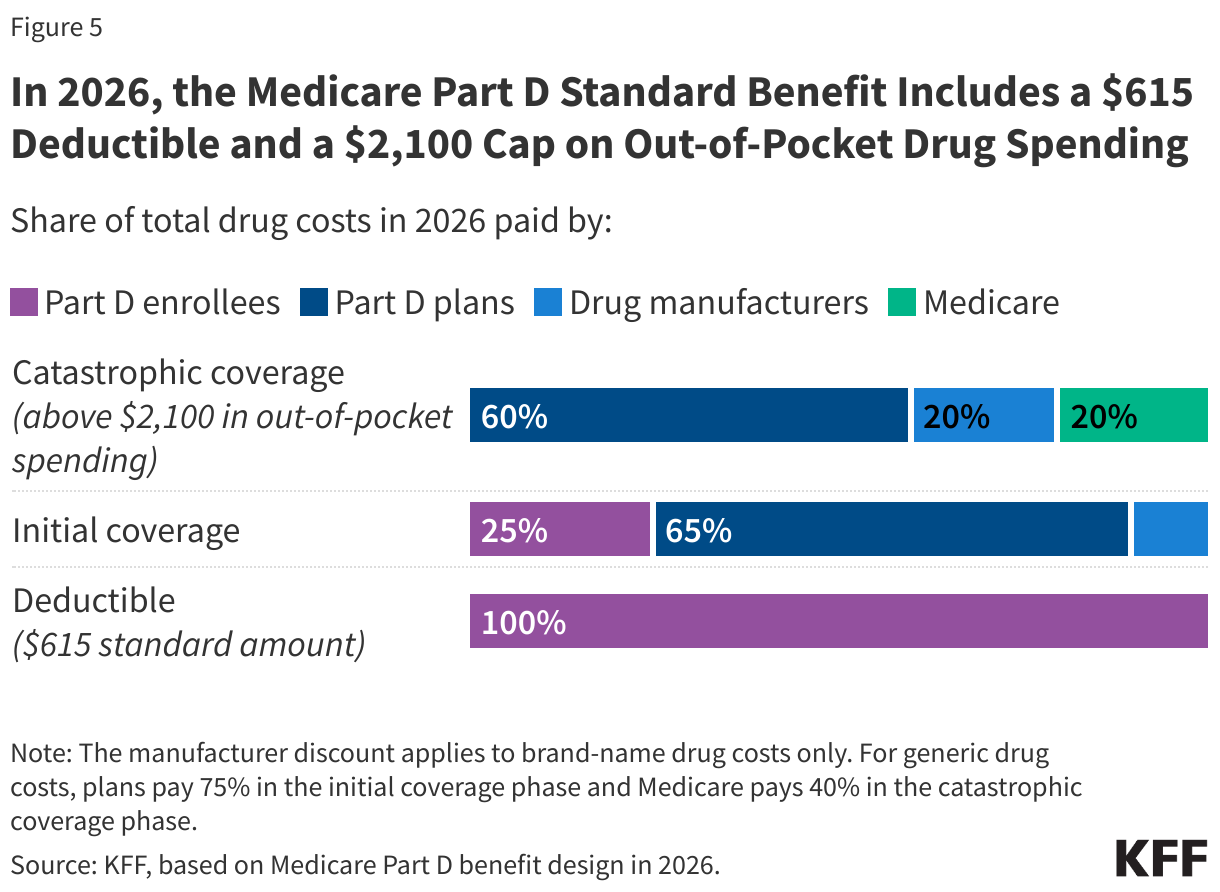
The Part D defined standard benefit changed substantially in 2025 and now includes a cap on out-of-pocket drug spending. The benefit has three phases, including a deductible, an initial coverage phase, and catastrophic coverage. For 2026, under the standard benefit, Part D enrollees will pay a deductible of $615 (up from $590 in 2024), and will then pay 25% of their drug costs in the initial coverage phase until their out-of-pocket spending totals $2,100 (Figure 5). At that point, they qualify for catastrophic coverage and pay no additional out-of-pocket costs.

In 2026, the Medicare Part D Standard Benefit Includes a 5 Deductible and a ,100 Cap on Out-of-Pocket Drug Spending (Stacked Bars)

Part D plans must offer either the defined standard benefit or an alternative equal in value (“actuarially equivalent”) and can also provide enhanced benefits. Both basic and enhanced benefit plans vary in terms of their specific benefit design, coverage, and costs, including deductibles, cost-sharing amounts, utilization management tools (i.e., prior authorization, quantity limits, and step therapy), and which drugs are covered on their formularies. Plan formularies must include drug classes covering all disease states, and a minimum of two chemically distinct drugs in each class. Part D plans are required to cover all drugs in six “protected” classes: immunosuppressants, antidepressants, antipsychotics, anticonvulsants, antiretrovirals, and antineoplastics.

Part D plans are also required to cover all drugs that have been selected for Medicare drug price negotiation, including all dosage forms and strengths. CMS will use the annual formulary review process to ensure that all Part D plans cover all dosages and formulations of selected drugs. Negotiated prices for the first 10 drugs that were selected for negotiation will take effect for Medicare beneficiaries on January 1, 2026.

Part D and Low-Income Subsidy Enrollment in PDPs and MA-PDs

Enrollment in Medicare Part D plans is voluntary, except for beneficiaries who are eligible for both Medicare and Medicaid and certain other low-income beneficiaries who are automatically enrolled in a PDP if they do not choose a plan on their own. Beneficiaries face a penalty equal to 1% of the national average premium for each month they delay enrollment unless they have drug coverage from another source that is at least as good as standard Part D coverage (“creditable coverage”).

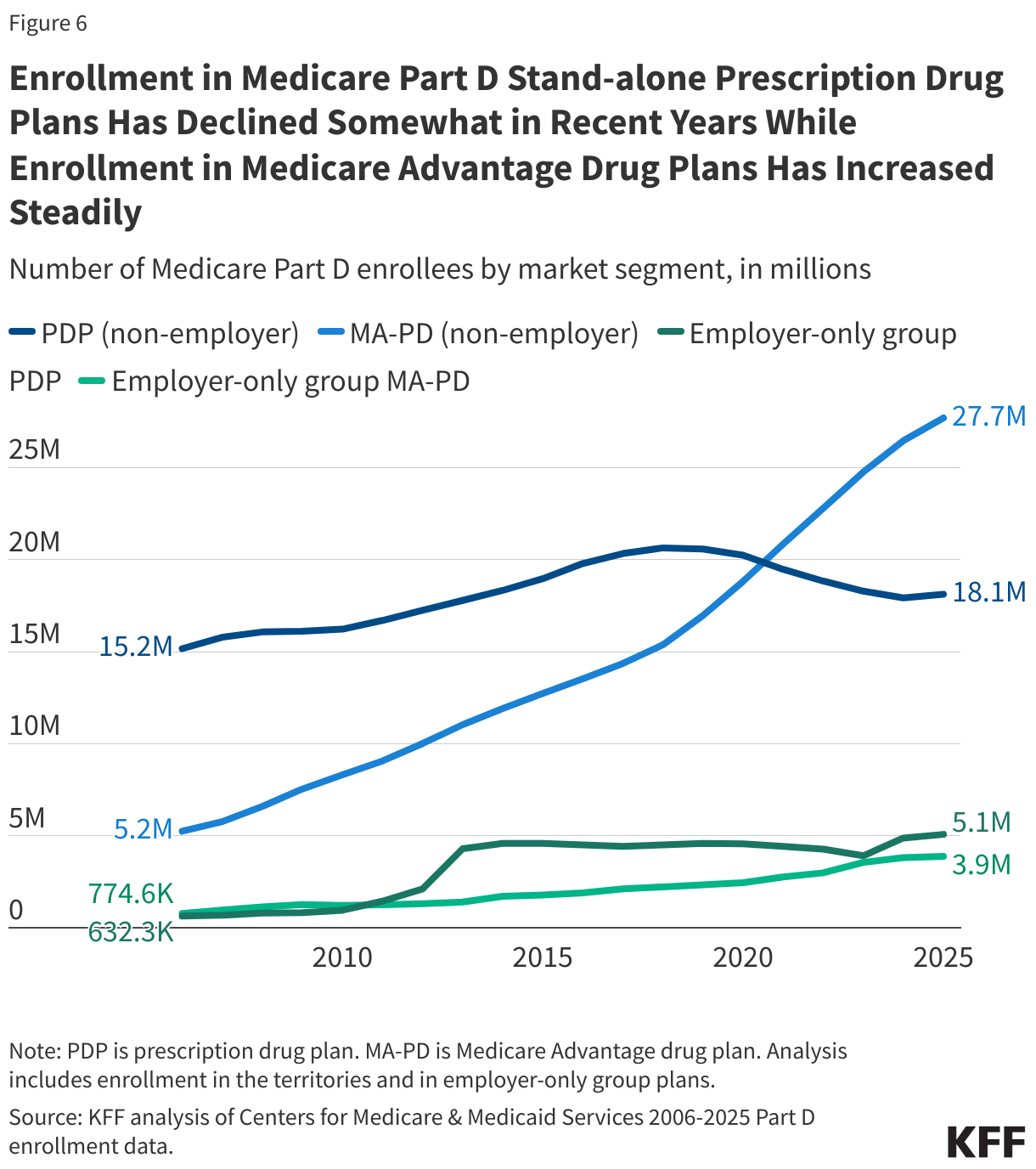
In 2025, 54.8 million Medicare beneficiaries are enrolled in Medicare Part D plans, including employer-only group plans; of the total, 58% are enrolled in MA-PDs and 42% are enrolled in stand-alone PDPs (Figure 6). Another 0.7 million beneficiaries are estimated to have drug coverage through employer-sponsored retiree plans where the employer receives a subsidy from the federal government equal to 28% of drug expenses between $615 and $12,650 per retiree in 2026. Several million beneficiaries are estimated to have other sources of drug coverage, including employer plans for active workers, FEHBP, TRICARE, and Veterans Affairs (VA). Around 11% of people with Medicare are estimated to lack creditable drug coverage.

Enrollment in Medicare Part D Stand-alone Prescription Drug Plans Has Declined Somewhat in Recent Years While Enrollment in Medicare Advantage Drug Plans Has Increased Steadily (Line chart)

Recent years have seen a growing divide in the Part D plan market between stand-alone PDPs, where the number of plans has generally been trending downward over time in conjunction with a reduction in PDP enrollment, and MA-PDs, where plan availability and enrollment have grown steadily in recent years. The widespread availability of low or zero-premium MA-PDs, while PDPs charge substantially higher premiums on average, could tilt enrollment even more towards Medicare Advantage plans in the future.

As of May 2025, 13.9 million Part D enrollees receive premium and cost-sharing assistance through the LIS program. As with overall Part D enrollment, more LIS enrollees are in MA-PDs than PDPs. Beneficiaries who are dual-eligible individuals, those enrolled in Medicare Savings Programs (QMBs, SLMBs, QIs), and those who receive Supplemental Security Income payments from Social Security automatically qualify for the additional assistance, and they are automatically enrolled in PDPs with premiums at or below the regional Low-Income Subsidy benchmark premium amount if they do not choose a plan on their own. Other beneficiaries can apply for the Low-Income Subsidy through either the Social Security Administration or Medicaid and are subject to both an income and asset test. 

Part D Spending and Financing

Part D Spending

Medicare’s actuaries estimate that spending on Part D benefits (net of premiums paid by enrollees) will total $141 billion in 2026, representing 11% of total Medicare benefits spending.

In general, Part D spending depends on several factors, including the total number of Part D enrollees, their health status and the quantity and type of drugs used, the number of high-cost enrollees (those with drug spending above the catastrophic threshold), the number of enrollees receiving the Low-Income Subsidy, the price of drugs covered by Part D and the ability of plan sponsors to negotiate discounts (rebates) with drug companies and preferred pricing arrangements with pharmacies, and to manage use (e.g., promoting use of generic drugs, prior authorization, step therapy, quantity limits, and mail order). Part D spending is also affected by the level of price discounts that the federal government negotiates under the Medicare Drug Price Negotiation Program, as well as the effect of the inflation rebate provision of the IRA on price growth for existing drugs and launch prices for new drugs.

Part D Financing

Financing for Part D comes from federal government contributions (75%), beneficiary premiums (13%), and state contributions (12%). Medicare subsidizes 74.5% of basic Part D benefit costs through a monthly capitated payment to Part D plans for each enrollee, based on an average of bids submitted by plans for their expected basic benefit costs, though this share may be higher with the Inflation Reduction Act’s 6% base beneficiary premium cap and the temporary Part D premium stabilization program in effect. Enrollee premiums for basic benefits were initially set to cover 25.5% of the cost of standard (basic) drug coverage, but with premium stabilization measures in effect, enrollees are paying a lower share of costs overall. Higher-income Part D enrollees pay a larger share of standard Part D costs, ranging from 35% to 85%, depending on income.

Payments to Plans

For 2026, Medicare’s actuaries estimate that Part D plans will receive direct subsidy payments from the federal government for the cost of basic Part D benefits (plus administrative expenses and profits) that average $1,710 per enrollee overall, $522 in reinsurance payments for very high-cost enrollees, and $1,337 in subsidy payments for enrollees receiving the LIS. Employers are expected to receive, on average, $561 in federal subsidies for retirees in employer-subsidy Part D plans. Part D plans also receive additional risk-adjusted payments based on the health status of their enrollees, and plans’ potential total losses or gains are limited by risk-sharing arrangements with the federal government (“risk corridors”).

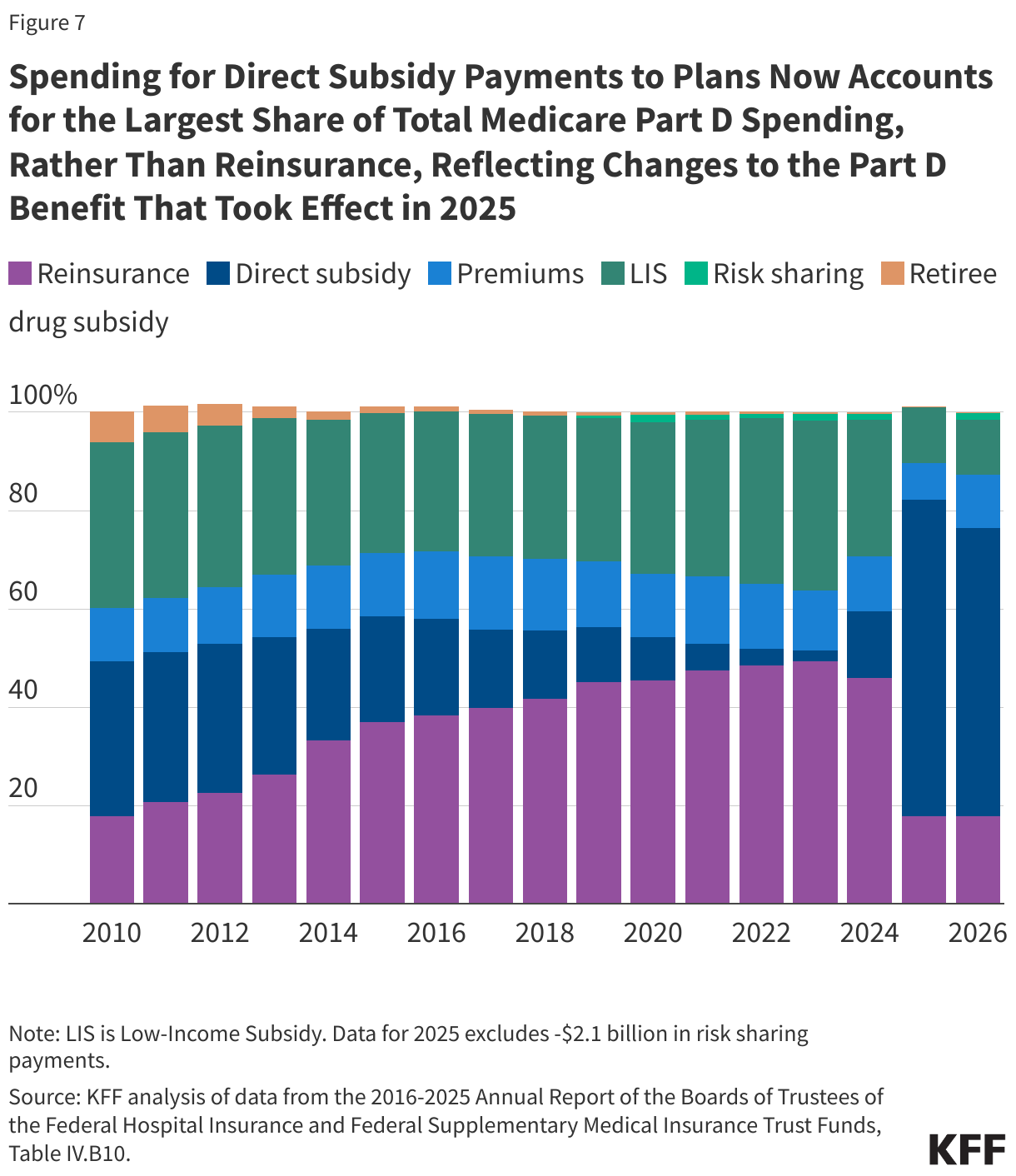
As of 2025, Medicare’s reinsurance payments to plans for total spending incurred by Part D enrollees above the catastrophic coverage threshold subsidize 20% of brand-name drug spending and 40% of generic drug spending, down from 80% in previous years, due to a provision in the Inflation Reduction Act. With this change in effect, Medicare's aggregate reinsurance payments to Part D plans are projected to account for 18% of total Part D spending in 2026, based on KFF analysis of data from the 2025 Medicare Trustees report. This is a substantial reduction from 2024, when reinsurance spending had grown to account for close to half of total Part D spending (46%) (Figure 7). Currently, the largest portion of total Part D spending is accounted for by direct subsidy payments to plans (59% of total spending in 2026).

Spending for Direct Subsidy Payments to Plans Now Accounts for the Largest Share of Total Medicare Part D Spending, Rather Than Reinsurance, Reflecting Changes to the Part D Benefit That Took Effect in 2025 (Stacked column chart)

Appendix

The Number of Medicare Part D Stand-alone Prescription Drug Plans and Benchmark Plans Has Declined Over Time (Table)

Medicare Part D Premiums Are Decreasing for Many Stand-Alone Drug Plans in a Number of States in 2026

Few Plans Are Increasing Premiums by $50, the Maximum Allowed Under the PDP Premium Stabilization Demonstration

Published: Oct 7, 2025

CMS has just released information about Medicare Part D plans for 2026, including plan availability and premiums for the coming year. As this year’s Medicare open enrollment period approaches, there’s some good news for Medicare Part D enrollees when it comes to monthly PDP premiums – lower on average, according to CMS – even as the total number of PDPs available drops yet again.

The headline of CMS’s press release emphasized stability in the Part D marketplace, but a quick review of the data shows that the total number of stand-alone drug plans available in 2026 will fall for the third year in a row, as plan sponsors scale back their PDP offerings (for example, Centene is discontinuing one of the 3 Wellcare PDP options; Health Care Service Corporation is discontinuing one of the 3 Cigna PDP options and withdrawing from several PDP regions) or exit the market entirely (as in the case of Elevance’s Anthem PDPs). Overall, there will be fewer PDPs in 2026 than in 2025 – 360 plans nationwide, down from 464 in 2025.

Firm decisions to exit the PDP market or scale back their PDP offerings in recent years have been based on evaluations about the profitability and viability of the stand-alone drug plan market, particularly for insurers with a smaller footprint, accounting for higher costs associated with a redesigned Part D benefit under the Inflation Reduction Act. The law added an out-of-pocket spending cap for Part D enrollees beginning in 2025 and shifted more of the share of high-drug cost enrollees from the federal government to the plans themselves, which increased plan liability overall. In addition, many insurers that offer both PDP and MA-PD plans have stated their interest in focusing resources on more lucrative Medicare Advantage markets.

Somewhat more unexpected than the reduction in plan availability for 2026 are the year-over-year premium changes for PDPs. A comprehensive KFF analysis will follow in the future, but it appears that substantial premium increases for PDPs across the board didn’t materialize, even as the Trump administration scaled back the level of support for additional PDP premium subsidies through the temporary Part D premium stabilization demonstration established by the Biden administration in 2024. For 2026, the federal government is providing participating PDPs with an across-the-board monthly premium subsidy of up to $10 (down from $15 in 2025) and limiting the monthly premium increase for 2026 to $50 (up from $35 in 2025) – revised parameters which, when they were announced, seemed to point in the direction of higher premiums for PDP coverage in 2026.

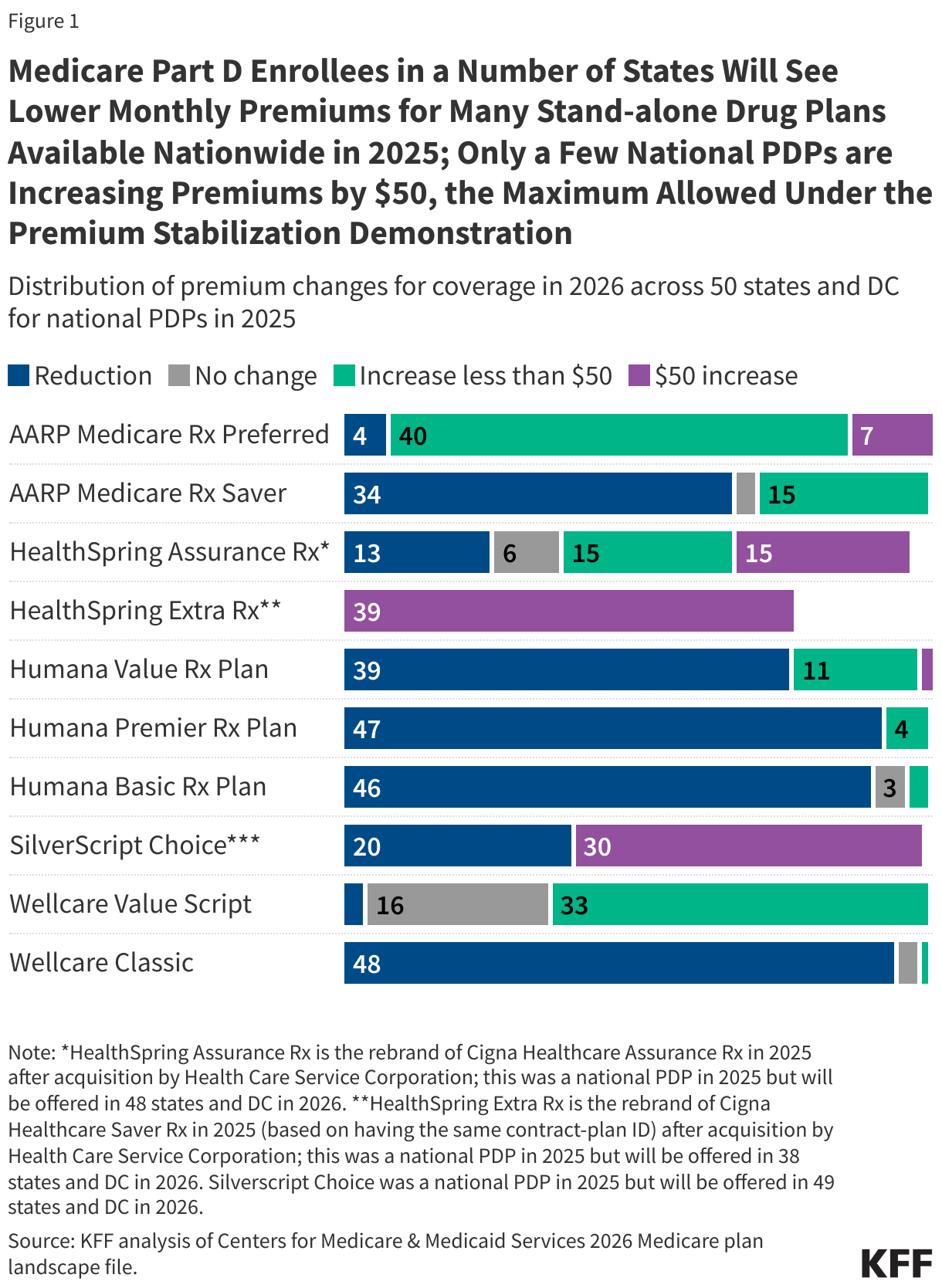
In fact, for all but one of the 10 PDPs that were offered nationwide in 2025 and that will continue to be offered on a national or near-national basis in 2026, Medicare Part D enrollees in a number of states will see lower monthly premiums in 2026 than in 2025. This is consistent with CMS’s projection that the average monthly PDP premium will decrease by a few dollars in 2026. Only a few national PDPs are increasing monthly premiums by $50, the maximum allowed under the premium stabilization demonstration, and PDP enrollees may have up to 6 PDPs available for $0 premium, depending on where they live.

Medicare Part D Enrollees in a Number of States Will See Lower Monthly Premiums for Many Stand-alone Drug Plans Available Nationwide in 2025; Only a Few National PDPs are Increasing Premiums by , the Maximum Allowed Under the Premium Stabilization Demonstration (Stacked Bars)

Looking at premium changes for a few of the more popular plans shows a mixed picture, however, with wide variation in monthly premiums across plans and the 50 states and DC (Figure 1):

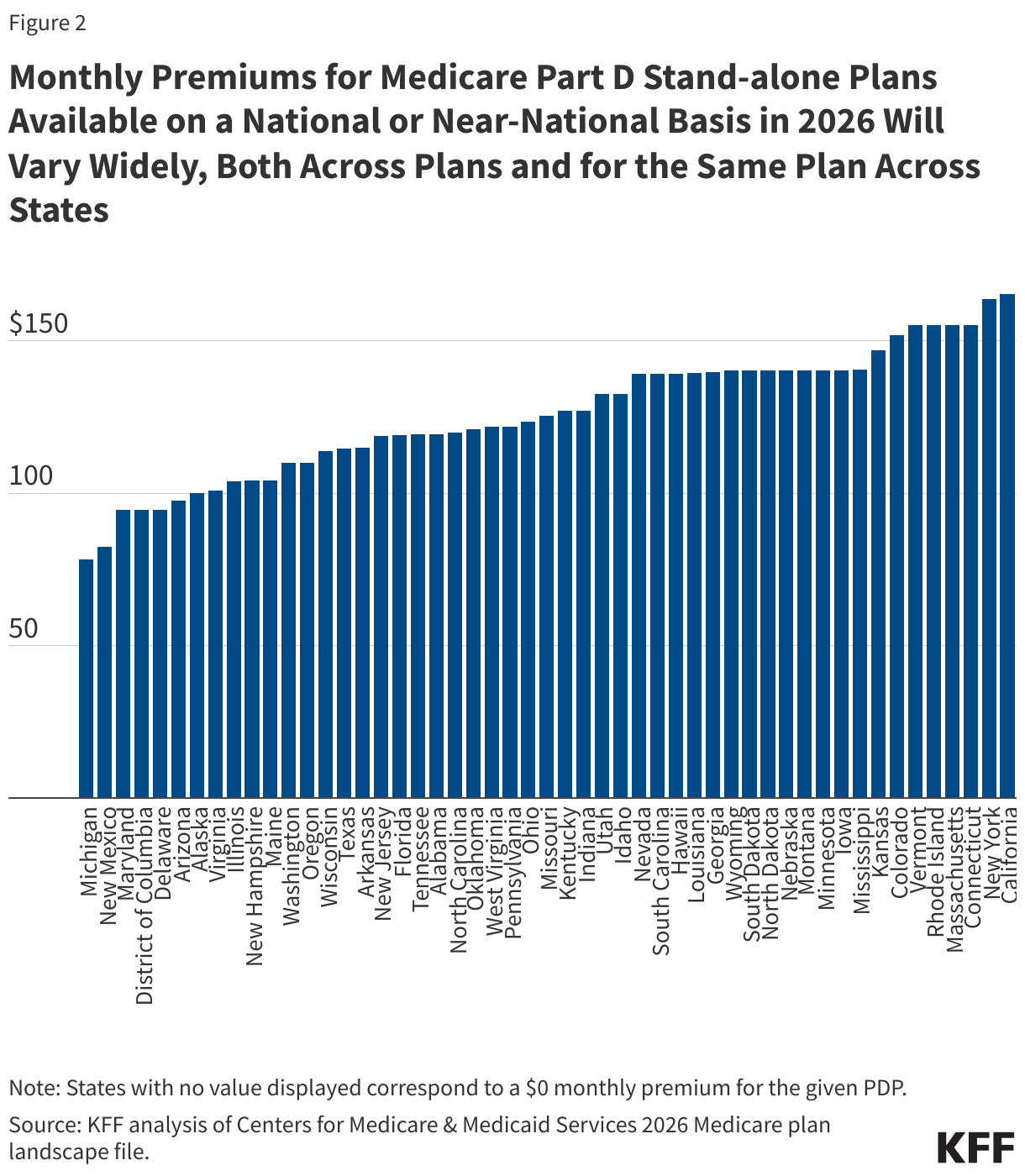
  • The monthly premium for the most popular PDP nationally, Wellcare Value Script, is increasing in more states (33, including DC) than where it is holding steady (16) or decreasing (2), and will range from $0 to $42.40 across states and DC in 2026 (Figure 2).
  • Enrollees in the second most popular PDP, Wellcare Classic, will see a premium reduction in 48 states (including DC), no change in 2, and an increase of less than $50 in 1. Monthly premiums will range from $0 to $45.70 across states and DC in 2026.
  • Enrollees in the third most popular PDP, SilverScript Choice, will face the maximum $50 increase in their monthly premium in 30 states (including DC), but a premium reduction in 20 other states. The monthly premium will vary across states and DC from $14.70 to $116.
Monthly Premiums for Medicare Part D Stand-alone Plans Available on a National or Near-National Basis in 2026 Will Vary Widely, Both Across Plans and for the Same Plan Across States (Column Chart)

According to CMS, virtually all PDP enrollees are in plans sponsored by insurers that opted to participate in the voluntary demonstration for 2026. In the absence of this demonstration and CMS’s actions during the bidding cycle for 2026 to negotiate and even reject plan bids, PDP premium increases would likely have been larger. And with 58% of all Part D enrollees in Medicare Advantage drug plans in 2025 and 42% in stand-alone PDPs, most Part D enrollees are not likely to face premium increases of any magnitude. This is because Medicare Advantage plans can use rebate dollars from the federal government to reduce premiums for prescription drug coverage. According to CMS, Medicare Advantage drug plan premiums for 2026 are holding steady at considerably lower levels than stand-alone drug plans, on average, with many plans charging zero premium for drug coverage in 2026, as in previous years.

Even if the monthly premium for a given Part D plan isn’t increasing, or is even decreasing, premiums are only one part of the story when it comes to Part D coverage. As is commonly advised during open enrollment, Medicare beneficiaries may want to look beneath the hood to see what other Part D plan features may be changing, including what drugs are and aren’t covered on the plan’s formulary, tier placement of covered drugs, deductibles, and cost-sharing requirements. The tradeoff with a reduction in premiums is that drug coverage may be getting less generous, which could mean fewer drugs covered, higher cost-sharing requirements, or greater utilization management restrictions – or likely some combination of all three.

How Does the Quality of the U.S. Health System Compare to Other Countries?

Published: Oct 6, 2025

This chart collection compares the United States and other similarly large and wealthy nations across various measures of care quality to show how the U.S. stacks up against its peers and how that has changed over time.

Generally, the U.S. performs worse in long-term health outcomes measures (such as life expectancy), certain treatment outcomes (such as maternal mortality and congestive heart failure hospital admissions), some patient safety measures (such as obstetric trauma with instrument), and health system capacity (such as rate of general practitioners). The U.S. performs similarly to or better than peer nations in other measures of treatment outcomes (such as mortality rates within 30 days of acute hospital treatment) and some patient safety measures (such as post-operative complications).

The chart collection is part of the Peterson-KFF Health System Tracker, an online information hub dedicated to monitoring and assessing the performance of the U.S. health system.

A Look at Variation in Medicaid Spending Per Enrollee by Group and Across States

Published: Oct 6, 2025

Editorial Note

Originally published in August 2024, this data note was updated on October 6, 2025 with data from 2023, the most current Medicaid data available at the time of this analysis.

Medicaid is the primary program providing comprehensive health and long-term care coverage to approximately one in five low-income Americans. States administer Medicaid programs within broad federal rules, but have flexibility in designing programs, which creates variation in spending and enrollment as well as spending per enrollee across eligibility groups and states.

Over the coming years, state Medicaid programs may see significant reductions to their Medicaid enrollment and spending, resulting in changes to their spending per enrollee, across eligibility groups due to the recently enacted budget reconciliation package once called the “One Big, Beautiful Bill,” signed by President Trump on July 4th. The new law is estimated by the Congressional Budget Office (CBO) to cut federal Medicaid spending by $911 billion – or 14% of federal Medicaid spending – over the next ten years and increase the uninsured rate by 10 million, with some of the increase attributed to individuals losing Medicaid coverage. Provisions in the new law will have different effects on Medicaid spending and enrollment across the states. For example, over half of the reductions in federal spending (associated with most of the projected enrollment declines) stem from policies that only would affect states that have expanded Medicaid under the Affordable Care Act (ACA). How states respond to reductions in federal funding will impact the amount of spending reductions and the distribution of enrollment losses, which will affect Medicaid’s spending per enrollee. 

This data note provides an overview of total Medicaid (state and federal shares) spending per enrollee for full-benefit Medicaid enrollees by eligibility group and state in 2023. Data from 2023 are the most current Medicaid data available at the time of this analysis. Full-benefit Medicaid enrollees are those that qualify for a full range of Medicaid services such as doctor’s visits, hospitalizations, prescription drugs, and home health services. A small number of total enrollees (8% of all enrollees in 2023) qualify for only a limited set of Medicaid benefits such as family planning or treatment of an emergency medical condition and are not included in this analysis. References to Medicaid enrollees in this data note refer to full-benefit enrollees. See methods for more details. Detailed state-level data are also available on State Health Facts.

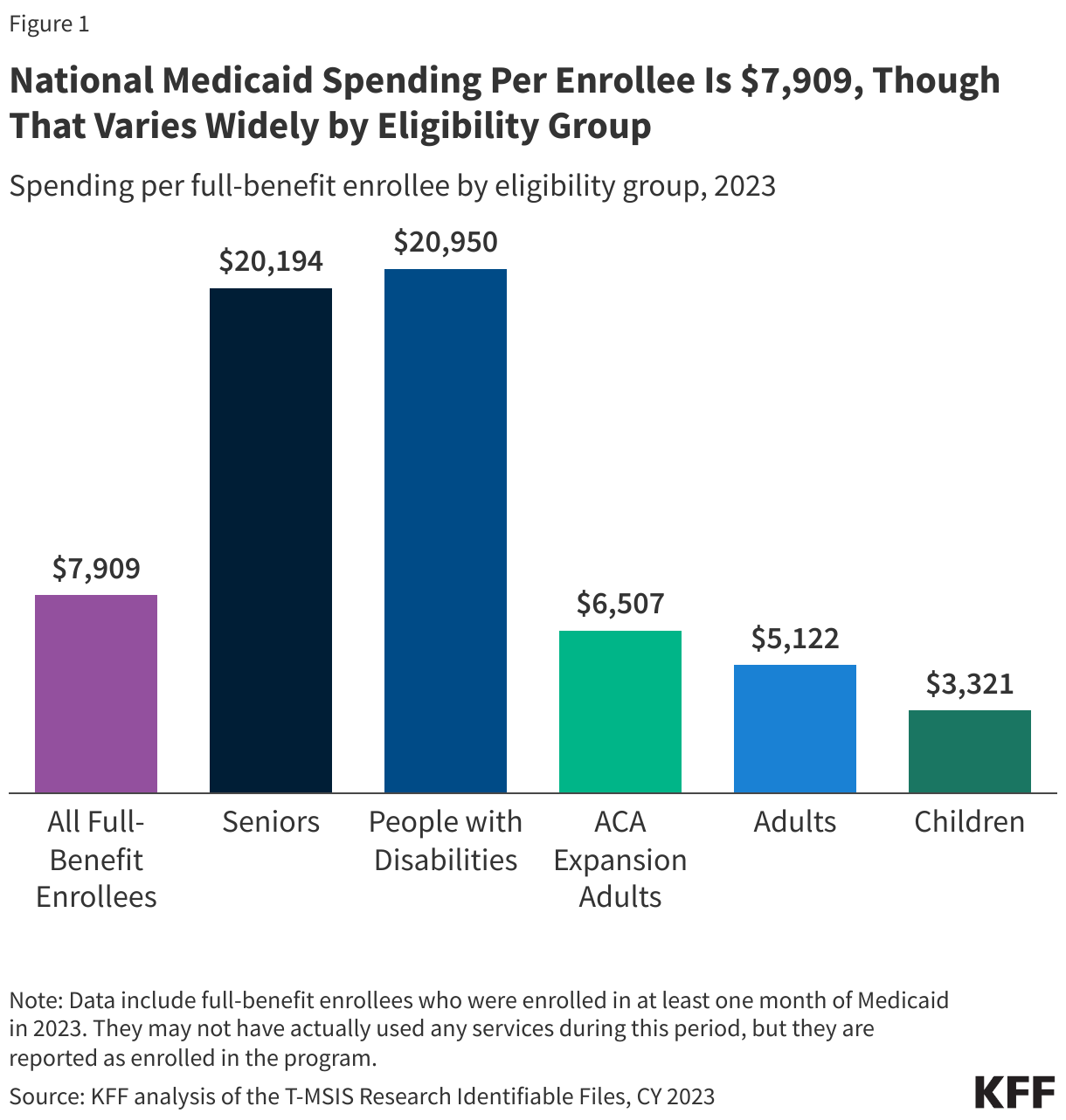
National Medicaid spending per enrollee is $7,909, though that varies widely by eligibility group (Figure 1). 

Overall, children account for 35% of full-benefit enrollment, but 15% of the spending, while adults ages 65 and older and people eligible because of a disability account for 19% of enrollment but 51% of the spending (data not shown). The disproportionate spending on certain eligibility groups stems from variation in spending per enrollee across the eligibility groups. Spending per enrollee is highest for people with disabilities ($20,950), and older adults ($20,194) (Figure 1). Those groups have per-enrollee spending approximately six times higher than child enrollees ($3,321), which have the lowest spending of any eligibility group (Figure 1). Differences in spending per enrollee reflect differences in health care needs and utilization. For example, older adults and people eligible on the basis of disability tend to have higher rates of chronic conditionsmore complex health care needs and are more likely to utilize long-term care (LTC) than other enrollees. Most older adults and people with disabilities enrolled in Medicaid are also dually eligible for Medicare. For dual-eligible individuals, Medicare is the primary payer for acute care services while Medicaid pays for services that Medicare does not, including vision, dental, and most LTC. Medicaid spending per enrollee accounts for less than half of all spending for full-benefit dual-eligible individuals that are 65 and older.

National Medicaid Spending Per Enrollee Is ,909, Though That Varies Widely by Eligibility Group (Column Chart)

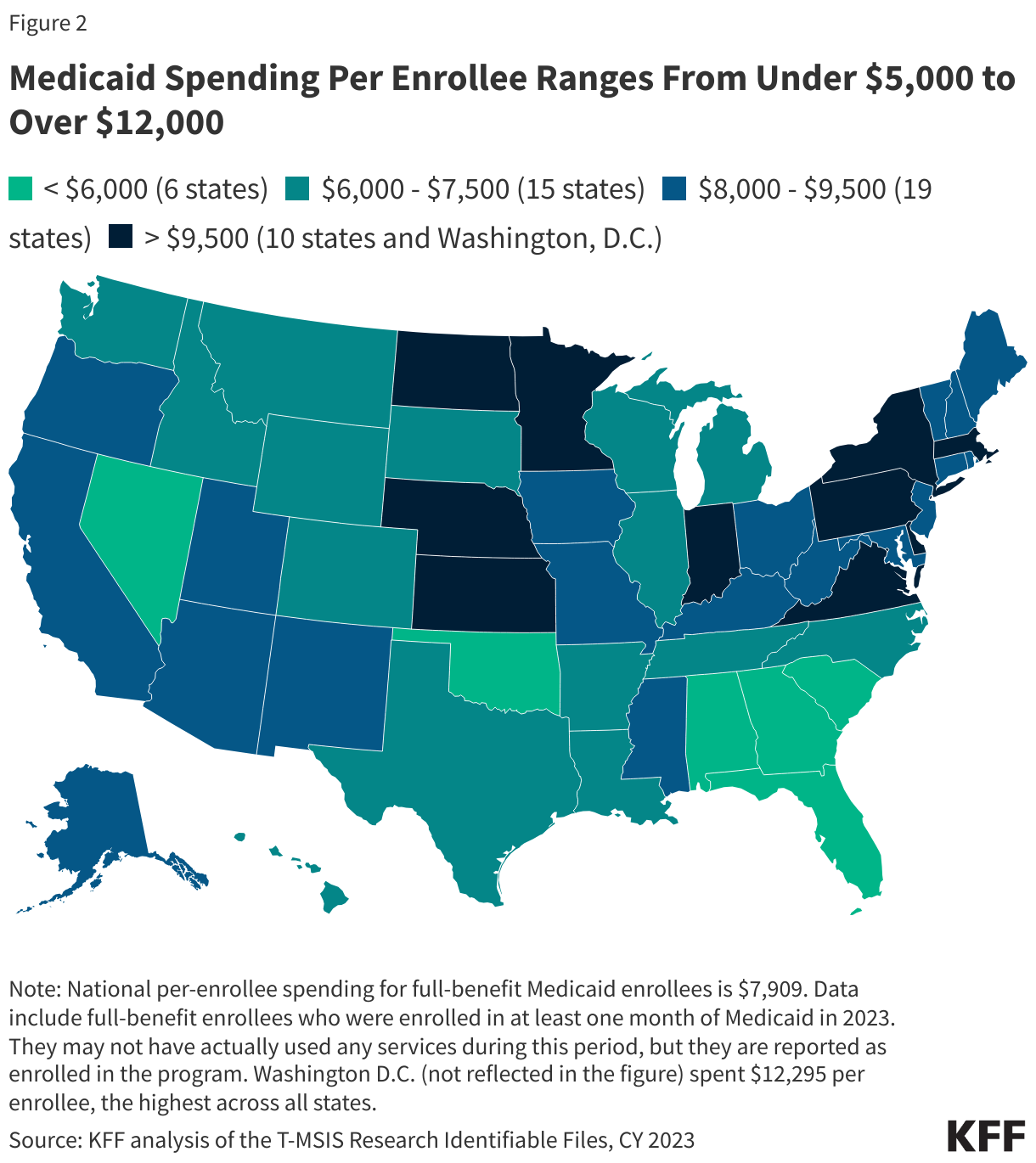
Flexibility for states to determine eligibility levels, benefits, and provider payments in the Medicaid program leads to wide variation in per-enrollee spending across states (Figure 2).

Other factors contributing to variation in per-enrollee spending include variation in state populations and demographics, ability and effort to raise revenue, and variation in health care costs and markets. Across states, Medicaid spending per enrollee ranges from $4,780 to $12,295, with a median spending of $7,909 (Figure 2). Alabama, Florida, Georgia, and Nevada report some of the lowest spending per enrollee, while Washington, D.C., Minnesota, Pennsylvania, and North Dakota report the highest spending per enrollee. Approximately one in seven states have spending greater than $10,000 per enrollee (Figure 2).

Medicaid Spending Per Enrollee Ranges From Under ,000 to Over ,000 (Choropleth map)

Within each eligibility group, there is also considerable variation in spending per enrollee across states (Figure 3).

People with disabilities have the widest variation across states for per-enrollee spending, ranging from $5,040 in Florida to $57,900 in Minnesota (Figure 3). States have considerable flexibility to decide the populations and services covered for long-term care (LTC), which drives large variation in per-enrollee spending for older adults and people with disabilities, who are more likely to use LTC. In contrast, per-enrollee spending for children ranges from $2,227 in Alabama to $5,457 in Alaska (Figure 3). All states must provide comprehensive coverage for children through the Early Periodic Screening Diagnosis and Treatment (EPSDT), which contributes to somewhat less variation in per-enrollee spending for children.

Many—but not all—states that have relatively high or low overall per-enrollee spending tend to see those same patterns across eligibility groups in the state (Figure 3). Some states with the lowest overall per-enrollee spending (e.g. Alabama, Oklahoma) fall among the states with the lowest per-enrollee spending for most eligibility groups (Figure 3). Others, such as Florida and Nevada are more mixed across eligibility groups. For example, Florida, has low per-enrollee spending across all eligibility groups except for children, where it has one of the highest per-enrollee spending. Similarly, some states with the highest overall per-enrollee spending (e.g. Washington, D.C., Delaware) fall among the states with the highest per-enrollee spending for all eligibility groups. However, states like Pennsylvania and Massachusetts are less consistently high across all eligibility groups (Figure 3).

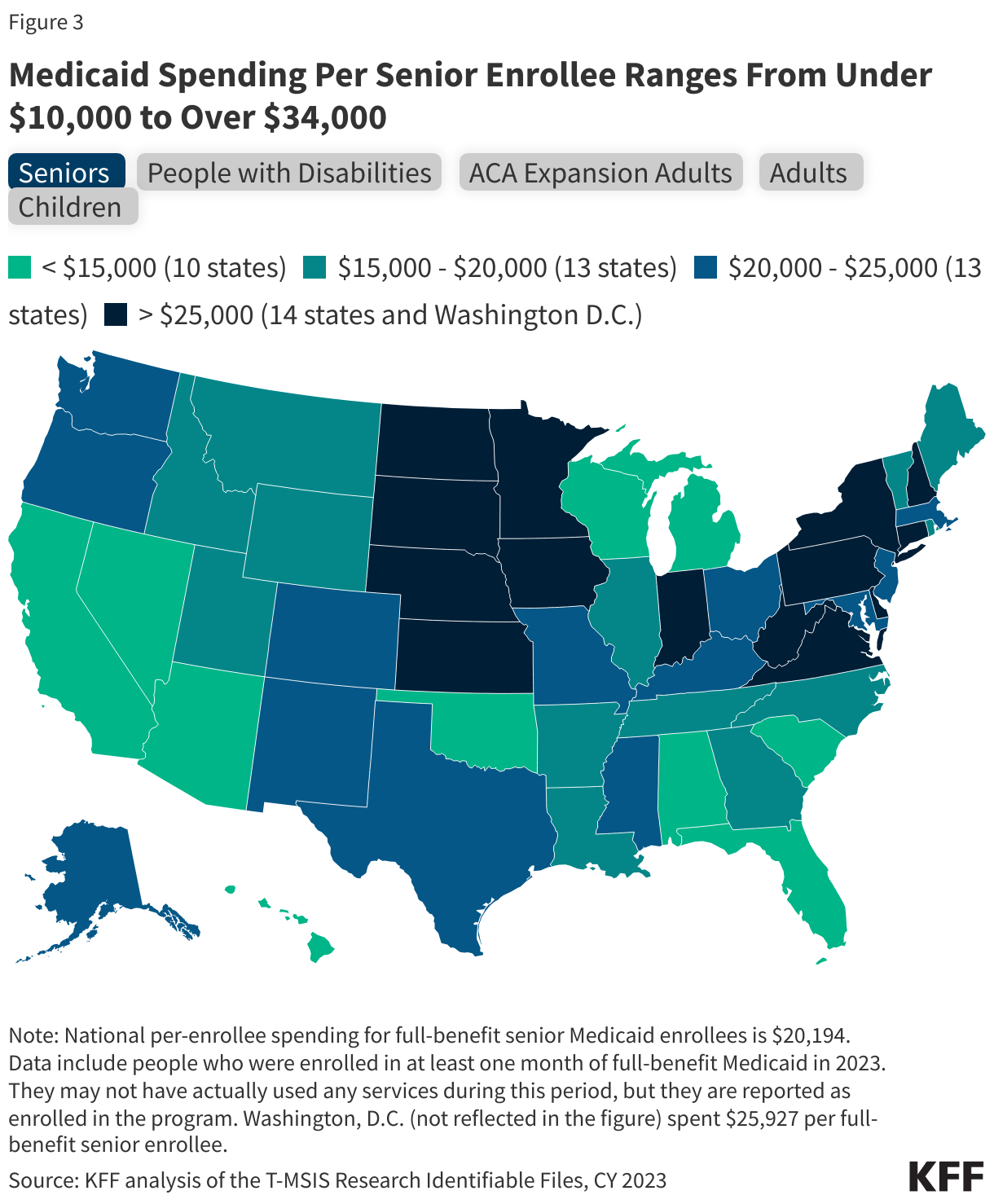
Medicaid Spending Per Senior Enrollee Ranges From Under ,000 to Over ,000 (Choropleth map)

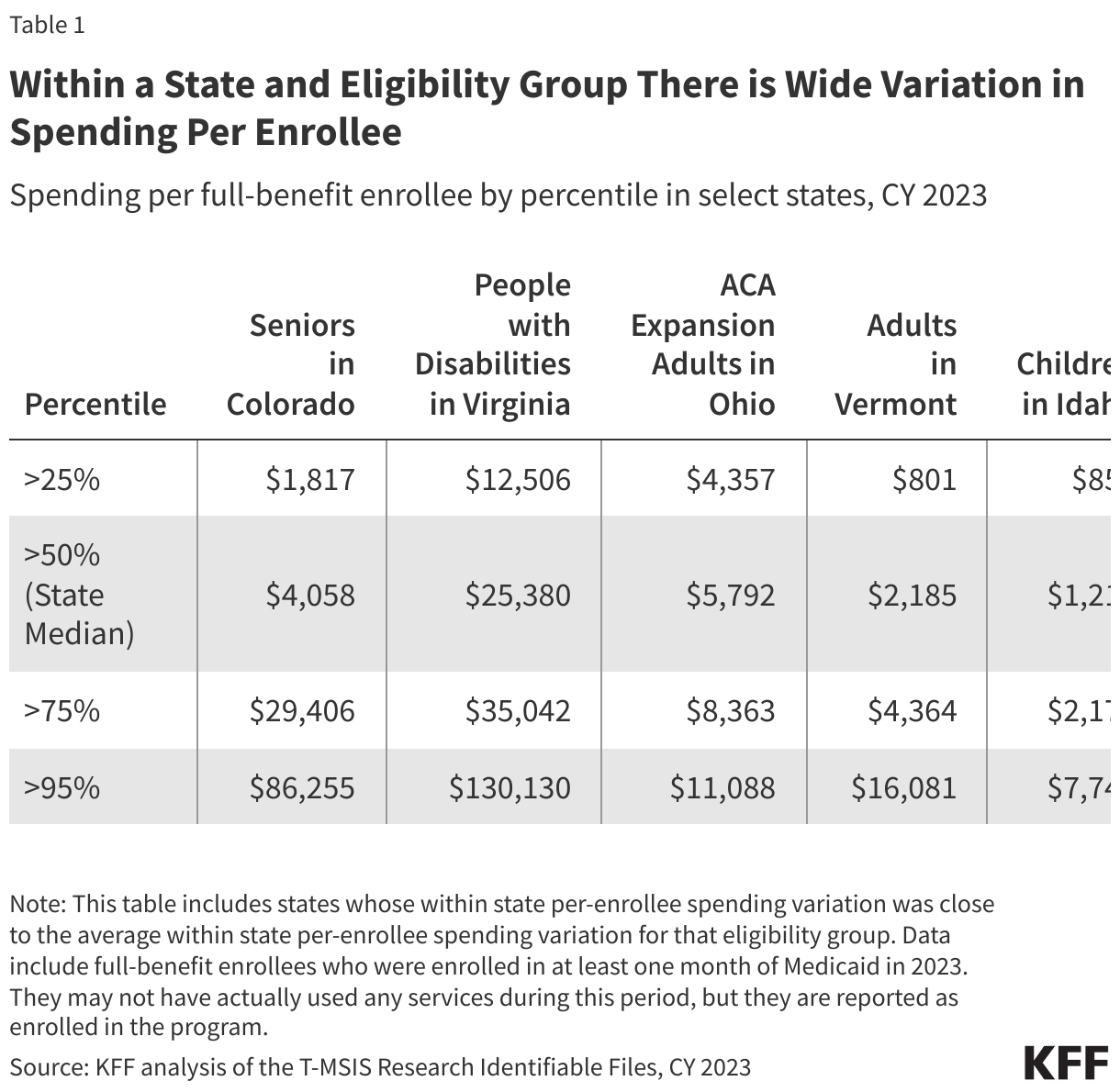
Even within a given state and eligibility group, there is wide variation in spending (Table 1). For example, among people with disabilities in Virginia, 25% have spending less than $12,506 and 5% have spending more than $130,130 – ten times higher (Table 1). Additionally, 25% of seniors in Colorado have spending less than $1,817, and 25% have spending sixteen times greater ($29,406) (Table 1). Despite the generally lower costs for non-disabled adult and child enrollees, the variation in spending for these eligibility groups is wide in Ohio, Vermont, and Idaho as well.

Within a State and Eligibility Group There is Wide Variation in Spending Per Enrollee (Table)

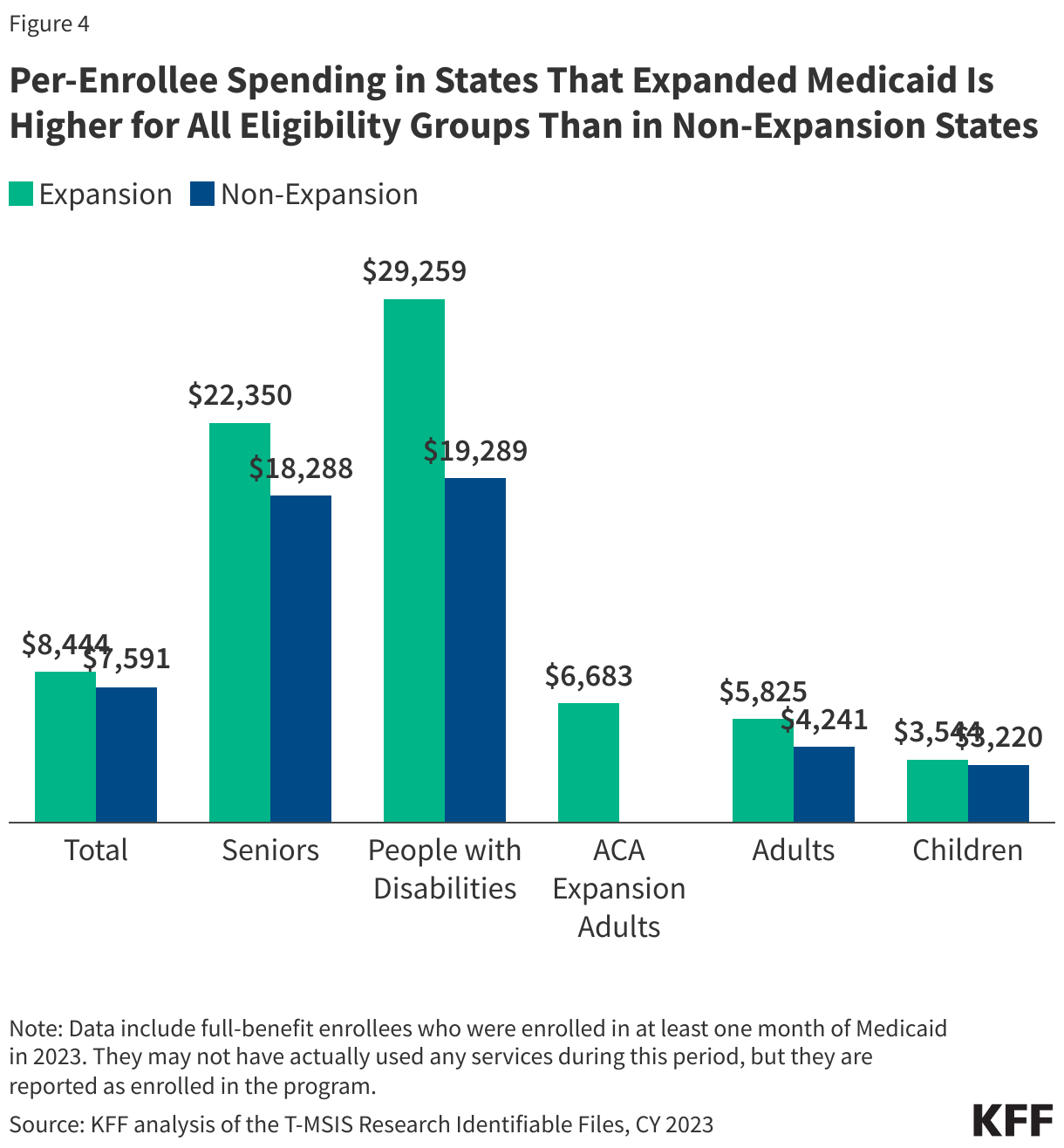
Per-enrollee spending in states that expanded Medicaid is higher for all eligibility groups than in non-expansion states (Figure 4).

Expansion states spend on average $8,444 per enrollee – nearly $1,000 more per enrollee when compared to non-expansion states, which spend $7,591 per enrollee (Figure 4). During debate over the reconciliation bill, some argued that the 90% match rate for expansion adults encourages expansion states to prioritize services for expansion adults of those of other populations—children, parents, people with disabilities, and older adults. However, across all non-expansion eligibility groups, average per-enrollee spending is higher in expansion states than in non-expansion states. For instance, expansion states have an average spending of $29,259 per enrollee eligible based on disability, while non-expansion states spend on average $19,289 per enrollee in the same eligibility group. Similarly, expansion states spend $22,350 per older adult enrollee compared to $18,288 for non-expansion states (Figure 4). These differences in spending may reflect state policy choices about benefits and eligibility, in addition to payment rates, regional variation in health care costs, and state demographics.

Per-Enrollee Spending in States That Expanded Medicaid Is Higher for All Eligibility Groups Than in Non-Expansion States (Grouped column chart)


Methods

Data: The KFF State Health Facts on spending per full-benefit enrollee use the T-MSIS Research Identifiable Demographic-Eligibility and Claims Files (T-MSIS data). This data note is based on State Health Facts data from CY 2023.

Overview of methods: KFF defined full-benefit enrollees as those who are enrolled in Medicaid for at least 1 month with full-benefits or those who received at least one month of benefits through an alternative package of benchmark equivalent coverage. They may have not actually used any services during this period, but they are reported as enrolled in the program and are eligible to receive services. References to dual-eligible enrollees do not include Medicare Savings Program (MSP) enrollees due to the restriction of data to full-benefit enrollees only.

Spending: Spending was calculated by summing the total spending of all claims per full-benefit enrollee in the T-MSIS claims files.

Poll Finding

5 Charts About Public Opinion on the Affordable Care Act

Published: Oct 3, 2025

Note: This resource was originally posted on February 22, 2024, and was most recently updated January 30, 2026, to include newer polling data on the public’s views of the ACA.

#1: Attitudes Toward the ACA Continue to Be More Favorable than Unfavorable, Divided Among Partisans

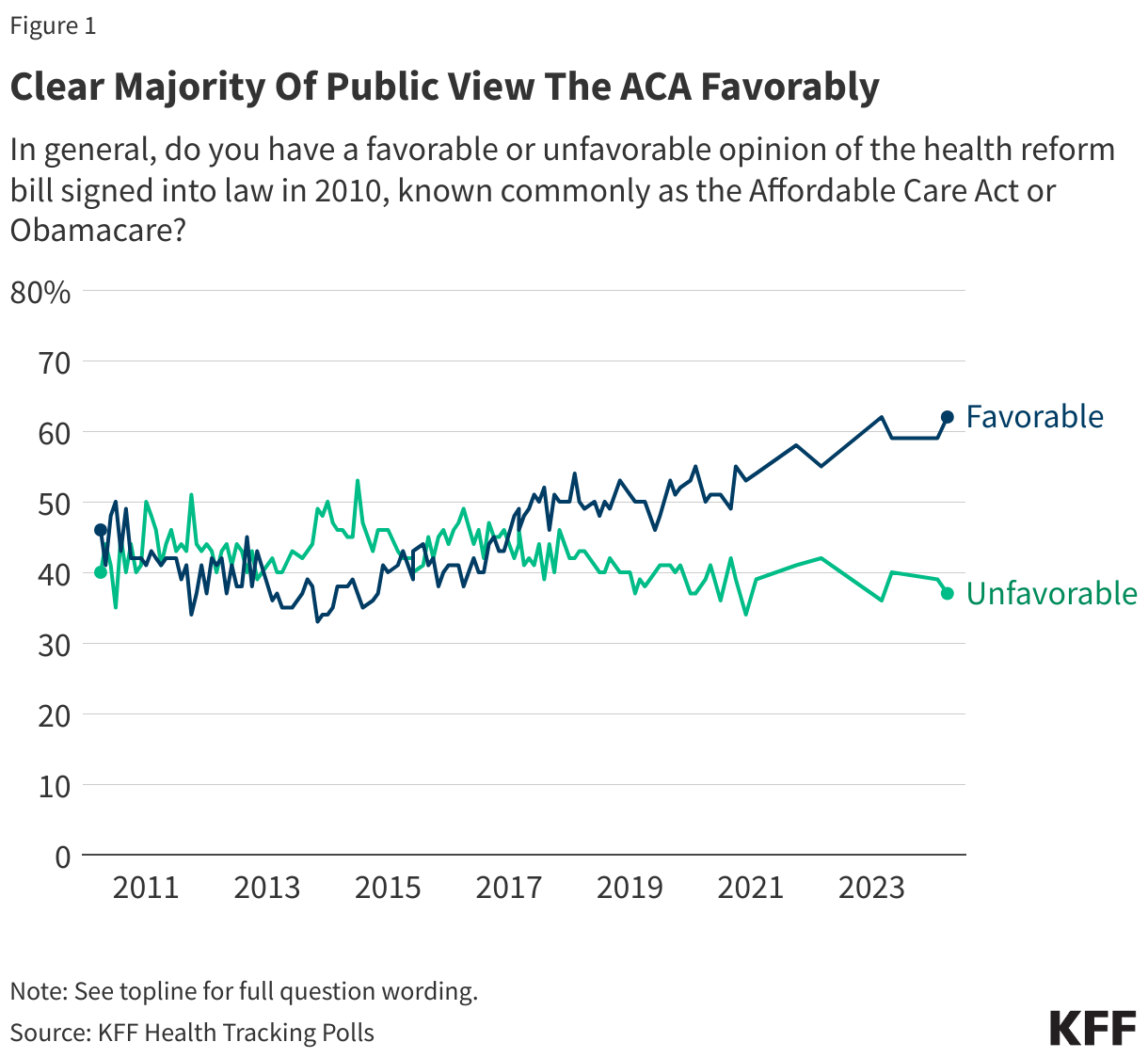
Public opinion of the Affordable Care Act (ACA) has been largely divided along partisan lines since the law was passed in 2010. Following Republican efforts to repeal the ACA in the summer of 2017, KFF Health Tracking Polls show an uptick in overall favorability towards the law, and since then, a larger share has held a favorable than an unfavorable view. In early 2026, about six in ten adults (58%) say they hold a favorable opinion of the ACA while about four in ten (41%) hold a negative opinion of the law. Views of the ACA are still largely driven by partisanship; about nine in ten Democrats (91%) along with six in ten independents (62%) view the law favorably, while about three-fourths of Republicans (77%) hold unfavorable views. Explore more demographic breakdowns using KFF’s interactive: The Public’s Views on the ACA.

Line chart showing percent of adults over time who say they have a favorable or an unfavorable opinion of the Affordable Care Act. Results shown from April 2010 to February 2024.

The ACA has been the subject of both legal challenges and Congressional actions aimed at overturning the 2010 health care law. However, many of the specific provisions included in the law are popular and the public would like them to remain.

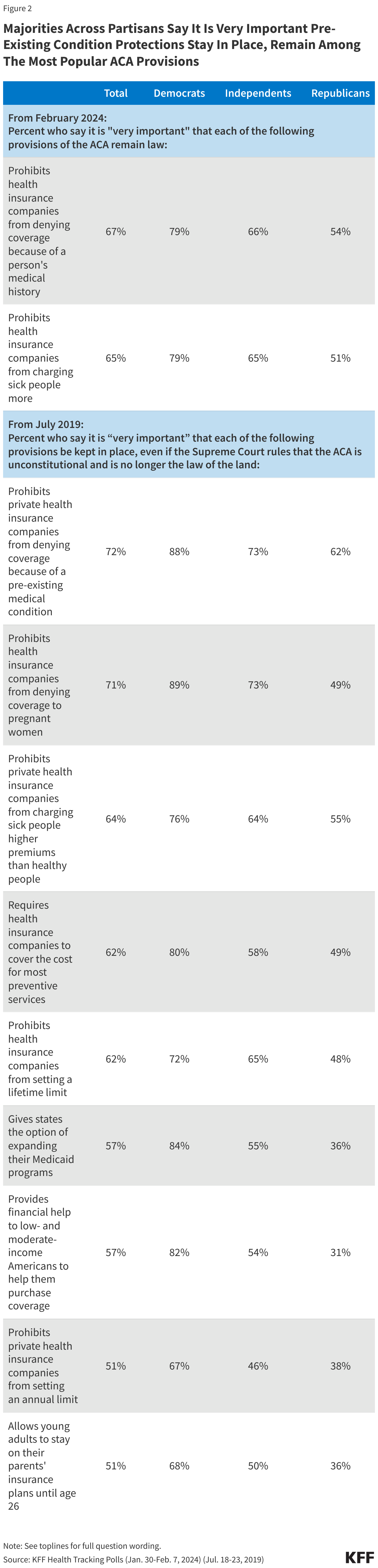
For example, the 2020 California v. Texas case challenged the legality of the individual mandate and brought special attention to the law’s protections for people with pre-existing medical conditions. These provisions prohibit insurance companies from denying coverage based on a person’s medical history (known as guaranteed issue) and prohibit insurance companies from charging those with pre-existing conditions more for coverage (known as community rating). As of February 2024, two-thirds of the public say it is “very important” for the guaranteed issue (67%) and community rating (65%) provisions to remain law, including majorities of Democrats and independents. About half of Republicans say each of these protections for people with pre-existing conditions are “very important.” Historically, majorities also say it is very important for many of the other ACA provisions to be kept in place, even if the Supreme Court ruled the ACA unconstitutional and no longer the law of the land.

Though majorities say it is very important for guaranteed issue to remain law, knowledge that this provision is part of the ACA has dropped over the past 14 years. As of February 2024, about four in ten (39%) adults are aware that the ACA prohibits insurance companies from denying coverage based on a person's medical history, compared to seven in ten adults in June 2010, shortly after the ACA’s inception.

Table showing percent of adults who say it is "very important" that specific Affordable Care Act provisions remain in place. Results shown by total adults and party identification.

#3: Pre-Existing Condition Protections Affect Large Shares of the Public

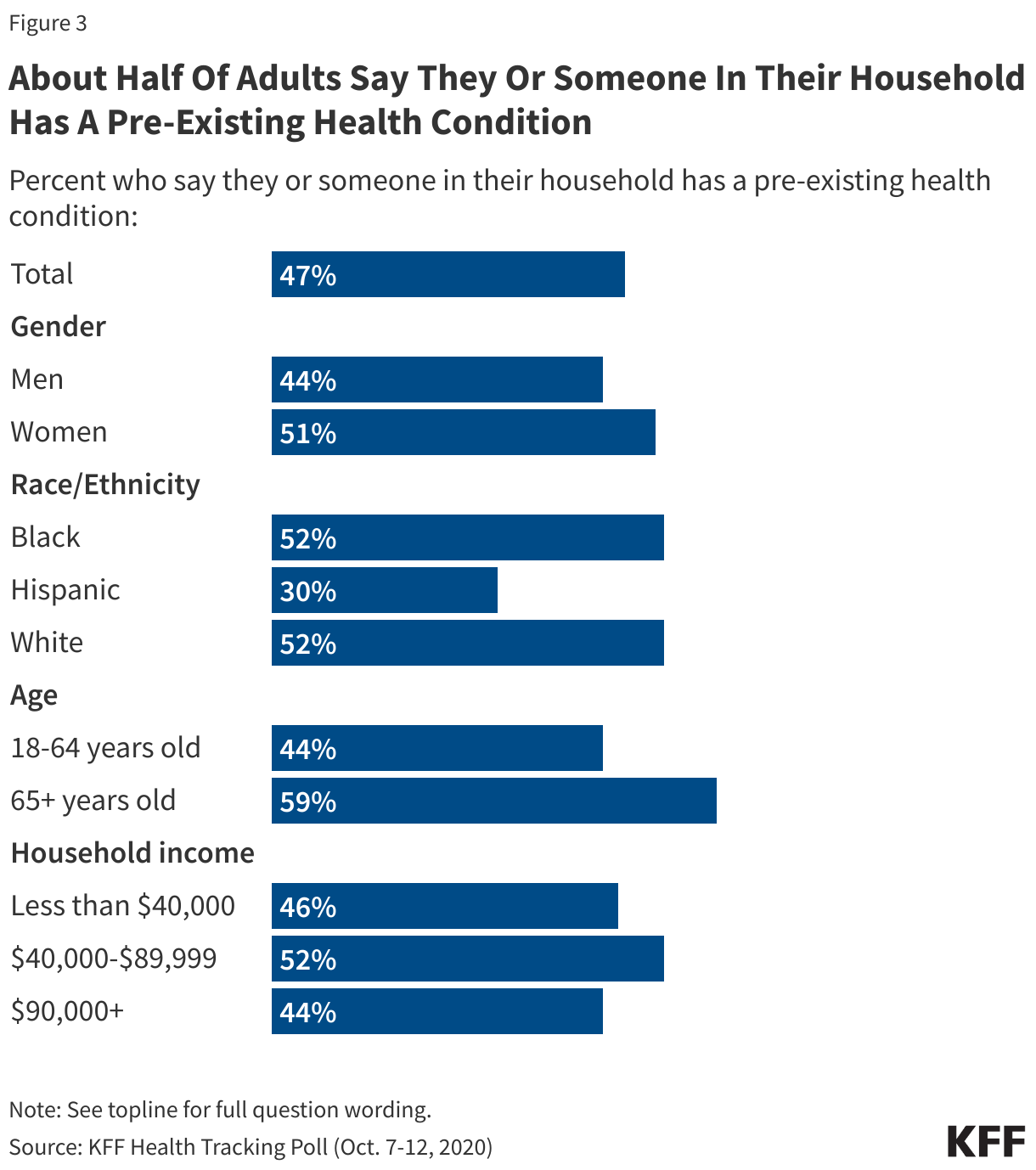
One reason why majorities across partisans may support the ACA’s protections for people with pre-existing medical conditions is that large shares of the public, regardless of age, gender, racial or ethnic identity, and income report having someone with a pre-existing condition in their household. A KFF analysis estimates that 27% of adults ages 18-64 have a pre-existing condition that would have led to a denial of insurance in the individual market prior to the implementation of the ACA. An even larger share of the public believes they or someone in their family may belong in this category. According to the KFF polling data from 2020, about half of the public say they or someone in their household suffers from a pre-existing medical condition, such as asthma, diabetes, or high blood pressure.1 

Bar chart showing percent of adults who say they or someone in their household has a pre-existing health condition. Results shown by total adults, gender, race and ethnicity, age, and household income.

#4: Those Who Say the ACA Has Helped Them Cite Increasing Access

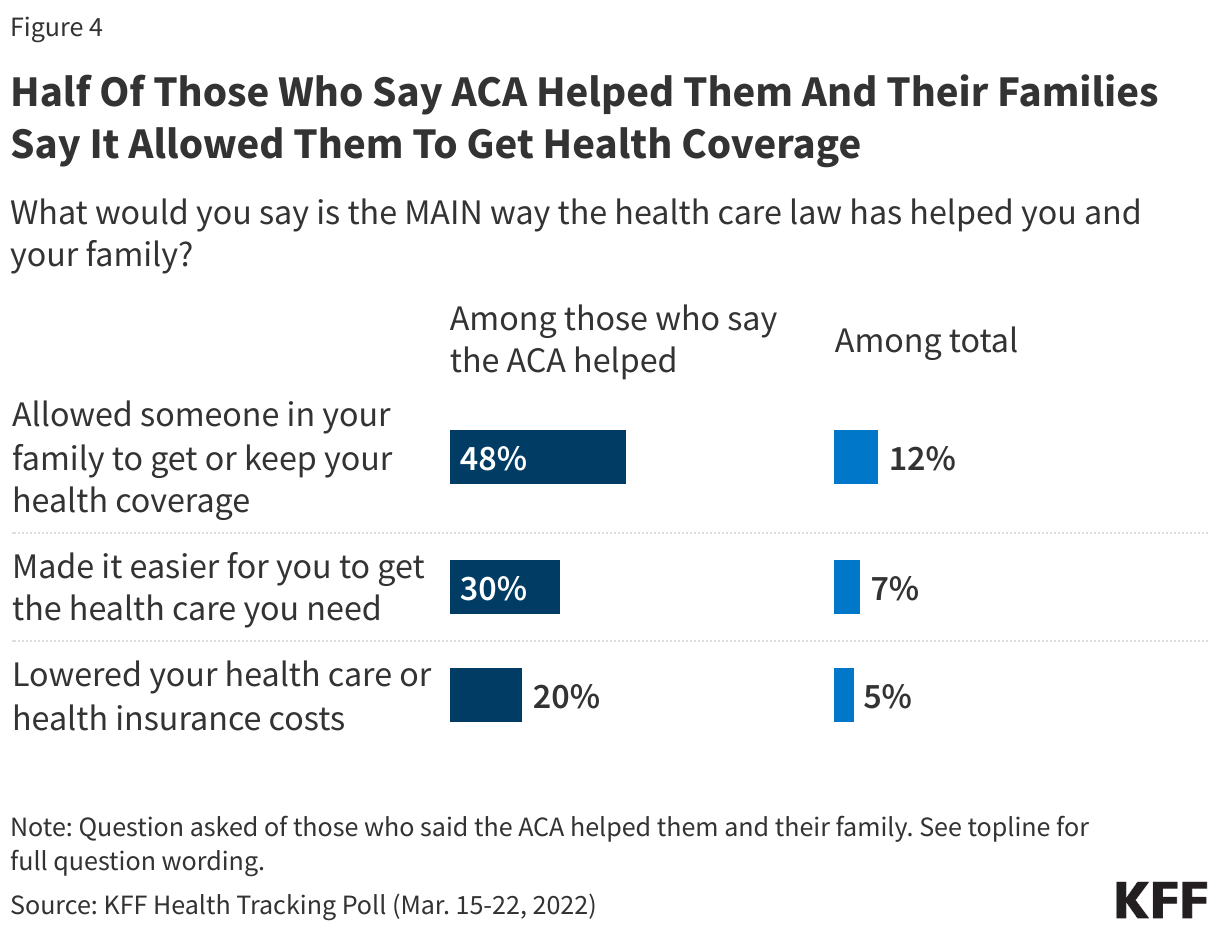
KFF polling from March 2022 shows about a quarter of the public says the ACA has helped them and their family in some way, while one in five say the law has hurt them. About half of those who say the ACA helped them say allowing someone in their family to get or keep their health coverage has been the main way the health care law has helped them (48%, or 12% of total adults). Three in ten say the law has made it easier for them to get the health care they need (7% of total) and one in five say it has lowered the cost of their health care or health insurance (5% of total).

Split bar chart showing percent of adults who say specific items were the main way the Affordable Care Act helped them and their family. Results shown among those who say the ACA helped them and among total adults.

The February 2024 Health Tracking Poll also reveals four in ten (39%) adults say the ACA has made it easier for people like them to get health insurance, while about one in four (23%) say it has made it more difficult. However this perception varies by partisanship, as Democrats are almost three times as likely as Republicans (60% v. 22%) to say the ACA has helped them in this way.

#5: Those Who Say the ACA Has Hurt Them Cite Costs

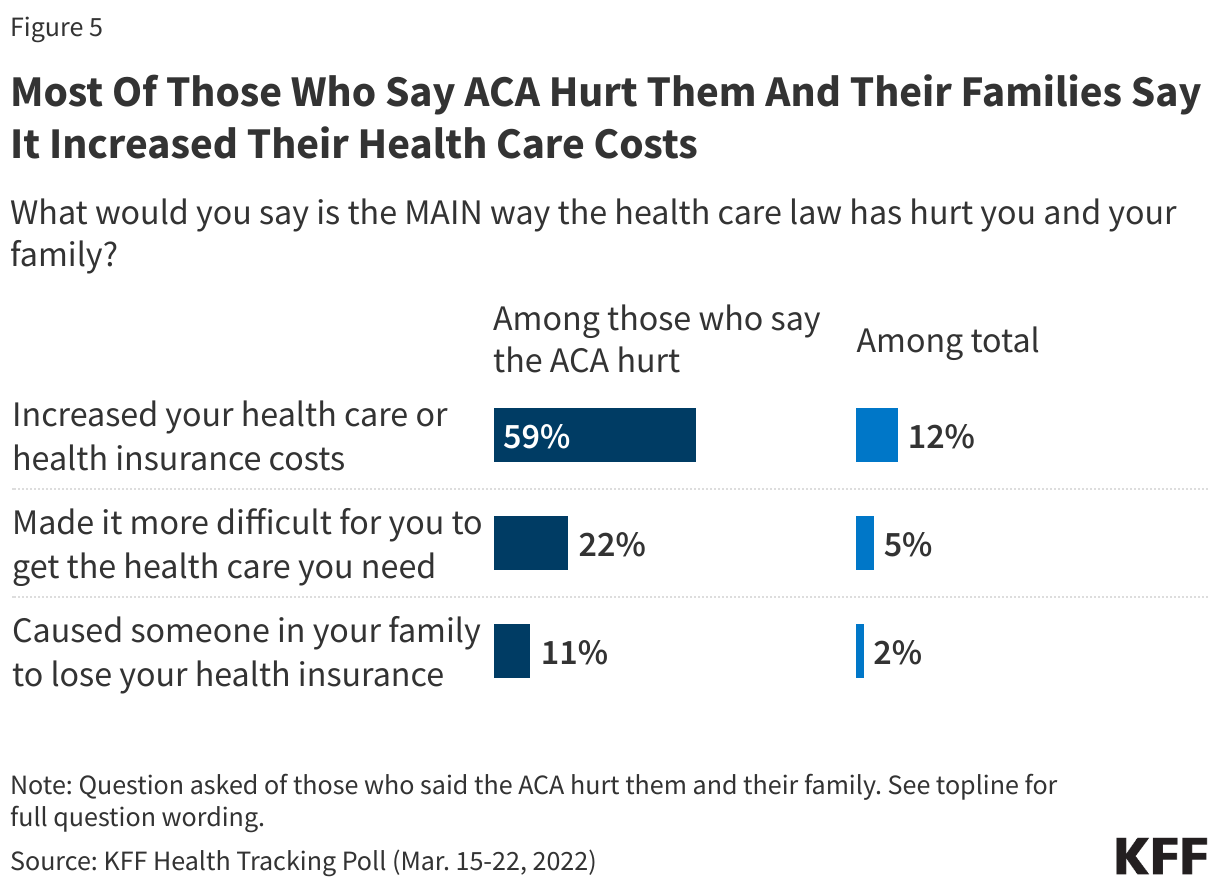
Among the one in five U.S. adults who say the ACA has hurt them and their families, most say the law has increased costs of health care or health insurance (59%, 12% of total). Smaller shares say it has made it more difficult to access care (22%, 5% of total), or caused someone in their family to lose coverage (11%, 2% of total). The high costs of health care in this country continue to be a major burden for many families.

Split bar chart showing percent of adults who say specific items were the main way the Affordable Care Act hurt them and their family. Results shown among those who say the ACA hurt them and among total adults.
  1. This estimate is a household measure of all groups and does not classify pre-existing conditions by whether they are or not a “deniable” condition. See the KFF Health Tracking Poll October 2020 topline for full question wording and details. ↩︎

U.S. Public Health

Table of Contents

What is Public Health?

Copy link to What is Public Health?

While there is no singular definition of public health, it has broadly been defined as “the science and art of preventing disease, prolonging life, and promoting health,” and “what we do together as a society to ensure the conditions in which everyone can be healthy”. Definitions and objectives for public health have evolved over time, as it is not a static concept (see Box 1). Public health encompasses a wide variety of programs and activities, including controlling the spread of communicable disease, preventing chronic diseases, improving nutrition, improving air and water quality, promoting safer workplaces, reducing automobile accidents, and more.

The overarching focus for a public health system is to help with disease prevention, health promotion, and to close gaps in health disparities in groups of people. These groups can range from small communities to populations at the national and even global levels. Public health’s focus on health equity in groups of people can be contrasted with clinical medicine, which is mostly focused on preventing and treating illness in individuals.   

Box 1: Selected Definitions of “Public Health”

  • “the science and art of preventing disease, prolonging life, and promoting health through the organized efforts and informed choices of society, organizations, public and private communities, and individuals.” – C-E A. Winslow (1920)
  • “the fulfillment of society’s interest in assuring conditions in which people can be healthy” – Institute of Medicine (1988)
  • “collective effort to identify and address the unacceptable realities that result in preventable and avoidable health outcomes, and it is the composite of efforts and activities carried out by people committed to these ends” – Turnock (2001)
  • “what we do together as a society to ensure the conditions in which everyone can be healthy.” – DeSalvo, et.al (2017)

A Brief History of Public Health in the U.S.

In the United States, public health evolved as a practice and a discipline over time with roots that extend back to the early history of the nation (the first governmental public health agency, the Marine Hospital Service, was formed in 1798). As scientific understanding about causes and effective interventions for diseases improved over time, public health practices evolved and expanded across the country. The 19th century saw a “great sanitary awakening” in the U.S., as illness came to be understood as an indicator of poor social and environmental conditions, and investments in hygiene and sanitation grew to combat disease in communities around the country, especially in large cities. After the U.S. Civil War, states began to set up boards of health to oversee growing investments and attention to public health activities in communities. The first state-level agency for public health was created in New York in 1866; Massachusetts established its first state board of health in 1869 and other states and jurisdictions followed. As the understanding of the germ theory of disease grew, state and local health departments created infectious disease laboratories in the 1890s. In the early to mid-20th century, state and local health departments grew in size and responsibilities and many of the public health interventions and focus areas that we see today were established and expanded.

In addition, a number of milestones occurred in the 20th century to grow the federal government’s role in public health, including new legislation such as the Food and Drug Act of 1906 (allowed federal oversight of manufacture, labeling and sale of foods) and the Sheppard-Towner Act of 1922 (authorized federal government funding of state-level public health efforts for the first time, in this case for maternal and child health programs). As part of the social welfare reforms undertaken via the “New Deal” in the 1930s and the “Great Society” in the 1960s, federal responsibilities, oversight, and funding for public health grew significantly. Many core federal departments and agencies we still have today were established during this period. From the late 1960s through today, U.S. public health efforts have experienced periods of decline and periods of growth often linked with broader social trends, changing perceptions about health threats, and economic and fiscal conditions in the country. During the first Trump administration and continuing through the Biden administration, the COVID-19 pandemic represented one of the greatest public health challenges of the last 100 years and led to an expansion of the government’s public health response. However, the expansion has proven temporary and during the second Trump administration, public health efforts face resource cuts and an uncertain future.

Public health powers and responsibilities derive from the U.S. Constitution and are shared across federal, state, and local levels of government – each of which has unique roles in such efforts that can vary state by state and even community by community. While many of public health efforts are funded and implemented through public (i.e. governmental) programs, private actors are also involved in funding and delivering public health services in the U.S. Given the many actors involved and the variations across federal, state and local roles and approaches, public health in the U.S. has often been referred to as a “patchwork” system.  

Key Public Health Frameworks, Services, Capabilities and Characteristics

Public health efforts are typically guided at the broadest level by strategies or frameworks outlining the services, capabilities and activities that help deliver on the mission to protect and promote communities’ health. A key framework for U.S. public health over the last few decades has been the 10 Essential Public Health Services (EPHS) framework, originally developed in 1994 by a federal workgroup (with input from outside experts), and updated in 2020. The EPHS highlights ten key public health service areas that include: monitoring population health status and community needs, investigating and addressing hazards and health problems, and using legal and regulatory actions to improve and protect the public’s health (see Table 1). An underlying principle of promoting equity underlies all service areas in this framework.
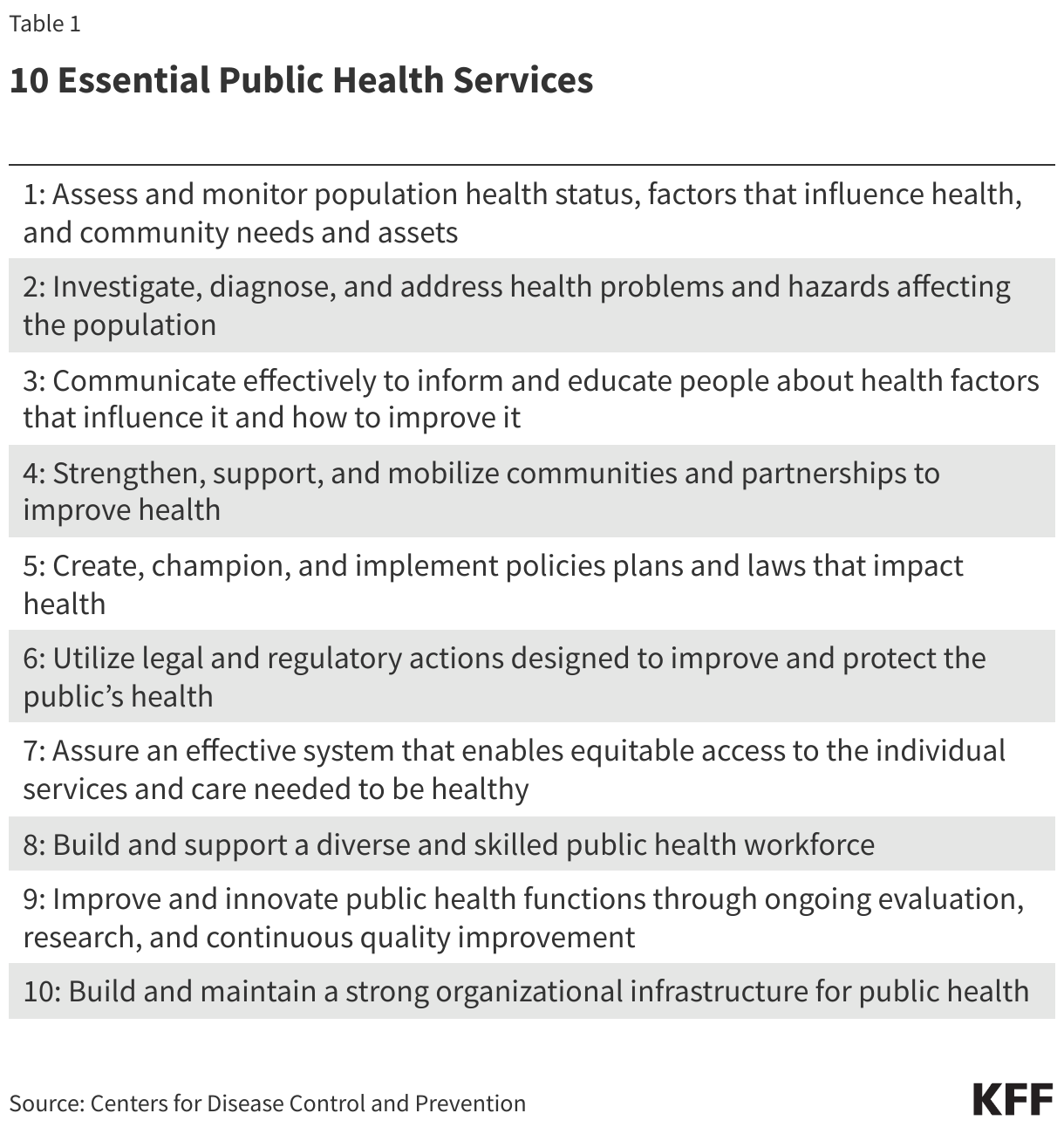
10 Essential Public Health Services (Table)

The “Foundational Public Health Services (FPHS)” framework is another key resource. This framework emerged from a 2013 convening of stakeholders who, in response to a recommendation from the Institute of Medicine, set out to define “a minimum package of public health capabilities and programs that no jurisdiction can be without.” The FPHS, which is now overseen by the Public Health Accreditation Board (PHAB), outlines eight “foundational capabilities” and five “foundational areas” that are central for delivering public health services to communities (see Table 2). These foundational areas include: communicable disease control, environmental public health, and maternal, child & family health, while foundational capabilities include assessment & surveillance, emergency preparedness & response, and communications.

The EPHS and FPHS frameworks overlap but are also seen as complementary, with the EPHS describing activities the public health system overall should undertake in communities, and the FPHS representing a minimum package of governmental public health activities that should be present everywhere.
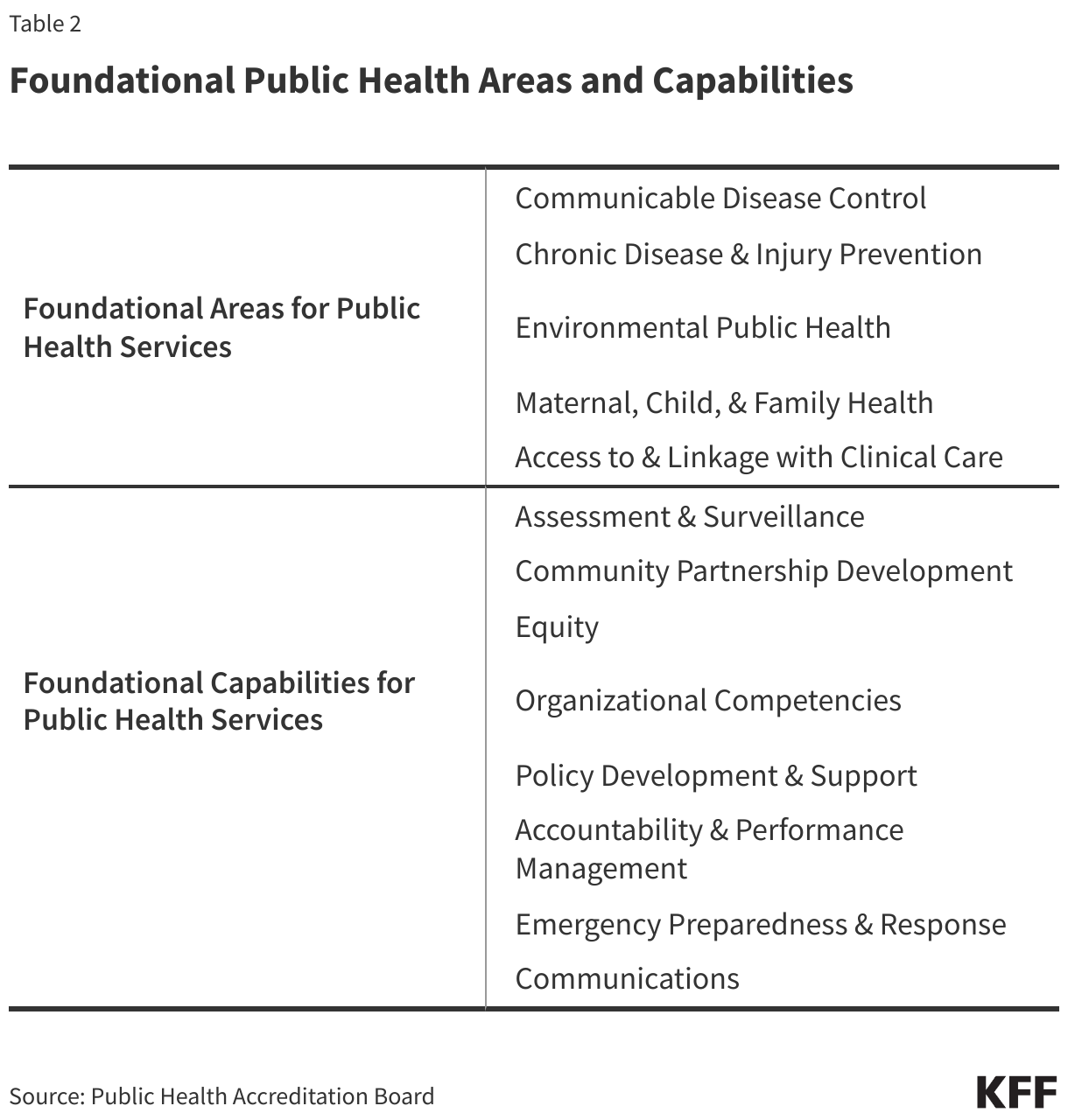
Foundational Public Health Areas and Capabilities (Table)

Other strategies and frameworks have been formed and shaped through numerous governmental and non-governmental expert bodies and reports. Particularly influential have been recommendations and guidance from the National Academy of Medicine (previously the Institute of Medicine), which published a milestone report on the U.S. public health system in 1998 and key follow-up reports in 2002 and 2017.

In addition to these frameworks and capabilities, public health can be identified through certain defining characteristics, which include:

  • Being science-based. Effective public health policies and activities draw from the best available science and evidence and are adapted and updated as new information and scientific understanding improves.
  • Focusing on prevention. Ultimately, the goal of public health interventions is to prevent disease or otherwise improve health outcomes in groups of people. When public health works, the result is often the absence of disease and/or longer, healthier lives in a community. This means the benefits derived from public health interventions – disease prevented – are often unseen and hard to quantify.
  • Addressing health inequities. Underlying the public health approach is a recognition that all people have an equal right to better health. However, in reality there are significant health disparities across different demographic groups and geographic areas. Therefore, public health interventions often emphasize addressing health needs in underserved, marginalized, disadvantaged, and otherwise vulnerable populations in support of health equity.

Social Determinants of Health

The health of a population can be greatly affected by non-medical factors, which would include things like educational access and quality, health care access and quality, neighborhood characteristics, social and community practices, and economic health and stability. These other, broader societal and community-wide factors are known as the “social determinants of health” (SDOH, see Figure 1). Unequal access to SDOH can feed health disparities. For example, communities that have less access to grocery stores with healthy foods face greater challenges with nutrition, which raises the risks of heart disease, diabetes, obesity and other conditions in these communities compared to others with health food options. During an epidemic or pandemic, the lack of sick leave policies and precarious economic circumstances can leave workers – especially low-wage workers - with little flexibility to take time off from work, raising their risk of infection and continuing community transmission. In general, racial and ethnic health and health care disparities can result in higher rates of illness and death for minority populations across a wide range of health conditions.

Many public health programs recognize the importance of social determinants of health, and sometimes work in partnership with other public and private efforts to help develop and implement complementary approaches aimed at improving health equity. The CDC recommends that public health departments consider how social determinants affect health in their communities, highlighting how a focus on implementing the 10 Essential Public Health Services can help address inequities that arise from these social conditions. Still, there are limits to how directly public health programs can address these issues given that they often involve broad social conditions such as employment, discrimination, housing, and education.

Source: KFF. Race, Inequality, and Health. https://www.kff.org/health-policy-101-race-inequality-and-health/?entry=table-of-contents-what-factors-drive-racial-and-ethnic-health-disparities
How Is Public Health Governed and Delivered in the U.S.?

Copy link to How Is Public Health Governed and Delivered in the U.S.?

As indicated in the name, “public” health is primarily shaped and supported through the public sector, i.e., governments. In the U.S., public health powers and responsibilities are shared across federal, state, and local levels of government. Legal authorities for public health powers are derived from the U.S. Constitution and relevant federal, state, and local laws (see Box 2 for an overview of the legal basis for U.S. public health powers). A set of public health departments and agencies at each of these levels forms the organizational backbone of the U.S. public health system. However, many private sector actors, such as non-governmental community-based organizations, academic institutions, private companies, philanthropies, and others, also have roles in the public health system.


Box 2: Legal Basis for State and Federal Public Health Powers

The U.S. Constitution does not mention public health specifically, but certain powers granted to the federal government and to states in the Constitution have been interpreted as encompassing public health. For example, under the 10th Amendment’s “police powers” clause, states are granted primary responsibility for enacting and enforcing laws to promote the health, safety, and general welfare of people in their jurisdictions, which is understood to include public health. This means that in the U.S., state governments often have primary responsibility for enacting public health measures and deciding on public health policies. During public health emergencies, states also have primary authority to impose and rescind certain measures within their jurisdiction such as business restrictions and school closings.

The Constitution also grants some powers to the federal government. Under the Constitution’s “commerce clause,” the federal government has exclusive authority to regulate interstate and foreign commerce. For public health, this means the federal government has authority to impose quarantines or other health measures that concern the spread of diseases into the U.S. from foreign countries and/or across state lines. The federal government’s Constitutionally derived power to tax and spend for the general welfare provides it the ability to use federal resources in support of public health activities in states and localities nationwide.

Even so, the lines between where federal and state public health powers begin and end – and how these powers are balanced with other legal concerns – are not always perfectly clear and can shift over time. Sometimes, existing rules or practices are challenged in court or changed through new legislation. For example, the Supreme Court in its Jacobson v Massachusetts decision in 1905 established that states can enforce compulsory vaccination laws, setting a precedent that public health concerns can sometimes outweigh individual rights. This and subsequent rulings upholding this principle have been a legal cornerstone for state-level vaccination requirements, such as those for school-aged children. However, in recent years many state legislatures have passed laws intended to weaken vaccination requirements or eliminate them entirely. In addition, during the response to COVID-19, many government-imposed public health interventions such as mandatory masking, social distancing, and vaccination requirements were challenged through legal action.

Federal Government

Each of the three branches of the federal government (Executive, Legislative, and Judicial) has a role in shaping and implementing public health in the U.S.

The President (Executive Branch)

Federal responsibilities and oversight of public health are spread across numerous executive branch agencies and departments overseen by the President (also see “Congress and the Executive Branch and Health Policy). The President, White House, and executive branch agencies also have the authority to set certain aspects of national public health policy, such as determining under which circumstances and for what diseases that individuals entering the U.S. may be subject to quarantine, isolation, and/or other public health measures, invoking border and migration control measures for public health issues such as those allowed under Title 42, and instituting public health controls or other measures on interstate travel and commerce.

The key federal departments and agencies involved in oversight and implementation of public health in the U.S. include:

Department of Health and Human Services (HHS) currently has 13 operating divisions and is overseen by[RS1]  a secretary, with multiple assistant secretaries responsible for specific offices and programs. For example, the Office of the Assistant Secretary of Health (OASH) oversees key HHS public health offices and regional offices, as well as the U.S. Public Health Service Commissioned Corps. Also within OASH is the Office of the Surgeon General, which has historically served as a center for expertise on many public health issues and has at times released influential reports, affecting U.S. public health policy and practice in areas such as tobacco, HIV/AIDS, and drunk driving. A reorganization of the department has been proposed, which, if enacted, would reduce the number of operating divisions and shift the organizational locations of some offices at HHS (more below). The following are the core public health-focused operating divisions within HHS:

  • Centers for Disease Control and Prevention (CDC) is considered the leading public health agency of the federal government. The CDC is comprised of a central Office of the Director, nine national centers covering different areas of U.S. public health, and a center for global health. CDC houses experts, laboratories, communication services, and other capabilities directed to improve the public’s health and respond to emergencies. One of CDC's core functions is to support state and local public health efforts through funding and technical assistance. CDC’s budget includes an annually appropriated discretionary amount provided by Congress each year (CDC’s FY2024 enacted budget for its core public health programs was $9.25 billion), and also several programs whose budget is determined by specific Congressionally-mandated program authorizations, such as the Vaccines for Children program (in FY2024 the budget for these mandatory programs totaled $8.03 billion). During outbreaks and other health emergencies, Congress has often provided additional emergency supplemental funding to support CDC response activities. CDC is led by a director, historically appointed by the President without need for Senate confirmation. Due to a law passed by Congress in December 2022, the CDC director position is a Senate-confirmed position as of January 2025.
  • Food and Drug Administration (FDA) is responsible for protecting public health by ensuring the safety, efficacy, and security of human and veterinary drugs, biological products, and medical devices. FDA also works to maintain the safety of (some of) the U.S. food supply, cosmetics, and products that emit radiation. FDA review and authorization/approval is necessary for all prescription drugs and all vaccines intended for use in humans, along with many other medical products and health devices. The total program level budget at FDA (the amount of money the FDA can spend for its activities) is comprised of both Congressionally appropriated funds and user fees collected via regulatory review of many of the products under FDA’s purview. In FY2024, the FDA’s total program level budget was $7.2 billion, of which $3.3 billion (46%) came from user fees. The FDA is led by a commissioner, a Senate-confirmed position.
  • Administration for Strategic Preparedness and Response (ASPR) is an operating division within HHS that leads medical and public health preparedness for, response to, and recovery from disasters and other public health emergencies. This includes activities to support development of medical countermeasures for health emergencies, a stockpile of emergency medical supplies and equipment for use during emergency responses, and support and technical assistance to state and local public health agencies to improve their response capacities. It is comprised of multiple centers, including the Center for Preparedness, the Center for Response, the Center for the Biomedical Advance Research and Development Authority (BARDA), and the Center for the Strategic National Stockpile. ASPR’s operating budget for FY2024 was $3.65 billion. ASPR is led by an Assistant Secretary for Preparedness and Response, a Senate-confirmed position.
  • Other HHS Operating Divisions: Other HHS agency programs also play a role in public health, including by helping to build capacity, respond to outbreaks and serve communities, even if they may be more directly focused on clinical care and services, including HRSA’s community health center program and Ryan White HIV/AIDS Program, and SAMSHA’s programs on substance abuse and mental health.

The current Trump administration announced there will be a reorganization of these HHS operating divisions.  For example, the administration proposed to create a new agency called the Administration for a Healthy America (AHA) that would consolidate several existing HHS agencies, including OASH, HRSA, SAMHSA, and expects to place ASPR within CDC, among other changes.  

Several other departments and agencies outside of HHS play a role in promoting the nation’s public health.

These include:

  • U.S. Department of Agriculture (USDA), which supports U.S. agriculture through assistance to farmers, and also oversees programs aimed at improving health, ending hunger, ensuring food safety, and other areas. USDA also protects public health through regulating aspects of the nation’s food supply and also providing food services for children and low-income people across the country. USDA’s Food Safety and Inspection Service (FSIS) regulates processors of meat, poultry, and eggs, and helps respond to foodborne disease outbreaks. The department’s Food and Nutrition Service oversees programs to provide food and nutrition education in schools as well as the Supplemental Nutrition Assistance Program (SNAP), which provides food benefits to low-income families.
  • Department of Defense (DoD) oversees programs focused on the health and safety of active-duty military members and their families, and also supports a number of public health functions such as health surveillance and emergency response.
  • Department of Homeland Security (DHS) provides support to help state and local public health agencies improve preparedness and response to terrorism and other public health threats.
  • Occupational Safety and Health Administration (OSHA) in the U.S. Department of Labor works to promote safe and healthy working conditions nationwide through setting and enforcing standards, and implementing training, outreach, education, and other assistance programs for worker safety.

Department of Veterans Affairs (VA) oversees programs focused on the health of military veterans and their families, including public health programs to help promote health and prevent disease in these populations.

This is not meant to be a comprehensive list; other federal agencies also have responsibilities and activities important for public health.

U.S. Congress (Legislative Branch)

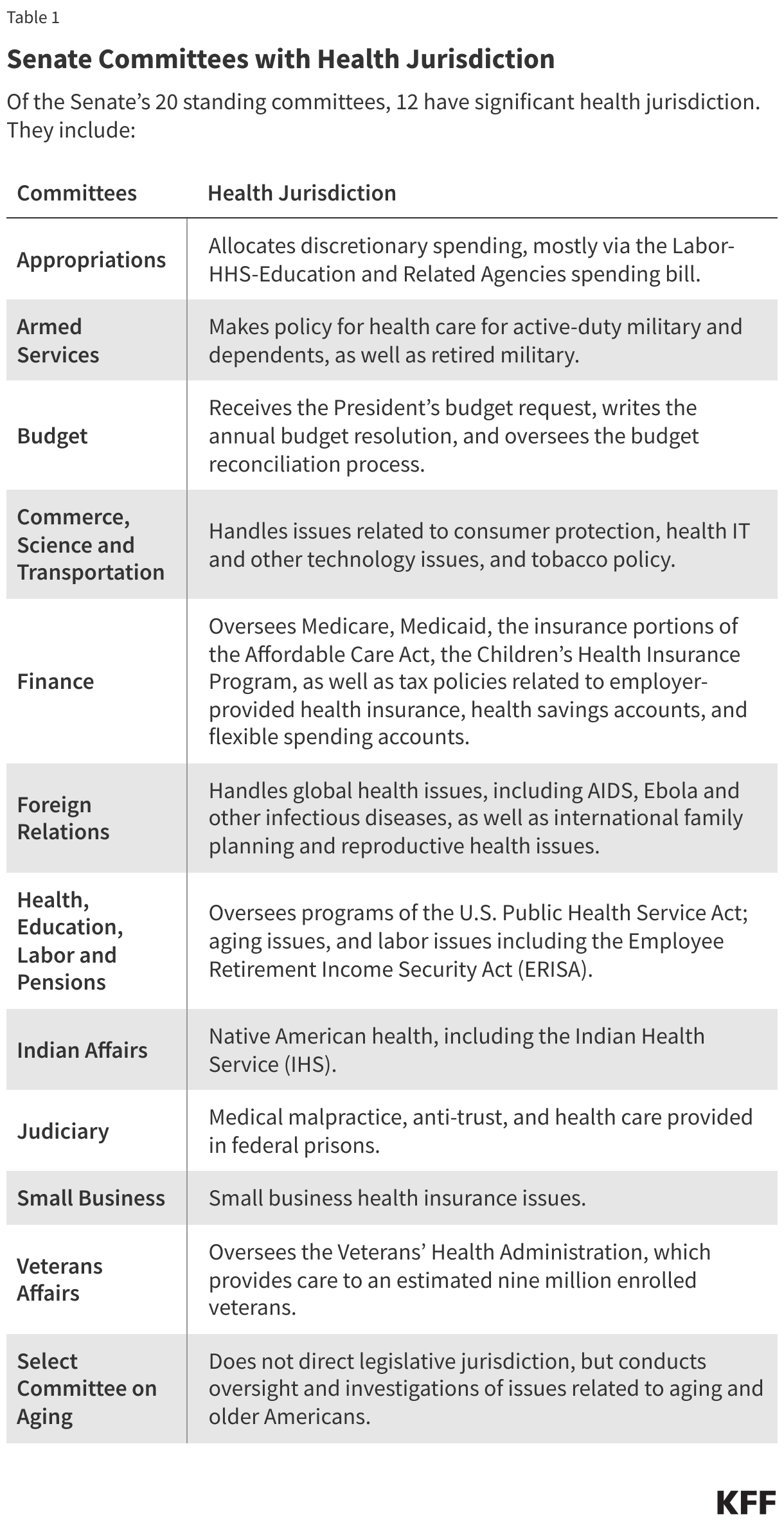
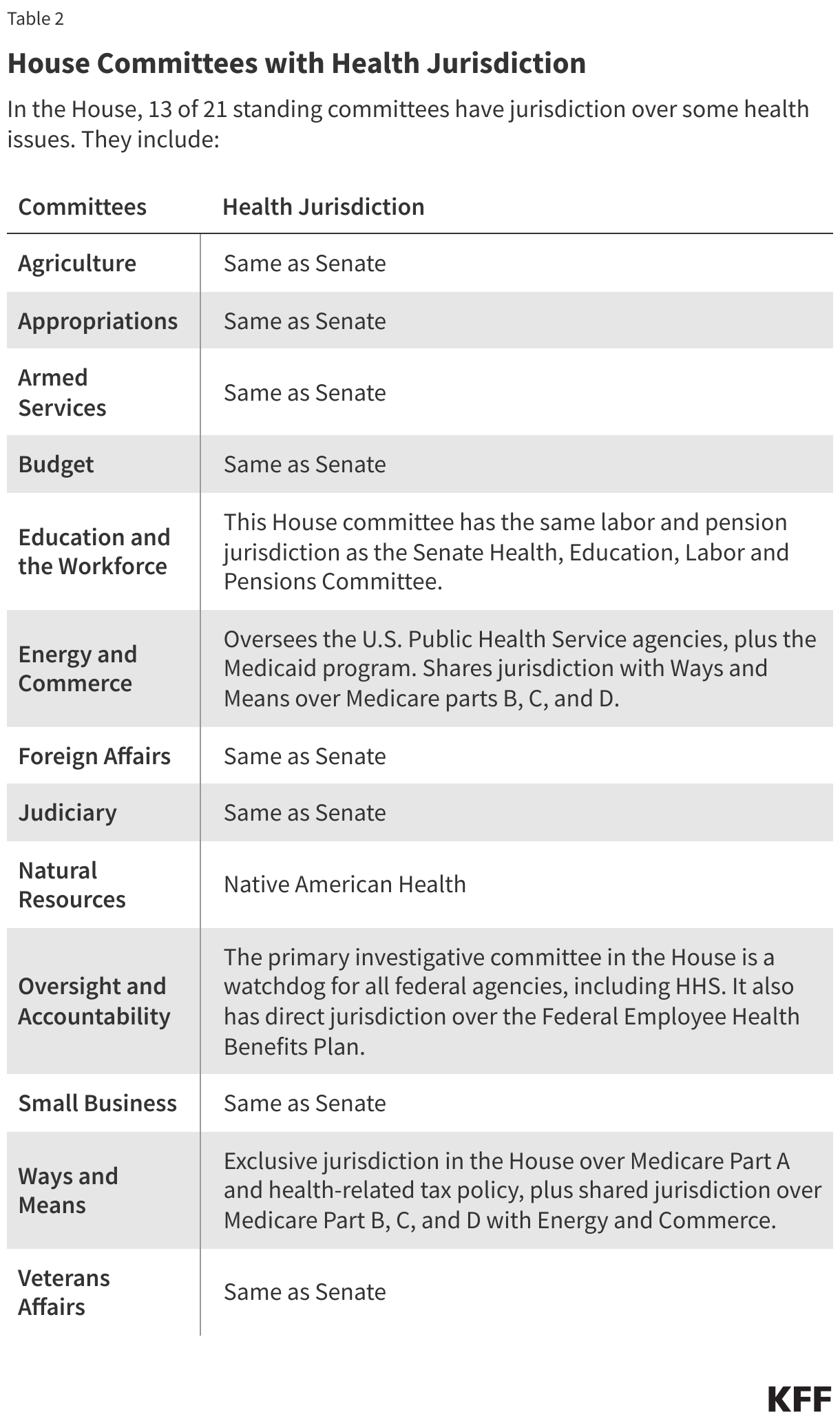
Congress (the House of Representatives and the Senate) makes laws, conducts oversight of the Executive branch, and determines the level of federal spending; all roles that are relevant to the U.S. public health system. Much of the federal funding for public health is for discretionary programs rather than mandatory ones (see Funding below), so Congress must come to agreement and pass bills annually to determine how much money goes to these programs. Congress may pass additional emergency funding to states and localities for public health efforts during national emergencies, such as was done numerous times during COVID-19. Congress may also pass laws that change federal practices related to public health, such as a 2022 law that made the CDC director a Senate-confirmed position. Oversight responsibilities for public health in the legislative branch are divided across a number of different Congressional committees with jurisdiction over different aspects of public health policy, and oversight of different Executive branch agencies and departments working in public health.

Federal Courts (Judicial Branch)

U.S. federal courts, up to and including the Supreme Court, pass judgment on how or whether federal public health laws and policies can be carried out and settle disputes between the federal government, individuals, states, and private companies over how public health activities are regulated and implemented. The legal basis for many current public health practices, such as vaccination requirements, rests on federal court decisions and precedents (see Box 2). Federal courts have also weighed in on the legality of a number of federal public health policies enacted during the response to COVID-19, such the CDC masking requirement for public transportation issued in January 2021 that was challenged and ultimately overturned by a federal court in April 2022, and the COVID-19 vaccination mandate for federal workers implemented by the Biden administration in September 2021 that was ultimately rescinded after legal challenges were raised in federal courts.

State, Local, and Territorial Governments

States are given primary responsibility for many public health powers under the U.S. Constitution (see Box 1). Each of the 50 states plus Washington D.C., five U.S. territories (American Samoa, Mariana Islands, Guam, Puerto Rico, and the Virgin Islands), and three associated states (Marshall Islands, Micronesia, and Palau) has public health departments that are responsible for implementing public health programs in their jurisdictions. Funding for public health programs at the state and local levels comes from a combination of federal, state, and other sources (see funding section below).

Across States, Public Health Governance Varies

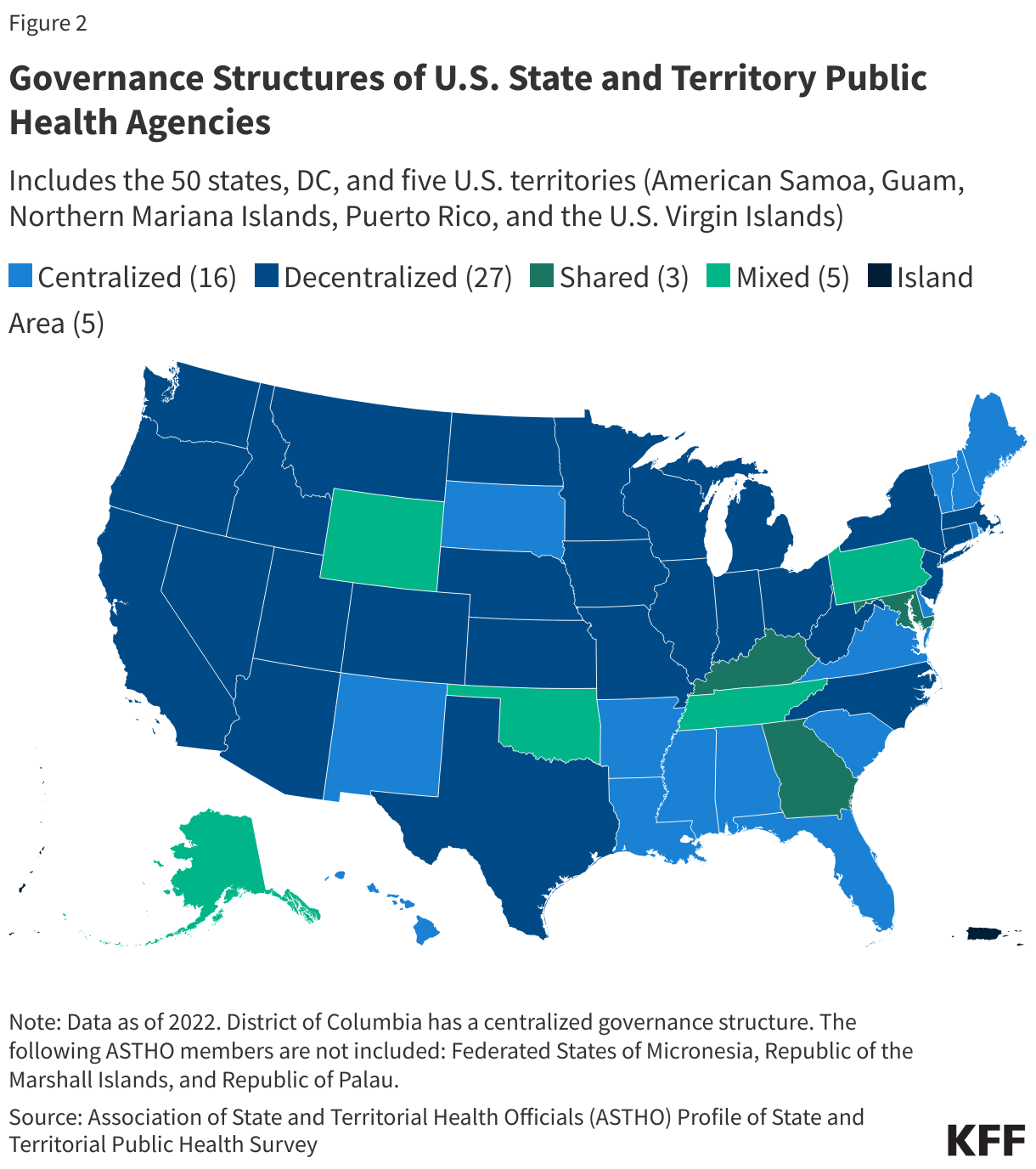
How public health is governed differs across these states and territories. Some have a very centralized governance model, where most or all parts of the state are served by local units of the state health agency and primary decision-making powers reside with state representatives. Others have a more decentralized governance structure, where most or all parts of the state are served by local public health agencies that may be independent of the state health agency. Still others have a mixed or shared approach to public health governance between the state and local decision makers. A 2022 analysis by the Association of State and Territorial Health Organizations (ASTHO) found that of the 50 states and D.C., 16 are centralized, 27 decentralized, and 8 have a mixed or shared approach to governance (See Figure 2).

U.S. map showing governance structures of state and territorial public health agencies in 2022. Decentralized governance is the most common model, used by 27 states, while 16 states and Washington, D.C., have centralized systems. Three states have shared governance structures, five have mixed structures, and the five U.S. territories shown are categorized as island areas. The map highlights substantial variation in public health governance across states and territories.

This variation in governance leads to very different processes across states for how public health policy is determined and implemented. While more decentralized public health governance can result in public health programs that are more tailored to the needs of specific areas, it can also make coordinated public health action more challenging, especially during outbreaks and pandemics, as occurred during COVID-19.

Common Public Health Activities at the State Level

According to a 2022 survey conducted by ASTHO, the activities most commonly implemented by state public health agencies in 2022 included:

  • communicable disease screening, prevention, and treatment, such as for HIV/AIDS and sexually transmitted diseases (all 51 state health agencies, including D.C., provide these services);
  • public health surveillance such as tracking chronic and communicable diseases as well as injuries (all 51 state health agencies);
  • immunization support, including managing orders and distributing vaccines for children and maintaining a childhood immunization registry (all 51 state health agencies);
  • laboratory services such as foodborne illness testing and influenza virus typing (50 state health agencies, all except Kentucky).

Other very common public health activities across states include: chronic disease prevention, family planning, maternal and child health home visits, tobacco cessation and prevention programs, food safety, inspection and training programs, and cancer screenings.

Local and Tribal Health Agencies

Even as state governments have the primary mandate to oversee public health policies and programs, many public health programs within states and territories are implemented through local (such as regional, county, city, and tribal) health departments. According to the National Association of County and City Health Officials (NACCHO), over 3,300 local health agencies are responsible for implementing public health programs across the country. Depending on the governance model present in each state, these local public health departments may have more or less autonomy regarding public health in their jurisdictions. Some areas may have local boards of health authorized by state laws, which establish guidelines for the operation of public health programs at more local level jurisdictions. In addition, under U.S. law, the 574 federally recognized American Indian and Alaska Native tribes and villages have many powers of self-government, which include responsibilities for implementing public health programs. Given this varied approach across states and at the local level, the U.S. is often referred to as having a “patchwork” public health system.

Non-governmental/Community-Based Actors

Also important for public health are a wide variety of non-governmental, including community-based, actors. This includes the public health professional associations that often advocate for and represent public health practitioners, such as the aforementioned ASTHO and NACCHO, plus the Council of State and Territorial Epidemiologists (CSTE), the Association of Immunization Managers (AIM), the American Public Health Association (APHA), Trust for Americas Health (TFAH), community-based organizations, philanthropic organizations, and many others. Colleges and universities are also important: there are at least 66 schools of public health, 164 public health programs, and 29 baccalaureate public health programs at institutions of higher learning in the U.S., which support research, training, and education programs in this field. A host of private companies are important for U.S. public health functions, including pharmaceutical and medical device companies, laboratories, and many others.

Public Health Funding

Copy link to Public Health Funding

Funding for public health comes primarily from government spending, which includes federal funding (both regular and supplemental appropriations) passed through to state and local governments via grants and cooperative agreements, as well as funding appropriated by state governments, and funds from city, county, district, and other local governmental sources. In addition, there may be non-governmental sources of funding for public health services, such as those from philanthropic and other private organizations. Over the last twenty years there have been periods of funding declines and growth for public health in the United States – sometimes referred to as a “boom-bust cycle” of support. For example, between 2010 and 2019, spending for state public health departments declined by 16% and spending for local public health departments declined by 18%, by some estimates. However, during the COVID-19 pandemic, public health budgets grew due to an influx of federal, state, and other response funding.

Estimating how much funding is directed to public health across the U.S. is challenging for a number of reasons. For one, there is variation across federal agencies & departments, states, and local governments on how “public health” spending is defined and how that data is collected, resulting in a lack of standardization and comparability. Second, public health programs may draw from and blend multiple sources of funding across federal, state, and local sources, making tracking and de-duplicating funding estimates challenging. Also, many public health departments, particularly at the state and local levels, have limited capacity and lack the resources and systems necessary to effectively track and report spending. Recognizing these challenges, there are sources we can look at that provide some idea about how much is spent on public health at the federal, state, and local levels:

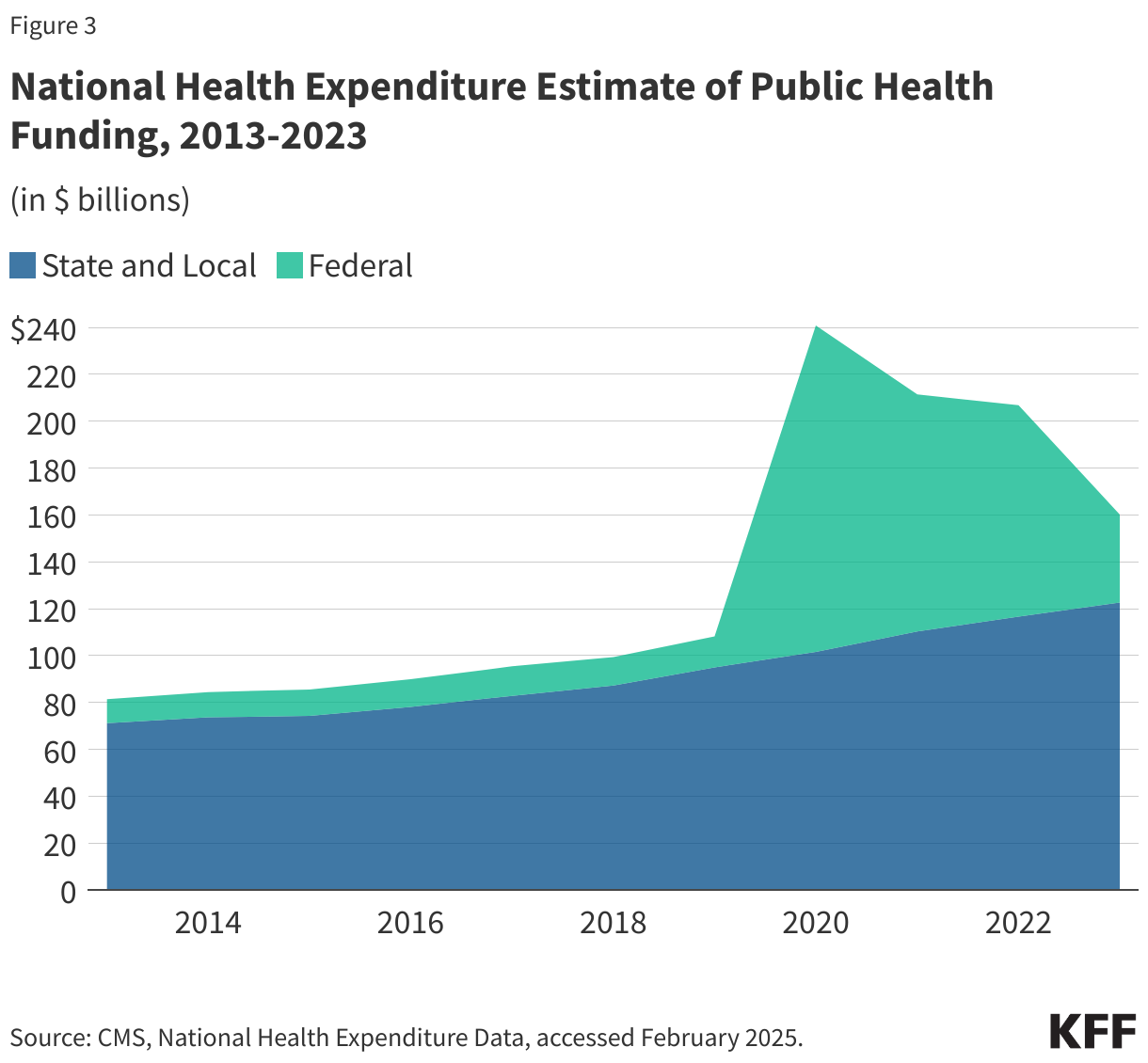
  • National public health spending estimates. One commonly cited estimate for national-level public health spending is the Centers for Medicare and Medicaid Services (CMS) Office of the Actuary’s National Health Expenditure Accounts (NHEA) data, which includes an annual Public Health Activity Estimate (PHE) for federal, and state and local spending on public health (as well as an estimate for all health spending). Figure 3 shows the PHE for federal, state and local public health spending between 2013-2023, ranging from a low of $80 billion in 2013 to a high of over $240 billion in 2020. Until 2020, these data indicated that the bulk of public health funding in the U.S. came from state and local sources. This changed during COVID-19, due to a massive increase in federal public health funding in 2020-2022 through supplemental (emergency) appropriations; the latest available data (from 2023) indicate that 3.3% of all U.S. health spending was directed to public health ($160 billion out of $4.87 trillion in total health spending). Some researchers who have studied the PHE believe it to be an overestimate of actual spending on public health.
Stacked area chart showing national public health spending from federal and state/local sources from 2013 to 2024. Total public health funding rose gradually from about  billion in 2013 to about 0 billion in 2019, surged to more than 0 billion in 2020 due to a sharp increase in federal spending, then declined but remained above pre-pandemic levels through 2024. State and local funding increased steadily throughout the period, while federal funding accounted for most of the pandemic-era spike and subsequent decline.
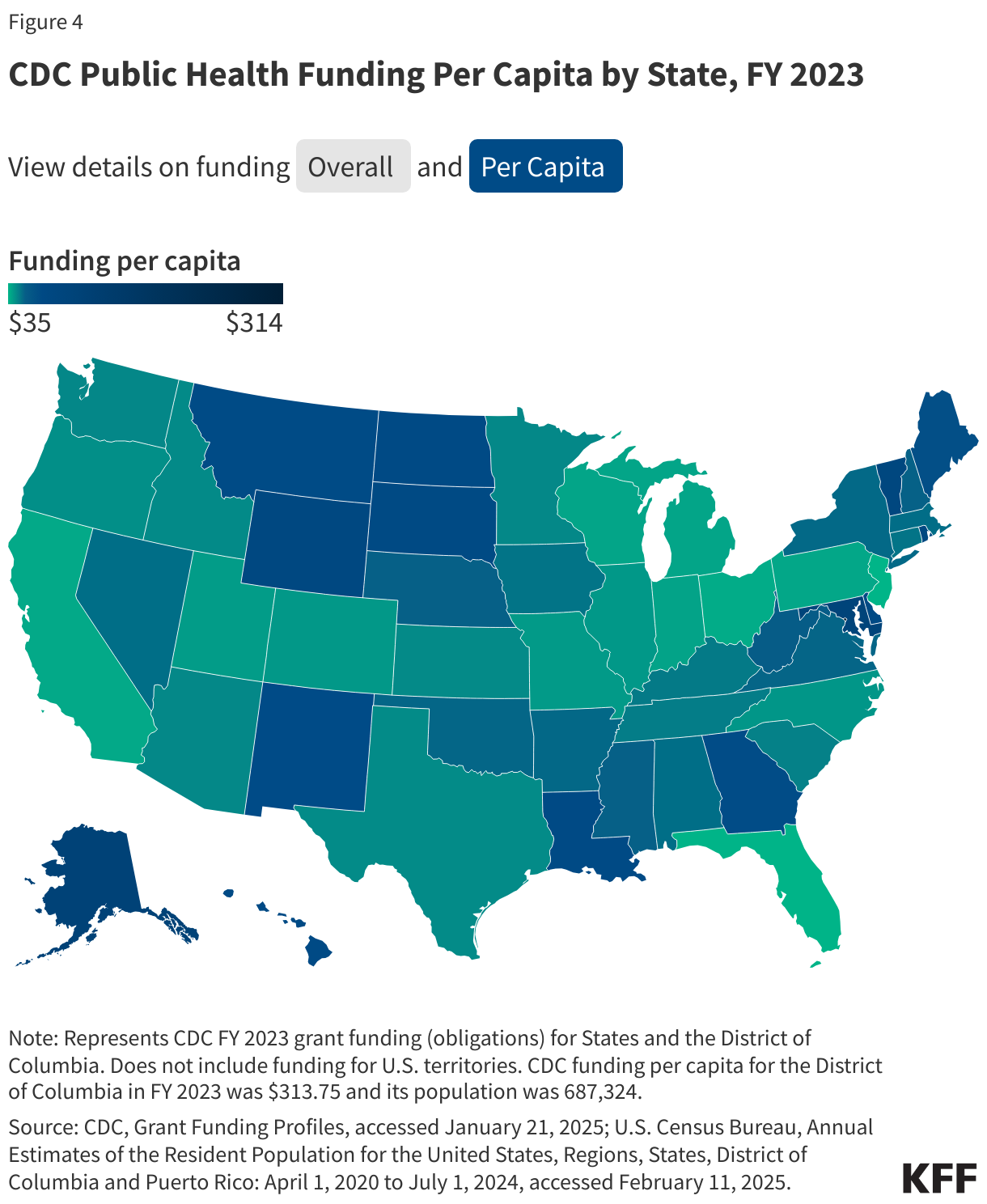
  • Individual departments and agencies. Some departments and agencies release data on how much funding they provide to public health programs nationally, which represent a subset of national public health spending amounts. For example, CDC provides annual spending data on all its grants, cooperative agreements, and emergency appropriations directed to state and local public health departments (CDC public health funding profiles). The CDC reported that it provided over $15 billion in grants to health departments across the country in FY2023, which includes funding derived from CDC’s core discretionary funds as well as mandatory funds for programs such as Vaccines for Children. The top state recipients (per capita) of CDC funds included Washington, D.C., Alaska, Maryland, and Vermont (see Figure 4).
Choropleth map showing CDC public health grant funding per capita by state in fiscal year 2023, ranging from  to 4 per resident. Per-capita funding varies widely across states, with generally higher levels in Alaska and several Mountain West, New England and Mid-Atlantic states, and lower levels in parts of the South and Midwest. The map highlights substantial geographic differences in CDC public health funding on a per-person basis.
  • State-level public health funding estimates. State spending on public health budgets comes from a combination of federal, state, and other sources. According to the ASTHO, in FY2021 (the latest data available, which came during the COVID-19 pandemic response that featured significant federal supplemental appropriations), federal sources comprised the largest share of state health department budgets (53%), followed by state sources (36%) and other sources (11%, see Figure 5).
Pie chart showing sources of state public health expenditures in fiscal year 2021, totaling .4 billion. Federal funding was the largest source at .3 billion, or 53% of expenditures, followed by state funding at .0 billion, or 36%. Other sources accounted for .1 billion, or 11%. Federal funds provided the majority of state public health spending.

ASTHO also reports that the largest category of state public health expenditure in 2021 was COVID-19 response activities, followed by clinical care services, and women, infants, and children (WIC) programs (see Figure 6). ASTHO data from 2018 (the most recent pre-pandemic year with data available) show the largest categories of public health expenditure then were clinical services (30%) and Women, Infants and Children (WIC) programs (23%).

Pie chart showing state public health expenditures by program category in 2021, totaling .4 billion. COVID-19 accounted for the largest share of spending at 31%, followed by clinical services and consumer care at 16%. Other spending categories included an aggregate “other” category at 16%, WIC at 11%, unspecified programs at 11%, quality of services at 6%, administrative functions at 4.7%, and infectious disease programs at 4.4%. COVID-19 response represented the largest single area of state public health spending in 2021.
  • Public health spending at the local (city/county/tribal) level: NACCHO reports that in 2021, local health departments drew a majority of their budgets from federal sources (55%, which included pass-throughs (26%), direct funding (25%), and Medicaid/Medicare-related sources (4%)). A further 21% came from state sources, 14% from local sources, and the remaining 10% from other sources. In 2021, NACCHO reports the mean and median annual expenditure per capita on public health by local health departments were $78 and $49, respectively.
  • Funding gap estimates: One study suggests that foundational public health capacities require an overall investment of at least $32 per person per year from all levels of government but, as of 2019 (prior to the COVID-19 pandemic), investment in public health capabilities was approximately $19 per person, indicating at least a $13 gap in annual per-capita spending on public health. While funding increased significantly during the COVID-19 pandemic, much of that support is time-limited.

Public Health Workforce

Copy link to Public Health Workforce

The public health workforce includes persons working for federal, state, and local health departments as well as those in the private sector working in community-based and voluntary organizations, hospitals and health care systems, and schools. Responsibilities for these workers can include providing health care services in public clinics, collecting and analyzing data; performing health inspections and safety monitoring at places of work, residence, and recreational facilities; developing, administering, and evaluating public health programs and policies; and providing public health education and communication services to communities, among others.

Over the last twenty years local public health departments have faced a general decline in workforce numbers in line with declines in public health budgets, with the notable exception of a rise in workforce funding due to additional federal funding (and more state and local funding) in response to the COVID-19 pandemic, although this support was time-limited. One study estimates between 2009 and 2019, the number of workers at local health departments dropped from 162,000 to 136,000, a 17% decline that translates into a loss of more than 1 worker per 10,000 residents served. Subsequently, additional funding from pandemic response led to growth in the public health workforce, even if temporarily: NACCHO estimates that in 2022 there were 182,000 public health workers at local health departments nationwide, the highest total in at least two decades. Looking specifically at the epidemiologist workforce, the Council of State and Territorial Epidemiologists (CSTE) estimates 5,706 epidemiologists worked at health departments of the 50 states and DC in 2024, which is a 38% increase over the 4,135 reported in 2021. These national numbers, however, mask an uneven distribution of the public health workforce, as rural health departments have low per-capita staffing numbers compared to large, primarily urban health departments.

Workforce retention has been an issue before, during, and after COVID-19, and is exacerbated now as pandemic-era funding expires. NACHHO and CSTE point to impending workforce losses and note that, despite the recent growth in the workforce, there is still a large gap between current staffing levels at health departments and what is needed to fully implement Foundational Public Health Services nationwide. In addition, the public health workforce faces stress, burnout, and relatively low pay, which contributes to turnover and retention issues.

Public Health Communication Challenges in an Era of Declining Trust

Copy link to Public Health Communication Challenges in an Era of Declining Trust

The Centers for Disease Control and Prevention (CDC) has defined health communication as “the study and use of communication strategies to inform and influence individual and community decisions that enhance health.”  Public health communication encompasses a broad and long-standing field of research and practice, and in the U.S. communication is recognized as one of the ten Essential Public Health Services and one of the eight Foundational Capabilities for Public Health.

There is a history of successful implementation of communications approaches to improve the public’s health. In the 20th century, for example, there were notable U.S. campaigns to raise awareness about the negative health effects of tobacco use, increase the use of seat belts, and improve nutrition and physical activity, all of which contributed to improved health across the country. 

However, implementing effective public health communication strategies can be difficult, especially in the context of a public health emergency such as an outbreak or pandemic. There is a history of U.S. public health authorities facing communication challenges to combat infectious disease epidemics, including HIV/AIDS and Ebola. More recently many of these same challenges, along with new ones, arose in the context of the COVID-19 pandemic response. 

At present, some key challenges for public health communication in the U.S. include:

  • A “fractured” system of health communicators and sources of health information that includes governmental institutions at the global, federal, state, and local level along with private organizations and individuals, which together can produce an often overwhelming amount of information, not all of which is trustworthy;
  • An evolving set of communication channels for public health information that includes traditional mass media along with a rapidly changing landscape of social media and other online communication networks;
  • A marked decline in trust in health institutions and increased skepticism of expert advice in recent years, as demonstrated in KFF polling;
  • The politicization of public health science and public health messaging, especially during and after the COVID-19 pandemic;
  • More exposure to public health misinformation (the spread of inaccurate or false information) and disinformation (the deliberate spread of false information with the intention to mislead). 

Still, there are strategies that can help address these challenges, such as:

  • Improving coordination on public health messaging among key messengers in public health;
  • Collaborating with information channels such as social media companies to understand and reduce the spread of misinformation;
  • Presenting and disseminating information from trusted sources through multiple channels;
  • Tailoring messages to intended audiences;
  • Engaging in two-way communication that encourages dialogue with members of the public and addresses questions and concerns, especially with those in the “malleable middle” who remain open to updating their opinions on health issues;
  • Proactively countering misinformation and disinformation;
  • Applying continual improvement strategies to learn from successes and failures in public health communication; and
  • Building trusted relationships with communities by engaging consistently over time, rather than only during crises.

Current Topics in U.S. Public Health

Copy link to Current Topics in U.S. Public Health

Case Surveillance, Reportable and Notifiable Diseases

Disease surveillance, which has been defined as the “ongoing, systematic collection, analysis, and interpretation of health-related data,” is a core function of the public health system. This includes collecting case information for diseases of importance, reporting and analyzing that information and investigating it if there is a need. In the U.S., responsibilities for public health surveillance activities are shared among state and local, federal, and private actors, just like for many aspects of public health.

Initial reports on cases of disease may originate from providers such as medical practitioners, hospitals, or laboratories. When a practitioner diagnoses and/or receives a positive lab result for certain conditions, this information is typically reported to the appropriate local and/or state health department, as determined by state disease reporting laws. Such reporting to state and local health departments is mandatory for a specific set of diseases, which are known as reportable diseases. The specific list of reportable diseases – most of which are infectious diseases that can pose a threat to public health – can differ between states, depending upon each jurisdiction's health priorities. Reports to state/local health departments will often include some personally identifiable data on the individual(s) diagnosed, to allow public health authorities to investigate and follow-up. This way, state and local health departments can provide necessary services to affected individuals, and also use reported information to locate the source of potential new outbreaks or health threats and intervene to prevent further spread.

In turn, state and local health departments may also send de-identified data about confirmed cases of certain diseases and conditions that are tracked nationally to the CDC. This notification is voluntary -- the federal government cannot require states to report diseases as that is a public health authority that rests at the state level. CDC does maintain a list of notifiable diseases that it requests state and local health departments provide through its National Notifiable Diseases Surveillance System (NNDSS). This list is updated every year using case definitions refined in collaboration between CDC and Council of State and Territorial Epidemiologists (CSTE). In 2023, for example, there were 123 reportable conditions on CDC’s notifiable diseases list.

Federal Declarations and Powers During Public Health Emergencies

The COVID-19 pandemic demonstrated how consequential public health emergencies can be. It presented the biggest challenge to the U.S. public health system and the largest public health response in a century, and it has had an effect on how public health is practiced across the country. In the event of a threat that is determined to represent a public health emergency, different components of the executive branch can make public health emergency declarations that unlock different flexibilities and resources for response purposes:

  • The President can issue a national emergency declaration pursuant to Section 201 of the National Emergencies Act, which will remain in effect until terminated by the President or through a joint resolution of Congress, or if the President does not issue a continuation notice annually. Such a notice was issued by President Trump for COVID-19 and was extended by President Biden. Declaring a national emergency allows the federal government to waive certain programmatic requirements related to Medicaid and Medicare, among other provisions.
  • The Secretary of HHS can declare a “public health emergency (PHE)” under Section 319 of the Public Health Service Act. A PHE lasts for 90 days and must be renewed to continue, and Congress must be notified of the declaration within 48 hours. Declaring a PHE allows the HHS Secretary the flexibility to take a number of different actions, such as: tap into emergency funds, rapidly approve grants and contracts, waive or modify requirements within health programs such as Medicare and Medicaid, adjust Medicare reimbursement policies for certain drugs, hire new temporary staff and reassign personnel, and other actions. Public health emergency declarations over the past decade have included those for COVID-19, opioids, hurricanes, wildfires, and an epidemic of Zika that began in 2016. 
  • The Secretary of HHS can also make a separate emergency declaration pursuant to Section 564 of the Federal Food, Drug, and Cosmetic (FD&C) Act, which can justify the use of emergency use authorization (EUA) for medical countermeasures needed for emergency response, such as new vaccines, treatments, and/or diagnostics. The EUA mechanism facilitates the availability and use of medical countermeasures determined to be safe and effective, but have not yet been formally approved by FDA. An emergency declaration issued pursuant to Section 564 of the FD&C Act remains in effect until terminated by the HHS Secretary. 

The HHS Secretary can also declare an emergency under the Public Readiness and Emergency Preparedness (PREP) Act (pursuant to Section 319F-3 of the Public Health Service Act), which allows the Secretary to provide liability immunity for companies and other actors for their activities and products developed and implemented to respond to a public health emergency. Such a declaration was made for COVID-19 by the Trump administration and continued by the Biden administration, which provided liability protections for vaccine manufacturers, etc.

Because most public health powers reside at the state level, the federal government has limited ability to issue nationwide mandates related to public health. However, during declared emergencies, the federal government does have expanded powers to do so, though the limits to these powers have been a point of contention during and after the COVID-19 emergency declaration. Examples include:

  • Mandates for federal workers or federal buildings/lands (mask mandate, vaccine mandate)
  • Airline and interstate travel-related mandates (e.g., mask mandates for interstate air, train, or bus travel, contact tracing/information tracking through airlines). A 1944 statute empowers the CDC “to make and enforce such regulations as in [its] judgment are necessary to prevent the introduction, transmission, or spread of communicable diseases from foreign countries into the States . . . or from one State . . . into any other . . . State.”  However, this authority has been the subject of litigation and a federal judge issued a ruling in 2022 that ended the CDC’s mask mandate for public transport during COVID-19.
  • Mandates for immigrants and international visitors (such as quarantine and isolation for incoming air passengers)

Even during emergencies, the federal government does not have the power to mandate widespread business or school closures, or vaccine mandates affecting the country’s population as a whole. State governments (and sometimes local governments), however, do have those authorities, and the federal government can make recommendations for state and local authorities to follow.

Water Fluoridation

Fluoridating water has been a long-standing public health practice in most communities across the U.S. and has been supported and recommended by the federal government for decades. The CDC considers fluoridation to be one of the most important public health interventions ever implemented. However, there has been growing scrutiny of the practice, and debates in many parts of the country about whether to continue fluoridation. Robert F. Kennedy Jr., the Secretary of Health and Human Services in the Trump administration, has long been critical of water fluoridation and has said the Trump administration will recommend that fluoride be removed from public water. Even so, key professional associationspublic health experts, and many policymakers continue to support fluoridation as an important tool for improving dental health.

While the federal government does have some role in determining water fluoridation policies nationally, it does not have legal authority to require state and local communities to fluoridate their water, nor to remove fluoridation in areas where it is already policy. Instead, these decisions – just like many public health policy decisions in the U.S. – are made at the state and local levels. There are some states that require water systems of a certain size within their state to provide fluoridated water, while others leave this decision to city, county, or other officials, or leave the choice up to voters who decide via local referendums. At the same time, the federal government – specifically the Environmental Protection Agency (EPA) – does have the primary authority to set and regulate the maximum level of fluoridation in public water systems. In addition, the CDC provides recommendations about best practices for achieving public health benefits from fluoridation that communities may choose to adopt.

Future Outlook

Copy link to Future Outlook

The public health system in the U.S. is a decentralized one, with most authorities and programs delegated to the state and local levels. This “patchwork” system can be a strength and a weakness. While it allows for tailoring public health to more local needs, it also makes more coordinated and uniform action more challenging, particularly in times of emergencies; in addition, public health services and capacity vary significantly across the country, meaning that not all communities have the same level of access and there are resulting inequities in community health status. In addition, while the COVID-19 pandemic brought more attention and funding to public health, it also brought more scrutiny and contributed to a more politicized environment concerning public health, setting up new challenges for its future, including for funding and policy.

The current Trump administration has taken a very different approach to public health compared to the Biden administration. Whereas President Biden oversaw a notable increase in public health investments and expansion of public health efforts during his presidential term, the Trump White House has implemented aggressive cuts to funding, programs, and staff at CDC, FDA, NIH and elsewhere. This includes moves to cut support for federal programs related to diversity, equity, and inclusion (DEI) and racial inequities, and those that address the health needs of LGBTQ+ people. Current HHS Secretary Kennedy stated that “nothing is going to be off limits” when it comes to policy changes at HHS, and so far, he and other staff have initiated a major reorganization, restricted NIH[RS1]  funding for health research, and requested a 25% cut in the department’s budget going forward. Vaccines, a cornerstone of public health efforts and infectious disease control, have been a target for Secretary Kennedy’s policy changes, as he announced new policies and recommendations for COVID-19 vaccines, canceled hundreds of millions of funding for mRNA vaccine research, installed anti-vaccine advocates to key staff positions, dismissed all members of a key federal vaccine advisory committee and hand-selected new members with a history of vaccine skepticism,  and vowed to change a key federal vaccine compensation program underlying the childhood vaccine market. Therefore, public health in the U.S. could be facing a turning point, and the next few years may bring continued turmoil to U.S. public health policy.

Resources

Copy link to Resources

Citation

Copy link to Citation

Michaud, J., Kates, J., Oum, S., & Rouw, A., U.S. Public Health 101. In Altman, Drew (Editor), Health Policy 101, (KFF, October 2025) https://www.kff.org/health-policy-101-u-s-public-health (date accessed).

Poll Finding

KFF Health Tracking Poll: Public Weighs Political Consequences of Health Policy Legislation

Published: Oct 3, 2025

Findings

Key Takeaways

  • As Congress debates federal health care spending as part of spending bill negotiations, including extending the enhanced premium tax credits, the latest KFF Health Tracking Poll finds three-quarters (78%) of adults say Congress should extend the enhanced tax credits for people who buy their own insurance through the ACA Marketplace. This is more than three times the share of the public (22%) who say Congress should let the credits expire. Notably, majorities across political party want Congress to extend the tax credits including nine in ten (92%) Democrats, eight in ten (82%) independents, and six in ten (59%) Republicans. A majority of Republicans who align with the MAGA movement (57%) also say Congress should extend these subsidies.
  • Both parties could face political fallout if the enhanced tax credits are not extended, though the public says they will place most of the blame on those currently in charge. About four in ten (39%) adults who want to see the tax credits extended say that if Congress does not extend these enhanced tax credits, President Trump deserves most of the blame, while another four in ten (37%) say the same about Republicans in Congress. About two in ten (22%) say that Democrats in Congress deserve most of the blame. Democrats are most likely to place blame on President Trump (56%) followed by Republicans in Congress (42%), while six in ten Republicans (61%) say they would place the blame on Democrats in Congress. Among those who buy their own coverage (nearly half of whom identify as Republican or Republican-leaning), Republicans in Congress and President Trump receive the majority of the blame (42% and 37%, respectively). 
  • Seven in ten adults who buy their own health insurance say that if the amount they paid for health insurance each month nearly doubled, they could not pay the higher premiums without significantly disrupting their household finances. In addition, four in ten (42%) say they would go without health insurance coverage if the amount they had to pay for health insurance each month nearly doubled. About a third (37%) say they would continue to pay for their current health insurance, while two in ten (22%) would get insurance from another source, like an employer or a spouse’s employer.
  • Majorities across partisanship also report that they would be concerned if they heard about something of the outcomes for both letting the tax credits expire, as well as if Congress extended the tax cuts – granted to a lesser degree. Majorities say they would be concerned if they heard that health insurance would be unaffordable for many people who buy their own coverage (86%), that 4 million people would lose their health insurance coverage (86%), or if they heard that people who work at small businesses or are self-employed would be directly impacted (85%). On the other side, if Congress does extend these enhanced tax credits, two-thirds of the public (63%) say they would be concerned if they heard that it would require significant federal spending that would be largely paid for by taxpayers.
  • Three months after the passing of the tax and budget legislation, the bill still remains largely unfavorable among the public overall – lagging far behind both the Affordable Care Act and the ACA Marketplaces in overall popularity. Many are still unsure of how the legislation will impact them personally but four in ten (43%) think it’s most likely to hurt them and their families.

Public Still Largely Unaware That ACA Enhanced Tax Credits Are Expiring, Strong Support for Congress Extending Them

On October 1st the U.S. federal government shut down as Congress was unable to pass a stopgap spending bill. As part of the discussions around the federal budget, Democrats are seeking to include the extension of the enhanced premium tax credits (ePTCs) for people who purchase their own health insurance through the ACA Marketplace that are set to expire at the end of the year.

About six in ten adults say they have heard “a little” (30%) or “nothing at all” (31%) about the expiring ACA subsidies, showing widespread lack of information on the cost of coverage for over 24 million people in the U.S.  Four in ten say (39%) they’ve heard “a lot” or “some” – up from 27% in June of this year. Even among the group whose cost of coverage is expected to double next year – those who purchase their own insurance plans – about six in ten (58%) say they have heard just “a little” or “nothing at all” about the expiration of tax credits for people who self-purchased insurance.

Democrats seem to be more aware of the pending expiration, with about half of Democrats (50%) saying they have heard at least “some” about this, compared to about a third of independents (35%) and Republicans (34%).

Stacked bar chart showing the levels of public awareness about the enhanced ACA marketplace subsidies.

Once the public is told that the expiration date for subsidies is looming, about three-quarters (78%) of adults say Congress should extend the enhanced tax credits for people who buy their own insurance through the ACA Marketplace, more than three times the share (22%) who say Congress should let the credits expire. Over eight in ten (84%) of those who buy their own insurance say that Congress should extend the enhanced tax credits.

Although Republicans are more likely than Democrats and independents to say that Congress should let the credits expire, majorities across political party want Congress to extend the tax credits including nine in ten (92%) Democrats, eight in ten (82%) independents, and six in ten (59%) Republicans, including 57% of Republicans who align with the MAGA movement. 

Split bar chart showing the shares of adults who say the enhanced marketplace tax credits should be extended and those who say they should be allowed to expire.

Previous KFF polling has shown that attitudes towards the credits shift slightly after hearing counterarguments both for and against the extension of the credits. This month’s poll shows that large majorities of the public, including majorities of Democrats, independents, Republicans, and MAGA supporters are concerned about many of the potential consequences of letting these enhanced tax credits expire. Additionally, majorities of independents and Republicans and about half of Democrats are concerned about the consequences for extending them.

More than eight in ten adults say they would be concerned, including at least half who say they would be “very concerned,” if they heard that health insurance would be unaffordable for many people who buy their own coverage (86%), that 4 million people would lose their health insurance coverage (86%), or if they heard that people who work at small businesses or are self-employed would be directly impacted (85%).

Stacked bar charts showing the level of concern adults would have if they heard about impacts of letting the ACA marketplace tax credits expire.

Concern over the possible consequences is high across party lines with large majorities of Democrats and independents saying they would be concerned about each of these potential outcomes, as well as three-quarters of Republicans and MAGA supporters.

Split bar chart showing shares by party who say they would be very or somewhat concerned to hear about impacts of letting ACA marketplace tax credits expire.

On the other side, if Congress does extend these enhanced tax credits, two-thirds (63%) of the public say they would be concerned if they heard that it would require significant federal spending that would be largely paid for by taxpayers, including a quarter (27%) who would be “very concerned.” This is predictably divided along partisan lines. More than eight in ten (83%) Republicans say they would be concerned about federal spending, but notably so do more than six in ten independents (61%) and nearly half of Democrats (49%). Republicans who support the MAGA movement are among the most worried about this issue, with almost half (47%) saying they would be “very concerned.”  

Stacked bar chart showing the levels of concern adults would have about federal spending if ACA marketplace tax credits were extended.

The poll finds more people say they would blame President Trump or Republicans in Congress than Democrats if tax credits are not extended. About four in ten (39%) adults who want to see the tax credits extended say that if Congress does not extend these enhanced tax credits, President Trump deserves most of the blame, while another four in ten (37%) say the same about Republicans in Congress. About two in ten (22%) say that Democrats in Congress deserve most of the blame, driven heavily by Republicans. Six in ten (61%) Republicans who want to see the tax credits extended say they would blame Democrats in Congress, including seven in ten MAGA Republicans, compared to one in six (17%) independents.

Over half of Democrats (56%) who want to see the tax credits extended say that if they are not extended, President Trump deserves most of the blame, though four in ten (42%) blame Republicans in Congress. Independents are largely split, with about four in ten saying they will blame Republicans in Congress (42%) or President Trump (39%).

Adults who purchased their own insurance, most of whom do so through the ACA Marketplace, are similarly split, with four in ten (42%) placing the blame if Congress does not extend the enhanced tax credits on Republicans in Congress and four in ten (37%) on President Trump. Two in ten (21%) of this group would blame Democrats in Congress if the subsidies expire. Notably, a previous KFF poll found that nearly half of adults enrolled in ACA Marketplace plans identify as Republican or lean Republican.

Stacked bar chart showing who the public would blame if Congress does not extend these enhanced tax credits.

Marketplace Enrollees Unsure How to Afford Coverage if Enhanced Tax Credits Expire

Six in ten adults who buy their own health insurance coverage think the cost of their personal health insurance would increase at least “some” if the tax credits are not extended, while about a quarter say they think it will increase “a little” (24%), or that their costs won’t increase at all (15%). Estimates are that the amount enrollees pay for premiums for ACA Marketplace plans will more than double on average and nearly 4 million people could eventually be uninsured. Notably, more than half of adults with Medicaid (54%) also say they think that if the enhanced tax credits expire the cost of their own coverage will also increase at least “some,” as do about four in ten people with Medicare age 65 and older and about half of people with employer-sponsored insurance.  It is important to note that the expiration of enhanced tax credits only directly impact people who buy their own coverage on the ACA Marketplace.

Stacked bar chart showing how much people who buy their own insurance think their health coverage will increase if the enhanced tax credits expire.

Among those who have insurance through the ACA Marketplace, seven in ten say that if the amount they paid for health insurance each month nearly doubled, they could not pay the higher premiums without significantly disrupting their household finances. Just three in ten estimate that they could pay the higher premiums.

Split bar chart showing the share of people with self-purchased insurance who say they would or would not be able to afford higher premiums if their coverage nearly doubled.

About four in ten (42%) Marketplace enrollees say they would go without health insurance coverage if the amount they had to pay for health insurance each month nearly doubled. Just over a third (37%) say they would continue to pay for their current health insurance, while about a quarter (22%) would get insurance from another source, like an employer or a spouse’s employer.

Stacked bar chart showing what the share of the public with self-purchased insurance would do if their health insurance nearly doubled.

Public Views of Major Health Care Legislation

On July 4, 2025, President Trump signed a sweeping legislative package known as the “Big Beautiful Bill,” that included significant changes to the country’s Medicaid program and the Affordable Care Act (ACA) Marketplaces. The package, which passed on a party-line vote, with no Democrats in favor, has been described as the biggest rollback of the country’s health care programs in modern history. Now, as part of federal budget negotiations, Democrats in Congress, are seeking to minimize some of these health insurance rollbacks. The latest KFF Health Tracking Poll shows both parties are playing to their bases, with Republicans strongly supporting the “Big Beautiful Bill” (BBB) legislation and Democrats largely opposed.

Overall, about four in ten (38%) adults hold favorable views of the tax and budget legislation passed earlier this year, including three-quarters of Republicans (75%) and eight in ten (82%) Republicans or Republican-leaning independents who support the MAGA movement. Democrats and independents, on the other hand, largely hold unfavorable views of the legislation, including nearly nine in ten (88%) Democrats and two-thirds (68%) of independents who say they view the law unfavorably.

Split bar chart showing the share of the public who have a favorable or unfavorable view of the "big beautiful bill".

The share of the public who say they have a favorable opinion of the tax and budget legislation has stayed relatively stable, at close to four in ten (38%), similar to 36% in July and 35% in June.

Overall favorability of the 2010 health care law known as the Affordable Care Act (ACA) continues to be at historically high levels, with about two-thirds (64%) of the public viewing the law positively. This is largely driven by Democrats and independents, with over nine in ten (94%) Democrats and two-thirds (64%) of independents viewing the law favorably, while two-thirds (64%) of Republicans have an unfavorable view. Click here to explore more than ten years of polling on the ACA.

Majorities Across Partisans View ACA Marketplaces Favorably

The ACA Marketplaces where people and small businesses can shop for health insurance are even more popular than the ACA itself, with seven in ten (70%) adults having a favorable view. The ACA Marketplaces have consistently been a more popular provision of the ACA, even before Congress passed the American Rescue Plan Act (ARPA) in 2021, which provided temporarily enhanced tax credits to adults who purchased their own health insurance through the Marketplaces. Though views of the ACA Marketplace are divided by partisanship, majorities across party lines view the ACA Marketplace positively, with eight in ten (84%) Democrats, seven in ten (69%) independents, and six in ten (59%) Republicans holding a favorable view. This also includes MAGA Republicans and Republican-leaning independents, among whom over half (56%) hold a favorable opinion of the Marketplace.

Among those who purchase their health care plan themselves, many of whom bought through the ACA Marketplace, seven in ten have a favorable opinion of the ACA health insurance exchanges or Marketplaces.

Stacked bar chart showing the public's level of favorability toward the ACA marketplaces.

Many Still Unsure How the “Big Beautiful Bill” Will Impact Them

Three months after the passing of President Trump’s major legislative achievement, the “Big Beautiful Bill,” most people remain unaware of how the effects of the tax and budget legislation will impact them. Six in ten adults say they do not have enough information as to how the legislation will impact them personally, while four in ten report that they do have enough information.

Democrats (50%) are more likely than Republicans (36%) and independents (37%) to say they have enough information about how the BBB will impact them personally. About four in ten (41%) Republicans and Republican-leaning independents who identify with the MAGA movement say they have enough information about the impact of the legislation, though majorities (59%) still do not.

The BBB legislation has made changes to the ACA Marketplaces including limiting some eligibility and shortening the open enrollment period. Among those who purchase their own health insurance, two-thirds (63%) say they do not have enough information about how the legislation will impact them. 

Split bar chart showing the share of adults who say they either have enough information or not enough information about the "big beautiful bill".

While many say they don’t have enough information about how the tax and budget legislation will affect them, partisanship once again plays a major role in public perception of the law’s impact. About four in ten (43%) say the recent legislation will generally hurt them and their families, which is twice the share who say the legislation will generally help them. More than a third of the public (36%) say the law won’t make a difference to them and their families.

Two-thirds (68%) of Democrats say the tax and budget legislation will generally hurt them and their families, as do about half (48%) of independents. Republicans are split between thinking the law will help them and thinking it won’t make a difference, with similar shares saying the law will help them and their families (43%) and saying they don’t think the law will make a difference for them (46%). Nearly half of Republicans and leaners who support the MAGA movement say the law will help them (48%) while four in ten say it won’t make a difference for them. Very few MAGA supporters (11%) say the law will hurt them.

Among those who purchase their own insurance, many through the ACA Marketplace, four in ten (42%) expect the legislation will generally hurt them and their family, while similar share (37%) expects it to not make much of a difference and just one in five (19%) say it will help.

Stacked bar chart showing the share of the public's views on how the big beautiful bill will impact them and their family.

Methodology

This KFF Health Tracking Poll was designed and analyzed by public opinion researchers at KFF. The survey was conducted September 23-29, 2025, online and by telephone among a nationally representative sample of 1,334 U.S. adults in English (n=1,255) and in Spanish (n=79). The sample includes 1,026 adults (n=64 in Spanish) reached through the SSRS Opinion Panel either online (n=1,004) or over the phone (n=22). The SSRS Opinion Panel is a nationally representative probability-based panel where panel members are recruited randomly in one of two ways: (a) Through invitations mailed to respondents randomly sampled from an Address-Based Sample (ABS) provided by Marketing Systems Groups (MSG) through the U.S. Postal Service’s Computerized Delivery Sequence (CDS); (b) from a dual-frame random digit dial (RDD) sample provided by MSG. For the online panel component, invitations were sent to panel members by email followed by up to three reminder emails. 

Another 308 (n=15  in Spanish) adults were reached through random digit dial telephone sample of prepaid cell phone numbers obtained through MSG. Phone numbers used for the prepaid cell phone component were randomly generated from a cell phone sampling frame with disproportionate stratification aimed at reaching Hispanic and non-Hispanic Black respondents. Stratification was based on incidence of the race/ethnicity groups within each frame. Among this prepaid cell phone component, 141 were interviewed by phone and 167 were invited to the web survey via short message service (SMS). 

Respondents in the prepaid cell phone sample who were interviewed by phone received a $15 incentive via a check received by mail. Respondents in the prepaid cell phone sample reached via SMS received a $10 electronic gift card incentive. SSRS Opinion Panel respondents received a $5 electronic gift card incentive (some harder-to-reach groups received a $10 electronic gift card). In order to ensure data quality, cases were removed if they failed two or more quality checks: (1) attention check questions in the online version of the questionnaire, (2) had over 30% item non-response, or (3) had a length less than one quarter of the mean length by mode. Based on this criterion, no cases were removed.

The combined cell phone and panel samples were weighted to match the sample’s demographics to the national U.S. adult population using data from the Census Bureau’s 2024 Current Population Survey (CPS), September 2023 Volunteering and Civic Life Supplement data from the CPS, and the 2025 KFF Benchmarking Survey with ABS and prepaid cell phone samples. The demographic variables included in weighting for the general population sample are gender, age, education, race/ethnicity, region, civic engagement, frequency of internet use, and political party identification. The weights account for differences in the probability of selection for each sample type (prepaid cell phone and panel). This includes adjustment for the sample design and geographic stratification of the cell phone sample, within household probability of selection, and the design of the panel-recruitment procedure.

The margin of sampling error including the design effect for the full sample is plus or minus 3 percentage points. Numbers of respondents and margins of sampling error for key subgroups are shown in the table below. For results based on other subgroups, the margin of sampling error may be higher. Sample sizes and margins of sampling error for other subgroups are available on request. Sampling error is only one of many potential sources of error and there may be other unmeasured error in this or any other public opinion poll. KFF public opinion and survey research is a charter member of the Transparency Initiative of the American Association for Public Opinion Research. 

GroupN (unweighted)M.O.S.E.
Total1,334± 3 percentage points
Party ID
Democrats418± 6 percentage points
Independents455± 6 percentage points
Republicans385± 6 percentage points
MAGA Republicans374± 6 percentage points


News Release

Despite Budget Concerns, Three-Quarters of Public Say Congress Should Extend the Enhanced ACA Tax Credits Set to Expire Next Year, Including Most Republicans and MAGA Supporters

7 in 10 Marketplace Enrollees Say They Could Not Afford Coverage if Their Premiums Doubled; 4 in 10 Say They Would Expect to Be Uninsured

Published: Oct 3, 2025

More than three-quarters (78%) of the public say they want Congress to extend the enhanced tax credits available to people with low and moderate incomes to make the health coverage purchased through the Affordable Care Act’s Marketplace more affordable, a new KFF Health Tracking Poll finds. That’s more than three times the share (22%) who say they want Congress to let the tax credits expire.

Most Republicans (59%) and “Make American Great Again” supporters (57%) favor extending the enhanced tax credits, which otherwise would expire at the end of the year and require Marketplace customers to pay much more in premiums to retain coverage. Larger majorities of Democrats (92%) and independents (82%) also support extending the enhanced tax credits, as do most people who buy their own health insurance, most of whom purchase through the Marketplace (84%).

The poll also tests the public’s response to arguments made by those who support and oppose extending the enhanced tax credits.

Among the public overall, more than eight in 10 say they would be concerned about the expirations of the tax credits if they heard that health insurance would become unaffordable for many people who buy their own coverage (86%), that about 4 million people would lose their health insurance coverage (86%), or that millions of people who work at small businesses or are self-employed would be directly impacted because they rely on the ACA Marketplace (85%).

In the other direction, a smaller majority (63%) say they would be concerned about extending the enhanced tax credits if they heard that it would require significant federal spending that would largely be paid by taxpayers. This includes a large majority of Republicans (83%) and most independents (61%).

When people who want to extend the enhanced tax credits were asked who deserves the most blame if they expire, roughly equal shares say President Trump (39%) and Republicans in Congress (37%), while a smaller share (22%) say that Democrats in Congress would deserve most of the blame.

“There is a hot debate in Washington about the looming ACA premium hikes, but our poll shows that most people in the marketplaces don’t know about them yet and are in for a shock when they learn about them in November,” KFF President and CEO Drew Altman said.

The poll was fielded just prior to the Oct. 1 federal government shutdown that was triggered in part by disagreements about whether, how and when to extend the expiring tax credits. A recent KFF analysis finds that losing that extra help would increase what Marketplace enrollees receiving financial assistance pay in premiums by an average of 114% – from $888 in 2025 to $1,904 next year.

The poll suggests that many Marketplace enrollees are going to be surprised by the jump in their premiums if the tax credits aren’t renewed in time for 2026 open enrollment period, which starts Nov. 1.

Among people who buy their own coverage (largely through the Marketplaces), about six in ten (58%) say they have heard just “a little” or “nothing at all” about the expiration of tax credits for eligible people with Marketplace coverage.

Among those who buy their own insurance, about a third (35%) expect their premiums to increase “a lot” next year.  A quarter (25%) expect their premiums to rise “some,” another quarter (24%) expect their premiums to increase “a little,” and the rest (15%) don’t expect any increase.

When asked if they could afford health coverage if their premiums nearly doubled, seven in 10 (70%) of those who purchase their own insurance say they would not be able to afford the premiums without significantly disrupting their household finances, more than twice the share (30%) who say they could afford the higher premiums.

About four in 10 (42%) Marketplace enrollees say they would go without health insurance coverage if the amount they had to pay for health insurance each month nearly doubled. Similar shares (37%) say they would continue to pay for their current health insurance, while two in 10 (22%) say they would get insurance from another source, like an employer or a spouse’s employer.

Other findings include:

  • Nearly two thirds (64%) of the public continue to hold favorable views of the Affordable Care Act overall, and a somewhat larger majority (70%) holds favorable views of the ACA’s Marketplaces. While two thirds (64%) of Republicans view the overall ACA unfavorably, most (59%) view the ACA Marketplaces themselves favorably.
  • Most (61%) of the public holds unfavorable views of the tax and budget law enacted in July, also known as the “big beautiful bill,” while about four in 10 (38%) view it favorably. Large majorities of Democrats (88%) and independents (68%) view the law unfavorably, while similar majorities of Republicans (75%) and MAGA supporters (82%) view it favorably.

Designed and analyzed by public opinion researchers at KFF, this survey was conducted September 23-29, 2025, online and by telephone among a nationally representative sample of 1,334 U.S. adults in English and in Spanish. The margin of sampling error is plus or minus 3 percentage points for the full sample. For results based on other subgroups, the margin of sampling error may be higher.

LGBTQ+ Health Policy

Table of Contents

Introduction

Copy link to Introduction

The share of individuals identifying as LGBTQ+ in the United States has increased over time, rising from just 4% in 2012 to 8% in 2023. In addition, support for same-sex marriage has also grown (27% in 1996 v. 69% as of 2024) and fewer believe there should be less acceptance for LGBTQ+ people (26% in 2001 v. 8% in 2020). Increases in identity and acceptance have been punctuated by several Supreme Court decisions providing new civil rights for LGBTQ+ people. Still, widespread stigma and discrimination persist for many LGBTQ+ people, including in health care as well as across a range of social institutions. These experiences can fuel significant health care disparities among LGBTQ+ people, challenging well-being and affecting health outcomes. Further, LGBTQ+ rights and health care access have become increasingly politicized at the federal and state levels, especially when it comes to young people.

All people’s health and health care experiences are informed by the socioeconomic context in which they live, including the policy environment. Federal and state policy can facilitate or impede access to health care for LGBTQ+ people. At the federal level, there have been both expansions as well as restrictions in protections and access over time and across presidential administrations, including the second Trump administration. Starting on the first day of his second term, President Trump began to issue numerous executive actions, several of which directly address or affect health programs, efforts, or policies designed to meet the health needs of LGBTQ+ people. These include actions that seek to limit data collection, lessen civil rights protections, restrict access to care, and remove acknowledgement of diverse sexual and gender identities. At the state level, there has been a rapid increase in the number of laws and policies impacting LGBTQ+ people’s health, especially, though not exclusively, that of young people. An increasing number of legal challenges to federal and state laws may ultimately decide access to care and the extent to which protections remain. This chapter provides an overview of LGBTQ+ people’s identities, experiences with health and health care, and the related health policy landscape.

A Note on Language

Throughout this chapter, whenever possible, we use the term LGBTQ+ to represent the full spectrum of non-heterosexual, non-cisgender people. Additionally, people who are asexual, questioning, or intersex are sometimes included under the LGBTQ+ umbrella. However, at times, the reader may encounter differences in terminology (e.g., LGBT, LGB, etc.). In these circumstances, we use language to reflect the specific data being cited. It is important to note that the language used to describe LGBTQ+ people has evolved considerably over time and will likely continue to do so.

Sex, Sexual Orientation, and Gender Identity

Copy link to Sex, Sexual Orientation, and Gender Identity

The concepts of sex, gender, and sexual orientation are discreet. However, they are often thought of as interrelated and dependent on one another, though their actual relationship is more diverse and complex:

  • Sex is often described as one’s biological categorization of being male or female based on anatomical, hormonal, and genetic factors. At birth, individuals are typically assigned a sex based on external genitalia. While sex is often thought of as a binary, as many as 1.7% of the population has been estimated to have some intersex trait, with population estimates of people with anatomical variations being lower (less than 0.5% of the population).
  • Gender identity is an individual’s sense or experience of being male, female, transgender (trans), non-binary, gender non-conforming, or something else. Gender identity may or may not align with the sex that was assigned at birth. Gender expression is the public expression of gender identity, which may occur through attire, body characteristics (e.g., hair), voice, etc. Gender expression may or may not align with traditional assumptions related to sex or gender identity.
  • Sexual orientation refers to emotional, romantic or sexual attraction to other people, often in relationship to one’s own sex and/or gender identity.

While many people and institutions historically considered these three concepts to be inseparably linked and linear (e.g., assigned the male sex at birth, identifies as male, and is attracted to women), there is wide variation in how these concepts relate, and they can be dynamic over time.

Who Are LGBTQ+ People?

Copy link to Who Are LGBTQ+ People?

It is estimated that 9.3% of U.S. adults identify as LGBTQ+, as of 2024, nearly triple the share in 2012 (3.5%), and LGBTQ+ identity is expected to continue to increase over time. This increase may reflect changes in behavior and desire, and an increased willingness to self-identify and disclose as societal acceptance has grown. Indeed, these two factors are likely interrelated. LGBTQ+ identity is strongly associated with age; younger generations self-identify at higher rates than older generations (23% of those aged 18-27 identify as LGBTQ+ compared to just 2% among those aged 79 and older). In addition, as of 2023, about 1 in 4 high school students identifies as LGBQ+. As the LGBTQ+ population ages and new generations identify at higher rates, it is expected that the share of adults who identify as LGBTQ+ will increase as well.

As such, the LGBTQ+ population is younger than the U.S. population overall. Almost half (47%) of LGBT adults are under age 30, compared to 18% of non-LGBT adults. Just 6% are 65 or older, compared to nearly one-quarter (24%) of non-LGBT adults (see Figure 1). LGBT adults are also more likely to have lower incomes and be living on less than $40,000 per year than non-LGBT adults (42% v. 33%), which may reflect their lower age. (See Table 1.)

Demographics of LGBT and Non-LGBT Adults

Within the LGBTQ+ community, identity is complex and multifaceted. Among adults who identify as LGBTQ+, the majority identify as bisexual (56%), a finding driven by younger adults, followed by gay (21%), and lesbian (15%). Smaller shares identify as transgender (14%), pansexual (1%), or in some other way (5%).

It is estimated that over 2.8 million adults and youth (over 13 years old) living in the U.S. identify as transgender or trans, which translates to 1% of all those 13 and older. A 2023 KFF/Washington Post Survey of a nationally representative sample of transgender adults in the U.S shows the trans adult population is younger than the larger cisgender adult population, with the majority of trans adults under the age of 35, echoing trends seen in the larger LGBTQ+ population. Additionally, most (70%) trans adults identify as lesbian, gay, or bisexual, compared to one in ten cisgender adults. Trans adults and cisgender adults do not notably differ when it comes to race and ethnicity or income. (See Table 2.)

Demographics of Transgender and Cisgender Adults

Most trans adults, or about 6 in 10, describe themselves as “trans, gender non-conforming” or “trans, nonbinary,” while smaller shares say they would describe themselves as a “trans woman” (22%) or a “trans man” (12%). (See Figure 1.)

Stacked horizontal bar chart shows responses from trans adults to the question, “Which of the following best describes how you think of yourself?” The largest share, 40%, identify as “Trans, nonbinary.” Another 22% identify as “Trans, gender non-conforming,” and 22% identify as “Trans woman.” About 12% identify as “Trans man.” A small remaining share identify “Some other way.”

In addition to sexual orientation and gender identity, the lives of people who are LGBTQ+ are also shaped and informed by a range of other intersectional sociodemographic factors, including race/ethnicity, income, geography, educational opportunities, language, citizenship status, disability status, and other variables, which, together, affect health access and outcomes in both positive and negative ways.

Data Collection

Having an understanding of who the LGBTQ+ community is, what challenges they face, what their health needs are, and how those differ from non-LGBTQ+ people allows policymakers, providers, and others to better meet the community’s needs. While the share of people who identify as LGBTQ+ has increased over time, the community is still a relatively small share of the overall population (approximately 8%). This makes representative data collection more difficult, particularly for sub-group analysis, since obtaining a representative sample of a small population requires a relatively larger sample size, which can be both challenging to obtain and costly. In addition to methodological challenges, in many cases, researchers, systems, and surveys simply haven’t asked about sexual orientation and gender identity. While the federal government had been moving towards greater data collection on sexual orientation and gender identity, some of that has been reversed in the second Trump administration and it is still not routine in state and local surveys, or in health systems, providers’ offices and employment, among other settings.

How data are collected is also important for reaching and understanding the needs and experiences of LGBTQ+ people. Best practice suggests data should be collected in ways that align with tested standards, conducted in culturally sensitive ways (accompanied by adequate training), secured responsibly, and then used to improve the lives of the people it represents. (See section on policy impact on LGBTQ+ people’s health.)

Stigma & Discrimination

Copy link to Stigma & Discrimination

Many LGBTQ+ people report having experienced stigma and discrimination in health care and other social institutions due to their actual or perceived sexual orientation, gender identity, and/or gender expression.

KFF polling has shown that LGBT adults face higher rates of discrimination and unfair treatment in their daily lives compared to others, with about two-thirds (65%) saying they have experienced at least one type of discrimination at least a few times in the past year, compared to four in ten non-LGBT adults. (See Figure 2.). These experiences are higher among LGBT adults who are younger and lower income.

Horizontal bar chart compares the share of LGBT adults and non-LGBT adults who report experiencing discrimination or mistreatment in daily life. About 65% of LGBT adults say they experienced at least one type of discrimination at least a few times in the past year, compared with about 40% of non-LGBT adults. The chart includes measures related to discrimination in daily interactions. Across the measures shown, LGBT adults consistently report higher rates of discrimination than non-LGBT adults.

The KFF/Washington Post Trans survey found that many trans adults say they feel discriminated against at least “sometimes” due to their gender identity or expression, with trans adults of color even more likely to report multiple types of discrimination, including because of their race or ethnicity, income level or education, or sexual orientation, reflecting how discrimination can cut across intersecting identities. (See Figure 3.)

The figure consists of three groups of stacked bars representing trans adults overall, trans adults of color, and White trans adults. It shows the basis on which trans adults overall, trans adults of color, and White trans adults say they feel discriminated. These bases include gender identity/expression, income/education level, sexual orientation, and race/ethnicity. About two-thirds of trans adults say they experience discrimination related to their gender identity or expression, regardless of their race/ethnicity. The chart shows trans adults of color are more likely to report multiple types of discrimination, including because of their race or ethnicity, income level or education, or sexual orientation.

Experiences of stigma and discrimination also occur in health care settings, in part because pathologizing LGBTQ+ identity, behavior, and desire has a long history in medicine. Indeed, much of the early language of LGBTQ+ identity has its origins in 19th-century psychiatry, which defined LGBTQ+ people in opposition to heterosexual people (and health). The early medical literature promotedthe idea that individuals with LGBTQ+ behavior or desire needed treatment, a notion that persisted for more than a century in dominant medical literature and, in 1952, homosexuality was defined as a psychiatric disorder in the Diagnostic and Statistical Manual of Mental Disorders (DSM), the tool for classifying mental health conditions in the United States; it was not removed as such until 1974 (though as a compromise APA added “sexual orientation disturbance” as diagnosis which was then replaced with “ego dystonic homosexuality” which was not removed until 1987.) While mainstream medicine has evolved from the view of needing to treat LGBTQ+ identity as a medical or psychological disorder, stigma and discrimination within medicine persist.

KFF polling shows that 6 in 10 LGBT adults report at least one of several negative experiences with a health care provider in the past three years – about twice the share of non-LGBT adults who report this. (See Figure 4.)

Horizontal bar chart titled compares the share of LGBT adults and non-LGBT adults who report experiencing discrimination or unfair treatment from a health care provider. LGBT adults are substantially more likely than non-LGBT adults to report negative experiences in health care settings, including having a provider assume something without asking, be blamed for a health problem, be ignored, or refused pain medication. 61% of LGBT adults reported at least one of those challenges, compared to 31% non-LGBT adults.

Additionally, about 3 in 10 trans adults say they have had to teach a doctor or other health care provider about trans people to receive appropriate care, had a doctor refuse to acknowledge their preferred gender identity, or been asked unnecessary or invasive questions about their gender identity that were unrelated to their care. (See Figure 5.)

Horizontal bar chart shows the share of trans adults reporting negative experiences in health care settings related to their gender identity. About three in ten trans adults say they had to teach a doctor or other health care provider about trans people in order to receive appropriate care. Similar shares say a provider refused to acknowledge their gender identity and separately asked unnecessary or invasive questions about their gender identity that were unrelated to the reason for their visit. 17% were denied gender affirming care.

Experiences of stigma, discrimination, and mistreatment based on sexual orientation or gender identity occur in multiple non-health care environments and institutions as well, and these also negatively affect health and well-being.

Hate crimes, defined as “bias against people or groups with specific characteristics that are defined by the law,” have negative effects on health, including both physical and psychological harm, and LGBTQ+ people are more likely to experience hate crimes than non-LGTBQ+ people. According to the FBI, in 2023, more than 1 in 5 hate crimes (23%) were related to being LGBTQ+. In 2022, of crimes related to being LGBTQ+, 17% were based on sexual orientation and 4% on gender identity, accounting together for 2,416 crimes in total. Hate crimes against gay men accounted for nearly half (45%) of these, followed by crimes against a combined group of LGBT people (26%), and then transgender people (14%). A smaller share was reported against lesbians (8%), gender non-conforming people (5%), bisexual people (1%), and heterosexual people (1%). (Notably, whether a hate crime gets reported to the FBI and how it is defined are highly variable, so these statistics are likely an underrepresentation of actual crimes that occur.) (See Figure 6.) LGBT+ people are also nine times more likely to self-report that they have experienced a hate crime than non-LGBT+ people.

LGBTQ Related Hate Crimes Reported to the FBI, 2022

Sexual violence, in particular, is a common experience among LGBTQ+ people relative to non-LGBTQ+ people and is especially high among bisexual women and gay and bisexual men. Bisexual women report higher lifetime experiences with rape, other sexual violence and stalking, and lesbian women report higher rates of sexual violence and unwanted sexual contact across their lifetimes than heterosexual women. Gay and bisexual men report higher rates of sexual violence, unwanted sexual experiences, and sexual coercion than heterosexual men, with gay men also reporting higher rates of stalking across their lifetimes than heterosexual men.

Transgender people also face higher rates of intimate partner violence and are more likely to be the victim of a violent crime, with surveys finding that trans people report high rates of violence across a range of measures. KFF polling shows that a majority of trans adults (64%) say they have been verbally attacked and 1 in 4 say they have been physically attacked because of their gender identity, gender expression, or sexual identity. The share of trans adults who have been physically attacked because of their gender identity increases to 31% among trans people of color.

Young LGBTQ+ people are also impacted by higher rates of bullying and violence, including sexual violence, compared to non-LGBTQ+. LGBTQ+ high school students report higher rates of being bullied than non-LGBTQ+ students, with LGBTQ+ students about twice as likely as non-LGBTQ+ students to report that they have been bullied on school property (29% v. 16%) or to report electronic bullying (25% v. 13%). Additionally, LGBTQ+ high school students are twice as likely to report having been injured or threatened with a weapon at school compared to non-LGBTQ+ students (14% v. 7%). Experiences with sexual violence generally (20% v. 8%) and forced sex in particular (17% v. 6%) were also more common among LGBTQ+ high school students than non-LGBTQ+ high school students. (See Figure 7.)

The grouped bar chart compares LGBTQ+ and non-LGBTQ+ high school students experiences related to bullying and violence in 2023. LGBTQ+ students report higher rates than non-LGBTQ+ students across all categories shown: being bullied on school property (29% vs. 16%), electronic bullying (25% vs. 13%), being injured or threatened with a weapon at school (14% vs. 7%), experiencing sexual violence (20% vs. 8%), and experiencing forced sex (17% vs. 6%).

LGBTQ+ people’s disproportionate experiences of maltreatment, stigma, and discrimination can have a significant and negative impact on present and future mental health. Indeed, LGBT adults who had recent experiences with at least one form of discrimination in the past year are more likely to report feeling always or often lonely (42% v. 15%), depressed (38% v. 21%) or anxious (65% v. 34%) than those who rarely or never experienced discrimination in daily life. Additionally, larger shares of LGBT women, younger LGBT adults, and lower-income LGBT adults report regular feelings of anxiety, loneliness, or depression. While other underlying factors beyond discrimination may contribute to these differences, the relationship between feelings of loneliness, anxiety, and depression and experiences with discrimination among LGBT adults remains significant even after controlling for race/ ethnicity, education, income, gender, and age (see section on mental health below). (See Figure 8.)

The grouped bar chart shows differences in experiences of ongoing anxiety, loneliness, and depression among LGBT adults, looking at these experiences among LGBT adults who experienced discrimination in the past year and those who did not. Among those who experienced discrimination, 65% of LGBT adults report feeling anxious always or often anxious, compared with 34% among those who did not. Thirty-eight percent of LGBT adults experiencing discrimination report feeling always or often depressed, compared with 21% among those who did not. Forty-two percent of LGBT adults experiencing discrimination report feeling always or often lonely, compared with 15% among those who did not.

Health Coverage and Access

Copy link to Health Coverage and Access

Overall, LGBT people report similar rates of being uninsured as non-LGBT people (9% v. 10%). LGBT adults, who are notably both younger and lower income than the general population, have higher rates of Medicaid coverage (25% v. 15%) and lower rates of Medicare coverage (8% v. 22%). They are slightly more likely to be covered by private insurance than non-LGBT adults (57% v. 51%). (See Figure 9.)

The grouped bar chart compares health insurance coverage among LGBT adults and non-LGBT adults. Both groups report similar rates of being uninsured (9% for LGBT adults vs. 10% for non-LGBT adults). LGBT adults are more likely to have Medicaid coverage (25% vs. 15%) and slightly more likely to have private insurance (57% vs. 51%). In contrast, LGBT adults are less likely to have Medicare coverage (8% vs. 22%) compared to non-LGB+ adults.

Research has found that having a usual source of care is associated with increased use of preventive care and better health outcomes, but LGBT people are more likely to report not having a usual source of care than non-LGBT people (19% v. 12%). (From KFF’s Survey of Racism, Discrimination, and Health). One study found that LGBTQ people were more likely to lack access to providers, delay care, face issues taking medications due to cost, and have fewer routine checkups than heterosexual cisgender people.

KFF polling has also found that many LGBT adults say negative health care experiences have affected their willingness to seek care, their health care coverage, and their physical health. For example, LGBT adults are significantly more likely than non-LGBT adults to report that having a negative health care experience in the last three years caused their health to get worse (24% v. 9%), made them less likely to seek health care (39% v. 15%), or caused them to switch health care providers (36% v. 16%).

LGBTQ+ People's Health Today

Copy link to LGBTQ+ People's Health Today

While in some areas, the health experiences of LGBTQ+ people mirror those of non-LGBTQ+ people, in other areas, LGBTQ+ people face disparities in health outcomes due to their sexual orientation and gender identity, as well as other factors such as race/ethnicity, class, nationality, and age. Disparities related to mental health, substance use, and sexual health are especially apparent, and LGBTQ+ people also experience certain chronic conditions at higher rates than heterosexual and cisgender people. In some cases, these are driven by social factors such as the biosocial impact of experiencing stigma and discrimination, higher rates of alcohol use and smoking, and obesity. They may also stem from fear of engaging with the health system, including from past experiences of discrimination, which may lead to forgoing routine screening or needed care.

There may also be a link between health care access, competency, and affordability (discussed above) and the ability to detect, control and treat disease. For example, research has found that transgender and gender-diverse people are both less likely to receive cancer screenings and also have a higher incidence of HIV- and HPV-associated cancers.

Overall Health Status

Despite being a younger population, a group traditionally reporting higher levels of well-being, LGBT people are more likely to report being in fair or poor physical health than non-LGBT people (26% v. 19%).

LGBT+ people also report that they are managing chronic conditions and living with disabilities that impact daily life at higher rates than non-LGBT+ people. Half (50%) of LGBT+ people reported that they had an ongoing health condition that requires regular monitoring, medical care, or medication, compared with 45% of non-LGBT+ people. Additionally, one-quarter (25%) of LGBT+ people reported having a disability or chronic disease that keeps them from participating fully in work, school, housework, or other activities, compared with 16% of non-LGBT+ people.

Likewise, a larger share of LGBT+ people report taking at least one prescription medication on a regular basis than non-LGBT+ people (62% v. 55%). This includes more than half (54%) of young LGBT+ adults (ages 18 to 24) who reported regularly taking a prescription compared to just over one-third (36%) of non-LGBT+ adults in the same age group.

Chronic Conditions

Studies have found disparities in certain chronic conditions among LGBTQ+ people, including reports of higher rates of diabetes among lesbians and gay and bisexual men and higher rates of cardiovascular diseases and cancers in certain populations. One study found LGBTQ+ survey respondents were more likely to report having asthma, arthritis, diabetes, kidney disease, hypertension, cardiovascular disease, heart attack, stroke, and chronic obstructive pulmonary disease (COPD) than non LGBTQ+ respondents.

HIV and STIs

There are significant HIV and STI-related disparities among gay and bisexual men, other men who have sex with men, and transgender women compared to other groups and the population as a whole. These disparities may arise for a range of reasons, including sexual networks, differences in behavior, and biological or social factors. In addition, increased incidence of HIV and STIs can, in turn, put these groups at higher risk for other comorbid conditions like other STIs and certain cancers. Nearly three-quarters (71%) of people diagnosed with HIV in 2022 were gay and bisexual men or other men who have sex with men, and of those, young Black and Latino men were disproportionately represented. (See Figure 10.)

Nearly Three-Quarters of HIV Diagnoses in 2022 Were Among Gay and Bisexual Men and Other Men Who Have Sex with Men, Most Were Among Black and Hispanic Men

A meta-analysis estimated that 14% of transgender women and 3% of transgender men are HIV positive. Black and Hispanic transgender women are disproportionately impacted, with prevalence estimates of 44% and 26%, respectively.

Among those seeking care at STD clinics, gay and bisexual men are more likely to test positive for gonorrhea and chlamydia than women or heterosexual men. An estimated 58% of cases of primary and secondary syphilis reported among men with known sex of sex partners in 2023 were among gay and bisexual men and other men who have sex with men, and cases have increased significantly over the past decade. Additionally, the 2022 mpox outbreak occurred almost exclusively among gay and bisexual men and other men who have sex with men, with Black and Hispanic men being especially impacted. While data are limited on gender identity and STIs, studies have indicated that incidence and prevalence levels of gonorrhea and chlamydia among transgender women are similar to those among cisgender gay and bisexual men.

Mental Health and Substance Use

LGBTQ+ people face greater mental health challenges and disparities than non-LGBTQ+ people, including in accessing mental health care. The drivers of these disparities are complex and may relate, in part, to widespread experiences of stigma and discrimination (as described above). Current attempts to institute anti-LGBTQ+ policies in many states and communities may contribute to poor mental health outcomes and increase the need for care.

LGBT adults are more likely than non-LGBT adults to describe their mental health and emotional well-being as either “fair” or “poor” (39% v. 16%). LGBT adults with household incomes below $40,000 are about twice as likely as LGBT adults with higher incomes to report fair or poor mental health (55% v. 27%), as are LGBT adults ages 18-29 compared to those ages 50 and older (56% v. 24%). Across racial and ethnic groups, about 4 in 10 Black (40%), Hispanic (35%) and White (41%) LGBT adults describe their mental health as fair or poor. (See Figure 11.)

The figure shows two columns of bar charts comparing self-reported mental health status between LGBT adults and non-LGBT adults by different variables. Overall it show 39% of LGBT adults describe their mental health as fair or poor, compared with 16% of non-LGBT adults. LGBT adults who are younger or lower income are most likely to report poor or fair mental health.  Differences are smaller by gender and similar across race/ethnicities.

More specifically, about half (54%) of LGBT adults report feeling anxious either “always” or “often” in the past year, while a third report feeling lonely (33%) or depressed (32%) “always” or “often” – more than twice the shares of non-LGBT adults who report the same. As noted earlier, those who experienced recent discrimination were more likely to report these feelings than those who did not. 

LGB adults also report having serious thoughts of suicide, making a suicide plan, or attempting suicide at higher rates than non-LGB adults, with disparities especially pronounced among bisexual adults. LGB adults also report higher rates of substance use and substance use disorder (SUD) than non-LGB adults, with rates especially high among bisexual adults.

KFF’s polling of trans adults shows that many struggle with serious mental health issues, including 4 in 10 (43%) who say they have had suicidal thoughts in the past year. Trans adults are about six times as likely as cisgender adults to say they have engaged in self-harm in the past year, and more than twice as likely to say they have had an eating disorder in the past year or had suicidal thoughts in the past year. (See Figure 12.)

The figure consists of three groups of stacked bars representing trans adults, LGBT adults, and cisgender adults. It shows the share each group has experienced specific mental health challenges. These include having the had done the following in the past 12 months: suicidal thoughts, an eating disorder, misused drugs or alcohol, engaged in self-harm. The chart shows many trans adults struggle with serious mental health issues, at times at higher rates than LGBT people overall and consistently more commonly than cisgender adults. This includes 43% of trans adults who say they have had suicidal thoughts in the past year compared to 34% of LGBT adults and 16% of cisgender adults and 17% who engaged in self-harm compared to 10% of LGBT adults and 3% of cisgender adults.

Mental health disparities are especially significant among young LGBTQ+ people. In 2023, more than half (53%) of LGBTQ+ high school students reported poor mental health in the past 30 days compared to 1 in 5 (21%) non-LGBTQ+ students and more than twice as many reported persistent feelings of sadness or hopelessness over the past year (65% among LGBTQ+ students compared to 31% among non-LGBTQ+ students). In addition, 41% of LGBTQ+ high school students reported having seriously considered suicide during the past year, with 20% having attempted suicide, rates that are substantially higher than for non-LGBTQ+ students (13% and 6%, respectively). (See Figure 13.)

A Bar chart compares LGBTQ+ and non-LGBTQ+ high school students across several mental health measures. LGBTQ+ students report substantially higher rates of poor mental health in the past 30 days (53% vs. 21%), persistent feelings of sadness or hopelessness during the past year (65%b vs. 31%), seriously considering suicide during the past year (41% vs. 13%), and attempting suicide during the past year (20% vs. 6%).

Substance use rates were also higher among LGBTQ+ high school students than their non-LGBTQ+ peers.LGBTQ+ students and students with any same-sex partners were more likely to engage in a range of substance use behaviors than their peers, including use of alcohol, marijuana, any illicit drug, vaping, and prescription opioids.

In addition to higher reported rates of mental health challenges, LGBT people, particularly those in fair or poor mental health and younger adults, report greater challenges accessing mental health care and are more likely to report forgoing needed mental health care than non-LGBT adults. About half (46%) of LGBT adults say there was a time in the past three years when they thought they might need mental health services but didn’t get them, more than twice the share of non-LGBT adults who say so (20%). Reported challenges to care include affordability and accessibility of providers, including finding a provider who can relate to their background and experiences.

Best Practices for Competent Care

Copy link to Best Practices for Competent Care

Access to competent and inclusive health care that meets the needs of LGBTQ+ people can improve engagement with the health system and, ultimately, health outcomes.

The American Medical Association (AMA) provides recommended standards of practice with LGBTQ patients and resources to help make medical practices LGBTQ-friendly, such as including posters, brochures, and other materials that are LGBTQ-inclusive, revising intake materials to be affirming and inclusive, and participating in further provider education.

Similarly, the American Psychiatric Association also provides guidance, including acknowledgment of the role the association played in perpetuating stigma for LGBTQ+ people in the past and guiding practitioners to not make assumptions about sexual orientation or gender identity in gathering medical information, reminding providers that families can be helped to move towards more acceptance of LGBTQ+ children to improve their mental health, and explicitly coming out against ‘conversion or reparative’ therapy. Indeed, the use of “conversion therapy” is condemned among all major health groups, 28 of which signed a 2023 joint statement against its use, stating that such interventions are both ineffective and harmful, and about half of states have enacted a ban on coverage therapy for minors.

Other resources highlight the importance of language use in caring for LGBTQ+ people, including when it comes to how sexual orientation and gender are discussed and described and how patients are addressed with respect to names and pronoun use. Leadership “buy-in” and the role of LGBTQ+ champions are also highlighted, as are the benefits of inclusive policies. Data collection used to improve health outcomes, staff training, and partnering locally with the LGBTQ+ community are also noted as ways to be a more affirming practice.

Providing health care services or competent referrals for health services that are disproportionately needed by the LGBTQ+ community is another way to offer inclusive care. This might include behavioral health services, STI care and screening, or inclusive family planning services. Another such service is gender affirming care (see below).

Gender Affirming Care

Copy link to Gender Affirming Care

Gender affirming care is a model of care which includes a spectrum of “medical, surgical, mental health, and non-medical services for transgender and nonbinary people” aimed at affirming and supporting an individual’s gender identity.Gender affirmation is highly individualized. Not all trans people seek the same types of gender affirming care or services and some people choose not to use medical services as a part of their transition. Gender affirming care is tailored to an individual’s needs across the lifespan.

Virtually all major U.S. medical associations support youth access to gender affirming care, including the American Medical AssociationAmerican Academy of Pediatrics, and the American Psychological Association, among others. In particular, these groups point to the evidence demonstrating that medically necessary gender affirming care enhances mental health outcomes for transgender youth, including by reducing suicidal ideation. Professional guidance for gender affirming care, including for young people, is provided by the Endocrine Society and the World Professional Association for Transgender Health, bodies that also support access to this care model.

There is no one way to transition. KFF polling finds commonly utilized gender affirming activities are related to a social transition, such as changing the types of clothes worn (77%), changing hairstyles/grooming habits (76%), or going by different pronouns (72%). Slightly fewer, but still a majority, of trans adults use a different name than the one on their birth certificate (57%). Fewer than half of trans adults report attending counseling or therapy as a part of their gender transition (38%) (which is sometimes a requirement for other gender affirming care), legally changing their name on identifying documents (24%), or using hormone treatments or puberty-blocking hormones (31%) Despite common rhetoric, surgical care is a rare component of gender affirming care, with just 16% of trans adults reporting having received gender-affirming surgery. While the number of young trans people using puberty blockers or hormone therapy has increased modestly in recent years, the overall number of those using these prescriptions remains fairly low and multiple studies have shown gender affirming surgery is extremely rare among minors.

Lack of insurance coverage for gender affirming care is a barrier to receiving these services. KFF’s polling finds, for example, that among trans adults with health insurance, about a quarter (27%) say their insurance covers gender affirming treatment or health care, while 14% say their health insurance does not cover this and 6 in 10 (58%) are unsure. One in 5 trans adults say they have had health insurance that would not cover gender affirming treatments or health care (22%). About 1 in 7 trans adults have changed jobs or health insurance in order to get gender affirming treatments or health care. (See Figure 14.)

This bar chart, titled “One in Five Trans Adults Say They Have Had Health Insurance That Would Not Cover Gender Affirming Treatments or Gender Affirming Care” presents experiences related to insurance coverage for gender-affirming care among trans adults. 22% of trans adults say their insurance would not cover gender-affirming health care, 15% say they have changed jobs or to get insurance covering care, 14% say they changed health insurance providers to get coverage, and 14% say they have gone on someone else’s insurance to get coverage.

Despite the evidence around the role gender affirming care can play in promoting well-being for young people and support from the medical community, some have argued against this care claiming that the services are experimental and lack an evidence base or that young trans people commonly change their minds about their gender identity. The Trump administration, in particular, has moved to limit access to gender affirming care, particularly for youth, through executive orders and other actions (see discussion below). The administration has also promoted misinformation about gender affirming care relating to issues like regret rates, how common surgical care is, and conflating it with female genital mutilation. It has stated that it will seek to prohibit providers receiving federal funding from providing certain gender affirming care services to minors. To date, more than half (27) of US states (as of July 2025) have enacted restrictions on gender affirming care for minors (discussed further below). As a result, young people may be unable to get medically necessary care depending on where they live and the resources their families have. Research has demonstrated that young transgender people’s mental health is negatively impacted when this care is denied, including leading to an increased risk of suicidality. Further, claims around lack of evidence and regret are not borne out by the data and, in fact, the very same services are provided to young people in other medical circumstances without controversy. 

Policy Impact

Copy link to Policy Impact

Policymaking, including in health care, can both facilitate and hinder access to care and coverage, and ultimately, health outcomes, for LGBTQ+ people. Recent examples of how policymaking addresses LGBTQ+ people’s health include:

Supreme Court of the United States (SCOTUS) Decisions: Several recent Supreme Court decisions have impacted the health and well-being of LGBTQ+ people. SCOTUS decisions regarding marriage equality have been particularly far reaching with both the Windsor (2013) and Obergefell (2015) decisions providing same-sex married couples with legal access to spousal health insurance benefits for the first time, among other changes. In Bostock (2019), SCOTUS ruled that in the context of employment, discrimination based on sex encompasses sexual orientation and gender identity—a decision that was subsequently used to support extending sex protections in health care to LGBTQ+ people (see discussion of Section 1557 below). In June 2025, in United States v. Skrmetti, SCOTUS ruled that a Tennessee law banning gender affirming care for minors did not violate the 14th Amendment’s Equal Protection clause, allowing it and other similar laws to remain in place, resulting in a continued patchwork of access. On March 10, 2025, SCOTUS granted certiorari in Chiles v. Salazar and will review a challenge to Colorado's conversion therapy ban for minors, assessing “whether a law that censors certain conversations between counselors and their clients based on the viewpoints expressed regulates conduct or violates the Free Speech Clause.” 

  • Section 1557: One area that has received significant attention over the last decade is Section 1557 of the Affordable Care Act (ACA). Section 1557 prohibits discrimination on the basis of a range of factors, including sex, and applies to health programs and activities receiving federal financial assistance (referred to as covered entities). Specifically, it prevents covered entities from discriminating against certain protected groups in providing health care services, insurance coverage, and program participation. Across different Presidential administrations, lengthy rulemaking and court challenges have affected the application of Section 1557, particularly around whether sexual orientation and gender identity should be encompassed in sex protections. The Obama administration interpreted the statute to include protections on the basis of gender identity and sex-stereotyping, laying out specific protections for trans people, while the Trump administration removed such protections. The Biden administration has since restored and expanded on protections, including by also interpreting sex protections to protect against discrimination on the basis of sexual orientation, following the Bostock decision. As of May 2025, the Trump administration had not yet issued rulemaking on Section 1557, but multiple executive orders suggest that the administration will view sex narrowly, laying the groundwork for removing explicit protections for LGBTQ+ people.
  • Mental Health: Policy can also positively or negatively impact the mental health of the LGBTQ+ community. For example, 988, the federally-mandated suicide and crisis line, supported by the Substance Abuse and Mental Health Services Administration (SAMHSA), historically included specific services to meet the needs of LGBTQ+ young people. While the service represented 10% of all contacts to 988 funded by Congress, the Trump administration ended this service in July 2025. Under the Biden administration, SAMHSA released a “road map” for supporting LGBTQ+ youth, an LGBTQI+ Family Support Grant providing nearly $2 million in funding for programs that address behavioral health for LGBTQ youth, and more than $5 million for “Family Counseling and Support for Lesbian, Gay, Bisexual, Transgender, Queer/Questioning, Intersex+ Youth and their Families,” and also funded the Center of Excellence: LGBTQ+ Behavioral Health Equity aimed at supporting “implementation of change strategies within mental health and substance use disorder treatment systems to address disparities impacting the LGBTQ+ community.” The Biden administration issued a rule to better protect LGBTQ+ youth in foster care. In addition to federal efforts, some states are also electing to highlight and address the behavioral health needs of LGBTQ+ people, sometimes through the use of federal funds. On the other hand, there is evidence that the promulgation of state laws and policies restricting access to LGBTQ+ health and other services negatively affects the mental health of the community. The Trump administration’s approach to LGBTQ people’s health has differed significantly. Following President Trump’s campaign promises, the administration has prioritized actions and policymaking aimed at limiting young people’s access to gender affirming care and, in some cases, denying existence of transgender people and fueling misinformation about transgender and intersex people and trans health care. The administration has reversed Biden-era agendas, roadmaps, and interpretations of civil rights protections regarding LGBTQ people’s well-being. Collectively, these actions can have a negative impact on well-being and access to medically necessary best practice care.
  • Gender affirming care: As noted above, the Trump administration has taken a range of actions and made proposals to limit gender affirming care for minors, differing from the Biden administration which had supported access to this care on principles of equity and well-being. These orders have generally sought to restrict access to services, limit research related to gender diversity, and stated that the federal government will only acknowledge two sexes and will not recognize diverse gender identities, including transgender people. As of July 2025, most of these actions do not formally prohibit entities from providing care, but they have led to a climate of fear and a chilling effect, with many providers walking back gender affirming care services for minors. Actions that led to this include creating an FBI tip line to report clinicians providing surgical care to minors, detailed collection of personal and institutional information offering gender affirming care, issuing subpoenas, and explicitly stating that the administration is seeking to make providing gender affirming care to minors a violation of terms of condition for participation in the Medicare and Medicaid programs, among others. Further actions limiting access are expected, as is litigation challenging these restrictions. The administration also released an evidence review related to information about treatment of gender dysphoria, concluding that the quality of evidence on the effects of intervention is low, and evidence on harms is “sparse.” It also states that there are significant risks and supports the use of psychotherapeutic approaches, including an approach termed “exploratory therapy”, which can include conversion therapy, departing from most U.S. medical associations. While the report has been used to promote restrictions, it has also faced criticism including for its approach to the review and promotion of misinformation, among other factors. Impacting both adults and minors, the administration also adopted a policy that would not require broad financial protections in the individual market and small group health insurance marketplaces from applying to gender affirming care.
  • Data collection: (See also callout box on data collection.)Better understanding who the LGBTQ+ community is and what challenges they face allows policymakers, providers, and other individuals and groups to meet their needs better and provide care and coverage that is culturally competent. Addressing care needs may happen in the provider’s office, at the health system level, or in the policy arena. Research on LGBTQ+ people and health has generally increased over time though that trend is currently reversing at the federal level. Both the Obama and Biden administrations implemented a range of efforts to improve collection and reporting of data on LGBTQ+ people. For example, in 2016, the NIH designated sexual and gender minorities (SGMs) as a health disparity population for research purposes. In doing so, NIH recognized the health disparities faced by this population and that “the extent and causes of health disparities are not fully understood, and research on how to close these gaps is lacking.” Many federal surveys also began to ask sexual orientation and gender identity (SOGI) questions, including the Behavioral Risk Factor Surveillance System Survey, the National Survey on Drug Use, the National Health Interview Survey, and the Youth Risk Behavior Survey, though data collection was not routine and it was sometimes an optional variable for states or a restricted variable for researchers. The Biden administration also issued an executive order calling for agencies to enhance routine collection of SOGI data to improve outcomes and address disparities, and an implementing roadmap in a Federal Evidence Agenda. However, SOGI data collection has become politicized. The first Trump administration sought to roll back some of the activities of the Obama administration, and these efforts have intensified in President Trump’s second term. On his first day in office President Trump rescinded the Biden-era executive order on data collection and issued executive orders taking a narrow view of sex and removing recognition of gender identity and limiting diversity, equity, inclusion, and accessibility (DEIA) activities in government programs, which led to limiting data collection efforts. A range of datasets, questionnaires, codebooks, reports, and other documents were removed from federal websites in the early days of the administration (some of which have been reposted due to a court order)and SOGI data collection in major surveys, including the Census, have been discontinued to comply with executive orders. Beyond survey data, data collection is also limited by efforts to rescind LGBTQ related research funding. Data collection efforts are also variable at state and health system levels and, if not reliant on federal funding, may be able to continue.
  • State and Local Policymaking: While federal policymaking plays an important role in individuals’ lives, so too does state and local policymaking, perhaps, especially so in health care. Over the past few years, there has been a rash of policymaking addressing LGBTQ+ people’s health. Policies have both aimed to expand protections and well-being for LGBTQ+ people and sought to restrict access to care or loosen antidiscrimination standards. For example, as of July 2025, over half of states have enacted policies aimed at limiting or prohibiting youth access to gender affirming care and most of this policymaking took place within an 18-month period . Other states have enacted “refuge laws” (also known as “shield laws”) that generally aim to protect individuals, families, and providers living in states where these bans have been enacted. State policymaking has also focused on LGBTQ+ people and access to services through private and public insurance coverage. For example, while some states expressly prohibit insurers from discriminating against people based on sexual orientation and gender identity, others are silent on the issue. Similarly, some state Medicaid programs explicitly cover gender affirming care, others have exclusions, and some have no clear policy; even those that do cover this care may not cover all the services an individual needs. About half of states have enacted laws banning conversion therapy for minors, but the Supreme Court is set to hear a challenge to Colorado’s ban in the fall of 2025. Finally, some LGBTQ+ related policy is not overtly health-related but has the potential to impact well-being. For example, preventing schools from adopting LGBTQ+ anti-bullying policies or enacting laws that require school staff to out transgender youth to their families stand to negatively impact health outcomes.

Future Outlook

Copy link to Future Outlook

Despite the increase in the share of people identifying as LGBTQ+ and in public support for LGBTQ+ relationships and protections against discrimination, LGBTQ+ people continue to face health disparities and worse health outcomes in several areas. In many cases, these are directly related to ongoing experiences of stigma, discrimination, and violence. Policy efforts to address health disparities among LGBTQ+ people, including those tied to experiences of stigma and discrimination, had increased over time but under the second Trump administration are reversing, with numerous executive branch actions designed to limit access to care and remove protections for LGBTQ+ people.  More generally, there has been growing partisanship in some areas of LGBTQ+ rights and access, particularly for LGBTQ+ youth, and a rise in the number of policies and laws that restrict access to recommended care. Monitoring these policies, the shifting legal landscape, and better understanding the actual experiences of LGBTQ+ people will help inform efforts to address and mitigate health disparities for this population moving forward.

Resources

Copy link to Resources

Citation

Copy link to Citation

Dawson, L., Kates, J., Montero, A., and Kirzinger, A., LGBTQ+ Health Policy. In Altman, Drew (Editor), Health Policy 101, (KFF, October 2025) https://www.kff.org/health-policy-101-lgbtq-health-policy/ (date accessed).

Congress and the Executive Branch and Health Policy

KFF Authors:

Table of Contents

Introduction

Copy link to Introduction

The federal government is not the only place health policy is made in the U.S., but it is by far the most influential. Of the $4.9 trillion the U.S. spent on health in 2023, the federal government was responsible for roughly a third of all health services. The payment and coverage policies set for the Medicare program, in particular, often serve as a model for the private sector. Many health programs at the state and local levels are also impacted by federal health policy, either through direct spending or rules and requirements. Federal health policy is primarily guided by Congress, but carried out by the executive branch, predominantly by the Department of Health and Human Services. 

The Federal Role in Health Policy 

Copy link to The Federal Role in Health Policy 

No one is “in charge” of the fragmented U.S. health system, but the federal government probably has the most influence, a role that has grown over the last 75 years. Today the federal government pays for care, provides it, regulates it, and sponsors biomedical research and medical training.  

The federal government pays for health coverage for well over 100 million Americans through Medicare, Medicaid, the Children’s Health Insurance Program (CHIP), the Veterans’ Health Administration, the Indian Health Service, and the Affordable Care Act (ACA).  It also pays to help provide insurance coverage for tens of millions who are active-duty and retired military and for civilian federal workers.

Federal taxpayers also underwrite billions of dollars in health research, mainly through the National Institutes of Health (NIH) and the Agency for Healthcare Research and Quality (AHRQ).

Federal public health policy is spearheaded by the Centers for Disease Control and Prevention. Its portfolio includes tracking not just infectious disease outbreaks in the U.S. and worldwide, but also conducting and sponsoring public health research and tracking national health statistics. 

The Health Resources and Services Administration (HRSA) funds critical health programs for underserved Americans (including Community Health Centers) and runs workforce education programs to bring more health services to places without enough health care providers. 

Meanwhile, in addition to overseeing the nation’s largest health programs, the Centers for Medicare and Medicaid Services (CMS) also operates the federal insurance Marketplaces created by the ACA and enforces rules made by the law for private insurance policies. 

While the federal government exercises significant authority over medical care and its practice and distribution, state and local governments still have key roles to play.  

States oversee the licensing of health care professionals, distribution of health care resources, and regulation of health insurance plans that are not underwritten by employers themselves. State and local governments share responsibility for most public health activities and often operate safety-net facilities in areas with shortages of medical resources. 

The Three Branches of Government and How They Impact Health Policy 

Copy link to The Three Branches of Government and How They Impact Health Policy 

All three branches of the federal government – Congress, the executive branch, and the judiciary – play important roles in health policy. 

Congress makes laws that create new programs or modify existing ones. It also conducts “oversight” of how the executive branch implements the laws Congress has passed. Congress also sets the budget for “discretionary” and “mandatory” health programs (see below) and provides those dollar amounts. 

The executive branch carries out the laws made by Congress and operates the federal health programs, often filling in details Congress has left out through rules and regulations. Federal workers in the health arena may provide direct patient care, regulate how others provide care, set payment rates and policies, conduct medical or health systems research, regulate products sold by the private sector, and manage the billions of dollars the federal government spends on the health-industrial complex.  

Historically, the judiciary has had the smallest role in health policy, but has played a pivotal role in recent cases. It passes judgment on how or whether certain laws or policies can be carried out and settles disputes between the federal government, individuals, states, and private companies over how health care is regulated and delivered.  Recent significant decisions from the Supreme Court have affected the legality and availability of abortion and other reproductive health services and the constitutionality of major portions of the ACA.

The Executive Branch – The White House

Although most of the executive branch’s health policies are implemented by the Department of Health and Human Services (and to a smaller extent, the Departments of Labor and Justice), over the past several decades the White House itself has taken on a more prominent role in policy formation. The White House Office of Management and Budget not only coordinates the annual funding requests for the entire executive branch, but it also reviews and approves proposed regulations, Congressional testimony, and policy recommendations from the various departments. The White House also has its own policy support agencies – including the National Security Council, the National Economic Council, the Domestic Policy Council, and the Council of Economic Advisors – that augment what the President receives from other portions of the executive branch.

How the Department of Health and Human Services is Structured

Copy link to How the Department of Health and Human Services is Structured

Most federal health policy is made through the Department of Health and Human Services. Exceptions include the Veterans Health Administration, run by the Department of Veterans Affairs; TRICARE, the health insurance program for active-duty military members and dependents, run by the Defense Department; and the Federal Employees Health Benefits Program (FEHB), which provides health insurance for civilian federal workers and families and is run by the independent agency the Office of Personnel Management.  

The health-related agencies within HHS are roughly divided into the resource delivery, research, regulatory, and training agencies that comprise the U.S. Public Health Service and the health insurance programs run by the Centers for Medicare and Medicaid Services (CMS). 

Ten of the 13 operating divisions of HHS are part of the U.S. Public Health Service, which also plays a role in U.S. global health programs. They are: 

  • The Administration for Strategic Preparedness and Response (ASPR) 
  • The Advanced Research Projects Agency for Health (ARPA-H)
    • The Agency for Healthcare Research and Quality (AHRQ) 
    • The Agency for Toxic Substances and Disease Registry (ATSDR) 
    • The Centers for Disease Control and Prevention (CDC) 
    • The Food and Drug Administration (FDA) 
    • The Health Resources and Services Administration (HRSA) 
    • The Indian Health Service (IHS) 
    • The National Institutes of Health (NIH) 
    • The Substance Abuse and Mental Health Services Administration (SAMHSA) 

The Centers for Medicare and Medicaid Services (CMS) is by far the largest operating division of HHS. It oversees not just the Medicare and Medicaid programs, but also the federal Children’s Health Insurance Program (CHIP) and the health insurance portions of the Affordable Care Act. Together, the programs under the auspices of CMS account for nearly a quarter of all federal spending in fiscal 2023, cost an estimated $1.5 trillion in fiscal 2023, and served more than 170 million Americans – more than half the population.

The current Trump administration has proposed a major restructuring of the health agencies under HHS, including creation of a new “Administration for a Healthy America.” As of September 2025, that restructuring has been blocked by court action.  However, a data analysis conducted by the news organization ProPublica found that as of August 2025, more than 20,500 workers – about 18 percent of the department’s workforce – had been laid off or left their jobs.

Who Makes Health Policy in Congress?

Copy link to Who Makes Health Policy in Congress?

How Congress oversees the federal health care-industrial complex is almost as byzantine as the U.S. health system itself. Jurisdiction and responsibility for various health agencies and policies is divided among more than two dozen committees in the House and Senate (Tables 1 and 2). 

In each chamber, however, three major committees deal with most health issues.  

In the House, the Ways and Means Committee, which sets tax policy, oversees Part A of Medicare (because it is funded by the Social Security payroll tax) and shares jurisdiction over other parts of the Medicare program with the Energy and Commerce Committee. Ways and Means also oversees tax subsidies and credits for the Affordable Care Act and tax policy for most employer-provided insurance.  

The Energy and Commerce Committee has sole jurisdiction over the Medicaid program in the House and shares jurisdiction over Medicare Parts B, C, and D with Ways and Means. Energy and Commerce also oversees the U.S. Public Health Service, whose agencies include the Food and Drug Administration, the National Institutes of Health, and the Centers for Disease Control and Prevention.  

While Ways and Means and Energy and Commerce are in charge of the policymaking for most of the federal government’s health programs, the actual amounts allocated for many of those programs are determined by the House Appropriations Committee through the annual Labor-Health and Human Services-Education and Related Agencies spending bill.  

In the Senate, responsibility for health programs is divided somewhat differently. The Senate Finance Committee, which, like House Ways and Means, is in charge of tax policy, oversees all of Medicare and Medicaid and most of the ACA.  

The Senate counterpart to the House Energy and Commerce Committee is the Senate Health, Education, Labor and Pensions Committee, which has jurisdiction over the Public Health Service (but not Medicare or Medicaid).  

The Senate Appropriations Committee, like the one in the House, sets actual spending for discretionary programs as part of its annual Labor-HHS-Education spending bill. 

Senate Committees with Health Jurisdiction
House Committees with Health Jurisdiction

The Federal Budget Process

Copy link to The Federal Budget Process

Under Article 1 of the U.S. Constitution, Congress is granted the exclusive power to “lay and collect Taxes, Duties, Imposts and Excises, and to pay the Debts and provide for the common Defence and General Welfare of the United States.”  

In 1974, lawmakers passed the Congressional Budget and Impoundment Control Act in an effort to standardize the annual process for deciding tax and spending policy for each federal fiscal year and to prevent the executive branch from making spending policy reserved to Congress. Among other things, it created the House and Senate Budget Committees and set timetables for each step of the budget process.  

Perhaps most significantly, the 1974 Budget Act also created the Congressional Budget Office (CBO). This non-partisan agency has come to play a pivotal role in not just the budget process, but in the lawmaking process in general. The CBO issues economic forecasts, policy options, and other analytical reports, but it most significantly produces estimates of how much individual legislation would cost or save the federal government. Those estimates can and do often determine if legislation passes or fails.

The annual budget process is supposed to begin the first Monday in February, when the President is to present his proposed budget for the fiscal year that begins the following Oct. 1. This is one of the few deadlines in the Budget Act that is usually met. 

After that, the action moves to Congress. The House and Senate Budget Committees each write their own “Budget Resolution,” a spending blueprint for the year that includes annual totals for mandatory and discretionary spending. Because mandatory spending (roughly two-thirds of the budget) is automatic unless changed by Congress, the budget resolution may also include “reconciliation instructions” to the committees that oversee those programs (also known as “authorizing” committees) to make changes to bring the cost of the mandatory programs in line with the terms of the budget resolution. The discretionary total will eventually be divided by the House and Senate Appropriations Committees between the 12 subcommittees, each responsible for a single annual spending (appropriations) bill. Most of those bills cover multiple agencies – the appropriations bill for the Department of Health and Human Services, for example, also includes funding for the Departments of Labor and Education.  

After the budget resolution is approved by each chamber’s Budget Committee, it goes to the House and Senate floor, respectively, for debate. Assuming the resolutions are approved, a “conference committee” comprised of members from each chamber is tasked with working out the differences between the respective versions. A final compromise budget resolution is supposed to be approved by both chambers by April 15 of each year. (This rarely happens.) Because the final product is a resolution rather than a bill, the budget does not go to the President to sign or veto.  

The annual appropriations process kicks off May 15, when the House may start considering the 12 annual spending bills for the fiscal year that begins Oct. 1. By tradition, spending bills originate in the House, although sometimes, if the House is delayed in acting, the Senate will take up its own version of an appropriation first. The House is supposed to complete action on all 12 spending bills by June 30, in order to provide enough time to let the Senate act, and for a conference committee to negotiate a final version that each chamber can approve by October 1. 

That October 1 deadline is the only one with consequences if it is not met. Unless an appropriations bill for each federal agency is passed by Congress and signed by the President by the start of the fiscal year, that agency must shut down all “non-essential” activities funded by discretionary spending until funding is approved. Because Congress rarely passes all 12 of the appropriations bills by the start of the fiscal year (the last time was in 1996, for fiscal year 1997), it can buy extra time by passing a “continuing resolution” (CR) that keeps money flowing, usually at the previous fiscal year’s level. CRs can last as little as a day and as much as the full fiscal year and may cover all of the federal government (if none of the regular appropriations are done) or just the departments for the unfinished bills. Congress may, and frequently does, pass multiple CRs while it works to complete the appropriations process. 

While each appropriations bill is supposed to be considered individually, to save time (and sometimes to win needed votes), a few, several, or all the bills may be packaged into a single “omnibus” measure. Bills that package only a handful of appropriations bills are cheekily known as “minibuses.”  

Meanwhile, if the budget resolution includes reconciliation instructions, that process proceeds on a separate track. The committees in charge of the programs requiring alterations each vote on and report their proposals to the respective budget committees, which assemble all of the changes into a single bill. At this point, the budget committees’ role is purely ministerial; it may not change any of the provisions approved by the authorizing committees.  

Reconciliation legislation is frequently the vehicle for significant health policy changes, partly because Medicare and Medicaid are mandatory programs. Reconciliation bills are subject to special rules, notably on the Senate floor, which include debate time limitations (no filibusters) and restrictions on amendments. Reconciliation bills also may not contain provisions that do not pertain directly to taxing or spending. 

Unlike the appropriations bills, nothing happens if Congress does not meet the Budget Act’s deadline to finish the reconciliation process, June 15. In fact, in more than a few cases, Congress has not completed work on reconciliation bills until the calendar year AFTER they were begun.   

A (Very Brief) Explanation of the Regulatory Process

Copy link to A (Very Brief) Explanation of the Regulatory Process

Congress writes the nation’s laws, but it cannot account for every detail in legislation. So, it often leaves key decisions about how to interpret and enforce those laws to the various executive departments. Those departments write (and often rewrite) rules and regulations according to a very stringent process laid out by the 1946 Administrative Procedure Act (APA). The APA is intended to keep the executive branch’s decision-making transparent and to allow public input into how laws are interpreted and enforced.

Most federal regulations use the APA’s “informal rulemaking” process, also known as “notice and comment rulemaking,” which consists of four main parts: 

  • Publication of a “Notice of Proposed Rulemaking (NPRM)” in the Federal Register, a daily publication of executive branch activities. 
  • Solicitation to the public to submit written comments for a specific period of time (usually from 30 to 90 days). 
  • Agency consideration of public reaction to the proposed rule; and, finally 
  • Publication of a final rule, with an explanation including how the agency took the public comments into account and what changes, if any, were made from the proposed rule. Final rules also include an effective date, which can be no less than 30 days but may be more than a year in the future. 

In situations where time is of the essence, federal agencies may truncate that process by issuing “interim final rules,” which can take effect even before the public is given a chance to comment. Such rules may or may not be revised later.  

Not all federal interpretation of laws uses the APA’s specified regulatory process. Federal officials also distribute guidance, agency opinions, or “statements of policy.” 

Future Outlook

Copy link to Future Outlook

Given how fragmented health policy is in both Congress and the executive branch, it should not be a surprise that major changes are difficult and rare.  

Add to that an electorate divided over whether the federal government should be more involved or less involved in the health sector, and huge lobbying clout from various interest groups whose members make a lot of money from the current operation of the system, and you have a prescription for inertia. 

Sometimes change does happen suddenly, however. In 2025, Republicans in control of the House, Senate, and White House narrowly passed a budget reconciliation bill that is projected to make deep cuts to the Medicaid program as well as add new barriers for people to maintain or enroll in health insurance under the ACA.

Another potential wildcard—in June of 2024, the Supreme Court overturned a 40-year-old precedent, known as “Chevron deference,” that gave the benefit of the doubt in interpreting ambiguous laws passed by Congress to federal agencies rather than judges. Overturning Chevron will likely make it easier for outsiders to challenge federal agency actions, but it will be some time before the full ramifications become clear.   

Another problem is that when a new health policy can dodge the minefield of obstacles to become law, it almost by definition represents a compromise that may help it win enough votes for passage, but is more likely to complicate an already byzantine system further. 

Unless the health system completely breaks down, it seems unlikely that federal policymakers will be able to move the needle very far in either a conservative or a liberal direction, although the second Trump administration is attempting to circumvent Congress entirely to remake federal health agencies and how they work. Whether that will withstand review by the courts remains to be seen.

Resources

Copy link to Resources

Citation

Copy link to Citation

Rovner, J., Congress, the Executive Branch, and Health Policy. In Altman, Drew (Editor), Health Policy 101, (KFF, October 2025) https://www.kff.org/health-policy-101-congress-and-the-executive-branch-and-health-policy/ (date accessed).