KFF designs, conducts and analyzes original public opinion and survey research on Americans’ attitudes, knowledge, and experiences with the health care system to help amplify the public’s voice in major national debates.
The latest partnership survey from the Kaiser Family Foundation and The Washington Post examines the public’s views, awareness, and preferences related to climate change. The poll assesses the public’s belief in whether human activity is causing the climate to change, as well as levels of concern and support for policy solutions to address climate change. It also probes the public’s willingness to accept the types of trade-offs that are associated with policy solutions, and finds that there are limits to public support and engagement on this issue. A companion survey of U.S. teens explores how this age group views the issue of climate change and its potential impact on their generation.
This survey is the 34th in a series of surveys dating back to 1995 that have been conducted as a part of The Washington Post/Kaiser Family Foundation Survey Project.
The latest partnership survey from the Kaiser Family Foundation and The Washington Post examines the public’s views, awareness, and preferences related to climate change. Like surveys conducted by other organizations, our poll finds high levels of concern and support for policy solutions to address climate change. In this poll, we also probed the public’s willingness to accept the types of trade-offs that are inevitably associated with policy solutions, and find that there are limits to public support and engagement on this issue. The poll finds that eight in ten U.S. adults believe that human activity is causing changes to the world’s climate, and two-thirds think the U.S. government is doing too little to reduce greenhouse gas emissions. Yet while many see climate change as an urgent issue, most are not discussing it often with their family and friends, and most are not willing to make personal sacrifices such as paying higher taxes at the gas pump or on their electric bills. While majorities of Democrats, Republicans, and independents agree that human-caused climate change is happening, there are large divisions in how partisans view the urgency of the issue and potential solutions.
1 in 4 Americans donated money to charity or otherwise acted to express their climate change views. 1 in 4 teens took part in a climate-change protest, rally or school walkout, or otherwise engaged on the issue. More in new @KFF/@WashingtonPost poll
The survey also included a sample of U.S. teens ages 13-17, and finds that most teens view climate change as an important issue. However, rather than standing out as a singularly important issue for teens, it is one of many issues they view as important. About one quarter of teens report engaging politically on the issue of climate change (by participating in a protest or school walk-out, or contacting a government official), but teens are less likely than adults to say they regularly discuss the topic with friends.
This survey is the 34th in a series of surveys dating back to 1995 that have been conducted as a part of The Washington Post/Kaiser Family Foundation Survey Project.
Key Findings
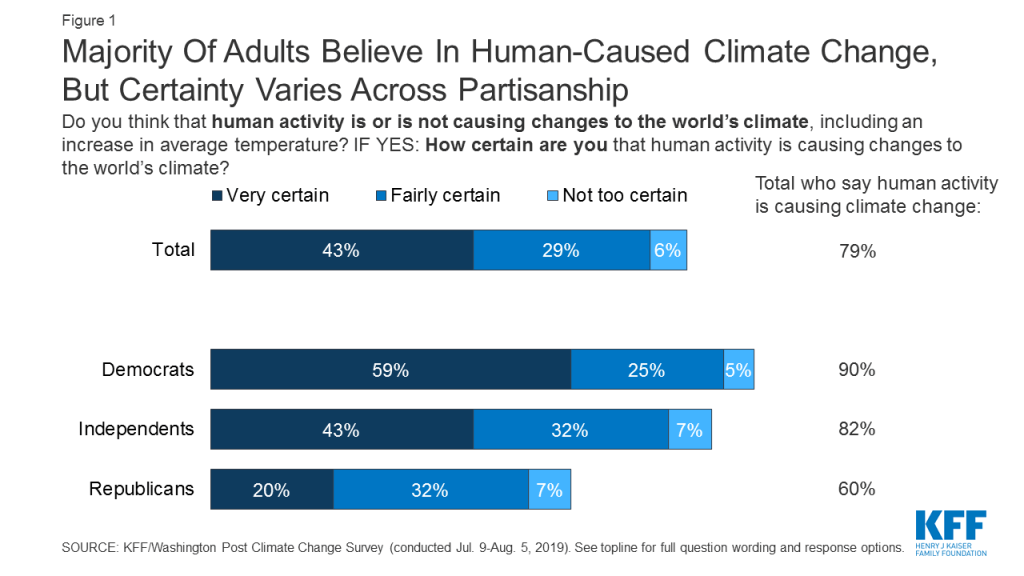
Majorities of U.S. adults across parties believe human-caused climate change is happening, but Republicans are much more doubtful about the seriousness of the problem. Large majorities of Democrats (90%) and independents (82%) and a solid majority of Republicans (60%) agree that human activity is causing changes to the world’s climate, including an increase in average temperature. However, Democrats and independents are much more likely to be firm in their beliefs: 59% of Democrats and 43% of independents say they are very certain that human activity is causing climate change, compared to one in five Republicans. Moreover, a majority (56%) of Republicans say that when it comes to what is said in the news, the seriousness of global warming and climate change is generally exaggerated, while most Democrats say the seriousness of the problem is generally correct (48%) or generally underestimated (46%).
Figure 1: Majority Of Adults Believe In Human-Caused Climate Change, But Certainty Varies Across Partisanship
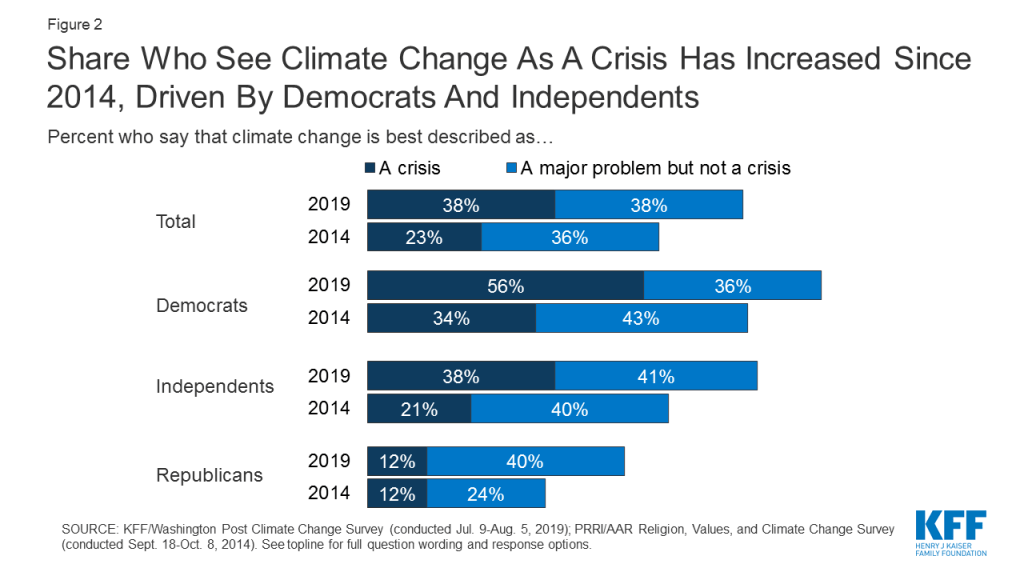
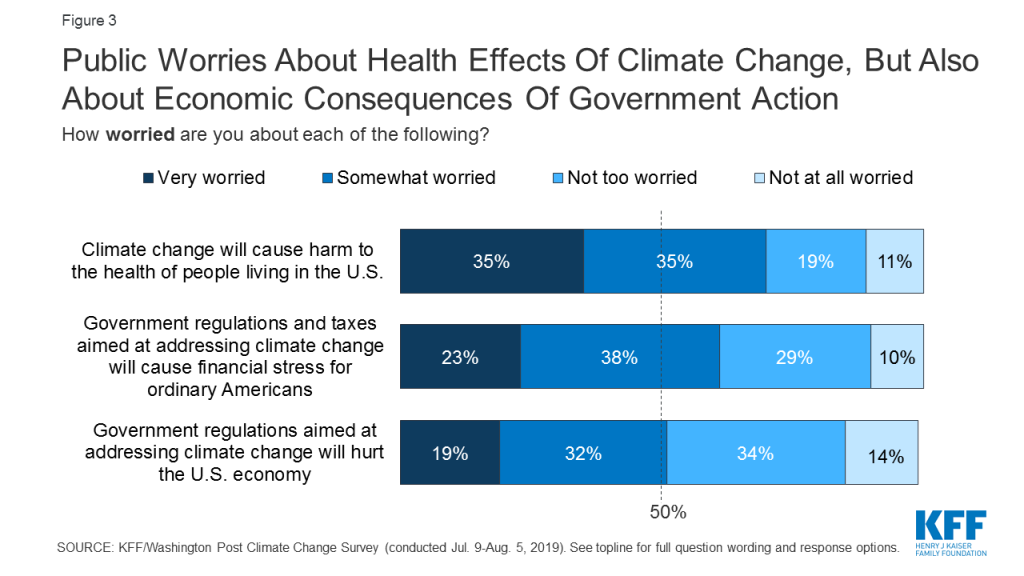
There are signs of increasing urgency around climate change, but also skepticism of government intervention. Thirty-eight percent of the public now calls climate change a “crisis,” up from 23% in a PRRI poll from 2014, driven by an increase among Democrats and independents. About half (52%) think that people need to act within the next 10 years to prevent the worst effects of climate change, or that it is already too late. Seven in ten are worried that climate change will cause harm to the health of people living in the U.S., and majorities say that businesses and corporations (72%), the U.S. government (67%), energy companies (65%), and their state government (60%) are doing too little to reduce greenhouse gas emissions. Despite this apparent sense of urgency and desire for action, people are skeptical of government intervention. Six in ten are worried that government regulations and taxes aimed at addressing climate change will cause financial stress for ordinary Americans, and about half (51%) are worried such government intervention will hurt the U.S. economy.
Figure 2: Share Who See Climate Change As A Crisis Has Increased Since 2014, Driven By Democrats And IndependentsFigure 3: Public Worries About Health Effects Of Climate Change, But Also About Economic Consequences Of Government Action
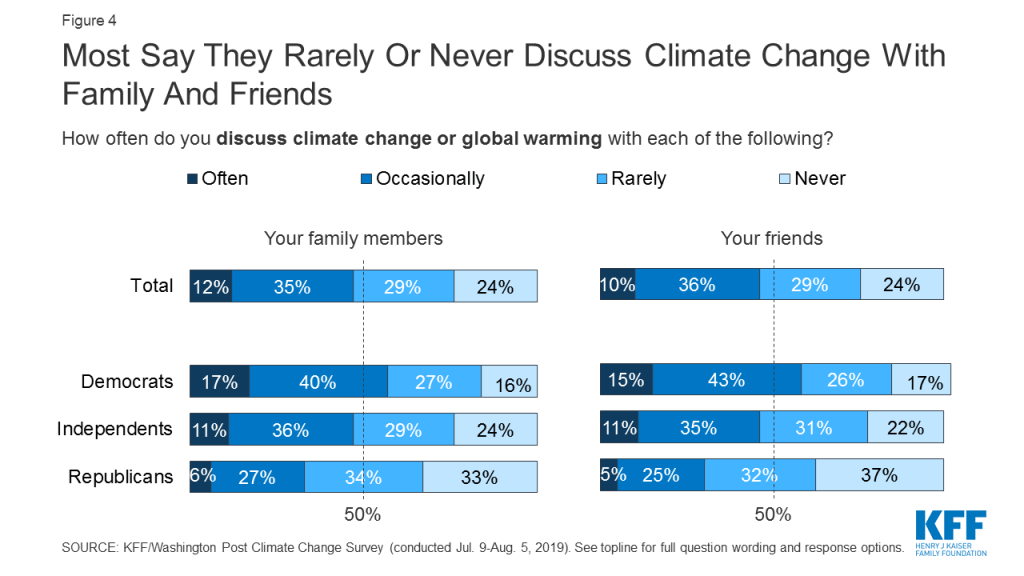
Climate change is not a frequent subject of dinner table conversations for most Americans, and few adults report any political engagement on the issue. About half of adults say they rarely or never discuss climate change with their family members (53%) or friends (54%), and just about one in ten say they often discuss the topic with either group (12% and 10%, respectively). Small shares say they have donated money to a charity working to address climate change (17%), contacted a government official (12%), or participated in a protest, rally, or other event (9%) to express their views on climate change.
Figure 4: Most Say They Rarely Or Never Discuss Climate Change With Family And Friends
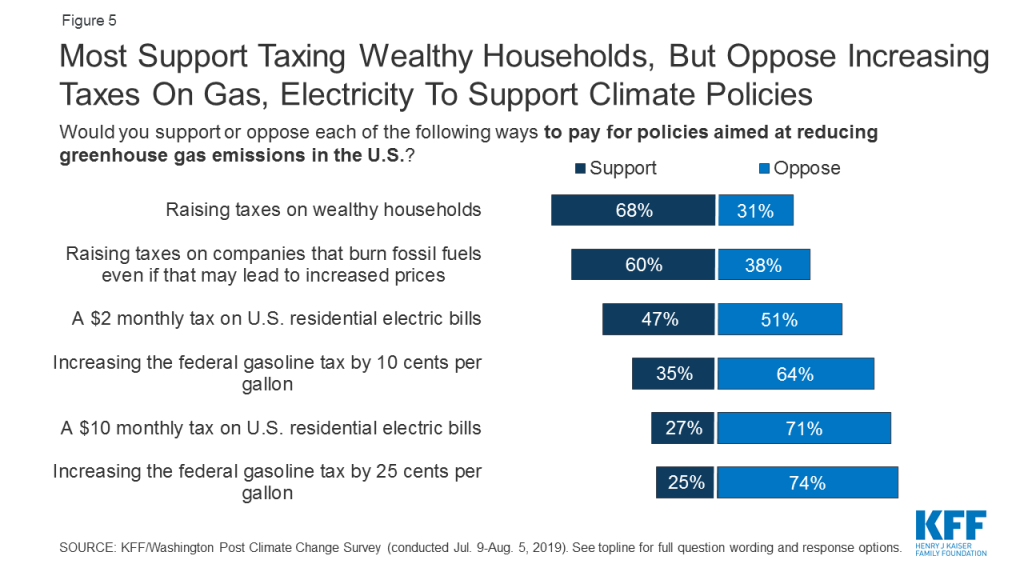
Few U.S. adults are willing to make personal sacrifices in the form of higher gas or electricity taxes in order to address climate change. Fewer than four in ten adults (37%) think that reducing the negative effects of global warming and climate change will require major sacrifices from ordinary Americans, while a plurality (48%) think it will require minor sacrifices and 14% say it won’t require much sacrifice at all. Majorities are willing to support raising taxes on wealthy households (68%) and on companies that burn fossil fuels, even if it may lead to increased electricity and transportation prices (60%), as ways to pay for policies aimed at reducing U.S. greenhouse gas emissions. But when it comes to taxes that are likely to hit consumers’ pocketbooks, support is much lower. About half (51%) oppose a $2 monthly tax on U.S. residential electric bills, and seven in ten (71%) are opposed to such a tax at the $10 a month level. Similarly, majorities oppose increasing the federal gasoline tax by 10 cents or 25 cents per gallon (64% and 74%, respectively). There are partisan divisions, but even majorities of Democrats oppose a $10 monthly electricity tax (60%) and a 25-cent per gallon gasoline tax (63%).
Figure 5: Most Support Taxing Wealthy Households, But Oppose Increasing Taxes On Gas, Electricity To Support Climate Policies
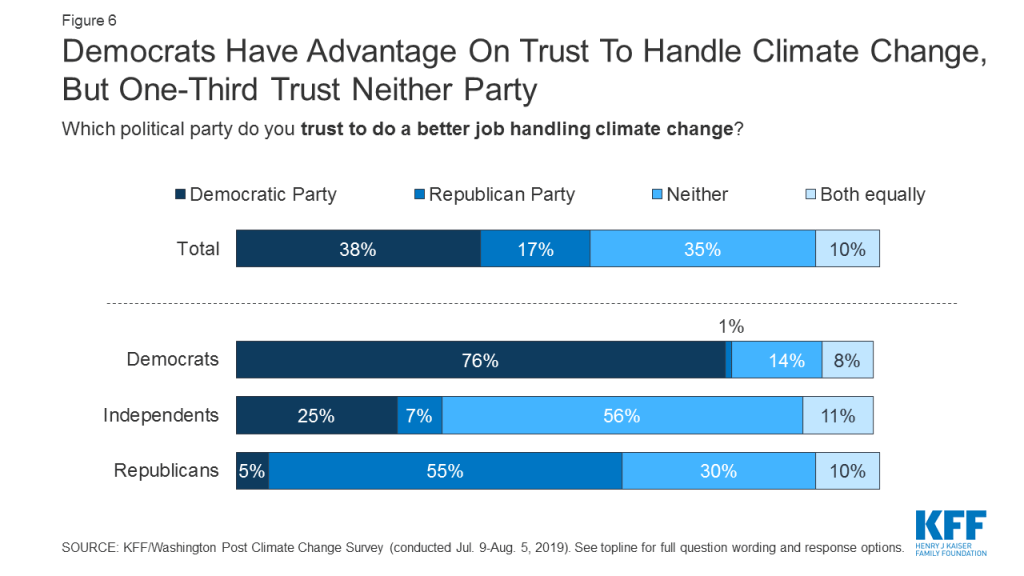
Democrats have an edge over Republicans when it comes to the issue of climate change, though majorities say both parties are doing too little. Democrats have a 21-percentage point advantage over Republicans in trust to handle climate change (38% vs. 17%), though a substantial 35% of the public say they trust neither party. Notably, majorities say that President Trump (66%), the Republican Party (69%), and the Democratic Party (56%) are doing too little to reduce greenhouse gas emissions. Two-thirds (67%) disapprove of President Trump’s handling of climate change (his lowest rating out of six issues tested), and a similar share (66%) disapprove of his plan to roll back fuel efficiency standards put in place by the Obama administration.
Figure 6: Democrats Have Advantage On Trust To Handle Climate Change, But One-Third Trust Neither Party
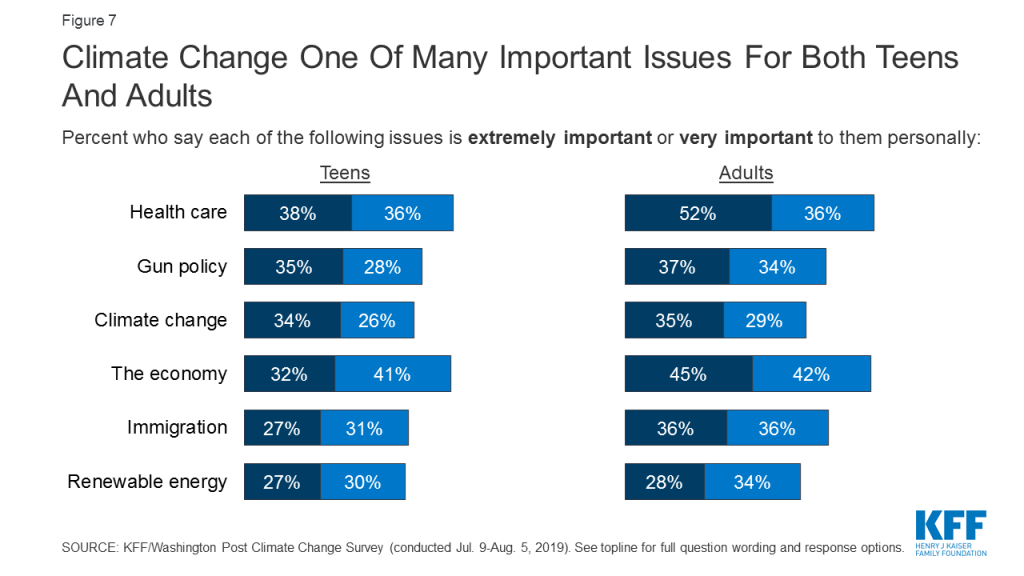
While most U.S. teens see climate change as an important issue, it does not stand out as a singular defining issue for their generation. Like adults, a large majority of teens (86%) believe that human-caused climate change is happening, though just under half (46%) are very certain. Six in ten teenagers (61%) say the issue of climate change is very or extremely important to them personally, making it one of many issues that teens view as important. Notably, about a third of teens (34%) say climate change is an extremely important issue, but rather than standing out as the top issue for teens, climate change ranks similarly to health care (38%), gun policy (35%), and the economy (32%). Teens (39%) and young adults ages 18-29 (43%) are about 10 percentage points more likely than adults ages 30 and older to say climate change will cause a great deal of harm to people in their generation. But like adults, teens are more likely to see climate change as a problem affecting future generations rather than their own (63% of teens and 60% of adults say future generations will be harmed a great deal).
Figure 7: Climate Change One Of Many Important Issues For Both Teens And Adults
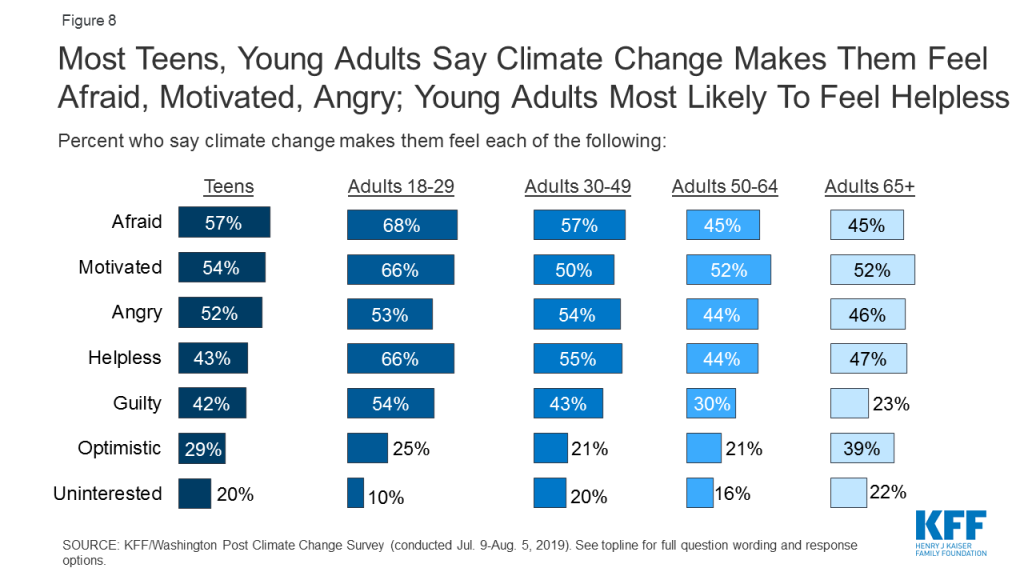
The issue of climate change evokes a variety of emotions for teens, though young adults are even more likely than teens to say they feel afraid, motivated, helpless, and guilty. Majorities of teens say the issue of climate change makes them feel “afraid” (57%), “motivated” (54%), and “angry” (52%). About four in ten (43%) say they feel “helpless” (vs. 53% of adults), while a smaller share (29%) say they feel “optimistic.” Young adults ages 18-29 are the age group most likely to express a variety of emotions when it comes to climate change, including “afraid” (68%), “motivated” (66%), “helpless” (66%), and “guilty” (54%). Like adults, most teens say they rarely or never discuss climate change with their family. Moreover, teens are 8 percentage points less likely than adults to say they at least occasionally discuss the issue with friends (38% vs. 46%).
Figure 8: Most Teens, Young Adults Say Climate Change Makes Them Feel Afraid, Motivated, Angry; Young Adults Most Likely To Feel Helpless
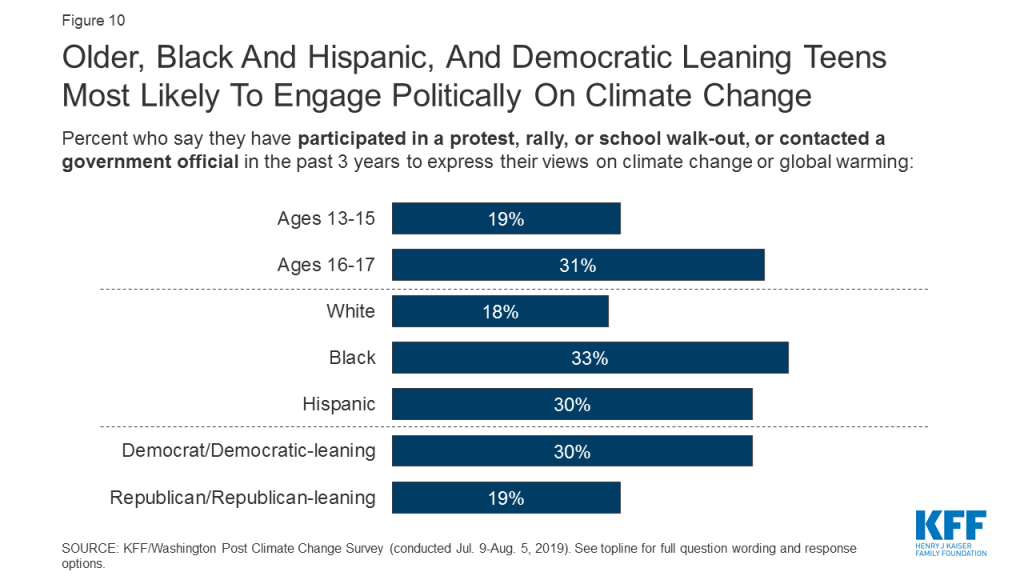
Most teens feel they can make a difference when it comes to climate change, and about a quarter report engaging politically on the issue. Almost two-thirds of teens who believe in human-caused climate change (55% of all teens) say they feel that there are things they can do personally to make a difference when it comes to reducing the effects of climate change. About four in ten teens (41%) say they have taken action to reduce their own carbon footprint. In addition, about one-quarter report engaging in some type of political action in the past 3 years to express their views on climate change; this includes 15% who say they’ve participated in a school walk-out, 13% who have participated in a protest or rally, and 12% who have contacted a government official. Some groups of teens are more likely than others to report engaging in political action around climate change, including those who are Black (33%) or Hispanic (30%), older teens ages 16-17 (31%), and those who identify as Democrats or lean Democratic (30%).
Figure 9: About One In Four Teens Say They Have Taken Some Action To Express Their Views On Climate Change In Past Three Years
Hispanic teens (and to a lesser extent, Black teens) stand out as particularly concerned and particularly active on the issue of climate change. In addition to being more likely to engage in political action, Black (37%) and Hispanic (41%) teens are more likely than White teens (24%) to think people need to act within the next year or two in order to prevent the worst effects of climate change. Hispanic teens (44%) are also more likely than White (32%) or Black (25%) teens to say climate change is an extremely important issue to them personally. Furthermore, Hispanic teens are more likely than White teens to say the issue makes them feel afraid (65% vs. 53%), angry (61% vs. 48%), guilty (51% vs. 38%), and helpless (50% vs. 39%).
Figure 10: Older, Black And Hispanic, And Democratic Leaning Teens Most Likely To Engage Politically On Climate Change
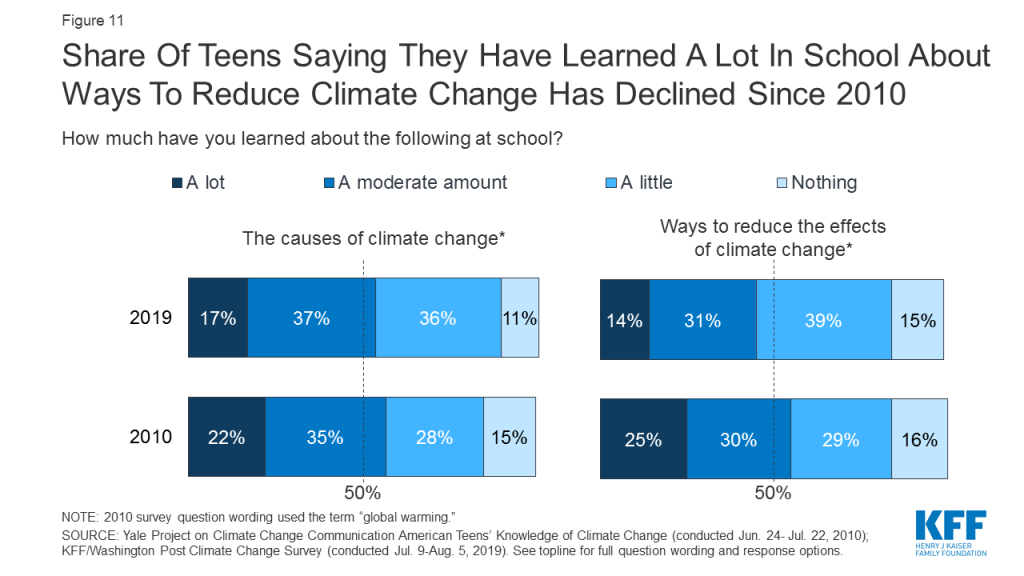
About half of teens say they have learned about the causes of climate change in school, yet some misconceptions about major contributors to climate change remain. Fifty-four percent of teens say they have learned at least a moderate amount about the causes of climate change in school, while 46% say they have learned about ways to reduce the effects of climate change. The share saying they have learned “a lot” about ways to reduce the effects of climate change has decreased somewhat since a similar survey of teens conducted in 2010 (from 25% to 14%). Six in ten teens recognize deforestation (62%), cars and trucks (62%), and burning fossil fuels for heat and electricity (61%) as major contributors to climate change, while fewer recognize airplane travel (30%) and cattle farming (18%) as major contributors. At the same time, about four in ten teens (39%) mistakenly believe that “the sun getting hotter” is a major contributor to climate change, and one in five think volcanic eruptions are a major contributor.
Figure 11: Share Of Teens Saying They Have Learned A Lot In School About Ways To Reduce Climate Change Has Declined Since 2010
Views On The Green New Deal
In February 2019, Representative Alexandria Ocasio-Cortez of New York and Senator Edward J. Markey of Massachusetts introduced the Green New Deal resolution calling on the federal government to dramatically reduce fossil fuel use and guarantee clean energy jobs. The survey finds that few Americans are familiar with the Green New Deal, though Republicans are more likely to have heard about it than Democrats. While the public likes many of the proposal’s goals, they oppose the increase in federal spending that would likely be needed to support them.
The Green New Deal is largely unknown to the public, with just about one in five saying they have heard a great deal (7%) or a good amount (15%) about the proposal. Republicans (33%) are twice as likely as Democrats (16%) to say they’ve heard at least a good amount, suggesting that anti-Green New Deal messaging has gotten more exposure than supportive messaging at this point.
Figure 1: Most Have Heard Little To Nothing About The Green New Deal
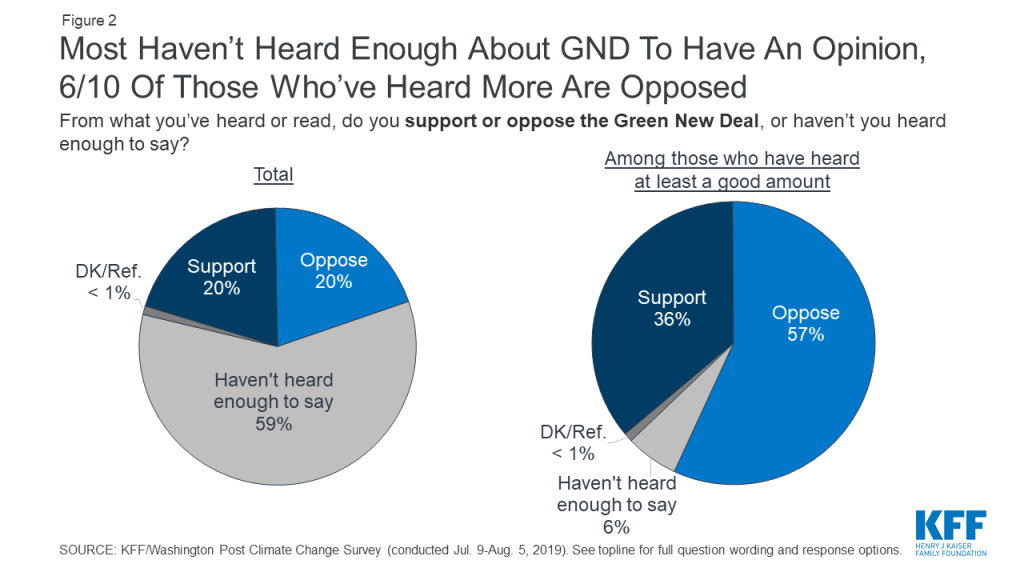
Six in ten adults (59%) say they haven’t heard enough to have an opinion of the Green New Deal, but among those who’ve heard at least a good amount, nearly six in ten are opposed.
Figure 2: Most Haven’t Heard Enough About GND To Have An Opinion, 6/10 Of Those Who’ve Heard More Are Opposed
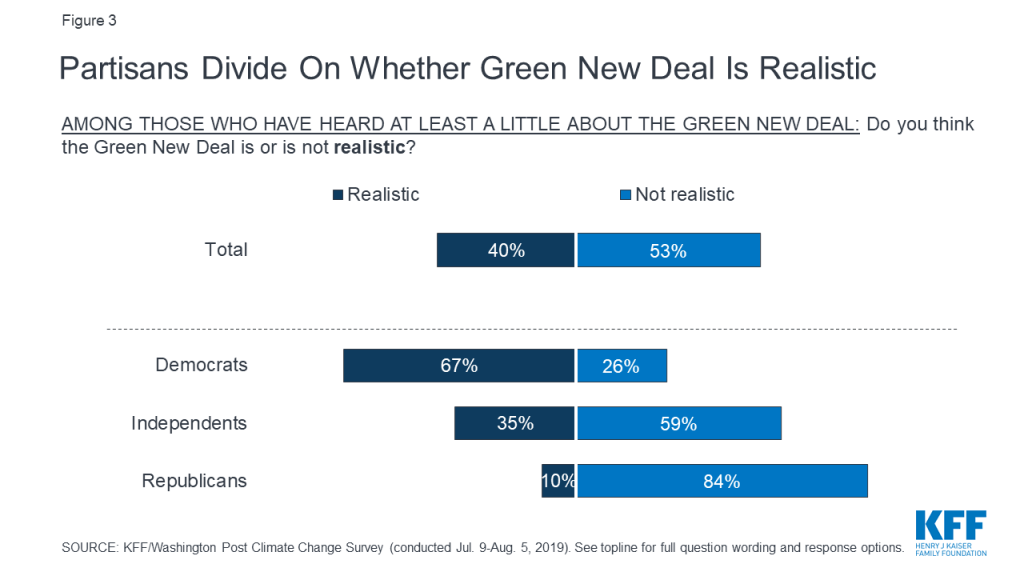
Among those who’ve heard at least a little about the Green New Deal proposal, four in ten say it’s realistic and just over half (53%) say it’s not realistic, including 26% of Democrats, 59% of independents, and 84% of Republicans.
Figure 3: Partisans Divide On Whether Green New Deal Is Realistic
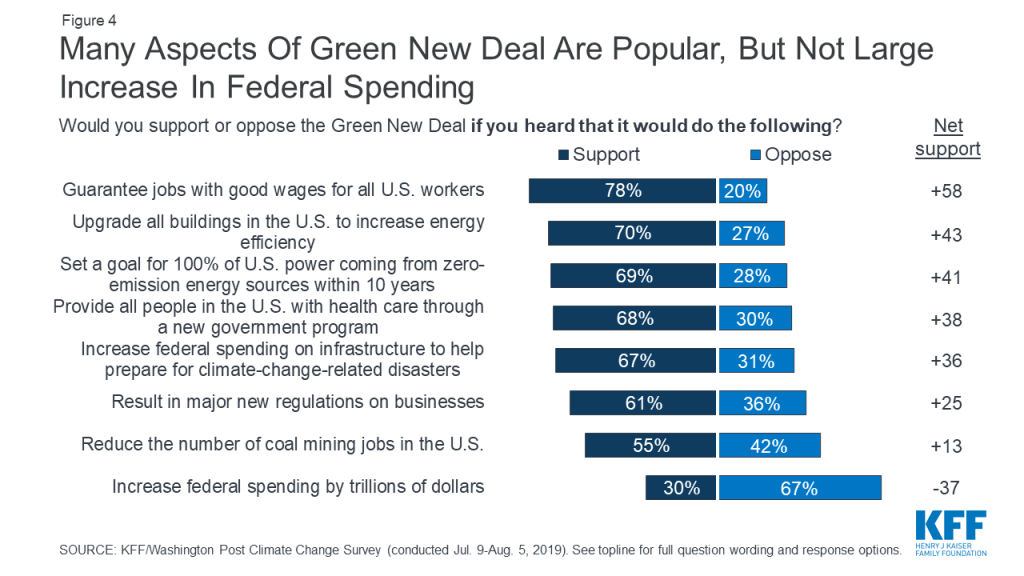
Substantial majorities of the public say they would support the Green New Deal if they heard it would guarantee jobs with good wages for all U.S. workers (78%), upgrade all buildings in the U.S. to increase energy efficiency (70%), set a goal for 100% of U.S. power coming from zero-emission energy sources within ten years (69%), provide all people in the U.S. with health care through a new government program (68%), and increase federal spending on infrastructure to help communities prepare for climate change-related disasters (67%). Yet support drops to just 30% if the proposal would increase federal spending by trillions of dollars.
Figure 4: Many Aspects Of Green New Deal Are Popular, But Not Large Increase In Federal Spending
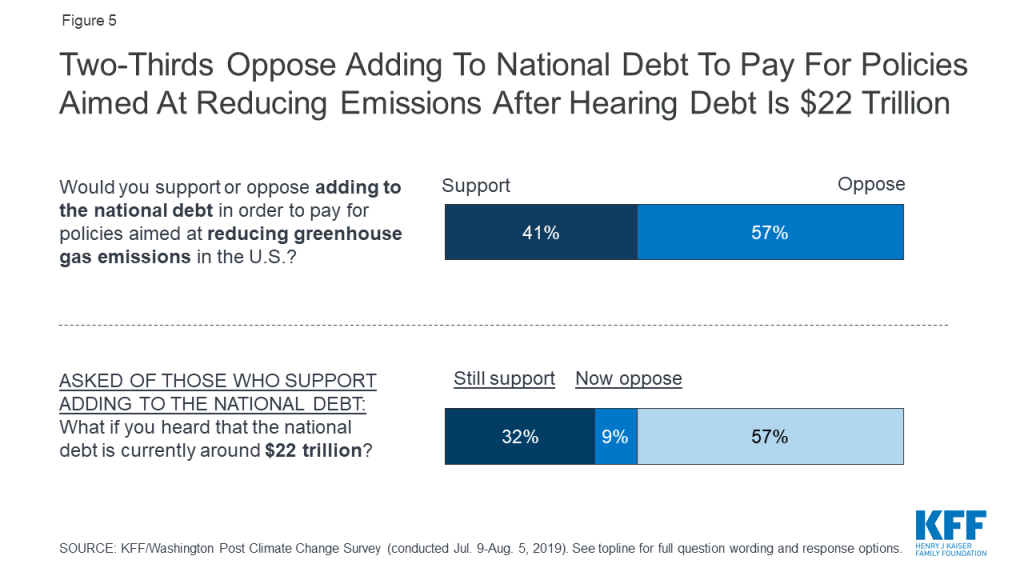
There does not appear to be an appetite among the public for increasing the national debt in order to pay for climate-related policies such as the Green New Deal. Nearly six in ten (57%) say they oppose adding to the national debt in order to pay for policies aimed at reducing greenhouse gas emissions in the U.S., rising to 66% when initial supporters are told that the debt currently stands at around $22 trillion.
Figure 5: Two-Thirds Oppose Adding To National Debt To Pay For Policies Aimed At Reducing Emissions After Hearing Debt Is $22 Trillion
Politics And Regional Differences
Many previous surveys have found that Americans’ views on climate change divide along partisan lines. In this survey, we explore how those divisions relate to political preferences, and also how partisanship interacts with people’s views of the role of climate change in extreme weather events. This section takes advantage of a unique element of this survey: the oversample of people living in several regions of the U.S. that have experienced extreme weather events like hurricanes, flooding, drought, and wildfires over the past several years.
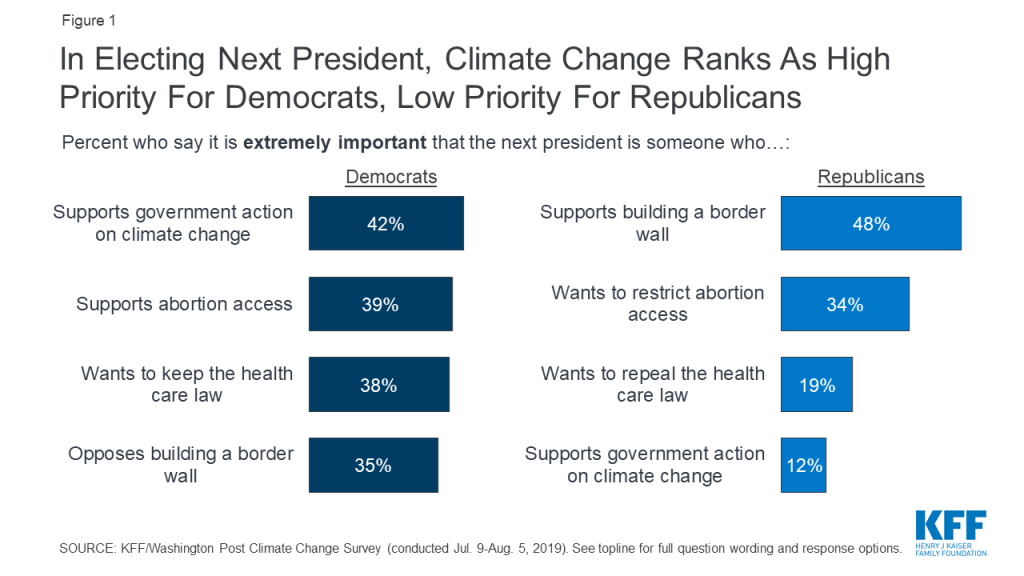
Majorities across parties say they want the next president to support government action on climate change, but it’s a much lower priority for Republicans than for Democrats. Large majorities of Democrats (91%) and independents (79%), and even a slim majority of Republicans (53%), say that they would like the next president to be someone who favors government action on climate change, suggesting that President Trump’s position on the issue is out of step with the mainstream. However, while 42% of Democrats see this as an extremely important issue to their vote – putting it on par with issues like abortion access (39%) and preserving the ACA (38%) – just 12% of Republicans say the same, ranking it far behind issues like support for a border wall (48%) and restricting abortion access (34%).
Figure 1: In Electing Next President, Climate Change Ranks As High Priority For Democrats, Low Priority For Republicans
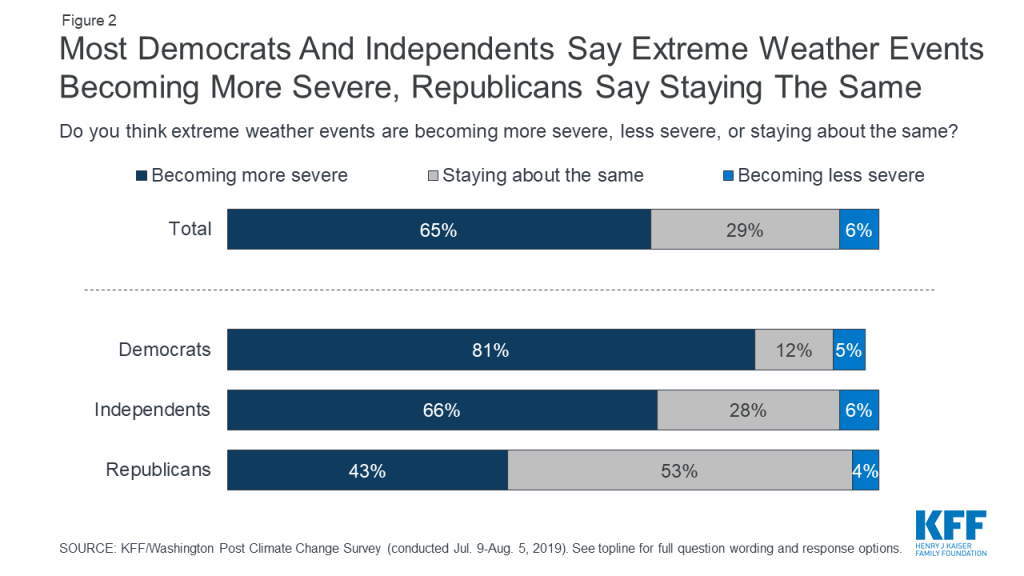
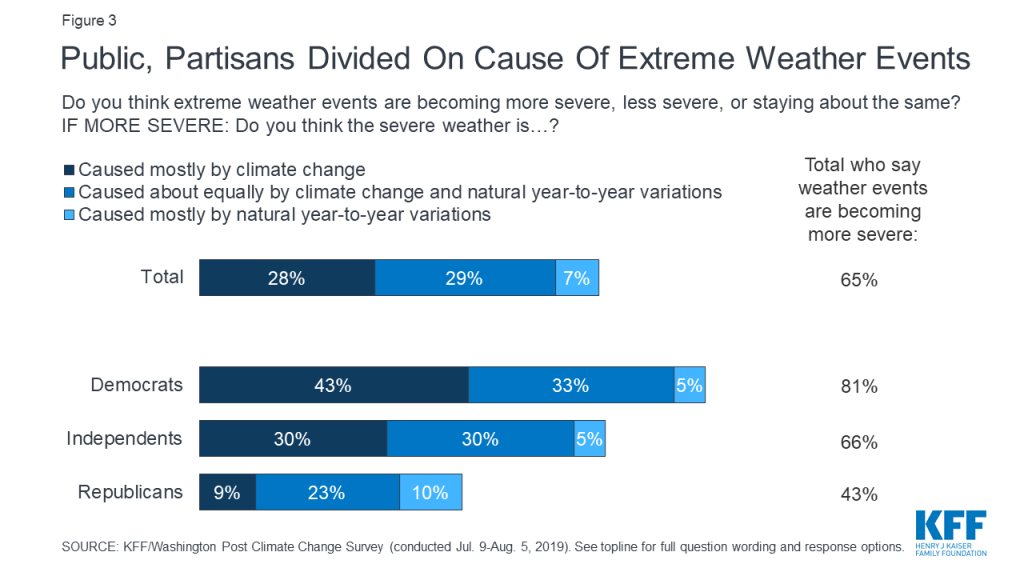
Nationally and across regions, Democrats and Republicans have very different views of severe weather events in their area and the role climate change plays. Nationwide, about two-thirds (65%) of adults think extreme weather events are becoming more severe, but this masks a massive partisan difference, with Democrats almost twice as likely as Republicans to believe this is the case (81% vs. 43%).
Figure 2: Most Democrats And Independents Say Extreme Weather Events Becoming More Severe, Republicans Say Staying The Same
The partisan divide on views of extreme weather is even starker when looking at the share who believe weather is becoming more severe and that climate change is mostly to blame: 43% of Democrats versus 9% of Republicans think this is true.
Figure 3: Public, Partisans Divided On Cause Of Extreme Weather Events
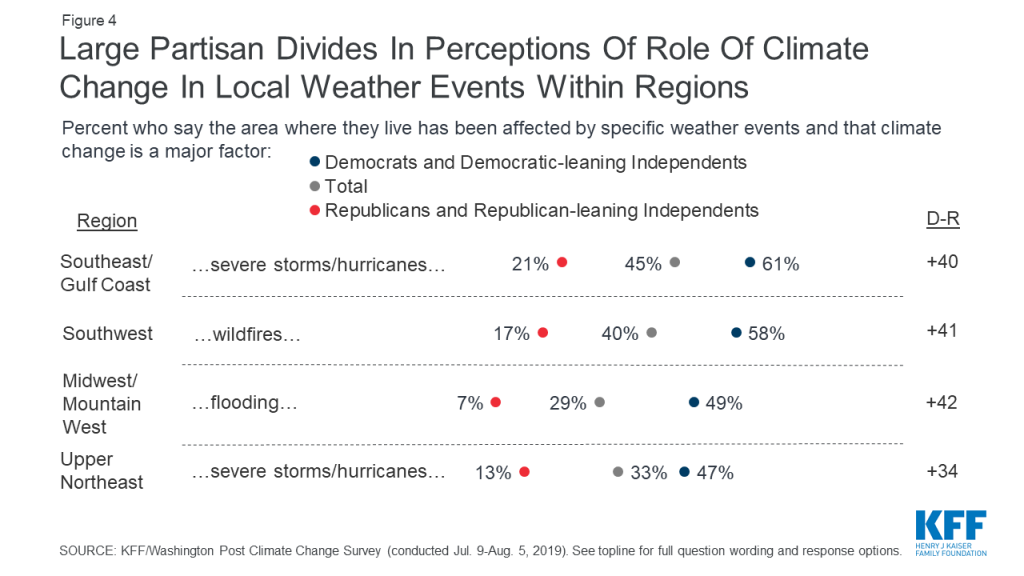
Partisan gaps also exist in perceptions of extreme weather in one’s own local area. When drilling down into regions that have been hard hit by extreme weather events, there are huge partisan gaps in attitudes about climate change’s role in these events. For example, in the Southwest, 58% of Democrats and Democrat-leaning independents versus just 17% of Republicans and Republican-leaning independents say that the area where they live has experienced wildfires in the past 5 years and that climate change is a major factor causing these fires. Similarly, in the Southeast/Gulf Coast region, those who identify as or lean Democrat are about three times as likely as Republican-leaners to say climate change is a major factor contributing to severe storms such as hurricanes in their area in the past 5 years (61% vs. 21%)1 .
Figure 4: Large Partisan Divides In Perceptions Of Role Of Climate Change In Local Weather Events Within Regions
Knowledge And Actions
What does the public understand about the major contributors to climate change, and what actions do they report taking to reduce their own carbon footprints?
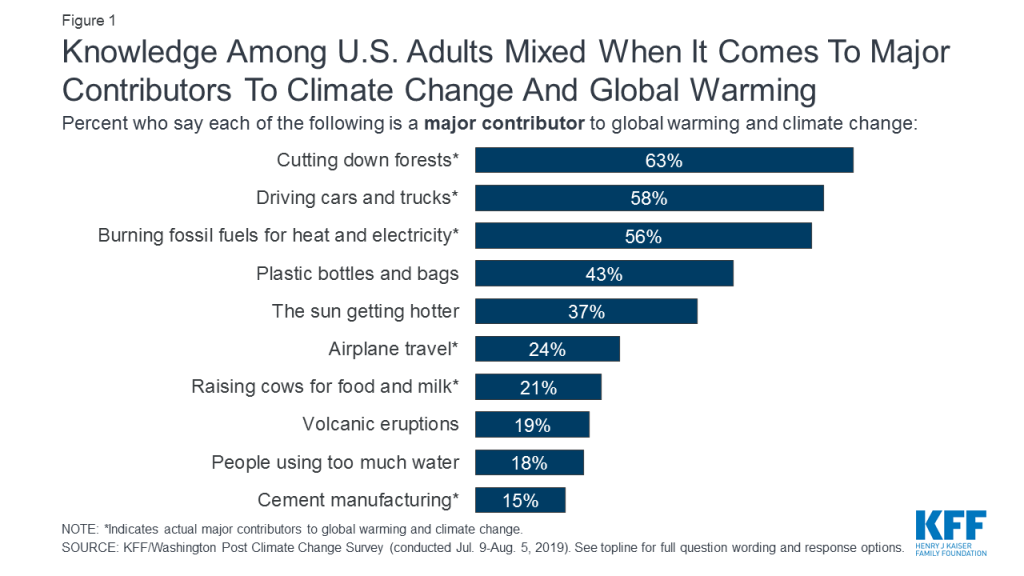
Most adults have a pretty good gauge on the major contributors to climate change, but some misperceptions exist. Majorities of the public recognize deforestation (63%), automobiles (58%), and burning fossil fuels for heat and electricity (56%) as major causes of climate change. Fewer recognize the major contribution of airplane travel (24%), cattle farming (21%), and cement manufacturing (15%). On the other hand, 43% think that plastic bottles and bags are a major contributor to climate change, when in fact they play more of a minor role compared to other factors. Substantial shares think other non-related factors such as “the sun getting hotter” (37%), volcanic eruptions (19%), and water usage (18%) are major contributors.
Figure 1: Knowledge Among U.S. Adults Mixed When It Comes To Major Contributors To Climate Change And Global Warming
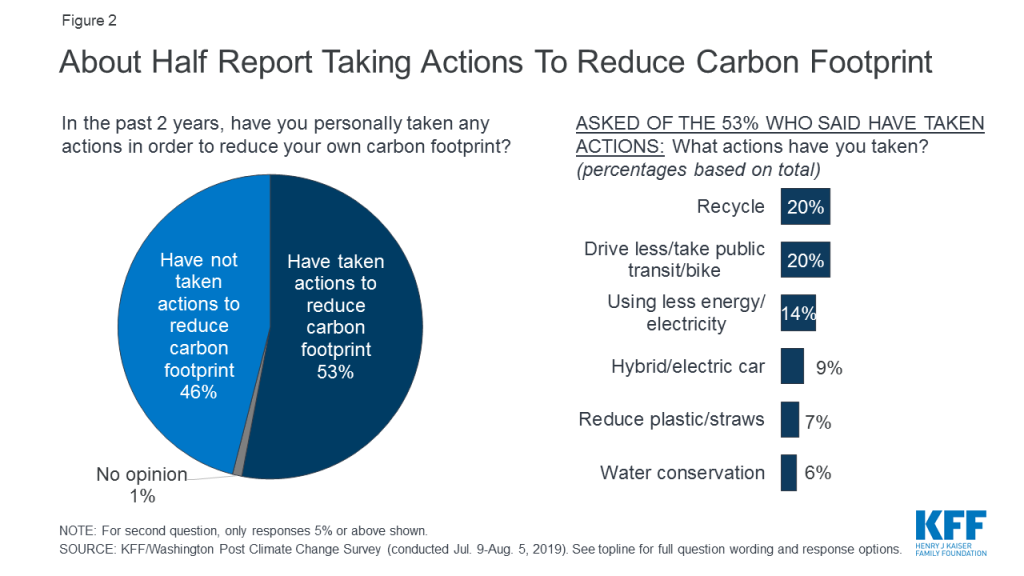
About half of adults say they have taken action to reduce their own carbon footprint, with a range of actions reported. About half (53%) of U.S. adults say they have taken actions to reduce their own carbon footprint in the past 2 years. Some of the actions people report taking target the major contributors of climate change: 20% report driving less, 14% use less electricity at home, 9% use a more fuel-efficient car, and 3% purchase electricity from a renewable source. However, some report actions that, while good for the environment, are less likely to make a major dent in climate change: 20% say they recycle, 7% reduce plastic use, 6% mention conserving water, and 4% mention using reusable items like bags, containers, and straws.
Figure 2: About Half Report Taking Actions To Reduce Carbon Footprint
Methodology
The Washington Post-Kaiser Family Foundation Survey Project is a partnership combining survey research and reporting to better inform the public. The Post-KFF Climate Change Survey, the 34th in the series, was conducted with a probability-based sample of 2,293 adults ages 18 and over and 629 teens between the ages of 13 and 17. Interviews were administered online and by telephone from July 9 through August 5, 2019 in English and Spanish.
NORC at the University of Chicago conducted sampling, interviewing, and tabulation for the survey using the AmeriSpeak Panel, a representative panel of adults age 18 and over living in the United States. AmeriSpeak Panel members are recruited through probability sampling methods using the NORC National Sample Frame, an address-based sampling frame. Panel members who do not have internet access complete surveys via telephone, and internet users complete surveys via the web (for the current study, 303 adults and 8 teens completed via phone; 1,990 adults and 621 teens via web). In order to allow for separate regional analysis, adult panelists living in the following regions were selected at disproportionately higher rates: Southwest (Arizona, New Mexico, Nevada, Utah, Colorado); Upper Mountain West/Midwest (Minnesota, North Dakota, South Dakota, Montana, Idaho); New England (Maine, New Hampshire, Vermont, Massachusetts, Connecticut, Rhode Island); and Southeast (Florida, Georgia, South Carolina, North Carolina, Alabama, Mississippi, Louisiana, Texas gulf coast counties: Orange, Jefferson, Chambers, Galveston, Harris, Brazoria, Matagorda, Jackson, Calhoun, Victoria, Refugio, Aransas, San Patricio, Nueces, Kleberg, Kenedy, Willacy, Cameron).
Fully enrolled teens (i.e., those for whom NORC has obtained parent consent, teen assent, and a complete teen profile) were eligible for sampling and recruitment from NORC’s AmeriSpeak Teen Panel, a probability-based panel of teens recruited via parents in the AmeriSpeak adult panel.
The combined results for teens and adults have been adjusted to weight oversampled geographic areas back to their accurate share of the adult population and to account for systematic nonresponse along known population parameters.
For adults, the first weighting stage made adjustments to account for the regional oversampling and for differential nonresponse to the survey screening interview. In the second weighting stage, the sample was adjusted to match known demographic distributions of the U.S. population using the following parameters: age, sex, education, race/ethnicity, and Census Division. Interviews in the oversampled regions were also weighted to match demographics within those regions. Region-level population benchmarks were obtained from the U.S. Census Bureau’s American Fact Finder for race/ethnicity and from the U.S. Census Bureau’s 2017 American Community Survey (ACS) for all other benchmarks.
The teen sample was weighted using a similar procedure, except that there was no regional oversampling for the teen sample so no oversample adjustment was needed. Demographic benchmarks for teens were obtained from the 2017 ACS for age, sex, parents’ highest education, race/ethnicity, and Census Division.
The margin of sampling error including the design effect for the full sample is plus or minus 3 percentage points for adults and 5 percentage points for teens. All statistical tests of significance account for the effect of weighting. For results based on other subgroups, the margin of sampling error may be higher. Sample sizes and margins of sampling error for other subgroups are available by request. Note that sampling error is only one of many potential sources of error in this or any other public opinion poll.
This questionnaire was administered with the exact questions in the exact order as appears in this document; question numbering may not be sequential. If a question was asked of a reduced base of the sample, a parenthetical preceding the question identifies the group asked.
The Kaiser Family Foundation and The Washington Post paid for the survey and representatives of The Washington Post and the Kaiser Family Foundation worked together to develop the survey questionnaire and analyze the results. Each organization bears the sole responsibility for the work that appears under its name. The project team from the Kaiser Family Foundation included: Mollyann Brodie, Ph.D., Liz Hamel, Lunna Lopes, and Cailey Muñana. The project team from The Washington Post included: Scott Clement and Emily Guskin. Both The Washington Post and the Kaiser Family Foundation Public Opinion and Survey Research team are charter members of the Transparency Initiative of the American Association for Public Opinion Research.
Endnotes
Southwest includes California, Arizona, New Mexico, Nevada, Utah, and Colorado. Upper Mountain West/Midwest includes Minnesota, North Dakota, South Dakota, Montana, Idaho. Upper Northeast includes Maine, New Hampshire, Vermont, Massachusetts, Connecticut, Rhode Island, New York, and New Jersey. Southeast includes Florida, Georgia, South Carolina, North Carolina, Alabama, Mississippi, Louisiana, and the gulf coast counties of Texas (Orange, Jefferson, Chambers, Galveston, Harris, Brazoria, Matagorda, Jackson, Calhoun, Victoria, Refugio, Aransas, San Patricio, Nueces, Kleberg, Kenedy, Willacy, and Cameron counties). ↩︎
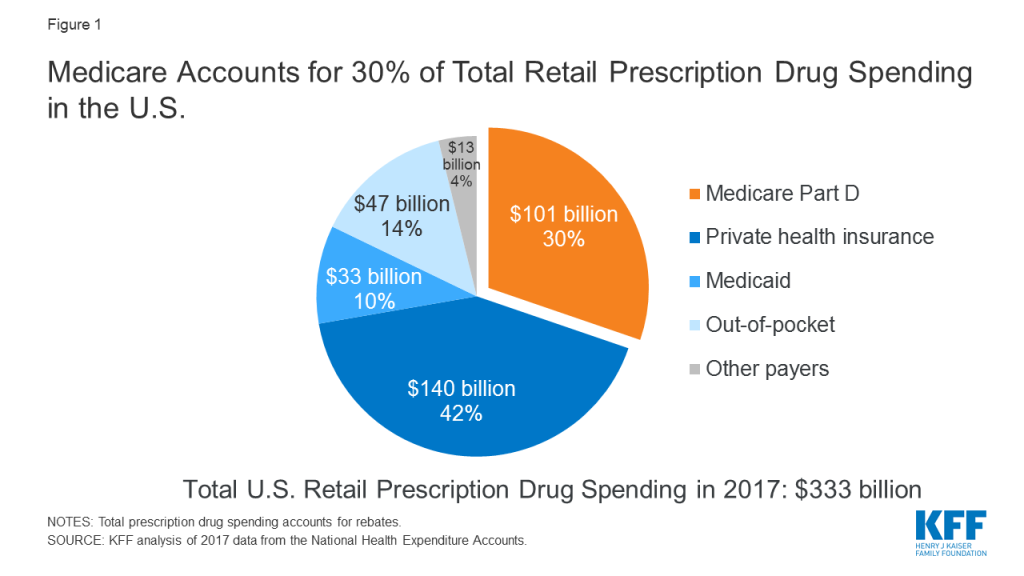
The affordability of prescription drugs is a pressing concern for many Americans, with broad agreement across the political spectrum that lowering prescription drug costs should be a top priority for Congress. The Trump Administration has put forward several proposals to address high and rising drug prices. Virtually all of the 2020 presidential candidates support efforts to lower drug prices1 , and key Congressional committees have marked-up legislation. Many of these proposals would directly affect prescription drug spending under Medicare, which accounts for 30 percent of national retail spending on drugs and nearly $1 out of every $5 in total Medicare spending (Figure 1).
Figure 1: Medicare Accounts for 30% of Total Retail Prescription Drug Spending in the U.S.
Prescription drugs are an important component of health care for Medicare beneficiaries, which includes more than 60 million older adults and people with long-term disabilities. The majority of Medicare prescription drug spending is for drugs covered under Part D, the outpatient prescription drug benefit. Medicare Part B also covers drugs that are administered to patients in physician offices and other outpatient settings.
This brief describes proposed and recent changes to control Medicare drug spending and lower beneficiaries’ out-of-pocket drug costs. We include proposals from the Trump Administration and legislation introduced during the 116th Congress, including legislation passed out of the Senate Finance Committee, and legislation recently introduced by Speaker Pelosi and adopted by the committees of jurisdiction in the House (H.R. 3). We review the implications of these changes for various stakeholders and explain their estimated effects on Medicare and beneficiary spending, to the extent such effects are known, based primarily on estimates from the Congressional Budget Office (CBO).
The brief focuses on drug pricing proposals related to Medicare specifically, rather than broader proposals that are not solely focused on Medicare, including those related to drug importation, expediting generic drug availability, patents, and price transparency.2 While we have made every effort to include the most recent proposals pertaining to Medicare drug costs, policy discussions are evolving rapidly. This brief will be updated as necessary in the future.
Overview of Proposed and Recent Changes
Proposed Changes
Allow the government to negotiate drug prices
Modify the Medicare Part D benefit design
Establish an out-of-pocket spending limit and reallocate liability for catastrophic costs
Exclude manufacturer discounts from the calculation of “TrOOP”
Cap increases in Medicare drug prices to the rate of inflation
Require rebates for Part D drugs with price increases faster than inflation
Establish an inflation limit on Part B drug reimbursement growth
Use international reference pricing for drugs covered by Medicare
Make other modifications to payments for drugs covered under Part B
Modify rebates under Part D
Eliminate rebates under Part D (withdrawn by the Administration in July 2019)
Share rebates with plan sponsors and/or beneficiaries
Move coverage of some drugs from Part B to Part D
Improve coverage for low-income Part D enrollees
Eliminate cost sharing for generics for low-income subsidy enrollees
Expand eligibility for low-income subsidies
Recent Changes
Allow Medicare Advantage plans to require step therapy for Part B drugs
Modify coverage requirements for drugs in Part D protected classes
Require Part D plan sponsors to use real-time benefit tools
Under the Medicare Modernization Act of 2003 (MMA), which established the Medicare Part D drug benefit, the federal government is prohibited from engaging in price negotiation or price setting on behalf of Medicare Part D beneficiaries. The MMA includes language known as the “noninterference” clause, which stipulates that the Secretary of Health and Human Services (HHS) “may not interfere with the negotiations between drug manufacturers and pharmacies and PDP sponsors, and may not require a particular formulary or institute a price structure for the reimbursement of covered Part D drugs.” This is in contrast to how drug prices are established by other federal programs. For example, there is a statutory requirement for mandatory drug price rebates in Medicaid, and, in the Department of Veteran Affairs (VA), a drug manufacturer may not charge more than the lowest price paid by any private sector purchaser.
In the years since the enactment of the MMA, lawmakers have introduced legislation to allow Medicare to negotiate drug prices, with the goal of lowering Part D program spending and enrollees’ out-of-pocket costs. Recent public opinion polls show strong and bipartisan support for allowing the federal government to negotiate drug prices in Medicare. During the 116th Congress, several members of Congress have introduced bills that would grant the Secretary authority to negotiate drug prices for Medicare Part D. Some are stand-alone bills, while others are incorporated in broader health reform legislation, including Medicare-for-all, public plan options, and Medicare buy-in proposals. Several Democratic presidential candidates have also endorsed this approach.
This summary focuses on five bills where the primary (or sole) purpose is to allow the Secretary to negotiate drug prices:
H.R. 3, “Elijah E. Cummings Lower Drug Costs Now Act,” introduced by Speaker Pelosi and sponsored by Representatives Frank Pallone (D-NJ), Richard Neal (D-MA), and Bobby Scott (D-VA), the respective Chairmen of House Committees Energy & Commerce, Ways & Means, and Education & Labor (as passed out of Committees in October 2019)
H.R. 1046/S. 377, “Medicare Negotiation and Competitive Licensing Act,” sponsored by Representative Lloyd Doggett (D-TX) in the House and Senator Sherrod Brown (D-OH) in the Senate
H.R. 448/S. 99, ”Medicare Drug Price Negotiation Act,” sponsored by the late Representative Elijah Cummings (D-MD) in the House and Senator Bernie Sanders (I-VT) in the Senate
S. 62, “Empowering Medicare Seniors to Negotiate Drug Prices Act,” sponsored by Senator Amy Klobuchar (D-MN)3
H.R. 275, ”Medicare Prescription Drug Price Negotiation Act,” sponsored by Representative Peter Welch (D-VT)
While these bills seek to achieve the same overall goal of reducing drug prices by allowing the federal government to negotiate prices with drug manufacturers in Medicare, they take different approaches to achieve that end. The proposals vary in terms of how much direction is given to the Secretary regarding the negotiation process itself; whether any criteria are offered for which drugs and how many shall be negotiated; the factors to be considered in determining a negotiated price; provisions that aim to give the Secretary greater leverage to secure price concessions from drug manufacturers; and provisions that may apply in the event of unsuccessful negotiations.
The Pelosi legislation (H.R. 3) amends the non-interference clause under current law by adding an exception that allows for the price negotiation process established by the legislation. The negotiation process outlined in H.R. 3 would apply to a minimum of 25 and up to 250 brand-name drugs lacking generic or biosimilar competitors (including insulin), and would prioritize the 125 drugs with the highest Medicare Part D spending and 125 drugs with the highest spending in the U.S. (net of rebates). The minimum number of drugs subject to negotiation increases from 25 in the first year (2023) to 30 between 2028 and 2032 and 35 in 2033. Newly-approved drugs with prices at or above median household income may also be subject to negotiation, based on projected spending. The proposal establishes an upper limit for the negotiated price equal to 120% of the Average International Market (AIM) price paid by six economically prosperous countries (Australia, Canada, France, Germany, Japan, and the United Kingdom), and the negotiated price applies to both Medicare and commercial payers in group and individual markets. None of the other proposals explicitly mention an upper limit on the negotiated price, nor do they extend the Part D negotiated price to other payers. H.R. 3 imposes financial penalties on drug companies that do not comply with the negotiating process as well as in the event that negotiations fail. For example, manufacturers that fail to negotiate with the Secretary would face an escalating excise tax on the previous year’s gross sales of the drug in question, starting at 65% and increasing by 10% every quarter to a maximum of 95%.
The proposals introduced by Doggett/Brown (H.R. 1046/S. 377) and Cummings/Sanders (H.R. 448/S.99) call for much broader negotiations by the Secretary on behalf of Part D enrollees without defining how many drugs would be subject to negotiation, if not all Part D covered drugs. The Cummings/Sanders proposal also directs the HHS Secretary to establish a Part D formulary, a practice used by private plans in negotiating price discounts with manufacturers (not included in H.R. 3). In the event of unsuccessful negotiation between the Secretary and manufacturers, the Doggett/Brown proposal authorizes the Secretary to circumvent a manufacturer’s exclusivity rights and issue a competitive license to another manufacturer to produce a generic or biosimilar version of the drug for sale to Part D plans. The Cummings/Sanders proposal would use the lowest available price in either other federal programs or other specified countries as a fallback for the negotiated price in the event that negotiations between the Secretary and manufacturers are unsuccessful.
The legislation sponsored by Klobuchar (S. 62) and Welch (H.R. 275) simply strikes the non-interference clause, and in the case of the Welch bill, requires the Secretary to negotiate Part D drug prices, but neither proposal specifies further conditions or circumstances under which the negotiation should occur or fallback approaches in the event of unsuccessful negotiations.
The Senate Finance Committee considered an amendment to its drug pricing legislation that would have allowed the HHS Secretary to negotiate drug prices, but the amendment did not pass (12 ayes; 16 nays). The Trump Administration has not introduced its own proposal allowing HHS to negotiate drug prices in Medicare Part D, although President Trump endorsed this idea during his candidacy. (For more detail on Medicare drug price negotiation proposals, see What’s the Latest on Medicare Drug Price Negotiations?)
Budget Effects
In an October 2019 letter to Chairman Pallone, CBO provided a preliminary estimate of the effects of the drug price negotiation provisions of H.R. 3 on Medicare spending. CBO estimates the drug price negotiation provisions in H.R. 3 would achieve $345 billion in Medicare savings over the period between 2023 (the first year in which maximum fair prices would be used in Part D) and 2029. In its analysis of H.R 3, CBO indicates that the provision to levy an excise tax on drug companies that do not enter into negotiations or agree to the maximum fair price provides the Secretary with needed leverage to achieve lower drug prices and federal savings. CBO has not yet estimated the effects of H.R. 3 on private health plans, nor the effect of the negotiation provisions on out-of-pocket costs and premiums for Medicare Part D enrollees. (For more detail on CBO’s assessments of Medicare drug negotiation, see What’s the Latest on Medicare Drug Price Negotiations?)
This estimate represents a significant departure from prior estimates. In its initial assessments of the Medicare drug price negotiation concept in 2004 and 2007, CBO said that repealing the non-interference clause and allowing price negotiations between the Secretary and drug manufacturers would yield negligible savings, primarily because the Secretary would have insufficient leverage to secure price concessions; in May 2019, CBO reaffirmed its previous conclusions.
In contrast to H.R. 3 which applies pressure on drug manufacturers by imposing financial penalties on drug manufacturers that fail to negotiate with the Secretary, the Doggett/Brown bill relies instead on competitive licensing, and the Cummings/Sanders bill uses prices in other federal programs and other countries as a fallback. The degree to which these various approaches are effective in securing lower prices from drug manufacturers would have significant implications for Medicare program savings and for Medicare beneficiaries’ out-of-pocket drug costs. CBO has not yet estimated the potential savings attributable to the other bills discussed above.
Effects on Beneficiaries
In its analysis of drug price negotiation under H.R. 3, CBO expects that the lower drug prices resulting from this policy would lead to lower beneficiary premiums and cost-sharing (though CBO did not quantify the magnitude of this decrease). CBO also expects that this policy would lead to higher use of prescription drugs due to lower rates of medication non-adherence because of cost concerns. With greater medication adherence, CBO predicts this policy would lead to improved health outcomes for many beneficiaries, which would result in lower utilization and spending for other Medicare-covered services. In addition, people with private group and individual insurance would also likely see their drug costs decrease because the legislation requires manufacturers to offer the lower negotiated price to private payers or pay a civil monetary penalty.
Other Implications
CBO expects that this policy would lower revenues for drug manufacturers and lead to higher drug prices in other countries. CBO estimates that the loss in revenue for drug manufacturers would lead to lead to 8 to 15 fewer drugs coming to market over the next 10 years, of the approximately 300 drugs expected to be approved during this period. The decrease in the development of new drugs could negatively impact some beneficiaries, but CBO notes it is difficult to determine the type of drugs that would be affected and what their impact would be an overall health. For example, CBO did not specify whether these drugs would be breakthrough therapies or similar to treatments that are currently available.
The Medicare Part D standard benefit includes several phases, including a deductible, an initial benefit period, a coverage gap, and catastrophic coverage. Across these different benefit phases, the allocation of costs paid by Part D enrollees, plans, drug manufacturers, and Medicare varies.
Under the current structure of Part D, when enrollees reach the coverage gap benefit phase, they pay 25 percent of drug costs for brand-name drugs, plan sponsors pay 5 percent, and drug manufacturers provide a 70 percent price discount. The value of this discount counts towards the calculation of an enrollee’s “true out-of-pocket spending” (TrOOP), the amount used to determine when catastrophic coverage begins (at $6,350 in annual out-of-pocket spending in 2020, equivalent to an estimated $9,719 in total spending). Once enrollees pass through the coverage gap benefit phase and reach the catastrophic coverage phase, they pay 5 percent of their total drug costs, plans pay 15 percent, and Medicare pays 80 percent. The Medicare portion of catastrophic coverage costs, known as reinsurance, limits the financial risk for Part D plan sponsors associated with higher-cost enrollees.
In recent years, policymakers have expressed concerns about the absence of a hard cap on out-of-pocket spending for Part D enrollees, a significant increase in Medicare reinsurance spending, and the allocation of financial responsibility for drug costs among plan sponsors, pharmaceutical companies, the Medicare program, and Part D enrollees. The Trump Administration’s FY 2020 Budget, the Senate Finance Committee legislation, and H.R. 3 all include provisions to address this concern, with some differences.
Establish an out-of-pocket spending limit and reallocate liability for catastrophic costs
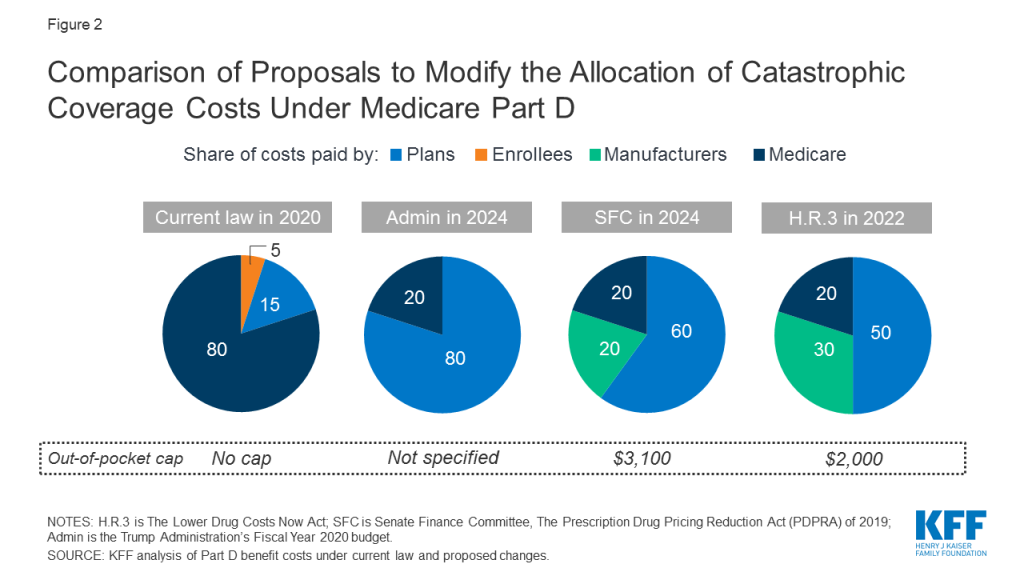
In its FY 2020 budget, the Administration proposed establishing an out-of-pocket spending limit in Part D by phasing down beneficiary coinsurance in the catastrophic phase from 5 percent to 0 percent (i.e., no cost sharing) over four years, beginning in 2020.4 The Administration’s proposal to add an out-of-pocket spending limit is paired with another proposal that would increase Part D plans’ share of catastrophic coverage costs from 15 percent to 80 percent, and decrease Medicare’s share from 80 percent to 20 percent.5,6
The Senate Finance Committee’s drug pricing legislation that was voted out of committee includes a provision to establish a cap on out-of-pocket spending and reallocate costs in the catastrophic phase. The cap on beneficiary out-of-pocket spending is initially set at $3,100 in 2022. For costs above the catastrophic threshold, the proposal reduces Medicare reinsurance payments from 80 percent to 20 percent, increases plans’ share from 15 to 60 percent, and requires drug manufacturers to pay 20 percent, instead of providing discounts in the coverage gap, which would be phased out. The proposed changes to the Medicare benefit design would be phased in over a three-year period, from 2022 to 2024.7
The drug price legislation introduced by Speaker Pelosi and voted out of three committees (H.R. 3) includes a provision to place a cap on out-of-pocket drug spending and reallocate liability for costs above the catastrophic threshold, but at somewhat different levels than the related provision in the Senate Finance Committee legislation. The cap on beneficiary out-of-pocket spending is initially set at $2,000 in 2022. For costs above the catastrophic threshold, the proposal reduces Medicare reinsurance payments from 80 percent to 20 percent, increases plans’ share from 15 to 50 percent, and requires drug manufacturers to pay 30 percent, instead of providing discounts in the coverage gap, which would be phased out. (Figure 2) Manufacturers would also be required to pay 10 percent of the costs in the initial coverage gap phase.8 As amended, H.R. 3 also includes a provision that would allow enrollees who reach the out-of-pocket cap of $2,000 in one prescription to smooth out their drug costs over the course of the year.
Figure 2: Comparison of Proposals to Modify the Allocation of Catastrophic Coverage Costs Under Medicare Part D
Budget Effects
Because the Administration’s FY 2020 budget combines proposals to add an out-of-pocket spending limit to Part D and reallocate costs for catastrophic coverage, the budget effects of these proposals are estimated together. According to CBO, these proposals are expected to decrease Medicare spending by $1.8 billion over 10 years. Estimated savings would be generated by shifting reinsurance costs from Medicare to plan sponsors. It is expected this shift would give plans stronger incentives to lower costs.
In contrast to CBO, the Administration estimates that its proposals would increase federal spending by $14.0 billion over 10 years. Spending could increase under these proposals if federal savings that result from reducing Medicare reinsurance payments do not offset higher spending from adding an out-of-pocket spending limit. Neither the CBO nor the Administration’s estimate included the budget impact on beneficiaries.
According to CBO’s preliminary estimate, the Senate Finance Committee’s Part D benefit redesign proposal would generate savings of $34.6 billion for Medicare over 10 years (2020-2029). Estimated Medicare savings are greater under the Senate Finance proposal than under the Administration’s proposal because both Part D plans and drug companies would have financial incentives to lower costs. Requiring drug companies to pay a portion of costs above the catastrophic threshold (20% in the Senate Finance Committee proposal) could create incentives for manufacturers to lower the price of specialty and other high-priced drugs. Requiring plans to pick up a larger share of costs above the catastrophic threshold (60% in the Senate Finance Committee proposal) is likely to create stronger incentives for plans to manage costs throughout all phases of the benefit.
There is no CBO score yet available for the H.R. 3 provisions related to Part D benefit restructuring.
Effects on Beneficiaries
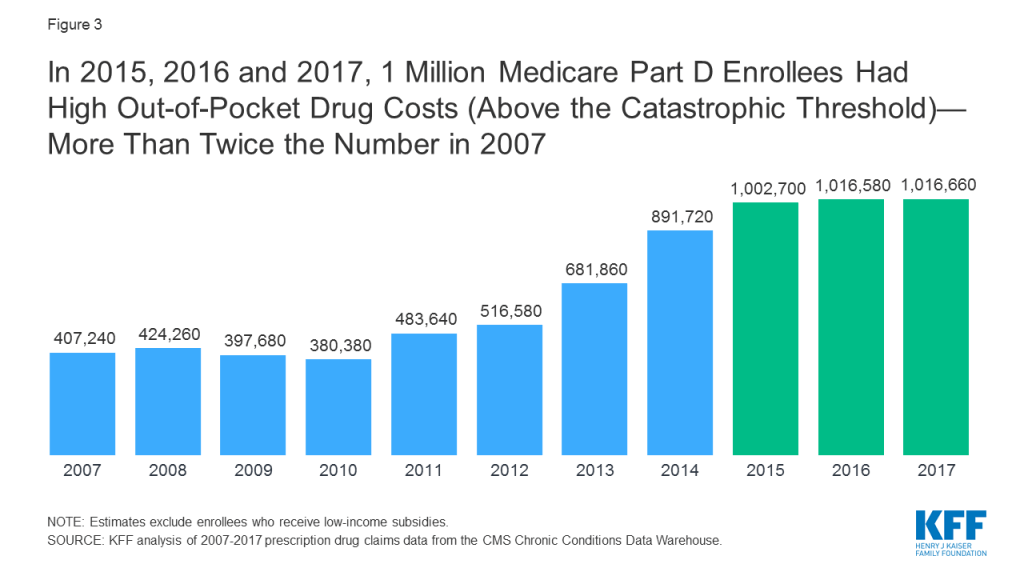
Adding an out-of-pocket spending limit in Part D would provide substantial savings for beneficiaries who have high drug costs. In 2017, over one million Part D enrollees had out-of-pocket spending in the catastrophic phase (Figure 3). Beneficiaries with out-of-pocket spending above the catastrophic threshold may be taking one high-cost drug, for conditions such as cancer, multiple sclerosis and Hepatitis C, or multiple relatively expensive drugs.
Figure 3: In 2015, 2016 and 2017, 1 Million Medicare Part D Enrollees Had High Out-of-Pocket Drug Costs (Above the Catastrophic Threshold)—More Than Twice the Number in 2007
All three of these proposals – the Trump Administration’s, the Senate Finance Committee’s and H.R.3 – would limit the financial exposure of Medicare beneficiaries, though as noted above, CBO has not estimated the effects of an out-of-pocket limit by itself.
In its preliminary analysis, CBO estimates that the Senate Finance Committee’s benefit redesign proposal, which includes an out-of-pocket spending limit among other features, would reduce beneficiary spending on cost sharing by $20 billion and premiums by almost $1 billion over the 10-year period. There is no similar estimate yet available from CBO for H.R. 3, although presumably the effects would be within the same range for both proposals.
Proposals that shift more financial risk to plan sponsors and pharmaceutical companies by increasing their share of costs in the catastrophic phase could also affect beneficiaries. Plans would have stronger incentives to control costs and minimize their liability by, for example, attempting to negotiate lower drug prices with pharmaceutical companies. Plans would also have stronger incentives to steer beneficiaries toward lower-cost medications, which could lower beneficiaries out-of-pocket costs. At the same time, plans may impose new formulary restrictions and cost management tools, which could potentially affect beneficiaries’ access to needed medications. It is also possible that plans could increase Part D premiums to offset the additional costs they incur above the catastrophic threshold, although the CBO’s preliminary estimate indicates that the effects of this proposal, on its own, would have only a modest impact on premiums.
Exclude Manufacturer Discounts from the Calculation of “TrOOP”
The Administration has proposed changing the calculation of enrollees’ out-of-pocket costs (TrOOP) to exclude the value of the manufacturer price discount on brand-name drugs filled in the coverage gap benefit phase. Under current law, the value of the discount is included in the calculation of out-of-pocket spending, which means that Part D enrollees move through the coverage gap benefit phase more rapidly and qualify for catastrophic coverage sooner than they otherwise would. The Administration’s rationale for this proposal is to “correct the misaligned incentive” that currently exists for plans when enrollees use more costly drugs and reach the catastrophic coverage phase sooner, because plans’ liability for costs during that phase is relatively low.
The Medicare Payment Advisory Commission (MedPAC) has also recommended this change in conjunction with adding an out-of-pocket limit to Part D and reducing Medicare’s reinsurance payments above the catastrophic threshold as described above. Some policymakers have suggested pairing the change in the calculation of TrOOP with one that would lower the catastrophic threshold so that beneficiaries are held harmless in terms of their total annual out-of-pocket liability (since removing the manufacturer discount from the TrOOP calculation would increase beneficiary out-of-pocket spending, as discussed below).
The Senate Finance Committee’s drug pricing legislation does not explicitly address the TrOOP calculation. However, because the coverage gap phase would be eliminated and there no longer would be a manufacturer discount in that phase, this would effectively change the TrOOP calculation. H.R. 3 sunsets the existing coverage gap discount program and the provision that the current manufacturer discount counts towards TrOOP, and does not include a requirement that the new 10 percent discount below the catastrophic coverage threshold would count towards TrOOP.
Budget Effects
CBO estimates that the Administration’s FY 2020 budget proposal to change the calculation of TrOOP by excluding the value of the manufacturer discount would reduce Medicare spending by $73.2 billion over 10 years. The CBO score indicates that plan costs would decrease substantially and enrollees would be responsible for the out-of-pocket costs in the coverage gap benefit phase leading to fewer enrollees progressing through the coverage gap benefit phase and into catastrophic coverage, and fewer enrollees ultimately reaching the catastrophic phase.
Effects on Beneficiaries
Under the Administration’s proposal, Part D enrollees would face higher out-of-pocket costs before reaching the out-of-pocket limit if the value of the manufacturer discount is excluded from the TrOOP calculation, and would progress through the coverage gap benefit phase at a slower pace. This would result in fewer enrollees incurring out-of-pocket costs that exceed the catastrophic threshold, which means that fewer would benefit from an out-of-pocket limit. However, if the out-of-pocket limit was lowered, as is proposed under the Senate Finance Committee legislation and under H.R. 3, beneficiaries might not incur higher out-of-pocket costs.
Higher out-of-pocket costs could lead to a decrease in medication adherence, as well as lower utilization. In its estimate of H.R. 3, CBO noted that improved adherence would lead to improved health outcomes and lower spending for other Medicare-covered services. If plan costs decrease as a result of changing the TrOOP calculation, plan premiums and Medicare spending on premium subsidies could also decrease. However, for people with high drug costs, the increase in out-of-pocket spending associated with the change in the TrOOP calculation would likely exceed the level of savings they would receive in the form of lower premiums.
Cap Increases in Medicare Drug Prices to the Rate of Inflation
For the past decade, annual price increases on brand-name drugs have far outpaced the rate of inflation.9 To address these concerns, the Administration and members of Congress are considering proposals to place a cap on annual price increases for drugs covered under Medicare at the rate of inflation (Consumer Price Index for All Urban Consumers, or CPI-U), or require manufacturers to pay a rebate to Medicare if their prices increase faster than the inflation rate. The Medicaid program has a similar policy in place whereby manufacturers are required to provide a rebate to the Medicaid program if the price of a prescription drug increases faster than the rate of inflation. In the case of the Trump Administration, the policy is limited to Part B drugs only whereas the Congressional proposals apply more broadly to Parts B and D.
Require Rebates for Part D Drugs with Price Increases Faster than Inflation
The Senate Finance Committee legislation includes a provision to require manufacturers of Part D drugs and biologics to pay a rebate to Medicare if prices increase faster than inflation. (The Committee voted down an amendment to strike this provision by a tie vote, 14-14.) The Committee proposal would only apply to brand-name drugs covered under Part D, and would measure price changes based on the list price (wholesale acquisition cost). Manufactures would have 30 days to pay the requisite rebate or would face a civil monetary penalty of the original rebate amount plus 25 percent. The measurement of price changes would look back to July 1, 2019, and the proposal would take effect January 1, 2022.
H.R. 3 includes a similar provision that requires manufacturers to pay a rebate if Medicare drug prices increase faster than the rate of inflation. Under this proposal, any manufacturer that increases the price of Part D drugs faster than the rate of inflation would be required to pay the difference in the form of a rebate to Medicare. However, unlike the Senate Finance Committee’s proposal, H.R. 3 would apply to all drugs, not just brand and biologics, and would use the average manufacturer price to measure drug prices, not the wholesale acquisition cost. Manufacturers that do not pay the requisite rebate amount within 30 days would be required to pay a penalty equal to 125 percent of the original rebate amount. H.R. 3 would measure price changes going back to January 1, 2016 (compared to 2019 in the Senate Finance Committee legislation), and the proposal would take effect in 2022. (See below for a discussion of the Part B drug rebate provisions included in the Senate Finance Committee and H.R. 3.)
Budget Effects
According to its preliminary estimate, CBO expects the Senate Finance Committee’s proposal would achieve $57.5 billion in Medicare savings over 10 years (2020-2029).
There is no CBO score yet available for the Part D rebate provision in H.R. 3.
Effects on Beneficiaries
In its preliminary analysis, CBO estimates that the Senate Finance Committee’s inflation rebate proposal would reduce beneficiaries’ spending on cost sharing by $5 billion and premiums by $5 billion over the 10-year period. (CBO has not yet provided a similar estimate for this provision in H.R. 3.) Requiring manufacturers to pay an inflation rebate to Medicare if their Part D drug prices increase faster than inflation could be expected to slow the growth in beneficiaries’ out-of-pocket drug costs over time if manufacturers limit price increases to the rate of inflation. It could also help beneficiaries better anticipate their out-of-pocket costs from one year to the next. If the inflation rebate proposal helps to limit the growth in Part D drug prices, it could also lower Part D plan sponsor costs, which could lower Part D premiums for enrollees.
The inflation rebate provisions in the Senate Finance Committee legislation and H.R. 3, on their own, would not automatically reduce drug prices from their current levels and would not automatically lead to lower out-of-pocket spending by enrollees. However, under both proposals, there is the potential for manufacturers to respond to the rebate requirement by lowering drug prices to the level they would have been if they had only increased at the rate of inflation. For example, under H.R. 3, this could lower out-of-pocket costs for beneficiaries who take drugs that have increased faster than the rate of inflation since 2016, if their costs are calculated based on the drug’s price (as under coinsurance). However, manufacturers may instead choose to pay the required rebate instead of reducing prices from their current levels.
Under both of these proposals, drug manufacturers may respond to the inflation rebate by increasing launch prices, which could result in some beneficiaries paying higher prices for new drugs, and potentially lead to higher costs for other payers and privately-insured patients. While plans have the ability to negotiate with companies and can refuse to cover drugs with very high launch prices, they may have less leverage in some instances, such as when there are no therapeutic alternatives available. It has also been argued that requiring inflation rebates could stifle innovation, which could affect access to new therapies. (These arguments apply similarly to the Part B inflation rebate proposal discussed below.)
Establish an inflation limit on Part B drug reimbursement growth
Medicare covers a more limited set of prescription drugs under Part B than under Part D, which are typically administered in outpatient settings such as physicians’ offices and hospital outpatient departments. These drugs are generally used in the treatment of serious illnesses such as cancer, multiple sclerosis, and other high-cost conditions. For most Part B drugs, providers are reimbursed based on the average sales price (ASP) of a given drug plus a 6 percent add-on payment. (Under the budget sequester, payments to providers for Part B drugs were reduced, resulting in a net payment of ASP plus 4.3 percent beginning in April 2013.) Both the Trump Administration and MedPAC have expressed concern that the current payment system creates incentives that contribute to higher Part B drug costs due to lack of price competition for certain drugs and because physician reimbursement is higher for higher-priced drugs.
As one of several modifications to payments for Part B drugs, the Administration has proposed placing an inflation-adjusted limit on payment for Part B drugs by capping the growth of the ASP payment rate for Part B drugs at the rate of inflation.10 Drugs would be paid either at the current ASP payment rate or at the inflation-adjusted ASP payment rate, whichever is lower. (For a discussion of the Administration’s other Part B drug payment proposals, see Use International Reference Pricing for Drugs Covered by Medicare and Make Other Modifications to Payments for Part B Drugs below.)
The Senate Finance Committee includes an inflation rebate proposal for Part B drugs, similar to the approach for Part D discussed above. If the average sales price for single source drugs and biologics (though not biosimilars), covered under Part B increase faster than the rate of inflation, manufacturers would be required to pay the difference in the form of a rebate to Medicare. Manufacturers that do not to pay the rebate within 30 days would face a monetary penalty equal to 125 percent of the rebate amount. Manufacturers that fail to pay the monetary penalty would not receive any payment for that drug under Part B until the penalty is paid. The measurement of price increases would look back to July 1, 2019, and would take effect on January 1, 2021.
The provision in H.R. 3 to establish an inflation rebate for Part B drugs is similar to the provision in the Sentence Finance Committee legislation. If the average sales price for single source drugs, biologics, as well as biosimilars, covered under Part B increase faster than the rate of inflation, manufacturers would be required to pay the difference in the form of a rebate to Medicare. Manufacturers that do not to pay the rebate within 30 days would face a monetary penalty equal to 125 percent of the rebate amount. However, unlike the Senate Finance Committee proposal, there is no provision that prevents payment for Part B drugs until the penalty is paid. The measurement of price increases would look back to January 1, 2016 (compared to 2019 in the Senate Finance Committee legislation), and the proposal would be implemented on July 1, 2021.
Budget Effects
CBO stated there was not enough detail to score the Administration’s proposal to limit Part B drug price growth to the rate of inflation. The Administration also did not estimate its potential budget impact.
In its preliminary estimate, CBO projects that the Senate Finance Committee’s inflation rebate proposal for Part B drugs would decrease Medicare spending by $10.7 billion over 10 years (2020-2029).
There is no CBO score yet available for the Part B rebate proposal in H.R. 3.
Effects on Beneficiaries
The underlying price of drugs covered under Part B affects beneficiary out-of-pocket spending because beneficiaries are required to pay 20 percent coinsurance for Part B drugs. Unlike most health insurance coverage, traditional Medicare does not have an annual cap on out-of-pocket spending, although many beneficiaries currently have a limit on their out-of-pocket costs, either through a supplemental policy that covers cost sharing, (such as Medigap), or if they are enrolled in Medicare Advantage plans, which are required to have an out-of-pocket limit.
Capping growth of Part B drug reimbursement to the rate of inflation could slow the growth in beneficiaries’ out-of-pocket costs for Part B drugs and lead to greater stability over time. Lower overall drugs costs could also result in lower Part B premiums and lower premiums for supplemental coverage that pays Part B cost sharing. This proposal would not directly lower the current high cost of many Part B drugs, however, but as mentioned previously in relation to the Part D inflation rebate proposal, manufacturers may choose to limit the increase in drug prices below the rate of inflation, to avoid paying a rebate. Limiting the increase in Medicare’s payments for drugs to the rate of inflation may lead companies to launch drugs at higher prices, which could increase costs for some beneficiaries. CBO’s estimate of the Senate Finance Committee proposal did not project the effects of the Part B inflation rebate on Part B premiums.
Use International Reference Pricing for Drugs Covered by Medicare
Many studies have shown that the United States pays more for drugs than other developed countries, on average.11 Several proposals have been introduced to align drug prices in the United States more closely with drug prices in other countries in order to lower drug costs. The Trump Administration has suggested using international reference pricing specifically for Part B drugs, while some Congressional proposals apply more broadly, including, but not limited to, drugs covered by Medicare.
In an advanced notice of proposed rulemaking (ANPRM), the Administration proposed to test a series of new approaches for reimbursing Part B drugs, one of which is sometimes referred to as the international price index (IPI) model.12,13 Under the IPI model, Part B drug payments would be based on an international reference price instead of ASP, except in situations where ASP is lower. The target prices would be derived from an international price index, which would be phased in over a five-year time period. The IPI model would be tested and its effectiveness evaluated using a randomized design in geographic areas that comprise 50 percent of Part B spending. Medicare would aim to reduce Part B drug payments to 126 percent of what other countries pay, compared to 180 percent currently.14 The Senate Finance Committee voted on an amendment to prevent implementation of this model, but it narrowly failed by a tie vote.
There are several Congressional proposals that would use international reference prices to limit prescription drug prices both for Medicare Part B and Part D and for other payers. Under one proposal introduced by Senator Bernie Sanders (I-VT), the price of brand-name drugs would be limited to the median price in Canada, France, the United Kingdom, Germany, and Japan; if companies’ drug prices exceeded this amount, the government would waive the companies’ patent and exclusivity rights for those drugs and allow other manufacturers to produce them.15 Under another proposal introduced by Senator Rick Scott (R-FL), drug manufacturers would be prohibited from charging a higher list price for both brand-name and generic drugs than they do in Canada, France, the United Kingdom, Germany, or Japan. As mentioned previously, H.R. 3 would use international reference pricing to set an upper limit on Medicare prices for drugs that have been selected for negotiation by the HHS Secretary, not to exceed 120 percent of the average price in up to six specified countries – Australia, Canada, France, Germany, Japan, and the United Kingdom.
Budget Effects
The Administration estimates that its proposed IPI model for Part B drug reimbursement would reduce federal Medicare spending by $17.9 billion over five years (2020-2025). There are many uncertainties around this estimate, however, and behavioral responses by a variety of stakeholders, including beneficiaries, manufacturers, and providers, would significantly affect the model’s financial effects. The Administration noted in the ANPRM that its estimate is likely to change. CBO has not scored the Administration’s proposal, nor any of the international reference pricing proposals that would apply more broadly.
Effects on Beneficiaries
The Administration estimates that Medicare beneficiaries could save $3.4 billion over five years under its Part B international reference pricing proposal due to decreased coinsurance that would result from lower list prices. However, some have indicated that not all beneficiaries would experience savings because many have supplemental insurance (Medigap, retiree health benefits, and Medicaid) that covers cost sharing for Part B drugs. Reduced prices for Part B drugs may lead to lower Part B costs overall, which could lead to a reduction in Part B premiums and premiums for supplemental coverage, along with a decrease in Medicaid spending on behalf of dually eligible beneficiaries who take Part B drugs. This proposal would not affect drug costs and spending under Medicare Part D.
Under broader international reference pricing proposals, Medicare beneficiaries could experience cost savings due to lower costs under Parts B and D. This could take the form of lower cost sharing for drugs covered under both Part B (if beneficiaries do not have supplemental coverage that covers cost sharing) and Part D, particularly for non-preferred drugs where beneficiaries could pay up to 50 percent of the cost of a specialty drug as well as above the catastrophic threshold where beneficiaries pay 5 percent of drug costs. Lower drug prices overall could also reduce Part B costs, which would reduce Part B premiums, as well as lower Part D plan costs, which could result in lower Part D premiums.
Other Implications
The Administration’s rationale for the IPI proposal is to “cut down on foreign governments’ freeriding,” by “securing for the American people a share of the price concessions that drug makers voluntarily give to other countries.” Analysis by the Administration’s Office of the Assistant Secretary for Planning (ASPE) showed that, for the 27 highest-cost Part B drugs, acquisition costs in the United States were 1.8 times higher than those in 16 other developed countries. However, some question the assertion that using international benchmark prices would reduce costs, arguing that pharmaceutical companies may simply refuse to sell a drug at the new target price, and Medicare would have little recourse with regard to enforcement due to its coverage requirements. Drug manufacturers may also find ways to adjust foreign prices that could undercut savings on U.S. drug prices.16
Similar issues would arise for the international reference pricing proposals that apply broadly (not limited to Part B only). Without some sort of enforcement mechanism, manufacturers may refuse to comply with these rules to sell a drug at a new lower price, and Medicare would still be required to cover the drug. At the same time, if manufacturers face a financial penalty for non-compliance, such as a tax or loss of exclusivity rights, they may have a strong incentive to increase prices in other countries to avoid serious financial losses. These tactics may ultimately lead to lower-than-anticipated savings.
Make Other Modifications to Payments for Part B Drugs
In addition to the Part D drug payment proposals outlined above, the Administration, the Senate Finance Committee, and other policymakers have proposed other modifications to payments for Part B drugs that aim to lower beneficiary out-of-pocket costs, decrease Part B drug spending, and address incentives within the current payment system that may lead to utilization of more expensive drugs even when less expensive alternatives are available.17 (H.R 3 does not include any other provisions related to Part B drug payment changes aside from the inflation rebate provision.)
The Administration’s ANPRM includes a provision to eliminate the ASP percentage-based add-on payments to physicians under Part B. As mentioned previously, under budget sequestration, providers are currently reimbursed at ASP plus a 4.3 percent add-on, rather than ASP plus 6 percent.18 The ANPRM provision would effectively raise the add-on payment back to the full 6 percent, but would change the form of reimbursement for the add-on payment to a fixed payment amount for physician-administered drugs, instead of the 6 percent add-on. This add-on payment would not vary with the underlying price of the drug, unlike the current ASP plus 6 percent payment.19
In its drug pricing legislation, the Senate Finance Committee proposed a number of changes to the Part B drug payment system. While these provisions differ in their specifics from the Administration’s proposals, they are designed to achieve similar goals. For example, in order to mitigate the financial incentive for physicians to prescribe higher-priced drugs, the Committee proposed to establish a maximum add-on payment of $1,000 for drugs, biologics, and biosimilars; currently there is no limit to the add-on payment amount that providers can receive. The legislation also includes a number of provisions that would modify how ASP is calculated, which are designed to reduce excess payments for Part B drugs by Medicare. For example, the Committee proposed to require manufacturers to exclude the value of coupons from the calculation of ASP; presently, manufacturers are not required to exclude the value of coupons or certain price concessions they provide to patients in the calculation of ASP, which results in higher Medicare reimbursements for Part B drugs.
Budget Effects
According to the Administration’s estimate for the ANPRM, the proposed changes to physician payments for Part B drugs would increase Medicare spending by $1.6 billion because payments to physicians under the proposed system of fixed amounts for the add-on payment would increase from the current add-on payment based on ASP plus 4.3 percent.
In its preliminary estimate, CBO projects that the Senate Finance Committee’s proposed changes to Part B drug payments would generate savings of $2.2 billion for Medicare over 10 years (2020-2029) (in addition to the $10.7 billion in projected savings from the Part B drug inflation rebate). The largest component of this estimate is the provision to exclude the value of coupons from ASP (estimated savings of $1.45 billion over 10 years), due to the reduction in Medicare payments for Part B drugs associated with lower ASP amounts.
Effects on Beneficiaries
All of these proposals aim to lower Part B drug prices, reduce excess payments that drive up Part B drug and program costs, and eliminate incentives for providers to prescribe higher-priced drugs. If payments to providers are disconnected from the price of drugs they administer, and if patients receive lower-priced drugs as a result, then beneficiaries’ out-of-pocket costs would be lower. Coinsurance would also be lower if the value of ASP for specific drugs declines. As discussed previously, however, Medicare beneficiaries with supplemental insurance may not experience a direct cost reduction because their Part B coinsurance is covered. At the same time, lower overall Part B costs due to reduced Part B drug prices could also lower Part B premiums for all beneficiaries.
Currently, section 14 of the Medicare and Medicaid Patient and Program Protection Act of 1987 requires the Health and Human Services Office of Inspector General (OIG) to establish “safe harbors”, which exempts certain business or payment practices from criminal penalties under the federal Anti-Kickback Statute. One of the safe harbor practices protected by the OIG rule are rebate payments made by drug manufacturers to pharmacy benefit managers (PBMs) and health plan sponsors. Under the current drug pricing system, pharmaceutical companies offer rebates to PBMs in exchange for preferred formulary placement of their drug over their competitors’ products, which helps to lower Part D plan and program costs.20 These rebates produce lower net drug prices for payers which enables them to offer lower premiums in turn. Rebates do not directly lower out-of-pocket costs for Part D enrollees, however, because any rebates negotiated for the drugs they take are not passed on at the point of sale.
Eliminate Rebates under Part D (withdrawn by administration in July 2019)
Under the Trump Administration’s February 2019 proposed rule, which was withdrawn in July 2019, rebate payments by drug manufacturers to PBMs, Medicare Part D plan sponsors, and Medicaid managed care organization (MCO) plan sponsors would have been excluded from the safe harbor protections. The rule also proposed two new safe harbor protections: one which would have allowed drug manufacturers to provide discounts that would apply to beneficiaries’ point of sale purchases, and another which would have authorized fixed fee arrangements for certain services between drug manufacturers and PBMs.
Budget Effects
According to CBO, this proposal would have increased federal Medicare spending by $177 billion over 10 years, due to increases in federal subsidies for premiums and for low-income cost sharing. Similarly, OACT estimated this proposal would have increased federal Medicare spending by $196 billion over 10 years (2020-2029).21 Both CBO and OACT assumed that with the elimination of rebates, pharmaceutical manufacturers would alter their pricing and rebate strategies. With the loss of rebate revenue, plans may have raised their premiums, which would have led to increased premium subsidies paid by the federal government, resulting in greater overall costs for the Medicare program. Others noted the possibility that varied stakeholder responses to the proposal could have potentially led to increases or decreases in overall federal spending that were impossible to predict.22
Effects on Beneficiaries
According to CBO, Part D premiums were likely to rise under this proposal, based on the assumption that bids from Part D plans would increase in the absence of rebates. OACT projected that the majority of beneficiaries would have seen an increase in their total out-of-pocket spending and premium costs of $58 billion over 10 years.
Both CBO and OACT predicted that a small group of beneficiaries who use drugs with significant manufacturer rebates might have seen a decline in their overall out-of-pocket spending due to decreased cost sharing at the point of sale. Lower out-of-pocket costs under this proposal could have led to increased medication adherence for affected beneficiaries and potentially could have reduced the incidence of costly, emergent medical events.23 However, premiums would have modestly increased for all beneficiaries, driving up total spending for most people covered by Medicare.
If manufacturers did not offer rebates at the point of the sale as large as the ones they currently offer to PBMs and plan sponsors, savings for beneficiaries who use the specific drugs that currently have substantial rebates would have been lower than estimated. Additionally, beneficiaries who do not use drugs that have significant manufacturer rebates would not have benefited from this proposal (and would have incurred higher Part D premiums). According to one industry-funded analysis, only 36 percent of brand drugs overall have manufacturer rebates, which indicates that many beneficiaries would not have seen savings.24
Other Implications
The Administration’s rationale for eliminating rebates was to better align incentives in order to “curb list price increases, reduce financial burdens on beneficiaries, lower or increase Federal expenditures, and improve transparency.” Eliminating rebates may have also altered other features of Part D formulary design, such as existing incentives for plans or PBMs to give preferred formulary placement to higher-cost drugs with higher associated rebates and/or provide less favorable coverage of lower-cost products that have low or no rebates.25 Those in support of the rebate proposal argued that it would have prevented PBMs from favoring high-cost drugs with high list prices, incentivized manufacturers to lower list prices in exchange for better formulary placement, and encouraged savings to be passed on to the consumer at the point of sale.26
There was much uncertainty over whether eliminating rebates in Part D would have the intended effect or instead result in both higher Part D premiums and higher out-of-pocket spending for beneficiaries and increased spending for the federal government. Some critics of the proposal contended that it did not create any incentives for manufacturers to lower list prices, particularly if rebates in the commercial market were still allowed, which may have left beneficiaries paying as much or more out of pocket without PBMs negotiating on their behalf.27 CBO likewise stated that it did not expect manufacturers to lower list prices as a result of this proposal. Some skeptics also questioned whether the proposed safe harbor to allow certain fixed fee arrangements between drug companies and PBMs would have had unintended effects, as plans and manufacturers adopted alternative arrangements that may have formed a de facto system of rebates.
Share Rebates with Part D Plan Sponsors and/or Beneficiaries
Rather than eliminate rebates entirely, some policymakers have proposed to require that PBMs share rebates with Part D plan sponsors and/or enrollees. One Congressional proposal introduced by Senator Ron Wyden (D-OR), would require a minimum percentage of rebates to be passed through to plan sponsors and patients. In its FY 2019 budget, the Administration included a proposal to pass at least one-third of all rebates and price concessions to enrollees at the point of sale, but the proposed rule to remove the safe harbor for rebates (which was withdrawn) superseded that approach.28
Budget Effects
CBO has not scored these proposals.
Effects on Beneficiaries
Proposals to share rebates with plan sponsors and/or patients have the potential to lower out-of-pocket costs for Part D enrollees, since cost sharing would be based on a lower price. However, manufacturers and plan sponsors could potentially take compensatory actions to lower the overall rebate amount, in which case savings to beneficiaries would be reduced.
In its FY 2020 budget, the Administration proposed authorizing the HHS Secretary to shift coverage of certain drugs currently covered under Part B to Part D, beginning in 2020, subject to a determination that savings could be gained from shifting from the ASP plus 6 percent reimbursement under Part B to negotiated pricing under Part D. The Secretary would not use this authority if doing so would limit patient access to a drug or if beneficiary cost sharing would increase. In order for this proposal to be implemented, a new billing mechanism may need to be established between Part D plans and Part B prescribers. The rationale for this proposal is to “allow HHS to leverage Part D plans’ negotiating power to bring down prices and lower patient out-of-pocket costs.”
The Senate Finance Committee legislation also has a provision that requires MedPAC to produce a report that analyzes the effects of shifting coverage of some Part B drugs to Part D. The report would look at the impact of this shift on program spending and beneficiary cost sharing as well as the feasibility and policy implications of such an approach.
Budget Effects
CBO stated it lacked sufficient detail to score this proposal, and the Administration did not produce a budget estimate.
Effects on Beneficiaries
This proposal could lead to lower out-of-pocket costs for beneficiaries if Part D plan sponsors are able to negotiate lower prices for drugs that are currently covered under Part B. In addition, beneficiaries with Medigap might see a reduction in their premiums, because Medigap would no longer be covering the 20 percent coinsurance for these drugs under Part B.
Under current law, Medicare beneficiaries with low incomes and modest assets are eligible to receive subsidies to help cover their Part D monthly premiums and cost-sharing amounts through the Part D Low-Income Subsidy (LIS) program. Some beneficiaries automatically qualify for the LIS, while those who do not can apply and will qualify for full subsidies if their income falls below 135 percent of the federal poverty level (FPL) ($16,862 individuals/$22,829 couples in 2019) and their assets do not exceed $9,230 ($14,600 if married). Those with incomes at or below 150 percent FPL ($18,735 individuals/$25,365 couples in 2019) and assets between $9,230 and $14,390 ($14,600 and $28,720 if married) qualify for partial subsidies.29
LIS enrollees currently pay low cost-sharing amounts for brand-name and generic drugs. Enrollees receiving full subsidies pay $1.25 for generics and $3.80 for brands in 2019, and those receiving partial subsidies pay $3.40 and $8.50, respectively. Because the cost differential between brands and generics is relatively small, there is some concern that LIS enrollees do not face a strong financial incentive to use generic drugs. This may result in higher costs for LIS enrollees who use brands when generics are available, as well as higher costs for Medicare, which subsidizes a large portion of cost sharing for LIS beneficiaries.
Eliminate Cost Sharing for Generics for LOW-INCOME SUBSIDY ENROLLEES
Under a provision in H.R. 3, cost sharing for generic drugs, including multiple source drugs, would be eliminated for Part D LIS enrollees, beginning plan year 2021. A proposal in the Administration’s FY 2020 budget would also eliminate cost sharing for generic drugs for Part D LIS enrollees, including for preferred multisource drugs and biosimilars, beginning in 2020. A similar proposal was recently introduced in Congress by Representative Joe Cunningham (D-SC1), and MedPAC recommended a similar change in 2016.
Budget Effects
For FY 2020, CBO estimates that eliminating cost sharing for generic drugs would increase federal spending by $23 billion over 10 years. By contrast, the Trump Administration estimates this proposal would reduce federal spending by $930 million over 10 years. CBO’s estimate suggests that higher spending could result from reducing LIS cost sharing for generic drugs, including for relatively expensive biosimilars, which could, in turn, lead to higher utilization of these drugs and, as a result, higher Medicare payments to plans on behalf of LIS enrollees. However, the Administration’s estimate suggests that eliminating cost sharing for generics and biosimilars may cause LIS enrollees to substitute generics for brands, which would reduce the amount of Medicare cost-sharing subsidies for LIS enrollees.
There is no CBO score yet available for eliminating cost sharing for generics as part of H.R. 3.
Effects on Beneficiaries
Eliminating cost sharing for generic drugs for LIS enrollees would create a stronger financial incentive to use generics, and would reduce out-of-pocket costs for LIS enrollees who take generic drugs and for those who are able to switch from brands to generics. Eliminating cost sharing would also ensure better access to needed drugs and less prescription abandonment. At the same time, unnecessary use of certain medications may increase due to the elimination of cost sharing.
expand Eligibility for Low-Income Subsidies
Beneficiaries who are dually eligible for Medicare and Medicaid automatically receive Part D Low-Income Subsidies. However, the rate of LIS take-up by eligible beneficiaries who are not automatically enrolled has historically been low, causing concern with regard to low-income beneficiaries who may not enroll due to eligibility requirements or application difficulties.30
H.R. 3 includes a provision to institute automatic enrollment into the LIS program for all adults who reach age 65 and have incomes up to 200 percent of poverty who are enrolled in Medicaid. Furthermore, the proposal would broaden LIS eligibility requirements for low-income Part D enrollees by eliminating the asset test by increasing the income eligibility thresholds. Part D enrollees with incomes up to 200 percent FPL would be eligible for partial subsidies and enrollees with incomes up to 150 percent FPL would be eligible for full subsidies beginning for plan year 2022.31 A similar Congressional proposal introduced by Senator Bob Casey (D-PA) would also broaden LIS eligibility requirements for low-income Part D enrollees by eliminating the asset test and by extending full LIS benefits to Part D enrollees with incomes up to 200 percent.32 Neither the Trump Administration nor the Senate Finance Committee have proposed expanding eligibility for low-income subsidies.
Budget Effects
CBO has not scored these proposals.
Effects on Beneficiaries
Establishing automatic enrollment, expanding eligibility for full and partial subsidies under the LIS program and eliminating the asset test would increase the number of low-income people on Medicare who qualify for premium and cost-sharing assistance under Part D, and lower out-of-pocket costs for beneficiaries who currently qualify for partial subsidies. Instituting automatic enrollment would reduce the government’s administrative burden for documenting eligibility, and eliminating the asset test would help more low-income beneficiaries qualify for LIS benefits. Furthermore, an increase in the number of people who qualify for premium and cost-sharing assistance may lead to higher drug utilization and increased medication adherence, due to lower out-of-pocket costs for beneficiaries.
Allow Medicare Advantage Plans to Require Step Therapy for Part B Drugs
Under CMS guidance in effect until August 2018, Medicare Advantage plans were not authorized to use utilization management tools such as step therapy for Part B drugs, unless these tools were allowed under traditional Medicare. CMS rescinded this guidance in August 2018. CMS recently finalized regulations that allow Medicare Advantage plans to use utilization management tools such as step therapy and prior authorization for Part B drugs, subject to certain rules.
According to CMS, these tools will enable Medicare Advantage plans to better manage and negotiate the price of Part B drugs, which will bring down costs for the Medicare program and beneficiaries. Certain safeguards would be established, such as changing the determination and appeals time frame to align with Part D rules; requiring Medicare Advantage plans to use Pharmacy and Therapeutics (P&T) committees to review and approve step therapy, similar to Part D; including disclosure requirements in plan documents; and instituting policies and procedures to inform various stakeholders about the requirements. The new step therapy rules will apply only to new prescriptions rather than existing prescriptions for Part B enrollees. Most rules will be in effect beginning January 1, 2020 (though some amendments will take effect starting January 1, 2021), but the guidance applies to plan year 2019.
Budget Effects
According to the Administration’s estimates, Medicare will see a net savings of $1.9 billion over 10 years (2020-2029), which consists of gross savings of $1.91 billion and gross costs of $11.2 million due to increased beneficiary appeals. The Administration calculates that the use of step therapy will yield savings of 1.6 percent on Part B drugs due to increased use of less costly biosimilars, which are clinically equivalent to biologics, and will generate more favorable rebates for drugs with adequate competition. This proposal has not been scored by CBO.
Effects on Beneficiaries
According to the Administration’s estimates, Medicare beneficiaries will save $62 million under this proposal. Broader use of utilization management tools could lead to lower out-of-pocket costs for Medicare Advantage enrollees who take Part B drugs, if beneficiaries are able to substitute lower-cost medications for more costly ones. However, this proposal could also create barriers to medication access and could lead to administrative hassles. Step therapy and prior authorization could be burdensome for beneficiaries who may first have to try a number of drugs before they can take the one that is most effective for them, which could lead to preventable side effects, as well as poorer health outcomes due to delays in receiving optimal treatment. Furthermore, step therapy could lead to increased coverage appeals by beneficiaries who disagree with plan coverage decisions, and may lead to access issues for patients who are ultimately denied coverage for specific drugs. In response to these and other concerns, the Administration pointed to safeguards included in the final rule, which the Administration contends are adequate to ensure that these policies do not impede needed access to care.
Modify Coverage Requirements for Drugs in Part D Protected Classes
Under current program regulations, Part D plans are required to cover all or substantially all drugs in six protected classes (anticonvulsants, antidepressants, antineoplastics, antipsychotics, antiretrovirals, and immunosuppressants for the treatment of transplant rejection). Although the protected classes were originally created to smooth the transition from Medicaid to Medicare Part D for beneficiaries with these conditions when the latter program first started, the protected classes have been affirmed by Congress at various junctures since their launch in recognition of the unique challenges faced by beneficiaries diagnosed with the particular medical and mental health problems that protected class drugs are intended to treat.
While this policy has largely achieved its purpose, the Administration has suggested that the “essentially open coverage” of certain drug categories under the protected classes policy may lead to overutilization of these drugs and limit Part D plans’ ability to use tools that can bring down the costs of prescription drugs, including negotiating rebates. Currently, only 13 percent of protected class drugs have manufacturer rebates, according to one industry-funded analysis.33 Rebate information is proprietary and therefore drug-specific rebate data is not publicly available.
The Administration recently finalized a rule addressing coverage requirements for the protected classes. Under the final rule, the Administration codified an existing policy that allows for the broader use of prior authorization and step therapy for protected class drugs in five of the six protected classes (excluding antiretroviral medications) and in the case of new prescriptions only. The rule also gives plans greater authority to use utilization management tools, including indication-based formulary design, for drugs in five of the six protected classes. The rule did not finalize changes that would have allowed broader use of prior authorization and step therapy without distinguishing between new starts and existing therapies, as is currently permitted for other drug categories and classes. These changes will take effect on January 1, 2020.
The Administration proposed, but did not finalize, other changes that would have allowed plans to exclude some protected class drugs from their formularies under specific circumstances, including: 1) if the drug is a new formulation of a protected class drug, even if the older formulation is no longer on the market, or 2) if the price of a drug increases beyond the rate of inflation based on the CPI-U.
Budget Effects
The Administration did not project the net budget effect of changes included in the final rule.
Effects on Beneficiaries
Proponents in favor of coverage restrictions for protected class drugs contend that the proposal would have resulted in lower costs for patients, because plans could get greater discounts on covered drugs. However, in comments submitted in response to the proposed rule, patient advocates, pharmaceutical companies, and others expressed concern that the proposed changes would reduce patients’ access to needed medications, disrupt ongoing therapy, and create an unintended incentive for manufacturers to launch new drugs at higher prices. In response, the Administration modified the first provision on step therapy to apply to new prescriptions only, and did not finalize provisions that would have allowed some protected class drugs to be excluded from formularies. By codifying existing policy, Medicare beneficiaries who use protected class drugs will retain current access to these medications.
Require Part D Plan Sponsors to Use Real-Time Benefit Tools
Under the MMA, prescription drug plan sponsors are required to adopt Part D electronic prescribing (eRx) standards. However, there is no requirement that prescribers utilize eRx tools. Prescribers that choose to use these tools must comply with the National Council for Prescription Drug Programs (NCPDP) SCRIPT standards, which allows prescribers to transmit information electronically, and the NCPDP Formulary and Benefits standards (F&B), which enable prescribers to view plan formularies. However, neither of these standards provides prescribers with real-time cost or coverage information for individual patients at the point of prescribing.
The Administration recently finalized a rule that would require Part D plan sponsors to adopt real-time benefit tools (RTBTs) that can be integrated with at least one prescriber’s eRx or electronic health record (EHR), to provide real-time, complete, and accurate patient-specific formulary and benefit information to prescribers. RTBTs could enable prescribers and patients together, at the point of prescribing, to determine the most suitable treatment based on clinical appropriateness, coverage, and cost. This rule requires plans to begin implementing RTBTs by January 1, 2021, though many plans have already implemented RTBTs voluntarily. There are also congressional proposals that establish more detailed requirements for the information to be included in this real-time benefit data, including a proposal in the Senate Finance Committee legislation.
Budget Effects
While there is no official budget estimate, the Administration states in the final rule that RTBTs will not be costly to implement, and that Medicare and beneficiaries will experience savings due to the use of lower-cost prescription drugs.
Effects on Beneficiaries
The Administration contends that the adoption of RTBTs will increase price and coverage transparency that will ultimately lower beneficiary out-of-pocket costs and improve medication adherence. Because RTBTs will enable prescribers to see beneficiary-specific Medicare Part D plan formularies and cost information at the point of prescribing, including formulary alternatives or utilization management data, prescribers and patients could collaborate to select a lower-cost treatment option. With research showing a positive association between higher patient cost sharing for medications and decreased medication adherence, RTBTs could also potentially lead to better medication adherence and better clinical outcomes for patients, according to the Administration. However, because there is no industry standard for RTBTs, it may be challenging to integrate these tools with various EHR or eRx systems, which could limit their efficacy. Furthermore, while successfully integrated RTBTs might give providers a real-time look at their patients’ Part D formularies, the lowest-cost treatment may not always be the optimal treatment option for a patient, suggesting that this tool’s impact may vary based on individual patient needs.
With drug prices on the rise and strong bipartisan public support for various policy approaches to lower drug costs, the Trump Administration and Congress have put forth a variety of proposals to address this issue, including several that would affect Medicare and beneficiary spending on prescription drugs. Many Democratic presidential candidates have also endorsed proposals to rein in drug spending. While there is interest among federal policymakers and candidates to restrain drug prices generally, there is particular interest in focusing on Medicare because of the wide range of policy levers available and the effect on the federal budget.
Under most of the proposals discussed in this brief, Medicare beneficiaries would likely see changes in their out-of-pocket costs, premiums, and access to medications, although the extent of these changes would vary depending on the proposal. These proposals would also have potentially wide-ranging effects on Medicare spending overall, which would depend greatly on the details specified in any final proposal and how stakeholders respond. Many of these proposals face strong opposition from the pharmaceutical industry, which has argued that proposals to reduce drug prices would adversely affect patients’ access to needed medications and dampen incentives for innovation by reducing revenue used to fund research and development. Furthermore, implementing some of these proposals in conjunction with others could produce interaction and spillover effects that may not be reflected in current estimates.
Going forward, it will be important to assess the implications and tradeoffs associated with each of these proposals on Medicare program spending, Medicare beneficiaries’ drug costs and coverage, and other stakeholders. While the prospects for these proposals are unclear, public concern over the affordability of prescription drugs suggests that the subject is unlikely to fade from the policy agenda in the near future.
This work was supported in part by Arnold Ventures.We value our funders. KFF maintains full editorial control over all of its policy analysis, polling, and journalism activities.
The authors acknowledge Jack Hoadley for his helpful comments on a draft of this paper.
Senator Klobuchar is also a co-sponsor of S. 377, “Medicare Negotiation and Competitive Licensing Act”. ↩︎
Ron Wyden (D-OR) has introduced a proposal that would eliminate cost sharing above the catastrophic threshold, but would fully implement this change in 2020 instead of a phased-in approach. See S.475, “The RxCap Act of 2019,” available at https://www.congress.gov/116/bills/s475/BILLS-116s475is.pdf↩︎
The Administration’s Center for Medicare & Medicaid Innovation (CMMI) is also moving forward with a model that would modify reinsurance under Part D to create stronger incentives for plans to reduce costs. The model keeps the current catastrophic phase coverage allocation in the Medicare Part D benefit design (which cannot be modified without a change in law) with the same liability (5 percent for enrollees, 15 percent for plans, 80 percent for Medicare), but tests an approach where plans that choose to participate take on two-sided risk. Based on a plan’s federal reinsurance expenditures, CMS will make performance-based payments to plans that experience savings, but plans will also be subject to a penalty for any reinsurance spending above its target benchmark. The model is scheduled to begin January 2020. ↩︎
The Medicare Payment Advisory Commission (MedPAC) also recently proposed a restructured standard benefit design similar in nature to the Senate Finance Committee and House proposals, but without specifying threshold amounts or what share of liability each payer would bear for catastrophic costs.
Under the current structure of the Part D benefit, brand manufacturers provide discounts in the coverage gap benefit phase of 70 percent, while beneficiaries’ out-of-pocket costs in the coverage gap benefit phase are 25 percent, and plans’ share is 5 percent. The MedPAC approach proposes eliminating the coverage gap benefit phase altogether and applying the manufacturer discount to the catastrophic phase, also called a “cap discount”.
The American Action Forum also has a proposal that would change plan liability in the catastrophic phase, including increasing liability for plans and manufacturers during this phase: https://www.americanactionforum.org/print/?url=https://www.americanactionforum.org/research/redesigning-medicare-part-d-realign-incentives-1/↩︎
Congressmen Horsford and Horn have introduced a stand-alone version of the Medicare Part D redesign and out-of-pocket cap that are described in H.R.3. See H.R. 4649, “Capping Drug Costs for Seniors Act of 2019,” available at https://www.congress.gov/116/bills/hr4649/BILLS-116hr4649ih.pdf↩︎
The Administration has also indicated it may issue an executive order related to international reference pricing. The executive order reportedly may include a “favored nations” policy, which would require that the U.S. pay the lowest price on pharmaceuticals available to other developed nations. It is unclear how this proposal differs or overlaps with the international price index model. See https://www.nytimes.com/2019/07/05/upshot/trump-drug-prices-executive-order.html. Additionally, it has been reported that there will be an executive order that will use the method laid out in the IPI, but apply it even more broadly, to Part D drugs. This approach may be delayed depending on the outcome of Senate Finance Committee legislation. See https://www.nytimes.com/reuters/2019/07/24/world/europe/24reuters-usa-drugpricing-exclusive.html?wpisrc=nl_health202&wpmm=1↩︎
Many proposals under discussion would apply some type of enforcement mechanism to ensure pharmaceutical manufacturers comply with new drug pricing rules. For example. if manufacturers continue to sell drugs above the average price in comparable OECD countries, these companies would be significantly taxed; these taxes would then be provided as rebates to consumers. For an example of this approach, see https://kamalaharris.org/drug-costs/↩︎
One Congressional proposal introduced by Representative Richard Neal (D-MA) aims to lower Part B drug spending by requiring drug manufacturers to report prices used to calculate certain payment rates for Part B drugs. The proposal would effectively lower the reimbursement for some Part B drugs from a WAC-based payment rate to an ASP-based payment rate. Under current law, when certain ASP information is unavailable, such as when a new drug comes to market, Medicare payments are based on the wholesale acquisition cost (WAC), which is generally higher than the ASP. CBO estimates that this would produce $1.7 billion in savings for the Medicare program over 10 years (2020-2029). See H.R.2113, “The Prescription Drug STAR Act,” available at https://www.congress.gov/116/bills/hr2113/BILLS-116hr2113ih.pdf↩︎
The Administration has also proposed establishing a competitive acquisition program (CAP)-like approach for procuring drugs as an alternative to the current system under which physicians “buy and bill” for drugs. Under this new approach, physicians could contract directly with private sector vendors who would procure medications directly and supply them to providers.
The original competitive acquisition program (CAP) was established as part of the MMA and operated from July 1, 2006 to December 31, 2008, but had limited success due to low vendor participation. In its rationale for including a new CAP proposal, the Administration has stated that, “a CAP-like approach with improvements, particularly in regards to onsite availability of drugs, could potentially address concerns about the financial burdens associated with furnishing Part B drugs and their rising costs, and address challenges experienced in the CAP.” ↩︎
Since 2006, rebates from drug companies to Part D plan sponsors have more than doubled, and now account for 21.8 percent of Part D costs. This is an overall average across all brand and generic drugs, including drugs for which rebates are not negotiated. CMS does not make drug-specific rebate data publicly available, because this information is considered proprietary. ↩︎
CBO and OACT also estimated the impact on Medicare Part B, the Medicaid program, and the private health insurance market. CBO projects this proposal would not have a significant effect on Part B spending. OACT examined Part B drugs that are also covered under Medicare Part D that receive significant rebates and estimates this plan will generate about $0.5 billion in savings in Part B. For Medicaid, CBO estimates it would cost the federal government $7 billion, while OACT estimates the proposal is expected to cost the federal government $1.7 billion and states $0.2 billion. CBO expects there would be little impact on this on the private health insurance market, while OACT estimates the proposal would save about $1 billion in this market over 10 years. ↩︎
In addition to the OACT estimate, the Office of the Assistant Secretary for Planning and Evaluation (ASPE) commissioned two studies on the impacts of ending rebate payments in their current form under the Part D program: Milliman, Inc., “Impact of Potential Changes to the Treatment of Manufacturer Rebates,” January 31, 2019, available at https://aspe.hhs.gov/system/files/pdf/260591/MillimanReportImpactPartDRebateReform.pdf and Wakely Consulting Group, “Estimates of the Impact on Beneficiaries, CMS, and Drug Manufacturers in CY2020 of Eliminating Rebates for Reduced List Prices at Point-of-Sale For the Part D Program,” August 30, 2018, available at https://aspe.hhs.gov/system/files/pdf/260591/WakelyImpactAllPartiesManufacturerRebatesPointSale.pdf↩︎
Leah L. Zullig, Bradi B. Granger, Helene Vilme, Megan M. Oakes, and Hayden B. Bosworth, “Potential Impact of Pharmaceutical Industry Rebates on Medication Adherence,” Am J Manag Care, May 2019. ↩︎
As an example of this coverage dynamic, the drug Repatha, used to treat high cholesterol, was highlighted at a recent Senate Finance Committee hearing. Repatha has a high list price with a correspondingly high rebate. The manufacturer has since produced an equivalent version of the drug at lower price, but one major PBM requires prior authorization for this less expensive version because the manufacturer offers a much higher rebate for the more expensive one. ↩︎
In a recent proposed rule, the Administration sought information on redefining the “negotiated price” of drugs patients pay at the point of sale. Currently, these “negotiated prices” do not include pharmacy price concessions or manufacturer rebates. The Administration was considering including pharmacy price concessions in the definition of “negotiated price” to lower patients’ out-of-pocket costs, but it has not moved forward with any changes at this time. ↩︎
H.R. 3 includes other provisions that affect the LIS, including a provision that would not count certain retirement accounts as income for the purposes of determining eligibility under the Medicare Part D low-income subsidy (LIS) program. ↩︎
Following the implementation of the Affordable Care Act (ACA) Medicaid expansion to low-income adults in 2014, there were large increases in Medicaid and CHIP enrollment across states that built on steady progress covering children over the past decade. These increases reflected enrollment among newly eligible adults in states that implemented the expansion as well as enrollment among previously eligible adults and children due to enhanced outreach and enrollment efforts and updated enrollment procedures associated with the ACA. However, enrollment began declining in 2018 and continued to decline in 2019, reversing this trend. This fact sheet provides analysis of recent enrollment trends in Medicaid and CHIP and discusses potential factors contributing to the enrollment decline and its implications for coverage rates. It is based on Kaiser Family Foundation analysis of the Centers for Medicare and Medicaid Services (CMS) Performance Indicator Project Data.1 The enrollment counts include full-benefit individuals of all ages enrolled in Medicaid and CHIP for each month, including those with retroactive, conditional, and presumptive eligibility.
Enrollment Changes December 2017-July 2019
Between December 2017 and July 2019, there was a net decline in total Medicaid and CHIP of 1.9 million people or -2.6%, from 74.3 to 72.4 million enrollees (Figure 1 and Table 1). This reflected an enrollment decrease of 1.7 million or -2.2% between December 2017 to December 2018, and a continued decline of 265,000 or -0.4% from December 2018 to July 2019. While the rate of decline slowed in 2019, the data are not fully comparable to 2018 because they represent partial year data. Total enrollment for both children and adults declined across the 48 states able to report separate data for children and adults for the time period examined:
Enrollment for children fell by about a 1.1 million or -3.0%, from 35.7 million in December 2017 to 34.7 million in July 2019. This included a decrease of 751,000 or -2.1% between December 2017 to December 2018, and a continued decline of 321,000 or -0.9% between December 2018 and July 2019.
Enrollment for adults fell by 750,000 or -2.1%, from 35.0 million in December 2017 to 34.3 million in July 2019. This included a decrease of 736,000 or -2.1% between December 2017 and December 2018, and a continued decline of 15,000 or <-1.0% between December 2018 and July 2019.
Figure 1: Total Medicaid and CHIP Enrollment Declined by 1.9 Million Individuals Between December 2017-July 2019
A total of 36 states, including the District of Columbia, had enrollment decreases between December 2017 and July 2019. About a third of states (15) had enrollment decreases of at least -5% between December 2017 and July 2019. States with the largest decreases included Missouri (-13.1%), Idaho (-10.8%), Wyoming (-8.5%), Ohio (-7.3%), and Illinois (-7.2%) (Figures 2 and 3). Enrollment remained flat or increased in 15 states, with the largest percent increases in Virginia (30.0%), Alaska (11.4%), and Iowa (4.4%). Virginia implemented the ACA Medicaid expansion to adults in January 2019, which accounts for its large growth in enrollment. Alaska also had a later implementation of its Medicaid expansion and is processing a backlog of applications, factors which may be contributing to its enrollment increase.2
Among the 48 states able to report separate data for children, between December 2017 and July 2019, there were enrollment declines for children in 36 states, and 34 states had enrollment decreases for adults. States with the largest percent enrollment decreases for children included Missouri (-16.1%), Idaho (-13.2%), and Utah (-9.7%). The largest percent enrollment decreases for adults were in Arkansas (-11.0%), Illinois (-8.9%), and Ohio (-8.7%). The largest percent increases for children occurred in Virginia (7.4%), Alaska (7.2%), and Iowa (4.1%), and, for adults, the largest percent increases were in Virginia (74.7%), Utah (30.2%), and Alaska (14.9%).
Total enrollment as of July 2019 remains 28% higher compared to states’ pre-ACA monthly average enrollment in the 49 states reporting data for both periods. However, July 2019 enrollment fell below pre-ACA monthly average enrollment levels in six states: Wyoming (-17.2%), Vermont (-4.1%), Kansas (-2.1%), Missouri (-1.7%), Oklahoma (-0.9%), and Texas (-0.02%).
Factors Contributing to Enrollment Declines
The enrollment declines observed since December 2017 reverse a previous trend of Medicaid and CHIP enrollment increases and raise questions about whether they reflect a growing number of individuals becoming uninsured or transitioning to other coverage.
Some of the decrease may reflect individuals moving to other coverage as a result of increases in income or changes in employment amid the improving economy. However, gains in employment may not necessarily translate into increases in employer-sponsored insurance (ESI). Lower-income workers are less likely to have an offer of ESI through their job and, even if an offer is available, it may not be affordable. A portion of the decline may also reflect some states catching up on redeterminations after having delayed them for a period of time as they implemented new systems under the ACA. Once states re-start renewals after a period of delay, they experience a drop-off in enrollment as they process renewals that had been in suspended status and determine some people are no longer eligible.
Survey data show a rise in the uninsured rate between 2017 and 2018, driven by decreases in Medicaid and CHIP coverage, suggesting that some individuals being disenrolled are becoming uninsured.3Experiences in some states suggest that some eligible people may be losing coverage due to barriers maintaining coverage associated with renewal processes and periodic eligibility checks.4 Although states have implemented updated and more automated renewal processes under the ACA and some have taken up options to reduce churn or people moving on and off the program over short periods of time, eligible individuals may still face barriers to maintaining coverage.5 For example, eligible individuals remain at risk for losing coverage if they do not receive or understand notices or forms requesting additional information to verify eligibility or do not respond to requests within required timeframes. Individuals may not understand or receive notices due to language or literacy challenges or if they have unstable housing arrangements or move frequently. Moreover, the growing use of periodic data checks by states may increase coverage gaps or churn, causing people to move on and off of coverage due to a temporary small increase in income, for example, from overtime or seasonal work.
CMS’s heightened focus on reducing errors in eligibility determinations could have trade-offs that make it more difficult for eligible people to obtain and maintain Medicaid coverage. CMS has increased its focus on beneficiary eligibility determinations as part of program integrity efforts, and indicated plans to change eligibility rules and tighten standards for eligibility verification to reduce improper payment rates associated with eligibility errors.6,7 These errors do not necessarily reflect fraud and abuse. HHS notes that the majority of these errors are due to instances where information required for eligibility determination was missing from state systems and/or states did not follow the appropriate process for determining beneficiary eligibility, and that they do not necessarily mean that a person was ineligible for the program. For example, a person could have been eligible but lacked proper documentation of eligibility or the person could have been placed in an incorrect eligibility category. Increased documentation and verification requirements could reduce instances of ineligible people being enrolled in the program and other eligibility errors, but result in greater enrollment barriers for people who are eligible for the program at the same time. The modernized enrollment and renewal processes established under the ACA were designed based on prior research and evidence that frequent documentation requirements serve as an enrollment barrier for eligible families.8
Other factors may also be leading to fall offs in Medicaid and CHIP coverage among individuals who remain eligible for the program. For example, the administration has reduced funds to support outreach and enrollment assistance, which is often an important for getting and keeping eligible families enrolled in coverage.9 Moreover, a growing body of research indicates that the shifting immigration policy environment may be deterring some families from enrolling themselves or their children in coverage or continuing coverage at renewal.10,11
Figure 3: Percent Change in Total Monthly Medicaid and CHIP Enrollment from December 2017 – July 2019
Table 1: Total Monthly Enrollment in Medicaid and CHIP, December 2017 to July 2019
Table 2: Total Monthly Child Enrollment in Medicaid and CHIP, December 2017 to July 2019
>
Table 3: Total Monthly Adult Enrollment in Medicaid and CHIP, December 2017 to July 2019
>
The data consists of monthly reports submitted by all 50 states and the District of Columbia on applications, eligibility, and enrollment activity. The enrollment counts include full-benefit individuals enrolled in Medicaid and CHIP for each month, including those with retroactive, conditional, and presumptive eligibility. Limited-benefit enrollees such as those with emergency Medicaid, family planning-only coverage and limited benefit dual eligible individuals are excluded. Centers for Medicare and Medicaid Services, “Medicaid & CHIP Monthly Applications, Eligibility Determinations, and Enrollment Reports: January 2014 – February 2019 (preliminary)”, Centers for Medicare and Medicaid Services, (May 10, 2019), https://www.medicaid.gov/medicaid/program-information/medicaid-and-chip-enrollmentdata/monthly-reports/index.html↩︎
Two Medicaid-Related Initiatives That Help Promote Long-Term Care at Home and in the Community, Rather Than in Institutions, Are Set To Expire at the End of December
All States and Washington D.C. Currently Utilize One or Both Initiatives
Two initiatives that for years have helped shift Medicaid enrollees away from nursing homes in favor of long-term care at home and in the community face year-end deadlines that could undercut that trend, according to two new KFF issue briefs. While there does not appear to be substantive disagreement over the initiatives like there is with many other federal health programs, their expiration is coming at a time when Congress is engaged in a contentious budget debate with other competing demands.
Funding for Medicaid’s Money Follows the Person (MFP) demonstration, which has served more than 90,000 people in 44 states since 2007, is set to expire on December 31. The program provides states with enhanced federal matching funds for services and supports needed to help seniors and people with disabilities transition from institutional care to community-based care.
Absent a reauthorization by Congress, KFF surveys show that nine of the 44 states will have exhausted their current funds by the end of this year, and the vast majority of the remaining states expect to run out of money for the program during 2020. Fifteen states report a range of services, activities and staff positions that they expect to discontinue, including services such as community case management, housing relocation assistance and family caregiver training.
The second brief examines the implications of a pending change to “spousal impoverishment” rules in Medicaid that allow married couples to protect a portion of their income and assets should one spouse seek Medicaid coverage for long-term care, so that the other spouse still has adequate resources to meet their needs. A provision of the Affordable Care Act that requires state Medicaid programs to apply such rules to home and community-based long-term care is set to expire at the end of December.
That could tip the balance of financial incentives toward institutional care, to which the rules would still apply, and affect the efforts that states have made through waivers to expand access to home and community-based services (HCBS), the brief explains. Following a decades-long shift, the majority of Medicaid long-term services and supports spending now goes toward HCBS instead of institutional care. Medicaid spent $167 billion on long-term services and supports in 2016, with 57 percent on HCBS.
If Congress does not extend the ACA provision, states would still have the option to continue applying the spousal impoverishment rule to at least some enrollees in HCBS. However, a KFF survey finds that at least 14 states expect the expiration of the ACA provision to have an effect on Medicaid enrollees who are receiving such services.
Medicaid’s Money Follows the Person (MFP) demonstration provides states with enhanced federal matching funds for services and supports to help seniors and people with disabilities move from institutions to the community. Over 90,000 people have participated in MFP from 2007 through June 2018.
With a short-term funding extension set to expire on December 31, 2019, MFP’s future remains uncertain for the 44 states participating in the program, without a longer-term reauthorization by Congress. Twenty percent of MFP states will have exhausted their current funds by the end of 2019, and the vast majority of the remaining states expect to do so during 2020.
Over one-third of MFP states identified a range of services that they expect to discontinue if federal funding expires, with community transition services most often cited. States also expect that they will not be able to maintain staff and activities focused on enrollee outreach and community housing, which are financed with enhanced federal matching funds.
Medicaid’s Money Follows the Person (MFP) demonstration has helped seniors and people with disabilities move from institutions to the community by providing enhanced federal matching funds to states since 2007.1 The program operates in 44 states (Figure 1 and Table 1), and has served over 90,000 people as of June 2018.2 Box 1 below provides more information about the MFP population, services, and financing. MFP seeks to reduce the Medicaid program’s institutional bias, which exists because nursing facility services must be covered, while most home and community-based services (HCBS) are provided at state option. The program is credited with helping many states establish formal institution to community transition programs that did not previously exist by enabling them to develop the necessary service and provider infrastructure.3 It also has been a catalyst for states to develop housing-related activities as states have used MFP funds to offer housing-related services and hire housing specialists to help beneficiaries locate affordable accessible housing, which is routinely cited as a major barrier to transitions.4
Figure 1: Money Follows the Person (MFP) Program Funding Status by State, 2019
With a short-term funding extension set to expire on December 31, 2019, MFP’s future remains uncertain without a longer-term reauthorization by Congress. MFP is a federal grant program created as part of the Deficit Reduction Act of 2005, and subsequently extended by the Affordable Care Act, with total funding increased to $4 billion.5 Although states were set to fully phase-out their MFP programs in federal fiscal year 2020, Congress has provided $254.5 million in additional funds in three short-term extensions of the program through December 2019.6 This issue brief highlights new data about the status of states’ MFP funding and the services and activities that would be affected if the program is not reauthorized. The brief draws on data from the Kaiser Family Foundation’s most recent 50-state Medicaid home and community-based services (HCBS) survey and 50-state Medicaid budget survey.
Figure 2: State MFP programs have transitioned more than 90,000 institutional residents back to the community
Box 1: MFP Enrollees, Services, and Financing
Over 90,000 people have moved from institutions to the community with support provided by MFP from 2007 through June 2018. Over 80 percent of MFP enrollees are people with physical, mental health, or adult-onset cognitive disabilities, and less than 20 percent are people with intellectual or developmental disabilities (I/DD) (Figure 2). While people with mental health disabilities comprise a small share of all MFP enrollees, states increasingly have focused on meeting this population’s typically greater needs as MFP programs became more established. One study shows a 77 percent increase in cumulative transitions for people with mental health disabilities in less than two years (1,790 in 2013 to 3,174 in mid-2015).7
MFP’s enhanced matching funds are available for HCBS to support beneficiaries during their first year in the community, after residing in an institution for more than 90 consecutive days. States receive an enhanced matching rate (within a range of 75% to 90%8 ) during the first year that an enrollee lives in the community for Medicaid HCBS that are covered through the state plan benefit package or a waiver. These services typically include personal care, adult day health, case management, homemaker, habilitative, and respite. States also receive the enhanced matching rate for “demonstration services,” which are additional HCBS provided during the enrollee’s first year in the community and in a manner or amount not otherwise available to Medicaid enrollees, such as transition coordination services or additional personal care hours. Enhanced matching funds are drawn down from the state’s MFP grant. From 2007 through 2016, states were awarded MFP grants ranging from nearly $6 million in South Dakota to nearly $400 million in Texas.9 Through MFP, states also provide services to help beneficiaries overcome barriers to returning to community living after residing in an institution for an extended period. These “supplemental services,” such as security and utility deposits and household set up costs, are not necessarily long-term care in nature and are reimbursed at the state’s regular matching rate.
States must use their enhanced matching funds for initiatives to shift their long-term care spending in favor of HCBS over institutional care. The activities most frequently financed by enhanced matching funds include expanding HCBS waiver capacity, providing access to transition services, improving access to affordable accessible housing, engaging in outreach, training direct care workers and medical providers, developing enrollee needs assessments, and supporting administrative data and tracking systems.10
Key Findings
Twenty percent (9 of 44) of MFP states will have exhausted their current funds by the end of 2019, and the vast majority of the remaining states expect to do so during 2020. Seven states (KS, LA, MA, MI, SD, TN, and WA) already have exhausted their MFP funds, and two more (AR and DE) expect to do so by December 2019 (Figure 1 and Table 1). Thirty-four states report they have not yet expended all of their MFP funds, although the vast majority of this group anticipates that their current funding will be exhausted during 2020.11
Over one-third (15 of 44) of MFP states identified a range of services and other program activities and staff positions that they expect to discontinue if federal funding expires (Table 1). Community transition services were most often cited as being at risk of discontinuing once MFP funds are exhausted. Other services that states expect to discontinue include community case management, housing relocation assistance, and family caregiver training. Program staff positions and activities that states expect to discontinue without additional federal funding include outreach specialists, housing specialists, and training for care coordinators and providers, among other activities. States use their enhanced matching funds to finance initiatives to expand HCBS, as described in Box 1 above, and may not be able to continue these activities if federal funding is lost.
Just over one-quarter (12 of 44) of MFP states already have added new services to existing HCBS waivers in anticipation of federal funding expiring (Table 1). These include 12 waivers serving seniors and people with physical disabilities, 11 waivers serving people with I/DD, three waivers serving people with brain injuries, and one waiver serving people with mental health disabilities. All of these states have added transition services (CO, DE, GA, ID, IN, MA, ND, OH, SD, VA, WA, and WV) to support individuals in the community up to a year after leaving an institution. In addition, Michigan has a Section 1915 (i) HCBS state plan amendment awaiting CMS approval to add transition services for seniors and adults with physical disabilities to replace MFP funding. Several states added other services to their waivers in addition to transition services. For example, Colorado added life skills training, home delivered meals, and peer mentorship to six waivers, Massachusetts added orientation and mobility services, Ohio added community integration services, and Washington added goods and services.
Eight states report plans to add new services to an existing HCBS waiver in anticipation of MFP funds expiring (Table 1). Among these states, four already have added some services to an existing waiver (described in the prior paragraph, GA, ID, IN, OH) and also now plan to add other services, while four states are making these plans for the first time (IA, NE, NJ, SC). Georgia plans to add transition services to its two waivers that do not already include these services. Iowa plans to add three new services, including crisis response, behavioral programming, and mental health outreach, to its waiver serving people with I/DD. Nebraska is exploring adding tenancy services to its waiver serving seniors and adults with physical disabilities. South Carolina plans to add expanded goods and services and transition coordination services to three waivers serving people with HIV/AIDS, seniors, and people with physical disabilities. Ohio is planning to add coaching support services and community integration support services to two waivers serving seniors and people with physical disabilities. NJ is seeking to expand community transition services to add one-time clothing purchase and one-time pantry stocking.
Looking Ahead
With the help of MFP enhanced federal matching funds, states have invested in building and maintaining their transition programs, serving over 90,000 seniors and people with disabilities who have received the services and supports to move from institutions to the community. The national MFP evaluation found that enrollees experienced significant increases in quality of life measures after leaving an institution, and these increases were sustained two years after moving to the community.12 HHS’s report to Congress on MFP noted that “any dollar value placed on these improvements would not adequately reflect what it means for people with significant disabilities when they can live in and contribute to their local communities.”13
The national MFP evaluation found that some individuals would not have transitioned without MFP. After five years of program operation, about 25 percent of older adult MFP enrollees and half of those with I/DD in 17 states would have remained institutionalized without MFP.14 Additionally, MFP enrollees were less likely to return to an institution compared to those who transitioned without MFP.15 Other research has found declines in nursing home occupancy rates and reductions in the number of nursing home residents who never expect to return to the community in states with “robust” MFP programs compared to states without MFP or with a “minimal” program.16 All of these findings show that MFP has contributed to tipping the balance of long-term services and supports (LTSS) spending, with spending on HCBS surpassing spending on institutional care for the first time in 2013, and comprising 57% of total Medicaid LTSS spending as of 2016.17 MFP also has helped states control per enrollee spending, as providing enrollees with HCBS typically costs less than institutional care.18 The national MFP evaluation found that state Medicaid programs realized $978 million in savings during the first year after transition for MFP enrollees through 2013, though all of these savings could not be attributed to MFP. 19
MFP’s future remains uncertain, with current funding exhausted by the end of 2019 in 20 percent of MFP states and most of the remaining states expecting to run out of funds during 2020. While some states have added certain HCBS funded by MFP to other Medicaid authorities in anticipation of the funding expiration, over one-third of MFP states report that some HCBS funded by MFP as well as staff positions to support transitions, such as outreach and housing coordinators, are at risk of ending when federal funding for the program expires. While MFP has contributed to state progress in rebalancing LTSS to date, support would need to be ongoing for states to maintain this progress, especially as the demand for LTSS is expected to grow as the population ages. States continue to report that lack of access to affordable and accessible housing and an inadequate supply of direct care workers are major barriers to serving more people in the community. While there are always competing demands on federal budget funding that could disrupt MFP, there is not a substantive debate over it as there is with many other health programs. However, if Congress does not reauthorize MFP, it could hinder state efforts to help beneficiaries move from institutions to the community.
Table 1: States’ Money Follows the Person (MFP) Program Funding and Future Plans
State
Has MFP Program
Exhausted MFP Funds
Plans to discontinue MFP services and/or program activities if federal funding not reauthorized
Already added MFP services to existing waiver
Plans to add MFP services to existing waiver
Alabama
X
Alaska
N/A
Arizona
N/A
Arkansas
X
X
California
X
X
Colorado
X
X
X
Connecticut
X
Delaware
X
X
DC
X
Florida
N/A
Georgia
X
X
X
Hawaii
X
Idaho
X
X
X
Illinois
X
X
Indiana
X
X
X
Iowa
X
X
Kansas
X
X
Kentucky
X
Louisiana
X
X
X
Maine
X
Maryland
X
NR
Massachusetts
X
X
X
Michigan
X
X
X
*
Minnesota
X
Mississippi
X
TBD
Missouri
X
X
Montana
X
X
Nebraska
X
X
Nevada
X
X
New Hampshire
X
New Jersey
X
X
New Mexico
N/A
New York
X
X
North Carolina
X
North Dakota
X
X
Ohio
X
X
X
Oklahoma
X
X
Oregon**
N/A
Pennsylvania
X
Rhode Island
X
South Carolina
X
X
X
South Dakota
X
X
X
Tennessee
X
X
X
Texas
X
Utah
N/A
Vermont
X
TBD
Virginia
X
X
X
Washington
X
X
X
West Virginia
X
X
X
Wisconsin
X
Wyoming
N/A
TOTAL:
44
7
15
12
8
NOTES: N/A = not applicable. NR = no response to survey question. TBD = state’s plans to be determined. HCBS waivers include § 1915 (c) and § 1115. *Additionally, MI is adding services to a § 1915 (i) state plan amendment. **OR discontinued its MFP program in 2010.SOURCES: KFF survey of Medicaid officials in 50 states and DC conducted by HMA, Oct. 2019; KFF Medicaid HCBS Program Survey, FY 2018.
Endnotes
To qualify for MFP, individuals must reside in an institution for more than 90 consecutive days and move to a house, apartment, or group home with less than four residents. ↩︎
The MFP enhanced federal matching rate is determined by subtracting the state’s regular matching rate from 100%, dividing the result in half, and then adding that number of percentage points to the state’s regular matching rate. The MFP enhanced matching rate is capped at 90%. ↩︎
The majority of MFP states consistently reported per enrollee spending for MFP enrollees receiving HCBS to be lower than those in institutions, and no state reported that institutional costs were lower than HCBS in KFF surveys of MFP states in 2008, 2010, 2011, 2012, 2013, and 2015. A couple of states using capitated managed care reported that HCBS and institutional costs were comparable due to a blended capitation rate. KFF, Money Follows the Person: A 2015 State Survey of Transitions, Services, and Costs (Oct. 2015). ↩︎
To financially qualify for Medicaid long-term services and supports (LTSS), an individual must have low income and limited assets. In response to concerns that these rules could leave a spouse without adequate support when a married individual needs LTSS, Congress created the spousal impoverishment rules in 1988. These rules required states to protect a portion of a married couple’s income and assets to provide for the “community spouse’s” living expenses when determining nursing home financial eligibility, but gave states the option to apply the rules to home and community-based services (HCBS) waivers.
Section 2404 of the Affordable Care Act (ACA), which is set to expire on December 31, 2019, changed the spousal impoverishment rules to treat Medicaid HCBS and institutional care equally. Applying more stringent Medicaid financial eligibility rules to HCBS than to nursing homes could slow or begin to reverse states’ progress in expanding access to HCBS, while reauthorizing the rules would provide stability for enrollees and states. This issue brief answers key questions about the spousal impoverishment rules, presents 50-state data from a 2019 Kaiser Family Foundation survey about state policies and future plans, and considers the implications if Congress does not extend Section 2404. Key findings include:
Some states may stop applying the spousal impoverishment rules to HCBS if Section 2404 expires. Forty of 51 states plan to continue applying the rules to at least some HCBS waiver populations. Two of 11 states plan to continue applying the rules to Section 1915 (i) state plan HCBS enrollees, while none of the eight states electing Community First Choice HCBS option plan to continue applying the rules to those enrollees.
Fourteen states expect that the expiration of Section 2404 would affect HCBS enrollees. The most frequently cited outcome was fewer individuals eligible for waiver services. Without Section 2404, the spousal impoverishment rules will revert to a state option for most HCBS waiver enrollees and will no longer apply to HCBS provided under other Medicaid authorities, unless states obtain a Section 1115 waiver, as of January 1, 2020.
Eight states report that the repeated temporary extensions of Section 2404 to date have resulted in confusion among enrollees and/or increased staff workload or administrative burdens.
Issue Brief
Introduction
Seniors and people with disabilities or chronic illnesses may need long-term services and supports (LTSS) for help with self-care tasks (such as eating, bathing, or dressing) and household activities (such as preparing meals, managing medication, or housekeeping). Medicaid is the primary payer for LTSS, covering over half of national spending on nursing home care and home and community-based services (HCBS) as of 2017.1 To financially qualify for Medicaid LTSS, an individual must have low income and limited assets. When one spouse in a married couple needs LTSS, Medicaid spousal impoverishment rules protect some income and assets to support the other spouse’s living expenses, in an effort to prevent her “financial devastation from paying the high cost of [her spouse’s] nursing home care.”2
Since Congress enacted the spousal impoverishment rules in 1988, federal law has required states to apply them when a married individual seeks nursing home care.3 Prior to 2014, states had the option to apply the rules when a married individual sought home and-community based waiver services.4 However, from January 1, 2014 through December 31, 2019, Section 2404 of the Affordable Care Act (ACA) has required states to apply the spousal impoverishment rules to HCBS waivers.5 Section 2404 also expanded the spousal impoverishment rules to the Section 1915 (i) HCBS state plan option, Community First Choice (CFC) attendant care services and supports, and individuals eligible through a medically needy spend down. If Congress does not reauthorize Section 2404, the spousal impoverishment rules will revert to a state option for HCBS waivers and will not apply to other HCBS, as of January 1, 2020 (Figure 1).
This issue brief answers key questions about the spousal impoverishment rules,6 presents new data from a 2019 Kaiser Family Foundation (KFF) 50-state survey about state policies and future plans in this area, and considers the implications if Congress does not extend Section 2404.
Figure 1: Application of Medicaid Spousal Impoverishment Rules
Key Questions About Medicaid LTSS Spousal Impoverishment Rules
1. What are the general Medicaid LTSS financial eligibility rules?
Federal law limits Medicaid LTSS eligibility to people with low incomes and limited assets. At minimum, states generally must cover nursing home care for people who have qualifying functional needs and receive federal Supplemental Security Income (SSI) benefits7 ($771 per month for an individual, and $1,157 for a couple in 2019).8 States can choose to adopt the “special income rule,” to increase the Medicaid nursing home income limit to 300% of SSI ($2,313 per month for an individual in 2019),9 and 43 states do so in 2018.10 States also can choose to apply the “special income rule” when determining Medicaid financial eligibility for people receiving HCBS under a waiver, and all but one of the states using the “special income rule” elect this option to expand HCBS financial eligibility; this eligibility pathway known as the “217-group.”11 Additionally, people who qualify for Medicaid institutional LTSS or HCBS under the “special income rule” typically are subject to an asset limit, and most states apply the SSI asset limits of $2,000 for an individual, and $3,000 for a couple.
Once eligible for Medicaid LTSS, individuals generally must contribute a portion of their monthly income to the cost of their care. These “post-eligibility treatment of income” (PETI) rules apply to both nursing home services and HCBS waivers. For those in nursing homes, a small “personal needs allowance” is permitted to pay for items not covered by Medicaid, such as clothing;12 the federal minimum personal needs allowance is $30 per month and the state median was $50 per month in 2018.13 Individuals in the “217-group” are subject to PETI under HCBS waivers and may have a higher “maintenance needs allowance,” recognizing that individuals living in the community must pay for room and board. There is no federal minimum for HCBS maintenance needs; instead, states may use any amount as long as it is based on a “reasonable assessment of need” and subject to a maximum that applies to all enrollees under the waiver.14
2. What policy considerations led Congress to enact the spousal impoverishment rules?
Congress created the spousal impoverishment rules in 1988, to protect a portion of a married couple’s income and assets to support the “community spouse’s” living expenses when the other spouse sought Medicaid LTSS. The spousal impoverishment rules supersede rules that would otherwise require eligibility determinations to account for a spouse’s financial responsibility for a Medicaid applicant or beneficiary.15 They were enacted “in response to evidence that at-home spouses – typically elderly women with little or no income of their own – faced poverty and a radical reduction in their standard of living before their spouses living in a nursing home could qualify for Medicaid.”16 Prior to the spousal impoverishment rules, “married individuals requiring Medicaid-covered LTSS were commonly faced with either forgoing services or leaving the spouse still living at home with little income or resources.”17
Concerns about potentially financially devastating LTSS costs that motivated Congress to add the spousal impoverishment rules to Medicaid 30 years ago remain relevant today. LTSS costs are difficult for most people to afford out-of-pocket, and private insurance coverage of LTSS is limited. In 2019, a year of nursing home care averages over $90,000; average annual home health aide services cost over $52,000; and average annual adult day health care services total nearly $20,000.18 As in 1988, the high cost of LTSS “can rapidly deplete the lifetime savings of elderly couples”19 today. The spousal impoverishment rules “help ensure. . . that community spouses are able to live out their lives with independence and dignity.”20 While the amounts protected under the rules (discussed below) might be considered “quite modest or even inadequate to sustain the at-home spouse’s accustomed standard of living, they far exceed the income and asset levels that may be retained in the case of unmarried recipients of Medicaid long-term care services”21 (described above, e.g., typically $2,000 in countable assets and a minimum of $30 monthly personal needs allowance for nursing home enrollees).
3. How do the spousal impoverishment rules affect Medicaid LTSS financial eligibility?
Since 1988, Congress has required states to apply the spousal impoverishment rules to long-term nursing home services to provide financial support for the “community spouse.”22 Specifically, states must disregard a portion of income and assets at two points when a married individual is seeking nursing home services: (1) when determining and renewing the individual’s Medicaid financial eligibility; and (2) when determining the individual’s monthly required contribution to his care costs under the PETI rules (Figure 2). The rules apply to long-term nursing home stays, which are those expected to last at least 30 consecutive days.23 The spousal impoverishment rules apply when a married individual seeks or receives Medicaid LTSS, and his spouse is not in a nursing home or other medical institution.24 The rules do not apply when both spouses seek long-term Medicaid nursing home care.25 The amounts protected under the spousal impoverishment rules are updated annually and are in addition to the general Medicaid LTSS income and asset limits described above. Box 1 provides additional detail about how protected amounts are determined under the rules.
Figure 2: Effect of spousal impoverishment rules on Medicaid financial eligibility.
Box 1: General Application of Medicaid Spousal Impoverishment Rules26
Income. When determining financial eligibility for a married individual seeking Medicaid LTSS,27 and when determining his required contribution from monthly income to the cost of care,28 any income in the “community spouse’s” sole name is not deemed available to the Medicaid spouse. Additionally, when determining the required contribution from monthly income to the cost of care, the starting point is that half of any income in the couple’s joint name is deemed available to the Medicaid spouse.29 The rules also provide for a “monthly maintenance needs allowance” (MMNA) for the community spouse, subject to both minimum and maximum limits.30 If the “community spouse’s” sole income, plus half of the couple’s joint income, is less than the minimum MMNA, the “community spouse” can retain additional income, enough to reach the minimum. The minimum MMNA is 150% FPL ($2,057.50 per month for a household of two in 2019).31 The “community spouse’s” MMNA cannot exceed a maximum limit ($3,160.50 in 2019).32
Assets. When determining Medicaid LTSS financial eligibility, the starting point is that half of the couple’s assets (including any countable assets in which either or both spouses have an ownership interest at the time of the Medicaid spouse’s most recent period of continuous institutionalization33 ) potentially can be retained by the “community spouse.34 The rules also provide for a “community spouse resource allowance” (CSRA), subject to minimum and maximum limits.35 If the “community spouse’s” half of the assets is less than the minimum CSRA ($25,284 in 2019; and higher at state option), the Medicaid spouse can transfer to her enough assets to reach the minimum CSRA. If the “community spouse’s” half of the assets exceeds the maximum CSRA ($126,420 in 2019), she can retain only the amount up to the maximum, with remaining assets considered available to the Medicaid spouse.36 After Medicaid eligibility is established, none of the “community spouse’s” assets are deemed available to the Medicaid spouse.37
From the rules’ creation in 1988, until ACA Section 2404 took effect in January 2014, states had the option to apply the spousal impoverishment rules to HCBS waivers.38 Specifically, states could choose whether to apply the rules to HCBS waivers in two instances: first, states could decide whether to apply the rules when determining and renewing financial eligibility under HCBS waivers for the “217-group.” These are individuals for whom states have opted to expand the minimum Medicaid LTSS financial eligibility limits under the “special income rule” (described above), who would be eligible under the Medicaid state plan if institutionalized, meet an institutional level of care, and would be institutionalized if not receiving waiver services. The option to apply the spousal impoverishment rules to HCBS waivers is specifically limited to the 217-group, even though states also can include people eligible through other Medicaid eligibility pathways in their HCBS waivers.39 Second, if states apply the spousal impoverishment rules when determining and renewing Medicaid financial eligibility for the 217-group under HCBS waivers, they also can opt to apply the rules to this group when determining any required monthly contribution from income to their cost of care under the PETI rules (described above). The 217-group is the only Medicaid HCBS population subject to PETI.
Prior to Section 2404 taking effect in 2014, most, but not all states, opted to apply the spousal impoverishment rules to HCBS waivers. In 2009 (the most recent year for which data are available prior to 2014), five states (Alabama, Massachusetts, New Hampshire, New York, and West Virginia) chose not to apply the spousal impoverishment rules to HCBS waivers, and these data were not reported for one state (Illinois).40
4. How Did ACA Section 2404 change the Medicaid spousal impoverishment rules?
Section 2404 currently requires states to apply the spousal impoverishment rules to Medicaid HCBS waivers from January 1, 2014 through December 31, 2019. Under the ACA, Section 2404 was set to expire on December 31, 2018, but Congress has temporarily extended the provision first through March 31, 2019, then through September 30, 2019, and most recently through December 31, 2019. Section 2404 removes the state option for applying the rules to HCBS waivers and instead makes the rules mandatory for determining both financial eligibility and PETI when a married individual seeks Medicaid home and community-based waiver services.41
Additionally, Section 2404 expands the types of HCBS to which states must apply the spousal impoverishment rules from 2014 through 2019. First, Section 2404 applies the spousal impoverishment rules to all individuals under Section 1915 (c) HCBS waivers, not just the 217-group. Section 2404 also applies the spousal impoverishment rules to HCBS provided under Section 1115 waivers. Finally, Section 2404 requires states to apply the rules when determining Medicaid financial eligibility for HCBS provided through additional authorities, including the Section 1915 (i) state plan option, CFC attendant care services and supports, and medically needy/spend down pathways. Table 1 summarizes federal requirements and state options to apply the spousal impoverishment rules over time.
Table 1: Federal Requirements and State Options to Apply Medicaid Spousal Impoverishment Rules
LTSS Authority
1988-2013
2014-2019, under Section 2404
As of Jan. 1, 2020, unless Section 2404 reauthorized
Institutional care
Nursing homes
Required
Required
Required
Medical institutions
Required
Required
Required
HCBS
217-group in Section 1915 (c) waivers
State option*
Required
State option*
Other groups in Section 1915 (c) waivers
Not allowed**
Required
Not allowed**
HCBS under Section 1115 waivers
Not allowed**
Required
Not allowed**
Section 1915 (i) state plan HCBS
Not allowed**
Required
Not allowed**
Community First Choice
Not allowed**
Required
Not allowed**
Medically needy/spend down
Not allowed**
Required
Not allowed**
NOTES: *States opt whether to apply the rules to financial eligibility for the 217-group, and if so, separately opt whether to also apply the rules to that group’s PETI. **States may obtain § 1115 waivers to apply the rules to individuals other than the 217-group. SOURCE: 42 U.S.C. § 1396r-5; ACA § 2404.
5. What are the implications if ACA Section 2404 expires in December 2019?
If Congress does not extend Section 2404, application of the spousal impoverishment rules to HCBS waivers will return to a state option as of January 1, 2020,42 and will no longer apply to the other HCBS authorities (Table 1). Without Section 2404, states would have to obtain a Section 1115 waiver to apply the spousal impoverishment rules to HCBS waiver enrollees other than the 217-group, Section 1915 (i) state plan HCBS, CFC, or individuals eligible through a spend down.43 Facing impending expiration of the rules first in December 2018, and again in April 2019, September 2019, and December 2019, CMS has issued guidance directing states to take the following actions if Section 2404 expires: (1) redetermine financial eligibility, without applying the spousal impoverishment rules, for all individuals receiving HCBS under Section 1915 (i) and CFC, and for those eligible under HCBS waivers (other than the 217-group if the state elects the option); (2) recalculate PETI for individuals receiving services under HCBS waivers, (other than the 217-group if the state elects the option); and (3) stop applying the rules to new Medicaid HCBS applicants (other than the 217-group if the state elects the option.44
If Section 2404 expires, over three-quarters (40 of 51) of states plan to continue applying the spousal impoverishment rules to at least some HCBS waiver populations (the 217-group), while five states’ plans were unknown at the time of our survey.45 Among the 40 states with plans to continue the spousal impoverishment rules for 217 waiver groups, all will apply them to eligibility determinations, 30 states will apply them to PETI, and 29 states will apply them to both determinations. Some state responses varied by waiver program. For example, 14 states were uncertain of continuation plans for at least one HCBS waiver.46 If the Section 2404 requirement expires, states will have the option to continue to apply the rules to the 217-group covered under Section 1915 (c) HCBS waivers.
Thirteen states already have or will seek a Section 1115 waiver to allow them to continue to apply the spousal impoverishment rules to non-217-group HCBS waiver enrollees, while 14 states will not seek such a waiver. Specifically, three states (AL, NV, OK) will seek a new Section 1115 waiver to continue to apply the spousal impoverishment rules to non-217 group waiver enrollees, and 10 states with existing Section 1115 waivers noted that this authority is included under their current waivers and will continue.47 By contrast, 14 states will not seek a Section 1115 waiver to continue the policy for non-217-group waiver enrollees.48 Sixteen states’ plans in this area were undecided at the time of our survey.49
Two of 11 states plan to continue applying the spousal impoverishment rules to Section 1915 (i) state plan HCBS enrollees if Section 2404 expires. These states (IA and NV) will seek a Section 1115 waiver to authorize this policy. By contrast, five states do not plan to continue applying the spousal impoverishment rules to Section 1915 (i) state plan HCBS if Section 2404 expires (CA, CT, ID, IN, TX). One state’s plans in this area were undecided (OH).50
None of the eight states offering CFC attendant services reported plans to continue applying the spousal impoverishment rules to CFC enrollees if Section 2404 expires.51 If Section 2404 expires, states would have to obtain a Section 1115 waiver to continue applying the spousal impoverishment rules to CFC enrollees. California, Oregon, and Washington would not seek such a waiver, while Connecticut, Maryland, Montana, and Texas were undecided.
Fourteen states report that the expiration of Section 2404 would have an impact on financial eligibility for individuals currently enrolled under HCBS waivers.52 Among these states, 10 expected that fewer individuals would be eligible for waiver services;53 five expected that more individuals would have a higher share of cost requirement under the PETI rules;54 and five expected that at least some waiver enrollees potentially would have to move to institutions due to loss of HCBS eligibility.55 Michigan indicated that the expiration of spousal impoverishment protections would result in 3,000 fewer individuals eligible under an HCBS waiver serving seniors and adults with physical disabilities. Without Section 2404, the spousal impoverishment rules will revert to a state option for HCBS waivers and will no longer apply to HCBS provided under other Medicaid authorities, unless states obtain a Section 1115 waiver, as of January 1, 2020.
Eight states report that the repeated temporary extensions of Section 2404 to date have affected the state and/or HCBS waiver enrollees. Among these states, six indicated confusion among waiver enrollees,56 and five noted increased staff workload.57 One state reported that state staff were unable to focus on other priorities due to the need to redetermine waiver eligibility and PETI in advance of the expiration date,58 while two states reported other impacts.59 Each time that the date on which Section 2404 was set to expire approached, states must redetermine enrollees’ financial eligibility, and if applicable PETI, without applying the spousal impoverishment rules, and send notice of any changes to enrollees before the expiration date, according to the CMS guidance described above. At minimum, states must do this for non-217 waiver enrollees, Section 1915 (i) enrollees, and CFC enrollees. States also must do this for the 217-group if they do not elect the option to continue to apply the rules. Then, each time after Congress enacted another temporary extension, states had to notify enrollees that the anticipated changes would not take effect, redetermine financial eligibility and PETI, this time applying the spousal impoverishment rules, and again send enrollees notice of any changes. This cycle has been repeated for scheduled expirations in December 2018, April 2019, September 2019, and December 2019,
Applying the same financial eligibility rules to Medicaid nursing facility care and HCBS helps alleviate bias in favor of institutional care.60 If financial eligibility limits are less stringent for nursing home care than for HCBS, an individual in need of LTSS may qualify only for institutional care. Even if an individual financially qualifies for both nursing home care and HCBS, he may be incentivized to choose nursing home care if that option will protect additional income and assets to support his spouse at home, due to differential application of the spousal impoverishment rules.
Applying more stringent income and asset rules to HCBS, compared to nursing home care, could impact the progress that states have made in expanding access to HCBS. The share of Medicaid LTSS spending devoted to HCBS instead of institutional care has been steadily increasing in recent decades. A majority of Medicaid LTSS spending went to HCBS for the first time in 2013, and reached 57% in 2016 (Figure 3). Although not required by federal Medicaid law, states have an independent community integration obligation under the Americans with Disabilities Act (ADA) when administering services, programs, and activities.61 The Supreme Court’s Olmstead decision found that the unjustified institutionalization of people with disabilities is illegal discrimination under the ADA, and Medicaid plays a key role in helping states meet their community integration obligations.62 Applying financial eligibility rules to HCBS that are more restrictive than those for institutional care could be challenged under the ADA, even if permitted by Medicaid law.
Figure 3: Medicaid long-term services and supports spending, by institutional vs. community setting.
Looking Ahead
Congress could consider legislation to extend Section 2404 in the coming weeks, before the provision expires at the end of December 2019. There does not appear to be a substantive debate over the issue like with other health programs, but there are always competing demands for federal funding. Section 2404’s original expansion of the spousal impoverishment rules in the ACA likely was time limited due to an effort to control costs. The Congressional Budget Office (CBO) estimated the cost of the temporary extension of Section 2404 at $22 million for January through March 2019 at $22 million63 and $46 million for April through September 2019.64 CBO estimated that a longer-term extension, for 5 years from October 2019 through March 2024, would cost $331 million;65 Congress subsequently amended this bill to extend the rules from October through December 2019.
If reauthorized, the rules would provide stability and continuity for enrollees receiving HCBS and for states administering Medicaid eligibility determinations and renewals, while increasing federal and state budgetary costs over and above the current baseline. If Section 2404 expires, several states have indicated their plans to continue to apply the spousal impoverishment rules to some or all HCBS waivers are unknown. Though most states are planning to continue to apply the rules at this time, without Section 2404 or a similar requirement, states could stop doing so at any time by submitting an HCBS waiver amendment.66 Additionally, without Section 2404, states lack legal authority to apply the rules when determining financial eligibility for HCBS under other authorities, including waiver enrollees other than the 217-group, Section 1915 (i), CFC, and spend down pathways, and would have to devote time and resources to obtaining and administering a Section 1115 waiver to be able to treat financial eligibility for all HCBS equally.67 To date, few states plan to seek such a waiver. Applying different Medicaid financial eligibility rules to institutional LTSS and HCBS could affect states’ progress in expanding access to HCBS, rebalancing LTSS spending, and promoting community integration.
Table 2: States’ Application of Spousal Impoverishment Rules to Medicaid HCBS
State
Applied to Waivers in 2009
Plans To Apply After § 2404 Expires in Dec. 2019 To:
217 Waiver Groups
Non-217 Waiver Groups
§ 1915 (i) HCBS*
CFC*
Alabama
No
Yes
Yes
Alaska
Yes
Unknown
Undecided
Arizona
Yes
Yes
Yes
Arkansas
Yes
Yes
No
California
Yes
Yes
Undecided
No
No
Colorado
Yes
Yes
No
Connecticut
Yes
Yes
No
No
Undecided
Delaware
Yes
Yes
Yes
No response
DC
Yes
Yes
No response
No response
Florida
Yes
Yes
No
Georgia
Yes
Yes
No
Hawaii
Yes
Yes
Yes
Idaho
Yes
Yes
Undecided
No
Illinois
No response
No response
No response
Indiana
Yes
Yes
Undecided
No
Iowa
Yes
Yes
Yes
Yes
Kansas
Yes
Unknown
Undecided
Kentucky
Yes
Yes
Undecided
Louisiana
Yes
Yes
No
Maine
Yes
No response
No response
Maryland
Yes
Yes
No
Undecided
Massachusetts
No
No response
No response
Michigan
Yes
Unknown
Undecided
Minnesota
Yes
Yes
No response
Mississippi
Yes
Yes
No
No response
Missouri
Yes
Yes
Undecided
Montana
Yes
Yes
Undecided
Undecided
Nebraska
Yes
Yes
No
Nevada
Yes
Yes
Yes
Yes
New Hampshire
No
No response
No response
New Jersey
Yes
Yes
Yes
New Mexico
Yes
Yes
Yes
New York
No
No response
Undecided
No response
North Carolina
Yes
No response
No response
North Dakota
Yes
Yes
Undecided
Ohio
Yes
Yes
No
Undecided
Oklahoma
Yes
Yes
Yes
Oregon
Yes
Yes
No
No
Pennsylvania
Yes
Yes
Undecided
Rhode Island
Yes
Yes
Yes
South Carolina
Yes
Yes
Undecided
South Dakota
Yes
Yes
No
Tennessee
Yes
Yes
Yes
Texas
Yes
Unknown
Undecided
No
Undecided
Utah
Yes
Unknown
Undecided
Vermont
Yes
Yes
Yes
Virginia
Yes
Yes
No
Washington
Yes
Yes
Yes
No
West Virginia
No
Yes
No response
Wisconsin
Yes
Yes
Undecided
Wyoming
Yes
Yes
No
TOTAL ELECTING WAIVER/STATE PLAN OPTION
All 50 states and DC offer at least 1 waiver
11 states
8 states
APPLICATION OF SPOUSAL IMPOVERISHMENT
45 yes, 5 no, 1 no response
40 yes, 5 unknown, 6 no response
13 yes, 14 no, 16 undecided, 8 no response
2 yes, 5 no, 1 undecided, 3 no response
0 yes, 3 no, 4 undecided, 1 no response
NOTES: *Blank cell = state does not elect option. “Unknown” = state’s plans undetermined at time of survey.SOURCES: Julie Stone, Medicaid Eligibility for Persons Age 65+ and Individuals with Disabilities: 2009 State Profiles (Cong. Research Serv., June 2011); KFF Medicaid HCBS Program Surveys, FY 2018.
MaryBeth Musumeci and Priya Chidambaram are with KFF.Molly O’Malley Watts is with Watts Health Policy Consulting.
Endnotes
National LTSS expenditures totaled $364.9 billion, including spending on residential care facilities, nursing homes, home health services, HCBS waivers, ambulance providers, and some post-acute care. Medicare post-acute care spending ($81.5 billion) is excluded. LTSS payers include Medicaid (52%), other public and private insurance (20%), out-of-pocket spending (16%), and private insurance (11%). All HCBS waivers are attributed to Medicaid. KFF estimates based on 2017 National Health Expenditure Accounts data from CMS, Office of the Actuary. ↩︎
The rules also apply to long-term care in other medical institutions besides nursing homes. 42 U.S.C. § 1396r-5. The rules apply to stays of at least 30 consecutive days. 42 U.S.C. § (h)(1)(B). ↩︎
Specifically, states could opt to apply the rules to individuals who are eligible for Medicaid by reason of a Section 1915 (c) HCBS waiver, under 42 U.S.C. § 1396a (a)(10)(A)(ii)(VI) (describing individuals who would be eligible under the Medicaid state plan if institutionalized, meet an institutional level of care, and would be institutionalized if not receiving waiver services, sometimes referred to as the “217-group,” because they also are described in 42 C.F.R. 435.217). 42 U.S.C. § 1396r-5 (h)(1)(A). ↩︎
This brief is not an exhaustive discussion of Medicaid LTSS financial eligibility rules. Additionally, other topics such as asset transfers and estate recovery are beyond the scope of this brief. ↩︎
To be eligible for SSI, beneficiaries must have low incomes, limited assets, and an impaired ability to work at a substantial gainful level as a result of old age or significant disability. ↩︎
Section 209 (b) allows states to apply Medicaid eligibility rules that are more restrictive than the SSI rules, as long as the state’s rules are no more restrictive than they were in 1972, when SSI was created, and provided that the state allows SSI beneficiaries to establish Medicaid eligibility through a spend-down. 42 U.S.C. § 1396a (f). ↩︎
42 U.S.C. § 1396a (q); 42 U.S.C. § 1396r-5 (d)(1). When determining PETI under the spousal impoverishment rules, additional deductions are permitted for minor or dependent children, dependent parents, or dependent siblings of either spouse who reside with the community spouse, 42 U.S.C. § 1396r-5 (d)(1)(C), and expenses incurred for medical or remedial care for the institutionalized spouse, 42 U.S.C. § 1396r-5 (d)(1)(D), in addition to the community spouse monthly income allowance discussed in Key Question 2. ↩︎
42 U.S.C. § 1396r-5 (a)(1). The rules permit (and sometimes require) that a married individual seeking Medicaid LTSS whose spouse is not institutionalized is treated differently for financial eligibility purposes than other individuals seeking Medicaid LTSS. 42 U.S.C. § 1396r-5 (a)(2). ↩︎
The rules also apply to states providing Medicaid under a Section 1115 waiver, to the same extent that the rules would apply if the state instead used state plan authority, 42 U.S.C. § 1396r-5 (a)(4)(A), and to PACE programs, 42 U.S.C.§ 1396r-5 (a)(5). ↩︎
The minimum MMNA can be increased if either spouse establishes that it does not provide adequate income to the “community spouse,” “due to exceptional circumstances resulting in significant financial duress.” 42 U.S.C. § 1396r-5 (e)(2)(B). ↩︎
The “community spouse” may retain additional assets if either spouse establishes that the assets retained in the CSRA do not generate enough income to meet the minimum MMNA. 42 U.S.C. § 1396r-5 (e)(2)(C). ↩︎
42 U.S.C. § § 1396r-5 (c)(2)(B), (f)(2)(A). For additional explanation of these provisions, see U.S. Dep’t of Health & Human Servs., Office of the Asst. Sec’y for Planning & Evaluation, Spouses of Medicaid Long-Term Care Recipients (April 1, 2005), https://aspe.hhs.gov/basic-report/spouses-medicaid-long-term-care-recipients. ↩︎
For example, states may include in their HCBS waivers individuals eligible for Medicaid under the state plan option to cover seniors and people with disabilities up to 100% of the federal poverty level (FPL, $12,160 for an individual in 2018) to offer services that are not provided under the state plan benefit package. ↩︎
Section 2404 does not require actual receipt of HCBS waiver services and thus allows an individual to obtain state plan Medicaid eligibility, by applying the spousal impoverishment rules, if the individual qualifies for but will not actually receive HCBS waiver services upon enrollment due to a waiver waiting list. CMS Informational Bulletin, Sunset of Section 2404 of the Affordable Care Act, Relating to the Spousal Impoverishment Rules for Certain Home and Community-Based Services Applicants and Recipients (Nov. 9, 2018), https://www.medicaid.gov/federal-policy-guidance/downloads/cib110918-2.pdf. ↩︎
CMS notes that states providing HCBS under Section 1115 waivers who wish to continue to apply the spousal impoverishment rules after Section 2404 expires may need to seek a waiver amendment to do so. CMS Informational Bulletin, Temporary Extension of the Affordable Care Act’s Spousal Impoverishment Provision for Married Recipients of Home and Community-Based Services (Feb. 8, 2019), https://www.medicaid.gov/federal-policy-guidance/downloads/cib020819.pdf; see also CMS Informational Bulletin, Additional Temporary Extension of the Spousal Impoverishment Rules for Married Applicants and Recipients of Home and Community-Based Services (Sept. 4, 2019), https://www.medicaid.gov/federal-policy-guidance/downloads/cib090419.pdf; CMS Informational Bulletin, Additional Extension of the Spousal Impoverishment Rules for Married Applicants and Recipients of Home and Community-Based Services (May 8, 2019), https://www.medicaid.gov/federal-policy-guidance/downloads/cib050819.pdf; CMS Informational Bulletin, Sunset of Section 2404 of the Affordable Care Act, Relating to the Spousal Impoverishment Rules for Certain Home and Community-Based Services Applicants and Recipients (Nov. 9, 2018), https://www.medicaid.gov/federal-policy-guidance/downloads/cib110918-2.pdf. ↩︎
The 40 states include 38 responding yes for § 1915 (c) waivers and two states (AZ and VT) responding not applicable; these two states do not offer any § 1915 (c) waivers and instead provide all HCBS through a § 1115 waiver that already authorizes application of the spousal impoverishment rules. The five states with unknown plans are AK, KS, MI, TX, and UT. The remaining six states (IL, ME, MA, NH, NY, and NC) did not respond to this survey question. ↩︎
AK, CA, CT, FL, KS, MI, MO, ND, OR, PA, TX, UT, WA, and WI. ↩︎
AR, CO, CT, FL, GA, LA, MD, MS, NE, OH, OR, SD, VA, and WY. ↩︎
AK, CA, ID, IN, KS, KY, MI, MO, MT, ND, NY, PA, SC, TX, UT, and WI. The remaining 8 states (DC, IL, ME, MA, MN, NH, NC, and WV) did not respond to this survey question. ↩︎
The remaining three states (DE, DC, and MS) did not respond to this survey question. ↩︎
The remaining state (NY) did not respond to this survey question. ↩︎
CA, ID, LA, MI, MO, MT, NV, NH, NY, OH, OK, PA, TX, and UT. ↩︎
$9 million in FY 2019, $7 million in FY 2020, and $7 million in FY 2021. Congressional Budget Office, H.R. 259 Medicaid Extenders Act of 2019 cost estimate (Jan. 11, 2019), https://www.cbo.gov/system/files/2019-01/hr259.pdf. ↩︎
Congressional Budget Office, H.R. 3253 Empowering Beneficiaries, Ensuring Access, and Strengthening Accountability Act of 2019 Preliminary Cost Estimate (as introduced on June 13, 2019), https://www.cbo.gov/system/files/2019-06/hr3253.pdf. ↩︎
Since § 2404 took effect, CMS has asked states to indicate in their § 1915 (c) waiver applications and renewals whether they intend to apply the rules to the 217-group if § 2404 expires. CMS Informational Bulletin, Sunset of Section 2404 of the Affordable Care Act, Relating to the Spousal Impoverishment Rules for Certain Home and Community-Based Services Applicants and Recipients (Nov. 9, 2018), https://www.medicaid.gov/federal-policy-guidance/downloads/cib110918-2.pdf. ↩︎
CMS indicates that it will work with states to expedite these waiver approvals. States could seek waivers to apply the rules to some but not all of these populations. These waivers would be approved using expenditure authority and would be subject to federal budget neutrality rules. Id. ↩︎
Telemedicine holds the potential to expand access to contraceptives, STI testing and treatment, and abortion care, yet few individuals use this approach to obtain these services. A new KFF analysis examines the opportunities of telemedicine to expand access to sexual and reproductive health care as well as the policy barriers impeding its expansion. Because each state defines and regulates telemedicine differently, the availability and coverage of services is inconsistent across the country. While no state explicitly prohibits the use of telemedicine for contraception or STIs — 18 states have effectively banned telemedicine approaches to provide medication abortion. Many of the states that have recently passed abortion restrictions that have led to clinic closures have passed laws that block the use of telemedicine to distribute mifepristone, even though research finds it to be safe, effective and acceptable to patients when compared to in-person care.
The brief also outlines the growing use of telemedicine for contraception and STI care, including a discussion of insurance coverage of telemedicine services, the financial implications for providers and patiensti and its potential to improve access to reproductive health care across the United States.
Telemedicine technologies may help address unmet reproductive health needs in the U.S., particularly for rural populations and those with transportation and childcare barriers.
A wide range of reproductive health care services are provided via telemedicine, including hormonal contraception, medication abortions, and sexually transmitted infection (STI) care. These services could replace the need for in-person care in some cases, though most telemedicine services today still function as an adjunct to the existing health care system.
Despite its potential, telemedicine utilization by patients is low and significant barriers exist to its implementation. Initiating a telemedicine program entails significant investment in technology, and requires overcoming logistical challenges including privacy concerns, licensing of physicians and malpractice coverage.
Insurance coverage of telemedicine services varies widely based on the insurance plan and state policies. Insurers typically pay lower rates for telemedicine compared to in-person care, and patients may pay out-of-pocket for services normally covered in full in the clinical setting, including contraception and STI screening.
Introduction
The World Health Organization (WHO) defines telemedicine as the provision of health care services by health care professionals, utilizing technology to exchange information in the diagnosis, treatment and prevention of disease. While not yet broadly adopted across the U.S., telemedicine’s use in reproductive health care has shown promise in offering innovative solutions to unmet health needs, particularly in areas with few health care providers. Leading medicalgroups endorse telemedicine in bolstering reproductive health services and expanding access for rural women. This brief presents an overview of telemedicine’s current use in sexual and reproductive health care, and reviews considerations in its coverage, potential to improve access, and financial implications for providers and patients.
Telemedicine Background
Varied definitions for telemedicine and telehealth exist. In the broadest definition, telemedicine can include basic telecommunication tools like phone calls, text messages, emails, faxes and online patient health portals that allow patients to schedule appointments, read appointment summaries, view lab results and communicate with their providers. Many health care organizations and insurers, however, adopt a narrower definition, typically involving three specific telemedicine modalities:
Videoconference: real-time exchange of information via video. Example: patient has an appointment on a web-based platform with a clinician.
Store and forward: an online consultation in which patient information is sent to a remote clinician, who later sends back diagnostic/treatment recommendations.
Remote patient monitoring: patient’s home monitoring device sends data to clinician for review. Example: home blood sugar data sent to doctor remotely.
Telemedicine facilitates remote interactions between patients and providers or between providers of different specialties, originating from health care facilities or a patient’s home (Figure 1). A patient may see their usual provider during a telemedicine visit, remaining within their existing health care system, or may interact with remote providers they have never met before, for example on a third party application.
Figure 1: Telemedicine Can Facilitate a Broad Range of Interactions, Using Different Devices and Modalities
Due to its diverse functions, telemedicine has long been touted as a method to increase health care access, focused on rural populations where clinicians are scarce. KFF’s 2017 Women’s Health Survey revealed many women, particularly low-income women, delay or forgo necessary health care due to problems obtaining transportation or childcare, indicating that telemedicine could be beneficial in low-income, urban populations as well.
Despite its potential, patient use of telemedicine appears small. An analysis of private insurance claims by FAIR Health reveals telemedicine use grew 14-fold for non-hospital patient-provider interactions from 2014-2018, but still represented only a small fraction of all medical claims (0.1%). Urban areas experienced more growth than rural, and the majority of utilizers were women (65%) and ages 31-40 (21%). Patients may be reluctant to adopt telemedicine, preferring in-person visits to videoconferencing, and establishing rapport via video poses challenges to patient engagement. In a study of health care consumers, 43% of respondents thought telehealth visits would be less personal than traditional services, and 49% perceived the quality of care to be lower. Since users may engage with different providers each time they utilize telemedicine, continuity of care may be disrupted as well.
Among providers, a 2016 survey of physicians found just 15% of physicians worked in practices offering telemedicine services, with primary care providers and OBGYNs using telemedicine considerably less than specialties like radiology and psychiatry (Figure 2). Uptake for telemedicine was notably higher among larger practices, and in non-metropolitan areas for provider to provider interactions.
Figure 2: Telemedicine Utilization Varies by Specialty and Practice Size/Location
Reproductive Health Services in Telemedicine
A broad range of gynecologic and obstetric services can be offered via telemedicine, including contraception, medication abortions, STI care, prenatal care, and limited applications in OB-Psychiatry, men’s sexual health and care for sexual assault victims (Table 1). The modalities of delivery and levels of patient-provider interaction vary across these services.
Table 1: Scope of Reproductive Health Services in U.S. Offered via Telemedicine
UAMS, Mayo Clinic, BabyScripts (partnering with GWU, Penn Medicine, MedStar Health, UTHealth, Medical University of South Carolina, etc.)
Video consultation with specialists
University of Pittsburgh
Obstetrics & Mental Health
Prenatal OB-Psych care
University of Arkansas for Medical Sciences (UAMS)
Postpartum depression care
Chiron Health, Amwell
Men’s Sexual Health
Treatment for erectile dysfunction, premature ejaculation
Roman
Sexual Assault
Video consultation with forensic sexual assault nurse examiners
Penn State SAFE-T center
KFF Analysis of Outpatient Telemedicine Utilization in Reproductive Health Care
Use of telemedicine in reproductive health care is minimal. KFF analyzed outpatient telemedicine utilization among individuals with large employer sponsored health plans, using the 2017 IBM Health Analytics MarketScan Commercial Claims and Encounters Database. 51,758,413 weighted claims were analyzed within the reproductive health categories of contraceptive management, medication abortion, prenatal care, and STI testing and treatment. 11,089 of these claims were delivered via telemedicine, meaning telemedicine services accounted for just 0.02% of all reproductive health claims.1 Within telemedicine claims for reproductive health, visits for contraceptive management were the most common (65%), followed by prenatal care (21%) and STI services (17%). Use of telemedicine for medication abortion was minimal (<1%) (Figure 3). The most frequent reproductive health diagnosis codes for telemedicine claims are shown in Figure 4. These data do not capture use of telemedicine on platforms that do not accept private insurance, or by patients with public insurance or no insurance.
Figure 3: Within Telemedicine Claims for Sexual and Reproductive Health, Contraceptive Management the Most CommonFigure 4: Top Five Diagnoses for Telemedicine Visits within Reproductive Health
Contraception
The most effective forms of birth control, including long acting reversible contraceptives (LARCs), require in-person care, but providers can prescribe a variety of other contraceptive methods via telemedicine, including oral contraceptive pills (OCPs), the patch and vaginal ring. As of June 2019, 14 online OCP platforms existed in the U.S. All determine eligibility and prescribe OCPs in the same general manner:
Using a smartphone or computer, the patient provides a health history via a questionnaire or video consultation with a clinician.
The clinician reviews the information remotelyand determines eligibility for OCPs. The provider may be a doctor, nurse practitioner, physician assistant or certified nurse midwife, often depending on state law.
The patient receives the OCPs by pharmacy pick-up or mail. Prescriptions are valid for 3-12 months, with a 1-12 month supply at a time, depending on the platform and insurance provider.
Almost all risk factors precluding use of hormonal birth control can be assessed online; evaluations screen for age, smoking history, and conditions posing significant health risks including clotting disorders, heart disease, breast cancer, and migraines with aura. These platforms cannot measure blood pressure, typically a necessity before initiating OCPs, but most require the user input a reading from the last year; the CDC deems this method acceptable if a provider cannot measure the blood pressure.2 A study of 9 telecontraception platforms found OCPs were prescribed when contraindicated in 3 of 45 visits, but adherence to CDC Medical Eligibility Criteria actually may be higher than for in-person visits. This suggests telemedicine prescription of OCPs is safe, as compared to traditional care.
Select platforms offer emergency contraception (Table 1). While levonorgestrel (LNG)/Plan B One Step can be accessed over the counter, ulipristal acetate (UPA)/Ella, requires a prescription. UPA is more effective in preventing pregnancy than LNG, especially for overweight and obese individuals, and can be taken up to 120 hours after unprotected sex (LNG has a 72 hour limit). Telemedicine prescription of UPA could allow for quicker and broader access to this medication.
Cost and coverage
Out of pocket costs for OCPs via telemedicine includes the consult fee, contraceptive product and delivery fee. Across the available platforms, a patient can expect to pay anywhere from $0 to more than $170 for the OCP prescription and a 1 month supply. This can total an average $313 per year (range $67to $519) for an uninsured patient according to a recent study. Many platforms accept private insurance to cover the cost of the contraceptive product, but not necessarily the consult or delivery fee. Some platforms do not accept any insurance plans, and almost none accept Medicaid (Table 2). Limited information is available on the cost of other types of contraception (patch, ring).
Under the ACA, most private insurance plans are required to cover FDA-approved contraceptive services and supplies without cost-sharing to the patient, but the providers must be in-network which is not always the case for telemedicine. Medicaid programs are similarly required to cover family planning services without cost-sharing to the patient, but because many platforms do not accept insurance, particularly public insurance, insurers may not reimburse patients for these applications. Therefore, telemedicine users pay more for contraception out of pocket than those who have an in-person visit with an in-network provider, which most plans are required to cover in full.
Table 2: Estimated Out of Pocket Costs for Oral Contraceptive Pills Prescribed via Telemedicine
OCPs via telemedicine are available in all 50 states, D.C., Puerto Rico and the U.S. Virgin Islands, from at least two vendors per state. That said, most telemedicine platforms only operate in specific states, likely due to challenges expanding across state lines. For example, TwentyEight Health only prescribes to NY and NJ residents, while PRJKT RUBY is available in 49 states and Planned Parenthood Direct will operate in all 50 states by the end of 2020.
To date, no policies specifically prohibit the use of telemedicine for contraception. Rather, telemedicine services for contraception follow the same state laws as do in-person services. For example, many telemedicine platforms for contraception have an 18+ age requirement, often in accordance with state laws (Figure 5). Several platforms also impose upper age limits, typically from 35-50 years old, likely due to safety concerns.
Figure 5: Telemedicine Companies Follow Same State Laws for In-Person Contraception Provision
Abortion
Medication abortions use medications to terminate pregnancy, most commonly mifepristone and misoprostol. Medication abortions are FDA approved until 10 weeks gestation, are highly safe and effective and account for approximately 39% of all abortions. Due to the myriad of restrictions on abortion, many communities do have not have access to medication abortion, and even in places where it is available, some states require patients have at least two visits to obtain the pills.
Table 3: Delivery Models for Telemedicine Medication Abortion
Model
Example
Description
Availability
Safety & Efficacy
Site-to-site
Planned Parenthood (PP)
1. Patient goes to participating PP clinic for intake appointment and ultrasound.
2. Remote PP provider reviews history and imaging. If eligible, provider remotely unlocks medication drawer in patient’s room.
3. Patient takes mifepristone in clinic, misoprostol at home.
1. Patient goes to any nearby clinic for pre-treatment labs and ultrasound.
2. Patient sends results to TelAbortion study, provider determines eligibility.
3. If eligible, patient mailed medications.
4. Follow up via phone or videoconference.
8 states: CO, GA, HI, ME, NM, NY, OR, WA
Found to be safe, feasible and acceptable to patients (Raymond et al. 2019).
Fully Remote
Women on Web
1. Patient fills out online questionnaire.
2. Provider remotely reviews info.
3. If eligible, patient receives medications by mail.
Process may require in-person visits if determined to need ultrasound or RhoGAM.
Not available in U.S.
Studies in Ireland and across 33 countries finds method is effective, low rates of adverse events (Aiken et al. 2017, Gomperts et al. 2008). May increase surgical intervention risk (Gomperts et al. 2014).
To address limited access, Planned Parenthood pioneered the first telemedicine medication abortions in the U.S. in 2008. Their protocol is classified as a “site-to-site” model, whereby a clinician remotely prescribes medication abortions by collaborating with Planned Parenthood centers that do not have on-site abortion providers; the patient receives their labs, ultrasound and medications all from their local Planned Parenthood clinic (Table 3). Alternatively, the TelAbortion study, a FDA-approved clinical trial run by Gynuity Health Projects, uses a “direct-to-patient” model. In this model the patient consults with a remote clinician, obtains labs and an ultrasound from any nearby clinic, and if deemed eligible, receives their medications by mail. While in-person services are still required, the difference between this and “site-to-site” is the freedom for patients to obtain pre-treatment tests from any convenient medical facility, rather than only partnering sites. Both the TelAbortion and the Planned Parenthood protocols have been shown to be safe, effective and acceptable to patients when compared to in-person care, but are only available in certain states.
Efforts are underway to provide telemedicine abortions without ever visiting a health care facility. In this “fully remote” model, the patient completes an online questionnaire to assess (1) confirmation of pregnancy, (2) gestational age and (3) blood type. If determined eligible by a remote clinician, the patient is mailed the medications. This model does not require an ultrasound for pregnancy dating if the patient has regular periods and is sure of the date of their last menstrual period (in line with ACOG’s guidelines for pregnancy dating). If the patient has irregular periods or is unsure how long they have been pregnant, they must obtain an ultrasound to confirm gestational age and rule out an ectopic pregnancy3 and send in the images for review before receiving their medications. If the patient does not know their blood type or has Rh negative blood, the provider may prompt the patient to visit a nearby clinic for an injection to prevent adverse reactions between maternal and fetal blood (RhoGAM), if indicated.
Women on Web successfully implements this model in multiple countries outside of the U.S. Multiple studies find their service is safe and effective, but may lead to small increased need for surgical intervention. AidAccess started offering this model in the U.S, using a remote physician in Europe and a pharmacy in India. This delivery system blends into the concept of “at-home” or “self-managed” abortions, however in telemedicine abortions, a clinician is always involved in the safe prescribing of these medications. The FDA issued a cease and desist letter to AidAccess as this service is not currently legal in the U.S.
Cost and coverage
Cost estimates for telemedicine abortions are not readily found. Per TelAbortion’s website, costs will depend on the patient’s state, required tests and insurance coverage, but the study will provide a cost estimate before enrolling. Similarly, patients must call their nearest Planned Parenthood for telemedicine abortion cost estimates. For in-person care, the Turnaway study found the average out of pocket cost to be $461 for a first trimester medication abortion across 30 U.S. sites; women also spent from $0 to $2200 (mean of $54) on related travel costs. Telemedicine abortions may cost similar to those in-person, but patients may save on transportation, childcare and lost wages.
Insurance coverage for abortion can be limited. The Hyde Amendment prohibits use of federal funds for abortion except in cases of rape, incest or endangerment to the woman’s life. This limits abortion funding for Medicaid enrollees, federal employees, and those covered by the military, Veterans Affairs, and Indian Health Service. In addition, several states restrict abortion coverage in private insurance plans (though most people with employer-provided health coverage are in self-insured plans, outside the reach of state restrictions). This means many people who obtain abortions incur out of pocket fees, regardless of their insurance plan. Should telemedicine abortions become more widely available, these limitations would apply.
Access and policy
Telemedicine services must abide by the same regulations as those for equivalent in-person services. Therefore, the multitude of laws enforced for in-person abortion services, including physician and hospital requirements, gestational limits, waiting periods, and age restrictions, all apply to telemedicine abortions. Telemedicine abortions are then subject to additional prescribing barriers described below.
Prescribing Barriers
A few states explicitly prohibit use of telemedicine in abortions (AZ, KY), while 18 states require the prescribing clinician be physically present with the patient for a medication abortion. This effectively prohibits all telemedicine abortions in those states (Figure 6). Indiana also prohibits prescription of medication abortions if the prescriber has not previously examined the patient in-person.
Figure 6: Many States Limit Use of Telemedicine for Medication Abortions
Telemedicine abortions are further limited by the FDA Risk Evaluation and Mitigation Strategy (REMS) on mifepristone, despite its exceedingly low rate of adverse events. Mifepristone’s REMS means it may only be dispensed by certified providers in clinics and hospitals, and is not available in commercial pharmacies or by mail like most other medications. The REMS also requires a prescriber and a patient agreement form before dispensing the medication, complicating remote provision of abortions. TelAbortion obtained a FDA waiver for their telemedicine study, allowing them to mail mifepristone directly to patients which is normally prohibited. If the REMS for mifepristone were lifted, the availability of medication abortions by telemedicine would likely increase.
What is a Risk Evaluation and Mitigation Strategy(REMS)? A REMS creates a strategy for medication prescribing, typically to decrease adverse events for drugs with safety concerns. 59 drugs currently require a REMS due to their life-threatening side effects, including several opioids, antipsychotics and cancer treatments. Mifepristone is associated with low rates of adverse events, and many urge for its REMS to be removed.
Scope of Practice
While not specific to telemedicine, 34 states only allow licensed physicians to prescribe medication abortions, excluding advanced practice clinicians (APCs) like nurse practitioners, certified nurse midwives and physicians assistants. For APCs trained in abortion care, multiple studies show their skills are safe and comparable to those of physicians. By reducing the number of providers allowed to offer abortions, the use of telemedicine abortion is indirectly limited.
STI Care
Several mobile apps and online services provide STI consultation, testing and treatment (Table 4). Most allow users to select a testing panel, which they then obtain through in-person lab centers like Quest or LabCorp. Some platforms offer at-home collection kits, where the consumer mails in self-collected samples to a lab for testing; this could involve self-collection of urine, a vaginal, rectal or oral swab or a finger prick blood sample. For positive results, several platforms offer provider consultation and prescribe treatment for select STIs (typically gonorrhea, chlamydia, trichomonas and herpes), with medications shipped home or ordered to a pharmacy. For some positive results, however, including HIV and syphilis, users would be prompted to seek in-person care for an exam and additional testing. Telemedicine STI testing may be ideal for individuals who are asymptomatic but may have been exposed to a STI after unprotected sex, but if the patient is showing symptoms, an in-person exam is still typically needed. Select platforms do not require testing before STI treatment, particularly for expedited partner therapy or acute flares of known herpes infections, and others prescribe PrEP (pre-exposure prophylaxis) for the prevention of HIV. Most platforms offer care to all genders, but Roman specializes in men’s sexual health.
Telemedicine has also been used to evaluate risk for cervical cancer. Nurx and Binx Health offer at-home HPV screening, to test for the strains of HPV that cause genital warts and cervical cancer; patients still require in-person pap smears to check the cervix for cancerous or pre-cancerous cells. For women with abnormal pap smears who need colposcopies, one study trialed transmitting live images of the cervix to a remote provider to determine the need for a biopsy or further testing. This study was limited by low quality images, and resulted in additional testing for patients.
Telemedicine care may be appealing to individuals who do not feel comfortable seeking in-person STI care due to stigma or privacy concerns; that said, not all mobile apps comply with the Health Insurance Portability and Accountability Act (HIPAA). Some consumers may doubt their ability to self-collect samples for testing, but studies show this collection method is feasible and acceptable to most patients, may increase uptake of testing by patients, and yields test results comparable in accuracy to clinician-collected samples for HPV, trichomonas, gonorrhea and chlamydia. The only FDA approved at-home HIV test requires the user collect an oral swab, test the sample and read the results at home; studies reveal false negative results are more common than for in-clinic testing using this method. More often however, telemedicine platforms have users mail in self-collected samples to a lab; the accuracy of this method compared to in-clinic testing remains unclear. False negatives may also occur if users order tests too soon after unprotected sex. To ensure quality results, users should look for platforms using FDA approved tests and labs accredited by the College of American Pathologists (CAP) and certified under the Clinical Laboratory Improvement Amendments (CLIA).
Table 4: Examples of STI Services Available via Telemedicine
NOTES: This is not an exhaustive list of all telemedicine platforms offering STI care.*The cost of STI testing panels varies based on the number of type of tests ordered.Abbreviations: CLIA: Clinical Laboratory Improvement Act. CAP: College of American Pathologists. HIPAA: Health Insurance Portability and Accountability Act
Cost and coverage
STI care via telemedicine can come with significant out of pocket costs to the patient (Table 4). While some platforms accept private insurance, most do not accept Medicaid, and many do not accept any insurance plans. Scant data exists comparing out of pocket costs for STI care using telemedicine to in-person care, however for most patients, telemedicine could cost more; this is because the ACA requires most private insurance plans and states with Medicaid expansion to cover recommended STI counseling and screening at no cost sharing to the patient. By 2021, state Medicaid programs and most private insurances will be required to cover the cost of PrEP for individuals at risk for HIV with no patient cost-sharing. For uninsured patients, STI services are often covered at no or low cost at publicly funded STI clinics, while these individuals would pay full price for telemedicine services. That said, insured individuals may not use their coverage to pay for STI care; in a study of U.S. STD clinics, 62% of patients with private insurance, 65% of patients on their parent’s insurance and 37% of patients on Medicaid were not willing to use their insurance for their visit, opting to pay out of pocket presumably due to privacy concerns. Individuals may be willing to pay more out of pocket for telemedicine in exchange for greater anonymity and forgoing in-person interactions.
Access and policy
Some telemedicine platforms for STIs operate in all 50 states, whereas others are restricted to certain regions (Table 4). Most platforms place age restrictions on its users; for example you must be ≥13 years old to access STI testing through Nurx and ≥18 for PlushCare. These limits are often more restrictive than state laws regarding minors and STI care; as of August 2019, minors in all 50 states and DC can consent to STI services, although 11 states require a minimum age (typically 12-14 years old). Most states do not mention STI care in their telemedicine reimbursement laws, but select states do. For example Texas and New Mexico specifically do not require in-person evaluation before expedited partner therapy, allowing telemedicine’s use for these cases.
Crosscutting Issues
State Regulation
All 50 states and D.C. define, regulate and reimburse for telemedicine differently. According to the Center for Connected Health Policy’s (CCHP) report on state telehealth laws, in 2018 over 160 telemedicine related bills were introduced, reflecting the field’s ever-changing policy landscape. This complexity creates challenges for patients in knowing what services are covered, and for providers who must ensure they comply with evolving state laws. Below we outline key issues related to the regulation and reimbursement of telemedicine. For the most up to date information, CCHP provides an interactive tracking tool for state and federal legislation regarding telehealth policy.
Licensing and Malpractice
Clinicians must be licensed to practice in states where they offer telemedicine services. For example, if a clinician is located in CA, but is providing services remotely to a patient in MA via telemedicine, the provider must be licensed in MA, the state where the patient is located. Nine states require special licenses specific to telemedicine (AL, LA, ME, NV, NM, OH, OR, TN, TX). Others participate in “compacts” that allow providers in participating states an expedited process to practice in other compact states. As of October 2019, 34 states participate in the enhanced Nurses Licensing Compact, and 29 states and D.C. participate in the Physician’s Interstate Medical Licensure Compact. Clinicians must also ensure their malpractice insurance covers telemedicine and services provided across state lines. Insurance premiums may be higher if covering telemedicine, and Hawaii is the only state to require malpractice carriers to offer telemedicine coverage.
Online prescribing
Most states require a patient-provider relationship be established before e-prescribing of medications. Many telemedicine platforms use an online health questionnaire to establish that relationship, but in at least 15 states, this method is considered inadequate (AR, CO, DE, FL, HI, ID, IA, KS, KY, LA, ME, MO, NM, WA, WI). Instead, a physical exam would be required before prescribing, either in-person, by live-video, or by a referring physician, depending on the state. Therefore, in certain states an app prescribing OCPs may need to establish the patient-provider relationship via live-video, rather than a questionnaire. Examples of online prescribing laws addressing telemedicine are shown below (Table 5).
Table 5: Examples of State Laws Addressing Prescribing Medications via Telemedicine
A patient completing a medical history online and forwarding it to a physician is not sufficient to establish the relationship, nor does it qualify as store-and-forward technology.
Pharmacists are prohibited from dispensing prescription drugs on the basis of an internet-based questionnaire or a telephone consultation, without a valid pre-existing patient-practitioner relationship.
Prohibits providers from issuing prescriptions without establishing an ongoing physician-patient relationship (exceptions apply).
NOTES: This table highlights common regulations but it not an exhaustive list of online prescribing laws.SOURCE: Center for Connected Health Policy. Current State Laws and Reimbursement Policies. Fall 2019.
Reimbursement and Coverage
Payment structures for telemedicine are relatively new and currently evolving; therefore, reimbursement and coverage vary by how each state chooses to regulate Medicaid and private insurance plans. Restrictions to telemedicine’s coverage often falls into one or more of the following categories:
Provider specialty: limiting reimbursement to specific medical specialties (example: covering psychiatry and radiology but not OBGYN).
Type of provider: limiting reimbursement to certain provider types (example: covering a visit with a physician, but not a nurse practitioner).
Type of modality: limiting reimbursement to specific modalities (example: live video reimbursed more often than store-and-forward or remote patient monitoring).
Patient condition: limiting reimbursement to certain conditions, like diabetes.
Location of patient/“originating” site: limiting the location a patient can be while engaging in the telemedicine service (example: excluding the patient’s home).
Medicaid
All states have laws determining which telemedicine services their Medicaid programs will cover, and for how much they will be reimbursed. These laws are not specific to reproductive health care, and may only cover certain specialties, providers, modalities, conditions and originating sites. While 50 states and D.C. reimburse for some forms of live videoconferencing, most limit coverage to certain specialties (typically behavioral health) and a few explicitly exclude OBGYN or abortion care (Appendix). Fewer states reimburse for store-and-forward services or remote patient monitoring, and often only certain services are covered like radiology or dentistry, or certain diagnoses like congestive heart failure. Eight states reimburse for some forms of all three modalities, but patients would still need to check with the specifics of their state’s plan to ensure coverage (Figure 7).
Figure 7: State Medicaid Policies Regarding Payment for Telemedicine Services Vary
Telemedicine has the potential to increase convenience and minimize travel by allowing patients to access services from their home. However, only 19 state Medicaid programs explicitly allow the patient’s home as the originating site. In the remaining states, telemedicine may not be covered if the patient is at home or a non-clinical site. The Centers for Medicare and Medicaid Services (CMS) has shown interest in expanding the use of telemedicine; while not as applicable to most reproductive-aged individuals, CMS will expand telehealth benefits to Medicare Advantage beneficiaries in 2020, allowing a patient’s home as the originating site. State telemedicine laws are evolving, and in the future, public insurance plans may cover more services as familiarity with how to pay for this care increases.
Private insurance
KFF’s Employer Health Benefits Survey reveals coverage for telemedicine by large employers has increased significantly in recent years; the share of large firms offering telemedicine health benefits grew from 27% in 2015 to 82% in 2019, indicating promising growth for the field. 41 states and D.C. have laws governing reimbursement for telemedicine services in private plans (although laws in GA are not currently in effect). As with Medicaid, private payer laws vary based on the services, specialties and providers they cover. In approximately half of states, if telemedicine services are shown to be medically necessary and meet the same standards of care as in-person services, private insurance plans must cover telemedicine services if they would normally cover the service in-person, called “service parity.” CCHP finds only 6 states (CA, DE, GA, HI, MN, NM) require telemedicine services to be reimbursed at the same rate as equivalent in-person services, called “payment parity;” our analysis of telehealth laws suggests an additional 4 states follow payment parity as well (AR, CO, KY, NJ). In the remaining states, telemedicine is typically reimbursed at lower rates than equivalent in-person care.
Low Uptake
Based on which definition of telemedicine is used, utilization estimates vary widely. In a study by Definitive Health Care, 44% of outpatient providers reported utilizing telehealth, including applications like video conferencing, online consults, RPM and patient portals for lab results, appointment notes and prescription instructions. Uptake of telehealth appears similarly robust in a recent report, Life in Rural America; of 695 women surveyed, 26% of participants reported ever receiving a diagnosis or treatment from a provider using email, text messaging, a mobile app, live video or telephone.
By contrast, most researchers analyzing insurance claims adopt a narrower definition of telemedicine, excluding applications like phone, email and patient portals, while focusing on videoconferencing, RPM and store and forward services. Using these parameters, telemedicine utilization appears minimal. In a KFF analysis of claims data among enrollees of large employer sponsored private health plans, less than 1% of people utilized outpatient telemedicine visits in 2016. Among Kaiser Permanente patients, <5% utilized video visits from 2015-2017, but those who did reported high patient satisfaction.
Telemedicine has yet to gain traction in underserved populations; a 2013-2016 analysis published in Health Affairs revealed utilization of telemedicine among Medicaid, low income and rural populations was significantly lower than individuals with private insurance, higher incomes and in suburban and urban settings, respectively, despite most of these individuals being willing to use telemedicine. These data suggest low income and rural communities are not currently reached by telemedicine to the degree its proponents may have intended.
Investment Costs in Telemedicine Technology:
Significant logistical and financial challenges come along with establishing a telemedicine program at a health center or as a third-party app. The telemedicine platform should be compliant with the Health Insurance Portability and Accountability Act (HIPAA) and often must integrate into an existing electronic health record. This represents a significant financial investment, and outpatient centers are divided regarding their interest in telemedicine; providers cite issues such as satisfaction with their current services without telehealth, lack of clarity in reimbursement and inability to justify the investment due to lack of financial return as reasons they are not interested in investing in telemedicine services. To help with investment costs for rural providers, the Federal Communications Commission’s Rural Health Care Program has recently approved a three-year program allocating $100 million for expanding telemedicine use in low-income rural areas, offering broadband and telecommunications services at discounted prices.
Beyond startup costs, the cost of telemedicine to the health system as compared to in-person care remains unclear. Certain studies show telemedicine visits are less costly than in-person care, particularly for emergency room visits. This cost savings may be offset by increases in new utilization of the health system; one study found 88% of telehealth visits represented new utilization of the health system by those who would otherwise not seek in-person care, leading to increased overall cost. By contrast, another study found decreased follow up visits among telemedicine users, contributing to overall cost savings to the health system. As telemedicine use expands, further analysis on this topic would help elucidate the cost of telemedicine to the health system, and to patients.
Looking Forward
Access to reproductive health care, including comprehensive contraception and abortion care, is being curtailed in many communities across the U.S. While telemedicine remains a promising tool to address this unmet need, utilization of telemedicine among patients remains low. For some services, including OCP prescriptions and self-collection STI testing, telemedicine can largely function separately from the existing health system. Meanwhile for other services, including abortion care and in-lab STI testing, users must still link to in-person care, making telemedicine an adjunct to the existing health system. Notably, in-person care is still required for more effective methods of contraception like LARCs, for confirmatory testing and treatment of HIV, and for many preventative services like pap smears and pelvic exams. Significant implementation barriers exist to telemedicine’s growth, including state policies limiting its use, variable insurance coverage and high start-up investment for health centers. The future of telemedicine will likely depend on increasing availability, expanding insurance coverage and increasing reimbursement, alignment of regulatory policies and broadening outreach efforts to underserved populations who could benefit from these technologies.
Appendix
Appendix 1
Reimbursement Requirements for Medicaid Programs and Private Payers Vary Widely State to State
Medicaid reimburses for the following telemedicine services…(Restrictions on services, conditions, providers and sites apply)
Private payers reimburse(Restrictions apply)
Live Video?
Store and Forward?
At-home Remote Patient Monitoring?
Email Phone Fax?
Home as originating site?
For some telemedicine services?
Telehealth at same rate as in-person care?
AL
✓
X
✓ Only for DM & CHF
X
X
X
X
AK
✓
✓
✓
X
X
X
X
AZ
✓ Includes OBGYN, excludes abortion
✓Excludes OBGYN & primary care
✓ For CHF
X
X
✓Excludes abortion
X
AR
✓Excludes abortion
X
X
X
X
✓Excludes abortion
✓
CA
✓
✓
X
Some
✓
✓
✓*
CO
✓
Dental
✓
X
✓
✓
✓
CT
✓Behavioral health only
✓Provider to provider only
X
Some
X
✓
X
DE
✓
X
X
X
✓
✓
✓
DC
✓
X
Xb
X
X
✓
X
FL
✓Behavioral health only
X
X
X
X
✓
X
GA
✓
✓ Ultrasound, X-ray, dentistry only
X
X
X
✓*
✓*
HI
✓
Xa
Xb
X
✓g
✓
✓
ID
✓Includes primary care
X
X
X
X
X
X
IL
✓
X
✓Uterine monitoring and BP in pregnancy
X
X
✓
X
IN
✓Excludes abortion
X
✓
X
X
✓Excludes abortion
X
IA
✓ Excludes abortion
X
Xc
Some
X
✓Excludes abortion
X
KS
✓Excludes abortion
X
✓
X
X
✓Excludes abortion
Xd
KY
✓
Radiology only
X
X
✓
✓
✓
LA
✓
X
✓
X
X
✓
X
ME
✓
X
✓
Some
X
✓
Xd
MD
✓
✓
✓
X
✓
✓
X
MA
✓Behavioral health only
X
X
X
X
✓
X
MI
✓
X
X
X
✓
✓
X
MN
✓
✓
✓
X
✓
✓
✓
MS
✓
Radiology only a
✓
X
X
✓
X
MO
✓
X
✓ Includes pregnancy
X
X
✓
X
MT
✓
X
X
X
✓
✓
X
NE
✓
Radiology only
✓
X
X
✓
X
NV
✓
✓
X
X
✓
✓
X
NH
✓
Xa,e
Xe
X
✓
✓
X
NJ
✓ Behavioral health only
X a
Xb
X
✓
✓
✓
NM
✓
✓
X
X
X
✓
✓
NY
✓
✓
✓
X
✓
✓
X
NC
✓
X
X
X
X
X
X
ND
✓
X
X
X
X
✓
Xd
OH
✓
X
X
X
✓
✓
Xf
OK
✓
X
X
X
X
✓
X
OR
✓
Dental
✓
Some
X
✓
X
PA
✓
X
X
X
X
X
X
RI
✓
X
X
X
X
✓
X
SC
✓
X
✓
X
✓
X
X
SD
✓
X
X
X
X
✓
X
TN
✓ Crisis-related only
✓
X
X
X
✓
X
TX
✓Excludes abortion
✓Only w/ real-time audio
✓Includes pregnancy
X
✓
✓ Excludes abortion
X
UT
✓
X
✓
X
X
✓
X
VT
✓
X
✓For CHF
X
✓
✓
X
VA
✓Includes OB ultrasound
✓Excludes OBGYN & primary care
✓Includes DM in pregnancy
X
X
✓
X
WA
✓Behavioral health & dentistry
✓Excludes OBGYN & primary care
✓
X
✓
✓
X
WV
✓
X
X
X
X
X
X
WI
✓
X
X
X
X
X
X
WY
✓
X
X
X
✓
X
X
Total states
50 + DC
14
22
5
19
41 + DC
10
NOTES: Telemedicine services must typically be shown to be equivalent to in-person services to meet reimbursement requirements.CHF= Congestive heart failure*Law exists but not currently in effect.|a HI, MS, NH, NJ have laws requiring reimbursement for store and forward in Medicaid, however are not in effect or do not have corresponding policy indicating enforcement.b DC, HI, NJ have laws requiring reimbursement for remote patient monitoring in Medicaid, however are not in effect or do not have corresponding policy indicating enforcement.c Iowa supposed to start remote patient monitoring program in July 2019 for Medicaid Managed Care plans.d Reimbursement has to be determined “in a manner consistent with” in-person services, but does not mention that the payment needs to be the same.e NH voted to expand Medicaid coverage to store and forward and remote patient monitoring, effective in 2020.f Ohio recently passed HB 166 recently passed on 7/18/19, telemedicine services be reimbursed at the same rate as equivalent in-person services, for health benefit plans issues or renewed as of 2021.g In statute, HI includes a patient’s home as eligible originating site, but not included in Administrative Rules.SOURCE: Center for Connected Health Policy. Current State Laws & Reimbursement Policies. Updated Oct 15, 2019.
Endnotes
KFF analyzed a sample of medical claims obtained from the 2017 IBM Health Analytics MarketScan Commercial Claims and Encounters Database, which contains claims information provided by large employer plans. We only included claims for women ages 15-44 who were enrolled in a plan for more than half a year. We defined outpatient telemedicine utilization to include any clinical interaction between a patient and health care provider (physician or non-physician), delivered via live-video, remote patient monitoring, store and forward technology or telephone. Telehealth claims were captured using procedure modifiers specific to telehealth, including GT and 95 for synchronous telecommunication and GQ for asynchronous telecommunication, and “place of service 2” to indicate delivery by telemedicine. We also analyzed the following procedure codes specific to telehealth: 99441-99444, 98966-98969, G2010, G2012, G9868-G9870, S9110, G0071. Inpatient and emergency department uses of telemedicine were excluded, as were provider-provider interactions. ↩︎
Per the CDC, OCPs can be safely provided after a thorough medical history and blood pressure measurement. Women with high blood pressure or vascular disease are generally not advised to use combined OCPs (estrogen and progesterone), due to increased risk of heart attack and stroke. Therefore, the CDC recommends a blood pressure measurement be taken before initiation of OCPs, but determines that in instances where a provider cannot take a measurement, the woman may report a prior measurement to her provider. However, studies have shown that women who do not have their blood pressure measured before starting OCPs are at a higher risk of heart attack and ischemic stroke than those who did have their blood pressure taken. ↩︎
Without an ultrasound, ectopic pregnancy cannot be excluded, however a study >16,000 women seeking medical abortions found the rate of ectopic pregnancy to be exceedingly low (1.3/1,000 pregnancies). ↩︎
KFF Brief Explains the Legal Challenges to New Title X Regulations
Attorneys General from 23 states, major family planning organizations, individual providers, and the American Medical Association have sued to block the new rules.
A new KFF brief provides an update on the legal challenges to the Trump Administration’s new Title X family planning regulations. These regulations make many changes to the program, notably they disqualify family planning providers who also offer abortion services with non-Title X funds from participating in the program and also ban Title X funded sites from referring patients to abortion services. Attorneys general from 23 states, major family planning organizations, individual providers, and the American Medical Association have sued HHS on the grounds that these regulations violate providers’ freedom of speech, create barriers to patients accessing care, impede timely access to services, as well as other constitutional and procedural arguments. The brief details the status of the litigation in different federal courts and explains the key positions of the plaintiffs and the Trump Administration.