KFF Health Tracking Poll: Ebola & Pandemic Preparedness
Findings
In May, authorities confirmed an Ebola outbreak centered in the Democratic Republic of the Congo (DRC), which has since grown to become the third largest Ebola outbreak on record, causing more than 2,000 cases and 750 deaths as of July. The State Department has announced the U.S. would provide “$270 million in direct Ebola response funding” and other support to assist the international response. This response from the Trump administration, however, comes amid a changed global and domestic health landscape, marked by reduced U.S. foreign aid funding and the dissolution of USAID, as well as cuts to domestic public health programs.
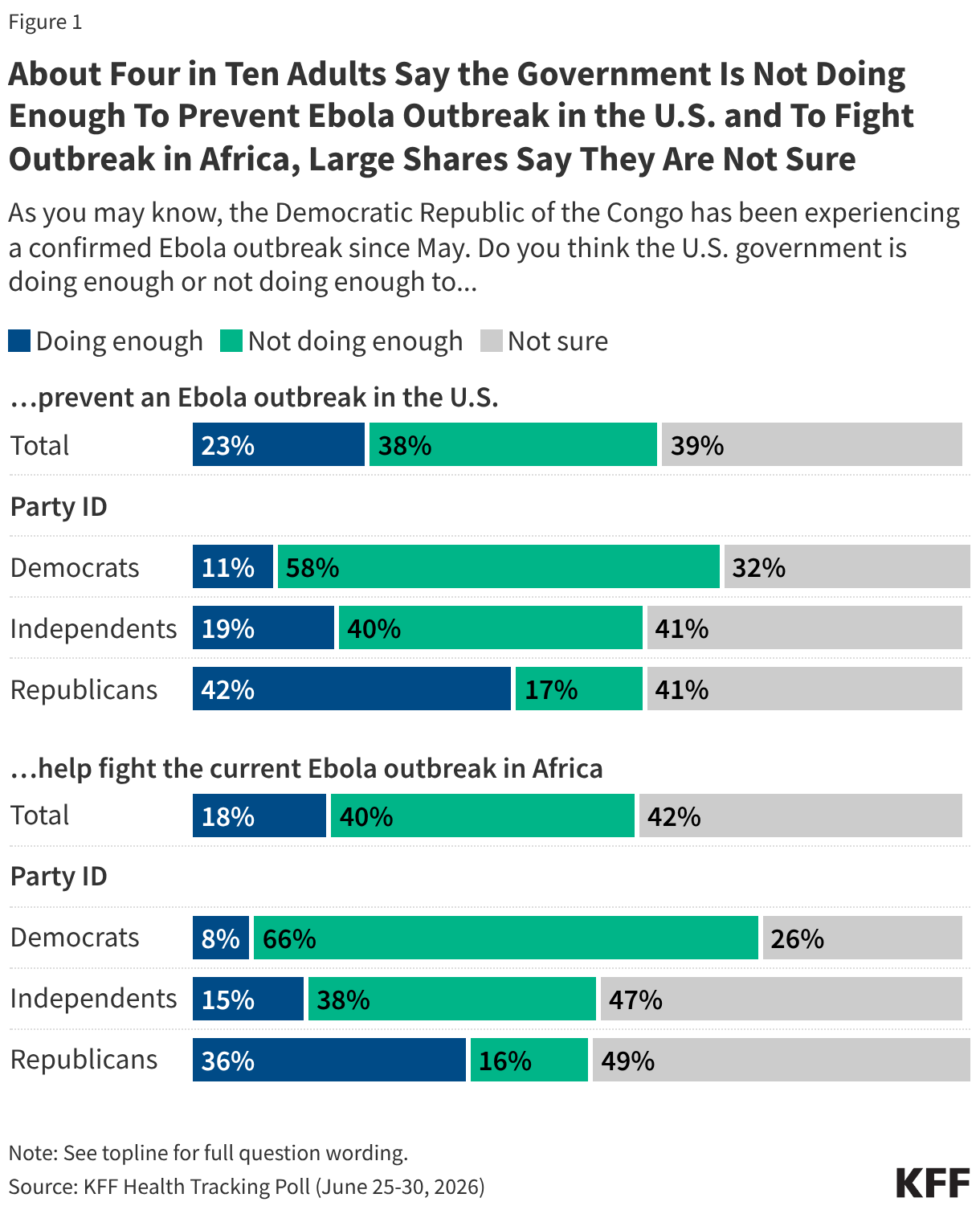
The latest KFF Health Tracking Poll finds many adults have yet to form an opinion on the U.S. government’s response to the Ebola outbreak in the Democratic Republic of the Congo, though among those with a view, more say the government is falling short than say it is doing enough.
About four in ten adults (38%) say the U.S government is not doing enough to prevent an Ebola outbreak in the U.S., while one in four (23%) say the government is doing enough and 39% say they are not sure. Views are similar when it comes to the U.S. role abroad, with four in ten (40%) saying the government is not doing enough to help fight the outbreak in Africa, while one in five (18%) say the government is doing enough and 42% say they are not sure.
Across partisans, Democrats are more critical of the U.S. government’s Ebola response with majorities saying it is not doing enough to prevent an outbreak in the U.S. (58%) nor to help fight the outbreak in Africa (66%). Notably, about four in ten independents and Republicans say they are not sure if the U.S. is doing enough to prevent an Ebola outbreak in the U.S. and about half of both groups are unsure if the government is doing enough to help fight the outbreak in Africa.
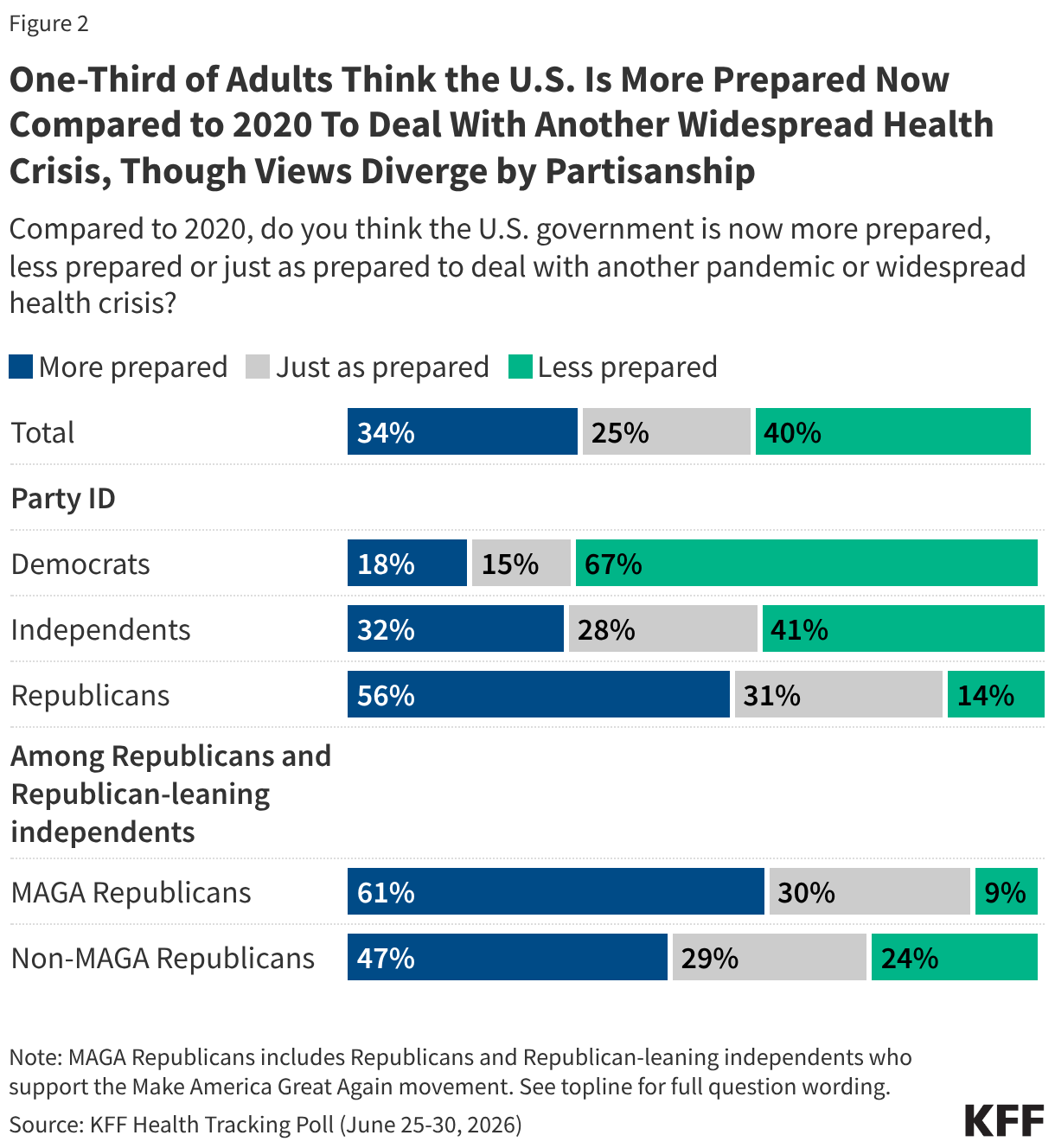
Several years after the height of the COVID-19 pandemic and amid recent changes to federal health agencies and global health engagement during President Trump's second term, the public holds mixed views on whether the U.S. government is prepared for another pandemic or widespread health crisis. A plurality of adults (40%) say the U.S. government is “less prepared” to deal with a pandemic now than it was in 2020, while about a third (34%) say the government is now “more prepared,” and one in four say it is “just as prepared” as it was in 2020. Views are divided across partisan lines. While two-thirds of Democrats (67%) say the U.S. government is now “less prepared,” a majority of Republicans (56%) say the country is now more prepared for a pandemic. About four in ten independents (41%) say the U.S. is “less prepared” for a pandemic compared to 2020, while about a third (32%) say it is “more prepared.”
Republicans and Republican-leaning independents who identify as supporters of the Make America Great Again (MAGA) movement are the most confident; six in ten (61%) of them say the U.S. is “more prepared” to deal with a pandemic now than in 2020, compared to about half (47%) of their non-MAGA counterparts who say the same.
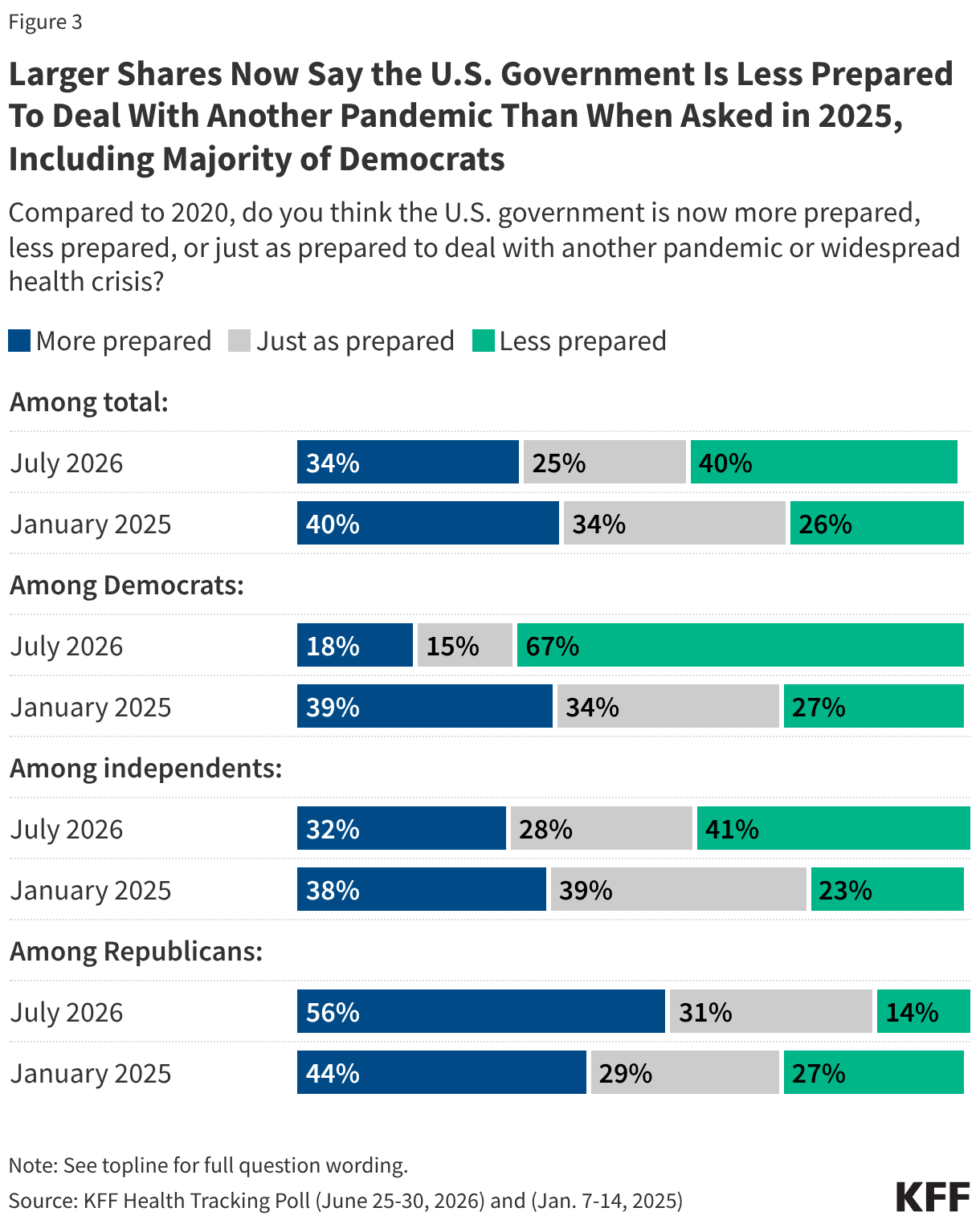
Compared to views shortly before the start of the second Trump administration, the public overall now takes a dimmer view of the U.S. government’s pandemic preparedness, though Republicans’ views have moved in the opposite direction. The share of the public who say the U.S. government is now less prepared to deal with another pandemic than it was in 2020 is up 14 percentage points since January 2025, before the Trump administration made significant changes to U.S. foreign aid efforts (40%, up from 26%). This increase is driven largely by Democrats, two-thirds (67%) of whom now say the U.S. is "less prepared" — an increase of 40 percentage points from early last year. Independents are also now more likely to say the U.S. is “less prepared” (41%, up from 23% in January 2025).
Republicans’ views, on the other hand, have shifted in the opposite direction. The share of Republicans who say the government is "more prepared" for a pandemic has increased 12 percentage points since January 2025 (56%, up from 44%), while fewer Republicans now view the U.S. as “less prepared” (14%, down from 27%).
Methodology
This KFF Health Tracking Poll/ KFF Tracking Poll on Health Information and Trust was designed and analyzed by public opinion researchers at KFF. The survey was conducted June 25 – June 30, 2026, online and by telephone among a nationally representative sample of 1,321 U.S. adults in English (n=1,238) and in Spanish (n=83). The sample includes 1,015 adults (n=69 in Spanish) reached through the SSRS Opinion Panel either online (n=990) or over the phone (n=25). The SSRS Opinion Panel is a nationally representative probability-based panel where panel members are recruited randomly in one of two ways: (a) Through invitations mailed to respondents randomly sampled from an Address-Based Sample (ABS) provided by Marketing Systems Groups (MSG) through the U.S. Postal Service’s Computerized Delivery Sequence (CDS); (b) from a dual-frame random digit dial (RDD) sample provided by MSG. For the online panel component, invitations were sent to panel members by email followed by up to three reminder emails.
Another 306 (n=14 in Spanish) adults were reached through random digit dial telephone sample of prepaid cell phone numbers obtained through MSG. Phone numbers used for the prepaid cell phone component were randomly generated from a cell phone sampling frame with disproportionate stratification aimed at reaching Hispanic and non-Hispanic Black respondents. Stratification was based on incidence of the race/ethnicity groups within each frame. Among this prepaid cell phone component, 142 were interviewed by phone and 164 were invited to the web survey via short message service (SMS).
Respondents in the prepaid cell phone sample who were interviewed by phone received a $15 incentive via a check received by mail or an electronic gift card incentive. Respondents in the prepaid cell phone sample reached via SMS received a $10 electronic gift card incentive. SSRS Opinion Panel respondents received a $5 electronic gift card incentive (some harder-to-reach groups received a $10 electronic gift card). In order to ensure data quality, cases were removed if they failed two or more quality checks: (1) attention check questions in the online version of the questionnaire, (2) had over 30% item non-response, or (3) had a length less than one quarter of the mean length by mode. Based on this criterion, 1 case was removed.
The combined cell phone and panel samples were weighted to match the sample’s demographics to the national U.S. adult population using data from the Census Bureau’s 2025 Current Population Survey (CPS), September 2023 Volunteering and Civic Life Supplement data from the CPS, and the 2026 KFF Benchmarking Survey with ABS and prepaid cell phone samples. The demographic variables included in weighting for the general population sample are gender, age, education, race/ethnicity, region, civic engagement, frequency of internet use and political party identification. The weights account for differences in the probability of selection for each sample type (prepaid cell phone and panel). This includes adjustment for the sample design and geographic stratification of the cell phone sample, within household probability of selection, and the design of the panel-recruitment procedure.
The margin of sampling error including the design effect for the full sample is plus or minus 3 percentage points. Numbers of respondents and margins of sampling error for key subgroups are shown in the table below. For results based on other subgroups, the margin of sampling error may be higher. Sample sizes and margins of sampling error for other subgroups are available on request. Sampling error is only one of many potential sources of error and there may be other unmeasured error in this or any other public opinion poll. KFF public opinion and survey research is a charter member of the Transparency Initiative of the American Association for Public Opinion Research.
| Group | N (unweighted) | M.O.S.E. |
| Total | 1,321 | ± 3 percentage points |
| Democrats | 426 | ± 6 percentage points |
| Independents | 439 | ± 6 percentage points |
| Republicans | 358 | ± 6 percentage points |