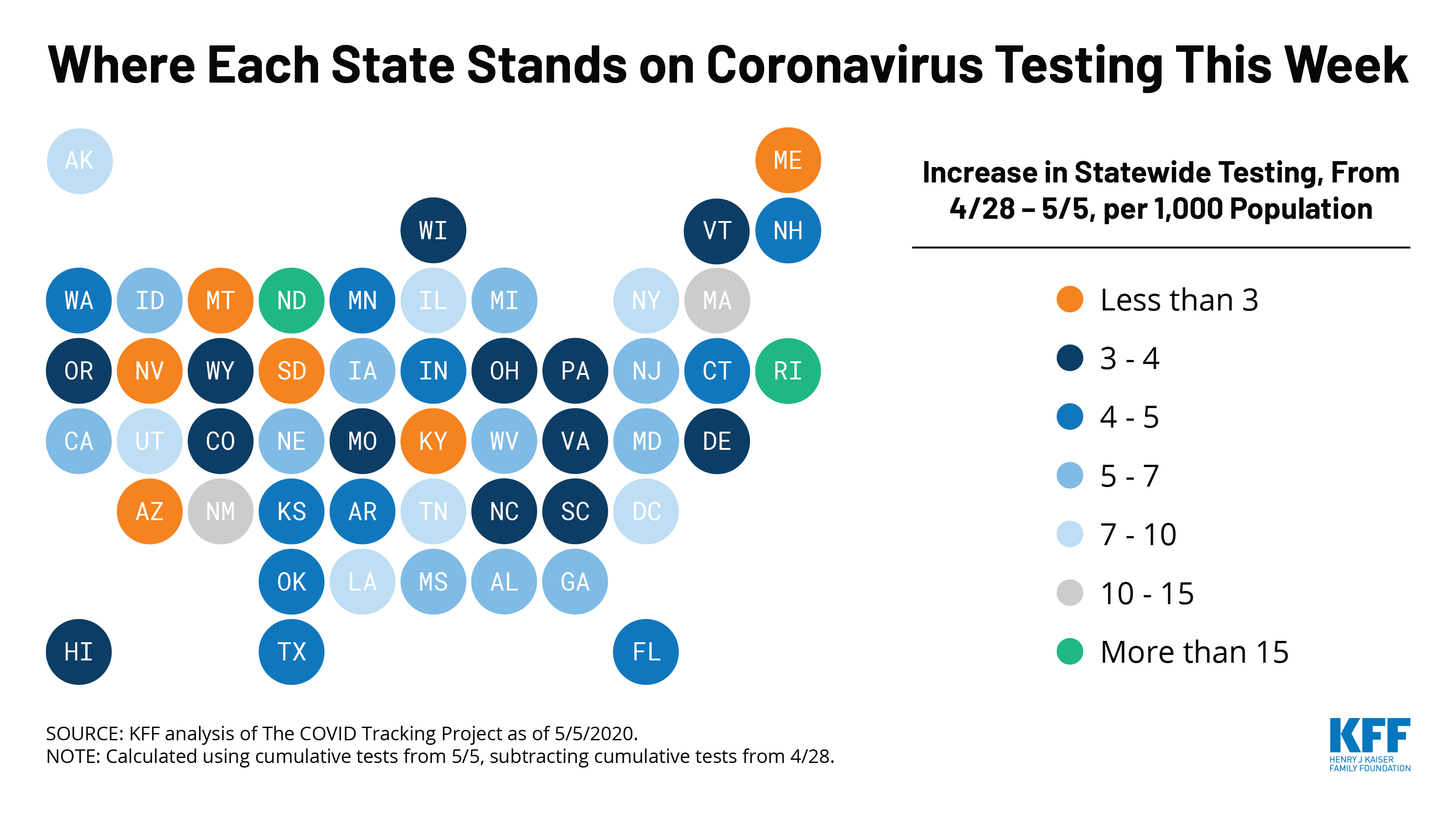
Where Each State Stands on Coronavirus Testing This Week
The independent source for health policy research, polling, and news.
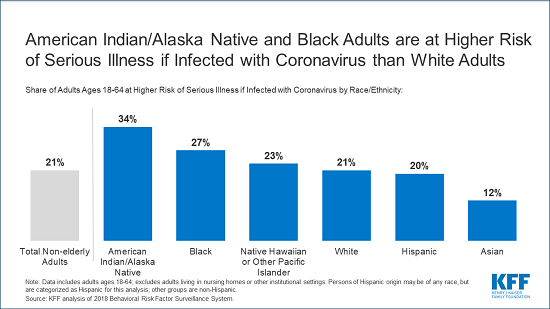
Among non-elderly adults, American Indian/Alaska Native and Black adults are more likely than Whites to be at higher risk of serious illness if infected with the new coronavirus — chiefly due to a higher prevalence of underlying health conditions and longstanding disparities in health care and other socio-economic factors, according to a new KFF analysis. People in lower-income households are also at higher risk.
The analysis finds that the share of non-elderly adults at higher risk of serious illness is 34 percent among American Indian/Alaska Natives and 27 percent among Blacks, compared to 21 percent of Whites. Asian adults are the least likely to be at higher risk of serious illness if infected (12%).
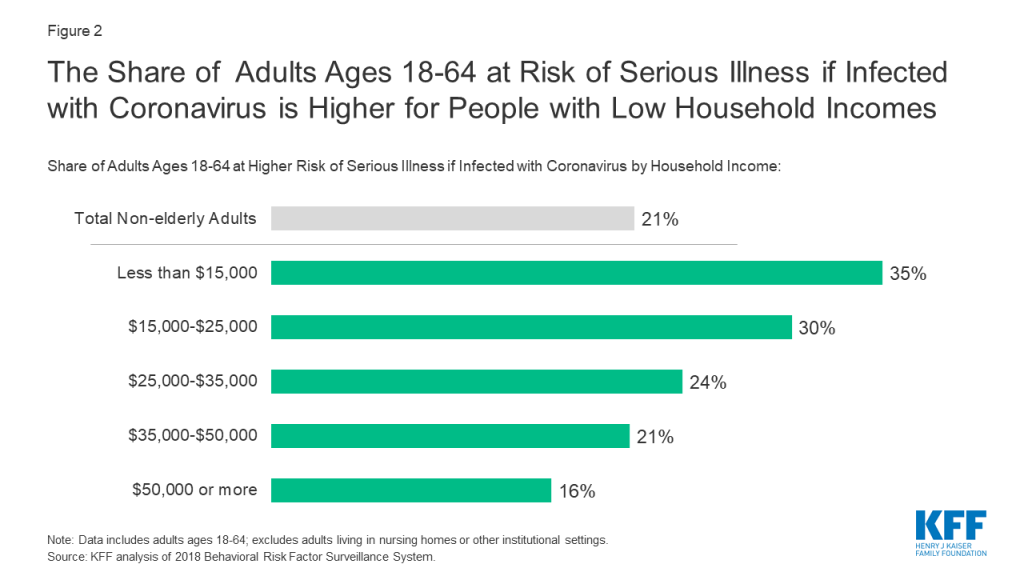
The analysis also finds that more than one in three (35%) non-elderly adults with household incomes below $15,000 are at higher risk of serious illness if infected with coronavirus, more than double the rate found among adults with household incomes greater than $50,000 (16%). Here again the higher risk arises due to a higher prevalence of underlying health conditions among non-elderly people with low incomes.
The new analysis builds upon previous work by KFF examining how many people in the U.S. are at higher risk of developing serious illness from coronavirus. The findings comport with emerging data on COVID-19 cases and deaths that suggest that serious illness from the disease is disproportionately affecting people in communities of color, due to the underlying health conditions and economic challenges faced by such groups.
Also available is a new short animation that examines the populations at higher risk for serious illness if they are infected with the coronavirus that causes COVID-19.
For the full analysis, and other KFF data and analyses related to COVID-19, visit kff.org.
The number of confirmed cases of coronavirus in the U.S. has steadily climbed and is now the highest in the world. The Centers for Disease Control and Prevention (CDC) and state and local governments continue to release data about the characteristics of people who have developed serious illness when infected with coronavirus, as well as the number of hospitalizations and deaths due to COVID-19. These emerging national and state-level data suggest that serious illness resulting from coronavirus disproportionately affects people in communities of color, due to the underlying health and economic challenges that they face. Similarly, adults with low incomes are more likely to have higher rates of chronic conditions compared to adults with high incomes, which could increase their risk of serious illness if infected with coronavirus.
To provide greater insight into the characteristics of people at greater risk of illness if infected with the novel coronavirus, we build on a prior analysis of higher risk adults in the U.S. to break down these numbers by race/ethnicity and household income in 2018. Our definition of higher risk includes: non-elderly adults between the ages of 18 and 64 with heart disease, chronic obstructive pulmonary disease (COPD), uncontrolled asthma, diabetes, or a body mass index (BMI) greater than 40, following the risk factors identified by the CDC. See Methods for more information.
Our prior analysis found about one in five adults (21%) ages 18-64 have a higher risk of developing serious illness if they become infected with coronavirus, due to an underlying health condition. This analysis finds:
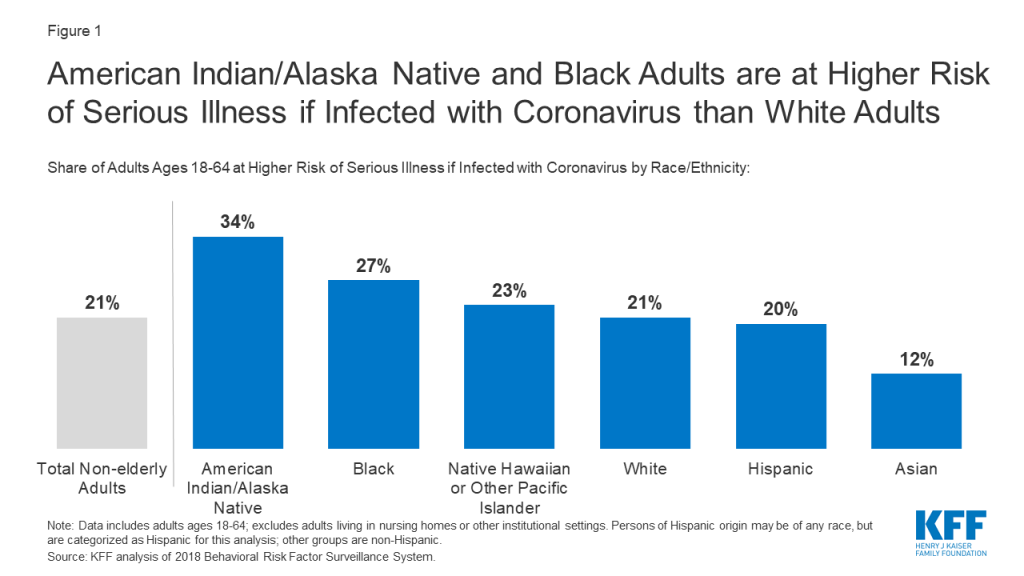
Most people who are infected with the novel coronavirus are not expected to become seriously ill, however, about one in five non-elderly adults (21%) have an underlying medical condition which puts them at higher risk of serious illness if they get infected. Among people ages 18-64, American Indian/Alaska Native and Black adults are more likely than White adults to be at a higher risk of serious illness due to underlying health conditions and longstanding disparities in health care and other socio-economic factors. Even though the shares of Hispanic and Native Hawaiian or Pacific Islander nonelderly adults at higher risk for serious illness if infected are similar to that of White adults, these groups face disparities in other health, social, and economic factors that may contribute to barriers to health care associated with coronavirus. Although our analysis finds Asian adults are the least likely to be at higher risk for serious illness, this finding may mask subgroups of Asian adults who may be at higher risk.
A larger share of non-elderly adults with lower household income than higher household income have a greater risk of serious illness if they are infected with coronavirus. This is principally because of underlying health conditions that are more prevalent among non-elderly adults with low incomes. People with low incomes who work in jobs such as grocery story workers, delivery drivers or home health aides that are defined as essential may put themselves at higher risk of contracting coronavirus than others who are able to shelter in place and follow guidelines for social distancing.
Lack of health insurance could pose challenges to people seeking treatment for COVID-19, which could disproportionately affect non-elderly adults with low incomes and people in communities of color. On April 24, 2020, the Paycheck Protection Program and Health Care Enhancement Act was signed into law, adding an additional $100 billion to the Provider Relief Fund, with funding to reimburse providers for treating uninsured patients with COVID-19. However, the large number of providers and services which are eligible for reimbursement could drain available funds, raising questions about coverage for the uninsured, and the costs of their care when such funds are no longer available.
Federal and state governments are strengthening their efforts to collect and report data by demographics on coronavirus testing, hospitalizations, and deaths. Even so, efforts to analyze these data are limited by the large number of missing responses, and limited surveillance in certain communities. Comprehensive nationwide data, broken down by race and ethnicity and income, are needed to understand how COVID-19 is affecting communities in the U.S. and how best to target coronavirus testing and other resources accordingly.
Methods
This brief analyzes data from the nationally-representative, cross-sectional 2018 Behavioral Risk Factor Surveillance System (BRFSS) of adults ages 18 to 64 living in the community. BRFSS is an ongoing, state-based, random-digit-dialed telephone survey of non-institutionalized civilian adults. The 2018 survey has over 430,000 respondents. Information about the BRFSS is available at http://www.cdc.gov/brfss/index.html. For this analysis, we calculated the share of people at risk of serious illness if they get infected with coronavirus, using BRFSS, by race/ethnicity and self-reported annual household income. The estimates of the percentage of adults at higher risk by race/ethnicity and household income use the BRFSS survey weights to account for the complex sampling design. Data exclude missing values for race/ethnicity and income; data also exclude approximately 15 percent of non-elderly adults who did not know or refused to report their household income. Data exclude adults living in Guam or Puerto Rico. Data represent adults who report ever being told by a doctor that they have one of the listed conditions. Because the CDC guidelines suggest that those with moderate or severe asthma are at greater risk than those with mild asthma, we adjusted the overall total to account for the share with uncontrolled asthma, adjusting the overall total by 62 percent, based on CDC prevalence.
How many adults in the United States are at a higher risk of serious illness if they are infected with coronavirus and who are they? Watch this two minute video to get informed about these highest-risk populations.
As we, and others, navigate how to communicate about COVID-19 and the urgent public health issues it brings, there is much that can be learned in looking at HIV messaging and how it has evolved.
Below are some of our observations from KFF’s more than two decades of experience running large-scale public information campaigns about HIV and other communicable diseases that have bearing in this new environment.
While much remains unknown about what our future with COVID-19 looks like, and even as we still are learning about the disease itself, what we have learned from messaging about HIV can offer a useful roadmap.
Since the early 1990s, KFF has produced some of the largest, most successful HIV public information campaigns on HIV, many with leading media, both here and abroad. In 2009, we launched Greater Than AIDS, a social impact response that works in partnership with health departments and other community allies to reach those most affected with life-saving information. In 2019, Greater Than AIDS media messages generated more than 360 million impressions and 15.4 million video views.
With so much information coming out daily about the coronavirus and COVID-19, it’s hard to keep up, but important to know the facts.
Test your knowledge, and share this quiz with family, friends and colleagues.
Family planning providers, including community health centers, free-standing women’s health centers, health departments, and Planned Parenthood clinics are significant sources of care for contraceptive and STI services for low-income and uninsured individuals. Medicaid, the Title X Family Planning Program, and Section 330 of the Public Health Service Act (PHSA) provide support to more than 10,000 safety-net clinics across the country that provide reproductive health services to low-income women, men, and teens. These safety-net clinics have had to find ways to continue providing quality family planning services while also following the social distancing rules during the coronavirus pandemic. Some of the common changes reported by clinics and recommended by organizations (e.g., CDC, NFPRHA, FPNTC, ASCCP, UCSF’s Beyond the Pill, and the Reproductive Health Access Project) during this time apply throughout the delivery system, while others are specific to family planning care.
Some of these changes may be temporary, but some, such as greater use of telemedicine, which can give patients more autonomy in their reproductive health care, may endure longer-term. Over time, we will gain a better understanding of the scope and scale of these changes as well as their impact on access and quality. Provider finances and the type of regulations the states adopt after the emergency eases will also have implications on how and whether clinics will continue to offer services like telemedicine care after the pandemic emergency subsides. In the recent past, some family planning providers have faced a unique set of funding challenges. The network of providers receiving federal Title X funds shrunk considerably in the past year, with 26% of clinics leaving the network, including all Planned Parenthood clinics. These departures were triggered by major changes to the program, issued by the Trump Administration in Spring 2019, that prohibited Title X -funded clinics from making abortion referrals and required complete physical separation of abortion services. Six states (WA, OR, UT, ME, VT, HI) no longer have any Title X-funded clinics. While many states were able to offset the loss with state funds, the looming fiscal crisis puts the continued availability of these dollars in question.
Now, during the pandemic emergency, many clinics are experiencing lower patient volume and staffing shortages. Rising unemployment means that safety-net clinics may see an increase in patients in the near future as people lose employer-sponsored insurance. This will likely be a combination of uninsured patients without a source of payment as well as some with Medicaid coverage, particularly in expansion states, which could bring in additional revenue. In non-expansion states, Medicaid family planning programs could provide another revenue source for clinics by extending coverage for family planning services to individuals who do not qualify for full scope Medicaid coverage. While some providers will obtain short-term assistance from the recently enacted COVID-19 relief laws, this support will likely not be sufficient to meet long-term financial needs. For millions of low-income people, their need for timely sexual and reproductive health will continue, but the extent to which many of the providers that have been serving them will have access to resources they need to keep their doors open is not clear.
There has been a lot of focus on the impact of COVID-19 on people in nursing homes, but less attention so far paid to seniors and people with disabilities receiving long-term home and community-based services (HCBS), who also face serious issues. Some news reports recently have emerged about outbreaks in group homes for people with developmental disabilities and the impact on people who receive and those who provide home care. HCBS help with tasks such as bathing, dressing, and preparing meals. Medicaid is the primary payer for these services, financing 59% of HCBS (Figure 1). Over 2.5 million people received services through Medicaid HCBS waivers offered in all 50 states and DC in FY 2018. People receiving HCBS may be at increased risk of adverse health outcomes from COVID-19 due to older age and/or chronic illness as well as from unmet daily needs due to workforce and medical supply shortages during the crisis. Maintaining and potentially expanding HCBS during the public health emergency is critical to prevent increased need for nursing home care.
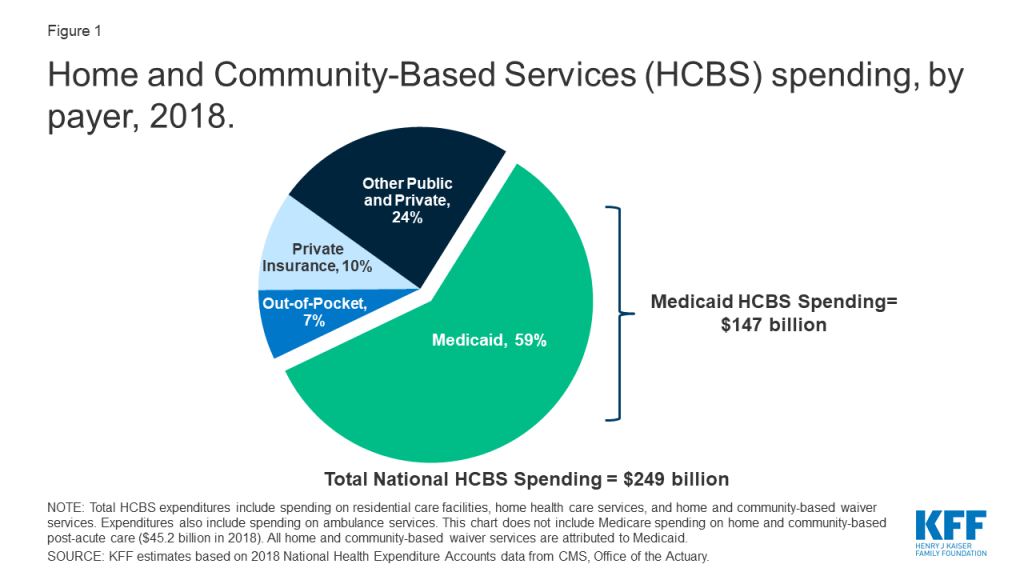
States are using a previously little-known Medicaid authority, Section 1915 (c) waiver Appendix K, to make temporary changes to their HCBS programs to respond to the COVID-19 emergency. States can use Appendix K to ensure that current HCBS enrollees continue to receive needed services, support providers, and cover additional people during the emergency. As of April 30, 2020, CMS has approved Appendix K authority in 182 waivers across 37 states.
Most states with Appendix K approvals to date are temporarily adopting or modifying policies to ensure that current waiver participants remain enrolled in coverage and maintain access to services during the emergency (Figure 2). For example, nearly all Appendix K approvals allow virtual eligibility assessments and service planning meetings, and most extend due dates for eligibility reassessments. These changes are important to continuity of care and do not require substantial new funding. Similarly, many approvals permit remote services at home or otherwise expanding the settings where services can be provided to account for social distancing. Approvals also enable waiver enrollees to receive services beyond the typical limits when necessary to address health and welfare during the emergency. Fewer states are using Appendix K to add new services to the waiver benefit package, such as home-delivered meals, medical supplies or equipment, or services specific to the COVID-19 emergency, such as wellness counseling, changes which likely would require additional funding.
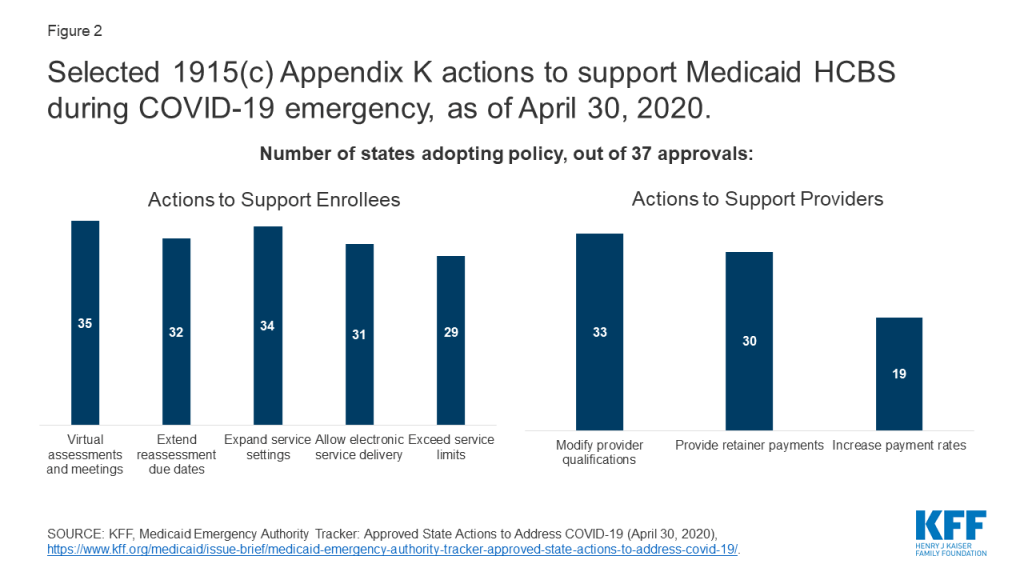
Many states with Appendix K approvals to date also are taking steps to support existing HCBS providers and expand the provider pool (Figure 2). For example, many approvals authorize making retainer payments to support the financial survival of providers who are temporarily unable to offer services as usual due to the crisis and temporarily modify provider qualifications to ensure an adequate workforce at a time when the health care system is strained to meet increased service needs and to account for providers who may be unable to work because they are ill. Like the most frequently adopted policy changes supporting enrollees, these actions do not require substantial new funding to implement. By contrast, fewer states are using Appendix K to temporarily increase provider payment rates to account for higher costs, such as personal protective equipment or hazard pay, during the emergency.
Few states with approvals to date are using Appendix K to serve more people in their HCBS waivers during the public health emergency. Many people on waiver waiting lists are at increased risk of coronavirus infection themselves or at increased risk of having unmet daily needs due to a caregiver’s infection. However, states are likely hesitant to commit additional funding as their budgets come under increased strain. Two states to date have temporarily increased the total number of people served under one of their waivers during the emergency (Maryland and Utah). A small number of states have temporarily increased cost limits or functional need criteria to expand the definition of who is eligible for the waiver during the emergency.
Overall, states’ use of Appendix K to temporarily adopt HCBS policies to respond to the COVID-19 emergency is limited, due to state budget constraints. The 6.2 percentage point increase in federal Medicaid matching funds recently enacted in the Families First Coronavirus Response Act is designed to help states facing increased costs during the emergency but likely is inadequate to encourage states to make even temporary changes during the emergency that require new funds. It remains to be seen whether additional legislative efforts will make more federal funding available to states to support current and expanded HCBS efforts to address the effects of the COVID-19 pandemic.
Key Takeaways
On May 6, 2020, the Supreme Court will hear oral arguments for Trump v. Pennsylvania, and a related case, Little Sisters of the Poor v. Pennsylvania, marking the third round of litigation involving the Affordable Care Act’s regulations on contraceptive coverage that has reached the high court. In these cases, it is Pennsylvania and New Jersey, not religious employers, that are leading the challenge to the Trump Administration’s contraceptive coverage regulations under the Affordable Care Act (ACA) giving employers wide latitude to claim an exemption from the requirement. In previous cases, the Supreme Court rulings tried to balance the beliefs of religious employers with women’s entitlement to receive no-cost contraceptive coverage. Since the Court last considered these regulations, Justices Gorsuch and Kavanaugh have joined the Court forming a solid conservative majority that may influence the outcome of these cases. This brief explains how the new regulations issued by the Trump Administration would change the contraceptive coverage requirement for employers and affect women’s coverage, the legal positions for challenging and defending these regulations, the potential rulings, and the broader ramifications.
The ACA is the first law to set preventive coverage requirements for health insurance across all markets – individual, small group, large group and self-insured plans. As part of these preventive requirements, there is a provision that charges the Health Resources and Services Administration (HRSA) to identify preventive services for women. Starting in 2012, HRSA required all new private plans were to cover, without cost-sharing, the full range of contraceptive services and supplies approved by the Food and Drug Administration (FDA) as prescribed for women. In 2018, an estimated 43.3 million women ages 15 to 49 had employer sponsored health insurance. The ACA contraceptive coverage rules implementing this recommendation have evolved through litigation and new regulations.
While the cases currently before the Supreme Court involve the Trump Administration’s regulations published in November 2018, at the core of these cases is an unresolved issue from the previous litigation. Although the Supreme Court has previously reviewed two cases involving challenges from religious employers to the ACA contraceptive coverage requirement, Burwell v. Hobby Lobby and Zubik v. Burwell, the Court never decided whether the Obama Administration’s regulations violate the religious rights of religiously affiliated nonprofit employers. While PA and NJ contend there is no legal justification for the Trump Administration‘s regulations expanding employer exemptions, the Trump Administration and the LSOP maintain that the accommodation crafted by the Obama Administration violates the Religious Freedom Restoration Act (RFRA) and that the Supreme Court needs to address this undecided issue from Zubik v. Burwell.
RFRA was enacted in 1993 to protect “persons” from generally applicable laws that burden their free exercise of religion. The employers that challenged the Obama regulations asserted that the regulations violated RFRA. When an individual with a sincerely held religious belief challenges a law that “substantially burdens” their exercise of religion, the Act requires the government to show the law furthers a “compelling interest” in the “least restrictive means.” In the Burwell v. Hobby Lobby decision, the Supreme Court ruled that the “closely held” for-profit corporations had religious beliefs that were being substantially burdened by the contraceptive coverage requirement. In the Court’s Hobby Lobby ruling, Justice Alito, wrote about the accommodation as a “less restrictive means,” to provide contraceptive coverage. The Court, however, did not decide whether the accommodation is lawful: “We do not decide today whether an approach of this type complies with RFRA for purposes of all religious claims. At a minimum, however, it does not impinge on the plaintiffs’ religious belief that providing insurance coverage for the contraceptives at issue here violates their religion, and it serves HHS’s stated interests equally well.”
In May 2016, with only eight justices, the Supreme Court remanded Zubik v. Burwell, sending seven cases brought by religious nonprofits objecting to the contraceptive coverage accommodation back to the respective district Courts of Appeal. The Supreme Court instructed the parties to work together to “arrive at an approach going forward that accommodates petitioners’ religious exercise while at the same time ensuring that women covered by petitioners’ health plans receive full and equal health coverage, including contraceptive coverage.” The Court also stated: “Nothing in this opinion, or in the opinions or orders of the courts below, is to affect the ability of the Government to ensure that women covered by petitioners’ health plans ‘obtain, without cost, the full range of FDA approved contraceptives.’”
However, the Trump Administration has stated that they do not believe it is feasible to resolve the religious objection of employers while still ensuring that the affected women receive full and equal health coverage that includes contraceptive coverage. Instead, the Administration suggests women could receive contraceptive services through Title X clinics or other governmental programs. However, most women who lose employer coverage for contraceptives will likely not qualify for free Title X services designed to offer services to low-income women, and over 25% of clinics have recently dropped out of Title X program in response to other Trump Administration regulations.
In October 2017, one week after issuing interim final regulations to expand the exemptions to the contraceptive requirement, the Trump Administration negotiated settlements with many of the nonprofit employers with ongoing legal challenges to the Obama contraceptive coverage regulations. The settlements give these employers permission to exclude contraceptive coverage from their plans, and in some case paid for some of the organizations’ legal fees.
After issuing interim final rules without notice or comment, the Trump Administration issued final regulations in November 2018 greatly expanding the types of employers that may be exempt from the ACA‘s contraceptive coverage requirement (Figure 1). The Trump Administration’s final regulations greatly expand eligibility for the exemption to all nonprofit and closely-held for-profit employers with objections to contraceptive coverage based on religious beliefs or moral convictions, including private institutions of higher education that issue student health plans. In addition, publicly traded for-profit companies with objections based on religious beliefs also qualify for an exemption. There is no guaranteed right of contraceptive coverage for their female employees and dependents or students.
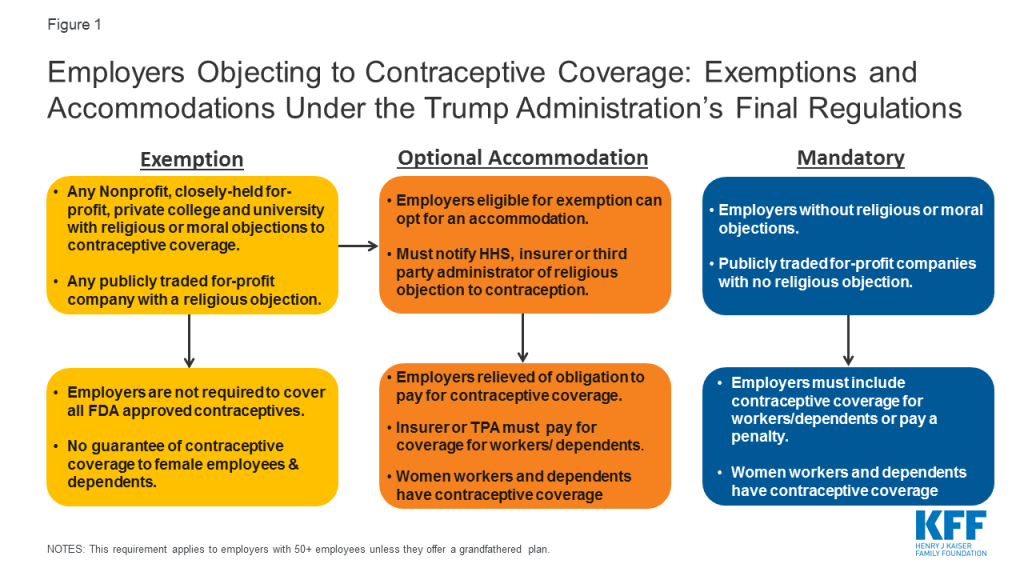
The accommodation developed by the Obama Administration is broadened to be available to any employer now eligible for the exemption as well as employers that previously qualified for the accommodation. The Trump Administration argues that these new rules will have only a limited impact on the number of women losing contraceptive coverage. How many employers who were not eligible for either the exemption or accommodation under the Obama-era regulations will now seek a full exemption is unknown, as is the number of employers previously utilizing the accommodation who will now opt for an exemption (resulting in the loss of contraceptive coverage for their employees and dependents). In the preamble to the regulations, Health and Human Services (HHS) estimates between 70,500 and 126,400 women would lose contraceptive coverage, and that the cost of losing contraception is $584 per woman annually and therefore the financial transfer effects attributable to these final rules on those women would be between approximately $41.2 million and $73.8 million.
Unlike the previous litigation challenging the Obama Administration’s regulations, the plaintiff states are not claiming the regulations violate RFRA, however the Trump Administration is using RFRA to defend their authority to issue the regulations. The States challenging the regulations contend that thousands of women would be without birth control coverage due to these rules and may turn to state-funded programs to receive contraception and the states will incur additional healthcare costs due to an increase in unintended pregnancies. The states are arguing that they also “possess strong interests in protecting the medical and economic health or their residents, minimizing unintended pregnancies and abortions, and ensuring that all of their residents—both men and women— are free and able to fully participate in the workforce, maximize their social and economic status, and contribute to their economies without facing discrimination on the basis of sex.” They argue federal agencies lack the authority either from RFRA or the ACA to create these new expanded exemptions, and that the regulations violate the civil rights protections in the ACA prohibiting discrimination on the basis of sex and other protected categories in most healthcare programs and categories.
In this case, the religious employers and the Trump Administration are aligned, and they contend that RFRA at least authorizes, if not requires, the federal agencies to create the broader religious exemptions. They also maintain that the ACA authorizes the new moral exemptions. In the preamble to the regulations, the Trump Administration explains that the moral exemption is necessary to “protect sincerely held moral objections of certain entities and individuals. The rules, thus, minimize the burdens imposed on their moral beliefs, with regard to the discretionary requirement that health plans cover certain contraceptive services with no cost-sharing, which was created by HHS through guidance promulgated by the Health Resources and Services.” Both the Administration and the LSOP contend that the ACA grants HRSA, and in turn the Agencies, significant discretion to shape the content and scope of any preventive services guidelines adopted pursuant to the preventive services provisions of the ACA, and this discretion includes shaping which entities must include coverage for all the preventive services. The Administration further explains in the preamble to the regulations, “Congress’s grant of discretion in section 2713(a)(4), and the lack of a mandate that contraceptives be covered or that they be covered without any exemptions or exceptions, lead the Departments to conclude that we are legally authorized to exempt certain entities or plans from a contraceptive Mandate if HRSA decides to otherwise include contraceptives in its Guidelines.” The Administration counters the states’ argument that the regulations discriminate on the basis on sex by stating that “any distinctions in coverage among women are not premised on sex, but on the existence of a religious or moral objection to facilitating the provision of contraceptives. Thus, the Rules do not violate Title VII’s prohibition on sex-based disparate treatment.”
The other major issues in dispute include whether the Trump Administration violated the Administrative Procedure Act, and whether a national injunction blocking implementation of the regulations for the whole country is the appropriate remedy or whether the remedy should be limited to the plaintiff states (Table 1).
One of the controversies is whether the Little Sister of the Poor (LSOP) has legal standing to appeal this case. In May 2018, with the Trump Administration no longer defending the Obama regulations, the LSOP obtained a permanent injunction from the federal district court of Colorado blocking government enforcement of the Obama regulations against the LSOP. As result, the Third Circuit found that the LSOP no longer have an injury and therefore denied appellate standing to the LSOP. The LSOP maintain they could be injured if they switch health plans, and the broad exemptions allowed by the Trump regulations are not implemented (Box 1).
| Table 1: Summary of the Parties’ Legal Positions | |
| Question: Did the Trump Administration violate the Administrative Procedure Act (APA) which governs the process by which federal agencies develop and issue regulations? The APA includes requirements for notice, public comment, and standards for judicial review | |
PA and NJ Position:
| Trump Administration & LSOP Position:
|
| Question: Do the federal agencies have the statutory authority to promulgate the final rules? | |
PA and NJ Position:
| Trump Administration & LSOP Position:
|
| Question: Do the Little Sisters of the Poor have legal standing to appeal this case? | |
PA and NJ Position:
| Little Sisters of the Poor Position:
|
| Question: Is it proper to issue a nationwide injunction in this case? | |
PA and NJ Position:
| Trump Administration & LSOP Position:
|
Box 1: The Little Sisters of the Poor and the ACA Contraceptive Coverage Requirement
The Little Sisters of the Poor, an international order of religious women devoted to caring for the elderly, have been challenging the contraceptive coverage requirement since 2013. Represented by the Becket Fund, they contend the accommodation crafted by the Obama Administration did not address their concerns, and they were part of a class action lawsuit filed in September 2013. In 2013, both the US District Court for the District of Colorado and the 10th Circuit Court of Appeals denied their request for relief, on the grounds that the accommodation was not a substantial burden. The LSOP then filed an emergency appeal with the Supreme Court, and Justice Sonia Sotomayor granted an emergency injunction while the litigation continued.
Special Rules for Self-Insured Church Plans: LSOP, have a self-insured church plan, which is a plan “established and maintained for its employees (or their beneficiaries) by a church or by a convention or association of churches.” Church plans are not limited to traditional church entities, but may include entities controlled by or associated with a religious denomination such as church-related hospitals, educational institutions and nonprofits that provide services to the aging, children, youth and family. Because church plans are not regulated by ERISA like other self-insured plans, they are not required to follow the ACA-related health reform mandates incorporated into the ERISA law. The Internal Revenue Code also lacks the authority to compel third party administrators of church plans to provide contraceptive coverage. Any provision of coverage made by a third party administrator for a self-insured church plan would be entirely voluntary. The third party administrator that operates the LSOP’s church plan is Christian Brothers Services, which also objects to contraceptive services. It is not clear that the LSOP have ever been subject to enforcement of the contraceptive coverage requirement.
Current Status and Legal Standing: In May 2018, with the Trump Administration no longer defending the Obama regulations, the LSOP obtained a permanent injunction from the federal district court of Colorado blocking government enforcement of the Obama regulations against them. In the current case, the LSOP continue to maintain that this injunction is dependent on them keeping their current health insurance plan, and they therefore hypothetically could be subject to the contraceptive coverage requirement at a later date if the Trump Administration’s broad exemptions are not implemented. The Third Circuit Court of Appeals found that the LSOP no longer have any injury and lack standing. LSOP has appealed this decision on standing, as well as the merits of the case, to the Supreme Court.
If the Court does not hold that the violations of the APA are consequential, federal agencies may bypass notice and comment periods in the future. If the court rules that the Trump Administration violated the APA, then the Administration would need to start over by properly posting proposed regulations with notice and a public comment period. With upcoming election in November, there is a possibility the rulemaking would not be complete while President Trump is in office. If the Obama regulations remain in effect, the Little Sisters of the Poor and other religious nonprofits would undoubtedly continue to challenge these regulations, but women would still have access to contraceptive coverage regardless of their employers’ religious or moral beliefs.
Given the current conservative majority, the Court may rule that RFRA requires the broad religious exemptions. However, RFRA does not include moral exemptions, and it is therefore less clear how the Court will view the moral exemptions. If the Court allows Trump Administration’s new regulation for religious exemptions to go into effect, it is unknown how many of employers and colleges will opt for the exemption, leaving their students, employees and dependents without no-cost coverage for the full range of contraceptive methods. For some women, choice of contraceptive methods may be limited by cost, placing some of the most effective yet costly methods out of financial reach. In addition, the decision may encourage similar broad religious exemptions regarding coverage for other services without regard to harm to people who are guaranteed these services under the ACA. The Trump Administration is likely to publish final regulations that remove protections for LGBTQ patients from discrimination granted by the anti-discrimination provisions of Section 1557 of the ACA. These new regulations will likely be challenged, and the Supreme Court’s decision in the current contraceptive coverage case could support or rebuke HHS’s authority to create these sweeping changes.
Unless the Court rules in favor of the States, it does not have to issue a decision about the scope of the injunction ordered by the district court and upheld by the Third Circuit Court of Appeals. However, even if the Court rules in favor of the Trump Administration, it may want to weigh in on the practice of district courts issuing national injunctions for federal policies. This practice has become more common in the last decade, and is controversial. Proponents of national injunctions argue they are necessary to ensure the law is uniform throughout the country. Critics of nationwide injunctions contend they are overly broad, and do not give the opportunity for other courts to decide the issue for their jurisdiction. In a case brought by California and four other states challenging the Trump Administration’s interim final regulations for contraceptive coverage, the 9th Circuit Court of Appeals limited the scope of the preliminary injunction issued by the district court to plaintiff states. Attorney General Barr has called for an end to nationwide injunctions. Justice Thomas wrote in a concurring opinion in Trump v. Hawaii in 2019 that nationwide injunction are “legally and historically dubious.” If the Court issues a ruling limiting the scope of injunctions, the decision could impact other cases challenging federal policies and result in federal policies becoming effective in some states, while being blocked in other states.
The Supreme Court will likely publish its ruling in late June 2020. The Obama administration tried to accommodate employers with religious objections and still guarantee women full contraceptive coverage without cost sharing. In contrast, the Trump Administration has acknowledged they do not think this is possible, and have prioritized broad exemptions for employers over women’s coverage. While the case once again pits the rights of women to receive health insurance that includes no-cost coverage for contraceptive services and supplies against those of employers who hold religious and moral objections to contraceptives, the ruling could have implications that go far beyond birth control coverage for thousands of women. The decision could also pave the way for broad exemptions to other laws protecting LGBTQ people, people living with HIV, and others from discrimination in the work place, in health care settings, in housing, and other areas of society. The contraceptive coverage provision of the ACA has been one of the most litigated aspects of the law. This could be final case or if the Court does not allow these broad exemptions, employers with religious or moral objections will likely continue to challenge the regulations.
We recently wrote about the scattershot approach states and communities took toward implementing social distancing measures, particularly stay-at-home orders. While some moved relatively early – and there are indications that this is paying off– others only implemented stay-at-home orders after the White House announced federal social distancing guidelines would extend through April. However, with those guidelines now expired, and the release of the White House’s “Guidelines for Opening Up America Again”, a growing number of states have begun to ease social distancing requirements, even without clear indications that they are successfully controlling their outbreaks. Here we review which states have done so, the approaches taken, and look at several key metrics for assessing their readiness for reopening.
A Range of Approaches
As of May 4, more than half of the states (27) had loosened social distancing restrictions in some way (See Table 1), and others have announced changes that will take effect in the coming weeks. In some cases, these restrictions were only in place for a relatively short period of time, such as in South Carolina (13 days) and Georgia (21 days), whereas in others, they were in place for much longer, such as in Indiana (41 days). As of this writing, the longest across all states, including those that have not begun lifting restrictions, is 48 (California).
In addition, states have taken very different approaches to easing social distancing measures. Some are making small and incremental changes, phasing them in over a period of time, while others are adopting broad changes all at once (see Table 2). For example:
Assessing Key Metrics
While there is no single metric for assessing when it is safe to begin easing social distancing measures, there are several that, when used together, can provide states with needed guidance. These include two metrics in the White House Guidelines, considered “gating criteria” that, with other criteria, should be satisfied before considering moving to a phased comeback:
Using these metrics, we assessed where the 27 states fall (see Table 3):
Taken together, only nine of the 27 states – Alabama, Alaska, Florida, Idaho, Missouri, Montana, Oklahoma, Vermont, and West Virginia – meet the metrics examined here.
However, few of the states have sufficient testing capacity to consider reopening. While most of the 27 states increased testing in the past week, in four states, Mississippi, South Dakota, Utah, and Vermont, the number of tests conducted in the past week fell relative to the week before. The three states with positivity rates above 20%–Colorado, Iowa, and Nebraska—each increased the number of tests conducted by 50% or more in the past week. The share of the population tested in the past week ranges from 0.2% in Montana, Maine, and South Carolina to over 1% in North Dakota, Alaska and West Virginia. Our recent review of testing benchmarks suggests 0.9% is the minimum threshold, but still well below most targets for the share of the population that should be tested each week.
If states could ramp up testing substantially and other criteria are met (such as sufficient hospital capacity and contact tracing capabilities – see, for example, COVIDActNow, Center for American Progress, and AEI), some may be able to consider easing some social distancing requirements, but most still fall short.
A Difficult Balance
In the face of the devastating economic effects the coronavirus is having on the U.S. economy, the pressure for states to ease social distancing restrictions is building. States are making different judgments in balancing the desire to increase economic activity by loosening these rules against the risks to the public’s health of moving too quickly. Just as states’ scattershot approach to stay-at-home orders raised concerns about ongoing community transmission in the U.S., recent movements by some states to ease restrictions similarly raise concerns about new outbreaks. While some states appear to be taking an incremental approach to reopening, others are more aggressive. An assessment of key metrics shows a mixed picture, with only nine of the 27 states meeting the metrics showing a downward trajectory, which still represent just a subset of factors that should be considered for reopening.
As states begin to loosen social distancing requirements, broader testing coupled with enhanced contact tracing and the ability to isolate those who contract the virus will be needed to contain localized outbreaks. Ongoing assessment of key metrics will be important to inform future state action, including if and when the reinstatement of some or all social distancing measures is needed.
| Table 1: Statewide Stay at Home Orders by Date | |||
| State | Date Announced | Effective Date | End Date |
| Alabama | April 3 | April 4 | April 30 |
| Alaska | March 27 | March 28 | April 24 |
| Arizona | March 30 | March 31 | May 15 |
| Arkansas | – | – | |
| California | March 19 | March 19 | Until revoked |
| Colorado | March 26 | March 26 | April 26* |
| Connecticut | March 20 | March 23 | May 20 |
| Delaware | March 22 | March 24 | May 15 |
| District of Columbia | March 30 | April 1 | May 15 |
| Florida | April 1 | April 3 | May 4 |
| Georgia | April 2 | April 3 | April 30* |
| Hawaii | March 23 | March 25 | May 31 |
| Idaho | March 25 | March 25 | April 30 |
| Illinois | March 20 | March 21 | May 30 |
| Indiana | March 23 | March 24 | May 4 |
| Iowa | – | – | – |
| Kansas | March 28 | March 30 | May 3 |
| Kentucky | March 22 | March 26 | Until revoked |
| Louisiana | March 22 | March 23 | May 15 |
| Maine | March 31 | April 2 | May 31 |
| Maryland | March 30 | March 30 | Until revoked |
| Massachusetts | March 23 | March 24 | May 18 |
| Michigan | March 23 | March 24 | May 15 |
| Minnesota | March 25 | March 27 | May 18 |
| Mississippi | March 31 | April 3 | April 27 |
| Missouri | April 3 | April 6 | May 3 |
| Montana | March 26 | March 28 | April 26 |
| Nebraska | – | – | |
| Nevada | March 31 | April 1 | May 15 |
| New Hampshire | March 26 | March 27 | May 31 |
| New Jersey | March 20 | March 21 | Until revoked |
| New Mexico | March 23 | March 24 | May 15 |
| New York | March 20 | March 22 | May 15 |
| North Carolina | March 27 | March 30 | May 8 |
| North Dakota | – | – | |
| Ohio | March 22 | March 23 | May 29 |
| Oklahoma | – | – | |
| Oregon | March 23 | March 23 | Until revoked |
| Pennsylvania | March 23 | April 1 | May 8 |
| Rhode Island | March 28 | March 28 | May 8 |
| South Carolina | April 6 | April 7 | May 4 |
| South Dakota | – | – | |
| Tennessee | March 30 | March 31 | April 30 |
| Texas | March 31 | April 2 | April 30 |
| Utah | – | – | |
| Vermont | March 24 | March 24 | May 15 |
| Virginia | March 30 | March 30 | June 10 |
| Washington | March 23 | March 23 | May 31 |
| West Virginia | March 23 | March 24 | Until revoked |
| Wisconsin | March 24 | March 25 | May 26 |
| Wyoming | – | – | – |
| * Stay at home order rolled back to high risk groups only. Source: KFF analysis of state documents and press releases. | |||
| Table 2: Rolling Back Social Distancing Measures | |||
| State | Effective Date of Stay at Home Order | Date Social Distancing Rollback Begins | Details |
| Alabama | April 4 | April 30 | Stay at home order lifted; large gathering and restaurant limits remain in place; some non-essential businesses can reopen with reduced capacity, elective procedures can resume |
| Alaska | March 28 | April 24 | Stay at home order lifted; large gathering limit increased but remains in place; some non-essential businesses (including personal care) can reopen with reduced capacity; restaurants can reopen to dine-in customers but must follow physical distancing and capacity limits; elective procedures can resume |
| Colorado | March 26 | April 27 | Stay at home order rolled back to high-risk groups; large gathering limit increased but remains in place; phased-in reopening for non-essential businesses (including personal care) with reduced capacity; restaurant limit remains in place; elective procedures can resume |
| Florida | April 3 | May 4 | Stay at home order lifted, but limit on large gatherings remains in place; retail businesses can reopen at 25% capacity; restaurants can reopen at 25% capacity; elective medical procedures can resume |
| Georgia | April 3 | April 24 | Stay at home order rolled back to high-risk groups; large gathering ban remains in place; some non-essential businesses (including personal care and gyms/fitness facilities) can reopen with reduced capacity; restaurants can reopen to dine-in customers with capacity limits; elective procedures can resume |
| Idaho | March 25 | May 1 | Stay at home order and large gathering ban are lifted; many non-essential businesses can reopen with certain precautions; restaurants remain closed to dine-in service |
| Indiana | March 24 | May 4 | In all but three counties, stay at home order lifted; limit on large gatherings loosened to ban groups of more than 25 people; most non-essential business can reopen; retail buisnesses can reopen at 50% capacity; restaurant limits remain in place |
| Iowa | – | May 1 | In 77 counties, some non-essential businesses can reopen at 50% capacity and restaurants can resume dine-in services at 50% capacity; non-essential businesses remain closed in remaining counties; elective procedures can resume |
| Kansas | March 30 | May 4 | Stay at home order lifted, but limit on gatherings of 10 or more people remains in place; most non-essential businesses, including restaurants, can reopen if they adhere to social distancing requirements, but personal care services businesses remain closed |
| Maine | April 2 | May 1 | Stay at home order and large gatherings ban remain in place; some non-essential businesses, including drive-in theaters, certain recreational facilities, barbershops and salons, may reopen; elective procedures can resume |
| Michigan | March 24 | April 24 | Some non-essential businesses,(bike repair, landscaping, garden supply, moving and storage, workers who process remote orders for pick-up/delivery) may reopen |
| Minnesota | March 27 | April 27 | Some non-essential businesses (non-critical industrial and manufacturing, office-based work) may reopen; All workers who can work from home must still do so |
| Mississippi | April 3 | April 27 | Stay at home order expired; non-essential businesses except gyms, clubs, personal care and grooming facilities may reopen with precautions; retail businesses cannot exceed 50% capacity and other requirements; restaurants and bars remain limited to drive-through, curbside and/or delivery |
| Missouri | April 6 | May 4 | Stay at home order and limit on large gatherings lifted; all businesses can reopen; retail businesses, including restaurants, must adhere to capacity limits |
| Montana | March 28 | April 27 | Stay at home order and large gathering ban lifted; retail businesses can reopen with capacity limits and strict physical distancing; restaurants, bars and distilleries can reopen to limited dine-in services |
| Nebraksa | – | May 4 | Limit on gatherings of more than 10 people remains in place; in 10 of 19 local health districts, previously closed personal care services businesses can reopen; restaurants can reopen to dine-in services at 50% capacity |
| North Dakota | – | May 1 | All businesses can reopen with certain precautions |
| Ohio | March 23 | May 4 | Stay at home order and ban on large gatherings remain in effect; certain manufacturing businesses and offices can reopen; most non-essential retail businesses must remain closed, except for carry-out, delivery, and by-appointment services only; elective medical procedures can resume |
| Oklahoma | – | Apirl 24 | Personal care businesses can reopen; restaurants, movie theaters, sporting venues, and gyms can reopen next week if they maintain social distancing protocols |
| South Carolina | April 7 | April 20 | Stay at home order lifted, but ban on large gatherings remain in effect; certain retail stores can reopen at 20% capacity; beaches can reopen; restaurants can reopen for outside dining only; lifted mandatory quarantine for travelers from certain states; large gatherings ban remains in effect |
| South Dakota | – | May 4 | Limits on retail business operations lifted |
| Tennessee | March 31 | April 27 | Stay at home order lifted, but limit on large gatherings remains in place; restaurants can reopen to dine-in customers at 50% capacity; retail businesses can reopen at 50% capacity |
| Texas | April 2 | April 30 | Stay at home order lifted; but limit on large gatherings remains in place; restaurants, retail stores, malls, movie theaters, museums, and libraries can reopen at 25% capacity |
| Utah | – | May 1 | Restaurants, personal care, and retail businesses can reopen if they maintain social distancing protocols; large gathering ban eased but remains in place; travel restriction rolled back; elective surgeries can resume |
| Vermont | March 24 | April 20 | Stay at home order and limit on large gatherings remains in place; limited businesses can reopen with social distancing and maximum of ten workers; outdoor retail spaces can reopen with a maxiumum of 10 people total |
| West Virginia | March 24 | May 4 | Stay at home order lifted; limit on large gatherings eased to allow gatherings of up to 25 people; some non-essential retail businesses, including barbershops and nail and hair salons, can reopen |
| Wyoming | – | May 1 | Limit on gatherings of more than 10 people remains in place; previously closed personal care businesses can reopen if they meet social distancing requirements |
| *IA, NE, ND, OK, SD, UT, and WY did not issue a stay at home order, but did require some or all non-essential businesses to close. Source: KFF analysis of state documents and press releases | |||
| Table 3: Readiness Metrics | |||||
| State | Percent Change in Daily Cases 4/13 and 4/27(7-day Rolling Average) | Percent Change in Positivity Rate 4/13and 4/27(7-Day RollingAverage) | Current Share of Tests with Positive Results(7-Day Rolling Average) | Percent Change in Weekly Tests(4/16-4/30) | Share of Population Tested in the Past Week |
| Alabama | -23.5% | -61.3% | 5.4% | 112.6% | 0.7% |
| Alaska | -72.3% | -90.9% | 0.4% | 103.1% | 1.0% |
| Colorado | 52.3% | -19.4% | 21.9% | 101.9% | 0.4% |
| Florida | -42.1% | -38.0% | 6.2% | 10.6% | 0.3% |
| Georgia | -14.1% | -56.7% | 11.0% | 44.9% | 0.5% |
| Idaho | -58.3% | -79.3% | 6.3% | 368.9% | 0.6% |
| Indiana | 50.3% | 27.0% | 19.8% | 9.7% | 0.3% |
| Iowa | 269.8% | 48.6% | 22.5% | 56.1% | 0.4% |
| Kansas | 239.1% | 73.4% | 16.4% | 98.4% | 0.4% |
| Maine | -33.1% | 84.8% | 5.2% | 2.5% | 0.2% |
| Michigan | -16.7% | -56.4% | 14.1% | 52.6% | 0.5% |
| Minnesota | 285.6% | 46.0% | 10.3% | 89.7% | 0.3% |
| Mississippi | 21.8% | 100.4% | 11.6% | -35.5% | 0.4% |
| Missouri | -24.7% | -56.8% | 8.3% | 141.3% | 0.3% |
| Montana | -82.0% | -81.6% | 0.8% | 5.2% | 0.2% |
| Nebraska | 441.4% | 115.4% | 22.4% | 57.1% | 0.4% |
| North Dakota | 188.7% | -45.4% | 4.2% | 140.6% | 1.5% |
| Ohio | 14.9% | -22.0% | 13.5% | 14.8% | 0.3% |
| Oklahoma | -10.4% | -41.0% | 3.9% | 14.9% | 0.4% |
| South Carolina | 3.5% | -8.5% | 10.6% | 23.8% | 0.2% |
| South Dakota | -42.9% | -35.1% | 15.2% | -15.7% | 0.3% |
| Tennessee | 61.2% | -34.5% | 4.9% | 19.4% | 0.7% |
| Texas | 7.2% | -46.2% | 6.3% | 34.8% | 0.3% |
| Utah | 28.2% | -18.8% | 3.4% | -9.9% | 0.9% |
| Vermont | -71.9% | -11.5% | 2.0% | -23.2% | 0.3% |
| West Virginia | -32.7% | -83.8% | 1.1% | 99.9% | 1.1% |
| Wyoming | 60.6% | 288.0% | 7.1% | 57.1% | 0.3% |
| SOURCE: KFF analysis cases and testing data; see State Data and Policy Actions to Address Coronavirus at https://www.kff.org/health-costs/issue-brief/state-data-and-policy-actions-to-address-coronavirus/ | |||||