


VOLUME 50
New KFF Poll Examines Patterns of Belief Across Common Vaccine Myths
Highlights
KFF’s latest Tracking Poll on Health Information and Trust shows that larger shares of the public express uncertainty over common vaccine myths than definitive belief. The latest analysis, looking at patterns of belief across vaccine myths, shows which adults are consistent myth believers, consistent myth deniers, and those who fall in the “mixed middle” whose views are less defined and may be an important focus for those looking to counter vaccine misinformation. These findings, including a detailed explainer on patterns of belief across vaccine myths, can also be found on KFF’s interactive Health Information and Trust Polling Dashboard.
Featured
Americans May Be Smarter About Vaccines Than You Think
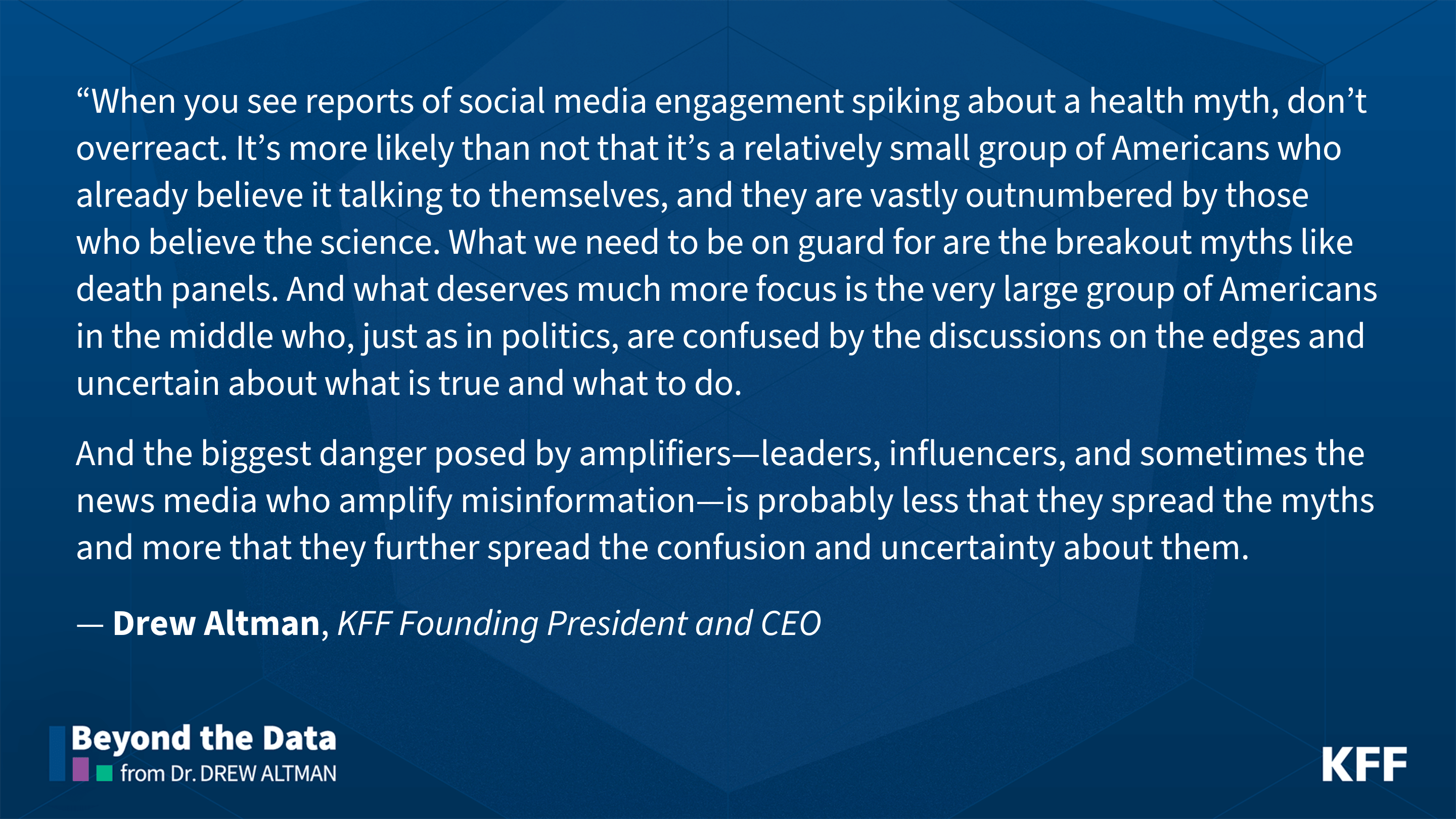
In a “Beyond the Data” column exploring KFF’s latest Tracking Poll on Health Information and Trust, KFF’s Founding President and CEO Drew Altman writes that Americans who firmly believe vaccine myths are vastly outnumbered both by those who believe science and those who remain uncertain. He suggests that amplifiers, including influencers, officials, and the media, may spread confusion and uncertainty about health claims.
KFF Poll Looks at Patterns of Belief Across Myths, Finding That Three in Ten Fall in the “Mixed Middle,” A Group That May Be an Important Focus for Dispelling Myths
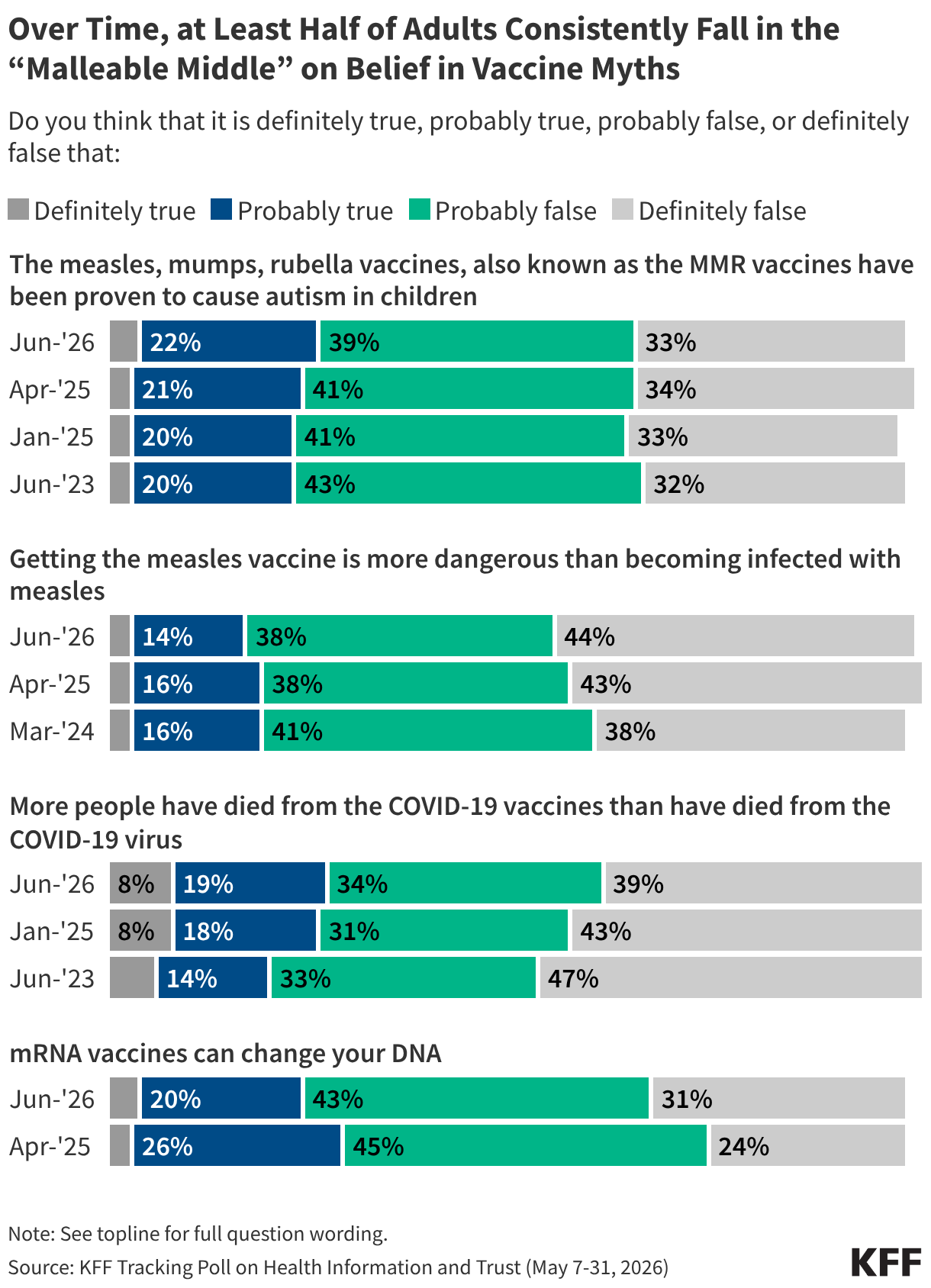
The latest KFF Tracking Poll on Health Information and Trust examines the pervasiveness of and belief in several common vaccine myths, including that the MMR vaccines have been proven to cause autism; that measles vaccines are more dangerous than measles; that more people died from COVID-19 vaccines than from the virus; and that mRNA vaccines can change your DNA.
Over the past several years, fewer than one in ten adults have said each of these myths are “definitely true,” while much larger shares (but fewer than half of adults) say they are “definitely false.” At the same time, at least half consistently fall in the “malleable middle,” expressing some uncertainty and saying the myths are either “probably true” or “probably false.” This dynamic has remained relatively stable over several years of KFF polling, though there have been some minor shifts in the share who say some of these myths are “definitely false,” reflecting how beliefs are not often completely fixed.
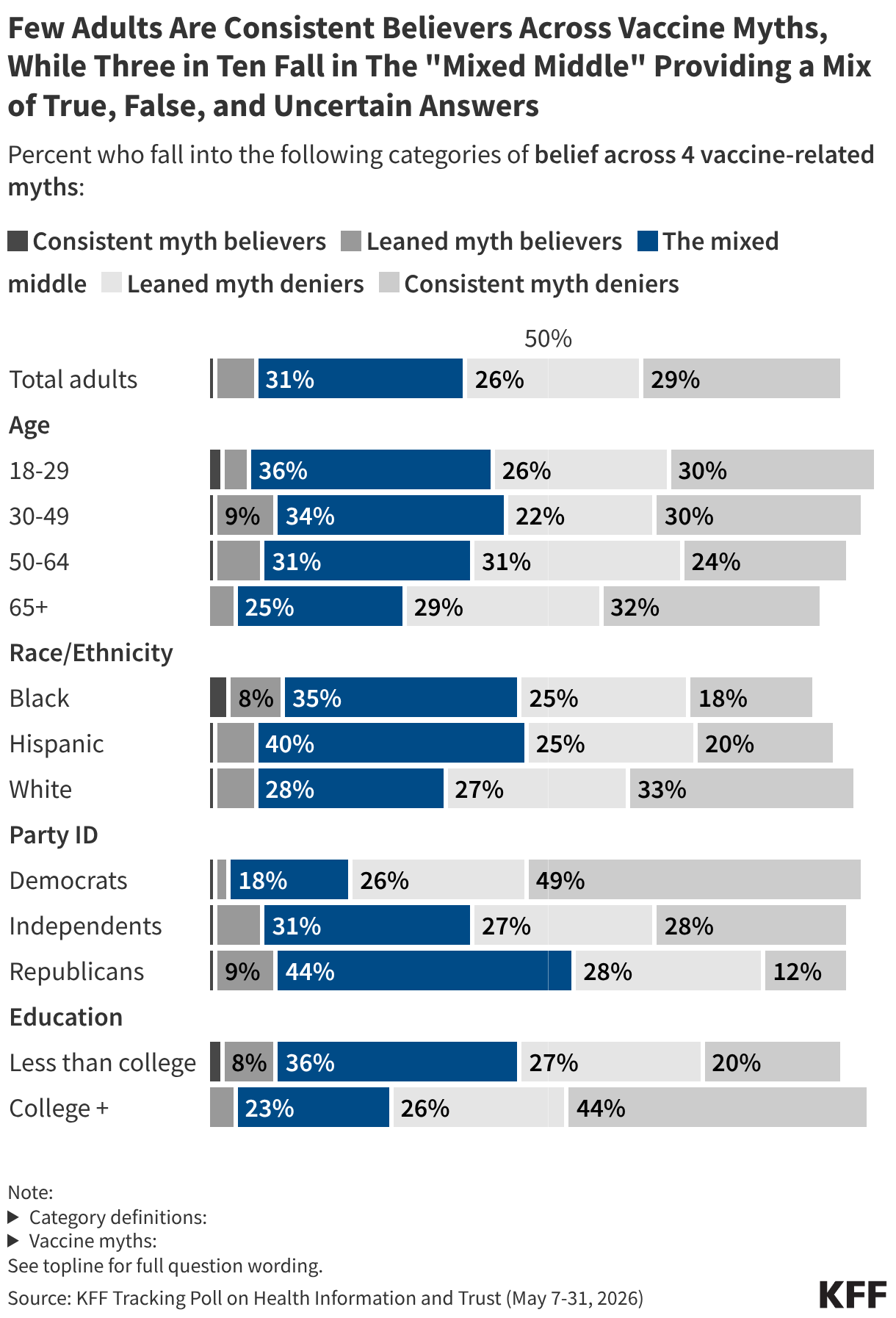
KFF’s latest poll also includes a new analysis looking at a typology of belief across these four vaccine myths. While at least half the public express some uncertainty over individual false vaccine claims, there are nuances to this group that can be examined by looking at patterns of belief across myths. Relatively few adults are consistent myth believers (1%) who say all four are true, including at least three that are “definitely true,” or leaned myth believers (6%) who say all the myths are true, but express more uncertainty saying at least half are “probably true.” Larger shares are on the side of the truth, including consistent myth deniers (29%) who say all four myths are false, including at least three as “definitely false,” and leaned myth deniers (26%), who say all are false, but at least half as “probably false.” Another three in ten adults (31%) fall in the mixed middle, a group that includes those who provide a range of true and false responses and lack certainty across at least half of the vaccine myths, saying they are either “probably true” or “probably false.”
This analysis provides a new lens for understanding different segments of the public who may benefit from different public health communications strategies. For example, adults in the “mixed middle” represent a share of the public who more routinely express doubt and do not consistently lean toward believing or denying vaccine myths. Given their higher levels of uncertainty, this “mixed middle” may be a key group to focus on for those who are looking to counter false information about vaccines. Larger shares of younger adults, Black adults, Hispanic adults, Republicans, and those without a college education fall into this “mixed middle” group.
Health information sources are also tied to uncertainty across vaccine myths: those who weekly use social media or artificial intelligence (AI) chatbots for health information are more likely to fall in the “mixed middle” than those who never use these platforms.
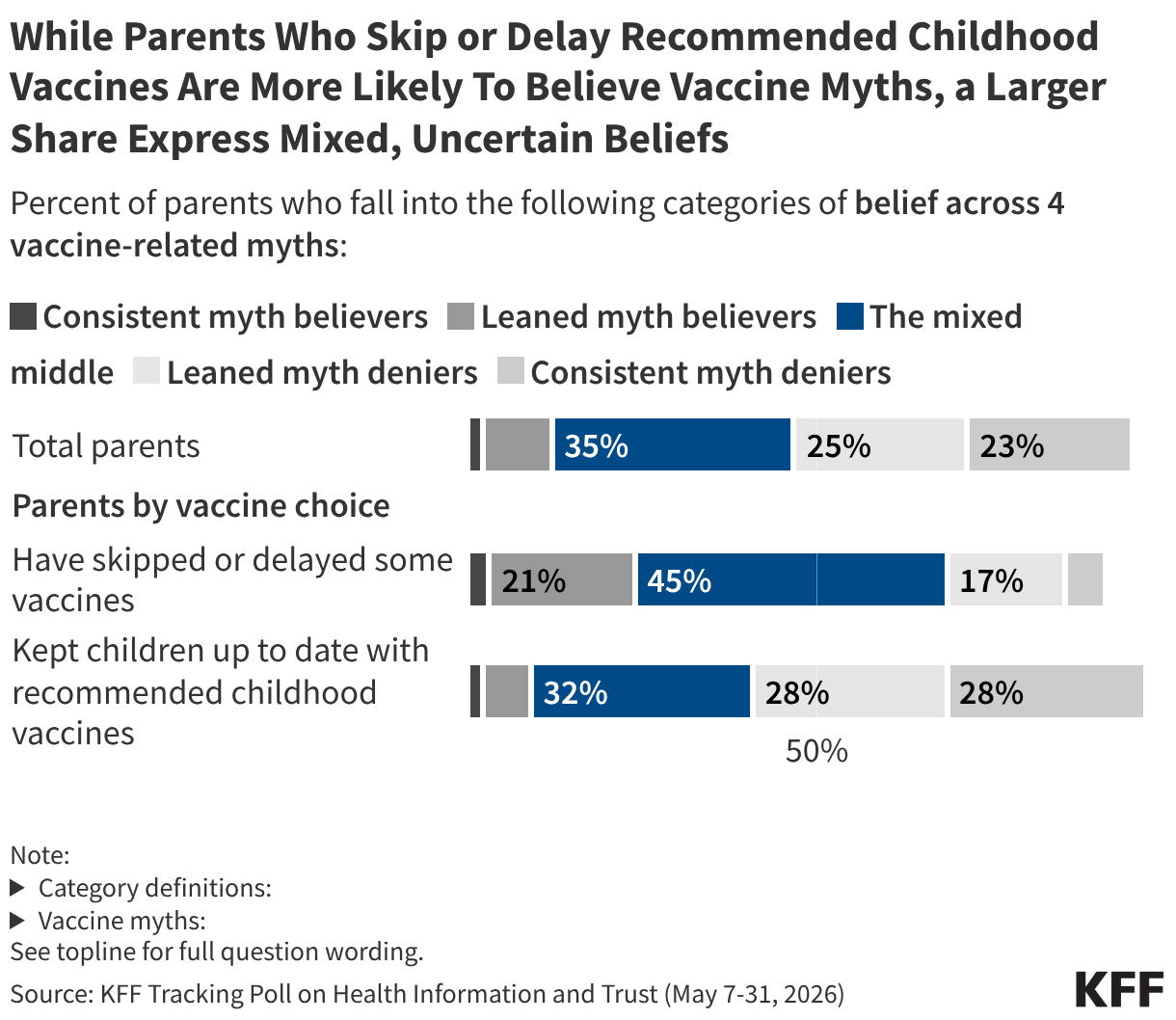
Notably, while parents who report skipping or delaying recommended vaccines are much more likely than those who keep their children up to date to believe or lean toward believing vaccine myths, nearly half of parents who report skipping or delaying some childhood vaccines fall in the “mixed middle.” This analysis shows that parents who are skipping or delaying vaccines for their children are more likely to express confusion and inconsistent beliefs across vaccine myths rather than consistent beliefs, which may reflect the potential for interventions to deliver accurate information among this group.
What We’re Watching
FDA Advisory Panel Recommends First mRNA Flu Vaccine, though Public Uncertainty About the Technology Persists
A Food and Drug Administration (FDA) advisory committee voted unanimously last month to recommend Moderna’s mRNA-based influenza vaccine for adults 50 and older. The committee’s recommendation is not a final approval, but if the vaccine is approved by the FDA, it would become the first flu vaccine in the U.S. to use the same mRNA technology deployed in COVID-19 vaccines. Moderna and panel members explained that using mRNA would enable vaccines to be produced and updated more quickly as strains change.
The vote has drawn renewed attention to mRNA vaccines online, with some online conversations misrepresenting both the technology’s safety and the scope of the vote. One physician with more than 600,000 followers suggested that all flu vaccines would use mRNA technology in the next flu season and urged followers to avoid them. Another post, from an attorney and podcast host, characterized the vote as part of a bigger plan to replace all vaccines with mRNA technology. Others revived false claims about mRNA vaccines from the COVID-19 pandemic, including that they can alter a person’s DNA or cause widespread health harms.
In reality, the committee’s recommendation applies only to one mRNA-based flu vaccine for adults 50 and older and would not affect traditional flu vaccines for most people. More than 6 billion doses of mRNA vaccines have been administered globally since 2020, and there is no evidence the technology alters human DNA or poses widespread health risks.
Why This Matters: KFF polling finds that roughly a third of adults (36%) have heard the claim that mRNA vaccines can alter a person’s DNA, and most people are uncertain whether it’s true or false. Exposure to this claim has declined 9 percentage points since April 2025, and the share who say the claim is “definitely false” has increased moderately over the same period. Past KFF polling also found that mRNA technology was obscure to much of the public, with about half (52%) reporting they didn’t know enough about it to say whether it was safe, larger than the shares who viewed it as either generally safe (32%) or generally unsafe (16%). As a new mRNA-based vaccine moves through the regulatory process, false narratives may find a receptive audience among adults who remain uncertain about the technology’s safety. The mRNA vaccine would be an additional option rather than a replacement for existing vaccines, but KFF will monitor whether uncertainty about the scope of the recommendation and mRNA’s safety could lead some to decline flu vaccination altogether.
Delayed Publication of Federal COVID Vaccine Study Highlights Disputes Over Agencies’ Scientific Independence
A study led by the Centers for Disease Control and Prevention (CDC) estimating COVID-19 vaccine effectiveness was published last week in a medical journal, months after acting CDC Director Jay Bhattacharya canceled its publication in the agency’s own weekly scientific report, citing methodological concerns. The study, which had been slated for publication in March in the CDC’s Morbidity and Mortality Weekly Report (MMWR), estimated the 2025-26 COVID-19 vaccine reduced COVID-associated emergency department visits and hospitalizations by at least 50%.
The study’s underlying approach, known as test-negative design, compares vaccination status among patients who test positive for a virus against those who test negative for the same symptoms. Bhattacharya has said he favors longitudinal cohort studies and raised concerns that test-negative studies may not adequately account for factors like prior infection.
A commentary published alongside the study, though, defended test-negative design as a long-standing, widely used approach for monitoring vaccine effectiveness. The CDC has long used this methodology to monitor flu vaccines, with a report about last winter’s flu vaccine effectiveness published in MMWR just a week before the COVID study was originally scheduled for publication. A co-author of the COVID study characterized the decision to withhold it from MMWR as “clearly not for scientific reasons” and said she believed it instead reflected the administration’s general stance on COVID-19 vaccines. HHS disputed that characterization, saying the agency does not make decisions based on predetermined conclusions.
Why This Matters: KFF polling has found that fewer than four in ten adults (38%) are confident that federal health agencies make decisions based on science rather than the personal views of agency officials, and fewer than half express confidence in agencies such as the CDC (40%) or FDA (36%) to act independently, without interference from outside interests. Disputes like this one, over a long-used and widely accepted research method, may also create confusion, potentially undermining confidence in the surveillance tools used to monitor vaccines.
AI & Emerging Technology
AI Chatbots Matched, But Didn’t Outperform, Existing Public Health Materials in Encouraging HPV Vaccination
A study published last month in JAMA Network Open found that brief conversations with an AI chatbot were no more effective than pre-existing public health materials at increasing parents’ intent to vaccinate their children against human papillomavirus (HPV), and the chatbot’s effects faded faster. Among more than 1,200 parents, researchers compared pre-existing public health materials from federal agencies like the CDC against a chatbot built using a standard AI model and instructed to respond to each parent’s top reason for not vaccinating. Both increased parents’ stated intent to vaccinate immediately afterward, but by 45 days, only the written materials maintained that effect. Neither approach meaningfully increased vaccination rates.
KFF and the Washington Post’s Survey of Parents showed that about one in five parents of children too young for HPV vaccination say they would “probably not” or “definitely not” vaccinate their child against the virus. Research conducted before the COVID-19 pandemic found that parents’ top reasons for not vaccinating their children against HPV were safety concerns and the belief that the vaccine wasn’t needed.
Why This Matters: As funding for traditional vaccination outreach becomes more scarce, some health departments may be looking for lower-cost alternatives to existing public health materials. This study suggests, however, that AI may not be an effective replacement for those existing tools. The study’s other finding, that even communications that impacted intentions didn’t result in more children getting vaccinated, demonstrates that changing intent doesn’t reliably change behavior, with researchers theorizing that practical barriers like scheduling a pediatrician visit may stand between intention and action.
More From KFF
- KFF Podcast: Is AI (Still) Biased?
- KFF Health News: Efforts to End School Vaccine Mandates Hit a Wall in Florida
- KFF Health News: Tennessee Pharmacies Sell Potent Ivermectin, Led by Anti-Vaccine Doctor Who’s Taken ‘Bucketloads’
About The Health Information and Trust Initiative: the Health Information and Trust Initiative is a KFF program aimed at tracking health misinformation in the U.S., analyzing its impact on the American people, and mobilizing media to address the problem. Our goal is to be of service to everyone working on health misinformation, strengthen efforts to counter misinformation, and build trust.

The Monitor is a report from KFF’s Health Information and Trust initiative that focuses on recent developments in health information. It’s free and published twice a month.
Sign up to receive KFF Monitor
email updates
Support for the Health Information and Trust initiative is provided by the Robert Wood Johnson Foundation (RWJF). The views expressed do not necessarily reflect the views of RWJF and KFF maintains full editorial control over all of its policy analysis, polling, and journalism activities. The data shared in the Monitor is sourced through media monitoring research conducted by KFF.