Eliminating the ACA: What Could It Mean for Medicaid Expansion?

Authors: Rachel Garfield and Robin Rudowitz
Published: Oct 1, 2020

The debate over filling the Supreme Court seat previously held by Ruth Bader Ginsburg has brought renewed attention to the possibility of the Affordable Care Act (ACA) being overturned under the court challenge in California v. Texas, currently scheduled to be heard shortly after the election this November. The expansion of Medicaid was a central component of the ACA, and 39 states have now adopted the ACA expansion into their Medicaid programs. Because Medicaid is administered by states, under federal guidelines, there may be some confusion about how overturning the federal law would affect state Medicaid programs.

Overturning the ACA would eliminate a Medicaid coverage pathway and federal Medicaid financing for millions of people. As of June 2019, 15 million people were enrolled in the ACA Medicaid expansion group and about 12 million of them were newly eligible under the ACA (the remainder were adults covered with waivers prior to the ACA and then moved to the ACA expansion group). This number could be even greater as enrollment has been increasing since February due to the pandemic and its related economic effects.  If the ACA is overturned, these individuals lose their federal entitlement to coverage and states cannot claim 90% federal matching dollars for their Medicaid costs. According to the Congressional Budget Office, the federal government is expected to pay $82 billion in FY 2020 for coverage for adults made eligible by the ACA.  It is most likely that states would not continue to finance coverage for these individuals with the regular Medicaid match or with state only funds, and most would likely become uninsured.

Can’t states continue the ACA expansion on their own?

For most adults who gained eligibility, no. Prior to the ACA, people had to both meet income standards and fit within one of the “categories” of covered groups, which generally included children, some of their parents, pregnant women, adults with disabilities, and some older (age 65 and up) adults. By extending Medicaid eligibility to nearly all adults up 138% of poverty, the ACA effectively eliminated categorical requirements. Overturning the ACA would eliminate the eligibility pathway for adults without dependent children that was created by the law as well as state access to federal matching funds for Medicaid coverage of this group. States that wished to continue to cover this group would need to either seek a waiver from the Secretary of HHS or use only state dollars to finance the coverage. Because the federal government is currently financing 90% of the cost of expansion – even more than the traditional match rate in Medicaid that ranges from 50% to 78%— transitioning the full cost to state budgets likely would not be possible within state budget constraints.

States could expand coverage to parents under pre-ACA eligibility pathways, but they would not receive enhanced matching funds for this coverage. Many parents were eligible for Medicaid prior to the ACA, but income eligibility limits for parents were very low—typically just 64% of poverty, equating to less than $14,000 a year for a family of three in current dollars. The ACA raised the federal income standard for adults—including parents—to 138% of poverty in states that adopted the expansion and also provided enhanced federal funds to cover the cost. Compared to a federal share between 50% and 78% for other groups, the federal government paid all (100% in years 2014-2016) or nearly all (now 90%) of the cost for adults covered through the expansion. Without the enhanced matching funds, it is likely that states will revert to pre-ACA, lower eligibility levels for parents.

Overturning the ACA also takes away the option for states that have not expanded to do so in the future. Most (25) of the 39 states that have adopted the expansion did so in 2014 when the expansion went into effect, but some states have expanded as recently as 2020 and others continue to debate expansion. If states that have not adopted the expansion do so, nearly 10 million uninsured adults—including those uninsured prior to the pandemic and those whose coverage is at risk due to the economic crisis—could become eligible for Medicaid. However, it would be surprising if states that didn’t expand when enhanced federal matching funds were available under the ACA opted to do so without enhanced matching funds through expanded parent coverage or a waiver.

What happens to people covered by the expansion if the law is overturned or repealed?

Most would likely become uninsured. Though most adults without disabilities who are covered by Medicaid are working, offer rates of employer-based insurance are very low for workers with incomes below Medicaid eligibility levels. Repealing or overturning the ACA would further eliminate other provisions that could help lower-income people access private coverage, such as protections for people with pre-existing conditions and premium subsidies in the ACA marketplace. While a limited number of states had waivers to cover adults without dependent children prior to the ACA, it is not certain that even these states would maintain ACA coverage through a waiver without enhanced federal funding, particularly given the current economic realities and revenue shortfalls states are facing related to the pandemic.

In addition to loss of coverage, other gains in access, utilization, affordability and in addressing disparities could be lost.  A review of over 400 studies showed that Medicaid expansion has improved access to care, utilization of services, the affordability of care, and financial security among the low-income population. More recent studies show improved self-reported health following expansion and an association between expansion and certain positive health outcomes. Some studies also show that Medicaid expansion is associated with decreased mortality overall and for certain specific conditions; reductions in rates of food insecurity, poverty, and home evictions; and improvements in measures of self-reported health and healthy behaviors.  Finally, some studies also show that the expansion has helped to narrow racial disparities in health coverage in health outcomes for Black and Hispanic individuals, particularly for measures of maternal and infant health.

States and providers would also lose federal funds that help them support services and health systems for residents. While the Medicaid expansion has increased federal spending, expansion studies point to positive economic outcomes in states including state budget savings, revenue gains, and overall economic growth as well as reductions in uncompensated care costs for providers. Expansion has helped providers increase operational capacity.

What Do We Know About Spending Related to Public Health in the U.S. and Comparable Countries?

Published: Sep 30, 2020

A new chart collection examines what we know about public health spending in the U.S. and comparable countries.

The chart collection explores high-level trends in spending on public health and prevention in the U.S., and finds that while the U.S. spends more than most comparable countries on preventive care, the share of total U.S. health spending committed to preventive care has declined in recent years, and the U.S. still has a higher rate of preventable death than the comparable country average.

The chart collection is available on the Peterson-KFF Health System Tracker, an online information hub dedicated to monitoring and assessing the performance of the U.S. health system.

How Health Insurers Responded to Applicants with Pre-existing Conditions Before and After the Affordable Care Act

Published: Sep 30, 2020

The fate of the Affordable Care Act (ACA) is again in doubt, with the Supreme Court set to hear arguments in California v. Texas days after the Presidential election. With protections for people with pre-existing conditions (among others) at risk, it is worth revisiting what it was like for people with pre-existing conditions to obtain coverage before this law.

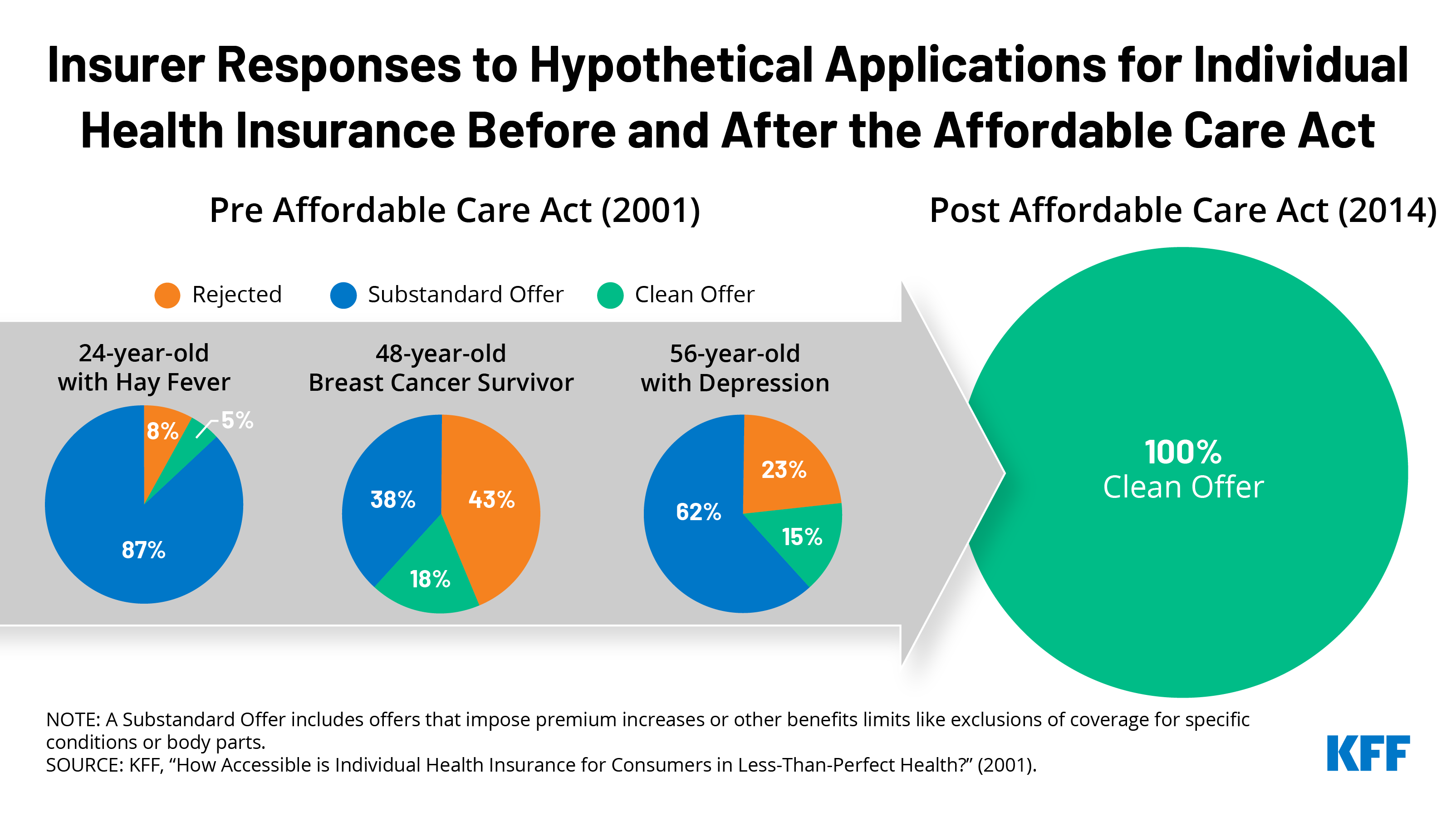
Pre-ACA, health insurance in the individual market was medically underwritten in most states.  That means applicants could be turned down, charged more, have their pre-existing condition excluded, or face other limits on covered benefits based on their health status.  More than 50 million Americans have a condition, such as diabetes or past heart attack, that would have made them “uninsurable” in the pre-ACA individual market. Taking into account less severe conditions, such as asthma or high cholesterol, millions more have pre-existing conditions that would make it harder to buy medically underwritten coverage.

In 2001, KFF examined how individual market insurers would treat applications from people in less than perfect health. In one scenario, a young woman with Hay Fever was rejected 8% of the time.  The vast majority (87%) of offers she did receive surcharged premiums or put limits on her benefits, including riders to eliminate coverage for her Hay Fever, prescription drugs, or her upper respiratory system. In another scenario, a seven-year breast cancer survivor was denied coverage 43% of the time; on 39% of her applications she was offered policies with surcharged premiums or benefit limits including permanent exclusion of cancer coverage.  Yet another applicant with HIV was denied 100% of the time.

By contrast, the ACA prohibits individual market insurers from denying coverage or charging higher premiums based on health status.  It also prohibits pre-existing condition exclusion periods and requires policies to cover essential benefits.

Source

How Accessible is Individual Health Insurance for Consumers in Less-Than Perfect Health?

Effects of the ACA Medicaid Expansion on Racial Disparities in Health and Health Care

Authors: Madeline Guth, Samantha Artiga, and Olivia Pham
Published: Sep 30, 2020

Executive Summary

The disparate impacts of the COVID-19 pandemic on people of color have exposed and compounded underlying racial/ethnic disparities in health and health care. These disparities include longstanding higher uninsured rates among people of color that contribute to barriers to care and, ultimately, worse health outcomes. The Affordable Care Act (ACA) coverage expansions, including the Medicaid expansion to low-income adults, provide an opportunity to reduce disparities in coverage, which research suggests may contribute to reductions in disparities access to care and health outcomes.

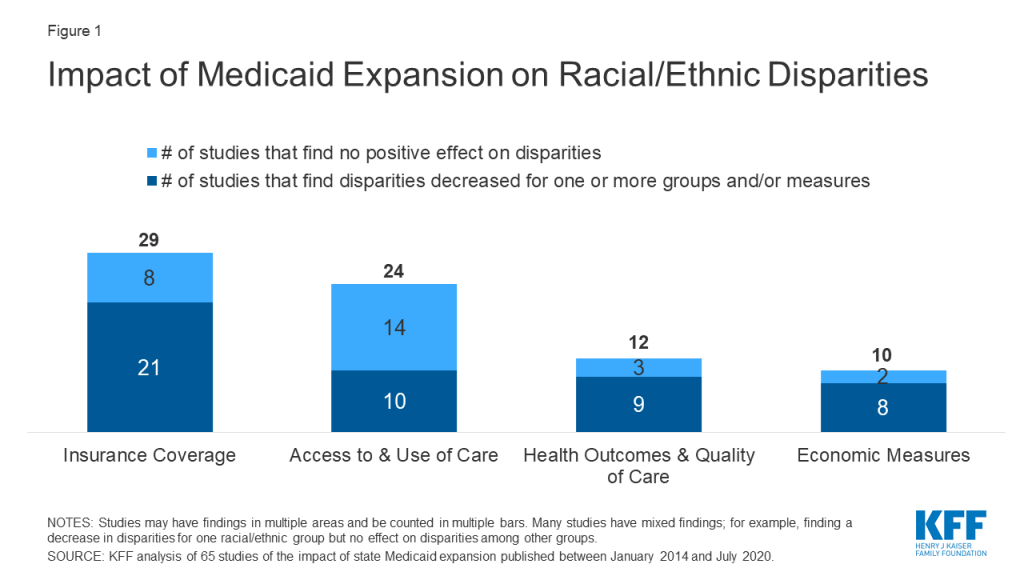
This issue brief builds on a previous literature review that broadly investigated the effects of Medicaid expansion by examining how the expansion has affected racial disparities in health coverage, access to care, health outcomes, and economic outcomes. It is based on a review of 65 studies published beginning in January 2014 (when the coverage provisions of the ACA went into effect) through July 2020. This brief groups outcomes into four broad categories: coverage; access to and use of care; health outcomes and quality of care; and economic measures. Key findings include (Figure 1):

  • Most of the 29 studies that examined how Medicaid expansion has affected disparities in health coverage found it helped narrow but did not eliminate racial disparities in health coverage.
  • The 24 studies that examined how Medicaid expansion affected access to and use of care generally found expansion was associated with improvements in these measures for some groups but more limited evidence that it reduced racial disparities that existed prior to expansion.
  • Some studies find that Medicaid expansion was associated with narrowed disparities in health outcomes for Black and Hispanic individuals, particularly for measures of maternal and infant health.
  • The limited number of studies that considered effects of expansion on disparities in economic measures had mixed results but suggested some narrowing of differences in the payer mix for provider reimbursement for health care services (the proportion of uninsured patients vs. Medicaid patients) by patient race/ethnicity and for measures of individual economic well-being.
Figure 1: Impact of Medicaid Expansion on Racial/Ethnic Disparities

Together these findings illustrate that Medicaid expansion has contributed to reductions in longstanding racial disparities in health coverage. They further suggest that, while increased coverage can help improve access to care and contribute to improvements in health, coverage alone is not enough to eliminate disparities in these measures. This finding reflects that a broad range of social and economic factors beyond health coverage influence and drive health. As such, the findings point to the importance of ongoing efforts to address health disparities considering a broad array of factors within and outside the heath sector, including historic and ongoing racism and discrimination.

Issue Brief

Introduction

This issue brief builds on a previous literature review that broadly investigated the effects of Medicaid expansion by examining how the expansion has affected racial disparities in health coverage, access to care, health outcomes, and economic outcomes. It is based on KFF’s review of 65 studies which examined the impacts of Medicaid expansion by race/ethnicity and were published beginning in January 2014 (when the coverage provisions of the ACA went into effect) through July 2020.1  This brief groups findings into four broad categories: coverage; access to and use of care; health outcomes and quality of care; and economic measures. (Appendix A provides a list of citations for each of the included studies, grouped by the four categories of findings.) Across categories, most research focused on disparities for Black and Hispanic individuals, leaving significant gaps in research to understand impacts for other groups of color.

This review only discusses findings related to changes in racial/ethnic disparities associated with Medicaid expansion. An additional body of work has examined effects of the ACA broadly and suggests significant decreases in disparities following the ACA, but did not examine effects of the Medicaid expansion specifically or differential effects by state Medicaid expansion status. While these studies are not included in this brief, expansion may have played a significant role in the effects found in these studies. (See Methods for more details.)

Key Findings: Effects of Medicaid Expansion

Disparities in Health Coverage

Across the 29 studies that examined how Medicaid expansion has affected disparities in health coverage, 21 found that Medicaid expansion helped narrow but did not eliminate racial/ethnic disparities in health coverage. Studies varied in the groups they examined and the metrics they included to assess coverage. Some of these studies had mixed results; for example, finding disparities narrowed for one racial/ethnic group but that expansion had no effect on or widened disparities for another group. Similarly, findings sometimes varied by measure; for example, some studies found disparities in uninsured rates decreased but those in Medicaid coverage did not, or vice versa. The few studies that did not find expansion had any positive effect on coverage disparities (including a few that found increased disparities) generally considered effects for a targeted population or only used data from the first year of expansion.2 ,3 ,4 ,5 ,6 ,7 ,8 ,9 ,10 ,11 ,12 ,13 ,14 ,15 ,16 ,17 ,18 ,19 ,20 ,21 ,22 

Most studies examined changes in coverage disparities for Black and Hispanic individuals but did not provide findings for other groups of color. There was slightly stronger and more consistent evidence of narrowed coverage disparities for Black individuals compared to Hispanic individuals. A smaller number of studies considered how expansion affected coverage disparities for other groups of color, and findings for these groups were mixed.23 ,24 ,25 ,26  A few studies further found variation in how Medicaid expansion affected coverage disparities by country of origin, language, and gender.27 ,28 ,29 

Several studies found decreased racial/ethnic coverage disparities among cancer patients and survivors. Specifically, studies suggest that expansion was associated with decreased coverage disparities among Black and Hispanic patients with newly diagnosed cancer; patients with lung, breast, or prostate cancer; patients with head and neck cancer; and women with endometrial cancer.30 ,31 ,32 ,33 ,34 ,35  Study authors explain that racial/ethnic disparities in cancer care and outcomes are longstanding and may be mitigated by increases in insurance coverage.

Disparities in Access to and Use of Care

Most of the 24 studies that examined how Medicaid expansion affected access to and use of care found that it was generally associated with improvements in these measures for some groups but more limited evidence that it reduced disparities that existed prior to the expansion. Ten studies found that Medicaid expansion was associated with narrowed disparities in at least one measure of access for at least one group of color. Within these studies, findings often varied by racial/ethnic group and measure; for example, finding reductions in disparities for some groups and in some measures but not others. The remaining studies did not find expansion reduced access disparities. Two studies found disparities widened for one more or more measures due to larger improvements among White individuals compared to people of color.36 ,37   Most studies considered disparities for Black and Hispanic individuals; few considered effects for other groups.38 ,39 ,40 ,41 ,42 ,43 ,44 ,45 ,46 ,47 ,48 ,49 ,50 ,51 ,52 ,53 ,54 ,55 ,56 ,57 ,58 ,59  Studies focused on several types of measures:

  • Access to primary care: While most studies found overall improvements in the share of people having a usual source of care, a personal doctor, and a recent doctor’s visit, they generally did not find expansion was associated with narrowed racial disparities in these measures or had mixed findings across groups, with improvements for one group but not another.60 ,61 ,62 ,63 ,64 ,65 
  • Affordability of care: Studies generally found improvements in affordability of care across groups, but mixed findings regarding effects on disparities. Several studies found that expansion decreased the gap between Black and White individuals in ability to afford care, but studies generally did not find a narrowing of disparities in affordability between Hispanic and White individuals.66 ,67 ,68 ,69 ,70 ,71 ,72 ,73 
  • Receipt of preventive care: In contrast to narrowed disparities in coverage among cancer patients associated with expansion, studies did not find expansion was associated with reduced disparities in cancer screening rates, cancer stage at diagnosis, and utilization of cancer surgery.74 ,75 ,76 ,77  One study also found that expansion did not affect disparities in receipt of the flu shot, while other studies found it was associated with narrowed disparities in HIV testing rates and in perforated appendix admission rates (which provide insight into the extent to which patients are able to obtain care earlier to prevent perforation).78 ,79 ,80 
  • Utilization of health care services: Most studies that consider utilization of services such as surgery for specific conditions find no effect of expansion on disparities.81 ,82 ,83 ,84 ,85 ,86 ,87 ,88  In contrast, a few studies found decreased disparities for at least one racial group in utilization of other specific services, including heart transplant listing rates, high-risk cancer surgery, and receipt of naltrexone or counseling without medication to address opioid use disorder (although this final study also suggested that White adults were more likely than adults of color to receive buprenorphine for opioid use disorder).89 ,90 ,91 

Disparities in Health Outcomes & Quality of Care

Studies suggest that Medicaid expansion narrowed disparities in some health outcomes for Black and Hispanic individuals, particularly related to infant and maternal health. Research in these areas generally did not examine effects for other groups of color. Studies suggest larger improvements for Black and, in some cases, Hispanic individuals as compared to White individuals in rates of infant mortality and other adverse birth outcomes and maternal mortality, helping to narrow but not eliminating disparities in these measures.92 ,93 ,94 ,95 ,96   Other studies also found disparities narrowed for at least one group in measures of self-reported health and one-year mortality among end-stage renal disease patients initiating dialysis, but findings were mixed across groups.97 ,98 ,99  Other research found no effect on survival rates among women with endometrial cancer across racial/ethnic groups.100  No studies found increased disparities in health outcomes, although two studies found increased disparities in certain measures of quality of hospital care.101 ,102 

Disparities in Payer Mix and Other Economic Outcomes

The limited number of studies that considered effects of expansion on disparities in economic measures had mixed results but suggested some narrowing of differences in the payer mix for provider reimbursement for health care services (the proportion of uninsured patients vs. Medicaid patients) by patient race/ethnicity and for measures of individual economic well-being. Research found greater increases in Medicaid-insured visits and/or decreases in uninsured visits among people of color compared to White people for a variety of specific conditions, although a few other studies suggested that expansion had no effect on or widened disparities in reimbursement patterns for other conditions.103 ,104 ,105 ,106 ,107 ,108 ,109 ,110   A few studies examined disparities in employment and other measures of individual economic well-being. For example, studies suggested that expansion was associated with gains in employment, student status, and volunteerism that reduced racial disparities.111 ,112  However, findings varied across racial and ethnic groups.113   Overall, research in this area remains limited.

Conclusion

Prior to the ACA, there were significant disparities in health and health care. The ACA Medicaid expansion provided an opportunity to reduce longstanding disparities in health coverage, which may contribute to improvements in and narrowed disparities in access to and use of care and health outcomes. This review of the literature finds that Medicaid expansion has helped to narrow but has not eliminated disparities in coverage. It also shows that Medicaid expansion was associated with improvements in measures of access to care, use of care, health outcomes, and certain economic measures across racial/ethnic groups, but its effects on disparities were often mixed across groups and/or measures. This review further shows that most studies only examined effects for Black and Hispanic individuals, leaving continued gaps in data and research for other groups.

Together these findings illustrate that the Medicaid expansion has contributed to reductions in longstanding racial disparities in health coverage. They further suggest that, while increased coverage can help improve access to care and contribute to improvements in health, coverage alone is not enough to eliminate disparities in these measures. This finding reflects that a broad range of social and economic factors beyond health coverage and health care influence and drive health. As such, the findings point to the importance of ongoing efforts to address health disparities considering a broad array of factors within and outside the heath sector, including historic and ongoing racism and discrimination.

Methods

This literature review includes studies, analyses, and reports published by government, research, and policy organizations using data from 2014 or later. This brief includes studies that examine impacts of the Medicaid expansion by race/ethnicity (even if impacts on racial/ethnic disparities were not the primary focus of the study). It excludes studies on impacts of ACA coverage expansions generally (not specific to Medicaid expansion alone), studies investigating potential effects of expansion in states that have not (or had not, at the time of the study) expanded Medicaid, and reports from advocacy organizations and media sources.

To collect relevant studies, we conducted keyword searches of PubMed and other academic health/social policy search engines as well as websites of government, research, and policy organizations that publish health policy-related research. We also used a snowballing technique of pulling additional studies from reference lists in previously collected studies. While we tried to be as comprehensive as possible in our inclusion of studies and findings that meet our criteria, it is possible that we missed some relevant studies or findings. For each study, we read the final paper/report and summarized the population studied, data and methods used, and findings. In instances of conflicting findings within a study, or if a reviewer had questions about specific findings, multiple reviewers read and classified the study to characterize its findings. In the issue brief text, findings are broken out and reported separately in four broad categories: Medicaid expansion’s impact on coverage disparities; disparities in access to and use of care; disparities in health outcomes and quality of care; and disparities in economic metrics. Studies may be cited in multiple categories or in multiple places within a category. Appendix A provides a list of citations for each of the included studies, grouped by the four categories of findings.

Appendix

Appendix A: Studies by Topic

Coverage

Ankit Agarwal, Aaron Katz, and Ronald Chen, “The Impact of the Affordable Care Act on Disparities in Private and Medicaid Insurance Coverage among Patients Under 65 with Newly Diagnosed Cancer, International Journal of Radiation Oncology, Biology, Physics (May 2019), https://www.redjournal.org/article/S0360-3016(19)30783-7/pdf

Manzilat Akande, Peter Minneci, Katherine Deans, Henry Xiang, Deena Chisolm, and Jennifer Cooper, “Effects Of Medicaid Expansion On Disparities In Trauma Care And Outcomes In Young Adults,” Journal of Surgical Research 228 (August 2018): 42-53, https://www.sciencedirect.com/science/article/pii/S0022480418301562

Kelsey Avery, Kenneth Finegold, and Amelia Whitman, Affordable Care Act Has Led to Historic, Widespread Increase in Health Insurance Coverage (Office of the Assistant Secretary for Planning and Evaluation, September 2016), https://aspe.hhs.gov/sites/default/files/pdf/207946/ACAHistoricIncreaseCoverage.pdf

Archana Babu et al., “The Affordable Care Act: Implications for Underserved Populations with Head & Neck Cancer,” American Journal of Otolaryngology 41, no. 4 (July-August 2020), https://doi.org/10.1016/j.amjoto.2020.102464

David Barrington et. al., “Where You Live Matters: A National Cancer Database Study of Medicaid Expansion and Endometrial Cancer Outcomes,” Gynecologic Oncology Epub ahead of print (June 2020), https://doi.org/10.1016/j.ygyno.2020.05.018

Jesse C. Baumgartner, Sara R. Collins, David C. Radley, and Susan L. Hayes, How the Affordable Care Act Has Narrowed Racial and Ethnic Disparities in Access to Health Care (The Commonwealth Fund, January 2020), https://www.commonwealthfund.org/publications/2020/jan/how-ACA-narrowedracial-ethnic-disparities-access

Thomas Buchmueller, Zachary Levinson, Helen Levy, and Barbara Wolfe, “Effect of the Affordable Care Act on Racial and Ethnic Disparities in Health Insurance Coverage,” American Journal of Public Health (May 2016), http://www.ncbi.nlm.nih.gov/pubmed/27196653

Thomas Buchmueller and Helen Levy, “The ACA’s Impact On Racial And Ethnic Disparities In Health Insurance Coverage And Access To Care,” Health Affairs 39, no. 3 (March 2020): 395-402, https://doi.org/10.1377/hlthaff.2019.01394

Fumiko Chino, Gita Suneja, Haley Moss, S. Yousuf Zafar, Laura Havrilesky, and Junzo Chino, “Healthcare Disparities in Cancer Patients Receiving Radiation: Changes in Insurance Status After Medicaid Expansion Under the Affordable Care Act,” International Journal of Radiation Oncology (December 2017), http://www.sciencedirect.com/science/article/pii/S0360301617341883

Charles Courtemanche, James Marton, Benjamin Ukert, Aaron Yelowitz, and Daniela Zapata, Impacts of the Affordable Care Act on Health Insurance Coverage in Medicaid Expansion and Non-Expansion States (Working Paper No. 22182, The National Bureau of Economic Research, April 2016), http://www.nber.org/papers/w22182

Charles Courtemanche, James Marton, Benjamin Ukert, Aaron Yelowitz, Daniela Zapata, and Ishtiaque Fazlul, “The Three‐Year Impact of the Affordable Care Act on Disparities in Insurance Coverage,” Health Services Research (October 2018), https://onlinelibrary.wiley.com/doi/10.1111/1475-6773.13077

Charles J. Courtemanche et al., The Impact of the ACA on Insurance Coverage Disparities After Four Years (National Bureau of Economic Research, Working Paper No. 26157, August 2019),http://www.nber.org/papers/w26157

Sandra Decker, Brandy Lipton, and Benjamin Sommers, “Medicaid Expansion Coverage Effects Grew in 2015 With Continued Improvements in Coverage Quality,” Health Affairs 36 no. 5 (May 2017): 819-825, http://content.healthaffairs.org/content/36/5/819.full

Alina Denham and Peter Veazie, “Did Medicaid Expansion Matter in States with Generous Medicaid?” The American Journal of Managed Care 25, no. 3 (March 2019): 129-134, https://www.ajmc.com/journals/issue/2019/2019-vol25-n3/did-medicaid-expansion-matter-in-states-with-generous-medicaid

Michael Dworsky and Christine Eibner, The Effect of the 2014 Medicaid Expansion on Insurance Coverage for Newly Eligible Childless Adults (Santa Monica, CA: Rand Corporation, 2016), https://www.rand.org/pubs/research_reports/RR1736.htm

Rene Flores and Robert Vargas, “Medicaid Expansion And Ethnoracial Disparities In Health Insurance Coverage,” Journal of Ethnic and Migration Studies 43, no. 12 (June 2017), https://www.tandfonline.com/doi/full/10.1080/1369183X.2017.1323451?needAccess=true

Anna L. Goldman and Benjamin D. Sommers, “Among Low-Income Adults Enrolled In Medicaid, Churning Decreased After The Affordable Care Act,” Health Affairs 39, no. 1 (January 2020): 85-93, https://doi.org/10.1377/hlthaff.2019.00378

Sergio Gonzales and Benjamin Sommers, “Intra-Ethnic Coverage Disparities among Latinos and the Effects of Health Reform” Health Services Research epub ahead of print (June 2017), http://onlinelibrary.wiley.com/wol1/doi/10.1111/1475-6773.12733/full

Xuesong Han, Robin Yabroff, Elizabeth Ward, Otis Brawley, and Ahmedin Jemal, “Comparison of Insurance Status and Diagnosis Stage Among Patients With Newly Diagnosed Cancer Before vs After Implementation of the Patient Protection and Affordable Care Act,” JAMA Oncology 4, no. 12 (August 2018): 1713-1720, https://jamanetwork.com/journals/jamaoncology/article-abstract/2697226

Xuesong Han et al., “Changes in Noninsurance and Care Unaffordability Among Cancer Survivors Following the Affordable Care Act,” Journal of the National Cancer Institute Epub ahead of print (November 2019), https://doi.org/10.1093/jnci/djz218

Susan Hayes, Pamela Riley, David Radley, and Douglas McCarthy, Reducing Racial and Ethnic Disparities in Access to Care: Has the Affordable Care Act Made a Difference? (The Commonwealth Fund, August 2017), http://www.commonwealthfund.org/publications/issue-briefs/2017/aug/racial-ethnicdisparities-care

John Heintzman, Steffani Bailey, Jennifer DeVoe, Stuart Cowburn, Tanya Kapka, Truc-Vi Duong, and Miguel Marino, “In Low-Income Latino Patients, Post-Affordable Care Act Insurance Disparities May Be Reduced Even More than Broader National Estimates: Evidence from Oregon,” Journal of Racial and Ethnic Health Disparities (April 2016), http://www.ncbi.nlm.nih.gov/pubmed/27105630

Hyunjung Lee and Frank Porell, “The Effect of the Affordable Care Act Medicaid Expansion on Disparities in Access to Care and Health Status,” Medical Care Research and Review epub ahead of print (October 2018), https://journals.sagepub.com/doi/abs/10.1177/1077558718808709?rfr_dat=cr_pub%3Dpubmed&url_ver=Z39.88-2003&rfr_id=ori%3Arid%3Acrossref.org&journalCode=mcrd

Brandy Lipton, Sandra Decker, and Benjamin Sommers, “The Affordable Care Act Appears to Have Narrowed Racial and Ethnic Disparities in Insurance Coverage and Access to Care Among Young Adults” Medical Care Research and Review 76, no.1 (April 2017): 32–55, https://www.ncbi.nlm.nih.gov/pubmed/29148341

Amandeep R. Mahal et al., “Early Impact of the Affordable Care Act and Medicaid Expansion on Racial and Socioeconomic Disparities in Cancer Care,” American Journal of Clinical Oncology Epub ahead of print (January 2020), https://doi.org/10.1097/coc.0000000000000588

Nevada’s Medicaid Population, (Las Vegas, NV: The Guinn Center, September 2019), https://guinncenter.org/wp-content/uploads/2019/09/Guinn-Center-NV-Medicaid-PopulationCharacteristics-2019.pdf

Scott R. Sanders et al., “Infants Without Health Insurance: Racial/Ethnic and Rural/Urban Disparities in Infant Households’ Insurance Coverage,” PLoS One 15, no. 1 (January 2020), https://doi.org/10.1371/journal.pone.0222387

George Wehby and Wei Lyu, “The Impact of the ACA Medicaid Expansions on Health Insurance Coverage through 2015 and Coverage Disparities by Age, Race/Ethnicity, and Gender” Health Services Research epub ahead of print (May 2017), http://onlinelibrary.wiley.com/doi/10.1111/1475-6773.12711/abstract

Dahai Yue, Petra Rasmussen, and Ninez Ponce, “Racial/Ethnic Differential Effects of Medicaid Expansion on Health Care Access,” Health Services Research (February 2018), http://onlinelibrary.wiley.com/doi/10.1111/1475-6773.12834/abstract

Access to and Use of Care (back to top)

David Barrington et. al., “Where You Live Matters: A National Cancer Database Study of Medicaid Expansion and Endometrial Cancer Outcomes,” Gynecologic Oncology Epub ahead of print (June 2020), https://doi.org/10.1016/j.ygyno.2020.05.018

Jesse C. Baumgartner, Sara R. Collins, David C. Radley, and Susan L. Hayes, How the Affordable Care Act Has Narrowed Racial and Ethnic Disparities in Access to Health Care (The Commonwealth Fund, January 2020), https://www.commonwealthfund.org/publications/2020/jan/how-ACA-narrowedracial-ethnic-disparities-access

Khadijah Breathett et al., “The Affordable Care Act Medicaid Expansion Correlated with Increased Heart Transplant Listings in African Americans but Not Hispanics or Caucasians,” JACC: Heart Failure 5 no. 2 (January 2017): 136-147, https://www.ncbi.nlm.nih.gov/pubmed/28109783

Khadijah Breathett et al., “Is the Affordable Care Act Medicaid Expansion Linked to Change in Rate of Ventricular Assist Device Implantation for Blacks and Whites?” Circulation: Heart Failure 13, no. 4 (April 2020), https://doi.org/10.1161/CIRCHEARTFAILURE.119.006544

Thomas Buchmueller and Helen Levy, “The ACA’s Impact On Racial And Ethnic Disparities In Health Insurance Coverage And Access To Care,” Health Affairs 39, no. 3 (March 2020): 395-402, https://doi.org/10.1377/hlthaff.2019.01394

Andrew Crocker et al., “Expansion Coverage And Preferential Utilization Of Cancer Surgery Among Racial And Ethnic Minorities And Low-Income Groups,” Surgery epub ahead of print (June 2019), https://www.surgjournal.com/article/S0039-6060(19)30198-9/fulltext

Adrian Diaz, Daniel Chavarin, Anghela Z. Paredes, and Timothy M. Pawlik, “Utilization of High-Volume Hospitals for High-Risk Cancer Surgery in California Following Medicaid Expansion,” Journal of Gastrointestinal Surgery Epub ahead of print (July 2020), https://link.springer.com/article/10.1007/s11605-020-04747-8

Afshin Ehsan et al., “Utilization of Left Ventricular Assist Devices in Vulnerable Adults Across Medicaid Expansion,” Journal of Surgical Research 243 (November 2019): 503-508, https://doi.org/10.1016/j.jss.2019.05.015

Yunwei Gai and John Marthinsen, “Medicaid Expansion, HIV Testing, and HIV-Related Risk Behaviors in the United States, 2010-2017,” American Journal of Public Health 109, no. 10 (October 2019): 1404- 1412, https://doi.org/10.2105/ajph.2019.305220

Kelsie M. Gould et al., “Bariatric Surgery Among Vulnerable Populations: The Effect of the Affordable Care Act’s Medicaid Expansion,” Surgery 166, no. 5 (November 2019): 820-828, https://doi.org/10.1016/j.surg.2019.05.005

Xuesong Han et al., “Changes in Noninsurance and Care Unaffordability Among Cancer Survivors Following the Affordable Care Act,” Journal of the National Cancer Institute Epub ahead of print (November 2019), https://doi.org/10.1093/jnci/djz218

Susan Hayes, Sara Collins, David Radley, and Douglas McCarthy, What’s at Stake: States’ Progress on Health Coverage and Access to Care, 2013-2016 (The Commonwealth Fund, December 2017), http://www.commonwealthfund.org/publications/issue-briefs/2017/dec/states-progress-health-coverageand-access

Susan Hayes, Pamela Riley, David Radley, and Douglas McCarthy, Reducing Racial and Ethnic Disparities in Access to Care: Has the Affordable Care Act Made a Difference? (The Commonwealth Fund, August 2017), https://www.commonwealthfund.org/publications/issue-briefs/2017/aug/reducing-racial-and-ethnic-disparities-access-care-has

Nathalie Huguet et al., “Cervical And Colorectal Cancer Screening Prevalence Before And After Affordable Care Act Medicaid Expansion,” Preventative Medicine (May 2019), https://doi.org/10.1016/j.ypmed.2019.05.003

Nadia Laniado, Avery R. Brow, Eric Tranby, and Victor M. Badner, “Trends in Non-Traumatic Dental Emergency Department Use in New York and New Jersey: A Look at Medicaid Expansion from Both Sides of the Hudson River,” Journal of Public Health Dentistry Epub ahead of print (October 2019), https://doi.org/10.1111/jphd.12343

Justin Le Blanc, Danielle Heller, Ann Friedrich, Donald Lannin, and Tristen Park, “Association of Medicaid Expansion Under the Affordable Care Act With Breast Cancer Stage at Diagnosis,” JAMA Surgery (July 2020), https://doi.org/10.1001/jamasurg.2020.1495

Brandy Lipton, Sandra Decker, and Benjamin Sommers, “The Affordable Care Act Appears to Have Narrowed Racial and Ethnic Disparities in Insurance Coverage and Access to Care Among Young Adults” Medical Care Research and Review 76, no.1 (April 2017): 32–55, https://www.ncbi.nlm.nih.gov/pubmed/29148341

Miguel Marino et al., “Disparities in Biomarkers for Patients With Diabetes After the Affordable Care Act,” Medical Care 58 (June 2020), https://doi.org/10.1097/mlr.0000000000001257

Hyunjung Lee and Frank Porell, “The Effect of the Affordable Care Act Medicaid Expansion on Disparities in Access to Care and Health Status,” Medical Care Research and Review epub ahead of print (October 2018), https://journals.sagepub.com/doi/abs/10.1177/1077558718808709?rfr_dat=cr_pub%3Dpubmed&url_ver=Z39.88-2003&rfr_id=ori%3Arid%3Acrossref.org&journalCode=mcrd

James McDermott et al., “Affordable Care Act’s Medicaid Expansion and Use of Regionalized Surgery at High-Volume Hospitals,” Journal of the American College of Surgeons 227, no. 5 (November 2018): 507-520.e9, https://doi.org/10.1016/j.jamcollsurg.2018.08.693

Brendan Saloner, Rachel Landis, Bradley Stein, and Colleen Barry, “The Affordable Care Act in the Heart of the Opioid Crisis: Evidence from West Virginia,” Health Affairs 38, no. 4 (April 2019), https://www.healthaffairs.org/doi/full/10.1377/hlthaff.2018.05049

Dahai Yue, Petra Rasmussen, and Ninez Ponce, “Racial/Ethnic Differential Effects of Medicaid Expansion on Health Care Access,” Health Services Research (February 2018), http://onlinelibrary.wiley.com/doi/10.1111/1475-6773.12834/abstract

Yasmin Zerhouni et al., “Effect of Medicaid Expansion on Colorectal Cancer Screening Rates,” Diseases of the Colon & Rectum 62, no. 1 (January 2019): 97-103, https://journals.lww.com/dcrjournal/Abstract/2019/01000/Effect_of_Medicaid_Expansion_on_Colorectal_Cancer.16.aspx

Cheryl Zogg et al., “Impact of Affordable Care Act Insurance Expansion on Pre-Hospital Access to Care: Changes in Adult Perforated Appendix Admission Rates after Medicaid Expansion and the Dependent Coverage Provision,” Journal of the American College of Surgeons 228, no. 1 (January 2019): 29-43, https://doi.org/10.1016/j.jamcollsurg.2018.09.022

Health Outcomes and Quality of Care (back to top)

Manzilat Akande, Peter Minneci, Katherine Deans, Henry Xiang, Deena Chisolm, and Jennifer Cooper, “Effects Of Medicaid Expansion On Disparities In Trauma Care And Outcomes In Young Adults,” Journal of Surgical Research 228 (August 2018): 42-53, https://www.sciencedirect.com/science/article/pii/S0022480418301562

David Barrington et. al., “Where You Live Matters: A National Cancer Database Study of Medicaid Expansion and Endometrial Cancer Outcomes,” Gynecologic Oncology Epub ahead of print (June 2020), https://doi.org/10.1016/j.ygyno.2020.05.018

Chintan Bhatt and Consuelo Beck-Sague, “Medicaid Expansion and Infant Mortality in the United States,” American Journal of Public Health 108, no. 4 (April 2018): 565-567, https://ajph.aphapublications.org/doi/full/10.2105/AJPH.2017.304218

Clare Brown, Jennifer Moore, Felix Holly, Kathryn Stewart, and Mick Tilford, “County-level Variation in Low Birthweight and Preterm Birth: An Evaluation of State Medicaid Expansion Under the Affordable Care Act,” Medical Care 58, no. 6 (June 2020): 497-503, https://doi.org/10.1097/mlr.0000000000001313

Clare Brown et al., “Association of State Medicaid Expansion Status With Low Birth Weight and Preterm Birth” Journal of the American Medical Association 321, no. 16 (April 2019), https://jamanetwork.com/journals/jama/fullarticle/2731179

Erica Eliason, “Adoption of Medicaid Expansion Is Associated with Lower Maternal Mortality,” Women’s Health Issues 30, no. 3 (May-June 2020): 147-152, https://doi.org/10.1016/j.whi.2020.01.005

Hyunjung Lee and Frank Porell, “The Effect of the Affordable Care Act Medicaid Expansion on Disparities in Access to Care and Health Status,” Medical Care Research and Review epub ahead of print (October 2018), https://journals.sagepub.com/doi/abs/10.1177/1077558718808709?rfr_dat=cr_pub%3Dpubmed&url_ver=Z39.88-2003&rfr_id=ori%3Arid%3Acrossref.org&journalCode=mcrd

Miguel Marino et al., “Disparities in Biomarkers for Patients With Diabetes After the Affordable Care Act,” Medical Care 58 (June 2020), https://doi.org/10.1097/mlr.0000000000001257

Minal R. Patel et al., “Examination of Changes in Health Status Among Michigan Medicaid Expansion Enrollees From 2016 to 2017,” JAMA Network Open 3, no. 7 (July 2020), https://doi.org/10.1001/jamanetworkopen.2020.8776

Shailender Swaminathan, Benjamin Sommers, Rebecca Thorsness, Rajnish Mehrotra, Yoojin Lee, and Amal Trivedi, “Association of Medicaid Expansion With 1-Year Mortality Among Patients With End Stage Renal Disease,” Journal of the American Medical Association (JAMA) 320, no. 21 (December 2018): 2242 2250, https://jamanetwork.com/journals/jama/fullarticle/2710505?guestAccessKey=ea3a8641-320b-4afd-b96edc59fbd90b20&utm_source=TrendMD&utm_medium=cpc&utm_campaign=J_Am_Med_TrendMD_1&utm_content=olf&utm_term=102518

Alexandra Wiggins, Ibraheem M. Karaye, Jennifer A. Horney, “Medicaid Expansion and Infant Mortality, Revisited: A Difference-In-Differences Analysis,” Health Services Research 55, no. 3 (March 2020): 393-398, https://doi.org/10.1111/1475-6773.13286

Cheryl Zogg et al., “Association of Medicaid Expansion With Access to Rehabilitative Care in Adult Trauma Patients,” JAMA Surgery epub ahead of print (January 2019), https://jamanetwork.com/journals/jamasurgery/articleabstract/2719270?utm_campaign=articlePDF&utm_medium=articlePDFlink&utm_source=articlePDF&utm_content=jamasurg.2018.5177

Economic Measures (back to top)

Heather Angier et al., “Racial/Ethnic Disparities in Health Insurance and Differences in Visit Type for a Population of Patients with Diabetes after Medicaid Expansion,” Journal of Health Care for the Poor and Underserved 30, no.1, (March 2019): 116–130, https://www.ncbi.nlm.nih.gov/pmc/articles/PMC6429963/

Heather Angier et al., “Uninsured Primary Care Visit Disparities under the Affordable Care Act,” Annals of Family Medicine, 15 no. 5 (September 2017): 434-442, http://www.annfammed.org/content/15/5/434.full.pdf+html

Kevin Callison and Paul Sicilian, “Economic Freedom and the Affordable Care Act: Medicaid Expansions and Labor Mobility by Race and Ethnicity,” Public Finance Review 46, no. 2 (March 2018), https://journals.sagepub.com/doi/abs/10.1177/1091142116668254

Adrian Diaz, Daniel Chavarin, Anghela Z. Paredes, and Timothy M. Pawlik, “Utilization of High-Volume Hospitals for High-Risk Cancer Surgery in California Following Medicaid Expansion,” Journal of Gastrointestinal Surgery Epub ahead of print (July 2020), https://link.springer.com/article/10.1007/s11605-020-04747-8

Meera Harhay et al., “Association between Medicaid Expansion under the Affordable Care Act and Preemptive Listings for Kidney Transplantation,” Clinical Journal of the American Society of Nephrology 13 (July 2018), https://cjasn.asnjournals.org/content/13/7/1069

J.W. Awori Hayanga et al., “Lung Transplantation and Affordable Care Act Medicaid Expansion in the Era of Lung Allocation Score” Transplant International Epub ahead of print (February 2019), https://onlinelibrary.wiley.com/doi/pdf/10.1111/tri.13420

Justin Le Blanc, Danielle Heller, Ann Friedrich, Donald Lannin, and Tristen Park, “Association of Medicaid Expansion Under the Affordable Care Act With Breast Cancer Stage at Diagnosis,” JAMA Surgery (July 2020), https://doi.org/10.1001/jamasurg.2020.1495

Heeju Sohn and Stefan Timmermans, “Social Effects of Health Care Reform: Medicaid Expansion under the Affordable Care Act and Changes in Volunteering,” Socius: Socialogical Research for a Dynamic World 3 (March 2017): 1-12, http://journals.sagepub.com/doi/full/10.1177/2378023117700903

Renuka Tipirneni et al., “Association of Medicaid Expansion With Enrollee Employment and Student Status in Michigan,” JAMA Network Open 3, no. 1 (January 2020), https://doi.org/10.1001/jamanetworkopen.2019.20316

Cheryl Zogg et al., “Association of Medicaid Expansion With Access to Rehabilitative Care in Adult Trauma Patients,” JAMA Surgery epub ahead of print (January 2019), https://jamanetwork.com/journals/jamasurgery/articleabstract/2719270?utm_campaign=articlePDF&utm_medium=articlePDFlink&utm_source=articlePDF&utm_content=jamasurg.2018.5177

Cheryl Zogg et al., “Impact of Affordable Care Act Insurance Expansion on Pre-Hospital Access to Care: Changes in Adult Perforated Appendix Admission Rates after Medicaid Expansion and the Dependent Coverage Provision,” Journal of the American College of Surgeons 228, no. 1 (January 2019): 29-43, https://www.journalacs.org/article/S1072-7515(18)32078-7/fulltext
Endnotes

  1. Studies measured effects on racial and ethnic disparities in several ways, including assessing whether modeled effects of Medicaid expansion were larger for people of color compared to White people, comparing trends in expansion vs. non-expansion states by race and ethnicity, and examining trends within an expansion state by race and ethnicity. ↩︎
  2. Ankit Agarwal, Aaron Katz, and Ronald Chen, “The Impact of the Affordable Care Act on Disparities in Private and Medicaid Insurance Coverage among Patients Under 65 with Newly Diagnosed Cancer, International Journal of Radiation Oncology, Biology, Physics (May 2019), https://www.redjournal.org/article/S0360-3016(19)30783-7/pdf ↩︎
  3. John Heintzman, Steffani Bailey, Jennifer DeVoe, Stuart Cowburn, Tanya Kapka, Truc-Vi Duong, and Miguel Marino, “In Low-Income Latino Patients, Post-Affordable Care Act Insurance Disparities May Be Reduced Even More than Broader National Estimates: Evidence from Oregon,” Journal of Racial and Ethnic Health Disparities (April 2016), http://www.ncbi.nlm.nih.gov/pubmed/27105630 ↩︎
  4. Brandy Lipton, Sandra Decker, and Benjamin Sommers, “The Affordable Care Act Appears to Have Narrowed Racial and Ethnic Disparities in Insurance Coverage and Access to Care Among Young Adults” Medical Care Research and Review 76, no.1 (April 2017): 32–55, https://www.ncbi.nlm.nih.gov/pubmed/29148341 ↩︎
  5. George Wehby and Wei Lyu, “The Impact of the ACA Medicaid Expansions on Health Insurance Coverage through 2015 and Coverage Disparities by Age, Race/Ethnicity, and Gender” Health Services Research epub ahead of print (May 2017), http://onlinelibrary.wiley.com/doi/10.1111/1475-6773.12711/abstract ↩︎
  6. Archana Babu et al., “The Affordable Care Act: Implications for Underserved Populations with Head & Neck Cancer,” American Journal of Otolaryngology 41, no. 4 (July-August 2020), https://doi.org/10.1016/j.amjoto.2020.102464 ↩︎
  7. Thomas Buchmueller, Zachary Levinson, Helen Levy, and Barbara Wolfe, “Effect of the Affordable Care Act on Racial and Ethnic Disparities in Health Insurance Coverage,” American Journal of Public Health (May 2016), http://www.ncbi.nlm.nih.gov/pubmed/27196653 ↩︎
  8. Fumiko Chino, Gita Suneja, Haley Moss, S. Yousuf Zafar, Laura Havrilesky, and Junzo Chino, “Healthcare Disparities in Cancer Patients Receiving Radiation: Changes in Insurance Status After Medicaid Expansion Under the Affordable Care Act,” International Journal of Radiation Oncology (December 2017), http://www.sciencedirect.com/science/article/pii/S0360301617341883 ↩︎
  9. Charles Courtemanche, James Marton, Benjamin Ukert, Aaron Yelowitz, and Daniela Zapata, Impacts of the Affordable Care Act on Health Insurance Coverage in Medicaid Expansion and Non-Expansion States (Working Paper No. 22182, The National Bureau of Economic Research, April 2016), http://www.nber.org/papers/w22182 ↩︎
  10. Charles Courtemanche, James Marton, Benjamin Ukert, Aaron Yelowitz, Daniela Zapata, and Ishtiaque Fazlul, “The Three‐Year Impact of the Affordable Care Act on Disparities in Insurance Coverage,” Health Services Research (October 2018), https://onlinelibrary.wiley.com/doi/10.1111/1475-6773.13077 ↩︎
  11. Sergio Gonzales and Benjamin Sommers, “Intra-Ethnic Coverage Disparities among Latinos and the Effects of Health Reform” Health Services Research epub ahead of print (June 2017), http://onlinelibrary.wiley.com/wol1/doi/10.1111/1475-6773.12733/full ↩︎
  12. Xuesong Han, Robin Yabroff, Elizabeth Ward, Otis Brawley, and Ahmedin Jemal, “Comparison of Insurance Status and Diagnosis Stage Among Patients With Newly Diagnosed Cancer Before vs After Implementation of the Patient Protection and Affordable Care Act,” JAMA Oncology 4, no. 12 (August 2018): 1713-1720, https://jamanetwork.com/journals/jamaoncology/article-abstract/2697226 ↩︎
  13. Susan Hayes, Pamela Riley, David Radley, and Douglas McCarthy, Reducing Racial and Ethnic Disparities in Access to Care: Has the Affordable Care Act Made a Difference? (The Commonwealth Fund, August 2017), https://www.commonwealthfund.org/publications/issue-briefs/2017/aug/reducing-racial-and-ethnic-disparities-access-care-has ↩︎
  14. John Heintzman, Steffani Bailey, Jennifer DeVoe, Stuart Cowburn, Tanya Kapka, Truc-Vi Duong, and Miguel Marino, “In Low-Income Latino Patients, Post-Affordable Care Act Insurance Disparities May Be Reduced Even More than Broader National Estimates: Evidence from Oregon,” Journal of Racial and Ethnic Health Disparities (April 2016), http://www.ncbi.nlm.nih.gov/pubmed/27105630 ↩︎
  15. Manzilat Akande, Peter Minneci, Katherine Deans, Henry Xiang, Deena Chisolm, and Jennifer Cooper, “Effects Of Medicaid Expansion On Disparities In Trauma Care And Outcomes In Young Adults,” Journal of Surgical Research 228 (August 2018): 42-53, https://www.sciencedirect.com/science/article/pii/S0022480418301562 ↩︎
  16. Kelsey Avery, Kenneth Finegold, and Amelia Whitman, Affordable Care Act Has Led to Historic, Widespread Increase in Health Insurance Coverage (Office of the Assistant Secretary for Planning and Evaluation, September 2016), https://aspe.hhs.gov/sites/default/files/pdf/207946/ACAHistoricIncreaseCoverage.pdf ↩︎
  17. Charles J. Courtemanche et al., The Impact of the ACA on Insurance Coverage Disparities After Four Years (National Bureau of Economic Research, Working Paper No. 26157, August 2019), http://www.nber.org/papers/w26157 ↩︎
  18. Jesse C. Baumgartner, Sara R. Collins, David C. Radley, and Susan L. Hayes, How the Affordable Care Act Has Narrowed Racial and Ethnic Disparities in Access to Health Care (The Commonwealth Fund, January 2020), https://www.commonwealthfund.org/publications/2020/jan/how-ACA-narrowedracial-ethnic-disparities-access ↩︎
  19. Scott R. Sanders et al., “Infants Without Health Insurance: Racial/Ethnic and Rural/Urban Disparities in Infant Households’ Insurance Coverage,” PLoS One 15, no. 1 (January 2020), https://doi.org/10.1371/journal.pone.0222387 ↩︎
  20. Amandeep R. Mahal et al., “Early Impact of the Affordable Care Act and Medicaid Expansion on Racial and Socioeconomic Disparities in Cancer Care,” American Journal of Clinical Oncology Epub ahead of print (January 2020), https://doi.org/10.1097/coc.0000000000000588 ↩︎
  21. David Barrington et. al., “Where You Live Matters: A National Cancer Database Study of Medicaid Expansion and Endometrial Cancer Outcomes,” Gynecologic Oncology Epub ahead of print (June 2020), https://doi.org/10.1016/j.ygyno.2020.05.018 ↩︎
  22. Thomas Buchmueller and Helen Levy, “The ACA’s Impact On Racial And Ethnic Disparities In Health Insurance Coverage And Access To Care,” Health Affairs 39, no. 3 (March 2020): 395-402, https://doi.org/10.1377/hlthaff.2019.01394 ↩︎
  23. Kelsey Avery, Kenneth Finegold, and Amelia Whitman, Affordable Care Act Has Led to Historic, Widespread Increase in Health Insurance Coverage (Office of the Assistant Secretary for Planning and Evaluation, September 2016), https://aspe.hhs.gov/sites/default/files/pdf/207946/ACAHistoricIncreaseCoverage.pdf ↩︎
  24. Ankit Agarwal, Aaron Katz, and Ronald Chen, “The Impact of the Affordable Care Act on Disparities in Private and Medicaid Insurance Coverage among Patients Under 65 with Newly Diagnosed Cancer, International Journal of Radiation Oncology, Biology, Physics (May 2019), https://www.redjournal.org/article/S0360-3016(19)30783-7/pdf ↩︎
  25. Michael Dworsky and Christine Eibner, The Effect of the 2014 Medicaid Expansion on Insurance Coverage for Newly Eligible Childless Adults (Santa Monica, CA: Rand Corporation, 2016), https://www.rand.org/pubs/research_reports/RR1736.htm ↩︎
  26. Nevada’s Medicaid Population, (Las Vegas, NV: The Guinn Center, September 2019), https://guinncenter.org/wp-content/uploads/2019/09/Guinn-Center-NV-Medicaid-PopulationCharacteristics-2019.pdf ↩︎
  27. Sergio Gonzales and Benjamin Sommers, “Intra-Ethnic Coverage Disparities among Latinos and the Effects of Health Reform” Health Services Research epub ahead of print (June 2017), http://onlinelibrary.wiley.com/wol1/doi/10.1111/1475-6773.12733/full ↩︎
  28. John Heintzman, Steffani Bailey, Jennifer DeVoe, Stuart Cowburn, Tanya Kapka, Truc-Vi Duong, and Miguel Marino, “In Low-Income Latino Patients, Post-Affordable Care Act Insurance Disparities May Be Reduced Even More than Broader National Estimates: Evidence from Oregon,” Journal of Racial and Ethnic Health Disparities (April 2016), http://www.ncbi.nlm.nih.gov/pubmed/27105630 ↩︎
  29. George Wehby and Wei Lyu, “The Impact of the ACA Medicaid Expansions on Health Insurance Coverage through 2015 and Coverage Disparities by Age, Race/Ethnicity, and Gender” Health Services Research epub ahead of print (May 2017), http://onlinelibrary.wiley.com/doi/10.1111/1475-6773.12711/abstract ↩︎
  30. Ankit Agarwal, Aaron Katz, and Ronald Chen, “The Impact of the Affordable Care Act on Disparities in Private and Medicaid Insurance Coverage among Patients Under 65 with Newly Diagnosed Cancer, International Journal of Radiation Oncology, Biology, Physics (May 2019), https://www.redjournal.org/article/S0360-3016(19)30783-7/pdf ↩︎
  31. Fumiko Chino, Gita Suneja, Haley Moss, S. Yousuf Zafar, Laura Havrilesky, and Junzo Chino, “Healthcare Disparities in Cancer Patients Receiving Radiation: Changes in Insurance Status After Medicaid Expansion Under the Affordable Care Act,” International Journal of Radiation Oncology (December 2017), http://www.sciencedirect.com/science/article/pii/S0360301617341883 ↩︎
  32. Xuesong Han, Robin Yabroff, Elizabeth Ward, Otis Brawley, and Ahmedin Jemal, “Comparison of Insurance Status and Diagnosis Stage Among Patients With Newly Diagnosed Cancer Before vs After Implementation of the Patient Protection and Affordable Care Act,” JAMA Oncology 4, no. 12 (August 2018): 1713-1720, https://jamanetwork.com/journals/jamaoncology/article-abstract/2697226 ↩︎
  33. Amandeep R. Mahal et al., “Early Impact of the Affordable Care Act and Medicaid Expansion on Racial and Socioeconomic Disparities in Cancer Care,” American Journal of Clinical Oncology Epub ahead of print (January 2020), https://doi.org/10.1097/coc.0000000000000588 ↩︎
  34. Archana Babu et al., “The Affordable Care Act: Implications for Underserved Populations with Head & Neck Cancer,” American Journal of Otolaryngology 41, no. 4 (July-August 2020), https://doi.org/10.1016/j.amjoto.2020.102464 ↩︎
  35. David Barrington et. al., “Where You Live Matters: A National Cancer Database Study of Medicaid Expansion and Endometrial Cancer Outcomes,” Gynecologic Oncology Epub ahead of print (June 2020), https://doi.org/10.1016/j.ygyno.2020.05.018 ↩︎
  36. Hyunjung Lee and Frank Porell, “The Effect of the Affordable Care Act Medicaid Expansion on Disparities in Access to Care and Health Status,” Medical Care Research and Review epub ahead of print (October 2018), https://journals.sagepub.com/doi/abs/10.1177/1077558718808709?rfr_dat=cr_pub%3Dpubmed&url_ver=Z39.88-2003&rfr_id=ori%3Arid%3Acrossref.org&journalCode=mcrd ↩︎
  37. Brendan Saloner, Rachel Landis, Bradley Stein, and Colleen Barry, “The Affordable Care Act in the Heart of the Opioid Crisis: Evidence from West Virginia,” Health Affairs 38, no. 4 (April 2019), https://www.healthaffairs.org/doi/full/10.1377/hlthaff.2018.05049 ↩︎
  38. Susan Hayes, Pamela Riley, David Radley, and Douglas McCarthy, Reducing Racial and Ethnic Disparities in Access to Care: Has the Affordable Care Act Made a Difference? (The Commonwealth Fund, August 2017), http://www.commonwealthfund.org/publications/issue-briefs/2017/aug/racial-ethnicdisparities-care ↩︎
  39. Brandy Lipton, Sandra Decker, and Benjamin Sommers, “The Affordable Care Act Appears to Have Narrowed Racial and Ethnic Disparities in Insurance Coverage and Access to Care Among Young Adults” Medical Care Research and Review 76, no.1 (April 2017): 32–55, https://www.ncbi.nlm.nih.gov/pubmed/29148341 ↩︎
  40. Dahai Yue, Petra Rasmussen, and Ninez Ponce, “Racial/Ethnic Differential Effects of Medicaid Expansion on Health Care Access,” Health Services Research (February 2018), http://onlinelibrary.wiley.com/doi/10.1111/1475-6773.12834/abstract ↩︎
  41. Andrew Crocker et al., “Expansion Coverage And Preferential Utilization Of Cancer Surgery Among Racial And Ethnic Minorities And Low-Income Groups,” Surgery epub ahead of print (June 2019), https://www.surgjournal.com/article/S0039-6060(19)30198-9/fulltext ↩︎
  42. Nathalie Huguet et al., “Cervical And Colorectal Cancer Screening Prevalence Before And After Affordable Care Act Medicaid Expansion,” Preventative Medicine (May 2019), https://doi.org/10.1016/j.ypmed.2019.05.003 ↩︎
  43. James McDermott et al., “Affordable Care Act’s Medicaid Expansion and Use of Regionalized Surgery at High-Volume Hospitals,” Journal of the American College of Surgeons 227, no. 5 (November 2018): 507-520.e9, https://www.journalacs.org/article/S1072-7515(18)31993-8/abstrac ↩︎
  44. Afshin Ehsan et al., “Utilization of Left Ventricular Assist Devices in Vulnerable Adults Across Medicaid Expansion,” Journal of Surgical Research 243 (November 2019): 503-508, https://doi.org/10.1016/j.jss.2019.05.015 ↩︎
  45. Kelsie M. Gould et al., “Bariatric Surgery Among Vulnerable Populations: The Effect of the Affordable Care Act’s Medicaid Expansion,” Surgery 166, no. 5 (November 2019): 820-828, https://doi.org/10.1016/j.surg.2019.05.005 ↩︎
  46. Nadia Laniado, Avery R. Brow, Eric Tranby, and Victor M. Badner, “Trends in Non-Traumatic Dental Emergency Department Use in New York and New Jersey: A Look at Medicaid Expansion from Both Sides of the Hudson River,” Journal of Public Health Dentistry Epub ahead of print (October 2019), https://doi.org/10.1111/jphd.12343 ↩︎
  47. Khadijah Breathett et al., “The Affordable Care Act Medicaid Expansion Correlated with Increased Heart Transplant Listings in African Americans but Not Hispanics or Caucasians,” JACC: Heart Failure 5 no. 2 (January 2017): 136-147, https://www.ncbi.nlm.nih.gov/pubmed/28109783 ↩︎
  48. Yasmin Zerhouni et al., “Effect of Medicaid Expansion on Colorectal Cancer Screening Rates,” Diseases of the Colon & Rectum 62, no. 1 (January 2019): 97-103, https://journals.lww.com/dcrjournal/Abstract/2019/01000/Effect_of_Medicaid_Expansion _on_Colorectal_Cancer.16.aspx ↩︎
  49. David Barrington et. al., “Where You Live Matters: A National Cancer Database Study of Medicaid Expansion and Endometrial Cancer Outcomes,” Gynecologic Oncology Epub ahead of print (June 2020), https://doi.org/10.1016/j.ygyno.2020.05.018 ↩︎
  50. Khadijah Breathett et al., “Is the Affordable Care Act Medicaid Expansion Linked to Change in Rate of Ventricular Assist Device Implantation for Blacks and Whites?” Circulation: Heart Failure 13, no. 4 (April 2020), https://doi.org/10.1161/CIRCHEARTFAILURE.119.006544 ↩︎
  51. Thomas Buchmueller and Helen Levy, “The ACA’s Impact On Racial And Ethnic Disparities In Health Insurance Coverage And Access To Care,” Health Affairs 39, no. 3 (March 2020): 395-402, https://doi.org/10.1377/hlthaff.2019.01394 ↩︎
  52. Justin Le Blanc, Danielle Heller, Ann Friedrich, Donald Lannin, and Tristen Park, “Association of Medicaid Expansion Under the Affordable Care Act With Breast Cancer Stage at Diagnosis,” JAMA Surgery (July 2020), https://doi.org/10.1001/jamasurg.2020.1495 ↩︎
  53. Miguel Marino et al., “Disparities in Biomarkers for Patients With Diabetes After the Affordable Care Act,” Medical Care 58 (June 2020), https://doi.org/10.1097/mlr.0000000000001257 ↩︎
  54. Brendan Saloner, Rachel Landis, Bradley Stein, and Colleen Barry, “The Affordable Care Act in the Heart of the Opioid Crisis: Evidence from West Virginia,” Health Affairs 38, no. 4 (April 2019), https://www.healthaffairs.org/doi/full/10.1377/hlthaff.2018.05049 ↩︎
  55. Susan Hayes, Pamela Riley, David Radley, and Douglas McCarthy, Reducing Racial and Ethnic Disparities in Access to Care: Has the Affordable Care Act Made a Difference? (The Commonwealth Fund, August 2017), http://www.commonwealthfund.org/publications/issue-briefs/2017/aug/racial-ethnicdisparities-care ↩︎
  56. Dahai Yue, Petra Rasmussen, and Ninez Ponce, “Racial/Ethnic Differential Effects of Medicaid Expansion on Health Care Access,” Health Services Research (February 2018), http://onlinelibrary.wiley.com/doi/10.1111/1475-6773.12834/abstract ↩︎
  57. Xuesong Han et al., “Changes in Noninsurance and Care Unaffordability Among Cancer Survivors Following the Affordable Care Act,” Journal of the National Cancer Institute Epub ahead of print (November 2019), https://doi.org/10.1093/jnci/djz218 ↩︎
  58. Jesse C. Baumgartner, Sara R. Collins, David C. Radley, and Susan L. Hayes, How the Affordable Care Act Has Narrowed Racial and Ethnic Disparities in Access to Health Care (The Commonwealth Fund, January 2020), https://www.commonwealthfund.org/publications/2020/jan/how-ACA-narrowedracial-ethnic-disparities-access ↩︎
  59. Thomas Buchmueller and Helen Levy, “The ACA’s Impact On Racial And Ethnic Disparities In Health Insurance Coverage And Access To Care,” Health Affairs 39, no. 3 (March 2020): 395-402, https://doi.org/10.1377/hlthaff.2019.01394 ↩︎
  60. Susan Hayes, Pamela Riley, David Radley, and Douglas McCarthy, Reducing Racial and Ethnic Disparities in Access to Care: Has the Affordable Care Act Made a Difference? (The Commonwealth Fund, August 2017), https://www.commonwealthfund.org/publications/issue-briefs/2017/aug/reducing-racial-and-ethnic-disparities-access-care-has ↩︎
  61. Hyunjung Lee and Frank Porell, “The Effect of the Affordable Care Act Medicaid Expansion on Disparities in Access to Care and Health Status,” Medical Care Research and Review epub ahead of print (October 2018), https://journals.sagepub.com/doi/abs/10.1177/1077558718808709?rfr_dat=cr_pub%3Dpubmed&url_ver=Z39.88-2003&rfr_id=ori%3Arid%3Acrossref.org&journalCode=mcrd ↩︎
  62. Brandy Lipton, Sandra Decker, and Benjamin Sommers, “The Affordable Care Act Appears to Have Narrowed Racial and Ethnic Disparities in Insurance Coverage and Access to Care Among Young Adults” Medical Care Research and Review 76, no.1 (April 2017): 32–55, https://www.ncbi.nlm.nih.gov/pubmed/29148341 ↩︎
  63. Dahai Yue, Petra Rasmussen, and Ninez Ponce, “Racial/Ethnic Differential Effects of Medicaid Expansion on Health Care Access,” Health Services Research (February 2018), http://onlinelibrary.wiley.com/doi/10.1111/1475-6773.12834/abstract ↩︎
  64. Thomas Buchmueller and Helen Levy, “The ACA’s Impact On Racial And Ethnic Disparities In Health Insurance Coverage And Access To Care,” Health Affairs 39, no. 3 (March 2020): 395-402, https://doi.org/10.1377/hlthaff.2019.01394 ↩︎
  65. Jesse C. Baumgartner, Sara R. Collins, David C. Radley, and Susan L. Hayes, How the Affordable Care Act Has Narrowed Racial and Ethnic Disparities in Access to Health Care (The Commonwealth Fund, January 2020), https://www.commonwealthfund.org/publications/2020/jan/how-ACA-narrowedracial-ethnic-disparities-access ↩︎
  66. Hyunjung Lee and Frank Porell, “The Effect of the Affordable Care Act Medicaid Expansion on Disparities in Access to Care and Health Status,” Medical Care Research and Review epub ahead of print (October 2018), https://journals.sagepub.com/doi/abs/10.1177/1077558718808709?rfr_dat=cr_pub%3Dpubmed&url_ver=Z39.88-2003&rfr_id=ori%3Arid%3Acrossref.org&journalCode=mcrd ↩︎
  67. Jesse C. Baumgartner, Sara R. Collins, David C. Radley, and Susan L. Hayes, How the Affordable Care Act Has Narrowed Racial and Ethnic Disparities in Access to Health Care (The Commonwealth Fund, January 2020), https://www.commonwealthfund.org/publications/2020/jan/how-ACA-narrowedracial-ethnic-disparities-access ↩︎
  68. Susan Hayes, Sara Collins, David Radley, and Douglas McCarthy, What’s at Stake: States’ Progress on Health Coverage and Access to Care, 2013-2016 (The Commonwealth Fund, December 2017), http://www.commonwealthfund.org/publications/issue-briefs/2017/dec/states-progress-health-coverageand-access ↩︎
  69. Susan Hayes, Pamela Riley, David Radley, and Douglas McCarthy, Reducing Racial and Ethnic Disparities in Access to Care: Has the Affordable Care Act Made a Difference? (The Commonwealth Fund, August 2017), http://www.commonwealthfund.org/publications/issue-briefs/2017/aug/racial-ethnicdisparities-care ↩︎
  70. Dahai Yue, Petra Rasmussen, and Ninez Ponce, “Racial/Ethnic Differential Effects of Medicaid Expansion on Health Care Access,” Health Services Research (February 2018), http://onlinelibrary.wiley.com/doi/10.1111/1475-6773.12834/abstract ↩︎
  71. Xuesong Han et al., “Changes in Noninsurance and Care Unaffordability Among Cancer Survivors Following the Affordable Care Act,” Journal of the National Cancer Institute Epub ahead of print (November 2019), https://doi.org/10.1093/jnci/djz218 ↩︎
  72. Jesse C. Baumgartner, Sara R. Collins, David C. Radley, and Susan L. Hayes, How the Affordable Care Act Has Narrowed Racial and Ethnic Disparities in Access to Health Care (The Commonwealth Fund, January 2020), https://www.commonwealthfund.org/publications/2020/jan/how-ACA-narrowedracial-ethnic-disparities-access ↩︎
  73. Thomas Buchmueller and Helen Levy, “The ACA’s Impact On Racial And Ethnic Disparities In Health Insurance Coverage And Access To Care,” Health Affairs 39, no. 3 (March 2020): 395-402, https://doi.org/10.1377/hlthaff.2019.01394 ↩︎
  74. Andrew Crocker et al., “Expansion Coverage And Preferential Utilization Of Cancer Surgery Among Racial And Ethnic Minorities And Low-Income Groups,” Surgery epub ahead of print (June 2019), https://www.surgjournal.com/article/S0039-6060(19)30198-9/fulltext ↩︎
  75. Nathalie Huguet et al., “Cervical And Colorectal Cancer Screening Prevalence Before And After Affordable Care Act Medicaid Expansion,” Preventative Medicine (May 2019), https://doi.org/10.1016/j.ypmed.2019.05.003 ↩︎
  76. David Barrington et. al., “Where You Live Matters: A National Cancer Database Study of Medicaid Expansion and Endometrial Cancer Outcomes,” Gynecologic Oncology Epub ahead of print (June 2020), https://doi.org/10.1016/j.ygyno.2020.05.018 ↩︎
  77. Justin Le Blanc, Danielle Heller, Ann Friedrich, Donald Lannin, and Tristen Park, “Association of Medicaid Expansion Under the Affordable Care Act With Breast Cancer Stage at Diagnosis,” JAMA Surgery (July 2020), https://doi.org/10.1001/jamasurg.2020.1495 ↩︎
  78. Dahai Yue, Petra Rasmussen, and Ninez Ponce, “Racial/Ethnic Differential Effects of Medicaid Expansion on Health Care Access,” Health Services Research (February 2018), http://onlinelibrary.wiley.com/doi/10.1111/1475-6773.12834/abstract ↩︎
  79. Yunwei Gai and John Marthinsen, “Medicaid Expansion, HIV Testing, and HIV-Related Risk Behaviors in the United States, 2010-2017,” American Journal of Public Health 109, no. 10 (October 2019): 1404- 1412, https://doi.org/10.2105/ajph.2019.305220 ↩︎
  80. Cheryl Zogg et al., “Impact of Affordable Care Act Insurance Expansion on Pre-Hospital Access to Care: Changes in Adult Perforated Appendix Admission Rates after Medicaid Expansion and the Dependent Coverage Provision,” Journal of the American College of Surgeons 228, no. 1 (January 2019): 29-43, https://www.journalacs.org/article/S1072-7515(18)32078-7/fulltext ↩︎
  81. Andrew Crocker et al., “Expansion Coverage And Preferential Utilization Of Cancer Surgery Among Racial And Ethnic Minorities And Low-Income Groups,” Surgery epub ahead of print (June 2019), https://www.surgjournal.com/article/S0039-6060(19)30198-9/fulltext ↩︎
  82. James McDermott et al., “Affordable Care Act’s Medicaid Expansion and Use of Regionalized Surgery at High-Volume Hospitals,” Journal of the American College of Surgeons 227, no. 5 (November 2018): 507-520.e9, https://www.journalacs.org/article/S1072-7515(18)31993-8/abstrac ↩︎
  83. Kelsie M. Gould et al., “Bariatric Surgery Among Vulnerable Populations: The Effect of the Affordable Care Act’s Medicaid Expansion,” Surgery 166, no. 5 (November 2019): 820-828, https://doi.org/10.1016/j.surg.2019.05.005 ↩︎
  84. Afshin Ehsan et al., “Utilization of Left Ventricular Assist Devices in Vulnerable Adults Across Medicaid Expansion,” Journal of Surgical Research 243 (November 2019): 503-508, https://doi.org/10.1016/j.jss.2019.05.015 ↩︎
  85. Khadijah Breathett et al., “Is the Affordable Care Act Medicaid Expansion Linked to Change in Rate of Ventricular Assist Device Implantation for Blacks and Whites?” Circulation: Heart Failure 13, no. 4 (April 2020), https://doi.org/10.1161/CIRCHEARTFAILURE.119.006544 ↩︎
  86. Khadijah Breathett et al., “The Affordable Care Act Medicaid Expansion Correlated with Increased Heart Transplant Listings in African Americans but Not Hispanics or Caucasians,” JACC: Heart Failure 5 no. 2 (January 2017): 136-147, https://www.ncbi.nlm.nih.gov/pubmed/28109783 ↩︎
  87. Brendan Saloner, Rachel Landis, Bradley Stein, and Colleen Barry, “The Affordable Care Act in the Heart of the Opioid Crisis: Evidence from West Virginia,” Health Affairs 38, no. 4 (April 2019), https://www.healthaffairs.org/doi/full/10.1377/hlthaff.2018.05049 ↩︎
  88. Nadia Laniado, Avery R. Brow, Eric Tranby, and Victor M. Badner, “Trends in Non-Traumatic Dental Emergency Department Use in New York and New Jersey: A Look at Medicaid Expansion from Both Sides of the Hudson River,” Journal of Public Health Dentistry Epub ahead of print (October 2019), https://doi.org/10.1111/jphd.12343 ↩︎
  89. Khadijah Breathett et al., “The Affordable Care Act Medicaid Expansion Correlated with Increased Heart Transplant Listings in African Americans but Not Hispanics or Caucasians,” JACC: Heart Failure 5 no. 2 (January 2017): 136-147, https://www.ncbi.nlm.nih.gov/pubmed/28109783 ↩︎
  90. Adrian Diaz, Daniel Chavarin, Anghela Z. Paredes, and Timothy M. Pawlik, “Utilization of High-Volume Hospitals for High-Risk Cancer Surgery in California Following Medicaid Expansion,” Journal of Gastrointestinal Surgery Epub ahead of print (July 2020), https://link.springer.com/article/10.1007/s11605-020-04747-8 ↩︎
  91. Brendan Saloner, Rachel Landis, Bradley Stein, and Colleen Barry, “The Affordable Care Act in the Heart of the Opioid Crisis: Evidence from West Virginia,” Health Affairs 38, no. 4 (April 2019), https://www.healthaffairs.org/doi/full/10.1377/hlthaff.2018.05049 ↩︎
  92. Erica Eliason, “Adoption of Medicaid Expansion Is Associated with Lower Maternal Mortality,” Women’s Health Issues 30, no. 3 (May-June 2020): 147-152, https://doi.org/10.1016/j.whi.2020.01.005 ↩︎
  93. Chintan Bhatt and Consuelo Beck-Sague, “Medicaid Expansion and Infant Mortality in the United States,” American Journal of Public Health 108, no. 4 (April 2018): 565-567, https://ajph.aphapublications.org/doi/full/10.2105/AJPH.2017.304218 ↩︎
  94. Alexandra Wiggins, Ibraheem M. Karaye, Jennifer A. Horney, “Medicaid Expansion and Infant Mortality, Revisited: A Difference-In-Differences Analysis,” Health Services Research 55, no. 3 (March 2020): 393-398, https://doi.org/10.1111/1475-6773.13286 ↩︎
  95. Clare Brown et al., “Association of State Medicaid Expansion Status With Low Birth Weight and Preterm Birth” Journal of the American Medical Association 321, no. 16 (April 2019), https://jamanetwork.com/journals/jama/fullarticle/2731179 ↩︎
  96. Clare Brown, Jennifer Moore, Felix Holly, Kathryn Stewart, and Mick Tilford, “County-level Variation in Low Birthweight and Preterm Birth: An Evaluation of State Medicaid Expansion Under the Affordable Care Act,” Medical Care 58, no. 6 (June 2020): 497-503, https://doi.org/10.1097/mlr.0000000000001313 ↩︎
  97. Hyunjung Lee and Frank Porell, “The Effect of the Affordable Care Act Medicaid Expansion on Disparities in Access to Care and Health Status,” Medical Care Research and Review epub ahead of print (October 2018), https://journals.sagepub.com/doi/abs/10.1177/1077558718808709?rfr_dat=cr_pub%3Dpubmed&url_ver=Z39.88-2003&rfr_id=ori%3Arid%3Acrossref.org&journalCode=mcrd ↩︎
  98. Minal R. Patel et al., “Examination of Changes in Health Status Among Michigan Medicaid Expansion Enrollees From 2016 to 2017,” JAMA Network Open 3, no. 7 (July 2020), https://doi.org/10.1001/jamanetworkopen.2020.8776 ↩︎
  99. Shailender Swaminathan, Benjamin Sommers, Rebecca Thorsness, Rajnish Mehrotra, Yoojin Lee, and Amal Trivedi, “Association of Medicaid Expansion With 1-Year Mortality Among Patients With End Stage Renal Disease,” Journal of the American Medical Association (JAMA) 320, no. 21 (December 2018): 2242 2250, https://jamanetwork.com/journals/jama/fullarticle/2710505?guestAccessKey=ea3a8641-320b-4afd-b96edc59fbd90b20&utm_source=TrendMD &utm_medium=cpc&utm_campaign=J_Am_Med_TrendMD_1&utm_content=olf&utm_term=102518 ↩︎
  100. David Barrington et. al., “Where You Live Matters: A National Cancer Database Study of Medicaid Expansion and Endometrial Cancer Outcomes,” Gynecologic Oncology Epub ahead of print (June 2020), https://doi.org/10.1016/j.ygyno.2020.05.018 ↩︎
  101. Manzilat Akande, Peter Minneci, Katherine Deans, Henry Xiang, Deena Chisolm, and Jennifer Cooper, “Effects Of Medicaid Expansion On Disparities In Trauma Care And Outcomes In Young Adults,” Journal of Surgical Research 228 (August 2018): 42-53, https://www.sciencedirect.com/science/article/pii/S0022480418301562 ↩︎
  102. Cheryl Zogg et al., “Association of Medicaid Expansion With Access to Rehabilitative Care in Adult Trauma Patients,” JAMA Surgery epub ahead of print (January 2019), https://jamanetwork.com/journals/jamasurgery/articleabstract/2719270?utm_campaign=articlePDF&utm_medium=articlePDFlink&utm_source=articlePDF &utm_content=jamasurg.2018.5177 ↩︎
  103. Cheryl Zogg et al., “Impact of Affordable Care Act Insurance Expansion on Pre-Hospital Access to Care: Changes in Adult Perforated Appendix Admission Rates after Medicaid Expansion and the Dependent Coverage Provision,” Journal of the American College of Surgeons 228, no. 1 (January 2019): 29-43, https://www.journalacs.org/article/S1072-7515(18)32078-7/fulltext ↩︎
  104. Cheryl Zogg et al., “Association of Medicaid Expansion With Access to Rehabilitative Care in Adult Trauma Patients,” JAMA Surgery epub ahead of print (January 2019), https://jamanetwork.com/journals/jamasurgery/articleabstract/2719270?utm_campaign=articlePDF&utm_medium=articlePDFlink&utm_source=articlePDF &utm_content=jamasurg.2018.5177 ↩︎
  105. Meera Harhay et al., “Association between Medicaid Expansion under the Affordable Care Act and Preemptive Listings for Kidney Transplantation,” Clinical Journal of the American Society of Nephrology 13 (July 2018), https://cjasn.asnjournals.org/content/13/7/1069 ↩︎
  106. Heather Angier et al., “Racial/Ethnic Disparities in Health Insurance and Differences in Visit Type for a Population of Patients with Diabetes after Medicaid Expansion,” Journal of Health Care for the Poor and Underserved 30, no.1, (March 2019): 116–130, https://www.ncbi.nlm.nih.gov/pmc/articles/PMC6429963/ ↩︎
  107. J.W. Awori Hayanga et al., “Lung Transplantation and Affordable Care Act Medicaid Expansion in the Era of Lung Allocation Score” Transplant International Epub ahead of print (February 2019), https://onlinelibrary.wiley.com/doi/pdf/10.1111/tri.13420 ↩︎
  108. Heather Angier et al., “Uninsured Primary Care Visit Disparities under the Affordable Care Act,” Annals of Family Medicine, 15 no. 5 (September 2017): 434-442, http://www.annfammed.org/content/15/5/434.full.pdf+html ↩︎
  109. Heather Angier et al., “Racial/Ethnic Disparities in Health Insurance and Differences in Visit Type for a Population of Patients with Diabetes after Medicaid Expansion,” Journal of Health Care for the Poor and Underserved 30, no.1, (March 2019): 116–130, https://www.ncbi.nlm.nih.gov/pmc/articles/PMC6429963/ ↩︎
  110. Adrian Diaz, Daniel Chavarin, Anghela Z. Paredes, and Timothy M. Pawlik, “Utilization of High-Volume Hospitals for High-Risk Cancer Surgery in California Following Medicaid Expansion,” Journal of Gastrointestinal Surgery Epub ahead of print (July 2020), https://link.springer.com/article/10.1007/s11605-020-04747-8 ↩︎
  111. Renuka Tipirneni et al., “Association of Medicaid Expansion With Enrollee Employment and Student Status in Michigan,” JAMA Network Open 3, no. 1 (January 2020), https://doi.org/10.1001/jamanetworkopen.2019.20316 ↩︎
  112. Heeju Sohn and Stefan Timmermans, “Social Effects of Health Care Reform: Medicaid Expansion under the Affordable Care Act and Changes in Volunteering,” Socius: Socialogical Research for a Dynamic World 3 (March 2017): 1-12, http://journals.sagepub.com/doi/full/10.1177/2378023117700903 ↩︎
  113. Kevin Callison and Paul Sicilian, “Economic Freedom and the Affordable Care Act: Medicaid Expansions and Labor Mobility by Race and Ethnicity,” Public Finance Review 46, no. 2 (March 2018), https://journals.sagepub.com/doi/abs/10.1177/1091142116668254 ↩︎

Is COVID-19 a Pre-Existing Condition? What Could Happen if the ACA is Overturned

Authors: Karen Pollitz, Jennifer Kates, and Josh Michaud
Published: Sep 30, 2020

Prior to the Affordable Care Act (ACA), having a pre-existing health condition, such as a severe respiratory illness, made it harder or even impossible for people to get and keep private health insurance in the individual market.  Coverage people bought on their own in this market was “medically underwritten” in most states. That meant applicants had to answer questions about their health status and history and, based on their answers, could be turned down, charged more, or offered a policy that permanently excluded their health condition.  Job-based group health plans could also exclude coverage for pre-existing conditions for up to one year.  However, people could change jobs and move to a new group health plan without a new exclusion period as long as they didn’t have a gap in coverage longer than 2 months.  And even before the ACA, employers could not deny eligibility for group health benefits or charge people more for group health benefits based on health status.

Since 2014, the ACA generally has made it illegal for private insurance to exclude coverage for pre-existing conditions or to deny coverage or charge higher premiums on that basis.  In November, the Supreme Court will hear oral arguments on California v Texas, a lawsuit brought by Republican state officials and supported by President Trump, that seeks to invalidate the ACA entirely.  If the ACA is overturned, federal law protection for people with pre-existing health conditions would end.   While some states have moved to enact similar insurance market reforms since the lawsuit was filed, tens of millions of people residing in many states – including Texas and most of the other plaintiff states that have not – could again be subject to medical underwriting.  And, even in states that have moved to assure pre-existing condition protections, it would be difficult to avoid a premium “death spiral” with federal subsidies to make coverage more affordable and encourage currently healthy people to sign up.

What might this mean for people in the time of COVID-19?  Below are a few key questions and answers.

How costly and serious is COVID-19 as a health condition?

So far, most confirmed cases of COVID-19 have been relatively mild, with symptoms lasting about 2 weeks and requiring little or no medical treatment.  However, scientists are still studying the clinical course of COVID-19 and the return-to-health-baseline for people with milder, outpatient illness.  In one CDC study so far of symptomatic adults who had a positive COVID-19 test result, 35% had not returned to their usual state of health when interviewed 2-3 weeks after testing.  Among younger adults (18-34) with no other chronic medical conditions, one in five had not returned to their usual state of health.  Patients who experience symptoms for weeks or months following so-called recovery and clearing of the virus are sometimes called “long haulers.”  The most common lingering symptoms for long haulers include fatigue, cough, headache, and loss of taste and smell.

A smaller share of patients have more severe illness requiring hospitalization.  On average, a hospital stay for COVID-19 complications could top $20,000 with costs approaching $90,000 if ventilator support is required.  Additionally, scientists are beginning to study possible long-term health effects in patients with severe cases of COVID-19; while most appear to recover fully, a small number have experienced longer-term damage to the lungs, heart, or immune system.  Scientists also are studying how long immunity to COVID-19 may last – whether natural immunity following infection or from a vaccine; so far a small number of cases of re-infection have been reported.

If the ACA were overturned, could insurers discriminate against people with COVID-19?

Yes.  Before the ACA, medically underwritten health insurance sold to individuals could discriminate based on a person’s health conditions and history as well as other risk factors.  So, for example, someone who applies for medically underwritten health insurance while sick – or after having been sick – with COVID-19 might be turned down, charged more, or offered a plan that excludes coverage for COVID-19 or related symptoms. A positive test for the coronavirus could also be used in medical underwriting.

In addition, someone who has recently been tested negative for COVID-19 – for example, a rideshare driver who gets tested from time to time out of concern about his potential exposure – might also be discriminated against if insurers determine people who seek testing tend to be at higher risk of getting COVID-19.  If ACA protections are invalidated, such people might be turned down, charged more, or offered a policy that temporarily or permanently excludes coverage for COVID-19.

How would a pre-existing condition exclusion period work for COVID-19?

The rules about so-called pre-existing condition exclusions varied by state.   In nearly all states, in addition to denying coverage or surcharging premiums, insurers could impose permanent pre-existing condition exclusions for any condition already diagnosed and disclosed at the time of application.  That means claims for otherwise covered services under the policy would be denied for the pre-existing condition.

In most states, insurers could also retrospectively impose a pre-existing condition exclusion period (of a year or longer) for conditions first diagnosed after buying a policy if the condition was one for which, in the insurer’s judgment, a “prudent layperson” would have sought medical advice or treatment.  Before the ACA, applications for underwritten coverage required people to grant insurers full access to their medical records.  If a newly insured person were to come down with COVID, the insurer could engage in “post-claims underwriting” to learn whether the patient had experienced symptoms, sought testing, or been exposed to the disease before buying the policy and, if so, the insurer might exclude coverage for the condition.

In some states, insurers could also count as pre-existing any other condition that existed prior to coverage, even if the patient did not know and could not have known they had it.  Under these rules, a person who buys an individual policy when she is newly (and unknowingly) infected by the coronavirus, and who gets sick shortly afterwards, might find that her insurer refuses to pay for any COVID-19 care because the condition was pre-existing.

Under job-based group health plans, the definition of “pre-existing condition” prior to the ACA was narrower.  A condition could be subject to an exclusion period only if the patient sought medical advice, diagnosis, or treatment for it within a six-month period prior to enrolling in a new plan.  Even under this rule, someone who gets tested for COVID-19 the day before enrolling in a group health plan and who gets her positive result 3 days later might still be subject to a pre-existing condition exclusion period.

How would insurers treat someone with a mild case of COVID-19?

This could vary from insurer to insurer. Some insurers might accept people with mild cases of COVID-19 with few or no limitations. However, before the ACA, insurers could and did take adverse underwriting actions against even relatively mild pre-existing conditions:  They might deny an application.  They might offer coverage with a surcharged premium (e.g., 150% of the standard rate for people in perfect health.)  Or they might offer coverage with specific limitations.  These could include a temporary or permanent exclusion of coverage for any claims related to a pre-existing condition.  Insurers might also exclude coverage for the body part or system affected by that health condition.  Or insurers might limit coverage in other ways – for example, eliminating the prescription drug benefit or increasing the otherwise applicable deductible.

A KFF survey of medical underwriters conducted 20 years ago tested insurer actions taken against a variety of health conditions, from mild to severe.  The survey presented one hypothetical applicant in excellent health except she had seasonal hay fever.  In 60 applications for coverage, this applicant was turned down 5 times, offered coverage with surcharged premiums 6 times, and offered coverage with benefit limits 46 times – including permanent exclusion of coverage for her allergies and, in three cases, for her entire upper respiratory system.  In just 3 of 60 applications, insurers offered standard coverage with no special exclusions, benefit limits, or premium surcharges.   Applicants with more serious medical conditions received more adverse underwriting actions.

What about a more severe case of COVID-19 with lasting effects?

So far, a small number of people with confirmed COVID-19 infection have developed symptoms or complications that are more serious and longer lasting.   Depending on the severity, such complications could render affected patients “uninsurable” in the individual insurance market under pre-ACA rules.  Before the ACA, insurers maintained lists of “declinable” medical conditions – including chronic lung, heart, and immune disorders – for which applicants would always be turned down.  An estimated 54 million adults prior to the pandemic had declinable medical conditions that would prevent them from buying medically underwritten health insurance.

My job puts me in regular contact with the public and at risk for COVID-19 infection.  Could that make it harder to get health insurance without the ACA?

Yes, it might.  Before the ACA, many insurers also maintained a list of uninsurable occupations.  Applicants could be turned down or charged more if they worked in jobs that were considered higher risk.  Examples of “ineligible occupations” included mining, crop dusting, and explosive handlers, as well as taxicab drivers and workers in meat processing plants.

Since the onset of the pandemic, I have struggled with anxiety and depression.  Could that affect my ability to get coverage if the ACA is overturned?

Yes, it could.  There has been a documented increase in the incidence of anxiety and depressive disorders since the onset of the pandemic.  Prior to the ACA, medically underwritten health insurance would nearly always decline applications from people with serious mental disorders, such as eating disorders or bipolar disorder.  However, insurers also took adverse underwriting actions against other mental health conditions.  The KFF underwriting survey tested a hypothetical applicant in perfect health except she suffered from situational depression following the death of her spouse.  In 60 applications for coverage, this applicant was denied a quarter of the time, and offered coverage with a surcharged premium and/or benefit exclusions 60% of the time.

Would health insurance cover treatment for COVID-19 in the same way if the ACA were overturned?

Possibly not.  Prior to the ACA, insurance policies sold in the non-group market were not required to cover essential health benefits. Many, for example, offered no or only limited coverage for mental health, substance use treatment, or prescription drugs. In addition, most private insurance applied annual and/or lifetime limits on covered services.  Prior to the ACA, insurers also maintained lists of uninsurable medications for which patients would be denied coverage.

To date, there are no approved treatments specifically for COVID-19.  New treatments are being studied and it is likely new treatments will be developed in the future.  Meanwhile, some treatments – authorized under emergency- or other limited authorities – currently are being given to COVID-19 patients.   And some of these are expensive; for example the manufacturer of Remdesivir charges more than $3,000 for a five-day treatment.

Return of Health Discrimination to Insurance Markets Could Affect Millions of People

Author: Gary Claxton
Published: Sep 29, 2020

With the Trump administration’s challenge to invalidate the Affordable Care Act (ACA) having moved to the Supreme Court in the midst of nomination fight, there has been a renewed focus on the number of people with pre-existing health conditions and how they might be treated in health insurance markets if the administration’s arguments prevail.

Prior to the ACA, people with pre-existing health conditions could be denied coverage or charged higher premiums if they sought coverage outside of their workplace, and small employers could be charged much higher premiums if their workers or their family members had or developed serious or chronic health conditions.

If the law is overturned, these practices may return. A substantial share of non-elderly adults have pre-existing health conditions that would see them declined for coverage under pre-ACA medical screening rules in the non-group market. In a previous study, we found that 27% of non-elderly adults, almost 54 million people, had a declinable pre-existing medical condition in 2018. Some groups are at higher risk; for example:

  • Older adults are more likely to have declinable conditions than younger people
AgeShare with a Pre-Existing Condition
Ages 18 to 3418%
Ages 35 to 4424%
Ages 45 to 5429%
Ages 55 to 6444%
Source: KFF analysis of 2018 National Health Interview Survey. See Methodology below.
  • Women, particularly younger women, are more likely than men to have declinable conditions, in part because pregnancy was considered a pre-existing condition
GenderAgeShare with a Pre-Existing Condition
FemaleAges 18 to 3422%
MaleAges 18 to 3415%
FemaleAges 35 to 4427%
MaleAges 35 to 4420%
FemaleAges 45 to 5432%
MaleAges 45 to 5427%
FemaleAges 55 to 6444%
MaleAges 55 to 6444%
Source: KFF analysis of 2018 National Health Interview Survey. See Methodology below.
  • Adults living in non-metropolitan counties are more likely to have declinable conditions than people in metropolitan areas
Metro StatusShare with a Pre-Existing Condition
Live in Metro County26%
Live in Non-Metro County32%
Source: KFF analysis of 2018 National Health Interview Survey and 2018 Behavioral Risk Factor Surveillance Survey. See Methodology below.

Without the ACA, there is nothing in federal law to assure people with pre-existing health conditions access to affordable non-group coverage should they need it. The President recently instructed his administration to work with Congress to find ways to protect people with pre-existing conditions, but no concrete proposals were included. Were the Court to overturn the ACA provisions relating to pre-existing conditions, millions of people could face discrimination in health insurance markets unless or until the federal or state governments fashion new protections.

Methodology

The methods are the same as we used here.

To calculate nationwide prevalence rates of declinable health conditions, we reviewed the survey responses of nonelderly adults for all question items shown in Methods Table 1 using the CDC’s 2018 National Health Interview Survey (NHIS).  Approximately 27% of 18-64 year olds, or 54 million nonelderly adults, reported having at least one of these declinable conditions in response to the 2018 survey.  The CDC’s National Center for Health Statistics (NCHS) relies on the medical condition modules of the annual NHIS for many of its core publications on the topic; therefore, we consider this survey to be the most accurate means to estimate both the nationwide rate and weighted population.

Since the NHIS does not include state identifiers nor sufficient sample size for most state-based estimates, we constructed a regression model for the CDC’s 2018 Behavioral Risk Factor Surveillance System (BRFSS) to estimate the prevalence of any of the declinable conditions shown in Methods Table 1 at the state level.  This model relied on three highly significant predictors: (a) respondent age; (b) self-reported fair or poor health status; (c) self-report of any of the overlapping variables shown in the left-hand column of Methods Table 1.  Across the two data sets, the prevalence rate calculated using the analogous questions (i.e. the left-hand column of Methods Table 1) lined up closely, with 21% of 18-64 year old survey respondents reporting at least one of those declinable conditions in the 2018 NHIS and 23% of 18-64 year olds in the 2018 BRFSS.  Applying this prediction model directly to the 2018 BRFSS microdata yielded a nationwide prevalence of any declinable condition of 29%, a near match to the NHIS nationwide estimate of 27%.

In order to align BRFSS to NHIS overall statistics, we then applied a Generalized Regression Estimator (GREG) to scale down the BRFSS microdata’s prevalence rate and population estimate to the equivalent estimates from NHIS, 27% and 54 million.  Since the regression described in the previous paragraph already predicted the prevalence rate of declinable conditions in BRFSS by using survey variables shared across the two datasets, this secondary calibration solely served to produce a more conservative estimate of declinable conditions by calibrating BRFSS estimates to the NHIS.  After applying this calibration, we calculated state-specific prevalence rates and population estimates off of this post-stratified BRFSS sample.


What Do We Know About People with High Out-of-Pocket Spending?

Published: Sep 29, 2020

An updated chart collection uses recent claims data to examine trends in out-of-pocket health expenditures across diseases.

The analysis finds that 12% of people with large employer coverage had more than $2,000 in out-of-pocket spending in 2018. High out-of-pocket spending becomes more likely as people age and is more likely for women than for men, as well as for people with certain health conditions including cancers, mental health disorders, and diabetes.

The chart collection is part of the Peterson-KFF Health System Tracker, an online information hub dedicated to monitoring and assessing the performance of the U.S. health system.

Who is Most Likely to Have High Prescription Drug Costs?

Published: Sep 29, 2020

An updated chart collection explores prescription drug spending for people who are covered by large employer health plans.

The analysis finds that about 4% of people with employer coverage have prescription drug costs totaling $5,000 or more, and about 3% have out-of-pocket prescription drug costs exceeding $1,000. Enrollees with total prescription drug spending exceeding $5,000 are more likely to be older and have serious health conditions.

The chart collection is part of the Peterson-KFF Health System Tracker, an online information hub dedicated to monitoring and assessing the performance of the U.S. health system.

A previous version of this analysis, titled “What are the recent and forecasted trends in prescription drug spending?”, can be found here.

News Release

Analysis: A Proposal Like Biden’s Health Plan Would Lower the Cost of ACA Marketplace Coverage for Nearly All Potential Enrollees and Lower Premiums for Over 12 Million Workers With Employer Coverage

Interactive Maps Show Affordability of 2020 Marketplace Premiums by County, and Projected Changes Under a Proposal Like Biden’s

Published: Sep 28, 2020

A new KFF analysis finds that expanding Affordable Care Act (ACA) premium subsidies like Democratic presidential nominee Joe Biden has proposed would lower the cost of Marketplace coverage for nearly all potential enrollees, including the uninsured and others currently priced out of the Marketplace.

While the former Vice President’s plan to create a public option has received substantial public attention, his companion proposal to expand ACA marketplace subsidies has been less discussed, even as it has the potential to affect the affordability of health insurance for many Americans. The plan is also projected to more than double federal marketplace spending, according to Biden campaign officials.

Premium savings would be greatest for older people with incomes just above $400% of poverty, where current subsidy eligibility cuts off. A 60-year-old making $50,000 would go from paying $1,029 on average per month for the second-lowest cost gold plan to paying $354 per month under a Biden-like proposal, a savings of $675 (or 66%) per month.

The cost savings would be even more substantial for people living in rural areas, where premiums are often higher. Currently, a 60-year-old making $50,000 in Floyd County, Georgia would pay $1,903 per month (45.7% of income) for the second-lowest-cost gold plan; a Biden-like proposal would reduce his monthly costs to $354 for the same level of coverage (8.5% of income).

Under the current law, the maximum premium contribution is capped at just under 10% of income and is benchmarked to a mid-level silver plan. Biden’s plan caps premium contributions at 8.5% of an enrollee’s income for a benchmark gold plan, making lower-deductible plans more affordable for consumers. The proposal also removes the upper income limit on premium subsidies, eliminating the so-called “subsidy cliff,” after which people making more than 400% of poverty ($49,960 for an individual, or $103,000 for a family of four) must pay the full price for their coverage.

The analysis focuses on Biden’s plan to enhance premium subsidies under the ACA. His plan also includes a new public option, available through the Marketplace and administered by Medicare, which would provide zero-premium coverage to adults in the Medicaid coverage gap – those with incomes below 138% of poverty, but living in states that have not expanded Medicaid under the ACA.

Additionally, people with employer-based coverage would be allowed to buy into the public option or enroll in another Marketplace plan if the cost of the coverage offered by their employer exceeds Biden’s proposed premium cap of 8.5% of household income. KFF estimates that 12.3 million people could save money by switching to a Marketplace plan under a proposal like Biden’s plan.

The issue brief includes interactive maps that allow users to see the most and least affordable ACA premiums by county in 2020, and how premiums would be projected to change if Biden’s proposed reforms were implemented. The analysis does not account for how the creation of a public option may impact pricing across the Marketplace, including Marketplace subsidies or the net cost of non-benchmark plans, nor does it estimate the increase in federal spending necessary to fund Biden’s plan.

Affordability in the ACA Marketplace Under a Proposal Like Joe Biden’s Health Plan

Authors: Cynthia Cox, Rachel Fehr, Karen Pollitz, Daniel McDermott, Gary Claxton, and Anthony Damico
Published: Sep 28, 2020

Issue Brief

The Affordable Care Act (ACA) has led to historic decreases in the uninsured rate, but about 11% of non-elderly Americans remain uninsured and the ACA Marketplaces can have high premiums and deductibles. Left out of the ACA’s affordable coverage expansion are those who buy their own insurance on the individual market but are ineligible for financial assistance. The ACA’s premium tax credits hold down premium payments for Marketplace shoppers whose incomes are between one and four times the federal poverty level ($12,490 – $49,960 for an individual in 2020). This subsidy structure has led to a lack of affordable individual market coverage options for people below poverty who live in states that do not expand Medicaid, and people shopping for their own coverage with incomes just above 400% of poverty across all states. In addition, people who are eligible for ‘affordable’ employer-sponsored insurance are ineligible for marketplace subsidies under current law. However, workers can be required to contribute as much as 9.78% of their household income for self-only coverage under an ‘affordable’ job-based plan, an amount much greater than some low-wage workers would have to pay for a subsidized marketplace plan were they eligible, and there is no limit on what workers with families might have to pay in premiums for employer coverage.

In years when there have been steep increases in exchange premiums, those receiving a subsidy have been protected from premium hikes, while those ineligible for subsidies face the full increase and may be priced out of coverage. Enrollment in the individual market increased from about 11 million before the ACA to a peak of 17 million in 2015 and 2016. Steep premium increases for the 2017 and 2018 plan years coincided with sharp reductions in signups, particularly among people not receiving subsidies. Currently, more than 13 million people are enrolled in individual market coverage.

Additionally, high deductibles have created affordability challenges even for those with premium subsidies. The ACA includes an additional type of financial assistance, called a cost-sharing subsidy, which brings down deductibles and copayments, but only Marketplace purchasers whose incomes are between 1 and 2.5 times the poverty level are eligible for this help. People outside of this income range typically face deductibles of several thousand dollars or more, with silver (mid-level plan) deductibles reaching an average of about $4,450 for a single person in 2020. High deductibles can also discourage people from enrolling in coverage in the first place.

While there is general agreement that high premiums and deductibles for those without a subsidy are critical problems facing the ACA Marketplace, the 2020 presidential candidates differ in their proposed solutions. President Trump has advocated repeal of the ACA and his administration currently supports a lawsuit that would overturn the law. If successful, the lawsuit could lead to significant coverage losses. President Trump has also expanded the availability of short-term plans, which have lower premiums than ACA-compliant plans because they do not have to follow the ACA’s rules, particularly coverage of pre-existing conditions. Short-term plans do not qualify for ACA premium subsidies, but the Trump administration has issued guidance allowing state waivers that would redirect premium subsidies to short-term plans under certain circumstances.

Former Vice President Joe Biden, on the other hand, has supported building on the ACA framework by expanding subsidies and creating a new public option. While Biden’s public option proposal has received significant attention, his proposal to expand ACA premium subsidies has not been the subject of much public discussion or analysis, especially his plan to extend eligibility for subsidies to people with employer coverage. In this analysis, we examine current insurance affordability challenges under the ACA, and the effects of a proposal like Biden’s to expand subsidies for people currently purchasing Marketplace or employer coverage. We find that:

  • The cost of ACA Marketplace coverage would be lower for nearly all current Marketplace enrollees, as well those who are currently priced out of the market.
  • A 40-year-old making $50,000 would go from paying $522 per month for the second-lowest cost gold plan to paying $354 per month under a Biden-like proposal, a savings of $168 (or 32%) per month.
  • More than 12 million people with employer-based insurance would pay a smaller share of their income towards premiums by switching into a Marketplace plan under premium caps similar to those Biden has proposed.

While a proposal like Biden’s would make coverage more affordable for a significant number of people, they would also increase federal spending, which we do not attempt to estimate here. The Biden campaign has estimated that Biden’s health plan would more than double federal Marketplace spending over 10 years.

How Affordable are Marketplace Plans under Current Law?

The map below shows premium affordability for people with various incomes and ages under current law. The ACA provides sliding scale subsidies that cap an individual’s required premium contribution toward a benchmark plan (the second-lowest-cost silver plan) at a certain percent of one’s income. The amount of premium tax credit equals the actual cost of the benchmark plan minus the individual’s required contribution. Premium tax credits are available to Marketplace purchasers whose incomes are between 100% and 400% of the federal poverty level. Cost-sharing reductions are available to Marketplace shoppers who have incomes between 100% and 250% of poverty. Those whose income is below 150% of poverty receive the most generous cost-sharing assistance, though in states that have expanded Medicaid most of this group are enrolled in Medicaid rather than the Marketplace.

Marketplace participants can apply their premium tax credits to other plans that are more or less expensive than the benchmark plan. For example, someone may decide to enroll in the cheapest bronze plan offered on the marketplace and, if the premium tax credit amount equals or exceeds the cost of that plan, she can enroll for free. Approximately 4.7 million uninsured individuals were eligible for zero premium bronze plans at the start of 2020. The tradeoff, however, is that bronze plans typically have much higher deductibles ($6,500 on average). Cost-sharing subsidies are only offered through silver-tier marketplace plans. A consumer might also decide to enroll in a plan that costs more than the benchmark plan – for example, she might prefer a more expensive gold plan with a lower deductible; on average, gold plan deductibles are about $1,500 per year for an individual. If so, the net premium payment after applying the tax credit will be more than the benchmark plan would have cost.

For people receiving both premium and cost-sharing assistance, ACA Marketplace plan subsidies are more comprehensive. For example, the average 60-year-old making $20,000 (160% of poverty) pays $77 per month (less than 5% of their income) on a silver plan, and has a deductible of less than $800.

Those with higher incomes who are still within the subsidy range face higher costs. For example, at a $49,000 income (392% of poverty), the typical 60-year-old would pay $399 per month (just under 10% of their income) with a typical deductible approaching $4,450 for the same silver plan. This person is still receiving a monthly subsidy of $579 for help paying the premium, but they are not eligible for a reduced deductible.

Marketplace shoppers who are not eligible for any assistance face high and rising costs. If a 60-year-old’s income is $50,000 (just over 400% of poverty), she is no longer eligible for subsidies and would have to pay full price for a silver plan – $979 per month, or 23% of her income, with a deductible of about $4,450. This is an example of the so-called “subsidy cliff,” described more below and shown in Figure 3. The subsidy cliff is less pronounced for younger enrollees. People ineligible for subsidies can reduce premium costs by choosing a less expensive bronze plan, though this would not necessarily eliminate the subsidy cliff. The national average premium for the lowest cost bronze plan in 2020 for a 60-year old costs $622 per month, or nearly 15% of gross income for someone earning $50,000 (Figure 3). In addition, deductibles under bronze plans are even higher, averaging $6,506 in 2020.

Figure 1

What Changes would Biden Make to ACA Marketplace Subsidies?

In this portion of the analysis, we focus on the effects of Joe Biden’s health plan on people who are currently purchasing their own coverage, or who would be purchasing this coverage but have been priced out. Biden has proposed building on the ACA by increasing the amount of financial assistance and expanding subsidy eligibility beyond the current range of 100-400% of poverty for Marketplace purchasers. In his plan, Biden would peg the benchmark for premium tax credits to the second-lowest cost gold plan instead of the current silver benchmark, meaning premium subsidies would be higher and Marketplace purchasers could more easily afford a lower-deductible plan.

Biden would reduce the maximum premium contribution cap to 8.5% of an enrollee’s income for a benchmark gold plan (currently the cap on enrollees’ contributions toward the benchmark silver plan is just under 10% of income). He would also remove the upper income limit on premium subsidies, extending the new 8.5% premium cap to higher-income enrollees, and so eliminating the “subsidy cliff.”

The Biden plan presumably would lower the required contribution for subsidy-eligible individuals at all income levels. Though his plan does not specify amounts, this analysis assumes required contribution amounts described in H.R. 1884, a measure passed in the House of Representatives in 2020 that also caps required individual premium contribution amounts at 8.5% of income and eliminates the subsidy cliff. In this bill, for example, people with income of 160% FPL, who must contribute 4.59% of their income toward the cost of the benchmark plan under current law, would only have to contribute 2.4% of their income toward the cost of the benchmark plan.

In addition, Biden would allow workers with an offer of job-based coverage to enroll in Marketplace plans with subsidies if that would be a better deal. Under current law, employees qualify for Marketplace subsidies only if their employer’s plan is deemed unaffordable or does not satisfy minimum coverage requirements. Employer coverage is considered unaffordable if the worker’s premium contribution for self-only amounts to more than 9.78% of household income. The affordability test for employer-sponsored coverage offered to family members also is based on the cost of self-only coverage. As a result, if an employer pays the full premium for its workers but contributes nothing toward the cost of family coverage, family members are still considered to have an offer of “affordable” employer-sponsored coverage and so are ineligible for Marketplace subsidies; this is sometimes referred to as “the family glitch.” (See below for analysis of how many people with employer coverage could benefit from this change.)

Biden would also create a public option that would be open to all Marketplace participants. People who live in states that have not adopted the ACA Medicaid expansion and who make less than 138% of the poverty line would be automatically enrolled in the public option with no premium. The public plan would also negotiate payment rates with doctors and hospitals with a goal of reducing overall health plan costs.

Biden’s campaign estimates that his plan would bring the uninsured rate down to 3%. In addition to the subsidy expansion and public option components of his plan, Biden has said that he would reinstate the individual mandate penalty, pass legislation to protect patients from surprise bills, block mergers that threaten competition in the health care industry, and allow the federal government to negotiate pharmaceutical prices.

How would a proposal like Biden’s affect premiums for people buying their own coverage?

We find that, by implementing a proposal like Biden’s to benchmark premium tax credits to the cost of more generous gold plans and capping premium payments at 8.5% of income, many individuals currently purchasing their own insurance could pay lower premiums for more generous coverage.

Average premium changes: On average across the U.S., a 40-year-old person making $20,000 (160% of poverty) would go from paying $139 to $39 per month for the second-lowest cost gold plan. A 40-year-old making $45,000 (360% of poverty) would go from paying $429 per month for the second-lowest cost gold plan under current law to $296 per month under a Biden-like proposal, a savings of 31% or $133 per month. A 40-year-old who makes $50,000, and thus is currently unsubsidized, would go from paying $522 per month to paying a subsidized premium of $354 for a gold plan.1 

The savings would be largest for older enrollees whose incomes are just above the current subsidy threshold. For example, a 60-year-old making $50,000 (just over 400% of the poverty line) would go from paying an average of $1,029 per month (25% of income) to $354 (8.5% of income) for a gold plan, a savings of 66% (Table 1).

Table 1: National Average Change in Monthly Premium and Annual Deductible for Enrollee at $50,000 Income(Just over 400% of Poverty)
Bronze Plan  (Typical Deductible of $6,500)Gold Plan  (Typical Deductible of $1,500)
Current LawBiden’s Proposal% ChangeCurrent LawBiden’s Proposal% Change
60 year old$622$30-95%$1,029$354-66%
40 year old$324$160-51%$522$354-32%
27 year old$272$186-32%$437$349-20%
Note: This table shows enrollment-weighted average premiums for the lowest-cost bronze plan and the second-lowest cost gold plan in each county, based on premiums in effect in 2020. The payment for the second-lowest cost gold plan under the Biden plan would be set as a certain percent of one’s income. Estimated costs of bronze plans do not take into account any impact of the new public plan option on premiums or subsidy amounts.

Importantly, in addition to lowering what people would pay in premiums for marketplace plans, the Biden proposal would mean that many people could more easily afford to purchase more generous Marketplace plans with lower deductibles. For example, using national average Marketplace plan premiums, a 40-year-old making $50,000 (just above the subsidy range under current law) would go from paying $522 per month (nearly 13% of her income) to paying $354 per month (8.5% of her income, a savings of 32%) for a gold plan with a typical deductible of about $1,500.

County-by-county premium changes: The cost difference is particularly dramatic for middle-income enrollees who are older and those living in rural areas, where premiums tend to be higher. On average, a 60-year-old making $50,000 would go from paying $888 per month (21.3% of her income) for a silver plan to $354 monthly (8.5% of her income) for a gold plan. A 40-year-old making $50,000 in Floyd County, Georgia, would go from paying $896 monthly (21.5% of her income) for the second-lowest cost gold plan to paying $354 monthly (8.5% of her income), a yearly savings of $6,504. The map below shows the effects on premiums of a plan that benchmarks premium subsidies to the second-lowest cost gold plan in each county, caps premium payments at 8.5% of income, and further enhances premium subsidies for the current subsidy-eligible population (Figure 2).

It is important to note that the premium estimates in this paper do not account for the potential impact of Biden’s proposed public option plan on Marketplace subsidies and the net cost for a non-benchmark plan. It is not yet known how the public option will be factored into the benchmark plan calculations or the extent to which the public option plan will be able to negotiate lower payment rates with doctors or hospitals, both of which could impact pricing across the Marketplace. These limitations are discussed further in the methods section.

Figure 22 

Elimination of the “subsidy cliff”:  Savings are most pronounced for older, middle- and upper-middle income enrollees because, under Biden’s proposal, there would no longer be a subsidy cliff. Currently, the subsidy cliff is most extreme for older enrollees due to age rating: On average, a 60-year-old making just above the subsidy range pays 15% of their income for a bronze premium, but this payment would drop to around 1% of their income under Biden’s plan as the enrollee would become eligible for financial assistance (Figure 3). Premium subsidies would gradually taper off at higher incomes where they are no longer needed to make plans affordable.

Figure 3

Biden’s proposed changes would have varying impacts in different parts of the country, depending in large part on the prices of gold plans currently, and what those prices are relative to the cost of other metal tiers. In general, the largest gains in affordability would go to middle and upper-middle-income, older enrollees living in rural areas since this group typically pays the highest premiums under current law, and to many people below the poverty line who live in states that have not expanded Medicaid (those in the “Medicaid gap”) since they are currently not eligible for Marketplace subsidies despite their low incomes.

Since Biden’s plan does not place an upper income limit on subsidy eligibility, an older adult in Lowndes County, Georgia, where gold plans are the most expensive in the country, could theoretically receive a subsidy even if their income exceeds $300,000 per year. Currently, under the ACA, a hypothetical 64-year-old with a $300,000 income in Lowndes County, Georgia would pay $2,692 per month for a gold plan, or 11% of their income; this would drop to $2,125 (8.5% of their income) under a plan like Biden’s. This is an extreme hypothetical scenario and it is unlikely a person with this income would be purchasing their own coverage, but it demonstrates how unaffordable premiums can be under current law for people who are not receiving subsidies.

Premium subsidy changes for other groups:  Adults who are in the Medicaid coverage gap – whose income is too low to qualify for Marketplace subsidies and who live in states that have not expanded Medicaid – would see the largest gains in affordability under the Biden plan. They would be eligible for, and automatically enrolled in, the new public plan option for zero premium. For example, a 60-year-old making $10,000 per year (80% of poverty) and living in a non-expansion state would go from having to pay $687 per month for the lowest-cost bronze plan currently available (over 80% of their income) to having the option of at least one plan with no premium under Biden’s proposal. Changes in affordability for coverage gap individuals are not reflected in the map in Figure 2.

Other enrollees may see no change to their premium contribution or could theoretically see premium increases in rare cases. People living in certain areas where gold plans already cost less than 8.5% of their income may not see much change in their own premium contributions. Subsidies may actually shrink in counties where, due to a practice called “silver loading,” gold plans are currently cheaper than the benchmark silver plan. For example, a 40-year-old making $40,000 in Fremont County, Wyoming, would go from paying $197 (5.9% of income) to $243 (7.3% of income) per month for the second-lowest cost gold plan. We use current day premiums as the basis of this analysis but, if Biden’s proposal ultimately becomes law, the practice of silver loading might also change or end.

Additionally, some states already have used state-only funds to supplement marketplace subsidies and/or extend them to more people. For example, California uses state dollars to extend Marketplace subsidies to people earning up to 600% of the poverty line. If Biden’s proposal ultimately were enacted, it is unclear whether states like California, Vermont, and Massachusetts would continue offering additional subsidies, so we do not factor in state-sponsored subsidies in Biden’s proposal.

How could a proposal like Biden’s affect premiums for people who enroll in coverage through an employer?

Biden’s proposal would allow those with an offer of employer-sponsored insurance to buy into the Marketplace. While the figures above illustrate how premiums would change only for people currently eligible to buy subsidized marketplace plans, there would also be substantial savings for many who currently have employer plans.

Biden’s health care proposal would eliminate the ACA’s “firewall” and “family glitch,” which make workers and their family members ineligible for premium tax credits if any worker in the family is offered “affordable” health insurance through their employer. Instead, people who are offered insurance through their work would be allowed to enroll in the public option plan and be eligible for Marketplace premium subsidies. Employer-based coverage is the largest source of insurance for non-elderly people in the U.S., and introducing the option to choose subsidized Marketplace coverage over an offer of job-based insurance could improve the affordability of coverage for many individuals and households, particularly those with lower-income workers who would otherwise qualify for substantial marketplace subsidies.

Figure 4: 12.3 Million people with ESI could save money on premiums by switching to a Marketplace plan with Biden’s proposed premium caps

We estimate that 12.3 million people who currently have employer-based insurance are paying a larger portion of their income towards premiums than they would be if they purchased a Marketplace plan under premium caps comparable to what Biden has proposed, which would be no more than 8.5% of household income. While 12.3 million constitutes less than 10% of total enrollment in employer-sponsored coverage today, it exceeds the number of people who were enrolled in marketplace plans at the start of the year (11.4 million).

In addition to comparing premiums, people deciding whether to switch from employer coverage to a marketplace plan might also consider the relative level of cost-sharing. Today, gold Marketplace plans (the new benchmark plan under the Biden proposal) have annual deductibles averaging about $1,500, compared to an average single deductible of $1,655 for people in employer plans that had an annual deductible in 2019. In 2019, 28% of covered workers were enrolled in a job-based plan with a deductible of $2,000 or more. Low-income workers with employer coverage could also qualify for cost-sharing reductions that would lower deductibles for Marketplace plans.

The decision to switch from employer-based coverage to a Marketplace plan might also take into account a comparison of provider networks. The majority of Marketplace plans today are closed network (e.g., HMO) or narrow network plans that limit an enrollee’s choice of doctors and hospitals. Under the Biden proposal, a new public option would be offered through the Marketplace and administered by the traditional Medicare program, whose provider network includes nearly every hospital and physician in the U.S.

Discussion

ACA Marketplace premiums have fallen a bit, on average, over the last two years. However, premiums and cost-sharing for even the least expensive ACA plans remain unaffordable for some middle-income people, particularly older people who face higher premiums, and impoverished people in states without Medicaid expansion. The more than two million people who fall into the Medicaid coverage gap in states that have not expanded Medicaid face the most pressing affordability challenges, since they are not eligible for either Marketplace subsidies or Medicaid despite living below the poverty line. Many enrollees who currently receive premium subsidies are ineligible for much or any cost sharing reductions, and as a result, often face high deductibles that may limit how often they can afford to actually use their insurance.  High deductibles could also discourage some people from buying coverage in the first place. Additionally, people with an employer offer that costs nearly 10% of their income for self-only coverage are currently not eligible for Marketplace subsidies, even if that plan cannot affordably cover the worker’s entire household.

Joe Biden proposes to expand ACA subsidies, which would lower the cost of Marketplace coverage for nearly all potential enrollees, including many uninsured people who have been priced out of the Marketplace altogether. Older, middle- and upper-middle-income people would see substantial savings under these proposals: an average 60-year-old making $50,000 (just above the current subsidy threshold) would see their Marketplace premiums decrease by 95% for a bronze plan and by 66% for a lower-deductible gold plan. Premiums would fall dramatically in West Virginia, Georgia, Wyoming, Missouri, South Dakota, and Nebraska, since unsubsidized Marketplace premiums are currently unaffordable in many rural parts of these states. Allowing people with employer-sponsored insurance to buy into the public option and purchase subsidized Marketplace coverage also has the potential to improve the affordability of health insurance for millions of people who are currently tied to their employer’s plan.

With these expanded subsidies and the creation of a public option, Biden’s proposal would increase the cost of operating the Marketplace. In 2019, the federal government spent nearly $55 billion in premium subsidies for Marketplace enrollees, and the Congressional Budget Office projects that the government will spend about $610 billion total on Marketplace subsidies between 2021 and 2030. This figure would likely increase significantly under Biden’s proposed changes, driven in part by those who transition from employer-sponsored insurance to the individual market. Biden’s campaign estimates that his health care plan, including the public option and the subsidy expansion, would cost an additional $750 billion over 10 years. Biden plans to pay for the plan by raising income taxes on high-income people and raising the capital gains tax.

In contrast to Biden’s plan to build on the ACA, President Trump has supported proposals to repeal and replace the ACA. The Trump administration has focused on addressing affordability problems by loosening regulations on short-term, limited duration health plans that generally have lower premiums than ACA-compliant coverage, in large part because these plans can exclude people with pre-existing conditions and may not cover certain services, thus shifting higher out-of-pocket costs to those who are sick. The Trump administration also supports a lawsuit that seeks to overturn nearly all parts of the ACA and, without a replacement plan, would lead to significant coverage losses.

Appendix

Appendix Table 1: Change in Monthly Bronze Premium under Biden’s Proposal
  Lowest Bronze (Current Law)Lowest Bronze (Proposed Changes)
IncomeFPL27 year old40 year old60 year old27 year old40 year old60 year old
$20,000160%$5$3$1$0$0$0
$25,000200%$37$24$3$0$0$0
$30,000240%$91$73$14$12$4$0
$35,000280%$156$136$41$45$26$0
$40,000320%$209$194$82$88$62$2
$45,000360%$234$232$116$135$107$10
$50,000400%$272$324$622$186$160$30
$60,000480%$274$331$666$231$223$71
$70,000560%$274$331$680$253$273$122
$80,000641%$274$331$687$265$301$182
$90,000721%$274$331$687$270$316$245
$100,000801%$274$331$687$273$325$308
Note: This table shows enrollment-weighted average premiums for the lowest-cost bronze plan. The payment for the second-lowest cost gold plan is set as a certain percent of one’s income. However, the lowest-cost bronze plan payment could change, depending on how insurers and the public option plan are priced relative to the gold benchmark.
Appendix Table 2: Change in Monthly Gold Premium under Biden’s Proposal
  Second-Lowest Gold (Current Law)Second-Lowest Gold (Proposed Changes)
IncomeFPL27 year old40 year old60 year old27 year old40 year old60 year old
$20,000160%$128$139$213$39$39$39
$25,000200%$191$202$275$83$83$83
$30,000240%$254$265$339$140$140$140
$35,000280%$321$333$405$192$193$193
$40,000320%$373$391$464$243$243$243
$45,000360%$398$429$505$296$296$296
$50,000400%$437$522$1,029$349$354$354
$60,000480%$439$529$1,075$395$419$425
$70,000560%$439$529$1,089$417$470$496
$80,000641%$439$529$1,095$428$498$567
$90,000721%$439$529$1,095$434$513$637
$100,000801%$439$529$1,095$436$522$707
Note: This table shows enrollment-weighted average premiums for the second-lowest cost gold plan. The payment for the second-lowest cost gold plan is set as a certain percent of one’s income. However, the lowest-cost bronze plan payment could change, depending on how insurers and the public option plan are priced relative to the gold benchmark.

Methods

We analyzed data from the 2020 Individual Market Medical files to determine premiums and the benchmark amounts to calculate premium tax credits for the scenarios presented. These files are available at data.healthcare.gov. Premiums for state-based Marketplaces are from KFF analysis of data received from Massachusetts Health Connector, Covered CA, and KFF analysis of data published by HIX Compare from the Robert Wood Johnson Foundation. This analysis only includes on-exchange plans. Off-exchange plans generally have similar premiums to on-exchange plans with the exception of silver plans, which often include an additional premium load on-exchange only to account for cost-sharing reductions insurers must provide to some exchange enrollees.

All averages are weighted by county-level 2019 plan selections. 2019 plan selections come from the 2019 Marketplace Open Enrollment Period County-Level Public Use file provided by CMS, available here. In states running their own exchanges, we gathered county-level plan selection data where possible and otherwise estimated county plan selections based on the county population in the 2010 Census and total state plan selections in the 2019 OEP State-Level Public Use File provided by CMS, available here.

The premium caps used to model Biden’s proposal are shown in Table 3.

Table 3: Premium Cap, by Income
Income% PovertyPremium Cap
Current Law, 2020(% of income for 2nd lowest cost silver plan)Biden’s Proposal(% of income for 2nd lowest cost gold plan)
Under 100%No Cap0% (in public option)
100% – 138%2.06%0% (in public option)
138% – 150%3.09% – 4.12%1% – 2%
150% – 200%4.12% – 6.49%2% – 4%
200% – 250%6.49% – 8.29%4% – 6%
250% – 300%8.29% – 9.78%6% – 7%
300% – 400%9.78%7% – 8.5%
Over 400%No Cap8.5%
Note: Note that tax credits for the 2020 benefit year are calculated using 2019 federal poverty guidelines.Source: Kaiser Family Foundation

This analysis has some limitations. While Biden also supports a new public option, the premium payments shown in this paper do not account for the public option. The Biden plan does not specify two details about the public plan that we would need to know to estimate how the public plan could impact Marketplace subsidies and, in particular, an individual’s net cost for a non-benchmark plan. First, the Biden plan, does not specify how much lower public plan provider payments might be compared to those paid by commercial insurers today. To the extent a public option negotiates lower payment rates for doctors and hospitals, the premium for the public option would be lower and might also lead competing private health insurance plans to lower their premiums. In addition, the Biden plan does not explain how the public option would be factored into the benchmark plan calculations. If the public plan is counted in determining the second-lowest-cost gold plan, and if the public plan premium is cheaper than the second-lowest-cost commercial gold plan, then the amount of premium tax credit dollars would be reduced for everyone. This would not affect what people pay for the benchmark plan – that amount is always equal to a sliding-scale percentage of household income. But it could increase what people pay for plans other than the benchmark plan because an individual’s payment for all other plans equals the plan’s actual premium minus the premium tax credit for that individual. Because we did not take into account effects of a new public plan offering, the figures in this analysis could overstate the cost of a bronze plan in some cases.

We used data from the 2019 Current Population Survey to estimate the number of people with employer-based insurance who are paying a higher share of their income on premiums now than they would be if they switched to a Marketplace plan under premium caps comparable to what Biden has proposed. To do so, we aggregated income and premium payments at the tax unit level. To reflect 2020 values, we adjusted tax unit income for inflation and adjusted tax unit premium payments using the average growth in employer sponsored premiums from KFF’s Employer Health Benefits Survey, depending on whether the tax unit had single or family coverage. We then deflated tax unit premiums to reflect the tax unit’s current after-tax premium based on the unit’s marginal tax rate and payroll tax liability. We used this adjusted premium value to calculate the share of the unit’s income that was going towards premiums, and compared that percentage to the premium caps that would apply to the unit as outlined in HR. 1884 (Appendix Table 3).

Endnotes

  1. A person making $50,000 is currently eligible for subsidies only in California, as the state funds additional subsidies for those who make less than 600% of poverty. Vermont and Massachusetts also provide additional state-funded subsidies to Marketplace enrollees, but these subsidies do not extend above 400% of poverty. ↩︎
  2. The payment for the second-lowest cost gold plan is set as a certain percent of one’s income. However, the lowest-cost bronze plan payment could change under Biden’s proposal, depending on how the public option plan is priced relative to the gold benchmark. ↩︎