With COVID-19 Cases Surging Again, States Are Taking Action, Though Current Efforts May Not Be Enough to Stop the Spread

Authors: Jennifer Tolbert, Natalie Singer, and Salem Mengistu
Published: Nov 20, 2020

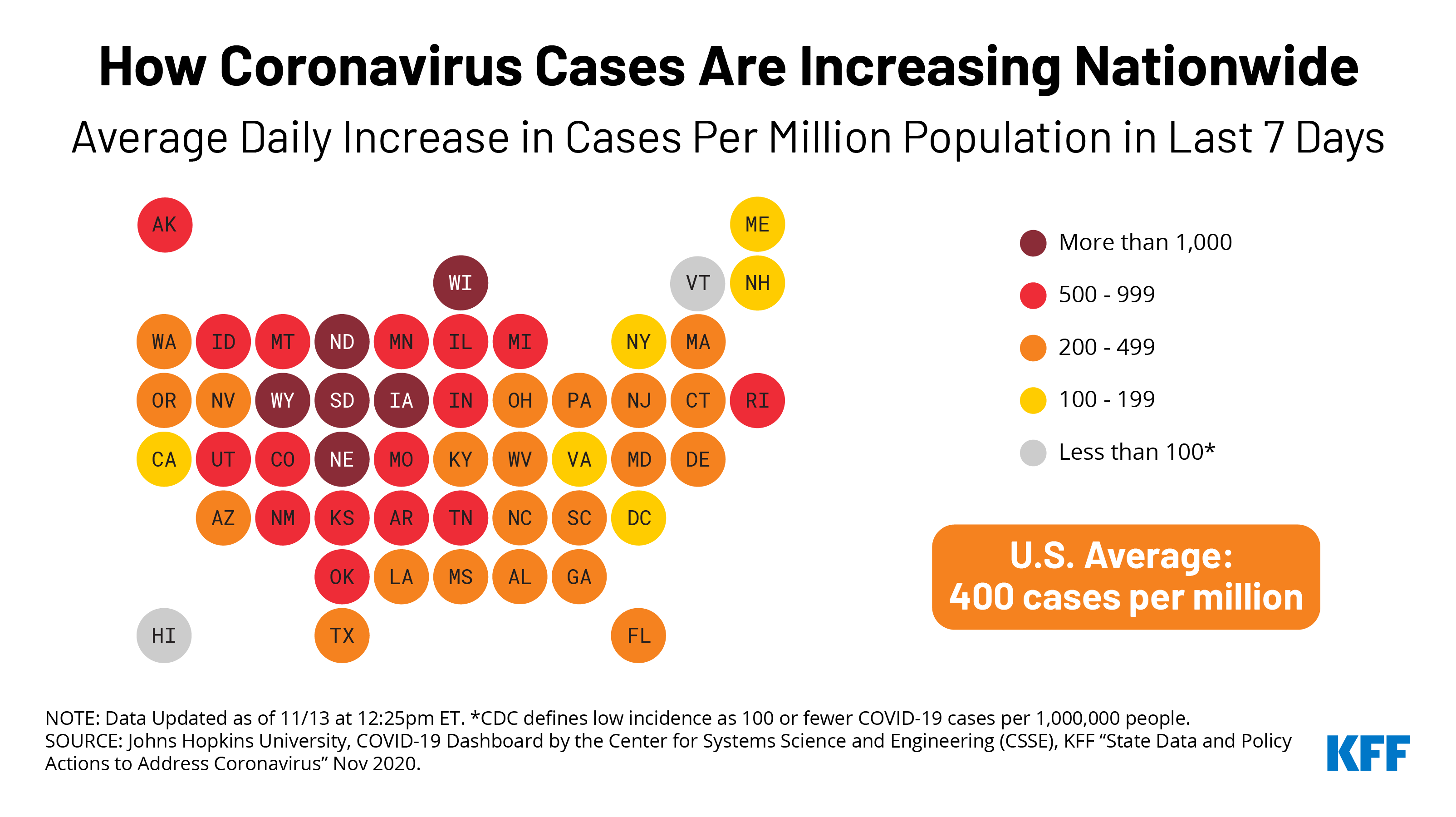
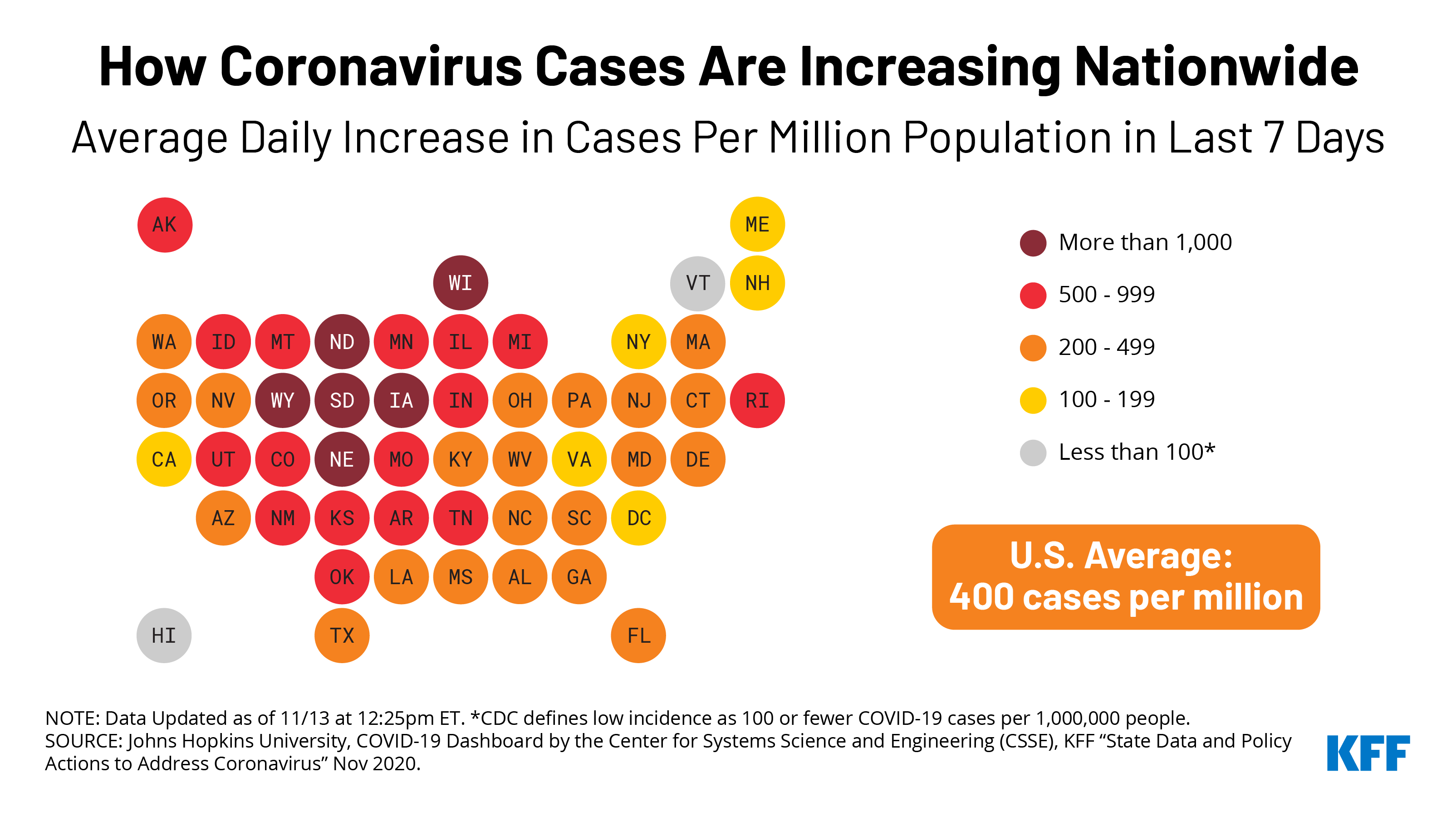
Coronavirus cases are once again surging in the United States, fueled by colder weather driving people indoors and relaxing of social distancing restrictions over the summer by state and local officials. Cumulative cases have topped 11 million and daily cases are escalating at levels not seen before. Currently, nearly all states and DC meet hotspot status—Hawaii is the only state where cases appear to have stabilized. Nearly 80,000 people are hospitalized nationally, more than at any point since the pandemic first hit. As hospitals fill up, the strain on the health care system is evident. Facing shortages of beds, staff, and supplies, hospitals and the entire health care system risk being overwhelmed unless action is taken to curtail the spread of the virus.

Without clear federal guidance and mixed message at times, critical decisions about imposing measures to slow the increase in cases, which have been mired in partisan politics, continue to fall to the states. Moreover, much has changed since state lockdowns were first imposed in the early days of the pandemic. On the one hand, we know more about how the coronavirus spreads and can target interventions more effectively. On the other hand, growing fatigue with social distancing measures and outright resistance from certain segments of the population, economic concerns related to even short-term business closures without federal financial relief, and limits placed on executive branch authority by some state legislatures and courts all pose new challenges for Governors.

Yet, despite these challenges and the politicization of COVID-19 related actions, 31 states have imposed new restrictions since the beginning of November.  The states span the ideological divide—13 are led by Republican governors while 18 are headed by Democrats.

While these recent actions are important and an acknowledgement of how dire the current situation is, state responses vary widely and, in many cases, may not be enough to stop the virus’ spread. In lieu of stay at home orders similar to what were adopted in March and April, states are focusing on a few key areas—face mask requirements, limits on large gatherings, and limits on restaurants and bars.

  • Universal face masking is recommended for preventing SARS-COV-2 transmission, yet decisions about mask mandates have been fraught with political and legal challenges. Still, after significant resistance among many states to implement such mandates, 38 states have done so, including Iowa, North Dakota and Utah in just the past two weeks (Table 1). Still, there are 13 states, several of which—Nebraska, South Dakota, and Wyoming—are at the epicenter of the current outbreak, that do not mandate mask wearing in public.
  • States are tightening limits on social gatherings in line with CDC recommendations on holiday gatherings. With the new restrictions, 17 states limit indoor gatherings to no more than 10 people and six effectively prohibit them altogether. Another eight states allow gatherings of up to 25 people. But that means 20 states either do not limit the size of gatherings or allow gatherings of up to 50 people.
  • Restaurants and bars are another source of COVID-19 spread. Here again, states are taking different approaches to limiting the public’s exposure. Seven states have recently closed restaurants to indoor or all in-person dining while 20 allow indoor dining but impose capacity limits. States have been more willing to close bars—16 states have closed bars to indoor service. However, 15 states continue to have no restrictions on restaurants and 13 do not restrict service at bars.
  • Several states have also adopted “curfews,” closing restaurants and bars, and in some cases, other businesses, at certain hours in the hopes of curtailing exposure by limiting socializing, especially with alcohol. So far, 17 states require restaurants to close or stop serving alcohol at a certain time and 12 states require the same for bars. Two states are imposing broader curfews from 10 pm to 5 am, statewide in Ohio and in “purple” counties in California (currently 41 of 58 counties). However, it is not clear that these measures will have any significant effect on limiting the spread of the virus.

Recent state actions, even in the midst of an election season and the political polarization of COVID-19 that has occurred, signal how urgent the situation is becoming. Just in the last two weeks, 31 states have issued new restrictions, and more are expected to do so soon.  With the holiday season just ahead and winter upon us, it remains to be seen whether these measures will be enough, particularly if some states, including those with surges, choose not to issue social distancing measures.

Table 1: State Policy Actions on Social Distancing Measures
StateNew Restrictions Imposed Since Beginning of NovemberFace Covering RequirementLimits on Indoor GatheringsLimits on RestaurantsLimits on BarsLimits on Retail and Other Businesses
AlabamaNoRequired for General PublicNoneOpen–No LimitsOpen–No LimitsOpen–No Limits
AlaskaNoRequired for Certain EmployeesNoneOpen–No LimitsOpen–No LimitsOpen–No Limits
ArizonaNoRequired for Certain Employees; Allows Local Officials to Require for General Public50 PeopleOpen at 50% Capacity; Closed in Counties with Substantial COVID-19 SpreadOpen at 50% Capacity, Closed in Counties with Substantial COVID-19 SpreadRetail and personal care open; gyms open at 25% capacity
ArkansasYesRequired for General PublicNoneOpen; Cannot serve alcohol after 11 pmOpen; Cannot serve alcohol after 11 pmOpen–No Limits
CaliforniaAutomatic based on metricsRequired for General PublicAll Gatherings Prohibited in Most CountiesClosed to Indoor Service in Most CountiesClosed in Most CountiesRetail open at 25% capacity for counties in Tier 1; personal care open with limits
ColoradoAutomatic based on metricsRequired for General Public10 People in Most CountiesOpen at 50% Capacity; Closed in Counties with Substantial COVID-19 SpreadClosed in All but One CountyRetail open at 50% capacity; personal care and gyms open at 25% capacity in most counties
ConnecticutYesRequired for General Public10 People in Homes/Up to 25 People in Venues Outside of HomesOpen at 50% Capacity; Must close dine-in service from 10 pm to 5 amClosedRetail and gyms open at 50% capacity; personal care services open at 75% capacity
DelawareYesRequired for General Public10 People in Homes/Up to 50 People in Venues Outside of HomesOpen at 30% CapacityOpen at 30% CapacityRetail open at 60% capacity; gyms and personal care services open at 30% capacity
District of ColumbiaNoRequired for General Public50 PeopleOpen at 50% CapacityClosedRetail open at 50% capacity; gyms open with 5 people per 1,000 square feet; personal care open by appointment only
FloridaNoRequired for Certain EmployeesNoneOpen–No LimitsOpen–No LimitsOpen–No Limits
GeorgiaNoRequired for Certain Employees; Allows Local Officials to Require for General Public50 PeopleOpen–No LimitsOpen at 35% CapacityOpen–No Limits
HawaiiNoRequired for General Public10 PeopleOpen at 50% Capacity; Cannot serve alcohol after 10 pmOpen at 50% Capacity, Cannot serve alcohol after 10 pmRetail and personal care open at 50% capacity; gyms open at 25% capacity
IdahoYesRequired for Certain Employees10 PeopleOpen–No LimitsOpen–No LimitsOpen–No Limits
IllinoisYesRequired for General PublicGatherings of more than one household are prohibitedClosed to Indoor ServiceClosed to Indoor ServiceRetail, gyms, and personal care open at 25% capacity
IndianaYesRequired for General Public25 PeopleOpen at 75% CapacityOpen at 75% CapacityOpen–No Limits
IowaYesRequired for General Public15 PeopleOpen; No service after 10 pmOpen; No service after 10 pmOpen–No Limits
KansasNoRequired for General PublicNoneOpen–No LimitsOpen–No LimitsOpen–No Limits
KentuckyYesRequired for General Public8 PeopleClosed to Indoor ServiceClosed to Indoor ServiceRetail and personal care open at 50% capacity; gyms open at 33% capacity
LouisianaNoRequired for General Public50% of Venue Capacity up to 250 PeopleOpen at 50% CapacityClosed to Indoor ServiceRetail, gyms, and personal care open at 50% capacity
MaineYesRequired for General Public50 PeopleOpen at 50% Capacity; Must close at 9 pmClosedRetail 5 people per 1000 sq. ft; gyms 50 people; personal care open at 50% capacity
MarylandYesRequired for General PublicNoneOpen at 50% Capacity; Must close from 10 pm to 6 amOpen at 50% Capacity; Must close from 10 pm to 6 amRetail, gyms, and personal care open at 50% capacity
MassachusettsYesRequired for General Public10 PeopleOpen; Must close indoor dining at 9 pmClosedAll non-essential businesses must close from 9:30 pm to 5 am; gyms open at 40% capacity
MichiganYesRequired for General Public10 PeopleClosed to Indoor ServiceClosed to Indoor ServiceRetail open at 30% capacity; gyms open at 25% capacity; personal care open by appointment only
MinnesotaYesRequired for General PublicAll Gatherings ProhbitedOpen at 50% Capacity; Must close from 10 pm to 4 amOpen at 50% Capacity; Must close from 10 pm to 4 amRetail, personal care open; gyms closed
MississippiNoRequired for Certain Employees20 PeopleOpen at 75% Capacity; Cannot serve alcohol after 11 pmOpen at 75% Capacity; Cannot serve alcohol after 11 pmOpen–No Limits
MissouriNoNoneOpen–No LimitsOpen–No LimitsOpen–No Limits
MontanaYesRequired for General Public25 PeopleOpen at 50% Capacity; Must close dine-in service at 10 pmOpen at 50% Capacity; Must close dine-in service at 10 pmRetail and personal care open; gyms open at 75% capacity
NebraskaYesRequired for Certain Employees25% of Venue CapacityOpen–No LimitsOpen–No LimitsOpen–No Limits
NevadaNoRequired for General Public10 PeopleOpen at 50% CapacityOpen at 50% CapacityRetail and gyms open at 50% capacity; personal care services open
New HampshireNoRequired for General PublicNoneOpen–No LimitsOpen–No LimitsRetail and gyms open at 50% capacity; personal care services open by appointment only
New JerseyYesRequired for General Public10 PeopleOpen at 25% CapacityClosedRetail open at 50% capacity; gyms open at 25% capacity; personal care  open by appointment only
New MexicoYesRequired for General Public5 PeopleClosed, except  Takeout/DeliveryClosedClosed except for curbside services and delivery*
New YorkYesRequired for General Public10 PeopleOpen at 50% Capacity; Must close dine-in service from 10 pm to 5 amOpen at 50% Capacity; Must close at 10 pmRetail open; Personal care services open at 50% capacity; gyms open at 33% capacity, must close at 10 pm
North CarolinaYesRequired for General Public10 PeopleOpen at 50% CapacityOpen at 30% Capacity; Outdoor service onlyRetail and personal care open at 50% capacity; gyms open at 30% capacity
North DakotaYesRequired for General Public50 PeopleOpen at 50% Capacity; Must close dine-in service from 10 pm to 4 amOpen at 50% Capacity; Must close dine-in service at 10 pmAll open at 25% capacity
OhioYesRequired for General Public10 People; All Gatherings Prohibited After 10 pmOpen; Must close to dine-in service from 10 pm to 5 amOpen; Must close to dine-in service from 10 pm to 5 amOpen–No Limits
OklahomaYesNoneOpen; Must close dine-in service from 11 pm to 5 amOpen; Must close to dine-in service from 11 pm to 8 amOpen–No Limits
OregonYesRequired for General Public6 PeopleClosed, except  Takeout/DeliveryClosedRetail open at 75% capacity; personal care services open by appointment only; gyms closed
PennsylvaniaNoRequired for General Public25 PeopleOpen at 25% CapacityOpen at 25% CapacityRetail open at 75% capacity; gyms and personal care services open at 50% capacity
Rhode IslandYesRequired for General PublicLimited to one household in Homes/Up to 25 People in Venues Outside of HomesOpen at 33% Capacity; Must close dine-in service at 10 pm weekdays/10:30 pm weekendsClosedRetail and personal care limited to 1 patron per 100 square feet; Must close at 10 pm weekdays/10:30 pm weekends; gyms closed
South CarolinaNoAllows Local Officials to Require for General PublicNoneOpen–No LimitsOpen–No LimitsOpen–No Limits
South DakotaNoNoneOpen–No LimitsOpen–No LimitsOpen–No Limits
TennesseeNoAllows Local Officials to Require for General PublicNoneOpen–No LimitsOpen–No LimitsOpen–No Limits
TexasNoRequired for General Public10 PeopleOpen–No LimitsOpen at 50% CapacityAll open at 75% capacity in areas with low hospitalizations. Limited to 50% capacity in areas with high hospitalizations
UtahYesRequired for General PublicAll Gatherings Prohibited Unless Held at a Business or Has an Event HostOpen; Cannot serve alcohol after 10 pmOpen; Cannot serve alcohol after 10 pmOpen–No Limits
VermontYesRequired for General PublicAll Gatherings Are ProhibitedOpen; Must close dine-in service at 10 pmClosedRetail open at 50% capacity; gyms and personal care services open at 25% capacity
VirginiaYesRequired for General Public25 PeopleOpen; Cannot serve alcohol after 10 pm and must close by 12amClosedNon-essential retail limited to 10 people per establishment; personal care services open; gyms open at 75% capacity or 25 people
WashingtonYesRequired for General PublicAll Gatherings Are ProhibitedClosed to Indoor ServiceClosedRetail and personal care services open at 25% capacity; gyms open outdoors only to 5 participants or fewer
West VirginiaNoRequired for General Public25 PeopleOpen at 50% CapacityOpen at 50% CapacityRetail open; gyms open at 40% capacity; personal care services limited to 10 person capacity
WisconsinNoRequired for General PublicNoneOpen–No LimitsOpen–No LimitsOpen–No Limits
WyomingYesAllows Local Officials to Require for General Public25 PeopleOpen–No LimitsOpen–No LimitsOpen–No Limits
NOTE: All states require physical distancing and other safety measures in businesses, including restaurants and bars.  * New Mexico has closed in-person services for all non-essential activities and issued a stay at home order.SOURCE: KFF review of state executive orders, guidance documents, policy bulletins, and news releases

Cost-Sharing Waivers and Premium Relief by Private Plans in Response to COVID-19 (Nov. 2020 Update)

Authors: Daniel McDermott and Cynthia Cox
Published: Nov 20, 2020

An updated issue brief estimates the number of enrollees in individual and fully-insured group market plans that have waived cost-sharing – out-of-pocket costs including coinsurance, copayments, and deductibles – for COVID-19 treatment. The analysis also estimates the number of enrollees whose insurer is offering various forms of premium payment relief.

The updated analysis finds that, as of November 2020, about half (49%) of fully-insured plan enrollees have coverage that waives cost-sharing for COVID-19 treatment through the end of the year. Additionally, 40% of individual market and fully-insured group market enrollees were in plans offering some form of premium relief during the pandemic. It remains unclear, however, how much longer insurers will continue to voluntarily offer premium relief and waive cost-sharing.

A previous version of this analysis was released in August 2020.

The brief can be found on the Peterson-KFF Health System Tracker, an online information hub dedicated to monitoring and assessing the performance of the U.S. health system.

News Release

What Do State Plans Reveal About Their Readiness to Distribute COVID-19 Vaccines? 

Published: Nov 18, 2020

With hopes that a COVID-19 vaccine or vaccines will be proven safe and effective soon, state and local public health authorities will play a critical role in ensuring the efficient distribution and administration of the vaccine.

To assess the readiness of these local governments to take on these responsibilities, KFF reviewed the preliminary vaccine distribution plans submitted to the U.S. Centers for Disease Control and Prevention last month by the states and the District of Columbia. These initial plans will be revised based on additional information and federal guidance.

The plans reveal that states are in varying stages of preparations, with some working on the issues for several months and others beginning more recently. Key findings include:

  • Defining exactly who will get the vaccine first is a critical task for states. The preliminary plans reveal that less than half of state plans contain an estimate for the number of people considered high priority to receive the vaccine. In every state, these high-priority groups include health care workers, essential workers, older residents and others with health conditions that put them at high risk if they were to contract COVID-19. States will need to know which vaccine or vaccines they are dealing with to finalize these plans.
  • All states will need to expand the number of providers and locations where people can get the vaccine, but most states are just beginning this process.
  • While Black and Hispanic people have been disproportionately affected by COVID-19, fewer than half of state plans include any details about their communication plans to reach racial and ethnic minority populations in their states with vaccination information.

“Our review shows that states are all over the map in terms of their readiness to handle vaccine distribution and even less prepared to mount the large-scale outreach efforts required to address vaccine hesitancy,” KFF President and CEO Drew Altman said. “There is time to provide the resources and guidance they need, but not a lot of time.”

Looking ahead, President-elect Joe Biden’s campaign and transition team have planned for a more prominent role for the federal government. This could result in more detailed federal guidance and a stronger federal hand in vaccine distribution, planning and implementation in the coming months, even as state and local jurisdictions will remain responsible for much of this effort.

A separate new KFF brief examines how various government programs and private insurers cover and pay for vaccines now, including specific policies for COVID-19 vaccines.

Vaccine Coverage, Pricing, and Reimbursement in the U.S.

Authors: Karyn Schwartz, Meredith Freed, Juliette Cubanski, Rachel Dolan, Karen Pollitz, Josh Michaud, Jennifer Kates, and Tricia Neuman
Published: Nov 18, 2020

Issue Brief

Several COVID-19 vaccines are now in phase 3 trials, and $10 billion in government money has been invested in the research, development, manufacturing, and distribution of vaccines. As part of this effort, the federal government has paid in advance for hundreds of millions of doses of multiple COVID-19 vaccines and, in some cases, has the option to purchase more. These government-purchased doses will be distributed for free to providers who will then administer the vaccine(s) under the Centers for Disease Control and Prevention’s (CDC) COVID-19 Vaccination Program.1  Once distributed, individuals will be able to get COVID-19 vaccine(s) without having to pay any cost sharing, due, in part, to changes made by Congress and CMS to the laws and regulations that typically govern insurance coverage for vaccines. The laws and regulations in place for other vaccines vary by program and type of insurance coverage—with some people qualifying for all CDC recommended vaccines without cost sharing, while others may either face cost sharing or gaps in coverage. As part of any campaign to encourage COVID-19 vaccinations, it will be important to make sure patients realize that access and affordability challenges they may have faced for other vaccines should not be a problem for the COVID-19 vaccine.

This brief explains how vaccines are covered and paid for through government programs and different types of insurance, including information on specific policies put into place for a COVID-19 vaccine. We describe vaccine coverage, patient cost sharing, and pricing in Medicare; private health insurance; the Vaccines for Children Program (VFC); Medicaid; Section 317 of the Public Health Services Act, which is the federal program that provides vaccines for uninsured adults; and the Department of Veterans Affairs (VA). Our brief also includes background information on how the CDC develops vaccine recommendations, since many of the federal vaccine coverage requirements currently in place are tied to those recommendations. The brief also includes three tables. Table 1 provides the price per regimen of vaccines that the U.S. government has already purchased. Table 2 summarizes how vaccine prices are set in each program or type of insurance, and Table 3 compares vaccine list prices with prices paid by Vaccines for Children program and Section 317, the Veterans Administration, as well as prices paid by Medicare Part B and Medicare Part D (not accounting for rebates).

Box 1: Background on CDC’s Vaccine Recommendations

Both childhood and adult vaccines play a key role in public health both by preventing individuals from becoming sick and, for some vaccines, by protecting the larger community through generating population immunity. The CDC, the federal government’s public health agency, plays a large role in making vaccine recommendations for children and adults that then influence insurance coverage for vaccines along with other public health requirements, such as local school vaccine requirements.

The CDC’s Advisory Committee on Immunization Practices (ACIP) is a federal advisory committee that develops recommendations on how to use vaccines to control disease in the United States, taking into account “consideration of disease epidemiology and burden of disease, vaccine safety, vaccine efficacy and effectiveness, the quality of evidence reviewed, economic analyses, and implementation issues.” ACIP’s recommendations are reviewed by the CDC Director and, if adopted, are published as official CDC/Department of Health and Human Services recommendations in the Morbidity and Mortality Weekly Report (MMWR). Statutory requirements for vaccine coverage are often tied to ACIP’s recommendations.

ACIP makes vaccine recommendations for both children and adults. In cases where multiple manufacturers make a vaccine for a given disease, ACIP typically does not recommend one manufacturer’s vaccine over another, but there are exceptions. For example, the recombinant zoster vaccine (sold under the brand name Shingrix) was recommended preferentially over the zoster vaccine live (sold under the brand name Zostavax).

Medicare

Medicare covers vaccines for more than 60 million people ages 65 and older and younger adults with long-term disabilities under both Part B (which covers primarily outpatient care, including injected or infused drugs delivered in physician offices) and Part D (which covers retail prescription drugs). This separation of coverage for vaccines under Medicare is due to the fact that there were statutory requirements for coverage of a small number of vaccines under Part B before the 2006 start of the of the Part D benefit, which is delivered through prescription drug plans that contract with Medicare. Vaccines previously covered under Part B remain covered through that part of Medicare, while others are covered under Part D.

Vaccines for influenza, pneumococcal disease, and hepatitis B (for patients at high or intermediate risk), and vaccines needed to treat an injury or exposure to disease are covered under Part B. All other commercially available vaccines needed to prevent illness are covered under Medicare Part D. Vaccine pricing, provider reimbursement, and patient out-of-pocket costs vary under both parts of Medicare.

Cost to patients

For the influenza, pneumococcal pneumonia, and hepatitis B vaccines covered under Medicare Part B, patients currently face no cost sharing for either the vaccine itself or its administration. For other Part B covered drugs and services, Medicare covers 80% of the cost, and beneficiaries are responsible for the remaining 20%. Cost sharing for the COVID-19 vaccine is discussed below. The majority of beneficiaries in traditional Medicare have supplemental insurance—such as Medigap, employer sponsored coverage, or Medicaid—that covers some or all of the coinsurance, but 6 million beneficiaries do not have supplemental insurance to cover these costs. The 24 million beneficiaries enrolled in Medicare Advantage plans are also responsible for cost-sharing requirements, which vary across plans.

As mentioned above, all commercially available vaccines that are not covered under Part B are required to be covered under Part D. Unlike Part B, Part D plans have flexibility to determine how much enrollees will be required to pay for any given on-formulary drug, including vaccines. (Part D enrollees who receive low-income subsidies (LIS) generally pay relatively low amounts for vaccines and other covered drugs.) For example, in 2018, average cost sharing by non-LIS enrollees for a dose of Shingrix, the shingles vaccine, was $57, while average cost sharing for Adacel (Tdap) was $24. Under Part D, cost sharing can take the form of flat dollar copayments or coinsurance (i.e., a percentage of list price). Patients do not pay separate cost-sharing amounts for the vaccine and its administration.

Vaccine price

For the influenza and pneumococcal vaccines covered under Part B, Medicare reimbursement is set at 95% of the Average Wholesale Price (AWP), except when furnished in a hospital outpatient setting, in which case reimbursement is based on reasonable cost. Medicare publishes an annual list of payment allowance limits for the influenza vaccines available in a given season. AWP is a publicly available, suggested price for sales of a drug by a wholesaler to a pharmacy or other provider. It is akin to a sticker price and used as a starting point for negotiation for payments to retail pharmacies. For other Part B covered drugs, reimbursement is 106% of the Average Sales Price (ASP). ASP is the average price to all non-federal purchasers in the United States and includes volume discounts, prompt pay discounts, cash discounts, free goods that are contingent on any purchase requirement, chargebacks (other than chargebacks for 340B discounts), and rebates (other than rebates under the Medicaid drug rebate program). The discounts and rebates factored into ASP are not accounted for in AWP.

Because the Part D benefit is administered by private drug plans, which are sponsored by private insurers and pharmacy benefit managers (PBMs), vaccine pricing and reimbursement will vary depending on negotiations between manufacturers and plans. This can lead to different prices paid for the same vaccine by different Part D plan sponsors, and different cost sharing among enrollees across Part D plans for the same vaccine. The size of rebates paid by manufacturers to PBMs and plans will depend in part on the competitive dynamics for each vaccine and how price sensitive patients are to higher out-of-pocket costs if a vaccine is placed on a higher tier.

COVID-19 vaccine requirements

Under the CARES Act and an accompanying interim final rule2 , Medicare beneficiaries will have coverage for COVID-19 vaccines through Medicare Part B with no cost sharing (rather than the typical 20% coinsurance). This coverage applies whether the vaccine receives FDA authorization through an Emergency Use Authorization (EUA) or is licensed under a Biologics License Application (BLA). Covering a COVID-19 vaccine under Part B rather than Part D will ensure broader coverage for the vaccine under Medicare since not all beneficiaries are enrolled in a Part D plan.

While Medicare will not pay for the initial doses of the COVID-19 vaccine already purchased by the government, if eventually the vaccine is reimbursed by Medicare, it will be reimbursed at 95% of AWP.3  That is the same formula used for influenza and pneumococcal vaccines.

Private Health Insurance

About 55% of people in the U.S. have private health insurance, and the vast majority of them are covered through employer-sponsored insurance. All non-grandfathered employer-sponsored health plans and individually purchased insurance from the Marketplaces are subject to certain coverage requirements and standards included in the Affordable Care Act (ACA). ACA-compliant individual coverage purchased off the marketplaces are subject to those requirements as well. However, the Trump Administration has expanded access to short-term plans, which are not subject to any federal coverage standards.

Cost to patients

Individual and employer-sponsored private health plans subject to the ACA’s preventive services coverage standards must provide coverage for individuals to receive vaccines that ACIP recommends without cost sharing. When a new vaccine is added to ACIP’s recommendations, plans must update their coverage once a new plan year starts following one year after the date when the CDC adopts that recommendation.4  Requirements specific to the COVID-19 vaccine are described below. Coverage for recommended vaccines is provided without cost sharing even for beneficiaries who have not reached their deductible. Short-term plans do not have to meet such standards and can require that beneficiaries pay cost sharing for vaccines or can exclude recommended vaccines from coverage altogether.

Vaccine price

There are no federal limits or rules regarding the price of vaccines or other prescription drugs in the private market. However, the inclusion of economic analysis in the development of ACIP recommendations may help to tamp down on prices for vaccines as compared to other medicines where there is no equivalent federal use of such analysis.

As with other medicines, rebates and other price concessions from drug manufacturers lower the net price of vaccines in many cases, although the size of those price concessions vary based on the competitive dynamics for each pharmaceutical product, along with other factors. Rebates and other price concessions are not made public, so we do not have data on the size of rebates for vaccines, how much the prices private plans pay for vaccines and how the prices vary from the list prices included in Table 3. It is possible that requirements for plans to cover vaccines without cost sharing may limit their ability to negotiate large rebates for vaccines.

COVID-19 vaccine requirements

The CARES Act requires that employer-sponsored and individual health plans subject to the ACA’s preventive services standards cover a coronavirus vaccine without cost sharing 15 days after it is recommended by ACIP.5  This will ensure that a coronavirus vaccine is covered by private insurance more quickly than the longer timeframe typically required for private health plans to incorporate a new ACIP recommendation. The guarantee is tied to the ACA provision requiring private insurers to cover vaccines, so it could be voided if the Supreme Court overturns the ACA.

During the public health emergency, private health insurance plans will be required to cover all the costs of a COVID-19 vaccine even if an out-of-network provider administers it.6  The Trump Administration’s interim final rule states that Medicare’s payment rate will be considered a reasonable rate for coronavirus preventive services, including administration of a COVID-19 vaccine.7  Additionally, vaccine providers may not seek any reimbursement, including through balance billing, from a vaccine recipient.8 

Vaccines for Children Program

The Vaccines for Children (VFC) program is a federal entitlement for eligible children created by Congress in 1993 in response to a measles outbreak that extended from 1989 through 1991. In 2020, the program had a budget of about $4.8 billion. Under this program, the CDC purchases vaccines directly from manufacturers and distributes them to grantees (i.e. state health departments and some local health agencies). Those partners then distribute the vaccines at no charge to private physicians’ offices and public health clinics registered as VFC providers. Vaccines recommended by ACIP are included in the VFC program. More than half of young children and one-third of adolescents in the United States are eligible to receive vaccinations through this program.9 

Children under age 19 are eligible for the VFC program if they are Medicaid-eligible, uninsured, or American Indian or Alaska Native. Children can also qualify if their insurance has a cap on vaccine coverage that the child has surpassed or if their insurance does not cover all or certain vaccines.10  Those types of limitations on vaccine coverage are not permitted under standards established by the ACA,11  but some grandfathered plans or short-term plans may include these limitations on vaccine coverage.

Cost to patients

Children get vaccines for free through the VFC program, but participating health care providers can charge for other services including administering vaccines and office visits. The fees for vaccine administration are limited by regulation, and children cannot be denied a vaccine because they cannot afford the administration fee itself, but the VFC program allows providers to refuse to see qualifying children if the provider will not be paid for the office visit. For children with Medicaid, the office visit and vaccine administration are covered by Medicaid with no cost sharing.12  Children who are uninsured may be eligible for free or reduced cost office visits and vaccine administration through a community health center. Additional cost sharing protections for the COVID-19 vaccine are discussed below.

Vaccine price

The Secretary of the Department of Health and Human Services (HHS) is authorized by statute to negotiate a discounted price for vaccines purchased under the VFC program.13  There is also an inflation-adjusted price cap for vaccines that were available in 1993 but no cap for newer vaccines. States can purchase additional vaccines at the VFC price for children who are not eligible for the program. Table 3 compares VFC prices for vaccines to the list prices and the prices paid by other federal programs. On average, the price the CDC pays for vaccines purchased through the VFC program is about 30% less than the list price. The level of discount off of the list price varies substantially and ranges from 15% below list price to 72% below list price.

When there are multiple manufacturers of a vaccine, the Secretary of HHS is authorized to contract with more than one manufacturer. This can help avoid shortages if one provider experiences problems in the supply chain. To help ensure sufficient supply, the statute also requires the Secretary to purchase six months of additional vaccine supply beyond what would otherwise be required.14 

COVID-19 vaccine requirements

The CDC will determine if COVID-19 vaccine(s) will be included in the VFC program.15  If they are included, then Medicaid will cover the administration fee for Medicaid-eligible children.16  COVID-19 vaccine administration costs for uninsured children can be reimbursed using the $175 billion provider relief fund created by the CARES Act, which the Trump Administration has stated it will use to cover vaccine-related administration costs for people who are uninsured. As of November 10, 2020, about $30 billion remained in that fund. However, it is unclear how well that system will work given that there have been challenges with a similar system for reimbursing for treatment for uninsured COVID-19 patients. It also not clear when there will be a vaccine available to children. The Food and Drug Administration said on October 22 that they do not know yet if the vaccine candidate(s) authorized or approved will be recommended for children.

Medicaid and CHIP

Preliminary data for July 2020 show that Medicaid and CHIP provide health insurance coverage to 75.5 million low-income Americans. Medicaid coverage for vaccines varies based on age, eligibility pathway, and state. Vaccines are an optional benefit for certain adult populations, including low-income parent/caretakers, pregnant women, and persons who are eligible based on old age or a disability. For adults enrolled under the ACA’s Medicaid expansion and other populations for whom the state elects to provide an “alternative benefit plan,” their benefits are subject to certain requirements in the ACA, including coverage of ACIP-recommended vaccines with no cost sharing.17  There are separate coverage requirements for the COVID-19 vaccine during the time that states are receiving enhanced federal matching funds under the Families First Coronavirus Response Act, and those are discussed below.

All states provide some vaccine coverage for adults enrolled in Medicaid who are not covered as part of the ACA’s Medicaid expansion, but as of 2019, only about half of states covered all ACIP-recommended vaccines.18  The ACA provides an incentive to states to cover all recommended vaccines without cost sharing for adults by providing a 1 percent increase in a state’s Federal Medical Assistance Percentage (FMAP) for vaccine spending, and at least 12 states have implemented this option.19  States can choose to cover a vaccine as a pregnancy-related service only and not for other adults who do not receive an “alternative benefit plan.” Otherwise, states that choose to cover vaccines must provide that coverage for all low-income parent/caretakers, people eligible based on old age or disability, and pregnant women eligible for full state plan benefits.20 

Medicaid-eligible children under 19—including those covered under a Medicaid-expansion Children’s Health Insurance Program (CHIP) program—are covered under the Vaccines for Children Program, where they receive vaccinations at no cost. Children covered by separate CHIP programs are not covered by Vaccines for Children, but age-appropriate vaccines are a required CHIP benefit.21  States must purchase vaccines for these children using CHIP funds, not Vaccines for Children funding.22 ,23 

Cost to patients

Federal Medicaid rules allow states to impose nominal cost sharing, but only for specific populations, and providers cannot refuse to provide a vaccine to a patient if they cannot pay their share of costs.24  Adults in the Medicaid expansion population, and other populations for whom the state elects to provide an “alternative benefit plan,” must receive preventive vaccines with no cost sharing. Other Medicaid populations generally exempt from cost sharing include most children under 18, most pregnant women, most children in foster care, people in institutions with a share of cost, people in hospice, and people receiving Indian health care provider services; other adults may be subject to nominal charges at state option.25  Children under 19 covered by Medicaid or CHIP receive recommended vaccines without cost sharing, including the office visit and administration.26 ,27  Young adults covered by Medicaid aged 19-20 are eligible for the Early, Periodic, Screening, Diagnostic, and Treatment (EPSDT) benefit, which includes vaccine coverage, but they may face cost sharing at state option if they are not enrolled in an alternative benefit plan.

Vaccine price

Vaccines are excluded from the Medicaid Drug Rebate Program (MDRP). The MDRP requires Medicaid programs to cover all FDA-approved drugs from participating manufacturers in exchange for rebates to Medicaid to offset the cost of prescription drugs.28  The program ensures Medicaid pays among the lowest prices for drugs and provides access to medications for enrollees. Excluding vaccines from the MDRP has both cost and coverage implications, as states are not required to cover all vaccines and do not receive rebates, which are a significant offset to Medicaid pharmacy spending.

States reimburse providers for administering vaccines, and reimbursement varies widely across states. States generally set payment rates for provider reimbursement through fee schedules and have broad flexibility within federal guidelines to determine payment rates.29  Payment rates for vaccines provided through fee-for-service (FFS) Medicaid may differ from those provided through managed care.30 ,31  Most states’ FFS fee schedules make a payment for vaccine administration in addition to reimbursing for the vaccine, and some states may reimburse for an office visit fee.32  Due to this wide state variation, there is no one price paid by Medicaid; for example, one study found that, as of 2019, FFS reimbursement for an HPV vaccine ranged from $5.27 in Missouri to $491.38 in Mississippi.33  It also found that on average, Medicaid FFS reimbursed providers an amount greater than the price paid by the CDC for vaccines that it purchases and also sometimes greater than manufacturer list price of a vaccine: for example, median FFS reimbursement for Hepatitis B vaccines ranged from 188% to 251% of the price paid by the CDC for vaccines and from 113% to 153% of list price.34 

COVID-19 vaccine requirements

Under the Families First Coronavirus Response Act, coverage of testing and treatment for COVID-19, including vaccines, is required with no cost sharing in order for states to access temporary enhanced federal funding for Medicaid.35  All states have taken up this enhanced federal funding and are therefore subject to these requirements. Under these rules, states also must compensate Medicaid providers for an administration fee or office visit, even if the vaccine is provided free of charge.36  To receive enhanced federal funding, states must also provide continuous coverage for individuals enrolled as of March 18, 2020 through the end of the month in which the COVID-19 public health emergency ends. Recent CMS guidance has reinterpreted the continuous coverage requirement to allow some changes between eligibility categories, but beneficiaries may not lose access to COVID-19 testing and treatment services if this was included in their original coverage on or after March 18, 2020.37 

The enhanced federal funding and COVID-19 vaccine coverage requirements are tied to states’ receipt of enhanced federal matching funds during the COVID-19 Public Health Emergency (PHE) declaration and only last through the end of the quarter in which the PHE ends.38  This means requirements to cover a coronavirus vaccine at no cost to enrollees will expire if the PHE is not renewed. Regular Medicaid rules regarding coverage of and cost sharing for vaccines (described above) will apply after the end of the PHE. HHS could continue to extend the PHE or Congress could pass additional legislation extending maintenance of effort requirements for COVID-19 vaccine coverage and enhanced federal funding or otherwise addressing Medicaid COVID-19 vaccine coverage.

Section 317 of the Public Health Services Act: Vaccines for Uninsured Adults

There is no federal entitlement program for uninsured adults to receive free vaccines similar to the VFC program for children. However, the federal government purchases a limited number of vaccines directly for uninsured and other qualifying adults through funding that comes from Section 317 of the Public Health Services Act. Section 317 is also used to provide funding to support public health infrastructure in the United States at the federal and state and local levels, and more than three-quarters of the program’s total funding is used for that purpose. Section 317 is a discretionary program, and its total budget in 2020 was about $616 million.39  Some states supplement the federal funding they get from Section 317 with state funds in order to reach more people.

After the ACA was passed, the CDC updated the eligibility criteria for adults to get vaccines through Section 317.40  As of 2012, adults are eligible for vaccines through Section 317 if they are uninsured, do not have coverage for vaccines, or are being vaccinated as part of a public health response such as a mass vaccination campaign.41 

Cost to patients

Uninsured adults may be able to get free vaccines from their state or local health department or a community health center through Section 317. Because Section 317 is a discretionary program and its budget for each year is fixed, federal funding for vaccines for uninsured adults does not increase automatically if the number of uninsured increases or if the cost of vaccines increases. The limited amount of funding available for vaccines purchased through Section 317 may be one factor contributing to lower influenza vaccination rates for uninsured adults. While about 40% of adults 18-64 with private or public insurance got the flu vaccine in 2018, just 16% of uninsured adults did so.

Vaccine price

As under the VFC program, the CDC negotiates prices for vaccines purchased through Section 317. Table 3 lists the prices the CDC pays for vaccines for adults purchased through Section 317. On average, the CDC price is about 40% less than the list price. The level of discount off of the list price varies substantially and ranges from 24% below list price to 59% below list price. Local entities providing vaccines under Section 317 may also have other sources of funding they use to pay for vaccines for people who are uninsured and can purchase additional doses at the Section 317 price.42  They also may be able to obtain free or discounted vaccines from pharmaceutical manufacturers’ patient assistance programs.

COVID-19 vaccine requirements

Providers that participate in the CDC COVID-19 Vaccination Program contractually agree to administer a COVID-19 vaccine regardless of an individual’s ability to pay and regardless of their coverage status.43  This means that people who are uninsured should be able to get the COVID-19 vaccine from a wider range of providers than just those that participate in Section 317. Providers that administer the COVID-19 vaccine to the uninsured will be reimbursed for vaccine administration costs through the $175 billion provider relief fund created by the CARES Act. The Trump Administration recently clarified that this fund will also be used to reimburse providers for people who have limited Medicaid benefits that do not include vaccine coverage, such as individuals who only have coverage for COVID-19 testing, or family planning services and supplies.44  As of November 10, 2020, about $30 billion remained in the provider relief fund, and it is also being used to pay for COVID-19 treatment costs for people who are uninsured, as well as broader provider relief related to the pandemic. Once the government has distributed the initial doses of COVID-19 vaccine(s), more funding may be needed through Section 317 or other programs to ensure there are sufficient vaccine doses for everyone who is uninsured if the vaccine is needed on an ongoing basis.

Additional outreach from trusted sources may also be needed to reach people are uninsured since they are less likely to have a usual source of care than those who are insured. It will be important for people who are uninsured to understand both the importance of getting a vaccine once one is available to them and that the vaccine will be available at no cost to them. Many of the COVID-19 vaccines in clinical trials require two doses, which will increase the importance of appropriate education and outreach to people who are uninsured.

Department of Veterans Affairs

The Veterans Health Administration (VHA) of the Department of Veterans Affairs (VA) is an integrated health care delivery system serving qualifying veterans. The VHA estimates that in 2020 it will provide care to more than 6 million patients.45  Eligibility for health care through the VA is based primarily on veteran status from military service. Veterans generally must also meet minimum service requirements; however, exceptions are made for certain circumstances, including discharge due to service-connected disabilities.46 

Cost to patients

The VA health system does not charge cost sharing for preventive care, including vaccinations.47 

Vaccine price

In order to participate in Medicaid and Medicare Part B, drug manufacturers must sell their medicines at a discount to the VA, along with the other three of the “Big Four” government agencies (U.S. Department of Defense, U.S. Public Health Service, and U.S. Coast Guard). The VA is in some cases able to negotiate even steeper discounts in return for preferential placement on its drug formulary. The “Big Four” price is the lower of two prices determined by formula:

  • Federal Ceiling Price: A minimum 24% discount off the “non-Federal Average Manufacturer Price” (non-FAMP) plus additional discounts if non-FAMP rises faster than inflation. The non-FAMP is the average price paid to manufacturers by wholesalers for drugs distributed to non-federal purchasers. The price takes into account any price reductions given to wholesalers, but does not account for rebates to PBMs or other third parties. A statutory formula requires additional discounts, if necessary, to prevent the federal ceiling price from rising faster than the rate of inflation.
  • Federal Supply Schedule (FSS) Price: The VA negotiates FSS prices with manufacturers on the basis of the prices that manufacturers charge their most-favored commercial customers under similar terms and conditions. During multiyear contracts, the FSS price may not increase faster than inflation.

These statutory discounts result in an average discount of about 40% off of the list price, with discounts ranging from 24% to 63% (Table 3).

COVID-19 vaccine requirements

Under current regulations, the VA does not require cost sharing for “an outpatient visit solely consisting of preventive screening and vaccinations (e.g., influenza vaccination, pneumococcal vaccination).”48  There are currently no VA-specific requirements related to a COVID-19 vaccine.

Implications

The current focus on a COVID-19 vaccine has fueled interest in issues related to vaccine coverage, pricing and cost sharing. As described in this brief, vaccines for children and adults are provided through various programs and types of insurance, each with different rules for vaccines already on the market. This means that many changes to insurance requirements were needed in order to ensure access to a COVID-19 vaccine with no cost sharing once a vaccine is approved and available. For other vaccines, there are no universal standards to ensure that ACIP-recommended vaccines are available to everyone with no cost for either the vaccine or its administration.

There is also no one system for vaccine pricing. HHS negotiates the price of vaccines directly with manufacturers and purchases vaccines through the Vaccines for Children Program and Section 317. Other vaccine prices are largely set by a mix of statutory formulas, private negotiations, and state reimbursement decisions in the case of Medicaid.

The federal government has already paid for several hundred million doses of multiple COVID-19 vaccines through Operation Warp Speed, even before clinical trials have been completed. Under the terms of Operation Warp Speed, the federal government has the option to purchase hundreds of millions of additional doses. It remains unclear how many additional doses of COVID-19 vaccines may eventually be needed, by when, and how long immunity will last under a COVID-19 vaccine. If, in the future, the COVID-19 vaccine becomes a regular, annual vaccine, it is expected that it would eventually be covered through the same programs and types of insurance that are currently used to pay for other vaccines. If concerns arise about the eventual cost of COVID-19 vaccine(s) or other vaccines to federal and state governments and private payers, policymakers may look to rules that already govern vaccine pricing and reimbursement in different markets to leverage the government’s buying power.
Tables

Table 1: Estimated Price of Initial Doses of COVID-19 Vaccines Purchased by the U.S. Government
Company/CandidatePrice per Dose/RegimenAgreement AmountNumber of Doses Owned by Federal Government
AstraZeneca AZD1222Adenovirus-vector vaccine$8 for two-dose regimenUp to $1.2 billion300 milliona
Janssen (Johnson & Johnson)AD26.COV2.S Adenovirus-vector vaccine$10 for one dose regimen$1 billion100 million
Merck/IAVIbV591 Recombinant vesicular stomatitis virus (rVSV) vector vaccinen/a$38 millionNone reported
ModernamRNA-1273 RNA vaccine$30 for two-dose regimen$1.5 billion100 million
NovavaxNVX-CoV-2373 recombinant protein vaccine$32 for two-dose regimen$1.6 billion100 million
PfizerBNT162b2 RNA vaccine$39 for two-dose regimen$1.95 billion100 million
Sanofi/GlaxoSmithKlineRecombinant SARS-CoV-2 Protein Antigen + AS03 Adjuvant$20 for one dose, $40 for two dose regimenb$2 billion100 million
a.  The agreement between the federal government and AstraZeneca states that “at least 300 million doses will be made available” to the government with up to $1.2 billion in government support.b.  Sanofi/GlaxoSmithKline and Merck/IAVI vaccine trials are testing 1 and 2 dose regimens.Source: J. Kates and J. Michaud, “Distributing a COVID-19 Vaccine Across the U.S. – A Look at Key Issues,” KFF, Oct 20, 2020.
Table 2: Overview of How Vaccine Prices Are Set
Program or Type of CoverageSummary of how vaccines prices are set
MedicareFor the influenza and pneumococcal vaccines covered under Medicare Part B, reimbursement is set at 95% of average wholesale price. For vaccines covered by Medicare Part D, private Part D plans and pharmacy benefit managers can negotiate with manufacturers to get rebates and other price concessions to lower the net price of vaccines.
Private InsuranceHealth insurers and pharmacy benefit managers can try to negotiate with manufacturers to get rebates and other price concessions to lower the net price of vaccines.
Vaccines for ChildrenThe Secretary of HHS negotiates the price of vaccines and purchases doses that are then distributed across the country.
MedicaidStates set provider reimbursement for vaccines. Vaccines are not eligible for Medicaid rebates.
Section 317CDC negotiates the price of vaccines and purchases doses that are then distributed across the country.
VAAs with other prescription drugs, the VA receives a minimum discount that is set by law. The VA is allowed to try to negotiate deeper discounts with manufacturers.
Table 3: Vaccine Costs Across Key Federal Programs
VaccineBrand NameList Price / DoseCDC Adult Vaccine PriceVFC PriceVA Cost/ DoseMedicare Cost/ Dose
HibActHIB®$17N/A$10$7$35**
Tetanus Toxoid, Reduced Diphtheria Toxoid and Acellular PertussisAdacel®$47$25$33$25$57**
Influenza (Age 6 months and older)Afluria® Quadrivalent$17$12$12$12*$10-$21
MENB – Meningococcal Group BBexsero®$179$107$120$107$189**
Tetanus Toxoid, Reduced Diphtheria Toxoid and Acellular PertussisBoostrix®$42$25$33$25$60**
DTaPDaptacel®$32N/A$19$15$63**
Hepatitis B AdultEngerix B®$62$26N/A$37$70
Hepatitis B (Pediatric)Engerix B®$25N/A$15$13$28
Influenza (Age 6 months and older)Fluarix® Quadrivalent$17$12$14$13$20
Influenza (Age 4 years and older)Flucelvax® Quadrivalent$24$14$15$14*$28
Influenza (Age 6 months and older)FluLaval Quadrivalent$17$12$14$13$20
Influenza Live, Intranasal (Age 2-49 years)FluMist® Quadrivalent$24$16$19$17*$27
Influenza (Age 6 months and older)Fluzone® Quadrivalent$17$13$14$13$10-$21
HPV-Human Papillomavirus 9 ValentGardasil®9$228$141$187$141$241**
Hepatitis A AdultHavrix®$72$33N/A$36$84**
Hepatitis A (Pediatric)Havrix®$34N/A$21$20N/A
Hepatitis B AdultHeplisav-B™$121$73N/A$78$131
HibHiberix®$11N/A$9$8$18**
DTaPInfanrix®$25N/A$19$15$45**
e-IPVIPOL®$35N/A$14$19$56**
DTaP-IPVKinrix®$54N/A$42$29$78**
Meningococcal Conjugate (Groups A, C, Y and W-135)Menactra®$128$75$96$76$144**
Meningococcal Conjugate (Groups A, C, Y and W-135)Menveo®$135$70$96$70$131**
Measles, Mumps, & RubellaM-M-R®II$79$49$22$49$90**
DTaP-Hep B-IPVPediarix®$83N/A$61$46$103**
HibPedvaxHIB®$26N/A$14$19$49**
DTaP-IP-HIPentacel®$100N/A$62$46$100**
Pneumococcal Polysaccharide (23 Valent)Pneumovax®23$105$63$59$63$120
Pneumococcal 13-valentPrevnar 13™$202$132$144$132$230
MMR/Varicella [2]ProQuad®$225N/A$138$137$224**
DTaP-IPVQuadracel™$55N/A$42$29N/A
Hepatitis B AdultRecombivax HB®$61$25N/A$26$70
Hepatitis B (Pediatric)Recombivax HB®$24N/A$13$9$28
Rotavirus, Live, Oral, OralRotarix®$125N/A$98$70N/A
Rotavirus, Live, Oral, PentavalentRotaTeq®$85N/A$72$55N/A
Zoster Vaccine Recombinant, AdjuvantedShingrix®$151$102N/A$102$161**
Tetanus and Diphtheria ToxoidsTDVAX™$26$16$16$16*$39**
Tetanus and Diphtheria ToxoidsTenivac®$35N/A$21$16$50**
MENB – Meningococcal Group BTrumenba®$150$93$114$94$167**
Hepatitis A-Hepatitis B AdultTwinrix®$109$62$63$62$120**
Hepatitis A AdultVaqta®$70$33N/A$36$89**
Hepatitis A (Pediatric)Vaqta®$33N/A$21$18N/A
VaricellaVarivax®$136$82$109$82$142**
NOTES: VFC is Vaccines for Children.* is the listed price for the Federal Supply Schedule because no VA/Big Four price was listed.** is the listed price for drugs covered under Medicare Part D and does not account for rebates.The Part B prices for Engerix-B, Recombivax HB, and Prevnar 13 are listed because that vaccine is typically covered under Medicare B; although a relatively small number of beneficiaries do receive the vaccine through Part D because they do not meet the Part B coverage criteria.In general, Medicare vaccine pricing data does not distinguish between adult and pediatric versions of a vaccine.The list price per dose is the wholesale acquisition cost and sometimes also includes the federal excise tax, which is between $0.75 and $2.25. That price is taken from the CDC’s price list and is listed there as the “Private Sector Cost/ Dose.”For simplicity, in cases where two different versions of the same vaccine have prices that vary by $2 or less, we only display the lower price. These different prices are typically for different types of packaging for the same vaccine (for example: syringe vs vial).SOURCE: Medicare cost for vaccines covered through Medicare Part B are taken from the 2020 ASP file and Seasonal Influenza Vaccines Pricing List; Part D prices come from the 2018 Part D spending dashboard.CDC adult vaccine price and VFC price come from the CDC Vaccine Price List https://www.cdc.gov/vaccines/programs/vfc/awardees/vaccine-management/price-list/index.html.The list prices come from the CDC Vaccine Price List and are the “Private Sector Cost/Dose” https://www.cdc.gov/vaccines/programs/vfc/awardees/vaccine-management/price-list/index.html.The VA/Big Four and federal supply schedule prices are taken from the VA’s Office of Procurement, Acquisition and Logistics and are available here: https://www.va.gov/opal/nac/fss/pharmPrices.asp.


Endnotes

  1. 85 Fed. Reg. 71142, 71175 (Nov. 6, 2020). ↩︎
  2. H. R. 748 § 3713; 85 Fed. Reg. at 71146. ↩︎
  3. 85 Fed. Reg. at 71147. ↩︎
  4. 80 Fed. Reg. at 41322. ↩︎
  5. H.R. 748 § 3203. ↩︎
  6. 85 Fed. Reg. at 71175. ↩︎
  7. 85 Fed. Reg. at 71175. ↩︎
  8. 85 Fed. Reg. at 71175. ↩︎
  9. Department of Health and Human Services, “Putting America’s Health First: FY 2021 President’s Budget for HHS,” p. 46. Available at: https://www.hhs.gov/sites/default/files/fy-2021-budget-in-brief.pdf?language=en ↩︎
  10. Children whose health insurance covers the cost of vaccinations are not eligible for VFC vaccines, even if the vaccine is subject to the plan’s deductible. Underinsured children are eligible to receive vaccines only at Federally Qualified Health Centers or Rural Health Clinics. ↩︎
  11. 42 U.S.C. § 300gg-13. ↩︎
  12. Children enrolled in the Children’s Health Insurance Program through Medicaid expansion CHIP have the same coverage as other children with Medicaid. Children with separate CHIP coverage are considered to have private health insurance. A list of CHIP program names and the type of program in each state is available at https://modern.kff.org/other/state-indicator/chip-program-name-and-type/?currentTimeframe=0&sortModel=%7B%22colId%22:%22Location%22,%22sort%22:%22asc%22%7D. ↩︎
  13. 42 U.S.C. § 1396s (d)(3). ↩︎
  14. 42 U.S.C. § 1396s (d)(6). ↩︎
  15. 85 Fed. Reg. at 71149. ↩︎
  16. 85 Fed. Reg. at 71149. ↩︎
  17. 42 U.S.C. § § 1396a (k)(1); 1396u-7; 18022; 42 C.F.R. § 440.345 (d). ↩︎
  18. 24 of 39 states in a CDC study. Granade CJ, McCord RF, Bhatti AA, Lindley MC. State Policies on Access to Vaccination Services for Low-Income Adults. JAMA Netw Open. 2020;3(4):e203316. doi:10.1001/jamanetworkopen.2020.3316 ↩︎
  19. 12 of 44 states in a CDC study. Granade CJ, McCord RF, Bhatti AA, Lindley MC. State Policies on Access to Vaccination Services for Low-Income Adults. JAMA Netw Open. 2020;3(4):e203316. doi:10.1001/jamanetworkopen.2020.3316 ↩︎
  20. Additional Policy and Regulatory Revisions in Response to the COVID-19 Public Health Emergency, 85 Fed. Reg. 71142 (Nov. 6, 2020), https://www.federalregister.gov/documents/2020/11/06/2020-24332/additional-policy-and-regulatory-revisions-in-response-to-the-covid-19-public-health-emergency. ↩︎
  21. CMS has stated vaccines are optional for pregnant women covered by CHIP, though it notes that all states covering this population do provide vaccines. Additional Policy and Regulatory Revisions in Response to the COVID-19 Public Health Emergency, 85 Fed. Reg. 71142 (Nov. 6, 2020), https://www.federalregister.gov/documents/2020/11/06/2020-24332/additional-policy-and-regulatory-revisions-in-response-to-the-covid-19-public-health-emergency. ↩︎
  22. https://www.medicaid.gov/chip/benefits/index.html ↩︎
  23. https://www.medicaid.gov/sites/default/files/2019-11/chip-vaccines.pdf ↩︎
  24. 42 U.S.C. § § 1396a (a)(14); 1396o. ↩︎
  25. https://modern.kff.org/medicaid/issue-brief/data-note-medicaids-role-in-providing-access-to-preventive-care-for-adults/ and http://files.kff.org/attachment/preventive-services-covered-by-private-health-plans-under-the-affordable-care-act-fact-sheet ↩︎
  26. Medicaid-eligible children fall under VFC requirements. https://www.cms.gov/files/document/03052020-medicaid-covid-19-fact-sheet.pdf ↩︎
  27. For children with CHIP, well-child visits including immunizations must be covered without “deductibles, coinsurance, or other cost sharing” 42 U.S.C. § 1397cc (c), (e). ↩︎
  28. 42 U.S.C. § 1396r-8 (k)(2)-(4). ↩︎
  29. Pursuant to 42 U.S.C. § 1396a (a)(30)(A), state Medicaid programs must ensure that provider payments are “consistent with efficiency, economy, and quality of care and are sufficient to enlist enough providers. . . .” ↩︎
  30. Most states deliver services through capitated managed care, which means states make a set per member per month payment. https://modern.kff.org/medicaid/issue-brief/10-things-to-know-about-medicaid-managed-care/ ↩︎
  31. Payment rates are set differently for FFS Medicaid and for managed care Medicaid. See https://www.macpac.gov/medicaid-101/provider-payment-and-delivery-systems/ ↩︎
  32. 41 of 49 states make a payment under FFS Medicaid and the median payment is $13.62 Granade CJ, McCord RF, Bhatti AA, Lindley MC. State Policies on Access to Vaccination Services for Low-Income Adults. JAMA Netw Open. 2020;3(4):e203316. doi:10.1001/jamanetworkopen.2020.3316 ↩︎
  33. Granade CJ, McCord RF, Bhatti AA, Lindley MC. State Policies on Access to Vaccination Services for Low-Income Adults. JAMA Netw Open. 2020;3(4):e203316. doi:10.1001/jamanetworkopen.2020.3316 ↩︎
  34. Granade CJ, McCord RF, Bhatti AA, Lindley MC. State Policies on Access to Vaccination Services for Low-Income Adults. JAMA Netw Open. 2020;3(4):e203316. doi:10.1001/jamanetworkopen.2020.3316 ↩︎
  35. This requirement does not apply to populations with limited benefit packages, for example, family planning services, TB-related services and the new COVID-19 testing group. Instead, CMS directs providers to seek reimbursement through the HRSA Provider Relief Fund. See Additional Policy and Regulatory Revisions in Response to the COVID-19 Public Health Emergency, 85 Fed. Reg. 71142 (Nov. 6, 2020); https://www.federalregister.gov/documents/2020/11/06/2020-24332/additional-policy-and-regulatory-revisions-in-response-to-the-covid-19-public-health-emergency. ↩︎
  36. Additional Policy and Regulatory Revisions in Response to the COVID-19 Public Health Emergency, 85 Fed. Reg. 71142 (Nov. 6, 2020); https://www.federalregister.gov/documents/2020/11/06/2020-24332/additional-policy-and-regulatory-revisions-in-response-to-the-covid-19-public-health-emergency. ↩︎
  37. Ibid. ↩︎
  38. Enhanced federal funding and test/treatment requirements expire at the end of the quarter in which the PHE ends. See https://modern.kff.org/medicaid/issue-brief/medicaid-maintenance-of-eligibility-requirements-issues-to-watch-when-they-end/. ↩︎
  39. Department of Health and Human Services, “Fiscal Year 2021 Centers for Disease Control and Prevention Justification of Estimates for Appropriation Committees,” page 51. Available at: https://www.cdc.gov/budget/documents/fy2021/FY-2021-CDC-congressional-justification.pdf ↩︎
  40. Section 317 vaccines funds may be used for children in the following specific circumstances: to vaccinate newborns receiving the birth dose of hepatitis B prior to hospital discharge that are covered under bundled delivery or global delivery package (no routine services can be individually billed) that does not include hepatitis B vaccine and also fully insured infants of hepatitis B infected women. ↩︎
  41. Adults not covered for vaccines and therefore eligible for Section 317 vaccines includes adults on Medicaid who do not have coverage for specific vaccines and are eligible for those vaccines through Section 317; adults living in correctional facilities and jails and household or sexual contacts of a hepatitis B infected individuals are also eligible for vaccines through Section 317. ↩︎
  42. Institute of Medicine (US) Committee on the Immunization Finance Dissemination Workshops. Setting the Course: A Strategic Vision for Immunization: Part 2 Summary of the Austin Workshop. Washington (DC): National Academies Press (US); 2002. ↩︎
  43. 85 Fed. Reg. at 71175. ↩︎
  44. 85 Fed. Reg. at 71149. Limited Medicaid benefit packages that may not include vaccine coverage include pregnancy-related services only (in states where this benefit package is not considered minimum essential coverage); tuberculosis-related services only; family planning services only; medically needy services (in states where this benefit package is not considered minimum essential coverage); breast/cervical cancer services only; COVID-19 testing services only; and Section 1115 waivers that provide limited benefit packages such as those focused on the progression of a specific disease. ↩︎
  45. Congressional Research Service, “Health Care for Veterans: Answers to Frequently Asked Questions,” March 4, 2020. ↩︎
  46. Congressional Research Service, “Health Care for Veterans: Answers to Frequently Asked Questions,” March 4, 2020. ↩︎
  47. 38 C.F.R. § 17.108 (e)(11). ↩︎
  48. 38 C.F.R. § 17.108 (e)(11). ↩︎

States Are Getting Ready to Distribute COVID-19 Vaccines. What Do Their Plans Tell Us So Far?

Authors: Josh Michaud, Jennifer Kates, Rachel Dolan, and Jennifer Tolbert
Published: Nov 18, 2020

Issue Brief

Introduction

With the U.S. still in the midst of an escalating COVID-19 pandemic, attention to the race for a safe and effective COVID-19 vaccine has intensified. What is clear is that when vaccines do become available, ensuring equitable and rapid distribution to the U.S. population will present an unprecedented challenge. The Trump Administration, under Operation Warp Speed, has already purchased in advance hundreds of million doses of several vaccine candidates, two of which have already demonstrated significant efficacy in Phase 3 clinical trials, and has begun planning for what will be the largest scale vaccination distribution effort ever undertaken in the U.S. This task will soon be inherited by the incoming Biden Administration, which has established a COVID-19 Task Force and is already planning its response.

A limited number of COVID-19 vaccine doses may start to become available as early as December, with more doses available over time. State, territorial, and local governments, who already have primary authority over routine vaccination, will play an increasingly important role in the distribution of these vaccines as more doses become available. In preparation, the federal government has asked the 64 jurisdictional immunization programs (all 50 states and DC, 8 U.S. territories and freely associated Pacific states and five cities) that the Centers for Disease Control and Prevention (CDC) funds and works with to develop COVID-19 vaccine distribution plans based on an Interim Playbook. The Playbook includes planning assumptions for jurisdictions to follow and requested information in 15 key areas (see Box). First drafts of these plans were due by October 16.

CDC Interim Playbook Planning Assumptions and Key Areas of Information Requested from States for Vaccine Distribution Planning

In its Interim Playbook CDC provided states with a set of planning assumptions as they developed their vaccine distribution plans. For example, CDC outlined how vaccine distribution will likely proceed in phases:

  • Phase 1 – there is an initial limited supply of vaccine doses that will be prioritized for certain groups and distribution more tightly controlled and limited number of providers administering the vaccine;
  • Phase 2 – supply would increase and access expand to include a broader set of the population, with more providers involved, and;
  • Phase 3 – there would likely be sufficient supply to meet demand and distribution would be integrated into routine vaccination programs.

CDC requested each state outline its capacities for distributing COVID-19 vaccines across a broad set of 15 critical areas: public health preparedness planning; organizational structure; plans for a phased approach; identifying and reaching critical populations to be prioritized for vaccine access; identifying and recruiting providers to administer the vaccine; vaccine administration capacity; allocating, distributing, and managing its inventory of vaccines; storage and handling; collecting, tracking, and reporting key measures of progress; second dose reminders; immunization information system requirements; developing a comprehensive communications plan around vaccination; regulatory considerations; safety monitoring; and program monitoring.

CDC guidance and federal oversight could evolve over the next several months as vaccines become available and distribution begins. The Biden campaign and transition team have planned for a more prominent role for the federal government in the U.S. COVID-19 response, which would likely include more detailed federal guidance and a stronger federal hand in vaccine distribution, planning and implementation, even as state and local jurisdictions will remain responsible for much of this effort. A critical challenge facing vaccine distribution efforts will be funding. To date, only $200 million has been distributed to state, territorial, and local jurisdictions for vaccine preparedness, though it is estimated that at least $6-8 billion is needed. President-elect Biden has said his administration would seek to invest $25 billion in manufacturing and distribution, which would require Congressional action.

While the CDC has made executive summaries of these plans available, there is no central repository for the full plans. We therefore sought to collect plans available from all 50 states and DC, as of November 13, identifying 47 full state plans in total (linked in the “State Plans” tab). We then reviewed each plan to gauge how states described their vaccine distribution planning progress to date. Rather than assess every single component of these plans in detail we identified common themes and concerns across the state plans, in particular focusing on what states reported regarding their progress in the following key areas:

  • identifying priority populations for vaccination in their state;
  • identifying the network of providers in their state that will be responsible for administering vaccines;
  • developing the data collection and reporting systems needed to track vaccine distribution progress; and
  • laying out a communications strategy for the period before and during vaccination.

Where are States in their Planning?

Based on the information in their plans, states are in varying stages of preparation for distributing a COVID-19 vaccine. While all have established a task force or planning committee to steer these efforts, which include representatives from different sectors, some have been planning for several months while other states’ planning efforts have started more recently. Some states have already begun the process of signing up providers to administer COVID-19 vaccines and building out existing immunization registries, while others are still just developing plans to do the same. All reported, however, that these initial plans are to be considered drafts only, to be updated as more information from the federal government and about a vaccine itself was available. Specifically, almost all cited the need to know which vaccine(s) would be authorized or approved, and that they will look to further federal guidance and recommendations before some key decisions are made, such as finalizing which individuals will be targeted as priority populations. Several raised concerns about the lack of visibility regarding vaccine distributions that will be made directly from the federal government to certain providers in their states, such as large pharmacy chains. These concerns were raised before the November 12 announcement by the federal government that it will be distributing future COVID-19 vaccines directly to some independent pharmacies and multi-state pharmacy chains across the U.S., in parallel to state efforts to recruit vaccination providers. States also discussed lessons learned from previous vaccine distribution efforts such as H1N1 pandemic influenza, including the need to build flexibility into distribution plans when supply is unpredictable and tailoring messages and outreach to diverse populations, which are certain to be challenges for a COVID-19 vaccine as well. Finally, even recognizing the that states are in different states of readiness in terms of their distribution planning efforts, it is clear all state health departments are taking this responsibility seriously and are overseeing significant efforts to make progress in their preparations.

Priority Populations1 

Each state will have to determine exactly who will be first in line to receive the likely limited number of vaccine doses that will be made available initially. In their plans, almost every state reports they are relying heavily on guidance from the federal government to define who these priority populations are, drawing on recommendations from the National Academies of Medicine and also expecting additional guidance from the CDC’s Advisory Committee on Immunization Practices. Many states report they will shape their prioritization plans using locally-defined criteria as well. Every state plan highlights the following broad categories as being priority populations for Phase 1 efforts: health care workers, essential workers, and those at high risk (older people and those with pre-disposing health risk factors). Most plans recognize (and CDC indicated in its guidance) that there will likely not be enough vaccines at first for all individuals identified in these Phase 1 priority groups. Even so, plans show that some states are much further along in defining prioritization categories and enumerating the number of people that fall into those categories. For example:

  • Less than half (19 of 47, or 40%) of state plans reviewed include a numerical estimate of the number of individuals in different priority populations; the majority of states report they are still developing their data sources and methodology to calculate the number in their priority groups.
  • Some states report already developing specific estimates of the numbers of health care workers likely among the first individuals targeted for vaccination, while other states do not include these estimates, or mention that they are working on developing methods to identify the numbers to be targeted in this group.
  • A majority of states (25 of 47, or 53%) have at least one mention of incorporating racial and/or ethnic minorities or health equity considerations in their targeting of priority populations. Some states expect to make racial and ethnic minorities an explicit priority population group, while others report using more general or indirect methods to do so, such as through use of the social vulnerability index (as was recommended by the NAM) and/or a Health Equity Team or Framework, as in the case of Arizona, California, Georgia, Louisiana, New Jersey, Ohio, and Vermont.

Providers

Each state will rely on a network of providers to administer the vaccines to individuals. These providers will likely include hospitals and doctors’ offices, pharmacies, health departments, federally qualified health centers, and other clinics that play a role in administering vaccines today. However, given the need to quickly vaccinate most residents, states will need to include additional partners, such as long-term care facilities, in the network and will potentially establish mass vaccination sites in public locations like schools and community centers. Prior to distribution and administration of vaccines, states will have to identify, vet, and approve hundreds to thousands of partners and site locations for vaccine delivery. According to the draft plans, states are at different points in the process of identifying these providers and expanding their network of providers needed to deliver vaccines to priority population groups. States that require providers to participate in immunization registries or those that already have most providers participating in these registries are further along in developing their provider networks, while other states report that they still need to start the process of enrolling providers.

  • Less than a third (13 of 47, or 28%) of states’ plans provide an estimate of the number of vaccine providers in the state, and only six provide some estimate of the number of providers by type (though some of these are limited to only one provider type).
  • About half (24 of 47, or 51%) report an estimate of the number of providers already participating in their immunization registries. A few states have also begun specific outreach to register as COVID-19 providers, although these efforts are in their beginning phases. At the same time, some states, particularly rural states, raise concerns about the lack of personnel to carry out vaccination in some areas, or how they will be able to send small enough batches of vaccines to be distributed by rural providers who may only be vaccinating a limited number of individuals.
  • Only a subset (12 of 47, or 26%) of state plans specifically mention or consider providers that are needed to reach racial and ethnic minorities.
  • Across plans, the most common types of providers that states report still needing to reach out to or incorporate as COVID-19 vaccine providers include: tribal providers, long-term care facilities, correctional facilities, and other types of adult care providers.

Data Collection and Reporting

All states have an immunization registry of one kind or another to track vaccinations administered by providers in their state. These registries range in terms of their comprehensiveness and reporting functionality. To incorporate the data collection and reporting needs for COVID-19 vaccination, many states are relying on (and often expanding) existing state-level immunization registries, while other states are developing new systems or using systems provided by the federal government. From the information in the draft plans, it is clear that some states are in a much better position in terms of their data collection and reporting capacity for COVID-19 vaccines, while others have more work to do to develop their systems, In addition, some common issues have been raised by states in their plans.

  • Just over half (25 of 47, or 53% ) of state plans report having immunization registries/database systems in place that are described as being (at least fairly) comprehensive and reliable; in the other state plans that information is unclear. Most states report still having to develop or add functionality to their existing immunization registries to be prepared for COVID-19 vaccine administration.
  • Most states report they will have no issues reporting the key data from their immunization registries to federal systems, though at least fifteen states report that data sharing agreements with federal partners are still being reviewed or remain in process.
  • Several states raise concerns about the ability to report certain CDC-recommended data elements to federal systems or meet CDC time requirements for reporting. States also mention limitations in collecting race/ethnicity data on individuals vaccinated.
  • Virtually all states’ plans incorporate expectations and procedures to report any vaccine adverse events through federal reporting systems such as the Vaccine Adverse Events Reporting System (VAERS).

Communications

Developing a communications plan before and during COVID-19 vaccination will be critical component of state planning. CDC requested that states outline how they will proactively design communication plans that anticipate and respond to the needs and concerns of different population groups. This includes the need to address misinformation and vaccine hesitancy, as well as crisis communications. Some states’ plans have very detailed explanations of their approach to communications across the vaccination phases, while others provide very little detail. Additionally, some state plans recognize the need to develop targeted messaging for vulnerable populations, while others do not.

  • About half (23 of 47, or 49%) of plans specifically mention racial/ethnic minorities or vulnerable populations when discussing COVID-19 vaccine communication.
  • Just over a third (18 of 47, or 38%) of state plans include at least a mention of addressing vaccine misinformation but most of these states do not provide specific strategies for countering misinformation.

State Plans

StateLink to Full Draft of COVID-19 Vaccination Plan (as of November 13, 2020)
Alabamahttps://www.alabamapublichealth.gov/covid19/assets/adph-covid19-vaccination-plan.pdf
Alaskahttp://dhss.alaska.gov/dph/Epi/id/SiteAssets/Pages/HumanCoV/AlaskaCOVID-19VaccinationDraftPlan.pdf
Arizonahttps://azdhs.gov/documents/preparedness/epidemiology-disease-control/infectious-disease-epidemiology/novel-coronavirus/draft-covid19-vaccine-plan.pdf
Arkansashttps://www.healthy.arkansas.gov/images/uploads/pdf/Arkansas_Interim_Draft_COVID-19_Vaccination_Plan_10-16-20.pdf
Californiahttps://www.cdph.ca.gov/Programs/CID/DCDC/CDPH%20Document%20Library/COVID-19/COVID-19-Vaccination-Plan-California-Interim-Draft_V1.0.pdf
Coloradohttps://drive.google.com/file/d/1bxacXFm3ZsdXVG9RQavew1ck5W7D52bt/view
Connecticuthttps://portal.ct.gov/-/media/Departments-and-Agencies/DPH/Communications/COVID-19-Vaccine-Advisory-Group/PHERP_Mass-Vaccination-Plan_FINAL-DRAFT_10152020_CDC.pdf
Delawarehttps://coronavirus.delaware.gov/wp-content/uploads/sites/177/2020/11/COVID-19-Vaccination-Playbook-DE-V7-102620-102920_webready.pdf
District of Columbia*
Floridahttp://ww11.doh.state.fl.us/comm/_partners/covid19_report_archive/vaccination-plan/vaccination_plan_latest.pdf
Georgiahttps://dph.georgia.gov/document/document/covid-19-vaccination-plan-georgia/download
Hawaii*
Idahohttps://coronavirus.idaho.gov/wp-content/uploads/2020/10/Idaho_COVID-19-Interim-Vaccination-Plan-V2-10-19-2020.pdf
Illinoishttps://www.dph.illinois.gov/sites/default/files/COVID19/10.16.20%20Mass%20Vaccination%20Planning.pdf
Indianahttps://www.coronavirus.in.gov/files/Indiana%20COVID-19%20Vaccination%20Plan_%20Interim%20Draft.pdf
Iowahttps://idph.iowa.gov/Portals/1/userfiles/61/covid19/vaccine/V1_2%20Iowa%20COVID-19%20Vaccination%20Strategy%20Draft%20with%20Appendices%2010_16_20.pdf
Kansashttps://www.coronavirus.kdheks.gov/DocumentCenter/View/1533/DRAFT-COVID-19-Vaccination-Plan-for-Kansas-Version11-10162020
Kentuckyhttps://chfs.ky.gov/agencies/dph/covid19/InitialDraftKentuckyVaccinationPlan.pdf
Louisianahttps://ldh.la.gov/assets/oph/Center-PHCH/Center-PH/immunizations/Louisiana_COVID-19_Vaccination_Playbook_V1_10_16_20.pdf
Mainehttps://www.maine.gov/dhhs/mecdc/infectious-disease/immunization/documents/covid-19-vaccination-plan-maine-interim-draft.pdf
Marylandhttps://phpa.health.maryland.gov/Documents/10.19.2020_Maryland_COVID-19_Vaccination_Plan_CDCwm.pdf
Massachusettshttps://www.mass.gov/doc/massachusetts-interim-draft-plan/download
Michiganhttps://www.michigan.gov/documents/coronavirus/COVID-19_Vaccination_Plan_for_Michigan_InterimDraft10162020_705598_7.pdf
Minnesota*
Mississippihttp://www.msdh.state.ms.us/msdhsite/index.cfm/14,11290,71,975,pdf/COVID-19_Vaccination_plan.pdf
Missourihttps://health.mo.gov/living/healthcondiseases/communicable/novel-coronavirus/pdf/mo-covid-19-vax-plan.pdf
Montanahttps://dphhs.mt.gov/Portals/85/Documents/Coronavirus/MontanaCOVID-19VaccinationPlanInterimDRAFT.pdf
Nebraskahttp://dhhs.ne.gov/Documents/COVID-19-Vaccination-Plan.pdf
Nevadahttps://nvhealthresponse.nv.gov/wp-content/uploads/2020/10/COVID-19-Vaccination-Program-Nevadas-Playbook-for-Statewide-Operations.pdf
New Hampshirehttps://www.dhhs.nh.gov/dphs/cdcs/covid19/documents/covid19-vac-plan-draft.pdf
New Jerseyhttps://www.state.nj.us/health/cd/topics/New%20Jersey%20Interim%20COVID-19%20Vaccination%20Plan%20-%2010-26-20%20(1).pdf
New Mexicohttps://cv.nmhealth.org/wp-content/uploads/2020/10/10.19.20-New-Mexico-Preliminary-COVID-vaccine-plan-ID.pdf
New Yorkhttps://www.governor.ny.gov/sites/governor.ny.gov/files/atoms/files/NYS_COVID_Vaccination_Program_Book_10.16.20_FINAL.pdf
North Carolinahttps://files.nc.gov/covid/documents/NC-COVID-19-Vaccine-Plan-with-Executive-Summary.pdf
North Dakotahttps://www.health.nd.gov/sites/www/files/documents/COVID%20Vaccine%20Page/Covid-19%20Mass%20Vaccination%20Plan.pdf
Ohiohttps://coronavirus.ohio.gov/static/docs/Interim-Draft-COVID-Vaccination-Plan-10-16-20.pdf
Oklahomahttps://coronavirus.health.ok.gov/sites/g/files/gmc786/f/state_of_oklahoma_covid-19_vaccination_plan.pdf
Oregonhttps://www.oregon.gov/oha/covid19/Documents/COVID-19-Vaccination-Plan-Oregon.pdf
Pennsylvania*
Rhode Islandhttps://health.ri.gov/publications/plans/RI-COVID-19-Vaccination-Plan-Interim-Draft.pdf
South Carolinahttps://scdhec.gov/sites/default/files/media/document/SC_COVID19_Vaccine_Interim_Plan-10.16.2020.pdf
South Dakotahttps://doh.sd.gov/documents/COVID19/SD_COVID-19VaccinationPlan.pdf
Tennesseehttps://www.tn.gov/content/dam/tn/health/documents/cedep/novel-coronavirus/COVID-19_Vaccination_Plan.pdf
Texashttps://www.dshs.state.tx.us/news/updates/Texas-Vaccine-Plan-10-16-2020-DRAFT-CDC-Submission.pdf
Utahhttps://www.scribd.com/document/481070793/COVID-19-Vaccination-Plan
Vermonthttps://www.healthvermont.gov/sites/default/files/documents/pdf/Vermont%20Jurisdictional%20COVID-19%20Vaccination%20Plan_Interim%20Draft.10.21.2020.pdf
Virginiahttps://www.vdh.virginia.gov/content/uploads/sites/11/2020/10/DRAFT-Virginia-COVID-19-Vaccine-Campaign-Plan-Version-1.1.pdf
Washingtonhttps://www.doh.wa.gov/Portals/1/Documents/1600/coronavirus/WA-COVID-19-Vaccination-Plan.pdf
West Virginiahttps://dhhr.wv.gov/COVID-19/Documents/vaccineplan.pdf
Wisconsinhttps://www.dhs.wisconsin.gov/publications/p02813a.pdf
Wyominghttps://health.wyo.gov/wp-content/uploads/2020/10/Interim-Draft-WDH-COVID-19-Vaccination-Plan10-16-20-b.pdf
*Only executive summary publicly available.

Endnotes

  1. While jurisdictions were asked to reach out to tribal nations within their respective areas for involvement in planning efforts, tribal nations have sovereign authority to provide for the health and welfare of their populations. This authority includes decisions around access to and distribution of the vaccine as well as establishing priority groups to receive the vaccine. We did not review state plans to assess their reported coordination efforts with tribal nations, including for outreach to tribal populations. ↩︎

This Week in Coronavirus: November 6 to November 12

Published: Nov 13, 2020

Here’s our recap of the past week in the coronavirus pandemic from our tracking, policy analysis, polling, and journalism.

This week, the U.S. posted its two highest daily totals for new cases since the pandemic began, adding over 662,000 cases and about 6,300 deaths.

As every state except Hawaii experienced a spike in coronavirus cases this week there is promising news about a potentially very effective vaccine. However, the upturn in U.S. cases is causing concern that our health care system is once again stretched beyond capacity.

A KFF analysis examines the composition of the health care workforce and how the risks and the impact of the pandemic on this workforce vary across racial/ethnic groups. While people of color only account for 40% of health care workers, they account for the majority of COVID-19 cases and deaths among this group based on available data.

Here are the latest coronavirus stats from KFF’s tracking resources:

Global Cases and Deaths: Total cases worldwide reached 52.7 million this week – with an increase of approximately 4 million new confirmed cases in the past seven days. There were over 59,000 new confirmed deaths worldwide and the total for confirmed deaths is nearing 1.3 million.

U.S. Cases and Deaths: Total confirmed cases in the U.S. passed 10.5 million this week. There was an increase of almost 1 million confirmed cases between November 5 and November 12. Approximately 7,000 confirmed deaths in the past week brought the total in the United States to  242,400.

Race/Ethnicity Data: Black individuals made up a higher share of cases/deaths compared to their share of the population in 37 of 50 states reporting cases and 32 of 48 states reporting deaths. In 6 states (ME, VT, NH, MN, RI, MI) the share of COVID-19 related deaths among Black people was at least two times higher than their share of the total population. Hispanic individuals made up a higher share of cases compared to their share of the total population in 43 of 46 states reporting cases. In 4 states (OR, NC, PA, and NH), Hispanic peoples’ share of cases was more than 3 times their share of the population. COVID-19 continues to have a sharp, disproportionate impact on American Indian/Alaska Native as well as Asian people in some states.

State Social Distancing Actions (includes Washington D.C.) that went into effect this week:

Extensions: CO, CT, MN, MS, NM, RI, SC, UT, VT

New Restrictions: IL, IA, MD, MN, NE, NY, NC, OR, UT, VT

Rollbacks: HI, MA

Enhanced Face Mask Requirement: UT

The latest KFF COVID-19 resources:

The latest KHN COVID-19 stories:

  • Five Important Questions About Pfizer’s COVID-19 Vaccine (KHN, New York Times)
  • KHN and Associated Press Investigation of Inadequate U.S. Public Health Infrastructure During the Pandemic Wins Top Journalism Award from the American Association for the Advancement of Science (News Release)
  • As Nation Awaits Vaccine, Biden Is Under Pressure to Name New FDA Chief ASAP (KHN, Daily Beast)
  • Orange County Struggles With Health Equity — And Battles State Restrictions (KHN, San Francisco Chronicle)
  • Lost on the Frontline: Explore the Database (KHN, The Guardian)
  • Nursing Homes Still See Dangerously Long Waits for COVID Test Results (KHN, CNN)
  • Workers Who Lost Jobs Due to COVID May Need Help Getting Coverage This Fall (KHN, Fortune)
  • Time to Discuss Potentially Unpleasant Side Effects of COVID Shots? Scientists Say Yes. (KHN, NBC News)
  • ‘Breakthrough Finding’ Reveals Why Certain COVID Patients Die (KHN, NBC News)
  • Clots, Strokes and Rashes: Is COVID a Disease of the Blood Vessels? (KHN, NPR)
  • Prayers and Grief Counseling After COVID: Trying to Aid Healing in Long-Term Care (KHN, CNN)
  • When False Information Goes Viral, COVID-19 Patient Groups Fight Back (KHN, NPR)
  • Stanford vs. Harvard: Two Famous Biz Schools’ Opposing Tactics on COVID (KHN, TIME)

Coronavirus Cases Surging Across the Country

Authors: Jennifer Tolbert, Kendal Orgera, Daniel McDermott, Chelsea Rice, and Hanna Dingel
Published: Nov 13, 2020

The total number of confirmed COVID-19 cases in the United States recently surpassed 10 million, and nationwide deaths are nearing 250,000. As we move into the holiday season, cases are rapidly growing across the country, putting pressure on health systems and providers. Currently49 states and D.C. are categorized as COVID-19 hotspots, Hawaii is the only exception (see our COVID-19 dashboard for more data and a detailed definition of hotspots). 

The chart shows daily new cases per million population in each state using a 7-day rolling average, which helps to account for fluctuations in reporting throughout each week.  


By this metric, six states – North Dakota, South Dakota, Iowa, Wyoming, Wisconsin, and Nebraska — had an average daily increase of more than 1,000 cases per million people in the past week, and 13 additional states saw an average of upwards of 500 new daily cases per million peopleThe alarming growth of COVID-19 cases in the Midwest and Mountain states, in particular, has led to urgent hospital capacity issues. Multiple hospitals in these states have reported being at full capacity, and COVID-19 hospitalizations nationwide have reached their highest level since the start of the pandemic. Looking ahead, rising cases combined with holiday gatherings and travel have the potential to exacerbate hospital capacity concerns around the country  


Source

State Data and Policy Actions to Address Coronavirus

News Release

KHN and Associated Press Investigation of Inadequate U.S. Public Health Infrastructure During the Pandemic Wins Top Journalism Award from the American Association for the Advancement of Science

Published: Nov 11, 2020

The American Association for the Advancement of Science (AAAS) has awarded KFF’s Kaiser Health News and The Associated Press one of its top journalism prizes for a joint investigation that revealed the diminished state of the U.S. public health infrastructure in the face of the COVID-19 pandemic.

The AAAS gave the news organizations its Gold Award in science reporting for “Hollowed-Out Public Health System Faces More Cuts Amid Virus,” an investigation that found that the public health workforce in the U.S. is underfunded and under threat, lacking the basic tools to confront the worst pandemic in a century. The novel coronavirus has infected more than 10 million people in the U.S. so far and killed more than 238,000.

The AAAS is the world’s largest multidisciplinary scientific society, which also publishes research in the esteemed journal Science. Its Kavli Science Journalism Awards recognize distinguished science reporting for a general audience. The program, open to journalists worldwide, received entries from news organizations in 54 countries this year. Winners will receive their awards in a virtual ceremony held in conjunction with the 2021 AAAS Annual Meeting in February.

KHN and AP journalists interviewed more than 150 public health workers, policymakers and experts, analyzed state and federal financial records, and surveyed statehouses around the country. Their investigation found that governments at every level have failed to provide the public health system with the resources — both human and financial — that are required to protect the nation from pandemics.

AP and KHN also shared data and offered guidance to news organizations that are AP members and customers to help them localize the findings of the investigation for their regions.

The full list of award winners is available on the AAAS website.

About KFF and Kaiser Health News

Filling the need for trusted information on national health issues, KFF (Kaiser Family Foundation) is a nonprofit organization based in San Francisco, California. KHN (Kaiser Health News) is a nonprofit news service covering health issues. KHN is an editorially independent program of KFF and, along with Policy Analysis and Polling, is one of the three major operating programs of KFF. KFF is not affiliated with Kaiser Permanente.

About AP

The Associated Press is an independent global news organization dedicated to factual reporting. Founded in 1846, AP today remains the most trusted source of fast, accurate, unbiased news in all formats and the essential provider of the technology and services vital to the news business. More than half the world’s population sees AP journalism every day. Online: https://apnews.com/

Senate Appropriations Committee Releases FY 2021 State and Foreign Operations (SFOPs) and Labor Health and Human Services (Labor HHS) Appropriations Bills

Published: Nov 11, 2020

The Senate Appropriations Committee released its FY 2021 State, Foreign Operations, and Related Programs (SFOPs) (links to bill and report) and Labor, Health and Human Services, Education, and Related Agencies (Labor HHS) (links to bill and report) appropriations bills and accompanying reports on November 10, 2020. The SFOPs bill includes funding for U.S. global health programs at the State Department and the U.S. Agency for International Development (USAID), while the Labor HHS bill includes funding for global health programs at the Centers for Disease Control and Prevention (CDC) and the National Institutes of Health (NIH).[i]

Key highlights are as follows (see table for additional detail):

  • Funding provided to the State Department and USAID under the SFOPs bill and through the Global Health Programs (GHP) account, which represents the bulk of global health assistance, totals $9.3 billion in the bill, $161 million above the FY20 enacted level, $3.3 billion above the President’s FY21 request, and $96.5 million above the FY21 House level. Funding for most global health programs at State and USAID either increased or remained flat compared to the FY20 enacted level, except for family planning and reproductive health (including UNFPA), which declined; by far, the largest increase is for global health security. The biggest differences between the House and Senate FY 2021 bills is related to family planning (the House would provide more) and global health security (the Senate would provide more). Details on specific programs are as follows (unless otherwise specified, totals represent funding through the Global Health Programs account):
    • Bilateral HIV funding through the President’s Emergency Plan for AIDS Relief (PEPFAR) is $4,700 million in the Senate FY21 bill, matching the FY20 enacted and FY21 House bills, and $1,520 million (48%) above the FY21 Request ($3,180 million).
    • The bill includes $1,560 million as the U.S. contribution to the Global Fund to Fight AIDS, Tuberculosis and Malaria (Global Fund), matching the FY20 enacted and FY21 House level, and $902 million (137%) above the FY21 Request ($657.6 million).
    • Funding for tuberculosis (TB) totals $325 million, $15 million (5%) above the FY20 enacted and FY21 House level ($310 million), and $50 million (18%) above the FY21 Request ($275 million).
    • Funding for malaria totals $785 million, $15 million (2%) above the FY20 enacted level ($770 million), $76.5 million (11%) above the FY21 Request ($708.5 million), and $30 million (4%) above the FY21 House level ($755 million).
    • The bill includes $865 million for maternal and child health (MCH), an increase of $14 million (2%) above the FY20 enacted level ($851 million), $205 million (31%) above the FY21 Request ($659.6 million), and $15 million (2%) above the FY21 House level ($850 million). Specific areas under MCH include:
      • Gavi, the Vaccine Alliance funding totals $290 million, matching the FY20 enacted, FY21 Request, and FY21 House level.
      • Polio funding through the GHP account totals $65 million, $4 million (7%) above the FY20 enacted and FY21 House level ($61 million). The President’s FY21 Request did not specify funding for polio.
      • The bill includes $139 million for the U.S. contribution to the United Nations Children’s Fund (UNICEF) provided through the International Organizations and Programs (IO&P) account, matching the FY20 enacted and FY21 House level. While the FY21 Request did not specify a funding amount for UNICEF and proposed to eliminate the IO&P account, it is possible that organizations such as UNICEF could receive funding through other accounts.
    • Funding for nutrition totals $150 million, matching the FY20 enacted level, $60 million (67%) above the FY21 Request ($90 million), and $5 million (3%) above the FY21 House level ($145 million).
    • Bilateral family planning and reproductive health (FP/RH) funding totals $461 million and is one of the only areas that is a decrease compared to the prior year total ($63 million or 12% below the FY20 enacted level of $524 million). The Senate FY21 FP/RH total is $224 million (95%) above the FY21 Request ($237 million) and $124.5 million (21%) below the FY21 House level ($585.5 million).
    • The bill does not include any funding for the United Nations Population Fund (UNFPA) similar to the FY21 Request; funding for UNFPA in FY20 totals $32.5 million and the FY21 House bill included $55 million. The Senate FY21 bill includes the Kemp Kasten amendment, which the Trump Administration has used in each year between FY17 and FY20 to withhold funding from UNFPA (learn more about the Kemp Kasten amendment here). By contrast, the House FY21 bill did not include the Kemp Kasten Amendment.
    • Funding for the vulnerable children program totals $30 million, $5 million (20%) above the FY20 enacted level ($25 million) and $6 million (25%) above the FY21 House level ($24 million); the FY20 Request proposed eliminating funding for this program.
    • Funding for neglected tropical diseases (NTDs) totals $102.5 million, matching the FY20 enacted and FY21 House level, and $27.5 million (37%) above the FY21 Request ($75 million).
    • Funding for global health security is the largest increase in the bill totaling $275 million, which is $175 million (175%) above the FY20 enacted level, $185 million (206%) above the FY21 Request ($90 million), and $150 million (120%) above the FY21 House level ($125 million).
    • The FY21 Senate bill states that up to $25 million made available under the GHP account may be made available for the Emergency Reserve Fund.
    • Funding for the World Health Organization (WHO) through the International Organizations and Programs (IO&P) account declined but is based on the assessed contribution (see KFF fact sheet on the WHO). WHO funding in the FY21 Senate bill totals $118.9 million, $3.8 million (3%) below the FY20 enacted level ($122.7 million), $61 million (105%) above the FY21 Request ($57.9 million), and $200 million (63%) below the FY21 House level ($200 million through the GHP account and $118.9 million through the IO&P account).
    • The Senate SFOPs bill also includes the Mexico City Policy (MCP) (see the KFF MCP explainer), while the House SFOPs bill includes a prohibition on using any current or prior SFOPs appropriations to implement the MCP.
  • Funding provided to CDC for global health through the Labor HHS bill totals $615.8 million, an increase of $45 million (8%) above the FY20 enacted level ($570.8 million), $83.6 million (16%) above the FY21 Request ($532.2 million), and $43 million (8%) above the House FY21 level ($572.8 million). All of the increase at CDC is for global public health protection, and the Senate would direct more to this area than the House. Global health funding at CDC includes:
    • $128.4 million for global HIV/AIDS, matching the FY20 enacted and FY21 House level and $58.9 million (85%) above the FY21 Request ($69.5 million).
    • $7.2 million for global tuberculosis (TB), matching the FY20 enacted and FY21 Request level and $2 million (22%) below the FY21 House level ($9.2 million).
    • $226 million for global immunization, matching the FY20 enacted and FY21 House level and $20 million (10%) above the FY21 Request ($206 million). Within this total are the following:
      • Funding for polio totals $176 million, matching the FY20 enacted and FY21 House level and $11 million (7%) above the FY21 Request ($165 million).
      • Funding for CDC’s other global vaccines/measles program totals $50 million, matching the FY20 enacted and FY21 House level and $9 million (22%) above the FY21 Request ($41 million).
    • $26 million for parasitic diseases and malaria, matching the FY20 enacted and FY21 House level and $1.5 million (6%) above the FY21 Request ($24.5 million).
    • The entire increase at the CDC is for the global public health protection program which totals $228.2 million, $45 million (25%) above the FY20 enacted and FY21 House level and $3.2 million (1%) above the FY21 Request ($225 million).
  • Funding for the Fogarty International Center (FIC) at NIH totals $83.5 million, $2.7 million (3%) above the FY20 enacted level ($80.8 million), $9.9 million (14%) above the FY21 Request ($73.5 million), and $3 million (4%) below the FY21 House level ($86.5 million).

Resources:

  • FY2021 State, Foreign Operations, and Related Programs Appropriations Bill – Bill
  • FY2021 State, Foreign Operations, and Related Programs Appropriations Bill – Report
  • FY2021 Labor, Health and Human Services, Education, and Related Agencies Appropriations Bill – Bill
  • FY2021 Labor, Health and Human Services, Education, and Related Agencies Appropriations Bill – Report

The table (.xls) below compares global health funding in the FY 2021 Senate SFOPs and Labor HHS appropriations bills to the FY 2020 enacted funding amounts as outlined in the “Consolidated Appropriations Act, 2020” (P.L. 116-94; KFF summary here), the President’s FY 2021 request (KFF summary here), and the House FY 2021 SFOPs and Labor HHS bills (KFF summary here and here).


Table: KFF Analysis of FY21 Senate Appropriations for Global Health
Department / Agency / AreaFY20 Enacted(millions)FY21Requesti(millions)FY21House(millions)FY21Senateii(millions)Difference(millions)
FY21 Senate– FY20 EnactedFY21 Senate– FY21 RequestFY21 Senate– FY21 House
 SFOPs – Global Health
HIV/AIDS$4,700.0$3,180.3$4,700.0$4,700.0$0 (0%)$1519.7 (47.8%)$0 (0%)
State Department$4,370.0$3,180.3$4,370.0$4,370.0$0(0%)$1189.7(37.4%)$0(0%)
USAID$330.0$0.0$330.0$330.0$0(0%)$330.0(N/A)$0(0%)
of which Microbicides$45.0$0.0$45.0$45.0$0(0%)$45.0(N/A)$0(0%)
Global Fund$1,560.0$657.6$1,560.0$1,560.0$0 (0%)$902.4 (137.2%)$0 (0%)
Tuberculosisiii –  – – – – –
Global Health Programs (GHP) account$310.0$275.0$310.0$325.0$15(4.8%)$50(18.2%)$15(4.8%)
Economic Support Fund (ESF) accountNot specifiedNot specifiedNot specifiedNot specified – – –
Malaria$770.0$708.5$755.0$785.0$15 (1.9%)$76.5 (10.8%)$30 (4%)
Maternal & Child Health (MCH)ivv – – – – –
GHP accountvi$851.0$659.6$850.0$865.0$14(1.6%)$205.4(31.1%)$15(1.8%)
of which Gavi$290.0$290.0$290.0$290.0$0(0%)$0(0%)$0(0%)
of which Poliovi$61.0Not specified$61.0$65.0$4(6.6%) –$4(6.6%)
UNICEFvii$139.0Not specified$139.0$139.0$0(0%) –$0(0%)
ESF accountNot specifiedNot specifiedNot specifiedNot specified – – –
of which PolioviviNot specifiedNot specifiedNot specified – – –
Nutritionviii – – – – – –
GHP account$150.0$90.0$145.0$150.0$0(0%)$60(66.7%)$5(3.4%)
ESF accountNot specifiedNot specifiedNot specified Not specified – – –
Family Planning & Reproductive Health (FP/RH)ix$607.5 –$805.5$461.0$-146.5 (-24.1%) –$-344.5 (-42.8%)
Bilateral FPRHix$575.0 –$750.0$461.0$-114(-19.8%) –$-289(-38.5%)
GHP accountix$524.0$237.0$585.5$461.0$-63(-12%)$224(94.5%)$-124.5(-21.3%)
ESF accountix$51.1Not specified$164.5$0.0$-51.1(-100%) –$-164.5(-100%)
UNFPAx$32.5$0.0$55.5$0.0$-32.5(-100%)$0.0(N/A)$-55.5(-100%)
Vulnerable Children$25.0$0.0$24.0$30.0$5 (20%)$30.0(N/A)$6 (25%)
Neglected Tropical Diseases (NTDs)$102.5$75.0$102.5$102.5$0 (0%)$27.5 (36.7%)$0 (0%)
Global Health Security$100.0$90.0$125.0$275.0$175 (175%)$185 (205.6%)$150 (120%)
GHP account$100.0$90.0$125.0$275.0$175(175%)$185(205.6%)$150(120%)
Emergency Reserve Fundxi$25.0xixi – – –
World Health Organization (WHO)xii$122.7$57.9$318.9$118.9$-3.8 (-3.1%)$61 (105.4%)$-200 (-62.7%)
GHP accountxiiNot specifiedNot specified$200.0Not specified – – –
Contributions to International Organizations (CIO) account$122.7$57.9$118.9$118.9$-3.8(-3.1%)$61(105.4%)$0(0%)
SFOPs Total (GHP account only)$9,092.5$5,998.0$9,157.0$9,253.5$161 (1.8%)$3255.5 (54.3%)$96.5 (1.1%)
Labor Health & Human Services (Labor HHS)
Centers for Disease Control & Prevention (CDC) – Total Global Health$570.8$532.2$572.8$615.8$45 (7.9%)$83.6 (15.7%)$43 (7.5%)
Global HIV/AIDS$128.4$69.5$128.4$128.4$0(0%)$58.9(84.7%)$0(0%)
Global Tuberculosisxiii$7.2$7.2$9.2$7.2$0(0%)$0(0%)$-2(-21.5%)
Global Immunization$226.0$206.0$226.0$226.0$0(0%)$20(9.7%)$0(0%)
Polio$176.0$165.0$176.0$176.0$0(0%)$11(6.7%)$0(0%)
Other Global Vaccines/Measles$50.0$41.0$50.0$50.0$0(0%)$9(22%)$0(0%)
Parasitic Diseases$26.0$24.5$26.0$26.0$0(0%)$1.5(6.3%)$0(0%)
Global Public Health Protection$183.2$225.0$183.2$228.2$45(24.6%)$3.2(1.4%)$45(24.6%)
Global Disease Detection and Emergency Response$173.4Not specifiedNot yet known$218.4$45(26%) – –
of which Global Health Security (GHS)$125.0$175.0Not yet knownNot yet known – – –
Global Public Health Capacity Development$9.8Not specifiedNot yet known$9.8$0(0%) – –
National Institutes of Health (NIH) – Total Global HealthNot yet knownNot yet knownNot yet knownNot yet known – – –
HIV/AIDSNot yet knownNot yet knownNot yet knownNot yet known – – –
Malaria$208.0Not yet knownNot yet knownNot yet known – – –
Fogarty International Center (FIC)$80.8$73.5$86.5$83.5$2.7(3.3%)$9.9(13.5%)$-3(-3.5%)
Notes:
i – In the FY21 Request, the administration proposed to consolidate the Development Assistance (DA), Economic Support Fund (ESF), the Assistance for Europe, Eurasia, and Central Asia (AEECA), and the Democracy Fund (DF) accounts in to one new account — the Economic Support and Development Fund (ESDF). ESF funding for the FY21 Request reflects the amounts requested by the administration for ESDF.
ii – The FY21 Senate bill states that funding from Global Health Programs, Development Assistance, International Disaster Assistance, Complex Crisis Fund, Economic Support Fund, Democracy Fund, Assistance for Europe, Eurasia and Central Asia, Migration and Refugee Assistance, and Millennium Challenge Corporation may be used to address an infectious disease or public health emergency as determined by the Secretary of State and not to exceed $50,000,000 in total funding.
iii – Some tuberculosis funding is provided under the ESF account, which is not earmarked by Congress in the annual appropriations bills and determined at the agency level (e.g. in FY18, TB funding under the ESF account totaled $4 million).
iv – Some MCH funding is provided under the ESF account, which is not earmarked by Congress in the annual appropriations bills and determined at the agency level (e.g. n FY18, MCH funding under the ESF account totaled $15.5 million).
v – It is not possible to calculate total MCH funding in the FY21 request because UNICEF, which has historically received funding through the International Organizations and Programs (IO&P) account, was not specified in the FY21 request.
vi – The minority summary of the FY20 conference agreement states that part of the increase in MCH funding is “due to a shift of $7.5 million for polio prevention programs from the Economic Support Fund account to the Global Health Programs account.”
vii – UNICEF funding in the FY20 Conference Agreement both include an earmark of $5 million for programs addressing female genital mutilation.
viii – Some nutrition funding is provided under the ESF account, which is not earmarked by Congress in the annual appropriations bills and determined at the agency level. (e.g. in FY17, nutrition funding under the ESF account totaled $21 million).
ix – The FY21 Senate bill text states that “not more than $461,000,000 shall be made available for family planning/reproductive health.”
x – The FY21 House bill text states that if this funding is not provided to UNFPA it “shall be transferred to the ‘Global Health Programs’ account and shall be made available for family planning, maternal, and reproductive health activities.”
xi – The explanatory statement accompanying the FY20 Conference Agreement states that the “agreement includes authority to reprogram $10,000,000 of Global Health Program funds to the Emergency Reserve Fund if necessary to replenish amounts used during fiscal year 2020 to respond to emerging health threats.” The House FY21 appropriations bill states that “up to $50,000,000 of the funds made available under the heading ‘Global Health Programs’ may be made available for the Emergency Reserve Fund.” The FY21 Senate bill text states that “up to $25,000,000 of the funds made available under the heading ‘Global Health Programs’ may be made available for the Emergency Reserve Fund.”
xii – The House FY21 appropriations bill states that of the GHP funding provided to USAID, “not less than $200,000,000 shall be available for grants or contributions to the World Health Organization, which shall be allocated and allotted not later than 60 days after the date of enactment of this Act.”
xiii – In FY20, the administration proposed to formally transfer $7.2 million from the “HIV/AIDS, Viral Hepatitis, STI and TB Prevention” account to “Global Tuberculosis” activities under “Global Health Programs” at CDC. The FY20 conference agreement formalizes this transfer.

[i] Total funding for global health is not currently available as some funding provided through USAID and DoD is not yet available.

News Release

New Brief Examines COVID-19 Risks and Impacts for Health Care Workers by Race and Ethnicity

Published: Nov 11, 2020

New coronavirus cases in the United States have hit daily records multiple times in the past week and hospitalizations are rising in several areas of the country. Health care workers face some of the greatest risk of exposure to the coronavirus and a new KFF brief examines the composition of the workforce and how the risks and the impact of the pandemic on this workforce vary across racial/ethnic groups. With prospects for a successful vaccine in the coming months, the brief also examines the overall impact the pandemic is having on health care workers as well as their attitudes towards taking a COVID-19 vaccine.

  • While 60% of health workers are White, people of color accounted for the majority of COVID-19 cases and deaths among health workers based on available data.
  • Studies suggest that, among health care workers, people of color are more likely to be in roles and settings that pose particularly high risk of exposure to coronavirus, including providing direct patient care or support in inpatient hospital or residential or long-term care settings and reporting inadequate access to PPE.
  • While over half (54%) of health care workers say they would definitely get a free, safe and effective vaccine, Black adults with a health worker in their household are much less likely than comparable White adults to say they would definitely get vaccinated (24% vs. 46%).

For more insights into the country’s health care worker population and their experiences with and attitudes about the coronavirus pandemic read the brief, COVID-19 Risks and Impacts Among Health Care Workers by Race/Ethnicity.