How Schools Have Responded to the Youth Fentanyl Crisis

Author: Nirmita Panchal
Published: Oct 28, 2025

With the onset of the COVID-19 pandemic, deaths due to drug overdose among adolescents more than doubled, primarily driven by the synthetic opioidfentanyl. National survey data show that while the percent of adolescents (ages 12-17) with a past year substance use disorder decreased from 2021 to 2024, the share of adolescents with a past year opioid use disorder remained stable over the same period. Additionally, less than one-third of adolescents with a past year opioid use disorder reported receiving any treatment. In recent years, many schools have incorporated measures to address the fentanyl crisis. Further, nearly 7 in 10 adolescents reported receiving substance use disorder and prevention education at school and over 480,000 adolescents received substance use treatment at school in 2023, underscoring how schools can serve as an access point for these services among youth.

This analysis examines trends in drug overdose deaths among adolescents from the latest data from the Centers for Disease Control and explores the steps public schools took in the 2024-2025 school year to combat drug overdose due to fentanyl by drawing upon survey data from the School Pulse Panel.1 The School Pulse Panel is a study by the National Center for Education Statistics and the U.S. Census Bureau that surveys schools monthly on a variety of topics, including drug overdose prevention services.

Total drug overdose death rates among adolescents sharply increased alongside the COVID-19 pandemic, before slowing in 2023; with the fastest increases in these deaths seen among children of color (Figure 1). In 2019, 1.1 per 100,000 adolescents (or 282 adolescents total) died by drug overdose, before increasing to 2.8 in 2022 (or 721 adolescents total). Although there has been a recent decline, drug overdose death rates remain higher than pre-pandemic rates (1.7 in 2024 or 441 adolescents total). White adolescents continue to account for the largest share of adolescent drug overdose deaths (50% in 2024); however, Black and Hispanic adolescents have experienced the fastest increase in these deaths in recent years.

Drug Overdose Death Rates Among Adolescents, 2019-2024 (Column Chart)

Among public schools in the 2024-2025 school year, nearly 3 out of 4 public school administrators reported that some or all of their staff are trained to recognize a drug overdose. Specifically, 30% of administrators reported that all of their teachers and staff are trained and 44% of administrators reported that some of their teachers and staff are trained (Figure 2). However, 16% of administrators reported that none of their staff are trained.

3 in 10 Public Schools Report That All Teachers and Staff Are Trained To Recognize A Potential Drug Overdose (Donut Chart)

Fifty-two percent of public schools reported offering fentanyl education to students in the 2024-2025 school year using several methods (Figure 3). The most common type of fentanyl education is provided through classroom instruction (30%), followed by school assemblies (22%) and events held for school families (22%).

3 in 10 Public Schools Incorporate Education on the Dangers of Fentanyl into Classroom Instruction (Bar Chart)

Seventy-seven percent of public schools reported storing naloxone – a nasal spray to reverse opioid overdose – on campus (Figure 4). In light of the fentanyl crisis, measures were taken to improve access to naloxone. An analysis of large school districts across the U.S. found that by 2023, there was an increase in the percent of districts stocking naloxone; however, some districts did not have plans to do so. Currently, several states, including Illinois, Rhode Island, Washington, and Arkansas, have mandates for schools to stock naloxone. California’s Department of Health Care Services provides naloxone for free to schools through an application process. Many other states recommend or at least allow schools to stock naloxone on campus and administer if needed.

Share of Public Schools That Store Naloxone as of the 2024-2025 School Year (Bar Chart)

Some schools are more likely than others to store naloxone – for example, schools with fewer students of color were more likely to store naloxone than schools with a higher population of students of color (Figure 4). Specifically, schools in which less than 25% of students were students of color were more likely to store naloxone than schools in which more than 75% of students were students of color (79% vs. 71%). This is consistent with research that suggests that compared to White people, Black people may have limited access to naloxone. Similar trends in schools storing naloxone were seen with schools in lower poverty neighborhoods compared to higher poverty neighborhoods (78% vs. 72%), middle and high schools compared to elementary schools (82% and 89%, vs. 69%), and schools with 1,000 or more students compared to smaller-sized schools.   

Among school staff, nurses, security personnel, and administrative staff are most likely to be trained to administer naloxone in the case of an emergency (Figure 5). In the 2024-2025 school year, 1% of public schools reported that naloxone was administered at school or during a school event.

Among School Staff, Nurses and Security Personnel are Most Likely to be Trained to Administer Naloxone (Grouped column chart)
  1. The School Pulse Panel utilizes a random stratified sample of the Common Core of Data, a universe of public schools. This stratified sample includes public and public charter schools, schools with magnet programs, alternative schools, special education schools, and vocational schools. Approximately 4,000 schools were included in the sample for the 2024-2025 school year. Approximately 1,600 schools responded to the March survey – findings from this survey are included in this brief. There has been some variation in the number of schools that respond each month. While school principals are the initial point of contact to complete the survey, they may invite other school and district staff to assist with completion. Published data is weighted and adjusted to account for non-response. ↩︎

8 Things to Watch for the 2026 ACA Open Enrollment Period

Published: Oct 28, 2025

The Affordable Care Act (ACA) Marketplace Open Enrollment season starts November 1, 2025 in most states. The premiums insurers charge are increasing. And, with enhanced premium tax credits set to expire at the end of the year, out-of-pocket premiums are expected to increase drastically. Additionally, changes to Marketplace enrollment and eligibility rules in this year’s budget reconciliation law and in the Trump Administration’s “Marketplace Integrity and Affordability” regulation (program integrity regulation) include other changes to open enrollment.

Here are the eight things to know for the 2026 Open Enrollment period.

1. Enhanced premium tax credits are set to expire.

Currently, enhanced premium tax credits provide extra financial assistance to ACA Marketplace enrollees who are eligible for subsidies, and make middle-income enrollees (those with incomes above four times the poverty level) eligible for financial help, unlike in the original ACA. These enhanced tax credits will expire at the end of the year unless Congress acts to change the law.

Looking ahead to 2026, the future of the enhanced premium tax credits remains uncertain. Without enhanced tax credits, KFF estimates that subsidized Marketplace enrollees’ out-of-pocket premium payments will be 114% higher, on average.

These increases in enrollees’ monthly premium payments will vary from person to person. If enhanced tax credits expire, people with incomes below four times poverty ($62,600 for an individual, $128,600 for a family of four) will continue to receive a tax credit, but the amount of financial help they receive could be significantly less. People with incomes above four times poverty will no longer be eligible for financial help and will be hit by a double whammy of lost tax credits and rising costs from insurers if enhanced tax credits expire. A KFF calculator allows users to input a zip code, income, and age to see 2026 premium payments with or without an extension of the enhanced tax credits.

While these tax credits do not expire until the end of 2025, if Congress does not extend the subsidies at least a few days before the enrollment window opens, Marketplace enrollees will log on and see these higher premiums as soon as open enrollment starts on November 1. The Congressional Budget Office projects significant coverage losses, and insurers expect younger, healthier enrollees to be more likely to drop their Marketplace plans, which will in turn push premium increases even higher than they otherwise would be. 

2. Marketplace enrollees could have to repay more at tax time.

Currently, an enrollee who makes less than 400% of the federal poverty level and whose income ends up being higher than they had estimated at the time they signed up must repay some of the excess premium tax credit on their taxes the following year, up to a repayment limit.

Starting in the 2026 plan year, due to changes made in the 2025 budget reconciliation law, tax credit repayment limits will be eliminated, and Marketplace enrollees will be expected to repay the full amount of any excess tax credits when they file their 2026 taxes.

Additionally, if enhanced premium tax credits expire, and the “subsidy cliff” returns for people with incomes over four times the federal poverty level, enrollees who start out with expected incomes below four times poverty but end up with actual incomes above four times poverty will have to pay back the entire tax credit, which could be thousands or even tens of thousands of dollars.

Marketplace enrollees, who are often self-employed, shift, or gig-workers, tend to have high income volatility, potentially leaving them subject to significant repayments. If an enrollee experiences a mid-year change in their expected earnings, they can notify the Marketplace to adjust their coming months’ tax credit to minimize repayments at tax time.

3. Program changes might result in more Marketplace enrollees selecting higher deductible plans.

With the expiration of enhanced premium tax credits, many ACA Marketplace enrollees facing higher monthly premium payments next year may decide to switch from a silver or gold plan to a bronze or catastrophic plan to keep a lower premium payment, but the tradeoff would be a much higher deductible.

The Trump administration announced plans to expand access to catastrophic health plans on the Federally Facilitated Marketplaces and some State-Based Marketplaces. Citing a “significant rise in health insurance premiums,” CMS will streamline the process for individuals to receive a “hardship exemption” if they are not eligible for premium tax credits or cost sharing help because their projected income is below the federal poverty level or above 250% of the federal poverty level. These individuals will be allowed to enroll in a catastrophic plan where they are available on or off the Marketplace. These plans have lower premiums than bronze plans but have an annual deductible of $10,600 for an individual or $21,200 for a family in 2026.

Additionally, the budget reconciliation law included changes to health savings account (HSA) rules that will automatically treat all Marketplace bronze and catastrophic plans as high-deductible health plans (HDHP), making them eligible to be paired with an HSA. In the past, not all bronze or catastrophic plans with high deductibles available on the Marketplace could be used with an HSA. This change could increase use of HSAs in the Marketplace. The budget reconciliation law also now allows all HDHPs with an HSA to cover telehealth and other remote services before the enrollee meets the deductible.

4. Premium tax credit eligibility will be eliminated for certain lawfully present immigrants.

Currently, lawfully present immigrants with incomes below 100% FPL who are ineligible for Medicaid because they have been in the U.S. less than five years are eligible for subsidized ACA Marketplace coverage.

Starting in 2026, lawfully present immigrants who are not eligible for Medicaid due to their immigration status and who have incomes below 100% FPL will no longer be eligible for subsidized Marketplace coverage.

Additionally, starting in 2027, the budget reconciliation law further restricts eligibility for subsidized Marketplace coverage only to certain lawfully present immigrants. These individuals include:

  • Lawful permanent residents
  • Cuban and Haitian entrants, as defined in section 501(e) of the Refugee Education Assistance Act of 1980
  • Any lawful residents living in the U.S. under the Compact of Free Association

This means other lawfully present immigrants such as refugees, asylees, and survivors of human trafficking will no longer be eligible for premium tax credits starting in 2027.

5. Consumers with lower incomes can no longer sign up year-round.

In recent years, consumers with estimated incomes less than or equal to 150% of the federal poverty level (FPL) ($23,475 for an individual, and $48,225 for a household of 4 in 2026) could enroll in Marketplace coverage at any point throughout the year, not just during Open Enrollment, in what was called the “low-income special enrollment period” (low-income SEP). Insurers had expressed concern that this year-round opportunity to enroll in and switch plans was leading to adverse selection as lower-income people could wait until they were sick to sign up or switch to a more generous plan.

Starting August 25, 2025, a consumer can no longer qualify for an SEP just because they have a low income. This change, included in the program integrity regulation, will expire at the end of plan year 2026; however, a provision of the budget reconciliation law that takes effect in 2026 will effectively end the low-income SEP permanently. This change will prohibit most consumers from receiving a premium tax credit if they enroll in Marketplace coverage through an income-based SEP, such as the low-income SEP.

6. Loss of federal Navigator funding could make it harder for some consumers to find help during open enrollment.

In February 2025, the Centers for Medicare & Medicaid Services (CMS) announced a 90% reduction in federal Navigator funding, reducing funding from $100 million last year to $10 million for the 2026 plan year. This cut will significantly reduce the resources available to nonprofit and community organizations that help consumers with navigating coverage changes, selecting plans, and applying for premium tax credits, among other services. For example, Navigators in the state of Louisiana were awarded $2,467,867 last year. This year they were awarded $250,000. In North Carolina, funding was reduced from $7,434,368 in 2025 to $750,000 in 2026.

While agents and brokers have facilitated an increasing number of enrollments for HealthCare.gov, unlike Navigators, agents and brokers are financially compensated by private insurers for enrolling people in plans. Recent Department of Justice indictments have involved allegations that some brokers have fraudulently enrolled consumers or switched their Marketplace coverage to obtain commission payments from insurance companies.

7. Deferred Action for Childhood Arrivals (DACA) recipients will be unable to sign up for Marketplace coverage.

A Biden administration regulation from 2024 allowed DACA recipients to enroll in Marketplace or Basic Health Program (BHP) coverage and access premium tax credits and cost-sharing reductions.

As of August 25, 2025, due to the Trump Administration program integrity rule, DACA recipients are no longer eligible for Marketplace coverage, premium tax credits, cost-sharing reductions, or BHP coverage in states that operate one. No DACA recipients can enroll after that date, and, in most states, those already enrolled in Marketplace coverage lost this coverage effective September 30, 2025.

8. Several planned regulatory changes to ACA Marketplace coverage have been temporarily blocked by a federal court.

The Trump Administration issued a program integrity rule that makes substantial changes to Marketplace enrollment processes and eligibility for premium tax credits, aimed in part at reducing fraudulent enrollment. These changes were scheduled to go into effect for the 2026 plan year. However, many of these changes have been temporarily halted by a federal court in Maryland.

In a case called City of Columbus et. al v. Kennedy, plaintiffs question the authority of the Trump Administration to make many of these changes, alleging that the Administration either exceeded their authority under the ACA or failed to make the case that these new eligibility and enrollment restrictions were warranted. The court granted a preliminary injunction in August blocking the implementation of several parts of the program integrity rule, including additional paperwork requirements for certain consumers to verify their income to be eligible for premium tax credits. Also, the court temporarily blocked a requirement that returning Marketplace enrollees who would otherwise be automatically reenrolled into a zero-premium plan pay a new five-dollar monthly premium until they actively reenroll. A list of the stayed provisions is available here.

It is expected that this case (and a related one) will take several months to be resolved, so consumers may not see these stayed provisions in effect soon, if at all.

Will Trump’s Announcement Expand Access to IVF? 

Published: Oct 27, 2025

Assistance with fertility care, a stated priority of President Trump, is an urgent need for many people. Rarely considered a “medically necessary” health service by health plans, only a minority of employers offer fertility benefits; and IVF is typically never covered by Medicaid or Medicare. The nationally representative KFF Women’s Health Survey finds that one in eight (13%) women ages 18 to 49 say they or their partner needed fertility assistance services at some point. While there are many obstacles to receiving fertility care, cost is by far the single largest barrier. Among those who reported needing fertility services at some point, 12% say they did not receive these services with cost cited as the leading reason.

During the 2024 campaign, Donald Trump pledged to make IVF free, and many have been waiting for the Administration to fulfill this promise. Following an executive order earlier this year, the October 16th White House announcement proposes to offer a discount on certain drugs that are used in IVF treatments through a new government website, TrumpRx.gov, and to develop additional options for employers to voluntarily offer assistance with fertility and family formation costs for their workers and their dependents. The impact of this plan, however, will be limited to either those covered by an employer that opts to cover these benefits or those who will be able to get discounts through the TrumpRx website once it is fully operational in 2026 and who can afford to pay the other costs associated with IVF that are not being made available at lower prices.

What are the features of Trump’s announcement on IVF?

The White House announcement focused on reducing the cost of some IVF drugs and clarifying options for employers to offer standalone fertility benefits for their employees and their dependents.  Here are some key takeaways about the Trump IVF plan:

IVF drug costs:  The Trump Administration says it will decrease the price of IVF drugs, Gonal-F, Ovidrel, and Cetrotide. People who use TrumpRx.gov will be connected to manufacturers who will sell them the drugs directly. This is based on a deal that the Administration made with the manufacturer, EMD Serono, to provide their medications to patients at Most Favored Nation (MFN) pricing, which would tie drug prices to the lowest price paid in a set of other developed nations. It is difficult to know precisely what the cost savings for IVF drugs specifically will be, both because of uncertainty around exactly what the MFN price level will be, and because the TrumpRx website is not yet operational. CMS estimates that women can save up to $2,200 per cycle of fertility drugs as a result of this deal on drugs that often cost over $5,000. While any reduction in the price of IVF drugs could be helpful, these are just a few of the many drugs that individuals may take throughout their IVF treatment. Gonal-F and Ovidrel are gonadotropins used to stimulate the ovaries and Cetrotide is a GnRH antagonist that prevents premature ovulation. Other medications involved in IVF cycles are oral contraceptive pills to control the timing of the menstrual cycle, as well as drugs that help prepare the uterine lining for implantation, stimulate egg growth, and prevent infections prior to embryo implantation. IVF treatment plans are very individualized to the person and not everyone going through IVF uses these specific discounted drugs. There are currently websites that already offer self-pay patients with discounts on fertility drugs, so the impact of the TrumpRx discount may depend on how it compares to existing discount programs. The White House announcement also states that the FDA will include a lower cost fertility drug in the initial round of recipients for the National Priority Review Voucher program, and that the review timeline will be expedited.

Fertility benefits: The administration states that they have created a new benefit option that makes it easier for employers to offer stand-alone fertility benefits–should they choose to. However, the pathway for these benefits was originally created in 1996 as part of the federal Health Insurance Portability and Accountability Act (HIPAA), which established the categories of “excepted benefits.” The Trump announcement does not create a new benefit category, rather it clarifies by explicitly stating that employers can offer fertility benefits under two subtypes of excepted benefits. Some employers have already been offering standalone fertility benefits without this level of regulatory specificity. In recent years, a number of companies, such as Carrot Fertility, Maven, and Progeny, have been established to offer such a product. Employers who offer comprehensive health insurance can use these programs to extend fertility benefits to their workers using a “group coverage” health reimbursement account (HRA) which allows employers to decide how much they want to spend on these benefits and does not have a federal spending cap. The White House plan clarifies that employers can use the following additional approaches to extend fertility benefits to their workers:

  • Independent, non-coordinated excepted benefit: Employers can currently offer standalone benefits for some specific services such as coverage for only a specified disease (such as cancer-only policies) and hospital indemnity insurance. The Trump announcement clarifies employers can voluntarily choose to also offer standalone insured fertility benefits, regardless of whether the employer also offers comprehensive health insurance. The Administration intends to do future rulemaking that would allow employers to offer standalone “self-insured” fertility benefits.  A freestanding fertility plan, however, would be of limited utility to people who are currently uninsured for fertility care unless it is offered along with comprehensive insurance that covers prenatal care and other costs associated with childbirth. The range and costs of services that such a plan might cover could be as comprehensive or narrow as the employer defines since it is an optional benefit. 
  • Limited excepted benefits: These plans include “excepted benefit health reimbursement accounts” (HRAs) that reimburse employees for their out-of-pocket fertility expenses, but employer contributions are capped at $2,150 for these accounts. This could be an option for employers who want to offer fertility benefits but want to limit their financial exposure to this relatively small amount, as it would only cover, on average, one -tenth of the cost of one IVF cycle. This might also include an Employee Assistance Program that provides coaching and navigator services related to fertility benefits. The Trump Administration is proposing future rulemaking to expand the ways employers can provide fertility benefits as limited excepted benefits, but do not outline these options in the announcement.  

What will be the impact of Trump’s IVF plan?

While many people are not insured for IVF, without a subsidy, mandate or some type of employer incentive, the President’s proposal is not likely to make a significant dent to the current gaps in access to IVF services,  as it essentially offers a discount for a limited set of drugs and clarifies that employers have pathways to offer a limited benefit without running afoul of ACA and HIPAA regulations. For people who lack coverage for IVF services, the discount on drugs through TrumpRx.gov could lower out of pocket costs for people who rely on those drugs as part of their treatment plan, but alone it does not address the majority of IVF costs, such as egg retrieval and embryo transfer.

The President’s announcement also encourages employers to offer IVF and other fertility benefits, but there is no mandate, nor are there any federal subsidies nor new tax incentives to encourage employers to offer these benefits to their workers. To implement a new mandate or tax incentive, Congressional action would be required. Employers already have the option to offer fertility benefits either as part of their insurance plan or as a standalone benefit. The KFF Employer Health Benefits Survey finds that one in four (27%) larger employers (200 or more workers) offers IVF coverage to their workers as do half (53%) of employers with at least 5000 workers. These benefits can vary greatly and may not cover the full cost of an IVF cycle, which on average ranges from $15,000 to $20,000, and many individuals struggling with infertility may need more than one IVF treatment cycle. 

Private insurance coverage for IVF has grown over the past decade, particularly as more states have enacted laws requiring plans in their state to cover services. These laws vary widely in scope and who is eligible for benefits. Some are limited to those who have a diagnosis of infertility, which effectively excludes single individuals and same sex couples. The White House announcement does not address any of these limitations. State laws, however, do not apply to self-funded plans, which cover about two-thirds (67%) of workers with employer-based insurance.

The plan also does not address gaps in fertility coverage faced by the nearly 16 million reproductive age women who are currently enrolled in Medicaid. Even with a discount through the TrumpRx website for some medications, the costs of the rest of IVF-related services would be prohibitive for most people on Medicaid who must have a low income to qualify for the program. A 2020 review of Medicaid programs conducted by KFF found that the vast majority of state programs did not cover fertility services, and among those who had limited coverage, no state provided comprehensive IVF services to Medicaid enrollees.

What are the chances for greater expansion of assistance with IVF costs and coverage?

IVF moved to the policy spotlight right after a 2024 ruling of the Alabama Supreme Court categorized embryos created through IVF as “unborn children”, bringing media attention to the potential implications of fetal personhood laws, which give rights to embryos. Fetal personhood is embedded in some state abortion bans and a variety of other public policies. The language is also widely promoted in conservative circles. For example, the Project 2025 blueprint refers to embryos as “aborted children” and opposes research using embryonic stem cells (which can be obtained through the IVF process). Many influential conservative groups, including the Southern Baptist Convention and Catholic Church, expressly oppose IVF.

This announcement comes at a time when the Trump Administration has laid off the staff of the Centers for Disease Control Division of Reproductive Health, including those who worked on the Assisted Reproductive Technology Surveillance team that ran the National Assisted Reproductive Technology (ART) Surveillance System, which collected data from assisted reproductive technology clinics in the U.S. and calculated and reported success rates for each clinic to monitor clinic outcomes. More recently, the majority of staff at the Office of Population Affairs under which the administration had proposed starting an Infertility Training Center was also let go. It is not clear what staff are left at HHS or CDC to track the provision of infertility treatment and to regulate the services.

To assist all people with coverage who want or need fertility care as the President promised during his campaign, Congress would need to approve a new law to either require or subsidize fertility and IVF coverage. In 2024, Congressional bills that would have established a national right to IVF failed as a result of opposition from nearly all Republican Senators. In May 2025, Representative Lauren Underwood introduced the Health Coverage for IVF Act of 2025, which would require small and non-group plans to offer comprehensive fertility coverage including IVF, but there has been no congressional movement on this bill to date.

Medicare Advantage Enrollees Have Access to About Half of the Physicians Available to Traditional Medicare Beneficiaries

Authors: Matthew Rae, Jeannie Fuglesten Biniek, Tricia Neuman, and Karen Pollitz
Published: Oct 27, 2025

Enrollment in Medicare Advantage, the private plan alternative to traditional Medicare, has increased steadily over time. The growth in enrollment has been accompanied by an increase in the number of Medicare Advantage plans, with the average beneficiary having the option to choose among 42 plans in 2025, including 34 with prescription drug coverage. Most Medicare Advantage insurers use provider networks, along with other tools, such as prior authorization, to help manage utilization and lower costs. While these practices may contribute to insurers’ ability to offer extra benefits and reduce cost sharing, they may also impose barriers to care by restricting choice of physicians, hospitals, and other providers, introducing additional complexity in comparing and choosing plans, and creating potential for disruption in care arrangements for patients when their hospitals and physicians are no longer in-network.

Despite the wide range of Medicare coverage options available, there are limited decision-support tools for beneficiaries wishing to compare Medicare Advantage provider networks to each other and to traditional Medicare. While Medicare beneficiaries say that physician availability is an important factor in selecting their coverage, it can be challenging to assess which physicians are in-network across all available plans. In 2025, as with prior years, the Medicare Plan Finder did not include Medicare Advantage provider network information. Beneficiaries have been directed to each plan’s website to obtain information about the provider network, and typically, the network directories are not available in a uniform, easy-to-compare format. Further compounding the problem, these directories are often inaccurate. As of October 2025, in advance of the 2026 plan year, CMS will post provider directory information on the Plan Finder using information aggregated by a third party, and beginning in 2027, Medicare Advantage insurers will be required to submit provider information directly to CMS for publication online.  

To understand how much provider networks vary across Medicare Advantage plans, this brief examines the share of physicians available to Medicare Advantage enrollees as a share of physicians available to traditional Medicare beneficiaries, by county, plan characteristics, and physician specialties, using 2022 Medicare Advantage provider directories. (See Methods.) The analysis finds wide variation in network breadth across plans and compared to traditional Medicare The size of a Medicare Advantage plan’s network does not necessarily indicate whether it includes enough physicians with the right expertise who are available when patients need care, or whether those physicians are accepting new patients, though smaller networks increase the chances that enrollees pay more for going out of network or experience some disruption in their care arrangements.

Key Findings:

  • Medicare Advantage enrollees were in a plan that included just under half (48%) of all physicians available to traditional Medicare beneficiaries in their area in 2022, on average. Narrower networks limit which doctors, specialists, and other health care providers are available to Medicare Advantage enrollees, unless they are willing and able to pay more to go out-of-network. Narrower networks can also be disruptive for patients who need to switch doctors or hospitals to stay within the network for their care.
    • For the one-fifth of Medicare Advantage enrollees in plans with the narrowest network, two out of three physicians available to beneficiaries in traditional Medicare in their area were out-of-network.
    • Conversely, for the one-fifth of Medicare Advantage enrollees in plans with the broadest networks, fewer than one-third of physicians available to traditional Medicare beneficiaries were out of their plan’s network.
  • The breadth of Medicare Advantage networks varied widely across counties. Among the 30 counties with the largest Medicare Advantage enrollment, the share of physicians available to Medicare Advantage enrollees as a share of physicians available to traditional Medicare beneficiaries ranged from an average of 18% in San Diego, CA to an average of 58% in Pima, AZ (Tucson). This variation across geographic areas means that some Medicare Advantage enrollees have more choice among health care providers than others.
  • In counties where larger shares of the population were people of color, a smaller share of physicians available to traditional Medicare beneficiaries were in-network, on average, than in other counties (37% vs 52%).
  • Even within the same county, physician networks often varied widely across plans. One third (32%) of all Medicare beneficiaries lived in a county where at least one plan had less than one-quarter of physicians available to traditional Medicare beneficiaries and at least one plan included at least two-thirds of physicians available to traditional Medicare beneficiaries, though these variations are difficult for beneficiaries to decipher and not obvious when potential enrollees are comparing their Medicare coverage options.
  • The share of physicians available to Medicare Advantage enrollees varied by specialty. Generally, larger shares of outpatient medical and surgical specialists were in plan networks than primary care physicians, with as many as 72% of ophthalmologists available to traditional Medicare beneficiaries in plan networks compared to only 55% of primary care physicians, on average.
  • Medicare Advantage plan quality star ratings were not correlated with the breadth of the physician network. Though star ratings were intended to help beneficiaries choose a plan that best meets their needs, they do not convey the information needed for potential enrollees who prioritize the breadth of the provider network. 

Medicare Advantage Enrollees had Access to About Half of the Physicians Available to Traditional Medicare Beneficiaries.

Traditional Medicare beneficiaries may see any physician who participates in Medicare, as long as the physician is taking new patients. According to a separate KFF analysis, just 1% of non-pediatric physicians have formally opted out of the Medicare program nationwide, and the vast majority of office-based physicians accept new Medicare patients. In contrast, enrollees in Medicare Advantage must see providers who participate in their plan’s network or potentially pay higher cost-sharing. On average, Medicare Advantage enrollees were in a plan that included about half (48%) of physicians available to traditional Medicare beneficiaries in their area in 2022 (Figure 1).

Some physicians are substantially less likely to participate in a Medicare Advantage network, such as hospital-based emergency medicine doctors and anesthesiologists. When these providers deliver certain services, such as care in an emergency room or anesthesia during surgery at an in-network facility, patients will not be liable for additional costs because the doctor is out-of-network. If hospital-based physicians are excluded from the analysis, the share of physicians available to traditional Medicare beneficiaries who participate in Medicare Advantage networks increases to 62%, on average. This analysis considers all individual-level physicians who billed traditional Medicare, including hospital-based physicians.  Based on available data is not possible to identify which physicians, under what circumstances, would not lead to higher costs for patients if the physician were out-of-network.

Many Medicare Advantage enrollees were in plans with narrower networks that included substantially fewer physicians. One in five Medicare Advantage enrollees were in plans with 32% or fewer of the physicians serving traditional Medicare beneficiaries. This means that for these Medicare Advantage enrollees, more than two out of three physicians available to traditional Medicare beneficiaries were out-of-network. At the same time, many Medicare Advantage enrollees were in plans with broader networks, with one in five Medicare Advantage enrollees in plans that included at least 63% of the physicians available to traditional Medicare (Figure 1).

The Average Medicare Advantage Enrollee is in a Plan That Includes Less Than Half of the Physicians Available to Traditional Medicare Beneficiaries (Column Chart)

The share of physicians included in Medicare Advantage plan networks varied widely across counties.

Medicare Advantage plans are offered at the county level. Like other characteristics of the Medicare Advantage market, such as plan availability, the average breadth of Medicare Advantage plan networks varied widely across counties, ranging from an average of just 15% of physicians available to traditional Medicare beneficiaries in Charles County, MD (outside Washington, D.C.) to 88% of physicians available to traditional Medicare beneficiaries in Redwood, MN (in southern Minnesota).

Among the 30 counties with the largest Medicare Advantage enrollment, the share of physicians included in plan networks ranged from an average of 18% in San Diego, CA, to an average of 58% in Pima, AZ (Tucson).

Just 30 counties are home to more than 20% of all Medicare Advantage enrollees. In these counties, the share of physicians available to traditional Medicare beneficiaries included in plan networks ranged from an average of 18% in San Diego, CA to 58% in Pima, AZ (Tucson). At least half of physicians were in-network in just 10 of these 30 counties. Conversely, in 20 of these 30 counties, fewer than half of all physicians available to traditional Medicare beneficiaries were in-network for Medicare Advantage enrollees, on average (Figure 2).

On Average, Medicare Advantage Enrollees in Nearly All Large Counties Were in Plans That Included Fewer Than Half of Local Physicians (Dot Plot)

Counties with relatively larger populations of people of color had smaller Medicare Advantage networks, on average

Medicare Advantage enrolls Black, Hispanic, and Asian and Pacific Islander Medicare beneficiaries at higher rates than White Medicare beneficiaries. Across dozens of measures examined in the literature, people of color, particularly Black Medicare Advantage enrollees, often fare worse than White Medicare Advantage enrollees.

Plans in counties with a disproportionate share of residents who are people of color tended to have narrower networks. More specifically, Medicare Advantage enrollees living in counties with the largest share of people of color had access to just 37% of the physicians available to traditional Medicare beneficiaries, on average, compared with 52% in counties where people of color made up a smaller share of the population (Figure 3).

The differential access to physicians persists when looking only within metropolitan counties (36% vs. 51%), which have narrower networks on average (see below) and often larger populations of people of color.

Counties With Relatively More People of Color had Narrower Physician Networks, on Average (Column Chart)

Counties with a larger number of insurers had smaller physician networks, on average.

In 2022, the average Medicare beneficiary could choose from plans offered by nine firms, and one-quarter of beneficiaries had access to plans from 11 or more firms. On average, Medicare Advantage enrollees in counties where more firms offered plans were in plans with smaller networks. Specifically, Medicare Advantage enrollees in counties with 11 or more firms were in plans that included less than 4 in 10 (39%) physicians available to traditional Medicare beneficiaries in the area, compared to 54% among Medicare Advantage enrollees in counties with five or fewer firms (Figure 4). The share of physicians who were in-network on average was similar when examining all Medicare Advantage enrollees and just those in large counties.

A Smaller Share of Physicians Were In-Network in Counties with More Issuers  Offering Medicare Advantage Plans (Dot Plot)

In rural counties, more than half (53%) of physicians available to traditional Medicare beneficiaries were in-network, on average, slightly more than the national average.

A larger share of Medicare beneficiaries living in rural areas get their Medicare coverage through traditional Medicare rather than Medicare Advantage, though enrollment in Medicare Advantage has grown substantially in rural areas in recent years. On average, Medicare Advantage enrollees in rural areas have a slightly larger share of physicians available to traditional Medicare beneficiaries in the network than those in metropolitan areas, 53% compared with 47%. A substantially smaller share of physicians practice in rural areas than in metropolitan areas, so broader networks in rural areas may not translate into better access to physicians.

The size of physician networks varied widely within most counties.

Most Medicare beneficiaries can choose from dozens of Medicare Advantage plans offered in their county. The plans vary across many dimensions, such as premiums, cost sharing, out-of-pocket limits, prescription drug coverage, use of prior authorization, and the availability and generosity of benefits for non-Medicare covered services. Additionally, the breadth of physician networks varies widely.

Nearly two-thirds of Medicare Advantage enrollees lived in a county with at least one plan that had fewer than 25% of physicians available to traditional Medicare beneficiaries in-network and, conversely, at least one plan with nearly two-thirds (64%) of the physicians available to traditional Medicare beneficiaries in-network. Such a large variation in the breadth of physician networks means that plan choice has substantial implications for which doctors someone can see without incurring additional cost-sharing.

Figure 5 shows the share of physicians available to traditional Medicare beneficiaries who are in network for plans offered in the 30 counties with the largest Medicare Advantage enrollment (which represents 23% of all Medicare Advantage enrollment). For example, in Hennepin County, MN (which includes Minneapolis), the share of physicians available to traditional Medicare beneficiaries who were in network ranged from 14% to 88%. In Clark County, NV (which includes Las Vegas) the difference across plans was smaller, but still substantial, ranging from 12% to 43%. 

Wide Variation in Physician Networks Across Large Counties, but Few Cover More Than Three-Quarters of Physicians (Dot Plot)

Some doctors did not participate in any Medicare Advantage plan network. On average, approximately 1 in 7 (14%) physicians who submitted Medicare claims were not included in any Medicare Advantage plan network. A large share of the doctors who do not participate in any Medicare Advantage network are hospital-based physicians, such as emergency medicine doctors and anesthesiologists (21% and 19% of all physicians who are not in any Medicare Advantage network, respectively). While obtaining care from a non-network provider generally results in higher costs for patients, that is not always the case. Specifically, emergency care is covered regardless of the provider’s network status. Additionally, patients are protected against out-of-network charges for certain services provided during a hospital stay or procedure that occurs in a hospital setting, when specific conditions are met, such as when the facility or primary provider (e.g., a surgeon) is in network. Otherwise, beneficiaries who see other types of physicians who are not in any Medicare Advantage plan network would either pay more to maintain continuity of care or need to find a new doctor.

There were differences in the size of Medicare Advantage networks across some Medicare Advantage plan characteristics, but not others.

Medicare Advantage plans with high-quality star ratings did not have larger physician networks.

One of the pieces of information that Medicare beneficiaries have when selecting a plan is the quality star rating. Medicare Advantage plans are rated on a scale of 1-to-5 stars, which reflect performance on a large set of indicators, including customer service, consumer satisfaction, the share of enrollees who receive vaccines and screenings, and management of certain conditions, among others. Both plan availability and enrollment are skewed towards plans with higher stars, with more than 80% of enrollees in this analysis in a plan with at least 4 stars in 2022.

On average, enrollees in plans with 4.5 or 5 stars had a network that included 49% and 43% of physicians available to traditional Medicare beneficiaries, respectively, compared to 51% for plans with 4 stars and 50% for plans with 3.5 stars (Figure 6). While star ratings do not incorporate any measures of network breadth, they are one of the more salient measures available to potential enrollees.

Plan Star Ratings Were Not Related to the Breadth of Their Physician Networks (Dot Plot)

PPOs had broader physician networks, on average, than HMOs.

In recent years, preferred provider organization (PPO) plans have comprised a growing share of the available Medicare Advantage plans. For example, between 2017 and 2025, the share of plans that were local PPOs increased from 24% to 43%. In 2025, more than half of Medicare Advantage enrollees were in HMOs. While PPOs and health maintenance organizations (HMOs) both use provider networks, PPOs have some out-of-network coverage, while typically HMOs do not, except in the case of emergencies. In 2022, just over half (54%) of physicians available to traditional Medicare beneficiaries were in-network in PPO plans, on average, compared with 45% in HMO plans. However, the size of the networks varied, particularly for HMOs, and many included more physicians than the average PPO plan (Figure 7).

On Average PPO Plans are Broader, but Many HMO Plans Have Wider Networks Than PPO Plans (Dot Plot)

On average, Medicare Advantage plans offered by BlueCross Blue Shield affiliates, UnitedHealthcare, and Centene included at least half of the physicians available to traditional Medicare beneficiaries.

The average share of in-network physicians varied across Medicare Advantage insurers. Enrollees covered by UnitedHealthcare and Blue Cross Blue Shield affiliated organizations included 58% and 59% of the physicians available to beneficiaries in traditional Medicare, respectively. Conversely, enrollees in Humana and CVS covered less than half (44% and 46% respectively), on average (Figure 8).

Network Breadth Across Insurers (Dot Plot)

At the same time, there is considerable variation across plans offered by the same insurer. For example, among enrollees in Humana Medicare Advantage plans, 6% percent had 25% or fewer physicians available to traditional Medicare beneficiaries in-network, and 34% had at least half of physicians available to traditional Medicare beneficiaries in-network (data not shown).

In many cases, a single insurer may offer multiple networks in the same area. For example, in Maricopa, AZ (Phoenix), UnitedHealthcare offered 12 plans with 12 different networks, ranging from 37% to 61% of physicians available to traditional Medicare beneficiaries. In Broward, FL (Fort Lauderdale) Humana offered 19 plans with three networks, ranging from 26% to 44% of physicians (data not shown).

The share of physicians included in Medicare Advantage networks ranged across specialties

CMS has network adequacy rules that require Medicare Advantage plans to contract with a certain number of primary care physicians, as well as physicians with specific specialties. Many of the specialties that are included in the network adequacy regulation participate at a higher rate on average than physicians without specific requirements.  Nearly three-in-ten physicians who submitted a Part B claim for a traditional Medicare beneficiary were hospital-based physicians. These physicians were less likely to be included in Medicare Advantage directories  (21%). Hospital-based physicians may have less incentive to participate in Medicare Advantage networks because the services they most frequently provide are likely to be covered regardless of network status. For example, emergency medicine doctors were among the most common types of doctors to not participate in a Medicare Advantage network. When a person receives emergency services, coverage of those services is not subject to network restrictions, so it would not matter that the physician providing the service is not in network.

Generally, Medicare Advantage plans included a larger share of outpatient medical and surgical specialists subject to network adequacy rules than primary care providers, with access ranging from 61% for neurology to 72% for ophthalmology on average (Figure 9).  The specific specialties and distance requirements established by these rules are listed in the Appendix. These physician categories do not represent all physicians or specialists an enrollee may need, but highlight some of the key capabilities that older Americans often require.

Medicare Advantage Enrollees Had Access to  Wide Share of Select Outpatient Specialists (Dot Plot)

An ongoing challenge in assessing network breadth is the lack of up-to-date, reliable data. As detailed in the Methods, this analysis has several limitations: it includes only individual physicians listed in plan directories who submitted at least one Part B claim during the year. “Phantom” providers those in the directory but not actually accepting the plan in the place and specialty listed, can overstate network size, while participating providers missing from directories can make networks appear narrower than they are.

This work was supported in part by Arnold Ventures. KFF maintains full editorial control over all of its policy analysis, polling, and journalism activities.
 
Karen Pollitz, a retired Senior Fellow at KFF contributed to this analysis.

Methods

This analysis mirrored the methods used in How Narrow or Broad Are ACA Marketplace Physician Networks? A longer description of trimming, assigning providers to addresses and specialties, as well as other data sources, is available here.

In total, 4,200 individual HMO/PPO MA plans from 2022 are included, covering a total of 20.3 million Medicare Advantage enrollees. This analysis excludes enrollees in employer- or union-sponsored group plans as well as Medical Savings Account (MSA) and Private Fee-For-Service plans (PFFS). 11% of enrollees were dropped from the analysis either because data were not available or based on the trimming rules described in the linked methods.

An issuer may use the same provider network for several plans, either in different markets or within the same service area. In some areas, insurers may use multiple networks across the plans they offer. Plans vary in important respects other than the provider network, including which services are covered and the structure of cost-sharing. In total, Medicare Advantage plans used 981 networks in 2022.

This brief considers the share of available physicians around an enrollee’s home who are listed in their plan’s network directory. Information on plan provider directories was collected by Ideon and made publicly available with support from the Robert Wood Johnson Foundation. Available physicians are those who practice within the county or are within the distance standards specified in the Medicare Advantage network adequacy standards. Thus, a wider radius is used for enrollees living in more rural counties or for specialist physicians. For example, in a large metro county, PCPs are included if they are within the county or within 5 miles of its population-weighted center, compared to 30 miles from the county center in rural areas. A specialist, such as a cardiologist, is included in large metro counties if they are within the county or 10 miles of its center and within 60 miles of a rural county.

Private health plan network directories often include significant numbers of “phantom” physicians who are not actually in-network, sometimes because they have retired or are otherwise no longer providing care. To estimate the total number of physicians who are in active practice, we relied on MD-PPAS, a federal database of physicians who submitted at least one Medicare Part-B claim in 2022. This data set is based on claims and therefore identifies individual-level physicians who saw at least one Medicare patient in the year. Medicare Part B is the largest payer of physician services and disabled Americans. Virtually all non-pediatric physicians participate in the program, with about 1% formally opting out together. MedPac, reports that the share of clinicians who accept Medicare is comparable to the share that accept private insurance. In total, 680,000 physicians, including 181,000 PCPs were included in MD-PPAS in 2022. MD-PPAS categorizes physicians into five different specialists based on the services they submitted claims for; these are primary-care (26% of physicians), medical specialists (19%), surgical specialists (16%), OBGYN (5%), hospital-based specialists (29%), and psychiatrists (4%).  

This brief calculates a physician participation rate, or the share of MD-PPAS physicians who were listed in each MA directory. While this method ensures that physicians who are not working at all, are not included in the analysis, networks may still include “phantom” providers who are actively practicing but who are inaccurately listed as participating in the plan. Further, this analysis does not consider whether the physician is currently seeing patients or for which services they are in-network.  Conversely, only physicians enumerated in the directory are included.  As explained in the linked methods, physicians associated with group practices, physicians working outside of their primary addresses, and others may be excluded.

Information on plan type, star ratings, plan enrollmen,t and plan characteristics was collected from CMS in a method described here and here. Information of the demographic characteristics of enrollees was collected from the Master Beneficiary Summary File (MBSF), 2022. Information on county characteristics was obtained from the 2020 CDC/ATSDR Social Vulnerability Index. Data on physician supply in counties was obtained from the Area Resource File (ARF) 2022.

Appendix

Medicare Advantage plans are generally required to include a minimum number of providers across various specialties and facility categories. Within Medicare Advantage network adequacy standards, plans may still include a tiny fraction of the providers working in or near the county. These regulations act as a floor and grant plans considerable latitude. This brief considers the share of available physicians around an enrollee’s home who are listed in their plan’s network directory. Available physicians are those who practice within the county or are within the distance standards specified in the Medicare Advantage network adequacy standards (Table 1).

Mileage Thresholds for Defining Local Areas (Table)

In total, CMS designates 78 “Large Metro” counties based on their population and population density, and 720 “Metro” counties. For example, Large Metro areas are classified as counties with at least a million people and a population density of at least 1,000 people per square mile, or counties with between 500,000 to 999,999 people and a population density of at least 1,500 people per square mile, or counties with a population density of at least 5,000 people. The county classifications follow the definitions used in the Medicare Advantage network adequacy rules (Table 3-1). Most Medicare Advantage enrollees live in one of these urban county-designations, including 29% in “Large Metro” counties and 53% in “Metro” counties.

News Release

Medicare Advantage Provider Networks Limit Enrollees to About Half of the Physicians in Their Area That Are Available to Beneficiaries in Traditional Medicare, on Average

Published: Oct 27, 2025

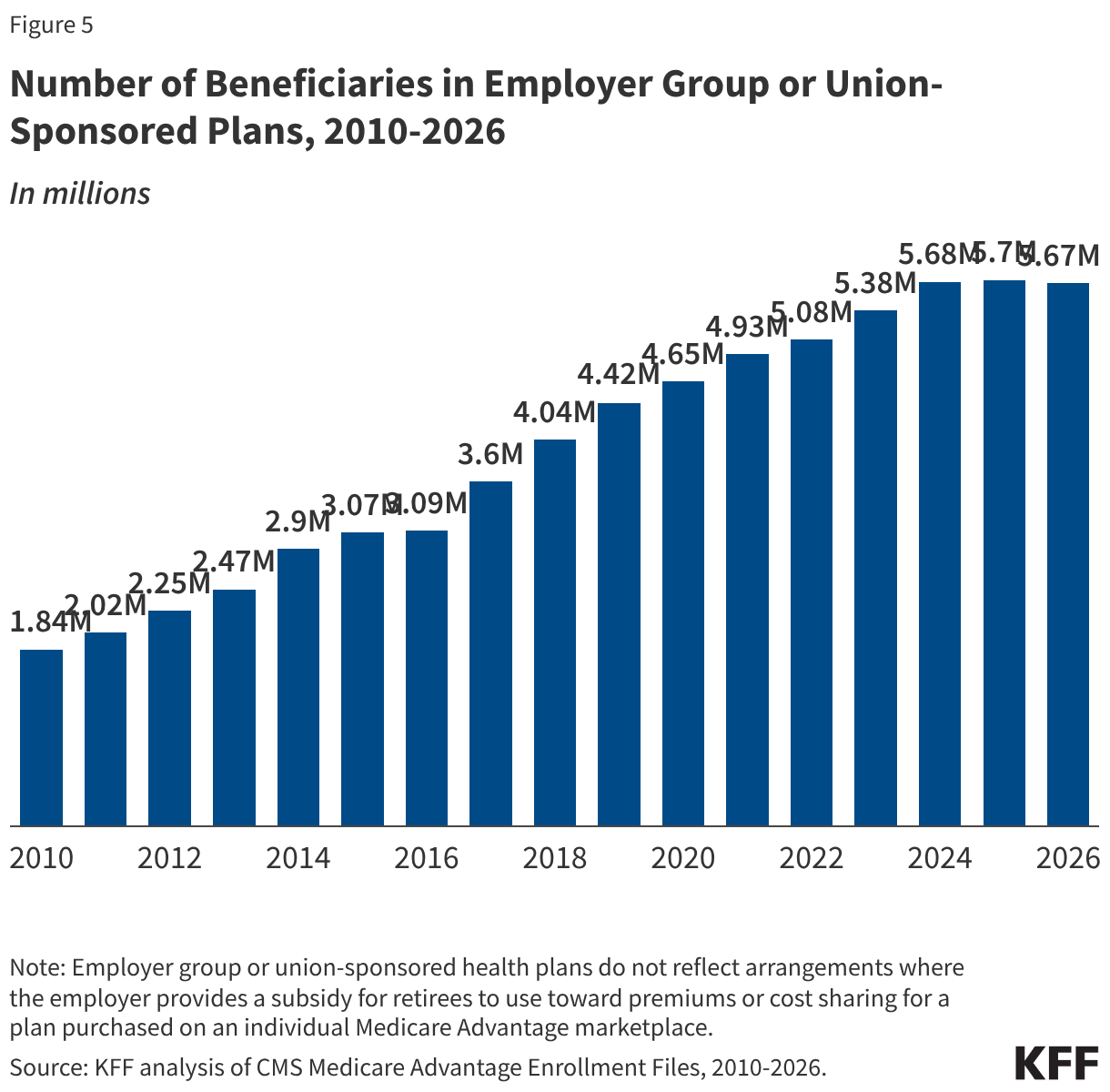
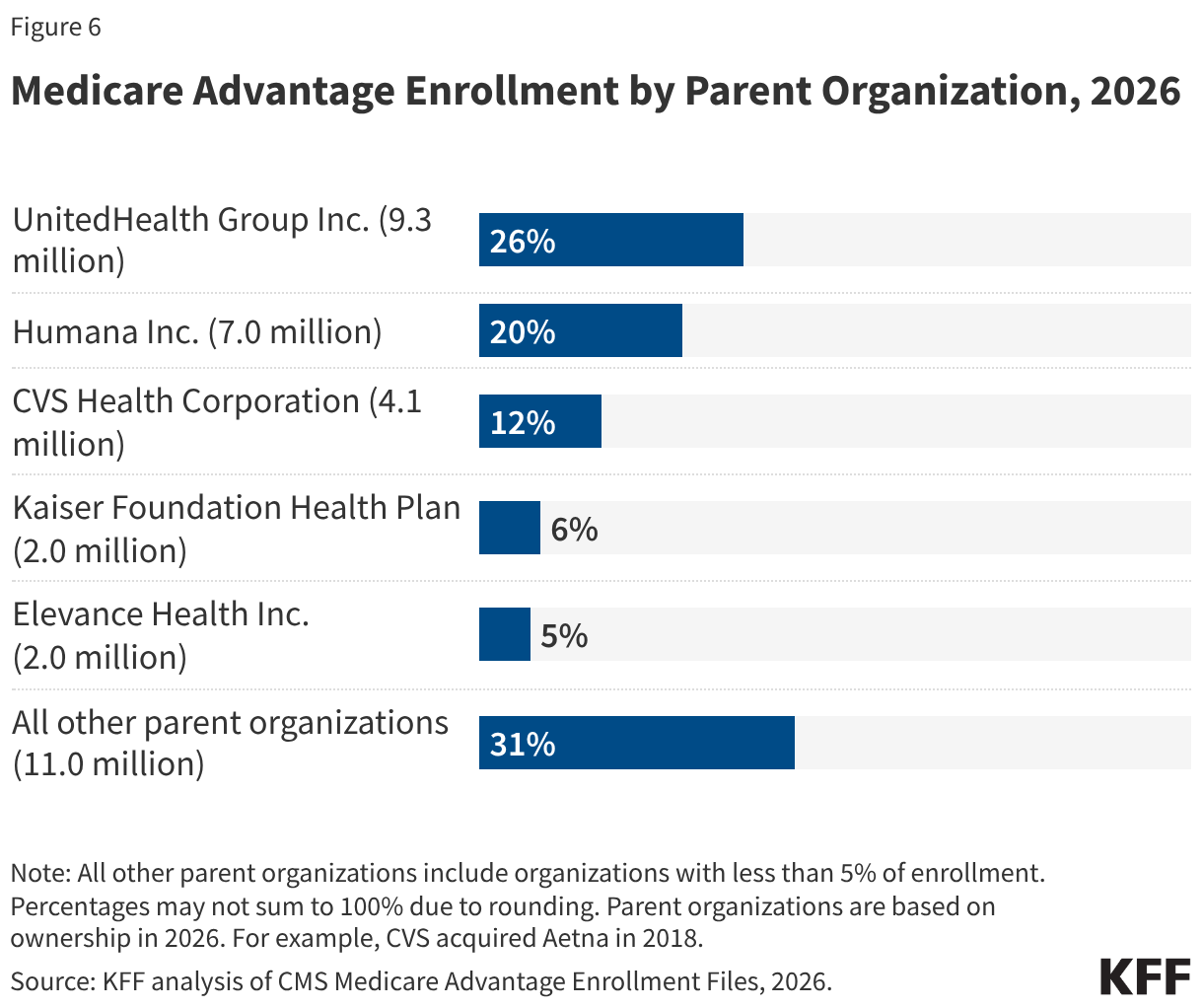
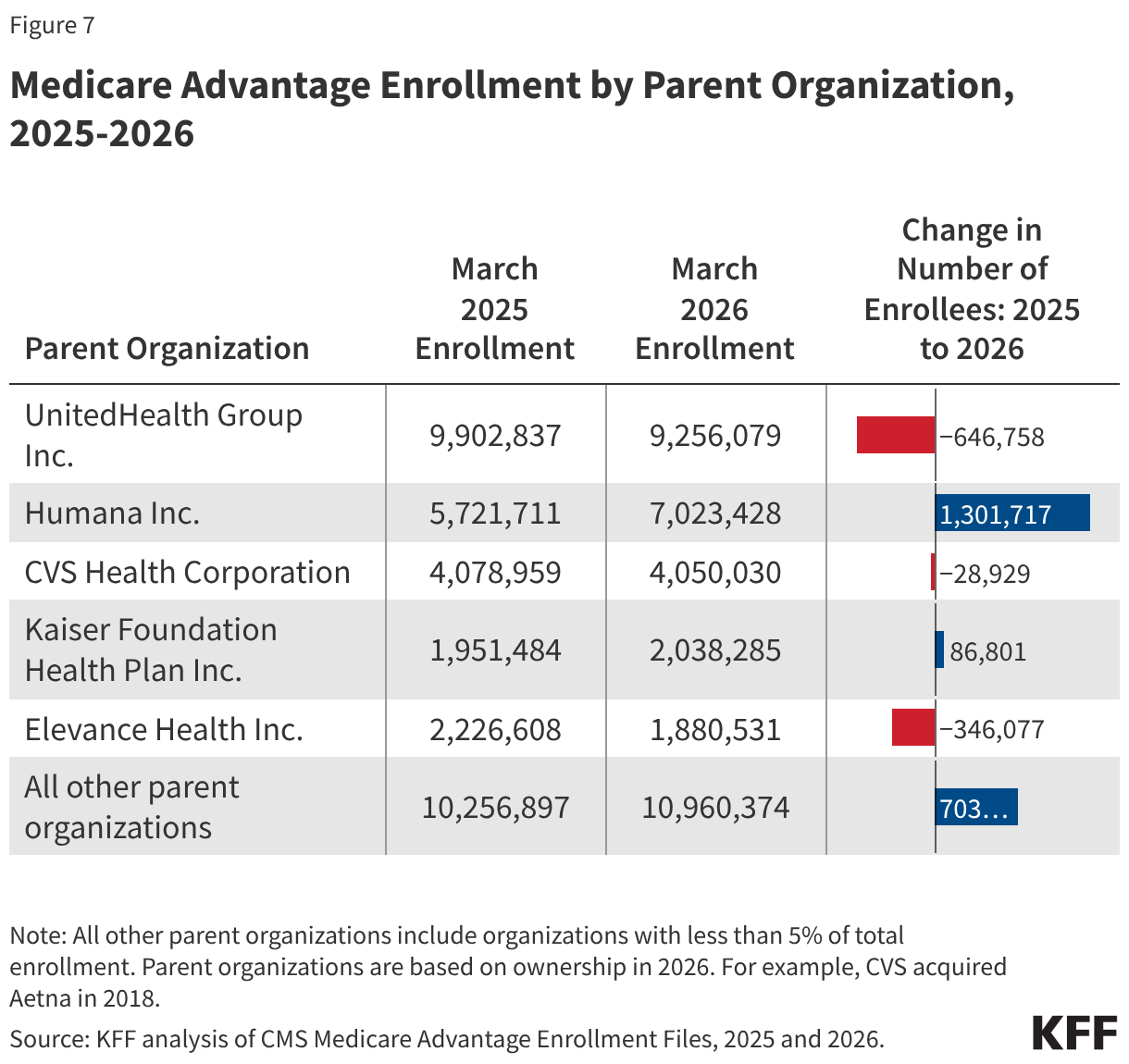
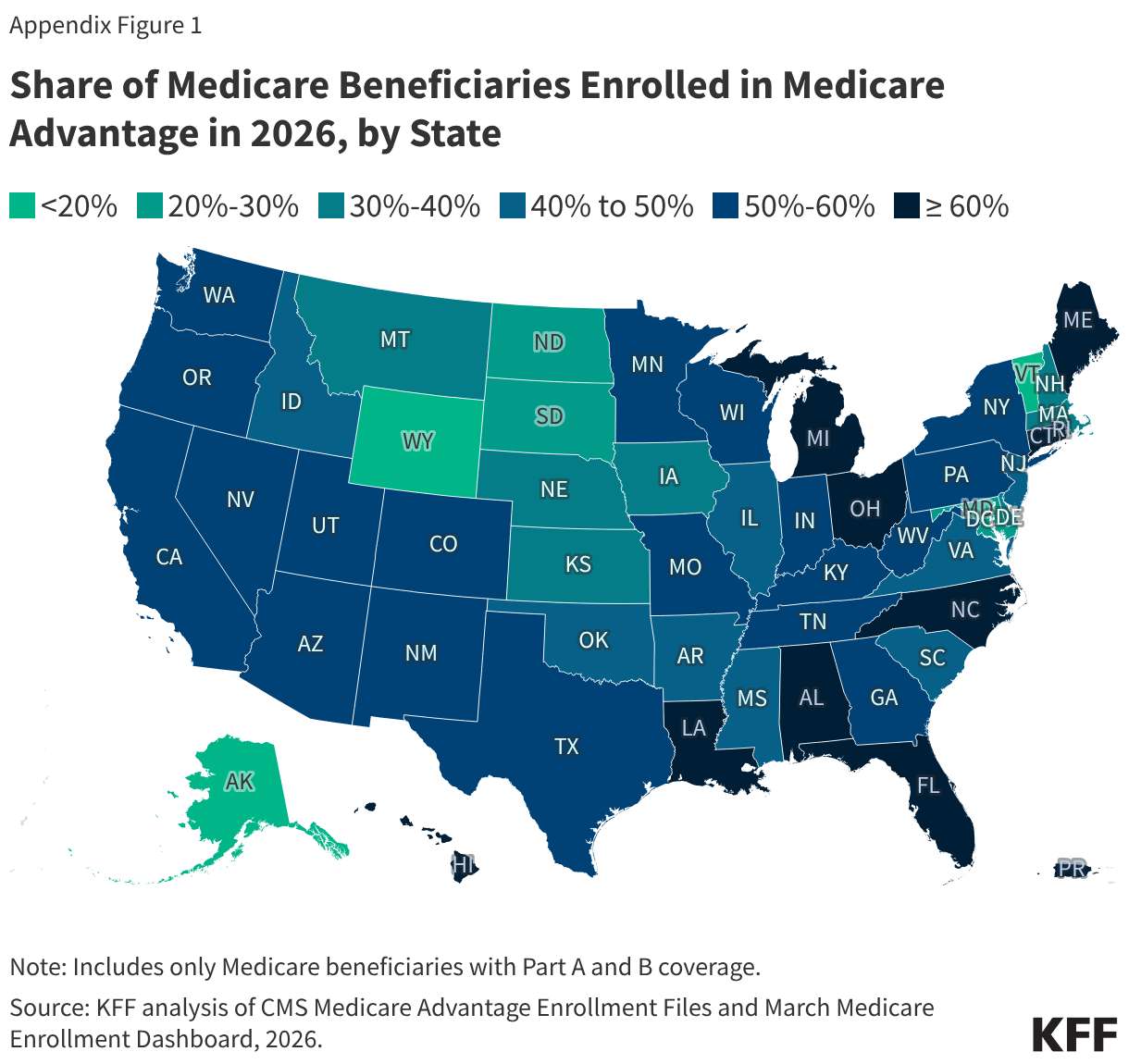
With Medicare’s annual open enrollment period underway, a new KFF analysis finds that Medicare Advantage enrollees, on average, had access to just under half (48%) of the physicians in their area who were available to people enrolled in traditional Medicare.

The finding illustrates a key tradeoff for beneficiaries in choosing Medicare Advantage.  Such plans can be appealing to beneficiaries because they offer extra benefits and cap out-of-pocket costs without the need for supplemental coverage. But the plans’ provider networks, which help insurers manage utilization and costs, also restrict enrollees’ choice of physicians, hospitals, and other providers without paying additional cost. Changes in provider networks can be disruptive for patients when their hospitals and physicians are no longer in-network.

In the analysis, KFF researchers document how much networks vary across plans by using 2022 Medicare Advantage provider directories to assess the share of physicians available to plans’ enrollees as a share of all physicians that submit claims for providing care to traditional Medicare beneficiaries, by county, plan characteristics, and physician specialties.

Among the key findings:

  • The one-fifth of Medicare Advantage enrollees in plans with the narrowest networks had in-network access to just about one-third of all physicians that were available to people in traditional Medicare. Conversely, the one-fifth of Medicare Advantage enrollees in plans with the broadest networks had in-network access to more than two-thirds of physicians available to beneficiaries in traditional Medicare.
  • The size of Medicare Advantage provider networks varies widely both across and within counties, which can make it hard for beneficiaries to decipher which option is best for them when choosing a plan.
  • The share of physicians available to Medicare Advantage enrollees varied by specialty. Generally, larger shares of outpatient medical and surgical specialists were in Medicare Advantage plan networks than primary care physicians.

Prior KFF research shows that beneficiaries value being able to choose their own doctors, but the vast majority of the nation’s nearly 69 million Medicare beneficiaries do not compare coverage options or switch plans.

This year the Centers for Medicare & Medicaid Services has a new tool on the online Medicare Plan Finder that allows beneficiaries to enter up to five of their preferred providers to more easily determine if they are in a plan’s network. Users can sort plans in their area by whether a “must-have provider” is in network. The Medicare open enrollment period began Oct. 15 and runs through Dec. 7.

U.S. Foreign Aid Freeze & Dissolution of USAID: Timeline of Events

Published: Oct 24, 2025

Starting on his first day of his second term in office, President Trump and his administration have taken several executive actions that directly impact U.S. global health efforts. This timeline, which is a companion resource to components of KFF’s Overview of President Trump’s Executive Actions on Global Health, provides a detailed overview of actions, including counter-actions, related to the administration’s efforts to freeze all U.S. foreign aid, dissolve the U.S. Agency for International Development (USAID), which implements most U.S. global health programs, and reorganize the Department of State. It will be updated as needed to reflect additional developments. 


Poll Finding

KFF Health Tracking Poll: Public Use and Trust in Health Care Apps and Websites

Published: Oct 24, 2025

Findings

Key Takeaways

  • There is widespread use of health care apps or websites to manage individuals’ health care with about three in four adults in the U.S. saying they have used a health care app or website in the past year, including majorities of adults regardless of income, education, race and ethnicity, and where they live. The most common use of these health care apps includes getting test and lab results, making appointments, and managing prescriptions or medications. This includes health care apps managed by a health provider like MyChart or other online patient portals for doctors, hospitals, or insurance companies, but does not include personal fitness or wellness apps used to track health and wellbeing.
  • About eight in ten adults ages 65 and older with Medicare say they have used a health care app or website in the past year, and the large majority say using these tools made it easier to manage their health care. This may be seen as encouraging sign for the “Make Health Tech Great Again” initiative announced by President Trump and CMS Director Dr. Oz announced earlier this year, which aims to partner with dozens of companies to increase the availability and use of digital health tools, including apps. But one in ten older adults with Medicare say that these digital health tools make managing their care more difficult.
  • A majority of older adults with Medicare say it should be at least an important priority for Medicare to make it easier to securely share information between different providers (81%) and increase the availability of apps that help manage chronic conditions with a health care provider (63%). However, few say that either of these items should be a top priority for Medicare. Instead, majorities call it important, but not a top priority.
  • While use of health care apps is common and most find them helpful in managing their care, the public is still very worried about privacy and many are cautious about the use of artificial intelligence, or AI. Majorities of adults express concerns about the privacy of their health information, regardless of whether the app is managed by the government (78%), a private technology company (75%), or a health insurance company (64%). Fewer, or about half (52%), are concerned about the privacy of their information if the app is managed by a hospital or other health care provider. Less than half of the public say they would trust a health care app that used AI to manage their health care (41%) or access their medical records and provide personalized health information or advice (32%).

Use of Digital Tools in the Health Care System

About eight in ten of the public say they have ever used a health care app or website to manage their health care, including three in four who say they have done so in the past year. This includes at least six in ten adults across education, income, race and ethnicity, and age groups. But the recent rate of uptake does vary somewhat within demographic groups. For example, eight in ten White adults say they’ve ever used an online tool to manage their health care in the past year, compared to seven in ten Black adults, and about two-thirds of Hispanic adults.  Education and income are also factors in recent use of health care apps or websites, with smaller shares of those with lower incomes and less than a college degree reporting they’ve ever used these online tools to manage their health care. Use of these digital health tools is widespread across age groups, with at least seven in ten saying they’ve ever used a health care app or website to manage their care and at least two-thirds having done so in the past year. In addition, use of health care apps does not vary depending on where people live, with large majorities of people living in urban areas (76%), suburban areas (79%), and rural areas (78%) reporting ever using such apps.

Stacked bar chart showing the levels of public awareness about the tax and budget bill. Results shown by party and coverage type.

Most commonly, seven in ten (71%) adults say they have used a health care app or website in the past year to access their medical records or lab test results, followed by about six in ten adults who have used an app or website to make an appointment with a doctor or health care provider (61%) or manage prescriptions (59%). More than half of adults (55%) have used an app or website in the last year to send a direct message to their doctor or other health care provider. Less common are using apps or websites to file claims or pay bills from either their health insurance company or provider (46%), to have video appointments with their doctor (35%), or to manage a chronic condition like diabetes or obesity with their doctor (21%).

Stacked bar chart show the share of people who say they have used a health care app or website.

Health Care App and Website Use Among Older Adults with Medicare

In late July, the Trump administration announced plans to build a “smarter, more secure, and more personalized healthcare experience.” This announcement came off the back of a “Make Health Tech Great Again” meeting at the White House, where the Centers for Medicare and Medicaid Services (CMS) secured commitments from healthcare and technology firms that will partner with the government to create better health technology, especially for those with government insurance. Among the technology groups to partner with the administration is OpenAI, with plans to add AI assistance to technology improvements.

Three quarters of adults with Medicare ages 65 and older say they’ve used an online tool to access their medical records or lab results in the last year. About six in ten older adults with Medicare say they’ve used a health care app or website to manage prescriptions or medications (62%), sent a direct message to their doctor or health care provider (57%), or made an appointment with a doctor or health care provider (55%). Just under half (45%) of older adults with Medicare have used an online tool to file claims or pay bills from their insurance company and provider in the last year. Smaller shares say they’ve used a health care app or website to have a video appointment with their doctor or health care provider in the last year (30%) or used it to manage chronic conditions like diabetes or obesity with their doctor or health care provider (23%).

Stacked bar chart showing the share of older adults with Medicare who have used a health care app or website.

Overall, two-thirds (65%) of the public say using health care apps and websites has made managing their health care easier, while one in ten say it makes no difference (8%). Few (5%) say that using these online tools makes managing their health care more difficult. Around one in five adults overall have never used these tools.

Notably, about one in ten (8%) Medicare enrollees ages 65 and older report that using these online tools makes it more difficult to manage their health care, while two in ten (21%) have never used these tools.

Stacked bar chart showing whether health care apps, websites, or online patient portals have made people managing their health easier or more difficult.

How Older Adults with Medicare See Technology as a Priority for CMS

A majority of older adults with Medicare say it is important for Medicare to prioritize aspects of app or website development for health care delivery, but few say it should be a top priority for the agency. Eight in ten (81%) say it is at least an important priority that Medicare makes it easier to securely share health information between different health care providers, and about two thirds (63%) say it’s at least an important priority that Medicare increases availability of apps that help manage chronic conditions like diabetes or obesity with the help of a health care provider.

Even though majorities say that it is at least important, few older adults with Medicare say that these are a top priority for them, including a quarter (27%) who say making it easier to share health information between providers is a top priority and one in ten (12%) who say increasing availability of apps to manage chronic conditions is a top priority.  About half of adults ages 65 and older with Medicare say each is important, but not a top priority. On the other hand, three in ten say increasing availability of apps to manage chronic conditions is not too important and 6% say it shouldn’t be done, while one in seven (14%) say making it easier to securely share health information is not too important and 5% say it shouldn’t be done.

Among the public overall, these shares are similar across partisanship, with majorities of Republicans and Democrats saying each of these is at least an important priority for Medicare but smaller shares seeing them as top priorities.

Stacked bar chart showing how much of a priority older adults on Medicare place on Medicare making it easier to share health information between providers and increasing the availability of apps.

One of the purposes noted by CMS in creating this digital health ecosystem is to reduce the number of apps that people have to use to access their health information. Half (51%) of people who have ever used health care apps, including 55% of those with Medicare ages 65 and older, report that they use multiple apps, websites, or accounts to manage their health care.

Most people who use multiple apps say they find it “very” or “somewhat easy” to keep track of the multiple sources, including 72% of Medicare enrollees ages 65 and older. However, three in ten adults and a similar share of older Medicare enrollees (28%) say they find it either “somewhat” or “very difficult” to manage multiple apps or websites.

Stacked bar chart showing whether people who use multiple apps think these apps have made it easier or more difficult to manage their health care.

Privacy Concerns and AI

Majorities of adults are concerned about the privacy of their information when using a health care-related app, regardless of who manages it. About eight in ten (78%) say they would be “very” or “somewhat” concerned about the privacy of their information when using a health care related app managed by the government, with similar shares saying so if the app was managed by a private technology company (75%). Two-thirds (64%) would be concerned about the privacy of their information if the app was managed by a health insurance company. Fewer – about half (52%) – say the same if the app was managed by a hospital or other health care provider.

Bar chart showing the share of people who say they would be very or somewhat concerned about their information privacy on a health care app managed by different groups.

Privacy concerns are pervasive across party, with majorities across partisanship saying they would be concerned about the privacy of their information on a health care related app managed by the government, a private technology company, or a health insurance company. Republicans, independents, and Democrats are less concerned about privacy issues if the app is run by a hospital or other health care provider but still a slight majority of independents and Republicans are concerned. A majority of adults, regardless of age, are concerned about the privacy of their information if the app is managed by the government, private technology companies, or an insurance company.

Bar chart showing the share of partisans who say they would be very or somewhat concerned about their information privacy on a health care app managed by different groups.

Part of CMS’s vision for modernizing America’s health care technology system involves supporting health care apps that utilize artificial intelligence (AI). However, the public isn’t quite convinced that AI can help manage their health care or provide personalized health information. Less than half of the public (41%) say they would have a “great deal” or “fair amount” of trust in a health care app, website, or online patient portal that uses an AI chatbot to make appointments or send messages to their doctors. An even smaller share, about one in three adults (32%), say they would trust an online health tool that uses AI to access their medical records to provide personalized health information. Very few would trust a health tool that uses AI “a great deal” to do either of these tasks, with just under one in ten trusting AI chatbots to manage their care or to access their medical records (8% for each).

Notably, the level of trust in AI does not vary across age groups with less than half regardless of age saying they trust AI to manage their care or provide personalized health information, though older adults are somewhat more likely than younger adults to say they don’t know enough to say whether they would trust online health tools that use AI to help manage their health care.

Stacked bar chart showing the levels of trust people would have towards a health care app that uses artificial intelligence.

Methodology

This KFF Health Tracking Poll/KFF Tracking Poll on Health Information and Trust was designed and analyzed by public opinion researchers at KFF. The survey was conducted September 23-29, 2025, online and by telephone among a nationally representative sample of 1,334 U.S. adults in English (n=1,255) and in Spanish (n=79). The sample includes 1,026 adults (n=64 in Spanish) reached through the SSRS Opinion Panel either online (n=1,004) or over the phone (n=22). The SSRS Opinion Panel is a nationally representative probability-based panel where panel members are recruited randomly in one of two ways: (a) Through invitations mailed to respondents randomly sampled from an Address-Based Sample (ABS) provided by Marketing Systems Groups (MSG) through the U.S. Postal Service’s Computerized Delivery Sequence (CDS); (b) from a dual-frame random digit dial (RDD) sample provided by MSG. For the online panel component, invitations were sent to panel members by email followed by up to three reminder emails.

Another 308 (n=15 in Spanish) adults were reached through random digit dial telephone sample of prepaid cell phone numbers obtained through MSG. Phone numbers used for the prepaid cell phone component were randomly generated from a cell phone sampling frame with disproportionate stratification aimed at reaching Hispanic and non-Hispanic Black respondents. Stratification was based on incidence of the race/ethnicity groups within each frame. Among this prepaid cell phone component, 141 were interviewed by phone and 167 were invited to the web survey via short message service (SMS).

Respondents in the prepaid cell phone sample who were interviewed by phone received a $15 incentive via a check received by mail. Respondents in the prepaid cell phone sample reached via SMS received a $10 electronic gift card incentive. SSRS Opinion Panel respondents received a $5 electronic gift card incentive (some harder-to-reach groups received a $10 electronic gift card). In order to ensure data quality, cases were removed if they failed two or more quality checks: (1) attention check questions in the online version of the questionnaire, (2) had over 30% item non-response, or (3) had a length less than one quarter of the mean length by mode. Based on this criterion, no cases were removed.

The combined cell phone and panel samples were weighted to match the sample’s demographics to the national U.S. adult population using data from the Census Bureau’s 2024 Current Population Survey (CPS), September 2023 Volunteering and Civic Life Supplement data from the CPS, and the 2025 KFF Benchmarking Survey with ABS and prepaid cell phone samples. The demographic variables included in weighting for the general population sample are gender, age, education, race/ethnicity, region, civic engagement, frequency of internet use, and political party identification. The weights account for differences in the probability of selection for each sample type (prepaid cell phone and panel). This includes adjustment for the sample design and geographic stratification of the cell phone sample, within household probability of selection, and the design of the panel-recruitment procedure.

The margin of sampling error including the design effect for the full sample is plus or minus 3 percentage points. Numbers of respondents and margins of sampling error for key subgroups are shown in the table below. For results based on other subgroups, the margin of sampling error may be higher. Sample sizes and margins of sampling error for other subgroups are available on request. Sampling error is only one of many potential sources of error and there may be other unmeasured error in this or any other public opinion poll. KFF public opinion and survey research is a charter member of the Transparency Initiative of the American Association for Public Opinion Research.

GroupN (unweighted)M.O.S.E.
Total1,334± 3 percentage points
   
Party ID  
Democrats418± 6 percentage points
Independents455± 6 percentage points
Republicans385± 6 percentage points
   
MAGA Republicans374± 6 percentage points
MAHA supporters583± 5 percentage points

VOLUME 33

KFF/Washington Post Poll Looks at Parents’ Trust in Children’s Health Content on Social Media, And Unfounded Claims About Abortion Pill Safety Follow FDA Approval of Generic Version


Summary

This volume highlights the latest release from the KFF/The Washington Post Survey of Parents, which finds that most parents report seeing children’s health content on social media, but many are unsure how to evaluate the trustworthiness of advice shared by health and wellness influencers. It also reviews misleading claims about the safety of medication abortion following the approval of a generic version of the abortion pill mifepristone, and it explores reports that federal officials are considering adding autism to the list of conditions covered by the Vaccine Injury Compensation Program. Lastly, it examines the use of AI chatbots by patients seeking to interpret lab results.


Featured: KFF/Washington Post Survey of Parents Finds Most Parents See Children’s Health Content on Social Media and Many Are Unsure What to Trust

The latest release from the KFF/Washington Post Survey of Parents finds that eight in ten parents say they see information or advice about children’s health at least occasionally on social media, including about three in ten who say they see this information daily or weekly. One-third (36%) of parents ages 18 to 34 say they see this content at least weekly compared to fewer parents ages 35-49 (28%) or those 50 and older (22%).

Three in Ten Parents See Information About Children's Health On Social Media At Least Weekly, Including Larger Shares of Younger Parents (Stacked Bars)

Even though most parents say they see children’s health content on social media, very few can name a specific influencer they trust for this content. One in seven (15%) parents say they trust a particular influencer for information and advice about children’s health, though just 4% can name the influencer. Parents are also largely split on their ability to discern whether content from influencers is trustworthy. About a third (35%) say it is easy to know what advice to trust when it comes from health and wellness influencers on social media, while about four in ten (38%) say it is difficult and another quarter (27%) say they don’t see such content.

Parents Are Split on Whether It Is Easy or Difficult To Know What Advice To Trust From Health Influencers (Stacked Bars)

When it comes to vaccine-related content specifically, one-third of parents say they have ever seen information or advice about children’s vaccines on social media, including similar shares who say most of the content they see is “pro-vaccine” (8%) and “anti-vaccine” (7%), with one in five (19%) saying they see a mix of both.


Recent Developments

Misleading Claims About Abortion Pill Safety Follow FDA Approval of Generic Version of Mifepristone

Photo of a person in a yellow sweater holding a capsule in their hand
MementoJpeg / Getty Images
What’s Happening?

Claims questioning the safety of the abortion drug mifepristone have circulated online following the Food and Drug Administration’s (FDA) approval of a second generic version of the drug. Mifepristone has been approved by the FDA for 25 years with an extensive safety record supported by peer-reviewed research, but the approval drew renewed attention to misleading narratives about its safety spread by lawmakers and officials who oppose abortion. The surprise decision to approve a second generic version followed a September 19 letter in which Health and Human Services (HHS) Secretary Robert F. Kennedy Jr. and FDA Commissioner Marty Makary pledged to conduct a full safety review of the drug.

What Are Common Themes in Online Conversations?
  • Posts about abortion pills increased on X, Reddit, and Bluesky on October 2, the day news of the approval was first reported. KFF’s monitoring of social media identified 8,959 posts, reposts, and comments mentioning terms relating to medication abortion on that day, up from a daily average of 2,460 over the 30 days prior.
  • Although posts about safety concerns represented a relatively small number of posts about medication abortions, the narrative was amplified by some prominent health officials and elected representatives who oppose abortion, despite mifepristone’s long record of safety and effectiveness. The most-engaged-with post about the safety of medication abortion that day came from Senator Josh Hawley, who has more than 2 million followers on X. The post claimed that evidence shows that abortion medications are dangerous and potentially fatal for the mother, though the post did not cite the alleged evidence supporting this claim.
Why This Matters

Unsupported claims questioning the safety of mifepristone despite extensive data showing the drug’s safety may influence decisions about medication abortion and create unnecessary concern and confusion among people seeking care. Mifepristone has been taken by millions of women and medication abortion currently accounts for nearly two-thirds of U.S. abortions. High-profile statements from government officials raising unfounded safety concerns may create confusion or hesitancy among patients and providers and fuel opposition to the drug when there is no evidence of harm.

What Does The Evidence Say?

Mifepristone has been approved by the FDA for 25 years, and FDA prescribing information notes that serious adverse events have been shown to occur in fewer than 0.5% of patients. Other studies have found similar rates, and major medical organizations, including the American College of Obstetricians and Gynecologists (ACOG) and the Society for Maternal-Fetal Medicine (SMFM) maintain that the drug is safe.

Reports Suggest HHS May Add Autism to List of Conditions Covered by Vaccine Injury Compensation Program

Photo of a toddler being administered a vaccination
Karl Tapales / Getty Images
What’s Happening?

Reports that federal health officials are considering expanding vaccine injury compensation to include autism may have contributed to increases in online conversations linking vaccines to the condition, despite decades of research showing no association. HHS Secretary Robert F. Kennedy Jr. has reportedly suggested both directly adding autism to the Vaccine Injury Compensation Program (VICP) and broadening definitions of some brain conditions covered by the program.

What is VICP?
  • The National Vaccine Injury Compensation Program is a no-fault alternative to the traditional court  system for vaccine injury claims, designed to compensate families for rare vaccine injuries. The program, which covers most routine vaccines and is funded by a small tax on doses administered, manages a trust fund of about $4 billion. The program includes a list of specific injuries that can be caused by each vaccine, which are presumed to be vaccine-related if they occur within timeframes described in the table.  Autism was excluded from this list after extensive litigation in the early 2000s, when judges appointed to handle vaccine injury cases reviewed test cases representing thousands of claims and found no link between vaccines and autism.
  • Compensation decisions through the program do not always indicate causation. Since 1988, about 60% of compensated cases involved negotiated settlements in which HHS drew no direct conclusions about the cause of injuries.
Why This Matters
  • Physicians and legal scholars have warned that this could lead to a wave of injury claims, potentially bankrupting the program and reinforcing false narratives that link vaccines to autism despite decades of research showing no association.
  • The myth that vaccines cause autism is a long-standing false claim, and despite frequent debunking, KFF polling has found that many parents continue to express uncertainty over whether or not it is true. Adding autism to the list of covered conditions could be used to suggest vaccines cause autism despite scientific evidence to the contrary, further eroding trust in vaccines and federal health authorities. Research suggests autism begins early in pregnancy, not in toddlerhood when most vaccines are given. KFF and The Washington Post’s recent release from the Survey of Parents found that at least one-third of parents said there had been too little research into the causes of autism (44%) or whether there is a link between vaccines and autism spectrum disorder (33%).
What Are People Saying?

News coverage and social media posts, reposts, and comments mentioning both autism and VICP spiked in late September and early October, according to KFF’s monitoring. KFF identified 1,647 posts, reposts, and comments published on X, Reddit and Bluesky on September 27, an increase from a daily average of only 12 from the 90 days prior. Many of the posts with the most engagement were reposts from an account with more than 400,000 followers that falsely claimed VICP had conceded vaccines cause autism. Similarly, the number of news stories mentioning both autism and VICP reached the highest point of the year thus far on October 8, with 86 news stories published that day, compared to a daily average of less than one for the year prior to this date.  

What Does The Evidence Say?

Decades of research have shown no causal relationship between vaccines and autism, and medical organizations like the American Academy of Pediatrics (AAP) have concluded there is no link. A 2013 CDC study, for example, showed that the amount of antigens received from vaccines was the same between children with and without autism, and a 2019 cohort study of over 650,000 children in Denmark found no increased autism risk from receiving the measles, mumps, and rubella (MMR) vaccine.


AI & Emerging Technology

Some Patients Turn to AI Chatbots to Interpret Lab Results

Photo of a vial of blood on top of printed lab results
peepo / Getty Images
What’s Happening?

A recent KFF Health News article detailed the growing trend of patients using artificial intelligence (AI) chatbots like ChatGPT, Claude, and Gemini to interpret their medical test results and records when they cannot quickly reach their doctors for answers. Some patients are uploading lab results, imaging reports, and other medical records to these chatbots to get medical explanations while waiting for physician callbacks or appointments.

How Widespread Is This Practice?

Data on how often patients specifically upload test results is not readily available, but KFF’s August 2024 Tracking Poll found that about one in six adults (17%) reported using AI chatbots at least once a month to find health information and advice, rising to one in four (25%) adults under age 30. Most adults (63%) said they were “not too confident” or “not at all confident” that health information from AI chatbots is accurate, while about a third said they were “very” (5%) or “somewhat confident” (31%) in the accuracy of this information.

Why This Matters

While AI chatbots may help patients understand results and reduce anxiety, physicians and researchers have identified risks of using this technology. One concern is AI “hallucinations,” instances where chatbots generate plausible but factually inaccurate information. Chatbots can present false information with the same tone as accurate information, making errors difficult for non-medical users to detect. These errors can be difficult to detect even for medical professionals. A March study published in BMC Medical Education found that general practice trainees had a mean accuracy of only 55% in detecting AI-generated medical hallucinations.

What Does The Evidence Say?

Research indicates that improved prompting strategies can improve the accuracy of AI-generated responses. An April study in JAMIA Open, for example, found that instructing a chatbot to take on the persona of a clinician improved accuracy, and an August Communications Medicine study showed that including additional safeguards in prompts, like asking the AI to use only clinically validated information, reduced the rate of hallucinations. AI education efforts focusing on how to tailor prompts to receive the most accurate information may improve the usefulness of these tools. Still, these strategies did not eliminate errors entirely, and researchers have recommended that chatbots should be supplementary tools rather than primary sources of health information.

About The Health Information and Trust Initiative: the Health Information and Trust Initiative is a KFF program aimed at tracking health misinformation in the U.S., analyzing its impact on the American people, and mobilizing media to address the problem. Our goal is to be of service to everyone working on health misinformation, strengthen efforts to counter misinformation, and build trust. 


View all KFF Monitors

The Monitor is a report from KFF’s Health Information and Trust initiative that focuses on recent developments in health information. It’s free and published twice a month.

Sign up to receive KFF Monitor
email updates


Support for the Health Information and Trust initiative is provided by the Robert Wood Johnson Foundation (RWJF). The views expressed do not necessarily reflect the views of RWJF and KFF maintains full editorial control over all of its policy analysis, polling, and journalism activities. The data shared in the Monitor is sourced through media monitoring research conducted by KFF.

Poll Finding

KFF/The Washington Post Survey of Parents: Exposure to and Trust in Children’s Health-Related Information Online

Published: Oct 22, 2025

Findings

As debates over the safety of childhood vaccines and trust in public health guidance play out in the U.S., findings from the latest KFF/Washington Post Survey of Parents reveal how parents encounter health information on social media and how it may shape their decisions. One-third (34%) of parents say they have seen social media content related to childhood vaccines and about three in ten report seeing children’s health-related content on social media weekly or daily (29%). Notably, many parents find it difficult to discern whether health-related information they see online is trustworthy (38%), and few say there is a particular influencer they trust when it comes to information about children’s health (15%). Regardless, only a small share of parents says children’s vaccine-related information on social media affects them, with 4% saying it has made it easier to make vaccine decisions for their children and another 4% saying it has made these decisions more difficult.

Many parents report seeing social media content related to children’s health, even if they are not actively seeking it out. About eight in ten (79%) parents say they see information or advice about children’s health at least occasionally, compared to just one in five (21%) who say they never see this content. About three in ten (29%) parents say they see information or advice about children’s health on social media daily (11%) or weekly (18%). About one in ten reports seeing this content about once a month (12%), and about four in ten report seeing it occasionally (38%).

Compared to their counterparts, larger shares of parents under age 35 (36%), mothers (35%), Black parents (33%), Hispanic parents (36%), and Democratic parents (33%) say they see this content at least weekly, even if they are not looking for it.

Stacked bar chart showing percent who say they see information about children's health on social media every day, at least once a week, at least once a month, occasionally, or never. Results shown by total parents, age, gender, race and ethnicity, and party identification.

Do Parents Trust Influencers When It Comes to General Health and Wellness Advice?

Some of the health-related content shared on social media comes from influencers, individuals who have a large following on social media and often post about issues of interest. While some social media users follow specific influencers, others may be exposed to posts from influencers they don’t follow, as algorithms promote content likely to interest them. With recent moves from large tech companies to get rid of third party fact checking, assessing the validity of this content can be tricky.

This KFF/Washington Post Survey of Parents shows many parents find it difficult to know what to trust when it comes to health content shared by influencers. While about a third (35%) of parents say it is “very easy” or “somewhat easy” to know what advice to trust when it comes from health and wellness influencers they see on social media, about four in ten (38%) say it is “somewhat difficult” or “very difficult.” This includes between one-third and four in ten parents across gender, age, race, ethnicity, and partisanship that say it is at least “somewhat difficult” to discern whether advice from influencers is trustworthy.

Stacked bar chart showing percent who say it is very easy, somewhat easy, somewhat difficult, or very difficult to know what advice to trust when it comes from health and wellness influencers they see on social media. Results shown by total parents, age, gender, race and ethnicity, and party identification.

About one in seven (15%) parents say there is a particular influencer they trust when it comes to information and advice about children’s health, though just 4% can name the influencer while one in eight (12%) say they can’t remember the influencer’s name. About eight in ten (84%) parents say there is either no particular influencer on social media they trust when it comes to information and advice about children’s health (58%) or that they do not see content from health and wellness influencers (27%).

Of the few parents who were able to name an influencer they trust (4%), the names mentioned include a variety of individuals and social media accounts. Very few influencers were mentioned by more than one parent who responded to the survey, suggesting that the health information parents get from influencers represents a spectrum of quality and viewpoints. While some influencers named (including “Dr. Beachgem10” and “Dr. Lauren Hughes”) appear from their profiles to be practicing medical doctors, many others are celebrities or other personalities without medical credentials.

Bar chart showing percent who say they have a particular influencer they trust most when it comes to information about children's health, and percent who say they do not have an influencer they trust.

The share of parents who say they have a particular influencer they trust most when it comes to information and advice about children’s health varies by age, race, ethnicity, and vaccine decisions. Younger parents (21%), Black parents (21%), and Hispanic parents (18%) are more likely than their counterparts to say there is an influencer they trust, though few can name a specific influencer. Parents who report having ever skipped or delayed a vaccine for their children are also more likely than those who have kept their children up to date on vaccines to say there is an influencer they trust for advice about children’s health (20% v. 14%), though few in either group can name the influencer. Similar shares of supporters of the Make America Healthy Again (MAHA) movement (15%) and non-MAHA supporters (15%) also say this.

Stacked bar chart showing percent who say they do or do not have a particular influencer they trust when it comes to information about children's health. Results shown by total parents, age, race and ethnicity, party identification, and vaccine choice.

When asked which comes closest to their view, about eight in ten (84%) parents say health influencers are mostly motivated by “financial interests” while 15% say they are mostly motivated by “serving the public interest.” Large majorities of parents across age, race and ethnicity, and partisanship say health influencers are motivated by financial interests, though Black parents and younger parents are more likely than their counterparts to say health influencers are motivated by serving the public good (26% and 19%, respectively) – the same groups who are more likely to say there is a specific influencer they trust when it comes to information and advice about children’s health.

Mirrored bar chart showing percent who say health influencers are either mostly motivated by financial interests or by serving the public interest. Results shown by total parents, age, race and ethnicity, and party identification.

Childhood vaccine recommendations have been a frequent subject of news coverage since the appointment of HHS Secretary Kennedy, including changes and actions at the state and federal levels. These changes may leave parents with questions, and some may turn to social media for advice.

The KFF/Washington Post Survey of Parents finds one-third (34%) of parents say they have ever seen information or advice about vaccines for children on social media. Notably, nearly half (45%) of parents who have skipped or delayed vaccines for their children aside from COVID-19 or flu say they have seen content related to vaccines for children online, compared to about one-third (32%) of parents who have kept their children up to date who say the same.

Compared to their counterparts, somewhat larger shares of mothers (37%), parents under age 35 (38%), and parents who support the MAHA movement (37%) say they have ever seen information online about children’s vaccines.

Bar chart showing percent who say they have ever seen information or advice about vaccines for children on social media. Results shown by total parents, age, gender, race and ethnicity, vaccine choice, and support for MAHA.

About one in five (19%) parents say they see vaccine content that is a “mix of both” pro- and anti-vaccine, while fewer see content that is “mostly pro-vaccine” (8%) or “mostly anti-vaccine” (7%). Notably, among parents who report skipping or delaying vaccines for their children, similar shares say they see mostly anti-vaccine (12%) or mostly pro-vaccine (10%) content online, and about one in four (24%) report seeing a mix of both.

Democratic parents are more likely to say they see pro-vaccine content online than Republican parents (13% vs. 7%), while similar shares report seeing mostly anti-vaccine content (7% and 8%). About one in seven (15%) Democratic parents and one in five Republican and independent parents see content that is mostly a mix of both.

While MAHA supporters are slightly more likely to say they have ever seen content related to childhood vaccines online, similar shares of MAHA supporters and non-MAHA supporters overall say they see mostly pro-vaccine content or mostly anti-vaccine content.

Stacked bar chart showing percent who say the content they see on social media is mostly "pro-vaccine," "anti-vaccine," "a mix of both," or that they don't see children's vaccine-related content. Results shown by total parents, party identification, vaccine choice, and MAHA support.

As many parents report lack of trust in health and wellness influencers, and amidst the broader confusion and uncertainty the public feels about what is true online, few parents say exposure to content about children’s vaccines has made the decision easier (4%) or harder (4%) to make vaccine decisions for their children. One-quarter (26%) of parents say exposure to childhood vaccine-related information on social media has not made it easier nor more difficult to make decisions about vaccinating their own children.

These shares are similar across parent age, partisanship, race, and ethnicity. Among parents who report skipping or delaying vaccines for their children, 9% say social media content has made their decisions easier, 7% say it has made it harder, and three in ten say it hasn’t made much difference.

Stacked bar chart showing percent who say the information about vaccines for children on social media has made it "easier," "harder," or has not made a difference when it comes to making vaccine decisions for their children. Results shown by total parents, age, party identification, race and ethnicity, vaccine choice, and MAHA support.

Methodology

This KFF/The Washington Post Survey of Parents was designed and analyzed by public opinion researchers at KFF and The Washington Post. The survey was designed to reach a representative sample of parents or legal guardians of children under the age of 18 in the U.S. The survey was conducted July 18 – August 4, 2025, online among a nationally representative sample of 2,716 parents using the Ipsos KnowledgePanel in English (n=2519) and in Spanish (n=197). KnowledgePanel is a nationally representative probability-based panel where panel members are recruited randomly through invitations mailed to respondents randomly sampled from an Address-Based Sample (ABS) provided by Marketing Systems Groups (MSG) through the U.S. Postal Service’s Computerized Delivery Sequence (CDS). Invitations were sent to panel members by email followed by up to two reminder emails.

All completes were reviewed to ensure respondents were giving the survey adequate attention. Three cases were removed from the data that failed internal quality checks. Most KnowledgePanel respondents received a financial incentive equaling about $1 for their participation in this survey with some harder-to-reach groups receiving about $5 for their participation.

The survey also includes an oversample of parents of children 5 years old and younger (n=1,092) in order to reach a higher rate of responses from parents who are currently making decisions around their child’s vaccines. The full sample was weighted to match the sample’s demographics to the national U.S. parent population using data from the Census Bureau’s 2023 American Community Survey. Weighting parameters included gender, age, education, race/ethnicity, region, metro status, and language proficiency within the Hispanic sample. The sample was also weighted to the total parent population on political party identification using the 2025 KFF Benchmarking Survey.  An additional adjustment was conducted in order to provide estimates from parents living in Texas (n=276) using the 2023 ACS as well as the 2023-2024 Pew Religious Landscape Survey. Both weights take into account differences in the probability of selection, including adjustment for the sample design, within household probability of selection, and the design of the panel-recruitment procedure.

The margin of sampling error including the design effect for the total sample is plus or minus 2 percentage points and plus or minus 3 percentage points for the parents of children under the age of 6. The full Texas sample has a margin of sampling error of plus or minus 7 percentage points. Numbers of respondents and margins of sampling error for key subgroups are shown in the table below. For results based on other subgroups, the margin of sampling error may be higher. Sample sizes and margins of sampling error for other subgroups are available on request. Sampling error is only one of many potential sources of error and there may be other unmeasured error in this or any other public opinion poll. KFF and The Washington Post are charter members of the Transparency Initiative of the American Association for Public Opinion Research.

GroupN (unweighted)M.O.S.E.
Total parents2,716± 2 percentage points
   
Support for Make America Healthy Again (MAHA) movement  
MAHA-supporting parents977± 3 percentage points
Not MAHA-supporting parents1,679± 3 percentage points
   
Party ID  
Democratic parents801± 4 percentage points
Independent/Other party parents1,077± 3 percentage points
Republican parents780± 4 percentage points
MAGA Republican parents498± 5 percentage points
   
Parents by vaccine choice  
Skipped or delayed any childhood vaccines436± 5 percentage points
Kept kids up to date on all childhood vaccines2,264± 2 percentage points


Perspectives from Employers on the Costs and Issues Associated with Covering GLP-1 Agonists for Weight Loss

Published: Oct 22, 2025

While more large employers are covering GLP-1 drugs for weight loss, conversations with employers highlight concerns about the cost of these medications. Many of these employers have considered scaling back coverage of GLP-1 agonists for weight loss, or in some cases, employers are adding or strengthening coverage requirements.

This analysis discusses findings from the 2025 KFF Employer Health Benefits Survey, with insights gained from interviews and group discussions with human resources directors and others who manage employer health benefits. These conversations occurred in five focus groups across the United States, covering over one hundred companies employing over a quarter of a million people, held throughout the summer and fall of 2025.

The full analysis and other data on health costs are available on the Peterson-KFF Health System Tracker, an online information hub dedicated to monitoring and assessing the performance of the U.S. health system.