The Trump Administration’s Foreign Aid Review: Reorganization of U.S. Global Health Programs

Published: Aug 6, 2026

Editorial Note: Originally published in May 2025, this resource has been updated as new information became available.

Starting on the first day of his second term, President Trump issued several executive actions that have fundamentally changed foreign assistance. These included: an executive order which called for a 90-day review of foreign aid; a subsequent “stop-work order” that froze all payments and services for work already underway; the dissolution of USAID, including the reduction of most staff and contractors; and the cancellation of most foreign assistance awards. Although a waiver to allow life-saving humanitarian assistance was issued, it was limited to certain services only and difficult for program implementers to obtain. Since then, responsibility for remaining global health programs has been transferred to the State Department. While there have been several legal challenges to these actions, there has been limited legal remedy to date. As a result, U.S. global health programs were disrupted and, in some cases, ended. Changes to the Department of Health and Human Services, including proposed cuts and reorganization, are also likely to affect these programs. This fact sheet is part of a series on the status of U.S. global health programs.

Background on U.S. Global Health Programs

  • Historically, U.S. global health programs have been overseen and managed by three main federal departments and agencies: the State Department, USAID (now dissolved), and CDC.
    • The State Department is home to the Bureau of Global Health Security and Diplomacy (GHSD), which leads and oversees PEPFAR (which receives direct appropriations from Congress) as well as global health security and, more recently, other global health programs.
    • USAID, an independent agency established by Congress, had housed and managed most other U.S. bilateral global health programs (before its dissolution in 2025), including TB, malaria, maternal and child health, and nutrition, receiving direct appropriations from Congress for these efforts. Because the State Department had not historically served as an implementing agency, USAID also managed more than half of PEPFAR’s funding, through State Department transfers and direct appropriations from Congress.
    • CDC has global programs for HIV, TB, polio, and global health security, which receive direct Congressional appropriations and also manages and implements PEPFAR funding transferred by State and USAID.
  • To carry out global health programs, federal agencies had funded other organizations, including non-profits, foreign governments, and international and multilateral health organizations, such as the Global Fund to Fight AIDS, Tuberculosis and Malaria (Global Fund) and Gavi, the Vaccine Alliance.
  • Prior to the start of the Trump administration, U.S. funding for global health, across multiple federal agencies and for bilateral and multilateral programs, including global health research, had totaled $12.0 billion in FY 2025.

Current Status of U.S. Global Health Programs

The following administration actions have or are likely to have a significant impact on the structure and operations of U.S global health programs:

  • Stop-work order: The stop-work order, as part of the foreign aid review, initially froze all bilateral global health programming and services, halting existing work in the field (it was not applied to the Global Fund or Gavi). Because it halted payments, many implementers had to terminate staff and end some services.
  • Limited waivers: Certain bilateral global health programs received waivers to allow “life-saving services” to continue, including a limited set of PEPFAR services and TB, malaria, maternal and child health, nutrition and infectious disease outbreak response services. Even with these waivers, services remained disrupted, and implementers faced challenges in getting permission to resume programming and difficulties in getting paid.
  • Dissolution of USAID: Because USAID was the main implementing agency for global health efforts, its dissolution and loss of most of its staff reduced program implementation capacity and operations. Announcements of reductions at CDC could further affect global health efforts.
  • Cancelled awards: In early 2025, it was reported that the administration canceled 86% of USAID awards. KFF analysis found that of the 770 global health awards identified, 80% were listed as terminated, totaling $12.7 billion in unobligated funding.
  • Other executive orders and actions: In addition to the foreign aid review, several other orders and actions have or will likely affect global health, including: a review of international organization participation, the reinstatement and further expansion of the Mexico City Policy (now under a broader umbrella called the Promoting Human Flourishing in Foreign Assistance (PHFFA) Policy) and withholding of UNFPA funding, and withdrawal from the World Health Organization.
  • Legal actions: In response to two lawsuits filed against the administration’s actions, a federal judge issued a preliminary injunction ordering the government to pay for work completed by February 13, 2025, although not all payments have been made and the court did not stop the government from canceling awards. The government appealed the ruling, and after several subsequent rulings in the case, the Supreme Court ultimately allowed the government to rescind (cancel) a portion of expiring global health funds before the end of the fiscal year. Further proceedings have been stayed, pending the outcome of a separate case.
  • Reorganization: The administration moved to restructure and/or reduce global health efforts as follows:
    • On March 28, 2025, Secretary of State Rubio announced that the State Department and USAID had notified Congress of their intent to “restructure certain Department bureaus and offices that would implement programs and functions realigned from USAID” as follows:
      • Proposing legislation to abolish USAID as an independent agency.
      • Separating almost all USAID personnel from federal service within the current fiscal year.
      • Identifying USAID programs that “continue to advance the Administration’s foreign policy objectives,” including a subset of global health activities to be transferred to GHSD. These include programs that help reduce health disparities, deliver lifesaving vaccines, promote maternal and child health, and control malaria, TB, and other diseases.
    • On April 22, 2025, Secretary Rubio announced a reorganization of the State Department to “empower the Department from the ground up, from the bureaus to the embassies”, including removing redundant offices and non-statutory programs that are “misaligned with America’s core national interests.” On May 29, 2025, the State Department notified Congress with further details, including that GHSD would be reorganized to include three major divisions: Health Programs (with the Office of Health Programs and the Office of Program Transition and Supply Chain), Health Policy and Diplomacy (with the Office of Health Diplomacy and the Office of Program Planning and Evaluation), and Global Health Security (with the Office of Outbreak Detection and Response). With the dissolution of USAID in July 2025, U.S. global health programs were moved to the State Department.
  • America First Global Health Strategy: In September 2025, the administration released the America First Global Health Strategy, its roadmap for future U.S. government global health engagement, with 3 broad pillars – making America safer, stronger, and more prosperous – and focusing on HIV, TB, malaria, polio, and global health security. Per the strategy, the U.S. is negotiating bilateral, multi-year agreements with countries receiving U.S. global health assistance. The agreements include co-investment by countries and aim to transition the majority of countries to full self-reliance by the end of the agreement period. The U.S. will provide 100% of current levels of funding for health commodities and frontline healthcare workers for HIV, TB, malaria, and polio through FY 2026 and reduced funding thereafter (and rapidly reduce funding for activities other than health commodities and frontline health personnel). Global health security activities focus on surveillance, data sharing and laboratory capacity, to enable early detection and rapid containment of outbreaks originating outside the U.S. A KFF analysis of the MOUs finds that the administration plans to reduce funding to countries by billions over the next five years, relative to the prior five-year period.
  • Funding: While the Trump administration has requested significantly less funding for global health in its budget requests, Congress has continued to appropriate funding at close to prior year levels, including $11.3 billion in FY 2026.

What to Watch

  • Implementation of the America First Global Health Strategy bilateral, multi-year agreements with selected countries (see KFF tracker)
  • Status of U.S. funding appropriated by Congress for global health programs
  • Impact of the new policies on U.S. funding and programs, including the PHFFA Policy
  • Impact of U.S. changes to global health programs on health outcomes

The Trump Administration’s Foreign Aid Review: Status of U.S. Support for the Global Fund to Fight AIDS, Tuberculosis and Malaria

Published: Aug 6, 2026

Editorial Note: Originally published in May 2025, this resource has been updated as new information became available.

Starting on the first day of his second term, President Trump issued several executive actions that have fundamentally changed foreign assistance. These included: an executive order which called for a 90-day review of foreign aid; a subsequent “stop-work order” that froze all payments and services for work already underway; the dissolution of USAID, including the reduction of most staff and contractors; and the cancellation of most foreign assistance awards. . Although a waiver to allow life-saving humanitarian assistance was issued, it was limited to certain services only and difficult for program implementers to obtain. Since then, responsibility for remaining global health programs has been transferred to the State Department. While there have been several legal challenges to these actions, there has been limited legal remedy to date. As a result, U.S. global health programs were disrupted and, in some cases, ended. Changes to the Department of Health and Human Services, including proposed cuts and reorganization, are also likely to affect these programs. This fact sheet is part of a series on the status of U.S. global health programs.

Background on the U.S. and the Global Fund

  • The Global Fund to Fight AIDS, Tuberculosis and Malaria (Global Fund) is an independent public-private, multilateral financing entity created in 2002. It raises and pools resources from multiple donors to address HIV, TB, and malaria and in turn, invests up to $5 billion per year in more than 100 low- and middle-income countries.
  • The Global Fund reports that it has helped to save 70 million lives and reduce the combined death rate of its three focus diseases by 63% since 2002. With its support, in 2024, 25.6 million people were on antiretroviral therapy, 7.4 million were treated for TB, and 162 million mosquito nets were distributed.
  • The U.S. government was instrumental in the creation of the Global Fund and is its largest donor, accounting for 33% of its funding. It also plays a significant role in governance and oversight of the Global Fund, holding one of twenty Board seats and currently sitting on two Board committees.
  • Only LMICs whose most recent Gross National Income (GNI) per capita is below a certain threshold and meet disease burden criteria are eligible for Global Fund assistance. Countries are required to co-finance by investing in health systems and HIV, TB, and malaria national responses. To date, 11 countries have graduated from Global Fund support.
  • The Global Fund has been considered the “multilateral component” of PEPFAR, as well as U.S. bilateral efforts focused on malaria and TB, complementing and extending the reach of U.S. programs to many more countries. It also works differently than U.S. bilateral health programs; unlike the U.S., it has no in-country presence and does not implement programs, instead providing financial assistance based on technical evaluations of country-led proposals. It also plays an important market shaping role through pooled procurement, driving down prices of health products, accelerating innovation and adoption of new products, and promoting quality standards, among other strategies.
  • U.S. participation in the Global Fund is authorized in the legislation that created PEPFAR, as a permanent part of U.S. law. Other parts of the authorization are time-bound, including several related to the Global Fund such as a requirement that U.S. contributions to the Global Fund cannot exceed 33% of all contributions, used to limit U.S. funding and leverage support from other donors. Because PEPFAR’s current authorization expired on March 25, 2025, this requirement is not in place unless Congress includes it in appropriations or other legislative language.
  • The Global Fund replenishes funding every three years, with periodic “pledging conferences” (the latest was held in November 2025). Its current replenishment (its eighth) generated $12.68 billion in pledges for the 2026-2028 period, including a pledge of $4.6 billion from the U.S.
  • Prior to the start of the Trump administration, U.S. funding for the Global Fund in FY 2024 was $1.65 billion.

Current Status of U.S. Support for the Global Fund

  • Stop-work order: The foreign aid review’s stop-work order initially froze all U.S. bilateral programming but was not applied to the Global Fund or other multilateral institutions. The administration subsequently announced that it canceled 86% of all USAID awards. Since the Global Fund relies on PEPFAR and other U.S. implementers, as well as U.S. government staff and expertise, to assist countries in delivering services, the disruption of that work affected some Global Fund efforts as well.
  • International organizations review: A second executive order, calling for a 180-day review of U.S. participation in all international intergovernmental organizations, was initiated. Per the order, the purpose of the review was to determine which are “contrary to the interests of the United States and whether such organizations, conventions, or treaties can be reformed”. The Global Fund was not on the list of 66 international organizations from which the U.S. withdrew, per a January 7, 2026, presidential memorandum.
  • America First Global Health Strategy: In September 2025, the administration released the America First Global Health Strategy, its roadmap for future U.S. government global health engagement. Per the strategy, the U.S. is negotiating bilateral, multi-year agreements with countries receiving U.S. global health assistance with an aim to transition the majority of countries to full self-reliance by the end of the agreement period. The U.S. government reports that it is coordinating with the Global Fund as it develops these agreements.
  • Long-acting injectable PrEP: On September 4, 2025, the administration announced that PEPFAR would partner with the Global Fund to support provision of long-acting injectable pre-exposure prophylaxis (PrEP) to up to 2 million people in high-burden countries by 2028.
  • Policy restrictions: In January 2025, the Trump administration reinstated the expanded Mexico City Policy from Trump’s first term and further expanded it in January 2026 to apply to almost all non-military foreign assistance, many more entities including multilateral organizations, and additional areas of restrictions including activities related to diversity, equity and inclusion and “gender ideology” under a broader umbrella known as the “Promoting Human Flourishing in Foreign Assistance” (PHFFA) Policy.
  • Funding: The Trump administration has requested significantly less funding for the Global Fund in its budget requests, and has not provided to the Global Fund all of the funding pledged by the U.S. to, and appropriated for, the seventh replenishment period (which included 2025). Despite this, Congress has continued to appropriate funding in support of U.S. pledges, including $1.25 billion in FY 2026. In addition, Congress included language in the FY 2026 spending bill stating that there remained “sufficient unobligated balances” from prior acts “to fulfill the United States pledge for the seventh replenishment.”

What to Watch

  • Implementation of the America First Global Health Strategy multi-year agreements with countries
  • Status of U.S. funding appropriated by Congress for the Global Fund
  • Impact of the PHFFA Policy on U.S. funding and programs, including support for multilateral organizations
  • Impact of U.S. changes to global health programs on health outcomes

The Trump Administration’s Foreign Aid Review: Status of U.S. Support for CEPI

Published: Aug 6, 2026

Editorial Note: Originally published in July 2025, this resource has been updated as new information became available.

Starting on the first day of his second term, President Trump issued several executive actions that have fundamentally changed foreign assistance. These included: an executive order which called for a 90-day review of foreign aid; a subsequent “stop-work order” that froze all payments and services for work already underway; the dissolution of USAID, including the reduction of most staff and contractors; and the cancellation of most foreign assistance awards. Although a waiver to allow life-saving humanitarian assistance was issued, it was limited to certain services only and difficult for program implementers to obtain. Since then, responsibility for remaining global health programs has been transferred to the State Department. While there have been several legal challenges to these actions, there has been limited legal remedy to date. As a result, U.S. global health programs were disrupted and, in some cases, ended. Changes to the Department of Health and Human Services, including proposed cuts and reorganization, are also likely to affect these programs. This fact sheet is part of a series on the status of U.S. global health programs.

Background on the U.S. and CEPI

  • The Coalition for Epidemic Preparedness Innovations (CEPI) aims to accelerate the development of vaccines and other technologies to prepare for and respond to epidemic and pandemic threats. Pooling and leveraging contributions from more than 30 governments, philanthropic foundations, and private sector partners, CEPI invests to drive research and development into vaccine and therapeutic candidates against high-threat pathogens. It also works to strengthen global laboratory and vaccine manufacturer networks and regulatory environments and to research and support vaccine safety. A core focus is its “100 Days Mission”, an effort to reduce the time it takes to develop vaccines and other countermeasures during outbreaks with pandemic potential.
  • Since its founding in 2017, CEPI contributed to the first licensed vaccine for Chikungunya; is supporting the development of vaccines for Lassa fever, MERS, Nipah virus and Rift Valley fever, all of them currently in clinical trials; and aided in the development of seven COVID-19 vaccines that were licensed for use.
  • The U.S. government made its first financial contribution to CEPI in 2020 and has thus far invested $217 million in the organization. It has also collaborated in other ways with the CEPI including through partnerships with U.S. International Development Finance Corporation (DFC), the Department of Defense, and the U.S. Biomedical Advanced Research and Development Agency (BARDA). The U.S. FDA had also been a member of CEPI’s Joint Coordination Group, and USAID, which had managed the relationship with CEPI, before its dissolution in 2025, had held the U.S. government seat on the CEPI Investors Council.
  • CEPI reports that it has contributed significantly to the U.S. economy through its funding of U.S.-based vaccine developers and that this funding far exceeds the amount of funding it has received from the U.S. government.
  • CEPI replenishes funding every five years. For the last replenishment round, held in 2022, the U.S. pledged $150 million over five years, which has been exceeded. The next replenishment round, known as CEPI 3.0, covers the 2027-2031 period. Additionally, CEPI has launched a Ebola R&D funding appeal (specifically medical countermeasures to the Bundibugyo strain of Ebolavirus), to which the U.S. has pledged $50 million. The U.S. accounts for approximately 6% of total contributions received by CEPI to date.
  • Prior to the start of the Trump administration, U.S. funding provided to CEPI in FY 2024 was $100 million.

Current Status of U.S. Support for CEPI

  • Stop-work order: The foreign aid review’s stop-work order initially froze all U.S. bilateral programming but was not applied to CEPI or other multilateral institutions. The administration subsequently announced that it canceled 86% of all USAID awards. KFF analysis found that of 770 global health awards identified, 80% were listed as terminated, including the CEPI contract. CEPI reported that it has not received a termination notice, but it has not received any regular funding from the Trump administration.
  • International organizations review: A second executive order, calling for a 180-day review of U.S. participation in all international intergovernmental organizations, was initiated. Per the order, the purpose of the review was to determine which are “contrary to the interests of the United States and whether such organizations, conventions, or treaties can be reformed”. CEPI was not on the list of 66 international organizations from which the U.S. withdrew, per a January 7, 2026, presidential memorandum.
  • Reorganization: The administration notified Congress on March 28, 2025, of its intent to permanently dissolve USAID and that any remaining USAID operations would be absorbed by the State Department, including global health activities, which would be integrated into its Bureau of Global Health Security and Diplomacy (GHSD). On May 29, 2025, the State Department further notified Congress of its proposed reorganization plan. With the dissolution of USAID, programs moved in July 2025.
  • America First Global Health Strategy: In September 2025, the administration released the America First Global Health Strategy, its roadmap for future U.S. government global health engagement. Per the strategy, the U.S. is negotiating bilateral, multi-year agreements with countries receiving U.S. global health assistance with an aim to transition the majority of countries to full self-reliance by the end of the agreement period. Global health security figures prominently in the new strategy, although CEPI, and other international organizations that focus on pandemic preparedness and response, are not mentioned.
  • Funding: The Trump administration has not included funding for CEPI in its budget requests and has provided no regular funding to the organization. Despite this, the Congress has continued to appropriate funding for CEPI, stating that funding should be consistent with prior year amounts.

What to Watch

  • Implementation of the America First Global Health Strategy
  • Status of U.S. regular funding appropriated by Congress for CEPI but, as yet, not provided by the Trump administration
  • Further results of the administration’s international organizations review
  • U.S. international engagement in pandemic preparedness and response

The Trump Administration’s Foreign Aid Review: Status of U.S. Family Planning and Reproductive Health Efforts

Published: Aug 6, 2026

Editorial Note: Originally published in May 2025, this resource has been updated as new information became available.

Starting on the first day of his second term, President Trump issued several executive actions that have fundamentally changed foreign assistance. These included: an executive order which called for a 90-day review of foreign aid; a subsequent “stop-work order” that froze all payments and services for work already underway; the dissolution of USAID, including the reduction of most staff and contractors; and the cancellation of most foreign assistance awards. Although a waiver to allow life-saving humanitarian assistance was issued, it was limited to certain services only and difficult for program implementers to obtain. Since then, responsibility for remaining global health programs has been transferred to the State Department. While there have been several legal challenges to these actions, there has been limited legal remedy to date. As a result, U.S. global health programs were disrupted and, in some cases, ended. Changes to the Department of Health and Human Services, including proposed cuts and reorganization, are also likely to affect these programs. This fact sheet is part of a series on the status of U.S. global health programs.

Background on U.S. Global Family Planning & Reproductive Health (FP/RH) Efforts

  • The U.S. government had supported FP/RH efforts for 60 years and was the largest donor to the sector. It also was one of the largest purchasers and distributors of contraceptives internationally.
  • Still, each year, about 260,000 women die from complications during pregnancy and childbirth, almost all in low- and middle-income countries. Almost one-third of these deaths could be prevented with greater access to contraception. Worldwide, an estimated 259 million women have an unmet need for modern contraception.
  • Recent decades have seen major gains in access to family planning and reproductive health services. The U.S. government contributed significantly to this progress, reporting that in the countries it supported, modern contraceptive prevalence increased from less than 10% in 1965 to 34% in 2023 and family size fell from more than 6 to 3.9. It also estimated that it would reach up to 24 million women and couples with contraceptive services and supplies, helping to prevent 14,000 maternal deaths and 8.1 million unintended pregnancies, in 2023.
  • Prior to its dissolution in 2025, USAID had served as the lead U.S. implementing agency for FP/RH activities, working in 41 countries, with focused efforts in 29 high-need countries and the Francophone West African region. The CDC also supported some global FP/RH activities primarily through research, surveillance and technical assistance.
  • The U.S. role in global FP/RH has often been contested, influenced by differing views and political debates primarily related to abortion. As a result, U.S. foreign assistance funding is governed by several legislative and policy requirements, including the Mexico City Policy (which has been implemented and rescinded along Presidential party lines and was significantly expanded by both Trump administrations), the Helms Amendment, and the Kemp-Kasten Amendment.
  • Prior to the start of the Trump administration, U.S. funding provided to bilateral FP activities in FY 2024 was $575 million; funding for UNFPA was $30.5 million.

Current Status of U.S. FP/RH Programs

The following administration actions have had a significant impact on FP/RH program operations:

  • Stop-work order: The stop-work order initially froze all FP/RH programming and services, halting USAID’s FP/RH programming including procurement and delivery of contraceptive commodities. Because the order halted payments, many implementers had to terminate staff and end some services.
  • Limited waiver: While the State Department issued a waiver of the stop-work order allowing certain “life-saving services” to continue, family planning services were specifically prohibited from continuation, including in the blanket humanitarian waiver issued on January 28, 2025, and the limited global health waiver issued on February 4, 2025.
  • Dissolution of USAID: As the main government implementer of FP/RH efforts, the dissolution of USAID and loss of most staff significantly affected FP/RH implementation capacity and operations. In addition, announcements of reductions at CDC could further affect global FP/RH efforts.
  • Canceled awards: In early 2025, it was reported that the administration has canceled 86% of all USAID awards. KFF analysis found that of the 770 global health awards identified, 233 included FP/RH activities, 85% of which were terminated.
  • Legal actions: In response to two lawsuits filed against the administration’s actions, a federal judge issued a preliminary injunction ordering the government to pay for work completed by February 13, 2025, although not all payments have been made and the court did not stop the government from canceling awards. The government appealed the ruling and after several subsequent rulings in the case, the Supreme Court ultimately allowed the government to rescind (cancel) a portion of expiring global health funds before the end of the fiscal year. Further proceedings have been stayed, pending the outcome of a separate case.
  • Reorganization: The administration notified Congress on March 28, 2025, of its intent to permanently dissolve USAID and move any remaining USAID operations to the State Department, with global health activities to be integrated into its Bureau of Global Health Security and Diplomacy (GHSD) which oversees PEPFAR. FP/RH programs were not continued.
  • America First Global Health Strategy: In September 2025, the administration released the America First Global Health Strategy, its roadmap for future U.S. government global health engagement. Per the strategy, the U.S. is negotiating bilateral, multi-year agreements with countries receiving U.S. global health assistance with an aim to transition the majority of countries to full self-reliance by the end of the agreement period. FP/RH activities are not included in these agreements.
  • Policy restrictions: In January 2025, the Trump administration reinstated the expanded Mexico City Policy from Trump’s first term and further expanded it in January 2026 to apply to almost all non-military foreign assistance, many more entities, and additional areas of restrictions including activities related to diversity, equity and inclusion and “gender ideology” under a broader umbrella known as the “Promoting Human Flourishing in Foreign Assistance” (PHFFA) Policy. The administration also withdrew from membership in and support of UNFPA on January 7, 2026.
  • Funding: The Trump administration has requested no funding for FP in its budget requests and stopped supporting this work in 2025, including rescinding FP funding and withholding funding from UNFPA. Despite this, Congress has continued to appropriate level funding for these programs including $575 million for bilateral FP activities and $32.5 million for UNFPA in FY 2026.

Impact on FP/RH Services and Outcomes

  • A rapid assessment survey of 108 WHO country offices in 2025 found that more than four in ten reported moderate or severe disruptions to FP and contraception services, with 38% reporting such disruptions for commodities specifically, due to the U.S. foreign aid freeze and other shortages.
  • Reports have indicated that millions of dollars in shipments of already purchased contraceptive commodities intended for low- income countries expired while the administration assessed whether to incinerate the supplies or transfer them to another distributor.
  • It is estimated that the loss of U.S. funding in 2025 resulted in a global contraceptive procurement funding gap of approximately $250 million.
  • In addition, several modeling studies have found that cuts in or termination of U.S. FP funding could result in significant increases in unintended pregnancies, unsafe abortions, and maternal deaths.

What to Watch

  • Implementation of the America First Global Health Strategy multi-year agreements with countries and whether countries will choose to continue any FP activities previously supported by the U.S. government.
  • Status of U.S. funding appropriated by Congress for bilateral FP efforts and contributions to UNFPA
  • Impact of the PHFFA Policy on U.S. funding and programs
  • Impact of U.S. changes to global health programs on health outcomes

The Trump Administration’s Foreign Aid Review: Status of Global Health Security/Pandemic Preparedness

Published: Aug 6, 2026

Editorial Note: Originally published in May 2025, this resource has been updated as new information became available.

Starting on the first day of his second term, President Trump issued several executive actions that have fundamentally changed foreign assistance. These included: an executive order which called for a 90-day review of foreign aid; a subsequent “stop-work order” that froze all payments and services for work already underway; the dissolution of USAID, including the reduction of most staff and contractors; and the cancellation of most foreign assistance awards. Although a waiver to allow life-saving humanitarian assistance was issued, it was limited to certain services only and difficult for program implementers to obtain. Since then, responsibility for remaining global health programs has been transferred to the State Department. While there have been several legal challenges to these actions, there has been limited legal remedy to date. As a result, U.S. global health programs were disrupted and, in some cases, ended. Changes to the Department of Health and Human Services, including proposed cuts and reorganization, are also likely to affect these programs. This fact sheet is part of a series on the status of U.S. global health programs.

Background on U.S. Global Health Security Efforts

  • The U.S. has supported global health security (GHS) and pandemic preparedness efforts for decades through funding and technical support provided to low- and middle-income countries (as well as support for multilateral efforts). This had included the development of formal GHS partnerships with other countries, starting with 17 in 2014 and rising to more than 50 in 2024.
  • GHS efforts are designed to help countries and regions build capacities needed to prevent avoidable outbreaks, detect infectious disease threats early, and reduce the impacts of epidemics and pandemics through rapid and effective responses.
  • Specific activities include: improving surveillance and laboratory systems, reducing the risks of animal to human disease exposures, training epidemiologists, and fostering better biosafety and biosecurity practices.
  • U.S. investments in GHS have led to measurable increases in capacity, including improvement in 9 of 15 technical areas between 2018 and 2023 in GHS partnership countries and reductions in average outbreak response times.
  • Prior to 2025, multiple U.S. agencies, coordinated by the National Security Council (NSC), were involved in these efforts including USAID (now dissolved), the Centers for Disease Control and Prevention (CDC), the Department of Defense (DoD), the State Department, HHS, and USDA. The first U.S. GHS Strategy was released in 2019 by the first Trump administration and an updated strategy was released by the Biden administration in 2024.
  • Prior to the start of the Trump administration, U.S. funding provided to bilateral GHS activities in FY 2024 was $1.25 billion; $100 million was provided to the Coalition for Epidemic Preparedness Innovations (CEPI) and $250 million to the Pandemic Fund.

Current Status of U.S. Global Health Security Programs

The following administration actions have had a significant impact on U.S. GHS programs:

  • Stop-work order: The stop-work order initially froze all USAID-based GHS programming and services. As a result, many GHS implementing partners let staff go and some USAID-supported GHS activities in progress were interrupted, such as funding for transport of samples and phone plans for contact tracers.
  • Limited waiver: Some GHS activities were included in a limited waiver issued by the State Department on February 4 allowing “life-saving services” to continue, including: rapid emergency response to immediate infectious disease outbreaks, focused on pathogens with pandemic potential and those that pose a national security risk to U.S. citizens (e.g., mpox and H5N1), including detection, prevention, and containment and supply of medical countermeasures. Even with the waiver, services remained disrupted and implementers faced challenges in getting permission to resume programming and difficulties in getting paid.
  • Dissolution of USAID: Before its dissolution, USAID had about 50 staff supporting international outbreak response efforts, a number which dropped to six in the early weeks of the Trump administration. As a result, many GHS partners lost points of contact and technical support, in addition to the loss of funding. Announcements of reductions at the CDC could further affect GHS capacity.
  • Reorganization: The administration notified Congress on March 28, 2025, of its intent to permanently dissolve USAID and that any remaining USAID operations would be absorbed by the State Department with global health activities (including for GHS) to be integrated into its Bureau of Global Health Security and Diplomacy (GHSD). On May 29, 2025, the State Department further notified Congress of its proposed reorganization plan, and with the dissolution of USAID, programs moved in July 2025.
  • America First Global Health Strategy: In September 2025, the administration released the America First Global Health Strategy, its roadmap for future U.S. government global health engagement (the Trump administration withdrew the 2024 Global Health Security Strategy and has not released an updated strategy). Per the America First strategy, the U.S. is negotiating bilateral, multi-year agreements with countries receiving U.S. global health assistance with an aim to transition the majority of countries to full self-reliance by the end of the agreement period. Global health security figures prominently in the new strategy and is part of all of the agreements signed to date. Goals include enabling detection of outbreaks with epidemic potential within seven days and containing outbreaks originating outside the U.S. rapidly at their source, prioritizing mobilization within 72 hours of detection.
  • Withdrawal from WHO: In January 2025, President Trump announced that the U.S. would withdraw from the World Health Organization (WHO) and halted its funding (the formal withdrawal was completed in January 2026). The administration also said that the U.S. would not be bound by the recently revised International Health Regulations or the new pandemic agreement being negotiated by WHO, two international instruments that outline roles and responsibilities for countries to prepare for and respond to outbreaks.
  • Funding: The Trump administration has requested significantly less funding for GHS in its budget requests and canceled or suspended funding for GHS-related projects and awards, including for contributions to CEPI and the Pandemic Fund. Despite this, Congress has continued to appropriate funding for bilateral GHS efforts at close to prior year levels, including $1.1 billion in FY 2026, and called for funding consistent with prior amounts for contributions to CEPI and the Pandemic Fund.

Impact on GHS Services and Outcomes

  • The combination of administration actions described above has reduced capacity and may challenge communication and coordination across U.S. agencies and with partners, contributing to slower responses to emerging health threats, greater impacts, and increased risk of importation of diseases into the U.S.
  • Experts estimate that there is a 50% chance of another pandemic emerging in the next 25 years, with the risk greatest in the least prepared countries. 
  • The health impacts of poorly controlled outbreaks can be severe. An internal USAID memo from 2025 estimated that the risk of losing USAID GHS programs alone could result in more than 28,000 new cases of dangerous infectious diseases, such as Ebola and Marburg, every year.
  • Emerging diseases can result in major economic and social costs, even with small-scale outbreaks.
    • The SARS 2003 outbreak led to an estimated $30 billion in economic losses (over $3 million per case) from reduced commerce, travel and trade.
    • The 2014-2015 West Africa Ebola epidemic led to an estimated $53 billion in economic losses. A single Ebola patient in New York cost the city’s $4.3 million in response measures.
    • Measles outbreaks in the U.S., often initiated through importation from other countries, can lead to significant costs; a recent study from Washington state found that a 71-case measles outbreak led to societal costs of $3.4 million, or almost $50,000 per case.
  • Pandemics have even more massive economic costs, as experienced with COVID-19, which cost the U.S. alone an estimated at $16 trillion – a number four times the lost economic output from the 2008 financial crisis.
  • News broke in mid-May of the ongoing Ebola outbreak in the Democratic Republic of the Congo, and given all of the changes made by the U.S. to its foreign assistance and global health response, U.S. support is taking shape under very different circumstances and through different organizational mechanisms than in the past, but a recent KFF analysis found that the speed of the U.S. government’s response to the current outbreak is on par with the prior two outbreaks, and initial U.S. funding amounts are already surpassing the prior two outbreaks.

What to Watch

  • Implementation of the America First Global Health Strategy multi-year agreements with countries
  • Status of U.S. funding appropriated by Congress for bilateral GHS efforts and contributions to CEPI and the Pandemic Fund
  • U.S. international engagement in pandemic preparedness and response

The Trump Administration’s Foreign Aid Review: Status of U.S. Support for Gavi, the Vaccine Alliance

Published: Aug 6, 2026

Editorial Note: Originally published in May 2025, this resource has been updated as new information became available.

Starting on the first day of his second term, President Trump issued several executive actions that have fundamentally changed foreign assistance. These included: an executive order which called for a 90-day review of foreign aid; a subsequent “stop-work order” that froze all payments and services for work already underway; the dissolution of USAID, including the reduction of most staff and contractors; and the cancellation of most foreign assistance awards. Although a waiver to allow life-saving humanitarian assistance was issued, it was limited to certain services only and difficult for program implementers to obtain. Since then, responsibility for remaining global health programs has been transferred to the State Department. While there have been several legal challenges to these actions, there has been limited legal remedy to date. As a result, U.S. global health programs were disrupted and, in some cases, ended. Changes to the Department of Health and Human Services, including proposed cuts and reorganization, are also likely to affect these programs. This fact sheet is part of a series on the status of U.S. global health programs.

Background on the U.S. and Gavi

  • Gavi, the Vaccine Alliance (Gavi), is an independent public-private, multilateral financing entity created in 2000. It raises and pools resources from multiple donors and in turn, disburses approximately $1.7 billion per year to support procurement and distribution of vaccines in low- and middle-income countries (LMICs).
  • Gavi supports vaccines against 20 infectious diseases, and hosts the global emergency vaccine stockpiles against Ebola, yellow fever, meningitis, and cholera. By playing a market shaping role through pooled procurement, demand forecasting, support for regional manufacturing capacity, and other strategies, Gavi helps to drive down prices for vaccines in LMICs.
  • Gavi reports that it has helped to immunize more than 1.2 billion children in 78 LMICs, preventing more than 20 million deaths, and generating economic benefits estimated at more than $280 billion, since 2000.
  • The U.S. government was one of the original donors to Gavi and had been its third largest contributor in recent years, providing 13% of its funding since its inception. Gavi also had a donor liquidity partnership with the U.S. International Development Finance Corporation (DFC) allowing Gavi to quickly access up to $1 billion from a “Rapid Financing Facility” to support routine immunization and pandemic response, backed by forthcoming donor pledges. Additionally, the U.S. was the largest donor to COVAX, the international effort housed at Gavi that supported the development, procurement, and delivery of COVID-19 vaccines to LMICs (COVAX ended in 2023).
  • Only LMICs whose most recent Gross National Income (GNI) per capita is below a certain threshold are eligible for Gavi assistance (56 countries in 2026). Countries are required to co-finance a portion of their vaccines on a sliding scale. To date, 19 countries have graduated from Gavi assistance.
  • Gavi had been the primary mechanism by which the U.S. government supported the procurement of vaccines for LMICs. The USAID bilateral maternal and child health program had complemented Gavi by supporting in-country capacity building and immunization campaigns and, prior to its dissolution in 2025, USAID had managed the U.S. partnership with Gavi.
  • Every five years, Gavi replenishes funding through “pledging conferences”. For the 2026-2030 period, Gavi secured more than $9 billion towards a target budget of $11.9 billion, which it estimates would save at least 8 million lives by 2030.
  • Prior to the start of the Trump administration, U.S. funding provided to Gavi in FY 2024 was $300 million.

Current Status of U.S. Support for Gavi:

  • Stop-work order: The foreign aid review’s stop-work order initially froze all U.S. bilateral programming but was not applied to Gavi or other multilateral institutions. The administration subsequently announced that it canceled 86% of all USAID awards. KFF analysis finds that of 770 global health awards identified, 80% are listed as terminated, including the main Gavi contract as well as the COVAX contract. Gavi reports that it has not received a termination notice for its main contract, although it did receive one for COVAX (all U.S. funding was already disbursed to COVAX in 2021).
  • International organizations review: A second executive order, calling for a 180-day review of U.S. participation in all international intergovernmental organizations, was initiated. Per the order, the purpose of the review was to determine which are “contrary to the interests of the United States and whether such organizations, conventions, or treaties can be reformed”. Gavi was not on the list of 66 international organizations from which the U.S. withdrew, per a January 7, 2026, presidential memorandum.
  • Reorganization: The administration notified Congress on March 28, 2025, of its intent to permanently dissolve USAID and that any remaining USAID operations would be absorbed by the State Department, including global health activities which would be integrated into its Bureau of Global Health Security and Diplomacy (GHSD). Delivery of lifesaving vaccines is listed among the USAID activities to be continued at GHSD, although currently the relationship with Gavi is being managed through the Office of Global Affairs at the Department of Health and Human Services. On May 29, 2025, the State Department further notified Congress of its proposed reorganization plan, and with the dissolution of USAID, programs moved in July 2025.
  • America First Global Health Strategy: In September 2025, the administration released the America First Global Health Strategy, its roadmap for future U.S. government global health engagement. Per the strategy, the U.S. is negotiating bilateral, multi-year agreements with countries receiving U.S. global health assistance with an aim to transition the majority of countries to full self-reliance by the end of the agreement period. While the strategy and country agreements include the importance of polio and malaria vaccination and metrics for measuring their delivery, Gavi is not mentioned, and the U.S. has not announced how it will procure these vaccines.
  • Funding: The Trump administration has not included funding for Gavi in its budget requests, including its FY27 budget request that stated that any future funding for Gavi is “contingent on the organization making necessary reforms and meeting certain benchmarks on vaccine safety.” While Congress appropriated $300 million for U.S. contributions to Gavi in FY 2025 and FY 2026, the current administration has not provided funding to Gavi after citing concerns about vaccine safety, despite Gavi following globally-recognized scientific standards and evidence. Gavi has committed to working toward accelerating its transition to different vaccines, in partnership with its Board and countries, and based on manufacturers ability to expand production capacity, among other factors. On July 29, 2026, the administration announced it would “immediately release” $600 million in Congressionally-appropriated FY25 and FY26 funding to Gavi.
  • U.S. representation on the Gavi Board: The U.S. historically played a role in Gavi’s governance, including as a Board and committee member, but with the suspension of U.S. funding by the Trump administration, the U.S. is no longer eligible to be part of the Board. In its recent announcement that it would resume funding, the administration stated that the U.S. “expects to resume its place on the Gavi Board.”   
  • Potential impact on health outcomes: The loss of U.S. support for Gavi would affect procurement of vaccines for LMICs, with particular impact on children. Gavi estimates that loss of funding could result in 75 million children not receiving routine vaccinations over the next five years, leading to more than 1.2 million children dying as a result. Reductions in vaccine stockpiles could also impact outbreak control.

What to Watch

  • Implementation of the America First Global Health Strategy
  • Status of U.S. funding appropriated by Congress for Gavi and the U.S. role in Gavi governance
  • Further results of the administration’s international organizations review
  • Impact of U.S. changes to global health programs on health outcomes

How Much and Why Premiums Are Going Up for Small Businesses in 2027

Published: Aug 6, 2026

Small businesses that offer health insurance to their employees could see health costs rise in 2027, according to an analysis of preliminary rate filings from all 50 states and DC. Nearly 300 insurers offering small group coverage reported a median proposed premium increase of 14% for next year.

Small group insurers say rising medical prices, including for hospitalizations, physician care, and prescription drugs, and increased utilization are major drivers of the premium increases. Among the other drivers, insurers point to the continued decline in small group plan enrollment, as more small businesses shift to alternative coverage options like self-insurance or stop offering health coverage altogether to lower costs.

The full analysis and other data on health costs are available on the Peterson-KFF Health System Tracker, an online information hub dedicated to monitoring and assessing the performance of the U.S. health system.

The Facts About Medicare Spending

Published:

Table of Contents

Introduction

Copy link to Introduction

Medicare, the federal health insurance program for people ages 65 and over and younger people with long-term disabilities, plays a major role in the U.S. health care system.

Medicare provides health insurance coverage for 70 million people, 20% of the U.S. population – a share which will grow larger in the coming decades. Medicare spending comprised 14% of the federal budget in 2025 and 21% of national health care spending in 2024. Given Medicare’s essential role as a source of coverage for an aging population and the importance of sustaining the program for future generations, Medicare is often part of discussions about total federal government spending, health care spending in the U.S., and the affordability of health care costs.

This brief provides key data about Medicare spending to help frame these discussions.

Population Aging and Medicare Enrollment Growth

Copy link to Population Aging and Medicare Enrollment Growth

An aging population leads to higher enrollment in Medicare. With the aging of the U.S. population, the number of people covered by Medicare has increased over time and will increase further in the coming decades. At the same time, the Medicare population will include a growing number of people ages 80 and older.

Figure 1

Medicare Spending Trends

Copy link to Medicare Spending Trends

Growth in total Medicare spending has been driven in part by an increase in the number of people enrolled in Medicare. Higher total Medicare spending has also been driven by growth in health care spending per Medicare beneficiary, which is influenced by increasing volume and use of services, new technologies, and rising prices. Rising spending on Medicare Advantage has also contributed to growth in total Medicare spending (discussed more below). Looking to the future, these factors will continue to play a role in Medicare spending growth.

Figure 2

Growth in Medicare spending per person over time has historically been on par with or lower than spending per person with private insurance, but may increase in the coming decade. Between 2010 and 2025, growth in spending per person was lower in Medicare than in private health insurance (3.1% vs. 4.3%). In contrast to private insurers, Medicare typically sets payment rates in advance for covered services, including hospitals, physicians, and other services (except prescription drugs). As a result, Medicare payments for these services are generally lower than rates paid by private insurers. For example, private payment rates for all hospital services are about double Medicare rates, on average.

Between 2025 and 2034, growth in spending per person is projected to be higher in Medicare than in private health insurance (6.0% vs. 4.9%), reflecting the aging of the population during this period, among other factors.

Figure 3

Spending on Medicare Benefits and Medicare Advantage

Copy link to Spending on Medicare Benefits and Medicare Advantage

Spending on physician services and on Medicare Advantage accounts for a growing share of Medicare spending. Medicare now spends more on physician and outpatient services covered under Medicare Part B, including drugs administered by physicians, than hospital services covered under Medicare Part A, or retail prescription drugs covered under Part D. This gap is expected to grow. Spending on Medicare Advantage, the private plan alternative to traditional Medicare, has also grown in recent years and is projected to continue to increase.

Figure 4

This increase in spending on Medicare Advantage in part reflects a rise in Medicare Advantage enrollment over these years. Between 2010 and 2025, the share of Medicare beneficiaries enrolled in Medicare Advantage plans more than doubled, from 25% to 54%.

Additionally, Medicare pays more to private Medicare Advantage plans for enrollees than their costs would be in traditional Medicare due to factors such as higher coding intensity and favorable selection into Medicare Advantage. These higher payments have contributed to growth in spending on Medicare Advantage and overall Medicare spending.

In 2026, payments to Medicare Advantage plans are estimated to be 114% of what traditional Medicare would have spent on the same beneficiary, on average. This amount had been decreasing after Congress made changes to how Medicare Advantage plans are paid in 2010—but it has been trending higher since 2017.

Medicare pays firms offering Medicare Advantage plans a set monthly amount per enrollee. The payment is determined through an annual process in which plans submit “bids” for how much they estimate it will cost to provide benefits covered under Medicare Parts A and B for an average beneficiary. Medicare also adjusts payment to Medicare Advantage plans based on certain factors, such as the health status of enrollees. Read KFF’s explainer to understand the details of how Medicare pays private plans.

Medicare Part A Solvency Challenges

Copy link to Medicare Part A Solvency Challenges

The Medicare Hospital Insurance (Part A) Trust Fund faces solvency challenges in the near future. Higher Medicare Part A spending, driven by enrollment growth and an increase in spending per beneficiary, coupled with a shortfall in revenues needed to pay for all Part A covered benefits, is projected to deplete the reserves in the Part A Trust Fund within 7 years.

Figure 5

Growth in Out-of-Pocket Spending

Copy link to Growth in Out-of-Pocket Spending

Increases in Medicare spending have led to higher Medicare premiums and deductibles for beneficiaries. Taken together the cost of Medicare Part A and B premiums and cost sharing represents roughly 18% of the average Social Security benefit in 2026, up from 14% in 2000. (Most beneficiaries do not pay a Part A premium. However, beneficiaries ages 65 and older who have paid fewer than 10 years of Medicare payroll taxes and some younger beneficiaries with disabilities are required to pay a premium for Part A coverage.) While most beneficiaries have other sources of income in addition to Social Security to help cover these expenses, there are also other out-of-pocket health care costs that beneficiaries could incur, such as premiums for prescription drug coverage and cost sharing for medications and physician visits, as well as costs for services not covered by Medicare, such as dental care and long-term services and supports.

Figure 6

Conclusion

Copy link to Conclusion

Medicare faces spending pressures due to rising enrollment and rising health care costs. Consideration of possible changes to Medicare to sustain the program for the long run—such as changes in payments to providers and Medicare Advantage plans, changes in benefits, or additional revenues—will involve careful deliberation about the effects on federal spending, total health care spending, health care providers, and access to quality care and the affordability of health care for Medicare’s growing number of beneficiaries.

Data Sources

Copy link to Data Sources

This resource, originally published on April 26, 2022, was most recently updated with new data in July 2026.

The Boards of Trustees of the Federal Hospital Insurance and Federal Supplementary Medical Insurance Trust Funds, 2026 Annual Report of the Boards of Trustees of the Federal Hospital Insurance and Federal Supplementary Medical Insurance Trust Funds, June 2026.

Centers for Medicare & Medicaid Services, Chronic Conditions Data Warehouse.

Centers for Medicare & Medicaid Services, Office of the Actuary, National Health Statistics Group, National Health Expenditure Data, Table 21 Expenditures, Enrollment and Per Enrollee Estimates of Health Insurance, United States, Calendar Years 1987-2024.

Congressional Budget Office, Analysis of the President’s Budgetary Proposals for Fiscal Year 2001, April 2000.

Congressional Budget Office, Baseline Projections for Medicare, various years.

Congressional Budget Office, The Budget and Economic Outlook: 2026 to 2036, February 2026.

KFF, How Medicare Pays Medicare Advantage Plans: Issues and Policy Options, November 2025.

KFF, Medicare 101: How Does Medicare Pay Hospitals, Physicians, and Other Providers in Traditional Medicare? October, 2025.

Medicare Payment Advisory Commission, March 2026 Report to the Congress: Medicare Payment Policy, March 2026.

Social Security Administration, Office of Retirement and Disability Policy, Annual Statistical Supplement, 2025, March 2026.

Social Security Administration, Office of Retirement and Disability Policy, Monthly Statistical Snapshot, January 2026, February 2025.

U.S. Census Bureau, Population Division, Projected Population by Five-Year Age Group and Sex for the United States, Main Series: 2022-2100.

U.S. Census Bureau, Laura Blakeslee, Zoe Caplan, Julie A. Meyer, Megan A. Rabe, and Andrew W. Roberts, Age and Sex Composition: 2020, C2020BR-06, May 2023.

How Much and Why ACA Marketplace Premiums Are Going Up in 2027

Authors: Matt McGough, Jared Ortaliza, Ashley Ferguson, Imani Telesford, Shameek Rakshit, Lynne Cotter, and Cynthia Cox
Published: Aug 3, 2026

Note: This brief was originally published on July 8 and updated on August 3, 2026 to include proposed 2027 rates from all 50 states and the District of Columbia.

ACA Marketplaces insurers are proposing a median premium increase of 15% in 2027, according to KFF’s updated analysis of 276 insurers with publicly available filings across all 50 states and the District of Columbia. This is the second consecutive year of double-digit premium hikes. Last year’s median nationwide proposed rate change was 18%, and the median finalized rate change was 20%. While this proposed rate change is lower than last year, it represents the second-highest requested rate change since 2018, as premium growth had been relatively flat in this market for several years.

Based on detailed filings from 16 states and DC, rising healthcare prices—as in prior years—remain the primary driver of 2027 premium increases. Insurers cite higher costs for health services, general economic inflation, and labor shortages. They also point to factors unique to the individual market: the expiration of enhanced premium tax credits at the end of 2025 and a related increase in the risk pool’s morbidity, as contributing to rising rates for 2027.

The full analysis and other data on health costs are available on the Peterson-KFF Health System Tracker, an online information hub dedicated to monitoring and assessing the performance of the U.S. health system.

Five Key Facts About People Experiencing Homelessness

Published: Jul 31, 2026

Editorial Note

This brief, originally published on September 9, 2025, was updated with the most recently available data on July 31, 2026.

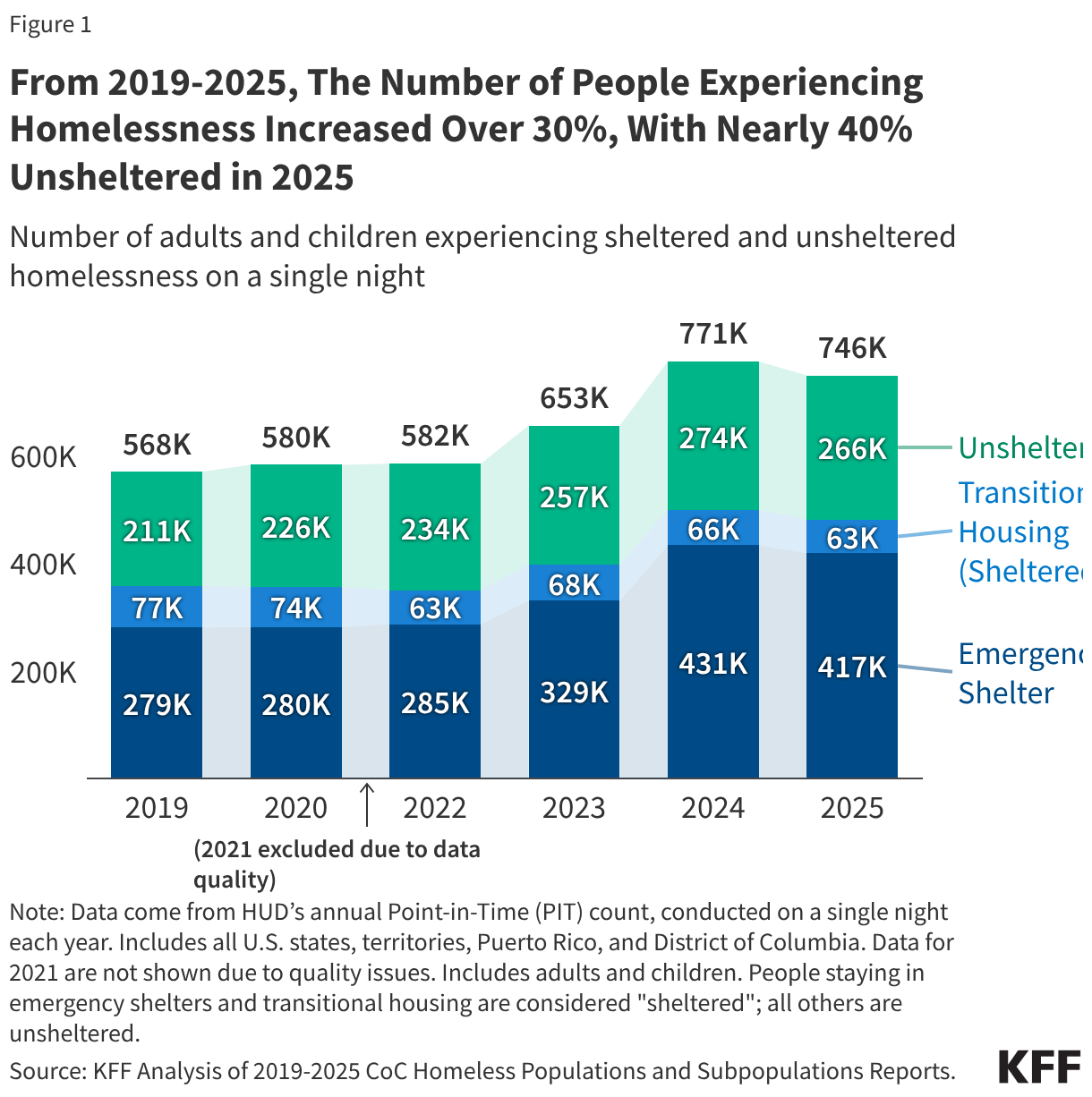
According to the most recent data available from the U.S. Department of Housing and Urban Development (HUD), nearly 746,000 people were experiencing homelessness on a single night in January 2025, an over 30% increase from 2019, but also a 3% decrease from the highest levels ever recorded in 2024. The links between homelessness and health are complex, and past KFF research found that people with prior experiences of homelessness have disproportionate physical and mental health needs and face greater socioeconomic challenges compared to those who have never experienced homelessness. People experiencing homelessness who are unsheltered also experience higher rates of chronic homelessness, chronic disease, mental illness, and substance abuse than those who are sheltered.

This data note reviews trends in homelessness and characteristics of people who are homeless using data from HUD’s Point-in-Time (PIT) count of sheltered and unsheltered people experiencing homelessness. The PIT count is generally conducted on a single night during the last ten days of January. While the PIT count is the primary nationally standardized measure to track trends in homelessness over time, these estimates likely undercount the total number of people experiencing homelessness, particularly among the unsheltered, due to challenges locating individuals who are unsheltered, local staffing capacity, and weather. The PIT count also does not include people who are staying with family or friends, referred to as “doubling up”, in other unstable housing situations, or living in permanent supportive housing.

These data capture a look at homelessness amid a number of federal policy changes aimed at clearing homeless encampments, limiting provisions for housing alternatives, and potentially resulting in institutionalization among people experiencing homelessness. President Trump signed an executive order in July 2025 on homelessness, mental health, and substance use that encouraged states to remove unhoused people from public spaces, following nationwide passage of Supreme Court-backed local laws making it easier for law enforcement to ticket, fine, or arrest people sleeping on public property. HUD proposed to shift homelessness services spending away from “Housing First” programs–which provide immediate housing without preconditions such as sobriety or mandatory mental health treatment—towards “transitional housing” programs, and require local homelessness services entities to cooperate with law enforcement to prohibit homeless encampments, but was blocked by court ruling in June 2026. Most recently, the Department of Justice (DOJ) issued an opinion in June 2026 and a notice in July 2026 challenging the longstanding interpretation of the Olmstead Supreme Court decision, signaling narrower federal enforcement of the integration mandate, which has helped spur state investment in rental assistance, supportive housing, and community services for people with disabilities. These changes could potentially result in fewer community services and increased institutionalization among people experiencing homelessness. 

1. From 2019 to 2025, the number of people experiencing homelessness on a single night increased by over 30% to nearly 746,000 people, with nearly four in ten (36%) staying in unsheltered locations.

The HUD PIT survey counts people experiencing homelessness in both sheltered and unsheltered settings on a single night. People are counted as unsheltered if they sleep in locations not ordinarily used as a regular sleeping accommodation, such as cars, parks, abandoned buildings, or campgrounds. The remainder of people experiencing homelessness were in sheltered locations, with nearly six in ten (56%) staying in emergency shelters and nearly one in ten (8%) in transitional housing, which is temporary housing with supportive services (Figure 1).

Between 2019 and 2025, the number of people experiencing homelessness rose by 31%. This increase was primarily driven by the growth in the number of people staying in emergency shelters and experiencing unsheltered homelessness, while the number of people in transitional housing declined over the same period. According to HUD, rising housing costs and the end of the COVID-19 public health emergency in May 2023, which ended the eviction moratorium and other income and safety net programs, drove recent increases. Counts of people experiencing homelessness peaked in 2024 and then decreased 3% from 2024 to 2025, with nearly 60% of the decrease driven by a reduction in the number of people in emergency shelters.

Beyond shifts in sheltered and unsheltered homelessness, the share of people experiencing homelessness identified as “chronic homelessness”—defined by HUD as having a disability, including physical, mental, developmental, substance use-related, or HIV/AIDS-related disabilities, and experiencing long-term or repeated episodes of homelessness of at least 12 months—increased from 19% in 2019 to 23% in 2025 (from about 106,000 to 170,000). However, the share of adults experiencing homelessness who were veterans fell from 8% in 2019 to 5% in 2025 (from about 37,000 to 33,000), similar to their share of the general adult population (6%). An increase in housing assistance programs from the Department of Veterans Affairs (VA) in recent years likely drove this decrease.

From 2019-2025, The Number of People Experiencing Homelessness Increased Over 30%, With Nearly 40% Unsheltered in 2025 (Stacked column chart)

2. In 2025, over eight in ten (82%) people experiencing homelessness were adults, with decreases in the number of people experiencing homelessness seen across age groups since 2024 except among adults ages 55 and older.

On a single night in January 2025, there were about 612,000 adults and 134,000 children experiencing homelessness, with adults consistently representing about eight in ten of all people experiencing homelessness since 2019 (Figure 2). The number of children experiencing homelessness increased 25% from 2019 to 2025. However, after several years as the fastest-growing age group among people experiencing homelessness, the number of children experiencing homelessness fell 10% (from about 148,000 to 134,000) from 2024 to 2025. Most households with children experiencing homelessness are sheltered, as children made up less than one in ten (4%) unsheltered people in 2025. Housing insecurity during childhood is associated with negative health outcomes later in life, including anxiety and depression. The number of adults experiencing homelessness fell 11% among adults ages 18-24 and 2% among adults ages 25-54 from 2024 to 2025 but increased among those ages 55 and older by 2%. While long-term data for these specific age ranges are not available prior to the 2023 PIT count, research found that adults born between 1955 and 1965 have comprised a disproportionate share of single adults experiencing sheltered homelessness across several decades, suggesting that the aging of this cohort has contributed to the recent rise in adults ages 65 and older experiencing homelessness.  
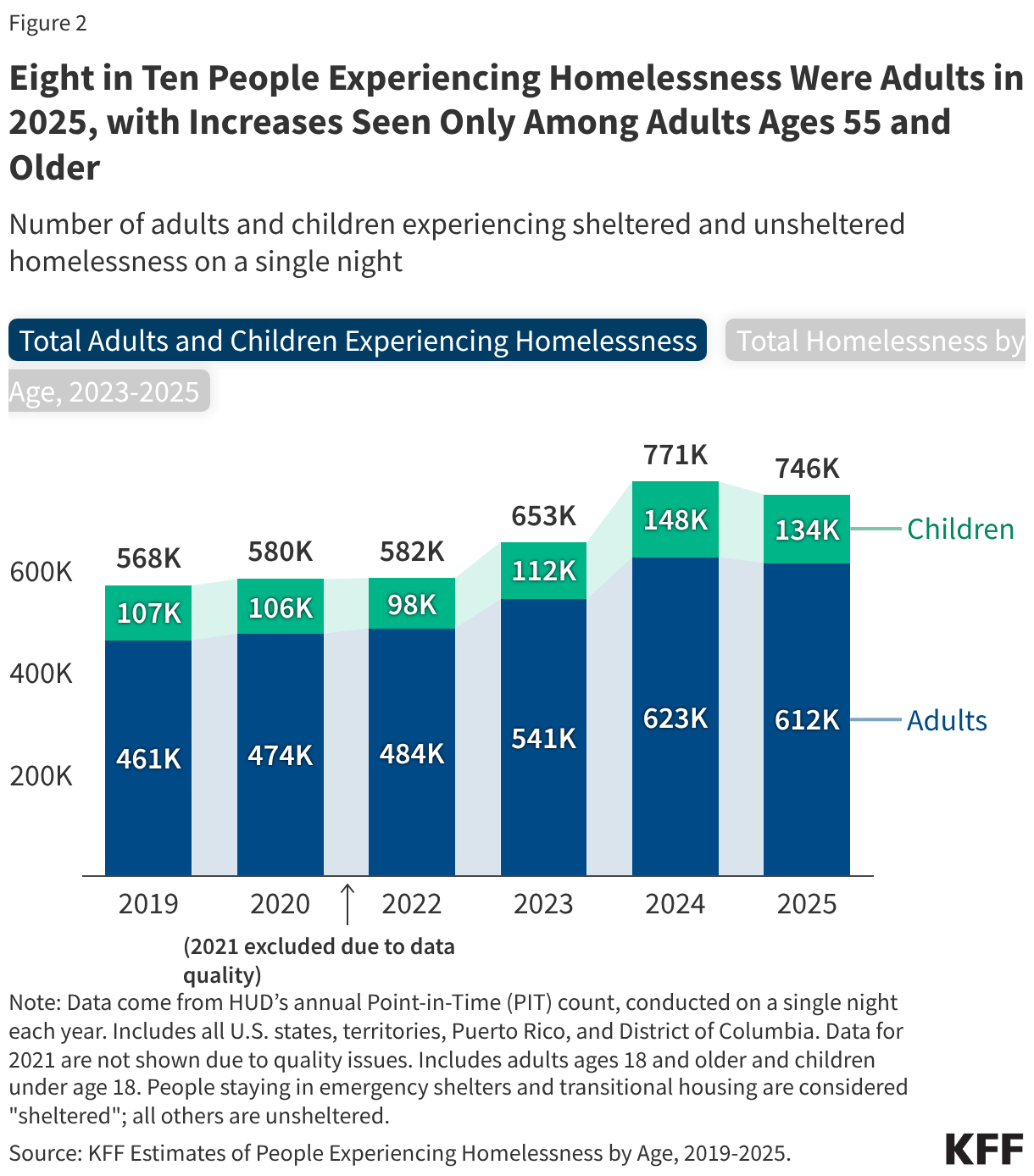
Eight in Ten People Experiencing Homelessness Were Adults in 2025, with Increases Seen Only Among Adults Ages 55 and Older (Stacked column chart)

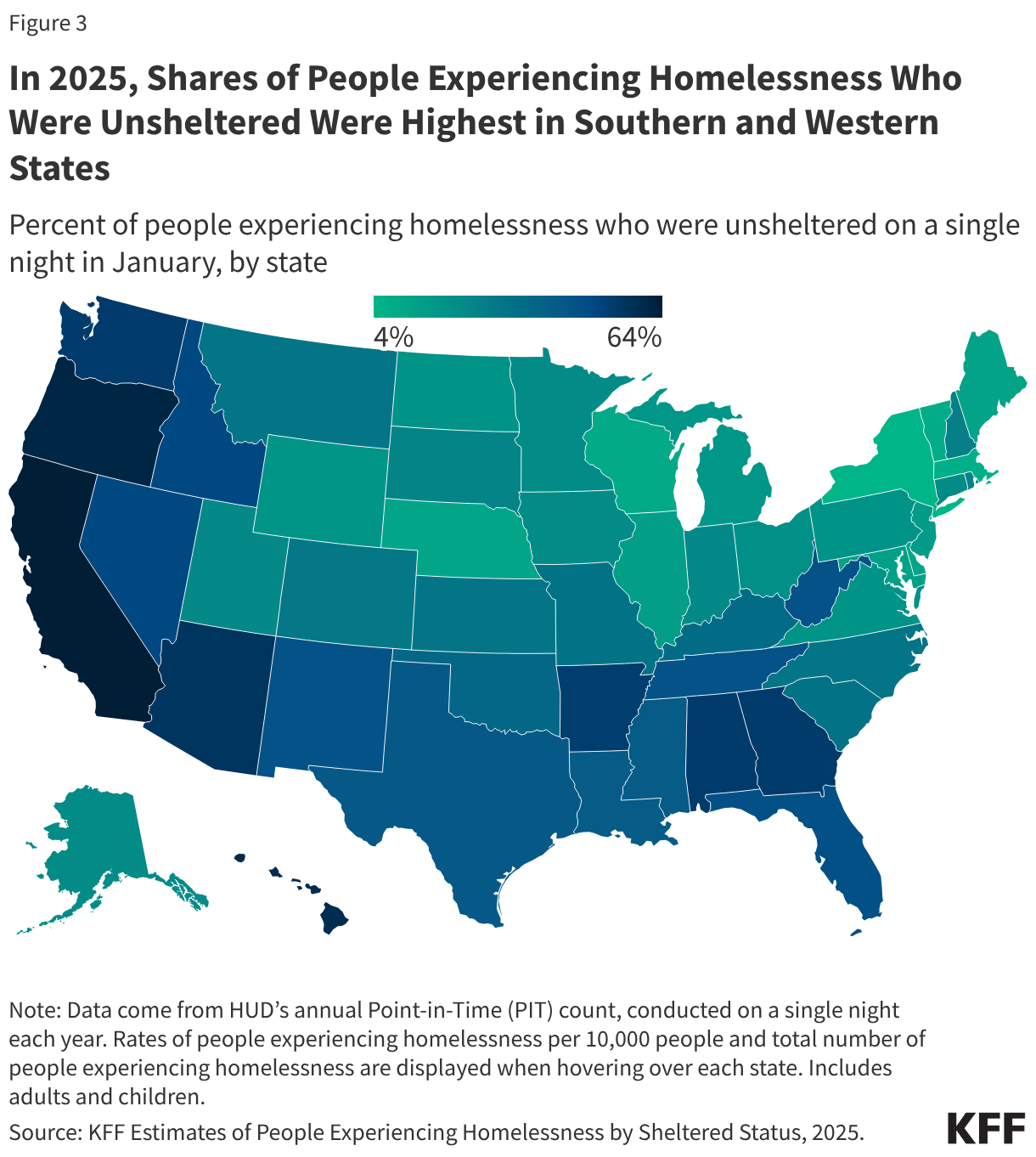
3. In 2025, Southern and Western states had higher shares of people who were experiencing homelessness who were unsheltered compared to other parts of the country.

States in the Northeast and West had higher rates of people experiencing homelessness per 10,000 people than elsewhere in the country on a single night in January 2025 (Figure 3). The share of people experiencing homelessness who were unsheltered by state were highest in Southern and Western states, including in California (64%), Oregon (61%), Arizona (56%), and Georgia (54%). In contrast, the shares of people experiencing homelessness who were unsheltered were lowest in New York (4%) and Massachusetts (6%), despite these states having relatively high rates of people experiencing homelessness per 10,000 people. These patterns may reflect a combination of local factors, including climate, housing costs, shelter capacity, right to shelter laws, and law enforcement policies that bring more people into emergency shelters or other sheltered housing.

In 2025, Shares of People Experiencing Homelessness Who Were Unsheltered Were Highest in Southern and Western States (Choropleth map)

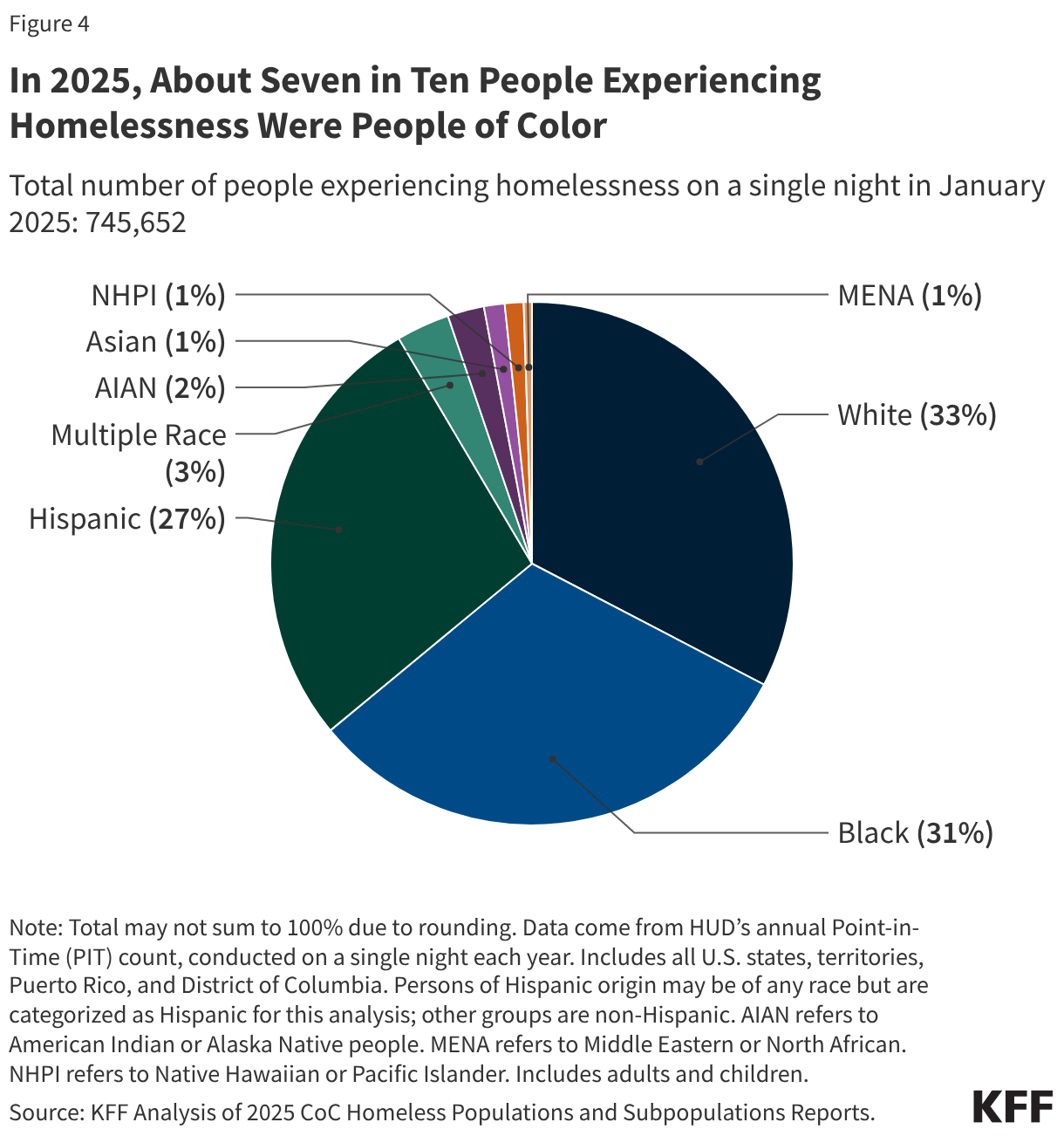
4. In 2025, about seven in ten (67%) people experiencing homelessness were people of color.

White (33%), Black (31%), and Hispanic (27%) people each accounted for about three in ten of people experiencing homelessness on a single night in January 2025, with other racial and ethnic groups making up smaller shares (less than 5%) (Figure 4). Black, Hispanic, AIAN, and NHPI people made up a disproportionate share of the people experiencing homelessness compared to their share of the total population.

In 2025, About Seven in Ten People Experiencing Homelessness Were People of Color (Pie Chart)

5. From 2019 to 2025, the share of adults experiencing homelessness with serious mental illness (SMI) or substance use disorder (SUD) remained stable, suggesting that rising homelessness reflects broader factors affecting both people with and without these conditions.

In 2025, about a quarter (24%, or 146,000) of adults experiencing homelessness on a single night in January met HUD’s SMI definition and nearly one in five (18%, or 112,000) had SUD according to HUD’s definition in the point-in-time count, about a 1% decrease from 2019 (Figure 5). SMI and SUD often co-occur—about one-quarter of people with SMI also have an SUD—but HUD’s publicly available data do not report the overlap of these conditions. The prevalence of SMI and SUD represents an outsized share of the population of adults experiencing homelessness as about 5-6% of adults overall have SMI according to the National Survey of Drug Use and Health (NSDUH) and 3% of adults in the general population meet NSDUH criteria for severe SUD. While homelessness among adults increased sharply from 2019 to 2025, the share of adults with SMI or SUD changed little, suggesting the increase was not concentrated among people with behavioral health conditions, and likely reflects broader pressures, such as rising housing and living costs. A Government Accountability Office (GAO) report found that a $100 increase in median rental price was linked to a 9% increase in estimated homelessness rate. Other research found increases in the number of people experiencing homelessness from 2019 to 2024 were more strongly associated with reductions in eviction moratoriums and climate-related events.
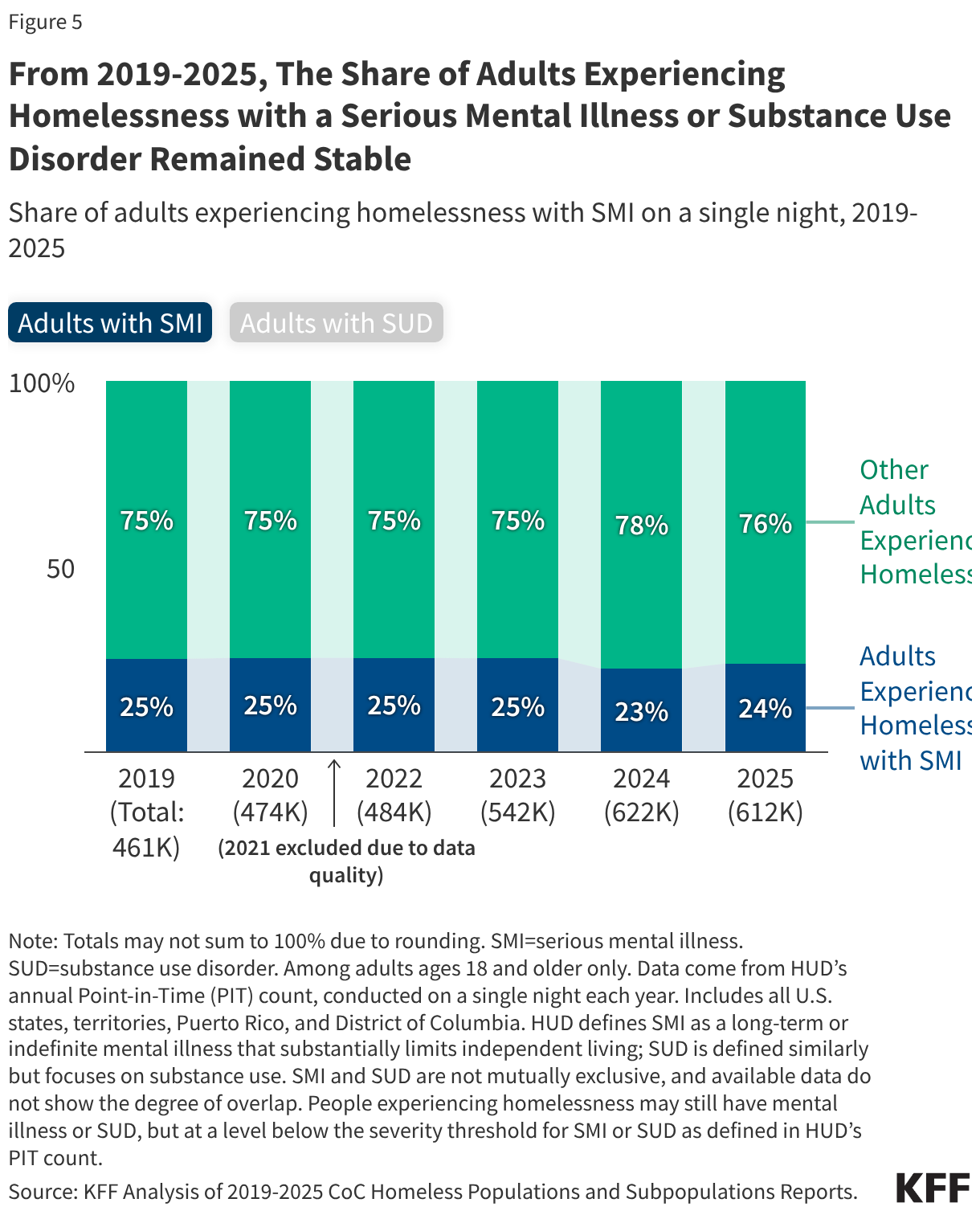
From 2019-2025, The Share of Adults Experiencing Homelessness with a Serious Mental Illness or Substance Use Disorder Remained Stable (Stacked column chart)