What’s The Role of Private Health Insurance Today and Under Medicare-for-all and Other Public Option Proposals?

Published: Jul 30, 2019

Introduction

The role of private health insurance under Medicare-for-all and other proposals has emerged as a prominent issue in the Democratic primary and an important issue for voters. Candidates are debating what role private insurance should have in the U.S. health care system and the implications of such a change for individuals across the country.

For more than two years KFF polling has found a majority of the public favoring a national Medicare-for-all plan with the most recent poll finding a slight dip in support with about half the public (51%) now saying they favor Medicare-for-all.  However, surveys also show most people do not have a clear understanding about the current Medicare-for-all proposals, and how they might change the nature of coverage people have today. For example, based on a poll fielded in early 2019, 55% of the public think that they and their families would be able to keep their current health insurance under Medicare-for-all; 54% think they would continue to pay health insurance premiums and 69% think they would continue to pay deductibles and copays for covered health services.  Public opinion is malleable in response to additional information and arguments about Medicare-for-all.  Support for Medicare-for-all increases to 67% when people hear it would eliminate insurance premiums and reduce out-of-pocket health costs, and increases to 71% when people hear it would guarantee health insurance as a right for all Americans, but drops to 37% when people hear Medicare-for-all would eliminate private health insurance.

What’s the role of private insurance today and how would it change under Medicare-for-all and other public option proposals? This new @KaiserFamFound brief explores the issues

This brief begins by examining the role that private insurers play in providing health coverage for Americans today, not only in employer plans and the individual insurance market, but also in Medicare and Medicaid. It then discusses how that would likely change under Medicare-for-all and other proposals and summarizes evidence on consumers’ experiences with private insurance.

Current Role of Private Health Insurance in the U.S.

Today, the majority of the U.S. population have some form of coverage delivered by a private health insurer. This includes: non-elderly people with employer-sponsored coverage or individually purchased health insurance plans; low-income Medicaid enrollees covered by managed care organizations; people age 65 and older and younger adults with disabilities in Medicare Advantage plans; and people in traditional Medicare who also have private insurance, such as Medicare part D stand-alone prescription drug plans, supplemental (Medigap) policies, or employer-sponsored retiree health coverage.

The following coverage estimates are the most current data available for each category of private insurance. These data points cannot be summed because they derive from different sources, from different years, and because some people have private insurance from multiple sources.

Employment-based coverage accounts for the largest share of people in the U.S. with private insurance. In 2017, 153 million non-elderly people had private, employer-sponsored health coverage. Typically, employers pay most of the premium on behalf of employees and their dependents – on average 82% of the premium for single coverage and 71% for family coverage. Employees and their families are typically responsible for deductibles and other cost-sharing requirements. The Affordable Care Act (ACA) requires large employers to provide full-time workers and their dependents health coverage that meets minimum standards for affordability and coverage value or pay a penalty. Although not mandated by law, a majority of small firms offer health benefits.

Non-group, individually purchased coverage is another source of private health insurance. An estimated 14 million people had private insurance coverage in the non-group market (also known as the individual market) in the first quarter of 2018. Of this total, roughly three-quarters purchased coverage through the ACA Marketplaces, where subsidies are available to eligible individuals with incomes between 100% and 400% of the federal poverty level (FPL). Most non-group plans are ACA compliant, meaning they must cover essential health benefits and cannot discriminate based on a person’s pre-existing condition; however, recent regulatory changes have made health plans that do not comply with the ACA consumer protections increasingly available in the individual market outside the Marketplaces.

The majority of Medicaid enrollees have coverage provided by managed care plans under contract with each state’s Medicaid program. Two thirds of all Medicaid enrollees (54 million) were enrolled in Medicaid managed care organizations (MCOs) as of July 2017 in the 38 states and DC that contract with Medicaid managed care organizations to deliver services to at least some beneficiary populations (e.g. children, parents, ACA expansion adults). MCOs generally provide all covered services to enrollees, but states may carve out specific services from MCO contracts (e.g. long-term care, dental, or behavioral health) and deliver these through fee-for service systems or limited benefit health plans. Medicaid MCOs are subject to broad federal and state standards and beneficiary protections. Federal standards prohibit premiums for most Medicaid enrollees, unless permitted under a demonstration waiver. Federal rules also prohibit deductibles and allow nominal cost-sharing for non-exempt enrollees. Payments to Medicaid MCOs totaled nearly $264 billion in FY 2017, accounting for about 46% of total Medicaid spending. While states contract with private plans, not all enrollment and spending is for private managed care plans. For example, California has a number of public county-operated health plans.

A growing share of Medicare beneficiaries are enrolled in Medicare Advantage plans, such as HMOs and PPOs, which are sponsored by private insurers and paid by the federal government to provide Medicare-covered services. Among the more than 60 million people now covered by Medicare, about one-third (22 million in 2019) are in a Medicare Advantage plan. Medicare Advantage plans are required to provide all Medicare-covered services, and are subject to federal standards with respect to benefits and cost-sharing requirements, and network adequacy. Many also provide additional benefits, such as dental, vision and gym memberships. Medicare Advantage plans receive capitated, risk adjusted payments from the federal government to provide Medicare-covered services, exceeding $250 billion in 2019, sometimes supplemented by beneficiary premiums. The Congressional Budget Office (CBO) projects nearly half of all Medicare beneficiaries (47 percent) will be in a Medicare Advantage plan by 2029.

The majority of people in traditional Medicare have additional coverage provided by one or more private plan sponsors. For example, 25 million Medicare beneficiaries in traditional Medicare are enrolled in private stand-alone Part D prescription drug plans. Enrollees typically pay an additional premium for this coverage, unless they qualify for low-income subsidies, and have cost-sharing requirements that vary across plans. In addition, nearly 20 million beneficiaries in traditional Medicare had private supplemental coverage in 2016, including 9.5 million traditional Medicare beneficiaries who purchased Medicare supplemental insurance (Medigap) policies in 2016, and another 9.6 million Medicare beneficiaries with private, employer or union-sponsored retiree health benefits that year.

Treatment of Private Insurance under Medicare-for-all and Other Public Plan Option Proposals

The role of private health insurance in the U.S. would vary across the range of proposals under discussion that establish a public program to broaden coverage and make health care more affordable.  Medicare-for-all proposals would have the most far-reaching effect; under some current Medicare-for-all proposals, the new public program would replace virtually all sources of private health insurance. Other proposals would establish a public option, but retain private insurance, with wide variation across proposals in the extent to which coverage would shift from private insurance to a public plan.

Under Medicare-for-all approaches proposed by Senator Bernie Sanders (S.1129) and Representative Pramila Jayapal (H.R.1384), all U.S. residents would be covered under a public program that provides comprehensive benefits, with no premiums or cost-sharing requirements.  Both Medicare-for-all bills would prohibit employers and private health insurers from offering coverage that duplicates Medicare-for-all covered benefits. The bills would permit supplemental insurance. However, because Medicare-for-all covered benefits would be comprehensive, the market for insurance to cover supplemental benefits likely would largely be limited to nursing home care, and only under the Senate bill, since the House bill covers institutional long-term care.

The Sanders Medicare-for-all bill would permit private contracting between health care providers who do not participate in the universal Medicare program and patients, and allow private insurance to cover these costs – a practice that is generally prohibited under the House bill. As a result, under the Sanders bill, there could also be a continued role for private insurance to cover or defray the cost of care for people who can afford to privately contract for medical care. Recognizing the likely impact on the private insurance workforce, both Medicare-for-all bills would set aside 1% of all national health expenditures per year for the first five years to offset anticipated economic dislocation of private health insurance and billing industry employees.

Under another approach, Medicare for America (H.R. 2452), all U.S. residents would be covered under the public program unless they opted out for a qualified employer plan. Medicare for America would maintain a role for private insurance by allowing employers to offer qualified health plans. It would however, eliminate private insurance sold through the individual market. Individuals covered under Medicare for America would also have the option to enroll in Medicare Advantage for America plans, building on the private insurance approach permitted under the current Medicare program. Today, for example, Medicare Advantage plans are offered in most, though not all, counties in the US.

Other proposals on the pathway to universal coverage would establish a public plan option and leave the current private health insurance system largely intact. The implications for private insurance would vary depending on a number of factors. For example, proposals that allow employers to choose to cover their employees under the public program would be more likely to diminish the role of private insurance than proposals that limit eligibility to people buying their own insurance. Likewise, proposals that allow employees in firms that offer group coverage to opt instead for the public plan could shift the balance between public and private insurance, particularly if such employees are eligible for subsidies under the public plan.

Several candidates running in the 2020 presidential race have addressed the role of private insurance in one way or another. In addition to the Sanders’ Medicare-for-all approach, co-sponsored by several presidential candidates, others have introduced proposals that would retain a role for private insurance while establishing a new public program or public plan option. Senator Kamala Harris’ new proposal would also establish a Medicare-for-all program, but it would allow private insurers to offer plans, modeled on Medicare Advantage, through the public program, and allow employers to provide a private Medicare plan to their employees. Former Vice President Joe Biden’s proposal would build on the architecture established by the Affordable Care Act (ACA) to create a government-sponsored public plan option available to employees, those in the individual market, and those currently in the Medicaid coverage gap, while retaining job-based coverage, Medicare and Medicaid. Other candidates, such as Senator Michael Bennet would create a new public plan option that would be available only to people who get their insurance through the ACA Marketplaces, alongside other private insurance options.

The level of provider payment rates used by the public plan could also influence the distribution of public and private insurance, and the competitiveness of private insurance against the new public option. All other things equal, if provider payment rates  were lower under the public plan than under private insurance, then the public plan would be expected to have lower premiums – assuming similar benefits and no selection effects.

Consumer Experiences with Private Health Insurance

In general, the public reports relatively high rates of satisfaction with their health insurance coverage, both in private insurance and public programs. At the same time, surveys and other studies document problems encountered by people that are somewhat unique to private insurance, relating to high cost-sharing, narrow provider networks, surprise medical bills, and lack of continuity of coverage. Because Medicare Advantage and Medicaid managed care plans are highly regulated, relatively speaking, these issues tend to be more prominent in employer and individually-purchased coverage. These issues also tend to disproportionately affect people in relatively poor health with significant medical care needs, who use their insurance more, and people with modest incomes and limited resources to cover unanticipated expenses.

  • High deductibles — High deductibles and other cost-sharing requirements have become prevalent in private health plans offered by employers and in the non-group market. For employer plans, in 2018 the average single deductible was $1,573 for those who have one, and 26% of covered workers were in plans with deductibles of $2,000 or higher. Deductibles in job-based health plans have risen at eight times the rate of workers’ earnings in the past decade. In the non-group market, nearly all ACA Marketplace plans have deductibles of $1,000 or higher, although half of all consumers who buy non-group coverage through the ACA Marketplaces qualify for cost-sharing subsidies.Consumers in high-deductible health plans are more likely to experience problems paying their out-of-pocket medical bills and are less satisfied with their coverage. According to a recent KFF/LA Times survey, two-thirds of consumers in high-deductible job-based plans say they could not pay a bill equal to their deductible at all or without borrowing or going into debt. Among people in employer plans with the highest deductibles, over half (55%) give their plan a grade of C or lower. And, 40% of people with employer coverage say they or someone in their family experience one or more health care affordability challenges in the last year.High deductibles are not generally a feature of Medicare Advantage plans; however, in traditional Medicare, the Part A deductible is $1,364 per benefit period, the Part B deductible is $185 and the standard Part D deductible is $415 in 2019, although some Part D plans have lower or no deductibles. Deductibles are not permitted in Medicaid.
  • Provider networks – Private health plans typically create networks of providers to negotiate the prices they pay. In PPO plans, patients pay lower cost-sharing if they receive care from network providers. In HMO plans, patients can only see network providers.Unlike traditional Medicare, which includes virtually all doctors and hospitals, private plans generally exclude some or many providers in an area, and may offer employers and non-group purchasers choices of more or less restrictive network options.  Networks with fewer available providers may have lower costs (because insurers can bargain more aggressively on the terms of inclusion), but also reduce patient provider choice at the point when they need care. The use of provider networks, which is necessary to make private insurance work, creates some issues for enrollees, including limited choice of providers, disruption of care continuity if an enrollee changes plans (and networks) or a provider leaves the network, and surprise medical bills (discussed more fully below).Medicare Advantage plans are subject to federal minimum standards with respect to provider network adequacy, but many have limited provider networks. On average, Medicare Advantage plan physician networks included less than half (46%) of all physicians in a county, and about one in three (35%) Medicare Advantage enrollees were in plans with narrow physician networks; one in six Medicare Advantage plans had narrow or ultra-narrow hospital networks.With respect to Medicaid MCOs, federal rules require that states establish network adequacy standards.  States have a great deal of flexibility to define those standards. Medicaid MCOs may use narrow networks but must comply with established network adequacy standards.
  • Surprise medical bills – In any type of network plan, patients sometimes receive care from hospitals and doctors they do not choose and are not in their plan’s network. So-called surprise medical bills can arise in emergencies—18% of emergency claims by people covered under large group health plans involved at least one out-of-network bill.  However, planned care can also involve surprise bills, such as when a pregnant woman chooses to deliver at an in-network hospital, but the on-call anesthesiologist is out-of-network—16% of in-network hospital claims by people covered under large group health plans involved at least one out-of-network bill.While people with private insurance HMOs can be charged unlimited amounts for out-of-network care, people in Medicare Advantage HMOs who see out-of-network providers can only be charged what the provider would receive from traditional Medicare. Medicaid MCOs must adequately and timely cover services out-of-network at no more than in-network cost to enrollees, if the services cannot be provided in-network, including emergency care.
  • Coverage continuity – Each month, many people lose or transition to new commercial coverage because they leave, lose, or change jobs. Even with no change in employment status, one’s group health benefits can change if an employer changes the plans it offers to employees. Disruptions in health insurance coverage can lead to disruptions in medical care, which could in turn have health consequences, lead to higher out-of-pocket costs, and cause stress for consumers.In 2018, 61% of all firms offering health benefits shopped for a new health plan or health insurance carrier and, of those, 25% changed plans/carriers. Turnover in non-group coverage is higher.  In 2016, 30% of enrollees were new to the market, and another 25% had switched from a different non-group plan the prior year. People who switch plans in the ACA Marketplaces changed coverage for a variety of reasons – for example, to find a lower premium or a plan that covered their doctor or because the prior plan was cancelled.Medicare Advantage enrollees generally have the option of remaining covered by the same plan, switching to a new Medicare Advantage plan, or switching to traditional Medicare program during the annual open enrollment period. The majority of Medicare Advantage enrollees do not voluntarily switch plans during the open enrollment period; however, enrollees with significant medical needs, enrollees who are under age 65 with significant disabilities, and enrollees with low incomes tend to disenroll from their private plan and switch to traditional Medicare at higher than average rates.For Medicaid, enrollees in mandatory managed care arrangements must be given a choice of at least two plans (with certain exceptions). Enrollees have the right to change plans “without cause” within 90 days of enrolling in the plan, and every 12 months thereafter, and can change plans for cause at any time. However, continuity/transition issues may occur if/when plans end their contract in a state and when enrollees move on and off the Medicaid program due to changes in income.

Discussion

Evidence shows the public is generally satisfied with their health insurance coverage, which may explain why the question of how private insurance is treated under Medicare-for-all and public plan option proposals has become a contentious issue in the Democratic primary and influences public opinion.  At the same time, there are growing concerns that people with private insurance encounter problems with their coverage, including high deductibles, surprise medical bills, narrow networks, denials, and other affordability challenges – problems that would be addressed under some Medicare-for-all proposals, as currently drafted. About half of the public support Medicare-for-all; yet, the idea of being required to give up private insurance for a new national health program clearly makes people nervous. The United States is an outlier among high-income countries in its lack of universal coverage. However, even in countries that have achieve universal coverage through some form of single-payer health care system, there is typically a role for private insurance in providing supplemental coverage.

Today, there is broad support among Democratic presidential candidates for expanding access to public health insurance programs, like Medicare.  Some favor a new Medicare program that will replace most or all current private coverage and promise affordability and coverage continuity that private insurance today does not always deliver, with the trade-off of higher taxes and substantial disruption to the current system.  Others favor a new Medicare option that can offer advantages over private insurance but not eliminate private coverage altogether, requiring less new federal spending but also continued premiums and cost sharing for many.  As the debate continues, it remains to be seen how effectively candidates and other advocates can educate the public about the specifics of their proposals and about the relative merits of providing health coverage through a public plan versus a system of competing public and private plans, and how well voters will come to understand the trade-offs involved.
News Release

Poll: Strong Initial Support for a Public Option, But Arguments Can Significantly Shift Views

Majorities View Private Employer-Sponsored Coverage Favorably And Rate Their Own Employer Coverage As Either Excellent or Good

Published: Jul 30, 2019

Health Care Remains a Top Issue for Democrats Heading into Next Debates; At This Stage, More Want to Hear About Candidates’ Difference than Contrasts with President Trump

The 2020 presidential election may be shaping up to be another election cycle focused on health care, with Democratic candidates offering competing proposals aimed at expanding coverage and controlling costs and a pending legal battle over the constitutionality of the Affordable Care Act.

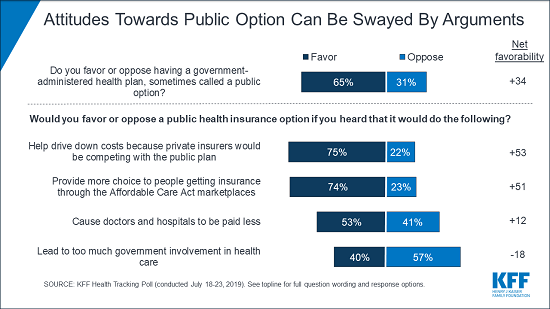
The latest KFF tracking poll takes a closer look at the public’s views on a “public option” that would compete with private insurance. Consistent with other polling showing the public likes choice and competition, the new poll finds two-thirds (65%) of the public – including most Democrats (85%) and independents (68%) – say they support a public option. Most Republicans (62%) oppose a public option.

Similar to previous KFF polling on Medicare-for-all, the new poll finds that attitudes towards a public option can swing significantly, depending on what arguments people hear.

For example, support climbs as high as 75% when people hear the argument made by supporters that it would help drive down costs because private insurers would be competing with a public option. On the other side, support falls to 40% when people hear the argument made by opponents that it would lead to too much government involvement in healthcare.

Support for Medicare-for-all Dips Slightly, Though Half of Public Remains Supportive

This month’s poll found a modest drop-off in support for a national Medicare-for-all plan that would cover all Americans. About half (51%) of the public say they support a national Medicare-for-all plan, down slightly from April (56%) and down 8 percentage points from its peak in March 2018 (59%). A majority of Democrats (72%) and independents (55%) still favor such a plan.

In addition, as in previous KFF polls, a larger share of Democrats and Democratic-leaning independents say that they would prefer building on the Affordable Care Act (ACA) to expand health coverage to more Americans (55%) than replacing the ACA with a national Medicare-for-all plan (39%).

The small dip in Medicare-for-all support may reflect recent debate over the role of private insurance, including employer-sponsored coverage, which would largely disappear under the leading Medicare-for-all plans but would continue under a public option.

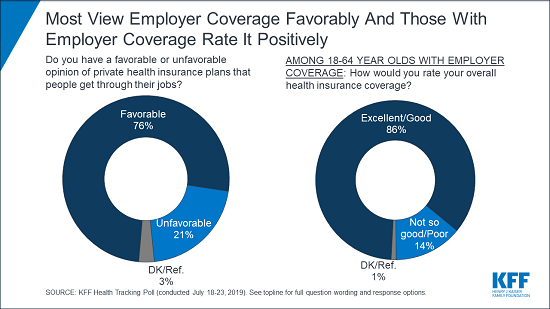
Three-quarters (76%) of the public views employer-sponsored health coverage favorably. Among people covered through employer plans, the vast majority rate their coverage as either “excellent” (36%) or “good” (50%), while small shares say it is “not so good” (10%) or poor (4%).

Medicare, the program – and the word used in Medicare-for-all – is also popular, with 83% of the public viewing it favorably. In addition, nearly everyone with Medicare rates their coverage as either excellent (48%) or good (47%).

A separate brief examines the role private insurers play in providing health coverage for Americans today in employer plans and the individual market, as well as in Medicare and Medicaid, and how that would likely change under Medicare-for-all and other proposals.

Health Care Remains a Top Issue for Democrats Heading into This Week’s Debates

Ahead of the second round of debates for Democratic presidential candidates, the poll finds health care remains a top issue for Democrats and Democratic-leaning independents. Among this group, more than eight in 10 (83%) say it is “very important” that the candidates talk about health care. Other top issues include climate change (76%), issues affecting women (71%), and immigration (69%).

On health care, Democrats and Democratic-leaning independents are more likely to say they want the candidates to focus more on their differences with each other (51%) than on their difference with President Trump (38%).

Among those who cite issues affecting women as important for the candidates to discuss, the largest share name abortion and reproductive health issues as their main concern (33% overall), while nearly as many cite equal pay issues (30%). Fewer cite equal treatment or equal rights (17%), women’s health care issues other than reproductive health (12%), other workplace issues (7%), or violence against women and sexual assault (7%).

If the Courts Overturn the ACA, Large Majorities across Parties Want to Retain Key Elements

A federal appeals court earlier this month heard arguments in a case backed by the Trump Administration and many Republican state attorneys general that seeks to overturn the entire Affordable Care Act. The poll finds most of the public wants to preserve key parts of the law that protect consumers, expand coverage and limit out-of-pocket costs.

Large majorities – including most Republicans – say it is “very important” to them that the provisions prohibiting insurers from denying coverage to people with pre-existing conditions coverage (72%) and charging sick people higher premiums than healthy people (64%) be kept in place.

Majorities – including about half of Republicans – also say it is “very important” to keep the ACA provisions prohibiting insurers from denying coverage to pregnant women (71%) or setting lifetime dollar limits on coverage (62%), as well as requiring insurers to cover the full cost of most preventive services (62%).

Designed and analyzed by public opinion researchers at KFF, the poll was conducted July 18-23, 2019 among a nationally representative random digit dial telephone sample of 1,196 adults. Interviews were conducted in English and Spanish by landline (296) and cell phone (900). The margin of sampling error is plus or minus 3 percentage points for the full sample. For results based on subgroups, the margin of sampling error may be higher.

News Release

As the Ebola outbreak in the DRC continues, new KFF explainer examines the status of the response and the limited U.S. role to date

Published: Jul 29, 2019

The ongoing Ebola outbreak in the Democratic Republic of Congo (DRC), recently declared a “public health emergency of international concern” by the WHO Director-General, is now second only to the West Africa outbreak of 2014-2015 in terms of number of cases and deaths. A new KFF explainer reviews the history of the outbreak in the DRC, which U.S. agencies are involved, how U.S. personnel are assisting, global response activities, and the role of vaccination in controlling the outbreak.

U.S. engagement has been limited compared to the 2014-2015 West Africa outbreak, where the U.S played a leading role and mobilized an unprecedented amount of funding and personnel. The U.S. has chosen a more limited role in this outbreak due to security concerns as well as improvements in global capacity to respond to Ebola. So far, the U.S. has contributed $136 million for the response.

The explainer also discusses how the U.S. government might change its approach and engagement in the DRC going forward, such as by providing additional funding or allowing U.S. government personnel to work directly in the outbreak zone.

News Release

Explainer Video Breaks Down Prescription Drug Rebates and Why They Matter in the Debate About Prescription Drug Costs

Published: Jul 26, 2019

A new KFF animation explains how rebates for prescription drugs work, including how they are determined, who benefits from them, how they affect spending by insurers and consumers and the role of pharmacy benefit managers in the process.

The Trump Administration had proposed banning such rebates in Medicare Part D, but dropped the proposal amid concerns that it would lead to higher costs for insurers, consumers and the Medicare program. It is still possible that policymakers could make changes to the rebate system, but they’re also talking about many other ways to lower drug costs.

Visit kff.org to view the animation and see other KFF research and data on prescription drugs.

Prescription Drug Rebates, Explained

Published: Jul 26, 2019

This animation explains how rebates for prescription drugs work and why they matter in the debate about lowering drug costs. The video breaks down how prescription drug rebates are determined, who benefits from them, how they affect spending by insurers and consumers and the role of pharmacy benefit managers in the process.

The Trump Administration had proposed banning such rebates in Medicare Part D, but dropped the proposal amid concerns that it would lead to higher costs for insurers, consumers and the Medicare program. It is still possible that policymakers could make changes to the rebate system. They are also talking about many other ways to lower drug costs.

The animation is part of a broad collection of KFF analysis and data on prescription drugs.

News Release

Among People with Employer Coverage, Those with Persistently High Spending for Several Years Averaged Almost $88,000 in Health Spending in 2017    

Prescription Drugs Accounted for almost 40 Percent of Costs for People with Persistently High Spending

Published: Jul 24, 2019

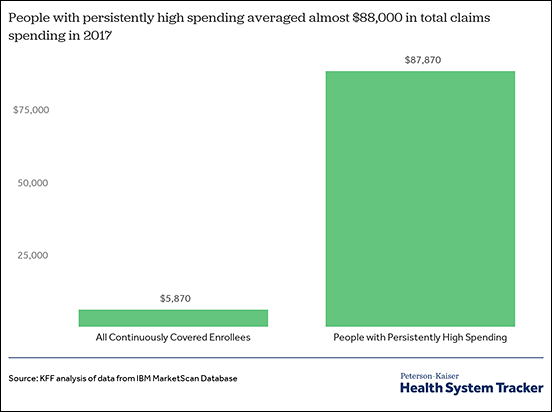
Among people with three consecutive years of coverage from a large employer, just 1.3 percent of enrollees accounted for 19.5 percent of overall health spending in 2017, finds a new KFF analysis. These “people with persistently high spending” – people in the top five percent of spending in each of the three years from 2015 to 2017 – had average health spending of $87,870 in 2017. That compared to average per person spending of $5,870 among all large group enrollees during that period.

Spending on retail prescription drugs accounted for almost 40 percent of spending for those with persistently high spending in 2017, more than twice the percentage for enrollees overall.  People with persistently high spending averaged over $34,100 in spending on retail prescription drugs (not including rebates) in 2017, compared to $1,290 for enrollees overall, the analysis finds.  This underscores the importance of prescription drugs in treating people with chronic illnesses as well as the fact that some drugs have very high prices.

The analysis also finds a close association between having persistently high spending and being diagnosed with certain chronic health conditions such as HIV, multiple sclerosis, cystic fibrosis, rheumatoid arthritis, diabetes with complications, and a number of cancers. While not everyone with these conditions has persistently high spending, there are large shares of people with persistently high spending who have these diseases.

Overall, health spending is highly concentrated: a small share of people account for most health care spending in any year. This group changes from year to year as some people experience serious illness and recover, but a portion of the group continues to have high spending for longer periods.  Their extensive health needs and predictably high spending make them an important focus for any efforts to lower costs and improve quality.

Donor Government Funding for HIV in Low- and Middle-Income Countries in 2018

Authors: Jennifer Kates, Adam Wexler, Eric Lief, and Joint United Nations Programme on HIV/AIDS (UNAIDS)
Published: Jul 24, 2019

Key Findings

This report provides an analysis of donor government funding to address HIV in low- and middle-income countries in 2018, the latest year available, as well as trends over time. It includes both bilateral funding from donors and their contributions to the Global Fund to Fight AIDS, Tuberculosis and Malaria (Global Fund) and UNITAID. Key findings include the following:

  • DONOR GOVERNMENT FUNDING FOR HIV CHANGED LITTLE BETWEEN 2017 AND 2018. Disbursements were US$8.0 billion in 2018, compared to $8.1 billion in 2017, in current dollars (after accounting for inflation and exchange rate fluctuations, funding declined slightly in 2018 compared to 2017).1  Seven of 14 donor governments increased disbursements between 2017 and 2018 (Australia, Canada, France, Japan, the Netherlands, Norway, and Sweden), five declined (Denmark, Ireland, Italy, the U.K., and the U.S.; the U.S. decline was due to timing of Global Fund payments – see below) and two were flat (the European Commission and Germany).
  • BILATERAL SUPPORT FROM DONORS DECLINED SLIGHTLY IN 2018. Bilateral disbursements decreased by $163 million in 2018, to $6.2 billion compared to $6.3 billion in 2017. Four donors increased bilateral support (Australia, Canada, the Netherlands, and Sweden), five decreased (Denmark, Ireland, Italy, the U.K. and the European Commission) and five were flat (France, Germany, Japan, Norway, and the U.S.).
  • CONTRIBUTIONS TO THE GLOBAL FUND AND UNITAID REMAINED STEADY. These totaled US$1.8 billion (after adjusting for an HIV share to account for the fact that the Global Fund and UNITAID address other diseases), compared to US$1.7 billion in 2017. Funding for the Global Fund was $1.7 billion; funding for UNITAID was $103 million. Nine of 14 donors increased their multilateral contributions, while one, the U.S., decreased and four remained flat (Canada, Germany, Ireland and the Netherlands). The U.S. decline was due to timing of payments and is expected to reach the same level as the prior year.
  • THE U.S. CONTINUES TO BE THE LARGEST DONOR TO HIV, EVEN AFTER ADJUSTING FOR THE SIZE OF ITS ECONOMY. In 2018, the U.S. disbursed US$5.8 billion, followed by the U.K. (US$605 million), France (US$302 million), the Netherlands (US$232 million), and Germany (US$162 million). The U.S. also ranked first when standardized by the size of its economy, followed by the Netherlands, Denmark, and the U.K.
  • FUNDING FROM DONOR GOVERNMENTS IN 2018 WAS SIGNIFICANTLY BELOW ITS PEAK IN 2014. Funding from donor governments rose rapidly from 2002 through 2008, marking the start of major new global HIV initiatives. It leveled, and even decreased, at the onset of the global financial crisis. After a short rebound, it reached its peak in 2014. Funding in 2018 was more than $600 million below 2014 levels.
  • OVER THE PAST DECADE, FUNDING FROM DONOR GOVERNMENTS, OTHER THAN THE U.S., DECLINED. Since 2010, HIV funding from donor governments, other than the U.S., declined by more than $1 billion, against a backdrop of budget constraints in the aftermath of the global financial crisis, as well as rising refugee and other humanitarian emergency costs. Most of the decline ($945 million) can be attributed to decreased bilateral support for HIV. However, while there were some increases in total funding provided to the Global Fund (for all three diseases) by these donors, they did not offset bilateral declines, and their overall UNITAID contributions went down. Moreover, after adjusting for an HIV share, multilateral contributions also declined over the period.
  • FUTURE FUNDING FROM DONOR GOVERNMENTS FOR HIV IS UNCERTAIN. If these trends continue, future funding from donor governments is likely to remain stable at best and will hinge largely on future U.S. support as well as the next three-year replenishment period for the Global Fund. In the case of the U.S., Congressional appropriations in 2019 were essentially flat, and the PEPFAR funding pipeline has diminished, which could lead to decreasing bilateral disbursements over time. There is also uncertainty about the U.S. pledge to the Global Fund, although the Congress has indicated its intention to increase support.2   Most recently, the U.K. also pledged to increase its support as well.3  Still, UNAIDS estimates that there is a gap of several billion dollars between resources available from donor governments and others, and the amount needed to address HIV  and that gap is growing.4 

  1. When measured in 2014 US dollars to account for a significant sustained rise in the value of the U.S. dollar against most other currencies in 2015, funding was essentially flat between 2017 and 2018. ↩︎
  2. U.S. Congress, H.R. 2740 – Labor, Health and Human Services, Education, Defense, State, Foreign Operations, and Energy and Water Development Appropriations Act, 2020; May 15, 2019. ↩︎
  3. The Global Fund to Fight Aids, Tuberculosis and Malaria. “Global Fund Praises UK for Increasing Pledge by 16 Percent.” June 29, 2019: https://www.theglobalfund.org/en/news/2019-06-29-global-fund-praises-uk-for-increasing-pledge-by-16-percent/. ↩︎
  4. UNAIDS. “Communities at the Centre: Global AIDS Update, 2019.” July 16, 2019: ↩︎

A Look at People Who Have Persistently High Spending on Health Care

Published: Jul 23, 2019

This analysis looks at the amounts and types of health spending for people with employer-based health insurance who have continuing high health care spending.

It finds that, among people with three consecutive years of coverage from a large employer, just 1.3 percent of enrollees accounted for almost 20 percent of overall spending in 2017. This group – people in the top five percent of spending in each of the three years from 2015 to 2017 – had average health spending of $87,870 in 2017. That compared to average per person spending of $5,870 among all large group enrollees during that period. Spending on retail prescription drugs accounted for almost 40 percent spending for those with persistently high spending in 2017, more than twice the percentage for enrollees overall.

The analysis also finds a close association between having persistently high spending and being diagnosed with certain chronic health conditions such as HIV, multiple sclerosis, cystic fibrosis, rheumatoid arthritis, diabetes with complications, and a number of cancers. While not everyone with these conditions has persistently high spending, there are large shares of people with persistently high spending who have these diseases.

Overall, health spending is highly concentrated: a small share of people account for most health care spending in any year. This group changes from year to year as some people experience serious illness and recover, but a portion of the group continues to have high spending for longer periods.  Their extensive health needs and predictably high spending make them an important focus for any efforts to lower costs and improve quality.

The analysis is part of the Peterson-Kaiser Health System Tracker, an online information hub dedicated to monitoring and assessing the performance of the U.S. health system.

News Release

New Online Resource Tracks Legislation Affecting Global Health 

Published: Jul 22, 2019

A new KFF online resource tracks more than 30 bills introduced in the current Congress that would affect global health policy.

The U.S. Global Health Legislation Tracker covers current legislation on an array of topics, from implementing a strategy to help end preventable maternal and child deaths to creating an action plan on climate change. There is also legislation regarding reproductive health, global health security, and LGBTI issues.

The tracker captures each bill’s title, sponsors and topic, as well as a short description of its global health provisions and current status in Congress. It links to the full text of each bill and will be updated regularly as new bills are introduced or existing bills move through the legislative process.

The tracker complements our U.S. Global Health Budget Tracker, which provides regularly updated information on U.S. government funding for global health.

Blended Finance for Global Health: Summary of a Policy Roundtable

Published: Jul 19, 2019

Issue Brief

Overview

Blended finance – the strategic use of public and philanthropic financing to catalyze private sector investments1  – has been the subject of increasing attention in development and global health, including by the U.S. government. Last year, Congress and the White House agreed to create a new government agency (the Development Finance Corporation, DFC) focused on blended finance and private sector investment, USAID has instituted policy changes to support of more private sector engagement, and the agency recently released a blended finance roadmap for global health. However, growing excitement in this area has not always translated into consistent action, and many remain unfamiliar with how blended finance works and what its potential is. Though we have seen new blended finance projects in health launched over the last few years, the health sector still comprises a small proportion of the blended finance portfolio globally. In the past only a small percentage of U.S. blended finance support focused on the health sector and overall funding amounts for blended finance are small compared to traditional assistance, raising questions of how global health will fit within U.S. blended finance efforts going forward.

Blended finance – an emerging strategy to catalyze private sector investment in low- and middle-income countries – could bridge the gap between available financing and estimated need. A @KaiserFamFound roundtable dug into key questions.

To examine this issue further the Kaiser Family Foundation held a policy roundtable in February 2019 with a group of stakeholders and experts. The discussion focused on the role of the U.S., the potential and the challenges of blended finance for global health, and recommended next steps. This brief provides some background on blended finance and global health, and summarizes key points from the discussion.

Key Messages from the Roundtable Discussion

1) Blended finance is likely to play an increasing role in global health as countries’ health and private sectors mature, governments look for ways to finance ambitious universal health coverage goals, and traditional donor support for global health remains level or even declines.

2) The U.S. government is poised to increase markedly its use of blended finance for global health, with leadership from USAID and, potentially, the DFC.

3) Only a small proportion of overall blended finance deals have focused on the health sector in the past, but global health institutions do have a track record of engagement with the private sector, and could be doing more in this area.

4) Blended finance holds great potential for global health, due to:

  • growing excitement and interest among stakeholders;
  • existence of mutually agreed upon principles and best practices;
  • the prospect that modest amounts of USG development funding can be used to leverage much greater amounts of private sector investment and expertise for health systems;
  • the flexibility of blended finance, which can be can be targeted and scaled as warranted;
  • the ability to draw lessons from other sectors with more experience in blended finance;
  • policy changes and leadership at agencies that enable more support for blended finance.

5) Using blended finance approaches face a number of challenges, including:

  • difficulty in linking health needs with the set of actors best positioned to address those needs;
  • potential for increased misuse of funds and corruption without adequate oversight;
  • a perception among some that health should be a public, not private, responsibility;
  • possible negative distortionary effects of greater private engagement in health systems;
  • achieving the market-competitive returns necessary to attract large-scale investors for scale-up;
  • crafting approaches that address health needs of the poorest and most vulnerable communities;
  • fostering and navigating the additional shifts in policy, staff training, and program approaches that would be required at U.S. agencies to implement blended finance more;

6) Steps the U.S. and other stakeholders can take to further support blended finance include:

  • Recognize that blended finance is not a magic bullet, so be realistic and align expectations among stakeholders regarding investment returns, impact on health outcomes, upfront costs, and other aspects of blended finance deals;
  • Focus on simplicity as much as possible;
  • Foster more communication and collaboration between USAID and the new DFC;
  • Build USAID staff capacity and understanding of principles and best practices, including disseminating lessons from the agency’s roadmap on blended finance for global health;
  • Build partner government capacity to oversee and monitor private sector involvement;
  • Build relationships and trust by creating a “community of interest” for stakeholders, taking advantage of the U.S. role as a trusted partner in many countries to serve in the role of convener.

Background

There is a large gap between the amount of development financing available in low- and middle-income countries and estimated need, with the United Nations estimating that countries need $2.5 trillion in additional funding to achieve the Sustainable Development Goals (SDGs) by 2030. Development institutions and donor nations are increasingly looking at blended finance as a set of approaches to catalyze more private sector investment in development, and a way to help bridge the funding gap. According to the OECD at least 17 Development Assistance Committee (DAC) donors use blended finance in one way or another, and between 2012 and 2015 private capital mobilized through blended finance increased from $15 billion to $27 billion, a 22% annual increase over those three years. All major multilateral development finance institutions such as the World Bank, International Finance Corporation, and Asian Development Bank, have expanded their initiatives in blended finance. In addition, a blended finance working group now brings these institutions together for regular meetings and has worked to develop common principles and best practices.

What is Blended Finance?

Blended finance can be defined as the “strategic use of public or philanthropic resources to mobilize new private capital for development outcomes.” In global health, this refers to using public sector funding (including foreign assistance) in ways that help overcome barriers to private investments in health care systems in low-and-middle income countries – the “blended” aspect refers to this mixing of public and private investment.

A few examples of the kinds of mechanisms and tools of blended finance include:

Credit guarantees and de-risking: Public funding used to provide guarantees or insurance, which can reduce the investment risk faced by private investors and/or improve the expected returns from an investment in a health-focused project.

Development impact bonds: result-based financing instruments that bring together public and private funding, and link payouts to the attainment of pre-determined, desired outcomes.

Debt buy-downs: public funds used to pay part or all of the principal or interest on a loan, contingent on achievement of pre-determined milestones or outcomes.

For further information and discussion of other types of blended finance mechanisms and approaches, refer to the list of resources at the end of this document.

Sources: USAID’s Blended Finance Roadmap; Convergence.

Just as with development finance overall, the global health sector faces significant funding challenges. The World Health Organization (WHO) estimates at least $134 billion in additional funding will be needed annually through 2030 to achieve the health-related SDGs in low- and middle income countries. With the amount of global health donor assistance stagnating and the private sectors in many low-and middle-income countries (LMICs) growing and maturing, there is increased interest in blended finance approaches for health as one way to help societies meet their health funding needs.

Still, the health sector has comprised a relatively small proportion of the blended finance landscape to date. Most blended finance deals over the last several years have been in other sectors, in particular energy and renewables, financial services, agriculture, and infrastructure. According to a 2018 Convergence report, just 5% of blended finance deals for LMICs between 2005 and 2017 were in the health sector, though due to the larger average size of health deals, health comprised 16% of total amount of blended finance capital flows.

U.S. Government and Blended Finance

There has been a marked trend toward greater U.S. support for and adoption of blended finance in foreign assistance. In 2018 a new, $60 billion U.S. government blended finance institution called the Development Finance Corporation (DFC) was created, and is scheduled to begin operations in October 2019. Organizational plans for the DFC describe how it will absorb existing U.S. blended finance activities (such as the Overseas Private Investment Corporation, OPIC and the Development Credit Authority, DCA), and enhance the U.S. ability to employ blended finance for development. The DFC has been designed to provide greater flexibility, access to more capital, and a broader set of financing tools to leverage private investments in development compared with previous U.S. blended finance efforts. It is worth noting that in the past, health has not been a major focus for OPIC (for example, in 2016, just 3% of OPIC’s portfolio was focused on “Health Care and Social Assistance.”); the extent to which the new DFC will engage in health-focused investments is not yet clear.

At USAID, Administrator Mark Green has emphasized the importance of the private sector, and blended finance in particular, for the mission of his agency. In 2018 USAID released a new private sector engagement policy, which outlines the agency’s vision on how its role will shift going forward. The policy notes U.S. assistance makes up a small and declining proportion of financing in LMICs, while private investment makes up a large, growing proportion. According to one analysis, the proportion of financial flows to developing countries from private capital grew from 29% in the 1960s (at USAID’s founding) to 84% in 2016. USAID presents this as an opportunity to re-think its role, moving away from the direct grant assistance model to a more catalytic model that “crowds in” private and other investment for development and sets countries on a “Journey to Self-Reliance”. The agency has already begun to put in place organizational changes meant to grow its engagement with private sector, and promises more such changes going forward.

According to USAID staff, existing funding authorities at the agency already allow a fair amount of flexibility to implement blended finance approaches, but to date these authorities have been little used. Even so, there are already examples of blended finance approaches for health supported by USAID. In late 2017 the agency successfully debuted its first ever development impact bond, which focuses on maternal health in India. Earlier this year, USAID’s Center for Innovation and Impact (CII) released a report titled Greater than the Sum of its Parts: Blended Finance Roadmap for Global Health, which outlines a rationale and a path for USAID staff and missions to further expand their use of blended financing approaches. The report provides step-by-step guidance for blended finance deals in global health, from identifying country archetypes, defining the health issue and financing challenges, to selecting the most appropriate and relevant blended finance instruments to address the issues.

Roundtable Discussion

Given the growing interest in the topic and the evolving global and domestic policy landscape, the Kaiser Family Foundation brought together a group of stakeholders and experts for a roundtable discussion on blended finance for global health and the role of the U.S. Participants included representatives from the U.S. government, financial firms, private companies, multilateral development finance institutions, non-governmental organizations, implementing organizations, and academia.

The group was asked to provide opinions focused on three main questions:

  • What is the potential of blended finance for global health?
  • What are the main barriers and challenges to using blended finance for global health?
  • What steps can the U.S. and others take to unlock the potential for blended finance and overcome the challenges?

The remainder of this report provides a summary of the main points to emerge from the discussion.

Blended Finance has Potential…

Participants felt blended finance approaches hold a lot of promise as a way to help countries address health needs, fill finance gaps, and accelerate progress toward meeting global health goals. The participants provided a number of reasons why there might be great potential at the moment, including:  

  • Participants felt there is a certain level of “excitement” and “momentum” behind blended finance in health right now. For one, many private sector investors are eager to engage in the health sectors, as they see opportunities in an underserved market with great potential, and the ability to generate returns while also benefitting societies. Donors expect stagnant or even declining budgets for global health going forward and need to look at different and innovative ways to leverage their assistance. Government leaders in LMICs understand they face serious gaps in providing health services to their populations and are looking for ways to inject new resources into their efforts and spark progress.
  • It was noted that the economies and private sectors in LMICs are growing and maturing, which means there is an increasing potential to adopt these approaches within many countries. As governments seek to achieve the ambitious goals of universal health coverage, many felt blended finance is likely to play an increasingly important role in building health systems.
  • When structured properly, blended finance approaches can effectively leverage assistance to bring in additional financing and expertise from the private sector. Using these approaches, relatively small amounts of U.S. assistance can go a long way to drawing in significant amounts of private investment, which increases the investments in global health and helps fill gaps.
  • Participants noted that blended finance approaches apply to a broad set of areas of health. There are examples and opportunities for blended finance deals that support research and development of new health technologies (such as drugs, vaccines and diagnostics), building physical health infrastructure such as clinics and hospitals, growing the health workforce through education and training, strengthening health supply chains, as well as reducing the financial or other access barriers that individuals and communities face in trying to access health care.
  • There are multiple options for structuring blended finance. They can be tailored, directed, and scaled based on the identified needs and desired outcomes. Instruments can focus on a specific disease (e.g., a microfinance loan facility in India that helps tuberculosis patients cover out-of-pocket costs of treatment) or broader primary health care (e.g., a working capital fund that faith-based health organizations in Tanzania can draw from to support delivery of health services). They can be scaled to address the needs of specific locales and populations (e.g. the maternal health development impact bond in Rajasthan, India), or population-level health needs (e.g. private sector investments as part of Indonesia’s expansion of its national health insurance scheme).
  • Global health can benefit from lessons drawn from other sectors with experience in blended finance deals. The sectors incorporating most of the blended finance activity over the last several years have included energy and renewables, small- and medium-enterprises and business development, infrastructure, and agriculture. While the needs across these discrete sectors vary widely, the approaches and underlying principles and structures of blended finance deals are broadly applicable across all of them, so lessons can be transferred from sectors to another.
  • USAID and other U.S. agencies are well-positioned to champion greater use of blended finance for global health. USAID staff already have deep expertise in the health systems of partner countries and long-standing relationships with key stakeholders. In addition, there is a mandate from USAID leadership for the agency to move more robustly into active engagement with the private sector, as evidenced by new policies and procedures being implemented. The creation of the DFC also is an indication that Congress and Administration more broadly are very supportive of blended finance approaches, and hope to foster the use of these approaches in global health and other sectors. Further, USAID already has a history of successful blended finance deals, including the creation of the maternal health development impact bond, which demonstrate some of the possibilities for the agency.
  • Global health has a history of working with the private sector that can be built upon. Public-private partnerships are already a core aspect of global health, with examples from Gavi (which draws in support from the private sector through its innovative financing approaches such as the International Finance Facility for Immunization and the Advanced Market Commitment for pneumococcal vaccines) to the Global Fund, which has called for greater use of innovative financing and blended finance to support its work going forward. Expanding blended finance for global health will mean expanding on the successes and experiences of past efforts while tapping into new resources and new partnerships.

…though faces Challenges and barriers

Participants also pointed out a number of important challenges for blended finance and global health, including:

  • Making links between a health need and the set of public and private actors able to address that need can be difficult. Health systems and financial sectors are complex and feature disparate sets of actors who may not have a history of working together, or even visibility of one another. A successful blended finance approach requires bringing these often disparate actors together to work toward a common goal, and it may be hard for a single actor to be in a position to understand the health and financial problems involved, and also know the relevant public and private actors needed to solve the issue, and begin a dialogue.
  • Some participants worried about blended finance deals opening the door for greater misuse of funds and other corruption in the absence of effective public oversight and regulation. Fraud and abuse are a feature of all health systems and both public and private actors but blended finance deals, which can potentially involve large amounts of new, private investments in health, need to be created with relevant principles and safeguards, and monitored closely to avoid undue corruption and waste.
  • Expanding the roles for private capital and for-profit companies – which emphasize return on investment rather than health outcomes – can be perceived as in conflict with standard approaches in global health. Many believe health should be a public sector responsibility, and do not support an increasing role for the private sector. This perception and potential resistance to increased private sector investment adds a set of political, social, and communications challenges to putting together blended finance deals for global health, on top of the technical considerations.
  • To date, blended finance deals for health have involved relatively small amounts of private financing, with investment coming mainly from impact investors. Greatly expanding private investment in health will likely entail tapping into commercial banks and other large-scale investors, who will expect risk-adjusted returns on any blended finance investments to be consistent with the returns available in the open marketplace. Market-comparable returns may be difficult to achieve for global health projects, making it more difficult to bring blended finance to scale in the health sector.
  • Developing measures of success for blended finance deals can be difficult. Investors contributing capital will be primarily interested in investment returns, while governments and donors involved will be focused on health outcomes. Clearly defined metrics agreed upon by all parties, along with Independent and trustworthy outcome monitoring, is needed but can be challenging.
  • Participants warned against seeing blended finance as a “magic bullet”; rather, it offers a set of tools and approaches that may or may not be applicable in different situations. Serious consideration of the issue, the context, and the effectiveness of blended finance in addressing the issue at hand are essential.
  • Within global health, sector specific “stovepipes” for funding can hinder the use of blended finance approaches, especially those efforts at building broader health system capacities instead of focusing on a specific disease or health outcome.
  • Making blended finance deals work effectively to address the health needs of the poorest, most vulnerable populations can be difficult. There may be an inverse relationship between the scale of health needs and difficulty of reaching a population, and the investment returns on projects that address those populations’ needs. This indicates there may be a limit to how for the blended finance model may go in some cases, leaving traditional public financing/donor grant financing as the preferred approach.
  • Some participants worried about potential unintended negative consequences. Incentivizing private sector solutions to achieve short-term health goals could distort health systems toward privatization, potentially hindering progress toward broader, more equitable universal health coverage.
  • Implementing a pivot in U.S. global health programs toward greater engagement with the private sector and blended finance entails a sizeable shift in thinking and approach by staff in D.C. and at overseas missions. Traditionally staff have not thought about delivering health solutions in this way, and many have little or no experience in working with private sector actors. Therefore, fostering and navigating this shift is a long-term challenge that likely requires sustained leadership and potentially disruptive changes to training, guidance, and personnel policies.

Unlocking the Potential and Overcoming Challenges

Participants discussed a number of steps that U.S agencies and other stakeholders could take to help unlock the potential of blended finance for global health, and overcome the barriers and challenges identified. These included:

  • Always keep in mind that blended finance approaches need to be used strategically where they make sense, address the core issue at hand, and provide a benefit compared with an alternative approach. Participants warned against putting together blended finance deals just “because you can.”
  • Be realistic and align expectations among all stakeholders regarding investment returns, impact on health outcomes, upfront costs, and other aspects of blended finance deals. Sometimes returns, impacts, or other aspects of blended finance deals can be oversold, so participants suggested taking care when making claims without proper evidence to back those claims. Being open and transparent also helps partners go into the deal with common shared understanding.
  • Focus on simplicity as much as possible. Sometimes blended finance deals can be overly complex, so making sure the approach is as straightforward as possible is likely to result in a more efficient use of scarce foreign assistance funds.
  • Foster more communication and collaboration between U.S. government blended finance actors such USAID and the new DFC. Participants felt that regular communication between these two key actors in blended finance can help build capacity, share lessons, and identify areas for collaboration. This is especially important as the DFC is in the process of standing up in the coming months and years.
  • Learn from and engage other development finance institutions with experience in blended finance, and take note of and incorporate the mutually agreed upon international principles and guidelines for blended finance.
  • Train and build staff capacity at USAID on principles and best practices, including disseminating the lessons contained in the agency’s new roadmap on blended finance for global health. This capacity-building within the agency has to be sustained, and empowered by leadership in order to be successful.
  • Make investments to help fill gaps in country and donor capacity to craft and oversee blended finance and the expected future growth in private sector involvement with LMIC health systems.
  • Build relationships and trust among key stakeholders by creating a “community of interest” bringing together U.S. agencies, private investors, country partners, and others. Take advantage of the U.S. role as a trusted partner in many countries to serve in the role of convener in support of blended finance.

Resources

Resources and Additional Reading

General Blended Finance:

OECD: Making Blended Finance Work for the SGDs. 2018 http://www.oecd.org/development/making-blended-finance-work-for-the-sustainable-development-goals-9789264288768-en.htm.

Convergence: The Global Network for Blended Finance. https://www.convergence.finance/.

International Finance Corporation. DFI Working Group on Blended Concessional Finance for Private Sector Projects. 2018 https://www.ifc.org/wps/wcm/connect/9ae7c66a-d269-4707-9f4d-0fb79947ede8/201810_DFI-Blended-Finance-Report.pdf?MOD=AJPERES

International Finance Corporation. Blended Concessional Finance: Scaling Up Private Investment in Lower-Income Countries. 2018 https://www.ifc.org/wps/wcm/connect/cb79d3ea-e077-4989-b821-769218b435ec/20181105-EMCompass-Note-60-Blended-Finance.pdf?MOD=AJPERES.

Overseas Development Institute: Blended finance in the poorest countries: the need for a better approach, 2019. https://www.odi.org/publications/11303-blended-finance-poorest-countries-need-better-approach.

USAID and Blended Finance:

USAID Center for Innovation and Impact. Greater than the Sum of its Parts: Blended Finance Roadmap for Global Health. 2019. https://www.usaid.gov/cii/blended-finance.

USAID . Private Sector Engagement Policy. 2019. https://www.usaid.gov/work-usaid/private-sector-engagement/policy.

USAID. Unleashing Private Capital for Global Health Innovation. 2019. https://www.usaid.gov/cii/private-capital.

Examples of Blended Finance in Global Health

Medical Credit Fund: https://www.medicalcreditfund.org/.

Utkrisht Development Impact Bond for Maternal Health: https://www.usaid.gov/cii/IndiaDIB.

Grand Challenges Canada. Cameroon Kangaroo Mother Care Development Impact Bond: https://www.grandchallenges.ca/2019/first-of-its-kind-development-impact-bond-launched-in-cameroon-to-save-newborn-babies/.


Endnotes

  1. Definition from: USAID Center for Innovation and Impact. Greater than the Sum of its Parts: Blended Finance Roadmap for Global Health. 2019. https://www.usaid.gov/cii/blended-finance. ↩︎