Recent Research on How Experiencing Racial Discrimination Impacts Health

Published: Jun 30, 2026

Racial discrimination is an underlying driver of health disparities that affects experiences across many aspects of everyday life as well as in health care settings. Repeated and ongoing exposure to racial discrimination can negatively affect individuals’ health and well-being, increasing risks of poor outcomes across multiple domains. Understanding how exposure to racial discrimination affects health can inform efforts to reduce health disparities. Racial and ethnic health and health care disparities result in higher rates of illness and death across a wide range of health conditions and are costly to the health care system, resulting in excess medical care costs and lost productivity, as well as additional economic losses due to premature deaths each year. Amid current federal efforts to reduce resources and initiatives focused on addressing disparities, identifying and understanding the continued evidence base about the role of racial discrimination in contributing to negative health outcomes remains important.

This brief provides an overview of the relationship between racial discrimination and health and highlights research published since 2015 examining mechanisms underlying health outcomes linked to self-reported experiences of racial discrimination, including biological changes, chronic stress, mental health, substance use, pregnancy-related outcomes, and sleep. Other research has also identified how structural racism negatively impacts health but is beyond the scope of this brief.

A large body of research conducted over several decades prior to 2015 has linked experiences of racial discrimination to negative health outcomes. While not exhaustive, this brief builds on past analyses by capturing more recent literature, including large-scale longitudinal studies and those based on methodological advances that study genetic, protein, and brain imaging biomarkers to better understand biological changes linking experiences of racial discrimination to health outcomes. Criteria for inclusion included studies conducted among U.S. populations that used validated measures of racial discrimination experiences and examined associations with biomarkers or health outcomes by race. Key takeaways include the following:

  • Recent research builds upon earlier evidence that racial discrimination is associated with worse health across multiple domains, which may contribute to health disparities. Research linked self-reported experiences of racial discrimination to a greater risk of chronic disease, mental health disorders, substance use, adverse pregnancy outcomes, and sleep problems among people of color compared to White people. For example, Black and Hispanic people who reported experiencing racial discrimination had elevated risk for cardiovascular disease compared to those who did not report discrimination. Exposure to racial discrimination also is associated with higher rates of preterm births and low birth weight among infants born to Black women compared to White women.
  • Emerging studies suggest racial discrimination may impact health outcomes through biological mechanisms linked to stress, inflammation, and changes in the brain. Recent findings associated experiences of racial discrimination with elevated stress and inflammation, shortened telomere length, and changes in brain structure and activity that can increase the risk of chronic disease, poor mental health outcomes, and shortened lifespans.
  • Some research gaps and limitations remain. Most studies relied on self-reported experiences of discrimination, which researchers identified as challenging to measure. Moreover, most research focused primarily on Black populations and therefore gaps remain in understanding impacts for other groups who experience ongoing discrimination. Some studies controlled for a more robust set of potential confounding factors, such as age, gender, income, and education, than others, largely due to limitations in sample size. Additionally, studies had mixed findings on the protective social and coping factors that mitigate the negative effects of racial discrimination.

Future research into how experiences of racial discrimination impact health may be limited due to actions by Trump administration, including executive orders eliminating federal diversity, equity, inclusion, and accessibility (DEIA) programs and related initiatives. A major impact of these efforts has been a reduction in federal support for health disparities research, which may limit the information available to track disparities and better understand the underlying factors affecting health outcomes.

Racism and discrimination at all levels contribute to differences in experiences across many aspects of everyday life which can negatively impact people’s health and well-being. It contributes to underlying inequities in social and economic factors that reflect historical and contemporary policies and drive racial and ethnic disparities in health, including access to housing, food, and economic and educational opportunities. However, racial health disparities persist even when controlling for differences in socioeconomic status. Many people of color continue to report experiences with daily discrimination. KFF survey data from 2023 found that at least half of American Indian or Alaska Native (AIAN) (58%), Black (54%), Hispanic adults (50%), and about 4 in 10 Asian adults (42%) say they experienced at least one type of interpersonal discrimination in daily life in the past year. These experiences included receiving poorer service than others at restaurants or stores; people acting as if they are afraid of them or as if they aren’t smart; being threatened or harassed; or being criticized for speaking a language other than English. 

A large body of research conducted over several decades has consistently documented strong associations between self-reported experiences of racial discrimination and negative health outcomes. These outcomes include poor mental health, such as depression, anxiety, and psychological distress. In addition, numerous studies have linked racial discrimination to physical health outcomes, such as hypertension, cardiovascular disease, obesity, asthma, and breast cancer, underscoring its broad impact on both physical and psychological well-being. Two conceptual frameworks help explain the mechanisms through which these associations may arise. The weathering hypothesis describes how chronic exposure to social and economic adversity, including racism and socioeconomic disadvantages, can accelerate health deterioration and contribute to racial health disparities. Allostatic load theory similarly focuses on cumulative physiologic “wear and tear” from repeated or chronic stress activation, which is associated with poorer health outcomes. Allostatic load is typically measured using various indicators, including blood pressure, cardiometabolic indicators, and other biomarkers. Research has found elevated allostatic load among adults who experienced various types of discrimination, including childhood racial discrimination.

Recent Research on Racial Discrimination and Health

Building on existing research, studies since 2015 have sought to replicate previous studies to confirm and extend findings by applying existing theories to more subgroups and outcomes and using new tools. The research often relies on associating health outcomes and biological indicators with self-reported experiences of racial discrimination, most commonly captured using validated survey instruments which measure individuals’ exposure to racial discrimination, such as the Experiences of Discrimination Scale. As this is an evolving body of research, several research limitations exist. Nearly all research studies utilize self-reported experiences of racial discrimination, which may underestimate actual exposure due to social desirability bias, recall errors, or confounds with other intersectional social factors. Some survey instruments that assess perception of racial discrimination may not perform equivalently across different racial and socioeconomic groups, which could affect cross-group comparisons. Most studies focus on Black people, while studies including populations such as AIAN and Native Hawaiian and Pacific Islander (NHPI) people are limited, reducing the generalizability of findings to these and other groups, such as Hispanic and Asian people, who experience ongoing racism. While most studies also analyzed interactions and effects due to variables other than exposure to racial discrimination, such as age, gender, income, and education, some used a less robust set of potential confounding factors due to limitations in sample size.

Impacts on Chronic Disease, Biological Changes, and Stress

Multiple studies find that racial discrimination is associated with a higher risk of chronic diseases and other conditions that may increase mortality risk. Research suggests that racial discrimination is associated with higher risk for cardiovascular and metabolic diseases, including high blood pressure, obesity, diabetes, chronic kidney disease, and other health conditions. A study found that people who reported experiencing racial discrimination had a 5% elevated risk for cardiovascular disease compared to those who did not report discrimination, with the strongest association between racial discrimination and cardiovascular disease risk seen among Asian and Latino people and among women compared to men. Additionally, exposure to experiences of racial discrimination during childhood among Black adults was associated with poorer cardiovascular health outcomes in adulthood compared to those who did not report discrimination. Other studies have highlighted a connection between racial discrimination and higher rates of obesity among women, as well as other health outcomes, including lupus and organ damage among Black women. One study found that experiencing discrimination was associated with an increase in mortality risk due to cardiovascular disease among Black people regardless of health behaviors, clinical risk factors, or social factors such as gender or racial and ethnic residential segregation. Another study found that experiencing racial discrimination was associated with higher risk of mortality due to any cause among Black adults ages 50 and older, even when controlling for health, behavioral, and economic factors.

Experiencing racial discrimination is associated with biological changes that increase inflammation and stress, which may increase the risk of developing chronic conditions and shorten lifespan. Inflammation is a natural response to injury and illness, but chronic inflammation that occurs in the absence of injury or illness can lead to various health issues, including cardiovascular disease, diabetes, and immune function. A longitudinal study found that elevated inflammation and higher levels of cumulative lifespan stress, which included experiences of discrimination, partly accounted for the shorter lifespans seen among Black participants compared to those who were White. Recent studies showed that individuals who experienced discrimination, including racial discrimination, exhibited higher levels of inflammation biomarkers compared to those who did not report discrimination. For example, one study found that Black people experienced more stress than White people across various measures, including due to racial discrimination, and that stress exposure was strongly associated with higher levels of a protein associated with inflammation. Research also found a similar pattern among pregnant Black women who reported experiencing racial discrimination compared to those who had not. Further, research at the genetic level, including the mechanisms that control inflammation levels, found that Black study participants had higher inflammatory signaling than White participants, and that racial discrimination explained over half of the race-related differences in expression of genes that promote inflammation. Another study of Black and White adults found that, among participants reporting high perceived discrimination, Black adults had a higher expression of a different set of genes linked to immune function and inflammation compared with White participants, suggesting a unique gene expression linked to experiences of racial discrimination.

Racial discrimination is also associated with shortened telomere length, which contributes to accelerated biological aging. Telomeres, which protect the ends of chromosomes, naturally shorten over time and serve as an indicator of aging. Chronic stress can accelerate telomere shortening and is associated with earlier onset of age-related disease, such as heart disease and cancer. Research found that, among Black people, those who reported racial discrimination had faster telomere shortening over a ten-year period than those who did not, though a separate study observed this effect only among Black adults ages 50 and older due to everyday discrimination rather than racial discrimination specifically. Another study found that experiences of racial discrimination were associated with shorter telomere length among Black women, Black people with high socioeconomic status, Black adults under age 40, and White men under age 40, illustrating complex interactions between experiences of discrimination and other sociodemographic factors. One hypothesis for the association observed among younger White men is that younger White males feeling “targeted” due to perceptions of race-related disadvantages as a result of increases in diversity efforts. Such perceptions may be especially pronounced among younger adults navigating educational and career advancement, although additional research is needed to better understand these relationships.

Research also has identified mitigating social and coping factors that may limit the impact of racial discrimination on stress and allostatic load, but some findings on protective buffers are mixed. Research among Black youth ages 16–18 found that higher parental and peer emotional support was associated with lower allostatic loads. A study found that, among Black women who reported experiences of racial discrimination, those with higher education levels and lower poverty status had lower allostatic load regardless of how much racial discrimination they reported experiencing compared to those with lower education levels. However, a study comparing allostatic load between Black and White adults found that experiencing higher levels of racial discrimination was associated with higher allostatic load regardless of education level, income, or wealth. Another study found that “John Henryism” among Black people, a high-effort, active coping style in response to racism and sociodemographic challenges, was associated with fewer depressive episodes but higher allostatic load, suggesting that some social coping strategies may come at the expense of health. Similarly, research conducted on the “superwoman schema” among Black women, where resilience, self-reliance, and other social processes are central to coping with discrimination, found mixed results where some coping strategies limit stress while others exacerbate it.

Pregnancy and Birth Outcomes

Recent research expands on a large body of research that shows racial discrimination is associated with adverse pregnancy outcomes. Research has documented that racism and chronic stress contribute to poor maternal and infant health outcomes, including higher rates of pregnancy-related depression and preterm birth among Black women and higher rates of mortality among Black infants. Racial discrimination during pregnancy may contribute to disparities in maternal and infant health outcomes as research has found that women of color experienced greater stress from experiencing racial discrimination than White women. Pregnancy-specific stress and lifetime exposure to racial discrimination disproportionately affect Black women and other women of color, and racial discrimination is associated with increased risk of psychological distress and reduced social support during pregnancy. Exposure to racial discrimination is associated with higher rates of preterm births, small for gestational age, and low weight births among infants born to Black women compared to White women. Additionally, experiencing racial discrimination during pregnancy is associated with elevated stress-related inflammatory markers and poor sleep among Black women, which may negatively affect maternal and perinatal health outcomes. Research among Black women also links maternal experiences of racial discrimination to poor sleep health among their children.

Mental Health and Substance Use

Recent evidence builds upon prior literature linking racism and discrimination to negative mental health outcomes, including post-traumatic stress disorder (PTSD), depression, and anxiety. Racial discrimination is associated with depression, anxiety, post-traumatic stress symptoms, and suicidal ideation and attempts among Black people. Recent studies indicated that exposure to discrimination exacerbated PTSD symptoms following traumatic injuries, as the added stress of racial bias may compound the psychological impact of the original trauma. Additionally, research among Black adults found that higher experiences of racial discrimination were associated with non-remitting PTSD, or PTSD that does not improve over time. Among Black youth between ages 9–14, higher levels of racial discrimination were associated with a greater risk of developing depressive symptoms over time. A study of school-age youth between 6th and 12th grade found that experiences of racial discrimination were associated with serious psychological distress and suicidality, most prominently among Black, Asian, and multiracial students. Research among Black youth between ages 11–19 found associations between online racial discrimination, PTSD symptoms, and suicidal ideation.

Emerging research also suggests that racial discrimination may contribute to changes to brain structure and activity that may increase risk of brain disorders and poor mental health outcomes. Brain structure plays a role in determining cognitive function and emotional regulation, with certain changes in brain volume, white matter integrity, and connectivity between different parts of the brain potentially increasing vulnerability to brain disorders and mental health conditions such as PTSD, depression, and anxiety. Research utilizing brain imaging methods has shown that experiencing racial discrimination is linked to reduced white matter integrity among Black adults 55 and older, which may increase the risk of stroke, dementia, and cognitive decline, and lower overall brain volume, which may be associated with depression. Among Black women, experiencing racial discrimination was associated with further reduced white matter integrity even when accounting for changes associated with trauma and PTSD. Research among Black youth found that coping with racial discrimination was associated with changes in brain activity that increased anxiety, depression, aggression, and rule-breaking symptoms. Research among trauma-exposed Black women also found that experiencing racial discrimination was associated with changes in connectivity between certain brain regions, including heightened activation in brain regions associated with threat vigilance and response, a state of chronic heightened stress. Another study among those who experienced a traumatic brain injury found that exposure to racial discrimination was associated with heightened connections in brain areas responsible for threat arousal, which is a state of heightened alertness that typically activates a stress response due to danger.

Experiencing racial discrimination is associated with an increased risk of substance use and alcohol use disorders. A review of studies found significant links between experiences of racial discrimination and both substance use and negative mental health outcomes. Experiences of racial discrimination were found to be associated with an increased risk for alcohol use disorder among AIAN, Black, Hispanic, and NHPI adults. Research also found that, among Hispanic college students, racial discrimination was a significant risk factor for the development of maladaptive alcohol use. A study of Black adults ages 18–24 found that experiences of racial discrimination were associated with past-year drug use and with frequent drug use, with a stronger association seen among those with a higher socioeconomic status compared to adults with lower socioeconomic status.

Sleep Disruption

Data suggest that racial discrimination is associated with sleep disruption, which may contribute to a range of negative health outcomes. Poor sleep is associated with a range of negative health outcomes, including increased inflammation, heightened risk for diabetes and obesity, and mental health issues such as depression and anxiety. Among youth ages 13–15, experiences of racial discrimination were linked to shorter sleep duration, more frequent disturbances, increased depressive symptoms, and lower levels of self-esteem. Additionally, research among college students found that experiences of racial discrimination contributed to greater increases in sleep problems among Black students compared to White students. Other research among people diagnosed with insomnia disorder found that experiences of racial discrimination were a significant factor in the link between race and insomnia severity for Black, Asian, and multiracial individuals.

Agbonlahor, O., DeJarnett, N., Hart, J. L., Bhatnagar, A., McLeish, A. C., & Walker, K. L. (2024). Racial/Ethnic discrimination and cardiometabolic diseases: A systematic review. Journal of Racial and Ethnic Health Disparities, 11(2), 783–807. https://doi.org/10.1007/s40615-023-01561-1

Allen, A. M., Thomas, M. D., Michaels, E. K., Reeves, A. N., Okoye, U., Price, M. M., Hasson, R. E., Syme, S. L., & Chae, D. H. (2019). Racial discrimination, educational attainment, and biological dysregulation among midlife African American women. Psychoneuroendocrinology, 99, 225–235. https://doi.org/10.1016/j.psyneuen.2018.09.001

Allen, A. M., Wang, Y., Chae, D. H., Price, M. M., Powell, W., Steed, T. C., Rose Black, A., Dhabhar, F. S., Marquez‐Magaña, L., & Woods‐Giscombe, C. L. (2019). Racial discrimination, the superwoman schema, and allostatic load: Exploring an integrative stress‐coping model among African American women. Annals of the New York Academy of Sciences, 1457(1), 104–127. https://doi.org/10.1111/nyas.14188

Artiga, S., Hamel, L., Gonzalez-Barrera, A., Montero, A., Hill, L., Presiado, M., Kirzinger, A., & Lopes, L. (2023, December 5). Survey on Racism, Discrimination and Health. KFF. https://www.kff.org/racial-equity-and-health-policy/poll-finding/survey-on-racism-discrimination-and-health/

Bastos, J. L., & Harnois, C. E. (2020). Does the Everyday Discrimination Scale generate meaningful cross-group estimates? A psychometric evaluation. Social Science & Medicine, 265(113321). https://doi.org/10.1016/j.socscimed.2020.113321

Beldon, M. A., Clay, S. L., Uhr, S. D., Woolfolk, C. L., & Canton, I. J. (2024). Exposure to racism and adverse pregnancy outcomes for Black women: A systematic review and meta-analysis. Journal of Immigrant and Minority Health, 27. https://doi.org/10.1007/s10903-024-01641-2

Berger, M., & Sarnyai, Z. (2014). “More than skin deep”: Stress neurobiology and mental health consequences of racial discrimination. Stress, 18(1), 1–10. https://doi.org/10.3109/10253890.2014.989204

Bernardo, C. de O., Bastos, J. L., González-Chica, D. A., Peres, M. A., & Paradies, Y. C. (2017). Interpersonal discrimination and markers of adiposity in longitudinal studies: A systematic review. Obesity Reviews, 18(9), 1040–1049. https://doi.org/10.1111/obr.12564

Bird, C. M., Webb, E. K., Schramm, A. T., Torres, L., Larson, C., & deRoon ‐Cassini, T. A. (2021). Racial Discrimination is associated with acute posttraumatic stress symptoms and predicts future posttraumatic stress disorder symptom severity in trauma‐exposed Black adults in the United States. Journal of Traumatic Stress, 34(5). https://doi.org/10.1002/jts.22670

Boen, C. (2019). Death by a thousand cuts: Stress exposure and Black–White disparities in physiological functioning in late life. The Journals of Gerontology: Series B, 75(9), 1937–1950. https://doi.org/10.1093/geronb/gbz068

Boyd, D. T., Quinn, C. R., Durkee, M. I., Williams, E.-D. G., Constant, A., Washington, D., Butler-Barnes, S. T., & Ewing, A. P. (2024). Perceived discrimination, mental health help-seeking attitudes, and suicide ideation, planning, and attempts among black young adults. BMC Public Health, 24(1). https://doi.org/10.1186/s12889-024-19519-1

Brody, G. H., Lei, M.-K., Chae, D. H., Yu, T., Kogan, S. M., & Beach, S. R. H. (2014). Perceived discrimination among African American adolescents and allostatic load: A longitudinal analysis with buffering effects. Child Development, 85(3), 989–1002. https://doi.org/10.1111/cdev.12213

Cahill, M., Illback, R., & Peiper, N. (2024). Perceived racial discrimination, psychological distress, and suicidal behavior in adolescence: Secondary analysis of cross-sectional data from a statewide youth survey. Healthcare, 12(10), 1011. https://doi.org/10.3390/healthcare12101011

Carliner, H., Delker, E., Fink, D. S., Keyes, K. M., & Hasin, D. S. (2016). Racial discrimination, socioeconomic position, and illicit drug use among US Blacks. Social Psychiatry and Psychiatric Epidemiology, 51(4), 551–560. https://doi.org/10.1007/s00127-016-1174-y

Cave, L., Cooper, M. N., Zubrick, S. R., & Shepherd, C. C. J. (2020). Racial discrimination and child and adolescent health in longitudinal studies: a systematic review. Social Science & Medicine, 250(112864), 112864. https://doi.org/10.1016/j.socscimed.2020.112864

Chae, D. H., Martz, C. D., Fuller-Rowell, T. E., Spears, E. C., Smith, T. T. G., Hunter, E. A., Drenkard, C., & Lim, S. S. (2019). Racial discrimination, disease activity, and organ damage: The Black women’s experiences living with lupus (BeWELL) study. American Journal of Epidemiology, 188(8). https://doi.org/10.1093/aje/kwz105

Chae, D. H., Wang, Y., Martz, C. D., Slopen, N., Yip, T., Adler, N. E., Fuller-Rowell, T. E., Lin, J., Matthews, K. A., Brody, G. H., Spears, E. C., Puterman, E., & Epel, E. S. (2020). Racial discrimination and telomere shortening among African Americans: The coronary artery risk development in young adults (CARDIA) study. Health Psychology, 39(3), 209–219. https://doi.org/10.1037/hea0000832

Chen, S., & Mallory, A. B. (2021). The effect of racial discrimination on mental and physical health: A propensity score weighting approach. Social Science & Medicine, 285(114308). https://doi.org/10.1016/j.socscimed.2021.114308

Cheng, H.-L., & Mallinckrodt, B. (2015). Racial/ethnic discrimination, posttraumatic stress symptoms, and alcohol problems in a longitudinal study of Hispanic/Latino college students. Journal of Counseling Psychology, 62(1), 38–49. https://doi.org/10.1037/cou0000052

Cheng, P., Cuellar, R., Johnson, D. A., Kalmbach, D. A., Joseph, C. L., Cuamatzi Castelan, A., Sagong, C., Casement, M. D., & Drake, C. L. (2020). Racial discrimination as a mediator of racial disparities in insomnia disorder. Sleep Health, 6(5), 543–549. https://doi.org/10.1016/j.sleh.2020.07.007

Cleveland Clinic. (2024, March 22). Inflammation: What is it, causes, symptoms & treatment. Cleveland Clinic. https://my.clevelandclinic.org/health/symptoms/21660-inflammation

Cobb, R. J., Sheehan, C., Louie, P., & Erving, C. L. (2021). Multiple reasons for perceived everyday discrimination and all-cause mortality risk among older Black adults. The Journals of Gerontology, 77(2), 310–314. https://doi.org/10.1093/gerona/glab281

Cohen, M. F., Corwin, E. J., Johnson, D. A., Amore, A. D., Brown, A. L., Barbee, N. R., Brennan, P. A., & Dunlop, A. L. (2022). Discrimination is associated with poor sleep quality in pregnant Black American women. Sleep Medicine, 100, 39–48. https://doi.org/10.1016/j.sleep.2022.07.015

Cohen, M. F., Dunlop, A. L., Johnson, D. A., Dunn Amore, A., Corwin, E. J., & Brennan, P. A. (2022). Intergenerational effects of discrimination on Black American children’s sleep health. International Journal of Environmental Research and Public Health, 19(7), 4021. https://doi.org/10.3390/ijerph19074021

Colten, H. R., Altevogt, B. M., & Institute of Medicine (US) Committee on Sleep Medicine and Research. (2006). Extent and health consequences of chronic sleep loss and sleep disorders. NIH.gov; National Academies Press (US). https://www.ncbi.nlm.nih.gov/books/NBK19961/

Cuevas, A. G., Ho, T., Rodgers, J., DeNufrio, D., Alley, L., Allen, J., & Williams, D. R. (2021). Developmental timing of initial racial discrimination exposure is associated with cardiovascular health conditions in adulthood. Ethnicity & Health, 26(7), 949–962. https://doi.org/10.1080/13557858.2019.1613517

Cuevas, A. G., McSorley, A.-M., Adiammi Lyngdoh, Fatoumata Kaba-Diakité, Harris, A., Brennan Rhodes-Bratton, & Rouhani, S. (2024). Education, income, wealth, and discrimination in Black-White allostatic load disparities. American Journal of Preventive Medicine, 67(1), 97–104. https://doi.org/10.1016/j.amepre.2024.02.021

Cuevas, A. G., Ong, A. D., Carvalho, K., Ho, T., Chan, S. W. (Celine), Allen, J. D., Chen, R., Rodgers, J., Biba, U., & Williams, D. R. (2020). Discrimination and systemic inflammation: A critical review and synthesis. Brain, Behavior, and Immunity, 89, 465–479. https://doi.org/10.1016/j.bbi.2020.07.017

Fani, N., Carter, S. E., Harnett, N. G., Ressler, K. J., & Bradley, B. (2021). Association of racial discrimination with neural response to threat in Black women in the US exposed to trauma. JAMA Psychiatry, 78(9). https://doi.org/10.1001/jamapsychiatry.2021.1480

Fani, N., Harnett, N. G., Bradley, B., Mekawi, Y., Powers, A., Stevens, J. S., Ressler, K. J., & Carter, S. (2021). Racial discrimination and white matter microstructure in trauma-exposed Black women. Biological Psychiatry, 91(3). https://doi.org/10.1016/j.biopsych.2021.08.011

Forde, A. T., Crookes, D. M., Suglia, S. F., & Demmer, R. T. (2019). The weathering hypothesis as an explanation for racial disparities in health: A systematic review. Annals of Epidemiology, 33, 1–18. https://doi.org/10.1016/j.annepidem.2019.02.011

Fuller-Rowell, T. E., Curtis, D. S., El-Sheikh, M., Duke, A. M., Ryff, C. D., & Zgierska, A. E. (2017). Racial discrimination mediates race differences in sleep problems: a longitudinal analysis. Cultural Diversity and Ethnic Minority Psychology, 23(2), 165–173. https://doi.org/10.1037/cdp0000104

Giurgescu, C., Engeland, C. G., Templin, T. N., Zenk, S. N., Koenig, M. D., & Garfield, L. (2016). Racial discrimination predicts greater systemic inflammation in pregnant African American women. Applied Nursing Research: ANR, 32, 98–103. https://doi.org/10.1016/j.apnr.2016.06.008

Giurgescu, C., Zenk, S. N., Engeland, C. G., Garfield, L., & Templin, T. N. (2017). Racial discrimination and psychological wellbeing of pregnant women. MCN, the American Journal of Maternal/Child Nursing, 42(1), 8–13. https://doi.org/10.1097/nmc.0000000000000297

Glass, J. E., Williams, E. C., & Oh, H. (2020). Racial/ethnic discrimination and alcohol use disorder severity among United States adults. Drug and Alcohol Dependence, 216(108203), 108203. https://doi.org/10.1016/j.drugalcdep.2020.108203

Guidi, J., Lucente, M., Sonino, N., & Fava, Giovanni A. (2020). Allostatic load and its impact on health: A systematic review. Psychotherapy and Psychosomatics, 90(1), 1–17. https://doi.org/10.1159/000510696

Hill, L., & Artiga, S. (2026, June 4). Elimination of federal diversity initiatives: Updates and current status. KFF. https://www.kff.org/racial-equity-and-health-policy/elimination-of-federal-diversity-initiatives-updates-and-current-status/

Hill, L., Artiga, S., Pillai, A., & Rao, A. (2025, March 21). Elimination of federal diversity initiatives: Implications for racial health equity. KFF. https://www.kff.org/racial-equity-and-health-policy/elimination-of-federal-diversity-initiatives-implications-for-racial-health-equity/

Hill, L., Rao, A., Artiga, S., & Ranji, U. (2025, December 3). Racial disparities in maternal and infant health: Current status and key issues. KFF. https://www.kff.org/racial-equity-and-health-policy/racial-disparities-in-maternal-and-infant-health-current-status-and-key-issues/

Johnson, A., Dobbs, P. D., Coleman, L., & Maness, S. (2023). Pregnancy-specific stress and racial discrimination among U.S. women. Maternal and Child Health Journal, 27(2), 328–334. https://doi.org/10.1007/s10995-022-03567-3

Jones, C. P. (2000). Levels of racism: A theoretic framework and a gardener’s tale. American Journal of Public Health, 90(8), 1212–1215. https://doi.org/10.2105/ajph.90.8.1212

KFF. (2023). How history has shaped racial and ethnic health disparities: A timeline of policies and events. KFF. https://www.kff.org/how-history-has-shaped-racial-and-ethnic-health-disparities-a-timeline-of-policies-and-events/

Krieger, N., Smith, K., Naishadham, D., Hartman, C., & Barbeau, E. M. (2005). Experiences of discrimination: Validity and reliability of a self-report measure for population health research on racism and health. Social Science & Medicine, 61(7), 1576–1596. https://doi.org/10.1016/j.socscimed.2005.03.006

Latendresse, G. (2009). The interaction between chronic stress and pregnancy: Preterm birth from a biobehavioral perspective. Journal of Midwifery & Women’s Health, 54(1), 8–17. https://doi.org/10.1016/j.jmwh.2008.08.001

LaVeist, T. A., Pérez-Stable, E. J., Richard, P., Anderson, A., Isaac, L. A., Santiago, R., Okoh, C., Breen, N., Farhat, T., Assenov, A., & Gaskin, D. J. (2023). The economic burden of racial, ethnic, and educational health inequities in the US. JAMA, 329(19), 1682–1692. https://doi.org/10.1001/jama.2023.5965

Lavner, J. A., Hart, A. R., Carter, S. E., & Beach, S. R. H. (2022). Longitudinal effects of racial discrimination on depressive symptoms among Black youth: Between- and within-person effects. Journal of the American Academy of Child & Adolescent Psychiatry, 61(1), 56–65. https://doi.org/10.1016/j.jaac.2021.04.020

Lawrence, W. R., Jones, G. S., Johnson, J. A., Ferrell, K. P., Johnson, J. N., Shiels, M. S., Diez Roux, A. V., & Forde, A. T. (2023). Discrimination experiences and all-cause and cardiovascular mortality: Multi-ethnic study of atherosclerosis. Circulation: Cardiovascular Quality and Outcomes, 16(4). https://doi.org/10.1161/circoutcomes.122.009697

Lewis, T. T., Cogburn, C. D., & Williams, D. R. (2015). Self-reported experiences of discrimination and health: Scientific advances, ongoing controversies, and emerging issues. Annual Review of Clinical Psychology, 11(1), 407–440. https://doi.org/10.1146/annurev-clinpsy-032814-112728

Liu, S. Y., & Kawachi, I. (2017). Discrimination and telomere length among older adults in the United States. Public Health Reports, 132(2), 220–230. https://doi.org/10.1177/0033354916689613

Mekawi, Y., Hyatt, C. S., Maples-Keller, J., Carter, S., Michopoulos, V., & Powers, A. (2021). Racial discrimination predicts mental health outcomes beyond the role of personality traits in a community sample of African Americans. Clinical Psychological Science, 9(2), 183–196. https://doi.org/10.1177/2167702620957318

Meyer, C. S., Schreiner, P. J., Lim, K., Battapady, H., & Launer, L. J. (2019). Depressive symptomatology, racial discrimination experience, and brain tissue volumes observed on magnetic resonance imaging. American Journal of Epidemiology, 188(4), 656–663. https://doi.org/10.1093/aje/kwy282

Miller, H. N., LaFave, S., Marineau, L., Stephens, J., & Thorpe, R. J. (2021). The impact of discrimination on allostatic load in adults: An integrative review of literature. Journal of Psychosomatic Research, 146(110434). https://doi.org/10.1016/j.jpsychores.2021.110434

Moody, D. L. B., Taylor, A. D., Leibel, D. K., Al-Najjar, E., Katzel, L. I., Davatzikos, C., Gullapalli, R. P., Seliger, S. L., Kouo, T., Erus, G., Rosenberger, W. F., Evans, M. K., Zonderman, A. B., & Waldstein, S. R. (2019). Lifetime discrimination burden, racial discrimination, and subclinical cerebrovascular disease among African Americans. Health Psychology, 38(1), 63. https://doi.org/10.1037/hea0000638

Ndugga, N., Hill, L., Rao, A., Pillai, A., & Artiga, S. (2025, December 16). Key data on health and health care by race and ethnicity. KFF. https://www.kff.org/racial-equity-and-health-policy/key-data-on-health-and-health-care-by-race-and-ethnicity/?entry=executive-summary-introduction

Oshri, A., Reck, A. J., Carter, S. E., Uddin, L. Q., Geier, C. F., Beach, S. R. H., Brody, G. H., Kogan, S. M., & Sweet, L. H. (2024). Racial discrimination and risk for internalizing and externalizing symptoms among Black youths. JAMA Network Open, 7(6), e2416491. https://doi.org/10.1001/jamanetworkopen.2024.16491

Pacheco, N. L., Noren Hooten, N., Wu, S. F., Mensah‐Bonsu, M., Zhang, Y., Chitrala, K. N., De, S., Mode, N. A., Ezike, N., Beatty Moody, D. L., Zonderman, A. B., & Evans, M. K. (2025). Genome‐wide transcriptome differences associated with perceived discrimination in an urban, community‐dwelling middle‐aged cohort. The FASEB Journal, 39(3). https://doi.org/10.1096/fj.202402000r

Pantesco, E. J., Leibel, D. K., Ashe, J. J., Waldstein, S. R., Katzel, L. I., Liu, H. B., Weng, N., Evans, M. K., Zonderman, A. B., & Beatty Moody, D. L. (2018). Multiple forms of discrimination, social status, and telomere length: Interactions within race. Psychoneuroendocrinology, 98, 119–126. https://doi.org/10.1016/j.psyneuen.2018.08.012

Paradies, Y., Ben, J., Denson, N., Elias, A., Priest, N., Pieterse, A., Gupta, A., Kelaher, M., & Gee, G. (2020). Racism as a determinant of health: A systematic review and meta-analysis. PLOS ONE, 10(9), 1–48. https://doi.org/10.1371/journal.pone.0138511

Robinson, M. N., & Thomas Tobin, C. S. (2021). Is John Henryism a health risk or resource?: Exploring the role of culturally relevant coping for physical and mental health among Black Americans. Journal of Health and Social Behavior, 62(2), 136–151. https://doi.org/10.1177/00221465211009142

Shammas, M. A. (2011). Telomeres, lifestyle, cancer, and aging. Current Opinion in Clinical Nutrition and Metabolic Care, 14(1), 28–34. https://doi.org/10.1097/mco.0b013e32834121b1

Spears, I. D., Gorelik, A. J., Norton, S. A., Boudreaux, M. J., Wolk, M. W., Siudzinski, J., Paul, S. E., Cox, M. A., Rogers, C. E., Oltmanns, T. F., Hill, P. L., & Bogdan, R. (2026). Cumulative lifespan stress, inflammation, and racial disparities in mortality between Black and White adults. JAMA Network Open, 9(1). https://doi.org/10.1001/jamanetworkopen.2025.54701

Thames, A. D., Irwin, M. R., Breen, E. C., & Cole, S. W. (2019). Experienced discrimination and racial differences in leukocyte gene expression. Psychoneuroendocrinology, 106, 277–283. https://doi.org/10.1016/j.psyneuen.2019.04.016

Torres, L., Geier, T. J., Tomas, C. W., Bird, C. M., Timmer‐Murillo, S., Larson, C. L., & deRoon ‐Cassini, T. A. (2024). Racial discrimination increases the risk for nonremitting posttraumatic stress disorder symptoms in traumatically injured Black individuals living in the United States. Journal of Traumatic Stress, 37(4). https://doi.org/10.1002/jts.23051

Tynes, B. M., Maxie-Moreman, A., Hoang, T.-M. H., Willis, H. A., & English, D. (2024). Online racial discrimination, suicidal ideation, and traumatic stress in a national sample of Black adolescents. JAMA Psychiatry, 81(3). https://doi.org/10.1001/jamapsychiatry.2023.4961

Wallace, M., Crear-Perry, J., Richardson, L., Tarver, M., & Theall, K. (2017). Separate and unequal: Structural racism and infant mortality in the US. Health & Place, 45, 140–144. https://doi.org/10.1016/j.healthplace.2017.03.012

Webb, E. K., Bird, C. M., deRoon-Cassini, T. A., Weis, C. N., Huggins, A. A., Fitzgerald, J. M., Miskovich, T., Bennett, K., Krukowski, J., Torres, L., & Larson, C. L. (2022). Racial discrimination and resting-state functional connectivity of salience network nodes in trauma-exposed Black adults in the United States. JAMA Network Open, 5(1), e2144759. https://doi.org/10.1001/jamanetworkopen.2021.44759

Williams, D. R., Lawrence, J. A., & Davis, B. A. (2019). Racism and health: evidence and needed research. Annual Review of Public Health, 40(1), 105–125. https://doi.org/10.1146/annurev-publhealth-040218-043750

Williams, D. R., Priest, N., & Anderson, N. B. (2016). Understanding associations among race, socioeconomic status, and health: Patterns and prospects. Health Psychology, 35(4), 407–411. https://doi.org/10.1037/hea0000242

Yip, T. (2015). The effects of ethnic/racial discrimination and sleep quality on depressive symptoms and self-esteem trajectories among diverse adolescents. Journal of Youth and Adolescence, 44(2), 419–430. https://doi.org/10.1007/s10964-014-0123-x

Yip, T., Cheon, Y. M., Wang, Y., Cham, H., Tryon, W., & El‐Sheikh, M. (2019). Racial disparities in sleep: Associations with discrimination among ethnic/racial minority adolescents. Child Development, 91(3), 914–931. https://doi.org/10.1111/cdev.13234
News Release

Poll: People Without a Trusted Health Care Provider Are More Likely to Endorse Vaccine Myths, As Are Those Who Often Use Social Media or AI for Health Information

While More People Identify Vaccine Myths as “Definitely False” than “Definitely True,” At Least Half Are Uncertain About What to Believe

Published: Jun 30, 2026

People who don’t have a trusted health care provider are more likely than people with one to believe or lean toward believing several common myths about vaccines, a new KFF Tracking Poll on Health Information and Trust reveals. Similarly, people who use social media or artificial intelligence (AI) chatbots at least weekly for health information are more likely than those who don’t to endorse these false vaccine claims.

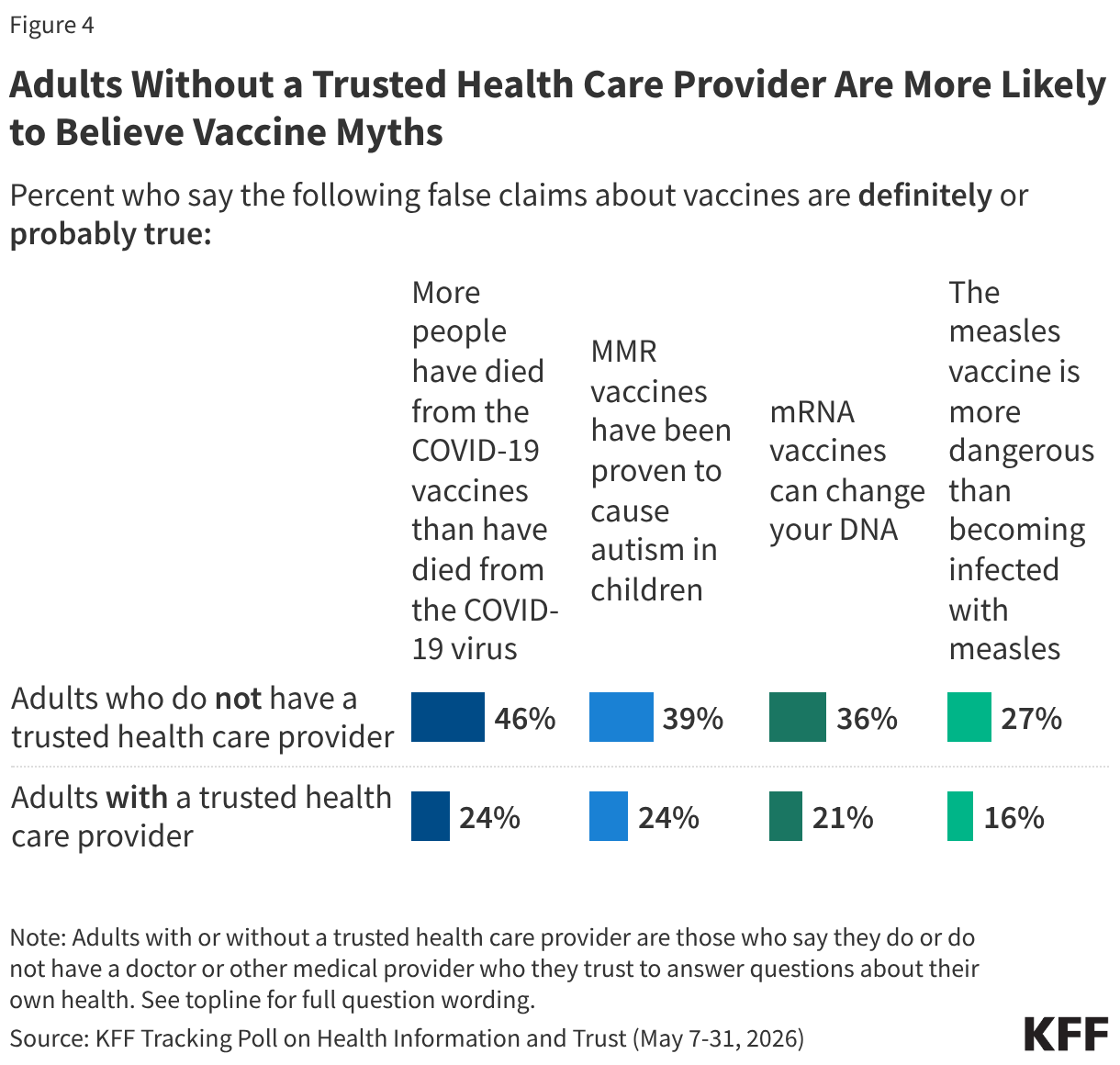
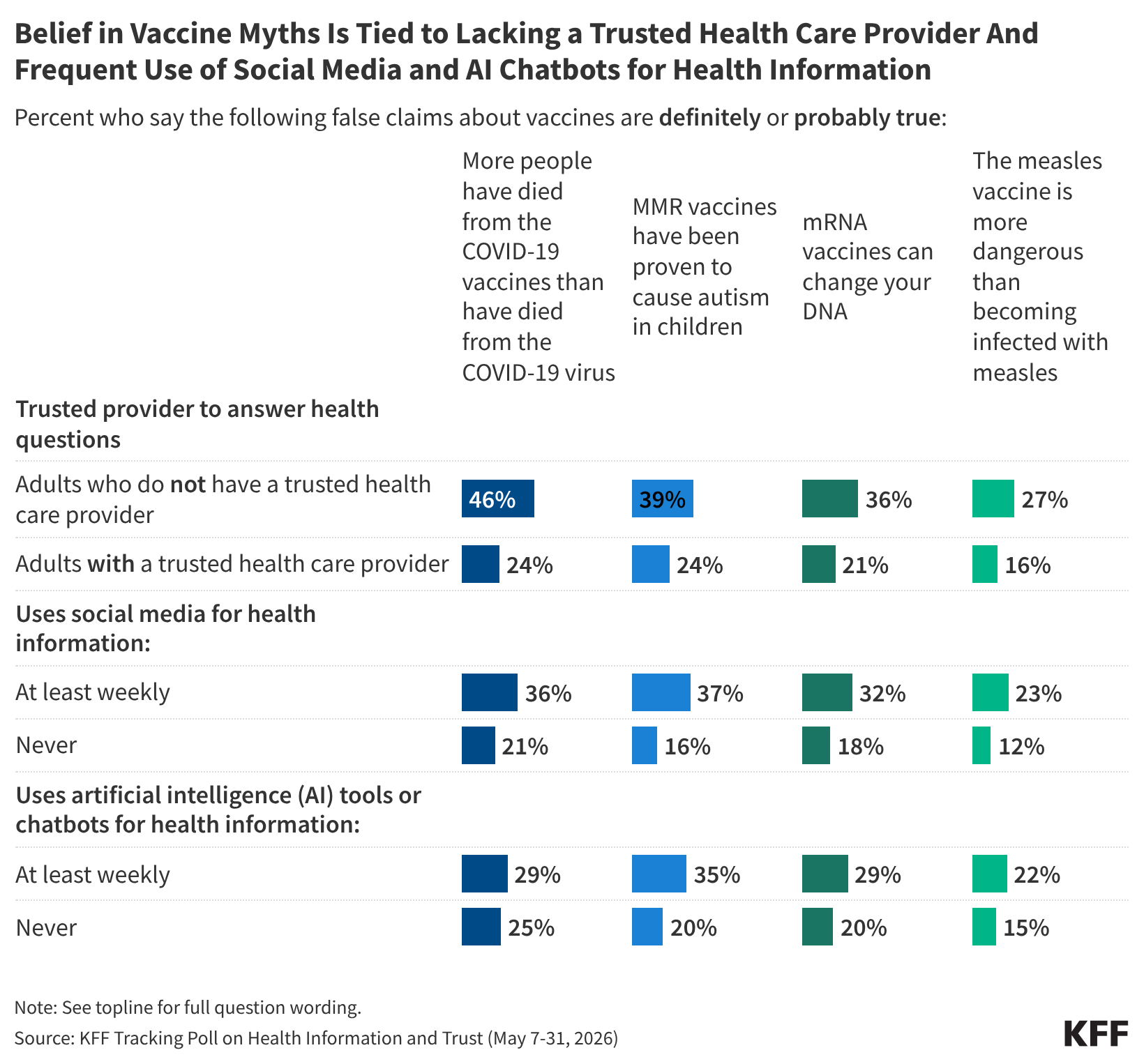
One example: Among adults who say they do not have a doctor or other health provider they trust to answer questions about their health, about 4 in 10 (39%) incorrectly believe that it is either “definitely” or “probably true” that MMR vaccines have been proven to cause autism in children, compared to a quarter (24%) among those who say they have a trusted provider.

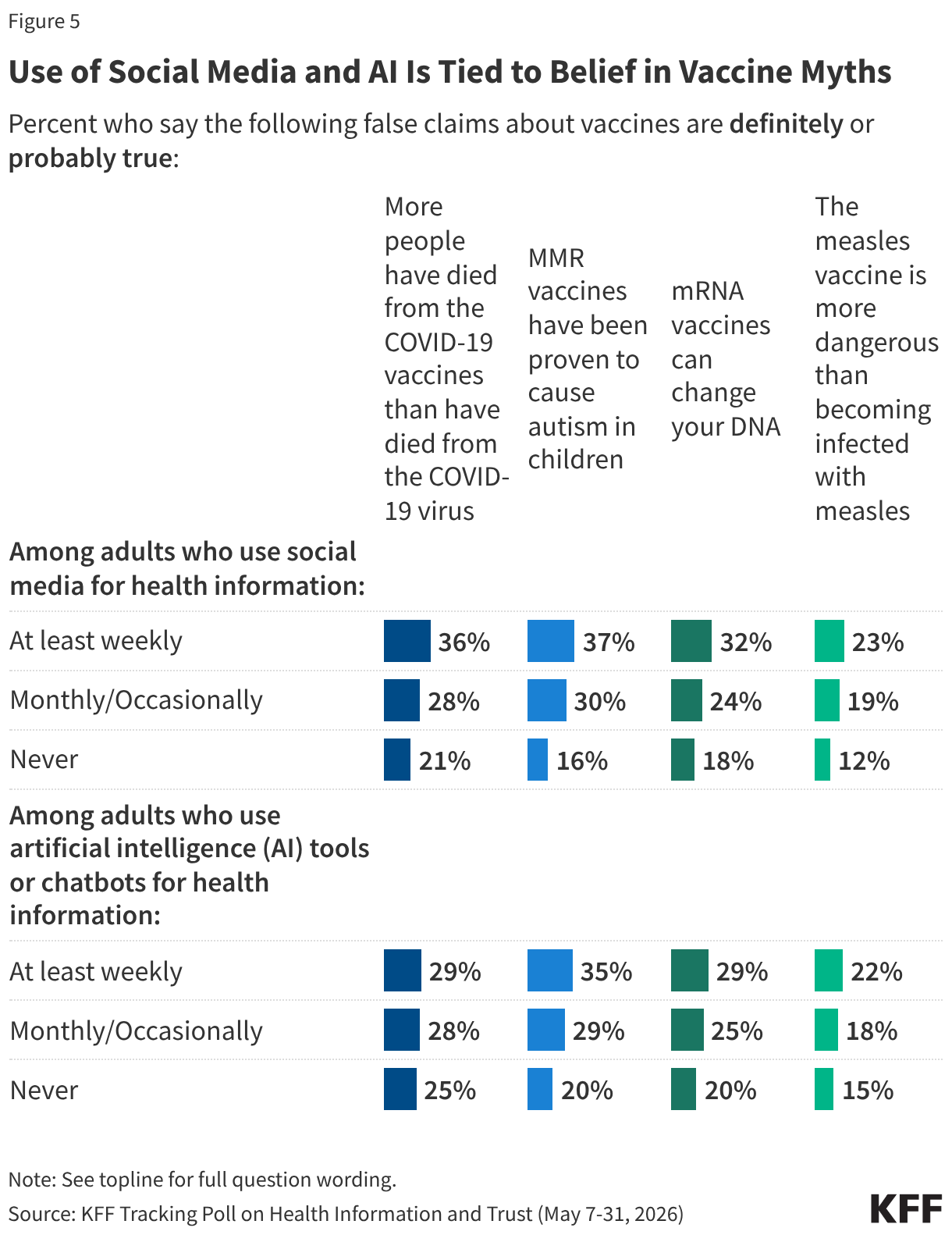
Similarly, more than a third of people who report using social media (37%) or AI chatbots (35%) at least weekly for health information incorrectly say this myth is true, about twice the share among those who never use social media (16%) or AI (20%) for health information.

The poll finds a similar pattern for most of the other vaccine myths tested for people without a trusted doctor as well as for people who frequently use social media or AI for health information. The differences remain significant even when controlling for other factors such as age, race and ethnicity, education, partisanship, and insurance status.

Exposure to each of these false claims has been fairly steady in KFF polls over the past several years, though the share who report hearing the myth that mRNA vaccines can alter a person’s DNA dropped by 9 percentage points since April 2025 (from 45% to 36%). Exposure to the myth that measles vaccines are more dangerous than measles rose between 2024 and 2025, but has remained steady since then (29% now).

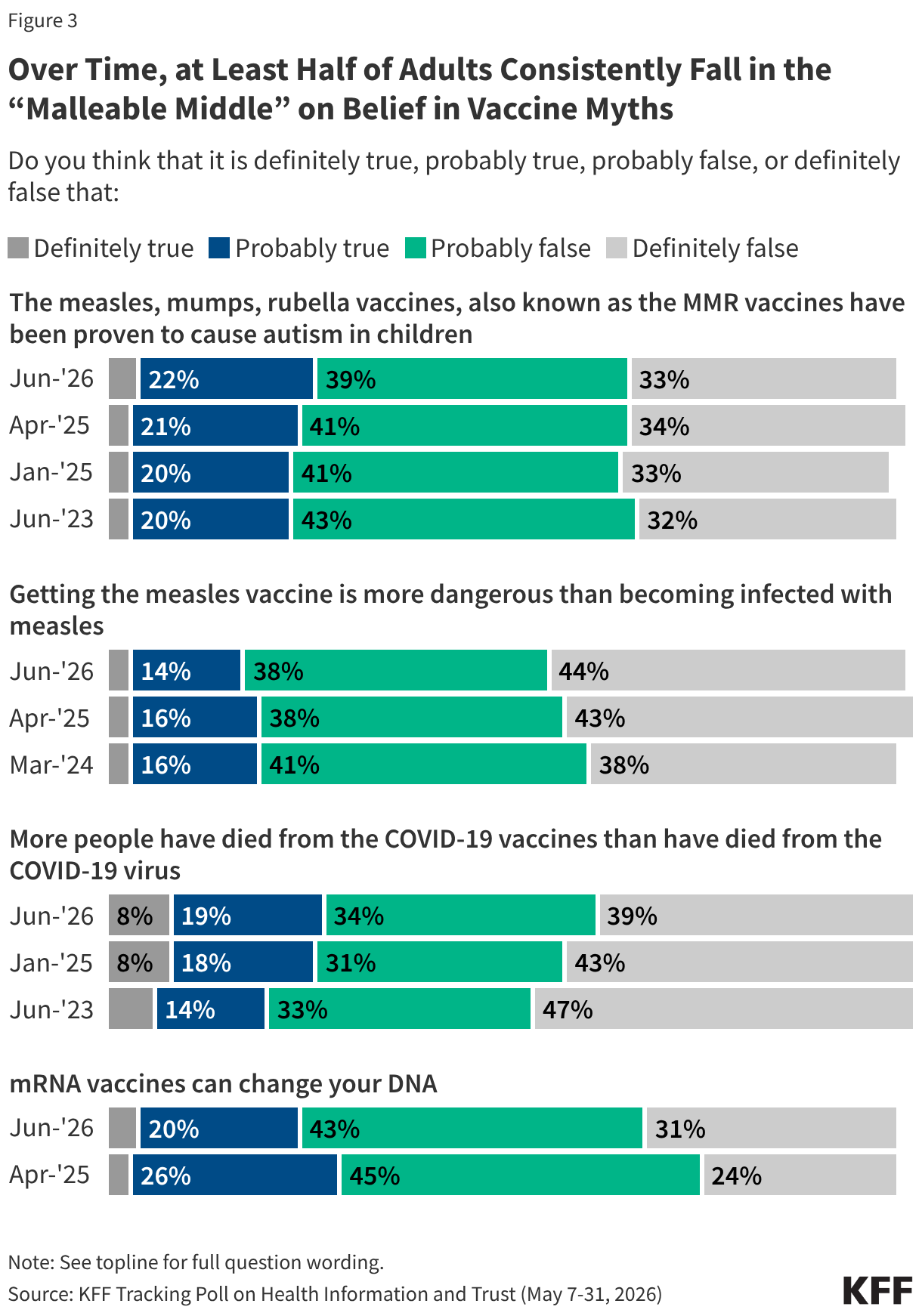
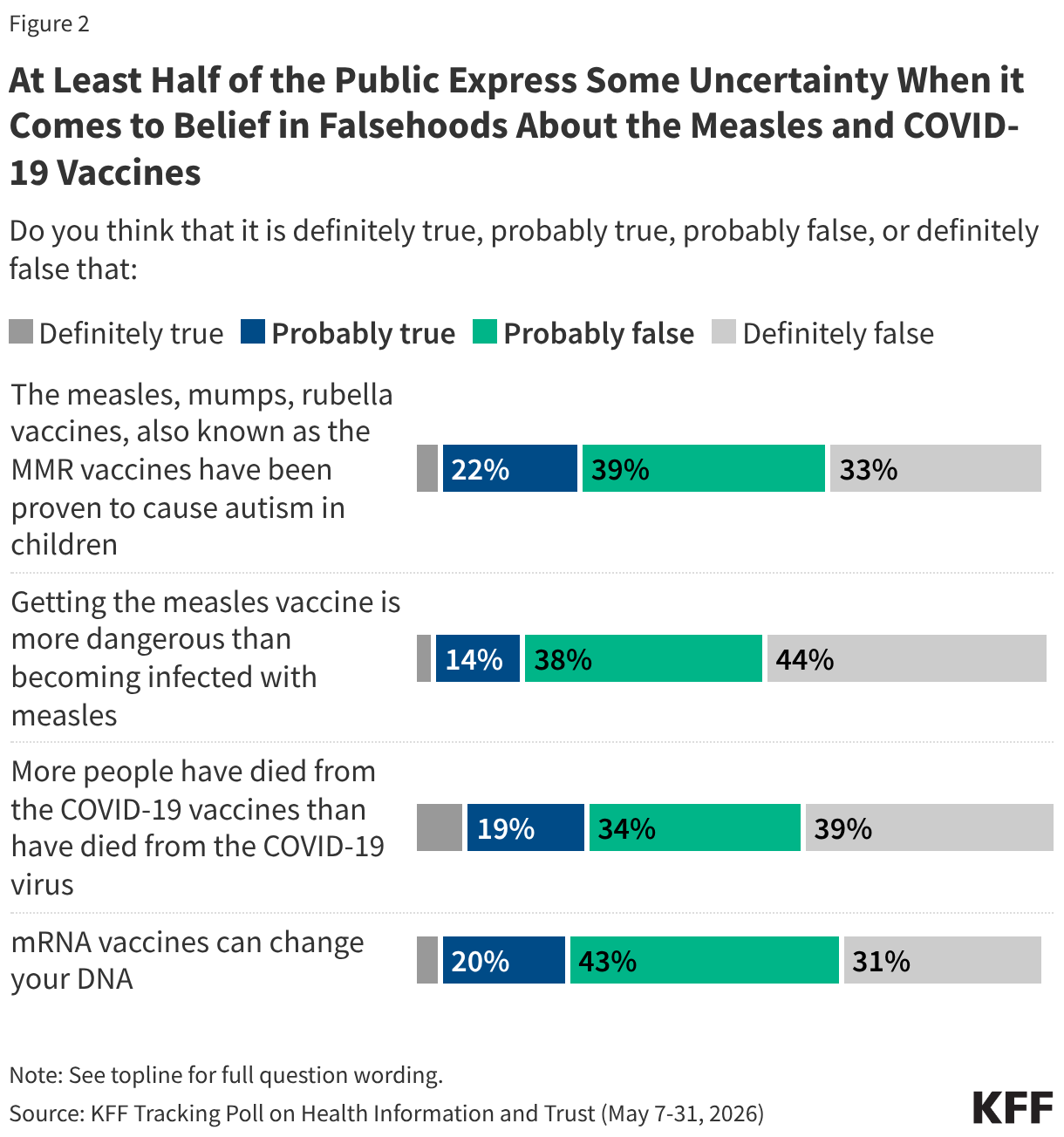
Across the four false vaccines claims, far more people say the claims are “definitely false” than say they are “definitely true,” but at least half of the public is less certain what to believe, falling into the malleable middle and saying each of these claims are either “probably true” or “probably false.”

While many parents who skip or delay recommended vaccines for their children express uncertainty over vaccine myths, they are also about twice as likely as parents who keep their children up to date on vaccines to believe or lean toward believing false claims about the measles and COVID-19 vaccines.

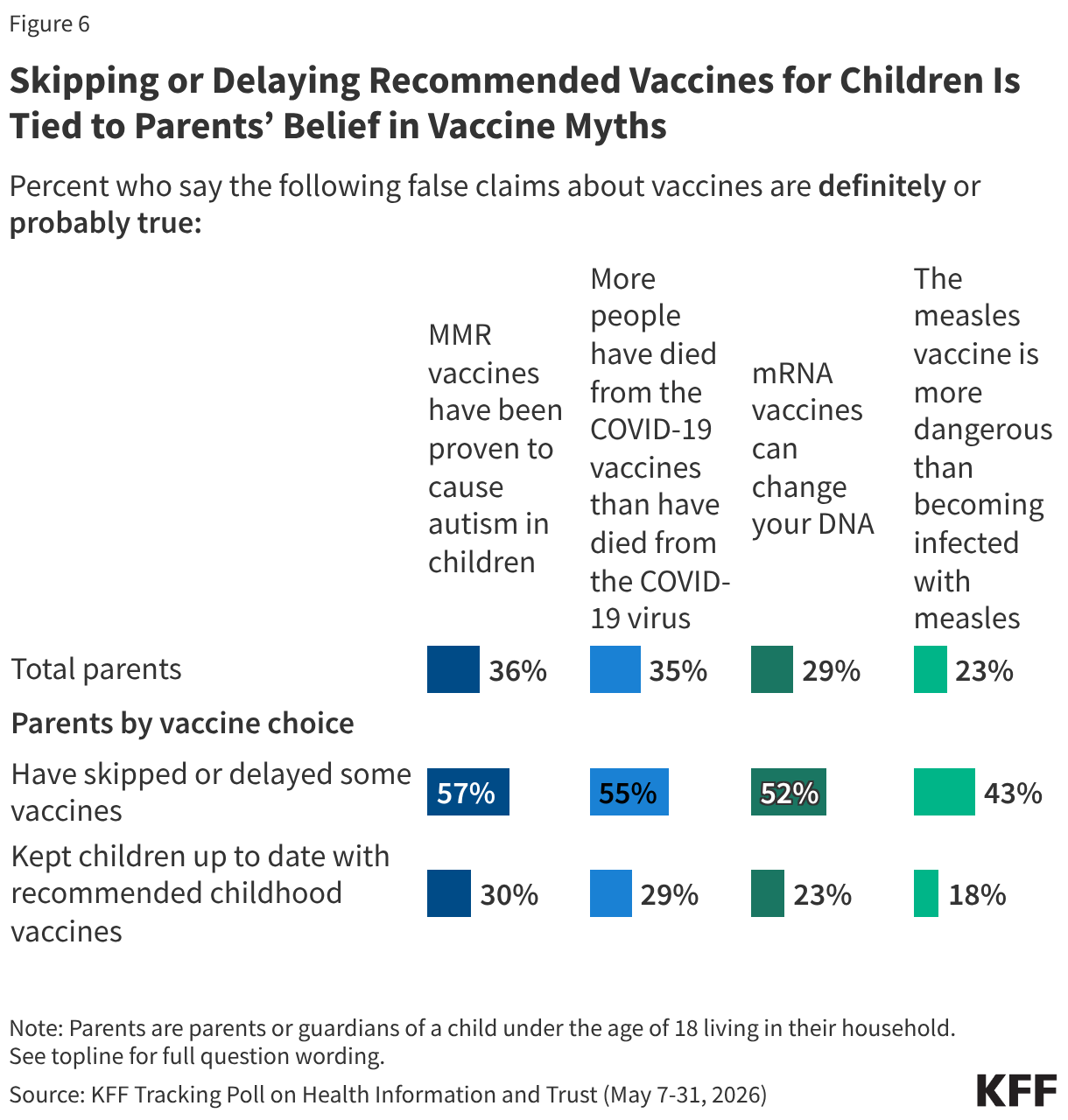
The pattern is true for each of the four false claims: that MMR vaccines cause autism in children (57%  among those who delay or skip vaccines v. 30% among those who stay up to date), that more people died from COVID-19 vaccines than the virus itself (55% v. 29%), that mRNA vaccines alter DNA (52% v. 23%), and that measles vaccines are more dangerous than measles (43% v. 18%). This relationship remains significant even when controlling for factors like age, education, and partisanship.

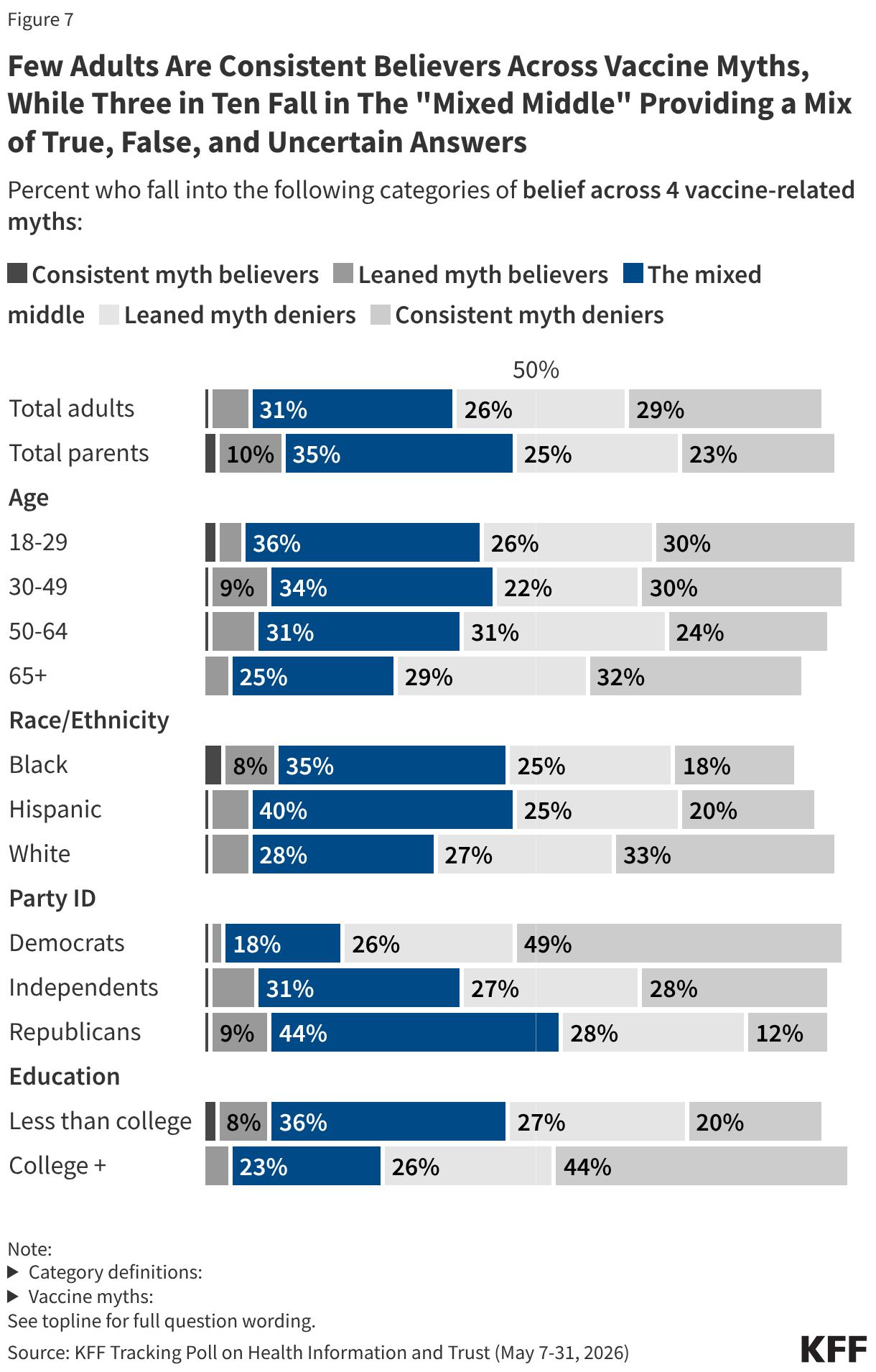
The poll also includes a new analysis that identifies patterns of belief across the four false claims and sorts them into a new belief typology. A small share (8%) are consistent or leaned myth believers (saying all four claims are either “probably” or “definitely true”) and just over half (55%) are consistent or leaned myth deniers (saying all four claims are either “probably” or “definitely false”). About 3 in 10 (31%) are in the mixed middle, providing a range of true and false answers and lacking certainty on at least half of the claims.

Designed and analyzed by public opinion researchers at KFF, this survey was conducted May 7-31, 2026, online and by telephone among a nationally representative sample of 2,480 U.S. adults in English and in Spanish. The margin of sampling error is plus or minus three percentage points for the full sample. For results based on other subgroups, the margin of sampling error may be higher.

Poll Finding

KFF Tracking Poll on Health Information and Trust: Update on Common Vaccine Myths

Published: Jun 30, 2026

Key Takeaways

  • With childhood vaccination rates in the U.S. continuing to decline as measles cases rise across the U.S., KFF’s latest Tracking Poll on Health Information and Trust shows that several commonly circulated vaccine myths remain pervasive among the public. Many adults say they have heard false claims about the measles and COVID-19 vaccines, including that the measles, mumps, and rubella (MMR) vaccines have been proven to cause autism in children (66%), that more people have died from the COVID-19 vaccines than the virus (46%), that mRNA vaccines can alter DNA (36%), or that measles vaccines are more dangerous than measles itself (29%).
  • While many have heard of these myths, smaller shares are convinced they are true. Fewer than one in ten adults express ardent belief in each myth, while larger shares (between 31% and 44%) say each are “definitely false” and at least half fall in the “malleable middle,” saying each of these claims is either “probably true” or “probably false.”
  • Adults who have a relationship with a trusted health care provider are less likely than those who don’t have such a relationship to believe or lean toward believing vaccine falsehoods. For instance, nearly half (46%) of adults who say they do not have a health care provider they trust to answer questions about their health say it is “probably” or “definitely true” that more people have died from COVID-19 vaccines than from the virus, which is nearly twice the share among those with a trusted provider (24%). While younger adults, Hispanic adults, and uninsured adults are more likely than their counterparts to say they don’t have a trusted provider, the connection between lacking a trusted provider and belief in vaccine myths holds even when controlling for factors like age, race and ethnicity, education, partisanship, and insurance coverage.
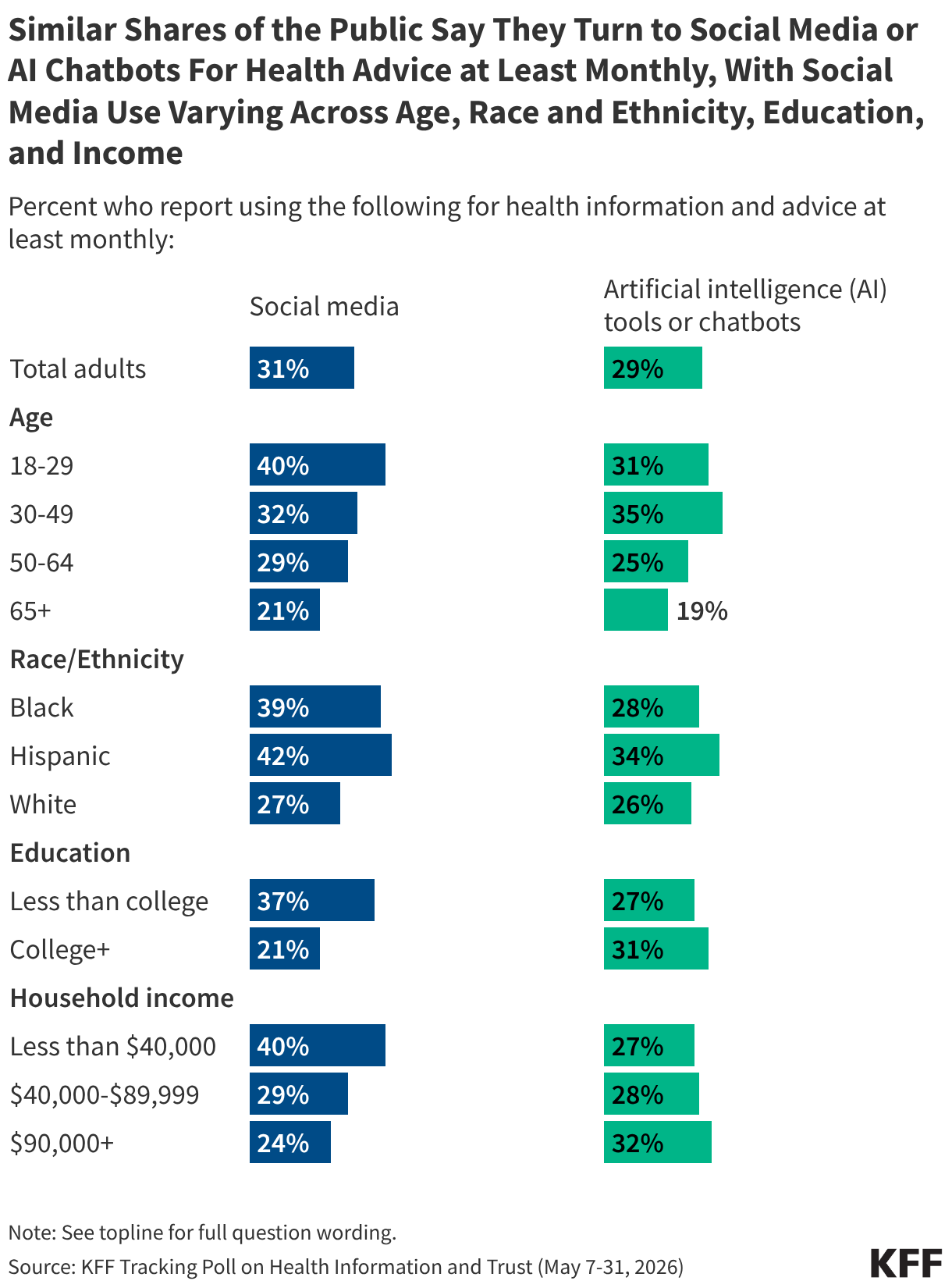
  • Those who use social media and artificial intelligence (AI) chatbots for health information are also more likely to endorse many of these vaccine myths. For example, adults who use social media for health information at least weekly are more than twice as likely as those who don’t use social media for health to say the myth linking MMR vaccines to autism is “probably” or “definitely true” (37% v. 16%). Use of artificial intelligence (AI) for health information is also correlated with views on some of these myths, with adults who regularly use AI for health information more likely than non-users to believe or lean toward believing myths about the MMR and mRNA vaccines. While younger adults, Black and Hispanic adults, and those without a college degree are all more likely to use to social media for health information, the connection between frequent use and belief in vaccine myths holds even when controlling for factors like age, race and ethnicity, education, and partisanship.
  • Parents’ views on vaccine myths are also correlated with their decisions about childhood vaccinations. Parents who report skipping or delaying recommended childhood vaccines are consistently at least 25 percentage points more likely than those who keep their children up-to-date to say vaccine myths are “definitely” or “probably true,” including the false claims that MMR vaccines cause autism in children (57% v. 30%), that more people died from COVID-19 vaccines than the virus itself (55% v. 29%), that mRNA vaccines alter DNA (52% v. 23%), and that measles vaccines are more dangerous than measles (43% v. 18%). This relationship remains significant even when controlling for factors like age, education, and partisanship.
  • When looking at patterns of belief across the four false vaccine claims, a new analysis shows that some adults are consistent or leaned myth believers (8% who say all four claims are either “probably” or “definitely true”), or myth deniers (55% who deny all four claims, saying they are either “probably” or “definitely false”). At the same time, about three in ten (31%) fall in a “mixed middle” group, providing a range of true and false answers across the four vaccine myths and lacking certainty on at least half of the false claims. This group may be an important focus for those looking to counter vaccine misinformation and dispel confusion. Black adults, Hispanic adults, Republicans, younger adults, and those without a college degree are all more likely than their counterparts to fall into this “mixed middle” group, as are individuals who go to social media or AI for health information. Notably, nearly half of parents who report skipping or delaying recommended vaccines for their children fall in the “mixed middle,” indicating that these parents’ decisions may be driven, at least in part, by uncertainty and confusion.

Exposure to Common Vaccine Myths

The latest KFF Tracking Poll on Health Information and Trust examines the pervasiveness of several commonly circulated vaccine myths. These false or unproven claims about vaccines have remained persistent in terms of exposure over the past several years, with little change to the share of the public have heard most of these myths.

The false claim that MMR vaccines have been proven to cause autism in children – a myth associated with a since retracted study from the 1990s – remains one of the most widely heard vaccine myths, with two-thirds of adults saying they have heard or read this. Nearly half (46%) of adults say they have heard the false claim that more people have died from the COVID-19 vaccines than the virus itself, and about one third of adults (36%) say they have heard the myth that mRNA vaccines can change your DNA (mRNA is a vaccine technology utilized by some COVID-19 vaccines and others under development). About three in ten adults (29%) say they have heard the false claim that measles vaccines are more dangerous than measles infections.

Exposure to each of these false claims has been fairly steady in KFF polls over the past several years, though the share who report hearing the myth that mRNA vaccines can alter a person’s DNA dropped by 9 percentage points since April 2025 (from 45% to 36%). Exposure to the myth that measles vaccines are more dangerous than measles rose between 2024 and 2025, but has remained steady since then.

Figure 1

Uncertainty Surrounding False Vaccine Claims

While many report having heard some false claims about vaccines, very few adults are ardent believers in these myths, with larger shares (but fewer than half) stating the myths are “definitely false.” At the same time, and consistent with past KFF polling, at least half of adults fall into the “malleable middle” across the myths, expressing some uncertainty and saying these vaccine myths are either “probably true” or “probably false.” Across these four vaccine falsehoods, most parents fall into the malleable middle, expressing some uncertainty for each claim.

Stacked bar chart showing the share of the public who believe four false vaccine claims are definitely true, probably true, probably false, or definitely false.

Over time, the share who fall in the “malleable middle” for these vaccine myths has been relatively stable, with at least half saying each is either “probably true” or “probably false.” At the same time, there have been some minor shifts in the share who view some of these myths as “definitely false” over the past few years, underscoring how the public’s willingness to endorse vaccine falsehoods is not completely static. Somewhat larger shares of adults now say it is “definitely false” that mRNA vaccines can change your DNA (31% now v. 24% in April 2025), and that measles vaccines are more dangerous than getting infected with measles (44% now v. 38% in March 2024). Conversely, the share of adults who think it is “definitely false” that more people have died from COVID-19 vaccines than from the virus has declined (39% now compared to 47% in June 2023) alongside a 5-percentage point jump in the share who say this myth is “probably true.” There have been no notable changes in views of the long-standing myth that MMR vaccines cause autism.

Stacked bar chart showing how belief in four false vaccine claims has changed over time, from June 2023 to June 2026.

Belief in Vaccine Myths is Tied to Lacking a Trusted Health Care Provider And Use of Social Media and AI For Health Information

Previous KFF polls have shown that health care providers are the most trusted source of health information among the public, and this latest poll shows that individuals who have a trusted provider are less likely than those without a trusted provider to endorse vaccine-related myths. For example, among adults who say they do not have a doctor or health care provider they trust to answer questions about their health (16% of all adults), nearly half (46%) say it is either “definitely” or “probably true” that more people have died from COVID-19 vaccines than from the COVID-19 virus, compared to a quarter (24%) among those who say they have a trusted health care provider.

Unsurprisingly, adults who say they do not have a trusted health care provider to answer their health questions are much more likely to be uninsured than those who have a provider they trust (36% v. 7%). At the same time, lacking a trusted provider could be related to low trust in providers and doctors more broadly and not necessarily related to health care access. Across demographics, adults under age 50, LGBT adults, and Hispanic adults are all more likely than their counterparts to say they don’t have a provider they trust to answer questions about their health. However, the connection between not having a trusted provider and belief in vaccine myths remains significant even when controlling for factors like age, race and ethnicity, education, partisanship, and insurance coverage.

Grouped bar chart showing the percentage of adults who believe four false vaccine claims are definitely or probably true, comparing adults with and without a trusted health care provider.

Frequent health information-seeking on social media and via artificial intelligence (AI) chatbots is also tied to a tendency to believe vaccine myths. Adults who say they use social media for health information and advice at least weekly (26% of all adults) are more likely than those who never use social media for health to say each false vaccine claim is “probably” or “definitely true.” Similarly, adults who report using AI tools or chatbots at least weekly for health advice (20% of all adults) are more likely than those who never use these chatbots to endorse myths about the measles vaccines and mRNA vaccines. For example, the share who say it is “probably” or “definitely true” that MMR vaccines have been proven to cause autism is higher among adults who seek health advice at least weekly from social media (37%) or AI (35%) compared to those who never use social media (16%) or AI (20%) for health advice.

The relationship between belief in vaccine myths and use of social media or AI for health information continues to be significant even when controlling for factors like age, race and ethnicity, education, and partisanship.

Bar chart showing the percentage of adults who believe four false vaccine claims are definitely or probably true, broken down by how often they use social media and AI tools for health information.

Parents who skip or delay recommended vaccines for their children are about twice as likely as parents who keep their children up to date on vaccines to believe or lean toward believing false claims about the measles and COVID-19 vaccines, underscoring how false health claims may shape parents’ decisions.

Overall, at least three in ten parents say it is “probably” or “definitely true” that MMR vaccines have been proven to cause autism in children (36%), that more people have died from COVID-19 vaccines than the virus (35%), or that mRNA vaccines can alter DNA (29%). About one in four (23%) parents believe or lean toward believing the myth that measles vaccines are more dangerous than measles.

The tendency to endorse these false vaccine claims, however, rises substantially among parents who report not keeping their children up to date on recommended vaccines. Six in ten (57%) parents who report having skipped or delayed recommended childhood vaccines (excluding seasonal vaccines for COVID-19 and flu), say it is either “definitely true” or “probably true” that the MMR vaccines have been proven to cause autism in children, while around half believe or lean toward believing that the COVID-19 vaccines killed more people than the virus (55%), or that mRNA vaccines alter DNA (52%). About four in ten (43%) parents who skipped or delayed childhood vaccines say it is true that the measles vaccines are more dangerous than measles itself. Each of these shares is at least 25 percentage points higher than among parents who report keeping their children up to date on recommended childhood vaccines, a relationship that remains significant even when controlling for factors like age, education, and partisanship. 

Bar chart showing the percentage of parents who believe four false vaccine claims are definitely or probably true, broken down by total parents and by whether they have skipped or delayed their children's vaccines or kept them up to date.

Digging Deeper on The Malleable Middle: Patterns of Belief Across Vaccine Myths

While KFF polling has routinely found that at least half the public fall in the “malleable middle” when it comes to a wide variety of false health claims, there are nuances within this group that can be examined by looking at patterns of belief across multiple myths rather than examining a single question.

This new typology identified five groups based off patterns of belief across the four false vaccine claims included in this survey:

  • Consistent myth believers (1% of the public) say all four vaccine myths are true, including at least three out of four as “definitely true.”
  • Leaned myth believers (6% of the public) say all four vaccine myths are true but are somewhat uncertain in their beliefs, saying at least two of the four myths are “probably true.”
  • The mixed middle (31% of the public) provide a range of true and false responses and at least half of the time provide a “probably” response (in either the true or false direction).
  • Leaned myth deniers (26% of the public) say all four vaccine myths are false but are somewhat uncertain, saying at least two of the four myths are “probably false.”
  • Consistent myth deniers (29% of the public) say all four vaccine myths are false, including at least three out of four as “definitely false.”

The “mixed middle” group, making up 31% of all adults, reflects a portion of the “malleable middle” that expresses the most uncertainty and does not routinely land on one side when it comes to commonly circulating vaccine falsehoods. The share who fall in the “mixed middle” differs by partisanship, education, race and ethnicity, and age. For example, four in ten Hispanic adults and about a third (35%) of Black adults are part of this group compared to fewer than three in ten white adults (28%). Republicans (44%) are more than twice as likely as Democrats (18%) to be part of this group, while independents (31%) fall in between the two. Those without a college degree (36%) are also 10 percentage points more likely than college graduates (23%) to fall into this mixed middle group. These findings suggest these groups who disproportionately fall in the “mixed middle” may be an important focus for those looking to counter vaccine misinformation and dispel confusion. 

Stacked bar chart showing the percentage of adults who fall into five belief categories — consistent myth believers, leaned myth believers, the mixed middle, leaned myth deniers, and consistent myth deniers — across four vaccine-related myths, broken down by total adults, total parents, age, race and ethnicity, party identification, and education.

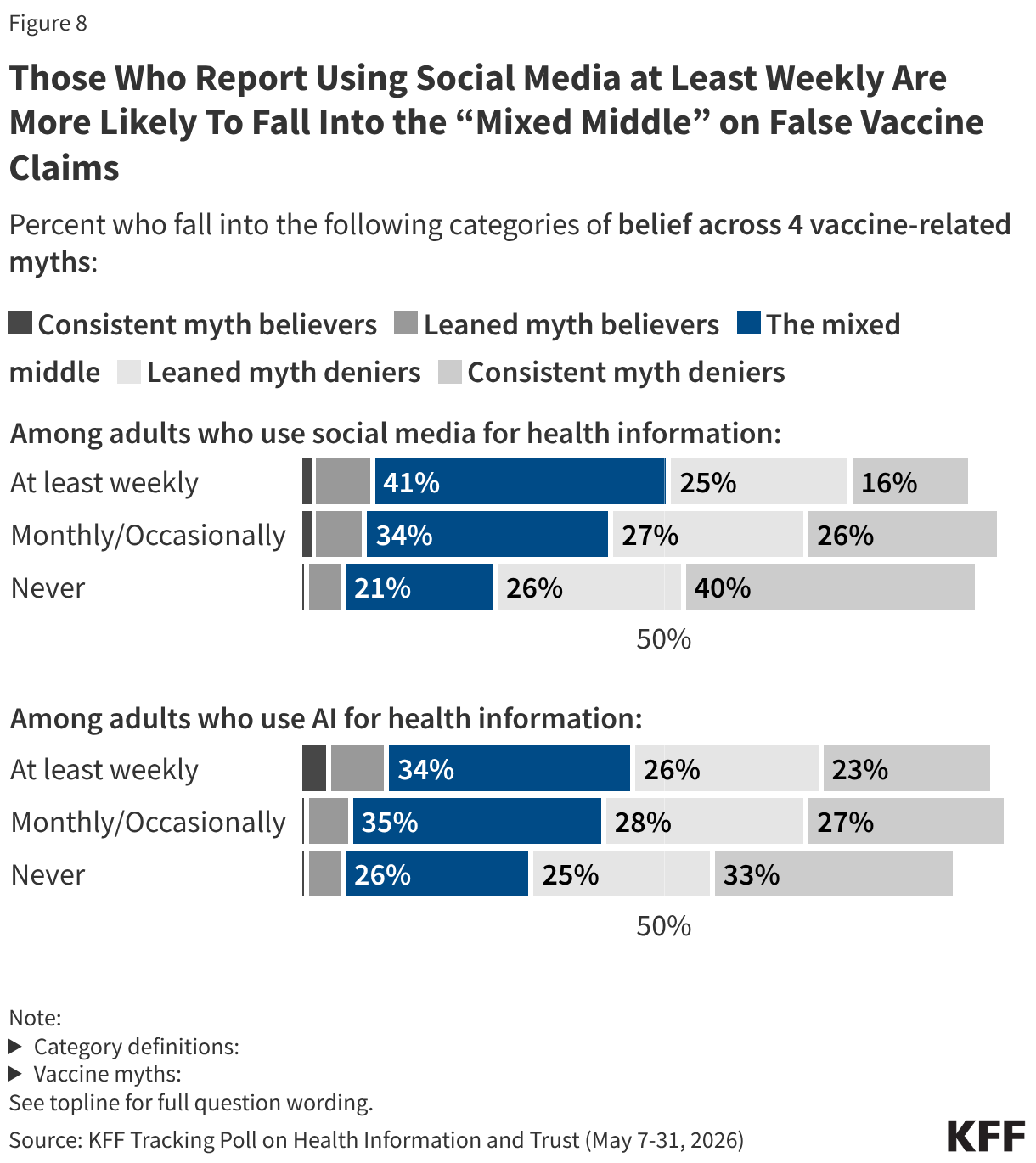
Adults who are frequently using social media for health advice are also more likely to lack certainty across vaccine myths, providing a range of mixed answers and saying at least half of the four myths are either “probably true” or “probably false.” When looking at belief across different vaccine myths, adults who report using social media for health information on at least a weekly basis are twice as likely to fall in the “mixed middle” group as those who never use social media for health (41% v. 21%). Adults who use AI tools for health information at least occasionally are also somewhat more likely to fall into the “mixed middle” compared to those who never use AI for health, but the difference is smaller for AI than it is for social media use.

Stacked bar chart showing the percentage of adults who fall into five belief categories — consistent myth believers, leaned myth believers, the mixed middle, leaned myth deniers, and consistent myth deniers — across four vaccine-related myths, broken down by how often they use social media and AI tools for health information.

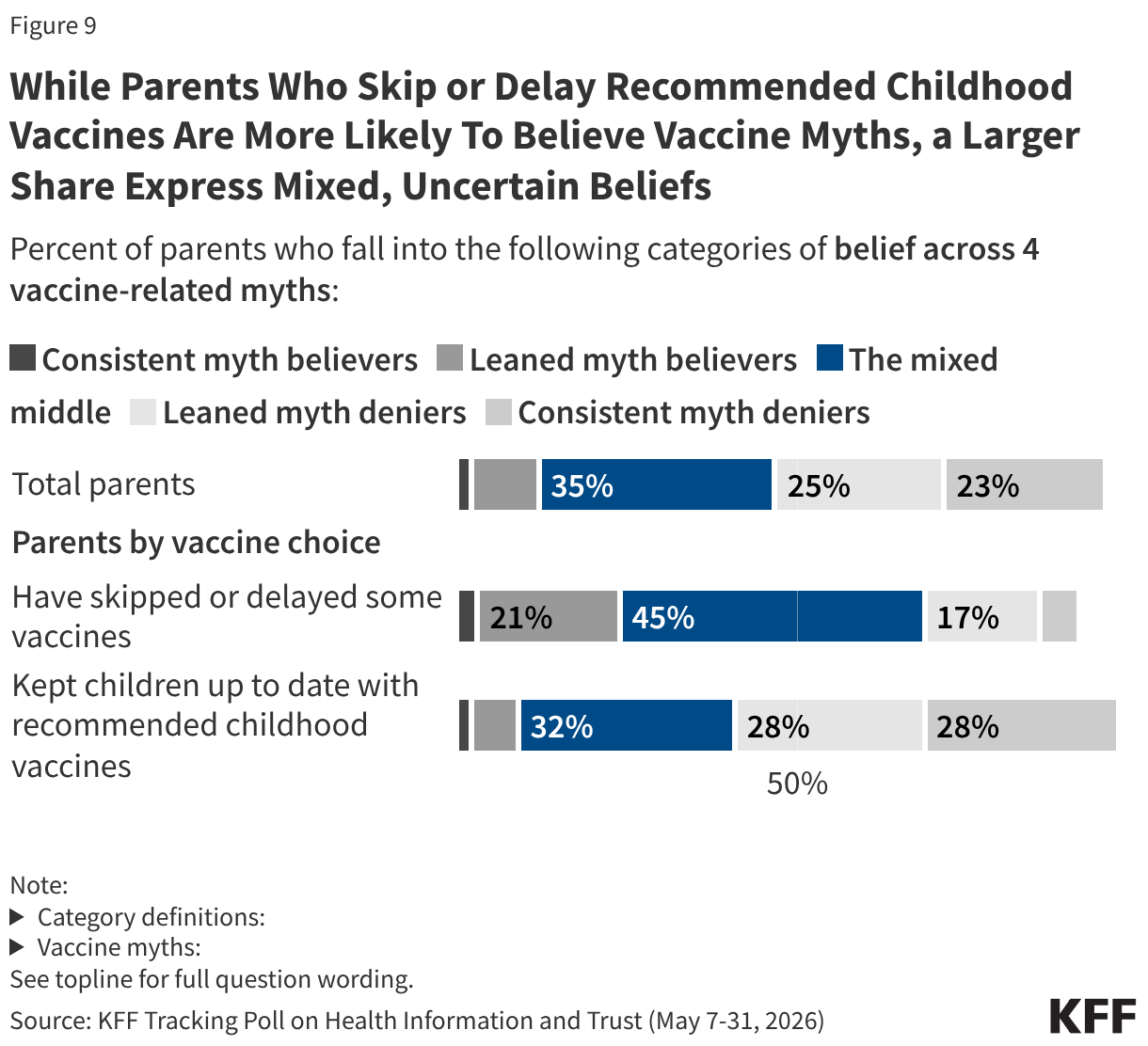
Nearly half (45%) of parentswho have skipped or delayed recommended vaccines for their children fall in this “mixed middle” group, underscoring the connection between confusion, uncertainty and parents’ decisions to forgo recommended vaccines for their children.

Stacked bar chart showing the percentage of parents who fall into five belief categories — consistent myth believers, leaned myth believers, the mixed middle, leaned myth deniers, and consistent myth deniers — across four vaccine-related myths, broken down by total parents and by whether they have skipped or delayed their children's vaccines or kept them up to date.

This KFF Tracking Poll on Health Information and Trust was designed and analyzed by public opinion researchers at KFF. The survey was conducted May 7 – 31, 2026, online and by telephone among a nationally representative sample of 2,480 U.S. adults in English (2,407) and Spanish (73).

The sample includes 1,977 who were reached through an address-based sample (ABS) and completed the survey online (1,819) or over the phone (158). An additional 503 respondents were reached through a random digit dial telephone (RDD) sample of prepaid (pay-as-you-go) cell phone numbers. Among this prepaid cell phone component, 223 were interviewed by phone and 280 were invited to the web survey via short message service (SMS). Marketing Systems Groups (MSG) provided both the ABS and RDD samples. All fieldwork was managed by SSRS of Glen Mills, PA; sampling design and weighting was done in collaboration with KFF.

Both the ABS and RDD sample frames included disproportionate stratification aimed at reaching Hispanic and non-Hispanic Black respondents. The ABS was also stratified based on model-based prediction of household-members’ party identification (Republican, Democratic, or independent).

Respondents received a $15 incentive for their participation, with interviews completed by phone receiving a mailed check and web respondents receiving an electronic gift card incentive.

In order to ensure data quality, cases were removed if they failed two or more quality checks: (1) attention check questions in the online version of the questionnaire, (2) had over 30% item nonresponse, or (3) had a length less than one quarter of the mean length by mode. Likewise, cases that were reached through ABS who reported a living in a different state than the sampled address were removed for quality assurance. Based on this criterion, 39 cases were removed.

The combined ABS and cell phone samples were weighted to match the sample’s demographics to the national U.S. adult population using data from the Census Bureau’s 2025 Current Population Survey (CPS). The combined sample was weighted by gender by age, gender by education, age by education, race/ethnicity by education, education, race, census region, population density, frequency of internet usage, recalled 2024 vote by quintiles of the county-level 2024 vote share. The weights also take into account differences in the probability of selection for each sample type (ABS and prepaid cell phone). This includes adjustment for the sample design and geographic stratification of the samples, and within household probability of selection. The population density benchmark was from the 2026 Claritas Pop-Facts Premier. The internet frequency benchmarks was from the 2025 National Public Opinion Reference Survey (NPORS) data. The county-level 2024 vote share was from CNN-provided file of 2024 election results by county

The margin of sampling error including the design effect for the full sample is plus or minus 3 percentage points. Numbers of respondents and margins of sampling error for key subgroups are shown in the table below. For results based on other subgroups, the margin of sampling error may be higher. Sample sizes and margins of sampling error for other subgroups are available by request. Sampling error is only one of many potential sources of error and there may be other unmeasured error in this or any other public opinion poll. The following questions included in this survey were designed, analyzed, and paid for by KFF. The demographic questions included in this study were developed and funded jointly by CNN and KFF, with each organization having independent editorial control over its portion of the survey. KFF Public Opinion and Survey Research is a charter member of the Transparency Initiative of the American Association for Public Opinion Research.

GroupN (unweighted)M.O.S.E.
Total2,480± 3 percentage points
   
Race/Ethnicity  
White, non-Hispanic                                                                                       1,355± 3 percentage points
Black, non-Hispanic435± 6 percentage points
Hispanic420± 7 percentage points
   
Age  
18-29399± 7 percentage points
30-49888± 4 percentage points
50-64590± 5 percentage points
65+556± 6 percentage points
   
Party ID  
Democrats774± 5 percentage points
Independents876± 5 percentage points
Republicans607± 5 percentage points
   
Parents of children under 18682± 5 percentage points

The Business of Health with Chip Kahn

AI: Show Me the Outcomes

June 30, 2026

Video

Audio

About this Episode


Episode 10, AI Series: Chip talks with Dr. Toyin Ajayi, co-founder and CEO of Cityblock Health, which delivers value-based care to more than 100,000 Medicaid and dual-eligible members across ten states, many of them people of color managing chronic conditions. Ajayi makes a pointed case: Roughly 60 percent of health care AI investment goes to billing, coding, and risk adjustment — making sure someone gets paid — while only a fraction goes to delivering care. If we continue to concentrate AI there, she warns, it will drive up cost without improving outcomes. She says there is a better way — AI built for care can lower costs by improving care for those hardest to reach. She and Chip discuss what that looks like and how Cityblock is using AI now to improve care and the patient experience for its members.

The Host


Headshot photo of Chip Kahn wearing a navy blue suit with a red tie, red pendant on lapel, and glasses.

Sr. Visiting Fellow

Charles N. Kahn III is a senior visiting fellow at KFF. He is also a visiting senior fellow at the American Enterprise Institute and a nonresident senior scholar at the University of Southern California’s Schaeffer Center for Health Policy & Economics. He serves as co-chair of the international Future of Health collaborative.

Guest


Co-founder and Chief Executive Officer, Cityblock Health

Dr. Toyin Ajayi is a Board-certified Family Medicine physician and CEO of Cityblock, a value-based healthcare provider for Medicaid and dually eligible beneficiaries. Prior to Cityblock, she served as Chief Medical Officer of Commonwealth Care Alliance, an integrated health plan and care delivery system for Medicare and Medicaid beneficiaries. Dr. Ajayi serves on the Board of Directors of Evolent Health and Foodsmart and is a co-founder of Coalition Partners. She’s an Aspen Institute Henry Crown Fellow and a member of the National Academy of Medicine. She’s been named to Inc.’s Female Founders 500 list, TIME100 Next, Modern Healthcare’s Top Women Leaders in Healthcare, and the STATUS List.

Dr. Ajayi received her undergraduate degree from Stanford University, an MPhil from the University of Cambridge, her medical degree, with Distinction in Clinical Practice, from King’s College London School of Medicine, and in 2024 was awarded an honorary Doctorate of Science from Georgetown University. Board certified in Family Medicine, Dr. Ajayi completed her residency training at Boston Medical Center and practiced as a hospitalist and primary care provider with a focus on patients with chronic, complex and end-of-life needs.


SERIES

This weekly podcast features insightful conversations between host Chip Kahn and his guests, who discuss the business of health care, connecting the dots between the health care business, policy, and patients.

The podcast’s first series on AI in health care illuminates how AI is changing health care, and features guests who are deploying this technology, managing its consequences, and designing policy around it.

Cost and Utilization of Inpatient Mental Health and Substance Use Treatment

Published: Jun 29, 2026

Inpatient treatment for mental health and substance use accounted for 10% of total commercial inpatient stays in 2023 (or 32 per 10,000 enrollees). The average (mean) total inpatient cost (including the share paid by the insurer and the share paid by the patient) for a mental health admission was $15,900 and for a substance use admission was $15,500.

Using claims data from the 2023 Merative MarketScan Commercial Claims Database, this Peterson-KFF analysis describes the most common diagnoses for inpatient treatment and total associated costs, including patients’ out-of-pocket share.

This brief is available through the Peterson-KFF Health System Tracker, an online information hub dedicated to monitoring and assessing the performance of the U.S. health system.

News Release

Nearly Four Million Medicare Beneficiaries Could Be Eligible for the Temporary Medicare GLP-1 Bridge Program Covering These Drugs for Weight Loss

Published: Jun 29, 2026

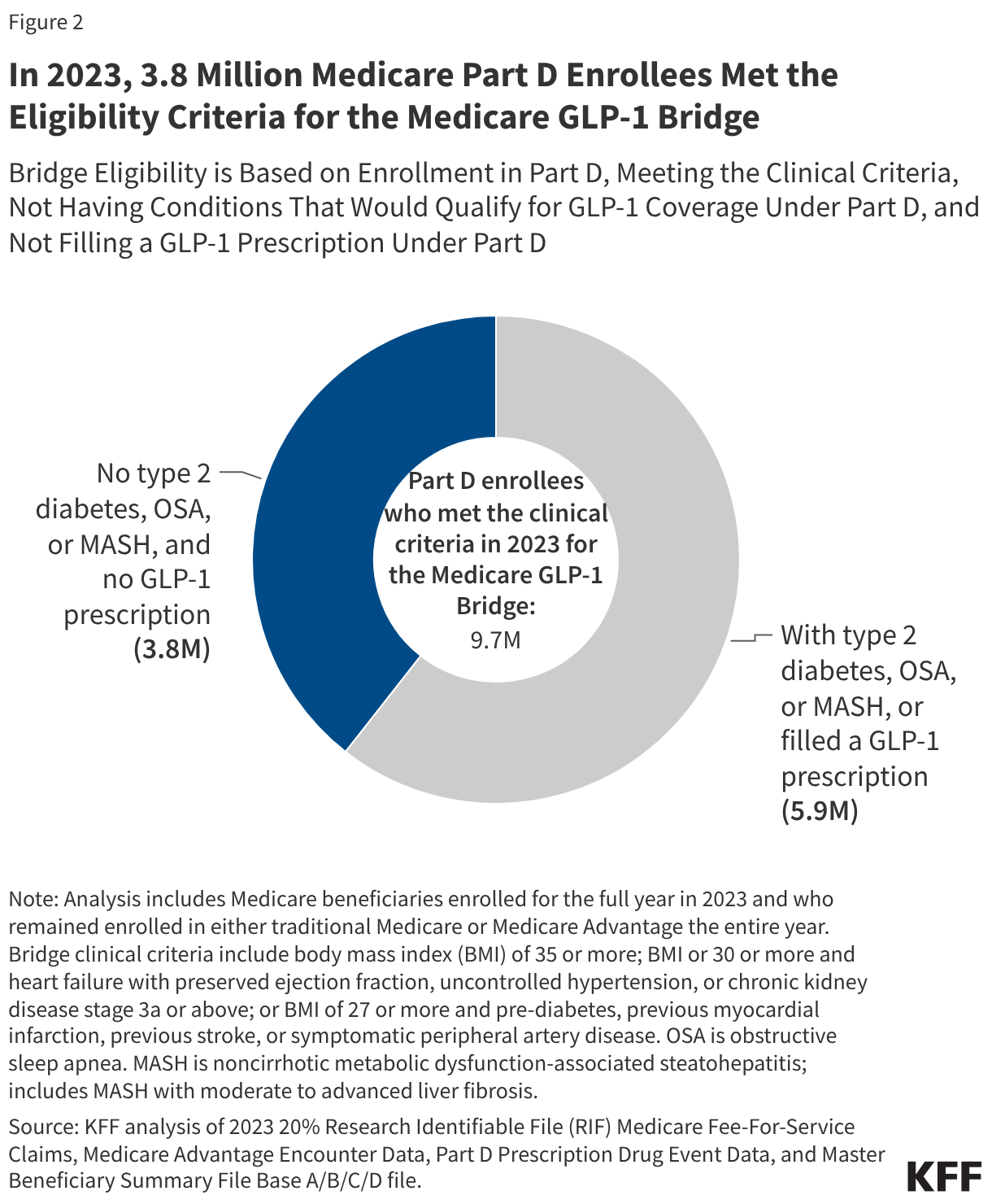
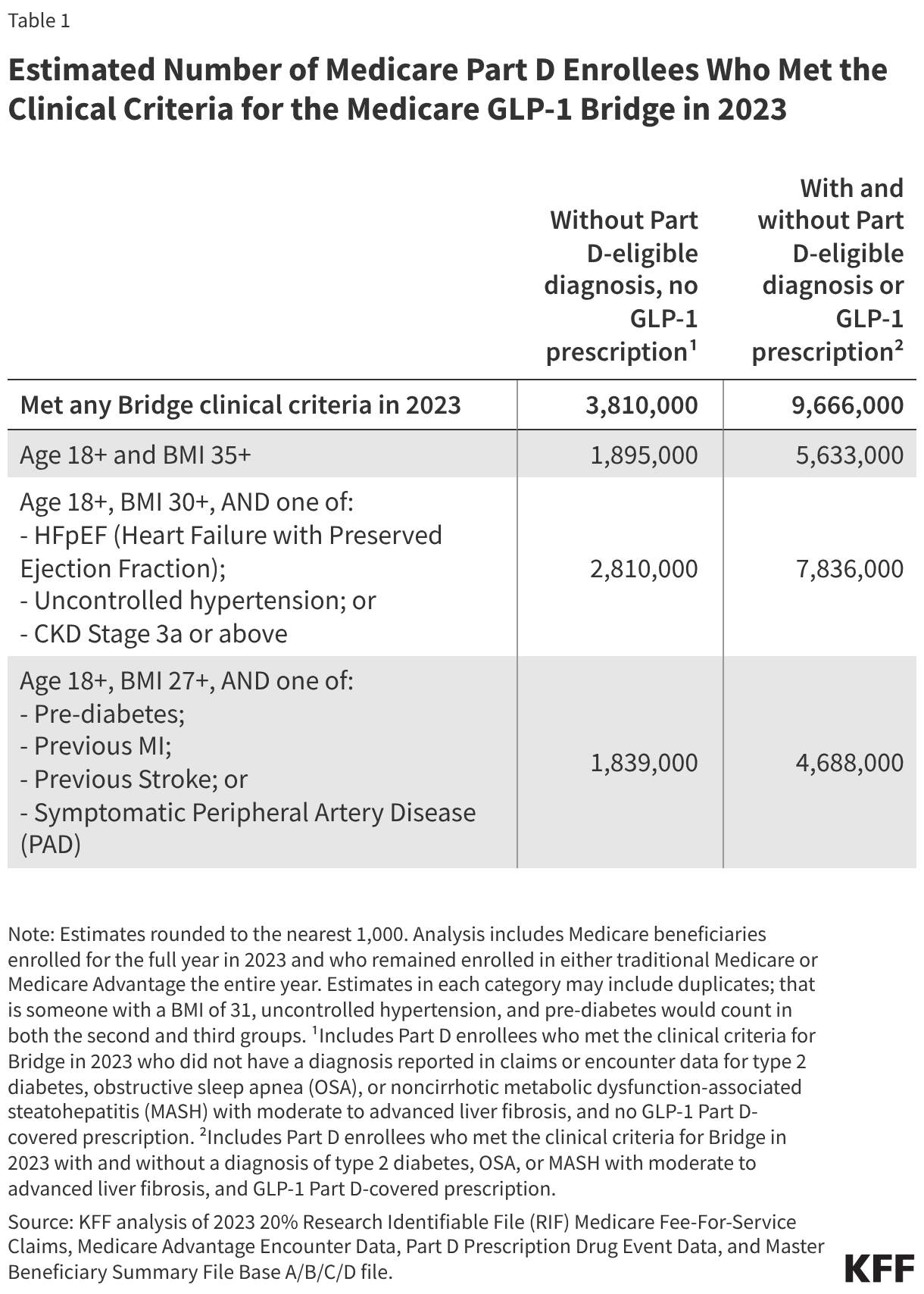
A new KFF analysis finds that 3.8 million Medicare beneficiaries met the criteria to be eligible for the new Medicare GLP-1 Bridge, based on claims data from 2023.

The temporary 18-month program, launching on July 1 and running through December 2027, will provide coverage of three GLP-1s (Wegovy, Zepbound, and Foundayo) used for weight reduction and weight management to eligible beneficiaries who are enrolled in Medicare Part D.

The total cost to the federal government of the program will depend in part on what share of eligible beneficiaries participate, how quickly they take up coverage, and how many prescriptions each participating beneficiary fills during the 18-month period.

Based on the estimated 3.8 million Part D enrollees eligible, if 10% to 25% participate in Bridge beginning in July 2026 and fill a prescription each month for the duration of the program, the cost to Medicare would be $1.3 billion to $3.3 billion (at a net monthly cost of $245 minus the $50 beneficiary copay). If participation instead ranged from 50% to 75%, the cost to Medicare would be between $6.7 billion and $10 billion.

The clinical criteria for determining a Part D enrollee’s eligibility for Bridge include having a BMI of 35 or more; or having a BMI of 27 or more along with certain comorbid conditions. In addition, eligibility is limited to Part D enrollees who don’t have conditions treated by GLP-1 drugs that are currently covered under Part D, such as type 2 diabetes, and who have not filled a GLP-1 prescription in their Part D plan in 2026.

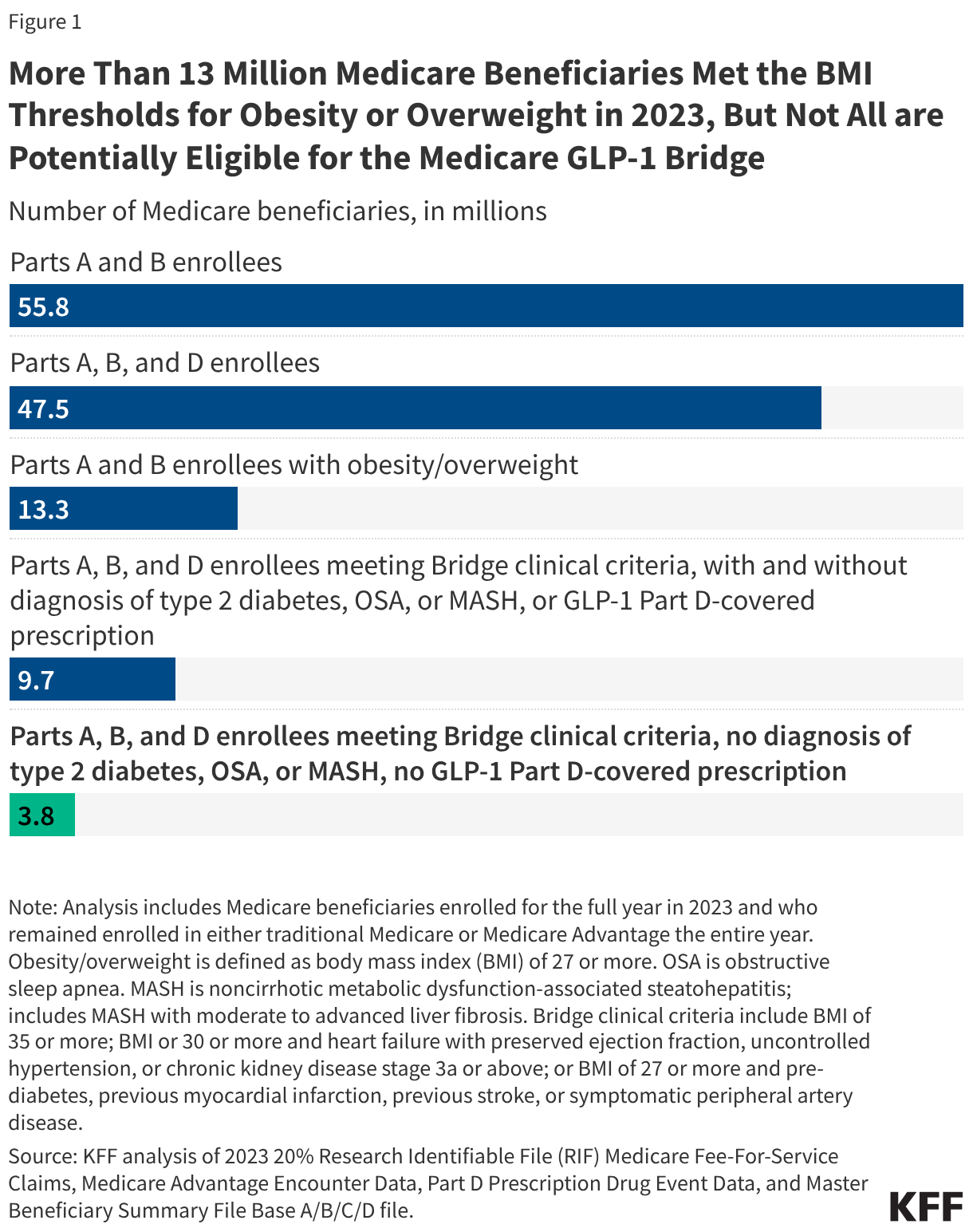
Although more than 13 million Medicare beneficiaries met the BMI thresholds for obesity or overweight based on diagnosis data in 2023, the analysis shows that a smaller group –9.7 million beneficiaries — were enrolled in Part D and met the clinical criteria for the Medicare-GLP-1 Bridge, and an even smaller subset — 3.8 million – met all of the eligibility criteria. That is because the potentially eligible population for Bridge is not as broad as if the program were targeted to all Medicare beneficiaries with obesity or overweight.

Tennessee Plans to Share Data on Children with Disabilities with Immigration Authorities

Published: Jun 29, 2026

According to recent news reports, the families of about 400 children with disabilities who are enrolled in Tennessee’s Children’s Special Services (CSS) program received notices from the state health department in early June stating that if their child continued to remain enrolled in CSS beyond June 30, 2026, their information would be reported to a central state immigration enforcement agency. However, following a lawsuit filed by physicians in the state, a judge issued a temporary restraining order on June 24, 2026, to prevent this data sharing from taking place. Tennessee is one of at least six states that have taken actions as of June 2026 to require state agencies to report applicants or recipients of Medicaid and/or other public benefits whose immigration status could not be verified and/or who were verified to not have lawful presence with immigration enforcement authorities. Under longstanding federal law, Medicaid and other federally funded health coverage are already limited to lawfully present immigrants.

In Tennessee, the legislation requires every state governmental entity, local governmental entity, and local health department to verify that each applicant who is 18 years of age or older and applies for a federal, state, or local public benefit is a United States citizen or lawfully present immigrant. It also requires these entities to report all identifying information for individuals who are not lawfully present and who receive federal, state, or local public benefits to the state’s centralized immigration enforcement division and makes it a criminal offense for an employee or official to intentionally fail to report an individual who is not lawfully present.

Tennessee has interpreted this law to include its CSS program, although Tennessee Representative Steve Cohen wrote a letter to Governor Bill Lee indicating that the law reads as limited to applicants who are at least 18 years old. Tennessee’s CSS program provides care coordination and payment assistance for certain services to people under age 21 whose family income is at or below 225% of the federal poverty level and who have a physical disability, such as cerebral palsy, cystic fibroses, sickle cell anemia or other serious medical conditions without immigrant eligibility restrictions. A recent report indicates more than 4,600 children in Tennessee are enrolled in CSS.

Health care providers and advocates in the state have warned that this data sharing will likely lead families to stop participating in the program, which could lead to disruptions in care that have life threatening consequences. Reporting requirements could also have “chilling effects” that lead to disenrollment and forgone enrollment among a broader group of families than those subject to the new reporting requirements due to confusion and fear. 

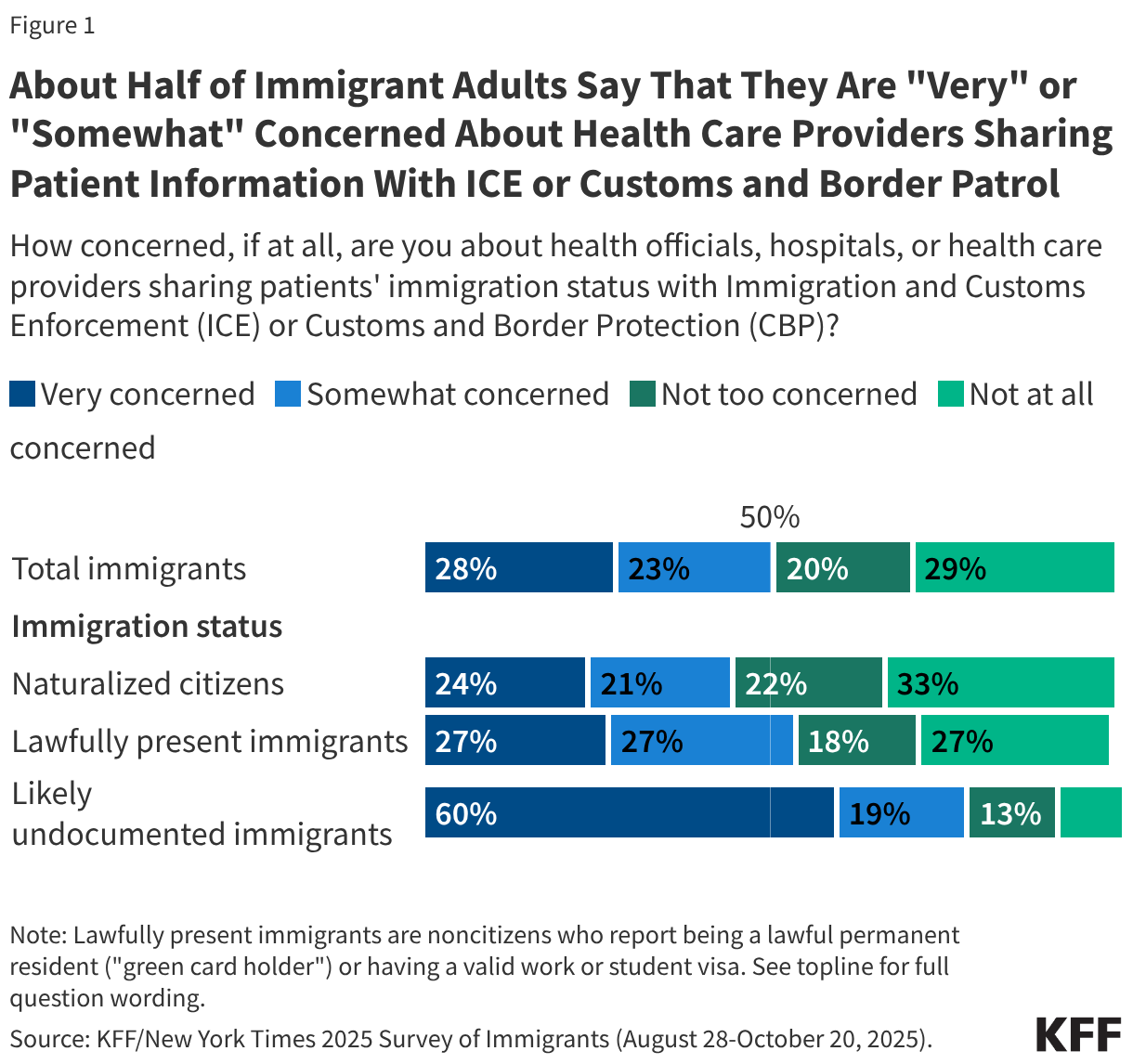
A 2025 national KFF survey shows that the share of immigrant adults who said they avoided applying for a government program that helps pay for food, housing, or health care in the past 12 months because they did not want to draw attention to their or a family member’s immigration status rose from 8% to 12% between 2023 and 2025. Further, 11% of immigrant adults say they have stopped participating in such a program since January 2025 because of immigration-related worries, including about four in ten (42%) of those who are likely undocumented and about one in six (17%) parents. Moreover, about half (51%) of immigrant adults overall and about eight in ten (78%) of those who are likely undocumented said they are “somewhat” or “very” concerned about health officials or providers sharing patient information with immigration enforcement officials (Figure 1). These data were collected prior to recent state-level actions to share data on immigrant families with immigration enforcement officials.

About Half of Immigrant Adults Say That They Are "Very" or "Somewhat" Concerned About Health Care Providers Sharing Patient Information With ICE or Customs and Border Patrol (Stacked Bars)

Beyond the data sharing actions in Tennessee and several other states, in July 2025, the Centers for Medicare and Medicaid Services (CMS) and U.S. Immigration and Customs Enforcement (ICE) established an Information Exchange Agreement that enables immigration enforcement officials to access the personal data of millions of Medicaid enrollees to help identify and locate “aliens in the United States.” This data sharing represents a reversal in prior policy that asserted CMS would not share such information and ICE would not use such information for immigration enforcement purposes, with assurances made to the public, applicants and enrollees, health care providers, and states that information collected to determine eligibility for health coverage programs would not be used for immigration enforcement. The administration also has directed the Internal Revenue Service to share personal information of individuals for immigration enforcement purposes, although these actions are facing court challenges.

Nearly Four Million Medicare Beneficiaries Met the Eligibility Criteria in 2023 for the Medicare GLP-1 Bridge

Published: Jun 29, 2026

On July 1, 2026, the Centers for Medicare & Medicaid Services (CMS) will roll out a new, temporary program covering GLP-1s for obesity for people with Medicare. The program, known as the Medicare GLP-1 Bridge, provides coverage of GLP-1s used for weight reduction and weight management to eligible beneficiaries enrolled in Medicare Part D, although the program will operate outside of the Part D benefit and payment system. Under the Medicare GLP-1 Bridge, eligible beneficiaries can get Medicare coverage of GLP-1s for obesity for a $50 monthly copayment, which will not count towards the Part D deductible or out-of-pocket spending cap and Part D Low-Income Subsidy cost-sharing assistance will not apply. The temporary program, running from July 2026 through December 2027, does not change the current statutory prohibition on Medicare coverage of drugs used for weight loss but instead is being established using the federal government’s Section 402 demonstration authority.

The Medicare GLP-1 Bridge will provide coverage of three GLP-1s (Wegovy, Zepbound, and Foundayo) that have been approved by the FDA for chronic weight management in adults with obesity (BMI of 30 or more) or adults with overweight (BMI of 27 or more) plus a weight-related comorbid condition. The clinical criteria for determining eligibility for the Medicare GLP-1 Bridge are somewhat more restrictive than the FDA approvals, however, and include Part D enrollees with a BMI of 35 or more; with a BMI of 30 or more and heart failure with preserved ejection fraction, uncontrolled hypertension, or chronic kidney disease stage 3a or above; or with a BMI of 27 or more and pre-diabetes, previous myocardial infarction, previous stroke, or symptomatic peripheral artery disease.

Eligibility for the Medicare GLP-1 Bridge will also be limited to Medicare beneficiaries who have not filled a prescription under their Part D plan for a GLP-1 in 2026, and who do not have a diagnosis with a condition that is a medically accepted indication for a GLP-1 drug that could be covered under Part D (specified by CMS as type 2 diabetes, obstructive sleep apnea (OSA), and noncirrhotic metabolic dysfunction-associated steatohepatitis (MASH)), even if they otherwise meet the clinical criteria. These limits are designed to prevent GLP-1 use that could be covered under Part D from shifting to the Medicare GLP-1 Bridge and will also help to limit the cost of the program to Medicare. As part of the prior authorization process for Bridge, prescribing clinicians will need to attest that the GLP-1 prescription is for weight reduction and weight management and that beneficiaries meet the clinical criteria and do not have a diagnosis of type 2 diabetes, OSA, or MASH that would make them eligible for GLP-1 coverage under Part D.

CMS has not released an estimate of how many beneficiaries could be eligible for the Medicare GLP-1 Bridge, although the director of Medicare at CMS, Chris Klomp, recently stated the agency anticipates the program will start with “single-digit millions” of beneficiaries. This analysis uses 2023 Medicare claims for traditional Medicare, Medicare Advantage encounter data, and Part D prescription drug event data to estimate the total number of Medicare beneficiaries with obesity or overweight, the number of Part D enrollees who met the Bridge eligibility criteria in 2023, and those who met the Bridge clinical criteria but who also had diagnoses recorded in claims or encounter data that would qualify for Part D coverage of GLP-1s (type 2 diabetes, OSA, or MASH) or who had a GLP-1 Part D-covered prescription during the year, either of which would make them ineligible for Bridge (see Methods).

More than 13 million Medicare beneficiaries met the BMI thresholds for obesity or overweight in 2023, but not all are potentially eligible for the Medicare GLP-1 Bridge. In 2023, an estimated 13.3 million Medicare beneficiaries enrolled in Parts A and B had obesity or overweight, based on having BMI of 27 or more recorded in claims or encounter data, or 24% of Medicare beneficiaries overall (Figure 1). (This estimate could be conservative to the extent that not all beneficiaries with obesity or overweight may have a claims-based diagnosis.) However, the potentially eligible population for the Medicare GLP-1 Bridge is not as broad as if the program were targeted to all people with Medicare with obesity or overweight. As detailed below, an estimated 3.8 million beneficiaries could be eligible for Bridge as of 2023, based on meeting all the eligibility criteria.

More Than 13 Million Medicare Beneficiaries Met the BMI Thresholds for Obesity or Overweight in 2023, But Not All are Potentially Eligible for the Medicare GLP-1 Bridge (Bar Chart)

Among the 47.5 million Medicare Part D enrollees in 2023, 9.7 million enrollees met the clinical criteria for the Medicare GLP-1 Bridge in 2023, but less than half of this group—3.8 million (39%)—is estimated to be eligible for Bridge (Figure 2, Table 1). These 3.8 million Part D enrollees met the clinical criteria, did not have a diagnosis of type 2 diabetes, OSA, or MASH, or a GLP-1 Part D-covered prescription in 2023, and could be eligible for the Medicare GLP-1 Bridge, assuming no changes in diagnosis or GLP-1 use in Part D in 2026. This estimate, which includes Part D enrollees in traditional Medicare and Medicare Advantage, represents 8% of Medicare Part D enrollees and 7% of the total population enrolled in Medicare Part A and Part B for the entire year in 2023. The other 5.9 million Part D enrollees met the clinical criteria but also had claims or encounter data recording a diagnosis of type 2 diabetes, OSA, or MASH, and/or had a GLP-1 Part D-covered prescription, either of which would make them ineligible for Bridge.

In 2023, 3.8 Million Medicare Part D Enrollees Met the Eligibility Criteria for the Medicare GLP-1 Bridge (Donut Chart)

The total cost to the federal government of the Medicare GLP-1 Bridge will depend in part on how many beneficiaries are eligible in 2026 and 2027, what share of them participate, how quickly they initiate use under the program after it begins, and how many prescriptions each participating beneficiary fills during the 18-month period. While take-up is uncertain, interest in the program among potentially eligible Medicare beneficiaries is likely to be strong. Based on the estimated 3.8 million Part D enrollees eligible for the Medicare GLP-1 Bridge as of 2023, if 10% to 25% participate in Bridge from when the program launches in July 2026 and fill a prescription each month for the 18-month duration of the program, the cost to Medicare would be $1.3 billion to $3.3 billion (at a net monthly cost of $245 minus the $50 beneficiary copay). Assuming higher participation rates ranging from 50% to 75%, the cost to Medicare would be between $6.7 billion and $10 billion. The ultimate cost to the federal government of the Medicare GLP-1 Bridge will depend on actual participation numbers and adherence during the 18-month program, as well as potential cost offsets from savings that might accrue over time due to beneficiary health improvements from GLP-1 use for weight reduction and weight management.

Estimated Number of Medicare Part D Enrollees Who Met the Clinical Criteria for the Medicare GLP-1 Bridge in 2023 (Table)

Methods

This analysis mapped ICD-10 codes to the clinical criteria specified by CMS for the Medicare GLP-1 Bridge and utilized the 2023 20% Research Identifiable File (RIF) Medicare Fee-For-Service Claims and Medicare Advantage Encounter Data to create condition flags, along with the Part D Prescription Drug Event data to create a flag for GLP-1 use. The 2023 RIF Master Beneficiary Summary File (Base A/B/C/D file) was used to identify individuals to include in the analysis, which were then weighted to produce population estimates. To be included in the analysis of diagnosis with obesity or overweight, an individual was required to have coverage under Parts A and B for all months of 2023, not have switched between traditional Medicare and Medicare Advantage during the year, and remain living for the entire year. To be included in the Bridge eligibility analysis, an individual was required to have coverage for Parts A, B, and D for all months of 2023, not have switched between traditional Medicare and Medicare Advantage during the year, and remain living for the entire year. Individuals were grouped based on their insurance type (traditional Medicare or Medicare Advantage) for 2023. Individuals received a condition flag if they had one or more claims/encounters that matched a respective ICD-10 code mapped onto one of the Bridge clinical criteria in an inpatient, outpatient, carrier, home health, or skilled nursing facility setting in 2023. Individuals received a GLP-1 user flag if they had one or more Part D prescription drug event claims for a GLP-1 medication in 2023.

Diagnoses on Medicare Advantage chart reviews were not included in the creation of the condition flags. This produces a somewhat more conservative estimate of Medicare Advantage enrollees who could be eligible for the Medicare GLP-1 Bridge.

This work was supported in part by Arnold Ventures. KFF maintains full editorial control over all of its policy analysis, polling, and journalism activities.

Tracking Insurer Participation Changes in the ACA Marketplaces in 2027

Authors: Jared Ortaliza, Justin Lo, Lynne Cotter, Matt McGough, and Cynthia Cox
Published: Jun 29, 2026

Editorial Note: Originally published on June 11, 2026, this brief has been updated to reflect additional information about carriers’ plans for 2027. 

As of September 15, 2026, nine carriers have announced that they will exit the ACA Marketplaces in plan year 2027, either in some or all states that they are currently offering plans; six carriers have announced they will enter new state Marketplaces. These changes in insurer participation follow the expiration of the enhanced premium tax credits at the end of 2025, which drove sign-ups to fall by over a million from the 2025 to 2026 Open Enrollment Periods—with further membership declines in the ACA Marketplaces expected as the year progresses. ACA Marketplace enrollment declines affect the size of the potential market for insurers, and, potentially, the risk pool—to the extent that healthier than average enrollees are more likely to drop coverage.

As people leave the Marketplace, insurers may reassess the profitability of their Marketplace participation and decide to pull out in the future. Cigna has decided to leave the individual market in 2027 to focus on other segments given the lack of potential to grow their ACA Marketplace business. Cigna, which reported first-quarter on-exchange enrollment of over 350,000 individuals, will exit the 11 states in which it currently participates both on- and off-exchange. In some cases, multiple insurers are announcing exits in the same state. In some states, with fewer insurers participating in the ACA Marketplaces, remaining insurers will have less competition and consumers will be left with fewer choices.

Changes in Insurer Participation for 2027 (Table)

VOLUME 49

KFF Poll Shows Three in Ten Adults Turn to Social Media or AI for Health Information, with Lower-Income Adults More Likely to Cite Cost and Access Barriers as a Reason


Highlights

The latest KFF Tracking Poll on Health Information and Trust finds roughly three in ten adults report turning to social media (31%) or AI chatbots (29%) at least monthly for health information and advice. The top reasons people report turning to social media for health advice are wanting to hear from those with similar experiences or a desire for quick information. But nearly one in five say they turned to social media due to difficulties accessing or affording care, similar to the shares who cited access and cost as reasons for turning to AI for health information in a previous KFF poll.  

These findings as well as data from dozens of past KFF polls can also be found on KFF’s Health Information and Trust Polling Dashboard.  


KFF Poll Shows Three in Ten Adults Regularly Turn to Social Media or AI For Health Advice, With Similar Shares of Social Media and AI Users Citing Barriers to Accessing Care as a Reason for Using These Platforms

KFF’s latest Tracking Poll on Health Information and Trust examines the public’s use of social media and AI for health information. Overall, three in ten (31%) adults say they use social media at least monthly for health information and advice, similar to the share (29%) who say they use artificial intelligence (AI) tools or chatbots at least monthly for health. Larger shares of adults under 30, Black and Hispanic adults, those without a college degree, and those with lower incomes say they turn to social media for health information at least monthly. 

Split bar chart showing the percent of people who report using social media or AI tools for health information and advice at least monthly. Results by total adults, age, race/ethnicity, education, and household income.

Among people who use social media for health information at least occasionally, over a third say a “major reason” they did so was to learn from others with similar experiences or conditions (36%) or because they wanted immediate information or support (35%). A smaller share of users (17%) say a “major reason” they relied on social media was because they don’t have a health care provider or couldn’t afford to see one.

Stacked bar chart showing the percent of people who selected wanting to learn from others, wanting immediate information, and not having a regular health care provider as a reason for using social media to find health information and advice.

While cost and access problems may not be the top reason people turn to either social media or AI for health information, nearly one in five users are turning to each of these mediums for these reasons, including even higher shares among those with lower incomes. Among adults who use social media for health, this reason is also more commonly cited among uninsured adults (32%) and some groups that have historically had a harder time accessing health care, including Hispanic adults (29%) and LGBT adults (30%). 

Similar Shares of Adults Who Use Social Media or AI for Health Information Cite Difficulties Accessing or Affording Care as a Major Reason, Including Larger Shares of Those With Lower Incomes (Split Bars)

While a slim majority of adults express confidence in their ability to tell whether health information from social media or AI tools is true or not, about four in ten lack confidence in this regard. Adults who use social media and AI for health information are more likely than those who don’t to express confidence in their ability to discern whether health information on these platforms is true or not, as are younger adults compared to older adults.

Grouped bar chart showing the percentage of adults who say they are very or somewhat confident they can tell true from false health information from social media and from AI tools or chatbots, broken down by total adults, age group, and whether they use each source for health information.

AI & Emerging Tech

Understanding the Role of AI in Spreading and Creating Faulty Research

  • A correspondence published in The Lancet in May identified more than 4,000 fabricated references across nearly 2.5 million biomedical papers published between 2023 and early 2026. Researchers found that papers containing at least one fabricated citation became substantially more common during the study period, rising from roughly one in 2,800 papers in 2023 to one in 277 papers in early 2026. Many of the fabricated references appeared legitimate, citing real researchers, plausible publication years, and topic-specific article titles, but pointed to studies that did not exist.
  • The authors note that large language models (LLMs) are known to generate fabricated citations that appear authentic, and that the sharp rise in fabricated references coincided with the period following widespread adoption of generative AI tools. While the study could not determine what caused the increase, researchers note that fabricated references can emerge through multiple pathways, including AI-generated citations, paper mills, and other forms of research misconduct.

Here’s the big picture:

  • AI systems can amplify inaccurate or fabricated information. Large language models sometimes generate information that sounds plausible but is unsupported or entirely false, a phenomenon often referred to as "hallucination." A 2025 study found that when fictional medical terms were included in health questions, chatbots elaborated on them in nearly two-thirds of cases, generating explanations and treatments for conditions that do not exist. Researchers demonstrated a similar dynamic in an experiment involving a fictional skin condition called "bixonimania." After uploading fake papers about the condition to a preprint server, they found that several major AI chatbots described the made-up disorder as real and, in some cases, recommended medical care. The fabricated papers were later cited in a peer-reviewed article before being retracted.
  • AI systems increasingly interact with scientific literature that contain fraudulent or unreliable research. Researchers have documented the growing presence of "paper mills," operations that produce and sell fraudulent academic manuscripts. A study in BMJ found that nearly 10% of cancer research papers showed signs of paper mill involvement, with the proportion increasing over time. Because AI systems are trained on large volumes of publicly available content, including scientific literature, concerns have emerged that low-quality or fraudulent research may influence the information these systems retrieve, summarize, or generate. Some research has shown that even when fraudulent papers make up just 0.01% of an AI system's training data, they can contribute to errors in as many as 10% of responses.
  • Generative AI is also lowering barriers to producing convincing scientific content. Researchers have identified AI-generated manuscripts circulating through academic publishing and scholarly databases, sometimes without disclosure of AI assistance. The ability to rapidly generate text, references, and literature reviews raises concerns that AI could accelerate the production of papers that appear credible but contain errors, unsupported claims, or fabricated citations. As a result, some researchers and publishers are calling for stronger screening, reference verification, and disclosure requirements throughout the publication process.

Why This Matters: AI is increasingly involved at multiple stages of the scientific information ecosystem, from generating content and citations to retrieving and summarizing published research. As fabricated references, fraudulent papers, and other forms of low-quality research become harder to distinguish from legitimate scholarship, weaknesses in one part of the system can affect others. New efforts to detect paper mills, verify references, and improve AI reliability are underway, but people are already using AI tools to answer health questions.


What We’re Watching

A Closer Look at the State Level: New Jersey Poll Finds Broad Concern About Misinformation, Alongside Use of Search and Social Platforms

A Rutgers-Eagleton Poll commissioned by the New Jersey Civic Information Consortium found that concerns about misinformation are widespread among New Jersey voters, with 60% describing the spread of false or misleading information as a "very big problem" and another 22% calling it a "moderately big problem." The survey also found that New Jerseyans frequently rely on digital channels for news, including search engines (77%), friends and family (75%), and national news outlets (71%). At the same time, about one-third of voters (34%) said local news coverage in their area has decreased over the past five years. Rutgers researchers noted that concern about misinformation was shared across demographic and political groups, suggesting a rare point of bipartisan agreement.

Why This Matters: The findings are consistent with 2023 KFF polling among the general public, which found that a vast majority of adults (83%) say the spread of false and inaccurate information in the United States is a “major problem.” At the same time, the Rutgers-Eagleton survey sheds light on the role that search engines, social networks, and interpersonal connections play in how people access information and evaluate its credibility.

About The Health Information and Trust Initiative: the Health Information and Trust Initiative is a KFF program aimed at tracking health misinformation in the U.S., analyzing its impact on the American people, and mobilizing media to address the problem. Our goal is to be of service to everyone working on health misinformation, strengthen efforts to counter misinformation, and build trust. 


View all KFF Monitors

The Monitor is a report from KFF’s Health Information and Trust initiative that focuses on recent developments in health information. It’s free and published twice a month.

Sign up to receive KFF Monitor
email updates


Support for the Health Information and Trust initiative is provided by the Robert Wood Johnson Foundation (RWJF). The views expressed do not necessarily reflect the views of RWJF and KFF maintains full editorial control over all of its policy analysis, polling, and journalism activities. The data shared in the Monitor is sourced through media monitoring research conducted by KFF.