Nearly Four Million Medicare Beneficiaries Met the Eligibility Criteria in 2023 for the Medicare GLP-1 Bridge
On July 1, 2026, the Centers for Medicare & Medicaid Services (CMS) will roll out a new, temporary program covering GLP-1s for obesity for people with Medicare. The program, known as the Medicare GLP-1 Bridge, provides coverage of GLP-1s used for weight reduction and weight management to eligible beneficiaries enrolled in Medicare Part D, although the program will operate outside of the Part D benefit and payment system. Under the Medicare GLP-1 Bridge, eligible beneficiaries can get Medicare coverage of GLP-1s for obesity for a $50 monthly copayment, which will not count towards the Part D deductible or out-of-pocket spending cap and Part D Low-Income Subsidy cost-sharing assistance will not apply. The temporary program, running from July 2026 through December 2027, does not change the current statutory prohibition on Medicare coverage of drugs used for weight loss but instead is being established using the federal government’s Section 402 demonstration authority.
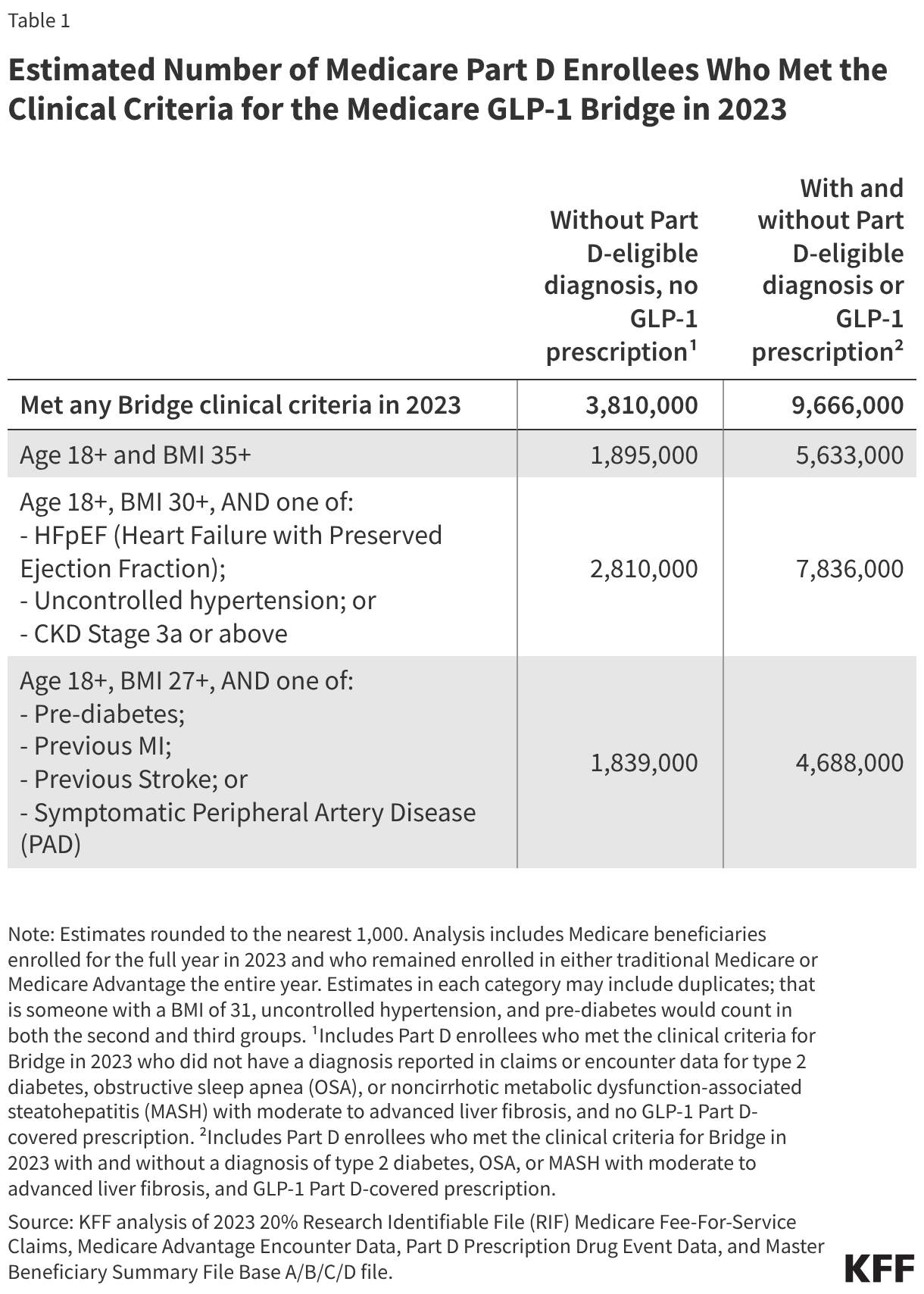
The Medicare GLP-1 Bridge will provide coverage of three GLP-1s (Wegovy, Zepbound, and Foundayo) that have been approved by the FDA for chronic weight management in adults with obesity (BMI of 30 or more) or adults with overweight (BMI of 27 or more) plus a weight-related comorbid condition. The clinical criteria for determining eligibility for the Medicare GLP-1 Bridge are somewhat more restrictive than the FDA approvals, however, and include Part D enrollees with a BMI of 35 or more; with a BMI of 30 or more and heart failure with preserved ejection fraction, uncontrolled hypertension, or chronic kidney disease stage 3a or above; or with a BMI of 27 or more and pre-diabetes, previous myocardial infarction, previous stroke, or symptomatic peripheral artery disease.
Eligibility for the Medicare GLP-1 Bridge will also be limited to Medicare beneficiaries who have not filled a prescription under their Part D plan for a GLP-1 in 2026, and who do not have a diagnosis with a condition that is a medically accepted indication for a GLP-1 drug that could be covered under Part D (specified by CMS as type 2 diabetes, obstructive sleep apnea (OSA), and noncirrhotic metabolic dysfunction-associated steatohepatitis (MASH)), even if they otherwise meet the clinical criteria. These limits are designed to prevent GLP-1 use that could be covered under Part D from shifting to the Medicare GLP-1 Bridge and will also help to limit the cost of the program to Medicare. As part of the prior authorization process for Bridge, prescribing clinicians will need to attest that the GLP-1 prescription is for weight reduction and weight management and that beneficiaries meet the clinical criteria and do not have a diagnosis of type 2 diabetes, OSA, or MASH that would make them eligible for GLP-1 coverage under Part D.
CMS has not released an estimate of how many beneficiaries could be eligible for the Medicare GLP-1 Bridge, although the director of Medicare at CMS, Chris Klomp, recently stated the agency anticipates the program will start with “single-digit millions” of beneficiaries. This analysis uses 2023 Medicare claims for traditional Medicare, Medicare Advantage encounter data, and Part D prescription drug event data to estimate the total number of Medicare beneficiaries with obesity or overweight, the number of Part D enrollees who met the Bridge eligibility criteria in 2023, and those who met the Bridge clinical criteria but who also had diagnoses recorded in claims or encounter data that would qualify for Part D coverage of GLP-1s (type 2 diabetes, OSA, or MASH) or who had a GLP-1 Part D-covered prescription during the year, either of which would make them ineligible for Bridge (see Methods).
More than 13 million Medicare beneficiaries met the BMI thresholds for obesity or overweight in 2023, but not all are potentially eligible for the Medicare GLP-1 Bridge. In 2023, an estimated 13.3 million Medicare beneficiaries enrolled in Parts A and B had obesity or overweight, based on having BMI of 27 or more recorded in claims or encounter data, or 24% of Medicare beneficiaries overall (Figure 1). (This estimate could be conservative to the extent that not all beneficiaries with obesity or overweight may have a claims-based diagnosis.) However, the potentially eligible population for the Medicare GLP-1 Bridge is not as broad as if the program were targeted to all people with Medicare with obesity or overweight. As detailed below, an estimated 3.8 million beneficiaries could be eligible for Bridge as of 2023, based on meeting all the eligibility criteria.
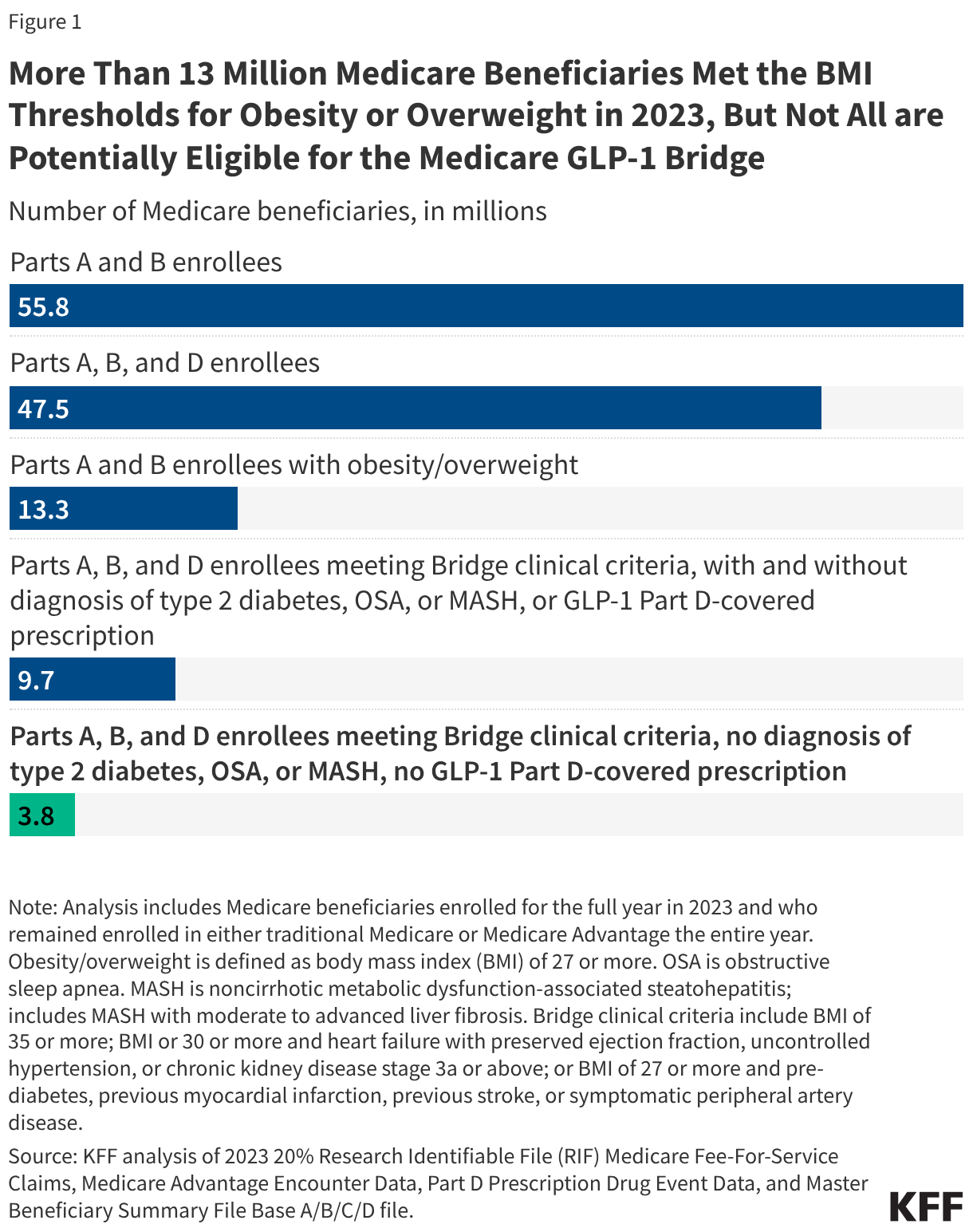
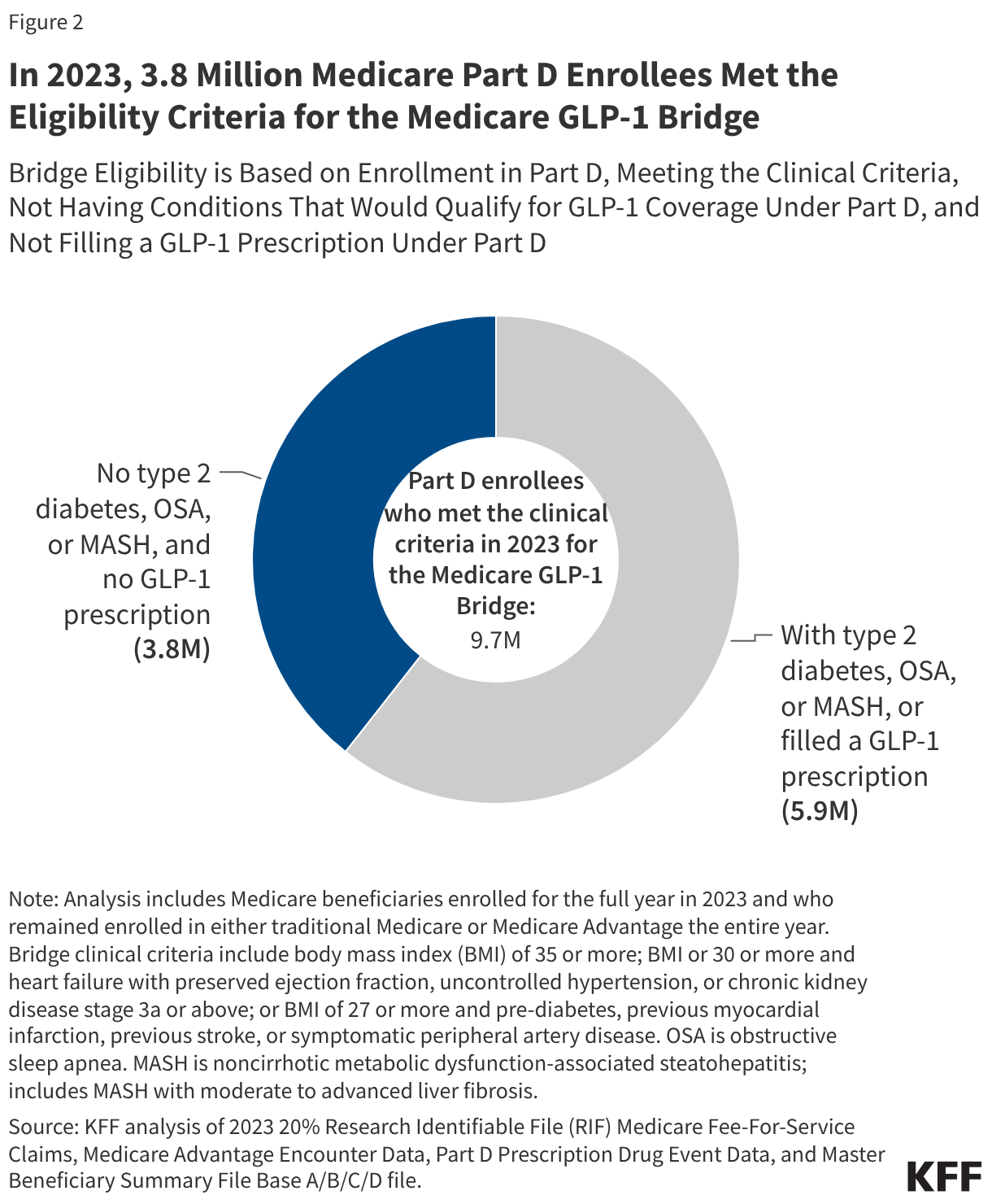
Among the 47.5 million Medicare Part D enrollees in 2023, 9.7 million enrollees met the clinical criteria for the Medicare GLP-1 Bridge in 2023, but less than half of this group—3.8 million (39%)—is estimated to be eligible for Bridge (Figure 2, Table 1). These 3.8 million Part D enrollees met the clinical criteria, did not have a diagnosis of type 2 diabetes, OSA, or MASH, or a GLP-1 Part D-covered prescription in 2023, and could be eligible for the Medicare GLP-1 Bridge, assuming no changes in diagnosis or GLP-1 use in Part D in 2026. This estimate, which includes Part D enrollees in traditional Medicare and Medicare Advantage, represents 8% of Medicare Part D enrollees and 7% of the total population enrolled in Medicare Part A and Part B for the entire year in 2023. The other 5.9 million Part D enrollees met the clinical criteria but also had claims or encounter data recording a diagnosis of type 2 diabetes, OSA, or MASH, and/or had a GLP-1 Part D-covered prescription, either of which would make them ineligible for Bridge.
The total cost to the federal government of the Medicare GLP-1 Bridge will depend in part on how many beneficiaries are eligible in 2026 and 2027, what share of them participate, how quickly they initiate use under the program after it begins, and how many prescriptions each participating beneficiary fills during the 18-month period. While take-up is uncertain, interest in the program among potentially eligible Medicare beneficiaries is likely to be strong. Based on the estimated 3.8 million Part D enrollees eligible for the Medicare GLP-1 Bridge as of 2023, if 10% to 25% participate in Bridge from when the program launches in July 2026 and fill a prescription each month for the 18-month duration of the program, the cost to Medicare would be $1.3 billion to $3.3 billion (at a net monthly cost of $245 minus the $50 beneficiary copay). Assuming higher participation rates ranging from 50% to 75%, the cost to Medicare would be between $6.7 billion and $10 billion. The ultimate cost to the federal government of the Medicare GLP-1 Bridge will depend on actual participation numbers and adherence during the 18-month program, as well as potential cost offsets from savings that might accrue over time due to beneficiary health improvements from GLP-1 use for weight reduction and weight management.
Methods
This analysis mapped ICD-10 codes to the clinical criteria specified by CMS for the Medicare GLP-1 Bridge and utilized the 2023 20% Research Identifiable File (RIF) Medicare Fee-For-Service Claims and Medicare Advantage Encounter Data to create condition flags, along with the Part D Prescription Drug Event data to create a flag for GLP-1 use. The 2023 RIF Master Beneficiary Summary File (Base A/B/C/D file) was used to identify individuals to include in the analysis, which were then weighted to produce population estimates. To be included in the analysis of diagnosis with obesity or overweight, an individual was required to have coverage under Parts A and B for all months of 2023, not have switched between traditional Medicare and Medicare Advantage during the year, and remain living for the entire year. To be included in the Bridge eligibility analysis, an individual was required to have coverage for Parts A, B, and D for all months of 2023, not have switched between traditional Medicare and Medicare Advantage during the year, and remain living for the entire year. Individuals were grouped based on their insurance type (traditional Medicare or Medicare Advantage) for 2023. Individuals received a condition flag if they had one or more claims/encounters that matched a respective ICD-10 code mapped onto one of the Bridge clinical criteria in an inpatient, outpatient, carrier, home health, or skilled nursing facility setting in 2023. Individuals received a GLP-1 user flag if they had one or more Part D prescription drug event claims for a GLP-1 medication in 2023.
Diagnoses on Medicare Advantage chart reviews were not included in the creation of the condition flags. This produces a somewhat more conservative estimate of Medicare Advantage enrollees who could be eligible for the Medicare GLP-1 Bridge.
This work was supported in part by Arnold Ventures. KFF maintains full editorial control over all of its policy analysis, polling, and journalism activities.