Measles Elimination Status: What It Is and How the U.S. Could Lose It

Author: Josh Michaud
Published: Apr 7, 2026

Originally published in July 2025, this policy watch has been updated in April 2026 to reflect additional developments and updated measles trends.

Measles has been officially “eliminated” from the U.S. since 2000, which means the country had not seen very large outbreaks and had not had 12 months or more of uncontrolled domestic transmission of the virus since before that time. However, a series of measles outbreaks began in the U.S. in early 2025 that continue today: from January 2025 through the end of March 2026, U.S. states have reported over 3,800 measles cases. Several factors have contributed to the ongoing transmission of measles in the U.S. These include funding and staffing cuts for public health efforts at the federal, state, and local levels that have affected measles prevention and response efforts across the country, along with mixed messages from federal health officials such as Department of Health and Human Services (HHS) Secretary Robert F. Kennedy, Jr. regarding measles response at the same time there has been no Senate-confirmed leader at CDC for almost the whole period since these outbreaks began. Further, there is increased skepticism among the public about the safety and effectiveness of measles vaccines and a decline in trust of health authorities in general, which has contributed to lower measles vaccination rates and complicated outreach and communication efforts in addressing the current outbreak.

What does this mean for U.S. elimination status and control of the disease going forward? This policy watch provides an overview of the definition of measles elimination, including how this status is decided and declared, and its significance. Further, it assesses how the current measles outbreak may threaten elimination status and what that might mean for control of measles in the U.S.

Measles and the Measles Vaccine

Measles is one of the most contagious human viruses. When spreading in a population with no prior immunity, it is estimated that on average one measles case can result in 12- 18 other cases (this is the basic “reproduction number” of measles). While most measles infections are not severe, health complications can occur in about 30% of measles cases, and around 1 in 1,000 measles infections lead to death. There is a higher risk of severe outcomes in young children and immunocompromised individuals. Among the 2,288 confirmed measles cases in 2025, 243 (11%) were hospitalized and three deaths have occurred. Besides the risk of the infection itself, measles can also have long-lasting negative impacts on the immune system more broadly, especially in children, leaving people more prone to serious outcomes from other infections. Those who recover from a measles infection usually develop long-term immunity to further measles infection.

Measles vaccines have been available in the U.S. since 1963 and are safe and effective at providing protection against illness and, importantly, against infection and onward transmission of the virus. It is estimated that two doses of a measles-containing vaccine are 97% effective in preventing infection. CDC recommends children get their first measles vaccine dose between 12 and 15 months of age, and the second dose between 4 and 6 years of age, before entering school. Currently, the most common measles-containing vaccine in the U.S. is the combination measles, mumps and rubella (MMR) vaccine. Epidemiologists estimate that when >95% of a population has immunity to measles, through previous infection or vaccination, then “herd immunity” is reached and measles transmission is interrupted and large outbreaks will not occur. Therefore, at least 95% coverage with two doses of the measles vaccine is a common goal for immunization campaigns and is the current Healthy People 2030 target in the U.S. However, it is estimated that national two-dose MMR coverage in the United States is for children entering kindergarten in 2024 was 92.5%, a figure that had declined from 94.7% in 2011. In addition, this coverage varied significantly across states, ranging from 78.5% in Idaho to 98.2% in Connecticut. Just 10 states had reported coverage levels at 95% or above in 2024-2025.

National, Regional, and Global Measles Elimination Goals and Prior U.S. Certifications

The first national goal to interrupt measles transmission in the U.S. was announced in 1966, just a few years after licensure of the first measles vaccine, and CDC announced further measles elimination goals in 1978 and 1993. In 1994, the member states of the Pan American Health Organization (PAHO, the Americas regional office of the World Health Organization (WHO) that includes the U.S.) set a goal of interrupting endemic measles virus transmission in the region by the year 2000 and in 2012, member states of the WHO endorsed a Global Vaccine Action Plan that included a measles elimination goal for all six WHO regions by 2020. 

Despite setting multiple goals since 1966, the U.S. did not officially achieve measles elimination status until 2000. Verification of elimination was carried out first through internal CDC and external expert review of U.S. strategy and programs to address measles, and epidemiological data on cases and vaccinations, which were compared against predetermined benchmarks for success. In March 2000, the National Immunization Program at CDC convened an external panel of experts to review the available data, and the panel concluded that criteria for elimination had been met, and officially stated that measles had eliminated from the U.S. Subsequently, a process was undertaken to re-verify U.S. elimination status in 2011, when the CDC’s National Center for Immunization and Respiratory Diseases assembled panel of external experts to review available evidence on U.S. measles programs and epidemiology since 2000. The panel agreed that measles elimination had been maintained, issuing a final report in March 2012. The U.S. has continued to review measles elimination status over time, including through an external expert committee known as the U.S. National Sustainability Committee for the Elimination of Measles, Rubella, and Congenital Rubella Syndrome.

Given the region-wide goal set in 1994, PAHO has also reviewed and verified national measles elimination for countries of the Americas, including the U.S. In 2007, PAHO member states created an international committee to verify country-level interruption of measles transmission and called for the creation of national-level commissions to help compile and submit related documentation to PAHO for review by an expert committee. Subsequently, PAHO’s Measles and Rubella Elimination Regional Monitoring and Re-Verification Commission (MRE-RVC) has met annually to review available evidence and issue reports on the status of elimination in PAHO member states with the U.S. consistently being designated as having sustained elimination. However, at its most recent meeting (in November 2025), the MRE-RVC placed the U.S. in the category of “sustained with major concerns.”

What Does it Mean to “Eliminate” Measles?

According to the guidelines developed by the U.S. and other PAHO member states, measles elimination has been defined at a basic level as: “Interruption of endemic measles virus transmission for a period greater than or equal to 12 months, in the presence of high-quality surveillance.” By contrast, measles is considered endemic in a given area if there is continuous transmission over a 12-month period.

In their review processes, CDC and external experts have used a variety of epidemiological and programmatic indicators, such as measles cases and transmission patterns, public health measures and response capabilities, and vaccination rates to help determine if endemic measles transmission has been “interrupted” and whether surveillance is “high-quality.” For example, when experts reviewed data for re-certification of measles elimination for the U.S. in 2011, the following primary lines of evidence were used (most covering the period 2001 to 2011) and the committee decided collectively that the data supported the conclusion that endemic measles virus transmission was interrupted in the presence of high-quality surveillance:

  • There were fewer than one reported measles case per 10 million population;
  • The great majority of measles cases were imported from areas outside the U.S. and most imported cases did not lead to further spread inside the U.S. – over the study period, 40% of cases were found to be imported;
  • The number and size of measles outbreaks over that period were small: a total of 64 outbreaks (median 4 outbreaks/year), with a median outbreak size of 6 cases. Only 16 outbreaks included 10 or more cases;
  • Measles vaccination rates among children had been sustained at high levels (>95%) over the study period, with no significant differences in coverage by race/ethnicity;
  • Data from national surveys indicated that population immunity to measles was above the “herd immunity” threshold; almost all age groups had seropositivity rates for measles antibodies over >95%, and;
  • Programmatic data on laboratory testing and case investigation performance indicated that U.S. surveillance adequately and quickly identified measles cases and transmission chains.

Prior to 2025, the largest outbreak of measles since U.S. elimination was declared occurred in 2018-2019. Imported measles cases in late 2018 had started a large outbreak centered in several close-knit communities with low vaccination rates in New York City and surrounding counties. As more measles cases came to be identified, state and local officials began to implement public health measures to combat the outbreak including declaring a public health emergency, mandating vaccinations and instituting fines for parents not vaccinating their children, which led to 60,000 MMR vaccine doses administered in affected areas in a few months. Authorities also closed schools where measles transmission occurred, prohibited unvaccinated children from attending school, and engaged in extensive communication and outreach efforts. At the time, federal agencies such as CDC provided technical assistance and other support and made clear statements about the importance of measles vaccinations, with then-CDC Director Robert Redfield stating “I encourage all Americans to adhere to CDC vaccine guidelines in order to protect themselves, their families, and their communities from measles” and pointing out that “organizations had been deliberately targeting these communities with inaccurate and misleading information about vaccines.” The White House also echoed this, with President Trump stating “vaccinations are so important” and encouraging parents to vaccinate their children against measles.  These combined efforts were effective in containing the New York outbreak in under 12 months, as transmission was interrupted by August 2019.

Does the Current Outbreak Threaten U.S. Measles Elimination Status?

In 2025, the U.S. had more reported measles cases, outbreaks, affected states, and deaths than in any year since 1992, and measles outbreaks have continued to occur in 2026. The pace of reported measles cases has fluctuated from early 2025 until March 2026, but there have been continual outbreaks and more states affected over that time period. A higher percentage of cases since 2025 have been due to local transmission vs. importation compared to prior years indicating local transmission has been the primary source of reported cases. Further, U.S. MMR vaccination rates have continued their steady decline and in many locations across the country levels of vaccination are below that needed for herd immunity. Table 1 summarizes key U.S. measles outbreak indicators as reported by CDC for 2025 and year-to-date (through March) 2026.
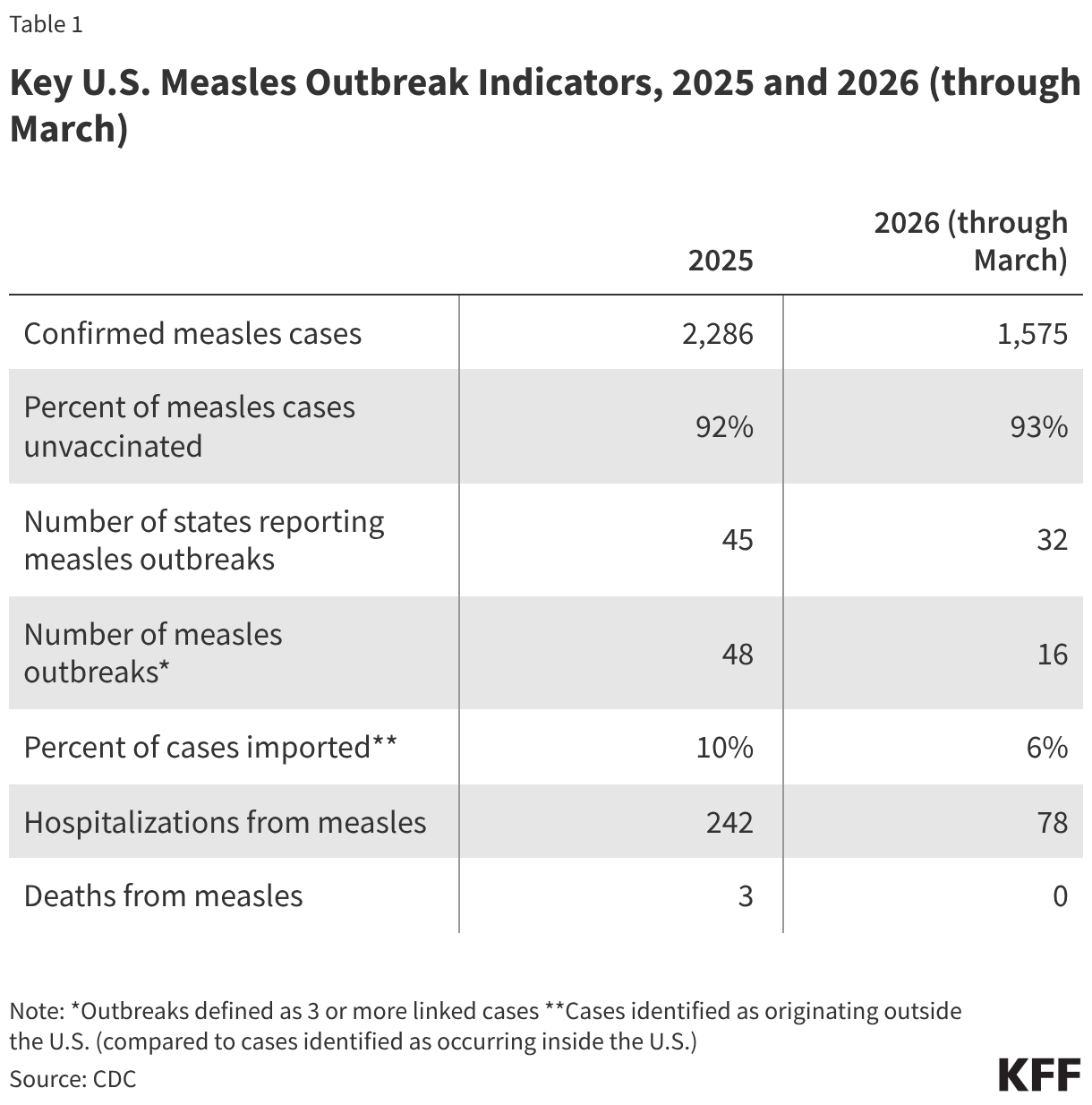
Key U.S. Measles Outbreak Indicators, 2025 and 2026 (through March) (Table)

Compared to the elimination period of 2001 to 2011 discussed above, these metrics are notably worse. There were 64 measles outbreaks in total over ten years (2001 -2011) but in 2025 there were 48 outbreaks, and there have been 16 new outbreaks in 2026 through March. While 40% of measles cases were imported in the 2001-2011 period, in 2025 just 10% of cases were imported and just 6% in 2026 (meaning more local transmission chains). There was one measles death over ten years during the elimination period, while there three in 2025 (none have been reported in 2026 to date). Many of these 2025 and 2026 data points are also worse than those from 2019, when U.S. measles elimination status was last threatened. For example, from January to October 1, 2019 (by which time the large outbreaks centered in New York had been contained), there had been 1,249 total measles cases, and 22 total outbreaks across 17 states; 2025 far surpassed those numbers. 

Primary responsibility for public health responses to measles sits with state and local health departments. At the moment, metrics on state and local capacities and response times for measles are not available, so gauging whether U.S. surveillance remains “high-quality” is challenging. However, in 2025 and 2026, state and local public health departments have faced cuts in funding and support from the federal government compared to previous years, which may impact their ability to track and respond to measles outbreaks. In recent years, the federal government has provided over half of state and local health public health departments’ budgets. There is little evidence that states most affected by measles in 2025, such as Texas, New Mexico, and South Carolina, have taken the kinds of measures that New York officials implemented to contain outbreaks in 2019: vaccination mandates, school restrictions and fines. While federal agencies such as CDC have been providing technical assistance and funding to affected areas, HHS Secretary Robert F. Kennedy, Jr. has downplayed the risks of measles and has provided mixed messages about the importance of vaccination compared to alternative treatments for measles, and CDC has been without a permanent Director since late August 2025. In January 2026, then Deputy Director of CDC Ralph Abraham stated that the measles outbreaks experienced by the U.S. were “just the cost of doing business…we have these communities that choose to be unvaccinated. That’s their personal freedom.” More recently, acting CDC Director Jay Bhattacharya has made stronger statements of support for measles vaccinations, saying in March 2026 that "measles is preventable and vaccination remains the most effective way to protect yourself and those around you.”

Data also show that national measles vaccination levels declined over the past five years, with kindergarten and childhood measles coverage rates dipping well below the 95% goal. Measles vaccination rates for kindergarteners at the national level declined from 95.2% in 2019-2020 to 92.5% in 2024-2025 (the latest available data), and over three-quarters of states had MMR vaccination rates below the target rate of 95% in the latest data. Additional studies have found that 78% of U.S. counties reported a decline in two-dose measles vaccine coverage in children, with the average county-level measles vaccination rate falling from 93.9% in 2019 to 91.3% in 2024. In 2025, 8% of U.S. measles cases had history of MMR vaccination while 92% of cases were unvaccinated or had unknown vaccination status; in 2026 so far 93% of cases were in unvaccinated individuals. Lower MMR vaccination rates have occurred in the context of broad declines in people’s trust in health authorities and in vaccinations in general. For example, KFF polling has found that parents are frequently exposed to misinformation about measles and the MMR vaccine, and in 2025 almost 20% of adults report they believed the false claim that “getting the measles vaccine is more dangerous than become infected with measles” is probably or definitely true.

Therefore, if current trends hold through the rest of the year there would appear to be grounds for the U.S. to lose measles elimination status, using prior definitions and benchmarks.

U.S. Measles Outbreaks in a Regional and Global Context

The U.S. is not alone in facing higher numbers of measles cases since 2025. There have also been large outbreaks in Mexico (6,213 reported cases in 2025) and Canada (5,463 reported cases in 2025). In fact, in November 2025 PAHO declared that Canada no longer holds measles elimination status due to having over 12 months of continual measles transmission. Like in the U,S., these outbreaks have been concentrated in communities with low vaccination rates. According to PAHO, in the region of the Americas, a total of 14,975 cases of measles were reported in 2025 across 13 countries, with almost all of these cases coming from North America. WHO reports that through June of this year, there were a total of 276,240 measles cases globally with large outbreaks occurring in the European and Eastern Mediterranean regions, in addition to the Americas. Outside of North America, the countries with the highest numbers of measles cases between August 2025 and January 2026 were India (12,135 cases), Angola (11,941), and Indonesia (8,892). As indicated in a standing travel warning from CDC, more circulation of measles regionally and globally means a higher risk that U.S. residents traveling internationally can be exposed, which raises the risk of importing measles and sparking new domestic outbreaks.

Looking Ahead

The next steps in determining U.S. measles elimination status include an internal federal-led review of state and CDC epidemiological data. A key outstanding question is whether transmission over the past year derived from the outbreak that began in January 2025 in West Texas, or whether outbreaks have been due to unconnected importation events. If cases over the past year across different states are epidemiologically linked to those from the Texas outbreak it would indicate continual chains of transmission extending more than 12 months, jeopardizing measles elimination status. Using genetic testing of measles virus isolated from patients, scientists can determine transmission patterns. CDC is currently working with partners to perform such sequences and publish the findings. These, along with other data, will be reviewed by the external expert PAHO committee (the Measles, Rubella, and Congenital Rubella Syndrome Elimination Regional Verification Commission, MRE-RVC), which is responsible for a determination of U.S. elimination status. After initially announcing a review meeting would take place in April 2026, PAHO changed the date for the U.S. measles elimination review to November 2026, which coincides with the regularly scheduled annual MRE-RVC meeting.

The elimination of measles in the U.S. was a notable public health achievement made possible by sustained investments in prevention and response capacities, support of vaccination, and commitment to the goal of elimination. However, this status is currently at risk, as demonstrated by the many factors discussed above. Losing measles elimination status would signify that the same commitment to measles prevention and control may no longer be present in the U.S. It could signify a future where measles is endemic and continuously circulating, especially if vaccination rates continue to decline. That would bring more hospitalizations and more deaths, particularly among vulnerable children, from a very preventable disease. There could be broader implications for communities across the country, which may have to contend with more frequent decisions about whether and when to close day cares and schools in the face of transmission risks. The societal costs of measles outbreaks are high, so continuous outbreaks would place an additional burden on already weakened and depleted public health systems, and would raise questions about what the appropriate level of support and funding should be from the federal government for outbreak response at the state and local levels.
Global Health Funding in the FY 2027 President’s Budget Request

Published: Apr 6, 2026

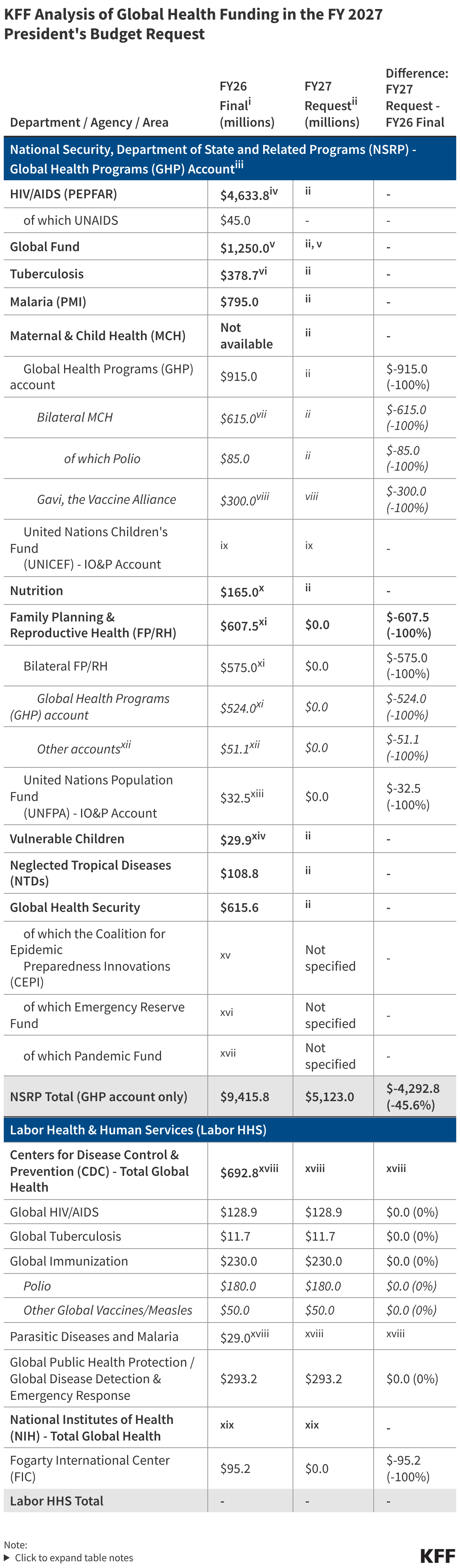
On April 3, 2026, the administration released its Fiscal Year 2027 budget request. The budget request includes discretionary funding for U.S. global health programs at the State Department, Centers for Disease Control and Prevention (CDC), and the National Institutes of Health (NIH). The proposed budget includes significant reductions in and restructuring of global health funding, including the elimination of some programs and activities as follows:

State:

  • Global Health Programs (GHP) account: The main account that supports global health programs totals $5.1 billion in the request, $4.3 billion below the FY 2026 amount ($9.4 billion).
  • Bilateral Funding:
    • Program areas: The FY27 request proposes to “eliminate disease-specific accounts and provide the Department crucial agility to address the actual needs of each recipient country—across HIV/AIDS and other infectious diseases such as Malaria, Tuberculosis, and Polio—to strengthen global health security and protect Americans from disease.”
    • Eliminated funding: Funding for family planning and reproductive health (FP/RH) is specifically eliminated in the FY27 request. The request does not mention funding for nutrition, the vulnerable children program, or neglected tropical diseases (NTDs), so it is possible funding for these programs is also eliminated.
  • Multilateral Funding:
    • The Global Fund to Fight AIDS, Tuberculosis and Malaria (Global Fund): Does not include a specific funding amount for the Global Fund in FY 2027 but commits to “leveraging $2 from other donors for every $1 from the United States.” It also states that funds may not exceed 33% of the total amount contributed to the Global Fund.
    • Gavi, the Vaccine Alliance (Gavi): Does not provide funding for Gavi and states that any future FY 2027 funding for Gavi is “contingent on the organization making necessary reforms and meeting certain benchmarks on vaccine safety.”
    • Eliminated funding: Eliminates funding for the Pan American Health Organization (PAHO), the United Nations Population Fund (UNFPA), and the World Health Organization. Funding for the United Nations Children’s Fund (UNICEF) was not specifically mentioned in the request. UNICEF and UNFPA have historically been provided through the International Organizations and Programs (IO&P) account, and the request states that “Authorities under IO&P were requested under the America First Opportunity Fund.”
  • Policy Provisions:
    • Period of availability: Proposes “aligning all Global Health Program accounts into 3-year period of availability.” Historically, funding has been available for 5-years for HIV and 2-years for other disease areas.
    • Promoting Human Flourishing in Foreign Assistance (PHFFA): Includes language to apply the PHFFA policy to all applicable foreign assistance accounts, including the GHP account.

Centers for Disease Control and Prevention (CDC):

  • CDC’s Global Health Center: Funding for CDC’s Global Health Center totals $663.8 million, and funding for all program areas remained level with FY 2026. This amount does not include funding for Parasitic Diseases & Malaria, which is proposed to be moved to another part of CDC, Emerging Infectious Diseases, without specifying an amount. FY 2027 global health funding at CDC is flat when Parasitic Diseases & Malaria funding is removed from the FY 2026 total.
  • CDC’s role in global health: The request states that “CDC serves as the nation’s first line of defense against emerging infectious diseases, protecting American communities, U.S. businesses, and the broader economy. CDC will play a key role in implementing an America First approach to global health to replace the functions of the World Health Organization.”

National Institutes of Health (NIH):

  • NIH funding: The FY 2027 request proposes reforms to the NIH, including overall funding decreases (while the NIH budget justification has not yet been released, the HHS Budget in Brief states that the overall decrease is approximately $5 billion). The budget does propose to eliminate funding for the Fogarty International Center (FIC), which was funded at $95 million in FY 2026.

See the table below for additional detail on global health funding. See other budget summaries (including the summary on FY 2026 Labor, Health and Human Services, Education, and Related Agencies [Labor HHS] and FY 2026 National Security, Department of State and Related Programs [NSRP] global health funding) and the KFF budget tracker for details on historical annual appropriations for global health programs.

KFF Analysis of Global Health Funding in the FY 2027 President's Budget Request (Table)

Resources:

A Closer Look at California’s Plans to Implement Work Requirements While Facing Major Budget Shortfalls Amid Cuts in Federal Medicaid Funding

Published: Apr 6, 2026

The 2025 reconciliation law requires states to condition Medicaid eligibility for adults in the Affordable Care Act (ACA) Medicaid expansion group and enrollees in partial expansion waiver programs (Georgia and Wisconsin) on meeting work requirements starting January 1, 2027. Implementing work requirements will require complex changes to eligibility and enrollment systems, as well as enrollee outreach and education, staff training, and coordination with managed care plans, providers, and other stakeholders. As states are preparing to implement work requirements and other changes in the reconciliation law, many states are facing more tenuous budget situations with slowing revenue growth and broader reductions in federal funding. 

The governor projects a $3 billion budget deficit for fiscal year (FY) 2027 and is proposing changes to slow Medicaid spending and close budget gaps while anticipating reductions in federal funding primarily due to changes included in the 2025 reconciliation law. Overall, state data show that California Medicaid (Medi-Cal) provides coverage to 14.8 million enrollees as of June 2025. Under the Governor’s proposed budget, Medicaid accounts for about 40% of the state budget and 20% of General Fund spending in FY 2027 or $49 billion (an increase from $45 billion in FY 2026). This issue brief examines the current budget context in California, the governor’s recently proposed budget, the state’s Medicaid Advisory Committee (MAC) meeting, state implementation plan documents and guidance, and data from KFF’s Medicaid work requirements tracker to provide initial insight into how California — the state with by far the largest number of Medicaid enrollees — is preparing to implement Medicaid work requirements during ongoing state budget debates.

What is the budgetary context as California prepares to implement work requirements?

California is facing a more tenuous fiscal climate like in other states, which led the state to implement spending cuts in FY 2026. In the past year, revenue volatility and rising costs have led to slowing state revenue growth following a period of record-breaking revenue and expenditure growth for states after the initial pandemic-induced economic downturn. Facing budget pressures in FY 2026 due to increasing spending demands from Medicaid, employee health care, education, housing, and disaster response, California implemented measures to slow cost growth in Medicaid, most of which may be attributed to higher utilization of services per-enrollee, higher service costs, and recent state benefit expansions. The changes in FY 2026 included partially restoring the asset test for seniors and persons with disabilities, ending Medicaid coverage of GLP-1s for obesity treatment, and ending supplemental payments for dental services.

In addition to Medicaid cuts, the state also implemented restrictions to their state-funded health program for immigrant adults who would qualify for Medicaid if not for their immigration status, including pausing enrollment and benefits, implementing cost-sharing, and reducing payments to health centers for services provided to undocumented immigrants. The state increased spending in other areas to fill in losses in federal funding, such as allocating funds to replace ACA Marketplace subsidies for some enrollees after the expiration of ACA enhanced premium tax credits at the end of 2025. California received $233 million this year from the federal Rural Health Transformation Program to help offset the 2025 reconciliation law impact on rural areas, though the program is unlikely to fully cover losses over time due to cuts in the law and from other federal policy changes.

The California governor’s proposed budget projects a $3 billion structural deficit for FY 2027 that is expected to grow to $22 billion in FY 2028 due to costs outpacing revenues and changes included in the 2025 reconciliation law. The governor’s proposed budget estimates that the 2025 reconciliation law would result in costs of $1.4 billion General Fund in FY 2027, with $1.1 billion in Medicaid alone. The proposed budget anticipates cost increases despite estimated reductions in spending due to eligibility changes that are expected to reduce the number of enrollees once they go into effect in 2027 (including work requirements, more frequent redeterminations, immigrant eligibility changes, and retroactive coverage). The budget also assumes cost increases (or revenue decreases) due to financing changes related to the state’s managed care tax and the hospital quality assurance fee, which are offset by modest revenue increases in the state’s managed care behavioral health tax. Other financing changes (including changes to state directed payments) will likely have larger impacts beyond the 2027 budget window.

In addition to the required federal Medicaid changes, the governor’s proposed budget voluntarily imposes Medicaid work requirements and six-month redeterminations on certain enrollees in California’s state-funded health program for immigrants. At the local level, voters in one California county approved a ballot measure in December 2025 to raise taxes to backfill Medicaid funding gaps caused by the 2025 reconciliation law, and voters in other counties may also consider similar ballot measures later in 2026.

What do we know about how California will implement work requirements?

Most Medicaid adults in California under age 65 who will be subject to the new work requirements are already working or attending school. As of June 2025, there were about five million expansion enrollees in California who could be affected by the new requirements. KFF analysis indicates that roughly 63% of Medicaid adults without dependent children in California who could be subject to work requirements work 80 or more hours per month or are attending school. In addition, many enrollees who are not working the required hours will likely qualify for exemptions from the new work requirements. California currently estimates that the introduction of work requirements will result in up to 1.4 million individuals being disenrolled over the reconciliation law implementation period.

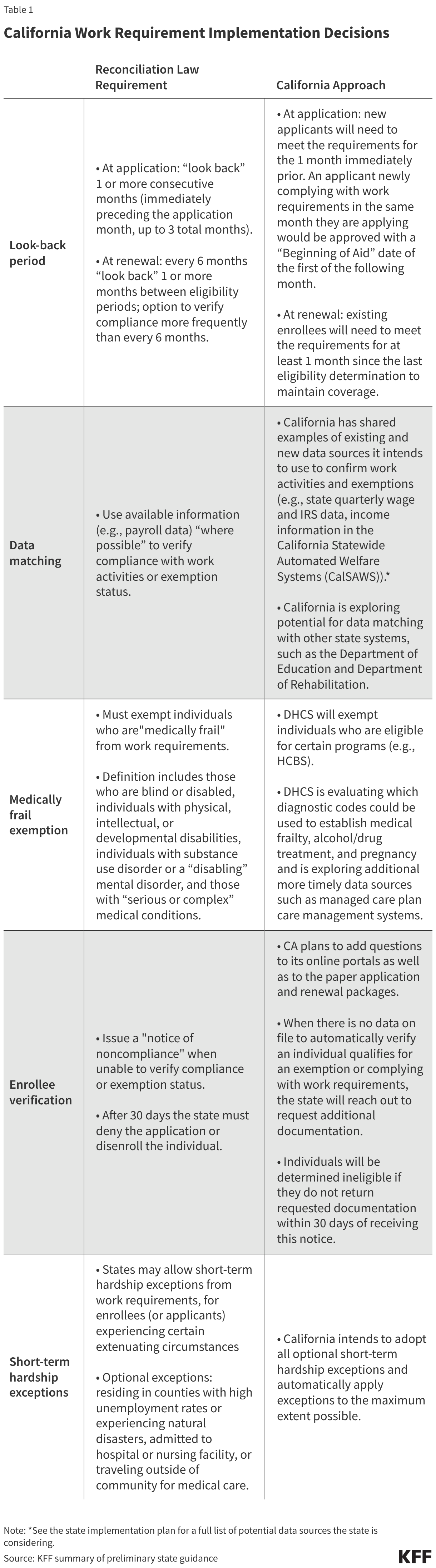
In initial state guidance, California provided a first look into how the state is planning to implement work requirements. Current state guidance discusses policies such as look-back periods, data matching, enrollee verification, and short-term hardship exceptions (Table 1). The guidance also provides early plans for individuals experiencing changes in circumstances and transitioning into the ACA Medicaid expansion group from groups not subject to work requirements, saying they will be subject to work requirement verification at their next renewal rather than immediately at the time of transition. There remain several areas where the state is waiting on federal guidance before clarifying policies (e.g., definitions for the “medically frail” exemption, standards for self-attestation, acceptable forms of verification, and criteria for exemptions and work activities).

California Work Requirement Implementation Decisions (Table)

In a recent Medicaid Advisory Committee (MAC) meeting, California state officials also provided early insight into the state’s outreach and communication plan. All states are required to have a Medicaid Advisory Committee to advise the State Medicaid agency about health and medical care services. These groups include Medicaid enrollees, advocates, and providers. The new law requires states to begin outreach to notify individuals (by mail and at least one additional method) of the new requirements at least three months before the start of the first compliance “look-back” period and notify individuals “periodically thereafter.” The proposed Governor’s Budget includes $4 million for navigators to assist with eligibility, enrollment, and retention. In its March MAC meeting, the state outlined some key tenets of its outreach plan:

  • Early outreach. California has already started outreach to members (e.g., text messages) and plans to continue to spread awareness by sharing flyers, social media posts, text messages, and relying on word of mouth through local partners.
  • Training and toolkits. The state plans to share toolkits and train county eligibility workers, Department of Health Care Services (DHCS) Coverage Ambassadors, navigators, health plans, doctors’ offices, clinics, community health workers, and community-based partners.
  • Maximizing reach. California will translate materials into 19 languages and work with “trusted messengers” (e.g., local groups) to help people get and retain coverage.
  • Automation and simplification. The state will aim to use existing data, when possible, to minimize extra steps for individuals and to simplify forms and renewal instructions as much as possible.

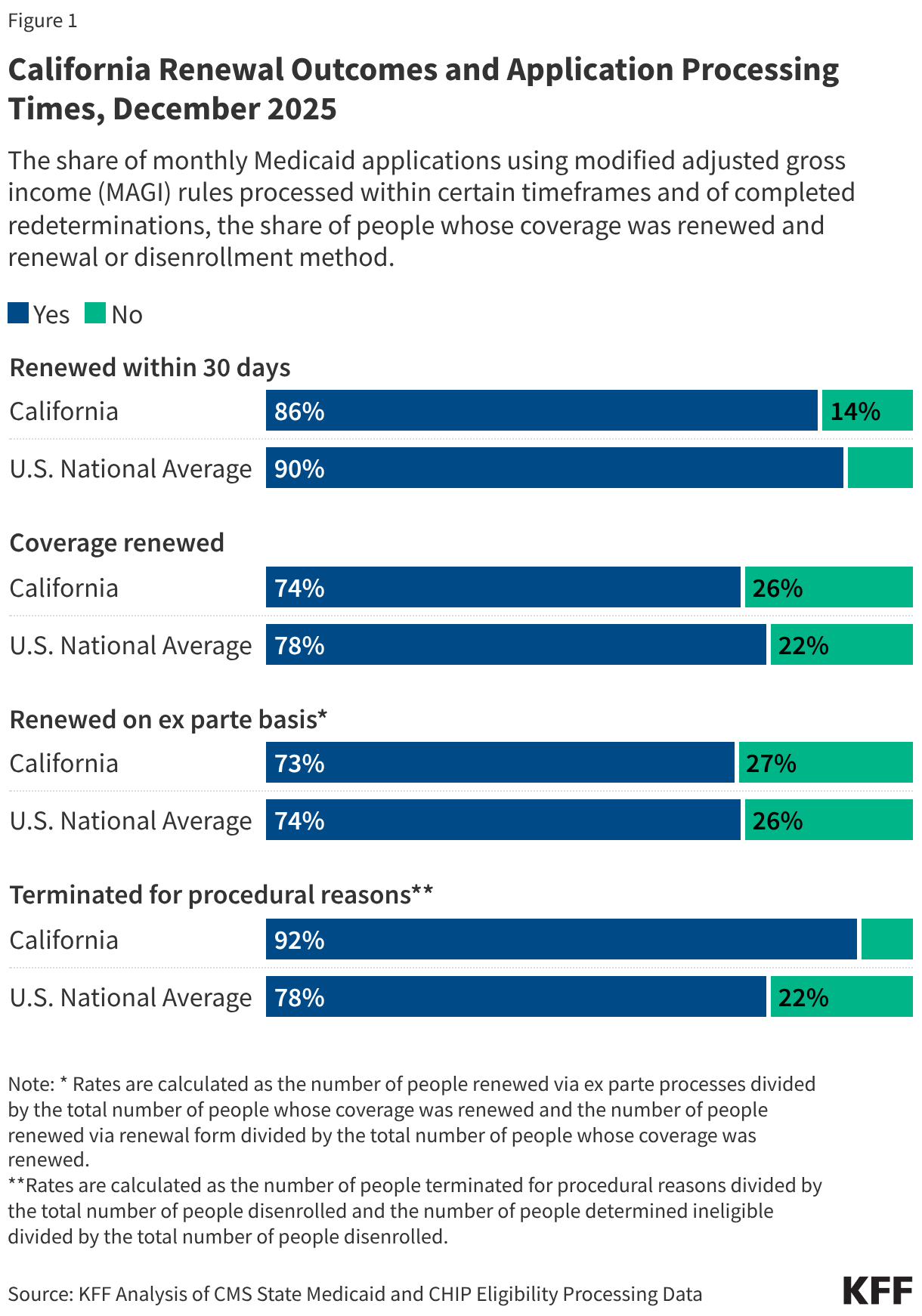
KFF is tracking metrics related to Medicaid enrollment, renewal outcomes, and application processing times that can provide insight into California’s potential readiness to implement data matching and other necessary system changes. As of December 2025, nearly nine in 10 applications in California were processed within 30 days and nearly three in four individuals going through a Medicaid redetermination had their coverage renewed. Of people who retained coverage, 73% were renewed through ex parte processes (meaning the state verifies ongoing eligibility through available data sources before sending a renewal form or requesting documentation from an enrollee). Early data match estimates shared during the recent MAC meeting list around 1.8 million individuals able to be determined exempt or compliant via an automated source based on August 2025 enrollment data, although these estimates are likely to change as the state integrates additional data sources and implements cross-system information data sharing. In its implementation plan, California acknowledges that ex parte rates have dropped back to levels from before the unwinding of COVID-era guarantees of continuous Medicaid enrollment and anticipates the work requirements to increase the manual administrative workload to support members in retaining coverage. Among those who were disenrolled, 92% were terminated for procedural reasons (a higher rate than the national average of 78%). While these metrics provide insight into California’s Medicaid eligibility systems, they are not the only indicators or predictors of successful implementation of work requirements, which will also require enrollee outreach and education, staff training, and coordination with managed care plans, providers, and other stakeholders.

California Renewal Outcomes and Application Processing Times, December 2025 (Stacked Bars)

As states implement work requirements, ongoing monitoring can help assess how processes are working and identify areas of concern. Central to that oversight is timely data on renewal outcomes, including data on disenrollments related to work requirements. While available data (highlighted above) from CMS can be helpful, these data are not timely enough for real-time monitoring and they do not isolate outcomes for the expansion population. States can fill that gap by reporting more timely data on application and renewal outcomes that include breakouts for individuals subject to work requirements. In the MAC presentation slides, California state officials communicated their intention to monitor key metrics related to the impact of work requirement implementation, including the number of individuals subject to work requirements, the number of individuals in compliance with reporting requirements, and the number of individuals who lose coverage due to procedural disenrollments.

A Preview of the Role Health Care May Play in the 2026 Election

Published: Apr 2, 2026

KFF has long examined the role of health care in U.S. elections, tracking how the issue ranks among voters’ top concerns, which political party or candidate voters’ trust, and how health care issues might motivate voter turnout. This issue brief summarizes the role health care has historically played in elections using KFF polls, exit polls, and other data to show how health care, especially the issue of health care costs, may play a role in the upcoming 2026 midterm elections.

Key Takeaways

  • Historically, health care has often been among the most important issues to voters: In most presidential and midterm election year polling since 1992, health care ranked among voters’ top concerns, with “the economy” taking the top spot in most elections. While these polls usually ask voters to choose between health care and the economy as separate issues, KFF polling has long shown how health care costs are an important factor in people’s economic concerns. On its own, health care rose to the top spot in the 2018 midterm exit poll, immediately after the failed attempt to repeal and replace the Affordable Care Act (ACA). In almost all recent elections, Democratic voters have consistently been more likely than Republican voters to say that health care is a top electoral issue.
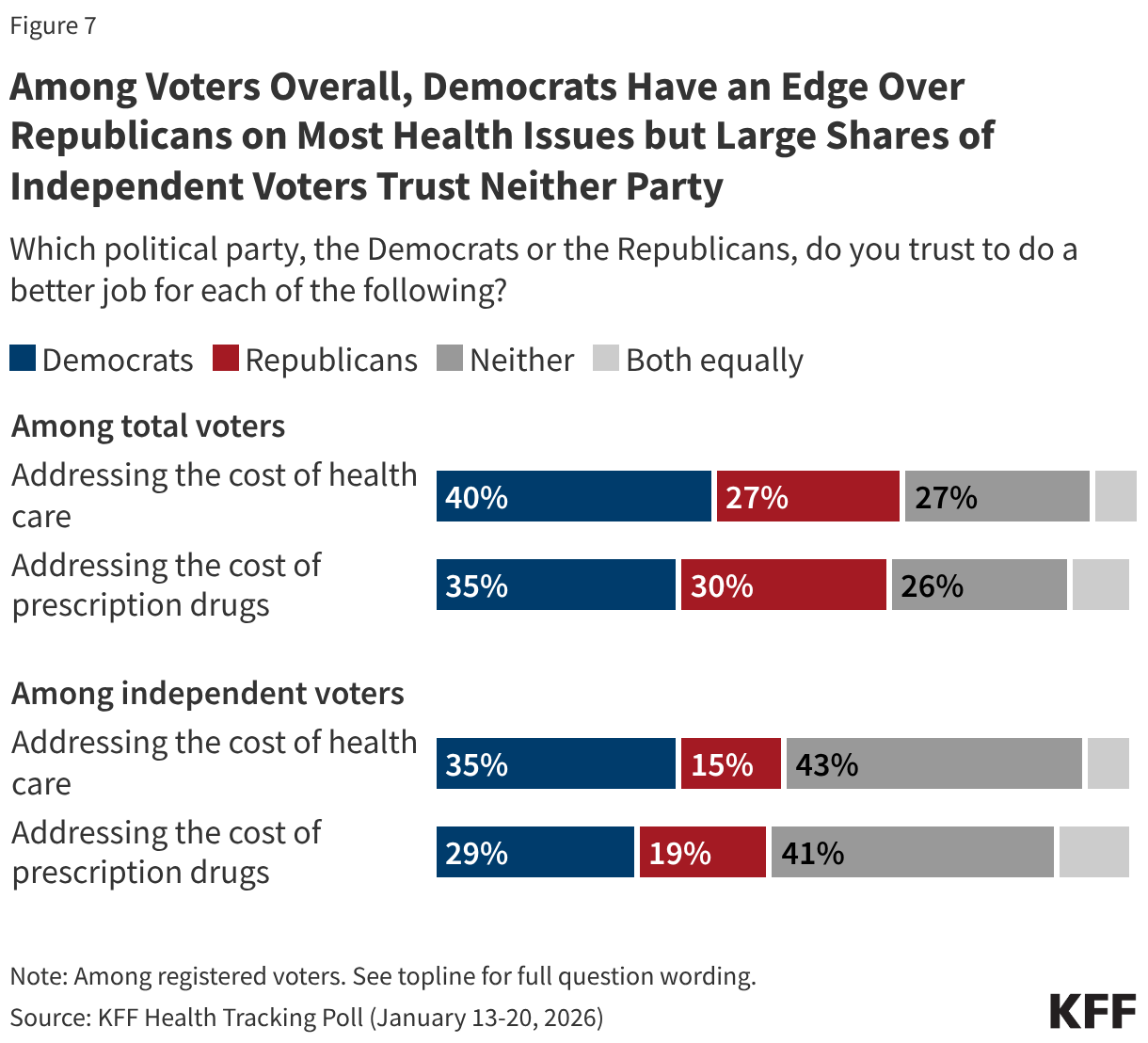
  • Partisan advantages on health care and the economy: Historically, Democrats have held an advantage over Republicans on who voters trust to handle health care issues, while Republicans have usually been seen as stronger on the economy. Health care costs sit at the intersection of these issues, raising questions about which party voters will trust more to address the affordability of health care. Recent KFF polling data suggests that heading into the 2026 election, the Democratic Party has the advantage on health care costs, but notably, about a quarter of voters, rising to four in ten independent voters, say they trust neither party on this issue.
  • Implications for the 2026 Midterms: Looking ahead to the 2026 midterm elections, the issue of health care affordability may help candidates motivate their bases. As of March 2026, Democrats maintain an advantage over Republicans in voter trust to address the cost of health care and prescription drugs, and majorities say health care costs are important to their vote. Who voters will ultimately trust to handle the affordability of health care, and whether the issue will be enough to translate into turnout and votes, remains an open question.

Health Care Has Been Among the Top Electoral Issues, Especially Following Periods of National Debate

National exit polls from elections over the past several decades show that voters ranked health care among their top concerns, but “the economy” was the number one issue in most elections. While exit polls usually ask voters to choose between health care and the economy as separate issues, KFF polling has long shown that health care costs are a key economic concern for the public. Analysis of exit poll data also show that health care has been more top-of-mind for voters immediately following periods of national debate on health care reform, such as in elections held during President Clinton’s presidency (1992-1998) and later during President Obama’s presidency (2008-2016) and the passage of the Affordable Care Act (ACA) in 2010. In these instances, health care costs were key health care issues, with political debate centering around affordability. But in the past three decades of exit polls, health care itself has only been ranked the number one issue by voters once, during the 2018 midterms after Republican attempts to repeal and replace the ACA failed dramatically in the Senate. Since 2020, health care has remained among the top issues, with the focus in some elections on specific health care issues such as COVID-19 or abortion access.

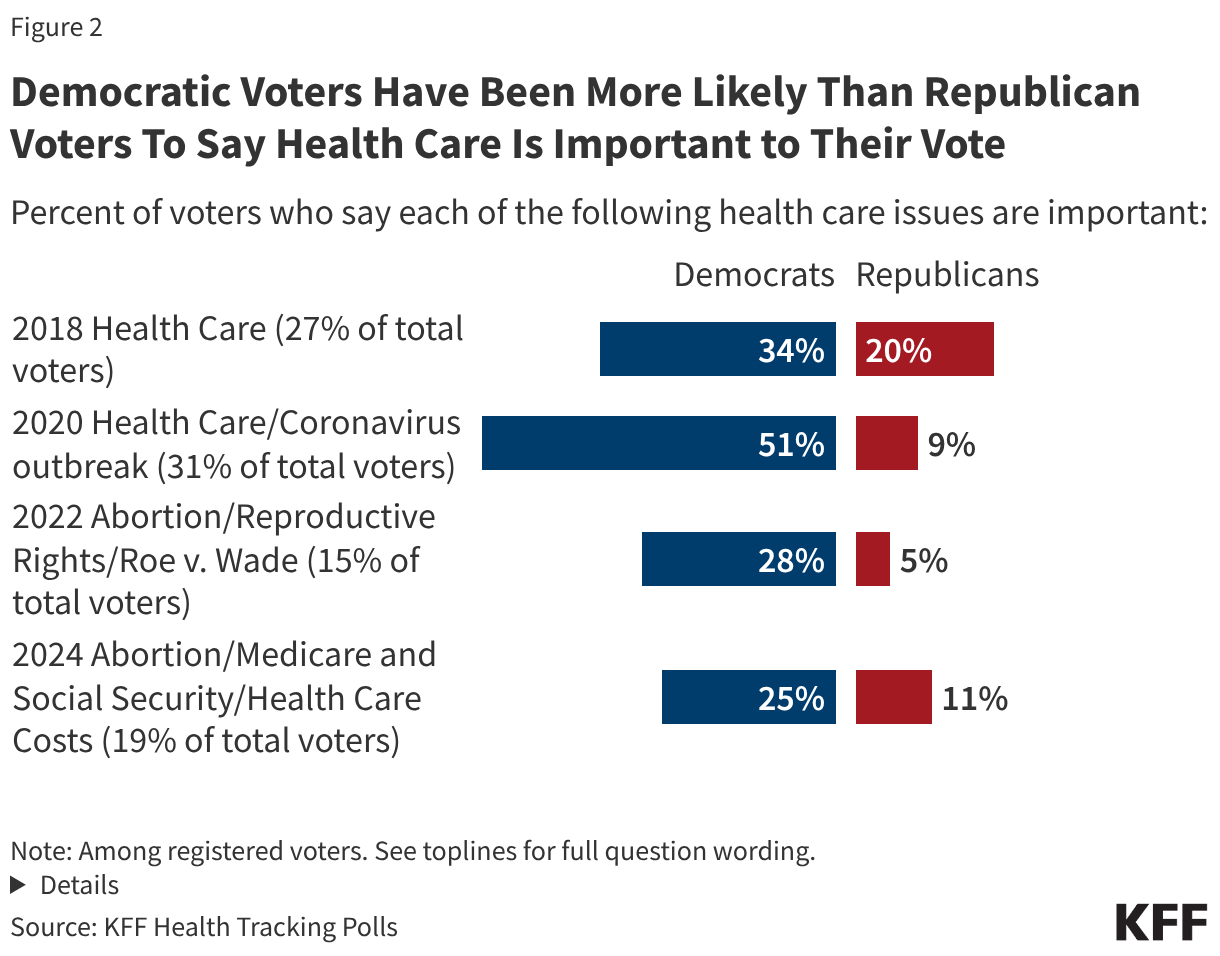
Figure 1

Democratic Voters Are More Likely to Say Health Care Is Important to Their Vote

Notably, Democratic voters have typically been more likely than Republican voters to cite health care issues as important in pre-election KFF Health Tracking Polls. For example, in 2018, when health care was the number one issue for all voters, about one third (34%) of Democratic voters said it was important for 2018 candidates to talk about health care, compared to one in five (20%) Republicans who said the same. In more recent elections when health care issues focused on specific topics like abortion rights and COVID-19, between a quarter and half of Democratic voters picked these issues, versus about one in ten, or fewer, Republican voters.

Split bar chart showing the share of republican and democratic voters who say each health care issue is important to their vote.

Democrats Have Historically Had Advantage on Health Care, Republicans on the Economy

While “the economy” tends to almost always have the top billing in election poll issue rankings, KFF polls have consistently found that the cost of health care is an important part of people’s economic concerns. Indeed, recent KFF polls have found that health care costs are a top economic worry, with many adults saying they have difficultly affording these costs, they are burdened by health care debt, or that they delay or skip care due to high costs. Given that health care costs sit at the intersection of both health care and the economy, who do voters say they trust on this issue?

When it comes to presidential elections, KFF Health Tracking Polls and other polls have found that voters often say the Democratic candidate is better suited to handle health care, while the Republican candidate is better suited to handle the economy. In the 2012 and 2016 elections, President Obama and Secretary Clinton had more than 10-percentage point leads over Governor Romney and President Trump respectively in the share of voters who said they trusted each on health care. When it comes to the economy, President Obama had a 7-percentage point advantage over Governor Romney in 2012, but in subsequent elections, President Trump has had an advantage over each of his Democratic opponents. These leads were narrow over Secretary Clinton in 2016 and President Biden in 2020, but widened to a 15-percentage point lead over Vice President Harris in 2024.1

Figure 3

In an era of hyper-partisan politics, KFF Health Tracking Polls conducted in the lead up to elections find that most voters tend to trust their own party to handle the direction of key issues. But among voters overall and among independent voters, the Democratic party has typically had an advantage over the Republican party when it comes to health care costs. For example, in surveys conducted in election years from 2012 to 2023, the Democrats had an advantage of thirteen percentage-points or less over Republicans on lowering health care costs. But in 2023, about six in ten voters said they trust the Democrats on the affordability of health care, compared to about four in ten who said they trust the Republicans.

Figure 4

Implications for the 2026 Midterm Elections

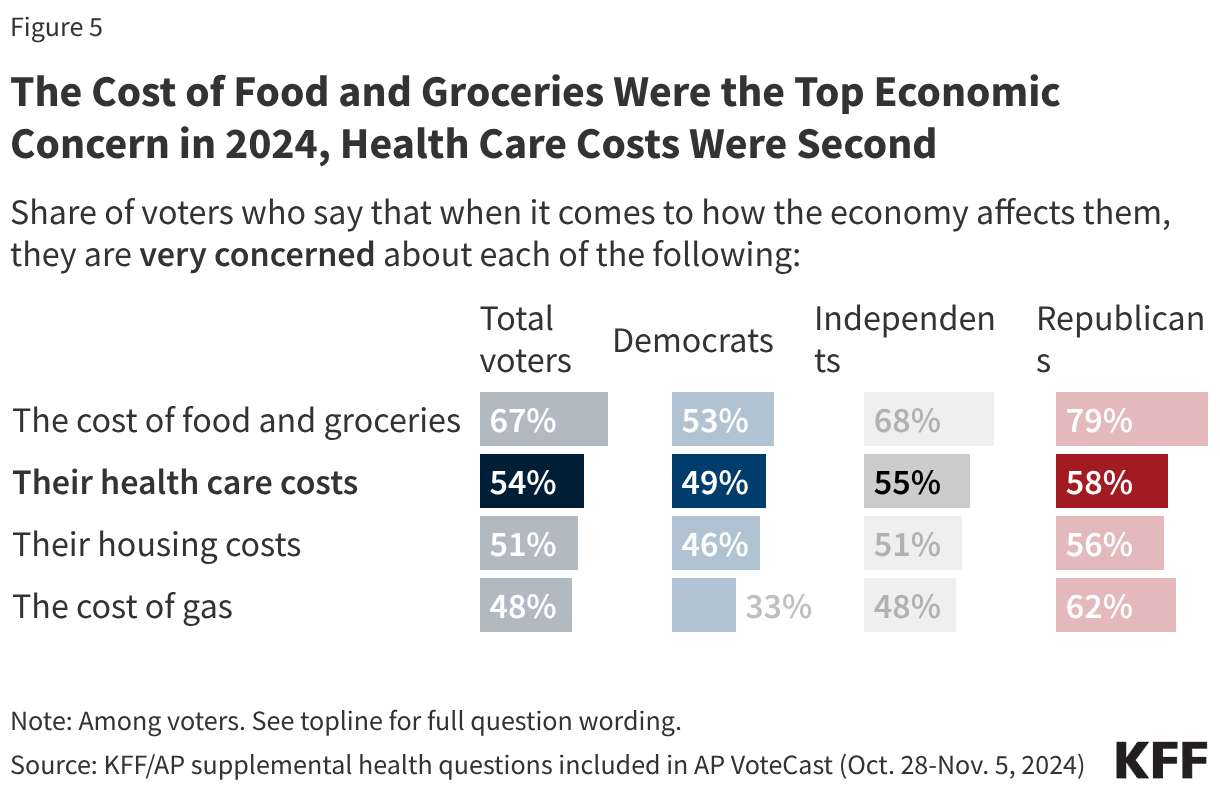
While there are many months before the midterm elections and events such as the war in Iran may shift electoral concerns, recent KFF pre-election polls show the public remains concerned about the number one issue of the 2024 election: the economy. But recent polls also suggest that the role of health care costs among voters’ economic concerns appears to be on the rise compared to previous election cycles. In 2024 polling from AP Votecast, when voters were specifically asked about which household costs they were “very concerned” about, the cost of food and groceries took the top spot across partisans (67% of total voters), and health care costs (54% of total voters) ranked second for Democratic and independent voters.

Split bar chart showing the share of partisan voters who say they are very concerned about the cost of essentials.

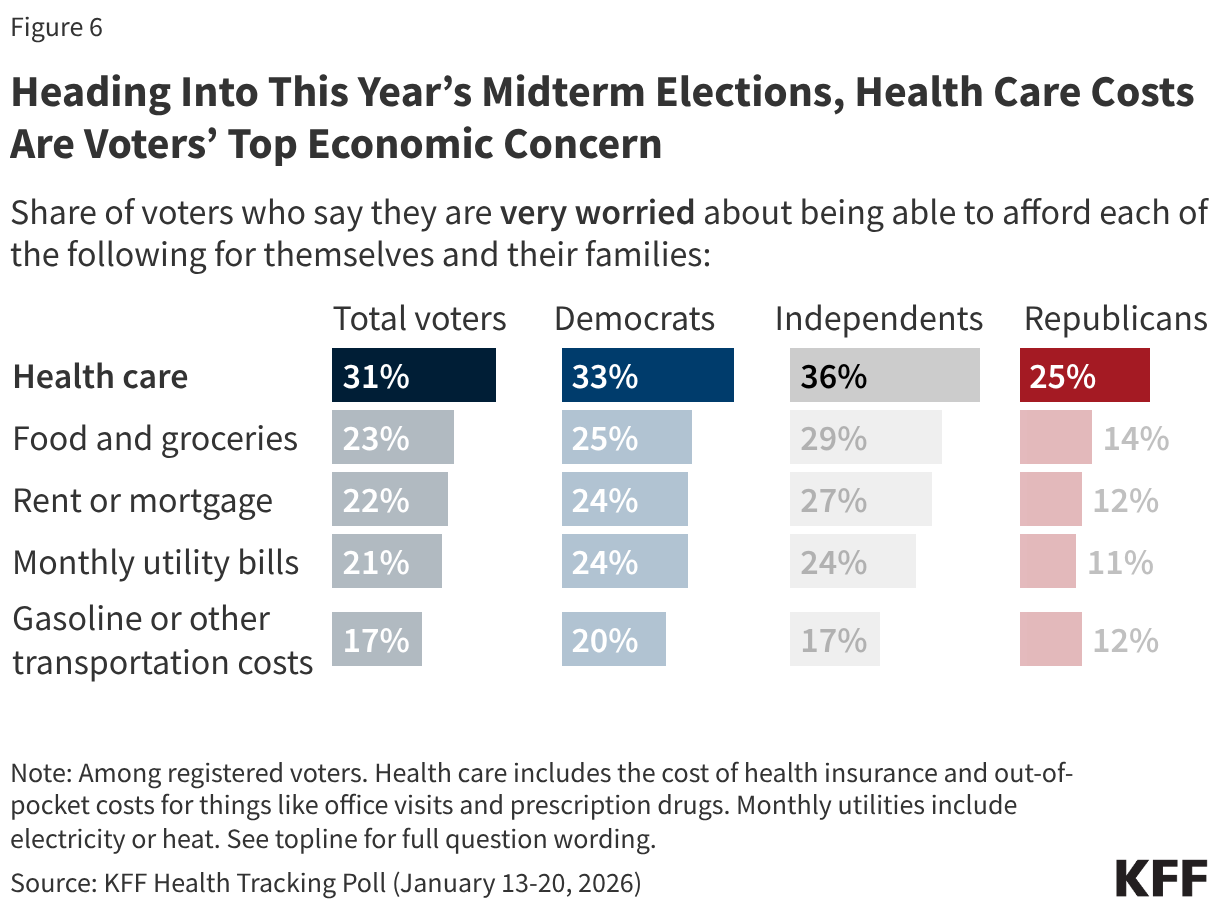
In more recent KFF polling from January 2026, health care costs are now voters’ top economic concern (31% of total voters say they are “very worried”). This is the case across partisanship, with substantial shares of Democrats (33%), independents (36%) and Republicans (25%) saying they are “very worried” about being able to afford health care for themselves and their families. 

Split bar chart showing the share of partisan voters who say they are very worried about being able to afford essentials for themselves and their families.

In January of this year, about one in four voters also said they feel their health care costs are increasing faster than other household expenses, such as food and utilities, and looking ahead, a majority (58%) said they expect health care costs for them and their families to become less affordable next year. In addition, in March, a majority (59% of the public; 57% of voters) say they are worried about affording prescription drugs for themselves and their families, the largest share since KFF first polled on this question in 2018.

The rising concern about health care costs has occurred at a time when health insurance premiums and cost-sharing for employer-sponsored insurance are on the rise, with the average annual premium for family health coverage rising 6% to nearly $27,000 in 2025. At the same time, the policy debate and government shutdown over the ACA enhanced tax credits have put a spotlight on increasing health care costs for ACA marketplace enrollees.

Amid this environment, there are signs that Democrats may now be viewed as more trustworthy than they were in 2024, when President Trump (the Republican candidate) won more votes than Vice President Harris (the Democratic candidate) among voters who said they were “very concerned” about health care costs (54% vs. 44%). Now, KFF polling from March 2026 finds Democrats have an advantage over Republicans for who voters trust to address the cost of health care (40% vs. 28%) and the cost of prescription drugs (38% vs. 28%), with about one in four voters saying they trust “neither party” on these issues.

Democrats maintain an advantage on health care and prescription drug costs among independent voters as well. But notably, the share saying they trust “neither party” rises to about four in ten among independent voters, larger than the shares who say they trust either the Democrats or the Republicans. The sizeable shares of independent voters, as well as voters overall, who say they trust neither party suggests that both parties may still be able to make inroads with voters on the issue of health care affordability before the midterm elections. But it also illustrates that there might be a lack of enthusiasm for candidates on this issue and may suggest that some voters may choose to stay home if they don’t feel either party can address this core issue.

Stacked bar chart showing share of registered voters who say they trust the Democrats, Republicans, or neither party to do a better job addressing key health care issues.

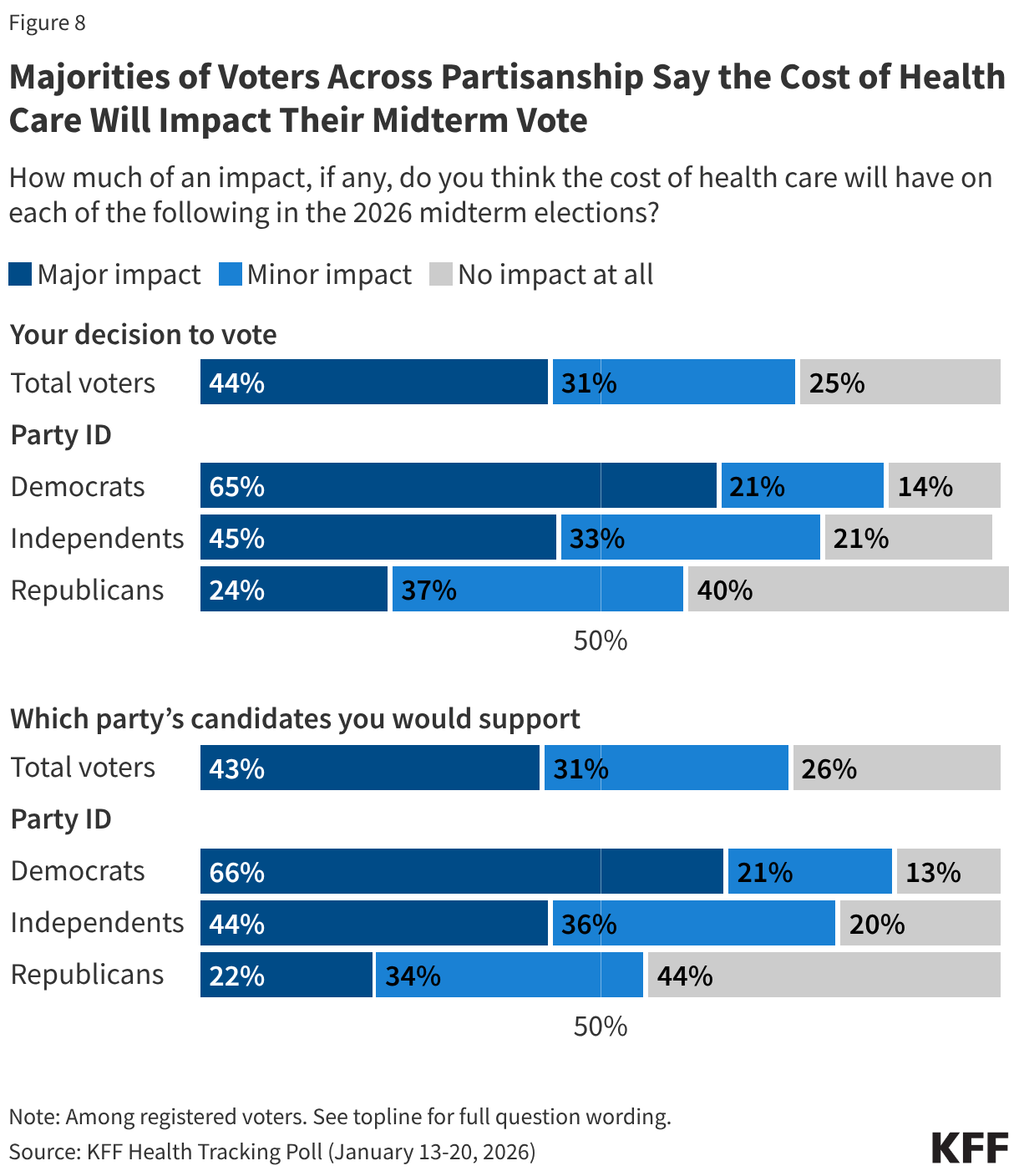
While voter trust and the perceived importance of health care costs matter for the midterm election, a key factor is how strongly the issue motivates voters to turn out. The 2026 campaigns are just beginning, but health care costs seem to be motivating voters across party lines. As of January 2026,  about two-thirds of Democratic voters and just less than half of independent voters said health care costs will have a “major impact” on both their decision to vote and which party’s candidate they will support. On the other hand, about one in four Republican voters also said health care costs will have a “major impact” on their voting choices, and an additional third said it will have a “minor impact,” suggesting the issue is motivating Republicans as well.

Stacked bar chart showing the shares of adults who say the cost of health care will have a major impact, minor impact, or no impact at all on their decision to vote or which party's candidate they would support in the 2026 midterm elections. Shown among total voters and by party identification.

  1. In 2012, question wording was, “Which presidential candidate, Barack Obama or Mitt Romney, do you trust to do a better job… lowering health costs for people like you?” and “…dealing with the economy and jobs?”
     
    In 2016, question wording was, "Thinking about the candidates for president in 2016, regardless of political party or who you intend to vote for, which candidate do you trust to do a better job dealing with access and affordability of health care, Donald Trump or Hillary Clinton?" and "Regardless of which presidential candidate you support, please tell me if you think Hillary Clinton or Donald Trump would better handle each of the following issues...The Economy."
     
    In 2020, question wording was, "Thinking about the candidates for president in 2020, regardless of political party or who you intend to vote for, which candidate do you trust to do a better job… dealing with health care, Donald Trump or Joe Biden?" and "…the economy."
     
    In 2024, question wording was, "Regardless of who you intend to vote for in the upcoming elections, which presidential candidate do you trust to do a better job dealing with each of the following?" "The economy and inflation" and "Health care costs, including prescription drug costs." ↩︎

Policy Tracker: Exceptions to State Abortion Bans and Early Gestational Limits 

Last updated on April 1, 2026

states have abortion bans or early gestational limits in effect

states have no health exception

states have no rape or incest exception 

states have no fatal fetal anomaly exception 

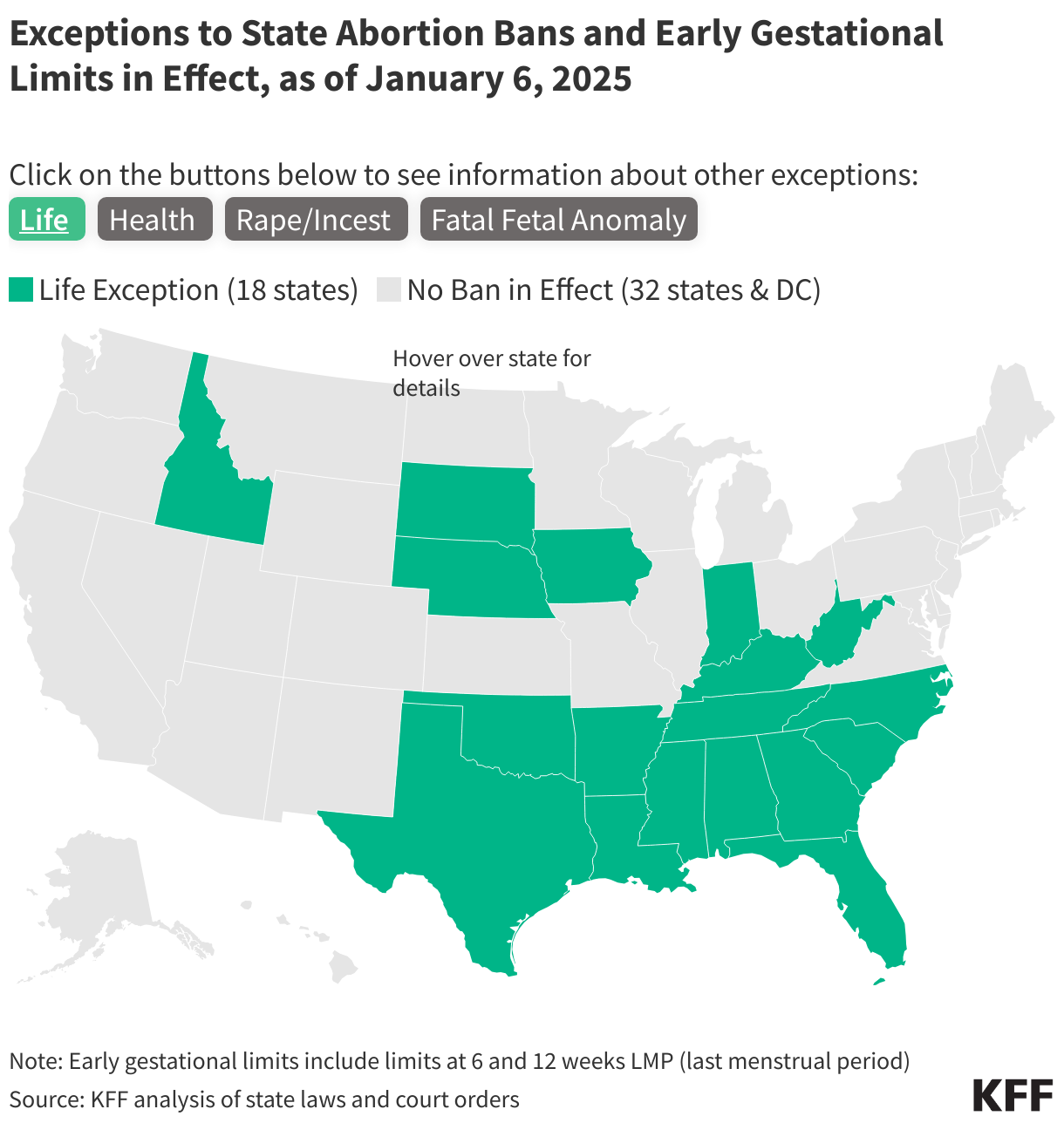
Abortion is currently banned in 13 states and 7 states have early gestational limits between 6 weeks and 12 weeks in effect. Nearly all of these bans include exceptions, which generally fall into four categories: to prevent the death of the pregnant person, when there is risk to the health of the pregnant person, when the pregnancy is the result of rape or incest, and when there is a lethal fetal anomaly. Almost all states with a health exception limit it to conditions affecting physical health, with some going further by explicitly excluding emotional or psychological conditions. Alabama is currently the only state with an abortion ban or early gestational limit in place that includes an exception for mental health within its broader health exception. Some states have more than one abortion ban or restriction in place. The maps below illustrate the exceptions in each state’s most restrictive gestational limit or total ban. For details hover over each state to read the rollover.  

For more information on the status of state abortion bans, please visit our Abortion in the United States Dashboard

Exceptions to State Abortion Bans and Early Gestational Limits in Effect, as of April 1, 2026 (Choropleth map)
Exceptions to State Abortion Bans and Gestational Limits in Effect, as of April 1, 2026 (Table)
Poll Finding

KFF Health Tracking Poll: The Public’s View of Immigration Enforcement Activities in Health Care Settings

Published: Apr 1, 2026

Findings

Soon after taking office, President Trump reversed longstanding policy that had protected against immigration enforcement in “sensitive locations” including health care facilities, schools, and places of worship. Following this recission, as well as an overall increase in enforcement activity, there have been reports of Immigration and Customs Enforcement (ICE) agents showing up at hospitals and other health care facilities. ICE presence at and around health care facilities has led to growing concerns among health care providers about the impacts on the health and safety of the community, including adults and children going without care. These actions sit against a backdrop of broad increased enforcement activity and policies restricting access to health coverage and care for immigrant families. Research shows that this environment has negative impacts on the mental and physical health of immigrant families, including the millions of U.S. citizen children living in them, as well as broader economic effects on communities.

KFF has conducted multiple surveys examining immigrants’ health and experiences amid the policy environment as part of its Surveys of Immigrants conducted since 2023. New data from the KFF Health Tracking Poll provides insights into how the general public views the Trump administration’s immigration enforcement polices in health care settings. Overall, it shows the public is split along partisan lines on the administration’s approach to immigration enforcement in health care facilities. Democrats and independents express concern over the administration’s tactics, whereas Republicans are largely not concerned. Majorities of Democrats and independents say they do not think ICE or Customs and Border Control (CBP) should be allowed to arrest or detain people in and around health care facilities, whereas a majority of Republicans say they should be allowed. On each of these measures, Republicans and Republican-leaning independents who support President Trump’s MAGA movement are much more likely to support these tactics or say they are not concerned than non-MAGA supporters.

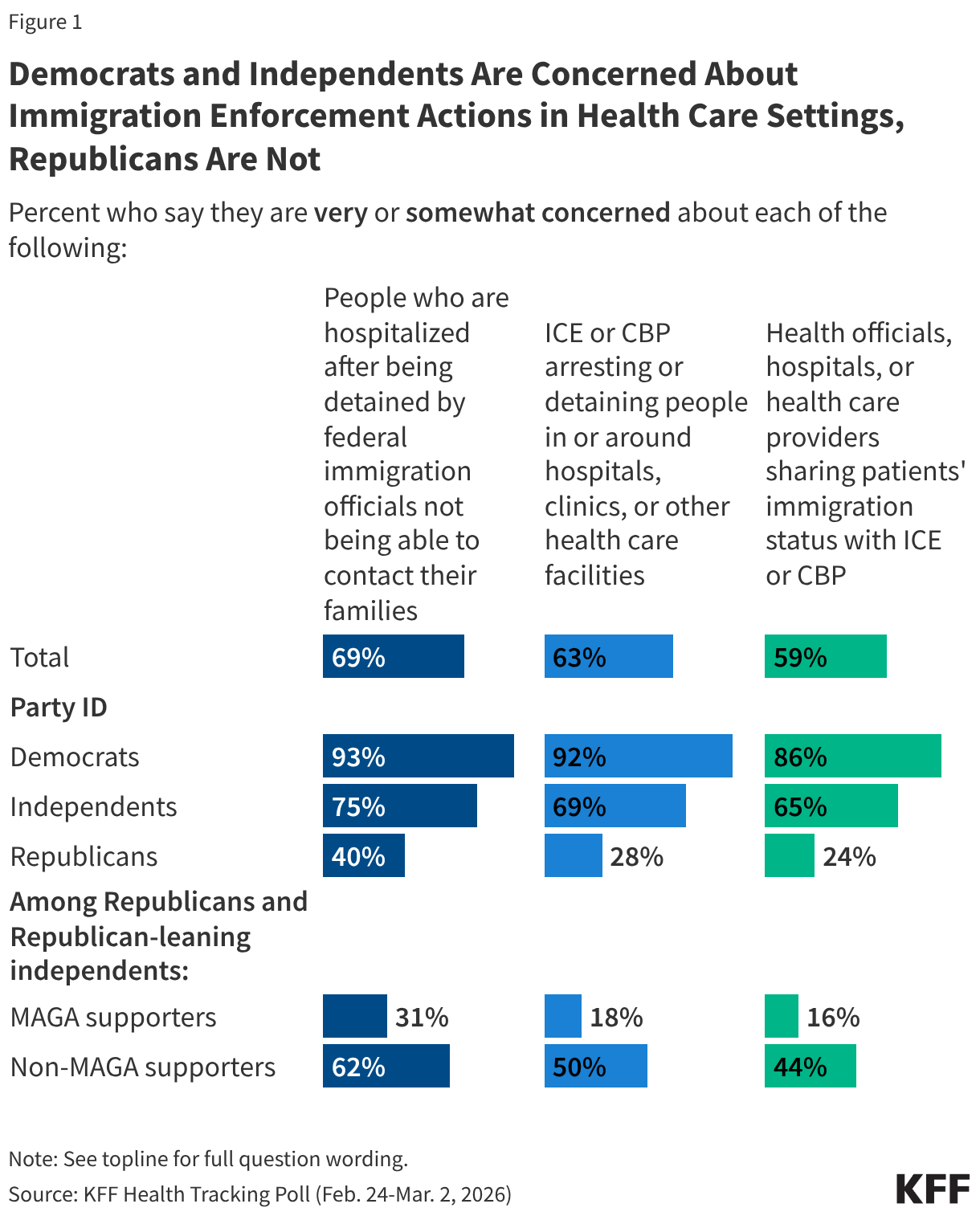
A majority of the public say they are concerned about the Trump administration’s tactics and immigration enforcement activities in or around health care settings. This includes majorities of the public who say they are “very” or “somewhat” concerned about people who have been hospitalized after being detained by federal immigration officials not being allowed to contact their families (69%), ICE or CBP arresting or detaining people in health care settings (63%), and health care providers and officials sharing patients’ immigration status with ICE or CBP (59%).

While majorities of the public are concerned about each of these tactics, there are big differences by partisanship, with Democrats and independents more likely than Republicans, especially MAGA Republicans, to say they are concerned about these. For example, about nine in ten Democrats and three-quarters of independents say they are concerned about people who have been hospitalized after detainment not being allowed to contact their families, whereas four in ten Republicans express concern. There are larger divides by partisanship on the two other tactics asked about, with Democrats about three times as likely as Republicans to say they are concerned about ICE or CBP detaining people in or around hospitals, clinics, or other health care facilities (92% vs. 28%) and health officials, hospitals, or health care providers sharing patients’ immigration status with ICE or CBP (86% vs. 24%). For each of these immigration enforcement tactics, two-thirds or more of independents say they are “very” or “somewhat” concerned about them. There are also differences among Republicans and Republican-leaning independents who support MAGA versus those who do not support the MAGA movement, with non-MAGA supporters at least twice as likely to say they are concerned about these tactics than MAGA supporters.

Split bar chart showing percent who say they are very or somewhat concerned about immigration enforcement actions in health care settings. Results shown by total adults, party identification, and MAGA support.

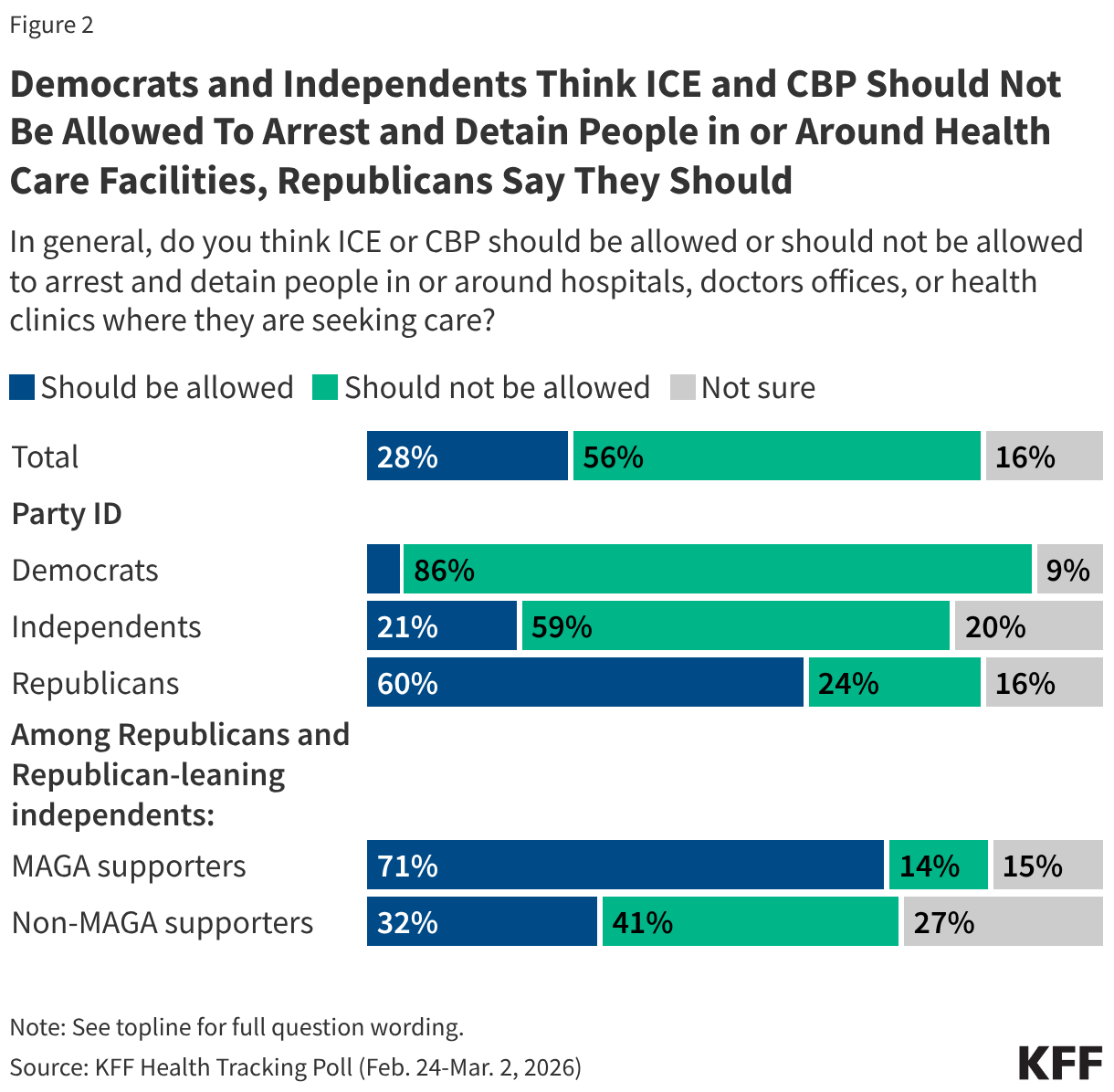
A majority of the public (56%) says ICE and CBP should not be allowed to arrest and detain people in or around hospitals, doctors’ offices or health clinics where they are seeking care, while about three in ten (28%) say they should be allowed, and one in six (16%) are “not sure.” There are stark divides by partisanship on this tactic. Nearly nine in ten (86%) Democrats and about six in ten (59%) independents say immigration enforcement activity should not be allowed in or around health care facilities, whereas six in ten Republicans say it should be allowed. But again among Republicans on this question, MAGA supporters are much more likely than non-MAGA supporters to say this tactic should be allowed (71% vs. 32%), and four in ten (41%) non-MAGA Republicans say it should not be allowed.

Stacked bar chart showing whether adults believe immigration enforcement in health care settings should be allowed or not. Results by total adults, party identification, and MAGA support.

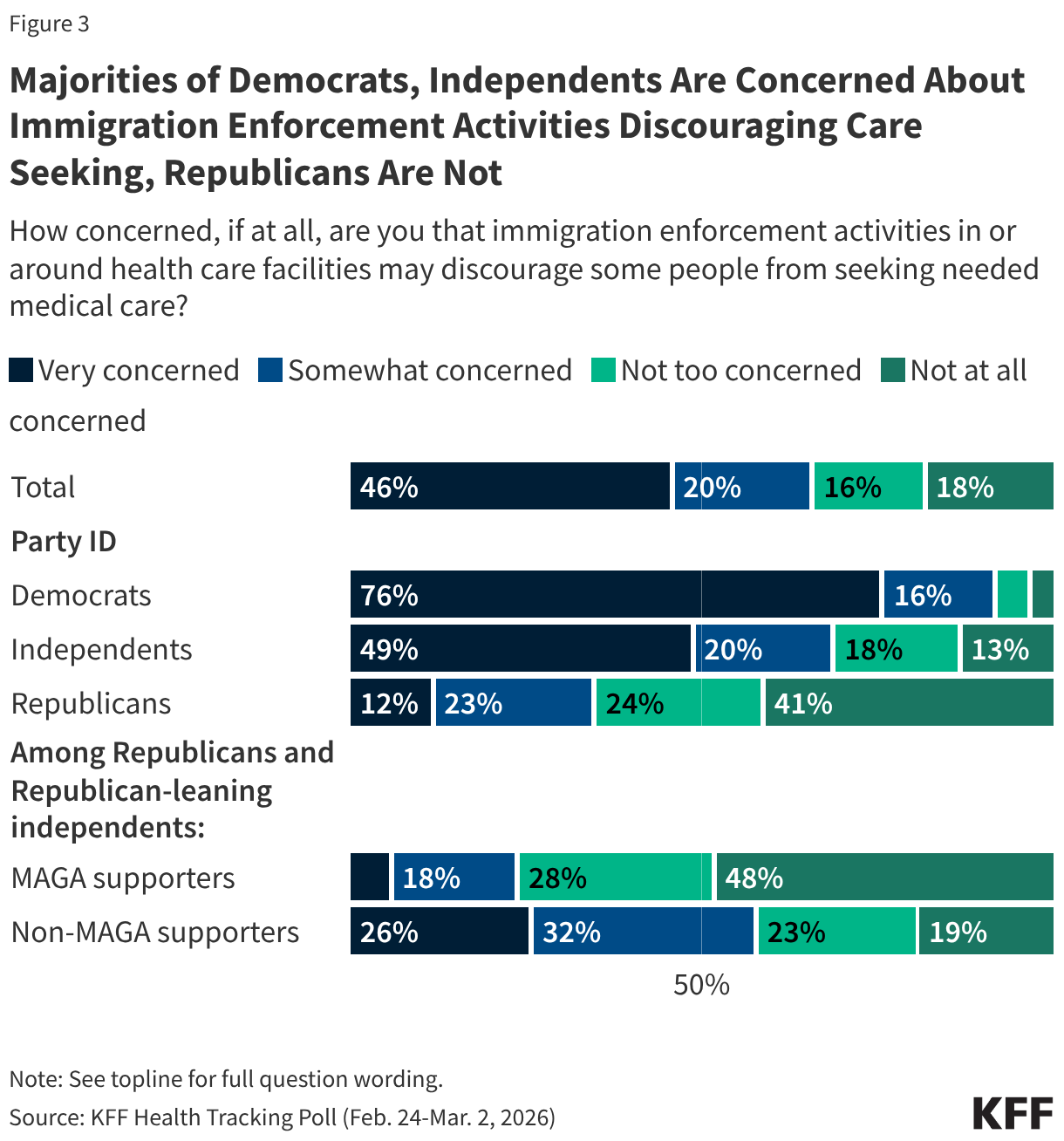
Two-thirds (65%) of adults say they are concerned that immigration enforcement activities in or around health care facilities may discourage some people from seeking needed medical care, while a third (34%) say they are not concerned. There are large differences by party identification on this topic, with about nine in ten Democrats (91%) and about seven in ten (69%) independents saying they are concerned about this, including three-quarters (76%) of Democrats who say they are “very concerned.” In contrast, most (65%) Republican say they are not concerned about this, including four in ten (41%) who say they are “not at all concerned.” However, there are stark divides by MAGA support among Republicans, with a majority of MAGA Republicans (76%) saying they are not concerned and a majority of non-MAGA Republicans (58%) saying they are concerned. Since the rescission of the “sensitive areas” policy and ramp up of ICE activity across the country, there have been reports of immigrants avoiding seeking medical care, which can lead to negative and costly health outcomes. Even prior to the recent uptick in public enforcement activity in areas such as Minneapolis and other parts of the country, the 2025 KFF/New York Times Survey of Immigrants found that many immigrants said they were avoiding seeking medical care due to concerns about drawing attention to someone’s immigration status. As of Fall 2025, 14% of immigrants overall said they have avoided seeking medical care since January 2025, rising to nearly half (48%) of likely undocumented immigrants.

Stacked bar chart showing how concerned adults are about immigration enforcement in health care settings discouraging people from seeking medical care. Results by total adults, party identification, and MAGA support.

Methodology

This KFF Health Tracking Poll/KFF Tracking Poll on Health Information and Trust was designed and analyzed by public opinion researchers at KFF. The survey was conducted February 24 – March 2, 2026, online and by telephone among a nationally representative sample of 1,343 U.S. adults in English (n=1,268) and in Spanish (n=75). The sample includes 1,019 adults (n=62 in Spanish) reached through the SSRS Opinion Panel either online (n=995) or over the phone (n=24). The SSRS Opinion Panel is a nationally representative probability-based panel where panel members are recruited randomly in one of two ways: (a) Through invitations mailed to respondents randomly sampled from an Address-Based Sample (ABS) provided by Marketing Systems Groups (MSG) through the U.S. Postal Service’s Computerized Delivery Sequence (CDS); (b) from a dual-frame random digit dial (RDD) sample provided by MSG. For the online panel component, invitations were sent to panel members by email followed by up to three reminder emails.

Another 324 (n=13 in Spanish) adults were reached through random digit dial telephone sample of prepaid cell phone numbers obtained through MSG. Phone numbers used for the prepaid cell phone component were randomly generated from a cell phone sampling frame with disproportionate stratification aimed at reaching Hispanic and non-Hispanic Black respondents. Stratification was based on incidence of the race/ethnicity groups within each frame. Among this prepaid cell phone component, 142 were interviewed by phone and 182 were invited to the web survey via short message service (SMS).

Respondents in the prepaid cell phone sample who were interviewed by phone received a $15 incentive via a check received by mail or an electronic gift card incentive. Respondents in the prepaid cell phone sample reached via SMS received a $10 electronic gift card incentive. SSRS Opinion Panel respondents received a $5 electronic gift card incentive (some harder-to-reach groups received a $10 electronic gift card). In order to ensure data quality, cases were removed if they failed two or more quality checks: (1) attention check questions in the online version of the questionnaire, (2) had over 30% item non-response, or (3) had a length less than one quarter of the mean length by mode. Based on this criterion, 1 case was removed.

The combined cell phone and panel samples were weighted to match the sample’s demographics to the national U.S. adult population using data from the Census Bureau’s 2024 Current Population Survey (CPS), September 2023 Volunteering and Civic Life Supplement data from the CPS, and the 2025 KFF Benchmarking Survey with ABS and prepaid cell phone samples. The demographic variables included in weighting for the general population sample are gender, age, education, race/ethnicity, region, civic engagement, frequency of internet use and political party identification. The weights account for differences in the probability of selection for each sample type (prepaid cell phone and panel). This includes adjustment for the sample design and geographic stratification of the cell phone sample, within household probability of selection, and the design of the panel-recruitment procedure.

The margin of sampling error including the design effect for the full sample is plus or minus 3 percentage points. Numbers of respondents and margins of sampling error for key subgroups are shown in the table below. For results based on other subgroups, the margin of sampling error may be higher. Sample sizes and margins of sampling error for other subgroups are available on request. Sampling error is only one of many potential sources of error and there may be other unmeasured error in this or any other public opinion poll. KFF public opinion and survey research is a charter member of the Transparency Initiative of the American Association for Public Opinion Research.

GroupN (unweighted)M.O.S.E.
Total1,343± 3 percentage points
   
Party ID  
Democrats449± 6 percentage points
Independents449± 6 percentage points
Republicans373± 6 percentage points
   
MAGA Republicans/Republican leaning independents334± 6 percentage points
   
Used AI for health information or advice in the past year458± 6 percentage points
Used for physical health information407± 6 percentage points
Used for mental health information234± 8 percentage points

How Does U.S. Life Expectancy Compare to Other Countries?

Published: Mar 31, 2026

Life expectancy at birth in the U.S. increased 0.6 years from 78.4 years in 2023 to 79.0 years in 2024, its highest-ever level. However, the average life expectancy in comparable countries was 82.7 years, about 3.7 years longer than in the U.S., reflecting a persistently wide difference in life expectancy between the U.S. and comparable countries.

This chart collection examines how life expectancy in the U.S. compares to that of other similarly large and wealthy countries in the Organisation for Economic Co-operation and Development (OECD). The countries included in the comparison are Australia, Austria, Belgium, Canada, France, Germany, Japan, Netherlands, Sweden, Switzerland, and the United Kingdom.

The analysis is available through the Peterson-KFF Health System Tracker, an information hub dedicated to monitoring and assessing the performance of the U.S. health system.

Poll Finding

Public Opinion on Prescription Drugs and Their Prices

Published: Mar 31, 2026

Editorial Note: This data note was updated on March 31, 2026, to reflect updated poll findings.

Key Takeaways

This data note summarizes KFF polling on the U.S. public’s experiences with prescription drug costs, use of GLP-1 medications, and support for policy solutions. Key takeaways include:

  • Most U.S. adults take at least one prescription drug, and many struggle or worry about affording their prescription medications. Six in ten adults say they are worried about being able to afford their prescription drug costs, a new high since KFF began asking in 2018. Four in ten say they have had to take cost-saving measures, such as skipping doses, not filling prescriptions, or taking other measures due to costs.
  • Increasing use of GLP-1 medications raises particular cost concerns. About one in five adults have ever taken a GLP-1 medication, and most users – including those with health insurance – say these drugs are difficult to afford. KFF will continue to monitor the public’s experiences with GLP-1 medications as use, regulation, and new formulations – including oral versions – continue to evolve.
  • Large majorities across party lines want the government to do more to regulate drug prices, and many support a range of policies. At least two-thirds of Democrats, independents, and Republicans say there is not enough regulation of prescription drug prices. Most support a range of policies to address costs, such as two provisions of the 2022 Inflation Reduction Act (IRA): allowing Medicare to negotiate prices and limiting how much drug companies can increase the price of drugs based on annual inflation rates.
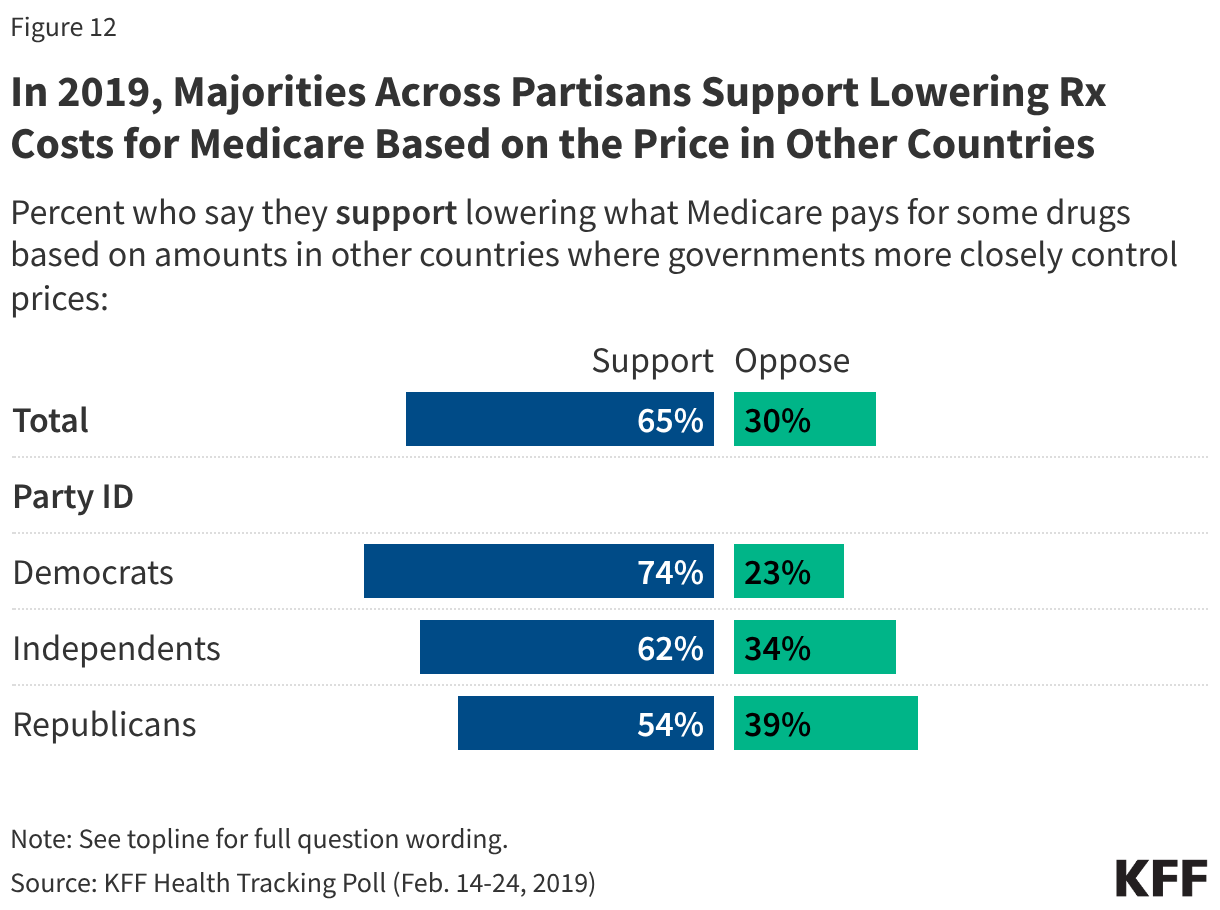
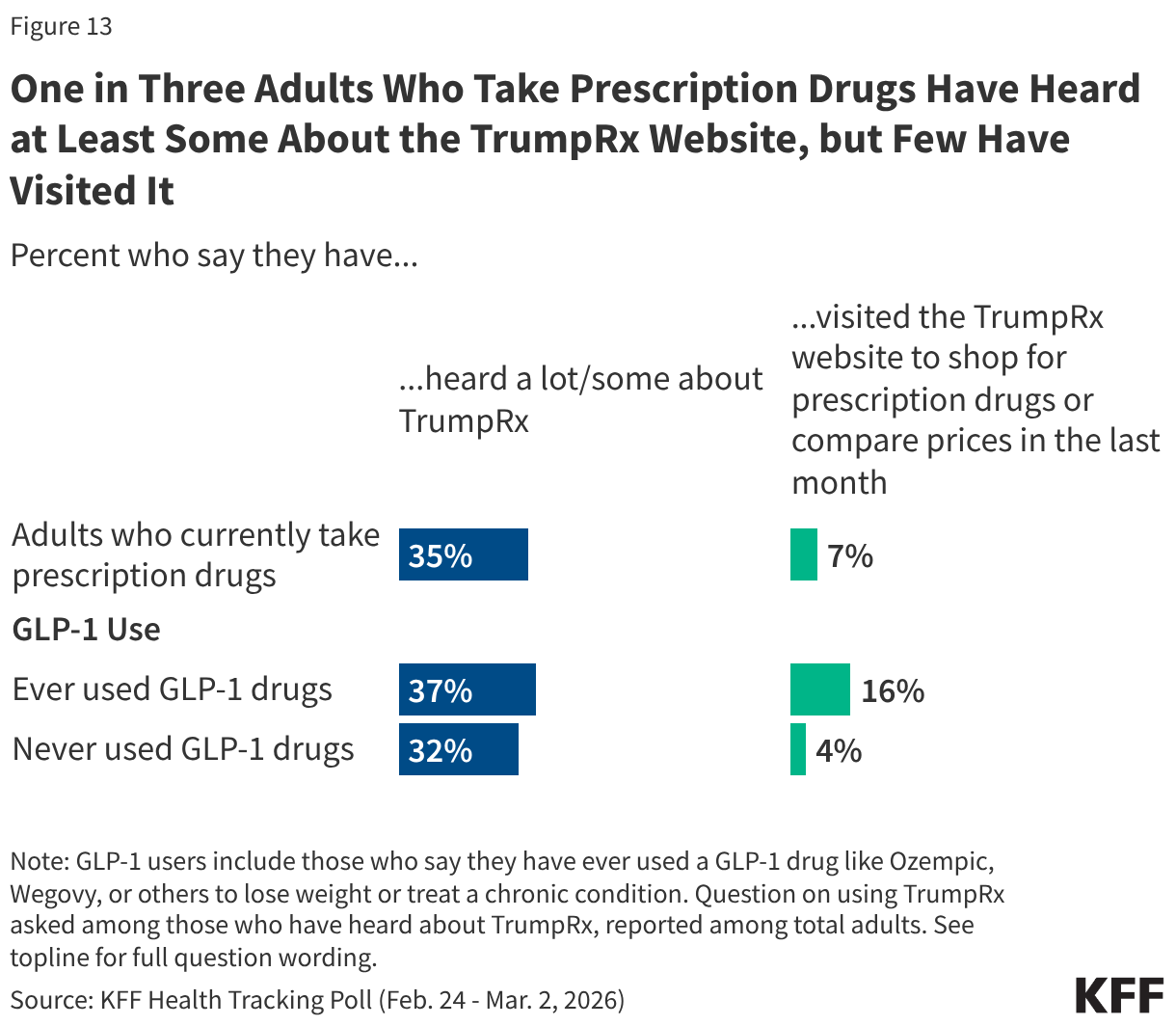
  • The Trump administration has taken several steps to try to lower prescription drug costs in its second term, but these initiatives have limited public visibility so far. Few adults have heard much about the administration’s drug pricing deals with manufacturers or TrumpRx, the federal website that provides discount coupons for certain drugs, launched in early 2026. KFF polling from 2019 found broad support for a related approach – lowering what Medicare pays for some drugs based on amounts in other countries – suggesting the idea has public appeal even if awareness of the current initiatives and the debates around them remain low.

The Public’s Experiences with and Views of Prescription Drugs

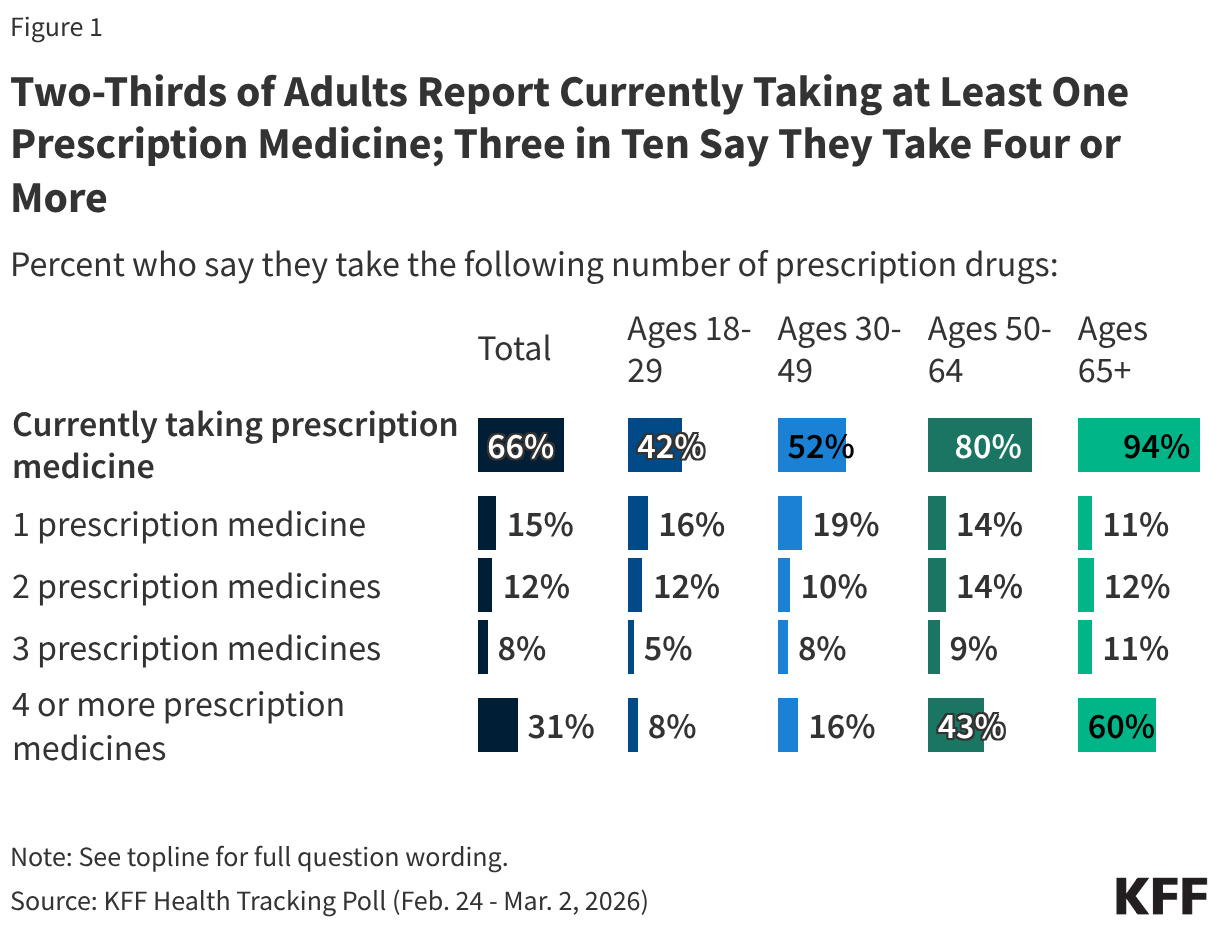
Prescription drugs touch the lives of most people in the U.S. in some way, and the public broadly recognizes their benefits. About two-thirds (66%) of adults say they are currently taking at least one prescription drug, and three in ten (31%) say they currently take four or more prescription medications. While many adults across age groups take prescription medications, older adults are much more likely to report taking 4 or more medications.

Six in ten adults ages 65 and older report taking four or more prescription medications, compared to fewer than half of younger adults.

Bar chart showing the percent who take any number of prescription medicine, 1 prescription medicine, 2 prescription medicines, 3 prescription medicines, or 4 or more prescription medicines.

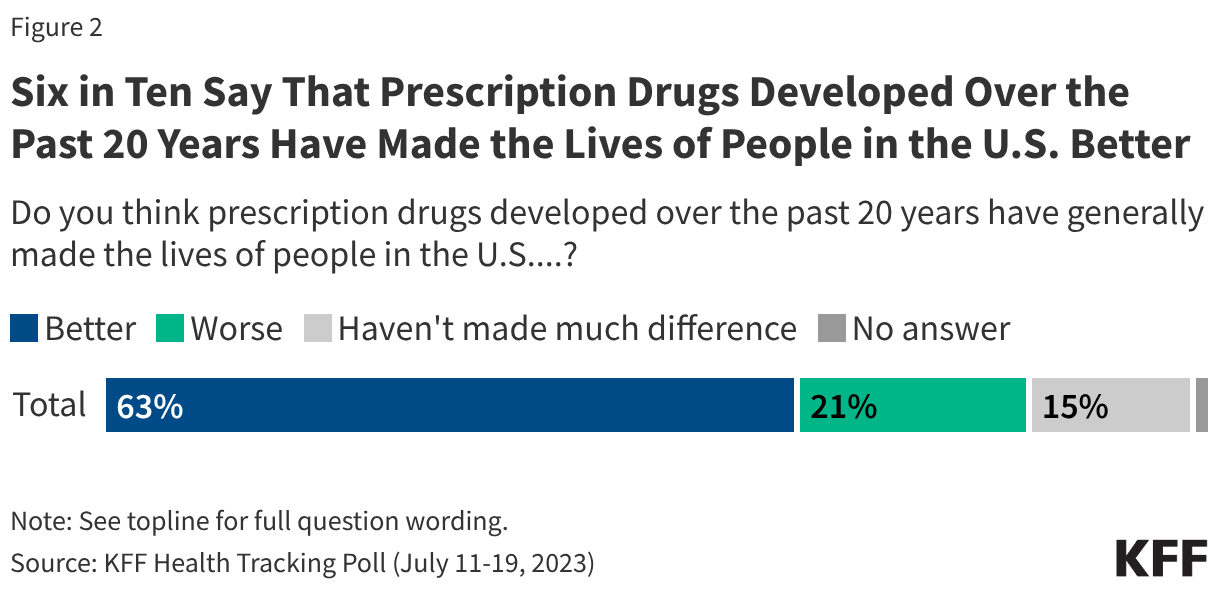
The public generally sees the benefits of these medicines. About six in ten (63%) adults believe prescription drugs developed over the past 20 years have generally made the lives of people in the U.S. better, while much smaller shares (21%) say they’ve made them worse or have not made a difference (15%).

Six in Ten Say That Prescription Drugs Developed Over the Past 20 Years Have Made the Lives of People in the U.S. Better (Stacked Bars)

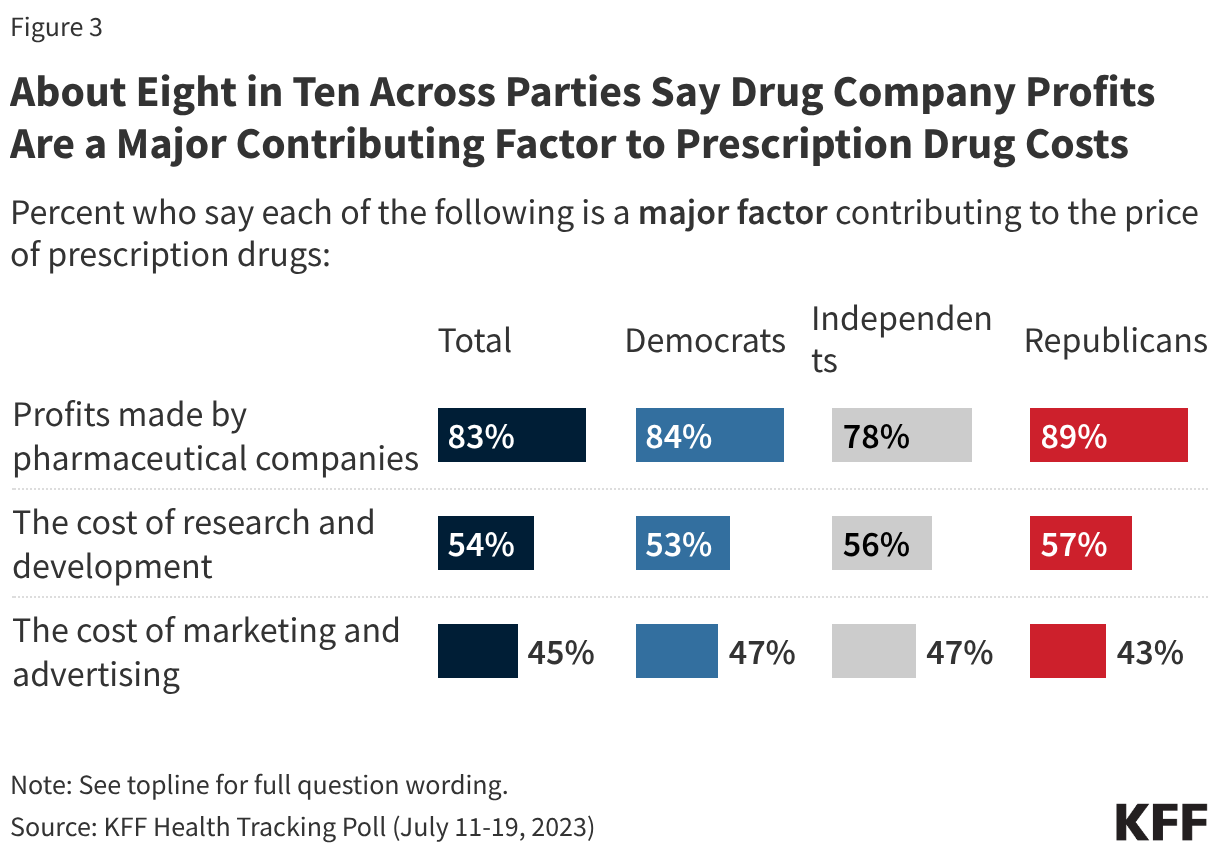
Despite seeing their general benefits to society, about eight in ten adults (82%) say the cost of prescription drugs is unreasonable, and the public sees profits made by pharmaceutical companies as the largest factor contributing to these prices. More than three-quarters of adults across partisanship say profits made by pharmaceutical companies are a “major factor” in the price of prescription drugs. This is followed by more than half who say the cost of research and development is a “major factor” contributing to the price, and 45% saying the same about the cost of marketing and advertising.

Split bar chart by total and party identification, showing the percent who say each of the following is a major factor contributing to the price of prescription drugs: profits made by pharmaceutical companies, the cost of research and development, and the cost of marketing and advertising.

Struggles Affording Prescription Drugs

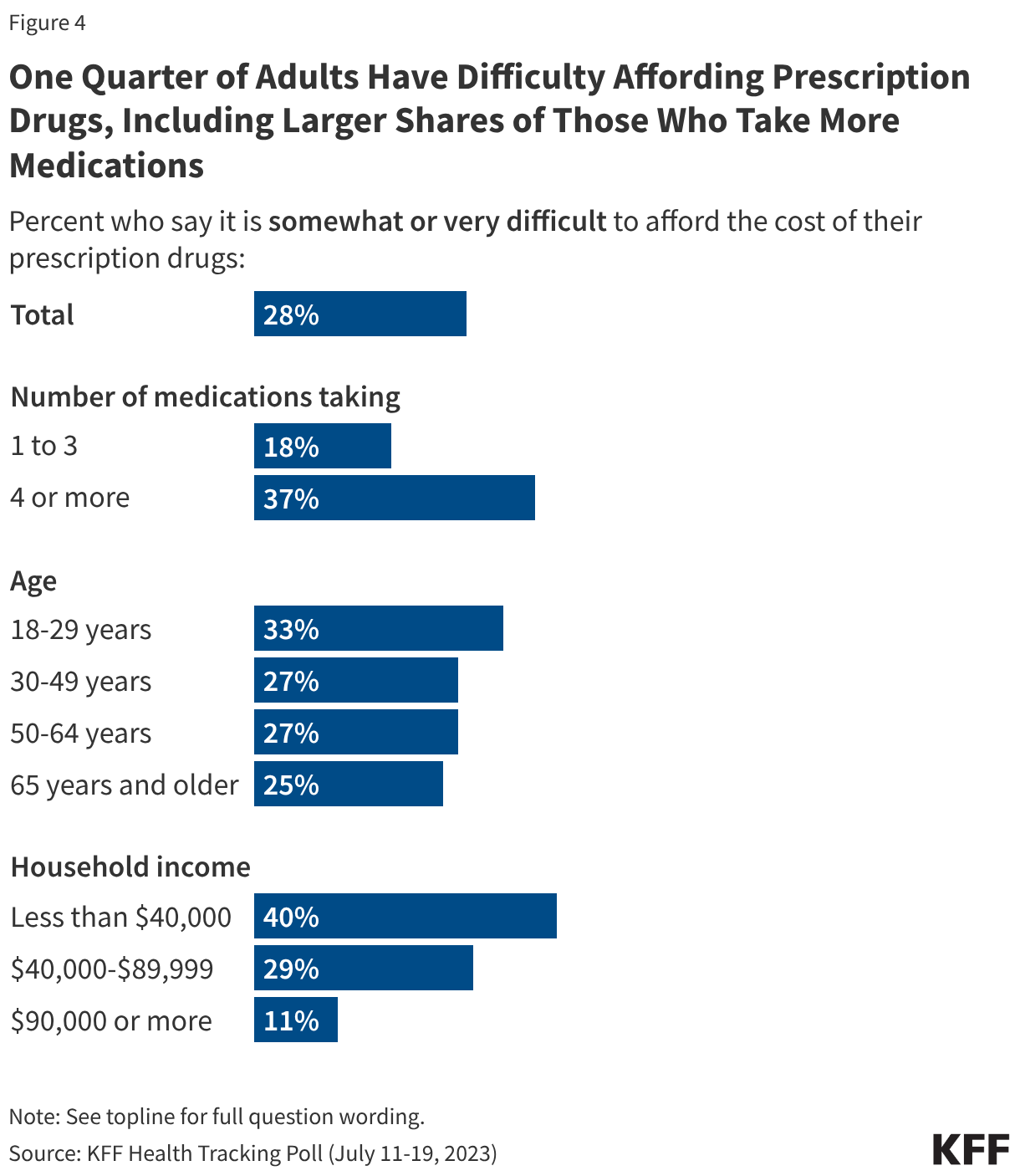
Many Americans face significant challenges affording their medications, including adults who take more medications or have lower incomes. KFF polling shows these challenges have grown more acute over the years. While about two-thirds (65%) of adults overall say it is “very” or “somewhat” easy to afford their prescription drug costs, affordability is a bigger issue for those who are currently taking four or more prescription medicines. Nearly four in ten (37%) of those taking four or more prescription drugs say they have difficulty affording their prescriptions, compared with one in five (18%) adults who currently take three or fewer prescription medications. Adults with an annual household income of less than $40,000 are also more likely than adults with higher incomes to report difficulty affording their prescription medications.

Bar chart showing percent who say it is difficult to afford the cost of their prescription medicine, by total, number of medications taken, age, and household income.

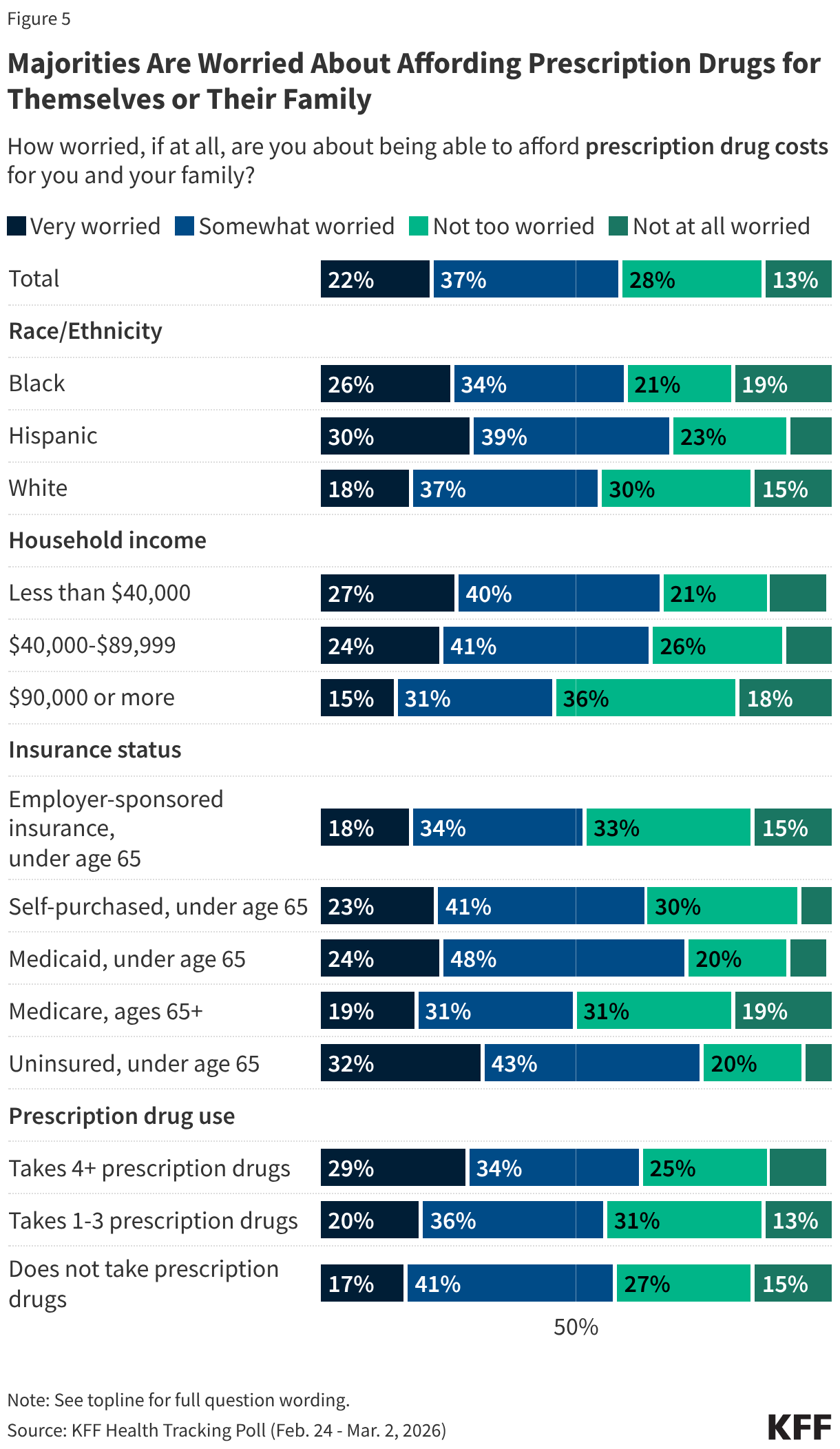
Overall, about six in ten adults say they are worried about being able to afford prescription drug costs for themselves or their families (59%), including about one in five (22%) who are “very worried.” Worry varies by insurance status, household income, race, and ethnicity. Substantial shares of uninsured adults under age 65 (32%), Hispanic adults (30%), Black adults (26%), and adults in households with annual incomes less than $40,000 (27%) say they are “very worried” about affording their prescription drug costs.

Among adults who take four or more prescription medications, about two-thirds (64%) report worrying about affording their medications, including about three in ten (29%) who are “very worried.” However, worry is not limited to those who take at least four medications. Most adults who take fewer prescriptions (1 to 3) worry about being able to afford their medications (56%). Even among adults who do not currently take any prescriptions themselves, a majority (57%) are “very” or “somewhat worried” about affording prescription medications, perhaps reflecting concerns about future needs or the prescription drug costs of family members.

Notably, about one in five (19%) Medicare enrollees say they are “very worried” about affording their prescription drug costs. Although older adults are more likely to take more prescription medications than younger adults, the vast majority of Medicare beneficiaries are enrolled in Medicare Part D plans, giving them prescription drug coverage that has improved with recent policies in the Inflation Reduction Act of 2022.

About one in four (24%) Medicaid enrollees under age 65 say they are “very worried” about affording their prescription drug costs. Medicaid provides comprehensive access to prescription drugs for eligible adults, with out-of-pocket costs limited to nominal amounts, which helps adults avoid cost-related prescription medication rationing or delays. However, while prescription out-of-pocket costs in Medicaid are limited, even low amounts may still be prohibitive for low-income families with Medicaid.

Majorities Are Worried About Affording Prescription Drugs for Themselves or Their Family (Stacked Bars)

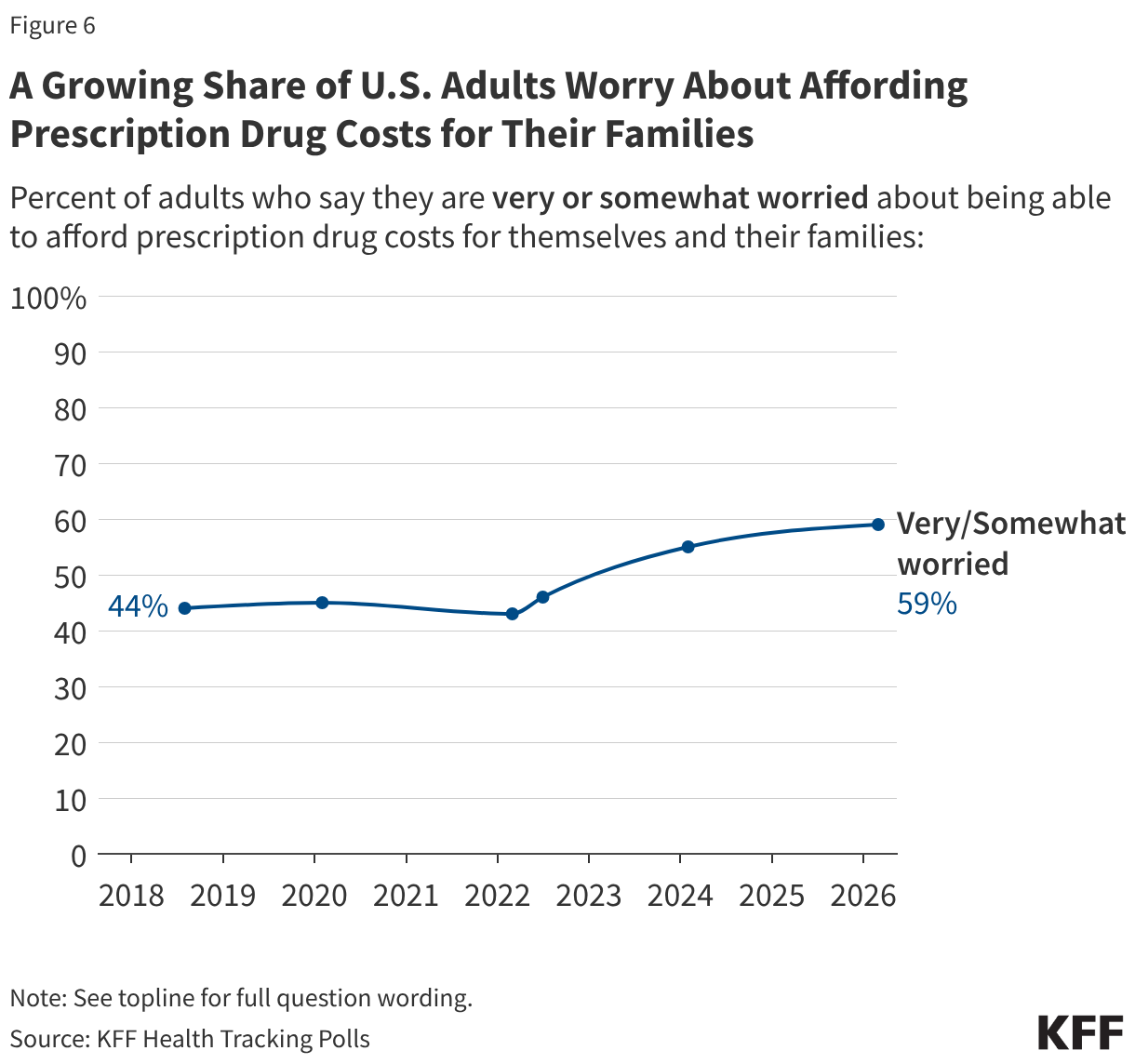
Since KFF first asked about worries affording prescription drug costs in 2018, the share of adults reporting worries has increased steadily, to a new high of six in ten (59%) in 2026.

Bar chart showing the share of adults who are very or somewhat worried about being able to afford prescription drugs from August 2018 to March 2026.

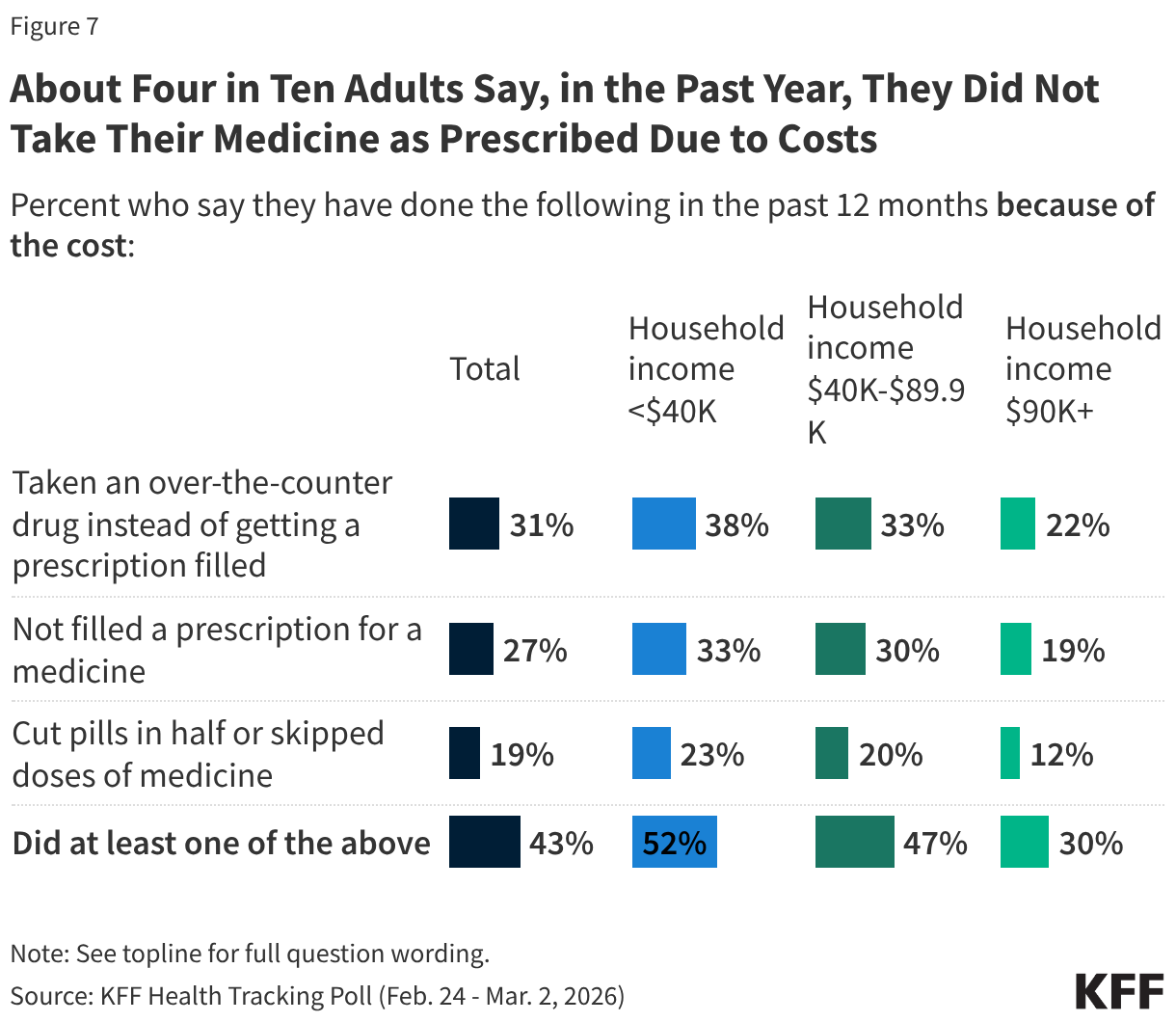
About four in ten (43%) adults report that they have not taken their medication as prescribed at some point in the past year because of the cost. This includes three in ten who have taken an over-the-counter drug instead (31%), a quarter who have not filled a prescription (27%), and about one in five (19%) who have cut pills in half or skipped doses of medicine because of the cost.

The share who reports not filling a prescription, taking an over-the-counter drug instead, or cutting pills in half or skipping doses increases to about half among adults with annual household incomes less than $40,000 (52%).

About Four in Ten Adults Say, in the Past Year, They Did Not Take Their Medicine as Prescribed Due to Costs (Split Bars)

GLP-1 Use and Affordability

In recent years, KFF has been tracking the public’s use and experiences with GLP-1 medications. These medications, such as semaglutide or tirzepatide, are used for weight loss or managing chronic health conditions. As GLP-1 medications have expanded beyond their original use for treating Type 2 diabetes, their popularity, combined with their high cost and need for long-term use, poses a potential cost burden on consumers, employers, and insurers. In response, some employers have restricted or dropped coverage for weight loss in 2026. Medicare Part D currently covers GLP-1 drugs only when prescribed to treat chronic illnesses such as diabetes and sleep apnea but prohibits the coverage for weight loss alone under federal law. Under the Medicaid Drug Rebate Program (MDRP), state Medicaid programs must cover GLP-1s for conditions like diabetes, but coverage for obesity is optional under federal law.

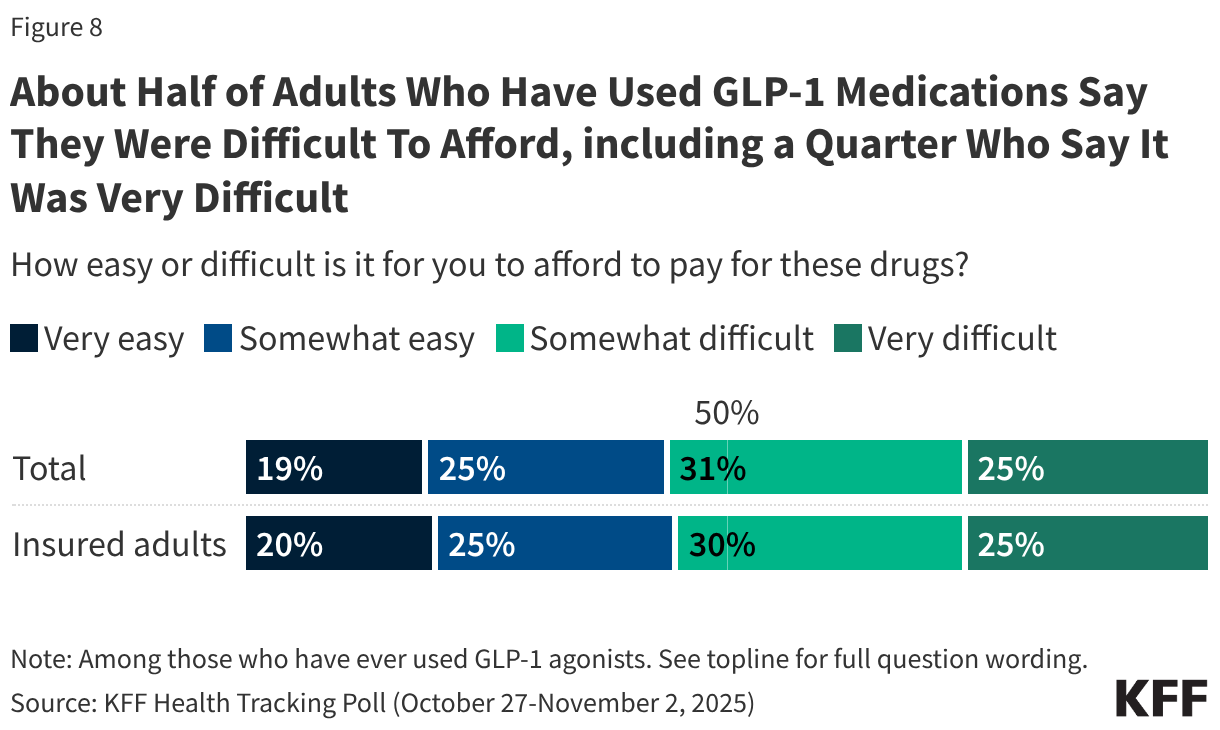
As of March 2026, KFF Health Tracking Polls show about one in five adults have ever taken a GLP-1 medication (18%), including 12% who currently take this class of medication (an increase of 6 percentage points from May 2024).

While most GLP-1 users get their medications from a primary care doctor and have them at least partially covered by insurance, a majority, including 55% of those who have health insurance, say it is difficult to afford these drugs. KFF will continue to monitor the public's experiences with GLP-1 medications as use, regulation, and new formulations – including oral versions – continue to evolve.

Stacked bar chart showing how easy or difficult paying for GLP-1 drugs is for adults who have ever used GLP-1 drugs.

Public Support for Drug Pricing Policies

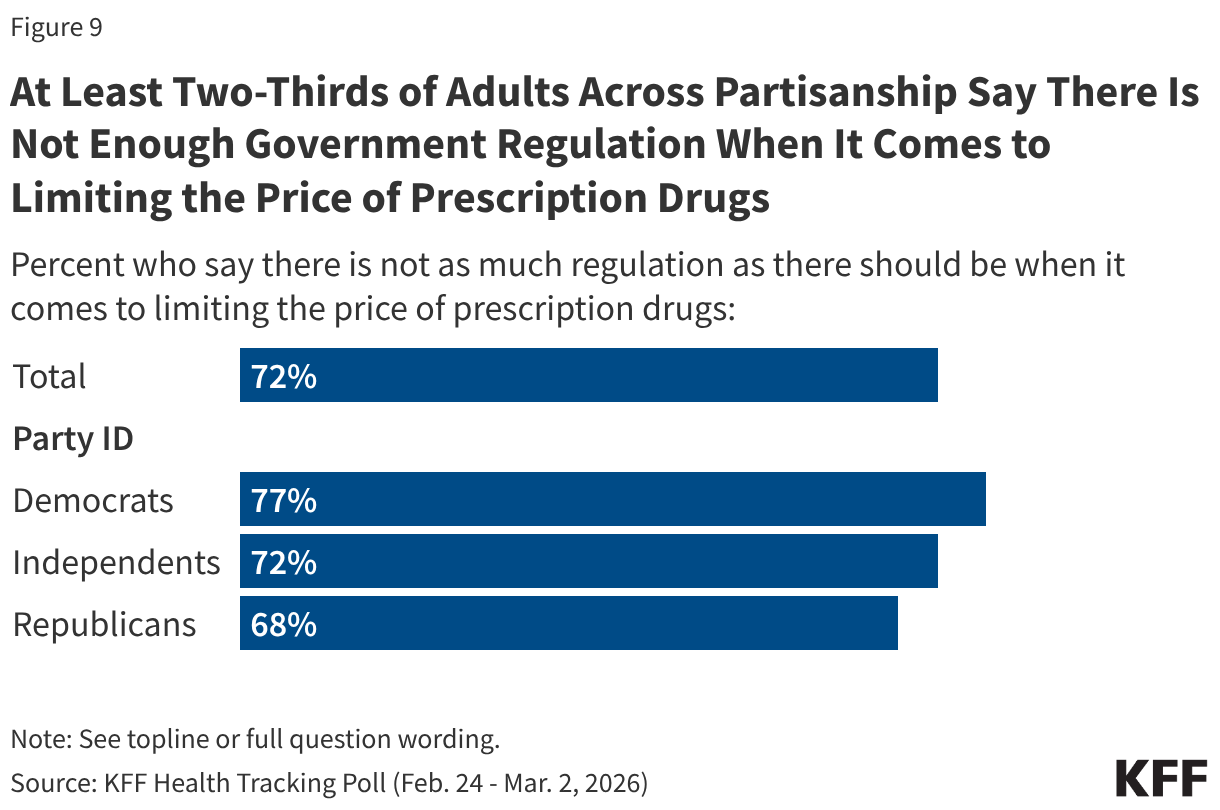
There is broad, bipartisan agreement that there should be more government regulation when it comes to prescription drug costs. The March 2026 KFF Health Tracking Poll finds about seven in ten adults (72%) say there is “not as much regulation as there should be” when it comes to limiting the price of prescription drugs, including at least two-thirds of Democrats (77%), Republicans (68%), and independents (72%).

Notably, larger shares of adults now say there is not enough regulation than five years ago, though KFF has found bipartisan agreement on this attitude since 2015.

Split bar chart by total and party identification showing percent of adults who say that there is not as much regulation as there should be when it comes to making sure prescription drugs are safe for people to use and limiting the price of prescription drugs.

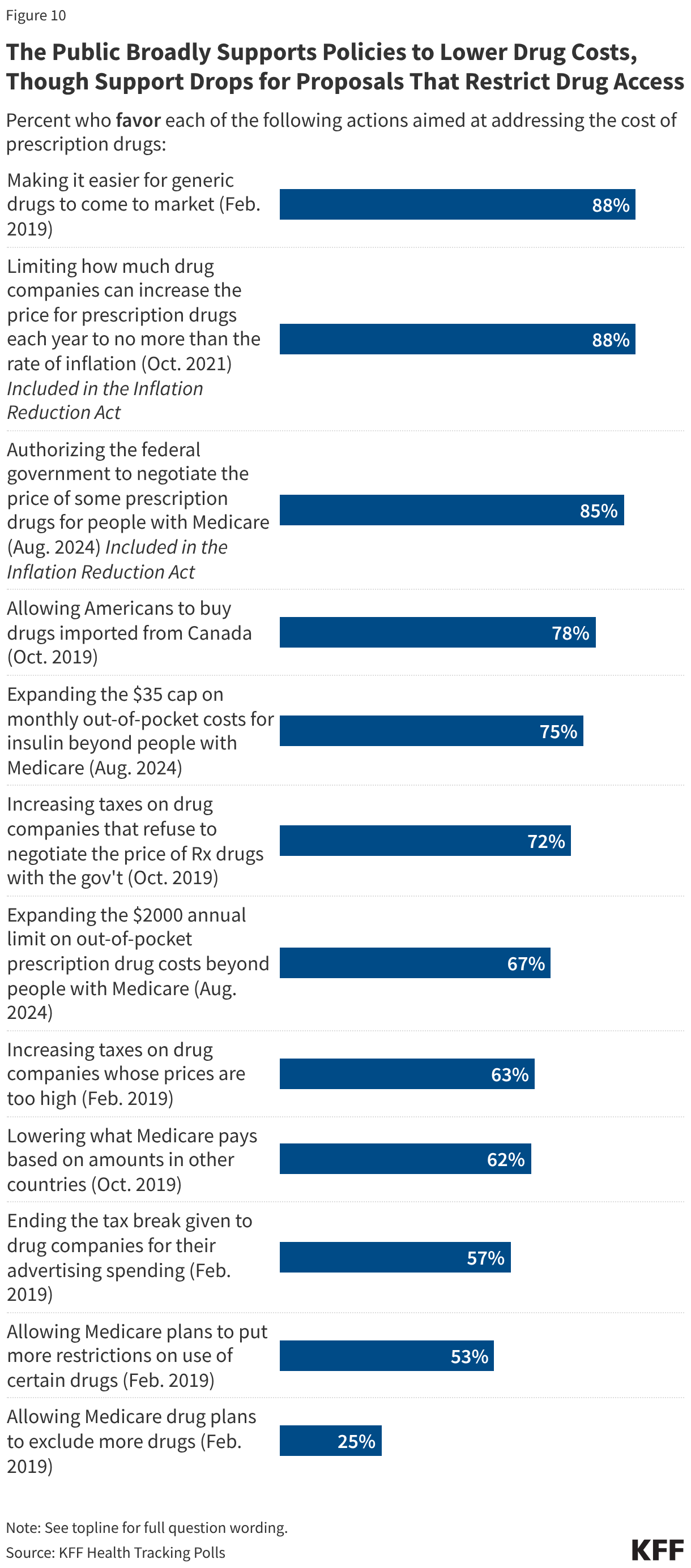
For decades, lawmakers have debated and passed drug pricing legislation. For example, in 2022 the Inflation Reduction Act, or IRA, included several provisions aimed at lowering prescription drug costs. The public largely supports many of these provisions, including limiting how much drug companies can increase the price of drugs based on annual inflation rates (88%) and allowing the federal government to negotiate with drug companies to get a lower price on medications for people with Medicare (85%).

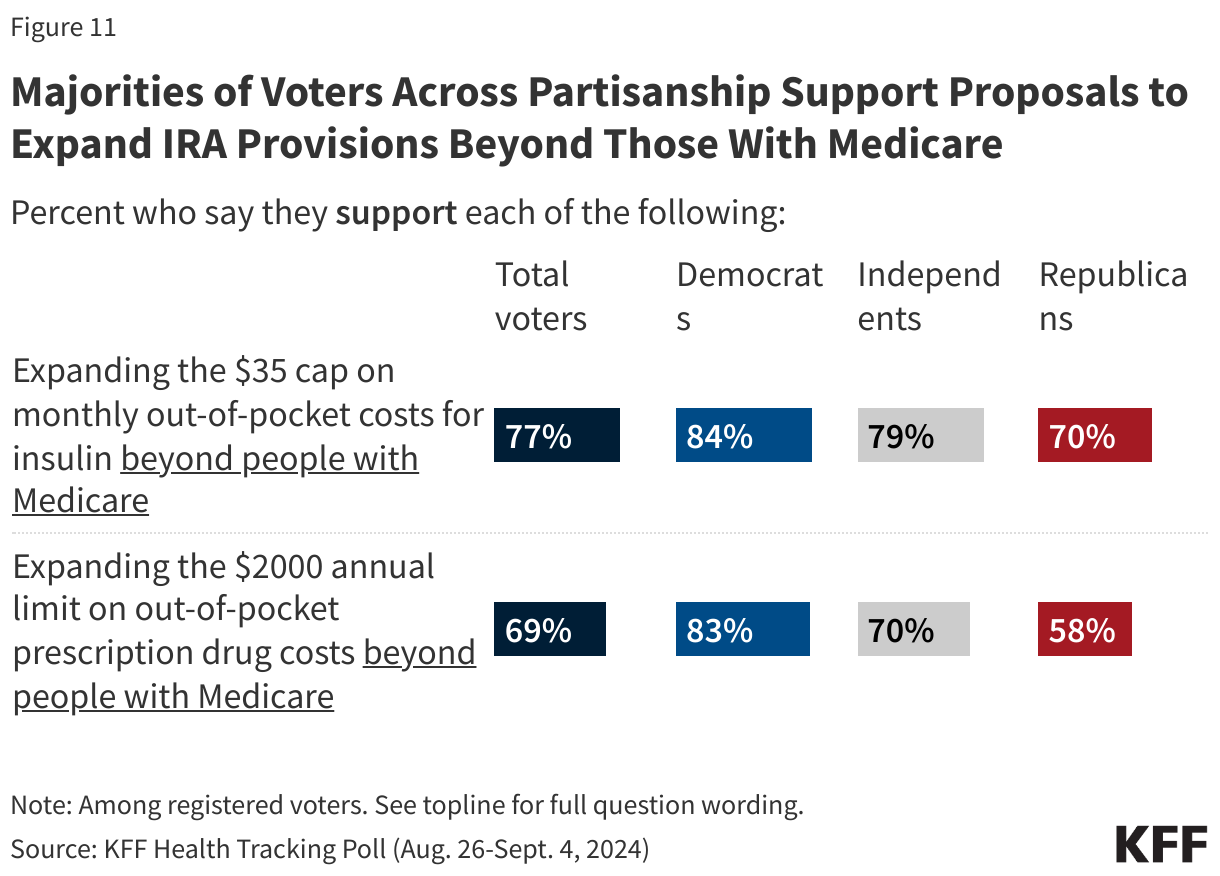
KFF polling shows the public – across partisans – is also supportive of other policy proposals that have been debated but not been put into law, such as increasing taxes on drug companies that refuse to negotiate the price of their drugs with the government, allowing Americans to buy drugs imported from Canada, making it easier for generic drugs to come to market, and expanding the IRA’s annual out-of-pocket maximum and monthly cap on insulin prices beyond people with Medicare.

Bar chart showing percent who favor specific actions to keep prescription drug costs down.

It is also notable that bipartisan support for the IRA provisions has held since its passage, and majorities across partisan lines support expanding what the law currently does. KFF polling from 2024, during the Biden administration, showed that at least eight in ten (85%) U.S. adults supported authorizing the federal government to negotiate drug prices for people with Medicare as the IRA does. This provision was supported by 90% of Democrats, 87% of independents, and 79% of Republicans.

In 2024, majorities across partisanship also supported expanding two IRA provisions beyond those covered by Medicare. Three in four adults supported a proposal to expand the $35 cap on out-of-pocket costs for insulin beyond those with Medicare, including majorities of Democrats (82%), independents (78%), and Republicans (67%). About two-thirds supported a proposal to expand the $2,000 annual limit on out-of-pocket prescription drug costs beyond those with Medicare, including 78% of Democrats, 69% of independents, and 57% of Republicans.

Bar chart showing shares of total voters, democratic voters, Independent voters, and Republican voters who say they support proposals to expand IRA provisions beyond those with Medicare.

Trump Administration Policy Actions on Prescription Drug Prices, TrumpRx and Direct Purchasing Options

President Trump first pushed to lower prescription drug costs in the U.S. to match prices in other developed nations, during his first term in 2018, an approach that later became formally known as “most-favored-nation” (MFN) pricing. While this was not put into effect during Trump’s first term, KFF polling from 2019 found broad public support for the approach, with about two-thirds (65%) of adults supporting lowering what Medicare pays for some drugs based on amounts in other countries where governments more closely control prices. This includes most Democrats (74%), independents (62%), and Republicans (54%).

Bar chart showing shares of total voters, democratic voters, Independent voters, and Republican voters who say they support proposals to expand IRA provisions beyond those with Medicare.

In the Trump administration’s second term, there have been more efforts to reduce the cost of prescription drugs. Though the details of the deals are confidential and not available to the public, the administration announced several prescription drug pricing deals with drugmakers related to what they charge state Medicaid programs for some of their drugs, and a subsequent deal with a maker of in vitro fertilization (IVF) drugs aimed at lowering the cost of these treatments. As of November 2025, awareness of these deals was limited, with three in ten adults saying they had heard a lot (6%) or some (25%) about them. Later in 2025, the president announced further developments in the MFN pricing, including deals to sell certain products directly to consumers at discounted rates.

In February 2026, amid the Trump administration's focus on lowering prescription drug costs, the administration officially launched TrumpRx, the federal government-run website where people can get discounts to buy prescription drugs directly from some manufacturers or pharmacies, without using their health insurance. As of early March 2026, few U.S. adults overall, including those who take prescription drugs, have heard much about or visited the website.

While few prescription drug users (7%) say they have visited the TrumpRx site to shop for or compare prescription prices in the month following the TrumpRx launch, this rises to about one in six (16%) among those who currently take or have ever taken a GLP-1 medication for weight loss or certain chronic conditions. The TrumpRx website features at least four major GLP-1 medications among its initial 43 listed drugs.

Split bar chart showing shares of adults who say they have heard about TrumpRx and share who say they have visited the TrumpRx website. Results shown by adults who take prescription drugs and GLP-1 use.

Prior to the launch of TrumpRx, drug discounts have been available through third-party platforms and directly from drug manufacturers. About four in ten adults who take prescription drugs say that in the past year, they have used a discount card or coupon to reduce their prescription drug costs (42%) or compared prescription drug prices online to find the lowest cost option (39%). Fewer say they have purchased a lower-cost drug from an online pharmacy without their insurance (15%) or directly from a drug manufacturer’s website (8%). 

Bar chart showing shares of adults who currently take prescription drugs and who say they have not taken their medication as prescribed because of the costs.

U.S. Global Health Country-Level Funding Tracker

Published: Mar 27, 2026

This tracker provides U.S. global health funding data by program area and country. It includes Congressionally appropriated (planned) funding amounts from FY 2006 – FY 2023, as well as obligations and disbursements from FY 2006 – FY 2025 (FY 2025 data are partially reported). Data were obtained from ForeignAssistance.gov (see About This Tracker below for more details). For examples of analyses that can be done using this tracker, please expand the section below.

Tracker

About This Tracker

The U.S. is the largest donor to global health in the world, providing bilateral (direct country-to-country) support for U.S. global health programs in over 75 countries in FY 2023 (through appropriated/planned funding), with additional countries reached through U.S. regional efforts and U.S. contributions to multilateral organizations. This tracker provides historical data on bilateral U.S. government funding for global health by country, region, and income-level. It presents data on country-specific global health funding channeled through the Department of State (State) and U.S. Agency for International Development (USAID); these agencies account for approximately 85% of all U.S. funding for global health. Funding channeled through other agencies – the National Institutes of Health (NIH), Centers for Disease Control and Prevention (CDC), and Department of Defense (DoD) – is not included, as these data are not available at the country-level. Funding directed to “regional” or “worldwide” programs, which may reach additional countries, is also not included. See our companion resource, KFF U.S. Global Health Budget Tracker, to view data on U.S. funding for global health overall, including funding channeled through these other agencies. Data in this tracker present three transaction types:

  1. Appropriated: funding amounts based on Congressional appropriations for a given fiscal year which may be obligated and disbursed over a multi-year period;
  2. Obligations: binding agreements that will result in disbursements (or outlays), immediately or in the future, and
  3. Disbursements: actual paid amounts (an outlay of funds) to a recipient in a given year.

These amounts will be updated as new data become available. Queried data can be downloaded using the button within the interactive, and the full data can be downloaded here. For questions related to this resource, or for inquiries on further analyses on U.S. global health funding, please contact globalhealthbudget@kff.org.

Sources

KFF analysis of data from the U.S. Foreign Assistance Dashboard, U.S. State Department regional classifications, and World Bank income classifications.

One or Two Health Systems Controlled the Entire Market for Inpatient Hospital Care in Nearly Half of Metropolitan Areas in 2024

Authors: Jamie Godwin, Zachary Levinson, and Tricia Neuman
Published: Mar 27, 2026

Editorial Note: This brief updates a previous analysis with more recent data, an evaluation of increases in concentration over time, and minor adjustments to the Methods.

National health spending totaled $5.3 trillion in 2024—18% of gross domestic product (GDP)—and is projected to grow faster than GDP through 2033, contributing to higher costs for families, employers, states, and the federal government. As policymakers consider a variety of strategies to make health care more affordable, they have been increasingly attentive to the effects of consolidation in health care markets and the potential implications for cost and quality of care. Hospital consolidation has been a subject of particular focus in part because spending on hospital care is the largest source of spending on health. Hospital care has also contributed more than other categories to the growth in national health spending over time, including from 2022 to 2024, when it accounted for 40% of spending growth. Consolidation may allow providers to operate more efficiently and help struggling providers keep their doors open in underserved areas, but it often reduces competition. A substantial body of evidence has found that consolidation can contribute to higher prices, with unclear effects on quality.

This analysis examines the competitiveness of markets for hospital care, based on RAND Hospital Data—a cleaned and processed version of cost reports from Medicare-certified hospitals—and American Hospital Association (AHA) survey data. The analysis examines competition among independent hospitals and health systems, referring to both as “health systems” throughout for brevity. Competition is measured in three ways: the share of metropolitan statistical areas (MSAs) controlled by a small number of health systems, the level of market concentration in MSAs based on the Herfindahl-Hirschman Index (HHI), and the share of hospitals affiliated with health systems over time. Using hospital data from 2024 (the most recent year available), this analysis focuses on general short-term or general medical and surgical hospitals depending on the dataset and excludes federal hospitals (see Methods for more details).

Key Takeaways

  • One or two health systems controlled the entire market for inpatient hospital care in nearly half (47%) of metropolitan areas in 2024.
  • In more than four of five metropolitan areas (83%), one or two health systems controlled more than 75 percent of the market.
  • Nearly all (97% of) metropolitan areas had highly concentrated markets for inpatient hospital care when applying HHI thresholds from antitrust guidelines to MSAs.
  • Most hospital markets in metropolitan areas (80%) became less competitive from 2015 to 2024 or were controlled by one health system over that entire period.

One or Two Health Systems Controlled the Entire Market for Inpatient Hospital Care in Nearly Half (47%) of Metropolitan Areas in 2024

Nearly one in five (19%) metropolitan statistical areas (MSAs) were controlled by a single health system, and more than one in four (27%) markets were controlled by two systems in 2024 (see Figure 1). In more than four of five metropolitan areas (83%), one or two health systems controlled more than 75 percent of the market. These markets all met the definition of highly concentrated markets based on thresholds in current antitrust guidelines (see below). One health system controlled at least half of the market in about three out of four MSAs (76%) and at least a quarter of the market in nearly every MSA (98%).

One or Two Health Systems Controlled the Entire Market for Inpatient Hospital Care in Nearly Half of Metropolitan Areas in 2024 (Small multiple donut chart)

The number of health systems in a given MSA tends to increase with the population of the region. For example, in 79% of MSAs with a population of less than 200,000, one or two health systems controlled the entire market for inpatient hospital care in 2024, as in the Muncie, IN; Napa, CA; and Amherst Town-Northampton, MA MSAs (Figure 2). MSAs with one or two health systems account for nearly half (47%) of all MSAs but 12% of the U.S. population living in metropolitan areas.

Conversely, virtually all (54 of 55) MSAs with a population of at least one million people had at least four health systems, as in the MSAs encompassing Detroit, Miami, and Phoenix. MSAs with four or more health systems accounted for 35% of all MSAs but 79% of the U.S. population living in metropolitan areas.

However, in fourteen of these relatively large MSAs with four or more health systems, the two largest health systems controlled at least 75% of the market, and in 44 of these areas, they controlled at least 50% of the market. For example, in the MSA encompassing Austin, TX, with 2.6 million residents, two systems (HCA Healthcare and Ascension Healthcare) controlled 89% of the inpatient hospital care market, though Austin is home to more than four health systems. The metropolitan area encompassing Portland, OR, with 2.5 million residents and more than four health systems, is a less concentrated market than Austin’s, but the two largest systems (Legacy Health and Providence) still control a combined 62% of the market. (See Methods for discussion about MSAs as geographic hospital markets).

Hospital Market Competitiveness Varied Across US Metropolitan Areas in 2024 (Symbol map)

Nearly All (97% of) Metropolitan Areas Had Highly Concentrated Markets for Inpatient Hospital Care in 2024 Based on Thresholds Used in Current Antitrust Guidelines

Another way to assess market competitiveness is to evaluate a measure of concentration known as the Herfindahl-Hirschman Index (HHI), which is based on the number of participants in a market and their respective shares. The measure runs from 0 (perfectly competitive) to 10,000 (monopoly market). Based on current merger guidelines from the Federal Trade Commission (FTC) and Department of Justice (DOJ), markets can be grouped into three categories: not concentrated (HHI < 1,000), moderately concentrated (1,000 – 1,800), and highly concentrated (HHI > 1,800). This analysis calculates HHIs for MSAs and groups these regions accordingly, though there are other ways of defining the boundaries of hospital markets (see Methods).

Nearly all (97% of) MSAs had highly concentrated markets for inpatient hospital care in 2024 based on thresholds used in current merger guidelines (Figure 3). These guidelines reflect updates in 2023 that lowered the HHI thresholds for moderately concentrated and highly concentrated markets. Based on the thresholds used in prior guidelines, a large majority but somewhat smaller share (93%) of MSAs were highly concentrated markets for inpatient hospital care in 2024, closer to an estimate from an earlier study (90%) that used data from 2016.

As was the case when looking at counts of health systems in MSAs, larger metropolitan areas tended to be less concentrated and more competitive than less populated metropolitan areas, although this was not always the case. All 10 MSAs that were identified as either not concentrated or moderately concentrated had more than one million residents, such as the MSAs encompassing Cincinnati, Los Angeles, and Miami. However, 45 MSAs with more than one million residents—including the MSAs encompassing Houston, Denver, and Atlanta—had highly concentrated hospital markets. Overall, 72% of people living in metropolitan areas lived in highly concentrated hospital markets.

Nearly All (97% of) Metropolitan Areas Had Highly Concentrated Markets for Inpatient Hospital Care in 2024 Based on Thresholds Used in Current Antitrust Guidelines (Donut Chart)

The Share of Hospitals Affiliated With Health Systems Increased From 56% in 2010 to 69% in 2024, With the Share Growing in Both Rural and Urban Areas

More than two thirds of hospitals (69%) are now part of a larger system, an increase from 56% in 2010 (Figure 4). A smaller share of rural than urban hospitals were part of a health system in 2024 (53% versus 80%), though shares have increased over time for both rural and urban regions: from 43% in 2010 to 53% in 2024 among rural hospitals and from 66% in 2010 to 80% in 2024 among urban hospitals.

Most system-affiliated hospitals in 2024 (52%) were part of a system with at least 15 hospitals, and 19% were in a system with at least 50 hospitals. Systems with at least 100 hospitals accounted for 10% of system-affiliated hospitals.

Hospitals joining larger systems may not always reduce local market competition, for example, if an independent hospital is acquired by a larger system that does not own facilities in the same market. However, mergers between hospitals that operate in different geographic markets for patient care—also known as “cross-market” mergers—may nonetheless lead to higher prices in some cases.

The Share of Hospitals Affiliated With Health Systems Increased From 56% in 2010 to 69% in 2024, With the Share Growing in Both Rural and Urban Areas (Line chart)

Most Hospital Markets in Metropolitan Areas (80%) Became More Concentrated From 2015 to 2024 or Were Controlled by One Health System Over That Entire Period

Four out of five metropolitan areas (80%) experienced an increase in hospital market concentration between 2015 and 2024 (Figure 5) or were controlled by a single hospital or health system for the duration. About two thirds of MSAs (65%) saw an increase in market concentration over this period, as measured by HHI, and the share of MSAs that were highly concentrated increased by two percentage points, from 95% to 97%. Fifteen percent of metropolitan areas were controlled by a single health system in both 2015 and 2024, meaning that concentration could not increase further in these markets. Concentration declined in only 20% of markets. In some cases, increases or decreases in concentration were very small.

Most Hospital Markets in Metropolitan Areas (80%) Became More Concentrated From 2015 to 2024 or Were Controlled by One Health System Over That Entire Period (Donut Chart)

The trend toward greater concentration was widespread across metropolitan areas of different sizes and regions. Among the 65% of MSAs that experienced increased concentration, the average HHI increased from 4,545 to 5,273, a 728 point increase. In markets that are not already controlled by one hospital or health system, market concentration may rise as a result of continued consolidation through mergers and acquisitions (Figure 4), shifts in hospital stays towards larger hospitals and health systems and away from smaller competitors, or hospital closures that reduce the number of competitors in a given market.

This work was supported in part by Arnold Ventures. KFF maintains full editorial control over all of its policy analysis, polling, and journalism activities.

Methods

Analyses of market shares and HHI (e.g., every figure except for Figure 4) were based in part on RAND Hospital Data. RAND Hospital Data are a cleaned and processed version of annual cost reports that Medicare-certified hospitals are required to submit to the federal government. Although limited to Medicare-certified hospitals, in 2024, the analysis of RAND data included the vast majority (98%) of non-federal general medical and surgical hospitals in US metropolitan areas included in the analysis of system affiliation based on the AHA Annual Survey Database (see below). Cost reports were assigned to years based on the end of the reporting period and were scaled up or down to reflect a 365-day period, as necessary. In cases where a hospital had multiple cost reports assigned to the same analysis year, the cost report covering the longer reporting period was retained. When cost reports were longer than 365 days and fully spanned a calendar year (such as one beginning 1/1/2022 and ending 7/31/2023), the cost report was assigned to both the year spanned in full (2022) and the year in which it ended (2023).

Analyses of market shares and HHI were restricted to non-federal, general short-term hospitals as identified in the RAND Hospital Data. Some general short-term hospitals in the analysis were identified as other hospital types, such as surgical hospitals, in the AHA data (6% of those that could be matched), though these represented a small share of discharges (1%). Market shares were calculated as the share of inpatient discharges in an MSA that occurred within a given health system or independent hospital. One percent of hospitals that met the other sample restrictions had missing values for inpatient discharges and were excluded. Hospitals were grouped into health systems, as applicable, based primarily on the hospital’s system affiliation in the AHA Annual Survey Database. A previous version of this analysis relied on the AHRQ Compendium of US Health Systems, but that file has not been updated to include 2024 information.

For 2024 analyses, in the small number of cases where a cost report could not be matched to the AHA Annual Survey database (2% of observations), the 2023 AHRQ Compendium was used to identify the hospital's corresponding AHA system identifier, where available. Twelve hospitals could not be matched to AHA or AHRQ records, of which 7 were manually assigned system affiliations based on internet searches. System affiliations for 40 hospitals (2% of the sample) were updated using the 2023 AHRQ Compendium when confirmed by internet searches in cases where: (1) the Compendium identified at least two hospitals in an MSA as being part of a Compendium health system that did not correspond to an AHA system and (2) at least one of those hospitals was identified as independent in the AHA data. In 3 instances (covering 11 hospitals), two AHA systems were combined into one when indicated by the AHRQ Compendium and confirmed through internet searches.

Analyses of changes in system affiliation and market structure over time (Figures 4 and 5) relied only on AHA system identifiers. When cost reports did not match to AHA data in the Figure 5 analysis, those hospitals were treated as independent.

MSAs reflect 2023 geographic definitions from the Census Bureau delineated based on data from the 2020 decennial census. HHIs were calculated as the sum of squared market shares for all health systems in a given MSA (e.g., an MSA divided evenly between two systems would have an HHI of 502 + 502 = 5,000). MSA population estimates for 2024 were obtained from the Census Bureau.

MSAs were used as a proxy for hospital markets, which is one approach used by other studies summarizing hospital market competition across the country. There are other ways of defining markets that would yield different results when calculating the level of competition. For example, one report also evaluated MSAs but focused on where residents received their care, including at hospitals outside of a given MSA. As another example, some have defined markets based on a radius around the hospital defined by distance or estimated travel time. More precise market definitions, such as those used to define competition in antitrust cases, were not feasible. This study did not exclude MSAs with populations of at least three million as some others have done, because the analysis sought to describe competition across all metropolitan areas.

The analysis of the share of hospitals affiliated with systems was based on the AHA Annual Survey Database alone. This analysis was restricted to nonfederal, general medical and surgical hospitals. Urban hospitals were defined as those operating in a metropolitan area, while rural hospitals were defined as those operating in nonmetropolitan areas. Metropolitan and nonmetropolitan designations were identified using Urban Influence Codes (UIC) data.