KFF designs, conducts and analyzes original public opinion and survey research on Americans’ attitudes, knowledge, and experiences with the health care system to help amplify the public’s voice in major national debates.
Medicaid, the provider of health insurance coverage for about one in five Americans and the largest payer for long-term care services in the community and nursing homes, continues to be a key part of health policy debates at the federal and state level. Important Medicaid issues to watch in 2019 include Medicaid expansion developments amid ongoing litigation about the ACA’s constitutionality as well as Medicaid demonstration waiver activities, including those focused on work requirements and other eligibility restrictions. States are also likely to continue to pursue initiatives to address the opioid crisis, and the recent passage of bi-partisan legislation with new tools and financing could bolster these efforts. Primary areas of federal policy to watch in 2019 with implications for Medicaid include the expiration of temporary funding for Puerto Rico and the US Virgin Islands in the absence of legislative action as well as potential regulatory changes to public charge policies that would likely lead to Medicaid enrollment declines among immigrant families. Finally, reforms in benefits, payment and delivery systems continue to evolve as states and the federal government focus on managed care, social determinants of health, prescription drugs, and community based long-term care. While beyond the scope of this brief, Congress and states could also consider broader health reform that could expand the role of public programs in health care including Medicare for All or Medicaid buy-in programs that could have significant implications for Medicaid.
#Medicaid continues to be a key part of health policy debates at the state and federal level, including decisions about Medicaid expansion, Medicaid work requirements, how to combat the opioid epidemic, how best to control Rx drug costs and more.
Medicaid Expansion
Medicaid expansion was an important issue in the 2018 midterm elections. Following the election, 37 states including the District of Columbia have adopted the ACA’s Medicaid expansion. This count includes Maine, where the new governor signed an executive order to begin implementation of the expansion after the outgoing governor delayed implementation following the passage of a ballot initiative in November 2017, as well as three states (Idaho, Nebraska and Utah) that newly passed the expansion through 2018 ballot initiatives. In Kansas and Wisconsin, incoming governors ran on the issue of Medicaid expansion; however, they will have to work with their legislatures to enact a change. Some states that had long opposed expansion like Mississippi and Georgia may also be exploring expansion options. Other states to watch include Montana, where a ballot initiative to eliminate the sunset date for the Medicaid expansion failed and the expansion now needs to be extended by the legislature to continue, and Alaska, where the governor-elect has been a critic of the state’s Medicaid expansion program. Many studies on the effects of the ACA Medicaid expansion point to positive effects on coverage, access to care, service utilization, and state budgets and economies. As states consider Medicaid expansion, a federal trial court judge in Texas v. U.S.ruled that the entire Affordable Care Act (ACA) is unconstitutional on December 14, 2018, although the decision has been stayed pending appeal. While the trial court’s ruling will not be the last word on the ACA’s constitutionality, as appeals have been filed, the litigation could have implications for states considering expansion.
What to Watch:
Will additional states move to adopt the Medicaid expansion in 2019, and will current expansion states seek to make changes to their programs?
What will the outcome of the Texas v. U.S. litigation be? Will pending litigation have implications for Medicaid expansion?
On November 20, 2018, CMS re-approved the Kentucky waiver. This waiver originally was approved in January 2018, but sent back to CMS prior to implementation after a federal district court ruling that the approval exceeded the Secretary’s Section 1115 authority in a lawsuit brought by a group of Medicaid enrollees challenging the approval. The re-approval is largely the same as the original waiver and includes a work requirement, premiums, coverage lock-out periods, and health incentive accounts. Implementation is set to begin in April 2019, although the court has approved a briefing schedule for the Kentucky Medicaid enrollees to challenge CMS’s re-approval of the waiver. Early experience in Arkansas, the first state to implement a work requirement in Medicaid, shows that the challenges reaching and informing enrollees about new requirements and enrollee difficulties navigating the online monthly reporting process and finding stable work can result in significant coverage losses. While evaluations are required for demonstration waivers, the evaluation plan related to the work requirement in Arkansas has not yet been approved. Litigation challenging the Arkansas waiver also is ongoing.
What to Watch:
What other pending waivers with work requirements will CMS approve?
How will litigation in Arkansas and Kentucky be decided; what will be the effect on other states?
What will be learned from states currently implementing new waiver policies that can help inform the debate and how quickly will evaluation results be publicly available?
Medicaid Initiatives to Address the Opioid and Substance Use Disorder Crisis
Medicaid covers 4 in 10 nonelderly adults with opioid addiction. Medicaid facilitates access to treatment by covering numerous inpatient and outpatient treatment services, as well as medications prescribed as part of medication-assisted treatment (MAT). States continue to focus on strategies to address the opioid crisis. All states are implementing pharmacy benefit management strategies including quantity limits, prior authorization requirements, and requirements for Medicaid prescribers to check their state’s Prescription Drug Monitoring Program before prescribing opioids to a Medicaid patient. States continue to increase access to MAT for opioid use disorder, and 38 states reported coverage of methadone in FY 2018. In addition, a number of states are using Medicaid Section 1115 waivers to expand treatment options for enrollees with substance use disorders (SUD), including opioid use disorder (OUD), primarily by using Medicaid funds to pay for short-term residential institutional (IMD) services under a State Medicaid Director Letter that was first released in 2015 and revised in 2017. On October 24, 2018, President Trump signed into law the Substance Use Disorder Prevention that Promotes Opioid Recovery and Treatment for Patients and Communities (SUPPORT) Act. While very broad in scope, the final legislation contains a number of provisions related to Medicaid’s role in helping states provide coverage and services to people who need OUD and other SUD treatment, including a time-limited option that allows federal Medicaid payments for enrollees with SUD in IMDs, available to states beginning in October, 2019. In 2018, the Centers for Medicare and Medicaid Innovation announced include two new state demonstration models focused on care delivery for children and pregnant women affected by the opioid crisis; funding opportunity notices for states to express interest are expected to follow.
What to Watch:
What initiatives will states pursue in 2019 to continue to tackle the opioid epidemic and what role will Medicaid play in these efforts?
What new options will states adopt that stem from the recently passed SUPPORT Act?
How will Medicaid expansion affect efforts to address the opioid epidemic?
Medicaid Financing for Puerto Rico and USVI
The February 2018 federal budget bill provided increased financial support for Medicaid in Puerto Rico and the U.S. Virgin Islands (USVI) in the aftermath of hurricanes Maria and Irma. The budget bill increased the federal caps for Puerto Rico ($4.8 billion) and USVI (approximately $142.5 million) and provided Medicaid funds at 100% federal match from January 2018 through September 2019, as these territories continue to recover from Hurricanes Maria and Irma. However, federal legislation will be required to avert a financial cliff when the Medicaid financing support expires at the end of September 2019. Individuals born in the U.S. territories are U.S. citizens or nationals, but federal financing for Medicaid programs in the territories is capped and the federal match rate is set at a percentage in law, unlike the guaranteed federal matching funds without a cap and variable matching rates for Medicaid in the states.
What to Watch:
Will Congress act to pass legislation to address the financing issues for Puerto Rico and USVI?
Will proposed financing changes be temporary or permanent?
Medicaid and Public Charge Changes
On October 10, 2018, the Trump Administration published a proposed rule that would make changes to “public charge” policies. Under longstanding policy, the federal government can deny an individual entry into the U.S. or adjustment to legal permanent resident (LPR) status (i.e., a green card) if he or she is determined likely to become a public charge. Under the proposed rule, officials would newly consider use of certain previously excluded programs, including Medicaid, the Supplemental Nutrition Assistance Program, the Medicare Part D Low-Income Subsidy Program, and several housing assistance programs, in public charge determinations. The changes would likely lead to broad decreases in participation in Medicaid and other programs among legal immigrant families and their primarily U.S.-born children beyond those directly affected by the changes. Nationwide, over 19 million or one in four (25%) children live in a family with an immigrant parent, and nearly nine in ten (86%) of these children are citizens. Decreased participation in Medicaid would increase the uninsured rate among immigrant families, reducing access to care and contributing to worse health outcomes. Coverage losses also would result in increased uncompensated care for providers. More than 210,000 public comments were submitted during the rule’s comment period that closed on December 10, 2018. The administration will now review those comments and decide whether to issue a final rule that could go into effect 60 days after publication.
What to Watch:
What will happen to the proposed “public charge” regulations?
How is coverage and access to Medicaid and health services affected by the proposed rule?
Medicaid and Payment and Delivery System Reforms
Risk-based managed care continues to be the predominant delivery system for Medicaid services, and states are focused on implementing alternative payment models, improving quality within MCOs and developing initiatives to address social determinants of health. In November 2018, CMS proposed some changes to the Medicaid managed care rule regarding network adequacy, beneficiary protections, quality oversight, and rate development and payment; the public comment period closes in mid-January 2019. States are seeking to increase Medicaid access in rural areas through coverage of new benefits including telehealth, e-Consult, telemedicine, and tele-monitoring. Strategies also include funding increases for rural providers, expanded SUD treatment services in rural areas, expanded funding for primary care residency programs, and participation in multi-payer initiatives that promote rural access to care. Prescription drug costs continue to exert pressure on Medicaid spending. Many states are implementing a variety of prescription drug cost containment initiatives, especially initiatives to generate greater rebate revenue and implement new utilization controls. Finally, nearly all states are employing one or more strategies to expand the number of people served in home and community-based settings, and states have initiatives to address long-term services and supports (LTSS) workforce issues. Housing-related supports remain an important part of state LTSS benefits, and states are working to maintain housing-related supports even as Money Follows the Person (MFP) grant funds expire. Congress is considering an extension of the MFP program and also changes to extend provisions in the ACA that require states to apply the Medicaid “spousal impoverishment” rules, which allow married couples to protect a portion of their income and assets should one spouse seek Medicaid coverage for institutional long-term care, to long-term care in community-based settings. Additionally, in November 2018, CMS issued a new State Medicaid Director Letter inviting states to waive the federal IMD payment exclusion for those with primary mental health diagnoses, which could have implications for states’ community integration obligations under the Americans with Disabilities Act and the Supreme Court’s Olmstead decision.
What to Watch:
What is Medicaid’s role in addressing social determinants of health and how is it evolving?
Will new federal or state policies emerge to help control rising prescription drug costs?
How will states continue to expand community-based LTSS and what will be the effect of the expiration of MFP funds?
On November 7, 2018, the Trump Administration issued new proposed regulations that would change the way Marketplace plans must bill and consumers must pay premiums for coverage in plans that include abortion services. The regulations would require:
Issuers to send two separate monthly bills either by mail or electronically to each policyholder: one bill for the non-Hyde abortion coverage (at least $1 per member per month) and one bill for the premium for the coverage of Essential Health Benefits and all other services. Consumers would need to pay their monthly premium in two separate transactions.
These regulations would disrupt coverage for many consumers, place additional administrative and reporting requirements on issuers, and add new oversight responsibilities for state insurance regulators.
Ultimately, it is highly likely that fewer women would have abortion coverage, thus making it more difficult for them to afford abortion services–even in states that have not enacted abortion coverage restrictions.
Introduction
On November 7, 2018, a day after the 2018 midterm elections, the Trump Administration issued a proposed regulation to address “Exchange Program Integrity.” A major element of this proposed rule would affect insurers, consumers, and state insurance regulators in the states that either allow or require abortion coverage. The Affordable Care Act (ACA) allows states to ban plans from offering abortion as a benefit on their Qualified Health Plans (QHPs) and requires plans that cover abortion to segregate policyholder payments for abortion coverage from all other premium charges.
The Trump administration acknowledges the new proposed regulation will be confusing for consumers and burdensome to issuers, but believes it is more consistent with “congressional intent” and is a “better implementation” of the ACA’s statutory requirement for separate payments. If finalized, these proposed rules could disrupt coverage for many consumers, place administrative and reporting requirements on issuers, and add new oversight responsibilities for state insurance regulators. Furthermore, this proposed regulation will likely result in plan decisions to eliminate abortion coverage from their policies in order to avoid additional administrative requirements, placing the costs of abortion care directly on women enrollees and potentially limiting their access to these services. These impacts are not surprising; the rule is consistent with ongoing Congressional and Trump Administration efforts to limit the number of abortions in the U.S. This brief provides an overview of current ACA-related abortion coverage policies and analyzes the potential impact of the proposed changes.
Background
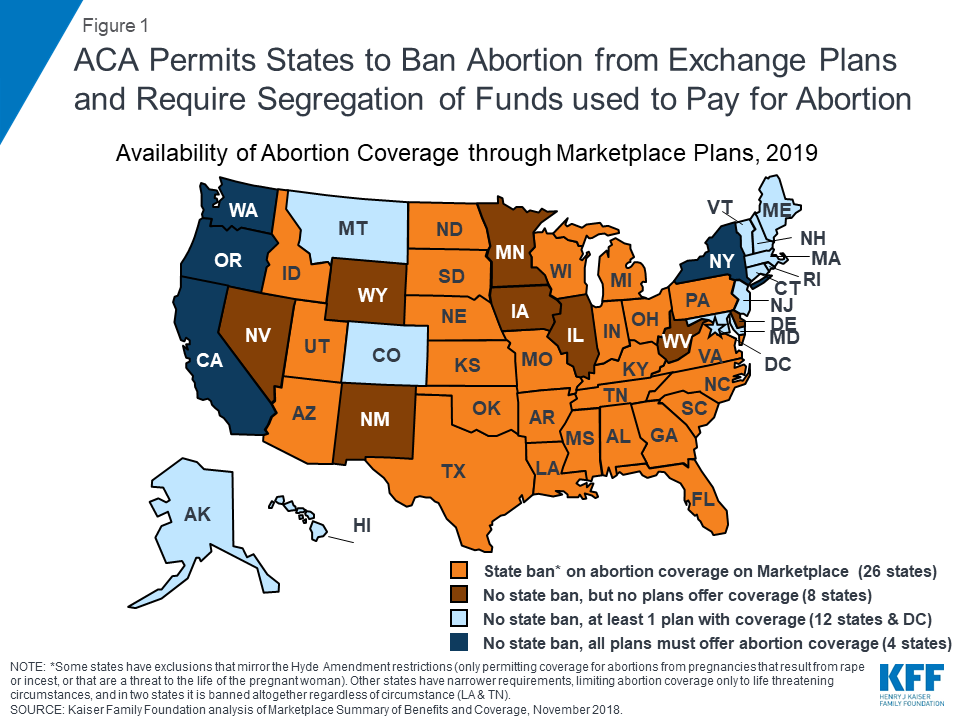
The ACA requires all QHPs to provide coverage for 10 Essential Health Benefits (EHB), but prohibits abortion services from being included as an EHB. States may ban plans offered through the ACA Marketplace from covering any abortions–even if the pregnancy is a result of rape or incest or a threat to the woman’s life as permitted under the Hyde Amendment. Since the ACA was implemented, 26 states have banned abortion coverage on their ACA Marketplace (Figure 1).
Figure 1: ACA Permits States to Ban Abortion from Exchange Plans and Require Segregation of Funds used to Pay for Abortion
The ACA and the relevant regulatory section requires plans that offer coverage for abortion beyond Hyde limitations to segregate the federal funds used to subsidize premium costs for the EHBs from the premiums costs that pay for that coverage. Plans must collect a separate payment for abortion coverage and notify consumers regarding the inclusion or exclusion of abortion in the Summary of Benefits and Coverage at enrollment. Any plan that includes coverage of abortions beyond Hyde limitations must estimate the actuarial value of such coverage by taking into account the cost of the abortion benefit, but it must be valued at least $1 per enrollee per month. This estimate cannot take into account any savings that might be achieved as a result of the abortions (such as the savings of not paying claims for prenatal care, delivery or postnatal care).
In 2015, the Obama Administration provided guidance on how this statute should be implemented, allowing options that simplified the billing and payment process for plans that include abortion coverage yet kept funds segregated. They allowed insurers to send “the enrollee a single monthly invoice or bill that separately itemizes the premium amount for non-excepted abortion service” or “sending the enrollee a notice at or soon after the time of enrollment that the monthly invoice or bill will include a separate charge for such services and specify the charge.”
In October 2017, the Trump Administration issued a bulletin reinforcing the 2015 notice. They also indicated that CMS would fully enforce the requirements related to abortion coverage in the Federally Facilitated Exchange (FFE) and, if states failed to require compliance in plans offered by the State-Based Exchanges (SBE), CMS would step in. In August 2018, 101 members of Congress signed a letter to Secretary Alex Azar stating their dissatisfaction with the Obama Administration policy, and urging the Trump Administration to issue new regulations that they believe were needed to reflect the intent of the law.
What do the new regulations propose?
On November 7, 2018, the Trump Administration issued a proposed regulation addressing exchange program integrity and proposed significant changes to how issuers must bill and consumers should pay for non-Hyde abortion coverage in Marketplace plans that include abortion coverage. HHS takes the position that the current regulations do “not adequately reflect…Congressional intent that the QHP issuer bill separately for two distinct (that is “separate”) payments as required by Section 1303 of the PPACA.”
Under the proposed rule:
Issuers would need to send two separate monthly bills either by mail or electronically to each policyholder: one bill would be for the non-Hyde abortion coverage (at least $1 per member per month) and one bill would be the premium for everything else excluding the non-Hyde abortion coverage
Consumers would be instructed by the issuer to pay in two separate transactions. If the consumer is paying by mail, the consumer must be told to send two checks in separate envelopes or make two electronic payments in the cases where the policyholder pays through electronic funds transfer.
How could the new proposed regulations affect enrollees and insurers?
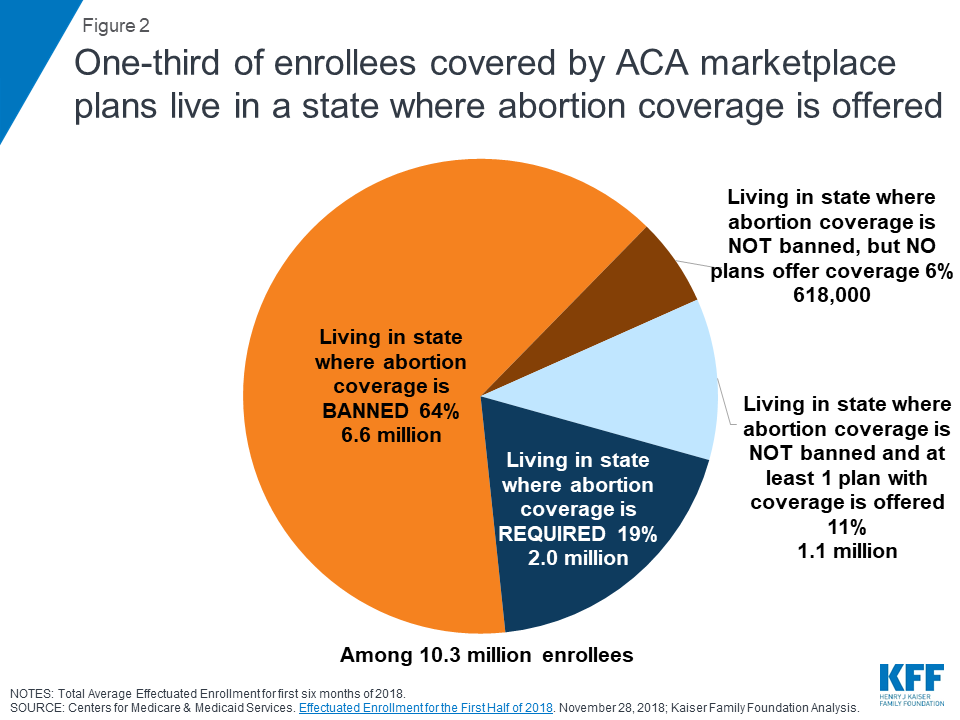
Consumers enrolled in 24 States and DC will potentially be affected, but the impact would be greatest for the enrollees who live in the four states that mandate abortion coverage and in the additional 12 states that offer plans with coverage. HHS estimates that 1.3 million enrollees to Marketplace plans will be impacted by the regulation. There are, however, 3.1 million enrolled who will be potentially impacted (Table 1), 2.0 million enrollees alone in states (CA, NY, OR, WA) which require all plans to cover abortion services (Figure 2). There are an additional 1.1 million enrollees in 12 other states and DC that include abortion coverage in their Marketplace plans. HHS estimates that consumer costs will total $30.8 million, but do no factor in the costs to consumers of a separate mailing nor potential loss of coverage.
Table 1: State Abortion Coverage Policies and Enrollment
State Abortion Coverage Rules for QHPs
Number of States
Number of Enrollees
Mandatory in all plans
4
2.0 million
No ban, at least one plan offers abortion coverage
12 and DC
1.1 million
No ban. no plans offer abortion coverage
8
618,000
Abortion coverage is banned
26
6.8 million
For details by state, see Appendix.
Figure 2: One-third of enrollees covered by ACA marketplace plans live in a state where abortion coverage is offered
Some consumers will likely be confused by the requirement to receive two invoices for the same insurance policy every month, and to pay two separate payments each month. The proposed regulation acknowledges that sending policyholders two separate bills would cause confusion because they might not understand why they are getting two different bills and why they need to make these payments separately. However, HHS has said that asking consumers to send separate payments will “help reduce consumer confusion about receiving two separate bills in a single envelope.”
Men and women who are beyond their reproductive years are most likely to be confused about the separate bill for abortion coverage, a health service they do not need. They may think the abortion coverage is a rider and not part of their plan, and decide not to pay the $1 without recognizing that they are making incomplete payments on their full insurance. Abortion coverage is not a rider. In fact, the CMS prohibits plans from selling any coverage riders on the Marketplace and a recent review of insurance plans finds there are no abortion riders available to individuals outside the Marketplace.
Some consumers may fail to pay their premium in full and have their coverage terminated for delinquent payment. The proposed rule states that if a subscriber fails to pay in separate envelopes or as separate transactions but pays the total amount in one payment, then the issuer is not permitted to cancel the coverage. It does not speak, however, to what issuers should do if the payment is not made in full—that is, if the policyholder pays for the EHB share of the premium but does not make the abortion payment.
What happens when individuals fail to pay some or all of their premiums?
Consumers receiving a federal Alternative Premium Tax Credit (APTC) are eligible for a three months grace period before their coverage is terminated for non-payment or incomplete payment of premiums. For others, it is state law that determines the length of the grace period.
For individuals receiving APTC, the issuer is required to pay for all claims for covered services provided to the policyholder in the first month of the grace period. Issuers may suspend payments for claims for services rendered during the second and third months of the grace period for consumers receiving APTC.
Issuers may terminate coverage if a consumer either fails to pay the outstanding premium or an amount that satisfies any applicable premium threshold, before the end of the grace period. The issuer will deny any claims that were suspended during the second and third months of the three-month grace period and the consumer is responsible for covering those costs.
When an issuer may begin the termination process for delinquent payments varies. Insurers could terminate coverage if QHP premium payments are not made in full following a grace period. Some insurers may have opted to set a premium threshold, which is a dollar amount or a percentage of the premium that the policyholder may owe before the process to terminate the policy for nonpayment is initiated. The amount the policyholder owes for non-payment is cumulative and over time, even a premium threshold will not be protective for policyholders who may be confused about or unaware they have not paid their premiums in full.
Some issuers might eliminate abortion coverage from their plans altogether because of the additional cost and administrative requirements. As a result, women enrollees will bear the cost of abortion services, even in states that permit Marketplace plans to offer abortion coverage. To implement this process, issuers will need to establish a protocol for sending two separate bills (including printing the letter and an additional envelope) and will also need to pay for postage for an extra monthly mailing (bulk mail is $0.383/mailing). HHS has calculated that this would affect 1,111 plans in 17 states and estimated costs per issuer ($63,120) totaling an estimated $807,385.92 for all plans. These estimates do not include the cost of printing and mailing the extra bills as well as additional staffing that will be needed to answer enrollee questions and address delinquent payments. Insurers could experience declining enrollment when enrollees default on coverage payments, even when they have the resources to cover the costs.
As a result of state decisions to ban abortion coverage and issuers’ choices to exclude abortion coverage where there is no state ban, only one-third of enrollees live in a state where abortion coverage is offered in the ACA Marketplace (Figure 2). At the time of the ACA debate about abortion coverage, some experts predicted that imposing these kinds of requirements on plans that cover abortion services would have a chilling effect on abortion coverage. This prediction has been borne out. Eight states have no legal ban, yet no plans are available that have abortion coverage. The exact reasons why the plans do not offer abortion coverage is not clear. It is likely that the proposed payment process will make additional insurers consider dropping abortion coverage to simplify their billing practices and avoid the need for additional paperwork, staffing, reporting, and oversight. Abortion coverage is particularly at risk in the 12 states currently offering plans that cover abortion, but that do not have a mandate.
Looking Forward
This rule is consistent with the Trump Administration’s stated priority to limit abortion access and other regulatory actions that could lead to the erosion of ACA related improvements for women’s health services. The proposed regulations for abortion coverage would likely cause consumer confusion, lead to coverage terminations, and prompt more insurers to eliminate abortion coverage. If finalized, these regulations could further erode the availability of coverage for a health service that many women may need and use.
Appendix
Appendix: State Policy on Abortion Coverage in Marketplace Plans
State QHP Abortion Coverage Policy
Availability of Abortion Coverage on Marketplace
Effectuated Enrollment in Marketplace
United States
4 states required;20 states & DC Not Banned;26 Banned
The Affordable Care Act’s changes to the nation’s health care system are so widespread that nearly all Americans would be affected in some way if a federal judge’s decision ruling the entire law unconstitutional is upheld, according to a new analysis from KFF (the Kaiser Family Foundation).
While the changes to the individual insurance market – including protections for people with pre-existing conditions, creation of insurance marketplaces, and premium subsidies for low and modest income people – have been the focus of political and policy debate and media coverage, the impact of the eight-year-old law reaches far beyond that relatively small slice of the health care system. The law also expanded Medicaid eligibility, imposed new requirements for employer-provided benefits, expanded preventive services, gradually closes the “doughnut hole” gap in Medicare drug coverage, reduced Medicare payments to health providers and insurers, introduced new national initiatives to promote public health and raise quality of care, and imposed a variety of tax increases to fund expanded health coverage. The number of non-elderly Americans who are uninsured decreased by 19.1 million people from 2010 to 2017 as the ACA went into effect.
All of the changes could be overturned if the courts uphold the ruling by U.S. District Judge Reed O’Connor this month that the ACA is unconstitutional. The analysis looks at key provisions of the law and how many people are affected by them, as well as relevant KFF public opinion polling. Many people would lose benefits if the law were overturned, but others would gain financially. Among the highlights:
Nearly 13 million Medicaid enrollees in 32 states and D.C. became newly eligible for the program through Medicaid expansion. Three-fourths (77%) of the public have a favorable view of the provision giving states the option to expand Medicaid.
Adult children are able to remain on their parents’ insurance plans up to age 26. About 2.3 million young adults gained coverage due to this provision. Eight in ten (82%) Americans view this provision favorably.
New health insurance marketplaces make available to individuals and families insurance plans with a defined set of minimum benefits (e.g. hospitalization, maternity care, mental health, prescription drugs), as well as federal subsidies and cost-sharing reductions based on income. As of June 2018, 10.3 million individuals had coverage through the marketplaces, including 8.9 million who received premium tax credits and 5.4 million who got cost-sharing reductions. Most of the public has a favorable opinion of the law’s creation of health insurance exchanges (82%), and of providing financial help to low- and moderate-income Americans who buy their own insurance (81%).
Insurers can no longer deny coverage for pre-existing conditions, charge higher premiums based on health status or gender, revoke coverage when someone gets sick or impose annual or lifetime limits. More than 52 million people have a pre-existing condition that could have kept them from getting coverage in the pre-ACA individual market. The ACA also capped out-of-pocket spending (at $7,900 for an individual and $15,800 for family coverage in 2019). Most Americans say it is “very important” to them that these ACA provisions remain law and seven in ten say they would want their states to establish protections for people with pre-existing conditions if the ACA’s protections are ruled unconstitutional.
Insurers must cover certain preventive services at no out-of-pocket costs to consumers. Eight in 10 (79%) favor eliminating out-of-pocket costs for many preventive services.
The law phases out the Medicare “doughnut hole” by gradually reducing the share of total drug costs paid by Part D enrollees in the coverage gap. Forty-three million people were enrolled in Medicare Part D in 2018. In 2016, more than 5 million Part D enrollees without low-income subsidies reached the coverage gap. Most Americans (81%) have a favorable view of this provision.Potential Impact of Texas v. U.S. Decision on Key Provisions of the Affordable Care Act, and other data and analyses about the ACA, are available at kff.org.
Arkansas is one of five states for which CMS has approved a Section 1115 waiver to condition Medicaid eligibility on meeting work and reporting requirements and the first state to implement this type of waiver. Unless exempt, enrollees must engage in 80 hours of work or other qualifying activities each month and must report their work or exemption status using an online portal by the fifth of the following month. The new requirements were phased in from June through September, 2018 for Arkansas Works enrollees ages 30 to 49, and will apply to those ages 19 to 29 beginning in 2019. Enrollees subject to the new requirements have annual incomes up to $16,753 (138% of the federal poverty level for an individual in 2018). As of December 2018, nearly 17,000 people have been disenrolled due to the new requirements.
Arkansas now requires some of its Medicaid enrollees to report monthly on their work activities to maintain their coverage. This @KaiserFamFound report looks at their experiences based on focus-group discussions in urban and rural areas
This brief builds on our prior analysis of state data and a case study published in October 2018, to include perspectives of enrollees and providers about the new “Arkansas Works” waiver requirements. The findings are primarily based on four focus groups with a total of 31 Arkansas Works enrollees conducted during November 2018, in Little Rock and Monticello, Arkansas to capture both more urban and rural experiences. Focus group participants included those currently subject to the new requirements and some who have lost coverage as a result of the new requirements as well as those who will become newly subject to them in 2019. They may not be representative of all Arkansas Works enrollees as they were successfully contacted via phone and email and had transportation to the group location. To account for these differences and provide a fuller picture of how enrollees are experiencing the new requirements, we also conducted interviews with four safety net health care and food assistance providers in November, 2018. Focus group and interview findings provide new insights into key questions about the early implementation of the new requirements and their impact on enrollees, including:
Are enrollees aware of the new requirements and if so, what is their experience setting up online accounts?
Enrollees were unaware or confused by new requirements. Notices and informational letters were not fully read or understood, and enrollees were unaware of key details including the penalty of coverage loss for the remainder of the calendar year for failure to meet the requirements for three months. Only a few enrollees recalled getting phone calls about the changes to AR Works. While many in the groups had social media accounts, virtually no one got information about AR Works through Facebook or other social media. The younger enrollees who will be phased in to the new requirements beginning in January had started to hear about the program changes, but few had complete information or fully understood what was required to comply.
Many enrollees found it difficult to navigate the process to set up an online account. The majority of those who were aware of the requirement to set up an online account reported problems doing so and had difficulty getting assistance. Many do not have computers or reliable cell phone or internet access, especially those in rural areas, and others are not comfortable using computers. However, the younger group of enrollees who will be phased in to coverage starting in January 2019 were not as concerned about setting up an account and on-going reporting.
“I went online and tried to set up an account. That was unsuccessful. So they listed this 866 number on the paper, so I tried to call and speak to somebody while I was in front of the computer, so they can walk me through it and help me set it up. And that was awful because you never could speak to nobody. And then I got through it give you all these prompts… it said you had to enter in your reference number that come on the paper and it kept saying my reference number was not my number….” Little Rock AR Works enrollee
What effects are the new requirements having on enrollees’ participation in work or other activities?
The new requirements do not appear to provide an additional incentive to work beyond economic pressures, but are adding anxiety and stress to enrollees’ lives. Many enrollees are already working, but may face unstable or unpredictable work hours. Volunteering was not an option for people who needed to pay the bills. More rural areas have few job opportunities. No enrollees had contacted the Department of Workforce Services (DWS) for assistance.
Health insurance through Medicaid supported the ability to work for some enrollees who were able to control chronic physical and mental health conditions, while other enrollees have physical and mental health conditions that make working difficult. Focus group participants reported a range of serious physical and mental health conditions that could interfere with work, but none had been identified as medically frail and therefore exempt from the new requirements. Enrollees’ lives are complicated with a multitude of factors that could affect their ability to work such being homeless or lack of transportation.
“The month that I didn’t take it [medication for narcolepsy], I was knocked out every day. Like while we’re talking, I’d probably be sleep right now…I couldn’t work.” Little Rock AR Works enrollee
What effect is the monthly reporting requirement having on enrollees?
Monthly reporting of work or exemption status is confusing and a challenge for most enrollees. Complicated circumstances, lack of computer literacy and limited access to computers or internet are factors that make monthly reporting difficult. In addition, some enrollees who reported successfully had too much income and lost coverage; however, the monthly reporting may not accurately account for fluctuations in income, which can lead to increased churn in and out of Medicaid and disruptions in continuity of care. It was difficult for enrollees to understand the exemption rules and process.
What effect are the new requirements having on individuals with more complex needs?
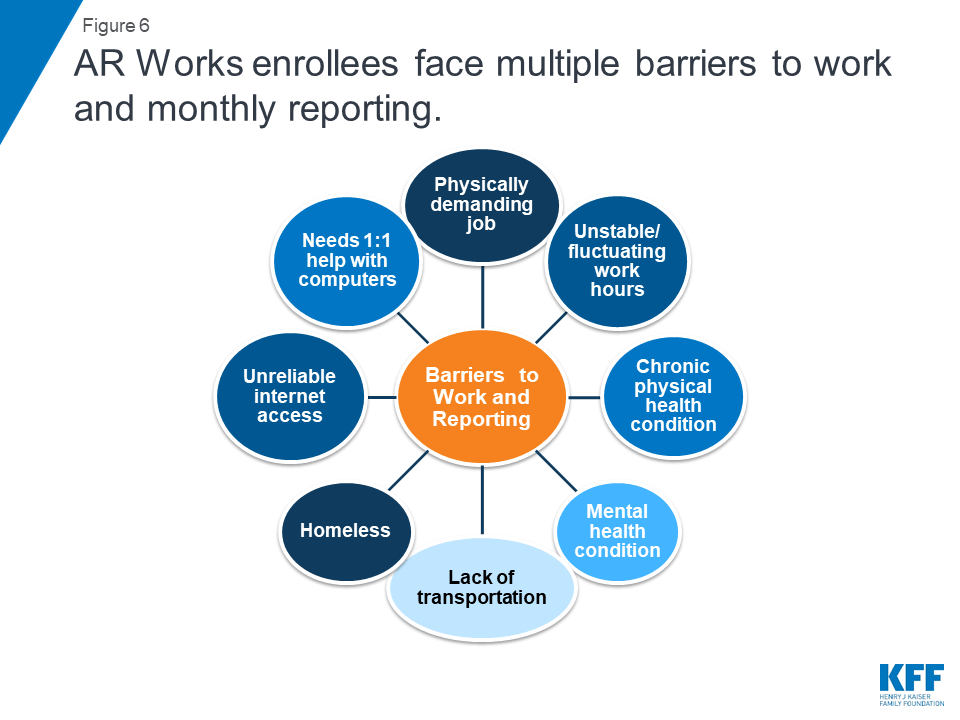
Providers report that the most vulnerable enrollees (those who are homeless or those with more severe physical and mental health disabilities) are most likely to face barriers complying with the new requirements. These individuals are less likely to participate in the focus groups and are more likely to be unaware of changes in program rules and to face challenges setting up online accounts, obtaining or maintain employment and complying with a monthly reporting requirement. Other more immediate needs like shelter, food or dealing with an acute physical or mental health care need will come before filling out online forms. In addition, some providers felt like they were excluded from implementation plans about the new requirements and were therefore not able to best support enrollees. Enrollees face an array of barriers to work and monthly reporting, with most experiencing multiple barriers.
What are the effects of coverage losses due to failure to satisfy the new requirements?
Loss of coverage can negatively affect enrollees’ health and can impede individuals’ ability to work. Enrollees value coverage and loss of coverage would negatively affect their ability to work, especially for those who rely on regular prescriptions to manage chronic physical and mental health conditions. Employer-sponsored coverage is not available or affordable to working enrollees. Medical debt is a concern, especially if individuals had to resort to using the emergency room to access needed care. Loss of Arkansas Works with a coverage lock-out could negatively affect health status, make it more difficult to obtain and maintain work, would increase stress and anxiety, and lead to gaps in care and greater emergency room usage.
“I’m in a halfway house. And the thing is I pay $145 dollars a week rent. It’s like I’m stuck in a rut because I’m in a dead-end job. I don’t make no more than maybe $200 a week. Okay, a $140 of that has gotta go to rent….that’s not counting my gas costs going back and forth to work. That’s not talking about my food…I’m having to come out of pocket because now [after losing coverage for failure to successfully report hours online] I don’t have any health insurance to cover $600 worth of medicine. My inhalers are 400 to $500.” Little Rock AR Works enrollee
“I have a mental illness, I’m bipolar…they can’t get my medicine right, little more manic, little excited…I try to think I’m okay without it and then just, you know…without this insurance I would be in a lot of trouble. I think there was one time, it would have been like $400 a month if I didn’t have insurance. And there’s no way possible.” Monticello AR Works enrollee
Providers interviewed for the report noted that they could face increases in uncompensated care if patients lost Arkansas Works coverage and became uninsured. Providers were also concerned that they would need to hire new staff and redirect resources to helping patients navigate the complexity of the new requirements which would mean cutbacks in other areas without any new revenue to support staff.
While these focus groups provide an initial look at enrollee experience with the new requirements, it will be important to understand more about those who lost coverage as the waiver continues. The state recently issued a press release indicating that, beginning on December 19, enrollees can report work activity by phone. While new reporting options may assist some enrollees, research shows that any additional reporting or administrative burdens create barriers to eligible people retaining coverage. Looking forward, it will be important to understand the implications of coverage loss for enrollees, including their ability to work, as well as providers.
Issue Brief
Introduction
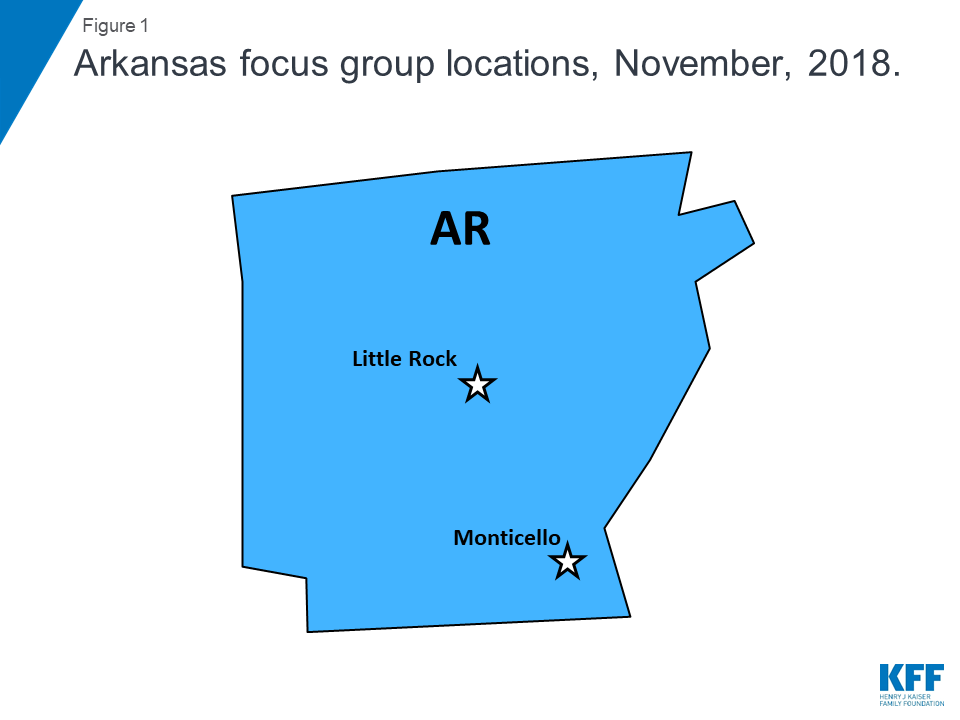
Arkansas is one of five states for which CMS has approved a Section 1115 waiver to condition Medicaid eligibility on meeting work and reporting requirements and the first state to implement this type of waiver.1 This brief builds on our prior analysis of state data and a case study published in October 2018, to include perspectives of enrollees and providers about the new “Arkansas Works” waiver requirements. The findings are primarily based on four focus groups with a total of 31 Arkansas Works enrollees conducted by the Kaiser Family Foundation, working with PerryUndem Research/Communication, during November 2018. Focus groups were held in Little Rock and Monticello, Arkansas to capture both more urban and rural experiences with the new requirements. Little Rock is the state capital and the most populous city in the state. Monticello is the county seat of Drew County, located in the rural lower Delta region in the southeastern corner of the state (Figure 1).
Figure 1: Arkansas focus group locations, November, 2018.
In each location, one group consisted of enrollees ages 30 to 49 who were currently subject to the new requirements and were not identified by the state through data matching as exempt from work or reporting requirements.2 Focus group participants also were not receiving SNAP benefits (so they were not automatically exempt from the Medicaid reporting requirements). A few in the older age group had lost coverage due to failure to meet the reporting requirement, and others knew someone who had lost coverage. Most were working, although several had changed jobs or cycled in and out of work in the past year. Others were unable to work due to caring for elderly parents or physical or mental health conditions that prevented work. A couple were in substance use recovery. Some participants did not have children, while others were parents of young adult children (ranging in age from late teens to 20’s and 30’s) or the parents of minor children for whom they did not have custody. Enrollees subject to the new requirements have annual incomes up to $16,753 (138% of the federal poverty level for an individual in 2018).
The other group in each location included enrollees ages 19 to 29 who will be subject to the new requirements beginning in 2019. Many participants in the younger age group were students, and most also were working. Most were relatively healthy, although a few had chronic physical or mental health conditions. All focus group participants were contacted via phone and email, so they may be unlike many other Arkansas Works enrollees who do not have regular access to a phone and/or email. Most had had stable addresses and phone numbers for some time, although one was homeless, living out of a car, and another lived in a halfway house. Participants also had reliable transportation to get to the focus groups, which is not common among all Arkansas Works enrollees.3
To account for these differences among enrollees and provide a fuller picture of how enrollees are experiencing the new requirements, we also conducted interviews with four safety net health care and food assistance providers and a case worker in the Department of Workforce Services in November, 2018, and reviewed publicly available reports and data. Key findings center on enrollees’ awareness of the new requirements and ability to set up online accounts for monthly reporting; the effect of the new requirements on enrollees’ work and common barriers to work; enrollees’ experience with monthly reporting; impacts on particular populations, such as those with disabilities or who are homeless; and the anticipated effects of coverage losses resulting from the new requirements.
Background
CMS approved Arkansas’ waiver amendment on March 5, 2018, and the new work and reporting requirements took effect for the initial group of beneficiaries on June 1, 2018. The requirements were phased in for enrollees ages 30 to 49 from June through September, 2018, and will apply to those ages 19 to 29 beginning in January, 2019. Unless exempt, enrollees must engage in 80 hours of work or other qualifying activities each month and must report their work or exemption status using an online portal. Individuals need to report work activities or exemptions by the 5th of the following month. The Arkansas Department of Human Services (DHS) has released monthly data related to the new requirements since June, 2018. September, 2018 was the first month that enrollees could lose coverage for failure to meet the new requirements for three months. As of December 7, 2018, the state reported that nearly 17,000 people have lost Medicaid coverage as a result of the new work and reporting requirements.
Key findings from our October, 2018 case study report show that despite a robust outreach campaign conducted by the state, health plans, providers, and beneficiary advocates, many enrollees have not been successfully contacted about the new requirements. In addition, the process to set up an online account is complicated. The state is using data matching to exempt about two-thirds of enrollees from the reporting requirements. For non-exempt enrollees, reporting of exemptions or work activities requires multiple steps. Some enrollees who may qualify for an exemption but are not identified by the state data matching may fall through the cracks, and others may face barriers to work. Coverage losses could result in gaps in care as well as increases in the uninsured rate and uncompensated care costs for providers.
Key Findings
Are enrollees aware of the new requirements and if so, what is their experiencing setting up online accounts?
Informational letters and notices about the new requirements were not fully read or understood by enrollees. The state has sent multiple mailings about the new requirements; links to samples are contained in the Appendix to this report. Enrollees in the November, 2018 focus groups confirm earlier findings that despite robust outreach efforts, many were not fully aware of the specifics of the new requirements. Most enrollees did get a letter, but the large majority did not fully read the letter and/or understand the new work or reporting requirements or the consequences of failure to comply, including coverage loss for the remainder of the calendar year. Enrollees described the letters as confusing and long, and many enrollees did not get to the second page. Many said their lives are busy and complicated, and they put the letters aside without fully comprehending the information because they had to focus on more immediate and pressing needs. For example, one enrollee said that she was focused on her alcoholism recovery and getting back on her feet so the notices went unread. Others were focused on meeting basic needs like affording food and utility bills. Safety net providers observed that those with low literacy levels or limited English proficiency would have greater difficulty understanding the information, given the complicated rules and reading level required. In a few instances, individuals had moved recently within the state, and despite having reported an address change to DHS, notices and other mail were not getting delivered to the correct address.
“I only skimmed through it and picked up [that] I had to do the 80 hours a month or something and then I set it down…It didn’t say nothing about opening an account.” Little Rock AR Works enrollee
“You get this in the mail, you don’t go to the next page, but my friend told me…you got to read the next page. Because if you don’t go online to do this, you’re going to get cut off…” Monticello AR Works enrollee
Few enrollees recalled getting phone calls about the changes to AR Works. Earlier findings report that phone calls were a focus of state and health plan outreach efforts, although they had limited effectiveness. Most focus group participants did not remember getting calls, but said that if they got a call from an unknown number, they were not likely to pick up. Most enrollees in the focus groups had stable cell phone numbers, but many did not have land line phones. Other enrollees who answered a call did not take additional action; however, one participant did say that repeated phone calls from his insurer motived him to try to set up an online account, although he required help from both the health plan and his wife to do so.
“And then I got a phone call with some lady saying, did you get the letter? You’re gonna have to start logging in or you lose your insurance. And I said what does that have to do with my insurance. Well it’s a new requirement. I just said, okay, thank you, have a good day and then we got off the phone.” Little Rock AR Works enrollee
“She was from Blue Cross/Blue Shield or something…my wife was like, well you need to talk them folks because they about to cut this off… I called the lady and talked to her and she was like, you need to report… you get three strikes and then they’ll cut it off.” Monticello AR Works enrollee
While many in the focus groups had social media accounts, virtually no one got information about AR Works through Facebook or other social media. The state had conducted outreach and education sessions through social media, like Facebook Live and posted YouTube videos online. While most people in the focus groups used social media to be in touch with friends or family, not one person in any of the groups had gotten information about Arkansas Works that way. In addition, enrollees reported having limited cellular data and those in more rural areas have less access to wi-fi or the internet and greater problems with cell phone connectivity, which makes accessing information about AR Works through social media more difficult. A common comment among the Monticello participants was not having any cellular service at home, especially for those living “out in the country,” and having to come “into town” to get a signal. Another Monticello participant who did live “in town” also described sporadic cellular service. Those with wifi described the connectivity as “going in and out.” A provider noted that some of the Delta region had no cellular service, with the only option to access the internet at home being a satellite connection, which was prohibitively expensive for those with low wage jobs.
The younger enrollees who will be phased in to the new requirements beginning in January, 2019 had started to hear about the program changes, but few had complete information or fully understood what was required to comply. Most had received a letter in the mail, although a number did not get the letter because they were college students with new addresses. A few had online accounts already set up for Arkansas Works and got the information through email. In some cases, they had heard about the new requirements from their parents or from the news. However, their understanding was high-level. Similar to the older enrollees, they may have gotten a letter and skimmed the information without fully understanding the key rules necessary to maintain coverage, including the requirement to set up an online account and to report work activities monthly and periodically report and renew exemptions.
The majority of those who were aware of the requirement to set up an online account reported problems doing so and could not get assistance. Some tried to set up an account but did not have the right reference numbers or passwords. Many said that the process was complicated, and it was difficult to get in touch with someone at DHS to get help. Many participants tried to call and were on hold for very long periods of time or transferred to multiple people before getting help. A number of enrollees gave up and were left with negative perceptions about DHS. One participant who was working but disenrolled from coverage was unable to successfully report hours after experiencing multiple problems with the reference number and account passwords. Several enrollees mentioned the fact that the online portal shuts down every evening at 9 pm for maintenance as an additional barrier to reporting because the portal was not open when they were most likely available to use it. A number of people in the focus groups knew about the DHS processing or call center in Pine Bluff. Notably, one enrollee who worked as a software technician had difficulty navigating the online account set-up process and ended up losing coverage for failure to successfully report her work hours. She was unable to set up her account because the portal would not accept the reference number from her notice and unable to reach a live person on the phone for help for some time; she was finally told to fax documents to Pine Bluff, but still was disenrolled and had to navigate an appeal. Many enrollees in the focus groups who tried to complete the online account process were not confident that they set up or reported information correctly. Many recalled receiving individualized help when they first signed up for AR Works coverage because it was difficult to navigate the new online processes and systems. Providers noted that support from enrollment assistors that had existed in 2014 was no longer available but still needed to help enrollees navigate the online account setup and reporting.
“I went online and tried to set up an account. That was unsuccessful. So they listed this 866 number on the paper, so I tried to call and speak to somebody while I was in front of the computer, so they can walk me through it and help me set it up. And that was awful because you never could speak to nobody. And then I got through it give you all these prompts… it said you had to enter in your reference number that come on the paper and it kept saying my reference number was not my number….” Little Rock AR Works enrollee
“Tried creating the account, went through the reference number problem. Finally got a reference number. And then when I went to log back in, they said my password changed. To get your password changed, you gotta call the actual website. Once you get to the actual website, they reset your password, but presumably it’s only good for that one time. So when you try to log back in the next week to do your stuff again, you have another new password change…That’s how the website is.” Little Rock AR Works enrollee
“I got a letter in the mail telling me that I had to do this, this, this and this and this, and I if I didn’t that I would be put on probation. And if I still didn’t complete it, then I would be [dropped]. I tried to those things that they required and I couldn’t. I ran around in a circle.” Little Rock AR Works enrollee
Many do not have computers or reliable internet access, especially those in rural areas, and others are not comfortable using computers. One Monticello participant described repeatedly being unable to get her account page to load on her cell phone when she tried to report her hours; after spending an hour on the phone with DHS, she was unable to get the problem resolved and “gave up.” Many who were not comfortable with computers or with low levels of computer literacy faced more trouble. Some in more rural areas do not have reliable internet or cellular phone service which complicates the process of setting up the online account. Many use phones instead of computers to access the internet, but filling out forms, involving navigating multiple steps and screens, can be difficult on a phone. Many in the focus groups did not own a computer so need to use a computer at the library, although some had access to a work or home computer (with college students most likely to report having a computer). A number of enrollees, particularly in the older group already subject to the work requirements, were not comfortable using computers and preferred one-on-one assistance or paper to filling out forms online.
“It’s so-so, in certain parts of the house I can get good signals and other parts, um-um.” Monticello AR Works enrollee
“I don’t have a good signal so I was up in the window trying to do that on my phone.” Monticello AR Works enrollee
The younger group of enrollees who will be phased in to the new requirements starting in January 2019 were not as concerned about setting up an account and on-going reporting. In contrast to the older enrollees, many said they would feel more comfortable with online reporting and were more cautious about paper reporting. Even when informed about difficulties with account setup and getting help encountered by the 30 to 49 year old group, many in the younger group that had not yet experienced trying to set up an account or report were confident that would be able to navigate the new requirements.
“I’d just go to DHS…They have to help you…and if you walk away that’s on you. Yeah I wouldn’t leave until…You have to get it done…I have this, and you need to do this…” Little Rock AR Works enrollee
“That’s why I do everything online because there’s always a paper trail of what you’ve turned in and what you haven’t. It can’t be lost when you can just click on it.” Little Rock AR Works enrollee
What effects are the new requirements having on enrollees’ participation in work activities?
The new requirements do not appear to provide an additional incentive to work, beyond economic pressures, but are adding anxiety and stress to enrollees’ lives. Many focus group enrollees already were working or looking for work before the new requirements were in effect. No one in the groups had gotten a new job as a result of the new requirements. People are motivated to work to make ends meet. The large majority were dealing with financial pressures and struggling to pay bills such as food and utilities based on earnings from low wage jobs. One single parent of a son away at college worked full-time but regularly did not have enough food and went to a relative’s home to eat. Other participants described carefully monitoring their spending on food, watching for coupons and sales, buying less healthy food because it was more affordable, and only buying what was needed for one meal at a time. Other financial pressures included car repairs and utility shut-offs. Safety net providers described their patient population as “living paycheck to paycheck” and working multiple part-time jobs because they could not get enough hours at one job. The new requirements are not incentivizing new work or other activities in which enrollees were not already engaged, but are layering on one more thing to deal with in enrollees’ already complex lives and causing added stress because no one wants to lose their coverage.
“Let me explain something to you. Some of us are working because we have to work…I have fibromyalgia. I’m a diabetic. I be in all kinds of pain, but I gotta make ends meet to take care of my home.” Little Rock AR Works enrollee
“I try to get as many hours as I can because I got bills to pay.” Little Rock AR Works enrollee
Many enrollees are already working, but may face unstable or unpredictable work hours. Many in the focus groups did not have stable or predictable work hours primarily due to forces outside of their control. One handyman said his work depends on the weather, some enrollees who work in a hair salon noted that people can cancel appointments (although sometimes the holidays brought more work), and some enrollees had jobs where the employer set the schedule (e.g., temporary work, home health care). This lack of control and predictability can result in some months with more than 80 hours of work and some months with less. Several participants had changed jobs or cycled in and out of the workforce in the last year. For example, one individual currently employed as a software technician previously had been laid off from a prior job and out of work for about six months. Another had done food service work back and forth at different restaurants. Volunteering was not an option for people who needed to pay the bills. Some reported getting letters from DWS that they could volunteer at Good Will; however, volunteering and not getting paid was not seen as a viable option.
“Well, being a hairstylist you, you’re not guaranteed a steady paycheck… Right, say that this week Sally doesn’t want her hair done, you know, you may not make it…my husband just recently, three months, four months ago, had passed his real estate and he’s trying to do that so I’m providing for the whole family… So I wouldn’t say that I’m like starving, but there are times, like right now I’m stressed.” Monticello AR Works enrollee
“I mean you could be working, but still not making 80 hours a month.” Little Rock AR Works enrollee
“I can’t afford to volunteer for free. I have to work. I have to have some money coming in” Little Rock AR Works enrollee
More rural areas have few job opportunities. Many in the focus groups in Monticello talked about a lack of job opportunities in rural areas, particularly for low skilled workers. Many said fast food was one of the only options or you needed to know someone, or have connections, to get a good job. There were also some welding or farming jobs, but some of those jobs required some skills or involved physically demanding work that was not suitable for all enrollees. In addition, some reported that some of the farming and welding jobs were becoming more automated, so those opportunities were shrinking. The mills remaining in the area were sometimes hiring but also regularly laying off employees.
“You have fast food here, what else do you have? I mean you have Walmart and then fast food.” Monticello AR Works enrollee
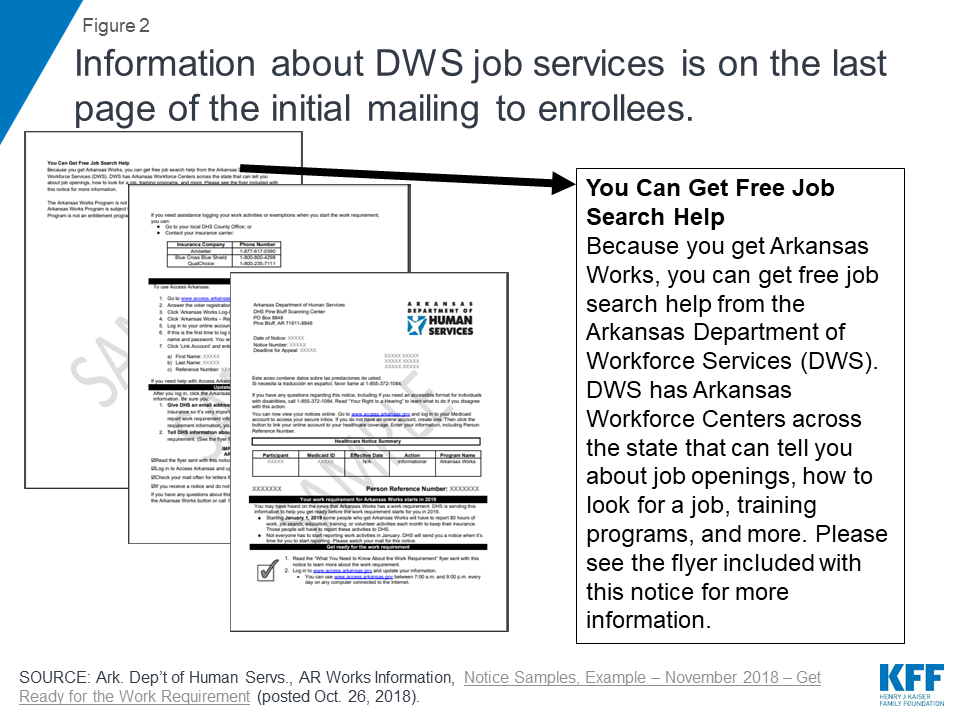
No enrollees had contacted the Department of Workforce Services (DWS) for assistance. They mostly associated DWS with unemployment benefits, although DWS also has resources available for job search and training programs. A case worker in a Little Rock DWS office was eager and willing to help enrollees find employment, and she also was able to assist with setting up online accounts and reporting work activities. Information about DWS job services is on the last page of the initial mailing to Arkansas Works enrollees (Figure 2). Many enrollees in the focus groups already had jobs, but others were not aware of the support from DWS. Still, enrollees in more rural or remote areas may have less access to DWS offices to get help even if there wanted to seek assistance there due to lack of transportation. The closest DWS office for some enrollees in the Delta region was described as a 45 minute to 1.5 hour drive.
Figure 2: Information about DWS job services is on the last page of the initial mailing to enrollees.
Health insurance through Medicaid supports the ability to work for some enrollees who were able to control chronic conditions, while other enrollees have physical and mental health conditions that make working difficult. While many participating in the focus groups were relatively healthy, a number had medical conditions that could interfere with work including mental health issues (anxiety, depression, bi-polar disorder), substance use recovery, asthma, diabetes, recurring migraines, fibromyalgia, chronic pain, arthritis, neuropathy in the feet, narcolepsy, high blood pressure, Crohn’s disease, and ulcers; several also mentioned dental needs. None of these participants had been identified as “medically frail” and therefore exempt from work and reporting. One participant described having to leave a 20-year nursing career and take a job as a cashier due to physical limitations from chronic health conditions. Having health coverage through Arkansas Works allowed many to access critical prescription drugs that helped to control chronic conditions which enabled them to work. However, some of these conditions would make having a job that involved standing for long periods, stress or other physical demands very difficult.
“Last, two weeks ago on a Friday, see I work so hard during the week by Friday, usually I take off because I’ve had enough, you know. And it was about noon and I felt like an elephant on my chest, like a breakdown, like, it’s almost like a complete mental breakdown where I couldn’t get to the house fast enough to get my [medicine]…It [bipolar disorder] interferes with my work sometimes.” Monticello AR Works enrollee
Enrollees’ lives are complicated with a multitude of factors that could affect their ability to work such being homeless or lack of transportation. In addition to unpredictable employment hours and health issues, many enrollees have a number of other complicating life factors, such as unstable housing, transportation problems (car issue or repairs, no regular access to reliable transportation), unexpected expenses, and family caregiving responsibilities for aging parents or grandchildren. These challenges can make it difficult to obtain or maintain a job. For example, one participant caring for her elderly parents wanted to also have paid employment but was limited in the hours that she was available to work outside the home.
“I’m in a halfway house. And the thing is I pay $145 dollars a week rent. It’s like I’m stuck in a rut because I’m in a dead-end job. I don’t make no more than maybe $200 a week. Okay, a $140 of that has gotta go to rent….that’s not counting my gas costs going back and forth to work. That’s not talking about my food…I’m having to come out of pocket because now I don’t have any health insurance to cover $600 worth of medicine. My inhalers are 400 to $500.” Little Rock AR Works enrollee
“I’m limited to the number of hours…I can work. Because I’m a caregiver for my parents…I try to look for assignments after 5, but they’re kind of hard to find.” Little Rock AR Works enrollee
What effect is the monthly reporting requirement having on enrollees?
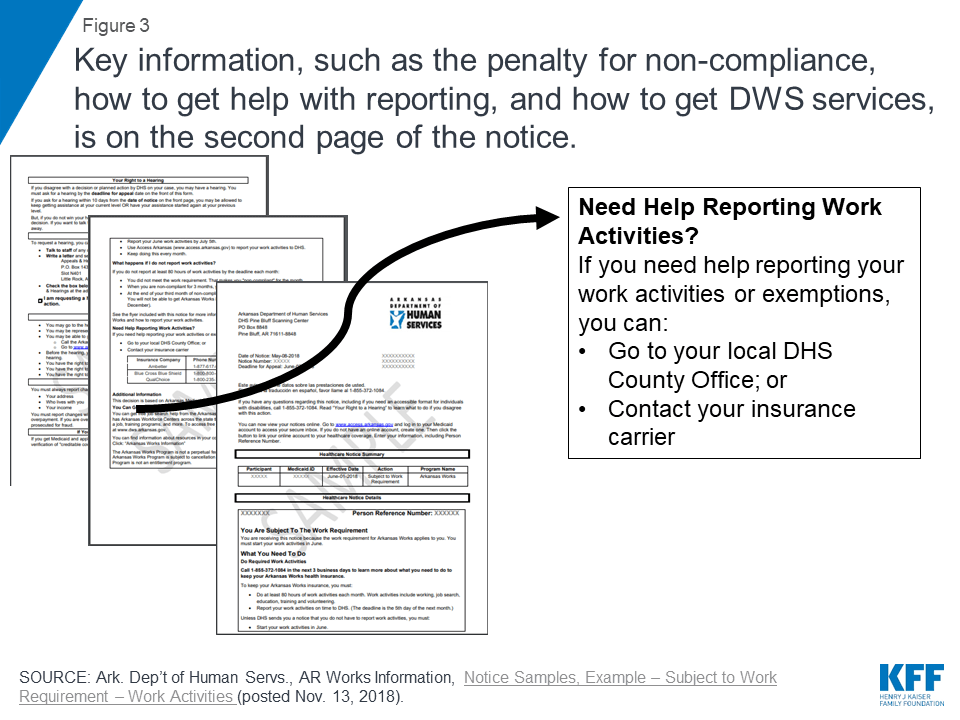
Monthly reporting is confusing and a challenge for most enrollees. Even for those who were working and had set up an account, the monthly reporting requirement seemed confusing, burdensome and hard to manage. Key information, such as the penalty for non-compliance, how to get help with reporting, and how to get DWS services, is on the second page of the notice (Figure 3). Issues mentioned above that create challenges to setting up an online account and to work, such as lack of computer or internet access, complicated and busy lives pressured by making ends meet in low wage jobs, and complex physical and mental health conditions all were factors that also contributed to challenges with satisfying an ongoing reporting requirement. Some who were trying to report encountered problems similar to those encountered during the account set-up process related to missing passwords or problems with the website. A number of enrollees commented that the system did not provide any confirmation that reporting was successful, so individuals were not confident that they reported correctly. Even the enrollees in the younger group about to be phased in to the requirements who were more comfortable using computers found the ongoing monthly reporting overwhelming and worried that it would be hard to keep track of and manage given other demands and pressures in their daily lives.
Figure 3: Key information, such as the penalty for non-compliance, how to get help with reporting, and how to get DWS services, is on the second page of the notice.
“It’s a lot to deal with. Especially on top of your day-to-day stuff. If you got kids, you work, you know. You got a house to maintain and then it’s one more added thing; you got to remember to put this in every month.” Little Rock AR Works enrollee
“If you don’t go into their website once a month and login, and then go to your access, and all that, then you lose your coverage. But the websites so screwed up that you login and then you navigate to the next page and it logs you out.. . So I don’t know if I’m doing enough to keep my coverage.” Little Rock AR Works enrollee
“I’m not computer smart; I’m worried about it. Insurance is important but hard to keep dealing with this.” Monticello AR Works enrollee
“it’s hard. I mean I’m not getting the whole thing of why we have to do, I mean, even put in your hours. I mean it’s not something that simple I wouldn’t think, you know, if you have to do it every month.” Monticello AR Works enrollee
“Something about checking your inbox on there that I would go there and it wouldn’t load all the way. So in the, next time I went to log on, my mom was like you need to, you know, put your hours in, this is the last day. So I called trying to log back in because it wouldn’t let me even though I had stuff written down with my password. I guess she said that it was such a busy time because that was the shut off date. And it was, I was going from one person to another, call this number, call that number, but I really talked to like three different people that same day and never got anything done. So I gave up.” Monticello AR Works enrollee
Monthly reporting may not accurately capture fluctuations in income and could result in additional program churn and coverage lock-outs. Some enrollees who reported successfully had too much income that month and lost coverage. Under the Affordable Care Act (ACA), eligibility renewals for Medicaid are to occur annually, so monthly fluctuations in income do not result in enrollees churning on and off of coverage. More frequent reporting may be capturing these fluctuations and resulting in more churn on and off of coverage. Some of these issues could be exacerbated with an increase in the minimum wage in Arkansas from $8.50 to $9.25 per hour in January 2019. While increased wages are positive for low-income workers, with unpredictable hours the increase could result in uneven wages over the course of the year making them ineligible some months and eligible other months based on income. These changes and reporting could increase churn and periods of being uninsured if enrollees are subject to a coverage lock-out. In addition, some enrollees were confused because the monthly reporting could coincide with their annual eligibility renewals. Enrollees who had just submitted documentation for their renewal were confused about why they also needed to separately report to satisfy the work requirement in the same month. Additionally, documents required to renew eligibility can be submitted in person, by fax, or by mail, while work requirement reporting must be done online.
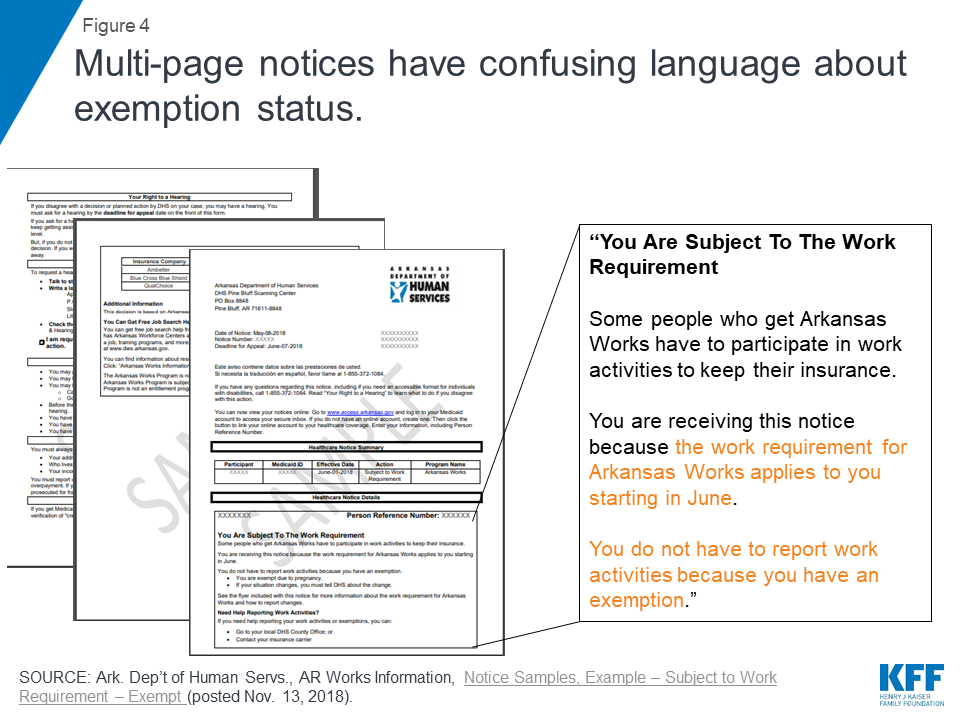
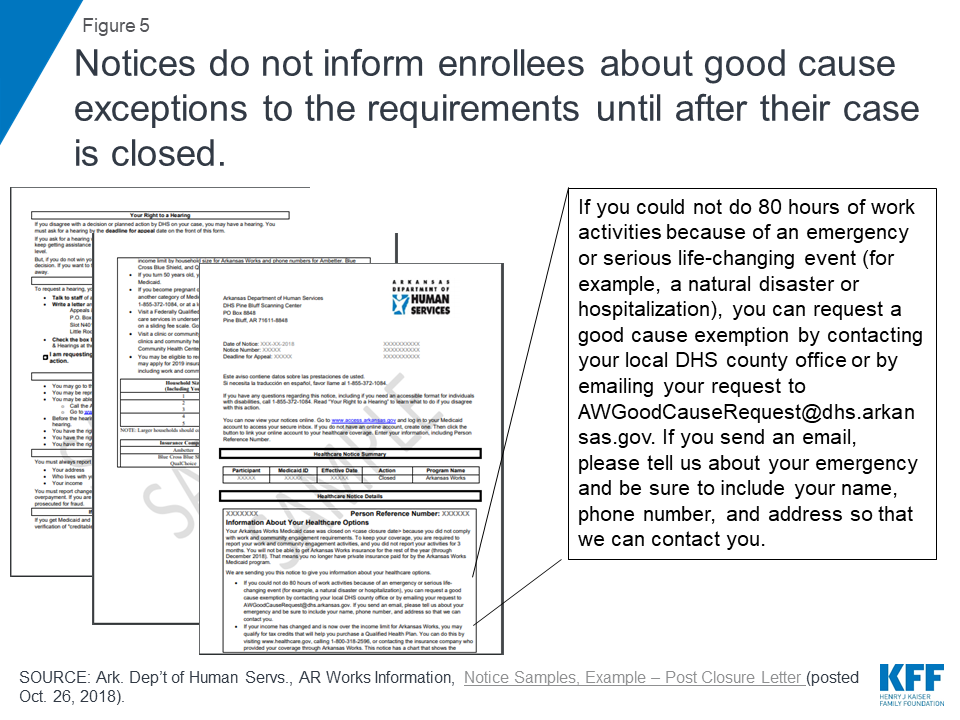
It was difficult for enrollees to understand the exemption rules and process. There was a lot of confusion about exemptions from the work and reporting rules (Figure 4). Some individuals thought their letter said they were exempt, but often the reason or the timeframe for the exemption was not stated or not clear. There was also confusion about whether an enrollee was exempt from the work requirement, or separately, from the reporting requirement. One noted that her letter said she had to work but on the same page then said she was exempt (Figure 4). Despite general confusion, one participant had obtained a family caregiving exemption and another had a short-term incapacity exemption due to a work injury. Navigating the exemption process was time-consuming and stressful for enrollees who already were experiencing stress from their family and health circumstances leading to the need for an exemption. Additionally, the notices do not tell enrollees about the good cause exception process (which is available for extenuating circumstances that interfere with an enrollee’s ability to work or report in a month) until after their case is closed for failure to comply with the requirements (Figure 5).
Figure 4: Multi-page notices have confusing language about exemption status.Figure 5: Notices do not inform enrollees about good cause exceptions to the requirements until after their case is closed.
For example, some knew about the exemptions for caregivers but were unclear if they still needed to report their work or exemption status. Many in the group of enrollees that will be phased in to the requirements in 2109 were in college, and there was a lot of confusion about if and how much time in school could qualify as an exemption and if individuals still had to report work hours as well (many students in the focus groups also were working part-time jobs). Some students did not understand that school was a qualifying activity. Others worried about their ability to keep their coverage over winter and summer breaks when they would return home and not have access to the job they worked during the semester or a comparable job (those who were in school elsewhere in the state but returned to rural areas to be with their families during break commented on the different job opportunities available to them in the two places). One enrollee with significant mental health issues in intensive outpatient treatment after a suicide attempt thought that her provider had sent a letter requesting an exemption as she is not able to work but was unsure if the state was recognizing her as exempt, based on the letter she received about the new requirements, which was causing additional stress. Some enrollees were confused about the appeals process. One enrollee had sent a letter to Pine Bluff but was unsure if the appeal was received or under consideration.
“My mom said I need to go online and do this and do that… I was on the phone with a lady trying to, she said I needed to do something with my hours….Well I was on the phone with the lady for like an hour, then she sent me to someone else, then she sent me to someone else. So it just…I just gave up from trying to report my hours worked.” Monticello AR Works enrollee
“My therapist had sent in a letter to Arkansas saying that I could not work for the next year… at the end of last year I tried to commit suicide and because I was misdiagnosed and I was on the wrong medicines. And at the beginning of the year I was diagnosed with bi-polar one that was uncontrolled and PTSD that was uncontrolled.” Monticello AR Works enrollee
What effect are the new requirements having on individuals with more complex needs?
Providers reported that patients who are homeless and those who have more serious physical or mental health disabilities may be more likely to be unaware of program changes and are more likely to have problems setting up an online account, working or complying with monthly reporting. The individuals who were able to participate in the focus groups do not accurately represent all AR Works enrollees because they were more likely to have phones or email to be contacted and more likely to have access to reliable transportation to participate in the groups. Providers also see a different set of enrollees who may have less stable addresses and phone numbers, have more complicated life circumstances exacerbated by homelessness and extreme poverty, and have more complex physical and mental health needs who would be harder to reach through mail, phone or social media about changes to the program.
An interview with the director of a food assistance program noted that communicating program changes through social media was “totally disconnected” from how the Arkansas Works enrollees she encounters would ever get information. If aware of the new requirements, these same enrollees are likely to face barriers in setting up an account, obtaining employment or complying with monthly reporting. The food assistance program director noted that many enrollees who are homeless are “in survival mode” just trying to navigate satisfying their basic needs for each day. They are focused on getting food and finding a place to sleep, and setting up an online account (and maintaining monthly reporting) are not really possible given other more basic and immediate needs. Figure 6 illustrates the array of barriers to work and monthly reporting requirements experienced by enrollees both in the focus groups and those whose experiences were relayed by safety net providers, with most enrollees experiencing multiple barriers.
Figure 6: AR Works enrollees face multiple barriers to work and monthly reporting.
Plaintiffs in the lawsuit challenging Arkansas’ waiver report challenges similar to the focus group participants and may also represent enrollees with more challenging circumstances compared to focus group participants. Nine individual Medicaid enrollees have filed a federal lawsuit, Gresham v. Azar, challenging HHS’s approval of the work and reporting requirements in Arkansas’ Section 1115 Medicaid waiver.4 The lawsuit is in the same court, before the same judge, as Stewart v. Azar, the case that set aside HHS’s original approval of Kentucky’s Medicaid waiver, including a work requirement and other provisions restricting eligibility and benefits.5 The Arkansas case should be ready for a hearing or a decision by the judge by mid-January, 2019, when the parties’ legal briefs are filed.6 Declarations filed by the Arkansas plaintiffs indicate that they experience multiple barriers to meeting the work and reporting requirements, including chronic physical and mental health conditions, fluctuating work hours, lack of transportation, lack of internet access, unfamiliarity with computers, and homelessness.7
Some providers felt like they were not included in implementation discussions for the new requirements and felt like they were not able to assist patients with navigating the new requirements. Some safety net providers felt like they did not have all of the information that would enable them to help their patients. For example, they were not aware of which of their patients were subject to the reporting requirements and also did not have access to information about which patients had one, two or three strikes for non-compliance. If they had more information, they would be in a better position to do outreach to specific patients at risk of losing coverage and assist with reporting. Providers were eager and willing to help their patients retain coverage if they knew who to target.
What are the effects of coverage losses due to failure to satisfy the new requirements?
Enrollees value having health insurance coverage, and loss of coverage would negatively affect their ability to work. AR Works has enabled enrollees to gain access to needed health care services and medications. No enrollee said that coverage was unimportant nor that they would willingly give up coverage. Most enrollees in the 30 to 49 age group first got insurance when Arkansas implemented Medicaid expansion in 2014, and remembered what it was like to be uninsured. Enrollees described having health insurance as bringing them peace of mind and comfort as well as protecting them from additional financial pressures and making it possible to manage their health. Health coverage has enabled focus group enrollees to work by covering medications needed to manage mental health, asthma, gastrointestinal, and other chronic health conditions. Without medication and regular follow-up care, these conditions could worsen and interfere with enrollees’ ability to work or the ability to look for work and also could result in emergency room visits or hospitalizations.
“The month that I didn’t take it [medication for narcolepsy], I was knocked out every day. Like while we’re talking, I’d probably be sleep right now…I couldn’t work.” Little Rock AR Works enrollee
“I have a mental illness, I’m bipolar…they can’t get my medicine right, little more manic, little excited…I try to think I’m okay without it and then just, you know…without this insurance I would be in a lot of trouble. I think there was one time, it would have been like $400 a month [for prescriptions] if I didn’t have insurance. And there’s no way possible.” Monticello AR Works enrollee
Employer-sponsored health coverage is not available or affordable to working enrollees. While many enrollees were in jobs that did not have benefits such as health coverage, a few enrollees had jobs that offered health coverage but said it was prohibitively expensive and not an option for coverage if an enrollee lost AR Works. Without Arkansas Works, these enrollees would be uninsured despite working. For example, the software technician who lost coverage after encountering problems with the online portal said that the insurance offered by her employer was not affordable.
Without AR Works, many worry about medical debt and would be forced to use the emergency room to access needed care. Some enrollees had been uninsured prior to obtaining AR Works coverage and had accrued medical debt from using the emergency room to access care. While medical debt was a concern, many felt like going to the emergency room would be the only viable option to get needed care without insurance. A number of enrollees said they would go without care or try their best to not get sick if they became uninsured.
“Once you rely on something to be there and it’s not then, it is a life changing situation. So you be trying to prevent anything from happening, I keep Germex with me. For real. Disinfectant in my car, Kleenex, don’t sneeze on me, get away from me.” Monticello AR Works enrollee
Loss of AR Works with the up to nine month coverage lock-out for failure to meet the new requirements could negatively affect enrollee health status and increase stress and anxiety. Many in the focus groups were not aware that they could be locked out of coverage for the remainder of the calendar year for failure to meet work or reporting requirements for three months. Many thought that rule would penalize those who get sick or injured and cannot work, just when they need the coverage most. There was concern about unforeseen events happening that could get in the way of work or reporting, leading to coverage loss. Those who had lost coverage also were not aware that they needed to reapply to obtain coverage again in January. People worried about not being able to get needed care because they could not afford it if they were uninsured. One enrollee who was working but had been hospitalized for asthma worried that without coverage he would not be able to get medications and would wind up back in the hospital. For one enrollee with severe mental health issues, who was not identified as medically frail, a loss in coverage could have catastrophic or fatal consequences if she were unable to access regular therapy and medications. Some worried that if their health worsened without coverage that would have ripple effects for family members who relied on them to provide caregiving and to work and provide financially. Providers worried that loss of coverage would interfere with medication adherence and continuity in treatment. One health center observed that it was too early to determine the full impact of coverage losses to date as most patients had three month supplies of their maintenance medications and had follow-up appointments for chronic conditions quarterly. Another provider worried that enrollees are giving up because they don’t know where to start with navigating the complex new rules.
Providers interviewed for the report noted that they could face increases in uncompensated care costs if patients lost Arkansas Works coverage and became uninsured. Community health centers noted that they serve patients with and without coverage, so patients would still come to get care, but the health centers would not be able to access Medicaid reimbursement for those who lose coverage. One clinic director noted that uncompensated care costs would be higher than they were prior to the Medicaid expansion because once individuals got coverage, they sought care and may have been newly diagnosed with chronic conditions that need ongoing treatment, whereas prior to the ACA, undiagnosed conditions were not getting regularly treated. The director of a free clinic serving the uninsured in Little Rock noted that they were seeing a steady increase in patients looking for care after seeing drastic declines in their patients, who had obtained coverage after the implementation of the Medicaid expansion. They were also seeing an increase in call volume from individuals worried about losing coverage. This clinic had changed its focus to serving undocumented immigrants after Medicaid expansion provided coverage to many of its former patients. However, five months after implementation of the work and reporting requirements, the clinic was receiving calls from, and reopening closed medical record files for, former patients who had lost coverage and needed health care and was recruiting providers to offer an additional weekly medical clinic as a result of increased patient calls. Providers were also concerned that they would need to hire new staff and redirect resources to helping patients navigate the complexity of the new requirements which would mean cutbacks in other areas without any new revenue to support staff.
I think the lockout’s crazy…It’s scary…what if something happens in that period.” Little Rock AR Works enrollee
“You know, for me having a little mental illness, if I were to be locked out of there, you know, when I get some of these bills what I would have had to pay? There’s no way like seeing some of these doctors that I could ever afford. And if I was locked out for 12 months and you have a little mental illness and you need, you know what I mean? I mean you would find a way I guess, but I think being locked out…That’s something you got to be worried about, you know.” Monticello AR Works enrollee
“That’s why I feel like that’s not right, because if someone gets like terminal or they’re really sick and need assistance you’re like that’s really messed up. What are they supposed to do just stay sick? What if they die like in that time period?” Monticello AR Works enrollee
“You feel like people that work and that decide these things are like human beings and would understand kind of your situation…So if I just got into an accident and my paperwork isn’t fully filed yet or whatever the case may be, I would expect for it to be kind of like an understanding thing.” Little Rock AR Works enrollee
CONCLUSION
This brief builds on our analysis of state data that shows that as of December 2018, nearly 17,000 individuals have lost Medicaid coverage due to the new work and reporting requirements and a case study published in October 2018, to include perspectives of enrollees and providers about the new “Arkansas Works” waiver requirements. The large majority of enrollees in our four focus groups were confused about the new requirements. Many found it difficult to navigate the process to set up an online account and keep up with regular reporting of work or exemptions. Enrollees who were able to work were already working or looking for a job so many did not feel like the new work requirements were an additional incentive to work, but instead were adding anxiety and stress to enrollees’ lives. Enrollees value coverage, and health insurance through Medicaid supported the ability to work for some enrollees who were able to control chronic physical and mental conditions with prescription drugs or treatment. Loss of coverage would impede their ability to work.
While these focus groups provide an initial look at enrollee experience with the new requirements, it will be important to understand more about the group of enrollees who lost coverage: whether individuals understand the new requirements, how to use the online portal and whether there are computer or internet access issues; how many have other health insurance coverage and how many are uninsured; how many are newly working, and in what types of jobs and whether those jobs come with health insurance; how many might have been eligible for an exemption but did not apply; whether some subject to disenrollment will be found to have good cause for not meeting the requirements; how many of those disenrolled will reapply for and regain coverage in January; and whether they will again lose coverage for failing to meet the work and reporting requirements in 2019. It will also be important to continue to understand the implications of coverage loss for enrollees as well as providers and how coverage loss affects an individual’s ability to work.
On December 12, 2018, the state issued a press release indicating that beginning on December 19 enrollees would be able to report work activity by phone with DHS and that DHS will be launching an advertising campaign to provide additional outreach to enrollees as the younger group of enrollees is phased in. DHS also plans to work with higher education institutions to inform students that school hours count toward meeting the requirement. While new reporting options may assist some enrollees, research shows that any additional reporting or administrative burdens create barriers to eligible people retaining coverage. Looking forward, it will be important to watch the development and outcome of litigation moving forward challenging HHS’s approval of the new requirements in Arkansas, if individuals who lost coverage re-enroll when they are eligible to do so in January, the experience with the younger group of enrollees who seem more confident about their ability to navigate online reporting, and the details of the final waiver evaluation plan.
Appendix
Links to Sample Arkansas Works Informational Mailings and Notices to Enrollees 8
In our October, 2018 case study, transportation was cited as a major barrier for enrollees throughout the state and especially in rural areas, and stakeholders also reported challenges with reaching enrollees by phone and email. See id. ↩︎
The latest data on U.S. health spending are now available on the Health Spending Explorer, an interactive tool that allows users to explore trends in health expenditures by federal and local governments, insurers, service providers, and individuals.
The data, which span from 1960 to 2017, are based on the just-released national health spending report from the federal government. Users can build and download custom charts, with options to filter data by type of service and source of funds.
Four related chart collections have also been updated with 2017 data:
These resources are available on the Peterson-Kaiser Health System Tracker, a partnership between the Peterson Center on Healthcare and KFF that monitors the U.S. health system’s performance on key quality and cost measures.
As the Affordable Care Act’s open enrollment period nears an end in most areas this week, a new analysis from KFF (the Kaiser Family Foundation) finds that 4.2 million currently uninsured people could get a bronze-level plan for 2019 and pay nothing in premiums after factoring in tax credits.
That works out to 27 percent of the 15.9 million uninsured individuals who could shop in the ACA marketplaces. In some states the share with access to a free bronze plan is far higher, including: Delaware (49%), Nebraska (49%), Iowa (48%), Utah (46%), Alaska (42%), Oklahoma (42%), Wisconsin (42%), Wyoming (41%), and Idaho (40%).
Looked at another way, over half (52%) of the uninsured who could get a free bronze plan live in four states: Texas (1,010,428 people), Florida (623,434), North Carolina (296,892) and Georgia (254,296). The analysis has detailed data on the number and share of the uninsured in each state who have access to a free bronze plan.
However, with bronze deductibles averaging $6,258 a year, getting a $0 premium bronze plan isn’t quite the no-brainer for the uninsured that it initially may seem. Many people eligible for a free bronze plan would also be eligible for significant cost-sharing assistance under the ACA by purchasing a silver plan instead. Silver plans may provide more financial protection, including lower deductibles, for those who get sick and use medical services.
The availability of $0 premium bronze plans arises from insurers’ practice of “silver loading”, the increasing of silver plan premiums in response to the Trump administration’s termination of cost-sharing payments to insurers in late 2017. That triggered higher ACA premium tax credits for consumers (since they are calculated using the second-lowest cost silver plan as a benchmark) and, in turn, made bronze plans more likely to be available for $0 in premiums.
Also available is KFF’s Health Insurance Marketplace Calculator, which allows users to enter their income, age, and family size and get estimates of premiums and available subsidies for insurance purchased on the ACA exchanges. We also have a searchable online archive of 300 frequently asked questions about the ACA and the health insurance Marketplace.
While the percent of the population without health coverage has decreased substantially since the major coverage expansion in the ACA, about 10% of the non-elderly population is still uninsured. This analysis looks at how many of the remaining uninsured are eligible for premium subsidies large enough to cover the entire cost of a bronze plan, which is the minimum level of coverage available on the Marketplaces.
The premium tax credits that subsidize Marketplace coverage are calculated using the second-lowest cost silver plan in each rating area as a benchmark. As was the case in 2018, many unsubsidized silver plans continue to be priced relatively high because insurers generally loaded the cost from the termination of federal cost-sharing reduction payments entirely onto the silver tier (a practice sometimes called “silver loading”). The relatively higher price for silver plans means subsidy-eligible Marketplace enrollees will continue to receive large premium tax credits in 2019. These subsidies also continue to make bronze plans more likely to be available for $0 than before cost-sharing reduction payments were terminated.
4.2 million uninsured people could get a bronze ACA plan for 2019 and pay $0 in premiums after factoring in tax credits. That’s 27% of the 15.9 million uninsured individuals who could shop in the Marketplace. Find out how many live in your state.
In this analysis, we focus specifically on the approximately 15.9 million uninsured people who could be shopping on the Marketplace, regardless of whether or not they are eligible for a subsidy.1 We therefore exclude people who are eligible for Medicaid and those who are undocumented immigrants (who are not permitted to buy Marketplace coverage).
We estimate that 27% of uninsured individuals who could shop on the Marketplace, or 4.2 million people nationwide, are eligible to purchase a bronze plan with $0 premiums after subsidies in 2019. As shown on the map and table below, the availability of free bronze plans varies widely between states, from less than 5% of uninsured potential Marketplace shoppers in Washington and Indiana to more than 45% in Delaware, Iowa, Nebraska, and Utah.
Rather than continuing to go without insurance, the 4.2 million uninsured people eligible for $0 bronze plans would benefit from the financial protection health insurance offers. However, bronze plans have an average deductible of $6,258, and many people eligible for a $0 bronze premium would also be eligible for significant cost-sharing assistance by instead purchasing a silver plan.
On average in 2019, benchmark silver plans with cost-sharing reductions (CSR) for single individuals with incomes below 200% of the poverty level can be purchased for roughly $20 to $130 per month after subsidies, depending on an enrollees’ income.2 Silver CSR plans have average annual deductibles ranging from $239 to $3,169 in 2019, also depending on income, and have reduced copays and coinsurance. It is therefore important for potential enrollees, particularly those with significant health needs, to not only consider the premium, but also the significant cost-sharing assistance that is only available if they enroll in a silver plan.
Table 1:Uninsured who have Access to a Free Bronze Plan After Tax Credits in 2019
State
Percent
Count
US Total
27%
4,235,841
Alabama
34%
130,557
Alaska
42%
23,283
Arizona
18%
54,673
Arkansas
6%
6,530
California
17%
174,136
Colorado
16%
34,703
Connecticut
23%
22,888
Delaware
49%
11,587
District of Columbia
N/A
N/A
Florida
31%
623,434
Georgia
26%
254,296
Hawaii
13%
2,418
Idaho
40%
35,305
Illinois
18%
66,414
Indiana
1%
3,167
Iowa
48%
33,633
Kansas
32%
56,799
Kentucky
26%
29,509
Louisiana
20%
33,861
Maine
34%
19,005
Maryland
17%
23,508
Massachusetts
9%
8,814
Michigan
29%
74,216
Minnesota
N/A
N/A
Mississippi
17%
52,789
Missouri
26%
115,551
Montana
31%
15,724
Nebraska
49%
31,591
Nevada
11%
14,508
New Hampshire
19%
9,626
New Jersey
9%
24,345
New Mexico
17%
14,091
New York
N/A
N/A
North Carolina
37%
296,892
North Dakota
23%
7,164
Ohio
13%
45,083
Oklahoma
42%
182,622
Oregon
20%
28,867
Pennsylvania
23%
74,382
Rhode Island
17%
3,929
South Carolina
34%
146,161
South Dakota
29%
19,058
Tennessee
34%
157,998
Texas
29%
1,010,428
Utah
46%
56,002
Vermont
26%
4,639
Virginia
30%
97,604
Washington
4%
8,581
West Virginia
11%
5,297
Wisconsin
42%
67,279
Wyoming
41%
22,894
SOURCES: 2019 Premiums come from KFF analysis of premium data from Healthcare.gov and review of state rating filings. Data on population and eligibility for subsidies come from KFF analysis of the American Community Survey (ACS) for 2017.
NOTES: This analysis does not include individuals who are over the age of 65, or who are eligible for Medicaid in 2019 or are undocumented immigrants. DC is not included in this analysis due to an insufficient sample size in the ACS. New York and Minnesota are not included in this analysis because they offer Basic Health Plans to enrollees with incomes less than 200% of poverty.
Methods
2019 Premiums come from Kaiser Family Foundation (KFF) analysis of premium data from Healthcare.gov and review of state rating filings. Premiums in this analysis are the full price of plans, rather than specifically the portion that covers essential health benefits (EHB). Since premium tax credits can only be used to cover the EHB portion of premiums, some of the individuals denoted as having access to a “free” bronze plan would actually have to pay a premium for non-essential health benefits if they enrolled in a bronze plan.
Data on population, income, and eligibility for subsidies come from KFF analysis of the Census Bureau’s 2017 American Community Survey (ACS). The ACS includes a 1% sample of the US population and allows for precise state-level estimates. The ACS asks respondents about their health insurance coverage at the time of the survey. Respondents may report having more than one type of coverage; however, individuals are sorted into only one category of insurance coverage.
This analysis does not include individuals who are over the age of 65, or who are eligible for Medicaid in 2019 or are undocumented immigrants. DC is not included in this analysis due to an insufficient sample size in the ACS. New York and Minnesota are not included in this analysis because they offer Basic Health Plans to enrollees with incomes less than 200% of poverty.
The 15,874,306 total number of uninsured for 2017 does not include DC, New York, or Minnesota. This figure does not include individuals who are over the age of 65, or who are eligible for Medicaid in 2019 or are undocumented immigrants. The Census Bureau estimates a total of 28.5 million people in the U.S. were uninsured in 2017. ↩︎
These premiums for benchmark silver plans are for individuals with incomes less than 200% of the federal poverty level, and do not vary with an enrollee’s age. This group is used as an example because they receive the largest cost-sharing assistance; those with incomes between 200 and 250% of poverty are also eligible for cost-sharing subsidies, but assistance for that income range is much less significant. ↩︎
On October 22, 2018, the Trump administration released new guidance on Section 1332 waivers established by the Affordable Care Act (ACA). This replaced earlier guidance released in 2015 and substantially changed the standards for evaluating waiver applications. While waiver activity to date has been limited and mostly used to implement state reinsurance programs to help reduce the cost of ACA-compliant individual market policies, the new guidance may encourage states to use 1332 waiver authority to make broader changes to insurance coverage for their residents, including to promote the sale of, and apply subsidies to, ACA non-compliant policies. On November 29, 2018, the Centers for Medicare and Medicaid Services (CMS) released a discussion paper outlining a set of waiver concepts designed to provide states with a roadmap for developing waiver applications that use the flexibility granted under the new guidance. This issue brief describes the new guidance, highlighting key changes from the 2015 guidance, describes how state waiver activity may change, particularly in light of the waiver concepts put forward by CMS, and discusses possible implications of the changes.
Background
Section 1332 authorizes state innovation waivers, allowing states to experiment with other strategies to provide residents with health coverage that delivers at least the same level of protections guaranteed under the ACA. The law allows states to waive only certain provisions of the ACA. States may seek waivers of requirements related to the essential health benefits (EHBs) and metal tiers of coverage (bronze, silver, gold, and platinum) along with the associated limits on cost sharing for covered benefits. They may alter the premium tax credits and cost-sharing reductions, including requesting an aggregate (pass-through) payment of what residents would otherwise have received in premium tax credits. States may also modify or replace the marketplaces and change or eliminate the individual and employer mandates (though Congress reduced the individual mandate tax penalty to zero starting in 2019). (See Appendix Table 1 for more detail on these provisions.) Importantly, states cannot use section 1332 authority to waive many of the ACA’s other consumer protections, including guarantee issue, rating rules, and the prohibition on pre-existing condition exclusions. The ACA also requires that states must enact a law authorizing actions to be taken under the waiver in order for the waiver to be approved.
The ACA includes so-called guardrails limiting how 1332 waivers will affect consumers and the federal deficit. The statutory language requires that state waiver applications must demonstrate that the plan will:
Provide coverage that is at least as comprehensive in covered benefits;
Provide coverage that is at least as affordable (taking into account premiums and excessive cost sharing);
Provide coverage to at least a comparable number of state residents; and
Not increase the federal deficit.
Earlier guidance, published by the Obama Administration in 2015, provided a strict interpretation of the statutory guardrails (see Appendix for a more detailed description). The 2015 guidance defined coverage as minimum essential coverage (MEC), which specifically excludes short-term, limited duration health insurance policies, and specified the number of people forecast to have coverage under the waiver could not be less than the number with coverage absent the waiver. It further specified that a waiver could not reduce the number of people with coverage as comprehensive as the state’s essential health benefits (EHB) benchmark plan. It measured affordability as residents’ spending on premiums, cost sharing, and other out-of-pocket costs relative to their income. Coverage could not be less affordable overall under the waiver and especially for those with high health care spending. Additionally, a waiver could not reduce the number of people with coverage meeting the minimum 60% actuarial value. Under the 2015 guidance, the effects of the waiver were assessed for residents overall and for vulnerable populations, both over the life of the waiver and in each year of the waiver.
1332 Waiver Activity
To date, eight states have won approval for 1332 waiver applications. All but one of these states has used the waiver authority to receive federal pass-through funding to implement reinsurance programs that reimburse insurers for certain high cost claims in order to lower premiums overall. However, other states, namely Iowa and Idaho, had proposed more significant changes to their insurance markets that the administration ultimately did not approve.
In 2017, Iowa submitted a 1332 waiver application that proposed several changes to the insurance marketplace. These changes included creating a single plan to be offered by insurers that would provide coverage similar to that offered under the standard silver marketplace plan; replacing the existing premium tax credits with flat premium subsidies based on age and income; and establishing a reinsurance program. Iowa withdrew its waiver when it became clear that CMS would not approve it.
In January 2018, pursuant to an executive order by Governor Otter, the Idaho Department of Insurance issued a bulletin outlining provisions of new individual health insurance products that insurance companies would be permitted to sell under state law. The new “State-Based Health Benefit Plans” would not have to comply with certain ACA requirements that prohibit discrimination based on pre-existing conditions. These plans would likely be offered for premiums lower than those charged for ACA-compliant policies – at least for consumers when they are healthy. Though the Idaho State-based Health Plan proposal was not submitted as a 1332 waiver, CMS reviewed the proposal and determined that it was not in compliance with the ACA. In a letter to the governor, CMS concluded that the Idaho bulletin creating State-based Health Plans could not legally be implemented, but advised that, “with certain modifications, these state-based plans could be legally offered under the [federal law’s] exception for short-term, limited-duration plans.”
Key Changes in the 2018 Guidance
The new guidance lays out principles to direct states’ development of innovation waiver proposals—renamed State Relief and Empowerment waivers. These principles prioritize private coverage over public coverage, encourage sustainable spending growth by eliminating regulations that limit competition, foster state innovation, support and empower those in need by providing financial assistance to purchase private insurance, and promote consumer-driven health care.
The 2018 guidance also establishes new, less restrictive standards for evaluating whether waivers meet the statutory guardrails (Table 1). The most important changes include:
”Coverage” is re-defined to include plans that do not comply with ACA rules, including short-term, limited duration plans and association health plans. This change is accomplished by referencing a different term in federal law than the earlier guidance – “health insurance coverage,” which is defined to include short-term plans in addition to ACA-compliant policies.
Evaluation of the comprehensiveness and affordability of coverage under a waiver will focus on the nature of coverage that is made available to residents, rather than on coverage that residents actually have. Under the new guidance, state waiver programs could provide and promote coverage options that are less comprehensive or less affordable than marketplace plans today, as long as the waiver coverage is an additional option for residents to choose.
The number of people covered under a waiver will be evaluated separately from the comprehensiveness and affordability standard. Under the Trump Administration guidance, waivers will be evaluated by counting the number of people who would actually be enrolled in any type of coverage, including short-term policies. Separately, the Administration will evaluate whether policies as comprehensive and affordable as ACA policies are offered, even if fewer state residents buy them. The 2018 guidance also provides further flexibility to states under the comprehensiveness standard; instead of comparing comprehensiveness to the benchmark EHB plan states use for their marketplace, state waivers could be evaluated against a hypothetical benchmark plan, authorized under other Trump Administration rules, that could be less comprehensive. Under the affordability standard, the 2018 guidance indicates that in addition to considering the number of state residents for whom comprehensive coverage has become more or less affordable, the magnitude of change will be considered. For example, a waiver that “makes coverage slightly more affordable for some people but much less affordable for a comparable number of people would be less likely to be granted…[while] a waiver that makes coverage much more affordable for some people and only slightly more costly for a large number of people would likely meet this guardrail.”
Waiver effects will be assessed in aggregate rather than for specific populations and over the term of the waiver, not year-by-year. In a departure from previous guidance, which required a separate assessment of waiver effects on vulnerable populations, the new guidance requires only that the effects of the waiver on the population overall be evaluated. The 2018 guidance also indicates state waivers could be approved that don’t meet the 1332 guardrails in each year the waiver is in effect, as long as the state can demonstrate that the reduction in coverage in a given year is temporary and the guardrails will be met over the course of the waiver.
States are encouraged to use private exchanges to offer subsidies for non-ACA compliant plans. The 2018 guidance notes that technical enhancements to healthcare.gov that created direct enrollment websites for use by agents and brokers can be used by states to implement 1332 plans. States could use private exchanges that display non-ACA compliant plans, such as short-term, limited duration plans, alongside compliant plans, in contrast to marketplace websites today that can only display ACA-compliant qualified health plans. States could also use private exchanges to distribute subsidy dollars, including to people who purchase these non-compliant plans. The guidance specifies that private exchange websites could still access the back-end functionality of healthcare.gov for purposes of conducting eligibility determinations, conducting data matching, and verifying special enrollment periods, among other functions. The 2018 guidance also offers new “data sharing functionality” that could make information on current healthcare.gov enrollees accessible to states outside of the Exchange context, subject to applicable privacy laws and standards.
The requirement that state 1332 waiver plans be authorized through legislation is relaxed. The ACA requires states to enact legislation to pursue and implement a 1332 waiver. The new guidance allows states to rely on existing legislation in combination with enacted regulations or executive orders. The guidance specifies that the state law must provide statutory authority to enforce ACA provisions, but it does not have to authorize specifically pursuit of a 1332 waiver. In this case, the waiver application must include a letter from the Governor describing the statutory authority for implementing the waiver.
Table 1. Comparing Requirements in 2015 Section 1332 Waiver Guidance to 2018 Waiver Guidance
2015 Guidance
2018 Guidance
Coverage
A comparable number of residents must be forecast to have coverage under the waiver as would have coverage absent the waiver
A comparable number of state residents eligible for coverage under Title I of ACA must be forecast to have coverage under the waiver as would have coverage absent the waiver
Coverage defined as minimum essential coverage
Coverage defined as minimum essential coverage AND “health insurance coverage” (which includes ACA non-compliant coverage)
Requirement must be met in each year of the waiver
Longer-term impacts on coverage will be considered, such that temporary reductions in coverage may be acceptable if coverage levels are met or exceeded over the course of the waiver term
Impact on all residents considered, including those with other forms of coverage
Impact on all state residents eligible for coverage under Title 1 of ACA considered, including those with other forms of coverage
Effects measured across different groups, including low-income, elderly, and those with serious health issues; waiver cannot reduce coverage for a subgroup, even if it would provide coverage to a comparable number of residents overall
Effects not measured across subgroups; instead, waiver application should address how it will support and empower consumers with low income and high health costs
Affordability
Health coverage under the waiver must be forecast to be as affordable overall for state residents as coverage absent the waiver
Affordability and comprehensiveness of coverage assessed together. Waiver must make available coverage that is as affordable and comprehensive as would have been available absent the waiver. Standard will be considered to be met if waiver provides access to affordable, comprehensive coverage, regardless of the coverage into which people enroll
Affordability measured by comparing residents’ net out-of-pocket spending on premiums and cost sharing to their incomes. Spending on non-covered health services also considered if affected by the waiver
Affordability measured by comparing individual’s expected out-of-pocket spending on premiums, cost sharing, and direct payments for health care to their income
Waiver cannot increase the number of people with high health spending relative to their income; effects on low income, elderly, those with serious health issues also measured
Magnitude of any changes in affordability will be taken into account; a waiver may meet the affordability standard if it makes coverage much more affordable for some and only slightly more costly for a larger number of people
Waivers prohibited from reducing the number of people with coverage that meets 60% actuarial value standard and protections against excessive out-of-pocket spending
Comprehensiveness
Health coverage under the waiver must be forecast to be at least as comprehensive overall for residents as coverage absent the waiver
Waiver must make available coverage that is as affordable and comprehensive as would have been available absent the waiver. Standard will be considered to be met if waiver provides access to affordable, comprehensive coverage, regardless of the coverage into which people enroll
Comprehensiveness refers to the scope of benefits provided by the coverage as measured by extent to which coverage meets the EHB requirements (or Medicaid or CHIP standards); coverage under the waiver would be compared to the state’s EHB benchmark and Medicaid/CHIP coverage in certain cases
States granted additional flexibility to select EHB benchmark; coverage under the waiver would be compared to the state’s EHB benchmark, any other state’s benchmark plan, or any other benchmark plan chosen by the state
Waiver cannot decrease the number of individuals with coverage that satisfies EHB, the number with coverage in any particular category of EHB, or the number with coverage that includes XIX/CHIP services.
Deficit Neutrality
Waivers must not increase the federal deficit over the period of the waiver or over the 10-year budget plan
Same
Estimated effects include all changes in income, payroll, or excise tax revenue, and any other forms of revenue, changes in marketplace financial assistance, other direct spending, such as changes in Medicaid spending, and all administrative costs
Generally the same, except eliminates reference to changes in Medicaid spending
State authorizing legislation
1332 statute requires states to enact a law authorizing pursuit of a 1332 waiver. No changes were made to this requirement; however, any changes to the states’ health care system that, under state law, are contingent on approval of the 1332 waiver would be considered.
States may use existing legislation that provides authority to enforce ACA provisions in combination with an executive order or enacted state regulation to pursue a 1332 waiver
How State 1332 Waiver Activities Might Change
By loosening the interpretation of the statutory guardrails and encouraging states to increase access to private coverage, specifically ACA non-compliant coverage, the new guidance appears to encourage states to develop waiver proposals that would make changes to their health coverage systems that are dramatically different from that provided under the ACA today. After the guidance was published, CMS released a set of “waiver concepts” to spur ideas that states could pursue through 1332 waivers.
Waiver programs could subsidize ACA non-compliant plans offered through parallel insurance markets. Using the pass-through authority under 1332 waivers, states could receive a lump-sum payment of some or all of the money the federal government would otherwise have paid in Marketplace subsidies in the absence of a waiver and then repurpose that pass-through funding to support other types of coverage – including medically underwritten short-term policies. This approach is described in one of the waiver concepts released by CMS. Shifting federal subsidy dollars to residents enrolled in ACA non-compliant plans would reduce resources available to subsidize ACA-compliant plans, because state waivers cannot result in increased federal spending. States considering such a change would need to demonstrate that residents would continue to have access to coverage that is as comprehensive and affordable as the ACA would provide. However, the guidance provides new flexibility in defining and evaluating these standards that could help states meet these guardrails.
States also could reallocate federal subsidy dollars across demographic groups. Another waiver concept put forward by CMS promotes the establishment of state-specific premium assistance programs. Under the new guidance, 1332 waiver guardrails would be evaluated in the aggregate, eliminating the previous requirement that coverage could not be reduced, or made less comprehensive or affordable, for vulnerable populations – specifically, residents with low incomes and/or high health care needs. As a result, state waiver programs might experiment with different subsidy structures, such as tax credits based on age and not income, similar to those proposed under some of the Congressional bills to repeal and replace the ACA. While states considering such a change would need to demonstrate that residents overall would continue to have access to coverage that is as comprehensive and affordable as the ACA would provide, the guidance provides new flexibility in defining and evaluating these standards that could help states meet these guardrails while redistributing subsidies across groups of people.
States could continue to seek waivers to establish reinsurance programs. The new guidance does not appear to affect states’ ability to obtain federal pass-through funds to finance a reinsurance program, as seven states have done to date. Implementing risk stabilization strategies, including a reinsurance program or high-risk pool was included as one of the waiver concepts released by CMS.
States are discouraged from proposing waivers that expand public programs. By prioritizing private coverage over public programs, the new guidance appears to make it more difficult for states to obtain waivers that would build on Medicaid, adopt a public plan option in the marketplace, or create a single payer plan.
Potential Implications
Under the Trump Administration guidance, states have substantially more flexibility in the design of 1332 waiver proposals, opening the door to approaches that could materially affect the stability of ACA marketplaces, redistribute subsidy dollars, and change consumers’ access to coverage based on health status, age, income, and other factors.
State waiver programs could reduce health insurance premiums for some, even many, state residents. The new guidance makes clear that states can redistribute federal subsidy dollars to improve affordability of premiums for residents in the aggregate. For example, one of the CMS waiver concepts describes restructuring subsidy eligibility to make premiums even cheaper for young adults in order to promote enrollment by people in this age cohort, or to extend subsidies to higher-income residents to address the “subsidy cliff” that now occurs for people when income exceeds 400% FPL. Under a budget neutral waiver, however, increasing subsidy resources for one population group would necessitate reducing subsidy dollars available to other groups. Under the new evaluation framework, this approach could be possible.
Parallel markets could divide the risk pool, isolating people with pre-existing conditions. Although the Section 1332 authority expressly does not permit waiver of the ACA market rules that prohibit insurance discrimination against people with pre-existing conditions, the new 2018 guidance allows states to set up and subsidize parallel, less-regulated insurance markets, featuring short-term health insurance that is medically underwritten and provides less comprehensive coverage. Even though states would need to retain an ACA-compliant market with comprehensive policies that do not discriminate based on health status, this uneven playing field could fragment the insurance market, steering healthy consumers to less-regulated coverage and driving up premiums for people with pre-existing conditions whose only options are ACA-compliant plans.
Shifting ACA subsidies to medically underwritten policies could destabilize ACA-compliant markets. Under current law, marketplace subsidies play a substantial role in stabilizing the risk pool, even in the face of adverse selection. Premium subsidies shield most marketplace enrollees from rate increases, (Figure 1) which helps maintain enrollment in marketplace coverage and stabilize the risk pool. For example, in 2019 premiums for benchmark marketplace plans are estimated to be 16% higher than they would otherwise be, on average, as insurers price for adverse selection due to repeal of the individual mandate penalty, more aggressive marketing of short-term policies, and termination of cost-sharing subsidy payments to insurers. While enrollment by unsubsidized individuals may decline as a result of these increases, subsidy-eligible individuals will be better positioned to remain in affordable coverage.
Figure 1: Premium Tax Credits Shield Consumers from Premium Increases
Under the new waiver guidance, however, states could provide subsidies for the purchase of ACA non-compliant plans, thus shifting at least some federal subsidy resources out of the ACA marketplace. Reducing the availability of subsidies for plans sold in the ACA marketplace would make the cost of ACA-compliant plans less affordable for people who rely on them. With fewer subsidies, more people will likely be forced to drop marketplace coverage, increasing instability in the market. How far states will be allowed to go in redistributing federal subsidies will likely depend on how CMS operationalizes the requirement in the 2018 guidance to consider the magnitude of changes on the affordability of coverage. By saying that a waiver may be approved even if it makes coverage less affordable for some, the new guidance appears to give CMS fairly broad discretion to determine whether a waiver meets the affordability guardrail.
New counting rules could reduce protection for people with pre-existing conditions. The 2018 guidance measures only the number of people with an insurance card of any type (including for a short-term policy) without measuring the affordability or comprehensiveness of coverage that state residents would actually have under the waiver. Further, the 2018 guidance eliminates the requirement to demonstrate comparable protections for people with high health risks. This change is significant. In the US population, the sickest 5% of the population accounts for about half of all health care spending in any given year (Figure 2). Given this distribution, it would be possible for a waiver to cover more residents, albeit with cheaper, less comprehensive policies, at the expense of a relatively small number of residents with costly pre-existing conditions. That outcome would not have been allowed under the 2015 guidance, which specified that “increasing the number of state residents with large health care spending burdens would cause a waiver to fail…”
Figure 2: Concentration of Health Care Spending in the U.S. Population, 2010
Other marketplace services and protections could be weakened under 1332 waiver programs. The guidance permits and encourages states to use private marketplace alternatives in their waiver programs. Currently ACA marketplaces must provide consumers a no-wrong-door avenue for obtaining an eligibility determination for tax credits and assessing eligibility for Medicaid and CHIP. ACA marketplaces also must display standardized, comparable information on ACA-compliant plans. Under waiver programs, however, private marketplaces might change or reduce these services, possibly affecting the ability of some consumers to find and remain covered under comparable coverage. For example, private marketplaces might not advise consumers about their eligibility for Medicaid and CHIP, leaving it to individuals to go elsewhere to learn about and apply for such coverage.
Looking Ahead
The 1332 waiver guidance released by the administration reinterprets the statutory requirements for these waivers, giving states increased flexibility to make significant changes to what coverage is available and weakening protections for vulnerable populations, including those with pre-existing conditions. Along with the new guidance, CMS developed and released a series of “Waiver Concepts” to stimulate ideas and serve as templates for approvable waiver applications. These templates provide further insights into the kinds of state waiver programs the Trump Administration supports and illustrates how it hopes states will use the enhanced flexibility afforded under the new guidance. Taken in its entirety, the new waiver guidance appears to lay out a path for state officials to pursue, via waivers, changes to the ACA that Congress has not been able to achieve through legislation. Whether and how states respond to the new waiver guidance remains to be seen.
Appendix
Appendix Table 1: Descriptions of ACA Provisions That May Be Waived under Section 1332 Authority
ACA Provision
Description
Individual Mandate
Requirement for individuals to have minimum essential health insurance coverage or pay a tax penalty.
Large employer mandate
Requirement for firms with more than 50 employees to provide affordable health benefits to full time workers and their dependents or pay a tax penalty.
Qualified health plan (QHP) standards
Includes requirements that health plans offered through the exchange must cover 10 essential health benefits, limit annual cost sharing for covered benefits, and be offered with a variety of cost sharing levels that correspond to metal tiers (bronze, silver, gold, platinum). These standards include other cost sharing rules (including requirement for non-network emergency services to be covered at in-network coinsurance levels), and the option for states to prohibit abortion coverage under QHPs offered through the Exchange.
Standards for health insurance exchanges
Includes requirements for the establishment of state exchanges that operate web sites displaying plan choices, provide navigator and call center assistance, offer annual open enrollment periods, determine eligibility for financial assistance, and certify that QHPs meet requirements for network adequacy, fair marketing practices, and other standards.
QHP cost sharing subsidies
Requirement that insurers offering exchange plans offer enhanced silver plans, with lower deductibles and other cost sharing, for eligible enrollees with income up to 250% of the poverty level.
QHP premium subsidies
Requirement to provide sliding scale premium tax credits for eligible QHP enrollees with income between 100% and 400% of the poverty level. The tax credit amount is based on the cost of the second lowest cost silver plan in the Exchange. Subsidies are only payable for QHP coverage enrolled through an Exchange. The ACA premium tax credit provisions also require that eligible individuals must be citizens or lawfully present residents of the US and cannot be eligible for other minimum essential coverage.
Subsidy pass through
Allows states to request to have premium tax credit and cost-sharing subsidies, that residents would otherwise have received, instead provided in an aggregate amount to be used to implement the state waiver.
Key Provisions in the 2015 1332 Waiver Guidance
The 2015 guidance defined “coverage” as minimum essential coverage (MEC). MEC includes employer-sponsored coverage, Medicaid and other public program coverage, and private individual health insurance. Importantly, the definition of MEC specifically excludes short-term, limited duration health insurance policies.
The coverage guardrail required that a comparable number of residents be covered. The 2015 guidance required waiver applications to forecast that a comparable number of state residents would have coverage under the waiver as would have coverage absent the waiver.
The comprehensiveness guardrail was evaluated in relation to the essential health benefit (EHB) benchmark plan. In most states, the EHB benchmark, which is used to define covered benefits offered through the marketplace, is based on coverage typically purchased by small employers or offered to state employees. The 2015 guidance said that to meet the comprehensiveness guardrail, a state waiver could not reduce the number of state residents with coverage at least as comprehensive as the benchmark plan in all ten categories of EHB, as well as in any one of the EHB categories.
The affordability guardrail measured residents’ out-of-pocket spending for premiums (net of subsidies) and cost-sharing and out-of-pocket costs. The 2015 guidance specified that “increasing the number of state residents with large health care spending burdens would cause a waiver to fail the affordability requirement, even if the waiver would increase affordability for many other state residents.” Additionally, to meet the affordability standard, coverage under the waiver could not reduce the number of people with coverage meeting the 60% actuarial value standard and with minimal protections against excessive out-of-pocket costs.
Waiver effects were assessed for residents overall, and for vulnerable populations. The 2015 guidance required waivers to meet the coverage, comprehensiveness, and affordability standards in conjunction – that is, at least a comparable number of state residents would have coverage that would be at least as comprehensive and as affordable as in the absence of the waiver. In addition to evaluating the waiver’s aggregate impact, the coverage, comparability, and affordability tests would also be applied to vulnerable populations within the state – those with low incomes and those with (or at risk of developing) serious pre-existing health conditions. For example, a waiver could not reduce affordability for low-income people in the state as a group.
Standards would be evaluated year-by-year. The 2015 guidance required that the guardrails be met in each year that the state waiver program is in place, as well as over the length of the waiver period.