News Release

Lowering the Age of Medicare Eligibility Would Likely Reduce Health Spending for Employers, But Raise Costs for the Federal Government by Covering More People in Medicare

Medicare’s Lower Provider Payment Rates Would Contribute to Lower Spending on Older Adults Moving From Employer Coverage

Published: Apr 27, 2021

Two new KFF analyses find that lowering the age of Medicare eligibility from 65 to 60 could significantly reduce health spending for employers, who could potentially pass savings to employees in the form of lower premiums or higher wages.

Additionally, per person health spending for older adults who move from employer coverage on to Medicare would likely be lower, though such moves would shift costs to taxpayers and increase Medicare program expenditures overall.

President Biden proposed lowering the age of Medicare eligibility to 60 during the presidential campaign, with the goal of broadening coverage and making health coverage affordable for older adults.

To illustrate the potential for employer savings, one analysis shows that lowering the age of Medicare eligibility to 60 could reduce costs for employer health plans by as much as 15 percent if all eligible employees shifted from employer plans to Medicare. Similarly, costs for employer plans could drop by as much as 30 percent if all people age 55 and over were no longer in employer-sponsored insurance, the analysis finds, and by up to 43 percent if everyone 50 and older chose to enroll in Medicare. The actual impact on health spending for employers would depend on how many older workers shifted from employer coverage to Medicare.

The savings in employer plans would come from employers covering fewer older adults, who tend to have higher health care spending than younger enrollees.

A second analysis by KFF experts shows how 60- to 64-year-olds who move from employer plans to Medicare could be covered more cheaply because Medicare payments to hospitals, physicians and other health care providers are generally lower than what private insurance pays.

Average monthly health care spending (per person) for enrollees ages 60-64 in large employer plans is 38 percent higher than average monthly spending for traditional Medicare beneficiaries ages 65-69 ($1,061 vs. $770), despite the fact that health needs and service use tend to increase with age.

Lowering the age of Medicare eligibility could lower overall health care costs, but would also shift costs from employer plans to the Medicare program. Such a shift also would likely lead to lower revenues for hospitals, physicians, and providers who deliver care to older adults who choose Medicare over employer coverage.

The full analyses are available here:

The first analysis is only available on the Peterson-KFF Health System Tracker, an online information hub dedicated to monitoring and assessing the performance of the U.S. health system.For more data and analyses related to health reform, employer-sponsored insurance and Medicare, visit kff.org.

Health Spending for 60-64 Year Olds Would Be Lower Under Medicare Than Under Large Employer Plans

Authors: Matthew Rae, Juliette Cubanski, and Anthony Damico
Published: Apr 27, 2021

Medicare currently offers health insurance coverage to more than 60 million Americans ages 65 and older and younger adults with long-term disabilities. During the presidential campaign, President Biden proposed to lower Medicare’s eligibility age from 65 to 60, along with other policies to address health insurance coverage and affordability. Then-candidate Biden stated that the proposal would not affect Medicare’s Hospital Insurance trust fund or premiums for currently eligible Medicare beneficiaries, but other important policy design features have yet to be specified, including how it would be financed or administered. While many details are unknown, the proposal would potentially allow millions of adults to switch from non-group or employer plans to Medicare.

Lowering the age of Medicare eligibility from 65 to 60 would likely lead to lower revenues for hospitals, physicians, and providers who deliver care to 60-64 year olds. Provider payment rates from private plans tend to be considerably higher than those paid by Medicare; for example, large employer plans pay between 1.6 to 2.5 times more than Medicare for the same type of inpatient admission. Over time, the payment rate differential has been increasing. If private plans paid the same rates as Medicare, their spending would decrease by 41%, or over $350 billion in 2021.

The flipside of lowering provider reimbursement to Medicare payment rates for the 60-64 age cohort is the potential to reduce health care spending for people who shift from large employer plans to Medicare, potentially saving money for people, employers, and the federal government in the form of reduced tax subsidies for employer coverage. In this analysis, we use claims data for covered medical services from both large employer plans and traditional Medicare to illustrate the potential spending effects of using Medicare payment rates in lieu of higher rates paid by employer plans. There may be some differences in plan design and structure between Medicare and private insurance plans, though covered benefits are likely similar. (See Data and Methods for details.)

While health care spending increases with age within a given payer type, our analysis shows substantially higher per person spending among 60-64 year olds in large employer plans than among 65-69 year olds in Medicare, primarily reflecting the differences in payment rates noted above.

  • Average health care spending per person per month for enrollees ages 60-64 in large employer plans ($1,061) is 38% higher than average monthly spending for traditional Medicare beneficiaries ages 65-69 ($770) (Figure 1). This comparison understates the savings that could be realized by shifting 60-64 year olds to Medicare, since one would expect 65-69 year olds to have roughly 20-25% higher spending, because health needs rise with age.
  • Average monthly health care spending for large employer plan enrollees ages 60-64 is similar to that of traditional Medicare beneficiaries in their early 70s, who tend to use more health care services than people in the younger age cohort.

Our previous analysis of the difference between provider payment rates from private plans and Medicare suggests that the adoption of Medicare payment rates could reduce per enrollee health spending for those aged 55-64 by almost $4,000 dollars per year. This analysis suggests that lowering Medicare’s eligibility age would lower total and per capita health care spending for people who shift from large employer plans to Medicare, thereby generating savings for employers and potentially increasing the affordability of health care for these individuals, while also shifting costs to the federal government associated with coverage for 60-64 year olds. The exact savings possible and the trade-offs involved would on depend many policy details that have yet to be specified.

Matthew Rae and Juliette Cubanski are with KFF. Anthony Damico is an independent consultant.

This work was supported in part by Arnold Ventures. We value our funders. KFF maintains full editorial control over all of its policy analysis, polling, and journalism activities

Data and Methods

Large employer plans: We analyzed a sample of medical claims obtained from the 2018 IBM Health Analytics MarketScan Commercial Claims and Encounters Database, which contains claims information provided by large employer plans. We only included claims for people under the age of 65. This analysis used claims for almost 18 million people representing about 22% of the 82 million people in the large group market in 2018. Weights were applied to match counts in the Current Population Survey for enrollees at firms of a thousand or more workers by sex, age and state. Weights were trimmed at eight times the interquartile range. Costs include both amounts paid by enrollees in the form of cost-sharing and spending by the plan. These data reflect cost sharing incurred under the benefit plan, but do not include balance-billing payments that beneficiaries may make to health care providers for out-of-network services or out-of-pocket payments for non-covered services. In addition, total health spending includes spending on retail prescription drugs, and is not reduced by the amount of any rebates that a plan may receive.

Medicare: We analyzed 2018 claims from a 20% sample of Medicare beneficiaries from the Centers for Medicare & Medicaid Services Chronic Conditions Data Warehouse. The analysis includes 25.4 million traditional Medicare beneficiaries only, excluding beneficiaries enrolled in Medicare Advantage plans (for whom claims data are not available), beneficiaries who originally qualified for Medicare due to having end-stage renal disease or a long-term disability, and beneficiaries who were not enrolled in both Part A and Part B for each month of enrollment during 2018. Claims include spending on health care services covered by Medicare and exclude non-covered services. Total health spending reflects payments by Medicare and beneficiary liability, and includes spending on retail prescription drugs, which is not reduced by the amount of any rebates that a plan may receive.

To derive estimates of average monthly per capita spending for each age cohort, we calculated the sum total of spending for each month of enrollment for all beneficiaries included in the cohort and the sum of the number of months those beneficiaries were enrolled, and divided the sum total spending by the sum total number of months.

How Lowering the Medicare Eligibility Age Might Affect Employer-Sponsored Insurance Costs

Published: Apr 27, 2021

President Biden proposed lowering the age of Medicare eligibility to 60 during the presidential campaign, with the goal of broadening coverage and making health coverage affordable for older adults.

This analysis illustrates the potential for employer savings and finds that lowering the age of Medicare eligibility to 60 could reduce costs for employer health plans by as much as 15 percent if all eligible employees shifted from employer plans to Medicare. Similarly, costs for employer plans could drop by as much as 30 percent if all people age 55 and over were no longer in employer-sponsored insurance, the analysis finds, and by up to 43 percent if everyone 50 and older chose to enroll in Medicare. The actual impact on health spending for employers would depend on how many older workers shifted from employer coverage to Medicare.

The brief is available on the Peterson-KFF Health System Tracker, an online information hub dedicated to monitoring and assessing the performance of the U.S. health system.

News Release

KFF’s Kaiser Health News and “This American Life” Team Up for a Chilling Account of the Threats and Menace Upending the Lives of Local Health Officials

Published: Apr 26, 2021

In the course of the pandemic, health officers have become the face of local government authority. And, in turn, many have become targets for the rage and resentment of some of the same loose-knit militia and white nationalist groups that stormed the U.S. Capitol in January, smashing windows, bloodying officers and savagely chanting “Hang Mike Pence.”

Kaiser Health News joined forces with the iconic public radio team at This American Life to chronicle this disturbing trend through the lens of California’s Santa Cruz County. The county, though widely viewed as liberal and progressive, saw an escalating succession of threats, capped by the cold-blooded killing of a sheriff’s deputy, that have upended the lives of health leaders trying to navigate the covid response.

KHN senior correspondent Anna Maria Barry-Jester tells the story of Dr. Gail Newel, Santa Cruz County’s health officer, and her boss, Mimi Hall, the county’s health services director, who have soldiered on as legitimate debate over their covid-related public health orders has devolved into vitriol and sinister intimidation. Their daily routines now incorporate security patrols, surveillance cameras and, in some cases, personal firearms.

They are public servants who no longer feel safe in public.

This is KHN’s first collaboration with This American Life. It follows similar partnerships with the investigative public radio team at Reveal and St. Louis Public Radio.

Listen to the This American Life audio story, entitled “The Herd,” here. And read KHN’s companion digitalstory here.

About KFF and KHN

KHN (Kaiser Health News) is a national newsroom that produces in-depth journalism about health issues. Together with Policy Analysis and Polling, KHN is one of the three major operating programs at KFF (Kaiser Family Foundation). KFF is an endowed nonprofit organization providing information on health issues to the nation.

About This American Life

This American Life is an award-winning weekly public radio program and podcast hosted by Ira Glass. It is heard by 2 million listeners each week on over 500 public radio stations in the U.S., with another 2.8 million people downloading each episode as a podcast. The show is produced in collaboration with WBEZ Chicago and delivered to stations by PRX, Public Radio Exchange.


Poll Finding

KFF COVID-19 Vaccine Monitor: Vaccine Attitudes Among Essential Workers

Authors: Liz Hamel, Alauna Safarpour, Mellisha Stokes, and Mollyann Brodie
Published: Apr 23, 2021

Findings

The KFF COVID-19 Vaccine Monitor is an ongoing research project tracking the public’s attitudes and experiences with COVID-19 vaccinations. Using a combination of surveys and qualitative research, this project tracks the dynamic nature of public opinion as vaccine development and distribution unfold, including vaccine confidence and acceptance, information needs, trusted messengers and messages, as well as the public’s experiences with vaccination.

Overview

There has been little research on how essential workers not employed in the health care sector have been impacted by the pandemic and their views on and experiences with COVID-19 vaccines. According to estimates from the latest KFF COVID-19 Vaccine Monitor, these workers make up about three in ten of the total U.S. adult population. These workers are those whose work requires them to work outside of the home during the pandemic, and many of them perform crucial jobs that Americans depend on, such as factory or warehouse work, delivery drivers, construction jobs, school and childcare center workers, retail jobs such as grocery and hardware store clerks among other jobs.

This analysis of the March KFF COVID-19 Vaccine Monitor examines the attitudes of those who identify as essential workers working outside their homes in non-health care settings. Despite many states prioritizing these workers during their vaccine rollouts, when compared to other employed adults these types of essential workers are less eager to get the vaccine right away, and a larger share express opposition to employer mandated vaccination.

Who ARE ESSENTIAL WORKERS?

For this analysis, essential workers are classified as anyone who self-identifies as being required to work full time or part time outside their home during the coronavirus outbreak. This analysis excludes essential workers employed in health care settings, a group discussed in the KFF/Washington Post Frontline Health Care Worker Survey. Essential workers in non-health care settings report working in a variety of different types of jobs including office jobs (16%), factories and warehouses (15%), delivery or transportation jobs (10%), retail (10%), schools and childcare centers (7%), construction (7%), and food service (6%). The remaining essential workers are employed in other settings such as house cleaners, landscapers, plumbers, and home maintenance workers (4%), or working at farm, garden, or agricultural sites (2%).

Compared to employed adults working from their homes, those identifying as essential workers are disproportionately male (63% vs. 52%), of Hispanic ethnicity (22% vs. 13%), and have less than a college degree (74% vs. 41%). Four in ten (39%) in this group also identify as either Republican or Republican-leaning independents compared to about a quarter (26%) of other employed adults.

About one-third (34%) of essential workers say they know someone who has died from the coronavirus and 64% know someone who tested positive for the disease. Another 13% of essential workers report that they themselves tested positive for the coronavirus (compared to 6% of adults employed in non-essential jobs).

Attitudes Towards COVID-19 Vaccination

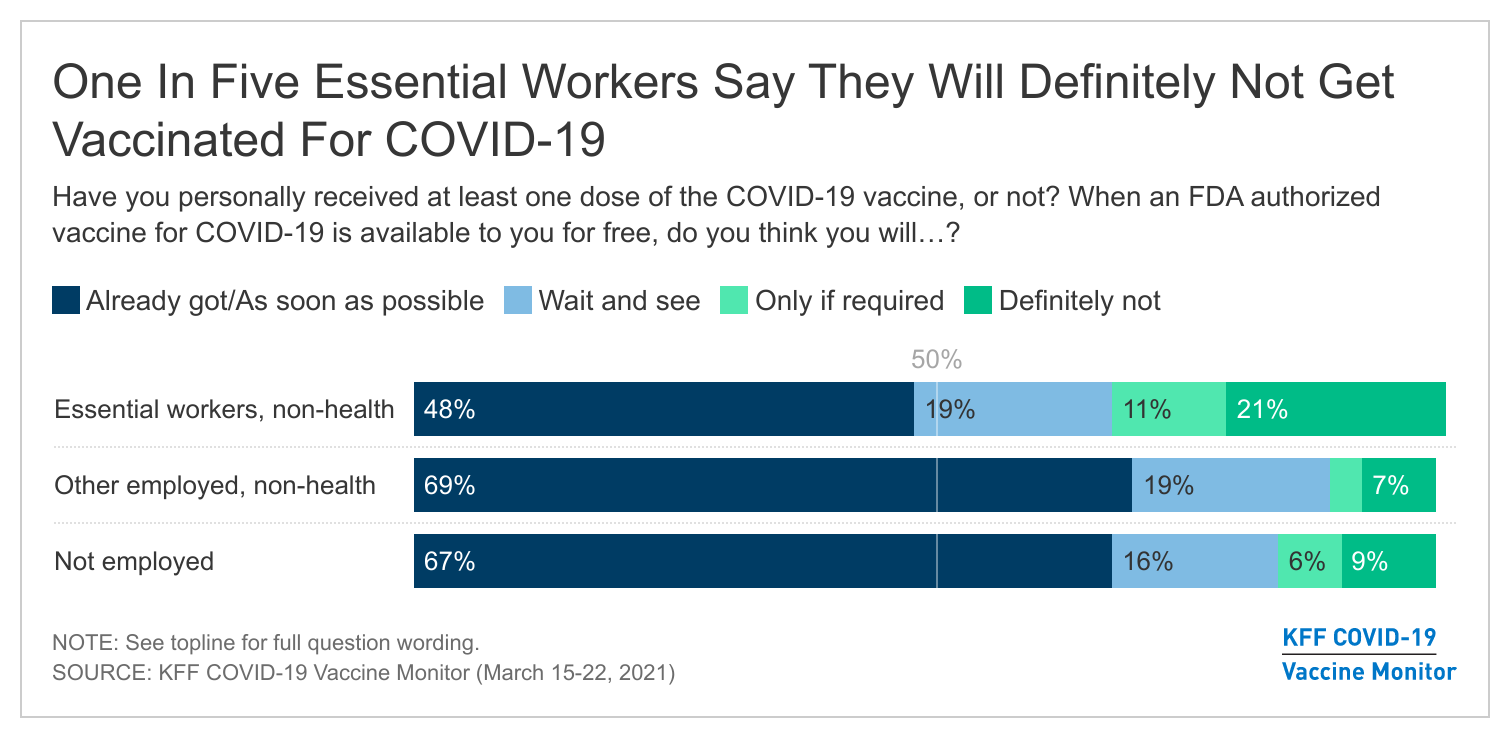
As of mid-March, roughly half (48%) of essential workers say they have already received at least one dose of the COVID-19 vaccine or will get a vaccine as soon as they can. This is a lower share than the nearly 7 in 10 workers employed in other professions (69%) and among adults without jobs (67%), despite the fact that most states prioritized these populations early during vaccine distribution.

About one in five essential workers (19%) say they will “wait and see” how the vaccine is working for others before getting vaccinated themselves, the same share as among those who are employed in non-essential jobs. However, essential workers are more likely than those who are doing their jobs from home to say they will get the vaccine “only if required” (11% vs. 3%) or that they will “definitely not” get vaccinated (21% vs. 7%).

Differences between demographic groups among essential workers

As with the public overall, partisanship plays a role in vaccination intentions among essential workers. Four in ten (40%) of Republican and Republican-leaning essential workers say they will “definitely not” get vaccinated, compared to just 5% of Democratic-leaning essential workers who say the same. Three-fourths (74%) of Democratic or Democratic-leaning essential workers say they’ve already been vaccinated or will get the vaccine as soon as possible compared to about three in ten (29%) Republican or Republican-leaning essential workers. By race and ethnicity, opposition to the vaccine is highest among White essential workers, with about a quarter (26%) saying they will definitely not get the vaccine compared to 7% of Black and 11% of Hispanic essential workers.

Similarly, essential workers’ opinions about the coronavirus vaccine show deep divides by education. Essential workers without college degrees are less likely than college graduates to say they have already gotten the vaccine or will get it as soon as they can. Among those with less than a college degree, 42% say they have already gotten the vaccine or will do so as soon as possible compared to two-thirds (66%) of those with a college education. Across income levels, roughly half (Household income under $40K: 47%, $40K-$89.9K: 48%, $90K+: 47%) of essential workers had already received a vaccine or plan to get one as soon as they can.

Although there are divides among essential workers in their attitudes towards the vaccine by party, race, and education, the demographics of essential workers cannot fully account for the lower enthusiasm for the vaccine among essential workers. A statistical analysis using the technique of multiple regression shows that even after controlling for demographic factors such as party, age, gender, education, race, income, ideology, and experience with contracting the coronavirus, essential workers remain more likely than non-essential workers to say they will “definitely not” get the vaccine. However, this analysis shows among these factors, the strongest predictors of vaccine intentions are party identification and political ideology.

VACCINE CONCERNS, ELIGIBILITY AND INFORMATION ABOUT WHERE TO BE VACCINATED

Among those who are not yet vaccinated and do not plan to get the vaccine as soon as they can, two-thirds (66%) are concerned about the possibility of experiencing serious side effects from the vaccine. In addition, essential workers express several work-related concerns about the COVID-19 vaccine. Majorities of these workers are very or somewhat concerned that they will be required to get vaccinated even if they don’t want to (63%), and about half (53%) are concerned they may have to miss work if they experience side effects from the vaccine.

This analysis also finds that substantial shares of essential workers are not sure where they can be vaccinated or aren’t sure whether they are currently eligible to receive the vaccine. Among unvaccinated essential workers, roughly 3 in 10 (31%) say they do not have enough information about where they will be able to get a vaccine and nearly 4 in 10 (39%) are not sure whether they are currently eligible to receive the vaccine in their state.

Among essential workers, education and income sharply divide understanding of where to get a coronavirus vaccine. Over one-third (37%) of unvaccinated essential workers without a college degree and 7% of college educated workers say they do not know where to get a COVID-19 vaccine. Among lower income essential workers (those with household incomes under $40,000), 45% say they do not have enough information about where they will be able to get a vaccine, compared to one quarter among those with incomes $40,000 and over.

As with knowledge of where to get a vaccine, uncertainty about current eligibility shows stark divides by education, ethnicity, and income. Unvaccinated essential workers without a college education express greater uncertainty about whether they are currently eligible to receive a vaccine, with 44% of essential workers without college educations saying they do not know whether they are eligible compared to 16% of college educated essential workers. Hispanic essential workers who are unvaccinated are also more likely to express doubt about whether they are eligible to receive a vaccine: half (53%) of unvaccinated Hispanic workers do not know whether they are eligible compared to three in ten (31%) unvaccinated White essential workers. A higher share of low-income essential workers are not sure whether they are eligible to receive the vaccine than essential workers with higher incomes; a 58% majority of those with household incomes under $40,000 are not sure whether they are eligible, compared to three in ten (30%) essential workers in households earning $40,000 or more. Uncertainty about vaccine eligibility may be mitigated moving forward now that all people ages 16 and older are eligible to receive a vaccine nationwide as of April 19.

Employer policies THAT MIGHT INCREASE VACCINATION UPTAKE

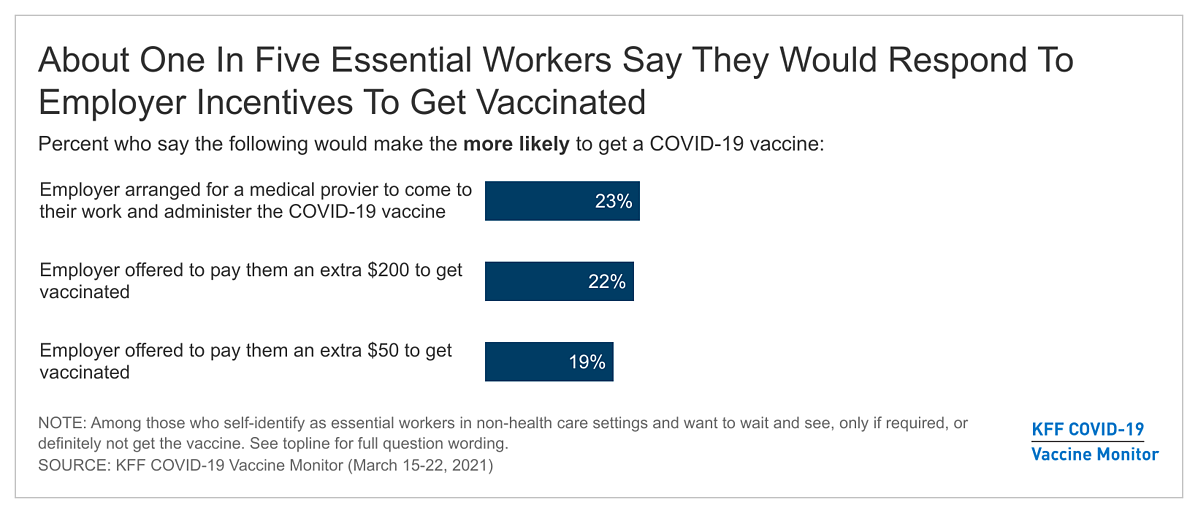
The latest COVID-19 Vaccine Monitor tested several policies that employers could implement to increase vaccination uptake among their workers. The hypothetical policies tested may be helpful to convert some unvaccinated essential workers to getting vaccinated. For example, roughly one-quarter (23%) of essential workers who are not convinced to get vaccinated right away say they would be more likely to get the vaccine if a medical provider came to their work to administer the shot.

Financial incentives also may convince some essential workers to get the vaccine. About one in five (19%) non-health essential workers who are not yet convinced to get the vaccine as soon as possible say they would be more likely to get the vaccine if their employer offered them $50 to get it, a share that increased slightly to 22% if the incentive was raised to $200.

EMPLOYER MANDATED VACCINATION

A 57% majority of non-health care essential workers say employers should not be allowed to require certain employees to get vaccinated for COVID-19. Opposition among essential workers is higher than among non-essential workers (42%) and those who are not currently employed (36%). Currently, employers can mandate vaccinations for their employees except under specific circumstances that conflict with federal law. However, a number of states have pending legislation that address vaccine mandates which may limit employer mandated vaccination on a state-by-state basis.

Views on employer mandates are divided along partisan lines among essential workers as they are among the general public. Nearly 8 in 10 (79%) Republican and Republican leaning essential workers oppose employer required vaccinations while about two-thirds (65%) of Democratic leaning workers support such mandates.

Methodology

This KFF COVID-19 Vaccine Monitor was designed and analyzed by public opinion researchers at the Kaiser Family Foundation (KFF). The survey was conducted March 15-22, 2021, among a nationally representative random digit dial telephone sample of 1,862 adults ages 18 and older (including interviews from 476 Hispanic adults and 490 non-Hispanic Black adults), living in the United States, including Alaska and Hawaii (note: persons without a telephone could not be included in the random selection process). Phone numbers used for this study were randomly generated from cell phone and landline sampling frames, with an overlapping frame design, and disproportionate stratification aimed at reaching Hispanic and non-Hispanic Black respondents. Stratification was based on incidence of the race/ethnicity subgroups within each frame. Specifically, the cell phone frame was stratified as: (1) High Hispanic: Cell phone numbers associated with rate centers from counties where at least 35% of the population is Hispanic; (2) High Black: Cell phone numbers associated with remaining rate centers from counties where at least 35% of the population is non-Hispanic Black; (3) Else: numbers from all remaining rate centers. The landline frame was stratified as: (1) High Black: landline exchanges associated with Census block groups where at least 35% of the population is Black; (2) Else: all remaining landline exchanges. The sample also included 190 respondents reached by calling back respondents that had previously completed an interview on the KFF Health Tracking Poll at least nine months ago. Another 402 interviews were completed with respondents who had previously completed an interview on the SSRS Omnibus poll (and other RDD polls) and identified as Hispanic (n = 178; including 63 in Spanish) or non-Hispanic Black (n=224). Computer-assisted telephone interviews conducted by landline (356) and cell phone (1,506, including 1,093 who had no landline telephone) were carried out in English and Spanish by SSRS of Glen Mills, PA. To efficiently obtain a sample of lower-income and non-White respondents, the sample also included an oversample of prepaid (pay-as-you-go) telephone numbers (25% of the cell phone sample consisted of prepaid numbers) Both the random digit dial landline and cell phone samples were provided by Marketing Systems Group (MSG). For the landline sample, respondents were selected by asking for the youngest adult male or female currently at home based on a random rotation. If no one of that gender was available, interviewers asked to speak with the youngest adult of the opposite gender. For the cell phone sample, interviews were conducted with the adult who answered the phone. KFF paid for all costs associated with the survey.

The combined landline and cell phone sample was weighted to balance the sample demographics to match estimates for the national population using data from the Census Bureau’s 2019 U.S. American Community Survey (ACS), on sex, age, education, race, Hispanic origin, and region, within race-groups, along with data from the 2010 Census on population density. The sample was also weighted to match current patterns of telephone use using data from the January- June 2020 National Health Interview Survey and to adjust for non-response bias, predominantly in the callback sample frames, on health insurance coverage, registered voter status, age, and reported vaccination rates (based on the non-callback RDD sample). The weight takes into account the fact that respondents with both a landline and cell phone have a higher probability of selection in the combined sample and also adjusts for the household size for the landline sample, and design modifications, namely, the oversampling of prepaid cell phones and likelihood of non-response for the re-contacted sample. All statistical tests of significance account for the effect of weighting.

The margin of sampling error including the design effect for the full sample is plus or minus 3 percentage points. Numbers of respondents and margins of sampling error for key subgroups are shown in the table below. For results based on other subgroups, the margin of sampling error may be higher. Sample sizes and margins of sampling error for other subgroups are available by request. Note that sampling error is only one of many potential sources of error in this or any other public opinion poll. Kaiser Family Foundation public opinion and survey research is a charter member of the Transparency Initiative of the American Association for Public Opinion Research.

This work was supported in part by grants from the Chan Zuckerberg Initiative DAF (an advised fund of Silicon Valley Community Foundation), the Ford Foundation, and the Molina Family Foundation. We value our funders. KFF maintains full editorial control over all of its policy analysis, polling, and journalism activities.

GroupN (unweighted)M.O.S.E.
Total1,862± 3 percentage points
Essential workers, non-health care477± 6 percentage points
News Release

Essential Workers Employed Outside Health Care are Less Enthusiastic about Getting a COVID-19 Vaccine than Other Adults

Employers Could Encourage Some to Get Vaccinated Through Incentives, Though Most of These Workers Oppose a Mandate

Published: Apr 23, 2021

There has been little research on how essential workers not employed in the health care sector have been impacted by the pandemic and their views on and experiences with COVID-19 vaccines. The latest KFF COVID-19 Vaccine Monitor report finds that this group of workers – roughly 3 in 10 of all adults who have been required to work outside their homes during the pandemic – are less enthusiastic about getting vaccinated than other adults.

As of mid-March, nearly half (48%) of non-health care essential workers said they had received at least one dose of the COVID-19 vaccine or will get a vaccine as soon as they can – fewer than the share among those who work from home (69%) and among adults who aren’t working (67%). Non-health care essential workers are also more likely than those who work from home to say they will get the vaccine “only if required” (11% vs. 3%) or that they will “definitely not” get vaccinated (21% vs. 7%).

These differences in enthusiasm in part reflect the underlying demographics of the two groups.

Compared to employed adults working from their homes, those identifying as essential workers are less likely to have a college degree (26% vs. 59%) and are more likely to identify as Republican or Republican-leaning independents (39% vs. 26%). People without a college degree and those who are or lean Republican in general are more likely to be resistant to getting a vaccine than their counterparts, though even after accounting for these and other demographic factors, essential workers are more likely than other adults to say they won’t get vaccinated.

Among essential workers who are not already vaccinated or planning to do so as soon as possible, two thirds (66%) say they worry about experiencing serious side effects, and about half (53%) are concerned they may have to miss work if they experience side effects from the vaccine.

The analysis finds employers could encourage some of these workers to get a vaccine through incentives. About 1 in 5 say they would be more likely to get vaccinated if their employer arranged for a health care provider to administer the vaccine at work (23%), or if their employer offered to pay them an extra $50 (19%) or $200 (22%) to get vaccinated.

Overall, most non-health care essential workers (57%) say that employers should not be allowed to require their workers to get vaccinated, compared to 42% of workers employed in other types of non-healthcare jobs.

The issue divides along partisan lines. Among non-health essential workers, those who identify as Republican or lean that way overwhelmingly say employers should not be allowed to mandate their workers get vaccinated (79%), while two thirds (65%) of Democrats and Democratic leaners say they should be able to do so.

Designed and analyzed by public opinion researchers at KFF, the KFF Vaccine Monitor survey was conducted from March 15-22 among a nationally representative random digit dial telephone sample of 1,862 adults, including oversamples of adults who are Black (490) or Hispanic (476). Interviews were conducted in English and Spanish by landline (356) and cell phone (1,506). The margin of sampling error is plus or minus 6 percentage points for results based on the sample of 477 essential workers. For results based on subgroups, the margin of sampling error may be higher.

The KFF COVID-19 Vaccine Monitor is an ongoing research project tracking the public’s attitudes and experiences with COVID-19 vaccinations. Using a combination of surveys and qualitative research, this project tracks the dynamic nature of public opinion as vaccine development and distribution unfold, including vaccine confidence and acceptance, information needs, trusted messengers and messages, as well as the public’s experiences with vaccination.

News Release

COVID-19 Deaths and Cases in Long-Term Care Facilities Have Fallen to All-Time Lows in the Four Months Since Vaccinations Began

Published: Apr 22, 2021

COVID-19 deaths and cases among residents and staff of long-term care facilities have fallen dramatically since vaccinations began in December, with deaths declining by nearly 89 percent and cases declining by nearly 92 percent as of April 2021, according to a new KFF analysis.

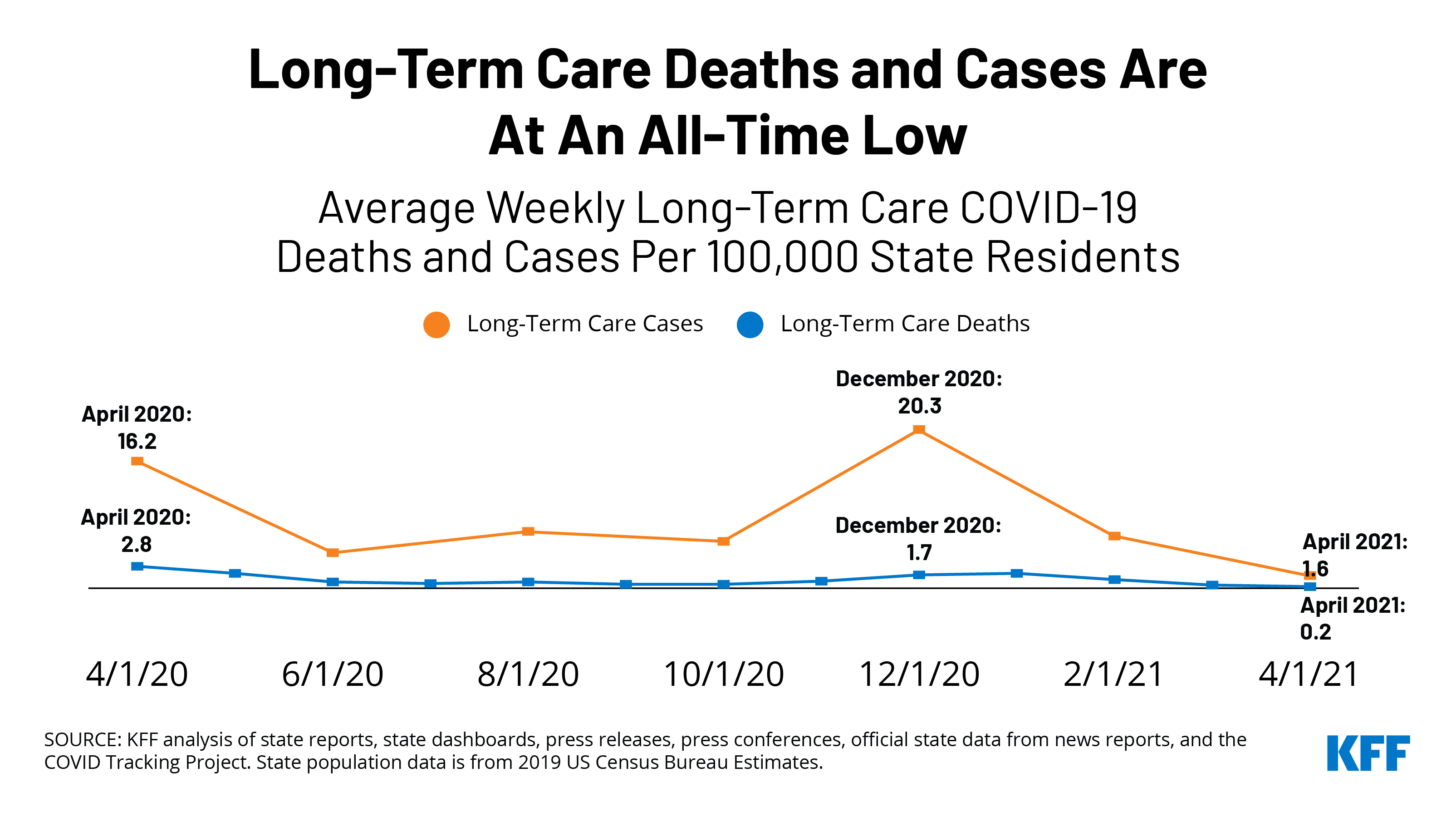
COVID-19 deaths in long-term care settings fell from 1.7 deaths per 100,000 state residents in December to just 0.2 deaths per 100,000 state residents in April, an all-time low, the analysis finds.

By mid-April, about a third (34%) of all COVID-19 deaths were in long-term care facilities, down from a peak of nearly half (49%) in June 2020 and 42 percent around the time that long-term care residents and staff began receiving vaccines in late December.

Similarly, average new weekly cases in long-term care facilities were just 1.6 per 100,000 state residents in April, also an all-time low, compared to a peak of 20.3 in December 2020 across the 39 states (38 states plus DC) for which trend data is available.

Not all the news is good. Eight states experienced a rise in COVID-19 cases in long-term care facilities between March and April 2021. The increases ranged from a 6 percent uptick in New Hampshire to a more than 150 percent jump in Connecticut and Michigan. Such increases may be reflective of increased COVID-19 cases and community spread in such states overall, often attributed to rising infections among younger people due to “pandemic fatigue.”

No states reported increases in both cases and deaths in long-term care settings between March and April, so it remains to be seen whether recent increases in cases in a few states will lead to increases in deaths.

For more data and analyses about COVID-19 and long-term care settings, visit kff.org.

COVID-19 Long-Term Care Deaths and Cases Are at An All-Time Low, Though A Rise In LTC Cases In A Few States May Be Cause for Concern

Authors: Priya Chidambaram and Rachel Garfield
Published: Apr 22, 2021

Data Note

Since December 2020, the US has fully vaccinated over 1.4 million residents in long-term care facilities (LTCF) and over 1 million LTCF staff. Since then, weekly deaths in nursing homes have continued to fall, much of which has been attributed to the high rates of vaccination among nursing home residents. LTCFs include a range of facilities, including nursing homes, assisted living facilities, and other congregate care facilities for people with disabilities or older adults. This data note looks at state-reported LTCF data from 41 states plus Washington DC to assess what has happened to new deaths and cases in LTCFs in the four months since vaccinations began on December 21st, 2020. We also examine how recent changes in deaths and cases in LTCFs have shifted the nature of the pandemic outside of LTCFs. Data in this analysis is as of the week of April 11th, 2021. See methods for more details.

COVID-19 Deaths in Long-Term Care Facilities

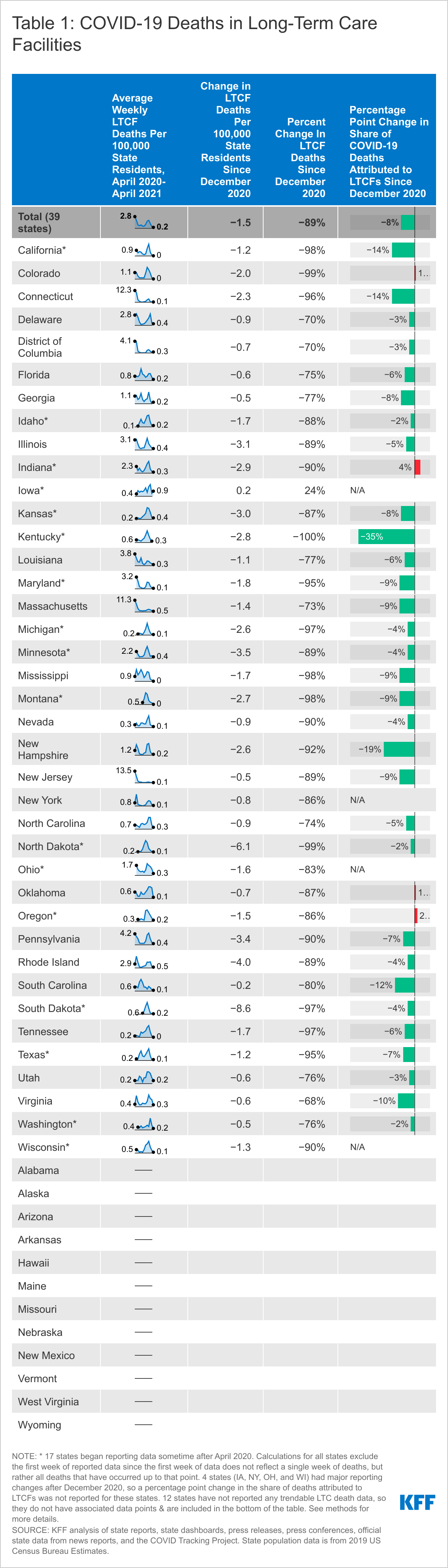
Table 1: COVID-19 Deaths in Long-Term Care Facilities

Of the 39 states (38 states plus DC) for which we can trend COVID-19 deaths in LTCFs, 21 states reported an all-time low death rate in April 2021. Five states reported zero LTCF deaths per 100,000 state residents in April 2021, a rounded value that represents a very small number of LTCF deaths in those states (Table 1 and Appendix Table 1). Across all states analyzed, LTCF deaths per 100,000 state residents hit an all-time low of 0.2 deaths per 100,000 state residents in April 2021, a steep decrease from the peak of 2.8 deaths per 100,000 US residents in April 2020 and a rate of 1.9 per 100,000 as vaccinations were being rolled out in January 2021. California, Colorado, Mississippi, Tennessee, and Montana reported zero LTCF deaths per 100,000 state residents in April 2021. This is a rounded value that represents a small number of LTCF deaths in those states. Of the 17 states that did not report the lowest number of LTCFs deaths per 100,000 in April 2021 over the course of the pandemic, 13 reported the lowest rate in April since vaccinations began in December 2020. These 17 states reported an average rate of 2.1 deaths per 100,000 in January 2021, which declined to 0.3 deaths per 100,000 in April 2021. See Appendix Table 1 for detailed data.

Since vaccinations began in mid-December 2020, the number of COVID-19 deaths in LTCFs across all states in this analysis has declined by 89% as of April 2021, from 1.7 deaths per 100,000 state residents to 0.2 deaths per 100,000 state residents (Table 1 and Appendix Table 1). Percent decline is calculated by taking the difference between average weekly deaths in December 2020 and average weekly deaths in April 2021 and dividing that difference by the average weekly deaths in December 2020.  Among the 39 states for which we can trend COVID-19 deaths between December 2020 and April 2021, 38 states reported a decline in deaths per 100,000 state residents, ranging from a decline of 68% in Virginia to 100% in Kentucky, with an average drop of 84%. Iowa was the only state that reported higher average weekly LTCF deaths in April 2021 than December 2020 (24% increase). It is possible that this number reflects unknown reporting changes or data reconciliation, especially because the trend in Iowa has been unstable, with increases and decreases reported since October 2020. Notably, Iowa’s LTCF deaths per 100,000 was lower in April 2021 than January and February 2021.

Both nationally and in most states, the share of deaths attributed to LTCFs has dropped since the start of vaccinations in December 2020 (Table 1), indicating a faster decline in death rates in LTCFs than in the community. To a large extent, deaths due to COVID-19 have been concentrated in LTCFs throughout the pandemic.  Previous analysis indicates that the share of COVID-19 deaths attributed to LTCFs peaked in June 2020, when about 49% of all COVID-19 deaths in the US were in LTCFs. Since then, the share of deaths attributed to LTCFs dropped slowly to 42% for the week of December 20th, 2020, when LTCF residents began receiving vaccines. By mid-April, 2021, LTCFs accounted for 34% of total, cumulative COVID-19 deaths, an eight-percentage point drop since the start of vaccinations. This pattern held in most states. However, four states reported a higher share of deaths in LTCFs in April 2021 compared to December 2020 (CO, IN, OK, OR). Increases in these states were modest, ranging from one to four percentage points, reflecting a slightly faster decrease in community deaths than LTCF deaths.

COVID-19 Cases in Long-Term Care Facilities

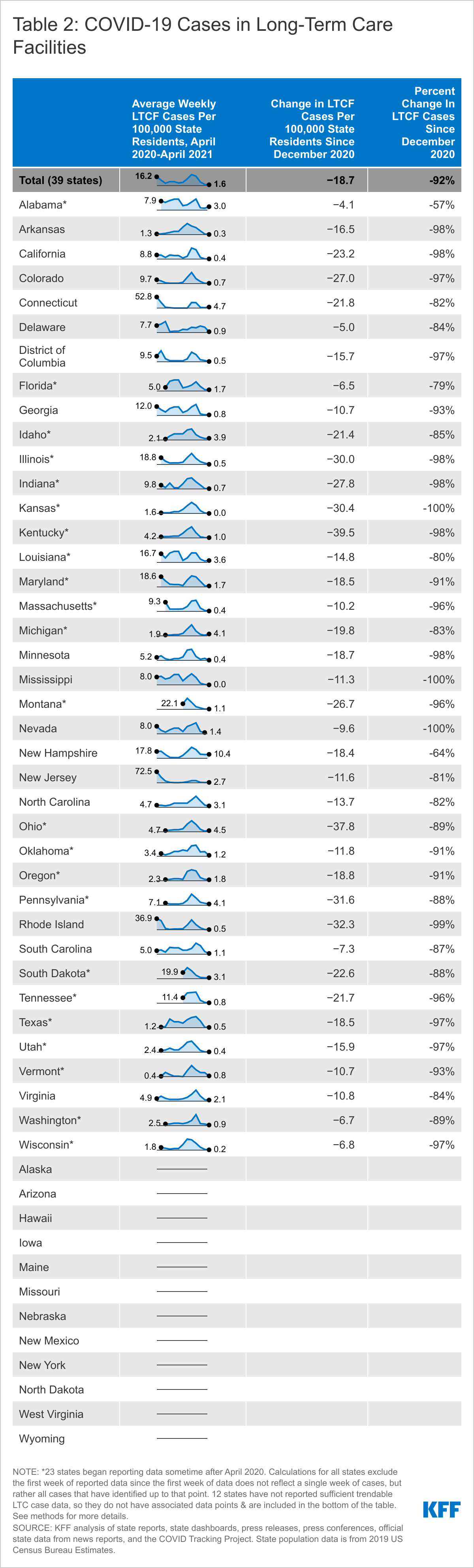
Table 2: COVID-19 Cases in Long-Term Care Facilities

Similar to LTCF deaths, average new weekly cases in LTCFs hit an all-time low in April 2021, with two states (Kansas and Mississippi) reporting zero new LTCF cases per 100,000 state residents that month (Table 2 and Appendix Table 2). Across the 39 states (38 states plus DC) included in this analysis, average new weekly cases in LTCFs were just 1.6 per 100,000 in April 2021, compared to a peak of 20.3 in December 2020. Of the 39 states, 28 states reported the lowest average weekly new case rate in April 2021 since the start of the pandemic. Of the remaining 11 states, 3 reported the lowest average weekly rate in April 2021 since vaccinations began in December 2020. See Appendix Table 2 for detailed data.

New cases in LTCFs dropped by 92% between December 2020 and April 2021, a pattern that is reflected in state-level data as well (Table 2 and Appendix Table 2). Nearly all states (36 of 39 states) included in the analysis reported a greater than 80% drop in LTCF cases in this time period. The remaining three states reported a drop of greater than 50%.

Reflecting a potentially troubling trend of increasing community spread, eight states reported increases in LTCF cases from March to April 2021 (Table 2 and Appendix Table 2). These increases ranged from a 6% increase in New Hampshire to over 150% in Connecticut and Michigan. The other five states that saw increases from March to April 2021 were Idaho (9%), Louisiana (31%), New Jersey (36%), Ohio (78%), and Alabama (81%). These increases may be a result of increased cases in the state overall, which has been attributed to rising infections among younger people due to “pandemic fatigue” and the rise of the B.1.1.7 variant. Research suggests a strong connection between increased cases in the community and increased cases in LTCFs. None of the states reported both an increase in LTCF cases and deaths between March and April 2021, so it remains to be seen whether these increased LTCF cases will lead to increased LTCF deaths.

Methods 

This analysis is based on data as of the week of April 11th, 2021 from 41 states plus Washington DC, for a total of 42 states. The remaining nine states were excluded because they do not directly report data on cases and deaths in long-term care facilities, their data is sourced from sporadically released media reports, or there were data quality or availability issues in trending data over time.

For example, some states have periodically reconciled their data, leading to large jumps that reflect reporting and data quality rather than actual cases or deaths.

Within the 42 states included in this analysis, we were able to trend long-term care cases in 38 states plus DC and deaths in 38 states plus DC. We included states for which we could reliably trend at least six months of data, using the earliest reliable period reported in the state as the starting point for that state’s trend.

States vary in which facilities they include in LTCF reporting and whether they include residents and staff in case and death counts. For all states, we trended the subset of facilities and populations that provide the longest reliable trend line. For example, our data for Delaware excludes staff cases because that data was not reported consistently; in Michigan, this analysis excludes cases and deaths in Adult Foster Care facilities since these cases and deaths were only added for recent weeks. For this reason, this analysis should not be used to identify state-level or national data on total long-term care cases and deaths. The most recent data on total cases and deaths in long-term care facilities can be located here. See below for details on how each indicator in the Tables and Appendix were calculated.

Average Weekly Long-Term Care Deaths/Cases Per 100,000 State Residents:

These data represent trends in long-term care deaths and cases in states overtime in the context of total state population. Total state population data is from 2019 estimates from the US Census Bureau. The first week of available long-term care data for each state was not included in this analysis since the first week of data does not reflect a single week of deaths and cases, but rather all deaths and cases that have occurred up to that point. New deaths and cases were calculated for each week thereafter, and then averaged for all of the weeks within the month. Weeks where states reported large increases or any decreases due to reporting changes or data reconciliation were not included in the calculations of monthly averages. These average new deaths and cases were converted to represent deaths and cases per 100,000 state residents to allow for easier comparison across states. Totals for each table were calculated by dividing total new deaths and new cases per month by the total state populations for the states represented in each month of data and converting values to represent totals per 100,000 state residents.

Change in Average Weekly LTCF Deaths/Cases Per 100,000 State Residents Since December 2020:

The change in LTCF deaths and cases per 100,000 state residents since December 2020 was calculated by taking the difference between the new LTCF deaths/cases in April 2021 and December 2020.

Percent Change In LTCF Deaths/Cases Since December 2020:

Percent change is calculated by taking the difference between average weekly deaths in December 2020 and average weekly deaths in April 2021 and dividing that difference by the average weekly deaths in December 2020.

Percentage Point Change in Share of COVID-19 Deaths Attributed to LTCFs Since December 2020:

This value was calculated by calculating the share of deaths attributed to long-term care facilities the week of December 20th, 2020 and subtracting this from the share of deaths attributed to long-term care facilities the week of April 11th, 2021. Shares of deaths were calculated by dividing total long-term care COVID-19 deaths by total COVID-19 deaths in the state at that time. Total deaths for each time period was pulled from KFF COVID tracker. This indicator is not calculated for Iowa, New York, Ohio, or Wisconsin since those states had major increases or decreases in reported deaths after December 20th, 2020. Any changes in the share of deaths between December 2020 and April 2021 would have been impacted by these major reporting changes and would not have accurately reflected the pandemic’s evolving impact on long-term care facilities.

This analysis relies on state-reported data instead of federal data since federal data does not include non-nursing home settings. COVID-19 has disproportionately impacted all types of long-term care settings, such as assisted living facilities and group homes. Thus, the state-reported data is more likely to capture the full burden of deaths in long-term care facilities. Additionally, federal data cannot be trended from March-May 2020, and therefore misses early months of the pandemic when there were outbreaks in LTCFs.

Appendix

News Release

What Are Some Policy Options for Reaching the 2.2 Million Uninsured People in the ACA’s “Coverage Gap”?

Published: Apr 22, 2021

A new KFF issue brief explores several potential policy options that would help close the Affordable Care Act’s “coverage gap,” including providing further new incentives for states to expand Medicaid, creating a new “public option” or extending ACA Marketplace premium subsidies to low-income people who don’t currently qualify for federal help.

At stake is affordable health coverage for 2.2 million uninsured people with incomes below the federal poverty level ($12,880 annually for an individual in 2021), who currently do not qualify for either their state’s Medicaid program or federal premium subsidies in the ACA marketplace. As of April 2021, 12 states have not adopted the ACA’s Medicaid expansion to provide coverage to adults with incomes through 138% of poverty.

President Biden proposed the public option approach during the 2020 campaign and is expected to soon release his American Families Plan proposal that could include a provision to address the coverage gap.

The KFF brief also explores the challenges and budgetary cost considerations of the potential options to expand coverage, all of which are likely to increase federal spending and could require offsets through other proposals that produce savings.

A previously released analysis of the coverage gap is also available.

Filling the Coverage Gap: Policy Options and Considerations

Authors: Robin Rudowitz, Rachel Garfield, and Larry Levitt
Published: Apr 22, 2021

As of April 2021, 12 states have not adopted the Affordable Care Act (ACA) provision to expand Medicaid to adults with incomes through 138% of poverty. In these states, 2.2 million uninsured people with incomes under poverty fall in the “coverage gap” and do not qualify for either Medicaid or premium subsidies in the ACA marketplace (See Appendix Table).  An additional 1.8 million uninsured adults in these states are currently eligible for marketplace coverage (because their incomes are between 100% and 138% of poverty level) but would be eligible for Medicaid if their state expanded.

The federal government covers 90% of the cost of Medicaid coverage for adults covered through the ACA expansion, a higher share than it does for other Medicaid enrollees. The American Rescue Plan Act (ARPA) enacted in March 2021 includes an additional temporary fiscal incentive for states to newly implement the ACA Medicaid expansion, and KFF analysis shows that all non-expansion states would actually save money for two years by newly expanding.  The incentive would be available for two years following expansion, but there is no time limit for states to take up the option.  It is unclear which states, if any, may take advantage of the new option, which has prompted discussion about whether further steps could be taken to guarantee coverage to people in the gap in President Biden’s forthcoming American Families Plan.

President Biden proposed during the campaign that a public option insurance plan would be broadly available and automatically enroll people in the coverage gap, but such a plan would be difficult to pass in a closely divided Congress. This issue brief examines some of the other options policymakers may consider to extend coverage to people in the gap, including  increased fiscal incentives for states, a narrower public option, and making people with incomes below the poverty level eligible for enhanced ACA premium subsidies.

What are leading options to provide coverage for people in the coverage gap?

Add More Financial Incentives for Medicaid Expansion

Additional incentives for non-expansion states generally include increases to the expansion match rate or other broader fiscal incentives for expansion states.  In addition to the APRA, which included a two-year, 5-percentage point increase in the federal matching rate for traditional (non-ACA) enrollees, policies could increase the expansion match rate.  For example, the policy could allow new expansion states to receive the three years of 100% federal matching dollars, as was available to states that had implemented in 2014, or could increase the current expansion match rate (e.g., to 95%) more broadly to all expansion states (new and current expansion states).  Alternatively, policies could provide additional financial incentives for all expansion states that increase the opportunity cost of not expanding (e.g., an increase in the traditional match rate) or could create financial disincentives to not expanding (e.g., a decrease in the traditional match rate or limits on disproportionate share hospital payments (DSH) or uncompensated pool funds).

Policies to encourage non-expansion states to cover people in the coverage gap build on the existing Medicaid infrastructure in those states.  As with other states that have adopted the expansion, expansion builds on existing Medicaid provider networks, health plans, and eligibility systems, as well as existing mechanisms to draw down federal funds for coverage. Coverage offered through Medicaid is designed to be affordable for people with low incomes. Medicaid generally prohibits premiums and deductibles and limits cost-sharing to nominal amounts, which differs from coverage provided in the Marketplace or other coverage.  In addition, there is no open enrollment period for Medicaid, so individuals can enroll at any time, and eligibility is based on monthly income (not projected annual income). Individuals are eligible for Medicaid even if they have an offer of employer coverage, and unlike marketplace coverage, there is no reconciliation at the end of the year to align benefits with actual income.

These options still rely on state action to adopt the expansion.  There are already substantial financial incentives for states to expand Medicaid under the ACA; some states have not acted on them largely due to politics or ideology, so it is unclear if additional incentives will impel them to act. Providing additional funding that would benefit only non-expansion states could also create equity issues in federal funds flowing to states that already expanded. For some policies, the legal limits of the federal government’s ability to leverage Medicaid funds to states as an incentive to adopt the ACA expansion is unclear.

Create a Broad or Narrow Public Option

Instead of relying on Medicaid, federal policy makers could create a new public option that would be available broadly or more narrowly targeted for the people in the coverage gap.  President Biden campaigned on a “public option,” a new federal public health insurance option, that would be available to all people eligible for marketplace coverage, people with employer coverage, and people who would otherwise be eligible for Medicaid in non-expansion states. For the last group (the coverage gap population), enrollment would be automatic, fully funded by the federal government, premium-free and provide the full scope of Medicaid benefits. Under the Biden campaign proposal, states that have expanded could move Medicaid expansion enrollees into the public option, with a maintenance-of-effort payment from the states.  Instead of a broad public option, a narrower option to provide coverage specifically for people in the coverage gap could be developed.

A public option would not depend on states to expand coverage and could be tailored to people with low incomes, but creating a new federal coverage option presents some political, administrative and implementation challenges.  Creating a broad or narrow public option would require an infrastructure to set up and administer a new federal health insurance program.  For example, it requires resources to set up the plan, set rates, administer or contract with plans to administer benefits, and establish and conduct eligibility and enrollment processes.  Even if the new public option plan were administered in conjunction with an existing federal health program (such as Medicare or the Federal Employees Health Benefits Program), there would be a number of design choices, such as whether and how the public option would conform with state insurance regulations; set payment rates for providers and prices for prescription drugs; and enroll providers or contract with health plans.  Different choices would have implications for costs, access, and affordability.  A broad public option has the potential to deliver coverage at a lower cost than in private insurance by restraining health care prices, but that would also be strongly opposed by the health care industry.

Setting up a narrow public option plan targeted to cover 2.2 million nationwide would still require many policy design choices and could be administratively complex, especially for a relatively small population nationwide. The guarantee of coverage for people with incomes below poverty at full federal cost would almost certainly mean that none of the current non-expansion states would choose to expand in the future. While a maintenance of effort requirement on current expansion states could theoretically prevent current expansion states from dropping the Medicaid expansion and shifting costs to the federal government, such a requirement could be difficult to sustain politically and could face legal challenges. This inequity across states could potentially be addressed through fiscal carrots provided to expansion states, but that would also increase federal costs. Given the limited scope of coverage, a narrow public option would likely be less disruptive to the health care industry than a broad public option.

Expand Eligibility for Marketplace Premium Subsidies

Policy makers could consider an option to extend financial assistance for coverage by extending Marketplace premium subsidies to people in the coverage gap.  Under current law, individuals below poverty are generally not eligible for premium subsidies to purchase coverage in the ACA marketplace, with the only exception being authorized immigrants who are ineligible for Medicaid because they have been in the U.S. fewer than five years.  One approach to covering people in the coverage gap would be to make them eligible for marketplace premium subsidies. Under the American Rescue Plan – which enhanced ACA premium subsidies for two years – people with incomes below 150% of the poverty level are eligible for a 100% premium subsidy for the second lowest cost silver plan. They are also eligible for cost-sharing reductions that provide them with coverage that has an actuarial value of 94%. This means that, on average, they are responsible for deductibles and copays equal to 6% of their health spending. The average deductible in these reduced cost-sharing plans in 2021 is $149, with an average out-of-pocket limit of $1,189. A policy to cover people in the coverage gap could reduce cost-sharing further for people with income below poverty, comparable to the nominal cost-sharing in Medicaid.  It also would be theoretically possible to provide wrap-around benefits for services like nonemergency medical transportation (NEMT) that are covered by Medicaid but not covered in the Marketplace, but there is currently no mechanism for doing so.

Similar to other options, expansion of marketplace subsidies does not depend on state action, but there a number of design challenges for policy makers to consider.  A policy to extend marketplace subsidies would expand coverage by building on the existing marketplace structure, which would reduce administrative complexity and could be accomplished relatively quickly and easily. However, there could be some challenges to this structure for people below poverty, depending on how the policy is designed, which would take time to implement.

Unless further cost-sharing reductions and benefit enhancements were included, marketplace plans would have significantly higher cost-sharing and less comprehensive benefits than Medicaid.  While provider networks in Medicaid may be more limited than typical employer insurance plans, in some parts of the country the networks in marketplace plans can be even more restrictive. As an entitlement program, Medicaid provides beneficiaries with broader legal protections for accessing care than enrollees in private insurance plans. Unlike Medicaid, eligibility for marketplace premium subsidies is reconciled for the year after the fact based on actual income. Such a reconciliation could be waived for people with incomes below poverty – including the need to file a tax return — but eligibility still requires estimating annual income rather than current income as in Medicaid.

There is some precedent for providing coverage to Medicaid enrollees through the marketplace.  For example, in Arkansas, the state buys marketplace coverage for Medicaid expansion enrollees; the state also pays the premium and other cost sharing amounts and provides wrap around coverage.  Extending marketplace subsidies to people in the coverage gap raises all of the same potential inequities across states as a public option.

What are the cost considerations for these options?

All options to expand coverage are likely to increase federal spending and could require offsets through other proposals that produce savings. In addition to the specific structure of the policy, cost considerations include:

Distribution of state and federal costs: Cost for Medicaid are shared by states and the federal government, while costs for marketplace subsidies and a public option would be borne entirely by the federal government (and the individual covered, for any premiums or out of pocket costs).  Thus, policies that rely on Medicaid may cost less to the federal government, depending on how much of a fiscal incentive might be provided to non-expansion states to encourage them to expand, as well as to current expansion states.

Relative costs of Medicaid versus private coverage: In addition, Medicaid costs per person may be lower than private insurance primarily due to provider payment rates.  Coverage costs (for both Medicaid and marketplace coverage) may also vary by state as health care costs and markets vary. For example, premiums in marketplace plans tend to be higher in rural areas with little competition among hospital and plans.  The federal government may also face costs if a new option creates an incentive for a current expansion state to drop coverage, leading the federal government to lose the state share of financing. For coverage options that use a new public option, the difference between Medicare rates and private coverage or Medicaid coverage is also a factor.

Enrollment: Lastly, government costs depend in large part on take-up and enrollment in the new option. If there are no adjustments for higher out of pocket costs, enrollment in coverage options through the marketplace could be relatively lower than other approaches.  Additionally, enrollment likely depends on outreach, if open enrollment periods apply to the group that could be eligible for Medicaid, and how incomes is counted (monthly or over the course of the year).

What to watch?

Existing and new research continue to show that expanding eligibility for health coverage to people with low incomes reduces the uninsured rate, improves access to and utilization of care, reduces uncompensated care costs, improves affordability of care, and reduces racial and ethnic disparities in coverage.  The pandemic has highlighted the importance of access to coverage and challenges with accessing care for uninsured people.  President Biden is expected to release the American Families Plan in the near future, which may include proposals to address coverage for people in the coverage gap.  Congress may also consider proposals as part of a budget reconciliation bill.  In the meantime, some states may move forward with expansion efforts and take advantage of existing incentives under the ARPA, and there are efforts to get expansion on the ballot in Mississippi and South Dakota and other states considering expansion in their legislative sessions. Understanding the tradeoffs that different approaches have for government cost, administrative feasibility, and affordability for low-income people will be helpful in assessing policies as details of specific proposals are released. While alternative approaches to Medicaid expansion could be more expensive for the federal government and offer fewer protections for beneficiaries, they could also guarantee coverage for low-income people now in states that may not choose to expand for many years or at all.

Appendix Table

Uninsured Adults in Non-Expansion States Who Would Be Eligible forMedicaid if Their States Expanded, by Current Eligibility for Coverage, 2019 
StateIn the Coverage Gap May Be Eligible for Marketplace Coverage 
(<100% FPL)(100%-138% FPL**)
All States Not Expanding Medicaid2,188,0001,800,000
Alabama127,00077,000
Florida415,000375,000
Georgia269,000184,000
Kansas45,00037,000
Mississippi102,00064,000
North Carolina212,000161,000
South Carolina105,00084,000
South Dakota16,00011,000
Tennessee118,000108,000
Texas771,000662,000
Wisconsin*030,000
Wyoming7,0008,000
NOTES: * Wisconsin provides Medicaid eligibility to adults up the poverty level under a Medicaid waiver. As a result, there is no one in the coverage gap in Wisconsin. ** The “100%-138% FPL” category presented here uses a Marketplace eligibility determination for the lower bound (100% FPL) and a Medicaid eligibility determination for the upper bound (138% FPL) in order to appropriately isolate individuals within the range of potential Medicaid expansions but also with sufficient resources to avoid the coverage gap.
SOURCE: KFF analysis based on 2020 Medicaid eligibility levels and 2019 American Community Survey.