Pulling It Together: A Public Opinion Surprise

Published: Apr 4, 2011

Medicaid is the nation’s primary health insurance program for low-income people and people with disabilities, covering more than 60 million people this year.  And it’s about to get a lot of attention: it’s likely to be a prime target for spending reductions by “deficit hawks” in debate over the budget; governors are arguing that federal rules requiring them to maintain coverage under Medicaid tie their hands at a time when they are trying to crawl out of the recession to balance their budgets; and the health reform law expands Medicaid coverage to all of the poor starting in 2014.

If you listen to the inside debate you would think Medicaid is America’s most unpopular program. Conservatives don’t like Medicaid on ideological grounds; it’s a government entitlement program.  Providers complain about the program’s reimbursement rates.  And liberals have long complained about the program’s limitations, especially the gaps in whom Medicaid covers and the large variations in coverage among states.  With its joint federal-state financing and welfare-linked heritage, Medicaid is treated as fundamentally different than the two other big entitlement programs — Social Security and Medicare — and thought to have dramatically less public support.

It was against this background that one of our recent polls produced a real surprise. It turns out that the insider’s view of Medicaid is not the public’s view at all.  While not viewed as favorably as Social Security or Medicare, Medicaid is actually surprisingly popular with the American people, and they resist the idea of making big cuts to the program.

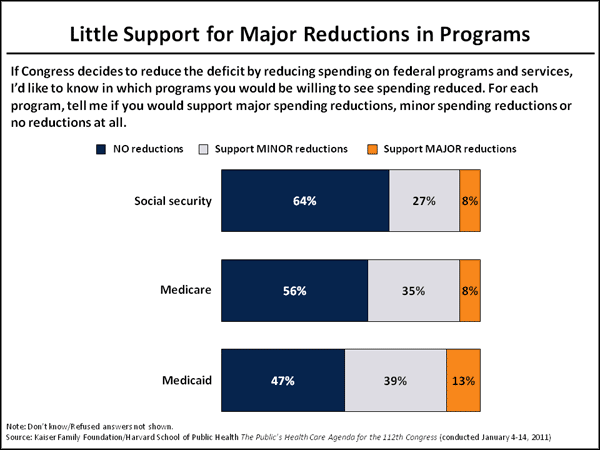
When we asked in our poll which programs the public was willing to see cut by Congress to reduce the deficit, no surprise, only 8% were willing to see “major reductions” in Social Security or Medicare. But only 13% were willing to see major reductions in Medicaid, the same percentage as for public education.  Sixty-four percent supported “no reductions” at all in Social Security as a way to reduce the deficit, 56% in Medicare, and 47% in Medicaid, hardly the mark of an unpopular program.  Forty-six percent of independents and a little more than a third (35%) of Republicans said they would “not support any reductions at all” in Medicaid to reduce the deficit.  The findings about support for major reductions are noteworthy because policy proposals such as capping the rate of increase in spending on major health programs and some Medicaid block grant proposals made to reduce federal spending would almost certainly entail major cuts.
Little-Support-for-Reductions-040411.gif

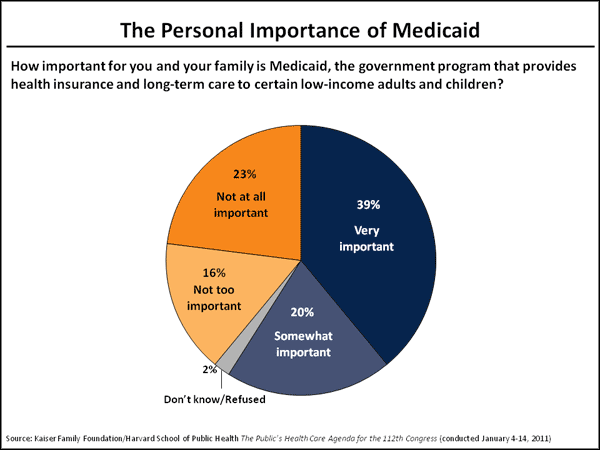
We got some clue about why Medicaid is more popular than the debate about the program might suggest from another question.  Fifty-nine percent of the American people said Medicaid was either “very important” to them or their families (39%) or “somewhat important” (20%).
Personal-Importance-of-Medicaid.gif

In health policy circles it has long been thought that Medicaid’s primary political protection comes from the vital long-term care and acute care services it provides to its elderly and disabled beneficiaries (and the political clout of the providers who serve them), even though these groups makeup a minority of Medicaid beneficiaries.  Those of us who have overseen Medicaid programs at the state level can certainly attest to the influence nursing homes and the disability community have in state legislatures. But with Medicaid now touching 69.5 million Americans in 2011, according to the Congressional Budget Office, and many more over time as beneficiaries and their family members and friends move in and out of the program, a more likely explanation for the program’s surprising support in our poll is simply that it has become more ingrained in the fabric of American life than has been generally realized.  State programs rebranding Medicaid in more popular ways in several states may also have helped change the program’s image with thegeneral public.  Medicaid now covers nearly one in three children, with the recession driving many previously middle-income children onto the program,providing coverage their parents no doubt value.

I have never taken the position that policymakers should follow the polls; they are one factor in a much larger equation. There is also no question that the public wants the deficit addressed, even if they flinch at cutting popular programs. Sixty-four percent ofthe public told us in the same poll that they were “very concerned”about the federal deficit (yes, the American people are fully capable ofembracing conflicting priorities such as reducing thedeficit and preserving popular programs, and that is a challenge forpolicymakers).

No doubt poll results on all the deficit reduction proposals will shift as a real debate breaks out and the public hears the arguments (and the spin).  Public reaction to proposals to cut programs to balance the federal budget could also be quite different from reactions to proposals for cuts at the state level if savings from state budget cuts are used for popular purposes other than general budget balancing, such as education.  We will examine the public’s views on changes in Medicaid and other public programs and proposed spending reductions more fully in upcoming polls.  But for now, with major proposals beginning to be discussed that could fundamentally change the Medicaid program and its role as a foundation for coverage expansion under health reform, it seems important to at least note these preliminary findings. They suggest that the conventional wisdom that Medicaid is an unpopular program that would be much easier to cut or change than the other big public programs could be exaggerated if not simply wrong.

Poll Finding

Kaiser Health Tracking Poll — April 2011

Published: Apr 1, 2011

As Congress and the president debate different approaches to reducing the deficit, the April Kaiser Health Tracking Poll indicates that initial public reaction is fairly evenly split when a premium support/voucher program like the one in House Budget Committee Chairman Paul Ryan’s “Path to Prosperity” proposal is described, but seniors prefer to keep the current Medicare system by a 2‐to‐1 margin. Meanwhile, public opinion on the health reform law remains remarkably steady.

The April poll is the latest in a series designed and analyzed by the Foundation’s public opinion research team.

Findings (.pdf)

Chartpack (.pdf)

Toplines (.pdf)


Federal Core Requirements And State Options In Medicaid: Current Policies And Key Issues

Published: Apr 1, 2011

Medicaid is a jointly financed partnership between the federal government and states. The federal-state financing and administrative structure of Medicaid provides a framework of federal core requirements along with broad state options for program design and administration. This issue brief presents an overview of the current Medicaid program framework, with a focus on eligibility, benefits and cost sharing, care delivery and provider payment, long-term services and supports, and dual eligibles, as well as key issues related to this framework and the balance between federal standards and state options.

Issue Brief (.pdf)

What the Actuarial Values in the Affordable Care Act Mean

Published: Apr 1, 2011

The Patient Protection and Affordable Care Act (PPACA) establishes four levels of coverage based on the concept of “actuarial value,” which represents the share of health care expenses the plan covers for a typical group of enrollees. As plans increase in actuarial value – bronze, silver, gold, and platinum – they would cover a greater share of enrollees’ medical expenses overall, though the details could vary across plans.

The levels of coverage provided for in the PPACA are central to the coverage people will get and how they will ultimately perceive the effects of the health reform law. But an actuarial value is not as intuitive for people as specific deductibles and other out-of-pocket costs. Additionally, estimates of deductibles and other coverage features were not released by the Congressional Budget Office during the legislative debate.

Because projections of deductibles are subject to variation in estimating techniques and databases used, to present the most likely range of out-of-pocket costs, the Foundation commissioned separate analyses from three different actuarial consulting firms to present a range of potential estimates.

The study is part of the new Kaiser Initiative on Health Reform and Private Insurance, which will inform federal and state policymakers as they implement the PPACA and examine the implications of changes in the private insurance market under the health reform law.

Issue Brief (.pdf)

Poll Finding

How Popular Is The Idea Of Changing Medicare To A Defined Contribution Plan?

Published: Apr 1, 2011

In March 2011, House Budget Committee Chair Paul Ryan released his “Path to Prosperity” budget plan, which included a proposal to change Medicare from a defined benefit program into one in which the government pays a specific amount towards the cost of private health insurance for each enrollee. Surveys conducted by five different polling organizations from March-April 2011 have attempted to gauge the level of public support for such a plan, and their results have varied widely, ranging from strong support for keeping Medicare as is, to a roughly even split, to a leaned preference for changing the system. Looking at the five organizations (including KFF) that have released polls on this proposed change to Medicare since the beginning of March, this data note points to several specific aspects of question wording that might be contributing to differences in the results.

Data Note (.pdf)

Poll Finding

The Digital Divide And Access To Health Information Online

Published: Apr 1, 2011

The Affordable Care Act (ACA) calls for a number of web-based initiatives, including development of the website healthcare.gov which provides a variety of health information and helps individuals find coverage options. Therefore, understanding the level and quality of Internet access among those groups most likely to benefit from reform, such as the uninsured, those with lower incomes, and members of racial and ethnic minority groups, is an important consideration as health reform is implemented. A new Data Note, using data from The Washington Post/Kaiser Family Foundation/Harvard University Race and Recession Survey, conducted Jan. 27-Feb. 9, 2011, examines racial and ethnic disparities in the shares who report seeking out health information online, and explores the broader question of how disparities in Internet access might impact the abilities of different groups to access health care information available on the web as part of the ACA.

Data Note (.pdf)

More on the Race and Recession Survey

Physician Willingness and Resources to Serve More Medicaid Patients: Perspectives from Primary Care Physicians

Published: Apr 1, 2011

This issue brief attempts to assess how primary care physicians will respond to the entry of 32 million newly insured people into the health care system under health reform. The increase in the number of people with health coverage is expected to intensify competition among patients and payers for primary care resources.

The brief analyzes data from a nationally representative survey of physicians to assess which adult-care primary care physicians are most likely to respond to health reform’s changes by serving additional Medicaid beneficiaries. It also profiles key aspects of their practices, patient care resources, and constraints on their capacity.

Issue Brief (.pdf)

Mental Health Financing in the United States: A Primer

Published: Apr 1, 2011

This primer provides an overview of behavioral health care, reviews the sources of financing for such care, assesses the interaction between different payers, and highlights recent policy debates in mental health. It also discusses the role of Medicaid, currently the largest source of financing for behavioral health services in the nation, covering a quarter of all expenditures. This comprehensive resource serves as a guide for those who want to understand the complex system of behavioral health financing in the United States.

Primer (.pdf)

Implications Of A Federal Block Grant Program For Medicaid

Published: Apr 1, 2011

This issue brief examines the broad implications of converting Medicaid to block grant financing, one of several ideas that have been put forth to help reduce the federal deficit. The paper, which does not analyze any specific proposal, notes that switching to block grant financing would fundamentally alter the Medicaid program and could have significant implications for states, localities, beneficiaries and health care providers.

Issue Brief (.pdf)

Related Resources: Prior Analyses of Block Grant Proposals

Issues in Restructuring Federal Financing (2005) (.pdf)

Financing Health Coverage: The CHIP Experience (2005)

Financing the Medicaid Program: The Many Roles of Federaland State Matching Funds (2004) (.pdf)

Medicaid and Block Grant Financing Compared (2004)

Federal Dollars and State Flexibility: The Debate Over Medicaid’s Future (1995)

The Impact Of The “Medigrant” Plan On Federal Payments To States (1995)

Poll Finding

Trends in the Use of Hospital and Provider Quality Ratings

Published: Apr 1, 2011

With a renewed emphasis on health care quality driven by the Affordable Care Act, this polling data note examines historical trends in Americans’ reliance on quality ratings and how their perceptions have changed over time.

Data Note (.pdf)