KFF Health Tracking Poll: Public Views on Foreign Aid and Global Health Spending
Findings
U.S. global health efforts have undergone substantial changes since the start of the second Trump administration, including the freezing of funding in early 2025, the cancellation of numerous projects, reduction in funding, and the dissolution of the United States Agency for International Development (USAID)—once the world’s largest foreign aid agency. Following these actions, the State Department released the America First Global Health Strategy, claiming that existing global health programs were “inefficient and wasteful” and that countries were too dependent on the U.S. for support, proposing a new approach to “make America safer, stronger, and more prosperous.” Among other things, the Strategy is anchored in new, time-limited agreements with countries with plans to reduce funding even more, by billions of dollars in the next few years.
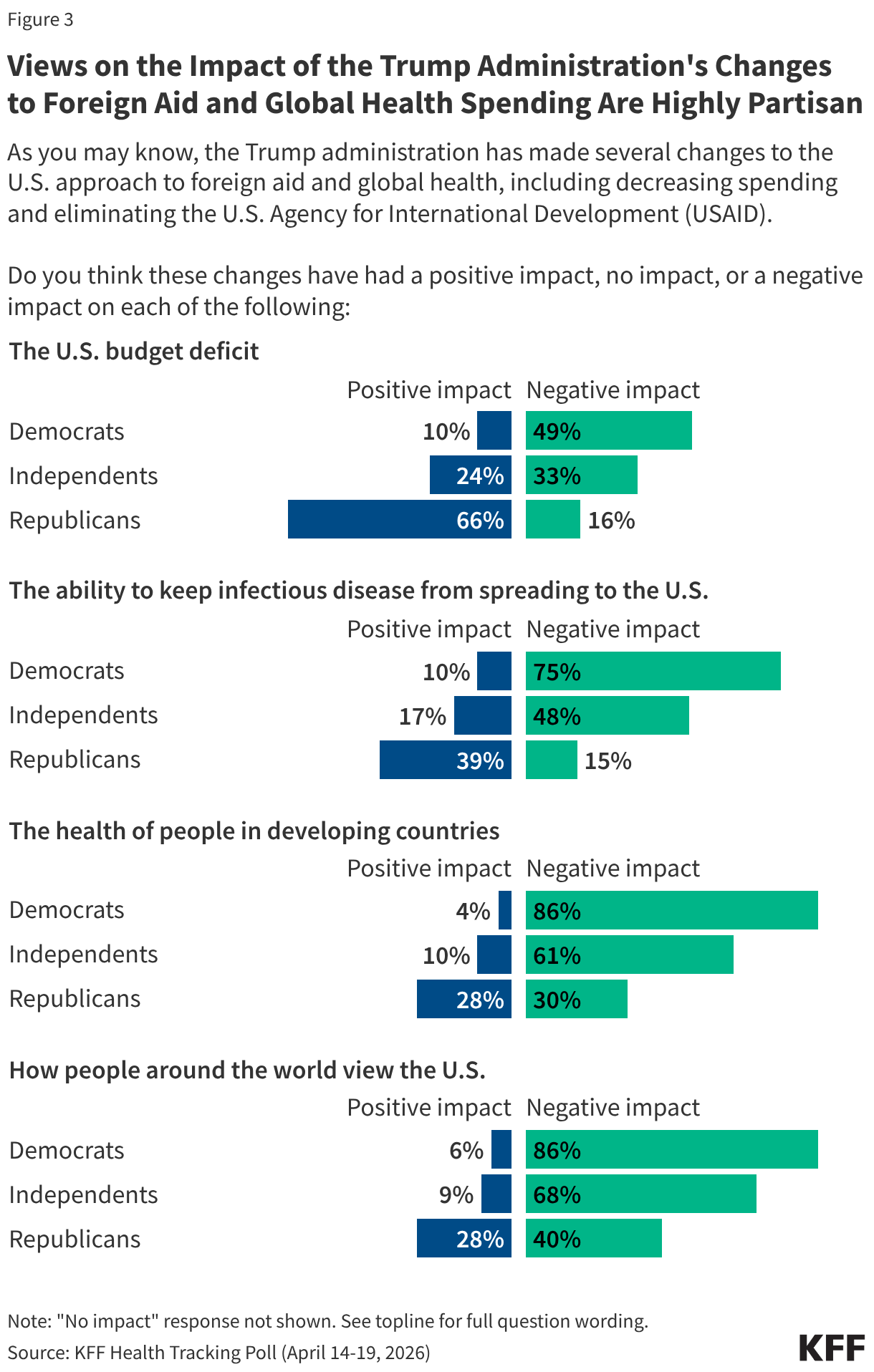
When asked about their awareness of the Trump administration’s reductions to U.S. spending on foreign aid, including funding to improve health for people in developing countries, nearly six in ten (58%) adults correctly identify that the administration has made cuts, including over four in ten (44%) who say there have been “major” cuts and one in seven (14%) who say there have been “minor” cuts. An additional third (36%) of adults say they don’t know enough to say.
While majorities across partisans know there have been reductions to U.S. spending on foreign aid, Democrats are 24 percentage points more likely than Republicans to identify them as “major” cuts (59% vs. 35%, respectively), while a larger share of Republicans than Democrats say there have been “minor” cuts (23% vs. 6%). Among independents, 44% say the administration has made major cuts to spending on foreign aid and 13% say they have made minor cuts.
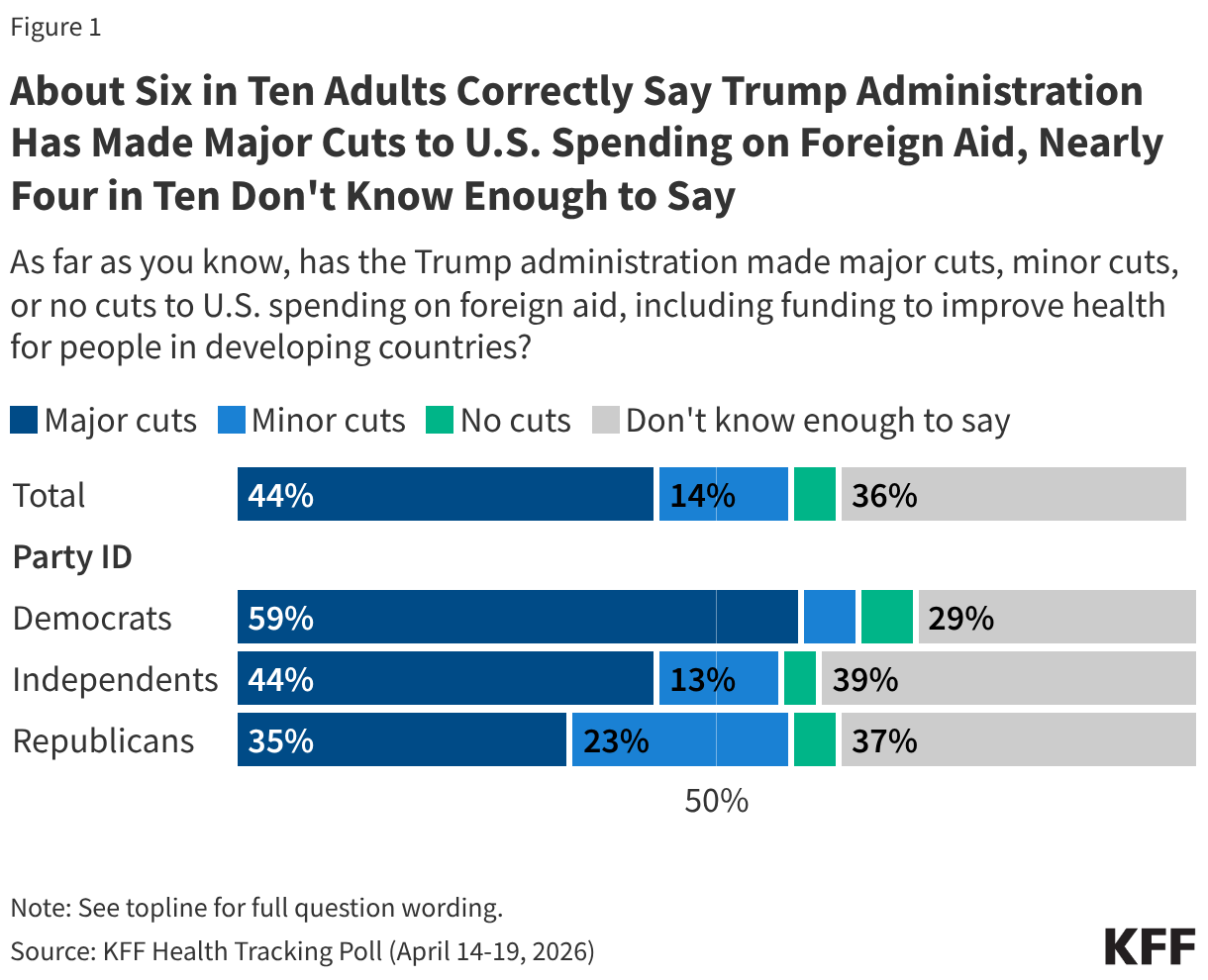
When it comes to assessing the impact of the changes the Trump administration has made to foreign aid and global health, majorities of the public say these changes have had a negative impact on “how people around the world view the U.S.” (64%) and on “the health of people in developing countries” (59%). Additionally, nearly half (46%) say “the ability to keep infectious disease from spreading to the U.S.” has been negatively impacted by the changes made by the Trump administration.
The public is more divided about the impact the Trump administration’s changes to foreign aid and global health have had on the U.S. budget deficit. Similar shares—about one-third—say the changes have had a positive impact (31%), a negative impact (33%), or no impact (35%) on the budget deficit. KFF polling from 2025 found a majority of the public overestimated the share of the federal budget allocated for foreign aid; on average, U.S. adults said foreign aid spending makes up one-quarter (26%) of the federal budget. In reality, about one percent of the federal budget has historically gone to foreign aid, with an even smaller fraction going toward global health efforts.
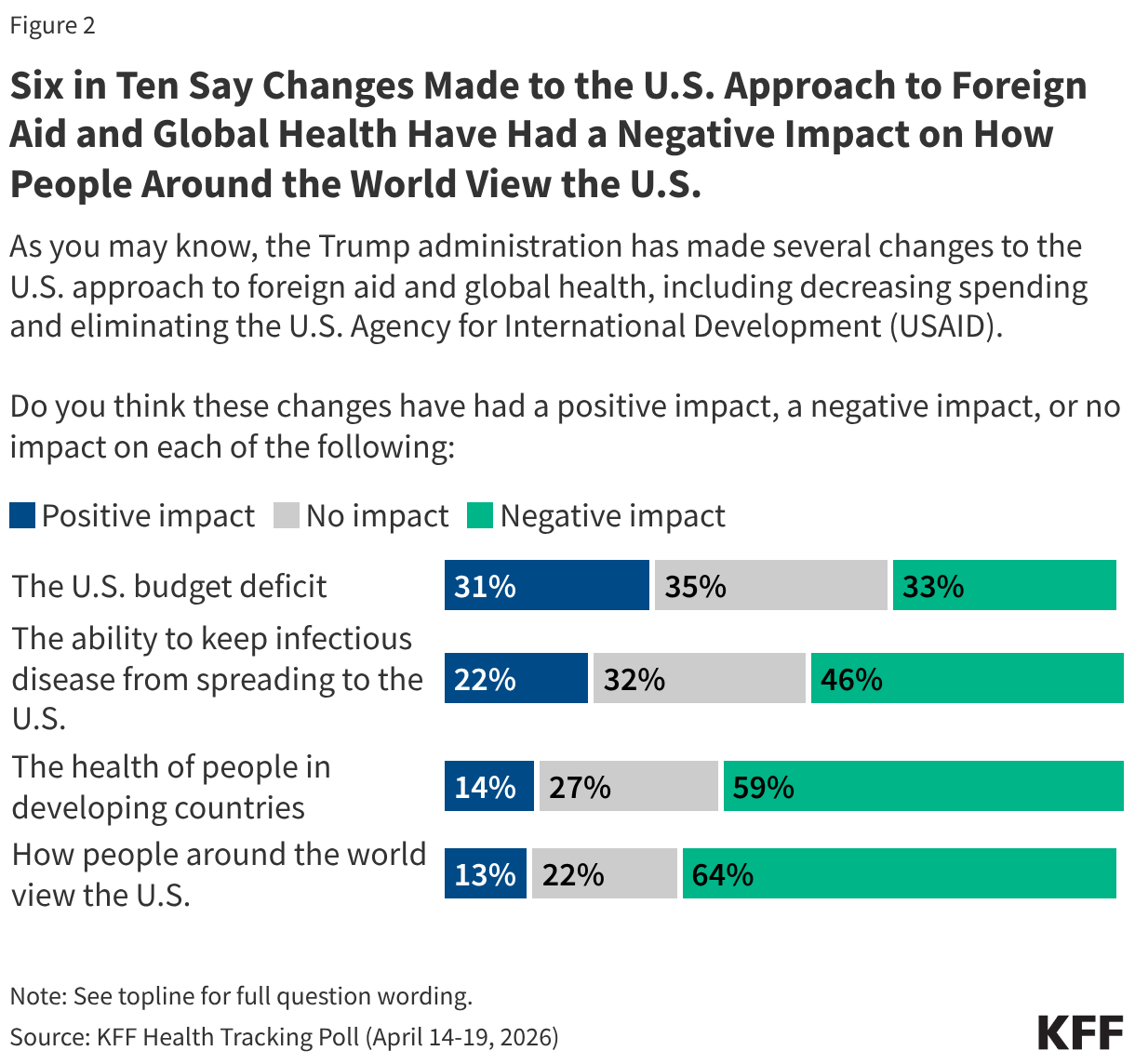
Unsurprisingly, public opinion on the impact of the Trump administration’s changes to U.S. foreign aid and global health efforts is highly partisan, but patterns differ somewhat depending on the impact being measured. Democrats and independents are overwhelmingly more likely to say these changes have had a negative rather than a positive impact on how people around the world view the U.S. (86% vs. 6% and 68% vs. 9%, respectively) and on the health of people in developing countries (86% vs. 4% and 61% vs. 10%). Both groups are also more likely to see a negative rather than a positive impact on the ability to keep infectious disease from spreading to the U.S. and on the U.S. budget deficit, though fewer than half of independents say there has been a negative impact on each of these areas.
In contrast, Republicans are more likely to say some of these areas have been positively rather than negatively impacted, such as the U.S. budget deficit (66% positive, 16% negative) and preventing the spread of infectious diseases to the U.S. (39% positive, 15% negative). Nearly half (46%) of Republicans say there has been no impact at all on preventing the spread of disease, and about one in five (18%) say this about the U.S. budget deficit.
Republicans are split when it comes to the impact of the administration’s changes to foreign aid and global health on the health of people in developing countries, with about three in ten saying these changes have had a positive impact (28%) and another three in ten saying the impact was negative (30%), while 42% say there has been “no impact.” And, when asked about international perceptions of the U.S., more Republicans say the administration’s changes to foreign aid and global health have had a negative impact (40%) than a positive one (28%), and 32% say it has had no impact.
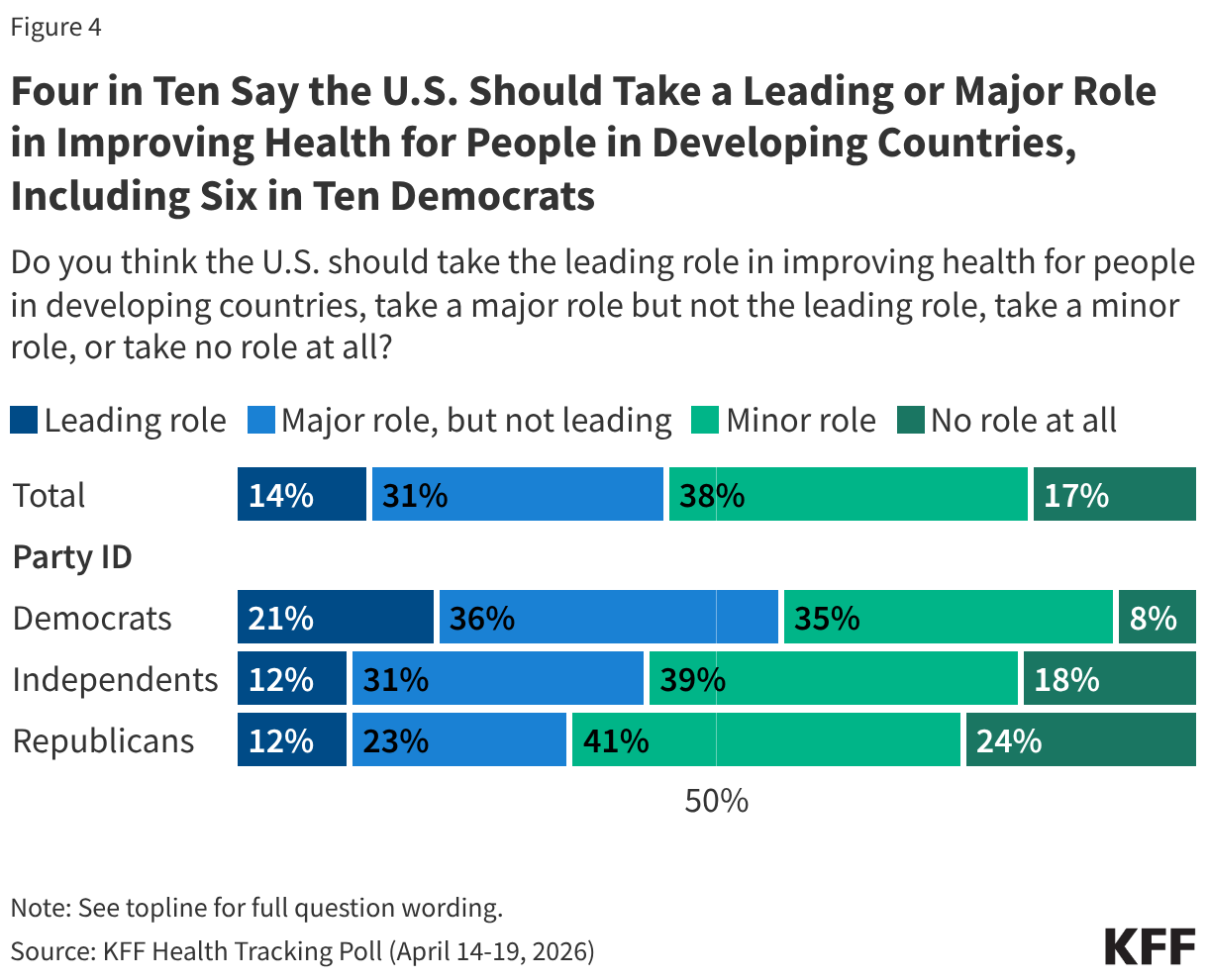
As the Trump administration continues its efforts to significantly reduce U.S. participation in global health efforts, nearly half (45%) of the public supports the U.S. playing a “leading” or a “major, but not a leading” role in improving health for people in developing countries. Nearly six in ten (58%) Democrats say the U.S. should play at least a major role compared to fewer independents (42%) and Republicans (35%) who say the same. Still, the share of Republicans who say the U.S.’s role should be major (35%) is larger than the share who say the U.S. should take “no role at all” (24%) in improving health for people in developing countries. About one in five (18%) independents also say the U.S. should play no role at all in improving health for people in developing countries, and even fewer Democrats say this (8%).
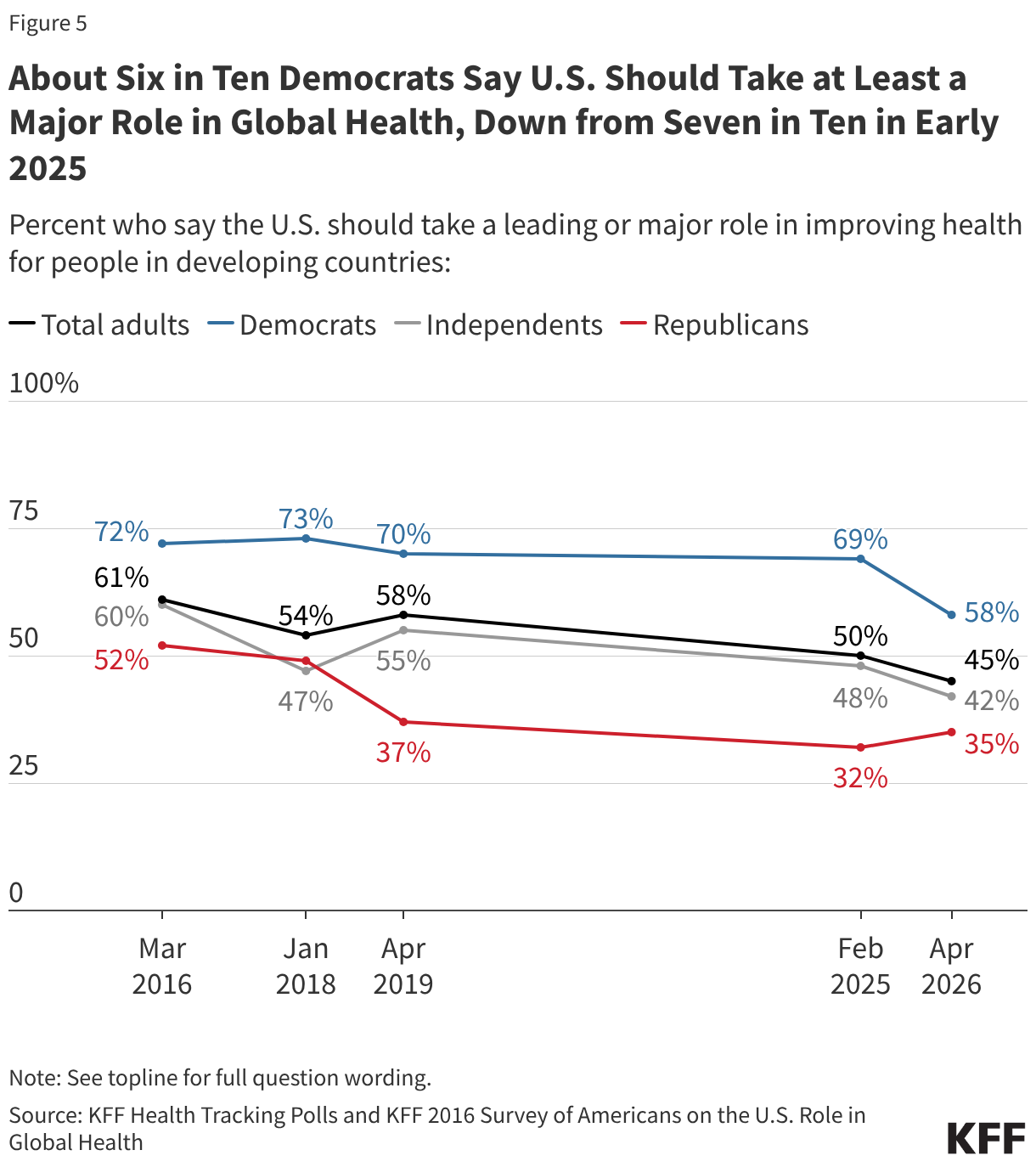
The share who say the U.S. should take a leading or major role in improving health for people in developing countries has declined somewhat since last year (45% now, down from 50% in February 2025), reaching a new low since KFF began asking this question in 2016. The most recent decline includes an 11-percentage point decrease in the share of Democrats who say the U.S. should play at least a major role in this area. The share of Republicans who say the U.S. should have at least a major role in improving global health declined during President Trump’s first term, though it has remained fairly steady since 2019.
Methodology
This KFF Health Tracking Poll was designed and analyzed by public opinion researchers at KFF. The survey was conducted April 14 – April 19, 2026, online and by telephone among a nationally representative sample of 1,343 U.S. adults in English (n=1,251) and in Spanish (n=92). The sample includes 1,023 adults (n=81 in Spanish) reached through the SSRS Opinion Panel either online (n=999) or over the phone (n=24). The SSRS Opinion Panel is a nationally representative probability-based panel where panel members are recruited randomly in one of two ways: (a) Through invitations mailed to respondents randomly sampled from an Address-Based Sample (ABS) provided by Marketing Systems Groups (MSG) through the U.S. Postal Service’s Computerized Delivery Sequence (CDS); (b) from a dual-frame random digit dial (RDD) sample provided by MSG. For the online panel component, invitations were sent to panel members by email followed by up to three reminder emails.
Another 320 (n=11 in Spanish) adults were reached through random digit dial telephone sample of prepaid cell phone numbers obtained through MSG. Phone numbers used for the prepaid cell phone component were randomly generated from a cell phone sampling frame with disproportionate stratification aimed at reaching Hispanic and non-Hispanic Black respondents. Stratification was based on incidence of the race/ethnicity groups within each frame. Among this prepaid cell phone component, 140 were interviewed by phone and 180 were invited to the web survey via short message service (SMS).
Respondents in the prepaid cell phone sample who were interviewed by phone received a $15 incentive via a check received by mail or an electronic gift card incentive. Respondents in the prepaid cell phone sample reached via SMS received a $10 electronic gift card incentive. SSRS Opinion Panel respondents received a $5 electronic gift card incentive (some harder-to-reach groups received a $10 electronic gift card). In order to ensure data quality, cases were removed if they failed two or more quality checks: (1) attention check questions in the online version of the questionnaire, (2) had over 30% item non-response, or (3) had a length less than one quarter of the mean length by mode. Based on this criterion, no cases were removed.
The combined cell phone and panel samples were weighted to match the sample’s demographics to the national U.S. adult population using data from the Census Bureau’s 2024 Current Population Survey (CPS), September 2023 Volunteering and Civic Life Supplement data from the CPS, and the 2025 KFF Benchmarking Survey with ABS and prepaid cell phone samples. The demographic variables included in weighting for the general population sample are gender, age, education, race/ethnicity, region, civic engagement, frequency of internet use and political party identification. The weights account for differences in the probability of selection for each sample type (prepaid cell phone and panel). This includes adjustment for the sample design and geographic stratification of the cell phone sample, within household probability of selection, and the design of the panel-recruitment procedure. Initial coding for open-ended questions was done using BT Insights AI Platform and then reviewed, edited, and finalized by KFF researchers.
The margin of sampling error including the design effect for the full sample is plus or minus 3 percentage points. Numbers of respondents and margins of sampling error for key subgroups are shown in the table below. For results based on other subgroups, the margin of sampling error may be higher. Sample sizes and margins of sampling error for other subgroups are available on request. Sampling error is only one of many potential sources of error and there may be other unmeasured error in this or any other public opinion poll. KFF public opinion and survey research is a charter member of the Transparency Initiative of the American Association for Public Opinion Research.
| Group | N (unweighted) | M.O.S.E. |
|---|---|---|
| Total | 1,343 | ± 3 percentage points |
| Party ID | ||
| Democrats | 420 | ± 6 percentage points |
| Independents | 450 | ± 6 percentage points |
| Republicans | 372 | ± 6 percentage points |