House Appropriations Committee Approves FY 2020 State & Foreign Operations (SFOPs) Appropriations Bill

Published: May 17, 2019

The House Appropriations Committee approved the FY 2020 State & Foreign Operations (SFOPs) appropriations bill (and accompanying report) on May 16, 2019. The SFOPs bill includes funding for U.S. global health programs at the State Department and the U.S. Agency for International Development (USAID).[i] Funding for these programs, through the Global Health Programs (GHP) account, which represents the bulk of global health assistance, totaled $9.3 billion, an increase of $459 million above the FY 2019 enacted level and almost $3 billion above the President’s FY 2020 request.

Key highlights are as follows (see table for additional detail):

  • While funding for most global health programs at State and USAID remained flat compared to the FY19 level, there were increases for the Global Fund to Fight AIDS, Tuberculosis and Malaria (Global Fund), tuberculosis (TB), maternal and child health (MCH), and family planning and reproductive health (FP/RH) programs. In all cases, funding for all programs was above the President’s FY 2020 request, which had proposed significant cuts.
  • Bilateral HIV funding through the President’s Emergency Plan for AIDS Relief (PEPFAR) is $4,700 million in the House FY20 bill, matching the FY19 level and $1,350 million above the FY20 Request ($3,350 million).
  • The bill includes $1,560 million as the U.S. contribution to the Global Fund to Fight AIDS, Tuberculosis and Malaria (Global Fund), an increase of $210 million above the FY19 level ($1,350 million) and $602 million above the FY20 Request ($958 million).
  • Funding for tuberculosis (TB) totals $310 million, $8 million above the FY19 level and $49 million above the FY20 Request ($261 million).
  • Funding for malaria totals $755 million, matching the FY19 level and $81 million above the FY20 Request ($674 million).
  • The bill includes $850 million for maternal and child health (MCH), an increase of $15 million above the FY19 level ($835 million) and $230.4 million above the FY20 Request ($619.6 million). Specific areas under MCH include:
    • Gavi, the Vaccine Alliance, which is included under MCH funding, totals $290 million, matching the FY19 level and $40 million above the FY20 Request ($250 million).
    • Polio funding through the GHP account, which is included under MCH funding, totals $59 million, matching total polio funding provided in FY19 level ($51.5 million through the GHP account and $7.5 million through the ESF account).[ii] The President’s FY 2020 Request did not specify funding for polio.
    • The bill includes $147.5 million for the U.S. contribution to the United Nations Children’s Fund (UNICEF) provided through the International Organizations and Programs (IO&P) account, $10 million above the FY19 level ($137.5 million). While the FY20 Request did not specify a funding amount for UNICEF and proposed to eliminate the IO&P account, it is possible that organizations such as UNICEF could receive funding through other accounts.
  • Funding for nutrition totals $145 million, matching the FY19 level and $66.5 million above the FY20 Request ($78.5 million).
  • Bilateral family planning and reproductive health (FP/RH) funding totaled $750 million, all of which is provided through the GHP account. This is an increase of $175 million above the FY19 enacted level for all accounts ($575 million; $524 million through the GHP account and $51 million through the ESF account) and $491 million above the FY20 Request ($259 million; $237 million through the GHP account and $22 million through the ESF account).[ii]
  • The bill includes $55.5 million as the U.S. contribution to the United Nations Population Fund (UNFPA), an increase of $23 million above the FY19 level ($32.5 million); the FY20 Request proposed eliminating funding for UNFPA.
  • Funding for the vulnerable children program totals $24 million, matching the FY19 level; the FY20 Request proposed eliminating funding for this program.
  • Funding for neglected tropical diseases (NTDs) totals $102.5 million, matching the FY19 level and $27.5 million above the FY20 Request ($75 million).
  • Funding for global health security totals $100 million in the bill. While this is a decrease compared to the FY19 level ($138 million), $38 million of the FY19 amount was provided through a one-time transfer of unspent emergency Ebola funding. The House FY20 amount increased compared to the FY20 Request ($90 million).
  • The bill also included the following policy provisions:
    • Mexico City Policy: The bill includes a permanent repeal of the Mexico City Policy (MCP), as reinstated by President Trump via executive order on January 22, 2017 (see the KFF MCP explainer), and a prohibition on using any current or prior SFOPs appropriations to implement the MCP.
    • Global Fund: The committee report states that the $1.56 billion is for the first installment of the U.S. contribution to the Global Fund’s sixth replenishment unless the conditions specified in PEPFAR’s authorizing legislation, including that U.S. contributions to the Global Fund cannot exceed 33 percent of total contributions to the Global Fund from all sources, are not met (see the KFF PEPFAR reauthorization side-by-side).
    • Transfer of Funds: While the bill provides the Secretary of State and USAID Administrator the ability to transfer a percentage of the funding amounts specified in the explanatory statement between accounts and/or areas, it specifically states that this authority does not apply to the Global Health Programs (GHP) account. This provision has been included in annual appropriations bills since FY 2017.

Resources:

  • FY2020 State and Foreign Operations Appropriations Bill – Bill
  • FY2020 State and Foreign Operations Appropriations Bill – Report
  • Details on U.S. global health funding provided in the House FY 2020 Labor, Health and Human Services, and Education (LHHS) Appropriations Bill, which was approved by full committee on May 8, 2019 can be found here.

The table (.xls) below compares global health funding in the FY 2020 House SFOPs appropriations bill to the FY 2019 enacted funding amounts as outlined in the “Consolidated Appropriations Act, 2019” (P.L. 116-6; KFF summary here) and the President’s FY 2020 request (KFF summary here).


Table: KFF Analysis of FY20 House SFOPs Funding for Global Health
Department / Agency / AreaFY19Enactedi(millions)FY20Requestii(millions)FY20Houseiii(millions)Difference(millions)
FY20 House- FY19 EnactedFY20 House- FY20 Request
 SFOPs – Global Health
HIV/AIDS$4,700.0$3,350.0$4,700.0$0 (0%)$1,350.0 (40%)
State Department$4,370.0$3,350.0$4,370.0$0(0%)$1,020.0(30.4%)
USAID$330.0$0.0$330.0$0(0%)$330.0(NA)
of which Microbicides$45.0$0.0$45.0$0(0%)$45.0(NA)
Global Fund$1,350.0$958.4$1,560.0$210.0 (16%)$601.6 (63%)
Tuberculosisiv $262.0 – – –
Global Health Programs (GHP) account$302.0$261.0$310.0$8.0(3%)$49.0(19%)
Economic Support Fund (ESF) accountNot specified$1.0Not specified – –
Malaria$755.0$674.0$755.0$0 (0%)$81.0 (12%)
Maternal & Child Health (MCH)vvi – – –
GHP account$835.0$619.6$850.0$15.0(2%)$230.4(37%)
of which Gavi$290.0$250.0$290.0$0(0%)$40(16%)
of which Polio$51.5$16.0$59.0$7.5(15%) $43(270%)
UNICEFvii$137.5Not specified$147.5$10.0(7%) –
ESF accountNot specified$75.5Not specified – –
of which Polio$7.5$7.0Not specified – –
Nutritionviii$89.7 – – –
GHP account$145.0$78.5$145.0$0(0%)$66.5(85%)
ESF accountNot specified$11.2Not specified – –
Family Planning & Reproductive Health (FP/RH)ix$607.5$259.0$805.5$198.0 (33%) $546.5(211%)
Bilateral FP/RH$575.0$259.0$750.0$175.0(30%)$491.0(190%)
GHP account$524.0$237.0$750.0$226.1(43%)$513.0(216%)
ESF account$51.1$22.0Not specified – –
UNFPA$32.5$0.0$55.5$23.0(71%) $55.5(NA)
Vulnerable Children$24.0$0.0$24.0$0 (0%)$24.0(NA)
Neglected Tropical Diseases (NTDs)$102.5$75.0$102.5$0 (0%)$27.5 (37%)
Global Health Security$138.0$90.0$100.0$-38.0 (-28%)$10.0 (11%)
GHP account$100.0$90.0$100.0$0(0%)$10.0(11%)
Ebola transfer$38.0$0.0$0.0$-38.0(-100%) –
Emergency Reserve Fundx$2.0$0.0$10.0$8.0 (400%)$10.0(NA)
Ebola transfer$2.0$0.0$0.0$-2.0(-100%)$0(NA)
Total (GHP account only)$8,837.5$6,343.5$9,296.5$459.0 (5%)$2,953.0 (47%)
Notes:
i – The FY19 Enacted includes the transfer of $40.0 million in unspent Emergency Ebola funding including: $2.0 million for the Emergency Reserve Fund and $38.0 million for “programs to accelerate the capacities of targeted countries to prevent, detect, and respond to infectious disease outbreaks.”
ii – In the FY20 Request, the administration proposed to consolidate the Development Assistance (DA), Economic Support Fund (ESF), the Assistance for Europe, Eurasia, and Central Asia (AEECA), and the Democracy Fund (DF) accounts in to one new account — the Economic Support and Development Fund (ESDF). ESF funding for the FY20 Request reflects the amounts requested by the administration for ESDF.
iii – The House FY20 SFOPs bill proposes to move the Economic Support Fund (ESF) from “Bilateral Economic Assistance” to “Security Assistance” and “redirects development, and most democracy and governance, funding that is long-term in nature to the Development Assistance or Democracy Fund accounts.” If the House FY20 bill is approved by Congress, it is possible that global health funding previously provided under the ESF account may be provided under the Development Assistance (DA) account.
iv – Some tuberculosis funding is provided under the ESF account, which is not earmarked by Congress in the annual appropriations bills and determined at the agency level (e.g. in FY17, TB funding under the ESF account totaled $2.64 million).
v – Some MCH funding is provided under the ESF account, which is not earmarked by Congress in the annual appropriations bills and determined at the agency level (e.g. in FY17, MCH funding under the ESF account totaled $56.54 million).
vi – It is not possible to calculate total MCH funding in the FY20 request because UNICEF, which has historically received funding through the International Organizations and Programs (IO&P) account, was not specified in the FY20 request.
vii – UNICEF funding in the FY19 Enacted totaled $137.5 million, of which $5 million is earmarked for programs addressing female genital mutilation.
viii – Some nutrition funding is provided under the ESF account, which is not earmarked by Congress in the annual appropriations bills and determined at the agency level. (e.g. in FY17, nutrition funding under the ESF account totaled $21 million).
ix – In prior fiscal years, bilateral FP/RH funding has been provided through both the GHP and ESF accounts. The report accompanying the House FY20 SFOPs bill states that “The Committee recommendation includes $750,000,000 for reproductive health and voluntary family planning in this Act.” All of this funding is included under the GHP account. The bill summary released by the House Committee on Appropriations states that the $750 million for FP/RH is an increase of $175 million above total funding provided in FY19 (GHP and ESF accounts).
x – The draft House FY20 appropriations bill states that “up to $10,000,000 of the funds made available under the header ‘Global Health Programs’ may be made available for the Emergency Reserve Fund.” Based on the language in the bill and the GHP totals presented in the report, this is not a specified funding line but is an authority given to the administration to transfer funds specified for other purposes under the GHP account to the Emergency Reserve Fund.

[i] Total funding for global health is not currently available as some funding provided through USAID and DoD is not yet available.

[ii] The House FY20 SFOPs bill proposes to move the Economic Support Fund (ESF) from “Bilateral Economic Assistance” to “Security Assistance” and “redirects development, and most democracy and governance, funding that is long-term in nature to the Development Assistance or Democracy Fund accounts.” If the House FY20 bill is approved by Congress, it is possible that global health funding previously provided under the ESF account may be provided under the Development Assistance (DA) account.

Why Bolstering Trust in Journalism Could Help Strengthen Trust in Medicine

Author: David Rousseau
Published: May 16, 2019

Mistrust and confusion created by the 21st-century information ecosystem have contributed to outbreaks of once-eradicated vaccine-preventable disease, to overhyped research findings that confuse the public, and to distrust in the financial motivations of physicians, hospitals, insurers, and drug and device manufactures alike.

Co-authored by KFF Vice President David Rousseau, Vineet M. Arora of University of Chicago Medicine, and Gary Schwitzer of the University of Minnesota School of Public Health, this perspective highlights the important relationship between medicine and trust in news media and articulates three ways that clinicians, health care organizations, and journalists might begin to rebuild the foundation of trust on which both medicine and journalism rely. It was published in the Journal of the American Medical Association.

News Release

“Deductible Relief Day” is May 19

On That Date, Health Spending for People in Employer Plans Will Exceed Average Deductibles

Published: May 16, 2019

Deductible Relief Day is May 19.

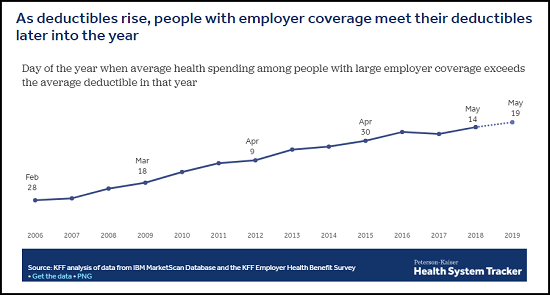
That’s the date by which average spending for people with employer-sponsored health insurance is sufficient to satisfy the average deductible, the amount they must pay out-of-pocket for most health care services before their insurance plan kicks in to help pay the bills, KFF analysts explain in a new analysis.

If you have not heard of Deductible Relief Day before, that is because we just invented it. But the issue it illuminates is real and represents a growing cost to consumers as deductibles have risen in recent years and become an increasingly prominent feature of employer health plans.

The analysis documents that:

  • Deductibles are rising. In 2009, the average deductible was $533 for a single person. In 2018, it was $1,350, an increase of over 150 percent.
  • More people have to pay them. In 2018, about 85 percent of covered workers were enrolled in an employer plan with a deductible, compared to 59 percent a decade earlier.
  • People are paying more. Average enrollee spending on deductibles has more than tripled from $130 in 2007 to $411 in 2017. Overall, out-of-pocket health spending among people with employer coverage has gone up from $493 in 2007 to $792 in 2017, with much of the increase taking the form of higher spending on deductibles.

As deductibles rise and become more common, it takes longer for people with employer coverage to satisfy their deductibles each year and begin benefiting more fully from the financial protection of their health plan. May 19 is Deductible Relief Day this year, but ten years ago, when deductibles were smaller and less prevalent, it fell on March 18, 2009. While health care costs have increased over time, deductibles have increased even more.

Since some enrollees do not have enough savings or discretionary income to be able to pay a typical deductible, these costs, which tend to be concentrated when an enrollee uses services, can lead people to delay care or struggle to pay medical bills. They also often face additional out-of-pocket costs even after meeting their deductible. Such costs include copays, a fixed amount patients must pay when visiting the doctor or receiving a medical service, and coinsurance, the portion of a medical bill the consumer is required to pay while the insurer pays the rest.

The analysis is part of the Peterson-Kaiser Health System Tracker, an online information hub dedicated to monitoring and assessing the performance of the U.S. health system.

Deductible Relief Day: How Rising Deductibles are Affecting People with Employer Coverage

Published: May 16, 2019

This analysis examines how health insurance deductibles are affecting consumers with employer-sponsored insurance. Deductibles have risen in recent years and become an increasingly prominent feature of job-based health plans.

“Deductible Relief Day” refers to the date by which average spending for people with employer-sponsored health insurance is sufficient to satisfy the average deductible, the amount consumers must pay out-of-pocket for most health care services before their insurance plan kicks in to help pay the bills.

The analysis is part of the Peterson-Kaiser Health System Tracker, an online information hub dedicated to monitoring and assessing the performance of the U.S. health system.

A First Look at North Carolina’s Section 1115 Medicaid Waiver’s Healthy Opportunities Pilots

Authors: Elizabeth Hinton, Samantha Artiga, MaryBeth Musumeci, and Robin Rudowitz
Published: May 15, 2019

Executive Summary

Medicaid funds typically cannot be used to pay for non-medical interventions that target the social determinants of health. However, in October 2018, CMS approved North Carolina’s Section 1115 waiver which provides financing for a new pilot program, called “Healthy Opportunities Pilots,” to cover evidence-based non-medical services that address specific social needs linked to health/health outcomes. The pilots will address housing instability, transportation insecurity, food insecurity, and interpersonal violence and toxic stress for a limited number of high-need enrollees. This waiver differs from others recently approved by the Trump Administration that aim to address health determinants by conditioning coverage on meeting work requirements. The pilot program may yield important evidence about how addressing certain non-medical needs may impact program costs and health outcomes. However, the scope and impact of the program is restricted by its limited funding. Implementing a long-term program on a broader scale would require larger sustainable financing streams and it’s unclear at this point whether CMS will use this waiver as a model for other states. This brief summarizes key features of the Healthy Opportunities Pilots.

Healthy Opportunities Pilots Key Highlights

Funding – CMS authorized $650 million in Medicaid funding for the pilot over five years, $100 million of which will be available for capacity building.

Pilot area – will include two to four regions of the state and is expected to serve approximately 25,000 to 50,000 beneficiaries, or about 1% to 2% of total Medicaid enrollees in North Carolina.

Eligible beneficiaries – must be enrolled in a managed care plan and must have at least one physical or behavioral health risk factor and at least one social risk factor.

Pilot services – will include evidence-based enhanced case management and other services, which must be approved by CMS, to address enrollee needs related to housing, food, transportation, and interpersonal safety.

Health plans – will manage the pilot budget and, working in close collaboration with care managers, will determine enrollee eligibility and authorize the delivery of pilot services.

Lead Pilot Entities (LPEs) – will develop, contract with, and manage the network of human service organizations that will deliver pilot services.

Timeline – The state will release an RFP for LPEs by November 2019 and anticipates beginning to deliver pilot services in late 2020.

Issue Brief

Background

There has been growing recognition that although health care is essential to health many broader social and environmental factors play a major role in shaping health. Social determinants of health are the conditions in which people are born, grow, live, work, and age.1  They include factors like socioeconomic status, education, neighborhood and physical environment, employment, nutrition/food security, and social support networks, as well as access to health care. In recent years, a broad range of initiatives have been launched at the federal, state, and local levels and by plans and providers to address social determinants of health, including efforts within Medicaid. These efforts stem from increasing rates of coverage under the Affordable Care Act (ACA), new funding and demonstration authorities provided through the ACA, and an increasing shift across the health system toward value- or outcome-based payments and “whole person” care.

Under a new waiver, North Carolina’s Medicaid program will pay for non-medical interventions that address housing instability, transportation insecurity, food insecurity and interpersonal violence & toxic stress for a limited number of high-need enrollees

Within Medicaid, states can use a range of optional state plan and waiver authorities (e.g., 1915(i), 1915(c), or Section 1115) to add certain non-clinical services to the Medicaid benefit package including case management, housing supports, employment supports, and peer support services for people who need help with self-care or household activities as a result of disability or chronic illness. Generally, states have not been able to use federal Medicaid funds to pay the direct costs of non-medical services like housing and food. Under federal Medicaid managed care rules, managed care plans have some limited flexibility to pay for non-medical services.2  Additionally, other recent Medicaid payment and delivery system reforms, like the formation of Accountable Care Organizations (ACOs), may provide flexibility or opportunities to cover non-medical services that support health.

Section 1115 Medicaid demonstration waivers provide states an avenue to test new approaches in Medicaid that differ from what is allowed by federal statute. States can obtain approval for Section 1115 demonstration waivers that test broad changes in Medicaid eligibility, benefits and cost-sharing, and payment and delivery systems as long as the Secretary determines that the demonstration is furthering the objectives of the Medicaid program. Waivers generally reflect priorities identified by states and CMS and often reflect changing priorities from one administration to another.

The current administration has largely marked a new direction for Medicaid demonstration waivers, including the approval of waivers that condition Medicaid eligibility on meeting work and reporting requirements as well as the approval of other policies that restrict eligibility and enrollment. In its approval of these demonstrations, the administration asserts such policies are designed to address health determinants (like employment) and to ultimately improve health outcomes.3  These new waivers run counter to many other efforts to address social determinants of health that focus on identifying social needs and facilitating links to services rather than making individuals’ health coverage dependent on meeting certain requirements – like reporting minimum monthly work hours.

CMS’s approval of North Carolina’s enhanced case management pilots within the state’s new Medicaid managed care delivery system stands in contrast to this recent trend in waiver approvals. This waiver allows the state to use Medicaid to pay directly for non-medical interventions that target the social determinants of health, although the program scope is restricted by its limited funding.

Overview of North Carolina’s Section 1115 Waiver

In 2015, the North Carolina General Assembly passed legislation that required the state’s Medicaid program to transition from its long-standing enhanced PCCM model to capitated managed care.4  Although the use of capitated managed care does not require Section 1115 waiver authority, as part of this transition, the state pursued certain elements, including an “Institution for Mental Disease” (IMD) waiver, pilots to address targeted health-related needs, a tribal uncompensated care pool, workforce innovation fund, and behavioral health home capacity-building funds which required submission of a Section 1115 waiver.5 ,6  In October 2018, CMS approved North Carolina’s Section 1115 waiver, including its transition from a fee-for-service (FFS) Medicaid delivery system to a capitated managed care program. North Carolina aims to transition approximately 1.5 million of its 2 million Medicaid enrollees to the new managed care delivery system.7  The state will begin transitioning enrollees by region to managed care “standard” plans in November 2019. Standard plans will cover physical, behavioral health, and pharmacy benefits. In 2021, the state plans to launch “tailored” plans for enrollees that have more significant mental health, intellectual or developmental disabilities, substance use, and traumatic brain injury needs.8  The state will also add “specialized” plans for foster care youth and former foster care youth. The state will require health plans to contract with local care management entities, including advanced medical homes and local health departments.

Within the new Medicaid managed care delivery system and care management infrastructure, CMS also approved a Healthy Opportunities Pilot program. All health plans must implement standardized screening questions to assess enrollees’ non-medical needs. If unmet needs are identified, plans will connect beneficiaries to community resources. Plans will have access to a statewide tool – NCCARE360 – to identify community resources and track and monitor referrals.9  Beyond these statewide efforts, in select regions, the Healthy Opportunities Pilots will authorize the use Medicaid funds to pay for enhanced case management and other support services for certain high-risk enrollees that meet physical or behavioral health and social risk factor criteria. The program aims to reduce health care costs and improve health outcomes by providing services to address housing instability, transportation insecurity, food insecurity, and interpersonal violence and toxic stress. The program is the first of its kind approved by CMS, allowing Medicaid funds to be used to pay for non-medical interventions that target the social determinants of health. CMS authorized $650 million in Medicaid funding for the pilot over five years. Funding for the pilot is part of the broader Section 1115 waiver in which the state must demonstrate budget neutrality to the federal government – meaning federal costs under the waiver must not exceed what federal costs would have been for that state without the waiver.10 

Key Features of the Healthy Opportunities Pilots

The state will operate the Healthy Opportunities Pilot program in two to four regions. Reflecting the program’s funding limitations, it expects to serve approximately 25,000 to 50,000 beneficiaries (or about 1% to 2% of total Medicaid enrollees) through the pilot program.

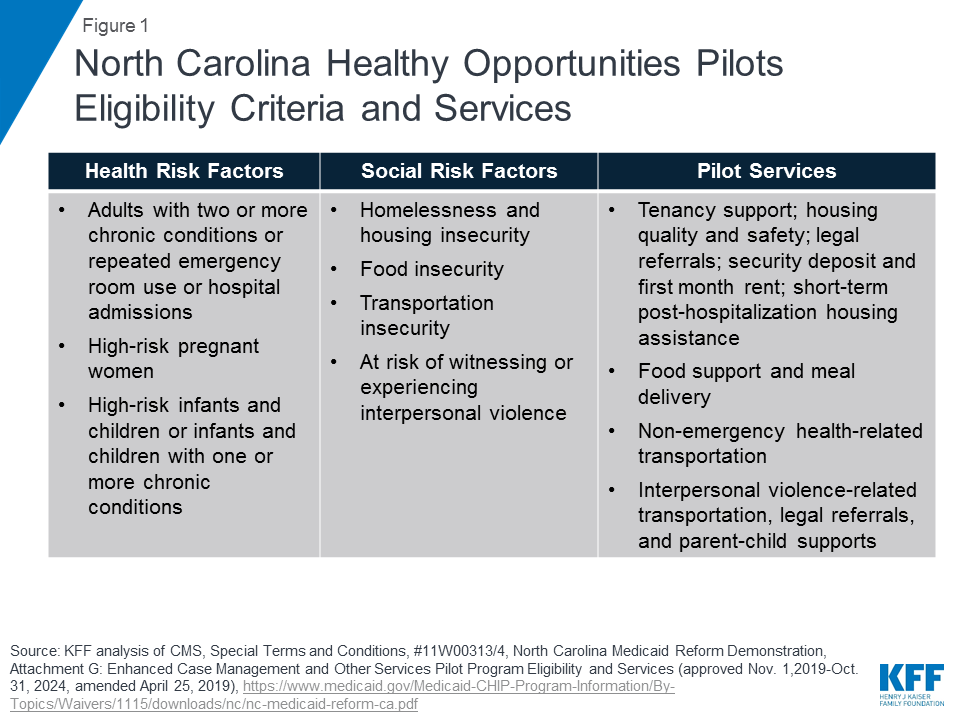
To be eligible to participate in the pilot program, beneficiaries must be enrolled in a managed care plan (standard, tailored, or a specialized plan) and must have at least one physical or behavioral health risk factor and at least one social risk factor (Figure 1). Health risk factors include adults with two or more chronic conditions or repeated emergency room use or hospital admissions; high-risk pregnant women (e.g., multifetal gestation, chronic condition likely to complicate pregnancy); and high-risk infants and children (e.g., prematurity, low birth weight, Neonatal Abstinence Syndrome, or one or more uncontrolled chronic conditions). Social risk factors include homelessness and housing insecurity, food insecurity, transportation insecurity, and being at-risk of witnessing or experiencing interpersonal violence. Participation in the pilot is voluntary and enrollees may opt out at any time.

Figure 1: North Carolina Healthy Opportunities Pilots Eligibility Criteria and Services

Pilot services will include evidence-based enhanced case management and other services designed to address enrollee needs related to: housing, food, transportation, and interpersonal safety. For example, pilot services may include housing modifications (e.g., carpet replacement, air conditioner repair) to improve a child’s asthma control, travel vouchers to a community-based food pantry or a medically-targeted healthy food box for an adult with diabetes living in a rural food desert, or assistance securing safe housing for a pregnant woman experiencing interpersonal violence.11  The care manager will recommend pilot services at the lowest intensity level that can be reasonably expected to meet an individual’s needs. Pilot transportation services include non-emergency health-related transportation including transportation to social services or to access pilot services. (Transportation services under the pilot are in addition to the non-emergency medical transportation (NEMT) benefit states are required to provide which helps ensure Medicaid beneficiaries have transportation to and from medical providers.) Approved pilot services are outlined in the waiver special terms and conditions.12  Any changes to the pilot services list must be reviewed and approved by CMS. Currently approved pilot services are also broadly outlined in Figure 1 (see Appendix for additional detail).

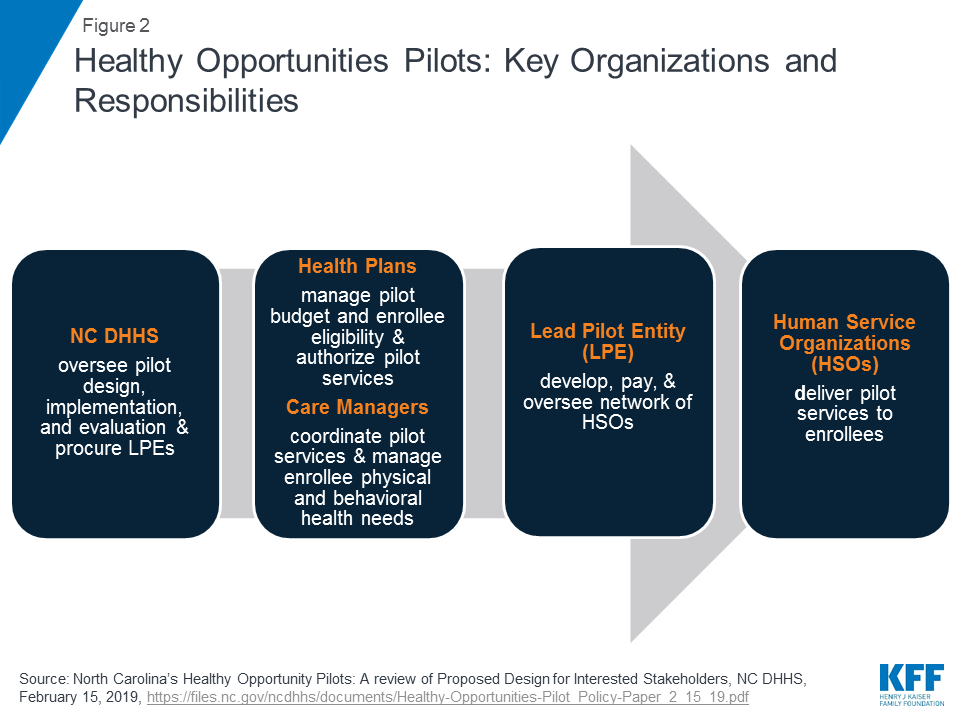
The state will require health plans to participate in the pilot program if they operate within any of the selected pilot regions. Health plans will be responsible for managing their pilot budget and may set enrollment caps/restrictions, if approved by the state – if/when the plan has limited funding capacity to serve all eligible enrollees (Figure 2). Health plans, in collaboration with care managers, will identify eligible enrollees and will seek consent from them to participate in the pilot program. Care managers will use standardized screening questions to assess health-related unmet resource needs.13  Health plans and their care managers will determine the pilot services to be provided to each enrollee and will work in collaboration with the lead pilot entity (LPE) to track enhanced case management and other pilot services. Every three months, health plans will review the pilot services each enrollee is receiving to ensure the services are meeting the enrollee’s needs. Plans must reassess enrollee pilot eligibility every six months. Health plans will also be required to participate in “learning communities” to disseminate best practices across regions.

Figure 2: Healthy Opportunities Pilots: Key Organizations and Responsibilities

Each region will have one lead pilot entity (LPE) that will serve as the regional pilot coordinator and will be accountable for pilot operations. The state will select LPEs through a competitive procurement process. The state expects LPEs to be rooted in their communities, indicating entities best positioned for this role may include, community-based organizations, county-based public agencies, local health departments, social services or multiservice agencies, community health centers, community health foundations, associations, or a partnership of agencies.14  The state expects LPEs will be “anchored by” a community-based health or social service organization and will not be led by a health system. LPEs will develop, contract with, and manage the network of participating pilot providers, including community-based organizations, social service agencies, and health care providers, that will deliver pilot services. LPEs will develop payment protocols and procedures and will track payments made to pilot providers. They will monitor and track pilot services and report on metrics for rapid cycle and summative evaluations. LPEs will provide technical assistance to health plans and providers and will participate in “learning communities.”

CMS authorized $650 million in federal and state Medicaid funding for the pilot over five years, $100 million of which will be available for capacity building. The state will distribute funding for the pilots to the participating health plans. Funding for each plan, which is outside of their capitation rate, will be a capped allocation based on the volume and cost of pilot services delivered to enrollees, including an administrative fee. Health plans will distribute funds to lead pilot entities. The LPEs will then distribute funds to providers authorized to deliver pilot services. The majority of pilot funding must be used to deliver pilot services. To ensure pilot funding is not used for a single domain (e.g., housing) or for a single population, the state plans to establish requirements regarding the minimum share of pilot funds that must be used for each of the four domains and across populations. LPEs may use capacity building funding to develop infrastructure/systems to prepare providers to deliver services, receive payment, and report on managing patient care. LPEs may also use capacity building funds for monitoring and program integrity purposes as well as for providing technical assistance. Federal financial participation (FFP) will be calculated based on aggregated amounts actually paid by the state to pilot providers, LPEs, and health plans.15 

Pilot services will be reimbursed through two methods: fee-for-service/cost-based reimbursement and bundled payments. The state must develop and submit fee schedules, cost-based reimbursement service sets, and bundled payment fee schedules to CMS for review no later than July 1, 2019. Over the course of the demonstration, the state must incorporate value-based payments for pilot services, increasingly linking payments for pilot services to health outcomes. The state will incorporate incentive payments in demonstration years one and two, withholds in years three and four, and shared savings arrangements in year five.

The state must develop an evaluation design for the pilot program, and must use an independent evaluator to conduct a summative pilot program evaluation as well as rapid cycle assessments. The rapid cycle assessments will help the state identify which interventions are most and least effective, so the state can make any necessary mid-course adjustments. Evaluation activities will also help the state identify effective services to incorporate into managed care statewide after the pilot ends.

The state’s Section 1115 waiver was approved for a 5-year period from November 1, 2019 through October 31, 2024. The state will release a Request for Proposal (RFP) in two to four regions detailing roles and responsibilities for LPEs by November 1, 2019. The state anticipates that the pilots will begin delivering services in late 2020.16 

Looking Ahead

CMS’s approval of North Carolina’s enhanced case management pilots within the state’s new Medicaid managed care delivery system is notable, as Medicaid funds typically cannot be used to pay directly for non-medical interventions that target the social determinants of health and as the Trump administration has been largely focused on more restrictive policies that may result in coverage loss, like work requirements, in its effort to help states address determinants of health and improve health outcomes. In contrast, the pilots approved in North Carolina will use coverage, and service provision, to support health-related needs. The pilot program may yield important evidence involving how addressing certain non-medical needs may impact program costs and health outcomes. However, the scope and impact of the program is restricted by its limited funding. Implementing a long-term program on a broader scale would require larger sustainable financing streams and it’s unclear at this point whether CMS will use this waiver as a model for other states. managed care delivery system is notable, as Medicaid funds typically cannot be used to pay directly for non-medical interventions that target the social determinants of health and as the Trump administration has been largely focused on more restrictive policies that may result in coverage loss, like work requirements, in its effort to help states address determinants of health and improve health outcomes. In contrast, the pilots approved in North Carolina will use coverage, and service provision, to support health-related needs. The pilot program may yield important evidence involving how addressing certain non-medical needs may impact program costs and health outcomes. However, the scope and impact of the program is restricted by its limited funding. Implementing a long-term program on a broader scale would require larger sustainable financing streams and it’s unclear at this point whether CMS will use this waiver as a model for other states.

Appendix

Healthy Opportunities Pilot Services Examples
HousingTenancy support and sustaining services
  • Assisting with identifying housing preferences, completing housing application and selection process, developing housing support plan, completing reasonable accommodations requests, reducing risk of eviction (conflict resolution etc.)
  • Supports for budgeting and financial literacy and independent living skills
  • Assessing housing/living environment health risks
  • Assisting with moving into stable housing through arranging the move, assessing unit’s readiness for move-in
  • Providing funding for utility set-up and moving costs (provided funding is not available through any other program)

Housing quality and safety improvement services

  • Repairs or remediation for issues such as mold or pest infestation
  • Modifications to improve housing accessibility (e.g., ramps, rails) and safety (e.g., grip bars in bathtubs)

Legal assistance

  • Connecting enrollees with community resources to address legal issues impacting housing

Securing housing payments

  • Providing one-time payments for security deposits and first month’s rent (provided funding is not available through any other program)

Short-term post-hospitalization

  • Housing for short period of time post-hospitalization, not to exceed six months, if individual is at imminent risk of homelessness (provided funding is not available through any other program)
FoodFood support services
  • Assisting with SNAP and WIC applications, accessing school-based food programs, and locating food banks or food programs
  • Nutrition counseling and education
  • Funding for meal and food support from food banks or other community-based food programs

Meal delivery services

  • Funding for targeted nutritious food or meal delivery services for individuals with medical or medically-related special dietary needs (provided funding is not available through any other program)
TransportationNon-emergency health-related transportation
  • Transportation services to social services that promote community engagement
  • Providing education assistance in gaining access to public transit
  • Providing payment for public transportation to support ability to access pilot and other community-based and social services
Interpersonal Violence (IPV) / Toxic StressIPV-related transportation
  • Transportation to/from IPV service providers

IPV and parenting

  • Assistance with linkages to community-based social service and mental health agencies with IPV expertise

Support resources

  • Assistance with linking to child care and after school programs
  • Assistance with linking to programs to increase capacity to participate in community engagement
  • Navigational services that improve safety and health of IPV victims (e.g., obtaining new phone number and mailing address, securing shelter and longer-term housing, connecting enrollees to medical-legal partnerships)

Legal assistance

  • Connecting beneficiary to legal services for IPV related issues

Child-parent support

  • Evidence-based parenting support programs and home-visiting services
  • Dyadic therapy treatment for children/adolescents at risk of attachment disorder

SOURCE: North Carolina’s Medicaid Reform Demonstration, approved October 19, 2018, see Attachment G.

Endnotes

  1. “About Social Determinants of Health,” World Health Organization, accessed March 22, 2019, http://www.who.int/social_determinants/sdh_definition/en/. ↩︎
  2. Under federal Medicaid managed care rules, Medicaid MCOs may have flexibility to pay for non-medical services through “in-lieu-of” authority and/or “value-added” services. “In-lieu-of” services are a substitute for covered services and may qualify as a covered service for the purposes of capitation rate setting. “Value-added” services are extra services outside of covered contract services and do not qualify as a covered service for the purposes of capitation rate setting. ↩︎
  3. The federal court that’s ruled on this issue so far rejected the contention that the Secretary could focus on alternative criteria, including health and well-being, in approving the demonstration project, instead of the objective to promote affordable health coverage. See: https://ecf.dcd.uscourts.gov/cgi-bin/show_public_doc?2018cv1900-58. ↩︎
  4. Session Law 2015-245, General Assembly of North Carolina, Session 2015, http://www.ncleg.net/Sessions/2015/Bills/House/PDF/H372v8.pdf as amended by Session Law 2016-121, General Assembly of North Carolina, Session 2016, https://www.ncleg.net/EnactedLegislation/SessionLaws/HTML/2015-2016/SL2016-121.html. ↩︎
  5. North Carolina Amended 1115 Demonstration Application, submitted November 20, 2017, https://www.medicaid.gov/Medicaid-CHIP-Program-Information/By-Topics/Waivers/1115/downloads/nc/nc-medicaid-reform-pa2.pdf. ↩︎
  6. CMS did not approve a number of provisions requested by the state. The state notes that it will continue to negotiate the following waiver provisions with CMS: uncompensated care pool for tribal providers, workforce innovation fund, and behavioral health home capacity-building funds. See: https://files.nc.gov/ncdhhs/CMS-1115-Approval-FactSheet-FINAL-20181024.pdf. ↩︎
  7. North Carolina Amended 1115 Demonstration Application, submitted November 20, 2017, https://www.medicaid.gov/Medicaid-CHIP-Program-Information/By-Topics/Waivers/1115/downloads/nc/nc-medicaid-reform-pa2.pdf. ↩︎
  8. Prior to the implementation of BH I/DD tailored plans, BH I/DD qualified enrollees will remain in the FFS Medicaid system for physical health services and in the state’s 1915(b) program for BH I/DD services instead of being mandatorily enrolled in the “standard” plan. ↩︎
  9. North Carolina Department of Health and Human Services, North Carolina’s Healthy Opportunities Pilots: A Review of Proposed Design for Interested Stakeholders, February 15, 2019, https://files.nc.gov/ncdhhs/documents/Healthy-Opportunities-Pilot_Policy-Paper_2_15_19.pdf. ↩︎
  10. For waiver budget neutrality purposes, pilot services are being treated as “hypothetical” – meaning, CMS considers these expenditures would have been eligible to receive FFP elsewhere in the Medicaid program (e.g., under section 1915 or under state plan authority). Subsequently, CMS does not require savings to offset these expenditures as part of the Section 1115 waiver. See: SMD # 18-009 Budget Neutrality Policies for Section 1115(a) Medicaid Demonstration Projects, August 22, 2018, https://www.medicaid.gov/federal-policy-guidance/downloads/smd18009.pdf. ↩︎
  11. North Carolina Department of Health and Human Services, North Carolina’s Healthy Opportunities Pilots: A Review of Proposed Design for Interested Stakeholders, February 15, 2019, https://files.nc.gov/ncdhhs/documents/Healthy-Opportunities-Pilot_Policy-Paper_2_15_19.pdf. ↩︎
  12. North Carolina Medicaid Reform Demonstration (11-W00313/4), approved October 19, 2018, https://www.medicaid.gov/Medicaid-CHIP-Program-Information/By-Topics/Waivers/1115/downloads/nc/nc-medicaid-reform-ca.pdf. ↩︎
  13. North Carolina Department of Health and Human Services, Using Standardized Social Determinants of Health Screening Questions to Identify and Assist Patients with Unmet Health-related Resource Needs in North Carolina, April 5, 2018, https://files.nc.gov/ncdhhs/documents/SDOH-Screening-Tool_Paper_FINAL_20180405.pdf. ↩︎
  14. North Carolina Department of Health and Human Services, North Carolina’s Healthy Opportunities Pilots: A Review of Proposed Design for Interested Stakeholders, February 15, 2019, https://files.nc.gov/ncdhhs/documents/Healthy-Opportunities-Pilot_Policy-Paper_2_15_19.pdf. ↩︎
  15. For waiver budget neutrality purposes, pilot services are being treated as “hypothetical” – meaning, CMS considers these expenditures would have been eligible to receive FFP elsewhere in the Medicaid program (e.g., under section 1915 or under state plan authority). Subsequently, CMS does not require savings to offset these expenditures as part of the Section 1115 waiver. See: SMD # 18-009 Budget Neutrality Policies for Section 1115(a) Medicaid Demonstration Projects, August 22, 2018, https://www.medicaid.gov/federal-policy-guidance/downloads/smd18009.pdf. ↩︎
  16. NC Medicaid, Healthy Opportunities Pilots Fact Sheet, https://files.nc.gov/ncdhhs/SDOH-HealthyOpptys-FactSheet-FINAL-20181114.pdf. ↩︎

House Appropriations Committee Approves FY 2020 Health and Human Services (HHS) Appropriations Bill

Published: May 13, 2019

The House Appropriations Committee approved the FY 2020 Labor, Health and Human Services, and Education (LHHS) appropriations bill (and accompanying report) on May 8, 2019. The LHHS appropriations bill, which provides funding for U.S. global health programs, includes funding at the Centers for Disease Control and Prevention (CDC) and the National Institutes of Health (NIH).[i]

Key highlights are as follows (see table for additional detail):

  • Funding provided to CDC for global health totaled $524 million, an increase of $35 million above the FY 2019 enacted level ($489 million) and $74 million above the President’s FY 2020 request.
    • The bill includes $128.4 million for global HIV/AIDS, matching the FY19 enacted level and $58.9 million above the FY20 Request ($69.5 million).
    • The bill includes $10 million for global tuberculosis (TB). This funding is in addition to funding provided through a transfer from the “HIV/AIDS, Viral Hepatitis, STD and TB Prevention” account at CDC.
    • Funding for global immunization programs at CDC totals $226 million, matching the FY19 enacted level and $20 million above the FY20 Request ($206 million).
      • Funding for polio, which is included under global immunization funding, totals $176 million, matching the FY19 enacted level; the President’s FY20 request did not specify a funding amount for polio at CDC.
      • Funding for CDC’s other global vaccines/measles program, which is included under global immunization funding, totals $50 million, matching the FY19 enacted level; the President’s FY20 request did not specify a funding amount for other global vaccines/measles at CDC.
    • Funding for parasitic diseases and malaria totals $26 million, matching the FY19 enacted level and $1.5 million above the FY20 Request ($24.5 million).
    • Funding for the global public health protection program at CDC totals $133.2 million, $25 million above the FY19 enacted level ($108.2 million) and -$16.6 million below the President’s FY20 Request ($149.8 million).
      • Funding for the global disease detection and emergency response program, which is included under global public health protection, totals $123.4 million, $25 million above the FY19 enacted level ($98.4 million).
      • Funding for the global public health capacity development program, which is included under global public health protection, totals $9.8 million, matching the FY19 enacted level.
  • Funding for the Fogarty International Center (FIC) at NIH totaled $85 million, a $7 million increase above the FY 2019 enacted level ($78 million) and $18 million above the President’s FY 2020 request ($67 million).

Resources:

  • FY2020 Labor, Health and Human Services, and Education Appropriations Bill
  • FY2020 Labor, Health and Human Services, and Education Appropriations Report
  • Details on U.S. global health funding provided in the House FY 2020 State & Foreign Operations (SFOPs) Appropriations Bill, which was approved by the subcommittee on May 10, 2019 and by the full committee on May 16, 2019 can be found here.

The table (.xls) below compares global health funding in the FY 2020 House SFOPs and LHHS appropriations bills to the FY 2019 enacted funding amounts as outlined in the “Consolidated Appropriations Act, 2019” (P.L. 116-6; KFF summary here) and the President’s FY 2020 request (KFF summary here).

Table: KFF Analysis of FY20 House HHS Funding for Global Health
Department / Agency / AreaFY19Enacted(millions)FY20Request(millions)FY20House(millions)Difference(millions)
FY20 House- FY19 EnactedFY20 House- FY20 Request
Health & Human Services (HHS)
Centers for Disease Control & Prevention (CDC) – Total Global Health$488.6$449.8$523.6$35.0 (7%)$73.9 (16%)
Global HIV/AIDS$128.4$69.5$128.4$0(0%)$58.9(85%)
Global Tuberculosisi –$10.0 – –
Global Immunization$226.0$206.0$226.0$0(0%)$20.0(10%)
Polio$176.0Not specified$176.0$0(0%) –
Other Global Vaccines/Measles$50.0Not specified$50.0$0(0%) –
Parasitic Diseases & Malaria$26.0$24.5$26.0$0(0%)$1.5(6%)
Global Public Health Protectionii$108.2$149.8$133.2$25.0(23%)$-16.6(-11%)
Global Disease Detection and Emergency Response$98.4Not specified$123.4$25.0(25%) –
of which Global Health Security (GHS)$50.0$99.8Not specified – –
Global Public Health Capacity Development$9.8Not specified$9.8$0(0%) –
National Institutes of Health (NIH) – Total Global Health$880.2$760.1Not specified – –
HIV/AIDS$590.1$511.1Not specified – –
Malaria$212.0$182.0Not specified – –
Fogarty International Center (FIC)$78.1$67.0$84.9$6.8(9%)$17.9(27%)
Notes:
i – Tuberculosis totals do not include the transfer of funding from the “HIV/AIDS, Viral Hepatitis, STI and TB Prevention” account at CDC. In FY20, the administration proposed to transfer $7.2 million from the “HIV/AIDS, Viral Hepatitis, STI and TB Prevention” account to “Global Tuberculosis” activities.
ii – In the CDC FY20 congressional justification, this funding line is titled “Global Disease Detection and Other Programs”. The full breakdown in funding for “Global Public Health Protection,” which includes “Global Disease Detection and Emergency Response,” “Global Health Security,” and “Global Public Health Capacity” is not yet known for the draft House FY20 bill. However, the draft bill includes $99.8 million for “global public health protection,” and the committee report specifies $123.4 million for “Global Disease Detection and Emergency Response.” These totals will be updated as more information becomes available.

Health and Health Care in the U.S. by Race and Ethnicity

Published: May 10, 2019

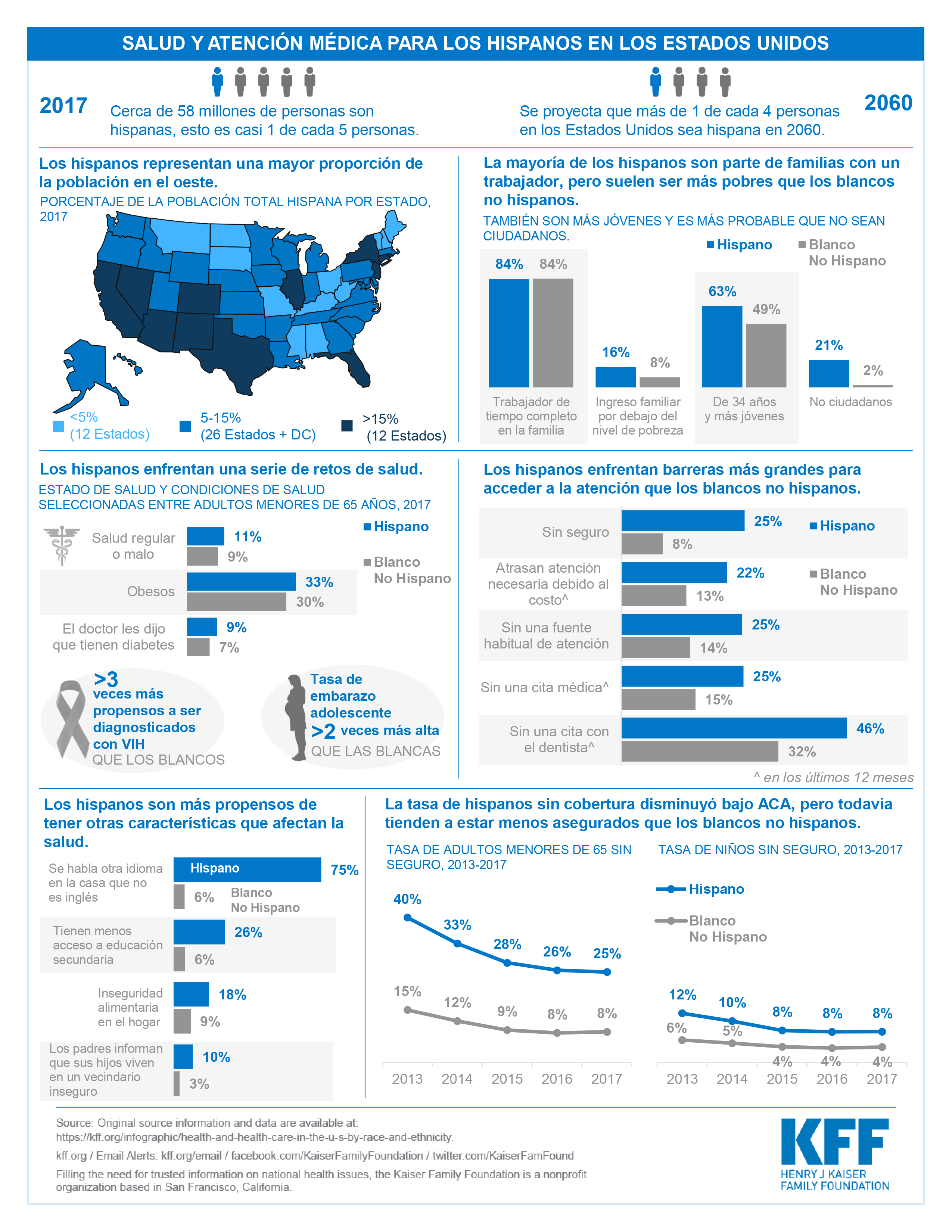
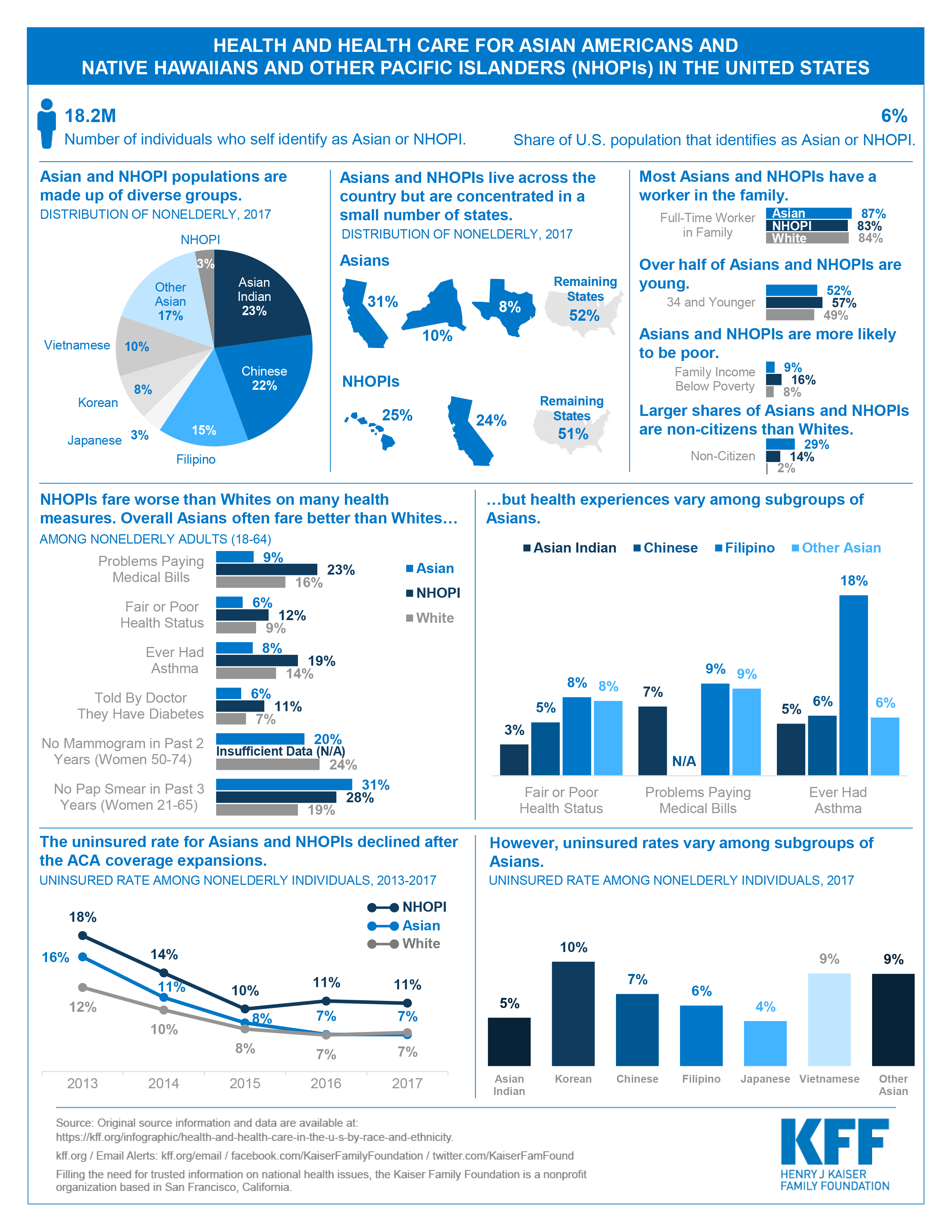
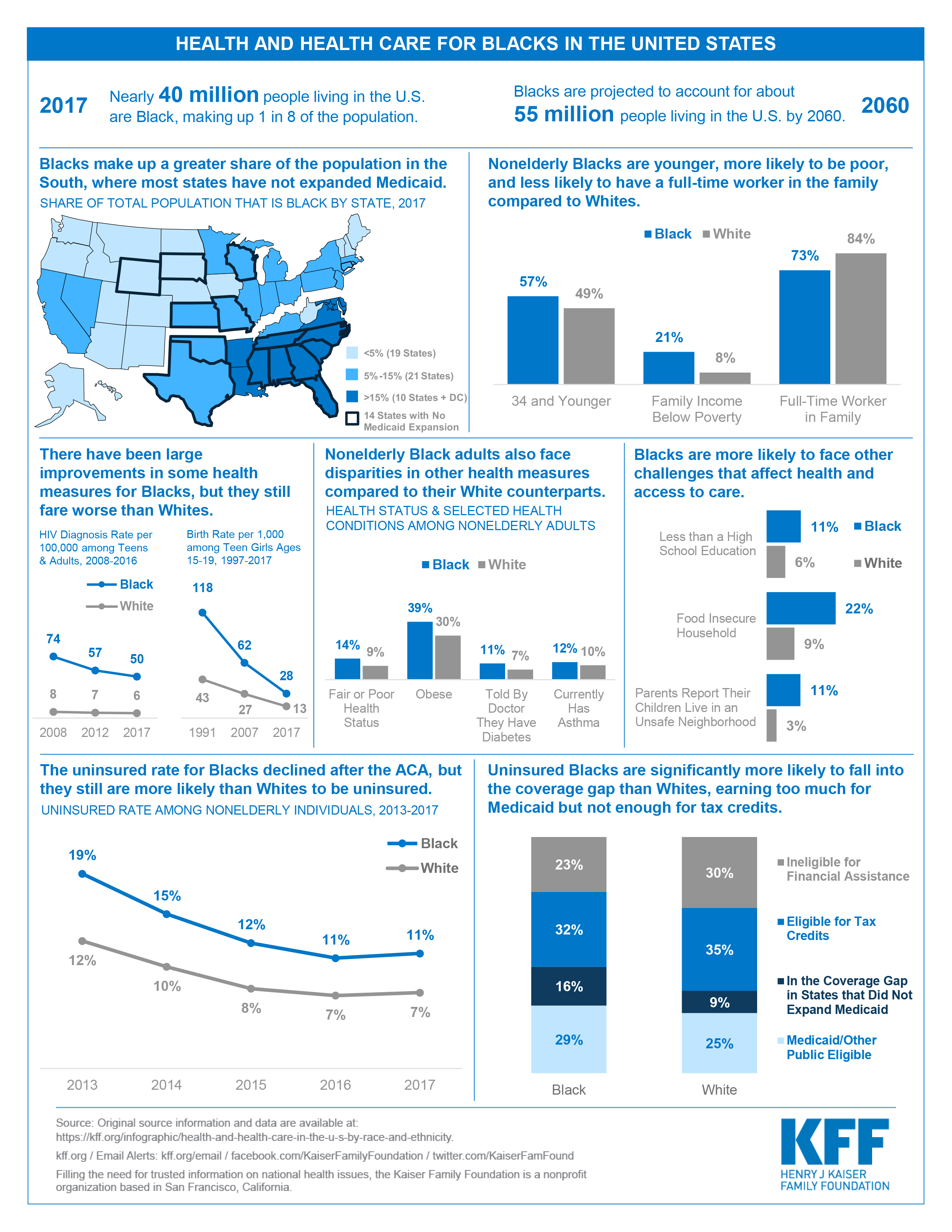
Disparities in health and health care remain a persistent challenge in the United States, resulting in inequities, limiting overall improvements in quality of care and health, and resulting in unnecessary costs. Disparities occur across a broad range of dimensions, including race/ethnicity. Using the most recently available data across a range of data sources, these infographics provide data on demographics; health coverage, access, and utilization; and health outcomes by racial and ethnic group, including Blacks, Hispanics, Asians and Native Hawaiians and Other Pacific Islanders, and American Indians and Alaska Natives, relative to Whites.