HHS Public Health Policy Actions Under the Trump Administration 2025-2026

Published: Mar 19, 2026

Note: Originally published on Nov. 12, 2025, this resource is updated as needed, most recently on March 19, 2026, to reflect additional developments. 

Since assuming office for a second term, President Trump and officials in his administration have instituted numerous policy actions through the Department of Health and Human Services (HHS) affecting public health in the U.S. This resource lists and briefly describes key actions in the order in which they were first issued, reported or announced, with subsequent linked actions and related outcomes also included with each entry. As new policy changes occur, they will be added. 

This resource is not meant to be exhaustive of all administration actions related to public health, as many other federal policy changes – including outside of HHS – have public health implications but are not captured here.

Additional KFF resources on administrative actions related to global health, LGBTQ+ health, and mental health and substance abuse are also available.

Date

|

Action/Description

January 20, 2025Presidential Executive Orders precipitate removal of some HHS websites and health data.
– In the first days of his second term President Trump issued a number of Executive Orders (EOs), including EOs that revoked many Biden administration orders and programs, and instituted new federal guidance related to “gender ideology,” “diversity, equity, and inclusion (DEI),” and “merit-based opportunities.” These EOs have implications for public health, particularly related to the collection and presentation of data and websites by the federal government. For example, in response to the EOs, HHS began to remove thousands of websites and numerous federal databases with public health information deemed to be related to DEI, LGBTQ, reproductive health, HIV/AIDS research, health disparities, and more, and limited some data collection and analysis in these areas. A lawsuit was filed to reverse these removals, and some information has been restored over time. In September, the administration agreed to restore all previously removed health-focused websites and data to versions that had existed on January 29, 2025.
February 7, 2025NIH announces change to indirect cost rate guidance.
– As part of grants for health research, the National Institutes of Health (NIH) provides “indirect cost” funding to grant recipients, which supports administration and facilities costs at grantee institutions. On February 7, NIH announced it would apply a new 15% “standard indirect cost rate” on all grants, which would apply to any new grants and to existing grants for expenses as of February 10, 2025. This was challenged in federal court and federal judges placed holds on the policy, first through a temporary restraining order affecting 22 states on February 10, a nationwide preliminary injunction on March 5, and a permanent injunction on April 4; prior rates still apply for the time being. The administration appealed the ruling and legal proceedings continue. If implemented, a 15% indirect cost rate would be a much lower rate compared to historical NIH rates and would amount to a significant cut in funding for institutions performing NIH-sponsored health research.
February 13, 2025Robert F. Kennedy, Jr. confirmed as HHS Secretary under President Trump.
– The Senate voted 52-48, along party lines, to confirm Robert F. Kennedy, Jr. as the Secretary of Health and Human Services.
February 13, 2025President Trump issues Executive Order (EO) establishing MAHA policy agenda and MAHA Commission.
– The EO outlines the purpose and objectives of the Trump administration’s Make American Healthy Again (MAHA) efforts. Stating that the U.S. must “re-direct our national focus…toward understanding and drastically lowering chronic disease rates and ending childhood chronic disease,” it directs federal agencies to “aggressively combat” mental health disorders, obesity, diabetes, and other conditions. It also establishes the MAHA Commission to advise the President, naming Secretary Kennedy as Chair. The EO directs the Commission to submit an assessment on how to combat the “childhood chronic disease crisis” within 100 days, and a strategy to address the crisis within 180 days, setting in motion processes to develop further public health strategies and plans (discussed in other entries below). 
February 14, 2025White House, DOGE initiate “reduction in force (RIF)”, including for HHS personnel.
– The EO outlines the purpose and objectives of the Trump administration’s Make American Healthy Again (MAHA) efforts. Stating that the U.S. must “re-direct our national focus…toward understanding and drastically lowering chronic disease rates and ending childhood chronic disease,” it directs federal agencies to “aggressively combat” mental health disorders, obesity, diabetes, and other conditions. It also establishes the MAHA Commission to advise the President, naming Secretary Kennedy as Chair. The EO directs the Commission to submit an assessment on how to combat the “childhood chronic disease crisis” within 100 days, and a strategy to address the crisis within 180 days, setting in motion processes to develop further public health strategies and plans (discussed in other entries below). 
February 14, 2025President Trump issues Executive Order prohibiting federal funding to schools and universities with COVID-19 vaccine requirements.
– The EO requires HHS to work with the Department of Education to prohibit COVID-19 mandates in schools, by issuing guidelines for compliance and barring federal funds from going to any educational agency, K-12 school, or institution of higher education that requires COVID-19 vaccination to attend in-person education programs (educational vaccine mandates are set at the state level). Educational vaccine requirements are set at the state and local levels. At the time the EO was released in February, no state required K-12 students to be vaccinated against COVID-19 while 15 colleges required Covid vaccines for students. However, by March 14, 2025 all of those colleges had ended their COVID-19 vaccine requirements for students.
February 18, 2025Secretary Kennedy announces public health policy priorities during HHS welcome ceremony.
– In his first remarks to HHS staff, Secretary Kennedy announces the public health priorities for his tenure. This include investigating the childhood vaccine schedule, tackling corruption and promoting transparency, and addressing a “chronic disease epidemic” especially in children, which he says may be linked to pesticides, food additives, antidepressants, microplastics, cellphone emissions, and other factors.
February 28, 2025Secretary Kennedy issues new rule ending public comment requirement for HHS grants and contracts.
– The new rule rescinds a prior HHS policy on “Public Participation in Rule Making” (the “Richardson Waiver,” dating back to 1971) and “re-aligns the Department’s rule-making procedures with the Administrative Procedure Act.”  As a result, “matters relating to agency management or personnel or to public property, loans, grants, benefits, or contracts” are exempt from the notice and comment procedures. This removes what had been a key step in the rulemaking process requiring public notification and a comment period. For example, changes to HHS policies related to work requirements for Medicaid and NIH funding would no longer require public comments under the new rule. This could streamline implementation of HHS policy, but also reduce public visibility on changes before they take effect.  Some lawmakers and public health focused groups have asked HHS to return to the prior requirements under the Richardson Waiver. 
March 7, 2025HHS announces that CDC will conduct a study of factors contributing to the rise in autism in the U.S.
– In statements to the press, HHS officials indicate CDC will initiate a study looking at the factors that are contributing to the rise in autism diagnoses in the U.S.. To date, no new CDC study results on this topic have been released though in a related development, in September 2025 President Trump and HHS leadership announced at a press conference and through a White House Fact Sheet that they believe there is a link between acetaminophen (e.g., Tylenol) use in pregnancy to autism (further details provided below). President Trump and Secretary Kennedy both have a history of linking vaccines and autism, even though there is no evidence of such a link.
March 13, 2025Food and Drug Administration (FDA) releases guidance on 2025-2026 influenza vaccine composition.
– The FDA guidance identifies which influenza virus strains manufacturers should use as components of 2025-2026 influenza vaccines. To develop these recommendations, FDA convened meetings of federal scientific and public health experts, including from FDA, CDC, and Department of Defense, but did not consult with the FDA’s Vaccines and Related Biological Products Advisory Committee (VRBPAC) or other professional groups outside the government. FDA had canceled the scheduled VRBPAC meeting on this topic, and the lack of input from outside experts was a break from past years’ practices. In addition, in past years there was active participation and coordination between U.S. federal experts and global technical experts working under the auspices of the World Health Organization (WHO), but official communications with WHO-linked experts has been curtailed since the Trump administration announced in January 2025 that the U.S. was withdrawing its membership from the UN agency.
March 17, 2025NIH initiates termination of numerous grants for HIV prevention and treatment programs.
– The canceled NIH grants include support for researchers investigating use of PrEP, medication used pre-exposure to prevent HIV infections, and programs focused on HIV/AIDS in adolescents and young adults. Even as the first Trump administration supported HIV/AIDS prevention and treatment efforts, including through a highly visible federal effort to “end the HIV epidemic” in the U.S. by 2030, these same programs have now been targeted for cuts (further details below).   
March 17, 2025HHS removes Surgeon General warning declaring gun violence a public health crisis.
– The HHS website was changed, removing a 2024 advisory from the Surgeon General on the public health impacts of gun violence. In addition to removing the Surgeon General’s warning, the administration has rolled back a number of gun safety policies in place during the Biden administration. The White House Office of Gun Violence Prevention, established during the Biden administration was shut down in early 2025. Further, significant numbers of staff at CDC’s Injury Center, which collects data on violent deaths and injuries, and CDC’s Division of Violence Prevention have been let go as part of the Trump administration’s reduction in force efforts.
March 25, 2025HHS and CDC seek to pull back $11 billion in supplemental COVID-19 and public health funding from state and local health departments.
– In a statement, HHS says it intends to pull back $11.4 billion in supplemental funding that had been provided by Congress for state and local public health departments through CDC for pandemic response activities. Following the announcement, on April 1, a group of 23 mostly Democratic-led states sued the Trump administration over the attempt to pull back this funding.  On April 3, a federal judge placed a temporary block on the administration’s actions, and on May 16, another federal judge indefinitely blocked the administration from enacting its funding pull back for the states that are part of the lawsuit. As of late August 2025, almost 80% of the funds initially targeted for cuts by the Trump administration had been restored for the 23 states that won in court. However, funding has not been restored to the remaining states, the majority of which are Republican-led.
March 27, 2025HHS announces a major re-organization and job cuts plan.
– HHS announces plans for a major restructuring of the department, in accordance with President Trump’s February 26 EO on “Implementing the President’s ‘Department of Government Efficiency’ Workforce Optimization Initiative.” The announcement says HHS will create an Administration for a Healthy America (AHA), which would combine several existing HHS offices including the Office of the Assistant Secretary of Health (OASH, which contains the Surgeon General’s Office), the Health Research and Services Administration (HRSA), the Substance Abuse and Mental Health Services Administration (SAMSHA), the Agency for Toxic Substance and Disease Registry (ATSDR), and the National Institute for Occupational Safety and Health (NIOSH). In addition, the Administration for Strategic Preparedness and Response (ASPR) at HHS would be moved under CDC. The announcement also says HHS will reduce its workforce by eliminating 10,000 full-time positions. Combined with other reduction in force efforts, a total of 20,000 HHS workers are expected to lose their jobs.

On May 5, a coalition of 19 Democratic-led states and the District of Columbia filed a lawsuit against the mass firing of federal health workers and re-organization of HHS. On May 10, a court ordered a temporary pause on sweeping federal firings at HHS and other agencies. On July 1, a federal judge blocked mass firings at HHS, saying they are likely unlawful. However, on July 8 the Supreme Court overturned the lower court decisions, allowing the Trump administration to proceed with job cuts. As of August it is estimated that over 20,000 jobs at HHS have already been cut, meaning the administration already met its initial workforce reduction goal.

Regarding re-organization, some organizational changes have been implemented at HHS, with major cuts or closures to public health related offices such as the HHS Office of Infectious Diseases & HIV Policy, the HHS Office of Minority Health, and HRSA’s Bureau of Primary Health Care.  However, other proposals such as the formation of an Administration for a Healthy America (AHA), have not yet been implemented. Implementing AHA to the extent proposed is likely to require approval from Congress, though so far Congress has not acted on legislation codifying these proposals.
March 31, 2025HHS withholds portion of Title X family planning service grants. 
– HHS notifies one in five current grantees of the federal Title X family planning program that a portion of their funding would be temporarily withheld. This funding freeze affects all nine Planned Parenthood grantees, in addition to 7 other nonprofit grantees, and it is estimated that a total of 879 clinics (24% of all Title X clinics) in 23 states are affected. After several months, funds were reinstated to some organizations, but the Planned Parenthood grantees have still not had their funding reinstated.
April 1, 2025HHS ends federal support for the “Safe to Sleep” program, which focuses on prevention of infant deaths during sleep.
– The Trump Administration ends federal participation in Safe to Sleep, a national campaign that focused on educating parents of newborns about safer sleeping practices for infants that can prevent death. The program, supported through the NIH’s National Institute of Child Health and Human Development (NICHD) Office of Communications in recent years, had been in existence for over 30 years and had contributed to a major decline in sudden infant deaths. The NICHD office was eliminated on April 1, along with federal support for “Safe to Sleep.”
April 2, 2025HHS requires CDC to reduce contract spending by $2.9 billion as part of DOGE cost reduction efforts.
– According to reports, HHS orders CDC to reduce its contract spending by $2.9 billion by April 18.CDC contract funding has been used to support several services at the agency including security, cleaning, and computers/technology. The sudden requirement to cut this spending by approximately 35% affects CDC operations. 
April 7, 2025HHS Secretary Kennedy announces changes to fluoride policies.
– Secretary Kennedy announces a plan to implement a number of changes to federal policy related to water fluoridation, including stating that CDC will stop recommending water fluoridation as a public health intervention (though to date, HHS and CDC still recommend community water fluoridation). In addition, Kennedy says the defunct Community Preventive Services Task will be revived and reconvened, with a goal of studying and making recommendations about water fluoridation. Kennedy also called on states to ban fluoride in their drinking water. Already this year Utah and Florida have banned community water fluoridation, the first states ever to do so.
April 17, 2025FDA informs Pfizer/Moderna that mRNA COVID vaccines will require an expanded warning label about myocarditis.
– In letters sent April 17, the FDA informs Pfizer and Moderna they must alter the warning labels for their COVID-19 mRNA vaccines to include expanded risks for myocarditis and pericarditis. Previously, the warning labels for these vaccines noted risks for these conditions for those aged 18 to 24 years (Moderna) and 12 to 17 years (Pfizer). However, updated labels are required to include new language saying “the observed risk of myocarditis and pericarditis following vaccination with mRNA COVID-19 vaccines has been highest in males 12 through 24 years of age” and that “persistence of abnormal cardiac magnetic resonance imaging (CMR) findings that are a marker for myocardial injury was common.”  According to FDA, the labels must also include more information about these conditions and their health risks.  Since the letters were sent, the companies have complied with the new FDA requirements. FDA approved the updated label language on June 25.
April 22, 2025FDA and HHS announce measures to phase out use of petroleum-based food dyes.
– FDA and HHS announce a series of steps the federal government will take to remove petroleum-based synthetic dyes from the U.S. food supply. These actions include initiating a process to revoke federal authorization for two such dyes and planning phase-outs by the food industry for others. In addition, the government will support research on food additives and children’s health and authorize natural alternative coloring options. Under the current plan, the phase-outs will occur through voluntary action taken by food companies.
May 1, 2025HHS announces a $500 million investment in a “next generation universal vaccine platform.”
– HHS and NIH announce that $500 million in funding will be directed to a new effort  to develop a “universal vaccine platform for pandemic-prone viruses.” The platform uses inactivated whole viruses, and is part of a broader federal effort to develop universal vaccines called “Generation Gold Standard.” The funds for this new investment appear to be re-purposed vaccine development funds from the Biden Administration’s NextGen initiative to develop next generation COVID-19 vaccines.
May 2, 2025White House Releases FY 2026 President’s Budget Request calling for major fundings cuts at HHS.
– The White House released an outline of the administration’s budget request for FY2026 and on May 30, the White House submitted the full Budget Request for FY2026 to Congress. The request proposes steep cuts to the HHS budget, including cuts for CDC, HRSA, SAMHSA, NIH, eliminating the Hospital Preparedness Program at ASPR, and reducing funding and cutting some programs focused on HIV/AIDS research and response. The budget request also asks Congress for $500 million to support a new “Administration for a Healthy America (AHA)” and MAHA-related priorities. The President’s Budget Request is only a proposal, as it is Congress that ultimately decides how much money the federal government appropriates. So far, Congressional spending bills for FY2026 have not included cuts to HHS of the magnitude requested by the President, and Congress has not provided the requested $500 million for AHA though budget negotiations continue.   
May 5, 2025White House Executive Order restricts funding and increases oversight for “gain of function” research at HHS.
– In an EO titled “Improving the Safety and Security of Biological Research” the White House cites concerns with federally funded “gain-of-function” (GOF) research on biological agents and states the Biden administration allowed dangerous GOF research to occur without sufficient oversight. The EO directs the Secretary of HHS to coordinate with other relevant Executive branch offices to establish guidance to end federal funding of “foreign entities” where GOF is being undertaken or in countries lacking oversight of GOF research. The EO requires the relevant Executive offices to submit updated policies and guidance for all federally supported GOF-related research, and to develop a strategy for managing risks of non- federally funded GOF research. The full implications of the EO are not yet clear, as the Executive branch offices must develop and implement specific guidance and regulations. According to outside experts, potential benefits of the EO include more transparency and stricter enforcement of dangerous research, while potential risks include hindering beneficial research that is not GOF and researchers choosing to curtail beneficial research to avoid potential repercussions under evolving federal restrictions.
May 20, 2025FDA leaders announce clinical trials will be needed for approval of certain new COVID vaccine formulations.
– In a medical journal article, FDA leaders indicate that going forward, for federal approval of new or updated COVID-19 vaccines (“boosters”) for use in individuals who are not considered at higher risk (defined as persons 65 or older or those with certain health conditions), will require vaccine makers to present evidence from randomized, placebo-controlled trials that demonstrate safety and efficacy. The announced policy is a departure from prior years when FDA did not require new trial data to authorize or approve boosters, but instead allowed approvals based on immune response evidence. The new policy could hinder investments by pharmaceutical companies in developing new COVID vaccine formulations, given the greater expense and time required to conduct new, full clinical trials.
May 22, 2025MAHA Commission Report on childhood chronic disease published.
– The first official report from the MAHA Commission (established by the February 13 EO discussed above) discusses factors contributing to a “chronic disease crisis” for U.S. children and provides a “call to action”. The report highlights four main drivers of the crisis: poor diet (primarily due to consumption of ultra-processed foods), exposure to chemicals, lack of physical activity and chronic stress, and “overmedicalization (excessive use of prescription drugs, such as antidepressants). The report calls for federal agencies to “close critical research gaps and guide efforts to better combat” these issues. It also says the MAHA Commission will develop and release a strategy in August (discussed below). The report expanded on the ideas initially outlined in the February EO and provided more details on Secretary Kennedy’s priorities to address chronic disease in children. There was some criticism of the report after its publication, with experts questioning some of the evidence and conclusions and pointing out significant errors and studies cited that did not exist, which indicated that artificial intelligence was likely used to help write the report. 
May 23, 2025Administration ends NIH funding for several HIV vaccine research projects. 
– NIH notifies two grant recipients working on broadly neutralizing antibody research for HIV vaccines of the cancelation of their funding.  The canceled grants supported early-stage vaccine development research that uses a different approach than other HIV vaccine candidates. Some other HIV vaccine candidates remain in the development pipeline and clinical trials continue, but the absence of this early-stage research could jeopardize the development of additional candidates going forward.
May 27, 2025HHS Secretary Kennedy announces CDC will no longer recommend COVID vaccines for healthy pregnant women and children.
– In a video post on X, Secretary Kennedy announces “the COVID vaccine for healthy children and healthy pregnant women has been removed from the CDC recommended immunization schedule.” The announcement was a departure from the typical process for changing vaccine recommendations, which includes review and input from the Advisory Committee on Immunization Practices (ACIP) and a notification from the CDC Director. Initially, the implications of changing CDC guidance without ACIP input were unclear given that no-cost insurance coverage for vaccination is linked to ACIP and CDC recommendations. On May 30, CDC changed the language on its website for COVID-19 vaccines, removing its prior recommendation for pregnant women to be routinely vaccinated and stating that healthy children 6 months to 17 years old could be vaccinated in consultation with health care providers/parents – a recommendation known as “shared decision-making,” which would mean insurance would still have to cover such vaccinations. On July 7, a coalition of professional medical organizations filed a lawsuit against HHS over the new COVID-19 vaccine recommendations, saying the department did not follow federal procedures in making the change and also mislead the public on the issue (on January 6, 2026, a federal court confirmed these plaintiffs have standing to challenge HHS’s actions on the COVID-19 vaccine recommendations, allowing the case to proceed to arguments). On August 19, independent expert groups, including the AAP, issued their own recommendations for COVID vaccines in infants and young children in contrast with CDC’s new recommendations.  On Aug 22, ACOG issued their own recommendations for pregnant patients.
June 9, 2025HHS Secretary Kennedy announces removal of all sitting members of ACIP.  
– In a post on X and a subsequent HHS press notice, Secretary Kennedy announces that all 17 sitting members of the CDC’s Advisory Committee on Immunization Practices (ACIP) are dismissed, to be replaced with new members selected by the Secretary. Kennedy says the move is “prioritizing the restoration of public trust above any specific pro- or anti-vaccine agenda.” The HHS Secretary does have the discretion to remove and nominate ACIP members, though no previous Secretary has dismissed all ACIP members at once. In a subsequent X post on June 11, Kennedy announces the nomination of eight new members to ACIP, several of whom have been critical of COVID-19 vaccines and have expressed concerns about harms caused by vaccinations more generally. In a later press release from September 15, HHS announces five more members to be appointed to ACIP, including several with a history of criticism of COVID-19 vaccine policies. 
June 17, 2025FDA announces National Priority Vouchers for expedited regulatory review of new drugs that support “U.S. national interest.
– FDA announces a Commissioner’s National Priority Voucher (CNPV) program, which can be “redeemed by drug developers to participate in a novel priority program” that shortens regulatory review time from 10-12 months to 1-2 months. FDA says it will determine the availability of vouchers for companies that are aligned with the “national health priorities” of: addressing a health crisis in the U.S.; delivering more innovative cures for the American people; addressing unmet public health needs; and, increasing domestic drug manufacturing as a national security issue. On October 16, FDA announced the first nine CNPV recipients, and on November 6, announced six more recipients.  The impact of this new priority voucher program on speeding drug approvals and onshoring drug manufacturing capacity is as yet unclear. In addition, there are several other existing priority review processes at FDA so adding another could strain FDA staff capacity at the same time there has been significant reductions in FDA’s staff and budget.  These strains have already slowed FDA review times in general.
June 18, 2025FDA approves lenacapavir – a new HIV prevention drug.
– FDA approves Gilead Sciences’ lenacapavir, a new injectable PrEP drug that has been shown to be highly effective at preventing HIV infection, and which requires just one dose every 6 months, making it the first ever twice-a-year drug option for HIV prevention. In September, CDC issued clinical guidance for use of injectable lenacapavir as PrEP, though that guidance did not include reference to transgender people, a group intentionally included in the clinical trials and at increased risk of HIV. FDA’s approval also precipitated a review by the World Health Organization (WHO) and on October 6, WHO pre-qualified lenacapavir for prevention of HIV. WHO pre-qualification can speed regulatory approval for the drug in many low- and middle-income countries with a high burden of HIV/AIDS and can also allow for global health mechanisms like the Global Fund to Fight AIDS, Tuberculosis and Malaria to procure the drug.
June 25-26, 2025The newly reconstituted ACIP makes recommendations and policy changes related to RSV and influenza vaccines, and designates new workgroups on hepatitis B, MMRV, and the childhood immunization schedule.
– ACIP votes to recommend respiratory syncytial virus (RSV) injections for babies and RSV vaccine for people 50 and older, and a ban on the use of thimerosal in multi-dose influenza vaccine vials. ACIP also agrees to stand up three new workgroups that will review the U.S. childhood vaccination schedule, hepatitis B guidance, and combination MMRV vaccine.  Subsequently, on July 3, CDC issued new RSV guidance that mirrored ACIP recommendations. On July 23, Secretary Kennedy enacted ACIP’s recommendation on thimerosal, rescinding federal recommendations for any influenza vaccines containing thimerosal (a change that only affects a very small percentage of the overall influenza vaccine market that is comprised of multidose vials).
July 1, 2025HHS alters program requirements and withholds funding from sex education and teen pregnancy prevention programs.
– HHS notifies all Teen Pregnancy Prevention (TPP) program grantees and Personal Responsibility Education Program (PREP) grantees in 46 states and territories that their material must align with President Trump’s executive orders, including those that ban the promotion of gender inclusivity, risk losing federal funding. TPP is a national grant program that funds grantees to replicate, develop, test, and evaluate evidence-based approaches to prevent teen pregnancy, while PREP awards grants to state agencies to use evidence-based models in educating adolescents on both abstinence and contraception. In August, the Trump administration cancelled a $12.3 million PREP grant to California after state officials refused to revise curricula in compliance with the EOs. In September 2025, 16 states and D.C. sued HHS alleging that the new PREP grant conditions are unlawful, unconstitutional, and harmful to gender diverse youth. Similarly, a federal judge blocked the HHS policy changes for TPP in October 2025.
July 2, 2025CDC deactivates its emergency response for H5N1 influenza (bird flu) and limits tracking and reporting of data on bird flu infections in humans and animals.
– CDC ends its emergency response for H5N1 bird flu in the U.S., which had been active since April 4, 2024. CDC reports the change is due to a decline in animal infections and no reports of human cases since February 2025. CDC also says data on the number of people tested for H5N1 will be reported only monthly, and no further data on infection rates in animals will be reported on the CDC website. Even so, reporting from states showed the number of H5N1 cases in birds, which had declined over the summer, began to increase again in fall 2025. However, much of the federal research and response efforts for H5N1 have been closed down or significantly limited following funding and staff cuts and a prolonged government shutdown. The limited federal tracking and reporting of H5N1 infections can slow identification of outbreaks and potentially slow response times.
July 9, 2025HHS Secretary Kennedy cancels a scheduled meeting of the U.S. Preventive Services Task Force (USPSTF).
– Secretary Kennedy cancels a meeting of the USPSTF several days before it was scheduled to take place, with no reason given and no re-scheduled meeting date provided. Typically, the task force meets three times a year, though no meeting has yet occurred under Secretary Kennedy. USPSTF is responsible for reviewing and recommending preventive health services. USPSTF recommendations have implications for what services insurers must cover with no cost-sharing, under the Affordable Care Act (ACA). Such services can include screening tests, behavioral counseling, and medications that can prevent diseases and illness (other than vaccines, which are tied to ACIP recommendations). However, along with other parts of the ACA, USPSTF has faced court challenges. On June 27 (prior to Kennedy’s cancelation of the meeting), while the Supreme Court ruled the ACA requirement that insurers cover USPSTF-recommended services is indeed constitutional, it also found that the HHS Secretary has the power to add and remove USPSTF members at will, which underscores the possibility that Secretary Kennedy may choose to dismiss some or all of the existing USPSTF members and appoint new members (as Kennedy has done with ACIP), or simply not name any new members, and has the power to choose not to adopt USPSTF recommendations. In light of Kennedy’s cancellation and the Supreme Court ruling, 104 public health focused organizations called on Congress to “protect the integrity of the USPSTF” through legislative action. The subsequent USPSTF meeting was scheduled to occur in November but that was also canceled, with HHS citing the government shutdown as the reason. 
July 31, 2025FDA announces new safety label requirement for opioid pain medications.
– The FDA says will require safety labels on opioid medications so that users can better understand that risks of long-term opioid use. The updated labels should include a summary on the risk of addiction, misuse, and overdose, treatment guidance and the risk of higher doses, how to safely discontinue opioid use, drug interactions, digestive complications, and overdose reversal medications. Drug companies received notification letters and have 30 days to submit updated labels for review.
July 31, 2025HHS Secretary Kennedy swears in Susan Monarez as CDC Director.
– In a statement welcoming the newly Senate-confirmed CDC Director, Secretary Kennedy says Monarez has “unimpeachable scientific credentials” and he has “full confidence in her ability to restore the CDC’s role as the most trusted authority in public health.” However, 28 days later (on August 27) the White House removed Monarez from her position at CDC. According to Kennedy, she was removed because he lost trust in her ability to serve as CDC Director and to implement the policies of the Trump Administration. According to Monarez, she was removed because she would not provide “blanket approval” for vaccine policy changes in advance and would not fire, as requested by Kennedy, CDC employees without cause. On August 28, Secretary Kennedy announced in a letter to CDC staff that Deputy Health and Human Services Secretary Jim O’Neill would serve as acting CDC Director.
August 1, 2025Newly announced CDC policy prevents outside professional medical and public health organizations from participating in working group meetings of ACIP.
– Officials at HHS notify professional medical organizations such as the American Academy of Pediatrics (AAP), the American Medical Association (AMA), the American College of Obstetricians and Gynecologists (ACOG), and others that they will be excluded from joining ACIP working group discussions going forward. Professional groups representing medical doctors and other stakeholders in vaccine policies have long participated as non-voting members, including in ACIP working groups. Working groups are typically responsible for helping review available data about topics prior to ACIP meetings, and helping develop recommendation language for ACIP to vote on, as well as other activities in support of ACIP. While the outside groups can be present and can participate in full ACIP meetings, the new policy removes them from providing any input through working groups.
August 5, 2025HHS announces a “coordinated wind down” of $500 million in federal funding for mRNA vaccine research
– HHS announces that it will cancel and begin to wind down mRNA vaccine development activities funded through the Biomedical Advanced Research and Development Authority (BARDA). In total, HHS reports it is canceling 22 projects worth nearly $500 million because “these vaccines fail to protect effectively against upper respiratory infections like COVID and flu…Going forward, BARDA will focus on platforms with stronger safety records and transparent clinical and manufacturing data practices.”  mRNA COVID-19 vaccines are effective in preventing severe illness and death from the disease, and mRNA vaccine technology has potential applications for other infectious diseases, as well as chronic diseases like cancer. The cancellation removes the bulk of U.S. federal funding for mRNA research, leaving questions about future progress by the U.S. in this area of vaccine technology.
August 15, 2025HHS reinstates the defunct Task Force on Safer Childhood Vaccines.
– The original Task Force on Safer Childhood Vaccines, a federal panel created by Congress in 1986 “to improve the safety, quality, and oversight of vaccines” was disbanded in 1998, but HHS announces that the group will be re-instated at NIH with participation from officials at FDA, CDC, and other government agencies. The goal of the reconstituted Task Force will be “the development, promotion, and refinement of childhood vaccines that result in fewer and less serious adverse reactions than those vaccines currently on the market, and improvements in vaccine development, production, distribution, and adverse reaction reporting” to help increase federal oversight and investigation of vaccine injuries.  The Task Force will come together to develop recommendations to be submitted to Congress within two years, with updates every two years after. Reinstatement of this panel has been a goal of anti-vaccine advocates for years, including the Children’s Health Defense, the anti-vaccine organization Secretary Kennedy founded, which supported a lawsuit earlier in 2025 against Kennedy that sought to require him to reconvene the Task Force.
August 27, 2025FDA approves COVID-19 vaccines for 2025-2026, while limiting scope of approval to certain ages and risk profiles.
– FDA approves updated COVID-19 vaccines for 2025-2026, but also limited the approval to persons 65 and older and those between 18 and 64 with a health condition that puts them at higher risk for severe disease. Previously, the FDA had approved the use of vaccines for all ages (over 6 months) regardless of risk profile.
September 9, 2025MAHA Commission releases strategy to address childhood chronic disease.
– A new MAHA Commission strategy document outlines actions the federal government is taking or plans to take to address childhood chronic disease in the U.S. These include “more than 120 initiatives” that together represent “the most ambitious national effort ever to confront childhood chronic disease,” and which outline a “blueprint for the entire government” to address chronic disease. Elements of the strategy include: changing federal science and research priorities, reforming dietary guidelines, changing nutrition and food regulations through reducing additives and ultra-processed foods, and improving effort to raise public awareness about chronic disease. The strategy highlights the risks of vaccine injuries, fluoride in drinking water, among many other areas.
September 18, 2025Secretary Kennedy renews the declaration of the national opioid crisis as a public health emergency.
– In a declaration on an HHS website, Secretary Kennedy renews the declaration of the opioid crisis as a national public health emergency (PHE).  The opioid crisis was initially declared a public health emergency in 2017; renewal is required every 90 days to continue the PHE.
September 19, 2025Secretary Kennedy announces that the FDA will launch a new review of mifepristone.
– Secretary Kennedy announced that the FDA will undergo a review of the current Risk Evaluation and Mitigation Strategy (REMS) for mifepristone, due to new evidence including an April 2025 report from the Ethics and Public Policy Center (EPPC) which claims that mifepristone has a higher rate of adverse events than previously reported. This report has drawn criticism due to methodological flaws and lack of transparency regarding its data sources.
September 19, 2025ACIP makes several new recommendations related to MMRV and COVID-19 vaccines
– In its September 18-19 meeting, ACIP members vote on several new recommendations including to no longer recommend the combination MMRV (measles, mumps, rubella, and varicella) vaccine for children under the age of 4 and instead to recommend that children in this age group receive measles, mumps, and rubella (MMR) vaccine separately from the varicella vaccine (V). In addition, ACIP members vote to change what had been a universal COVID-19 vaccine recommendation (except for HHS’ recent change for healthy children and pregnant women) to “shared clinical decision-making”, including for those 65 and older, along with a recommendation for new language on risk-benefit for COVID-19 vaccinations. ACIP’s recommendations were adopted by CDC on October 6. While the separate MMR+V vaccines had been recommended as preferred by the CDC for many years, the combination MMRV provided an option for parents to reduce the number of injections their children receive. Now, insurers will no longer be required to cover this vaccine at no-cost. The new COVID-19 vaccine recommendations mean people of all age groups are now recommended to have an interaction with a health care provider (which could include a doctor, nurse, or pharmacist) to determine whether getting a COVID-19 vaccination is recommended for them. If that determination is made, insurers must cover the vaccine at no-cost, although it is possible that some consumers may face challenges in accessing providers in the first place or demonstrating that they have consulted with a medical provider seeking vaccination in some cases.    
September 22, 2025President Trump and Secretary Kennedy announce new actions to address autism spectrum disorder in the U.S.
– In a press conference and via an HHS press statement and Fact Sheet, President Trump and HHS Secretary announce several actions to address the issue of autism spectrum disorder (ASD) in the U.S. This includes FDA authorization for leucovorin, a treatment option for some children with autism, a regulatory change that will allow state Medicaid programs to newly cover leucovorin for the indication of ASD. President Trump and Secretary Kennedy also highlight what they say are risks of acetaminophen use during pregnancy and association with autism. The press release notes “HHS wants to encourage clinicians to exercise their best judgment in use of acetaminophen for fevers and pain in pregnancy by prescribing the lowest effective dose for the shortest duration when treatment is required.”  In his remarks, President Trump also implicated childhood vaccines as a potential risk factor for autism, though no new evidence was presented and that link has already been repeatedly and conclusively ruled out. In a subsequent press statement on September 22, HHS announced FDA was initiating a labeling change for leucovorin, and a safety label change for acetaminophen to include information about the “potential risks of acetaminophen so patients can make a more informed decision.” Public health groups and experts criticized the conclusions linking acetaminophen use in pregnancy and autism, and expressed doubts about leucovorin as a treatment for autism. President Trump’s remarks also precipitated a lawsuit filed on October 28 in Texas against the maker of Tylenol.
September 30, 2025FDA approves a new generic mifepristone product.
– The FDA approved Evita’s Solutions application for a generic version of mifepristone.   The approval included a reminder that the generic mifepristone is subject to the same  Risk Evaluation and Mitigation Strategy (REMS) as the brand-name.
September 30, 2025HHS awards $60 million in grants to support prevention of falls and related programs for older adults and those with disabilities.
– Secretary Kennedy announced 59 new grants totaling $60 million is being awarded to states, territories, tribes, and local organizations supporting older adults and Americans with disabilities, including programs for “preventing falls among seniors, managing chronic conditions…and funding dementia-capable programs.”
October 10, 2025Trump Administration fires thousands of HHS employees, including hundreds at CDC, during federal government shutdown.
– In the midst of a government shutdown and an ongoing federal funding impasse in Congress, the White House Office of Personnel and Management says over 4,000 federal workers are to be fired. At HHS, over a thousand workers are notified that they have lost their jobs, with most of those losses concentrated at CDC. Some of those job losses were reversed over the next few days, with HHS officials stating some notices were sent in error. Even so, as of October 14 it is estimated that about 600 CDC employees remain fired, including staff in areas such as injury prevention, health statistics, and Congressional relations. There is a question about whether such firings during a government shutdown are legal, and groups representing federal workers have filed lawsuits to halt these mass layoffs.
October 31, 2025FDA announces new restrictions on ingestible fluoride products for children.
– FDA announces new enforcement actions “to restrict the sale of unapproved ingestible fluoride products for children” and sends letters to health care professionals warning about the risks associated with these products. The actions come after FDA conducted a review and published a scientific evaluation of these products. In the announcement. FDA says it will be developing a “fluoride research agenda” and “the first national oral health strategy” for the U.S. in partnership with NIH and other HHS agencies.
November 10, 2025FDA announces a warning label change on hormone replacement therapy (HRT) products for addressing symptoms of menopause.
– In a press release, a fact sheet, and a live press event, FDA leaders announce that they will initiate the removal of broad “black box” warnings from HRT products for menopause. The FDA also announces approvals for two new drugs for menopausal symptoms. According to the FDA, women have been “under-utilizing approved therapies” since the “black box” warnings about risks associated with the drugs were placed on these products over 20 years ago. Labels will be rewritten with guidance saying that there are long-term health benefits if HRT is begun within 10 years of the onset of menopause.
November 19, 2025CDC changes language on its website to say a link between vaccines and autism cannot be ruled out.
– A CDC website providing information to the public on Autism and Vaccines, is changed to include language saying “studies have not ruled out the possibility that infant vaccines cause autism.” The new site also discusses the “state of the evidence” on common childhood vaccines and supposed links to autism. The new language is a reversal from previous CDC statements saying “vaccines do not cause autism,” and contradicts the long established scientific consensus that there is no link between vaccines and autism. The new CDC webpage language has been criticized by professional medical organizations such as the American Medical Association and the American Academy of Pediatrics, as well as autism organizations such as Autism Speaks and the Autism Science Foundation.
November 21, 2025CDC staff ordered to end all monkey research programs, potentially affecting development of prevention tools for HIV and other infectious diseases.
– According to reports, CDC staff are ordered to halt its monkey research program by the end of 2025. This program has helped develop HIV prevention tools such as pre-exposure prophylaxis (PrEP) and microbicides, as well supported prevention research for other infectious diseases.
November 28, 2025Internal FDA communication proposes stricter federal requirements for testing and approving vaccines.
– According to reports, the head of FDA’s Center for Biologics Evaluation and Research (CBER), which is responsible for regulating vaccines, issues an email to staff proposing new, stricter federal requirements for vaccine testing, evidence, and approval. The email states that in the future FDA will “demand pre-market randomized trials assessing clinical endpoints for most new products” and that FDA “will not be granting marketing authorization to vaccines in pregnant women” without this kind of evidence. Newly developed pneumonia, influenza, and COVID-19 vaccines are specifically mentioned as vaccines that would be subject to these new requirements. The rationale given for this policy change is a new analysis of vaccine safety data indicating “COVID-19 vaccines have killed American children,” though no evidence to support that statement is provided in the email.
December 5, 2025ACIP votes to end recommendation that all newborns receive hepatitis B vaccine dose at birth
On the second day of the Advisory Committee on Immunization Practices’ (ACIP) December 4-5 meeting, members vote to end a long-standing recommendation that all newborns in the U.S. receive a dose of hepatitis B vaccine. The committee now recommends parents of infants born to mothers who test negative for hepatitis B consult with their provider to help decide if and when their child should receive the first hepatitis B dose. ACIP continues to recommend that infants born to mothers who test positive for hepatitis B, or whose hepatitis B test status is unknown, receive the first hepatitis B vaccine dose at birth. A recommendation from ACIP becomes part of the official CDC immunization schedule once it is adopted by the CDC director.
December 30, 2025HHS ends certain requirements for state reporting of immunization data to the Centers for Medicare and Medicaid Services (CMS).
December 30 letter from the Centers for Medicare and Medicaid Services (CMS) informs state health officials that starting in 2026, states will no longer be required to report several measures related to immunization status to CMS. Specifically, CMS removes the following from its “Child and Adult Core Sets”: “Childhood Immunization Status”, “Immunizations for Adolescents”, “Prenatal Immunization Status: Under Age 21”; and “Prenatal Immunization Status: Age 21 and Older.” In addition, in its letter CMS informs state health officials it will “explore options to facilitate the development of new vaccine measures that capture information about whether parents and families were informed about vaccine choices, vaccine safety and side effects, and alternative vaccine schedules” and “how religious exemptions for vaccinations can be accounted for.” Data reported by states and included in the Child and Adult Core Sets are used by Medicaid and CHIP to monitor access to and quality of health care for their beneficiaries, so an absence of this data could make monitoring immunization coverage in this population more challenging.
January 5, 2026HHS announces changes to the federal childhood vaccination schedule that reduce the number of routinely recommended vaccines
Health and Human Services (HHS) issues a memo implementing major changes to the government’s recommended vaccination schedule for children. Under the new guidelines, there are vaccines for 11 diseases recommended for all children, down from 17 diseases a year ago. In addition to COVID-19 (which HHS stopped recommending for all children back in October 2025), the new schedule no longer recommends routine vaccinations for five other diseases: rotavirus, COVID-19, influenza, hepatitis A, hepatitis B, and meningococcal. These vaccines have been moved from routine recommendation to “shared clinical decision making,” a process that is “individually based and informed by a decision process between the health care provider and the patient or parent/guardian.”  The HPV vaccine remains recommended for routine vaccinations, though under the new guidelines HHS reduces the number of recommended doses of HPV drops from two or three (depending on age of initial vaccination) to one. Coverage for all of these immunizations should remain the same through public and private insurance mechanisms. On March 16, 2026, a federal judge issued a ruling that stayed changes to the vaccine schedule from being implemented, as the government did not follow required procedures. On April 29, HHS appealed the judge’s stay and court review continues.
February 3, 2026BARDA opens solicitations for a $100 million prize program for development of novel antivirals targeting dengue, West Nile, and other viruses.
In a news release, HHS’ Biomedical Advanced Research and Development Authority (BARDA) announces it is opening solicitations for a share of a new $100 million SMART Antiviral prize intended to speed the development of “broad-spectrum, small-molecule antiviral therapies” targeting families of viruses that include dengue, Zika, West Nile, and Chikungunya. This first stage is designed to receive solicitations at the concept stage, with solicitations for further development stages anticipated in the future.
February 4, 2026Trump Administration instructs CDC to rescind $600 million in public health funds going to four Democratic-led states
According to reports, the Office of Management and Budget ordered CDC to cut $600 million in funding that had been earmarked for state and local public health programs in California, Colorado, Illinois, and Minnesota. Most of the funding cuts affect programs focused on HIV and STD prevention, are are to be terminated because they “do not reflect agency priorities” according to an HHS spokesperson. On February 11, affected states filed a lawsuit in federal court against these cuts, and on February 12 a federal judge issued a temporary restraining order blocking the cuts from taking effect.
February 10, 2026FDA refuses to review Moderna’s license application for its investigational mRNA-based influenza vaccine
Moderna announces it received a “Refusal to File” letter from FDA stating that the agency will not initiate a review of the company’s biological license application for its investigational mRNA-based seasonal influenza vaccine. According to FDA, the refusal is due to the company’s use of an inadequate comparison arm in its study. Moderna states the letter is “inconsistent with previous written communications” with FDA staff. On February 18, Moderna announced that FDA had reversed its decision, and will now review the application, following further discussions with the company.
February 18, 2026FDA to allow drug approvals with evidence from one clinical trial rather than two
In an opinion article published in the New England Journal of Medicine, FDA leaders announce a new FDA policy that will make the default requirement for FDA approvals to be results from one clinical trial instead of the prior requirement of two clinical trials.  The stated goal of the change is to accelerate the approval and availability of new medicines.
February 19, 2026CDC delays February ACIP meeting
HHS/CDC announces the ACIP meeting previously scheduled for February 25-27 will be postponed. The postponement occurs amid an ongoing federal lawsuit filed by the American Academy of Pediatrics (AAP) and other medical groups that argues the recent revisions made by HHS to the federal child immunization schedule were arbitrary and violated administrative procedures and seeks to have the ACIP panel appointed by HHS Secretary Kennedy removed and replaced and its decisions overturned. On February 26, CDC announced the ACIP meeting had been rescheduled for March 18-19. On March 16, 2025, the judge ruled that 13 of 15 ACIP member appointments did in fact violate administrative procedures and their appointments are stayed along with any ACIP votes since the appointments were made. As a result, the planned March 18-19 ACIP meeting has been canceled.
February 23, 2026FDA launches new framework for speeding development and approval of therapies for rare diseases
FDA announces draft guidance for drug developers that seek approval for targeted, individualized therapies. The new framework outlines new approaches to regulatory review and evidence requirements on the safety and efficacy for rare diseases, given that traditional randomized clinical trials may not be feasible for these conditions.
March 4, 2026HHS Postpones Third Straight Meeting of US Preventive Services Task Force (USPTF)
USPTF, which makes recommendations on preventive health care services, has not met since March of 2026. Five of the 16 USPTF members’ terms have ended as of January 1 and have not been replaced.  

Medicaid Postpartum Coverage Extension Tracker

Published: Mar 19, 2026

The Medicaid program finances about 4 in 10 births in the U.S. Federal law requires states to provide pregnancy-related Medicaid coverage through 60 days postpartum. After that period, some postpartum individuals may qualify for Medicaid through another pathway, but others may lose coverage, particularly in non-expansion states. To help improve maternal health and coverage stability and to help address racial disparities in maternal health, a provision in the American Rescue Plan Act of 2021 gave states a new option to extend Medicaid postpartum coverage to 12 months via a state plan amendment (SPA). This new option took effect on April 1, 2022 and was originally available for five years; however, the option was made permanent by the Consolidated Appropriations Act 2023. The Centers for Medicare and Medicaid Services (CMS) released guidance on December 7, 2021 on how states could implement this option.

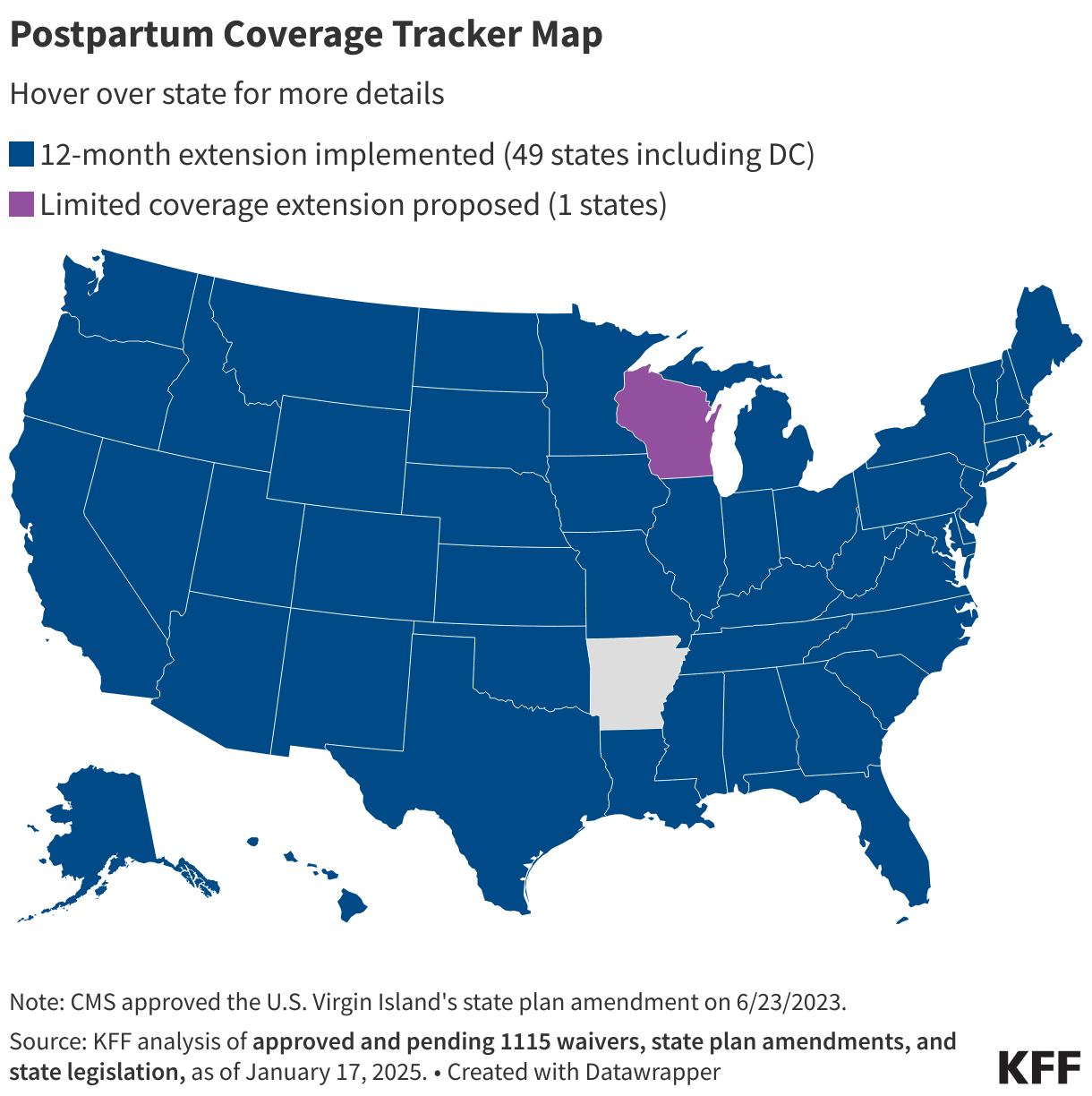
States that sought to implement extended postpartum coverage prior to April 1, 2022 have done so through a section 1115 waiver or by using state funds. This page tracks state actions to implement extended Medicaid postpartum coverage, including states that have implemented a 12-month postpartum extension, states that are planning to implement a 12-month extension, states with pending legislation to seek federal approval through a SPA or 1115 waiver, and states that have proposed or received approval for a limited coverage extension.

Medicaid Postpartum Coverage Extensions: Approved and Pending State Action as of March 19, 2026

Postpartum Coverage Tracker Map (Choropleth map)

Medicaid Postpartum Coverage Extensions: Approved and Pending State Action as of March 19, 2026

>

What to Know About Medicare Coverage of Telehealth

Published: Mar 19, 2026

Editorial Note

This explainer was updated on March 19, 2026 to include the latest data about telehealth in Medicare.

Introduction

Use of telehealth, which includes a range of health care services delivered to patients by providers at a separate location, has grown rapidly in recent years, among both privately-insured patients and Medicare beneficiaries. Prior to the COVID-19 pandemic, telehealth utilization in traditional Medicare was very low, but it rose dramatically in 2020 following temporary measures put in place at the start of the COVID-19 public health emergency that greatly expanded the scope of Medicare coverage of telehealth. Since early 2021 telehealth use has declined steadily, but it remains higher than pre-pandemic levels, with considerable variation by level of income, disability, and urban versus rural location, among other factors.

Congress has repeatedly extended several pandemic-era flexibilities around Medicare coverage of telehealth, but with a few key exceptions (discussed below), most pandemic-era telehealth flexibilities remain temporary. This leaves them vulnerable if authorization lapses, such as during the government shutdown that began on October 1, 2025, when Medicare coverage of many telehealth services briefly lapsed before being retroactively reinstated on November 12, and creates uncertainty for both providers and beneficiaries. Many of Medicare’s telehealth flexibilities were recently granted a two-year extension under the Consolidated Appropriations Act of 2026 and will remain in effect through December 31, 2027, while a handful have been incorporated into the program on a permanent basis through prior legislation and through the annual physician fee schedule rulemaking process. There is bipartisan support for proposed legislation to permanently expand Medicare coverage of telehealth, and many health care providers are supportive of keeping these services accessible, but questions remain about the longer-term impact on patient care, Medicare spending, and program integrity.

This brief provides answers to key questions about the current scope of Medicare telehealth coverage, including both temporary and permanent changes adopted through legislation and regulation, and policy considerations that lie ahead.

Key Takeaways:

  • Congress has enacted legislation several times to extend Medicare’s expanded coverage of telehealth, which is currently due to expire in December 2027. Prior to the COVID-19 public health emergency, Medicare coverage of telehealth was limited to beneficiaries in rural areas and to certain types of providers, facilities, and services.
  • While use of telehealth in traditional Medicare has declined since the early months of the COVID-19 pandemic, use remains nearly two times higher than it was pre-pandemic. Use is higher among urban (vs. rural) beneficiaries, beneficiaries who are dually eligible for both Medicare and Medicaid (vs. beneficiaries who are not Medicaid eligible), and beneficiaries with disabilities or end-stage renal disease (vs. beneficiaries who qualify for Medicare based on age).
  • Medicare currently pays telehealth providers at different rates depending on the location of the beneficiary receiving the service. Medicare pays telehealth providers at a higher rate for telehealth services provided to beneficiaries located in their homes than for telehealth services provided to beneficiaries located in a separate clinical setting from the provider. When telehealth is provided to beneficiaries in clinical settings, Medicare also pays a separate fee for practice expenses to the facility where the beneficiary is located, which results in total Medicare payments that are generally higher relative to home-based telehealth despite the lower provider payment rate.
  • Coverage rules are different in Medicare Advantage, where plans have some flexibility to offer additional benefits, including telehealth benefits, not routinely covered by traditional Medicare (outside of the current temporary flexibilities).
  • Policymakers have considered legislation that would permanently expand Medicare coverage of telehealth, and are weighing the implications for Medicare spending and program integrity.

What is the Current Scope of Medicare Telehealth Coverage?

Prior to the declaration of the COVID-19 public health emergency, Medicare coverage of telehealth was largely restricted to beneficiaries in rural areas and to certain types of providers, facilities, and services. Beneficiaries were typically required to travel from their homes to an approved site, such as a clinic or doctor’s office, when receiving telehealth services. To make it easier and safer for beneficiaries to seek medical care during the pandemic, the Secretary of the Department of Health and Human Services (HHS) waived many of these restrictions in March 2020, enabling broader use of telehealth for all Medicare beneficiaries. While the pandemic-related expansion of telehealth coverage under Medicare was initially due to expire at the end of the COVID-19 public health emergency, Congress has extended these flexibilities several times, most recently through December 2027, and incorporated select provisions into the program on a permanent basis (Figure 1).

The following list summarizes key provisions related to coverage of telehealth in traditional Medicare under current law, both temporary and permanent, as well as limited changes made through the annual physician fee schedule rulemaking process. (See section below for a discussion of telehealth coverage by Medicare Advantage plans.)

Temporary Telehealth Provisions (Extended by Congress Through December 31, 2027)

  • Waiver of geographic and “originating site” requirements: Telehealth is currently available to Medicare beneficiaries in both urban and rural areas, and patients can receive telehealth services from any location, including their home as the “originating site.” Prior to the expansion, telehealth coverage in traditional Medicare was generally limited to rural areas, and patients were required to travel to an approved originating site, such as a clinic or doctor’s office, when receiving telehealth services. (Providers participating in select accountable care organizations (ACOs) are permitted to waive these requirements under the Bipartisan Budget Act of 2018, and may continue to provide telehealth services without geographic restrictions, and to beneficiaries in their homes, should the current temporary flexibilities expire.)
  • Expansion of covered telehealth services: Medicare currently offers coverage for an expanded set of telehealth services, including physical and occupational therapy, emergency consultations, and nursing facility care. Prior to the expansion, Medicare offered coverage for a more limited set of telehealth services, such as preventive health screenings, office visits, and psychotherapy. The Centers for Medicare & Medicaid Services (CMS) has the authority to expand the list of allowable telehealth services when there is a demonstrable clinical benefit and continues to evaluate select services for inclusion on this list. Beginning in 2026, CMS has taken steps to simplify the process of expanding telehealth coverage to new services, such as eliminating the distinction between “provisional” and “permanent” services. In past years, services were often added on a provisional basis before being considered for permanent inclusion.
  • Coverage of audio-only services: Medicare currently allows many telehealth services to be provided to patients via audio-only platforms, such as a telephone or a smartphone without video. Prior to the expansion, Medicare required all telehealth services to be provided via a two-way audio/video connection, such as an interactive audio-video system or a smartphone with video enabled.
  • Expansion of eligible “distant site” telehealth providers: Currently, any health care provider who is eligible to bill for Medicare-covered services can provide and bill for telehealth as a “distant site” telehealth provider and may conduct an initial telehealth visit whether or not they have treated the beneficiary previously. Additionally, federally qualified health centers (FQHCs) and rural health clinics (RHCs) are authorized to provide and bill for telehealth. Prior to the expansion, only physicians and certain other providers (e.g., physician assistants, clinical social workers, and clinical psychologists) were permitted to bill for telehealth services as the distant site provider and must have treated the beneficiary receiving those services within the last three years. FQHCs and RHCs were not authorized to serve as distant site providers but could serve as originating sites if located in a qualifying area.
  • Waiver of in-person visit requirement for behavioral health: Currently, Medicare beneficiaries receiving behavioral health services may opt to receive these services via telehealth with no in-person visit requirements. The Consolidated Appropriations Act of 2021 made numerous changes to Medicare coverage of behavioral telehealth (see below), including a provision that beneficiaries must have an in-person visit with their behavioral health provider no more than six months before their initial telehealth appointment and annually thereafter. Subsequent legislation has delayed this requirement, which is currently due to take effect in January 2028.
  • Use of telehealth for hospice recertification: Patient recertification for the Medicare hospice benefit can currently be conducted via telehealth, provided there is a two-way audio/video connection that allows for real-time interaction between the patient and hospice provider. Prior to the expansion, only in-person encounters could be used for the purposes of hospice recertification.

Permanent Telehealth Provisions:

  • Behavioral health: The Consolidated Appropriations Act of 2021 permanently removed geographic and originating site restrictions for any telehealth service used to diagnose, evaluate, or treat a mental health disorder. (These restrictions had already been lifted for treatment of substance use disorders and co-occurring mental health disorders in 2018.) While many provisions related to Medicare telehealth coverage are due to expire at the end of 2027, Medicare beneficiaries may continue to receive behavioral health services from their homes, in both urban and rural areas, and may do so via audio-only platforms if they are unable to access a video connection or do not consent to video use. Additionally, FQHCs and RHCs are permanently allowed to serve as “distant site” telehealth providers for behavioral health services.
  • Removal of frequency limitations: CMS recently finalized a provision in the 2026 Physician Fee Schedule Final Rule that permanently removes frequency limitations for subsequent inpatient visits, nursing facility visits, and critical care consultations provided via telehealth. This provision took effect on January 1, 2026. However, in the absence of further action by Congress, as of January 1, 2028 (when the current temporary flexibilities expire), implementation of this provision will be limited to the types of providers, services, and settings where telehealth was permitted before the current flexibilities were put in place.
  • Virtual instruction and direct supervision: The 2026 Physician Fee Schedule Final Rule also includes provisions permanently allowing direct supervision of many procedures by physicians and other supervising providers to be conducted virtually via two-way audio/video connections as well as permanently allowing teaching physicians to instruct residents virtually in all teaching settings when overseeing services provided via telehealth. These provisions took effect on January 1, 2026. However, as with other changes made through the physician fee schedule rulemaking process, implementation of these provisions will be limited in scope after January 1, 2028 should the current flexibilities expire.

What Share of Medicare Beneficiaries Use of Telehealth Services?

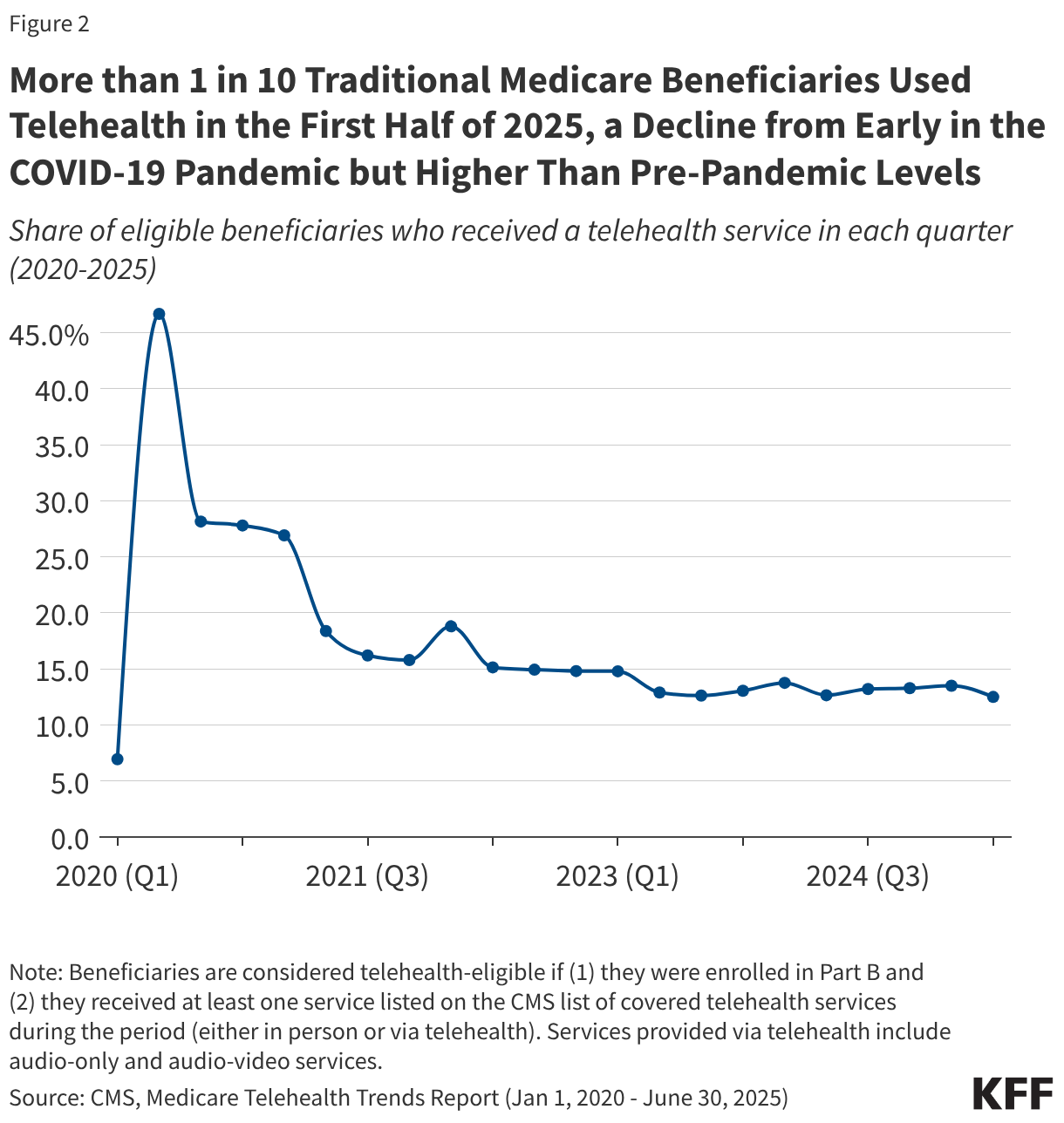
Telehealth use in traditional Medicare increased dramatically at the start of the COVID-19 public health emergency, with nearly half (46.7%) of all eligible beneficiaries receiving at least one telehealth service in the second quarter of 2020, compared to just 6.9% in the first quarter (Figure 2). While use has declined since that time, it remains nearly two times higher than pre-pandemic levels, with more than one in ten (12.5%) eligible beneficiaries receiving a telehealth service in the second quarter of 2025 (the most recent period for which data is available).

More than 1 in 10 Traditional Medicare Beneficiaries Used Telehealth in the First Half of 2025, a Decline from Early in the COVID-19 Pandemic but Higher Than Pre-Pandemic Levels (Line chart)

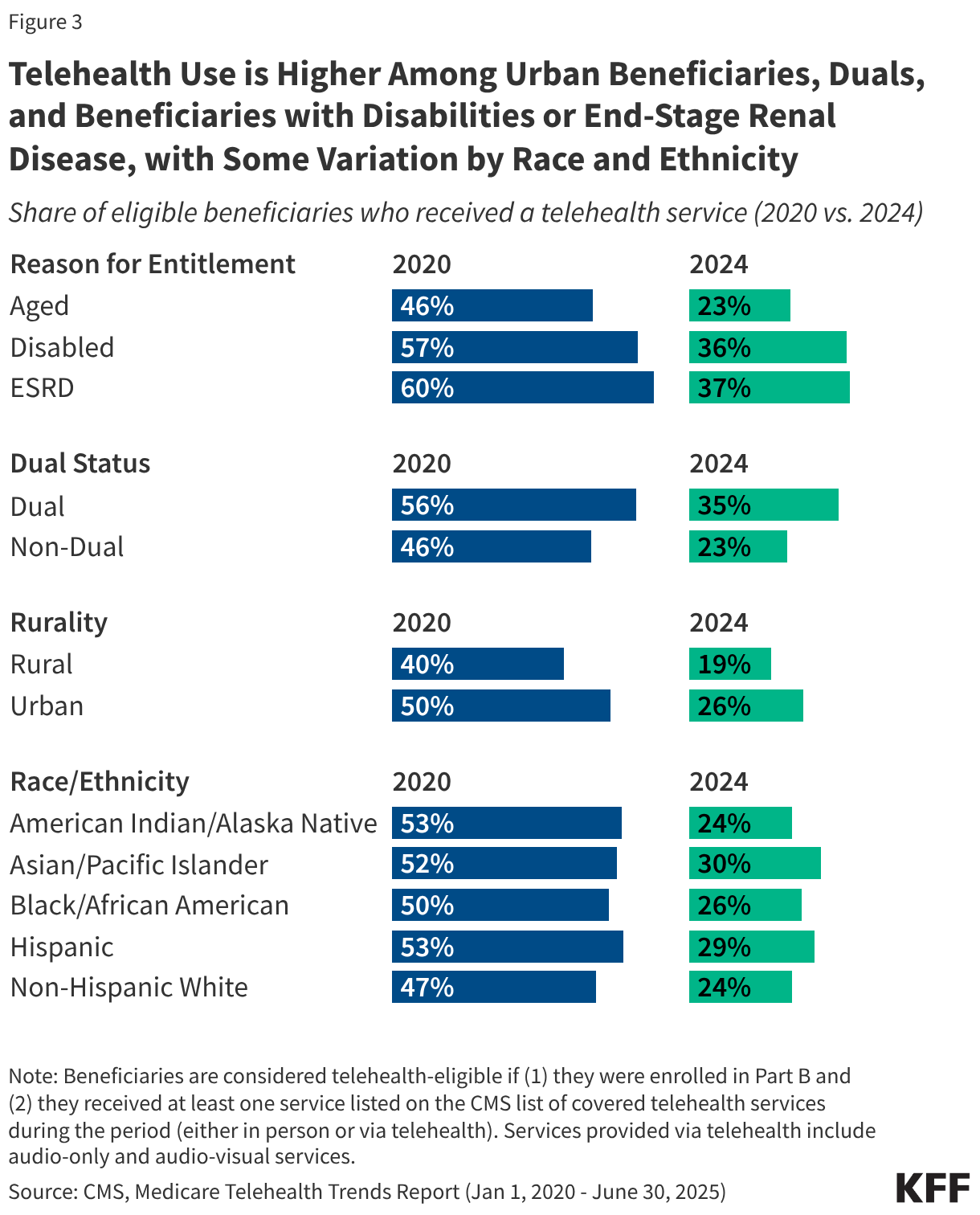
Use of telehealth services varies by geography, race and ethnicity, reason for Medicare eligibility, and dual enrollment in Medicare and Medicaid (Figure 3).

Telehealth Use is Higher Among Urban Beneficiaries, Duals, and Beneficiaries with Disabilities or End-Stage Renal Disease, with Some Variation by Race and Ethnicity (Split Bars)

Reason for Medicare eligibility: Rates of telehealth use in 2024 were higher among beneficiaries who qualify for Medicare based on having end-stage renal disease (ESRD) (37%) or a long-term disability (36%), relative to those who qualify based on age (23%). This may be due in part to higher overall rates of service use among people with ESRD and disabilities (whether in-person or via telehealth) but may also reflect a preference for telehealth among these populations, or a greater ease of accessing care via telehealth relative to in-person care. Beneficiaries under age 65 who qualify for Medicare based on having long-term disabilities are more likely than older beneficiaries to report having three or more limitations in activities of daily living, and may be more likely to benefit from the increased flexibility of receiving health care services from their home via telehealth.

Dual-eligible individuals: Rates of telehealth use in 2024 were higher among beneficiaries dually eligible for both Medicare and Medicaid compared to Medicare beneficiaries who were not Medicaid eligible (35% vs. 23%). Dual-eligible individuals are four times more likely than other Medicare beneficiaries to live on incomes of less than $20,000. Prior studies have found that having lower income or living in a socioeconomically deprived neighborhood is associated with higher rates of telehealth use, suggesting that telehealth may have the potential to improve health care access for beneficiaries with limited access to in-person services.

Geography: Rates of telehealth use in 2024 were higher among beneficiaries living in urban areas than those in rural areas (26% vs. 19%), which may be due in part to disparities in access to broadband and other communication technologies. Beneficiaries in rural or underserved areas may lack the infrastructure to support reliable video telehealth visits or the means to afford internet access, which may further impede access to telehealth if coverage of audio-only services is reduced or eliminated.

Race and ethnicity: Rates of telehealth use in 2024 were highest among Asian and Pacific Islander (30%) and Hispanic (29%) beneficiaries, and somewhat lower among Black (26%), American Indian or Alaska Native (24%), and non-Hispanic White beneficiaries (24%). Given that beneficiaries of color are more likely than non-Hispanic White beneficiaries to report difficulty accessing needed health services, telehealth use may help to improve access to care for certain groups.

How Does Medicare Pay Providers for Telehealth Services?

As of January 2024, Medicare pays for telehealth services based on the location of the beneficiary. Medicare pays providers at a higher rate for telehealth services provided to beneficiaries who are located in their homes and a lower rate for telehealth services provided to beneficiaries who are located in a separate clinical setting (i.e., originating site) (with that lower rate being the same regardless of whether the clinical setting is a doctor’s office or a facility, such as a rural health clinic). According to CMS, the higher rate paid by Medicare for telehealth services provided to beneficiaries in their homes better reflects the practice expenses of providers in mental health and certain other specialties who provide a significant share of their services via telehealth, but also maintain an office for in-person services, an arrangement that became common after the telehealth expansion allowed for greater numbers of beneficiaries to access telehealth from home.

However, when beneficiaries receive telehealth services in clinical settings, such as a rural health clinic, Medicare makes a separate payment to the originating site (the “facility fee”) to reimburse for the cost of practice expenses, and the telehealth service provider is reimbursed at a lower rate that solely reflects the cost of the service itself. This results in total Medicare payments that are generally higher when beneficiaries receive telehealth in clinical settings despite the lower payment to the telehealth service provider.

In contrast, Medicare pays for most in-person services based on the location of the provider. For services furnished in a non-facility setting, such as a doctor’s office, providers are reimbursed at a higher rate that reflects the cost of some practice expenses as well as reimbursement for the service itself (equivalent to the rate paid for telehealth services provided to beneficiaries in their homes). For services furnished in a facility setting, such as a hospital outpatient department, providers are solely reimbursed for the service provided (equivalent to the rate paid for telehealth services provided to beneficiaries in clinical settings), and practice expenses are reimbursed directly to the facility as a separate facility fee. As in the case of clinic-based telehealth, the addition of the facility fee means that total Medicare payments are generally higher for facility- than non-facility-based services, though the provider portion of these payments is smaller.

How Do Medicare Advantage Plans Cover Telehealth?

Medicare Advantage plans are required to cover all Part A and Part B benefits covered under traditional Medicare, and have some flexibility to offer additional benefits as well, including telehealth benefits not routinely covered by traditional Medicare (outside of the current telehealth expansion), such as telehealth services provided to enrollees in their own homes, services provided outside of rural areas, and services provided through audio-only platforms.

Since 2020, Medicare Advantage plans have been permitted to include the costs associated with select telehealth services in their basic Medicare Part A and B benefit package, and may continue to do so after December 2027 regardless of the status of the temporary telehealth expansions in traditional Medicare. Telehealth services may be included in a plan’s basic benefits package if they meet certain requirements, such as coverage under Medicare Part B when the same service is provided in person. When these requirements are not met, plans may continue to offer supplemental telehealth benefits via remote access technologies and/or telemonitoring services, but must cover the cost of these benefits using rebates or supplemental premiums.

What Has Been Proposed to Expand Medicare Coverage of Telehealth?

While Congress has enacted legislation to extend temporary telehealth flexibilities in Medicare since 2023, there has been little movement on bills that would permanently extend these flexibilities. For example, the CONNECT for Health Act of 2025, introduced by Senator Schatz, would permanently implement several key pandemic-era telehealth flexibilities, such as the removal of geographic and originating site requirements and the broad expansion of providers eligible to offer telehealth, but has not been scheduled for a vote.

Trump administration officials, including CMS Administrator Dr. Mehmet Oz, have voiced support for the use of telehealth and other health technologies to increase access to health care services and promote treatment of chronic disease. The upcoming Advancing Chronic Care with Effective, Scalable Solutions (ACCESS) Model from the Center for Medicare & Medicaid Innovation (CMMI) will test the impact of new payment options designed to incentivize the use of technologies such as telehealth platforms, wearable devices, and health care apps for prevention and management of certain chronic conditions, though these payment options will be temporary and limited to the performance period of the model.

Finally, at the state level, certain states have taken action to develop multi-state licensure compacts, which have allowed for additional flexibility related to licensure in participating states. Medicare providers are generally required to be licensed in any state where they are practicing, and this requirement extends to telehealth. In most cases, a distant site telehealth provider must be licensed in the state where the beneficiary receiving services is located when the telehealth visit takes place, but multi-state licensure compacts can extend these permissions to a wider area. These compacts are formed when states agree upon a uniform standard of care and enact state laws which allow qualified providers to practice across state lines while maintaining a single license, to maintain multiple licenses, or which expedite the process of gaining additional licensure across member states. These compacts may be continued beyond December 2027, though other restrictions may limit their use if the current flexibilities are allowed to expire.

What Are the Implications of Telehealth for Program Integrity?

As policymakers weigh whether to permanently implement current flexibilities around Medicare coverage of telehealth, several questions have been raised about the impact of telehealth services on patient care quality and program spending, as well as the potential for fraud and overuse.

Since the current flexibilities were introduced, state and federal agencies have filed several lawsuits regarding the submission of fraudulent claims by telehealth companies to Medicare and other insurers. However, investigations by the HHS Office of the Inspector General (OIG) into provider billing patterns during the first year of the COVID-19 pandemic found that just 0.2% of providers who billed for a telehealth service during the period engaged in excessive billing patterns that posed a high risk to the Medicare program, and clinicians generally complied with Medicare requirements when providing Evaluation and Management services through telehealth, suggesting little evidence of widespread misuse to date. MedPAC has recommended that CMS take certain precautions going forward, such as applying additional scrutiny to “outlier” clinicians who deliver more telehealth services than others and requiring in-person visits before high-cost tests and medical equipment are paid for.

What are the Implications of Telehealth for Medicare Spending?

The impact of expanded telehealth coverage on Medicare spending is difficult to assess, as it depends on several factors. Some telehealth services may replace in-person care, as in the case of behavioral health visits, but easier access to telehealth may also lead to an overall increase in use of services and higher costs. Prior research has found modest increases in clinical encounters and spending per person among Medicare beneficiaries in geographic areas and health systems with higher rates of telehealth use. At the same time, there is evidence to suggest that beneficiaries with greater access to telehealth services may have fewer emergency department visits and improved adherence to certain medications. Additional research could help policymakers and other interested parties assess the degree to which any increases in Medicare spending as a result of expanded telehealth coverage are offset by improvements in quality of care or decreases in other costs, such as spending on preventable hospital admissions and other types of acute care services.

The Congressional Budget Office (CBO) scored the extension of current telehealth flexibilities through December 2027 under the Consolidated Appropriations Act of 2026 as costing $3.8 billion from 2026 to 2028. CBO has not yet scored the cost of recent legislative proposals, such as the CONNECT for Health Act of 2025, that would implement these flexibilities on a permanent basis.

Poll Finding

Cost Concerns and Coverage Changes: A Follow-Up Survey of ACA Marketplace Enrollees

Published: Mar 19, 2026

Findings

About the Survey

At the end of 2025, despite a government shutdown over the policy, the enhanced premium tax credits expired, decreasing financial assistance for subsidized Marketplace enrollees and contributing to significant increases in the Affordable Care Act (ACA) Marketplace costs for most enrollees overall. Amid the debates leading up to the expiration, KFF conducted a probability-based survey of 1,350 adults covered by ACA Marketplace plans in late 2025 to better understand their worries about potential cost increases for their health coverage. Now—without the enhanced tax credits in place—KFF re-interviewed 1,117 individuals (more than 80% of the original sample) to learn how they are navigating these changes to the ACA Marketplace. 

This report is based on all 2025 Marketplace enrollees who took the follow-up survey, including returning Marketplace enrollees1, those who have left the Marketplace entirely for another type of coverage, and those who are now uninsured.

Summary of Findings

Half of those who have re-enrolled in ACA Marketplace coverage say their health care costs are “a lot higher” this year. Following the expiration of the enhanced premium tax credits and an open enrollment period that left many Affordable Care Act (ACA) Marketplace enrollees feeling “worried” and “angry,” most of those who have re-enrolled in Marketplace coverage now report paying more for coverage. A large majority (80%) of returning Marketplace enrollees say their 2026 plan’s premiums, deductibles, or coinsurance and co-pays are higher than last year, including half (51%) who say they are “a lot higher.”

ACA Marketplace enrollees worry about affording their monthly premiums, as well as out-of-pocket expenses such as emergency care or routine medical visits. With many returning Marketplace enrollees reporting higher costs this year, majorities express worry about affording both routine and unexpected medical care. Three in four (73%) returning Marketplace enrollees say they are “very worried” or “somewhat worried” about being able to afford costs for emergency care or hospitalizations while about half are worried about affording costs for routine medical visits (49%) or prescription drugs (45%). Worries are even greater among those with lower incomes and those with chronic health conditions. In addition, one in six (17%) returning Marketplace enrollees say they are not confident they will be able to afford their monthly health insurance premium for the entirety of 2026. This is even as a quarter of those who switched plans say they downgraded their plan’s metal tier (e.g. from a Silver plan to a Bronze plan) in 2026, which generally have lower premiums but typically have higher out-of-pocket costs.

Health care costs are straining household budgets. Among 2025 Marketplace enrollees who have re-enrolled in Marketplace coverage, many report that their health care costs are putting pressure on household budgets. A majority (55%) of returning Marketplace enrollees say they are (or will be) cutting back spending on food or basic household items in order to afford the costs of coverage and care. The impact is even harder for returning enrollees with chronic health conditions, with 62% saying they are, or will be, cutting back on food and other household items in order to help them afford their health care costs.

Bar chart showing health care cost concerns among 2025 ACA Marketplace enrollees who still have Marketplace coverage.

Some previous ACA Marketplace enrollees are now uninsured or have changed to a different Marketplace plan, citing costs as the major reason for that decision. One in ten (9%) 2025 Marketplace enrollees say they are now currently uninsured and three in ten (28%) say they switched to a different Marketplace plan. When asked the reasoning behind their change, a larger share say costs were the driver rather than changes to their health care needs. A 34-year-old man living in Texas put it this way, “The prices are simply too high. $800/month for the absolute cheapest plan for two people. Our income is $120k, so we don’t qualify for subsidies in Texas. I don’t think we could afford our mortgage if I had to pay for health insurance.”

Health care costs may be a deciding factor for ACA Marketplace enrollees in the 2026 midterm elections. With health care costs front and center for 2025 Marketplace enrollees, many who are registered to vote say that the cost of health care will have a major impact on their decision to vote (48%) and which party’s candidate they will support (49%) in the midterm elections. The issue currently resonates more with Democrats, who are more than twice as likely as Republicans to say health costs will play a major impact on their decision to vote in the 2026 midterms (67% vs. 27%) and on which candidate they decide to vote for (70% vs. 30%).

Where Are They Now? Coverage Changes Among 2025 Marketplace Enrollees

The Follow-Up Survey of ACA Marketplace Enrollees finds most (69%) 2025 enrollees say they have re-enrolled in Marketplace coverage for 2026, including four in ten (39%) who say they are enrolled in the same plan they had in 2025 and nearly three in ten (28%) who have switched to a different Marketplace plan. This is largely consistent with the 2025 survey findings in which a third said they would be “very likely” to look for a different Marketplace plan if their premiums doubled.

Additionally, about three in ten 2025 Marketplace enrollees now say they no longer have Marketplace coverage, including 22% who transitioned to a different source of coverage, such as through an employer, by becoming eligible for programs like Medicare or Medicaid, or say they have now purchased a non-Marketplace health insurance plan (some of which may provide less comprehensive coverage and have fewer consumer protections than Marketplace plans). One in ten (9%) 2025 Marketplace enrollees say they are currently uninsured. A large amount of churn on and off the Marketplace is normal as ACA Marketplace coverage is often a temporary source of coverage between jobs, and because income, age, and other circumstantial changes can make people newly eligible for other public programs such as Medicaid or Medicare.

Bar chart showing health insurance coverage type among 2025 Marketplace enrollees.

Notably, half (49%) of younger 2025 Marketplace enrollees between the ages of 18 and 29 report having left the Marketplace entirely, including 14% who say they are currently uninsured. In contrast, smaller shares of older 2025 Marketplace enrollees—ages 50 and up—say they are currently uninsured (7%). Additionally, younger 2025 enrollees are also more likely than their older counterparts to say they have left the Marketplace for another source of coverage—which would be expected with life changes such as starting a new job, getting married, or experiencing a change in income. Significant shares of younger adults having left the Marketplace in 2026 is consistent with previous KFF policy analysis on the expiration of the enhanced tax credits, which attributes part of this year’s increases to insurers anticipating healthier (e.g. younger) adults exiting the Marketplace, creating an enrollee base that is more expensive on average.

Stacked bar chart showing health insurance coverage type by age among 2025 Marketplace enrollees.

Among those who still have a Marketplace plan, one in six (17%) returning enrollees say they are “not too” or “not at all” confident they will be able to afford their insurance premiums for all of 2026. This may put them at risk of losing their Marketplace coverage at some point this year.

Stacked bar chart showing confidence in affording monthly health insurance premiums for the entire year among 2025 Marketplace enrollees who still have Marketplace coverage.

Additionally, 4% of returning Marketplace enrollees say they have yet to pay their first premium for 2026. Notably, returning enrollees who receive tax credits to help pay for their coverage are generally provided with a 3-month grace period for nonpayment of premiums, meaning most may have until the end of March to pay any premiums that are due before facing the retroactive termination of their health insurance coverage.

Costs Are a Major Reason Why Enrollees Switched to a Different Marketplace Plan or Dropped Coverage

Almost four in ten (37%) 2025 enrollees are either uninsured or switched to a different Marketplace plan. When asked the reasoning behind their change, a larger share say costs were the driver rather than changes to their health care needs. Eight in ten say they made a change to their coverage because it was too expensive, including seven in ten (71%) who say this was a “major reason” and one in ten (9%) who said it was a “minor reason.” Just over a third (36%) say changing health needs were a major or minor reason why they changed plans or dropped their Marketplace coverage.

Stacked bar chart showing reasons 2025 Marketplace enrollees made changes to their health insurance coverage. Results reported among 2025 Marketplace enrollees who either switched to a different Marketplace plan or are currently uninsured.

Many 2025 enrollees who switched Marketplace plans this year say their previous plans’ premiums increased dramatically when selecting coverage for 2026. Additional reasons for changing plans include their old plans no longer being available and general dissatisfaction with their previous plan.

In Their Own Words: What is the main reason you switched to a different Marketplace plan this year?

“The cost of the same plan I had in 2025 tripled in price to $360/month. So I went with a different plan that cost less. But even it was higher than the plan I had in 2025.” – 62-year-old man, Wisconsin

“The price went from 2k to 3500 for a household of 4 people.” – 37-year-old man, Florida

“Income exceeded the subsidy limit, forcing us to pay the full cost, so we switched down to a bronze from a gold plan. Even doing that our premiums are 3 times what they were in 2025, with lower plan features and a higher deductible.” – 56-year-old man, Texas

“Cost. By switching to Bronze, I would receive a tax credit that covered my plan. If I had stayed on my Silver plan, I would’ve had to pay out-of-pocket, which my budget does not allow for.” – 26-year-old woman, Montana

“In 2025 I had the elite bronze plan. The monthly premium cost of the plan I had in 2025 went up, the PCP and prescription copays went up, and the deductible went up almost $4000. To keep my out of pocket expenses the same and given my prior history...I had to drop to the everyday bronze with a much larger deductible and just hope that I continue not to actually need anything unexpected.” – 55-year-old man, South Carolina

Health Care Costs Weigh Heavily on the Now Uninsured

Among the 9% of 2025 enrollees who say they are currently uninsured, survey responses indicate that the cost of health care played a major role in their decision to drop coverage, and many from this group report worrying about affording medical care.

In Their Own Words: What is the main reason you are currently without health insurance coverage?

“The end of ACA subsidies caused a huge increase in premiums, the cost of which I could not afford.” – 63-year-old man, California

“Even though I make some income (too much for subsidies, even last year), the increase is so high even for those without subsidies. I simply cannot afford to pay $1,200 a month for insurance. It used to be high premiums meant low deductibles and copays, but not anymore. This is ridiculous. $1,200 for a healthy person, and an $8,000 deductible. Really?” – 56-year-old woman, Illinois

“[I am] self-employed and [there are] no cheap health plans.”– 24-year-old man, Florida

“Without the subsidy, I cannot afford the premium payments.”– 54-year-old man, Texas

“The prices are simply too high. $800/month for the absolute cheapest plan for two people. Our income is $120k, so we don’t qualify for subsidies in Texas. I don’t think we could afford our mortgage if I had to pay for health insurance. $800/month is 8 self pay doctors visits a month. If I have a catastrophic health event it makes more sense for me to just declare bankruptcy than it would be to be delinquent on other payments.” – 34-year-old man, Texas

Many 2025 enrollees who are now uninsured cite fears about accessing and affording care in the case of unexpected medical emergencies. Some who have significant health issues say their main worry about not having health insurance is being unable to afford necessary medications and treatment.

In Their Own Words: What is your main worry, if any, about not currently having health insurance?

“Not managing ongoing health issues and pre-existing conditions.” – 48-year-old woman, Colorado

“Everything. Can’t afford insurance can’t afford health care without insurance so basically just hoping and praying I don’t get sick or have any major issues pop up.” – 38-year-old man, Alabama

“We are 59 and 61 yrs old. We need healthcare. And now we will either avoid seeing a dror go bankrupt.” – 59-year-old woman, Virginia

“I’m in my ‘50s and have some health concerns that I won’t be able to address this year.” – 55-year-old man, Idaho

Health Care Costs Contribute to Affordability Worries and Challenges Among Returning Marketplace Enrollees

Following the expiration of the ACA enhanced premium tax credits in December 2025, a large majority (80%) of returning Marketplace enrollees say their health care costs are higher this year compared to 2025. This includes half (51%) of returning enrollees who say their health care costs—whether it be their premiums, deductibles, and/or their coinsurance and co-pays—are “a lot higher” compared to last year.

About six in ten (63%) returning Marketplace enrollees say their monthly health insurance premium is higher than 2025, including 40% who say it is “a lot higher.” In addition, nearly half say their deductibles are higher (45%, including 24% who say they’re “a lot higher”), and one-third say their coinsurance and co-pays are higher compared to last year (36%, including 18% “a lot higher”).

Increases in insurance plan cost-sharing are pronounced among those who say they switched their Marketplace plan this year. Over half (54%) of returning enrollees who switched plans say their deductibles are higher this year compared to last year (including 34% who say “a lot higher”), and an additional four in ten (42%) say their coinsurance and co-pays are higher (25% “a lot higher”). This likely reflects the fact that some enrollees switched to lower tier Bronze plans which may mitigate some of the increase in premiums but typically have higher out-of-pocket costs. Overall, a quarter (26%) of plan switchers say they downgraded their metal plan (e.g. from a Silver plan to a Bronze plan) in 2026.

Stacked bar chart showing share of adults who say their premiums, deductibles, or coinsurance/copays are a lot higher, somewhat higher, lower, or about the same as last year. Results reported among 2025 Marketplace enrollees who still have Marketplace coverage.

While most 2025 Marketplace enrollees say they still have Marketplace coverage in 2026, having insurance does not insulate them from worrying about the costs of accessing care. About three in four (73%) returning Marketplace enrollees say they are “very worried” or “somewhat worried” about being able to afford costs for emergency care or hospitalizations while about half are worried about affording costs for routine medical visits (49%) or prescription drugs (45%).

Stacked bar chart showing share of adults who say they are worried about affording health care costs like emergency care, routine medical care, and prescription drugs. Results reported among 2025 Marketplace enrollees who still have Marketplace coverage.

At least seven in ten returning Marketplace enrollees across income groups say they are worried about being able to afford costs for emergency care or hospitalization. However, those with lower incomes are more likely than their higher-income counterparts to worry about being able to afford prescription drugs. Those with chronic conditions are more likely than those without such conditions to worry about affording emergency care, routine care, and the cost of prescription medications.

Split bar chart showing shares of adults who say they are "very" or "somewhat worried" about affording health care costs like emergency care, routine medical care, and prescription drugs. Results shown by total, household income, and chronic health condition status. Results reported among 2025 Marketplace enrollees who still have Marketplace coverage.

Rising health care costs can place considerable pressure on household budgets and create additional financial strain. Just over four in ten (44%) returning Marketplace enrollees say their health care costs have made it harder to afford other expenses, including over a third (37%) who say it has made it more difficult to afford food and groceries and about three in ten who say it has made it more difficult for them to afford their monthly utilities (32%), their rent or mortgage (30%), or gasoline or other transportation costs (30%)

About half of returning Marketplace enrollees with lower household incomes and those with chronic health conditions report that their health care costs are placing financial strain on other expenses.

Split bar chart showing share of adults who say their health care costs made it more difficult to afford food and groceries, monthly utilities, rent/mortgage, gasoline and transport, or any of the above. Results shown by total, household income, and chronic health condition status. Results reported among 2025 Marketplace enrollees who still have Marketplace coverage.

A majority (55%) of returning Marketplace enrollees say they have already, or are planning to, cut back spending on food or basic household items in order to cover any health care related costs. Around four in ten (43%) say they have already or are planning to find an extra job or work more hours to cover health expenses, while about two in ten are skipping or delaying paying other bills (23%) or taking out loans or increasing their credit card debt (20%). Notably, while one in five returning enrollees say they are already looking for another job or trying to find more hours, an increase in income could help them afford their premium or deductible payments, but it could also mean they become eligible for less financial assistance.

Returning Marketplace enrollees with chronic conditions are among the most likely to report taking steps to cover their costs, with about six in ten (62%) saying they have or plan to cut back on spending, half (52%) saying they have or plan to work more, a third (33%) saying they will skip or delay paying bills, and a quarter (26%) saying they will take out a loan or increase their credit card debt.

Stacked bar chart showing share of adults who are already or plan on cutting back on spending, finding an extra job, skipping bills, or taking out a loan in order to cover any costs related to health care. Results reported among 2025 Marketplace enrollees who still have Marketplace coverage.

In Their Own Words: What changes or actions have you taken or think you may take in order to afford your health care costs this year?

“Attempt to pay off loans to free up more monthly money, budget groceries more tightly, put hospital debt on a payment plan.” – 24-year-old woman, Kentucky

“Cut back on food expenses, choose cheaper & fewer dining out experience, watch heat & AC usage even more.” – 54-year-old woman, California

“Attempt to use as little health care as possible. Make sure our doctors and hospitals are covered by the insurance. Talk with our doctors to verify that ordered treatments and/or drugs are really necessary. Discuss with providers/pharmacies to see if self-pay may be cheaper than using insurance in particular cases.” – 56-year-old man, Texas

“Shopping for cheaper groceries, not buying clothes, avoiding getting sick, not being as social.” – 63-year-old woman, California

“Pare back expenses as much as possible.” – 39-year-old man, Iowa

“Limit going to the doctor. I can't afford the medications prescribed so I try to find over the counter substitutions.” – 54-year-old woman, Texas

“My grocery budget and fun budget are smaller so we can afford the premium.” – 38-year-old woman, Colorado

“I may have to get part-time employment. I may have to get a job after being retired.” – 60-year-old woman, Florida

Open Enrollment Process Left Many Marketplace Enrollees Worried and Angry

Following the expiration of the enhanced premium tax credits for ACA Marketplace coverage, many 2025 Marketplace enrollees say they felt worried or angry as they went through the process of evaluating their health insurance options for 2026. Nearly two-thirds (63%) of 2025 Marketplace enrollees say they felt “worried” during the process of looking for coverage while about half (52%) say they felt “angry.” Nearly half (46%) say the process made them feel “confused,” while nearly four in ten (37%) say they were “satisfied” during the process of looking for insurance coverage for this year.

Bar chart showing adults who say they felt "worried", "angry", "confused", or "satisfied" about the process of looking at health insurance coverage options for 2026. Results reported among 2025 Marketplace enrollees.

Reactions to the Expiration of Enhanced Premium Tax Credits

In a recent KFF Health Tracking poll, a majority of the public overall said Congress did the wrong thing by letting the enhanced premium tax credits for people who buy their insurance on the ACA Marketplace expire. Unsurprisingly, 2025 Marketplace enrollees share this sentiment, with eight in ten (78%) saying that Congress did the wrong thing by letting the credits expire, while two in ten say Congress did the right thing.

Majorities of 2025 Marketplace enrollees across partisanship agree that Congress did the wrong thing, including nearly all Democrats (94%), eight in ten independents, and six in ten Republicans (58%). Even among Trump’s base—Republicans and Republican-leaning independents who support the MAGA (Make America Great Again) movement—a majority (54%) say that Congress did the wrong thing by letting the credits expire.

Mirrored bar chart showing the share of the public who say Congress did the right thing or the wrong thing by letting the enhanced tax credits expire. Shown among total 2025 Marketplace enrollees and by party identification. Results reported among 2025 Marketplace enrollees.

When asked how they feel about the expiration of the enhanced premium tax credits, many 2025 Marketplace enrollees express anger, frustration, and disappointment. While some are fine with the expiration or note that it has not impacted them, many are upset at the rise in their own insurance costs and the government’s failure to extend the credits.

In Their Own Words: How do you feel about Congress letting the enhanced premium tax credits for the Affordable Care Act (ACA) expire?

“Angry. They get affordable good coverage even when they aren't doing ANYTHING. We struggle to pay for health insurance. And they gut the ACA without offering any alternative.” – 60-year-old independent woman, California

“I am okay with it. It was not going to be able to sustain itself so it needed to happen.” – 48-year-old Republican woman, Florida

“Evil on the part of republicans. Absolutely ineffectual on the part of democrats.” – 33-year-old Democratic man, Washington

“It's a disgrace that families are being put in this position to chose between health insurance and all other household needs.” – 42-year-old Democratic woman, Pennsylvania

“It could hurt some people but the impact to me is minimal.” – 56-year-old independent man, California

“There should have been a gradual decrease versus a sudden cut off or more communication so that people could prepare as needed and advocate where possible.” – 44-year-old Democratic woman, California

“I feel as if it's unfair to those who make too much to be able to receive Medicaid. We are getting penalized for making more money than poverty level.” – 26-year-old independent woman, Florida

“It needs to expire and pharmaceutical companies need to have a cap on prices. They should not be able to charge so much. Also, put a cap on insurance company premiums too.” – 47-year-old independent woman, Georgia

“It has had a major financial impact on my already financially stressed household as I am fully disabled in a wheelchair and unable to work and also unable to receive disability or social security.” – 58-year-old Republican woman, Texas

Among all 2025 Marketplace enrollees, about six in ten (62%) place the most blame on either President Trump (32%) or Republicans in Congress (30%), while a smaller share (14%) say Congressional Democrats deserve the most blame. Two in ten think Congress did the right thing by letting the tax credits expire.

While very few Democratic 2025 Marketplace enrollees blame their own party (3%) for the expiration of the enhanced tax credits, three in ten Republicans, including two in ten MAGA-supporting Republicans, place the most blame on either President Trump or Republicans in Congress.

Stacked bar chart showing percent who say either Democrats in Congress, Republicans in Congress, or President Trump, deserves most of the blame for the enhanced tax credits expiring. Results shown by total 2025 Marketplace enrollees and by party identification. Results reported among 2025 Marketplace enrollees.

Potential Political Impacts of Higher Health Care Costs Among Marketplace Enrollees

When it comes to increases in their own health care costs, returning Marketplace enrollees blame lawmakers alongside health insurance and pharmaceutical companies.

Among the eight in ten returning Marketplace enrollees who say their premiums or cost-sharing are higher this year, seven in ten say health insurance companies deserve “a lot” of blame for the increase. Although the public perceive health insurance companies as a major source of blame for their cost increases, lack of action by Congress in extending the tax credits is attributed as the main cause of increases in premiums and other costs according to KFF policy analysis. Majorities of returning Marketplace enrollees also say Republicans in Congress (54%), President Trump (53%), and pharmaceutical companies (52%) deserve “a lot” of blame for the increase in their health care costs. A third (34%) of returning Marketplace enrollees who report having higher health care costs say Democrats in Congress deserve “a lot” of blame. Fewer place “a lot” of blame on hospitals (30%), doctors (12%), or employers (8%). Notably, around half or more of those who report that their premiums, deductibles, or coinsurance and co-pays are higher this year than last year place at least some blame on each of the groups asked about.

Stacked bar chart showing adults who say each of the following deserve "a lot of blame" or "some blame" for the increase in their health care costs. Results reported among 2025 Marketplace enrollees who still have Marketplace coverage and said their health care costs are higher this year compared to last year.

Across partisanship, at least two-thirds of returning Marketplace enrollees whose health care costs (including premiums, deductibles, or coinsurance and co-pays) are higher now than last year say health insurance companies deserve “a lot” of blame, and around half or more place “a lot” of blame for their increased costs on pharmaceutical companies. However, when it comes to lawmakers, there is a predictable partisan division. Among returning Marketplace enrollees with higher health care costs than last year eight in ten or more Democratic enrollees place “a lot” of blame on President Trump (83%) and on Congressional Republicans (80%) for their increased costs. In contrast, six in ten returning Republican enrollees who now have higher health care costs place “a lot” of blame on Democrats in Congress, as do MAGA supporting Republican enrollees.

Split bar chart showing share of returning Marketplace enrollees who say each of the following deserves "a lot of blame" for the increase in their health care costs. Results shown among 2025 Marketplace enrollees who still have Marketplace coverage and by party identification. Results reported among 2025 Marketplace enrollees who still have Marketplace coverage and said their health care costs are higher this year compared to last year.

Health care costs may impact enrollees’ decisions at the ballot box this November, and in some congressional districts, the number of Marketplace enrollees could be enough to swing close elections. Three-quarters of 2025 Marketplace enrollees who are registered to vote say the cost of health care will have a “major impact” or “minor impact” on their decision to vote (73%) and which party’s candidate they will support (74%) in the midterm elections. Majorities of voters across partisanship say health care costs will impact their voting decisions, however Democrats are more than twice as likely as Republicans to say it will have a major impact on their decision of whether to vote (67% vs. 27%) and on which party’s candidate they will support (70% vs. 30%). At least four in ten independent voters say that health care costs will have a major impact on their decision to vote (47%) and who they decide to vote for (44%).

Stacked bar chart showing percent who say the cost of health care will have a "major impact", "minor impact" or "no impact" on their decision to vote and which candidate's party they would support in the 2026 midterm elections. Results reported among 2025 Marketplace enrollees who are registered to vote.

Beyond being motivated to vote, some enrollees have taken actions to discuss their rising health care costs with friends and family, online, or by directly contacting an elected official. Three-quarters (76%) of 2025 Marketplace enrollees have discussed the cost of health insurance with friends or family, including similar shares across partisanship. However, few report taking further action, including one in seven (14%) who have contacted an elected official by phone, mail, internet, or in person to discuss the cost of health insurance and one in nine (12%) who have posted on social media about the cost of health insurance.

Democrats are more likely than Republicans to say they have contacted an elected official (17% vs. 10%) or have posted on social media about the cost of their coverage (16% vs. 7%).

Split bar chart showing share of adults who say they have discussed the cost of health insurance with family, contacted any elected officials to discuss the cost of health insurance, or posted on social media about the cost of health insurance. Results reported among 2025 Marketplace enrollees.

Methodology

This KFF Follow-Up Survey of Marketplace Enrollees was designed and analyzed by public opinion researchers at KFF. The survey was conducted February 12- March 2, 2026, online and by telephone among a nationally representative sample of 1,117 U.S. adults who had Marketplace insurance in 2025 in English (n=1,079) and in Spanish (n=38). The sample is entirely derived from people who completed the KFF Marketplace Survey in 2025 (n=1,350). 

The original sample was recruited using two probably-based panels, the SSRS Opinion Panel and the IPSOS Knowledge Panel. The SSRS Opinion Panel is a nationally representative probability-based panel where panel members are recruited randomly in one of two ways: (a) Through invitations mailed to respondents randomly sampled from an Address-Based Sample (ABS) provided by Marketing Systems Groups (MSG) through the U.S. Postal Service’s Computerized Delivery Sequence (CDS); (b) from a dual-frame random digit dial (RDD) sample provided by MSG. For the online panel component, invitations were sent to panel members by email followed by up to three reminder emails. The IPSOS Knowledge Panel is a nationally representative probability-based panel where panel members are recruited randomly through invitations mailed to respondents randomly sampled from an Address-Based Sample (ABS) through the U.S. Postal Service’s Computerized Delivery Sequence (CDS). The follow-up sample included 842 individuals from SSRS Opinion Panel and 264 reached through the Ipsos Knowledge Panel. 

An additional 11 adults who were previously recruited to complete a KFF survey in 2024-2025 and were reached via their prepaid cell phone number. A small group of these individuals reported that they had Marketplace coverage in 2025.  Among this prepaid cell phone component, 4 were interviewed by phone and 7 were invited to the web survey via short message service (SMS). 

Respondents in the prepaid cell phone sample who were interviewed by phone received a $15 incentive via a check received by mail. Respondents in the prepaid cell phone sample reached via SMS received a $10 electronic gift card incentive. SSRS Opinion Panel respondents received a $5 electronic gift card incentive (some harder-to-reach groups received a $10 electronic gift card). Ipsos operates an incentive program that includes raffles and sweepstakes with both cash rewards and other prizes to be won. An additional incentive is usually provided for longer surveys. In order to ensure data quality, cases were removed if they failed two or more quality checks: (1) attention check questions in the online version of the questionnaire, (2) had over 30% item non-response, or (3) had a length less than one quarter of the mean length by mode. Based on this criterion, there were 2 cases removed. 

The combined recontacted cell phone and panel samples were weighted to match the sample’s demographics to the national U.S. adult population aged 18-64 who are currently covered by direct-purchase insurance using data from the Census Bureau’s 2025 Current Population Survey (CPS). The demographic variables included in weighting are Sex by Age, Education, Sex by Education, Age by Education, Race/Ethnicity, Census Region, Number of Adults in Household, Home Tenure (Own/Rent), and residence in a Medicaid Expansion state. Additionally, the weights account for differences in the probability of selection for each sample type (prepaid cell phone, IPSOS Knowledge Panel, and SSRS Opinion Panel). This includes adjustments for ownership of a prepaid cellphone, the design of the panel-recruitment procedure (IPSOS Knowledge Panel and SSRS Opinion Panel), and propensity to complete the recontact interview. 

The margin of sampling error including the design effect for the full sample is plus or minus 3.8 percentage points. Numbers of respondents and margins of sampling error for key subgroups are shown in the table below. For results based on other subgroups, the margin of sampling error may be higher. Sample sizes and margins of sampling error for other subgroups are available on request. Sampling error is only one of many potential sources of error and there may be other unmeasured error in this or any other public opinion poll. KFF public opinion and survey research is a charter member of the Transparency Initiative of the American Association for Public Opinion Research.

GroupN (unweighted)M.O.S.E.
Total 2025 Marketplace enrollees1,117± 4 percentage points
   
Returning Marketplace enrollees794± 4 percentage points
Returning enrollees with the same plan as 2025437± 6 percentage points
Returning enrollees who switched to different Marketplace plan345± 7 percentage points
   
Party ID  
Democrats525± 6 percentage points
Independents133± 11 percentage points
Republicans408± 6 percentage points
   
MAGA Republicans258± 8 percentage points

Endnotes

  1. This survey includes 794 returning Marketplace enrollees: respondents who say they are currently enrolled in the Marketplace, irrespective of whether they effectuated their enrollment. Some returning Marketplace enrollees may retroactively lose their health coverage for 2026 if they do not make their first premium payment. ↩︎
News Release

KFF Follow-Up Survey of Marketplace Enrollees: Following End of Enhanced Credits, Half of Marketplace Enrollees Now Say Costs Are a Lot Higher, Most Expect to Cut Back on Basic Household Expenses to Afford Coverage

One in 10 Dropped Their Marketplace Coverage and Are Now Uninsured and Three in 10 Switched ACA Plans, Most Citing High Costs

Published: Mar 19, 2026

Following the expiration of the enhanced premium tax credits for people with Affordable Care Act (ACA) Marketplace plans, a new KFF follow-up survey of the same Marketplace enrollees KFF surveyed in 2025 finds half (51%) of returning enrollees say their health care costs are “a lot higher” this year compared to last year, including four in 10 who specifically say their premiums are “a lot higher.” In all, a large majority (80%) of these enrollees say their health care costs, which can include premiums, deductibles, co-pays, or coinsurance, are higher.

This new survey, which was fielded about a month after open enrollment ended in most states and before the grace period to make payments ends for many enrollees, re-interviewed Marketplace enrollees who shared their expectations for their coverage decisions late last year. It also finds that nearly one in six (17%) returning ACA Marketplace enrollees say they are not confident they will be able to afford their premiums this year. For those who kept the same Marketplace plans, the expiration of the ACA’s enhanced premium tax credits in 2025 is estimated to have increased annual premium payments by more than two-fold on average this year.

Responding to Rising Health Costs
Among those who re-enrolled in an ACA Marketplace plan, a majority (55%) say they have cut or plan to cut spending on food or other basic household expenses to afford their health care costs. The impact is even greater for those with chronic health conditions, more than six in 10 (62%) of whom say they are, or will be, cutting back on food and other basics.

Marketplace enrollees are also concerned about their ability to pay for both routine and unexpected medical expenses. About three in four (73%) returning Marketplace enrollees say they are “very worried” or “somewhat worried” about being able to afford costs for emergency care or hospitalizations while about half are worried about affording costs for routine medical visits (49%) or prescription drugs (45%).

“The impacts on Marketplace enrollees we see in this follow-up survey will likely get worse as people struggle to make payments and the grace period many have expires,” KFF President and CEO Drew Altman said.

For some, rising costs have already forced them to make tough choices. About one in 10 (9%) Marketplace enrollees dropped their ACA coverage and are now uninsured and another nearly three in 10 (28%) changed Marketplace plans. When asked why they decided to drop or change their coverage, most cited costs.

A 63-year-old man in California describes why he is uninsured now:
“The end of ACA subsidies caused a huge increase in premiums, the cost of which I could not afford.”

A 56-year-old man in Texas explains why he switched to a different Marketplace plan:
“Income exceeded the subsidy limit, forcing us to pay the full cost, so we switched down to a bronze from a gold plan. Even doing that our premiums are 3 times what they were in 2025, with lower plan features and a higher deductible.”

In all, seven in 10 (69%) of those who had ACA Marketplace coverage in 2025 have re-enrolled in a plan through the Marketplace, while others became eligible for different types of health insurance coverage either through an employer (5%) or through Medicare (4%) or Medicaid (7%). A small share (5%) purchased health plans outside of the ACA Marketplace, which typically provide less comprehensive coverage and have fewer consumer protections than Marketplace plans. Even in years with few policy changes, shifts across Marketplace plans or to other types of coverage are normal and often follow changes in employment, income, age, and other life circumstances.

Looking Ahead to the Midterms
Among returning Marketplace enrollees who saw higher health costs, seven in 10 (70%) blame health insurance companies “a lot” for their increased costs and at least half place “a lot” of blame on congressional Republicans (54%), President Trump (53%), or pharmaceutical companies (52%). While majorities of partisans place “a lot” of blame on lawmakers from the opposite party, independents with Marketplace coverage are more likely to say Congressional Republicans (56%) and President Trump (58%) deserve “a lot” of blame than Congressional Democrats (28%).

Three-quarters of those who had Marketplace coverage in 2025 and are registered to vote say health care costs will affect their decision to vote (73%) and which party’s candidate they will support (74%). Democrats are more than twice as likely as Republicans to say it will have a major impact on their decision to vote (67% vs. 27%) and which candidate they may support (70% vs. 30%). Among independent voters, nearly half say the issue will have a major impact on their decision to vote (47%) and which candidate they will support (44%).

Designed and analyzed by public opinion researchers at KFF, this survey, which builds on a 2025 survey of ACA Marketplace enrollees, re-interviewed more than 80% of the original sample to learn how they are navigating changes to the ACA Marketplace. The survey was conducted February 12-March 2, 2026, online and by telephone, in English and in Spanish, among a nationally representative sample of 1,117 U.S. adults who had ACA Marketplace coverage in 2025 and completed the initial KFF survey. The margin of sampling error is plus or minus four percentage points for the full sample. For results based on other subgroups, the margin of sampling error may be higher.

KFF QUIZ

How Well Do You Understand Your Health Insurance?

Health insurance is often complicated, but understanding the basics helps you make better decisions about your coverage and care. This 10-question quiz touches on some terms you may encounter. Test your knowledge and pick up some useful insights along the way.

Question 1 of 10
Which statement best describes a health insurance premium?
Question 2 of 10
Which of the following is the best definition of the term “annual health insurance deductible”?
Question 3 of 10
Which statement describes the difference between a copayment and coinsurance?
Question 4 of 10
Your health insurance plan has a $1,000 deductible for hospital care and a $250 per-day copayment once the deductible is met. You are hospitalized for 4 days, and the hospital charges negotiated with the insurance company (the “allowed amount”) total $6,000. How much would you be responsible for paying?
Question 5 of 10
Which statement describes a Health Savings Account (HSA)?
Question 6 of 10
When you receive care from an out-of-network medical professional or facility, what costs might you be responsible for? (“Out of network” refers to a doctor, hospital, or facility that does not have a contract with your health insurance plan.)
Question 7 of 10
Under federal “surprise billing” protections, patients are generally shielded from higher out-of-network charges when they receive:
Question 8 of 10
What does it mean when a health care professional says that a test, procedure, or medication requires “prior authorization” in order for insurance to cover it?
Question 9 of 10
Which of the following best describes a prescription drug “formulary”?
Question 10 of 10
Which of the following are required to publicly post prices for health care services?

The U.S. Government and the World Health Organization

Published: Mar 17, 2026

Editorial Note: Originally published in March 2017, this resource is updated as needed to reflect the latest developments.

Key Facts

  • The World Health Organization (WHO), founded in 1948, is a specialized agency of the United Nations with a broad mandate to act as a coordinating authority on international health issues, including helping countries mount responses to public health emergencies.
  • On January 20, 2025, President Trump issued an Executive Order announcing that the U.S. would withdraw as a member of WHO and halt funding to the organization, and on January 22, 2026, the administration announced the U.S. withdrawal was complete. In 2020 during the first Trump administration, the U.S. temporarily suspended U.S. funding to WHO and initiated a process to end U.S. membership in the organization, actions that were reversed by the Biden administration in 2021.
  • Prior to these actions, the U.S. government (U.S.) had been actively engaged with WHO throughout its history, providing financial and technical support as well as participating in its governance structure and had historically been one of the largest funders of WHO. U.S. contributions had ranged between $163 million and $816 million annually over the last decade.
  • Since 2021, WHO has overseen negotiation processes to update the International Health Regulations (IHR) and establish a new “pandemic agreement.” In May 2024, member states approved revisions to the IHR and, in May 2025, approved a new pandemic agreement. President Trump’s January 2025 Executive Order withdrawing from WHO also stated that the U.S. would not be bound by the revised IHR or the new pandemic agreement and would no longer participate in related discussions or other WHO-based negotiations.
  • WHO now faces funding shortfalls and, in the absence of U.S. contributions, had to implement staffing cuts last year. Almost 3,000 positions – 22% of the organization’s staff – were eliminated between January and June 2025, and a number of WHO’s activities were cut or curtailed. The lack of U.S. support, a shrinking institutional footprint, and other challenges raise questions about WHO’s role going forward.

What is the World Health Organization?

WHO, founded in 1948, is a specialized agency of the United Nations. As outlined in its constitution, WHO has a broad mandate to “act as the directing and coordinating authority on international health work” within the United Nations system. It has 193 member states (the U.S. is no longer a member).

The agency has played a key role in a number of past global health achievements, such as the Alma-Ata Declaration on primary health care (1978), the eradication of smallpox (formally recognized in 1980), the Framework Convention on Tobacco Control (adopted in 2003), and the 2005 and 2024 revisions of the International Health Regulations (IHR), an international agreement that outlines roles and responsibilities in preparing for and responding to international health emergencies. WHO has regularly provided member states with technical guidance and support during responses to epidemics and pandemics, such as Ebola, Zika, mpox, and COVID-19.

Mission and Priorities

WHO’s overarching mission is “attainment by all peoples of the highest possible level of health.” It supports its mission through activities such as:

  • providing technical assistance to countries;
  • setting international health standards and providing guidance on health issues;
  • coordinating and supporting international responses to health emergencies such as disease outbreaks; and
  • promoting and advocating for better global health.

The organization also serves as a convener and host for international meetings and discussions on health issues. While WHO is generally not a direct funder of health services and programs in countries, it does provide supplies and other support during emergencies and carries out programs funded by donors.

WHO’s goal for its current work period (2025-2028) is to “get the world back on track to achieve the health-related Sustainable Development Goals (SDGs) while advancing health equity and building health systems resilience.” In pursuit of this, WHO focuses on three priorities: “to promote health by addressing the root causes of disease, including climate change; to provide health by strengthening health systems based on primary health care and expanding access to health services and financial protection; and to protect health by preventing, preparing for, mitigating, detecting and responding rapidly to health emergencies.”

As part of its work to help countries be better protected against health emergencies – and propelled by the issues and challenges faced during the COVID-19 pandemic – WHO has overseen two sets of international negotiations among member states since 2021. The first was a process to update and amend the IHRs, which was completed and approved by member states in May 2024 and came into force in September 2025. While the U.S. had, through Executive Agreement, become party to prior revisions of the IHR, the Trump administration has stated that the U.S. will not be bound by the IHRs any longer. The second is a new pandemic agreement designed to institute common principles and mechanisms contributing to global prevention, preparedness, and response capacities for health emergencies such as pandemics. In May 2025, 124 member states voted to approve the agreement and initiate the process by which it can be ratified by states and then formally adopted by WHO. Eleven countries (including Poland, Israel, Italy, Russia, Slovakia and Iran) abstained from voting on the agreement, while the U.S. and other countries such as Argentina did not participate in the vote and have criticized the agreement. WHO member states continue to negotiate an annex to the agreement that details a new pathogen access and benefits sharing (PABS) system.

Organization

WHO has a global reach, with a headquarters office located in Geneva, Switzerland, six semi-autonomous regional offices that oversee activities in each region,1 and a network of country offices and representatives around the world. It is led by a Director-General (DG), currently Dr. Tedros Adhanom Ghebreyesus, who was first appointed in 2017 and was re-elected to a second five-year term in May 2022. Dr. Tedros has indicated that his priorities include continuing to strengthen WHO’s financing, staffing, and operations; building pandemic preparedness and response capacities at WHO and elsewhere; and helping countries re-orient health systems toward primary health care and universal health coverage.

World Health Assembly

The World Health Assembly (WHA), now, with the U.S. withdrawal, comprised of representatives from 193 member states, is the supreme decision-making body for WHO and is convened annually. It is responsible for selecting the Director-General, setting priorities, and approving WHO’s budget and activities. The annual WHA meeting in May also serves as a key forum for nations to debate and make decisions about health policy and WHO organizational issues. Every four years, the WHA negotiates and approves a work plan for WHO, known as the general programme of work (GPW). The current GPW (GPW 14) covers the period 2025-2028. Every two years the WHA also approves WHO’s programme budget in support of its work plan; the current programme budget covers the 2026-2027 biennium. More information about WHO’s budget provided below.

Executive Board

WHO’s Executive Board, comprised of 34 members technically qualified in the field of health, facilitates the implementation of the agency’s work plan and provides proposals and recommendations to the Director-General and the WHA. The 34 members are drawn from six regions as follows:

  • 7 represent Africa,
  • 6 represent the Americas,
  • 5 represent the Eastern Mediterranean,
  • 8 represent Europe,
  • 3 represent South-East Asia, and
  • 5 represent the Western Pacific.

Member states within each region designate members to serve on the Executive Board on a rotating basis.

Activities

WHO supports activities across a number of key areas, organized into several “budget segments,” including “base programmes,” emergency operations, polio eradication, and “special programmes” (see Table 1). “Base programmes” refer to WHO headquarters and regional operations activities in support of the organization’s strategic objectives, such as improving access to quality essential health services, essential medicines, vaccines, diagnostics, and devices for primary health care. “Emergency operations” includes WHO efforts to help countries prepare for and respond to epidemics and other health emergencies such as COVID-19, mpox, and natural disasters. “Special programmes” include a number of WHO-led initiatives such as the Research and Training in Tropical Diseases program and Pandemic Influenza Preparedness (PIP) Framework activities.

Funding

Programme Budget

WHO has a programme budget set in advance by member states, which is meant to outline planned activities to meet its work plan over a two-year period (biennium) and describe the “resource levels required to deliver that work.” The current programme budget of $6.2 billion covers the period 2026-2027, and was approved by member states in May 2025. This amount represents a 9% decrease from the previous 2024-2025 programme budget of $6.8 billion. See Table 1.

The programme budget represents a plan for the organization’s anticipated resources, but actual resources may deviate from the initial budgeted amounts over course of the biennium due to changing or unexpected circumstances, such as additional resources provided to WHO for emergency responses or lower levels of support than expected. For example, in the 2022-2023 biennium, WHO reported a final approved budget of $10.4 billion, compared to the initial planned budget of $6.1 billion, largely reflecting additional funding received for emergency operations, including for COVID-19 and polio eradication.

Recent WHO Programme Budgets (Table)

Revenue

WHO has two primary sources of revenue:

  • assessed contributions (set amounts expected to be paid by member-state governments, scaled by income and population) and
  • voluntary contributions (other funds provided by member states, plus contributions from private organizations and individuals).

Most assessed contributions are considered “core” funding, meaning they are flexible funds that are often used to cover general expenses and program activities. Voluntary contributions, on the other hand, are often “specified” funds, meaning they are earmarked by donors for certain activities. While decades ago the majority of WHO’s revenue came from assessed contributions, in recent years voluntary contributions have comprised the larger share of WHO’s budget. For example, in the 2024-2025 budget period, voluntary contributions accounted for $5.9 billion or 83% of total revenue.2 See Figure 1.

Pie chart showing WHO revenue sources by type for 2024-2025 biennium.

Reliance on voluntary, relatively inflexible funding has, in WHO’s view, hampered its operations and effectiveness. In 2022, member states, including the U.S. at that time, agreed in principle to move toward more predictable, flexible funding for WHO and to reduce the role of specified voluntary contributions. Since then, member states have agreed to increases in assessed contributions, with a 20% increase already implemented for the 2024-2025 biennium and another 20% increase approved for the current 2026-2027 biennium, with the goal of having 50% of WHO’s programme budget financed through assessed contributions by 2030.

In 2024, member states also approved the launch of WHO’s first-ever “investment round,” which mobilized additional funding for WHO over the subsequent four years. In its investment case for 2025-2028, WHO estimated it needs $11 billion to implement its general programme of work (GPW) over this period, but member state assessments (core contributions) are likely to amount to $4 billion, leaving a $7 billion gap to fill with voluntary contributions and other donations. Thus far, the investment round has generated $3.8 billion in additional donor pledges through 2028, or 53% of its original goal of $7 billion. The Biden administration did not announce any additional U.S. pledges to WHO through the investment round, and now the Trump administration has ceased U.S. funding for the organization.

Challenges

WHO faces a number of institutional challenges, including:

  • a scope of responsibility that has expanded over time with little growth in core, non-emergency funding;
  • an inflexible budget dominated in recent years by less predictable voluntary contributions often earmarked for specific activities;
  • a cumbersome, decentralized, and bureaucratic governance structure;
  • a dual mandate of being both a technical agency with health expertise and a political body where states debate and negotiate on sometimes divisive health issues; and
  • ongoing budget and staffing challenges due to the loss of U.S. contributions and changes in the global financial landscape.

These and other challenges were particularly evident during and after perceived failures of the agency in the response to the Ebola epidemic in West Africa (2014-2015), and in the criticisms directed at WHO as it tried to help coordinate a global response to the COVID-19 pandemic. Even as many member states continue to support WHO and recognize its importance for global health, many also call for reforms to the organization that would help address its weaknesses. WHO itself supports reforms in several areas and has taken some internal reform actions.

U.S. Engagement with WHO

Prior to 2025, the U.S. government had long been engaged with WHO in multiple ways including through financial support, participation in governance and diplomacy, and joint activities (see below).

Current Status

In 2020, after the onset of the COVID-19 pandemic, the first Trump administration suspended U.S. financial support for WHO and initiated a process to withdraw the U.S. from membership in the organization.3Under the Biden administration, U.S. relations with WHO were re-established in January 2021, and U.S. funding to the organization was restored.4 However, President Trump announced on the first day of his second term, January 20, 2025, that the U.S. would be withdrawing from WHO membership and signed an Executive Order to once again suspend U.S. contributions to the organization, withdraw the U.S. from membership, and recall all U.S. personnel working with the organization. On January 22, 2025, the Trump administration submitted a formal letter of withdrawal to WHO and  stated its withdrawal was completed on January 22, 2026. WHO, however, has responded by raising legal questions about whether the U.S. can complete any withdrawal without meeting its financial obligations such as assessed contributions it has not provided.

Since it began the process of withdrawing from WHO, the Trump administration has begun exploring alternative arrangements such as exploring the use of bilateral agreements to secure access to information about infectious disease outbreaks and has been considering building an alternative system for global outbreak detection and response, separate from WHO. Some U.S. states have expressed disagreement with the Trump administration’s withdrawal from WHO and are pursuing direct partnership with WHO themselves.

History

Financial Support

Prior to 2025, the U.S. government supported WHO through assessed and voluntary contributions (which have now been halted as directed by President Trump’s Executive Order). The U.S. had been the single largest contributor to WHO (though in the 2020-2021 period, when the first Trump administration withheld some U.S. funding during the COVID-19 pandemic, it was the third largest).

For many years, the assessed contribution for the U.S. has been set at 22% of all member state assessed contributions, the maximum allowed rate. Between FY 2017 and FY 2024, the U.S. assessed contribution was fairly stable, fluctuating between $109 million and $122 million (in FY 2019 and FY 2020 the U.S. actually paid less than its assessed amount, and in FY 2021 it paid more than that amount due to payments made toward outstanding arrears). See Figure 2.

Voluntary contributions for specific projects or activities, on the other hand, varied to reflect changing U.S. priorities and/or support during international crises. Over the past decade, U.S. voluntary contributions ranged from a low of $105 million in FY 2020 to a high of $694 million in FY 2022. Higher amounts of voluntary contributions were reflective of increased U.S. support for specific WHO activities such as emergency response. U.S. voluntary contributions also supported a range of other WHO activities such as polio eradication; maternal, newborn, and child health programs; mental health services for victims of torture and trauma; health coordination in COVID-19 response; and other infectious diseases.

U.S. Contributions to the World Health Organization (WHO), by Type of Contribution, FY 2017-FY 2026 (in millions) (Stacked column chart)

For the 2022-2023 biennium period, WHO reported that U.S. assessed and voluntary contributions together represented 15.6% of WHO’s total revenue, making the U.S. the largest donor to WHO during that period.

Governance Activities

Prior to its withdrawal, the U.S. had been an active participant in WHO governance, including through the Executive Board and the World Health Assembly (WHA).  This had included  active engagement at the WHA, sending a large delegation each year that was typically led by a representative from the Department of Health and Human Services, with multiple other U.S. agencies and departments also participating and  active participation in pandemic agreement negotiations and in the process to update and amend the IHR agreement. All official U.S. participation in WHO governance has been terminated.

Technical Support

The U.S. had, in the past, provided technical support to WHO through a variety of activities and partnerships. This included U.S. government experts and resources supporting research and reference laboratory work via WHO collaborating centres, WHO-based international partnerships such as the global outbreak and response network (GOARN), and advisory groups convened or overseen by WHO. U.S. government representatives had often been seconded to or had served as liaisons at WHO headquarters and WHO regional offices, working day-to-day with staff on technical efforts,5 though those personnel were recalled following the initiation of the U.S. withdrawal.

Partnering Activities

The U.S. had also worked in partnership with WHO before and during responses to outbreaks and other international health emergencies, including participating in international teams that WHO organized to investigate and respond to outbreaks around the world. For example, the U.S. worked with WHO and the broader multilateral response to the Ebola epidemic in West Africa that began in 2014, and U.S. scientists were part of the WHO delegation that visited China in February 2020 to assess its response to COVID-19. However, U.S. withdrawal from WHO has brought such coordination to an end.

Endnotes


  1. These include: AFRO (Africa), EMRO (Eastern Mediterranean), EURO (Europe), PAHO (The Americas), SEARO (Southeast Asia), and WPRO (Western Pacific). ↩︎
  2. WHO. Contributors 2024-2025. http://open.who.int/2024-25/contributors/contributor. Data through December 2025. Accessed February 2, 2026. “Other revenue” includes contributions to the PIP (pandemic influenza preparedness) partnership and Contingency Fund for Emergencies. ↩︎
  3. Trump Administration/White House. “President Donald J. Trump Is Demanding Accountability From the World Health Organization.” Fact Sheet. April 15, 2020; Trump Administration/White House. Letter to Dr. Tedros Adhanom Ghebreyesus, WHO Director-General from President Trump. May 18, 2020.; Trump Administration/White House. “Remarks by President Trump on Actions Against China.” Remarks by President Trump on May 29, 2020. May 30, 2020; Trump Administration/U.S. Department of State. “Update on U.S. Withdrawal from the World Health Organization.” Press Statement by Morgan Ortagus, Department Spokesperson. Sept. 3, 2020. https://2017-2021.state.gov/update-on-u-s-withdrawal-from-the-world-health-organization/index.html. ↩︎
  4. White House, “Letter to His Excellency António Guterres,” correspondence from President Biden, Jan. 20, 2021, https://qa.usembassy.gov/letter-to-his-excellency-antonio-guterres/; Associated Press. ‘Biden’s US revives support for WHO, reversing Trump retreat’. January 2021. https://apnews.com/article/us-who-support-006ed181e016afa55d4cea30af236227. ↩︎
  5. CDC. Global Health Partnerships webpage. https://web.archive.org/web/20241214013406/https://www.cdc.gov/global-health/partnerships/. ↩︎

Eight Trends Shaping 2026 Health Care Costs

Authors: Lynne Cotter, Emma Wager, Hattie Xu, Tom Lebert, Julia Harris, Brad Brockbank, and Matthew Rae
Published: Mar 17, 2026

Health care affordability is top of mind for many Americans, rising well above other necessities based on recent KFF polling.

A new Peterson-KFF policy explainer lays out the health care trends shaping the 2026 policy debates, including rising premiums, spending on prescription drugs, health care price transparency and consolidation, artificial intelligence in health care, and Medicaid funding cuts and other key program changes.

This brief is available through the Peterson-KFF Health System Tracker, an online information hub dedicated to monitoring and assessing the performance of the U.S. health system.

Abortion on the 2026 Ballot: The Evolving Landscape of State Abortion Initiatives 

Published: Mar 17, 2026

Since the Supreme Court’s 2022 Dobbs ruling, state ballot initiatives have become a powerful tool used by advocates on both sides hoping to either protect or limit abortion access in their state. Successful ballot initiatives that enact state constitutional amendments provide stronger legal authority to either protect or restrict abortion than laws enacted by the legislature or state Supreme Court rulings. Since 2022, twelve states have passed ballot initiatives, usually, but not exclusively, to protect abortion rights in their state. Once again, this November, five states (Table 1) may have abortion-related measures for their voters to consider. Abortion rights advocates in Nevada and Virginia have placed a constitutional amendment protecting the right to abortion on the November ballot. The Missouri legislature has placed an initiative on the ballot to repeal a state constitutional amendment protecting the right to abortion approved by voters in 2024. In addition, voters in Idaho and Nebraska may vote on abortion initiatives if the measures qualify for the ballot. This issue brief reviews the abortion-related initiatives currently slated to be on the ballot in November 2026 and examines how these measures may impact abortion access in the state. 

Confirmed and Potential Abortion-Related Ballot Measures in the 2026 Election (Table)

Ballot Initiatives Seeking to Protect Abortion Rights

Virginia

Virginia is currently the only state in the South without a total abortion ban or early gestational limit, allowing abortion until the third trimester. Unless the litigation challenging the placement of the ballot measure succeeds, voters in Virginia will decide whether to enshrine these abortion protections into the state constitution in November. On February 6, 2026, Governor Spanberger signed a bill, placing the Right to Reproductive Freedom Amendment on the ballot, after the legislature passed it in two successive sessions as is required by state law. However, on March 3, 2026, Charla Bansely, the District 3 Supervisor for the Bedford County Board of Supervisors filed a lawsuit seeking to block the placement of the measure on the November ballot. Ms. Bansely alleges state election officials failed to distribute the constitutional amendment to circuit clerks in all counties, as required by state law, before certifying the abortion measure for the ballot.

The Right to Reproductive Freedom Amendment would amend the state constitution to guarantee a fundamental right to abortion until the third trimester, as well as contraception and fertility care. The Amendment would allow the Commonwealth of Virginia to regulate abortion in the third trimester; however, abortion cannot be prohibited if the pregnant person’s life or physical, or mental health is at risk, or if the fetus is not viable. If passed, the Amendment will provide durable protection for abortion rights in the state’s constitution by ensuring that changes in the composition of the legislature or the courts in the Commonwealth do not impede access to abortion care.

Nevada

Nevada law requires citizen-initiated ballot initiatives amending the state’s constitution to pass in two successive general elections. Therefore, Nevadans will vote for the second time on the Reproductive Rights Amendment initially approved by voters in 2024. If passed, the Reproductive Rights Amendment will, “guarantee a right to all individuals to abortion performed or administered by a qualified health care practitioner until fetal viability or when needed to protect the life or health of the pregnant patient, without interference from the state or its political subdivisions.” 

Abortion is currently legal in Nevada until 24 weeks gestation. In 1990, voters passed as a “statute affirmation” which upheld the existing law, NRS 442.250, which legalized abortion until 24 weeks, and prohibited the state legislature from amending or repealing the law unless it was placed on the ballot. In 2019, Nevada enacted the Trust Nevada Women Act, which decriminalized medication abortion and removed informed consent laws. The Reproductive Rights Amendment would protect the individuals’ right to abortion beyond the existing law by limiting state interference. While passage of the Reproductive Rights Amendment would provide the strongest protection against efforts to limit reproductive rights by the legislature or courts, any effort to change the gestational limit for abortion in Nevada would have to be approved by a direct vote of state residents, not by the legislature. 

If the Reproductive Rights Amendment passes, abortion rights advocates are likely to bring a new challenge to Nevada’s parental notification for minors law, contending it is not permissible under the new constitutional amendment. If successful, this challenge would allow minors to consent for their own abortions. Last year, a court lifted a 1985 injunction blocking the notification law and reinstated the parental notification requirement. Planned Parenthood Mar Monte, the affiliate that operates the Nevada Planned Parenthood clinics, has challenged this law in a case currently pending at the Nevada Supreme Court. 

Idaho

Idaho has among the most restrictive abortion laws in the nation. Abortion rights advocates are seeking to reverse these bans by trying to get a new law approved, the Reproductive Freedom and Privacy Act, which will change the legality of abortion in the state. However, the initiative faces considerable barriers to getting on the ballot. In Idaho, a citizen-initiated ballot initiative can only be placed on the ballot if the petitioner gathers signatures from 6% of the registered voters in the last election in 18 of the state’s 35 legislative districts and submits these signatures by May 1 of the election year. The signatures must then be verified by the county clerks and submitted to the secretary of state for certification. 

Idahoans United for Women and Families, a nonprofit group that advocates for comprehensive reproductive health care in the state, is organizing the 2026 ballot initiative. In January 2025, the group sued the attorney general’s office arguing that the financial impact statement and the short title of the ballot initiative contained biased language. On June 16, 2025, the Idaho Supreme Court agreed and ordered the attorney general to draft a new financial statement and short title. 

The Reproductive Freedom and Privacy Act would create a state law giving people the right to make decisions about their own reproductive health care including abortion up to fetal viability and in medical emergencies, miscarriage care, prenatal, pregnancy and postpartum care, contraception, and fertility treatment. The statute defines a medical emergency as  a physical medical condition, based on the physician's good faith medical judgment, that complicates the physical medical condition of a pregnant patient as to warrant an abortion to protect a pregnant person's life, or for which a delay will create a serious impairment of a major bodily function or organ of the pregnant person. In January 2026, Idahoans United for Women and Families announced that they collected over 63,000 signatures towards the signature requirement for the ballot initiative. Idaho is currently enforcing a total abortion ban with exceptions only to prevent the death of the pregnant person or in the first trimester for reported cases of rape or incest. 

If passed, the Reproductive Freedom and Privacy Act could expand access to abortion in Idaho. However, the Act would still face challenges after the election because Idaho allows its legislature to amend or repeal a citizen-initiated statute without restrictions.

There are numerous examples where the legislature has reversed or amended the will of the electorate. In 2002, the Idaho legislature repealed citizen-initiated statutes that sought to place term-limits on elected officials. In 2019, the Idaho legislature amended a citizen-initiated statute that expanded Medicaid eligibility. In addition, the Idaho legislature is currently considering a bill that would give the governor veto power over ballot initiatives that pass with less than two-thirds support from voters. Therefore, even if the Reproductive Freedom and Privacy Act is on the ballot and voters approve it, the Republican-majority legislature is likely to amend or repeal the law. Additionally, if legislation granting the governor power to veto voter-approved initiatives is enacted, the Governor would likely exercise that authority to veto the measure.

Ballot Initiatives Seeking to Curtail Abortion Rights 

Missouri 

In 2026, voters in Missouri will again be asked to decide the legal status of abortion in their state, but this time to reverse a recently approved constitutional amendment. In 2024, Missouri voters approved Amendment 3, the Right to Reproductive Freedom Amendment, which amended the state’s constitution to guarantee a right to abortion until fetal viability. Before Amendment 3 was passed, Missouri banned abortion with exceptions only to avert the death of the pregnant person or to avert a serious risk of substantial and irreversible physical impairment of a major bodily function of the pregnant person. After Amendment 3 passed, Planned Parenthood, one of the abortion providers in the state, filed a lawsuit challenging not only the state’s total abortion ban, but also a series of regulations on facilities and clinicians providing abortions. These restrictions included a 72-hour waiting period between an initial appointment and when an abortion could be performed, as well as abortion specific informed consent requirements. The court struck down the abortion ban, allowing abortion to be legal in the state, but did not block regulations on facilities and clinicians providing abortions while the litigation continues. 

State legislators that oppose abortion rights have drafted a new ballot initiative that seeks to repeal Amendment 3. The 2026 ballot initiative, also known as Amendment 3, would ban abortion except in cases of medical emergencies, fatal fetal anomalies, or pregnancies 12 weeks or less gestation that are a result of rape or incest. The initiative includes a parental or guardian consent requirement for minors except in medical emergencies and prohibits state funding of abortions in most circumstances. The Amendment defines a medical emergency as  "a condition that, based on reasonable medical judgment, so complicates the medical condition of a pregnant woman as to necessitate the immediate termination of her pregnancy to avert the death of the pregnant woman or for which a delay will create a serious risk of substantial and irreversible physical impairment of a major bodily function of the pregnant woman. A medical emergency shall include, but not be limited to, an ectopic pregnancy at any point following the diagnosis of such and treatment for a miscarriage." The ballot initiative explicitly allows the legislature to regulate abortion provision, facilities, and providers including, “requiring physicians providing abortion care to have admitting privileges at a nearby hospital; laws requiring facilities where abortions are performed or induced to be licensed and inspected for clean and safe conditions and adequate instruments to treat any emergencies arising from an abortion procedure; laws requiring physicians to perform a sufficient examination of the woman to determine the unborn child's gestational age and any preexisting medical conditions that may influence the procedure; and laws requiring ultrasounds to be performed only by physicians or licensed medical technicians.” In addition, the initiative includes a ban on gender affirming care for minors. 

The 2026 ballot initiative has faced legal scrutiny. On July 2, 2025, the ACLU of Missouri filed a lawsuit against the secretary of state alleging that the language for the 2026 ballot initiative was intentionally misleading, contained an inaccurate summary, and is unconstitutional because it included more than one subject. The ACLU argued that the language of the ballot initiative failed to properly inform voters that a “yes” vote would lead to a repeal of reproductive rights protections that passed in 2024. The ACLU also contended that the subject of the ballot initiative is related to “reproductive health care,” but includes topics unrelated to reproductive health, including a ban on gender-affirming care for minors. On July 4, 2025, the Missouri Western District Court of Appeals ruled that the language of the 2026 ballot initiative failed to inform voters that the initiative would repeal and replace the 2024 Right to Reproductive Freedom Amendment, and certified new ballot language for the 2026 ballot initiative. The language certified by the court will appear on the November 3, 2026, ballot. This is the first time voters could decide to repeal a state constitutional amendment protecting abortion. Passage of the 2026 ballot initiative would ban abortion in Missouri and prevent minors from accessing gender affirming care. 

Nebraska

In 2024, Nebraskans voted on two citizen-initiated ballot initiatives related to abortion, and in 2026 voters could once again be asked to decide on the legality of abortion in their state. In 2024, Nebraska voters weighed in on two separate constitutional amendments related to abortion rights. Voters approved the Prohibit Abortions After the First Trimester Amendment, which bans abortion after the first trimester unless the pregnant person experiences a medical emergency or the pregnancy is a result of rape or incest. Voters opposed the competing ballot measure, the Right to Abortion Initiative, which would have amended the state constitution to recognize a fundamental right to abortion until fetal viability. As a result, abortion is banned after 12 weeks gestation in the state.

The 2026 ballot initiative would impose a total abortion ban in the state. Choose Life Now, the same campaign that initiated the 2024 Prohibit Abortion After the First Trimester Amendment, is collecting signatures to have the Establish Personhood of Preborn Children Amendment added to the 2026 ballot. This new initiative would establish personhood at fertilization. Nebraska law requires citizen-initiated ballot initiatives to collect signatures from 10% of registered voters before it can appear on the ballot. Choose Life Now is still gathering signatures. 

Some Abortion Restrictions Remain in Place After Voters Pass Constitutional Amendments

Voters in Arizona, Ohio and Missouri passed state constitutional amendments establishing the right to abortion in recent elections. After abortion advocates challenged existing state abortion bans under the new constitutional amendments, courts have blocked the pre-existing state abortion bans. However, legal challenges to existing abortion restrictions such as waiting periods, and telemedicine bans, have taken longer as courts have not uniformly blocked these provisions. 

On November 5, 2024, Arizona voters passed Proposition 139, a ballot initiative that amended the state constitution to guarantee a right to abortion until fetal viability. The amendment also allows abortions after fetal viability if the physician providing the abortion determines that the abortion is necessary to protect the life, or physical or mental health of the pregnant person. After this constitutional amendment became effective in December 2024, advocates filed legal challenges to block Arizona’s 15-week ban and other abortion restrictions. In March 2025, a court ruled Arizona’s 15-week ban was unconstitutional under the new amendment. In February 2026, an Arizona state court ruling blocked several abortion restrictions including: (1) a ban on abortion based on fetal diagnoses; (2) a 24-hour waiting period and (3) a prohibition on telemedicine for abortion care due to new protections granted in the state’s constitutional amendment. However, Republican state legislators who have intervened in the lawsuit may appeal this decision. The Democratic Arizona Attorney General declined to defend the laws on behalf of the state, and therefore it is unlikely the state will appeal. 

There are, however, still abortion restrictions in effect in Arizona including a ban on state funds for abortion (which affects Medicaid), a parental consent requirement for minors seeking abortions, and a law that bars medical professionals other than doctors from providing abortions. In February 2026, the ACLU of Arizona filed a lawsuit on behalf of advanced practice clinicians contending the physician only law violates the constitutional amendment protecting abortion. 

On November 7, 2023, Ohio voters passed Issue 1, a ballot initiative that amended the state constitution to guarantee every individual has the right to make their own reproductive decisions including contraception, fertility treatment, continuing a pregnancy, miscarriage care, and abortion care. The amendment also allows the state to prohibit abortion after fetal viability; however, an abortion cannot be prohibited after viability if it is necessary to protect the life or health of the pregnant person. After the passage of Issue 1, advocates cited the new amendment in legal challenges to the state’s 6-week ban as well as the many other abortion restrictions. In October 2024, the Hamilton County Court of Common Pleas issued a permanent injunction blocking Ohio’s 6-week abortion ban from taking effect, marking the first permanent injunction based on Ohio’s Reproductive Freedom Amendment. Courts have blocked many of the other abortion restrictions as well. One provision that was challenged, but is still in effect, is a requirement for providers to document the reason for an abortion, but this provision does not impact patients’ access to abortion care. Ohio law still requires parental consent for minors seeking abortions and blocks public funding for abortions. 

As was discussed earlier, Missouri voters approved Amendment 3, the Right to Reproductive Freedom Amendment in 2024, which guarantees a right to make and carry out decisions about all matters relating to reproductive health care including: prenatal care, childbirth, postpartum care, birth control, abortion care, miscarriage care, and respectful birthing conditions. The amendment also allows the government to regulate abortion after fetal viability; however, it prevents the government from restricting abortion after fetal viability if the abortion is necessary to protect the life, physical or mental health of the pregnant person. After the passage of Amendment 3, a court blocked the state’s abortion ban but many restrictions on abortion (72-hour waiting period and abortion specific informed consent requirements) remain in place and are the subject of ongoing litigation.

Options for Future Citizen Referred Ballot Measures Are Limited

Citizens are allowed to propose a constitutional amendment for the ballot in 17 states. There are only two states, Arkansas and Oklahoma, with current bans on abortion which allow for citizen-initiated constitutional amendments and have yet to vote on an abortion measure (Figure 1). There were efforts in Arkansas (where there is a near total abortion ban) to get an initiative on the ballot, but the Arkansas Secretary of State rejected the petition for the initiative on the grounds that the signatures were not properly gathered, and thus the initiative did not make it to the ballot. The Arkansas Supreme Court upheld this decision. 

Oklahoma has a total abortion ban, with an exception only to save the life of the pregnant person and classifies performing an abortion as a felony. A citizen-led effort to put a state constitutional amendment that would have added an “individual right to reproductive freedom” on the ballot was withdrawn in December 2022, before signature gathering began.

In 2024, in Florida, Nebraska, and South Dakota, abortion rights amendments failed to garner sufficient votes for passage. In Nebraska, voters approved a competing measure to ban abortion after the first trimester. In South Dakota, the measure failed to pass, only garnering 41% of the votes. In Florida, the initiative received 57% approval. However, state law requires 60% approval for a constitutional amendment. As the popular vote fell just 3 percentage points short of approval, abortion rights supporters in Florida may try again in a future election to reverse the 6-week abortion ban. 

Conversely, in states with current abortion protections without a constitutional amendment protecting abortion, only three states (Illinois, Massachusetts, Oregon) have a process for citizen initiated constitutional amendments. However, in today’s political climate it is unlikely that new citizen initiatives will be brought to the electorate to weaken existing abortion protections.

Most Medicare Beneficiaries Affected by Plan Terminations in 2025 Have Robust Medicare Advantage Options in 2026

Published: Mar 13, 2026

After years of rapid increases, Medicare Advantage enrollment growth slowed in 2025, a trend that continued in 2026. The number of Medicare Advantage prescription drug (MA-PD) plans available to the average Medicare beneficiary has declined from a peak of 36 in 2024 to 32 in 2026. Additionally, the trend of rapidly expanding extra benefits, spurred by sharp increases in rebate payments from the federal government, has stalled, with a smaller share of plans offering over-the-counter allowances and meals after hospital stays. Medicare Advantage insurers have warned that recent changes to the Medicare Advantage payment system have already hurt enrollees, leading to plan terminations, reduced benefits, and higher costs, and that these harmful effects will be exacerbated if the Trump Administration’s proposed payment rates for the 2027 plan year are finalized.

Despite concerns raised by the industry, the Medicare Advantage market remains robust in terms of enrollment, plan choice, and extra benefits. Enrollment in Medicare Advantage surpassed 35 million people in February of 2026, as more than half of eligible beneficiaries receive their Medicare coverage from a private plan. The number of plan options has ticked down in recent years, but remains higher in 2026 than in 2022 and every year before. Virtually all Medicare beneficiaries have at least one zero-premium plan with prescription drug coverage to choose from (excluding the Part B premium that all beneficiaries pay). Almost all plans (at least 98%) offer vision, dental, and hearing – benefits that are not covered by traditional Medicare. At the same time, rebate payments to plans from the Medicare program, which must be used to lower cost sharing, pay for extra benefits, and reduce premiums, are expected to reach their highest level ever, averaging more than $2,600 per enrollee in 2026.

Nevertheless, 2.6 million people who were covered by a MA-PD plan in 2025 had that coverage terminated at the end of the year as insurers decided to discontinue or reduce the service areas where certain plans were offered. Plan terminations affected 13% of all enrollees in individual MA-PDs in 2025, a substantially larger share than in previous years (6% of enrollees in individual MA-PDs in 2024 were affected by plan terminations). There are several reasons why plan terminations may have increased going into the 2026 plan year. Increases in the utilization of health care services, consistent with higher spending growth, and slower increases in the federal payments per enrollee to Medicare Advantage plans (stemming from changes to how payments are adjusted for the health status of enrollees) have somewhat reduced the relatively high gross margins private insurers realize on their Medicare Advantage business. This has led insurers to take a more careful look at the plans they offer and reduce the number of plans or withdraw from some markets in efforts to stabilize their margins. In some cases, insurers are also investing more in special needs plans (SNPs), which restrict enrollment to people with specialized health needs or who are covered by both Medicare and Medicaid (dual-eligible individuals). The number of SNPs offered has continued to increase, more than doubling since 2020.

This analysis examines the Medicare Advantage options in 2026 for Medicare beneficiaries who were covered by a MA-PD plan that was terminated at the end of 2025. It also examines the characteristics of plans that were terminated and the areas where the terminated plans were offered in 2025. The analysis excludes special needs plans, employer-and union-sponsored group plans, and individual plans that do not include prescription drug coverage (see Methods).

Key Findings

  • Virtually all (98.9%) Medicare beneficiaries enrolled in a Medicare Advantage plan that terminated coverage at the end of 2025 (2.6 million beneficiaries) have at least one MA-PD plan available in 2026, with an average of 25 MA-PD options offered in their area in 2026. Most Medicare beneficiaries affected by a plan termination that had a zero-premium MA-PD option in 2025 also had a zero-premium MA-PD option in 2026. 
  • More than two-thirds (68.7%) of Medicare beneficiaries enrolled in a plan that terminated coverage have at least one Medicare Advantage plan offered by the same insurer in 2026 in addition to MA-PDs from other insurers, while 29.8% have at least one option from another insurer in 2026 but none from the same insurer. Another 0.4% can choose an MA-PD from the same insurer in 2026 but have no MA-PD options from other insurers.
  • Just 1.1% of people who were in terminated plans nationwide have no MA-PD options in 2026 (less than 30,000 people).
  • About half (49%) of all enrollees in terminated plans were covered by small insurers; however, UnitedHealth Group, Inc. had the largest share (20%) of enrollees in plans that terminated coverage in 2025.
  • Medicare Advantage enrollees living in rural areas were disproportionately affected by plan terminations. While 14% of 2025 MA-PD enrollees lived in a rural county, nearly one in four (23%) enrollees in a plan that terminated coverage at the end of 2025 live in a rural area. Plan terminations in rural areas were also more likely to lead to no MA-PD options in 2026.
  • The impact of Medicare Advantage plan terminations at the end of 2025 varied across states, ranging from less than 5% of enrollees in 12 states to 60% or more in 6 states, including Vermont where more than 90% of 2025 Medicare Advantage enrollees were in a plan that was terminated (the other states with 60% or more of enrollees affected are WY, SD, ID, NH, ND). The states where the largest shares of Medicare Advantage enrollees were impacted are mostly rural states that comprise a small share of Medicare Advantage enrollment (and a small share of enrollees affected by plan terminations).

More than two-thirds of enrollees in plans that terminated coverage at the end of 2025 have MA-PD options from the same insurer in 2026

Virtually all (98.9%) Medicare beneficiaries enrolled in a plan that was terminated at the end of 2025 have MA-PD plan options in 2026. On average, these Medicare beneficiaries can choose from 25 MA-PD plans offered by 7 firms, and for more than two-thirds of people (68.7%), those options include an MA-PD plan from the same insurer as their 2025 coverage, as well as a plan from another insurer (Figure 1). Just under a third (29.8%) of beneficiaries in a plan that was terminated at the end of 2025 have a MA-PD option from another insurer in 2026, but not the same insurer that sponsored their 2025 coverage. The vast majority (83%) of Medicare beneficiaries affected by plan terminations have at least one zero-premium MA-PD to choose from in 2026, similar to the share (86%) in 2025.

A small share of people in plans terminated at the end of 2025 (0.4%) only have the option of enrolling in a MA-PD plan from the same insurer that sponsored their 2025 coverage (no other insurers are offering a plan in their area). Just 1.1% (28,472) of Medicare beneficiaries in a plan terminated at the end of 2025 have no MA-PD plan available in 2026.

More Than Two-Thirds of Enrollees in Terminated Plans Have Medicare Advantage Options From the Same Insurer in 2026 (Donut Chart)

All Medicare beneficiaries enrolled in a plan that terminated coverage at the end of 2025 have the option to receive their Medicare coverage from traditional Medicare. Traditional Medicare offers broader access to providers and less utilization management than Medicare Advantage, but does not offer extra benefits, such as dental, vision, and hearing. Additionally, beneficiaries who want prescription drug coverage must purchase a standalone drug plan, and many traditional Medicare beneficiaries also purchase a supplemental Medigap policy. Beneficiaries who have had their coverage terminated by their Medicare Advantage insurer have a special guaranteed issue period to purchase a Medigap policy to supplement their coverage under traditional Medicare, meaning they cannot be denied coverage or charged a higher premium for a Medigap policy due to pre-existing conditions (something Medigap insurers are permitted to do in most states in most other cases outside of a person’s initial eligibility period for Medigap). Medigap policies require an additional monthly premium, which averaged more than $200 in 2023, though premiums vary both across and within states as well as by type of Medigap policy.

That additional cost is one reason many of the beneficiaries affected by plan terminations may choose a different Medicare Advantage plan for 2026 rather than switch to traditional Medicare. Enrolling in a different Medicare Advantage plan could lead to changes in benefits and cost sharing, as well as other plan characteristics. For example, previous KFF work has shown that Medicare Advantage provider networks vary substantially, even across plans offered by the same insurer, so having to switch plans, even if to another plan from the same insurer, could require a change in providers to stay in-network, unless the individual chooses to switch to traditional Medicare.

About half (49%) of the 2.6 million Medicare Advantage enrollees in plans that terminated coverage in 2025 were covered by small insurers

Medicare Advantage enrollment is highly concentrated among a small number of relatively large firms. Two insurers, UnitedHealth Group, Inc. and Humana Inc., together comprised just under half of all enrollment in individual MA-PDs in 2025, another four insurers comprise between 4% and 11% of enrollment each, while more than 100 small insurers (that represent less than 3% of MA-PD enrollment each) together enrolled just less than one-third (31%) of Medicare beneficiaries in an individual MA-PD in 2025. Those smaller firms, however, accounted for about half (49%) of Medicare beneficiaries enrolled in plans that were terminated at the end of 2025 (Figure 2).

UnitedHealth Group had the largest number of enrollees (532,869) in terminated plans, which represents a slightly smaller share (20%) of people affected by plan terminations than the firm’s share of individual MA-PD enrollment (24%) in 2025. Fewer than 2% of UnitedHealth Group enrollees (8,500 people) affected by plan terminations have no MA-PD options in 2026. More than half of this group lives in Vermont, where UnitedHealth Group pulled out completely.

In contrast, the second largest insurer, Humana, had a relatively small number of people affected by terminations, comprising just 2% of all terminated enrollees compared with the firm’s share of individual MA-PD enrollment (19%).

Medicare Beneficiaries Enrolled in Plans Sponsored by Small Insurers Were Disproportionately Affected by Plan Terminations (Stacked column chart)

Among the smaller insurers, four firms terminated plans that affected at least 100,000 enrollees. Two of the firms, UCare Minnesota and Blue Cross Blue Shield (BCBS) of Michigan Mutual Ins. Co., were among the largest insurers in a single state, Minnesota and Vermont, respectively. (Note, while an insurer’s name may include a specific state, those insurers may operate in multiple states). UCare Minnesota, the second largest insurer in the state of Minnesota in 2025 (which also offered plans in some Wisconsin counties), terminated all of its individual MA-PD plans, which enrolled nearly 150,000 Medicare beneficiaries, although it is still offering D-SNPs. Fewer than 1% of former UCare Minnesota enrollees have no MA-PD options in 2026.

BCBS of Michigan Mutual Ins. Co., which offered MA-PDs in five states in 2025 (IA, MI, ND, SD, and VT), terminated plans that affected just over one-third of their 2025 enrollees and was one of two insurers to pull out of Vermont completely (leaving Humana as the only insurer in the market in 2026). Of the almost 110,000 enrollees in a BCBS of Michigan Mutual Ins. Co. sponsored plan in 2025 that was terminated, 17,000 (all in VT) have no MA-PD option in 2026.

Two other insurers terminated plans affecting over 100,000 enrollees and all of the Medicare beneficiaries in these two plans have other MA-PD options in 2026. Those insurers are Highmark Health, which terminated plans affecting 148,000 enrollees (44% of 2025 the firm’s individual MA-PD enrollment) in four states (DE, NY, PA, WV), and Lifetime Healthcare, Inc., which terminated plans affecting 106,000 enrollees (45% of the firm’s individual MA-PD enrollment) in New York.

The disproportionate share of Medicare beneficiaries in plans sponsored by small insurers affected by plan terminations could raise questions about the impact on competition and market concentration. However, recently released 2026 Medicare Advantage enrollment data suggests the impact of plan terminations is more mixed, as some small insurers have increased enrollment substantially year-over-year. For example, Devoted Health, Inc., which had 0.8% of enrollment in 2025, added more than 160,000 enrollees to its individual MA-PD plans between February 2025 and February 2026, more than doubling enrollment and expanding its market share to 1.6%. Overall, enrollment in individual MA-PDs sponsored by small insurers grew by more than 300,000 enrollees between February 2025 and February 2026, reflecting increases in enrollment for over half of all small insurers.

Additionally, enrollment in Medicare Advantage plans fluctuates and an insurer can lose enrollees beyond the number that were in a terminated plan or gain enrollees that offset losses from discontinuing plans or shrinking service areas. It is possible that higher levels of disruption in plan offerings from one year to the next may lead enrollees to switch plans, even if not directly affected by a plan termination. For example, enrollment in UnitedHealth Group plans declined by more than the enrollment in terminated plans, while the net increase in Humana MA-PDs between February 2025 and February 2026 was 831,000 enrollees.

Just under one-quarter (23%) of Medicare Advantage enrollees in a plan that terminated coverage live in a rural area

Medicare beneficiaries living in a rural county were disproportionately affected by plan terminations. Medicare Advantage enrollees living in a rural county comprised 23% of those who lost their coverage at the end of 2025 but just 14% of all individual MA-PD enrollment in 2025 (Figure 3). On average, enrollment in terminated plans was lower in rural counties than in urban counties. Consistent with the larger impact in rural counties, terminated plans had relatively low enrollment, on average. The median county-level enrollment per terminated plan was just 22 people.

A Larger Share of Enrollees Affected by Plan Terminations Lived In Rural Areas Compared to all Enrollees in Medicare Advantage Prescription Drug (MA-PD) Plans (Stacked Bars)

Additionally, plan terminations in rural counties were more likely lead to no MA-PD options in 2026 than plan terminations in urban areas, though only a small number of enrollees overall were left with no options. Nearly two-thirds (65%) of the approximately 30,000 enrollees in terminated plans with no MA-PD options in 2026 live in rural counties (these counties are in just 8 states: CA, CO, MN, MT, NE, OR, SD, and VT), while the remaining 35% live in urban counties (all in VT). Among all enrollees in rural areas affected by plan terminations, 3% have no MA-PD option in 2026 compared to less than 1% in urban areas.

In some, mostly rural states, at least 60% of Medicare Advantage enrollees were affected by plan terminations

Just under 13% of enrollees in individual MA-PD plans in 2025 nationwide were affected by plan terminations, but in a handful of mostly rural states the impacts were much larger. In Vermont, more than nine-in-ten (93%) Medicare beneficiaries enrolled in an individual MA-PD in 2025 were in a plan that terminated at the end of the year. In five other states, at least 60% of enrollees were affected: Wyoming (65%), South Dakota (64%), Idaho (63%), New Hampshire (61%), and North Dakota (60%) (Figure 4). Altogether, these six states comprised 9% of the 2.6 million MA-PD enrollees who were in terminated plans, and just 2% of individual MA-PD enrollment in 2025.

In contrast, in 12 states fewer than 5% of Medicare Advantage enrollees were affected by a plan termination in 2025. These states represent less than one-tenth (9%) of people enrolled in terminated plans but nearly one-third (30%) of individual MA-PD enrollment. 

In Six Mostly Rural States, 60% or More of Enrollees in Medicare Advantage Plans With Prescription Drug Coverage Were Affected by Plan Terminations (Choropleth map)

In Vermont, plan terminations were significantly more likely to leave Medicare beneficiaries without any Medicare Advantage option than in other states. More than two-thirds (68%) of enrollees in terminated plans in Vermont have no MA-PD options in 2026. In contrast, less than 5% of enrollees in terminated plans in California, Colorado, Minnesota, Montana, Nebraska, and South Dakota have no MA-PD options in 2026. In all other states, every Medicare Advantage enrollee affected by plan terminations has MA-PD options in 2026.

Methods

This analysis examined the Medicare Advantage prescription drug (MA-PD) plans that were terminated at the end of 2025 and MA-PD plan availability in 2026, including by firm and rurality. KFF uses the term “plan terminations” to apply to all county-level plan offerings that are no longer available in 2026. Those include plans that did not have their contract renewed and other types of situations, such as service area reductions where a subset of the plan’s 2025 enrollees will no longer have the option of continuing to receive coverage through the same plan. Medicare Advantage plans without prescription drug coverage, Special Needs Plans, and employer- and union-sponsored plans are excluded from this analysis. Cost plans, PACE plans, HCPPS, and MMPs are also excluded from this analysis.

Data on Medicare Advantage plan terminations, enrollment, and availability were collected from a set of data files released by the Centers for Medicare & Medicaid Services (CMS): 2025 and 2026 Medicare Advantage plan landscape files, released each fall prior to the annual enrollment period and the Medicare Advantage contract/plan/state/county level enrollment file for February 2025, June 2025, and February 2026.

Enrollment data is only provided for plan-county combinations that have at least 11 beneficiaries; thus, this analysis excludes enrollees who reside in a county where county-wide plan enrollment does not meet this threshold.

This analysis determines urban and rural analysis based on the 2024 Urban Influence Codes (UIC) published by the U.S. Department of Agriculture (USDA) Economic Research Service. See Methods of KFF, “Key Facts About Medicare Beneficiaries in Rural Areas” (June 2025) for more details. Connecticut is excluded from the analysis by rurality because of differences in FIPS codes in the CMS Medicare Advantage data and the USDA 2024 UIC.

This work was supported in part by Arnold Ventures and AARP. KFF maintains full editorial control over all of its policy analysis, polling, and journalism activities.