
More Than Half of ACA Marketplace Enrollees Live in Republican Congressional Districts
Since the enhanced tax credits became available, ACA Marketplace enrollment has soared, more than doubling to 24.3M people since 2020. While nearly all states’ Marketplaces grew since the introduction of the enhanced tax credits, some red states stand out as having a larger share of their population enrolled in ACA Marketplaces.
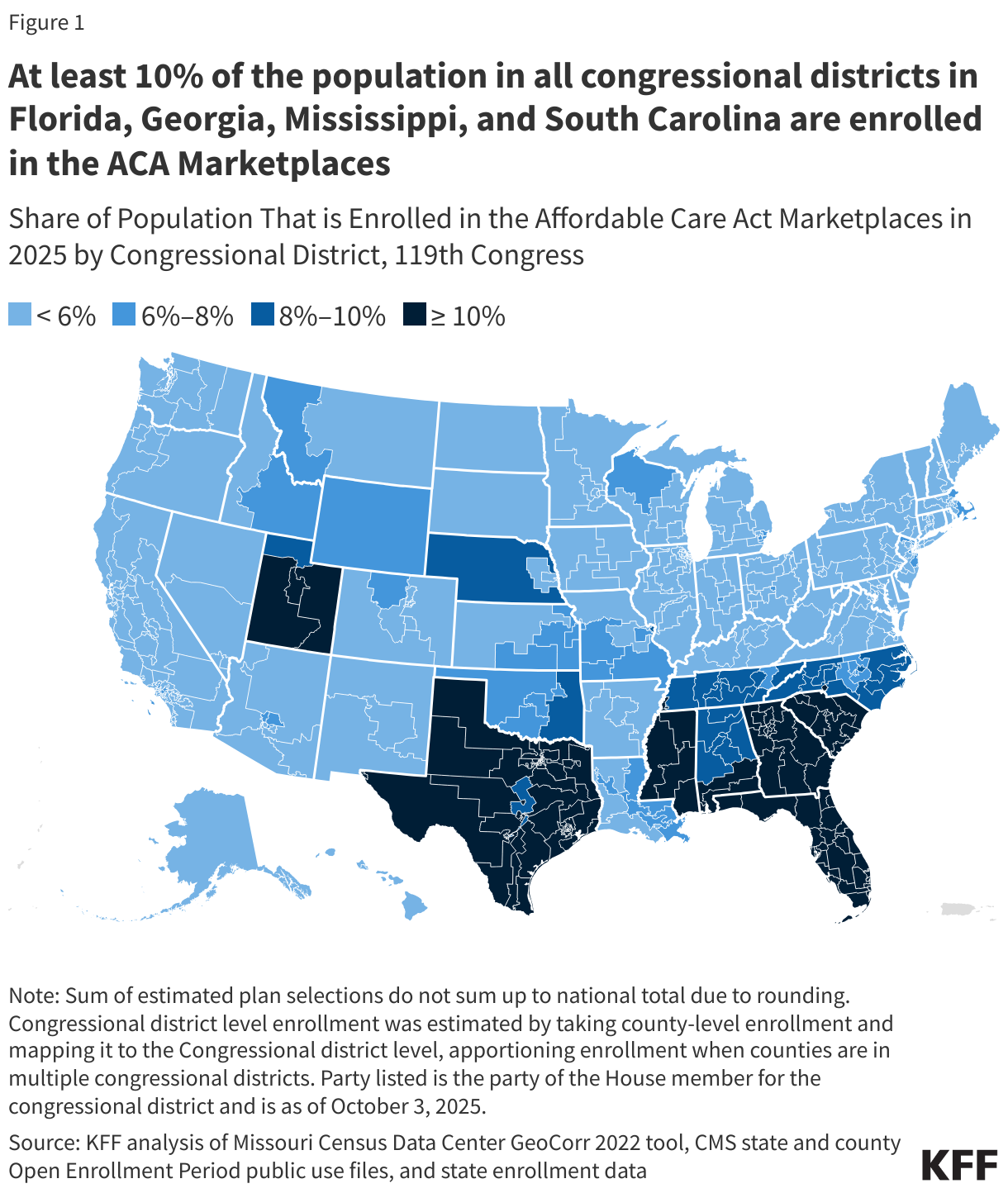
Nearly six in ten Marketplace enrollees (57%) live in congressional districts represented by a Republican. Generally, enrollment in ACA Marketplace coverage by congressional district is largest in the South. At least 10% of the population is enrolled in ACA Marketplace plans throughout all congressional districts in Florida, Georgia, Mississippi, and South Carolina, along with almost all in Texas and Utah.
While a relatively small share of the national population gets their coverage through the ACA Marketplaces, in some districts, the number of ACA enrollees could be enough to swing a close election. For example, in the 10 most competitive districts in the last election, the margin of victory was fewer than 6,000 votes. There are at least 27,000 ACA Marketplace enrollees in each of these districts. (About 9 in 10 enrollees nationwide are voting age). Republicans currently represent 5 of these 10 districts.
In Florida, there are 10 congressional districts where at least 20% of the population is enrolled in a Marketplace plan. The top 5 congressional districts by ACA Marketplace enrollment are all in Florida and represented by a mix of Democrats and Republicans:
- FL27 (R): 298,261 enrollees (38% of population)
- FL24 (D): 290,676 enrollees (35% of population)
- FL28 (R): 287,091 enrollees (36% of population)
- FL09 (D): 272,854 enrollees (30% of population)
- FL26 (R): 258,529 enrollees (30% of population)
Some factors help explain why a large share of the population in the South relies on the ACA Marketplaces. The enhanced tax credits, in addition to making middle-income enrollees newly eligible for financial assistance, also increased the amount of financial assistance for those already eligible for subsidies under the ACA. This has helped drive low-income enrollment in the ACA Marketplaces. Many states in the South had high uninsured rates prior to the introduction of the enhanced premium tax credits. Gains in affordability made possible by increased tax credits helped those who were previously uninsured sign up for coverage.
Additionally, several states in the South have not adopted the Medicaid expansion. This means low-income enrollees who make up to 138% of poverty who’d otherwise be eligible for Medicaid in an expansion state are instead eligible for zero or-low cost ACA Marketplace coverage. Enrollees making between 100%-150% of poverty make up 45% of the ACA Marketplace in 2025.
The enhanced tax credits are set to expire at the end of this year unless extended by Congress. Democrats attempted to introduce a provision extending the enhanced premium tax credits ahead of the government shutdown, though a deal was ultimately not reached. The Congressional Budget Office estimates that extending the premium tax credits would cost $35 billion per year, on average. If the enhanced tax credits are not renewed, however, CBO also estimates that about 4 million more people would become uninsured than otherwise would have been the case.