Public Opinion

Caregivers in the U.S.

Experiences of Unpaid Caregivers in the U.S.

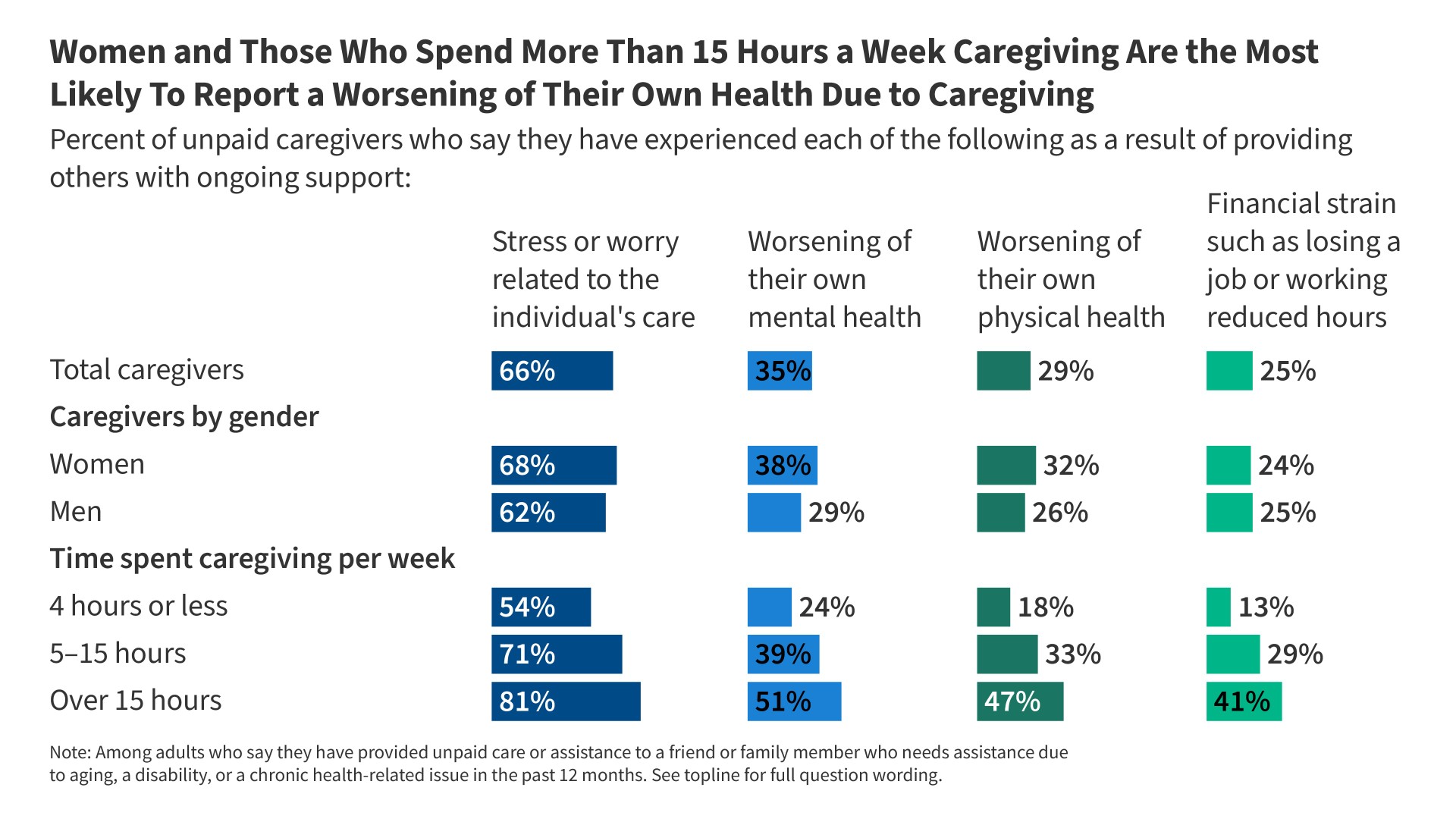
About 3 in 10 adults in the U.S. say they have provided unpaid care to a friend or family member who needs assistance due to aging, disability, or a chronic condition in the past 12 months. The median amount of time that such caregivers provide unpaid assistance is five hours per week, though the number of hours varies widely. Unpaid caregivers are disproportionately women. Read the news release.
HeaLTH in the Midterms

Health Care in the 2026 Midterm Election

This dashboard focuses on KFF’s analysis of the role health care costs and other health policy issues played in voters’ decisions in the 2026 midterm elections, including in key Senate races. It examines the role of rising health costs on voters’ decisions, views on the Trump administration’s health care policies, and opinions on the government’s role in health care amid discussions of Medicare for All.

Abortion on the Ballot in 2026: Polling Insights from Voters in Four States

This dashboard provides KFF’s analysis of the role abortion played in voters’ decisions in the 2026 midterm elections, with a focus on four states with abortion-related ballot measures: Idaho, Missouri, Nevada, and Virginia. It examines support for each of the measures across groups, including additional questions in Missouri.

What Do the Midterm Election Results Mean for Health Care? 

Event Date:

On November 5 at Noon ET, join KFF for a special post-election discussion and live “What the Health” podcast taping. Part of the discussion will focus on public opinion survey data on how voters weighed health care as they went to the polls nationally and in the four states with abortion-related ballot initiatives. 

Midterm Voters Give Democrats a Big Advantage to Handle Health Care

Quick Insights

KFF’s analysis of the 2026 Voter Poll by SSRS shows midterm voters gave Democrats a 19-percentage-point advantage on which party is better able to handle health care. Voters also gave Democrats a narrow edge on handling the economy (43% vs. 37%), a reversal from 2024, when Trump had a 10-point advantage over Harris. "In an election focused on affordability, Democrats’ messaging on health care costs appears to have resonated with voters and may have contributed to the party’s gains."

Health Information and Trust

About Half of Parents Mistakenly Believe Spacing Out Vaccines Is Healthier for Children; Half Say No Strong Evidence to Support Such a Claim

KFF Tracking Poll on Health Information and Trust: Fall 2026 Update on Vaccine Views

The latest KFF Tracking Poll on Health Information and Trust finds about half of parents mistakenly believe spacing out vaccines is healthier for children, while confidence in many long-standing childhood vaccines is high across partisans. These findings take on new relevance following President Trump’s recent executive order calling for changes in U.S. childhood vaccine recommendations, including splitting the measles, mumps, and rubella (MMR) vaccine—currently given as a single combined shot—into three separate vaccines across multiple visits.

Dashboard: Polling on Health Information and Trust

Drawing on KFF’s poll findings, this interactive dashboard tracks the public’s trusted sources for health information, attitudes toward vaccines, and use of news, social media, and AI for health-related information.

Health Tracking PollS

Democrats Hold a Nearly 2-to-1 Advantage Over Republicans on Handling the Cost of Health Care

Health Care Issues in the Lead-Up to the 2026 Midterm Election 

In the lead up to the midterms, health care costs remained tied with gas as voters’ top midterm concerns. Two-thirds of U.S. adults also favored Medicare-for-all, a new high in KFF Polling, but support shifts when competing claims from critics and proponents are heard.

Most Democratic Voters Want To Hear Candidates Discuss Health Costs and Future of Health Programs; More Republicans Focused on Fraud

Public Views on Fraud in Health Programs

As the 2026 midterms approach, health care costs remain voters’ top health priority, but fraud in government health programs, including Medicaid and Medicare, is resonating with Republican voters, 55% of whom say it’s extremely important for candidates to address.

Mifepristone and the Midterms

Amid an ongoing FDA re-review of mifepristone, awareness of the safety and prevalence of the abortion pill remains limited. This KFF poll also finds that the voters who say abortion policy is an important issue for 2026 midterm candidates to discuss are disproportionately Democrats.

MAHA and the Midterms

This KFF Health Tracking Poll finds that the cost of health care is a more prominent focus for Make America Healthy Again (MAHA) voters than issues like food and vaccine policy. Four in ten MAHA voters (42%) choose lowering health costs as the most important health priority, outranking other MAHA priorities.

the essentials

Health Tracking Poll

Our signature survey project provides up-to-date data on the public’s health care views, knowledge, and experiences.

Tracking the Public’s Views on the ACA

Tracking the Public’s Views on the ACA

This interactive tool tracks public opinion on the Affordable Care Act, from the inception of the law to the present, including trends based on party identification, income, age, gender, and race/ethnicity.

Health Information and Trust Tracking Poll

The Health Information and Trust Tracking Poll is part of KFF’s Health Information and Trust Initiative, which tracks health misinformation and analyzes its impact on the public.

Stay informed.

Stay informed.

Filter

1,651-1,660 of 1,871 results

  • Race and Ethnicity in 2001: Attitudes, Perceptions and Experiences

    Poll Finding

    The Washington Post/Kaiser Family Foundation/Harvard University Survey Project's latest findings appeared in a series of occasional articles in The Washington Post beginning on June 22, 2001. The survey explores the public's perspectives on social policies and the role of government, perceptions of the life experiences of people from other racial and ethnic groups, and their own personal experiences. TOPLINE Download

  • New Survey on Consumer Experiences with Health Plans

    Report

    Survey on Consumer Experiences with Health Plans A Kaiser Family Foundation/Harvard School of Public Health survey found that more than six in ten privately insured American adults under age 65 give their health plans a grade of A or B, but nearly half report having some type of problem with their health plan in the last year with a range of consequences for the consumer. The survey found strong support for the right-to-sue a health…

  • Public Opinion Update: The Public, Managed Care, and Consumer Protections

    Fact Sheet

    The Kaiser Family Foundation and Harvard School of Public Health monitored consumer experiences with managed care and attitudes toward alternative consumer protection approaches. This Public Opinion Update summarizes key findings from surveys conducted between 1997 and 2001, a period in which the intensity of public debate and media attention paid to managed care issues varied substantially. Public Opinion Update (PDF)

  • Health News Index – July/August 2001

    Poll Finding

    Health News Index July/August, 2001 The July/August 2001 edition of the Kaiser Family Foundation/Harvard School of Public Health, Health News Index includes questions about major health stories covered in the news, including stem cell research and patients rights legislation. The Health News Index is designed to help the news media and people in the health field gain a better understanding of which health stories Americans are following and what they understand about those health issues.…

  • Employers Attitudes Toward Patients Rights

    Report

    A national survey of employers, released jointly by the Kaiser Family Foundation and the Health Research and Educational Trust, found that smaller employers (3 to 199 employees) are significantly more likely than larger employers (200 or more employers) to support a person's right to sue a health plan, and somewhat more likely to support the right to appeal a health plan's decision to an independent reviewer. Two-thirds (67%) of smaller employers express support for the…

  • Medicare and Prescription Drug Focus Groups

    Report

    Summary Report This report, : Summary Report, produced jointly by the bipartisan team of Bill McInturff of Public Opinion Strategies and Geoff Garin of Peter D. Hart Research Associates, presents key findings from a series of eight focus groups on the Medicare program and the current debate over prescription drug coverage and Medicare reform. These groups, conducted in four cities with both elderly and non-elderly participants in June 2001, explored attitudes about Medicare and how…

  • New V-Chip and TV Ratings Study Release

    Report

    A Kaiser Family Foundation survey released in July 2001 found that 40% of American parents now own a TV equipped with a V-Chip. While parents express high levels of concern about children's exposure to TV sex and violence, just 17% of those who own a V-Chip or 7% of all parents are using it to block programs with sexual or violent content. More than half of all parents have consulted TV ratings to decide which…

  • National Surveys of the Role of Polls in Policymaking

    Poll Finding

    Three companion surveys by the Kaiser Family Foundation, conducted in collaboration with Public Perspective magazine, give new insight into how the public, policy leaders and media professionals view public opinion polls. The surveys show that while policy leaders and journalists see polls as an effective tool for giving the public a voice in the policymaking process, the public itself is more skeptical. The discussions of the surveys in Public Perspective also explore the extent to…

  • Condom Ads on TV: Unwrapping the Controversy

    Poll Finding

    Ever seen a condom advertised on TV? Up until a few years ago, the answer was almost always "no." But condoms and other topics once considered "taboo" are beginning to make an appearance on the small screen. A number of leading broadcast networks, as well as cable channels have in recent years quietly let go of long-standing policies prohibiting contraceptive commercials. But several others still prohibit advertising for condoms - even though they accept ads…

  • Health News Index – May/June 2001

    Poll Finding

    Health News Index May/June, 2001 The May/June 2001 edition of the Health News Index includes questions about major health stories covered in the news, including the Supreme Court ruling regarding the distribution of medical marijuana and the debate in Congress over a Patients Bill of Rights. This edition also includes findings on public support for certain prescription allergy medicines being sold over the counter. The Health News Index is designed to help the news media…