
About 3 in 10 Adults Have Provided Unpaid Care to a Friend or Family Member in the Past Year, Including Higher Shares of Women and People Ages 50 to 64
Many Caregivers, Particularly Those Who Spend Longer Hours Caregiving, Report a Toll on Their Physical Health, Mental Health, and Finances
About 3 in 10 adults (29%) in the U.S. say they have provided unpaid care to a friend or family member who needs assistance due to aging, disability, or a chronic condition in the past 12 months, according to a KFF survey released today.
The KFF Survey of Health Access and Caregiving finds the median amount of time that such caregivers provide unpaid assistance is five hours per week, though the number of hours varies widely. Nearly half (45%) of unpaid caregivers (or 13% of all adults in the U.S.) spend four hours or less per week on these tasks, while about a quarter (23%; 7% of all adults) say they spend more than 15 hours a week.
The survey finds that unpaid caregivers are comprised disproportionately of women (57% are women, 42% are men). Unpaid caregivers also tend to be older than the adult population who do not provide unpaid caregiving (53% of caregivers are ages 50+ compared to 44% of non-caregivers). One-quarter (26%) of unpaid caregivers are parents or guardians of a child under 18 living in their household, and many unpaid caregivers (44%) say they are employed full-time, illustrating how many unpaid caregivers must juggle multiple responsibilities.
Substantial shares of unpaid caregivers say the work they do takes a toll on their own health and finances, particularly those who devote many hours to caregiving each week. Two-thirds (66%) of unpaid caregivers say they have experienced stress or worry related to their caregiving duties. At least a quarter say they have experienced worsening of their own mental (35%) or physical (29%) health or say they have experienced financial strain such as losing a job or having to work reduced hours (25%). The share reporting financial strain is highest among those who work part-time (41%) or are unemployed (34%).
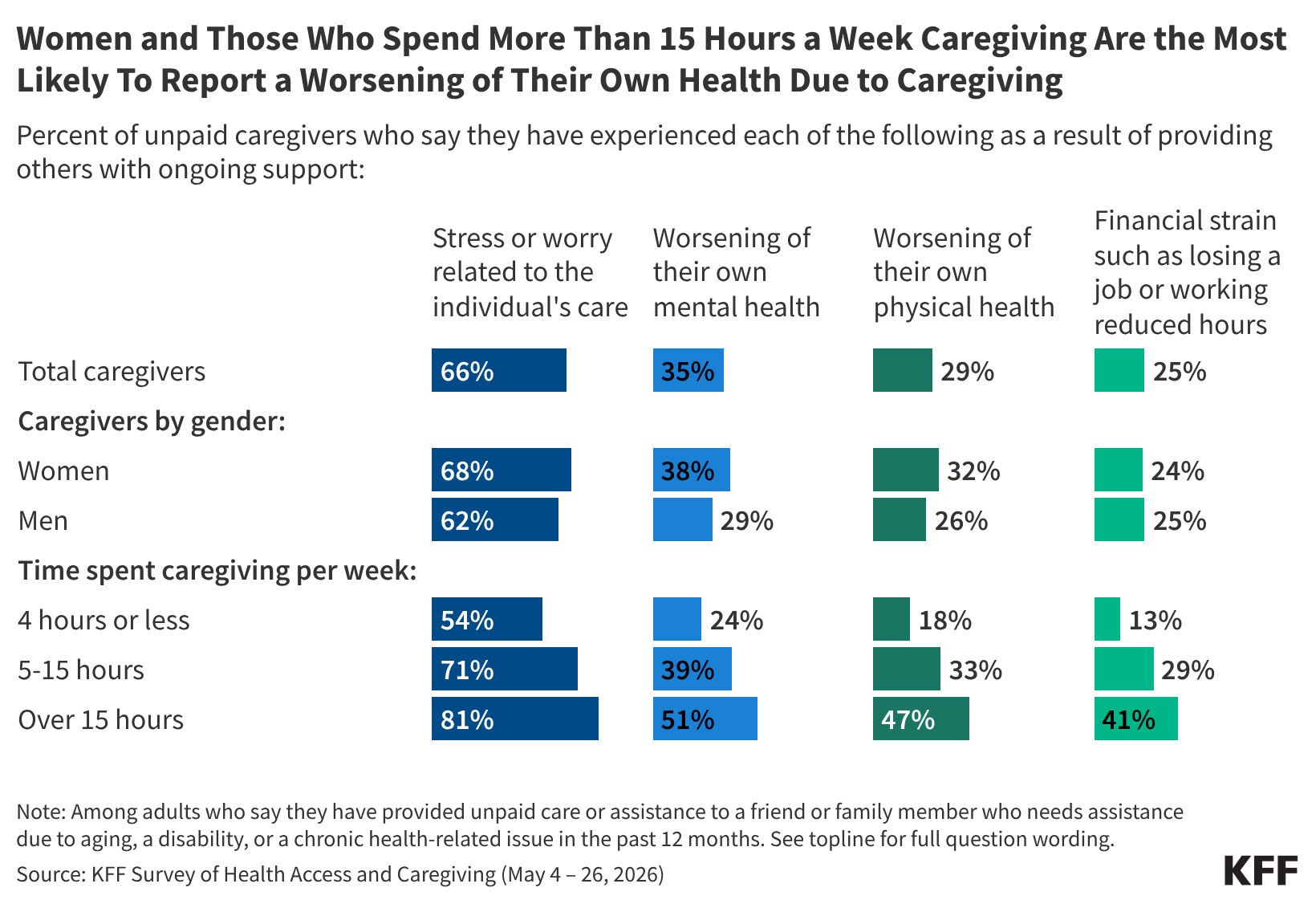
About eight in ten caregivers (81%) who spend over 15 hours weekly providing care say they have experienced stress or worry as a result, about half each say they have experienced a worsening of their own mental health (51%) or physical health (47%), and four in ten (41%) have experienced financial strain. Across all measures, these shares are substantially higher compared to those who spend fewer hours caregiving each week. Women caregivers are also somewhat more likely than men to report stress or worry and a worsening of their own mental or physical health due to caregiving duties.
Unpaid caregivers provide an array of essential assistance to the person they care for. Most commonly, these tasks include “housekeeping, grocery shopping, or preparing meals” (70% of all caregivers, including 72% of women and 66% of men). About half (51%) of unpaid caregivers say they manage an individual’s medical care, such as helping manage medications or transportation to medical appointments. Smaller, though still sizeable, shares report managing their finances (37%), making decisions about medical care like choosing a provider (30%), and providing physical care including helping them bathe or dress (26%).
Designed and analyzed by KFF public opinion researchers, KFF’s Survey of Health Access and Caregiving was conducted in English and in Spanish May 4 – 26, 2026, online and by telephone among a large, nationally representative sample of 25,873 adults, including 8,209 who say they have provided unpaid care to a friend or family member who needs assistance due to aging, disability, or a chronic health-related issue in the past 12 months. The margin of sampling error is plus or minus one percentage point for the full sample and plus or minus two percentage points for unpaid caregivers. For results based on other subgroups, the margin of sampling error may be higher.