KFF/AP Rural Voters Survey
Methodology
This KFF/AP Rural Voters Survey was designed and analyzed by public opinion researchers at KFF and The Associated Press. The survey was conducted online and by telephone August 12-24, 2026 among a nationally representative sample of 2,241 U.S. adults registered to vote in rural areas of the country. KFF and the AP each contributed financing for the survey, and representatives of each organization worked together to develop the survey questionnaire and analyze the results. Each organization bears the sole responsibility for the work that appears under its name. Sampling, data collection, weighting, and tabulation were managed by SSRS in close collaboration with KFF.
Interviews were administered in English (n=2,236) and Spanish (n=5) combining samples from the SSRS Opinion Panel who have been matched to the L2 voter file. and a stratified Registration-Based Sample (RBS) from the L2 voter file. For this study, rural areas were defined as those in Census tracts that fall within codes 5-10 of the USDA’s 2020 Rural-Urban Commuting Area (RUCA) Codes.
1,577 registered voters living in rural areas were reached through the SSRS Opinion Panel, The SSRS Opinion Panel is a nationally representative probability-based panel where panel members are recruited randomly in one of two ways: (a) Through invitations mailed to respondents randomly sampled from an Address-Based Sample (ABS) provided by Marketing Systems Groups (MSG) through the U.S. Postal Service’s Computerized Delivery Sequence (CDS); (b) from a dual-frame random digit dial (RDD) sample provided by MSG. For the online panel component, invitations were sent to panel members by email followed by up to three reminder emails. Telephone panelists received up to four phone calls.
Another 664 rural adults were reached through a stratified Registration-Based Sample (RBS) from the L2 voter file. Stratification was based on rurality, race, and geography. RBS cases were invited to the survey through multiple contacts: An invitation letter including non-contingent incentive and a follow-up postcard to all, email reminders to those with a listed email address, text-message reminders to those with a cell phone number matched to the voter file, and outbound telephone calls to those with phone number matched to the voter file.
Individuals who completed the survey received a monetary incentive for their participation including either a $10 electronic gift card or a $10 incentive check depending on the method of contact. In order to ensure data quality, cases were removed if they failed two or more quality checks: (1) attention check questions in the online version of the questionnaire, (2) had over 30% item non-response, or (3) had a length less than one quarter of the mean length by mode. Based on this criterion, eight cases were removed.
A multi-stage weighting process was applied to ensure an accurate representation of the population including adjustments for the sample design and within household probability of selection. The combined panel and RBS samples were weighted to match the sample’s demographics to the U.S. rural registered voter population using data from the L2 voter file. The variables included in weighting are gender, age, education level, race and ethnicity, Census region, RUCA category, 2024 turnout, and modeled likely 2024 vote choice.
The margin of sampling error including the design effect for the full sample is plus or minus 3 percentage points. Numbers of respondents and margins of sampling error for key subgroups are shown in the table below. For results based on other subgroups, the margin of sampling error may be higher. Sample sizes and margins of sampling error for other subgroups are available on request. Sampling error is only one of many potential sources of error and there may be other unmeasured error in this or any other public opinion poll. KFF public opinion and survey research is a charter member of the Transparency Initiative of the American Association for Public Opinion Research.
| Group | N (unweighted) | M.O.S.E. |
| Total | 2,241 | ± 3 percentage points |
| Party/Party Lean | ||
| Democrat/Lean Democrat | 836 | ± 4 percentage points |
| Republican/Lean Republican | 1,174 | ± 4 percentage points |
| Pure Independent | 177 | ± 9 percentage points |
| MAGA Republicans/Rep leaners | 883 | ± 4 percentage points |
| NOT MAGA Republicans/Rep leaners | 288 | ± 7 percentage points |
Findings
Key Takeaways
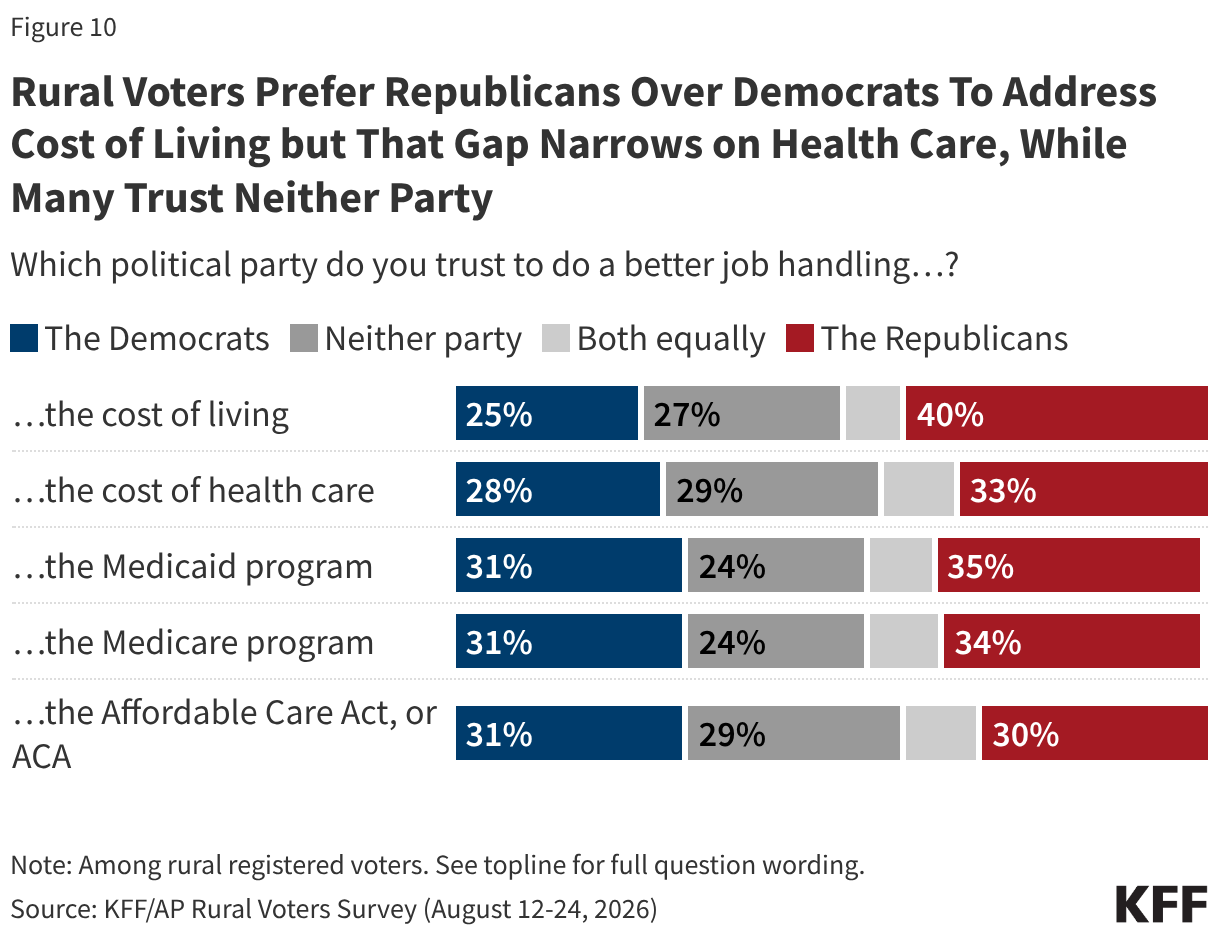
- Economic frustrations in rural America have significantly worsened over the past decade, and growing dissatisfaction with the rising cost of living appears to be chipping away at rural voters’ historical support for President Trump. Rural voters overwhelmingly name the cost of living as their top election issue, and three quarters, including majorities across partisanship, now rate the cost of living in their area as either “fair” or “poor,” a 25-percentage point increase from 2017. While more rural voters prefer the Republican Party than the Democrats to best address the cost of living (40% v. 25%), many (27%) say they trust neither party, including most independents (67%) and four in ten (42%) Republicans who do not support the MAGA movement.
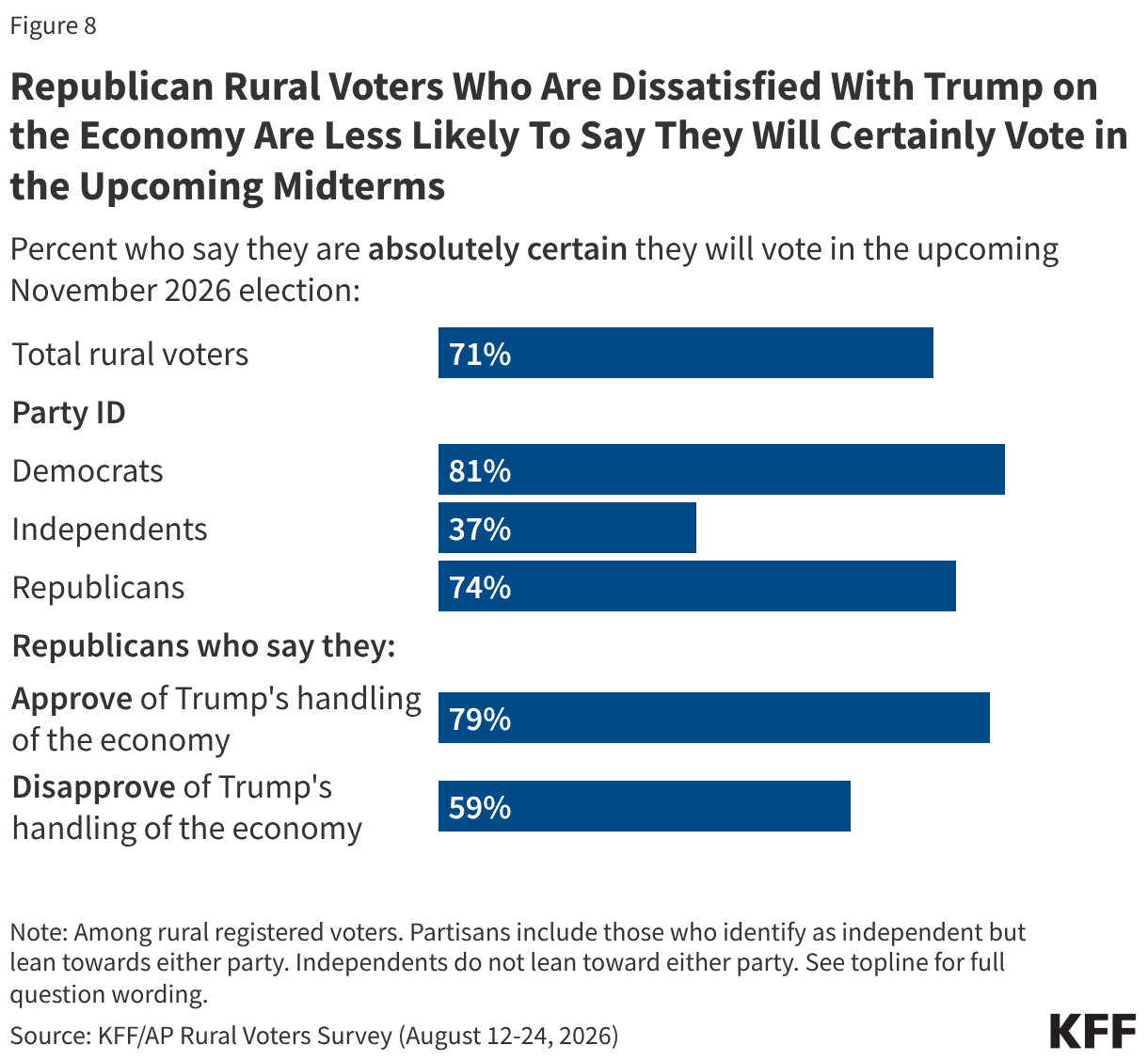
- President Trump continues to garner strong approval among his base of Republicans across rural America, but growing economic frustrations may be impacting some Republicans’ enthusiasm to turn out in the 2026 midterms. About one-quarter (27%) of rural Republican voters disapprove of Trump’s handling of the economy, and this group is substantially less likely than Republicans who approve of Trump on the economy to say they are “absolutely certain” to vote in the upcoming election (59% vs. 79%). Overall, eight in ten Democratic rural voters (81%) say they are certain to vote, slightly higher than the share of Republican rural voters who say the same (74%).
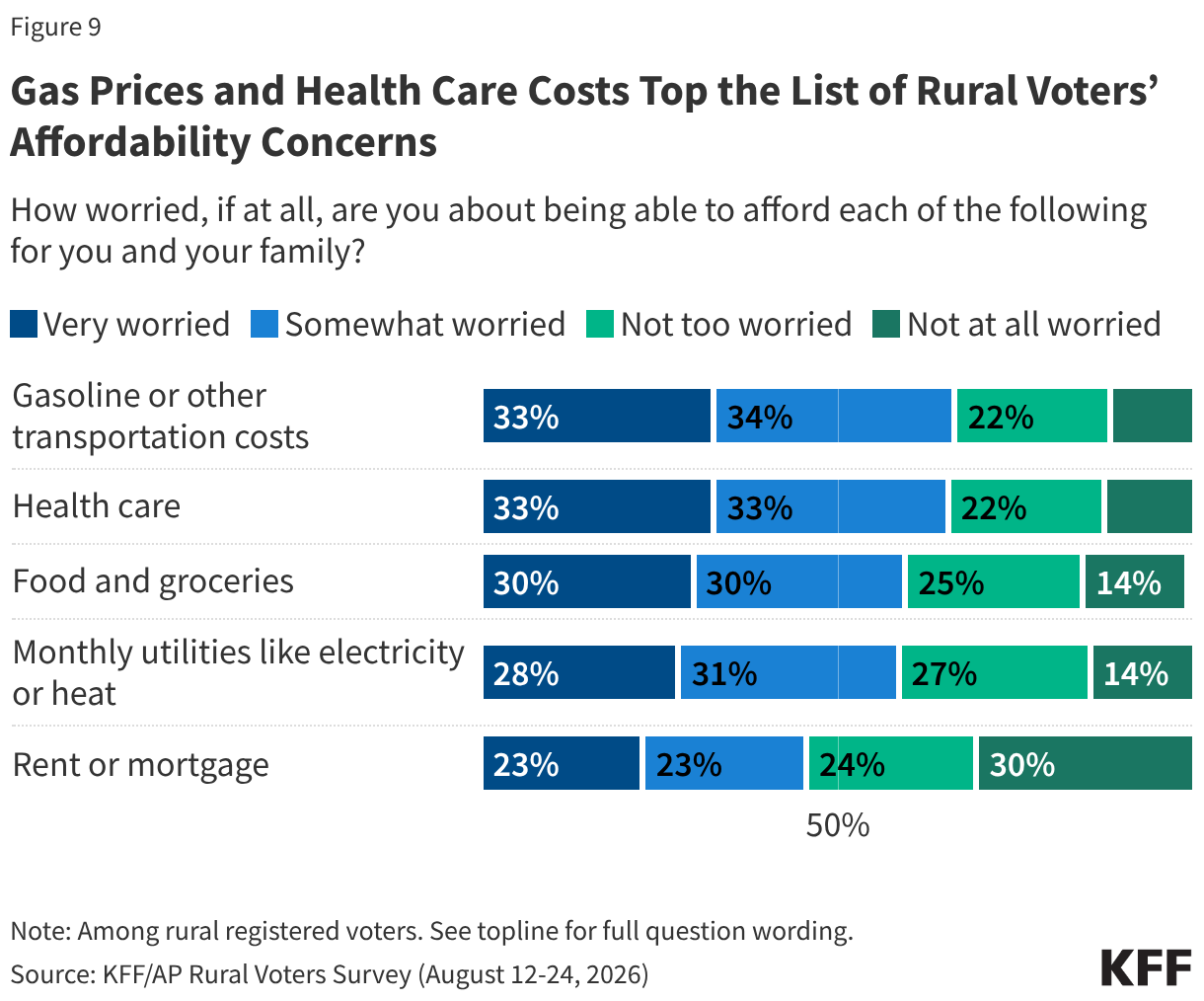
- As KFF polling has found nationally, health care costs play a large part in rural voters’ concerns about the cost of living. Two-thirds of rural voters say they are at least “somewhat worried” about affording health care for themselves or their families, on par with the share who say they are worried about affording gas (67%) and higher than worries about affording food (60%), monthly utilities (59%), or housing costs (46%).
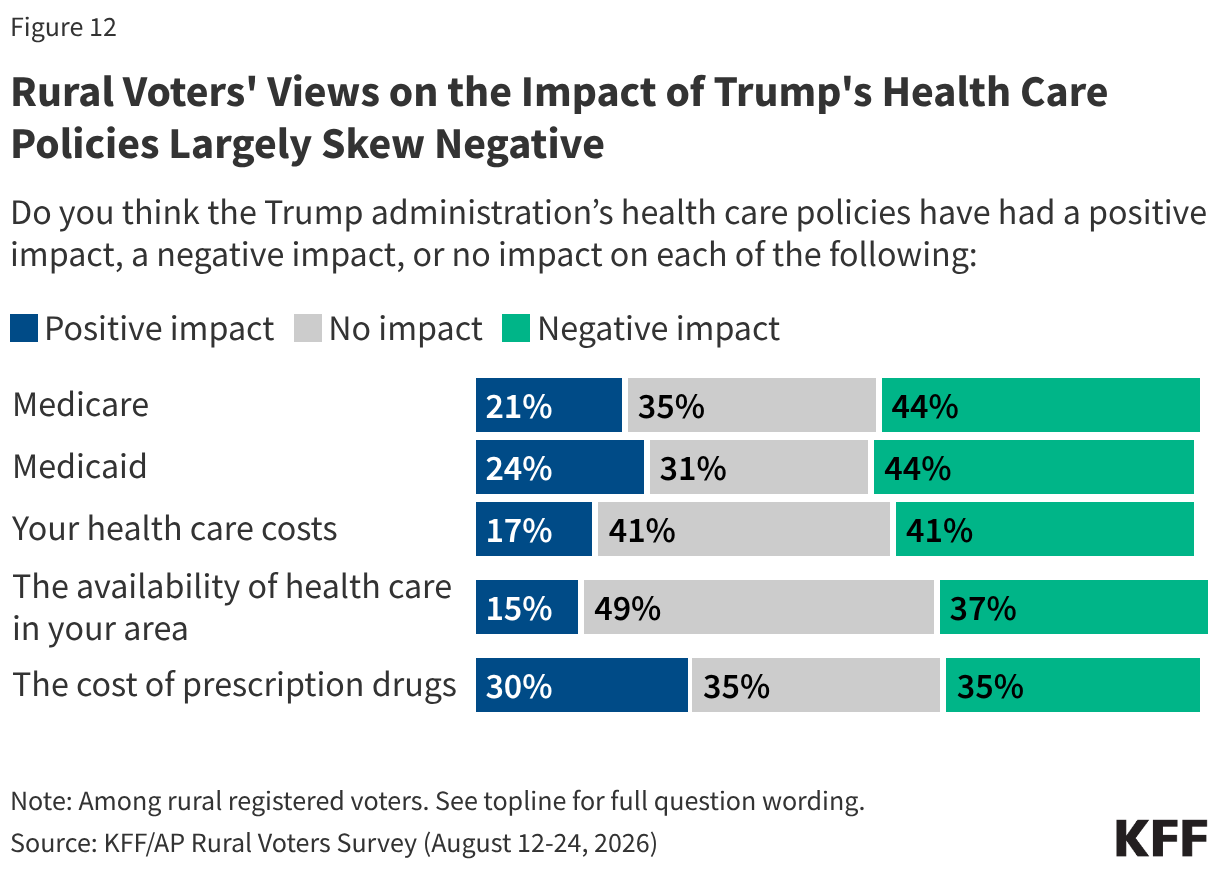
- More than half (54%) of rural voters disapprove of President Trump’s handling of health care, and views on the impact of his administration’s policies on areas like health care costs, Medicare, Medicaid, and the availability of health care are largely negative. For example, by more than a 2-to-1 margin, rural voters say the Trump administration’s policies have had a negative rather than a positive impact on their own health care costs (41% vs. 17%). Still, the Republican Party has a narrow advantage over the Democratic Party in rural voters’ trust to handle the cost of health care (33% vs. 28%), though about three in ten Republicans (28%) say they trust neither party on health care costs, rising to six in ten (59%) among independent rural voters.
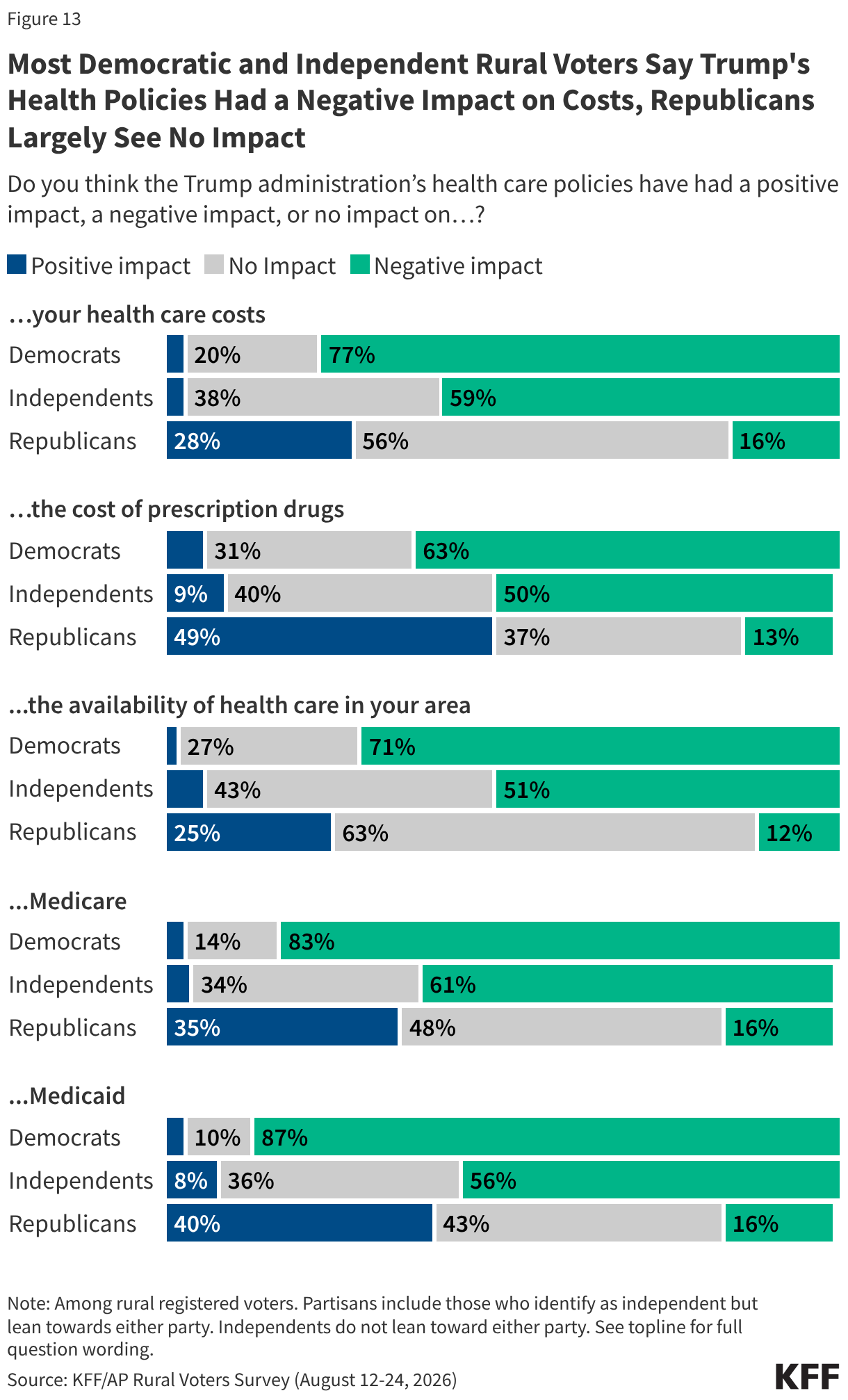
- The overwhelming majority (92%) of rural voters say Medicaid is important for people in their local community and half have had a personal or family connection to the program at some point in their lives. However, awareness of future cuts to the program included in President Trump’s “One Big Beautiful Bill” is low among rural voters, with most saying they don’t know whether the legislation increases or decreases future federal spending on Medicaid. Despite this, nearly twice as many rural voters say Trump’s health care policies have had a negative rather than a positive impact on Medicaid (44% vs. 24%). While rural Republican voters are more likely to say the impact of Trump’s policies on Medicaid has been positive (40%), a similar share (43%) say they have had no impact.
- Provider shortages have been a persistent challenge in rural areas, and the poll finds increases since 2017 in the share of rural voters saying their area lacks sufficient doctors (46%, up from 33%) and hospitals (35%, up from 21%) to serve the needs of the local community. Some voters appear to attribute responsibility to the Trump administration, with more than twice as many saying the administration’s policies have had a negative rather than a positive impact on the availability of health care in their area (37% vs. 15%).
Partisan Identification Among Rural Voters
The KFF/AP Rural Voters Survey draws from a nationally representative sample of 2,241 registered voters who currently live in census tracts classified as rural areas.
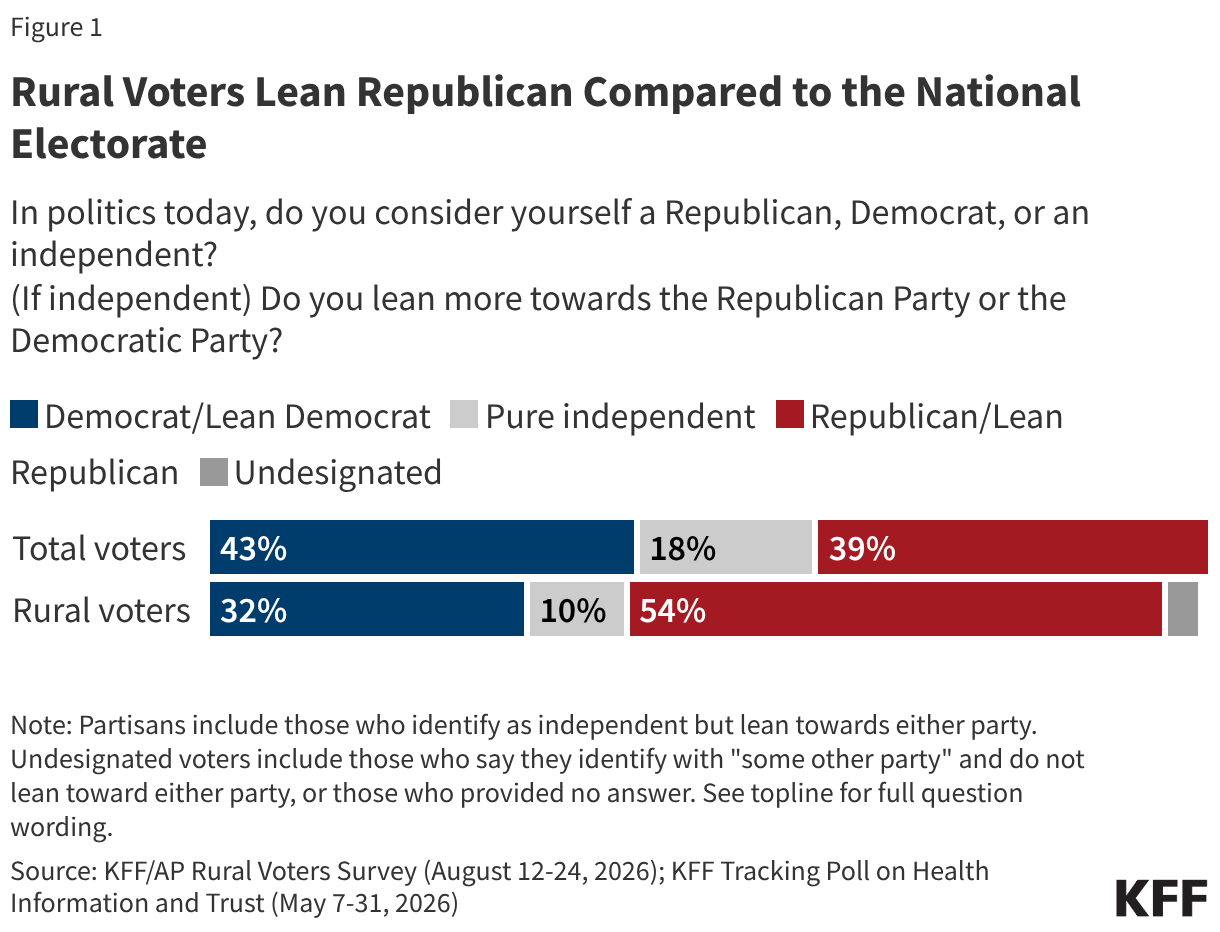
Rural voters skew more Republican compared to voters nationally, a difference that plays a role in their overall views and preferences on a range of issues.
Slightly more than half (54%) of rural voters identify as Republicans or Republican-leaning independents versus one-third (32%) who are Democrats or Democratic-leaning independents. A previous KFF poll found the national electorate is more evenly divided, with roughly similar shares identifying as either Democratic/Democratic-leaning (43%) or Republican/Republican-leaning (39%).
In addition to partisanship, this report also breaks out Republican/Republican-leaning rural voters by their support for President Trump’s Make America Great Again (MAGA) movement. Three quarters of Republican rural voters say they support the MAGA movement, while a quarter (24%) do not.
Cost of Living is the Top Issue for Rural Voters in 2026
A key theme echoed by majorities of rural voters across the country is that the current economic situation in the U.S. is putting significant pressure on them and their families – and it is what they want the candidates to be focused on during the 2026 election.
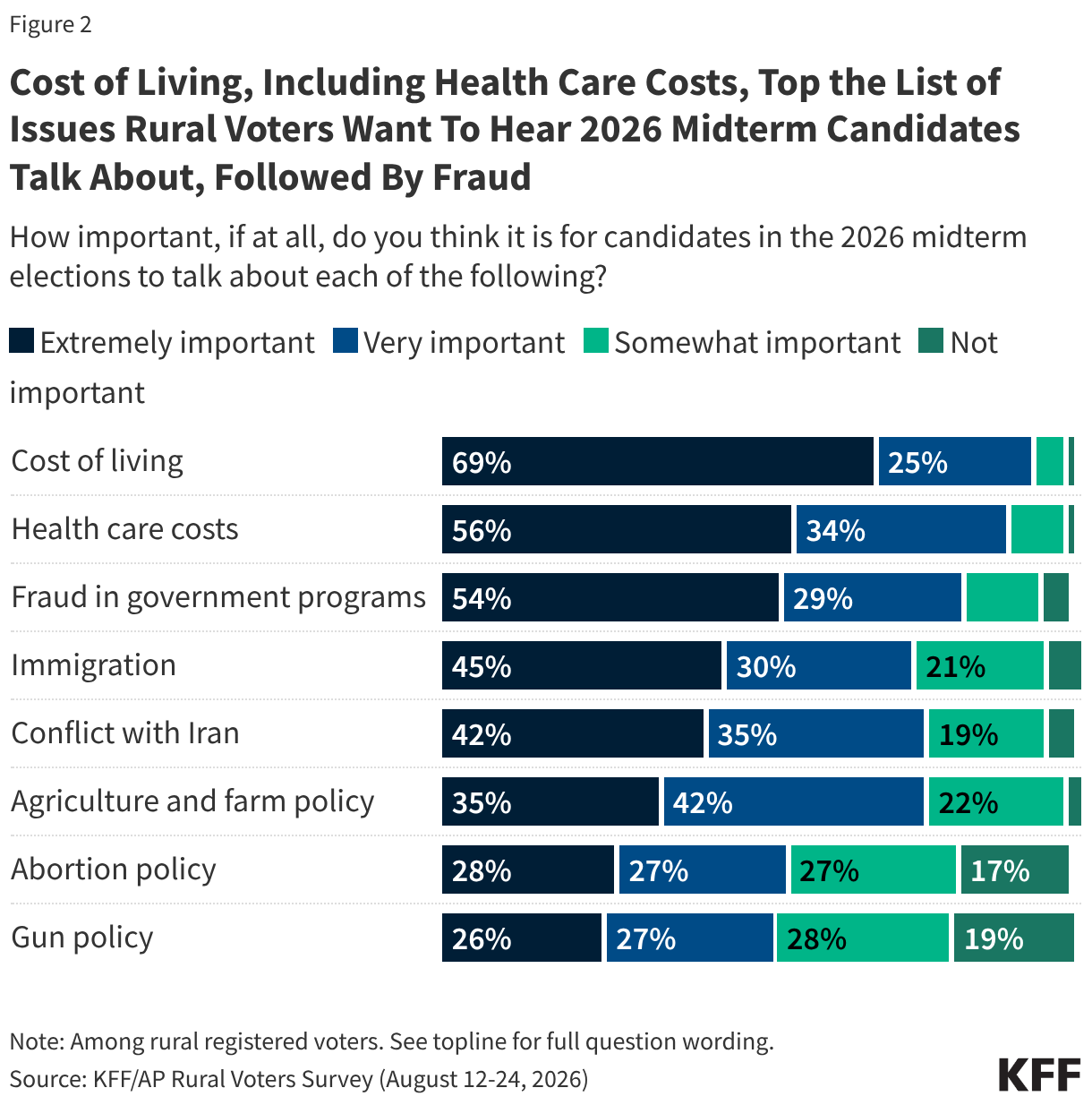
Cost of living is the top issue that rural voters want to hear midterm candidates talk about. About seven in ten (69%) rural voters say it is “extremely important” for candidates in the 2026 midterm elections to talk about cost of living, followed by health care costs (56%) and fraud in government programs (54%). Four in ten or more of these voters say it’s “extremely important” for candidates to talk about immigration (45%) or the conflict with Iran (42%), while smaller shares say they want to hear candidates talk about agriculture and farm policy (35%), abortion policy (28%), or gun policy (26%).
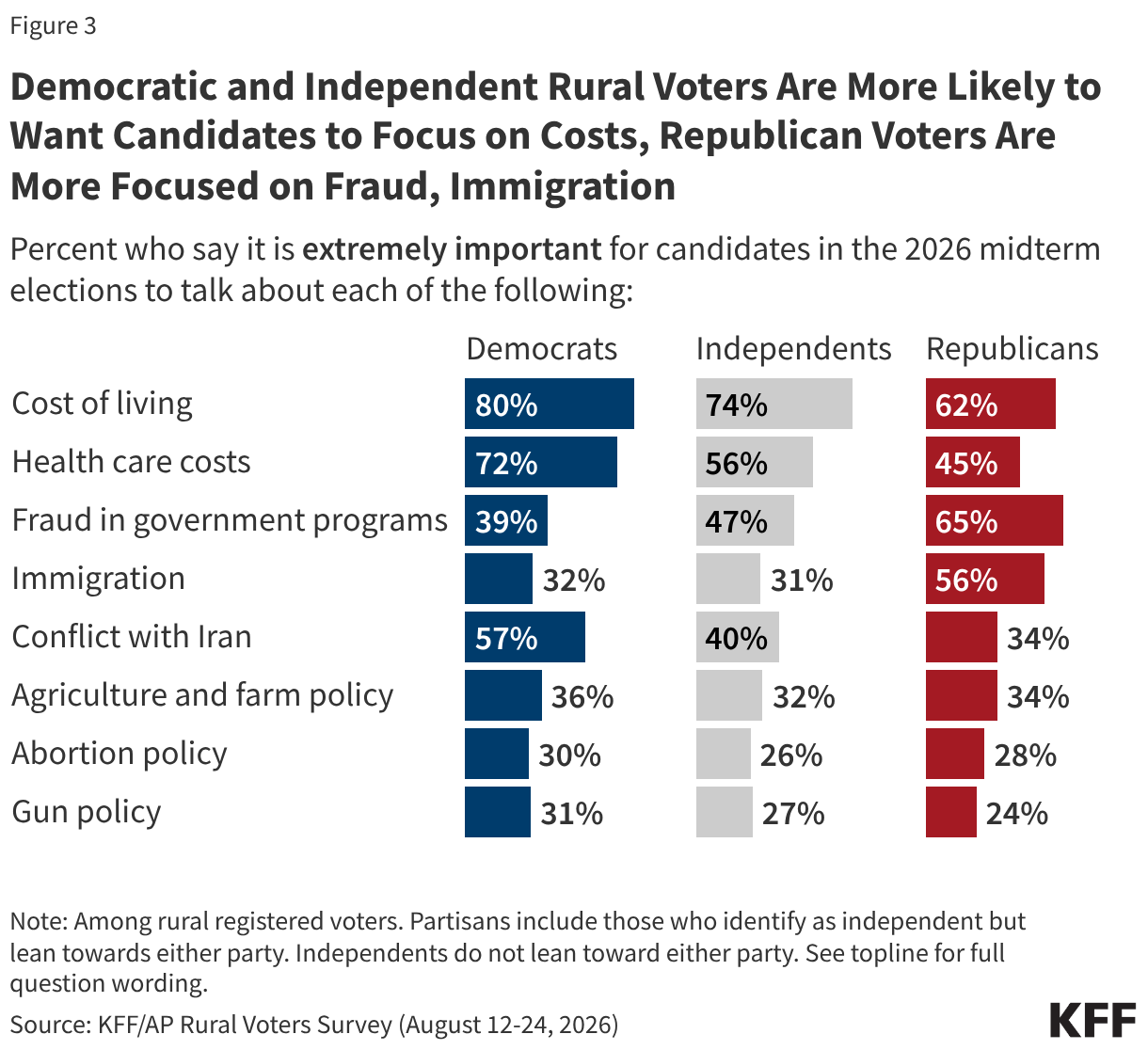
While cost of living is a top concern across partisans,1 the ranking of issues differs. The top three issues Republican rural voters want candidates to discuss are fraud in government programs (65%), cost of living (62%), and immigration (56%). For Democratic voters in rural areas, the top three concerns are cost of living (80%), health care costs (72%), and the conflict with Iran (57%).
In addition, rural voters overwhelmingly name economic factors, especially the rising cost of living, as the biggest problem in their communities. When asked what the biggest issue facing their local community is, roughly six in ten (57%) of these voters offer responses related to economic concerns as their community’s biggest issue, including rising costs, lack of jobs, low wages, housing affordability, and stagnant local economies.
In Their Own Words: Rural Voters Describe the Biggest Economic Problems Facing Their Local Communities
“Everything is expensive, the price of living is horrendous. It is impossible to even think of raising a family in this current climate. You can’t even sustain one single person with one form of income, when most places aren’t hiring full time so you have to have 2-3 part time jobs to sustain yourself.” – 27-year-old rural voter from Alabama, Democratic-leaning independent
“I think prices are too high right now. Also, the government takes way, way too much in taxes, leaving people too little to live on. We have to live within our means and balance our finances …Almost all of the politicians are hypocrites.” – 66-year-old rural voter from Ohio, Republican
“Gas prices are financially impacting me in a major way, someone who has to drive 45 minutes, each way, to work because I live rural, is impacting my budget. Between the gas prices and food prices increasing, I pay over $300 more on my budget. That’s not a little amount when every penny counts. Also, property taxes have doubled in the last 4 years.” – 51-year-old rural voter from Florida, independent who doesn’t lean toward either party
“Healthcare and our economy, no new jobs, inflation, gas prices, electricity, water supply is not clean, hard to save money when you’re paying it just to survive and support yourself and your children and grandchildren.” – 56-year-old rural voter from West Virginia, Democrat
“Electric bills and bills period. No one can afford to live anymore with the high food prices, high rent. Making do and I work 48 hrs a week with a family of 5 at home” – 36-year-old rural voter from New York, Republican
“We have lost several major manufacturing plants in my town. This resulted in a large portion of the community becoming unemployed. This has created a huge ripple effect of issues including a huge migration of people out of the area. Lower number of students enrolled has led to a drop in school funding and we are having to close an elementary school. The city council is proposing allowing a data center to be built close to town to “bring in jobs/opportunities” even though the majority of the community is against it and actively fighting it.” – 32-year-old rural voter from Kansas, Democrat
“The amount I am paying for groceries is too high for the income I make, and I am a teacher. I have a degree I should be able to afford a vacation for my family. I should be able to go to the local store and not pay about double what it is at Walmart.” – 26-year-old rural voter from North Dakota, Republican
Note: Responses are lightly edited for length and spelling, but reflect respondents’ own language and do not represent the views of KFF.
Current Economic Conditions Weigh Heavily on Rural Voters
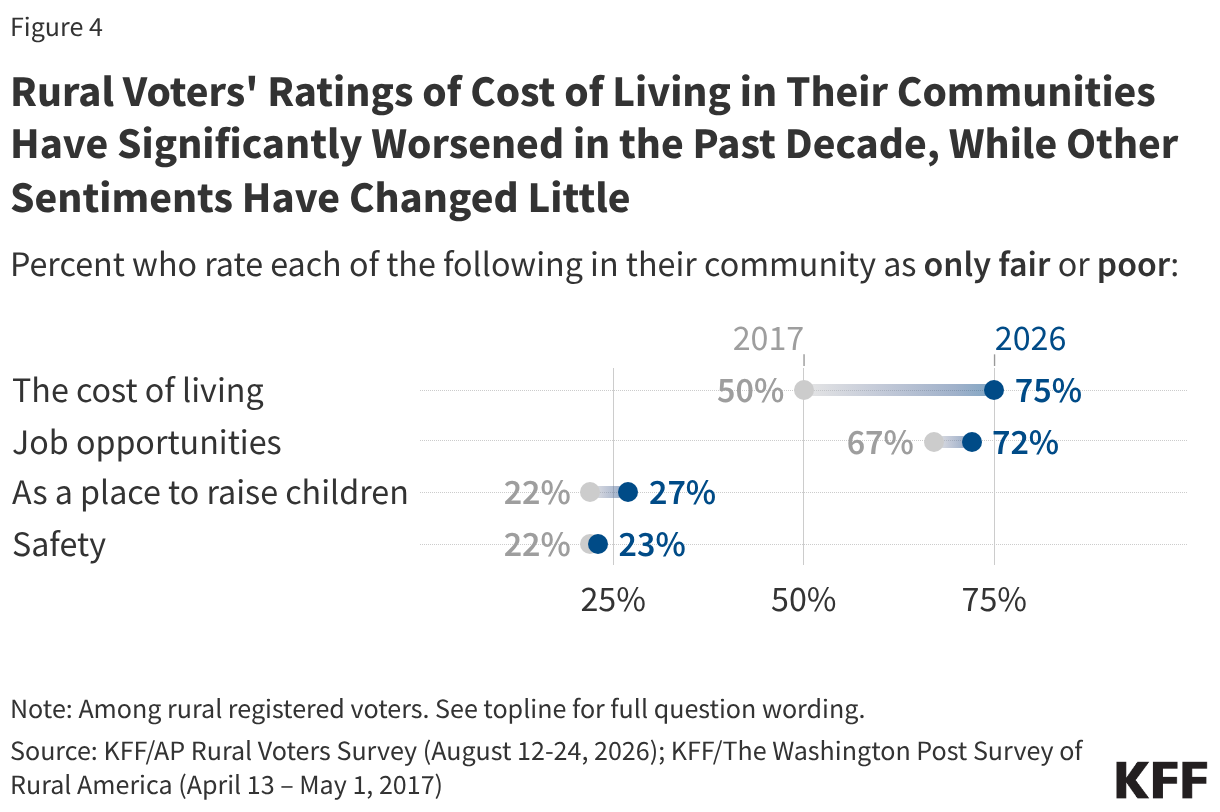
While most rural voters continue to have positive views of their community in terms of safety and raising children, their views on cost of living in their areas has gotten markedly worse over the past decade. Three in four rural voters now say the cost of living in their community is “only fair” or “poor”, a 25-percentage point increase since 2017, when half of rural voters said the same. This includes double-digit increases in the shares of Republican, Democratic, and independent rural voters who rate the cost of living in their community negatively.
Seven in ten rural voters (72%) also rate job opportunities in their communities negatively, a slight increase from two-thirds (67%) in 2017.
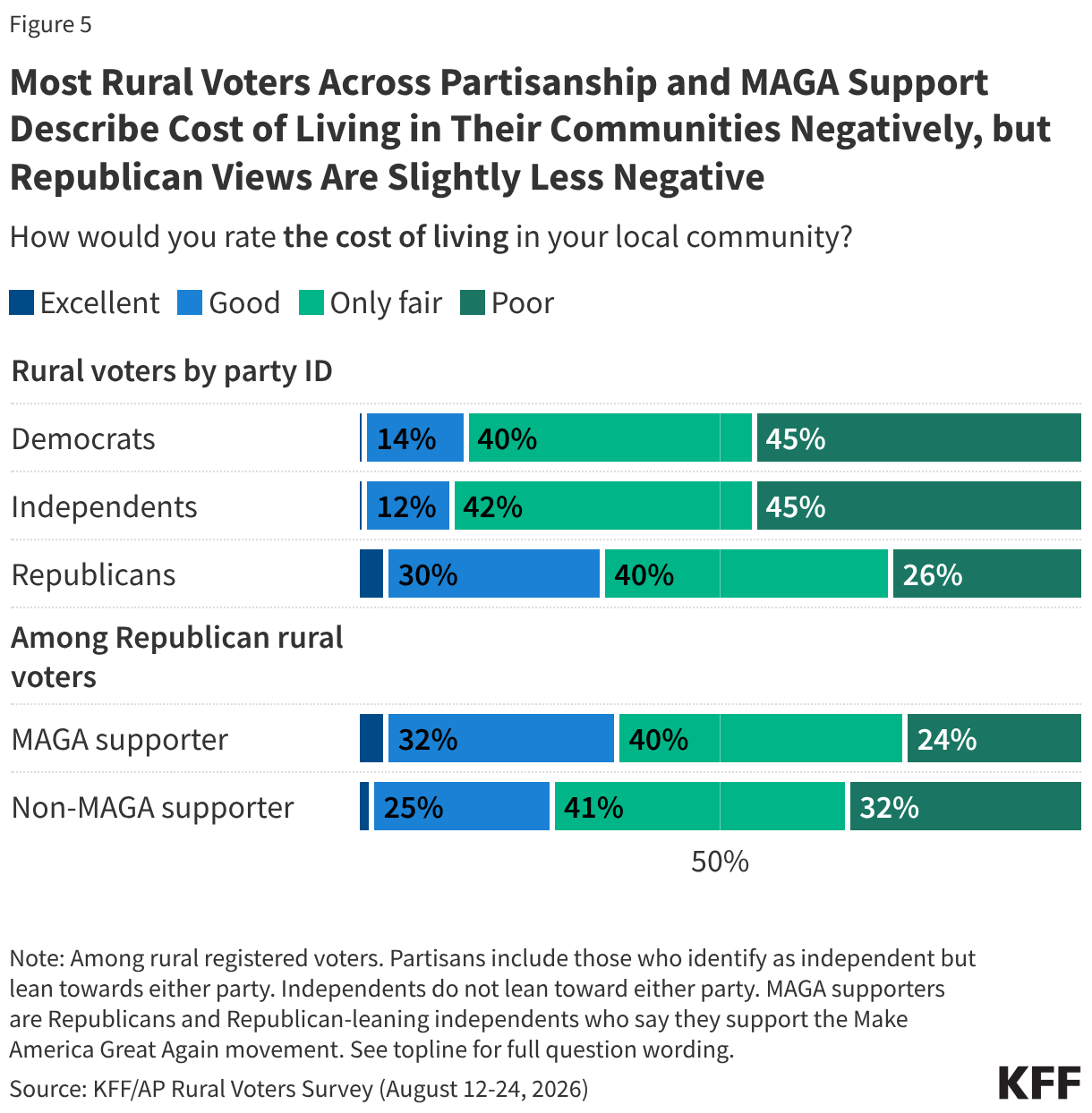
Majorities of rural voters across partisanship describe the cost of living in their community negatively, including more than eight in ten independents (87%) and Democrats (85%) and fewer, but still a majority, of Republicans (66%). Republican rural voters who do not support President Trump’s Make America Great Again (MAGA) movement are somewhat more negative in their views of the cost of living where they live compared to MAGA supporters (73% v. 64%).
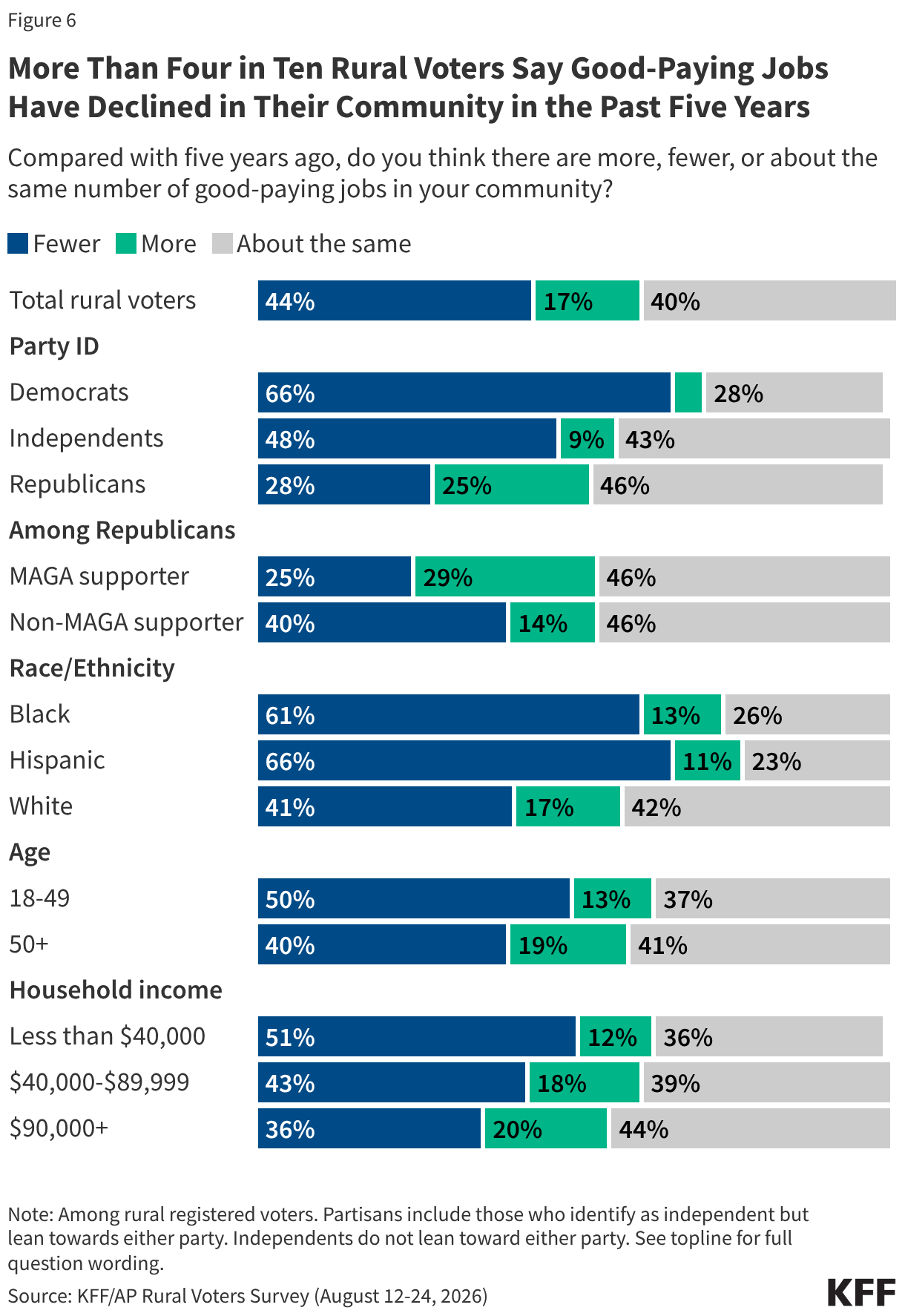
A plurality of rural voters say good-paying jobs have faded in their communities in the past five years. Overall, more than four in ten (44%) say there are fewer good paying jobs in their community compared to five years ago, while just one in six (17%) say there are more of these jobs. Another four in ten say the number of well-paid jobs in their area is about the same as it was five years ago.
Democratic and independent rural voters are more likely than their Republican counterparts to say good-paying jobs have waned in their communities in the past five years, but similar to dynamics seen on other economic sentiments, non-MAGA supporting Republicans are nearly twice as likely as MAGA supporting Republicans to say good-paying jobs have declined where they live. Views that good-paying jobs have declined in their community are also held by larger shares of rural voters who are Hispanic (66%), Black (61%), have annual household incomes below $40,000 (51%), or are under age 50 (50%) compared to their counterparts.
More than four in ten (44%) rural voters say their local economy has gotten worse during the second Trump presidency, including eight in ten (82%) Democratic rural voters, half (51%) of independents, and one in five (19%) Republican rural voters, though this rises to a third (35%) among non-MAGA supporting Republicans.
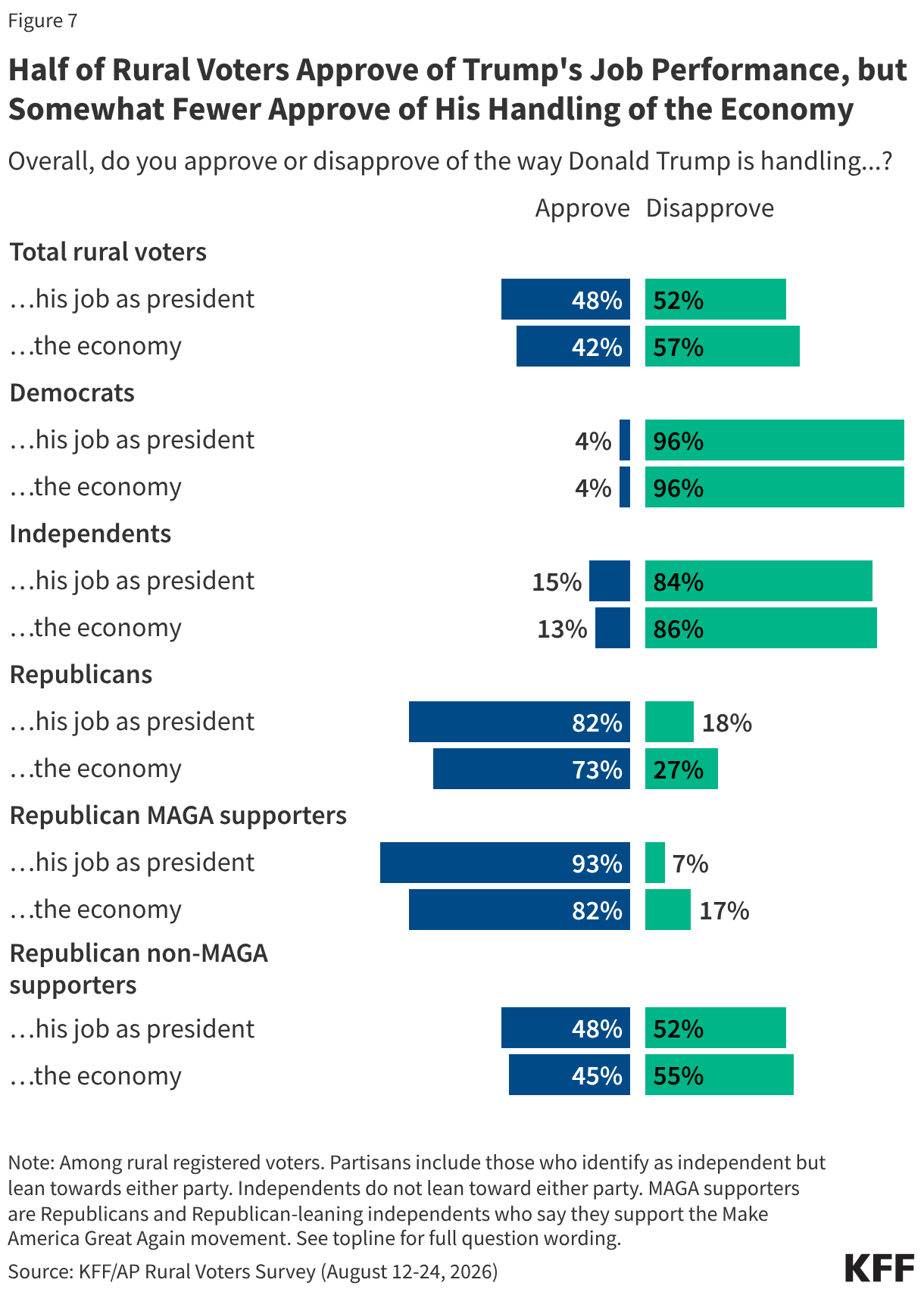
All of these negative economic sentiments may be contributing to rural voters’ views of President Trump overall and on the economy. About six in ten rural voters (57%) disapprove of President Trump’s handling of the economy. While about half (48%) of rural voters approve of his overall job performance, this has dropped slightly from a similar question asked in 2017, when 56% of rural registered voters said they approved. Notably, a larger share of Republican rural voters disapprove of President Trump’s handling of the economy (27%) than of his overall job performance (18%).
For Republican rural voters, however, approval of President Trump varies widely between MAGA supporters and non-MAGA supporters, suggesting that the President’s approval among rural Republicans outside his core base is much weaker. Half or more non-MAGA Republican rural voters (who make up a quarter of Republican rural voters overall) say they disapprove of the president’s job performance (52%) and his handling of the economy (55%) compared to one in six or fewer MAGA-supporting Republicans.
Republican Rural Voters Sour on the Economy May Not Turn Out in 2026
While the overwhelming majority (98%) of rural Republican voters say they would be more likely to vote for a Republican candidate than a Democrat in the upcoming election, dissatisfaction with President Trump’s handling of the economy may be impacting some Republican rural voters’ motivation to turn out for the 2026 midterms.
Republican rural voters overall are somewhat less likely than Democrats to say they are “absolutely certain” to vote in the upcoming election (74% vs. 81%). Further, Republicans who say they disapprove of Trump’s handling of the economy (27% of Republican rural voters overall) are 20 percentage points less likely than those who approve of his handling of the economy to say they are “absolutely certain” to vote (59% vs. 79%).
Health Costs and Price of Gas Top Household Affordability Worries
While rural voters express concern about affording a wide range of household necessities, health care costs and the price of gasoline top the list. Two-thirds of rural voters say they are either “very” or “somewhat worried” about being able to afford gasoline or transportation costs (67%) or health care (66%) for themselves or their families. Somewhat smaller majorities express worry about affording food and groceries (60%) or monthly utilities (59%), while nearly half (46%) are worried about affording their rent or mortgage.
While health care costs and gas remain the top affordability concern across partisanship, as with other economic sentiments, Democratic voters in rural areas are more likely than their Republican counterparts to express affordability worries across the board. Likely reflecting their lower incomes, younger rural voters are also more worried than older voters about being able to afford a variety of expenses. But for the youngest cohort of rural voters under age 30, health care costs rise to the top of their economic concerns, with about three quarters (77%) saying they are worried about affording health care for themselves or their families.
Who Voters Trust to Handle Key Issues
The Republican Party has an advantage when it comes to which party rural voters trust more to address the cost of living – rural voters’ top election priority – but voters are more divided on which party they trust to address health care costs, a key factor in their affordability concerns. At the same time, at least a quarter of rural voters say they prefer neither party across these issues.
Overall, four in ten rural voters say they trust the Republican Party to do a better job handling the cost of living, compared to a quarter who trust the Democratic Party and another quarter (27%) who trust neither party.
The Republican Party has a much narrower advantage on health care costs. One-third of rural voters say they trust the Republican Party more to handle health care costs compared to about three in ten (28%) who trust the Democratic Party more. And similar shares of rural voters say they prefer the Democrats and the Republicans on handling Medicaid, Medicare, and the Affordable Care Act, while at least a quarter say they trust neither party to handle each of these health care programs.
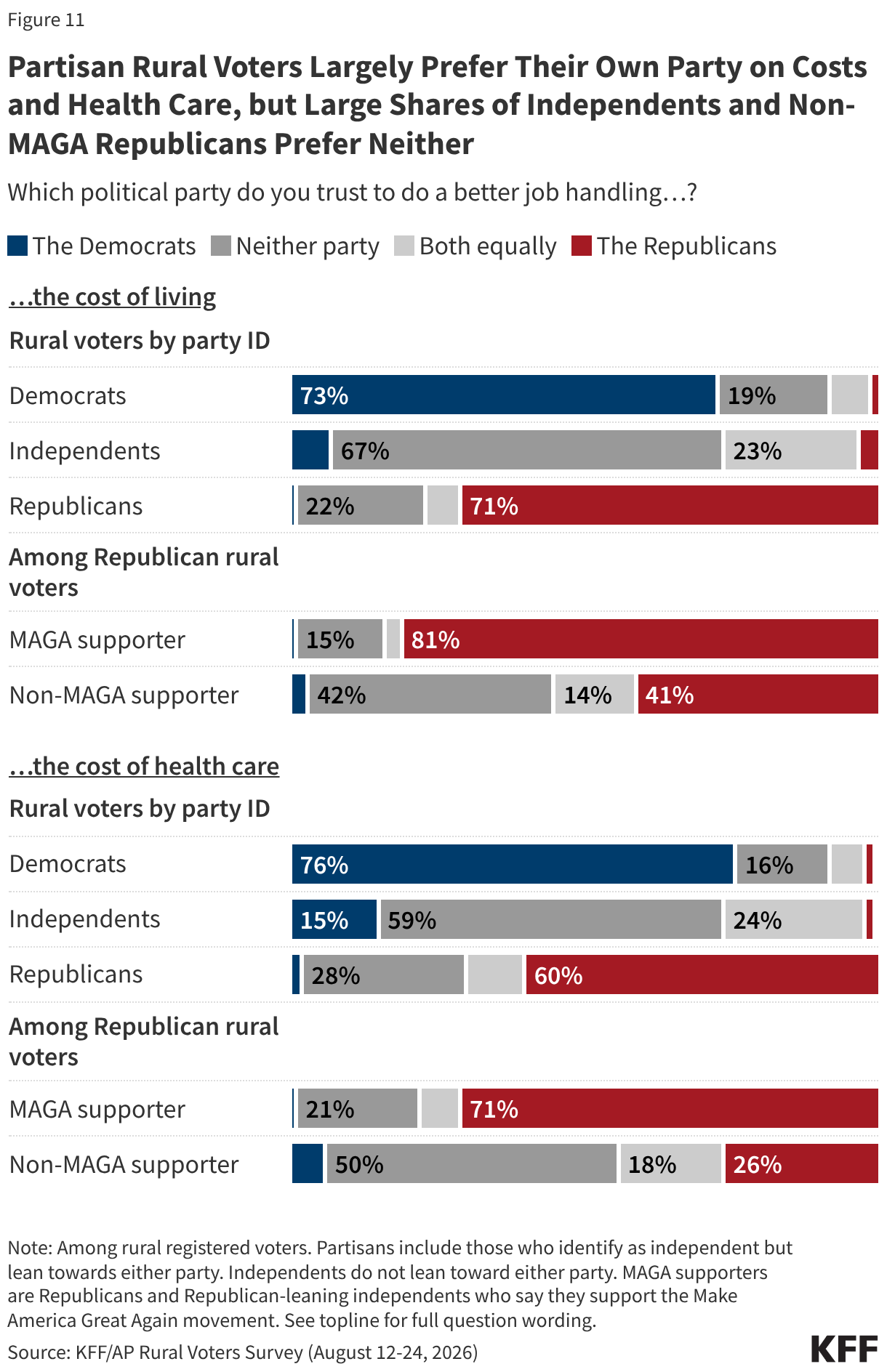
Partisans largely pick their own party on handling cost of living and health issues. For health-related issues, the Democrats tend to have a stronger advantage with their own rural voters than Republicans do with theirs, and this drops to fewer than half among non-MAGA supporting Republicans. For example, three-quarters (76%) of Democratic rural voters say they trust the Democratic Party to do a better job handling health care costs, while a smaller share (60%) of Republican rural voters say the same about the Republican Party, dropping to a quarter (26%) among non-MAGA supporting Republicans. Republican rural voters who do not support the MAGA movement largely still do not prefer Democrats, but rather say they trust neither party to handle costs.
While small shares of independent rural voters prefer the Democratic Party over the Republican Party to address the cost of health care, majorities of these independents say they trust neither party to address cost of living or health care cost (67% and 59%, respectively).
Views of Trump Administration’s Recent Changes to Health Care Policies
With slightly more than half (54%) of rural voters saying they disapprove of Trump’s handling of health care, views on the impact of the administration’s specific health care policies also skew negative. Roughly twice as many rural voters say the Trump administration’s health care policies have had a negative impact rather than a positive impact when it comes to their own health care costs (41% v. 17%), Medicare (44% v. 21%), Medicaid (44% v. 24%), and the availability of health care in their area (37% vs. 15%). Between three in ten and half of rural voters say the administration’s health care policies have had “no impact” in each of these areas. Views are slightly more divided on the impact of the administration’s policies on prescription drug costs, with three in ten (30%) saying the impact has been positive and about one-third each saying it has been negative (35%) or had no impact (35%).
Partisans’ views are unsurprisingly divided on the impact of Trump’s health care policies, with most Democratic voters and at least half of independent voters saying they’ve had a negative impact. While Republican rural voters are less negative in their views, they are not overwhelmingly positive, either: over half say the administration’s policies have had “no impact” on their own health care costs, or the availability of health care in their area. Republican rural voters are somewhat more positive when it comes to the impact of the administration’s policies on Medicaid, with four in ten saying the impact has been positive, 16% viewing it as negative, and another four in ten (43%) saying there has been no difference.
Most (57%) rural voters who purchase their own health coverage (10% of rural voters overall) say the administration’s health care policies have negatively impacted their health care costs, higher than the share of rural voters with employer sponsored insurance or Medicare. This likely reflects the impact of rising costs for those who purchased coverage through the ACA Marketplaces following the expiration of enhanced premium tax credits last year.
Medicaid’s Role for Rural Voters
Roughly half (49%) of rural voters say they or a family member have gotten support from the Medicaid program at some point in their lives, including four in ten (38%) who say they or a family member currently receives some form of coverage through the program. More than half of rural voters who are Hispanic (72%), Black (67%), under age 30 (65%), or women (56%) say they or someone in their family has ever gotten coverage from Medicaid, with at least four in ten across partisanship saying the same.
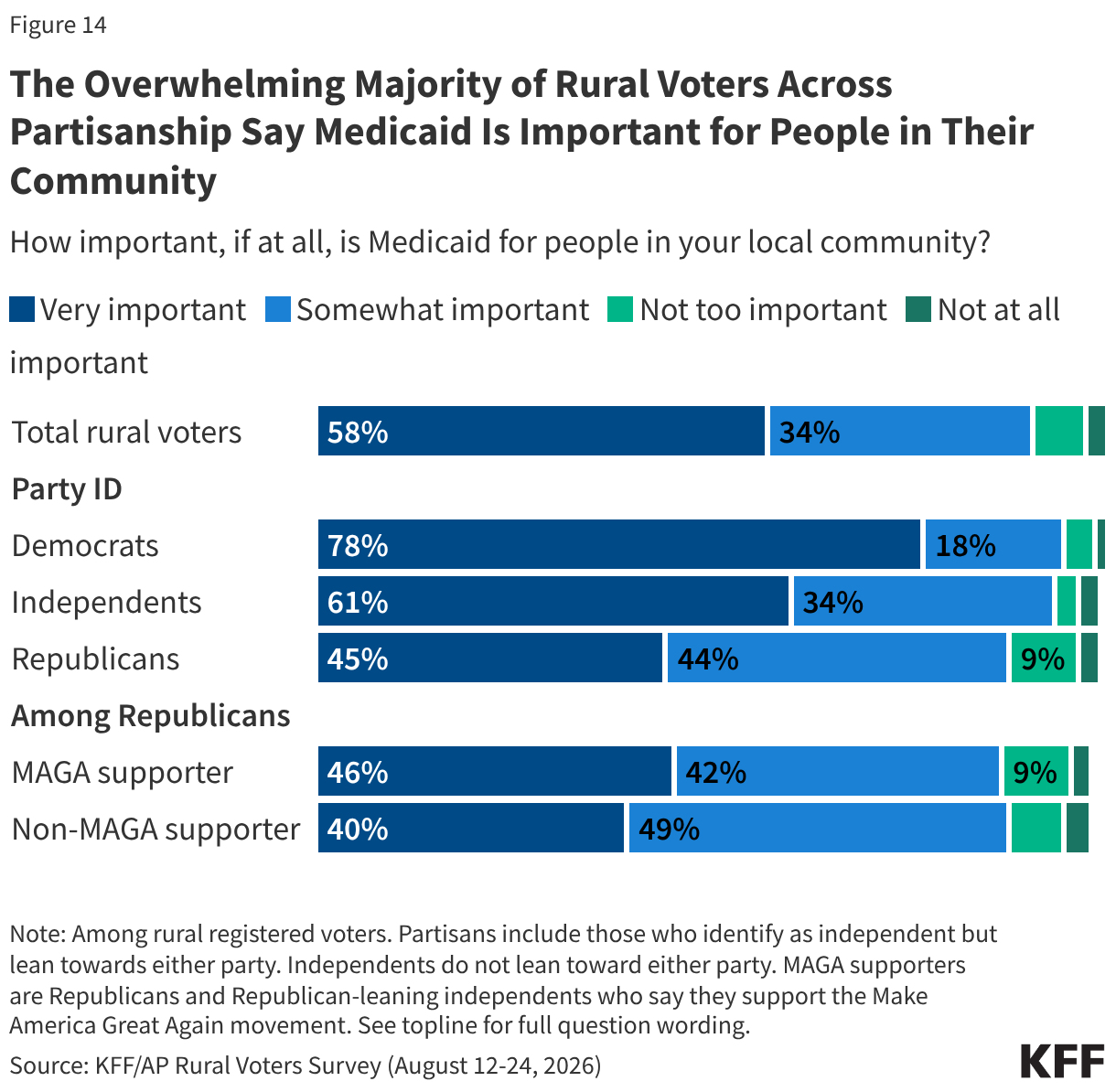
Similar to sentiments held by the general population, nine in ten (92%) rural voters, including large majorities across partisanship and among Republican MAGA supporters say Medicaid is important for people in their local community.
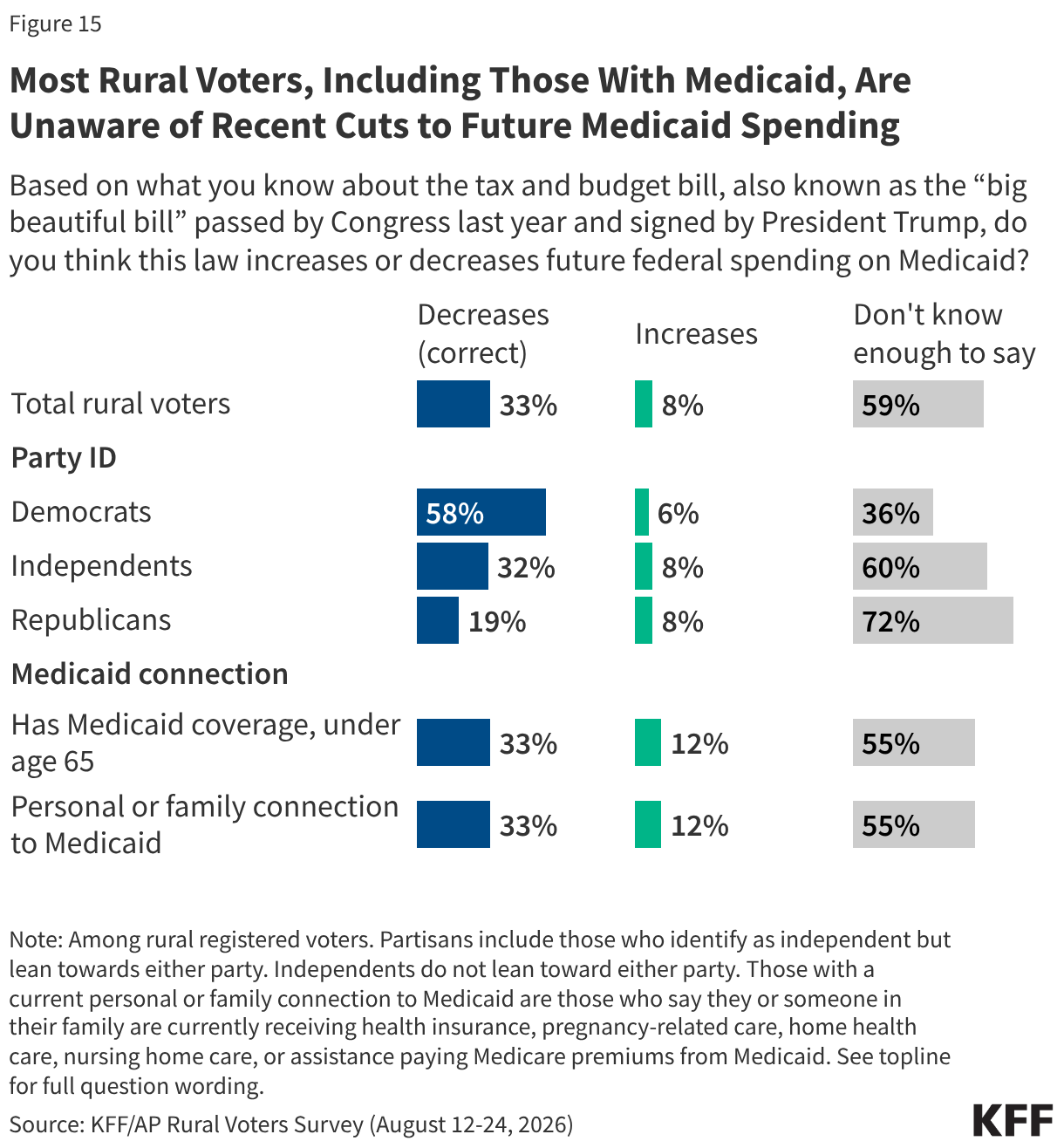
In late 2025, Congress passed and President Trump signed into law a legislative package known as the “One Big Beautiful Bill,” that included significant changes to the Medicaid program including reducing future federal spending on the program by more than $900 billion.
Awareness of reduced Medicaid funding among rural voters is low, with just one-third correctly saying the bill decreases future spending on Medicaid while six in ten (59%) say they don’t know enough to say, including more than seven in ten Republican voters.
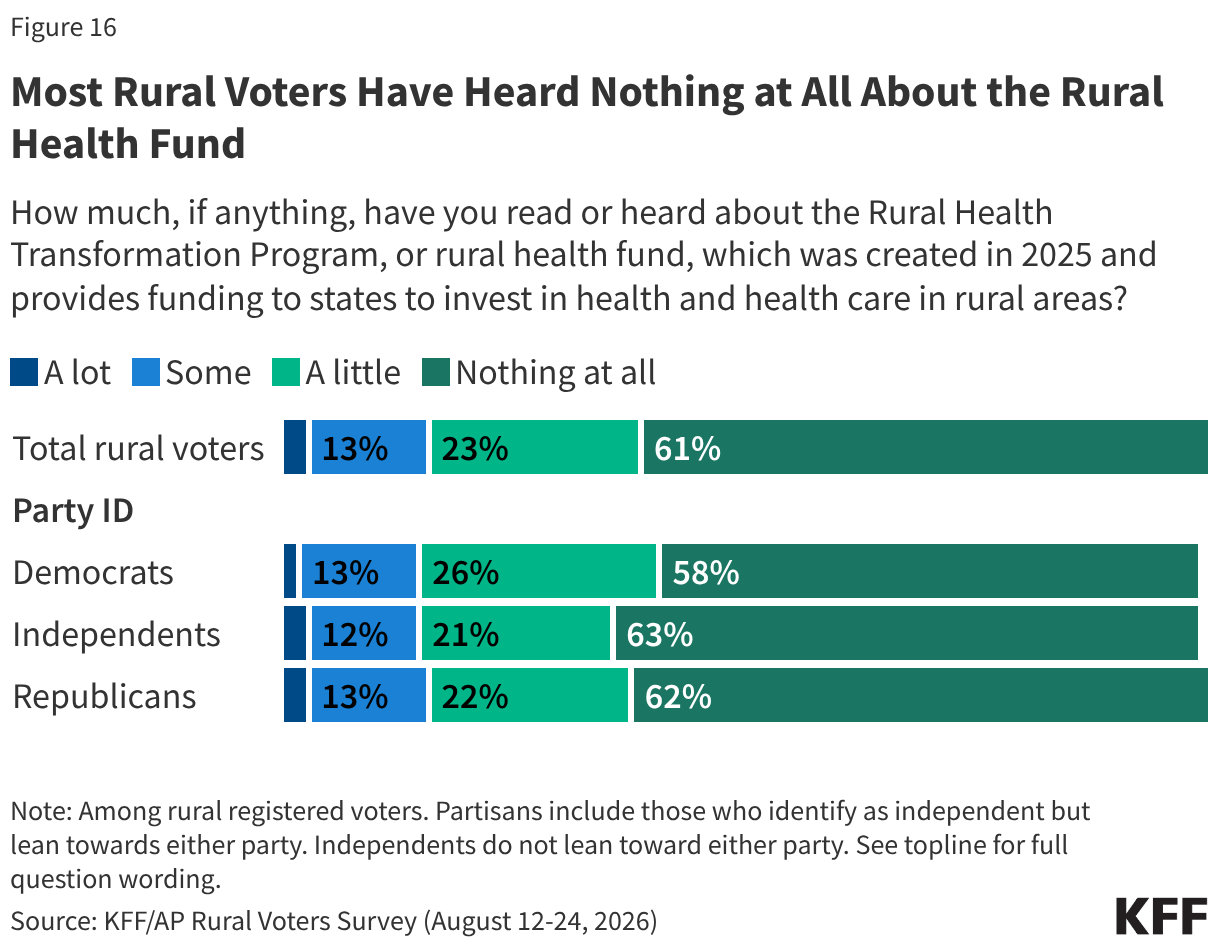
During the drafting of the 2025 budget bill, lawmakers added $50 billion in funding for a Rural Health Transformation Program, or “Rural Health Fund,” in response to concerns over the impact that reductions in health spending could have in rural areas. Most rural voters, however, remain unaware of the fund, with more than eight in ten saying they have heard either “a little” (23%) or “nothing at all” (61%) about the program. More than half of voters across partisanship say they have heard “nothing at all” about this fund.
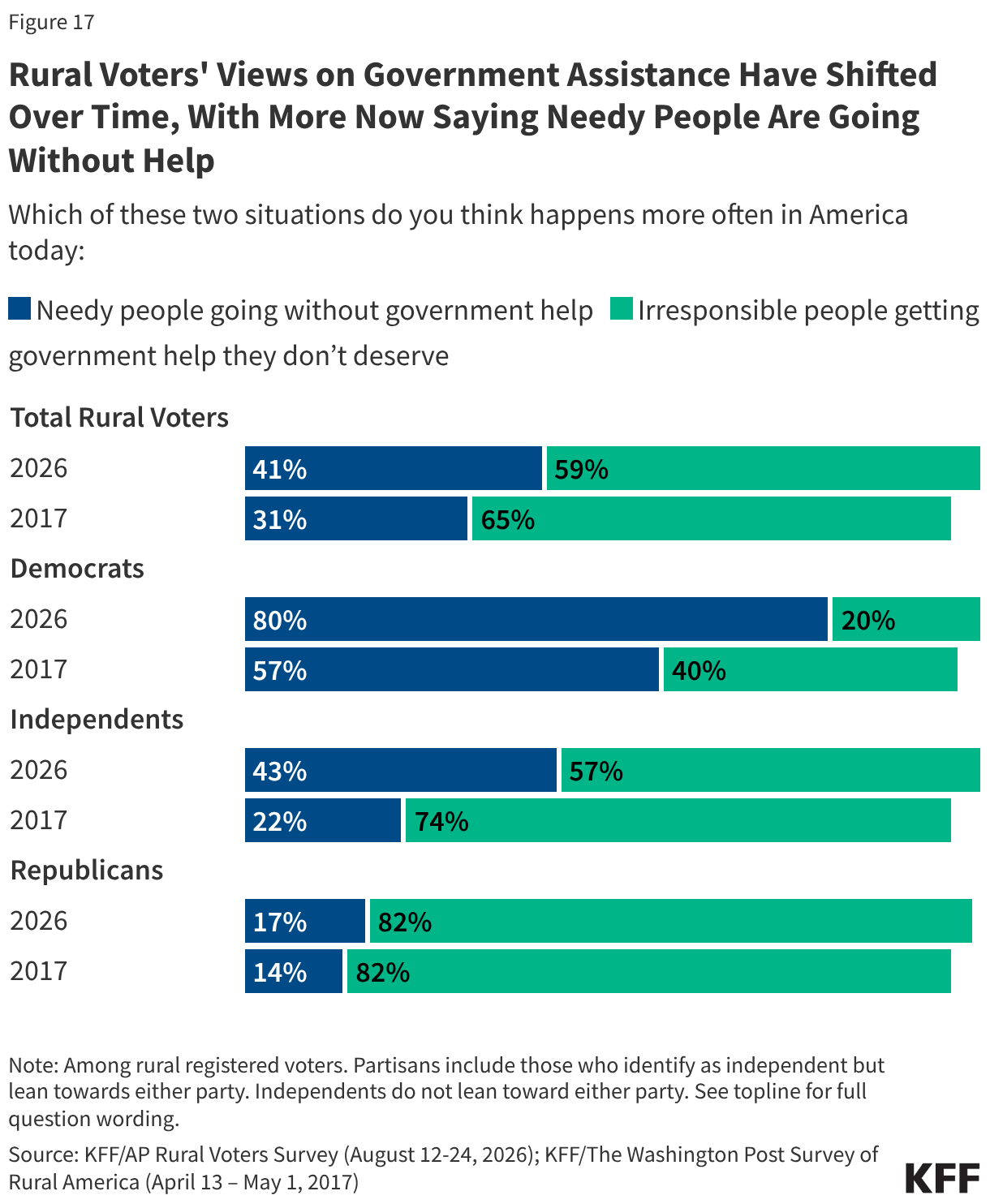
A majority of rural voters say it’s more often that government assistance goes to undeserving people, though their views on this have softened somewhat over the years. Six in ten (59%) rural voters say it’s more common in America that “irresponsible people get government help they don’t deserve” compared to four in ten (41%) who say it’s more common that “needy people go without government help.” These views have shifted moderately among rural voters over the past nine years, with a 10-percentage point rise in the share who say it’s more common that needy people are going without help. These sentiments have shifted most dramatically among Democrats and independents, while Republicans’ views have largely remained unchanged.
For Republican rural voters, having a current connection to the Medicaid program appears to soften their views on government assistance more broadly: Republicans who say they or a family member are currently receiving some type of Medicaid coverage are three times as likely as those with no such current connection to say it’s more common in America that people are going without government assistance they need (33% v. 10%).
A Growing Share of Rural Voters Say Their Communities Lack Key Health Care Services
Rural areas in the U.S. can face unique health care challenges, including provider shortages, lack of internet access, and hospital closures. The KFF/AP Rural Voters Survey shows that many rural voters rate health care in their communities poorly, a sentiment shared by Democrats, independents, and Republicans. As with other economic sentiments, views on the availability of some health care services have worsened over the years.
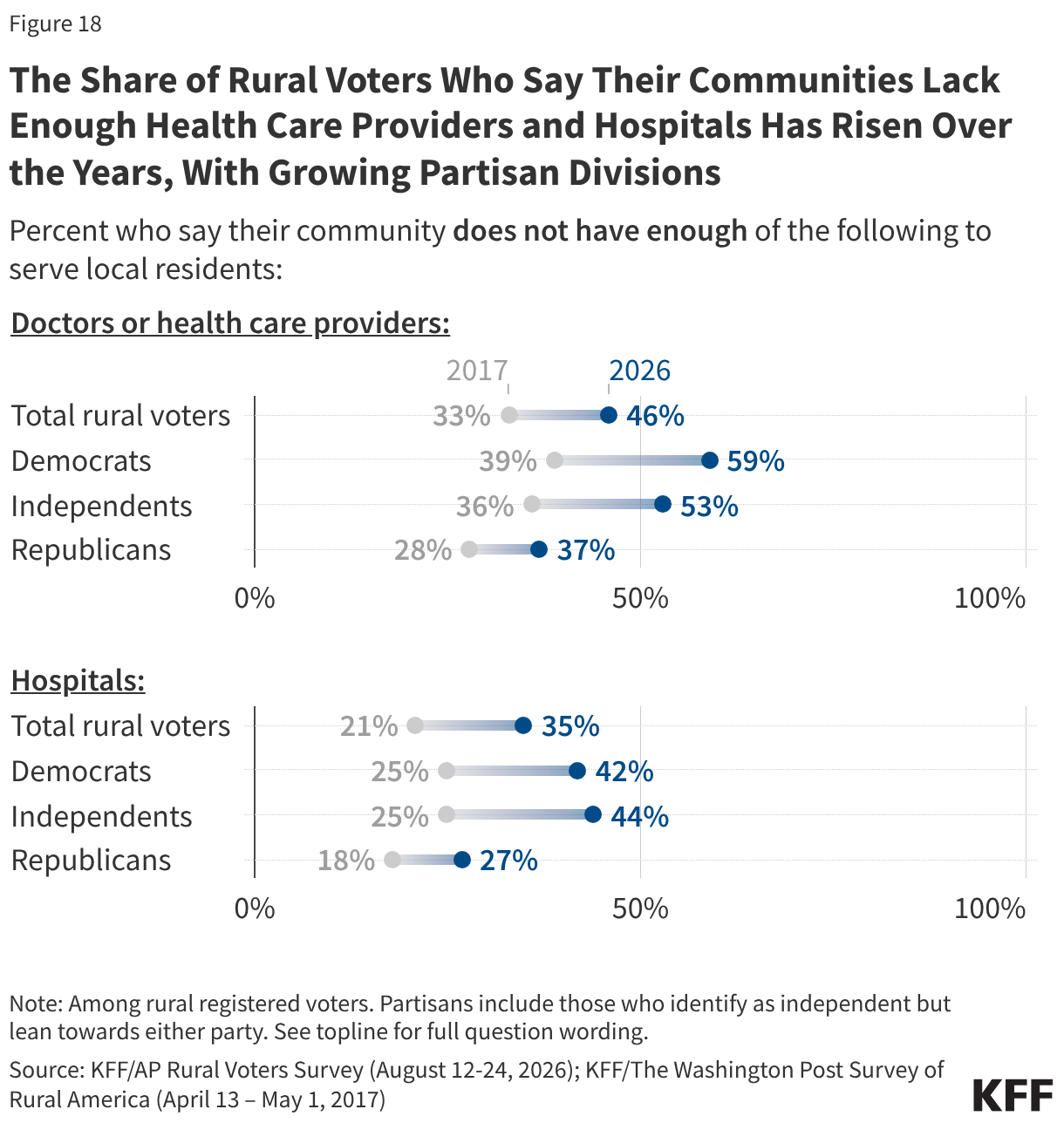
Many rural voters say their communities lack sufficient health care services and providers to serve local residents, including mental health care providers (62%) and doctors or other health care providers (46%). While most rural voters say their communities have enough pharmacies (81%) or hospitals (65%) to serve local residents, a notable share (35%) say their communities do not have enough hospitals, rising to half among Black (52%) and Hispanic (52%) rural voters.
Rural voters’ perceptions of the availability of doctors and hospitals have worsened since 2017 overall and across partisans, however the rise in the share saying their community lacks enough providers and hospitals has been steeper among Democrats than among Republicans. Between 2005 and 2026, nearly 200 rural hospitals have closed or converted, with closures recently outpacing openings in rural areas.
In Their Own Words: Rural Voters Who Say Health Care-Related Issues Are the Biggest Problem Facing Their Community
“We need more help affording healthcare for our family. Our health insurance tripled this past year and we can barely afford to pay for it plus afford food! We were hoping Trump, with his business sense would figure out a way that every person in the country would have health insurance, the price of food would finally come down, and the price of gas would be at its lowest ever. Instead, we are at war…” – 54-year-old rural voter from Wisconsin, Republican
“No decent permanent facilities for the elderly. There’s one really nice place that only the rich can afford. The hospital emergency room is horrific, at times there are very sick individuals in the waiting room or on stretchers in the hallway.” – 67-year-old rural voter from Tennessee, Republican
“The lack of a living wage is a major issue, but our greatest crisis is the lack of quality healthcare. Those with the ability to travel, go to [nearby cities] for medical care. The local hospital is stocked with part-time traveling nurses, and doctors. There is no stability in healthcare, and I worry that the proposed Medicare, and Medicaid cuts will endanger the future of the hospital.” – 70-year-old rural voter from Texas, Democrat
“There’s a somewhat vague sense of dreadful anticipation that our small rural community is going to lose its hospital due to Trump and his administration’s cuts, which apparently kick in on January 1, 2027. The hospital employs a great many people and it is the only reasonable option for emergency care and other kinds of medical services for about a 25 to 30 miles radius.” – 64-year-old rural voter from New York state, Democrat
Note: Responses are lightly edited for length and spelling, but reflect respondents’ own language and do not represent the views of KFF.
Endnotes
- Throughout this report, Democratic and Republican rural voters include those who identify as independent but lean towards either party, respectively. Independents are independent rural voters who do not lean toward either party. ↩︎
Overview
The KFF/AP Rural Voters Survey examines the views and political priorities of voters living in rural areas across the United States. The urban-rural divide has been a major factor in U.S. elections for the past several decades and played an important role in President Trump’s reelection victory in 2024, when nearly seven in ten rural voters voted for him. As the 2026 midterm election approaches, the survey finds that while rural voters continue to lean Republican, concerns about the cost of living loom large, and disapproval of President Trump’s handling of the economy may be diminishing voter enthusiasm among some rural Republicans. At the same time, health care costs are also a top election issue for rural voters and an important component of their cost-of-living concerns. By more than a 2-1 margin, rural voters say the Trump administration’s health care policies have worsened their health care costs and access to care in their communities, while many express frustration with both political parties on health costs, saying they trust neither to deal with this issue. Rural voters’ economic sentiments have worsened in many respects since 2017, when KFF and the Washington Post explored similar subjects in a Survey of Rural America. These and other findings shed light on the mood and concerns of rural voters in the run-up to the 2026 midterms.
Explore KFF Health News and The Associated Press’ Reporting:
Economic frustration tests Trump’s standing with rural voters, new AP-KFF poll finds, Sept. 23, 2026