Senate Appropriations Committee approves FY19 State & Foreign Operations (SFOPs) Appropriations Bill

Published: Jun 22, 2018

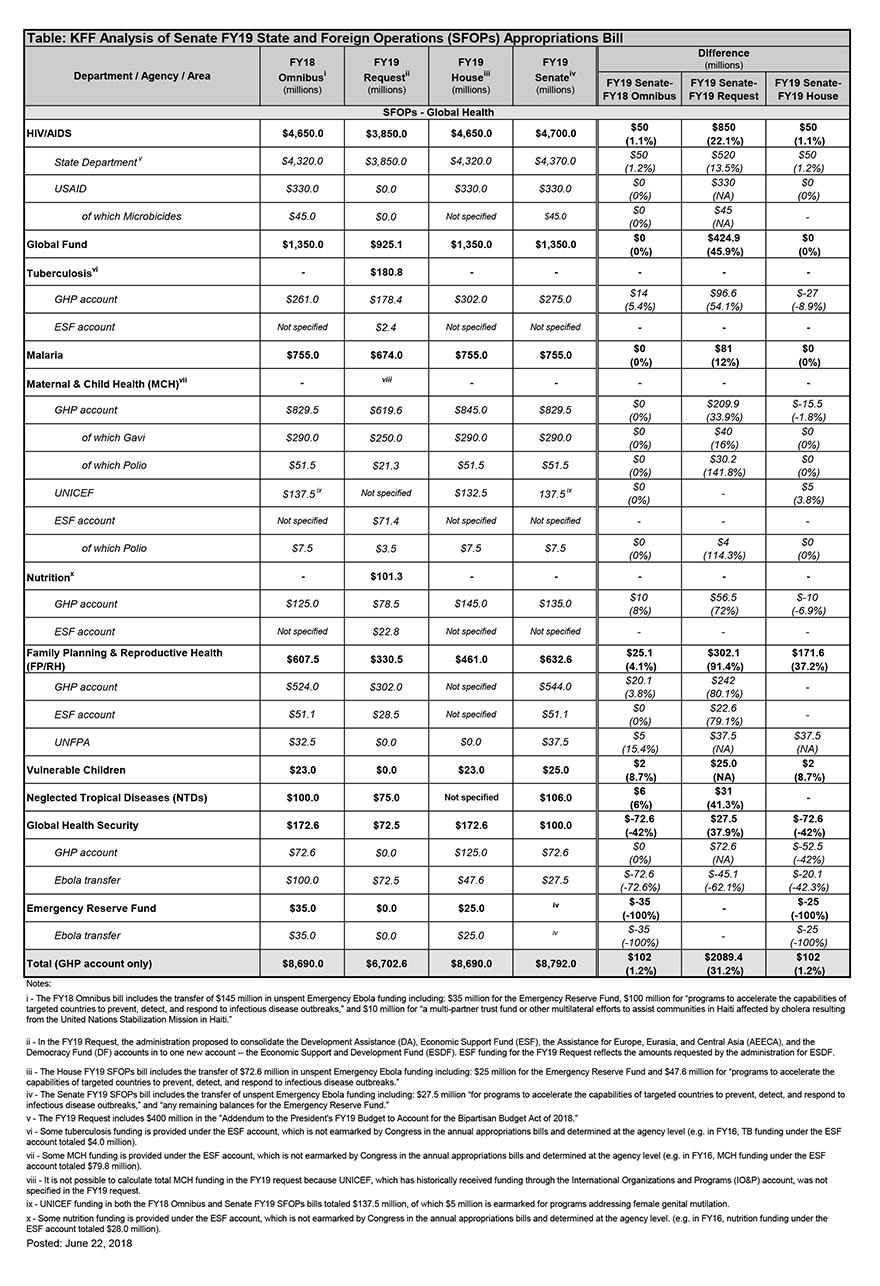
The Senate Committee on Appropriations approved the FY19 State & Foreign Operations (SFOPs) appropriations bill (and accompanying report) on June 21, 2018. The SFOPs bill includes funding for U.S. global health programs at the State Department and the U.S. Agency for International Development (USAID).Key highlights are as follows (see table for additional detail):

  • Funding provided to the State Department and USAID through the Global Health Programs (GHP) account, which represents the bulk of global health assistance, totals $8.9 billion in the bill, more than $100 million above the FY18 enacted and House FY19 levels, and $2.1 billion above the President’s FY19 request.
  • Funding for all global health programs at State and USAID either increased or remained flat compared to the FY18 enacted level. Details are as follows (unless otherwise specified, totals represent funding through the Global Health Programs account):
    • Bilateral HIV funding through the President’s Emergency Plan for AIDS Relief (PEPFAR) is $4,700 million in the Senate FY19 bill, $50 million above the FY18 enacted and House FY19 levels, and $850 million above the President’s FY19 request.
    • The bill includes $1,350 million as the U.S. contribution to the Global Fund to Fight AIDS, Tuberculosis and Malaria (Global Fund), matching the FY18 enacted and House FY19 levels and $425 million above the President’s FY19 request.
    • Funding for tuberculosis (TB) totals $275 million, $14 million above the FY18 level and $97 million above the FY19 request, but $27 million below the House FY19 level.
    • Funding for malaria totals $755 million, matching the FY18 enacted and House FY19 levels and $81 million above the FY19 request.
    • The bill provides $100 million in total funding for Global Health Security (GHS), of which $27.5 million is provided through a transfer of unspent emergency Ebola funding. The bill also transfers all remaining unspent emergency Ebola funding to the Emergency Reserve Fund, which Congress established in 2017 with the purpose of enabling the U.S. to respond rapidly to emerging health threats.
    • The bill includes $830 million for maternal and child health (MCH), matching the FY18 level and $210 million above the FY19 Request, but $16 million below the House FY19 level.
      • Gavi, the Vaccine Alliance, which is included under MCH funding, totals $290 million, matching the FY18 enacted and House FY19 levels and $40 million above the FY19 request.
      • Polio funding, which is included under MCH funding, totals $59 million ($51.5 million through the GHP account and $7.5 million through the Economic Support Fund account), matching the FY18 enacted and House FY19 levels and $34 million above the FY19 request.
      • The bill includes $137.5 million for the U.S. contribution to UNICEF provided through the International Organizations and Programs (IO&P) account, matching the FY18 enacted level and $5 above the House FY19 level. While the FY19 request did not specify a funding amount for UNICEF and proposed to eliminate the IO&P account, it is possible that organizations such as UNICEF could receive funding through other accounts.
    • Family planning and reproductive health (FP/RH) funding totals $633 million in the bill, which is $25 million above the FY18 enacted level, $172 million above the House FY19 level, and $302 million above the FY19 Request.
      • Bilateral FP/RH funding totals $595 million, which is $20 million above the FY18 enacted level, $134 million above the House FY19 level, and $265 million above the FY19 Request.
      • United Nations Population Fund (UNFPA), which is included under FP/RH funding, totals $37.5 million, which is $5 million above the FY18 enacted level. Funding for UNFPA was eliminated in both the House FY19 bill and the FY19 request.
    • Funding for nutrition totals $135 million in the bill, $10 million above the FY18 enacted level and $57 million above the FY19 request, but $10 million below the House FY19 level.
    • Funding for neglected tropical diseases (NTDs) totals $106 million in the bill, $6 million above the FY18 enacted level and $31 million above the FY19 request. The House FY19 bill did not specify a funding level for NTDs.
    • Funding for vulnerable children totals $25 million in the bill, $2 million above the FY18 enacted and FY19 House levels. Funding for vulnerable children was eliminated in the FY19 request.

The SFOPs bill also included the following policy provision:

  • Reverses Mexico City Policy (also known as the “Global Gag Rule”) in law, as reinstated by President Trump via executive order on January 22, 2017 (see here for more information on the Mexico City Policy).

Resources:

  • Senate FY19 State and Foreign Operations Appropriations Bill (see here)
  • Senate FY19 State and Foreign Operations Appropriations Report (see here)

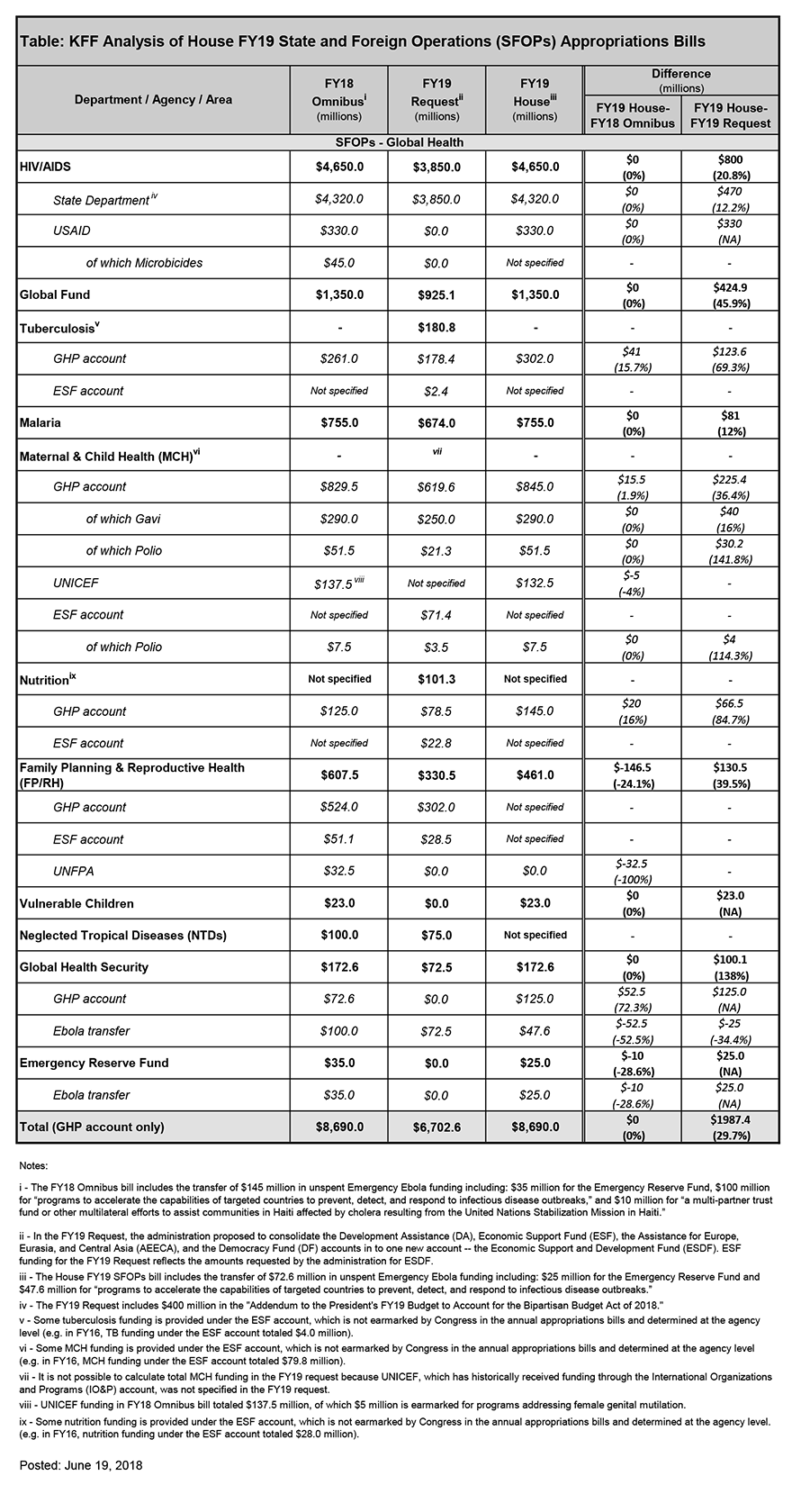
The table (.xls) below compares the FY19 House SFOPs appropriations bill to the FY18 funding amounts as outlined in the “Consolidated Appropriations Act, 2018” (P.L. 115-141; KFF summary here), the House FY19 SFOPs appropriations bill (KFF summary here) and the President’s FY19 request (KFF summary here).

Note: Some funding amounts (e.g. global health funding provided through the Economic Support Fund account at USAID) are determined at the agency level, and are not earmarked by Congress in the SFOPs appropriations bill.

Short-Term Limited Duration Plans and HIV

Published: Jun 21, 2018

Key Findings/Points

  • While short-term limited duration (STLD) insurance policies, which provide temporary insurance to those with coverage gaps, have long been available, the Trump Administration is seeking to promote their use and expand their availability.
  • STLDs are exempt from ACA requirements prohibiting medical underwriting, pre-existing condition exclusions, and other protections. While not expected to cover someone with HIV, we tested this hypothesis by applying for coverage in 38 STLD plans as someone with HIV. Coverage was denied in all 38 cases.
  • We also found that STLD insurance would generally not meet the needs of someone was diagnosed with HIV while enrolled, due to benefit limitations, particularly for prescription drugs, and high out-of-pocket costs. Further, coverage would not be renewed after the term ended.
  • To the extent that ACA non-compliant policies, such as STLD plans, are expanded, they could affect the ACA-compliant insurance market, driving up costs for those who rely on them, including people with HIV. Moreover, with pending litigation in Texas now supported by the Trump Justice Department that would eliminate the ACA’s pre-existing condition protections, our finding that HIV remains an uninsurable condition without such protections, underscores the implications of such a change.

Introduction

Short-term limited-duration (STLD) health insurance policies, designed to provide temporary coverage to people experiencing coverage gaps, have long been available in the private market, pre-dating the passage of the Affordable Care Act (ACA). Intended primarily for healthy individuals, STLD policies are generally less expensive than traditional policies but limit benefits, including through pre-existing conditions exclusions, exclusion of benefit categories, and high out-of-pocket costs. In addition they are medically underwritten, meaning those with certain health conditions, such as HIV, can be turned down from coverage or charged more. They are exempt from the requirements of the ACA that prohibit many of these practices in more traditional individual coverage. The Trump Administration has moved to promote the use of these plans, proposing to expand their availability and lengthen their coverage periods.1  (See, Understanding Short-Term Limited-Duration Health Insurance, for more background).

Given this, we wanted to explore what they would mean for people with HIV – both those seeking short term, gap coverage as well as those who are diagnosed with HIV while enrolled. We expected STLD plans to use a similar underwriting process to those employed in the individual market prior to the ACA and reject people with HIV outright. 2   We test this hypothesis in this analysis. We also assessed whether such a plan could meet basic HIV care and treatment needs for someone diagnosed once enrolled. While this analysis focuses on people with HIV, these findings may apply to many others with a range of current or past health challenges such as cancer, hepatitis, diabetes and depression.

Methodology

We analyzed data and applied for STLD plans sold on the website, Agile.com, in April 2018. Agile.com was selected for this analysis due to its market prominence, breadth of plan offerings, and because unlike other platforms assessed, it allows consumers to apply for coverage and receive a determination without attesting to the information provided or supplying a social security number and full contact information. We looked at plans in five states that use the Agile.com marketplace and represent the highest HIV prevalence (FL, GA, IL, MD, and TX).3  Together, these states account for one-third of people living with HIV in the U.S.4  We applied to the plans with the most and least expensive premiums available by each issuer in a major city in each of the five states: (Miami, FL; Atlanta, GA; Houston, TX; Chicago, IL and Baltimore, MD), totaling 38 plans. In each case, we applied for coverage as a 35-year-old male. Table 1 provides a summary of the states and plans in the sample.

Table 1. States and Plans in Sample
StateState Share of People with HIVIssuers with STLD Plans on Agile.comNumber of Plans Reviewed
Maryland3%

National General

(1)

2
Florida11%LifeshieldNational GeneralStandard LifeUnitedHealth One(4)8
Georgia5%LifeshieldEverest PrimeNational GeneralUnitedHealth One(4)8
Illinois4%Everest PrimeLifeShieldNational GeneralStandard LifeUnitedHealth One(5)10
Texas8%Everest PrimeLifeShieldNational GeneralStandard LifeUnitedHealth One(5)10
Source: Share of people with HIV – Kaiser Family Foundation analysis of CDC Atlas data. Available at: https://www.cdc.gov/nchhstp/atlas/index.htm

Findings

Applying as Someone with HIV

We first looked at eligibility determinations for someone with HIV. We found that in all 38 cases, an individual with HIV would be denied coverage in STLD products. The Agile.com marketplace allows users to apply for STLD insurance plans electronically, answering medical, residency, and insurance coverage questions online, after which a real time coverage determination is provided. The number and type of questions asked varies slightly across plans but applicants can typically expect to answer 5-8 questions. All applicants are asked a question about a range of health conditions. For example:

Within the last 5 years has any applicant been diagnosed with, received treatment, abnormal test results, medication, consultation for, or had symptoms of: Insulin or medication dependent diabetes except gestational (diabetes does not apply to residents of DC), stroke, transient ischemic attack (TIA), cancer or tumor except basal cell skin cancer, Crohn’s disease, ulcerative colitis, rheumatoid arthritis, systemic lupus, chronic obstructive pulmonary disease (COPD), emphysema, cystic fibrosis, hepatitis C, multiple sclerosis, muscular dystrophy, alcohol or drug abuse; bipolar disorder or schizophrenia; an eating disorder; or any diseases or disorders of the following: liver, kidney, blood, pancreas, lung, brain, heart or circulatory including heart attack or catheterization?

–       Lifeshield, GA

In every instance, applicants are also asked a stand-alone question about HIV/AIDS, similar to how HIV was treated in the pre-ACA market. Examples of this question include:

Within the last 5 years has any applicant been diagnosed or treated by a physician or medical practitioner for Acquired Immune Deficiency Syndrome (AIDS) or tested positive for Human Immunodeficiency Virus (HIV)? – National General, IL

Within the last 5 years have you or has anyone listed on the application received treatment advice medication or surgical consultation for HIV infection from a doctor or other licensed clinical professional or had a positive test for HIV infection performed by a doctor or other licensed clinical professional? (The person(s) named will not be covered under the policy.) – UnitedOne, GA

Within the past 5 years, has the Applicant or any Proposed Insured been diagnosed or treated by a physician or medical practitioner for Acquired Immune Deficiency Syndrome (AIDS), AIDS Related Complex (ARC) or tested positive for Human Immunodeficiency Virus (HIV)? – Lifeshield, FL

In all 38 applications, when the HIV/AIDS question was answered affirmatively, the applicant was rejected from coverage.5 ,6  In some cases, this was explicit in the question wording; in others, the rejection was only provided afterward. By contrast, ACA-compliant policies are prohibited from engaging in medical underwriting, denying coverage on basis of health status, and imposing pre-existing condition exclusions.

Access to HIV Care & Treatment if Diagnosed While Enrolled

In addition to exploring whether someone with HIV would be offered an STLD insurance policy, we assessed whether someone diagnosed with HIV once covered would have meaningful access to HIV care and treatment. In most cases, we found that such access would be fairly limited. In addition, because STLD plans are non-renewable, an enrollee newly diagnosed with HIV while covered by a STLD plan would not be able to renew coverage at the end of the period, currently limited to three months.

We assessed coverage and cost-sharing related to prescription medication, laboratory services, and specialist visits (the most basic and critical elements of HIV care) in each of the 38 plans in our sample. Findings are as follows.

Table 2. States and Plans in Sample
ServicePlans Offering CoverageCost-Sharing
Drug Coverage13% (5) offer some coverageOf those offering coverage:
  • Benefit limit in all plans = $3,000
  • All plans require deductible met first ($1,000 or $10,000)
  • All plans require co-insurance (20%-30%)
Specialty Provider Visits100% (38 plans) offer some coverageAll require cost-sharing, design varies, sometimes including limits:
  • 29% cover prior to deducible with co-payment ($40 or $50).
  • 29% cover after deductible (up to $10,000) met with co-insurance (20%- 50%); 1 plan does not have additional cost-sharing or coinsurance
  • 18% cover visits 1-3 with flat co-payment; subsequent visits after deducible ($1,000-$5,000) with co-insurance (20%- 50%).
  • 24% utilize limits (1-2) and/or caps ($2,000)
Laboratory Services 100% (38 plans) offer some coverageAll require cost-sharing:
  • All cover after deductible met ($250-$10,000)
  • 74% require co-insurance (20%-50%), 26% do not
Drug Coverage

Access to comprehensive drug coverage is arguably the most important element of HIV care. The Department of Health and Human Services’ (DHHS) national clinical recommendation is now to initiate antiretroviral treatment (ART) as soon as possible after diagnosis.7  Doing so improves both individual health outcomes and serves as a preventive measure given that when an HIV-positive individual is engaged in care and treatment and the amount of virus in their body reaches an undetectable level, there is effectively no risk of transmitting HIV to others.8 

The majority of plans reviewed (33 or 87%) did not offer drug coverage of any kind. However, in four states (IL, TX. FL, and GA), individuals enrolling in STLD plans on Agile.com, had access to at least one plan with drug coverage. Maryland was the only state not to offer any plans with drug coverage on this marketplace in this sample. Some plans mention pharmacy discount cards but do not offer credible drug coverage or guaranteed discounts. A plan without drug coverage would not meet the needs of someone with HIV.

Just 5 plans, all from a single issuer, provide some drug coverage but come with significant limitations related to cost sharing and dollar caps (See Table 2). For example, all 5 plans have a $3,000 limit on prescription spending for the three month term period, a limitation that might prohibit someone with HIV from filling a prescription each month. The plans also require patients to pay out-of-pocket for prescriptions at the point of sale, at the lowest price available, and then submit a claim to the plan, something that could be burdensome and financially out of reach for many.

For the one issuer offering drug coverage, obtaining information on those benefits was difficult. There were no links to formularies on Agile.com, in the plan documents provided, and we were unable to locate links on the issuer’s website. Upon calling the issuer’s 800 number, the agent we first spoke with was unable to provide details on the drug benefit, unaware of where to find formulary information or if one existed at all. After being transferred to a manager, we were directed to the correct location of the formulary for the 5 plans offering a drug benefit in this study. We were told that an enrollee would receive the formulary document only after enrollment in coverage was complete. The manager also emphasized that drug coverage excludes treatment for pre-existing conditions.

Reviewing the formulary, we found that while not all approved HIV medications were included, it did cover all drugs identified in the recommended initial regimens for treatment naïve patients by the DHHS HIV Treatment Guidelines.9 

ACA compliant plans, by contrast, are required to provide a Summary of Benefits and Coverage (SBC), which offer specific information on how essential benefits (including prescription drugs, provider visits, and laboratory services) are covered. The plans must also display clear links with up-to-date formularies, which, along with the SBC, can be used to assess which drugs are covered and how cost-sharing is applied. These documents are provided on both issuer websites and on state Marketplaces.

Specialist Provider Visits

Many people with HIV get their care from a specialty provider, such as an infectious disease physician. We assessed coverage of specialty providers visits among the plans in the sample and found that all 38 plans cover these services to some degree, though some use dollar and quantity caps to substantially limit coverage. For example, 24% of plans cap specialty visits to 1 or 2 or impose dollar caps. Cost-sharing related to coverage varied but in some cases could be quite significant (see Table 2). For instance, some plans do not cover visits until the deductible has been met, which in one case was $10,000.

In addition to utilization management and cost-sharing, another aspect of provider access is network scope. While STLD plans permit enrollees to seek care out-of-network, a feature emphasized by issuers, better pricing is often available to enrollees using an in-network provider, a detail de-emphasized in plan materials. For instance, one plan says up front, “Choose your own doctors and hospitals with no network restrictions” but does not clarify that the plan does indeed have a network where care can delivered with lower out-of-pocket costs until much deeper in the plan information. Several plans reviewed use the networks of parent insurance companies and seem to provide significant choice, including among infectious disease specialists. Others contracted with an outside vendor to create a provider network and also seemed to have reasonable access to specialists. However, it was very hard to find provider network information and at times, it was unclear which network was related to what plan.

For ACA-compliant policies, the SBC would provide information on coverage of specialist visits  and links to provider networks in their online materials. These documents are also provided on both issuer websites and state Marketplace websites.

laboratory services

Another important element of HIV care delivery is laboratory services, particularly to test for CD4 counts, viral load, and drug resistance. As with specialty provider visits, all 38 plans offered laboratory services. Unlike the other areas examined, however, laboratory services generally included few limitations – none impose dollar or quantity caps, for example, though all require cost-sharing (see Table 2).

Discussion

The Trump administration’s proposals to expand STLDs could make them a more mainstream insurance option that offers some consumers less-expensive coverage while they are healthy. However, for those with a past or pre-existing condition or who become sick while enrolled, such plans are, by design, either unavailable or limited in the covered benefits they offer. As we find here, people with HIV would be denied STLD coverage in all cases because they are HIV positive. Moreover, if an STLD enrollee was diagnosed with HIV, they would not have access to needed services, such as prescription drugs, or face limits and prohibitive costs if the service was covered. Further, since STLD policies are non-renewable, at the end of the coverage period an enrollee diagnosed with HIV would not be able to enroll in a new policy.

As people with HIV and other significant health conditions will not gain access to the lower cost STLD plan market, those without group coverage will likely remain in ACA-compliant plans (if not eligible for Medicaid, Medicare, or other coverage). To the extent that migration of younger healthier individuals to the non-compliant market destabilizes the individual market risk pool, people with HIV and other less healthy individuals could face higher costs in the future. Subsidies would protect low-income individuals from dramatic premium increases but the cost would increase the federal deficit and those who are not eligible, could face financial strain.10  In the context of HIV, this could strain the Ryan White program which currently helps with premium and other cost-sharing assistance. Additionally, pending litigation in Texas now supported by the Trump Justice Department, the prohibition against pre-existing condition exclusions could be reversed, eliminating access for those with HIV and other health conditions. Given this potential dynamic, it will be important to continue to monitor the status of the case as well as the impact of proposed changes to STLD plans, and other non-ACA compliant products, on people with HIV (and others with significant health conditions) along with the ACA-compliant marketplace that serves them.11 

Endnotes

  1. President Donald Trump. Presidential Executive Order Promoting Healthcare Choice and Competition Across the United States. October 12, 2017. Available at: https://www.whitehouse.gov/presidential-actions/presidential-executive-order-promoting-healthcare-choice-competition-across-united-states/; U.S, Department of Treasury, Department of Labor and Health and Human Services. Proposed Rule. Short-Term, Limited-Duration Insurance. 83 Fed. Reg. 55 (February 21, 2018). https://www.gpo.gov/fdsys/pkg/FR-2018-02-21/pdf/2018-03208.pdf ↩︎
  2. The Kaiser Family Foundation. (2001). How Accessible is Individual Health Insurance for Consumer in Less-Than-Perfect Health? Available at: https://modern.kff.org/wp-content/uploads/2013/01/how-accessible-is-individual-health-insurance-for-consumer-in-less-than-perfect-health-report.pdf. ↩︎
  3. While CA and NY rank higher than IL and MD in terms of HIV prevalence, neither state sells products on Agile.com. ↩︎
  4. Kaiser Family Foundation analysis of CDC Atlas data, U.S. HIV prevalence. Available at: https://www.cdc.gov/nchhstp/atlas/index.htm ↩︎
  5. While HIV is highlighted as a condition plans are specifically seeking to avoid in selecting enrollees, many other past or current health conditions would be grounds for rejection from coverage. In addition, to HIV, answering affirmatively to any of the health condition related application questions would result in rejection. ↩︎
  6. In several circumstances, the HIV/AIDS application question mentions that, by law, residents of Wisconsin (WI) do not need to disclose their HIV status. To test this we also applied for plans in WI. Despite this disclaimer, the HIV/AIDS question is asked in the WI plan applications and the applicant must answer the question to move on in the process and ultimately, receive a coverage determination. If the applicant says they have been diagnosed with HIV, they are rejected from coverage. If they say they have not been, they are accepted but the applicant has then lied on their application, which could be grounds for rejecting claims or rescinding coverage. Online at least, there seems to be no way to avoid responding to this question despite the statement that WI residents need not answer it. ↩︎
  7. INSIGHT START Study Group. Initiation of antiretroviral therapy in early asymptomatic HIV infection. N Engl J Med. Jul 20 2015. Available at http://www.ncbi.nlm.nih.gov/pubmed/26192873; .S. Department of Health and Human Services. Panel on Antiretroviral Guidelines for Adults and Adolescents. Guidelines for the Use of Antiretroviral Agents in Adults and Adolescents Living with HIV. Available at http://www.aidsinfo.nih.gov/ContentFiles/ AdultandAdolescentGL.pdf. Accessed 6/7/2018. ↩︎
  8. Cohen MS, Chen YQ, McCauley M, et al. Prevention of HIV-1 infection with early antiretroviral therapy. N Engl J Med 2011;365:493-505.; Cohen MS, Chen YQ, McCauley M, et al. Antiretroviral therapy for the prevention of HIV-1 transmission. N Engl J Med 2016;375:830-9.;CDC. HIV Treatment as Prevention; updated November 2017. https://www.cdc.gov/hiv/risk/art/index.html ↩︎
  9. U.S. Department of Health and Human Services. Panel on Antiretroviral Guidelines for Adults and Adolescents. Guidelines for the Use of Antiretroviral Agents in Adults and Adolescents Living with HIV. Available at http://www.aidsinfo.nih.gov/ContentFiles/ AdultandAdolescentGL.pdf. Accessed 6/7/2018. ↩︎
  10. U.S. Department of Health and Human Services. Centers for Medicare & Medicaid Services, Office of the Actuary. Estimated Financial Effects of the Short-Term, Limited-Duration Policy Proposed Rule. April 6, 2018.  https://www.cms.gov/Research-Statistics-Data-and-Systems/Research/ActuarialStudies/Downloads/STLD20180406.pdf?elq_mid=11771&elq_cid=1094384 ↩︎
  11. Pollitz, K., et al. (2018). Kaiser Family Foundation. Understanding Short-Term Limited Duration Health Insurance. Available at: https://modern.kff.org/health-reform/issue-brief/understanding-short-term-limited-duration-health-insurance/   ↩︎

What’s in the Administration’s 5-Part Plan for Medicare Part D and What Would it Mean for Beneficiaries and Program Savings?

Published: Jun 20, 2018

Introduction

Today more than 43 million older adults and people with disabilities have prescription drug coverage under Medicare Part D. Part D helps people with Medicare afford their medications by subsidizing the purchase of drug coverage from private stand-alone prescription drug plans (PDPs) and Medicare Advantage drug plans (MA-PDs), and offering additional financial help to people with low-incomes. Although premiums for Part D plans have been stable in recent years, cost-sharing requirements for drugs covered by plans have increased over time. While there have been changes to the benefit since it took effect in 2006 to enhance financial protections—in particular, phasing out the coverage gap—Part D coverage does not fully protect beneficiaries from high drug costs because the benefit does not have an annual cap on out-of-pocket spending. Enrollees who do not receive low-income subsidies are required to pay 5 percent of their total drug costs above the catastrophic coverage threshold.

What is in the #TrumpAdmin’s 5-part plan for #Medicare #PartD — and what would it mean for beneficiaries and program savings?

Against this backdrop, and with rising concern over increases in prescription drug costs, the Trump Administration has proposed what it calls a “5-part plan” that would change several features of the Part D drug benefit. These proposals were included in the Administration’s FY2019 budget proposal and referenced in the Administration’s May 2018 blueprint on drug costs. (The budget and the blueprint included other proposals related to Medicare Part B drug reimbursement, including shifting coverage for some Part B drugs to Part D, and proposals related to Medicaid. Those proposals are not discussed here.) This brief describes the Administration’s five Part D proposals and discusses the potential implications for people with Part D prescription drug coverage and program spending, based on estimates from the Congressional Budget Office (CBO).

What are the proposals in the Administration’s 5-part plan for Part D?

1. Share rebates with Part D enrollees

Currently, Part D plans and pharmacy benefit managers (PBMs) negotiate rebates with drug manufacturers in exchange for favorable placement on drug plan formularies. These rebates, which are not disclosed publicly, help to lower plan costs and are currently shared with plan enrollees in the form of lower premiums, but they are not shared directly at the pharmacy counter with enrollees who take the specific drugs for which rebates are negotiated. Part D plans have negotiated steadily higher manufacturer rebates over time, rising from 9.6 percent of total plan costs in 2007 to an estimated 23 percent in 2017, according to Medicare’s Office of the Actuary.

Under the Administration’s proposal, Part D plans would be required to pass on at least one-third of total rebates and price concessions to enrollees at the point of sale. The Administration solicited comments on potential policy approaches related to this idea in a November 2017 proposed rule for the Medicare Advantage and Part D programs. The Administration’s stated rationale for this proposal is to “improve price transparency” and “allow beneficiaries to share directly in the savings from discounts.”

Budget effects

CBO estimated that this proposal would increase federal spending by $43.4 billion over 10 years (2019-2028). The CBO score suggests that Medicare spending would increase substantially as the amount of premium subsidies increases to cover higher plan bids, since plans could no longer use the entire value of these rebates to reduce their costs.

Effects on beneficiaries

Requiring plans to share a portion of rebates with enrollees at the point of sale would produce savings for enrollees who take these drugs, since they would face lower out-of-pocket costs on these specific medications when they fill their prescriptions. This could be especially helpful for enrollees who pay cost sharing in the form of a coinsurance rate, which is a percentage of the drug’s total cost. But this change would also lead to higher premiums for all enrollees since it would increase plan costs.

2. Change the calculation of “TrOOP”

Under current law, drug manufacturers are required to provide a 50 percent discount on the price of brand-name drugs filled by beneficiaries in the coverage gap. The Bipartisan Budget Act of 2018 increased this discount to 70 percent beginning on 2019. The value of this discount counts towards the calculation of an enrollee’s “true out-of-pocket spending” (TrOOP), the amount used to determine when catastrophic coverage begins. Once enrollees reach the catastrophic phase of the benefit, they pay 5 percent of their total costs, plans pay 15 percent, and Medicare pays 80 percent. Based on KFF analysis of Part D claims data, the aggregate value of this manufacturer discount increased from $2.6 billion in 2012, the first year the coverage gap discount was offered, to $5.7 billion in 2016, and the average discount received by Part D enrollees increased from $677 to $1,090 per person over this same time period.

The Administration’s proposal would exclude the value of the manufacturer price discount on brand-name drugs filled in the coverage gap from the calculation of beneficiaries’ “true out-of-pocket spending.” MedPAC also recommended this change, in combination with the proposed changes to catastrophic coverage (described below). The Administration’s stated rationale for this proposal is to “correct the misaligned incentive” whereby plans might encourage enrollees to use more expensive brands so that enrollees move more quickly through the coverage gap and into catastrophic coverage, where plans’ share of costs is relatively low.

Budget effects

CBO estimated that this proposal would reduce federal spending by $58.5 billion over 10 years. The CBO score indicates that plan costs would decrease substantially as the burden of out-of-pocket costs in the coverage gap shifts to enrollees, as enrollees progress more slowly through the coverage gap and into catastrophic coverage, and as fewer enrollees ultimately qualify for catastrophic coverage—thus lowering plan costs and federal subsidies for Part D coverage. The effects of this proposal would also interact with the Administration’s proposal to add an out-of-pocket limit and change reinsurance, as described below.

Effects on beneficiaries

Although the manufacturer discount has generated significant savings for Part D enrollees who reach the coverage gap, as noted above, it has also been cited as a factor in driving more beneficiaries through the coverage gap and into the catastrophic phase of the benefit. The number of non-LIS enrollees who reached catastrophic coverage was relatively stable between 2007 and 2011, the year before the discount took effect—between 0.4 and 0.5 million—but has increased each year since then, from 0.5 million in 2012 to 1.0 million in 2015.

If the value of the manufacturer discount no longer counted towards TrOOP, Part D enrollees who reach the coverage gap would face higher out-of-pocket costs in that phase of the benefit and would progress through the coverage gap more slowly, meaning fewer enrollees would reach the catastrophic coverage threshold. Higher out-of-pocket costs could also lead to lower utilization, which could lower plan costs. If plan costs are lower as a result of changing the TrOOP calculation, that would also lower plan premiums paid by all enrollees and Medicare spending on premium subsidies.

3. Add an out-of-pocket limit to Part D and change reinsurance

Under the current design of the Part D benefit, beneficiaries are required to pay 5 percent of their total drug costs during the catastrophic coverage phase, after their TrOOP spending exceeds an annual threshold ($5,000 in 2018). During this phase, plans pay 15 percent of an enrollee’s total costs and Medicare pays 80 percent.

The Administration has proposed to establish an out-of-pocket limit in the Part D benefit by phasing down beneficiary coinsurance in the catastrophic coverage phase of the benefit from the current 5 percent level to 0 percent (no cost sharing) over four years, beginning in 2019. This proposal is paired with another proposal that would increase plans’ share of costs for catastrophic coverage from 15 percent to 80 percent, and decrease Medicare’s reinsurance from 80 percent to 20 percent. The Medicare Payment Advisory Commission (MedPAC) recommended similar changes in 2016. The Administration’s stated rationale for these proposals is to give beneficiaries “more predictable” annual out-of-pocket costs and to “incentive plans to better manage spending throughout the entirety of the benefit.”

Budget effects

CBO estimated that adding an out-of-pocket limit, increasing the share of costs that plans pay for catastrophic coverage, and reducing Medicare’s reinsurance would reduce federal spending by $1.5 billion over 10 years. The CBO score for these proposals suggests that any increase in Medicare spending that might have resulted from adding an out-of-pocket limit would be more than offset by reducing Medicare reinsurance payments and increasing plans’ share of costs for catastrophic coverage, and also by an expected reduction in the number of enrollees who reach catastrophic coverage due to the change in the TrOOP calculation described above. Requiring plans to bear a larger share of costs for catastrophic coverage would also apply greater pressure on plans to exercise more control over their enrollees’ total drug costs and utilization, which could reduce plan costs.

Effects on beneficiaries

Adding an out-of-pocket limit would reduce out-of-pocket costs for Part D enrollees who reach the catastrophic coverage phase of the benefit. In 2015, one million Part D enrollees who did not receive low-income subsidies had spending in the catastrophic coverage phase of the Part D benefit, and their average out-of-pocket costs in the catastrophic phase were $1,215. This added coverage would provide peace of mind to all Part D enrollees, who would benefit from having their annual out-of-pocket costs limited in the event that they had high drug spending. Fewer enrollees would have out-of-pocket spending high enough to qualify for this additional financial protection, however, if the Administration’s proposal to exclude the value of the manufacturer discount from the TrOOP calculation was also adopted, as described above.

4. Relax Part D formulary standards

Under current program regulations, Part D plans are required to cover a minimum of two drugs per drug category or class, and to cover all or substantially all drugs in six protected classes (anticonvulsants, antidepressants, antineoplastics, antipsychotics, antiretrovirals, and immunosuppressants for the treatment of transplant rejection).

The Administration’s proposal would loosen Part D plan formulary standards by requiring plans to cover a minimum of one drug per drug category or class, down from the current two-drug requirement. The proposal would also expand plans’ ability to use utilization management tools for specialty drugs and drugs in the six protected classes. The Administration’s stated rationale for this proposal is to allow plans to “better manage” the Part D benefit.

Budget effects

CBO estimated that this proposal would reduce federal spending by $6.3 billion over 10 years (2019-2028). By relaxing the current two-drug standard for Part D formulary coverage and allowing plans to limit coverage to only one drug per class, plans could have greater leverage in price negotiations. If plans are able to negotiate steeper discounts on the drugs they choose to cover, that could lower plan costs, generate savings for enrollees in the form of lower premiums, and lower Medicare spending. Similar effects could result from giving plans greater ability to apply utilization management restrictions to specialty drugs and drugs in the protected classes, which would enable plans to exercise greater control over use of these drugs.

Effects on beneficiaries

Relaxing Part D formulary standards and giving plans greater ability to apply utilization management restrictions to specialty drugs and drugs in the six protected classes could mean that enrollees face more restrictive plan formularies, greater burdens in getting access to certain medications, and more difficulty finding plans that cover all of the drugs they take. Looser coverage standards and greater use of utilization management could lower premiums if plans negotiate higher rebates and if utilization declines, both of which would lower plan costs.

5. Eliminate cost sharing for generics for low-income enrollees

Under current law, low-income subsidy (LIS) enrollees currently pay relatively low cost-sharing amounts for brand-name and generic drugs. For enrollees receiving full subsidies, cost sharing in 2018 is $1.25 for generics and $3.70 for brands; those receiving partial subsidies pay $3.35 and $8.35, respectively.

This proposal would eliminate cost sharing on generic drugs for Part D enrollees receiving LIS, including biosimilars and preferred multisource drugs, beginning in 2019. MedPAC recommended a similar change in 2016. The Administration’s stated rationale for this proposal is to encourage the use of “higher value” drugs among LIS enrollees.

Budget effects

CBO estimated this proposal would increase federal spending by $18.7 billion over 10 years. The CBO score for this proposal indicates that the proposal would increase spending for Medicare because the amount of low-income cost sharing subsidies that Medicare provides to plans would increase. Also, to the extent that making generics less expensive for LIS enrollees, including relatively high-cost biosimilars, could lead to higher utilization of these drugs, the amount of low-income cost-sharing subsidies that Medicare provides would be even greater than under the current cost-sharing structure for LIS enrollees.

Effects on beneficiaries

Because the cost differential between brands and generics is relatively small for LIS enrollees, there is some concern that these enrollees do not face a strong financial incentives to use generic drugs, which increases both their out-of-pocket costs and the cost to Medicare, since the remainder of their cost sharing is subsidized by Medicare. Eliminating cost sharing for generic drugs for LIS enrollees would provide a stronger financial incentive to use generics, and would reduce out-of-pocket costs for LIS enrollees who take generic drugs and for those who are able to switch from brands to generics.

Conclusion

The Administration’s 5-part plan for Part D would likely affect all Part D enrollees in terms of their out-of-pocket costs, premiums, and access to medications, although some enrollees would be affected to a greater degree than others. The Administration has emphasized that these proposals are intended to be implemented together, since eliminating any of them would change the impacts of the plan overall. This makes it difficult to precisely measure the effects for beneficiaries, since the effects would depend on several factors specific to an individual enrollee, including what drugs they take, what plan they’re enrolled in, how their plan premium changes, how their formulary coverage and access to medication changes, whether they receive low-income subsidies, their level of drug costs in any given year, whether they reach the coverage gap and/or catastrophic coverage phase in any given year, and the level of rebates negotiated by their plan for drugs they take.

Despite the many factors and interactive effects that complicate efforts to examine the potential impact of the Administration’s 5-part plan for Part D, it will be important to fully assess the implications of these proposals for Part D enrollees’ drug costs, access, and plan premiums, and Part D plan and Medicare program spending.
 

House Appropriations Committee approves FY19 State and Foreign Operations (SFOPs) Appropriations Bill

Published: Jun 20, 2018

The House Committee on Appropriations approved the FY19 State & Foreign Operations (SFOPs) appropriations bill (and accompanying report) on June 20, 2018. The SFOPs bill includes funding for U.S. global health programs at the State Department and the U.S. Agency for International Development (USAID).

Key highlights are as follows (see table for additional detail):

  • Funding provided to the State Department and USAID through the Global Health Programs (GHP) account, which represents the bulk of global health assistance, totals $8.7 billion in FY19, matching the FY18 level and almost $2 billion above the President’s FY19 request.
  • Details are as follows (unless otherwise specified, totals represent funding through the Global Health Programs account):
    • While funding for most global health programs at State and USAID remains flat compared to the FY18 level, there were increases for tuberculosis (TB), maternal and child health (MCH) and nutrition, and a decrease for family planning and reproductive health (FP/RH); funding for all program areas specified in the bill were above the President’s FY19 Request.
    • Bilateral HIV funding through the President’s Emergency Plan for AIDS Relief (PEPFAR) is $4,650 million in the House FY19 bill, matching the FY18 level and $800 million above the President’s FY19 request.
    • The bill includes $1,350 million as the U.S. contribution to the Global Fund to Fight AIDS, Tuberculosis and Malaria (Global Fund), matching the FY18 level and $425 million above the President’s FY19 request.
    • Funding for tuberculosis (TB) totals $302 million, $41 million above the FY18 level and $124 million above the FY19 request.
    • Funding for malaria totals $755 million, matching the FY18 level and $81 million above the FY19 request.
    • The bill provides $172.6 million in total funding for Global Health Security (GHS), of which $47.6 million is provided through a transfer of unspent emergency Ebola funding. Total GHS funding in the bill matches the FY18 level (FY18 GHS funding included $100 million through a transfer of unspent emergency Ebola funding) and is $100 million above the FY19 Request.
    • The bill provides $25 million to the Emergency Reserve Fund through a transfer of unspent emergency Ebola funding. Funding in the bill for the Emergency Reserve Fund, which Congress established in 2017 with the purpose of enabling the U.S. to respond rapidly to emerging health threats, is $10 million below the FY18 level and $25 million above the FY19 request.
    • The bill includes $845 million for maternal and child health (MCH), an increase of $16 million above the FY18 level and $225 million above the FY19 Request. Specific areas under MCH include:
      • Gavi, the Vaccine Alliance, which is included under MCH funding, totals $290 million, matching the FY18 level and $40 million above the FY19 request.
      • Polio funding, which is included under MCH funding, totals $59 million ($51.5 million through the GHP account and $7.5 million through the Economic Support Fund account), matching the FY18 level and $34 million above the FY19 request.
      • The bill includes $132.5 million for the U.S. contribution to the UNICEF provided through the International Organizations and Programs (IO&P) account, $5 million below the FY18 level. While the FY19 request did not specify a funding amount for UNICEF and proposed to eliminate the IO&P account, it is possible that organizations such as UNICEF could receive funding through other accounts.
    • Bilateral family planning and reproductive health (FP/RH) funding in the bill totals $461 million from all accounts, which is $114 million below the FY18 level ($575 million) and $131 million above the FY19 Request.
    • Funding for nutrition totals $145 million in the bill, $20 million above the FY18 level and $67 million above the FY19 request.
    • Funding for vulnerable children totals $23 million, matching the FY18 level. Funding for vulnerable children was eliminated in the FY19 request.
    • Funding for neglected tropical diseases (NTDs) was not specified in the bill.

The SFOPs bill also included the following policy provisions:

  • Codifies the expanded Mexico City Policy (also known as the “Global Gag Rule”) in law, as reinstated by President Trump via executive order on January 22, 2017 (see here for more information on the Mexico City Policy).
  • Prohibits funding for the United Nations Population Fund (UNFPA). In FY18, Congress provided $32.5 million for the U.S. contribution to UNFPA, but the administration invoked the Kemp-Kasten amendment to withhold funding for UNFPA (see here for more information on Kemp-Kasten).

Resources:

The table (.xls) below compares the FY19 House SFOPs appropriations bill to the FY18 funding amounts as outlined in the “Consolidated Appropriations Act, 2018” (P.L. 115-141; KFF summary here) and the President’s FY19 request (KFF summary here).

Note: Some funding amounts (e.g. global health funding provided through the Economic Support Fund account at USAID) are determined at the agency level, and are not earmarked by Congress in the SFOPs appropriations bill.

News Release

KFF/EHF Poll: Texans’ Top State Health Priorities Include Lowering Out-of-Pocket Costs and Reducing Maternal Mortality

Two Thirds of Texans Say the State is Not Doing Enough to Help Low-Income Adults Get Health Care

Published: Jun 14, 2018

Most Texans Don’t Know their State has the Nation’s Highest Uninsured Rate

Texans’ top health care priorities for the state revolve around making health care and prescription drugs more affordable, reducing maternal mortality and increasing access to health insurance coverage, finds a new statewide Kaiser Family Foundation/Episcopal Health Foundation survey on Texas health policy issues.

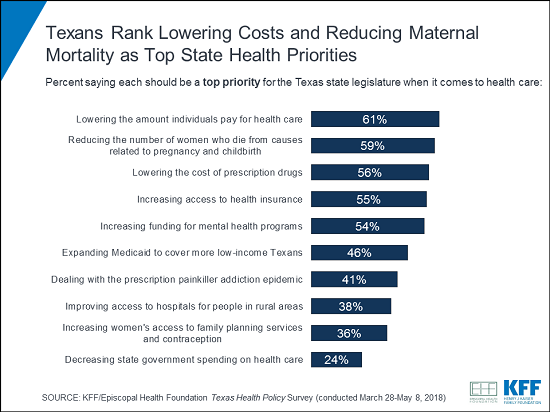
Majorities say “top priority” should be given to lowering what people pay for health care (61%), reducing maternal mortality (59%), lowering prescription drug costs (56%), increasing access to health insurance (55%) and boosting funding for mental health programs (54%).

Nearly half (46%) of Texans say expanding Medicaid to cover more low-income Texans should be a top priority. At the same time, the poll finds that two thirds (64%) say that the state is not doing enough to help low-income adult residents get needed health care, and the same majority (64%) favor expanding the state’s Medicaid program to cover more low-income adults.

Texas is one of 17 states that has not expanded its Medicaid program under the Affordable Care Act, which requires the federal government to pay the vast majority of the cost of expanded coverage.

Large majorities of Texas Democrats (82%) and independents (71%) support Medicaid expansion in the state, while most Republicans (59%) prefer keeping the state’s Medicaid program as it is today. Lower-income residents are most likely to support expansion, though a majority of those with higher incomes also favor it.

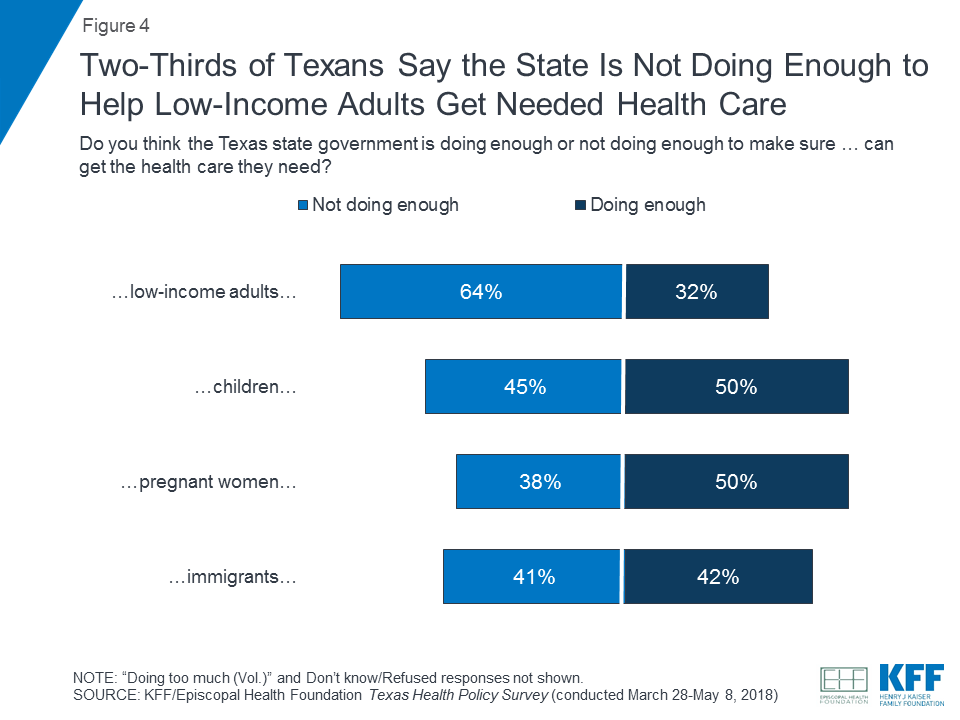
When asked about whether the state is doing enough to help other groups get needed health care, Texans are more mixed. Half say the state is doing enough to help children (50%) and pregnant women (50%), while fewer (42%) say the state is doing enough to help immigrants.

Texas currently has more residents without health insurance than any other state and has the highest uninsured rate in the country (21% among adults ages 19-64, compared to 12% nationally). However, most Texans don’t realize it.

The poll finds that three in 10 (31%) correctly say that Texas has an above-average uninsured rate, while about one in five (19%) incorrectly say it has a below-average uninsured rate.  The rest say either that it is about the same (34%) or that they don’t know (16%).

The findings are from the first report in a series drawing on a new KFF/EHF survey of Texans on their views of and experiences around health policy and Medicaid. Future reports will examine health care costs, the experiences of Texans with private insurance, and women’s health care.

When asked about state budget priorities overall, a majority (54%) of Texans say they favor increased spending on health care programs – fewer than say the same about public education (71%) and similar to the shares who want increased spending on infrastructure (55%) and public safety (52%).

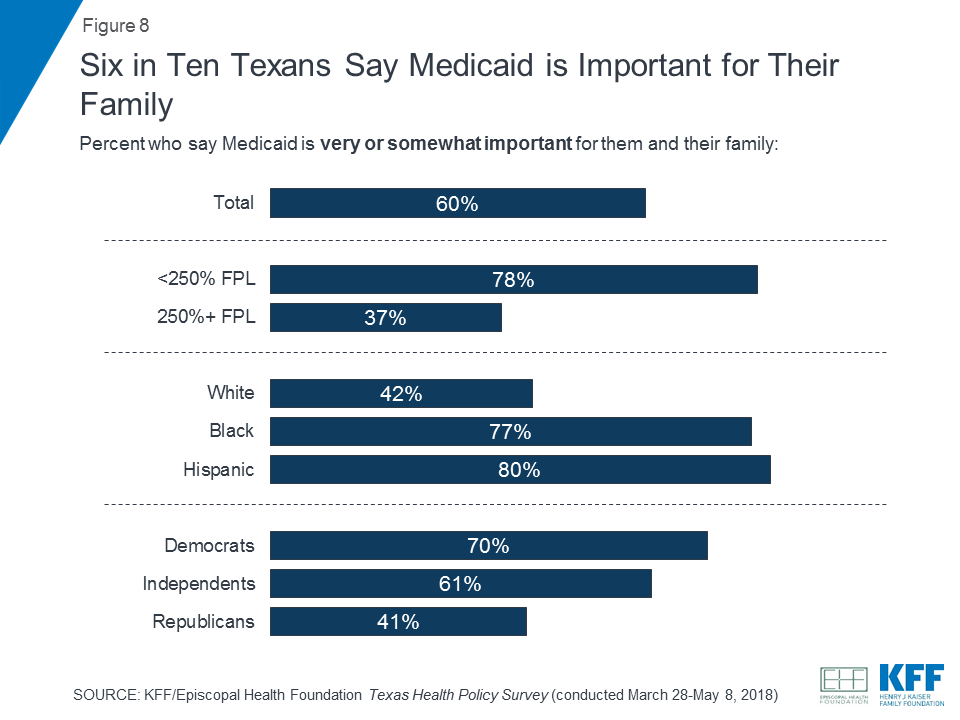
Most Texans (60%) say Medicaid is important to their families, and the same share (60%) say the state’s Medicaid program is working well for those low-income residents who are already covered by the program.

Overall, seven in 10 (71%) Texans report a personal connection to someone covered by the Medicaid program – including those who have personally received Medicaid assistance (31%), have had a child covered (11%), or have a close friend or family member who has been covered (29%).

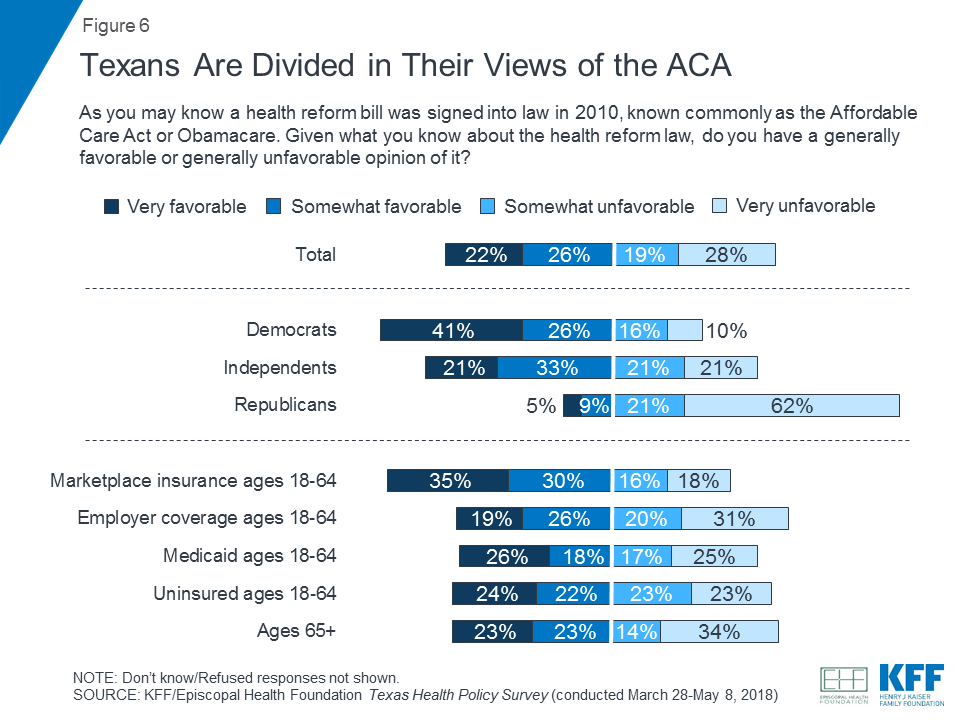
Like Americans overall, Texans are also divided in their views of the 2010 Affordable Care Act. Roughly equal shares of Texans hold favorable (48%) and unfavorable (47%) views of the law sometimes called Obamacare. In the latest national Kaiser Health Tracking Poll, 49% of Americans overall had a favorable view of the law and 42% were unfavorable.

Designed and analyzed by researchers at the Kaiser Family Foundation and the Episcopal Health Foundation, the Texas Health Policy Survey was conducted from March 28-May 8, 2018 among a random digit dial telephone sample of 1,367 adults living in Texas. Interviews were conducted in English and Spanish by landline (439) and cell phone (928). The margin of sampling error including the design effect for the full sample is plus or minus 3 percentage points. For results based on subgroups, the margin of sampling error may be higher.

The Episcopal Health Foundation (EHF) believes all Texans deserve to be healthy. EHF is committed to transforming the health of our communities by going beyond just the doctor’s office. By providing millions of dollars in grants, working with congregations and community partners, and providing important research, we’re supporting solutions that address the underlying causes of poor health. EHF was established in 2013 and is based in Houston. With more than $1.2 billion in estimated assets, the Foundation operates as a supporting organization of the Episcopal Diocese of Texas and works across 57 Texas counties.  #HealthNotJustHealthcare

Texas Residents’ Views on State and National Health Policy Priorities

Authors: Liz Hamel, Bryan Wu, Mollyann Brodie, Shao-Chee Sim, and Elena Marks
Published: Jun 14, 2018

Topline-Kaiser-Family-Foundation-Episcopal-Health-Foundation-Texas-Health-Policy-Survey

Executive Summary

Texas, the nation’s second most-populous state, has a diverse population in terms of race, ethnicity, immigration status, income, and geography. One of 17 states that did not expand Medicaid under the Affordable Care Act, Texas also has the largest number of uninsured residents among U.S. states. In a new survey, the Kaiser Family Foundation and the Episcopal Health Foundation sought to gauge Texans’ views on health policy priorities at both the state and national level.

Overall, the survey finds that health care is a priority for Texans, with over half saying the state legislature should increase spending on health care programs, similar to the share who want to increase spending on public safety and infrastructure, but behind the share calling for increases in public education spending. Within health care, initiatives that would lower the cost of health care and prescription drugs, reduce maternal mortality, improve access to health insurance and provide funding for mental health programs are seen as the highest priorities.

There is also a robust level of support for state action to expand coverage to low-income adults in Texas, including through Medicaid. Roughly two-thirds of Texans say the state government is currently not doing enough to make sure low-income adults can get the health care they need, and the same share says the state should expand its Medicaid program. This support exists in spite of the fact that only three in ten Texans are aware of the fact that Texas has a higher uninsured rate than other states.

Support for Medicaid may be related to the fact that about seven in ten Texans report some level of connection to the program, saying that they themselves, a child, or a close friend or family member has received help from Medicaid at some point. While partisans differ in their opinion of whether the state should expand Medicaid, majorities of Texans across political parties say they have a favorable view of Medicaid and that the program is working well for most low-income people covered by it.

Future briefs based on the survey will cover Texans’ experiences with health care affordability and access, the views and experiences of those with private insurance, women and children’s health care in Texas, and Texans’ views on social determinants of health.

Findings

Texans’ Views on Health Care as a Priority for the State Legislature

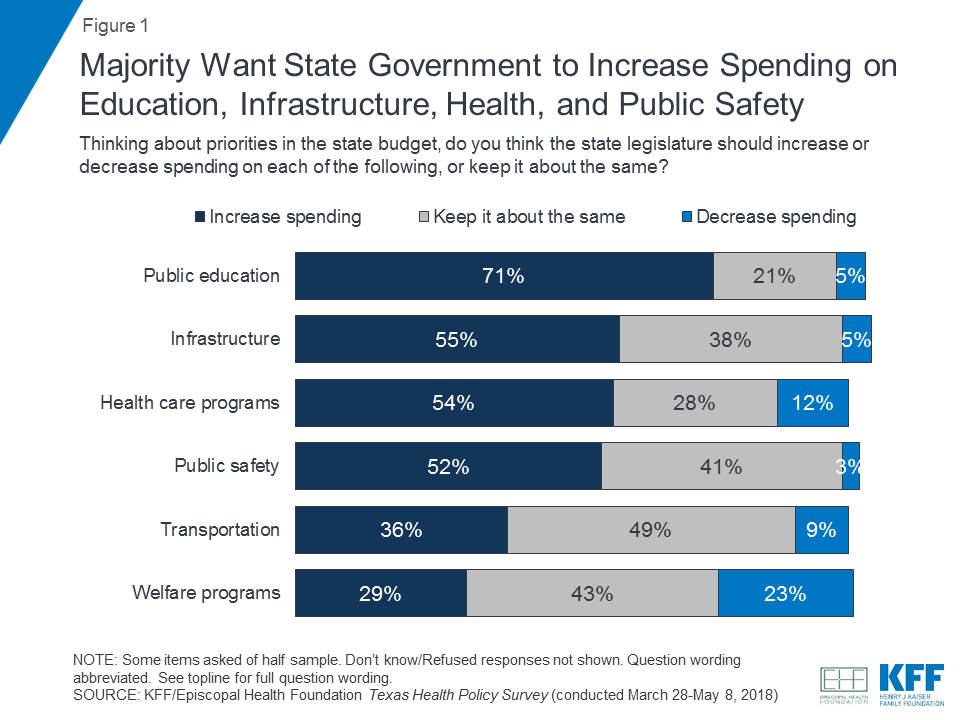
Health care programs are one of many spending priorities Texas residents see for their state government. When asked whether the state legislature should increase, decrease, or maintain current levels of spending in various areas, a majority (54 percent) of Texans want spending on health care programs to increase (Figure 1). This is lower than the share who want the state to increase spending on public education (71 percent) and similar to the shares who want increases in spending on infrastructure (55 percent) and public safety (52 percent). By contrast, pluralities of Texans want state spending on transportation and welfare programs to stay about the same.

Figure 1: Majority Want State Government to Increase Spending on Education, Infrastructure, Health, and Public Safety

Texans’ views of state spending on health care vary somewhat by demographic group. Democrats, women, Black residents, and those with at least some college education are more likely to support increases in state spending on health care programs. However, across groups few say the state should decrease spending; rather there is a greater preference among Republicans, White and Hispanic residents, and those with no college education to keep state spending at its current level (Table 1).

Table 1: Views of State Spending on Health Care by Key Demographics
Percent who say the state legislature should ______ spending on health care programs:Party IdentificationGenderRace/EthnicityEducation level
Dem.Ind.Rep.MaleFemaleWhiteBlackHisp.High school or lessSome college4-year college degree
Increase69%55%41%50%59%53%77%46%48%60%58%
Decrease61316159121013141211
Keep about the same2328342729271137332326
Don’t know/Refused14983724555

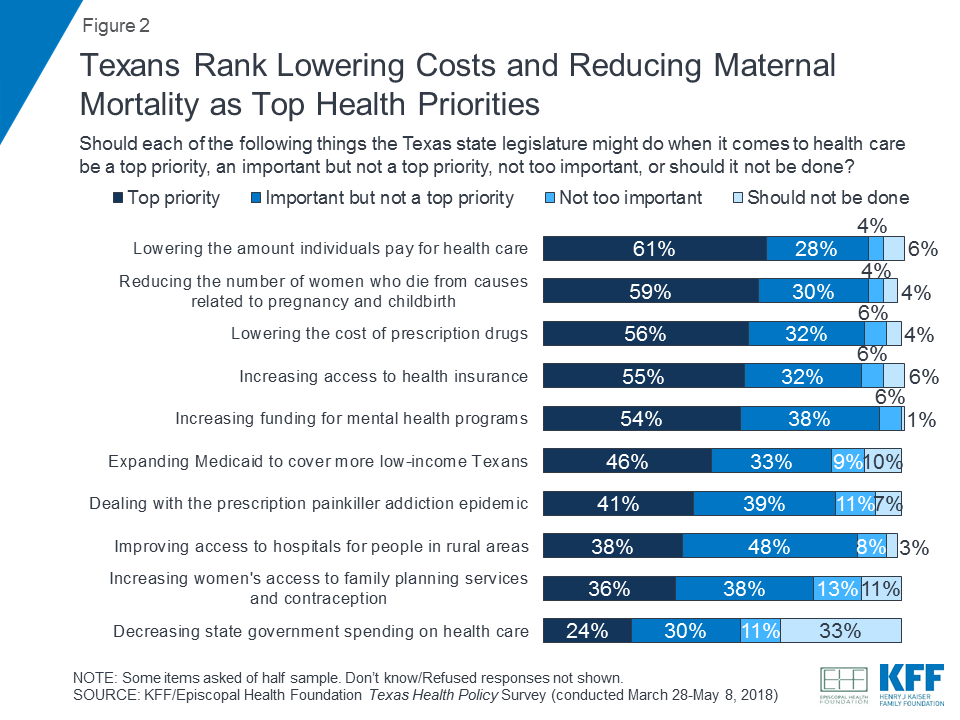
When asked about various things the state legislature might focus on within health care, all are viewed as important by a majority of Texans, with issues of affordability, insurance access, and maternal and mental health rising to the top (Figure 2). Majorities say top priority should be given to lowering what individuals pay for care (61 percent), reducing maternal mortality (59 percent), lowering prescription drug costs (56 percent), increasing access to health insurance (55 percent), and increasing funding for mental health programs (54 percent). Nearly half (46 percent) say expanding Medicaid to cover more low-income Texans should be a top priority, while about four in ten say the same about dealing with the prescription painkiller addiction epidemic (41 percent), improving hospital access in rural areas (38 percent), and increasing contraception access (36 percent). Fewer say the state legislature should place a top priority on decreasing state spending on health care (24 percent), while one-third (33 percent) say this should not be done.

Poll: Texans’ top state health priorities include lowering out-of-pocket costs and reducing maternal mortality

While there are differences in how various demographic groups in Texas view health care priorities for the state legislature, lowering the amount individuals pay for health care and lowering prescription drug costs are seen as a top priority by majorities of Texans regardless of political party, race/ethnicity, gender, or self-reported income level.

Figure 2: Texans Rank Lowering Costs and Reducing Maternal Mortality as Top Health Priorities

Rating the State on Access to Care for Vulnerable Groups

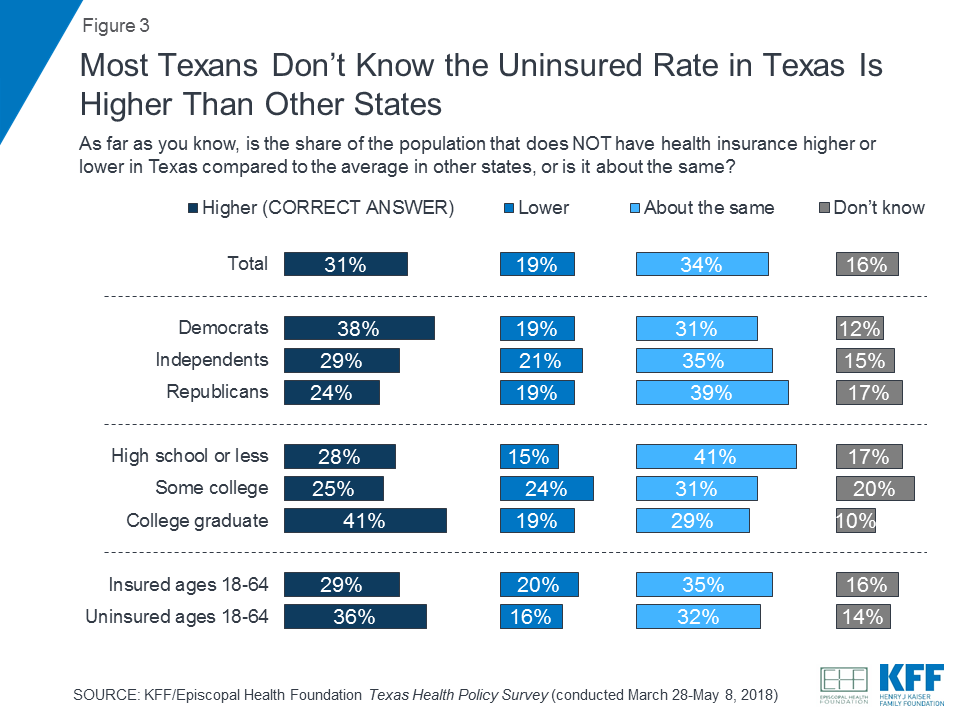
Texas has the largest number of uninsured individuals of any state in the nation. According to Kaiser Family Foundation analysis of Census data, 21 percent of adults between the ages of 19-64 in Texas are uninsured, substantially higher than the national average of 12 percent.1  However, most Texas residents are unaware of this fact. About three in ten (31 percent) correctly answer that the share of the population without health insurance is higher in Texas compared to the average in other states, while about one in five (19 percent) believe the uninsured rate is lower in Texas than other states and about a third (34 percent) think it’s about the same (Figure 3).

Among Texans, Democrats and those with higher levels of education are more likely to be aware of the fact that Texas has a higher uninsured rate than other states. However, those who are uninsured themselves are no more likely than their insured counterparts to be aware of this fact.

Figure 3: Most Texans Don’t Know the Uninsured Rate in Texas Is Higher Than Other States

Despite this lack of understanding about the uninsured rate, a majority of Texans believes the state should be doing more to provide access to health care for low-income adults. Sixty-four percent of Texas residents say the state government is not doing enough to make sure low-income adults in Texas can get the health care they need, while about a third (32 percent) say the state is doing enough in this area already (Figure 4). Responses are more evenly split when it comes to state efforts to help children and immigrants obtain health care; about equal shares say the state is doing enough and not doing enough to help each of these groups get the health care they need. On the other side of the spectrum, more Texans say the state is doing enough (50 percent) than say it is not doing enough (38 percent) to make sure pregnant women can get needed health care.

Figure 4: Two-Thirds of Texans Say the State Is Not Doing Enough to Help Low-Income Adults Get Needed Health Care

As is true on many questions of health care policy nationally, Democrats in Texas are more likely than Republicans to say the state is not doing enough to help each of these groups get the health care they need. Other demographic differences exist, too. For example, Black residents are more likely than either White or Hispanic Texans to say the state is not doing enough to help low-income adults, children, and pregnant women get needed health care, while both Black and Hispanic residents are more likely than White residents to say the same about immigrants. Similarly, residents with lower incomes are more likely than those with higher incomes to say the state should be doing more to help low-income adults and immigrants get health care. Those who were themselves born outside the U.S. are also more likely than U.S.-born Texans to say the state is not doing enough to help immigrants access care (Table 2).

Table 2: Perceptions of State Efforts on Helping Different Groups Get Needed Health Care
Percent who say the state is not doing enough to help ______ get the health care they need:  Party IdentificationRace/EthnicityIncome (% of FPL)Nativity
Dem.Ind.Rep.WhiteBlackHisp.Less than 138%138%-250%250% or moreNative-bornForeign-born
Low-income adults80%69%43%58%83%65%74%65%57%64%62%
Children6146304665364346464833
Pregnant women5541173752343941374030
Immigrants6143162754535141343756

Role of Federal and State Government in Health Care

To a certain extent, Texans’ ratings of the job the state is doing to help different groups access health care reflect underlying preferences about the level of government involvement in the health system. Overall, the vast majority of Texans feel that both the state and federal governments should play at least a minor role in making the health care system work well, with more seeing a major role for the state rather than the federal government (67 percent versus 54 percent, Figure 5).

Figure 5: Texans More Likely to See Major Role for State than Federal Government in Health Care

Reflecting patterns often seen in surveys, partisans differ in their responses to questions about government involvement, particularly at the federal level. While 73 percent of Democrats and 57 percent of independents in Texas say the federal government should play a major role in making the health care system work well, just 28 percent of Republicans agree. Republicans are more likely to support state rather than federal government in health care, with a slim majority (53 percent) of Republicans saying the state should play a major role, along with 70 percent of independents and 78 percent of Democrats. Likely reflecting these partisan differences, Texans who are Black or Hispanic, have lower self-reported incomes, or live in urban areas are more likely than their White, higher-income, suburban and rural counterparts to say both the federal and state government should play a major role in the health care system (Table 3).

Table 3: Views on the Role of Governments in Making the Health Care System Work Well
Percent who say ______ should play a major role when it comes to making the health care system work well:Party IdentificationRace/EthnicityIncome (% of FPL)Geography
TotalDem.Ind.Rep.WhiteBlackHisp.Less than 138%138%-250%250% or moreUrbanSub-urbanRural
The federal government54%73%57%28%39%74%67%65%55%46%60%51%38%
State governments67787053577378757060696657

Texans’ Views of the Affordable Care Act

In addition to being divided on the role the federal government should play in the health care system, Texans are also divided in their view of the Affordable Care Act (ACA) – the most comprehensive federal health care legislation of the past several decades. Overall, 48 percent of Texas residents say they have a favorable view of the ACA and about an equal share (47 percent) say they have an unfavorable view (Figure 6). Nationally, the most recent Kaiser Health Tracking poll finds that 49 percent of U.S. adults have a favorable view of the law and 42 percent view it unfavorably.2  Like the nation overall, opinion of the ACA divides sharply along partisan lines in Texas, with two-thirds of Democrats (67 percent) expressing a favorable view of the law and about eight in ten Republicans (83 percent) expressing an unfavorable view. Those who get their insurance from the ACA marketplace are also more likely to express a favorable view of the law than those with employer coverage, Medicaid, the uninsured, or seniors (most of whom get coverage through Medicare).

Figure 6: Texans Are Divided in Their Views of the ACA

Texans’ Views and Awareness of Medicaid

As one of 17 states that did not expand Medicaid under the ACA, low-income adults in Texas are eligible for Medicaid only if they meet certain criteria (i.e. people with disabilities, pregnant women, parents with very low incomes). Compared to other U.S. states, particularly those that have expanded Medicaid, adults covered by Medicaid in Texas mostly have very low incomes due to strict eligibility criteria. Roughly 4 million people are covered by Medicaid in Texas, nearly three-quarters of whom are children.3  Among non-elderly adults enrolled in Medicaid in Texas, 60 percent are women.4  Among all non-elderly individuals with Medicaid in Texas (including children), 57 percent are Hispanic, 22 percent are white, and 16 percent are Black,5  and 70 percent are in families with at least one full-time worker.6 

Despite relatively strict eligibility criteria, the survey finds that about seven in ten Texas residents report some level of personal connection to the Medicaid program, similar to the share in national Kaiser Health Tracking polls.7  This includes 31 percent who say they personally have received help from Medicaid at some point (either directly receiving health insurance, getting help to pay their Medicare premiums, or having pregnancy-related care or long-term care paid for in part by Medicaid), 11 percent who say they’ve had a child covered by Medicaid, and 29 percent who say a close friend or family member has received help from Medicaid (Figure 7). Reflecting the demographic makeup of Medicaid recipients in Texas, the share reporting a personal connection to Medicaid in the survey is higher among women (78 percent), Hispanic and Black residents (78 percent each), and those with self-reported incomes below 250 percent of the federal poverty level (80 percent). The share reporting a personal connection to Medicaid is similar among Texans living in urban, suburban, and rural areas (71 percent, 70 percent, and 74 percent, respectively).

Figure 7: Women, Hispanic and Black Texans, Those with Lower Incomes More Likely to Report a Connection to Medicaid

In addition to reporting personal connections to the program, six in ten Texans say Medicaid is either very important (41 percent) or somewhat important (19 percent) to them and their families (Figure 8). Again, the share saying Medicaid is personally important is higher among those with lower incomes as well as residents who are Black or Hispanic. Perhaps reflecting these demographic differences, there is also a partisan difference on this question, with Democrats and independents more likely than Republicans to say Medicaid is important for their families (70 percent, 61 percent, and 41 percent, respectively).

Figure 8: Six in Ten Texans Say Medicaid is Important for Their Family

Seven in ten Texans (71 percent) express a very or somewhat favorable view of Medicaid, similar to the 74 percent of adults nationally who said the same in a KFF Tracking Poll in February 2018. In Texas, favorable views of Medicaid are expressed by majorities of both those with a personal connection to Medicaid (73 percent of those with any personal connection, including 76 percent of those currently covered) and those with no connection to the program (65 percent). While majorities across different demographic groups express a favorable view of Medicaid, Texans who are Black or Hispanic, have lower incomes, identify as Democrats, or are currently covered by the program are more likely than their counterparts to say they have a very favorable view of Medicaid (Table 4).

Table 4: Views on Medicaid by Key Demographic Groups
In general, do you have a favorable or an unfavorable opinion of Medicaid?Party IdentificationRace/EthnicityIncome (% of FPL)Medicaid Connection
TotalDem.Ind.Rep.WhiteBlackHisp.Less than 138%138%-250%250% or moreCurrently coveredAny connec-tionNo connec-tion
NET Favorable71%78%71%60%64%72%78%75%66%70%76%73%65%
Very favorable34453222234544453424503725
Somewhat favorable37323938412735303246273540
NET Unfavorable26202436312519202827212529
Somewhat unfavorable17131722211913151817131719
Very unfavorable877141066510108810
NOTE: Don’t know/Refused responses not shown.

When asked whether Medicaid is working well for most low-income people covered by the program, six in ten Texans (60 percent) say it is working well, somewhat higher than the 52 percent of adults nationally who said so in a February 2018 KFF poll. Majorities across race/ethnicity, income, and political party in Texas say Medicaid is working well, as do 64 percent of those with a personal connection to Medicaid, including 68 percent of those who are currently covered by the program (Table 5).

Table 5: Perceptions of the Medicaid Program on Low-Income People in Texas
Would you say the current Medicaid program is working well for most low-income people covered by the program in Texas, or not? Party IdentificationRace/EthnicityIncome (% of FPL)Medicaid Connection
TotalDem.Ind.Rep.WhiteBlackHisp.Less than 138%138%-250%250% or moreCurrently coveredAny connec-tionNo connec-tion
Working well60%59%58%63%53%54%71%66%60%56%68%64%49%
Not working well33383628384124303535303238
Don’t know73699544592412
NOTE: Refused responses not shown.

While most Texans have a favorable view of Medicaid, knowledge about the program is somewhat mixed.

Texas is one of 17 states that haven’t expanded Medicaid to cover more low-income residents using mostly federal dollars. Most Texans say they favor expansion

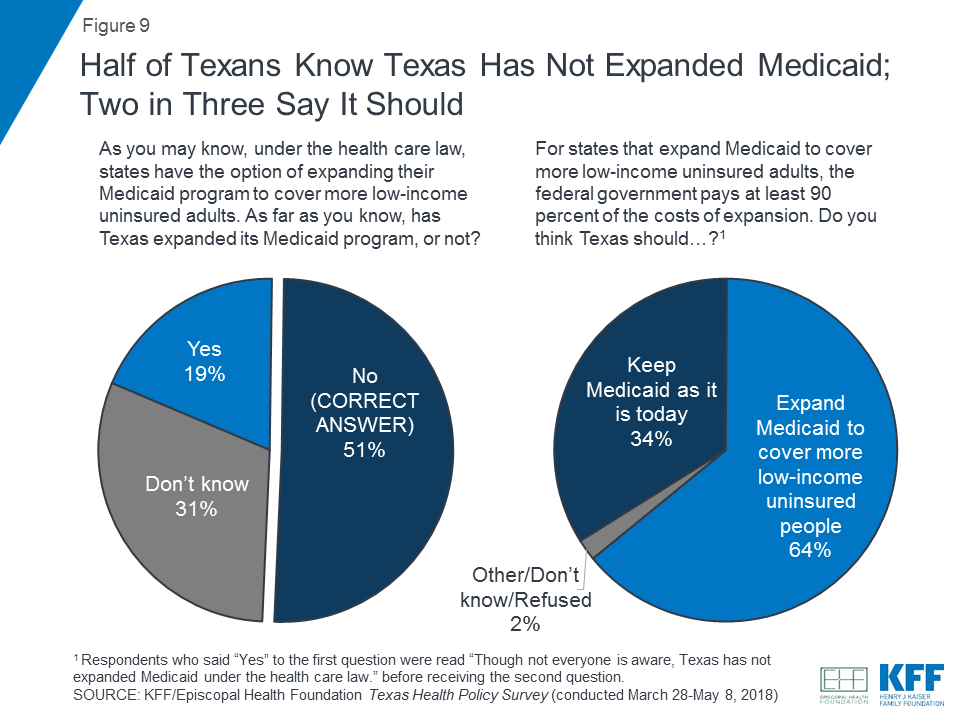
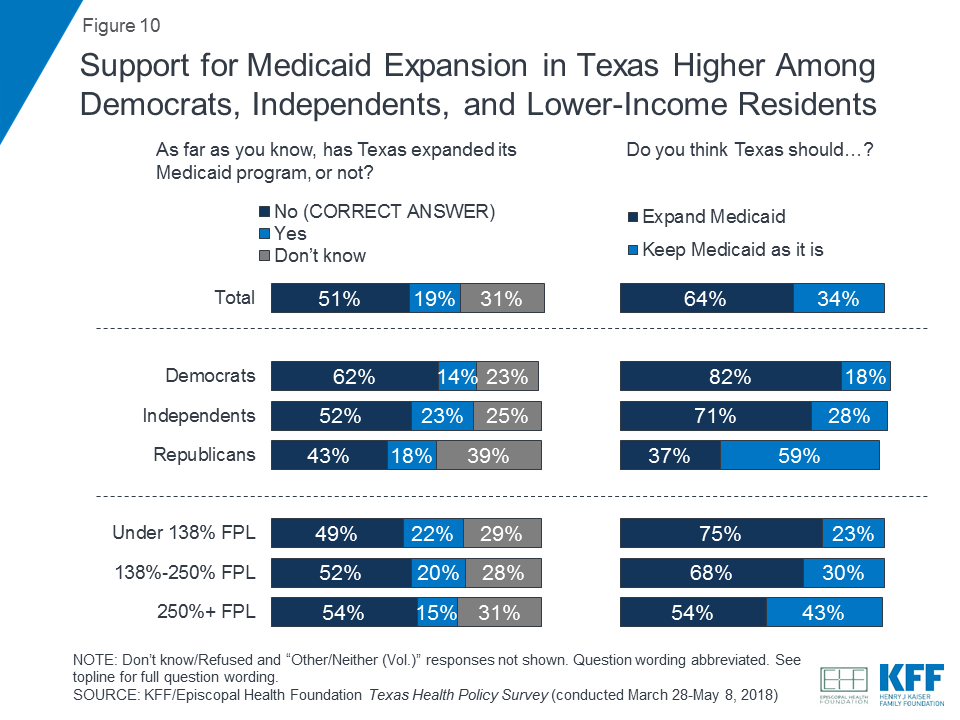
When asked whether Texas has expanded Medicaid under the ACA, about half (51 percent) of Texans correctly answer that the state has not expanded, but one in five (19 percent) incorrectly think it has expanded and three in ten (31 percent) say they don’t know. When asked whether they think Texas should expand Medicaid under the health care law, about two-thirds (64 percent) of Texans say the state should expand its program, while about a third (34 percent) say Medicaid should be kept as it is today (Figure 9).

Figure 9: Half of Texans Know Texas Has Not Expanded Medicaid; Two in Three Say It Should

Partisans differ somewhat in both their awareness and opinions of state Medicaid expansion. Democrats are somewhat more likely than Republicans and independents to know that Texas has not expanded its Medicaid program (62 percent, 43 percent, and 52 percent, respectively). The difference is even bigger on the question of what the state should do, with Democrats more than twice as likely as Republicans to want Medicaid expansion in the state (82 percent versus 37 percent). In addition, large shares of Texans with lower incomes – who are more likely to benefit from Medicaid expansion in the state – support such an expansion (75 percent of those with incomes below 138 percent of the federal poverty level and 68 percent of those with incomes between 138 and 250 percent of poverty). Still, there is majority support for expansion in Texas among those who are less likely to be eligible for Medicaid under expansion themselves, with 54 percent of individuals with incomes at least 250 percent of the poverty level saying the state should expand Medicaid (Figure 10).

Figure 10: Support for Medicaid Expansion in Texas Higher Among Democrats, Independents, and Lower-Income Residents

Methodology

The Kaiser Family Foundation/Episcopal Health Foundation Texas Health Policy Survey was conducted by telephone March 28 – May 8, 2018 among a random representative sample of 1,367 adults age 18 and older living in the state of Texas (note: persons without a telephone could not be included in the random selection process). Interviews were administered in English and Spanish, combining random samples of both landline (439) and cellular telephones (928, including 688 who had no landline telephone). Sampling, data collection, weighting and tabulation were managed by SSRS in close collaboration with Kaiser Family Foundation and Episcopal Health Foundation researchers. Episcopal Health Foundation paid for the costs of the survey fieldwork, and Kaiser Family Foundation contributed the time of its research staff. Both partners worked together to design the survey and analyze the results.

The sampling and screening procedures included an oversample component designed to increase the number of respondents ages 18-64 with Medicaid or non-group health insurance coverage. This included 180 respondents who were reached by calling back respondents in Texas who had previously completed an interview on either the SSRS Omnibus poll or the Kaiser Health Tracking Polls and indicated they fit one of the oversample criteria (based on age and type of health insurance coverage). It also included an oversample of counties with higher shares of Medicaid recipients.

The dual frame cellular and landline phone sample was generated by Marketing Systems Group (MSG) using random digit dial (RDD) procedures. All respondents were screened to verify that they resided in Texas. For the landline sample, respondents were selected by asking for the youngest adult male or female currently at home based on a random rotation. If no one of that gender was available, interviewers asked to speak with the youngest adult of the opposite gender. For the cell phone sample, interviews were conducted with the qualifying adult who answered the phone.

A multi-stage weighting design was applied to ensure an accurate representation of the Texas adult population. The first stage of weighting involved corrections for sample design, including accounting for oversampling of high-Medicaid counties, as well as non-response for the callback sample. In the second weighting stage, demographic adjustments were applied to account for systematic non-response along known population parameters. Population parameters included gender, age, race, Hispanicity (broken down by nativity), educational attainment, phone status (cell phone only or reachable by landline), state region, and residence in a low-income county. This stage excluded the Medicaid and non-group oversample components. Based on this second stage of weighting, estimates were derived for types of health insurance coverage (Medicaid, non-group, employer-sponsored, all else) in the Texas population. The last stage of weighting included all respondents and included health insurance coverage based on the previous stage’s outcomes. Weighting parameters were based on estimates from the U.S. Census Bureau’s March 2017 Current Population Survey (CPS), with the exception of population density of the respondent’s county of residence which was based on the 2010 Census, and telephone use (cell phone-only, landline-only, dual-user) which was based on data from the January-June 2016 National Health Interview Survey.

The margin of sampling error including the design effect for the full sample is plus or minus 3 percentage points. For results based on subgroups, the margin of sampling error may be higher. Sample sizes and margins of sampling error for subgroups are available by request. Note that sampling error is only one of many potential sources of error in this or any other public opinion poll. Kaiser Family Foundation public opinion and survey research is a charter member of the Transparency Initiative of the American Association for Public Opinion Research.

Endnotes

  1. Kaiser Family Foundation estimates based on the Census Bureau’s March Current Population Survey (CPS: Annual Social and Economic Supplements), 2014-2017, https://modern.kff.org/other/state-indicator/adults-19-64/ ↩︎
  2. Kirzinger A, Wu B, Munana C, and Brodie M, Kaiser Health Tracking Poll: Preview of the Role of Health Care in the 2018 Midterm Campaigns, May 2018, https://modern.kff.org/health-costs/poll-finding/kaiser-health-tracking-poll-preview-role-of-health-care-2018-midterm-campaigns/ ↩︎
  3. Texas Health and Human Services, Healthcare Statistics, data for February 2018 accessed May 31, 2018: https://hhs.texas.gov/about-hhs/records-statistics/data-statistics/healthcare-statistics ↩︎
  4. Kaiser Family Foundation estimates based on the Census Bureau’s March Current Population Survey (CPS: Annual Social and Economic Supplements), 2014-2017, https://modern.kff.org/medicaid/state-indicator/distribution-by-gender-4/ ↩︎
  5. Kaiser Family Foundation estimates based on the Census Bureau’s March Current Population Survey (CPS: Annual Social and Economic Supplements), 2014-2017, https://modern.kff.org/medicaid/state-indicator/distribution-by-raceethnicity-4/ ↩︎
  6. Kaiser Family Foundation estimates based on the Census Bureau’s March Current Population Survey (CPS: Annual Social and Economic Supplements), 2014-2017, https://modern.kff.org/medicaid/state-indicator/distribution-by-employment-status-4/ ↩︎
  7. Kirzinger A, Wu B, and Brodie M, Kaiser Health Tracking Poll – February 2018: Health Care and the 2018 Midterms, Attitudes Towards Proposed Changes to Medicaid, March 2018, https://modern.kff.org/health-reform/poll-finding/kaiser-health-tracking-poll-february-2018-health-care-2018-midterms-proposed-changes-to-medicaid/ ↩︎
News Release

Walgreens and Greater Than AIDS Join with Health Departments and Local Organizations to Help Provide Free HIV Testing in More Than 180 Cities for National HIV Testing Day on June 27 

Testing at participating Walgreens supports ongoing commitment to community outreach on HIV

Published: Jun 13, 2018

DEERFIELD, Ill., June 13, 2018 – Walgreens and Greater Than AIDS, a leading national public information response to the domestic HIV/AIDS epidemic, are working with 220 health departments, AIDS service organizations, and other community organizations to help provide free HIV testing and information at participating Walgreens stores in more than 180 cities on National HIV Testing Day on Wednesday, June 27, between 10 am – 7 pm (local time).

Walgreens and Greater Than AIDS are helping the participating testing partners to expand the free HIV testing to even more locations this year with a focus on heavily affected communities. Since 2011, more than 40,000 HIV tests have been conducted as part of the activation. BioLytical Laboratories and OraSure Technologies, Inc. are donating test kits and Abbott Rapid Diagnostics is providing support for outreach.

Local agencies will be at participating Walgreens stores to provide free, confidential, and fast test results on site, without the need to schedule an appointment. Counselors will be on hand to answer questions about HIV prevention and treatment options, including PrEP, a medication that offers another effective means of protection for those testing negative for HIV.

“Walgreens has supported people living with HIV/AIDS since the beginning of the epidemic more than 30 years ago,” said Glen Pietrandoni, senior director, patient care and advocacy, at Walgreens. “Early testing can mean access to effective treatment and the opportunity to go on to live a healthy normal lifespan. In addition, with proper adherence to medication, successfully treated patients cannot easily transmit the virus to others. As we continue to work towards an end to HIV/AIDS, it is crucial that testing and trusted resources on treatment are made more widely available within communities.”

The Centers for Disease Control and Prevention (CDC) recommends HIV testing as part of routine health care. An estimated 1.1 million people in the United States are living with HIV and approximately 1 in 7 are unaware of their status.[i]

“There are more options than ever to prevent and treat HIV,” said Tina Hoff, Senior Vice President and Director, Health Communications and Media Partnerships at the Kaiser Family Foundation, which leads Greater Than AIDS. “The first step is knowing your status. This collaboration normalizes HIV testing as part of everyday life, while helping to educate about these advances.”

The community partnership is part of an ongoing commitment by Walgreens and Greater Than AIDS to broaden the reach of HIV testing and information in non-traditional settings and to support the outreach of local organizations. Year round, HIV-trained pharmacy staff are available at more than 1,000 Walgreens locations nationwide, including communities with high HIV prevalence, offering one-on-one, confidential medication counseling to support treatment adherence, and assisting with other care needs, such as identifying financial assistance options.

For a complete list of participating Walgreens locations and supporting partners for this year’s National HIV Testing Day, as well as additional information about HIV testing, including year-round testing sites, visit www.greaterthan.org/walgreens.

About Walgreens

Walgreens (www.walgreens.com), a provider of trusted care in communities since 1901, is included in the Retail Pharmacy USA Division of Walgreens Boots Alliance, Inc. (NASDAQ: WBA), the first global pharmacy-led, health and wellbeing enterprise. Approximately 8 million customers interact with Walgreens in stores and online each day, using the most convenient, multichannel access to consumer goods and services and trusted, cost-effective pharmacy, health and wellness services and advice. As of Aug. 31, 2017, Walgreens operates 8,100 drugstores with a presence in all 50 states, the District of Columbia, Puerto Rico and the U.S. Virgin Islands, along with its omnichannel business, Walgreens.com. Approximately 400 Walgreens stores offer Healthcare Clinic or other provider retail clinic services.

About Greater Than AIDS

Greater Than AIDS (www.greaterthan.org) is a leading national public information response focused on the U.S. domestic HIV epidemic. While national in scope, Greater Than AIDS focuses on communities most affected. Through targeted media messages and community outreach, Greater Than AIDS and its partners works to increase knowledge, reduce stigma and promote actions to stem the spread of the disease.

About Kaiser Family Foundation

The Kaiser Family Foundation (www.kff.org), a leader in health policy analysis, health journalism and communication, is dedicated to filling the need for trusted, independent information on the major health issues facing our nation and its people. The Foundation is a non-profit private operating foundation based in San Francisco, California.

[i] HIV/AIDS Basic Statistics, Centers for Disease Control and Prevention, last updated: December 18, 2017, Last accessed: May 2018, 2018. https://www.cdc.gov/hiv/basics/statistics.html