
A Look at the High Unemployment Hardship Exception to Medicaid Work Requirements Based on Unemployment Data from February 2025 to January 2026
The 2025 reconciliation law will—for the first time—require adults who are enrolled in Medicaid though the Affordable Care Act (ACA) expansion, along with those in partial expansion waiver programs in Georgia and Wisconsin, to meet work requirements or qualify for an exemption as a condition of eligibility starting in January 2027 in most states.
States may adopt an optional hardship exception to Medicaid work requirements for individuals living in counties with unemployment rates at or above 8%, or at least 1.5 times the national average unemployment rate. A recent KFF survey found that most states plan to adopt this exception, which will exempt both Medicaid applicants and enrollees in counties with unemployment rates that meet the specified thresholds. However, four states, Indiana, Iowa, Missouri, and Oklahoma, do not plan to adopt the exception.
An update to a previous KFF analysis of county unemployment rates, using 12-month average unemployment rates from February 2025 through January 2026, and county-level Medicaid expansion enrollment estimates that:
- 1.4 million expansion enrollees, or 7.5% of expansion enrollees, live in counties that meet the high unemployment threshold and may qualify for the hardship exception in the 27 states that plan to adopt the exception and in the 12 states that had not made a decision on adoption at the time of the KFF survey.
- Among the states that are planning to adopt or may adopt the exception, 133 counties in 22 states meet the high unemployment thresholds, representing 7% of counties in expansion states and states with partial expansion waiver programs. No counties meet the thresholds in 16 states, and DC does not meet the thresholds.
- Nine in ten expansion enrollees who are in counties that meet the high unemployment criteria and could be exempt from the work requirements live in five states—California, New York, Michigan, New Jersey, and Oregon.
- Among the states that do not plan to adopt the hardship exception, two counties in Iowa and Missouri meet the high unemployment thresholds, and approximately 3,300 expansion enrollees in those counties may have qualified for the high unemployment hardship exception if the states had decided to adopt the exception. In Indiana and Oklahoma, there are no counties that meet the thresholds.
Nebraska began enforcing work requirements on May 1, 2026, the first state to implement the new requirements. Although the state indicated it would adopt the high unemployment hardship exception, no counties in the state currently meet the thresholds.
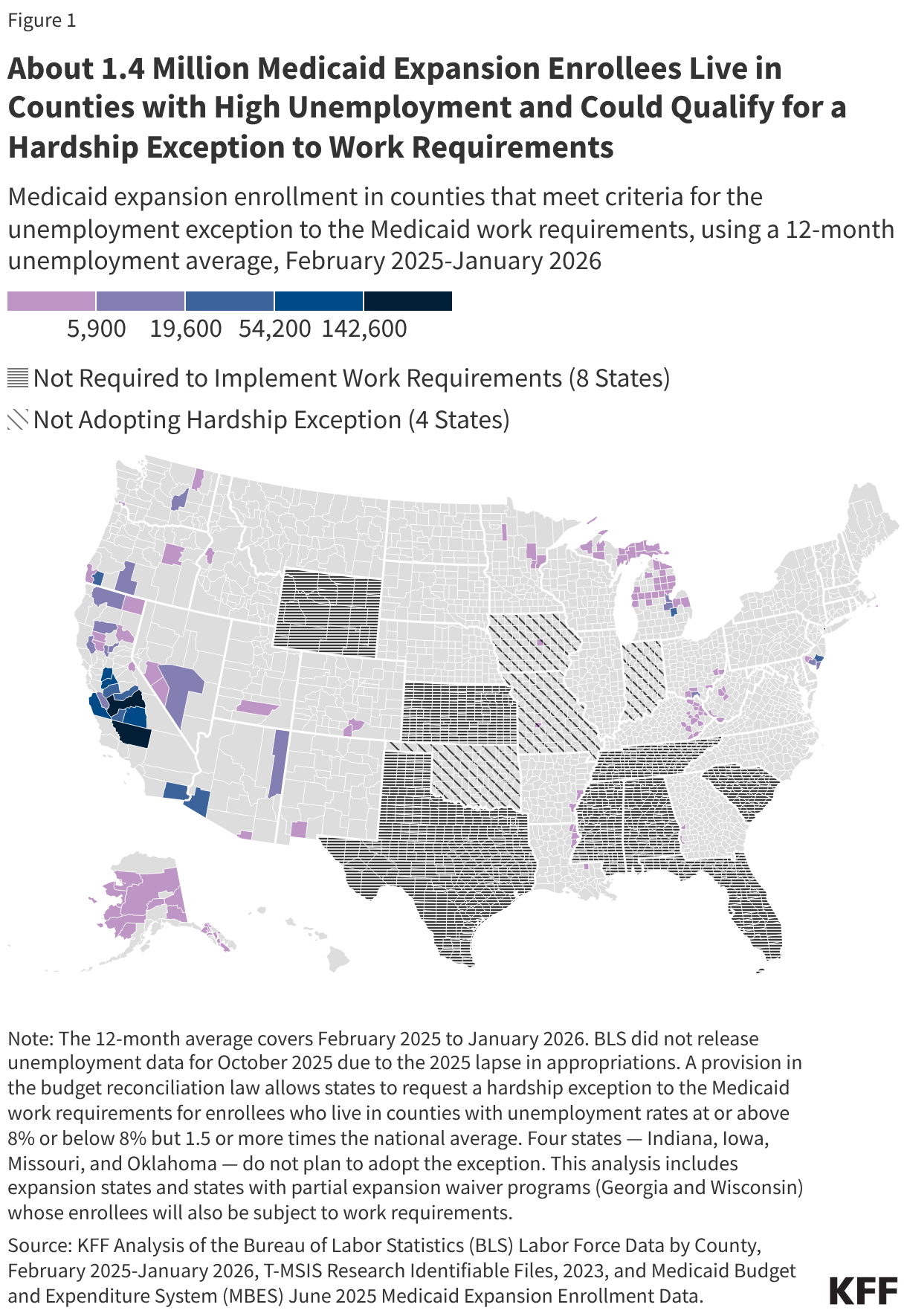
States are waiting for federal guidance on how to implement this hardship exception, including what data will be used to identify counties that meet the thresholds and what additional information states must submit. This analysis uses the most recent available county-level unemployment data from Bureau of Labor Statistics (BLS) and is consistent with the methods used to determine whether any counties qualify for the high unemployment exemption waiver from SNAP work requirements. However, the guidance, which CMS is expected to release in early June, may require a different method.
KFF’s interactive Medicaid work requirements tracker includes new county-level unemployment data by state, showing which counties meet the high unemployment thresholds and how many expansion enrollees in those counties may be exempt from work requirements.