Public Opinion

Caregivers in the U.S.

Experiences of Unpaid Caregivers in the U.S.

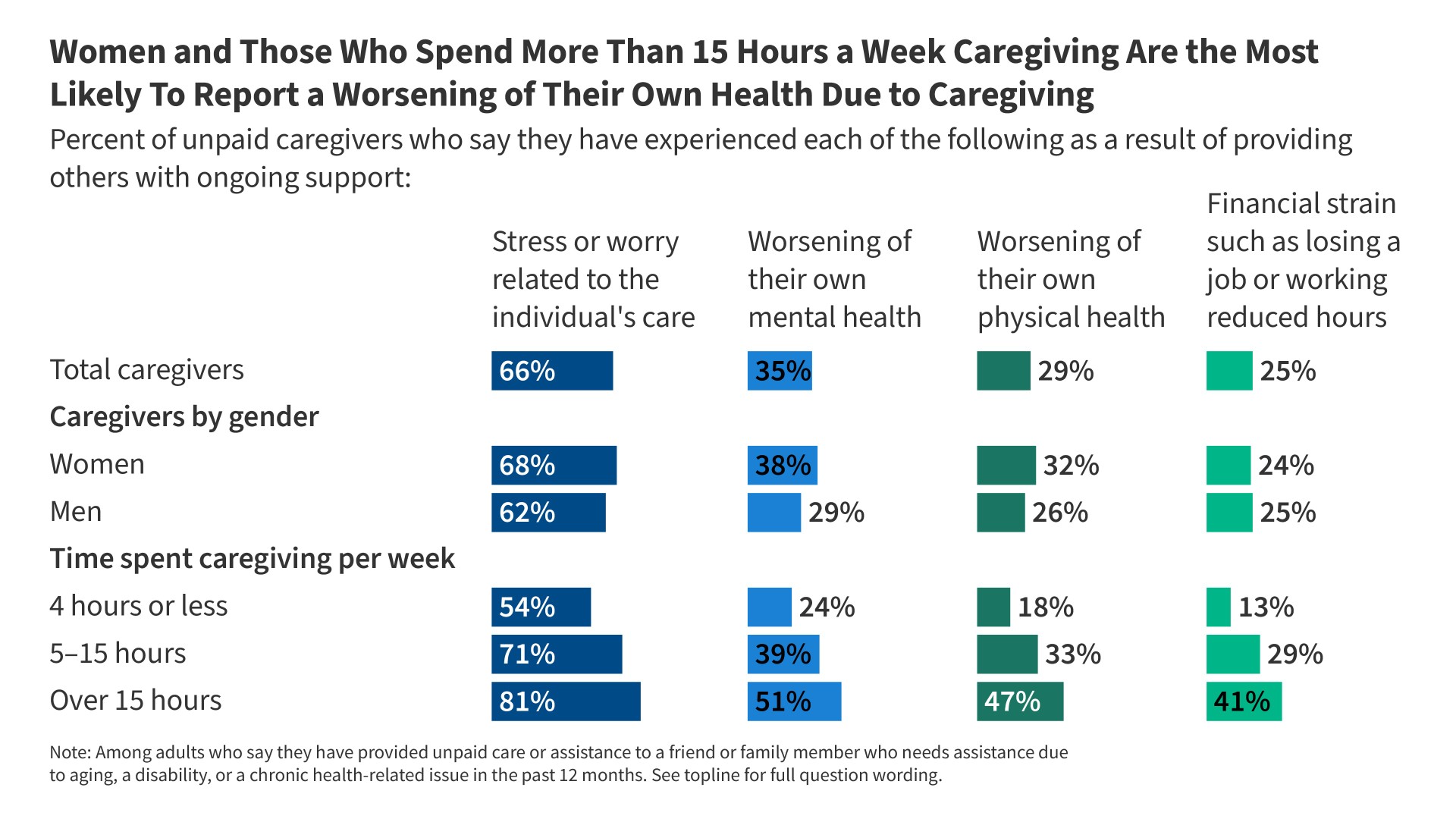
About 3 in 10 adults in the U.S. say they have provided unpaid care to a friend or family member who needs assistance due to aging, disability, or a chronic condition in the past 12 months. The median amount of time that such caregivers provide unpaid assistance is five hours per week, though the number of hours varies widely. Unpaid caregivers are disproportionately women. Read the news release.

HeaLTH in the Midterms

Health Care in the 2026 Midterm Election

This dashboard focuses on KFF’s analysis of the role health care costs and other health policy issues played in voters’ decisions in the 2026 midterm elections, including in key Senate races. It examines the role of rising health costs on voters’ decisions, views on the Trump administration’s health care policies, and opinions on the government’s role in health care amid discussions of Medicare for All.

Abortion on the Ballot in 2026: Polling Insights from Voters in Four States

This dashboard provides KFF’s analysis of the role abortion played in voters’ decisions in the 2026 midterm elections, with a focus on four states with abortion-related ballot measures: Idaho, Missouri, Nevada, and Virginia. It examines support for each of the measures across groups, including additional questions in Missouri.

What Do the Midterm Election Results Mean for Health Care? 

Event Date:

On November 5 at Noon ET, join KFF for a special post-election discussion and live “What the Health” podcast taping. Part of the discussion will focus on public opinion survey data on how voters weighed health care as they went to the polls nationally and in the four states with abortion-related ballot initiatives. 

Midterm Voters Give Democrats a Big Advantage to Handle Health Care

Quick Insights

KFF’s analysis of the 2026 Voter Poll by SSRS shows midterm voters gave Democrats a 19-percentage-point advantage on which party is better able to handle health care. Voters also gave Democrats a narrow edge on handling the economy (43% vs. 37%), a reversal from 2024, when Trump had a 10-point advantage over Harris. "In an election focused on affordability, Democrats’ messaging on health care costs appears to have resonated with voters and may have contributed to the party’s gains."

Health Information and Trust

About Half of Parents Mistakenly Believe Spacing Out Vaccines Is Healthier for Children; Half Say No Strong Evidence to Support Such a Claim

KFF Tracking Poll on Health Information and Trust: Fall 2026 Update on Vaccine Views

The latest KFF Tracking Poll on Health Information and Trust finds about half of parents mistakenly believe spacing out vaccines is healthier for children, while confidence in many long-standing childhood vaccines is high across partisans. These findings take on new relevance following President Trump’s recent executive order calling for changes in U.S. childhood vaccine recommendations, including splitting the measles, mumps, and rubella (MMR) vaccine—currently given as a single combined shot—into three separate vaccines across multiple visits.

Dashboard: Polling on Health Information and Trust

Drawing on KFF’s poll findings, this interactive dashboard tracks the public’s trusted sources for health information, attitudes toward vaccines, and use of news, social media, and AI for health-related information.

Health Tracking PollS

Democrats Hold a Nearly 2-to-1 Advantage Over Republicans on Handling the Cost of Health Care

Health Care Issues in the Lead-Up to the 2026 Midterm Election 

In the lead up to the midterms, health care costs remained tied with gas as voters’ top midterm concerns. Two-thirds of U.S. adults also favored Medicare-for-all, a new high in KFF Polling, but support shifts when competing claims from critics and proponents are heard.

Most Democratic Voters Want To Hear Candidates Discuss Health Costs and Future of Health Programs; More Republicans Focused on Fraud

Public Views on Fraud in Health Programs

As the 2026 midterms approach, health care costs remain voters’ top health priority, but fraud in government health programs, including Medicaid and Medicare, is resonating with Republican voters, 55% of whom say it’s extremely important for candidates to address.

Mifepristone and the Midterms

Amid an ongoing FDA re-review of mifepristone, awareness of the safety and prevalence of the abortion pill remains limited. This KFF poll also finds that the voters who say abortion policy is an important issue for 2026 midterm candidates to discuss are disproportionately Democrats.

MAHA and the Midterms

This KFF Health Tracking Poll finds that the cost of health care is a more prominent focus for Make America Healthy Again (MAHA) voters than issues like food and vaccine policy. Four in ten MAHA voters (42%) choose lowering health costs as the most important health priority, outranking other MAHA priorities.

the essentials

Health Tracking Poll

Our signature survey project provides up-to-date data on the public’s health care views, knowledge, and experiences.

Tracking the Public’s Views on the ACA

Tracking the Public’s Views on the ACA

This interactive tool tracks public opinion on the Affordable Care Act, from the inception of the law to the present, including trends based on party identification, income, age, gender, and race/ethnicity.

Health Information and Trust Tracking Poll

The Health Information and Trust Tracking Poll is part of KFF’s Health Information and Trust Initiative, which tracks health misinformation and analyzes its impact on the public.

Stay informed.

Stay informed.

Filter

1,711-1,720 of 1,871 results

  • Education and Health Care Lead Issues on Voters’ Minds for 2000 Election

    Report

    The Kaiser Family Foundation/Harvard School of Public Health National Survey on Health Care and the 2000 Elections is a survey of Americans' views on health related issues in the upcoming 2000 elections. Among leading findings, voters cited education and health as top issues on their minds for the upcoming 2000 elections. The survey was conducted by telephone between December 3-13, 1999. The survey included a national random sample of 1,515 adults, including 1,257 registered voters.…

  • Alan Guttmacher Institute Press Release

    Other Post

    Susan Tew/Chris Kirchgaessner 212-248-1111 mediaworks@agi-usa.org EMBARGOED FOR RELEASE: 9:30 AM, TUESDAY, DECEMBER 14, 1999 U.S. PUBLIC SCHOOL DISTRICTS OVERWHELMINGLY PROMOTE ABSTINENCE, BUT NOT TO THE EXCLUSION OF CONTRACEPTIVE INFORMATION Still, One-Third Say Instruction Must Be "Abstinence-Only" and Prohibit or Distort Contraceptive Information Among the seven in 10 public school districts that have a district-wide policy to teach sexuality education, the vast majority (86%) require that abstinence be promoted, either as the preferred option for teenagers…

  • Agenda

    Other Post

    Are Schools Just Saying No Are Schools "Just Saying No?" Is Abstinence-Only the Trend in Sex Education? And, Who Influences Policy? Tuesday, December 14 9:30 am-11:30 am National Press Club First Amendment Room 529 14th Street NW, 13th Floor Washington, D.C. 9:30 amRegistration 9:50 amWelcome/Introductions 10:00 amNew Research: Findings from Two New National Surveys of Public School Administrators about Sex Education Today Cory L. Richards, Vice President for Public Policy, The Alan Guttmacher Institute, will…

  • Agenda-kidsAgenda.doc-1535-kidsAgenda-doc

    Other Post

    class=normal>Kids & Media @ The New MillenniumNovember 17, 1999New York City Agenda 8:30 a.m. Registration 9:00 a.m. Welcome - Drew E. Altman, Ph.D., President, Kaiser Family Foundation 9:10 a.m. Presentation of study results Key findings: Vicky Rideout, Director, Kaiser Family Foundation'sProgram on the Entertainment Media & Public Health Comments: Donald F. Roberts, Jr., Ph.D., Professor of Communication,Stanford University Questions from the press: Drew E. Altman, Ph.D. 10:00 a.m. Roundtable discussion - Jeff Greenfield, CNN, moderator…

  • Kids & Media @ The New Millennium

    Report

    is one of the most comprehensive national public studies ever conducted of young people's media use. The study, based on a nationally representative sample of more than 3,000 children ages 2 -18, shows how much time kids spend watching TV and movies, using computers, playing video games, listening to music, and reading. The report also looks at how much oversight parents exert over their children's media use, and addresses numerous other issues such as how…

  • The Kaiser/Harvard Health News Index September/October 1999

    Poll Finding

    Health News Index September/October, 1999 The September/October 1999 edition of the Kaiser Family Foundation/Harvard Health News Index includes questions about major health stories covered in the news, including questions about the uninsured, Patients' Rights and health care reform proposals by democratic presidential candidates. The survey is based on a national random sample of 1,033 Americans conducted October 8-12, 1999 which measures public knowledge of health stories covered by news media during the previous month. The…

  • Race, Ethnicity & Medical Care: A Survey of Public Perceptions and Experiences

    Poll Finding

    Toplines This is a copy of the results of a telephone survey conducted on a random, national sample of nearly 4,000 African American, Latino and white adults, 18 years of age and older. The questions were designed to reveal what each respondent believed about the impact of race and ethnicity on medical care today. Some questions asked about respondents' experiences and others asked about their perceptions. Toplines/Survey Chart Pack This chartpack includes a number of…

  • Americans Willing to Pay for Improving Schools

    Poll Finding

    News Release Americans Willing to Pay for Improving Schools Public Approves of Higher Taxes for Schools, but Insists on Fairness in How the Money Is Spent; Support Weak for Vouchers, Unclear for Charter Schools A new survey on education released today shows that Americans think education is so important they are willing to pay substantially higher taxes for specific improvements. Although parents generally are enthusiastic about their children's schools, they believe other schools in their…

  • The Second Kaiser Family Foundation Survey of Health Care in South Africa

    Report

    The 2nd Annual Kaiser Family Foundation National Household Survey of approximately 4,000 South African households measures changes since the first survey (in 1998) in key demographics, public health, and health status indicators. The survey also establishes data on access to health care and factors affecting access, such as the cost of transport, waiting time, etc., as well as patient satisfaction with the quality of care. Report

  • Reality Check:  South Africans’ Views of the New South Africa

    Report

    Reality Check: South Africans' Views of the New South AfricaA Report on a National Survey of the South Africa People, 1999 Reality Check is a joint project of the Henry J.Kaiser Family Foundation and Independent Newspapers. It is based on a national representative survey conducted face to face with 3,000 South Africans in November and December of 1998. Its purpose was to give South Africans a way to talk about their feelings on the new…