Medicare

Medicare Open Enrollment

Part D Premiums and Cost Sharing in 2027

The average monthly premium for Medicare Part D coverage in stand-alone prescription drug plans (PDPs) will increase to $51 in 2027, up 50% from $34 in 2026, if current enrollees don’t switch into lower-premium plans during the open enrollment period. That is more than five times higher than the drug coverage premium in Medicare Advantage plans that offer Part D coverage, which is projected to average $9 per month in 2027. Most Part D enrollees also will face a deductible of several hundred dollars for drug coverage in 2027.
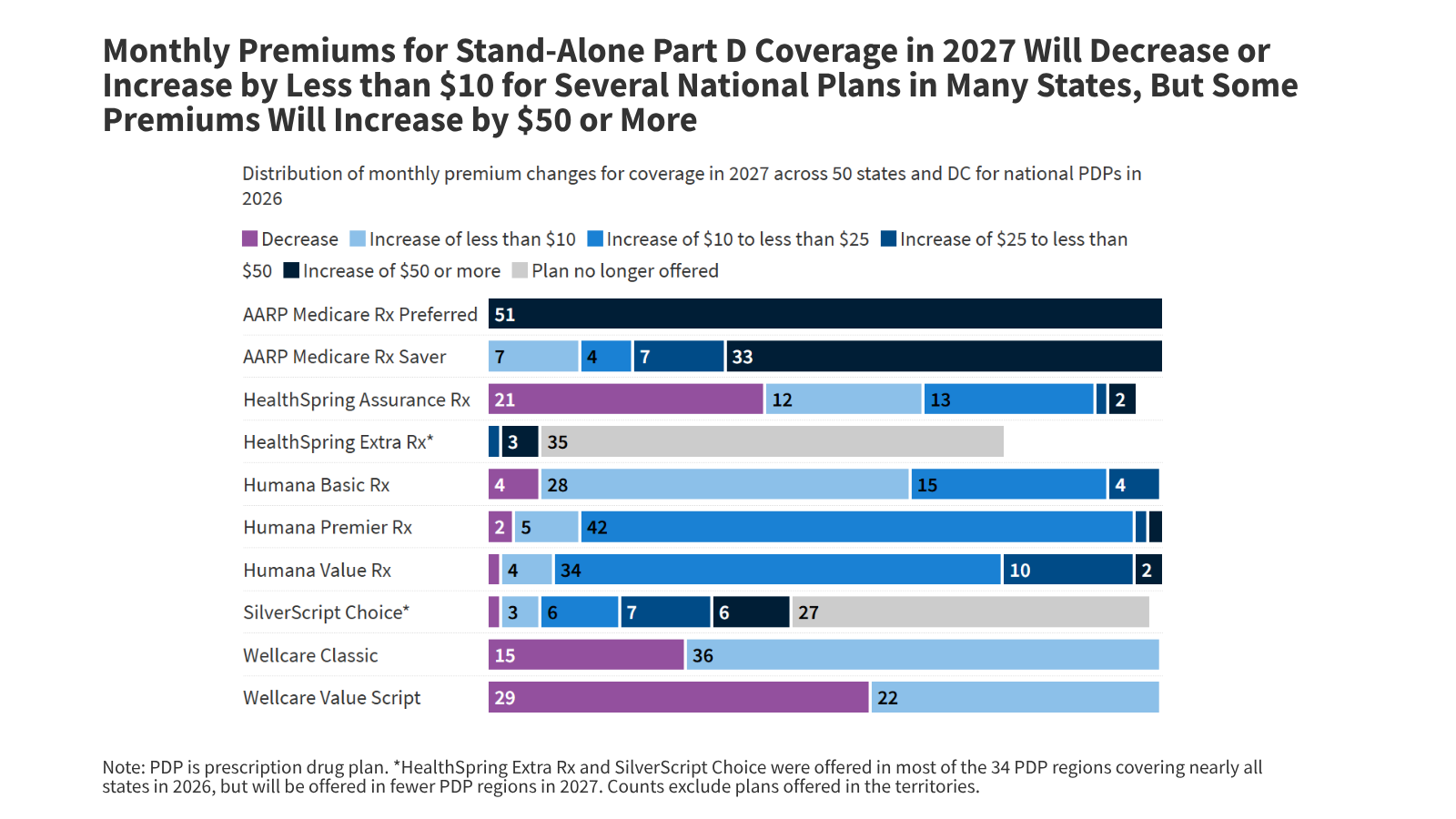

Also: Many Medicare Part D Stand-Alone Drug Plan Enrollees Will See Modest Premium Increases for 2027

Medicare Open Enrollment and Coverage Options: Key Questions and Answers

Each year, Medicare beneficiaries have an opportunity to make changes to how they receive their Medicare coverage during the nearly 8-week annual open enrollment period, which runs from October 15 through December 7. This brief answers key questions about the Medicare open enrollment period and Medicare coverage options.

NEW AND NOTEWORTHY

How Much Do People With Medicare Pay For Coverage?

This brief provides an overview of the costs faced by Medicare beneficiaries in traditional Medicare, Medicare Advantage, and Medicare Part D, including premiums, deductibles, copays, and coinsurance, focusing on costs in 2026.

What’s in a Name? From Today’s Medicare to Medicare for All

KFF’s Larry Levitt explains how proposals to create Medicare-for-All promise more generous benefits than the existing Medicare program, with no premiums or cost-sharing, but could end up looking more like Medicare if it became the subject of a serious national debate about the tradeoffs involved to implement it.

Medigap

Medigap Guaranteed Issue Requirements: An Overview of Federal and State Rules

This issue brief analyzes federal and state rules related to guaranteed issue requirements for Medigap policies and how they impact beneficiaries’ access to Medigap, including the implications for Medicare beneficiaries with pre-existing medical conditions and those under age 65 with long-term disabilities.

Data Visualization

The Facts About Medicare Spending

This interactive provides the facts on Medicare spending. Medicare, which serves 67 million people and accounts for 12 percent of the federal budget and 21 percent of national health spending, is often the focus of discussions about health expenditures, health care affordability and the sustainability of federal health programs. Explore data on enrollment growth, Medicare spending trends overall and per person, growth in Medicare spending relative to private insurance, spending on benefits and Medicare Advantage, Part A trust fund solvency challenges, and growth in out-of-pocket spending by beneficiaries.

Read More

Stay informed.

Stay informed.

Filter

141-150 of 1,627 results

  • BTD Health Policy in 2026

    Health Policy in 2026

    From Drew Altman

    In a new column, President and CEO Dr. Drew Altman forecasts eight things to look for in health policy in 2026. “First and foremost,” he writes, “is the role health care affordability will play in the midterms.” And, he notes: “The average cost of a family policy for employers could approach $30,000 and cost sharing and deductibles will rise again after plateauing for several years.”

  • While Republicans in Congress have largely opposed the IRA and Medicare drug price negotiation, President Trump appears to be embracing it. With this latest announcement, the Trump administration can take credit for delivering lower drug prices in Medicare, while Democrats can take credit for creating the Medicare drug price negotiation program in the first place.

    Understanding the Trump Administration’s Negotiated Drug Prices for Medicare

    Quick Insights

    While Republicans in Congress have largely opposed the IRA and Medicare drug price negotiation, President Trump appears to be embracing it. With this latest announcement, the Trump administration can take credit for delivering lower drug prices in Medicare, while Democrats can take credit for creating the Medicare drug price negotiation program in the first place.

  • Medicare Advantage Glossary

    Feature

    This glossary serves as a guide to the sometimes arcane terms that inhabit the world of Medicare Advantage, the private plan alternative to traditional Medicare.

  • Chart Reviews Increase Payments to Medicare Advantage Insurers for 1 in 6 Enrollees

    Issue Brief

    Using Medicare Advantage encounter data, this analysis finds that 62% of Medicare Advantage enrollees have at least one chart review record and that diagnoses added from chart reviews increase payments from CMS to insurers for 17% of enrollees. The use of chart reviews varies across the largest Medicare Advantage insurers.

  • Why We Are Stuck with Prior Authorization Review

    Why We Are Stuck with Prior Authorization Review

    From Drew Altman

    Prior authorization review frustrates patients and physicians, but we likely can’t just eliminate it. In his new column, President and CEO Dr. Drew Altman discusses why, and why the focus is now instead on “doing it smarter.” Altman writes: “A proposal to eliminate prior authorization altogether could be the single most tangible and popular health reform idea a candidate could make. But, in our fragmented health system, with no great way to control costs or…