
More Than 4 Million Medicare Beneficiaries Will Have Their Medicare Advantage or Stand-Alone Prescription Drug Plan Terminated at the End of 2026
The market for private Medicare plans, including Medicare Advantage and Part D stand-alone prescription drug plans, is dynamic, with plan offerings changing every year. Leading up to the Medicare annual open enrollment period, which began on October 15th, some insurers announced that they would be reducing the Medicare Advantage plans offered for coverage in 2027. There was also uncertainty about premiums and plan availability in the stand-alone prescription drug plan (PDP) market for 2027 following the Trump administration’s decision to end the Part D Premium Stabilization Demonstration one year early. Using plan data from the Centers for Medicare & Medicaid Services (CMS), we find that 4.3 million Medicare beneficiaries, including 3.1 million Medicare Advantage drug plan enrollees and 1.2 million PDP enrollees, will have their plan terminated at the end of 2026.
Private insurers will terminate the Medicare Advantage prescription drug plans (MA-PDs) of about 3.1 million people on December 31. Most affected beneficiaries – 2.8 million – are in MA-PDs available for general enrollment, while about 300,000 are in Medicare Advantage special needs plan (SNPs), which restrict enrollment to people who are dually eligible for Medicare and Medicaid or who have specific health needs (Figure 1).
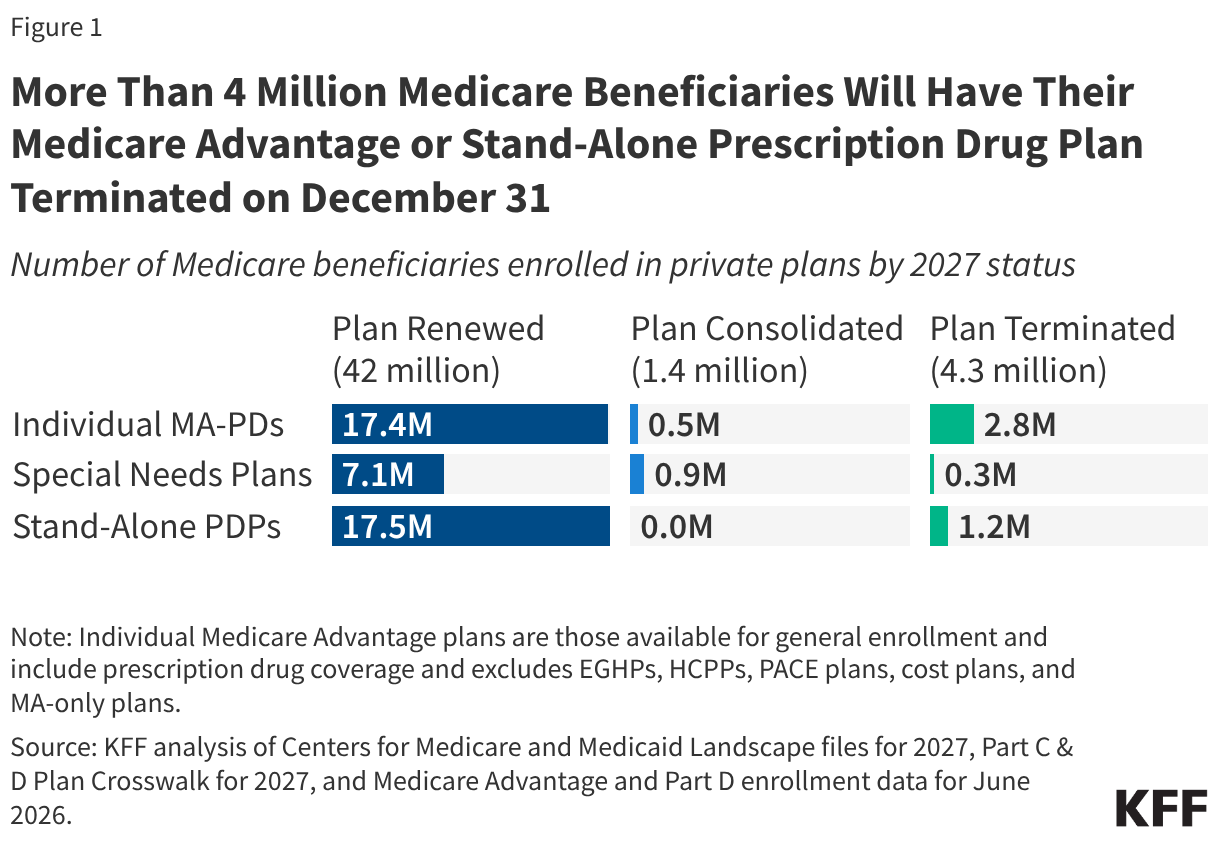
MA-PD enrollees in plans that are being terminated must proactively enroll in another Medicare Advantage plan if one is available in their area or they will be switched automatically to traditional Medicare. The 2.8 million individual MA-PD enrollees in terminating plans translates to 14% of all enrollees in MA-PDs available for general enrollment, similar to the share affected by terminations for 2026 (13%), but substantially larger than in the previous year. Among enrollees in SNPs, about 4% will be affected by a plan termination for 2027. KFF has not examined terminations among SNP enrollees in previous years.
Four parent organizations are terminating plans that account for 50% of enrollees who are losing their individual MA-PD plan. Those parent organizations are Humana, Inc. (19% or 530,000 enrollees), UnitedHealth Group (13% or 367,000 enrollees), CVS Health Corporation (9% or 254,000 enrollees), and Aware Integrated, Inc., which sold Blue Cross branded plans in Minnesota (9% or 249,000 enrollees).
People who have their Medicare Advantage coverage terminated will qualify for a special enrollment period for Medigap with guaranteed issue rights, meaning they cannot be denied a Medigap policy or charged more due to a pre-existing condition. Medigap is supplemental coverage that helps beneficiaries pay out-of-pocket costs not covered by traditional Medicare.
About 1.2 million PDP enrollees are in plans that will also be terminated at the end of this year (Figure 1). That translates to 6% of enrollees in PDPs, double the share impacted last year (3%). Most of these enrollees – 81% or 950,000 – are in the SilverScript Choice PDP sponsored by CVS Health that is being terminated in 13 PDP regions for 2027. Another 190,000 enrollees (16%) are in HealthSpring Extra Rx, sponsored by Health Care Service Corporation, which is being terminated in 16 regions. For the remaining 3% of enrollees in terminated PDPs, about 14,000 are in BlueCross Rx Value in South Carolina, while 7,000 are in Blue Rx PDP Complete and 7,000 in Blue Rx PDP Plus, both in Pennsylvania and West Virginia.
These PDP terminations are reflected in a reduction in the number of PDPs available to the average Medicare beneficiary, down to 9 in 2027 from 11 in 2026. More concentrated enrollment in a smaller number of PDPs potentially exposes more PDP enrollees to annual enrollment disruptions as plan availability and premiums change from one year to the next. Enrollees in plans that are being terminated will need to select a new stand-alone PDP to supplement their traditional Medicare or switch to a MA-PD if they want to continue having prescription drug coverage under Medicare Part D.
About 1.4 million Medicare Advantage enrollees are in a plan that is consolidating with another plan offered by the same insurer. These enrollees, who will be moved automatically to the other Medicare Advantage plan, include 500,000 Medicare Advantage enrollees in plans available for general enrollment and about 900,000 enrollees in special needs plans (Figure 1).
Starting in January 2027, private insurers that offer a dual eligible special needs plan (D-SNP) and an affiliated Medicaid managed care plan in the same county may generally only offer one D-SNP for full-benefit dual-eligible individuals. As a result of this new requirement, private insurers have made a large number of changes to their D-SNP offerings for 2027.
Enrollees who are moved to another Medicare Advantage plan because of a consolidation can select a different Medicare Advantage plan during open enrollment (dual-eligible individuals are also permitted to switch plans at other times during the year under certain circumstances). They may also opt to switch to traditional Medicare but would not have federal guaranteed issue rights if they wanted to purchase a Medigap policy. The lack of federal guaranteed issue rights for Medigap is less consequential for dual-eligible individuals than for other Medicare beneficiaries, because state Medicaid programs cover Medicare premiums, and in many cases cost sharing, for dual-eligible individuals, so they generally do not need additional supplemental coverage.
The annual open enrollment period offers Medicare beneficiaries the opportunity to review their coverage options and make changes. Aside from Medicare beneficiaries who are affected by plan terminations, the millions of Medicare beneficiaries in private plans that will continue to be offered next year are also likely to see changes to costs, benefits, provider networks, or drug formularies, among other plan characteristics. For PDP enrollees, some who stay in their current plan could face sizeable premium increases in 2027, making it worthwhile to compare their plan options. With the average Medicare beneficiary having 28 MA-PDs and 9 PDPs to choose from, however, comparing coverage options remains a challenge.
Methods
The plans in this analysis include Medicare Advantage prescription drug (MA-PD) plans available for general enrollment and special needs plans, but exclude employer- and union sponsored plans, Medicare Advantage plans open for general enrollment without prescription drug coverage, cost plans, PACE plans, and HCPPs. The analysis also includes stand-alone prescription drug plans (PDPs) available to beneficiaries in traditional Medicare. The plan terminations included in this analysis capture county-level plan offerings that had at least 11 enrollees in June 2026 and are not available for enrollment for the 2027 plan year. Those include plans that were not renewed, as well as plans that reduced their service area to no longer serve a subset of counties (including consolidations that simultaneously reduced the service area). These are identified using the 2027 Part C and Part D plan crosswalk.
People enrolled in plans that are identified as a “renewal” plan in the 2027 Part C and D plan crosswalk but have a different plan ID for 2027 are not included in our count of people affected by terminations. People who are enrolled in a plan that is being consolidated with another plan are also not considered to be in “terminated” plans because they will continue to be covered by Medicare Advantage unless they proactively choose to switch to traditional Medicare. These enrollees also do not have a federal guaranteed issue right for Medigap.