
How Much Do People with Medicare Pay for Coverage?
The Medicare program provides health insurance coverage to over 70 million people ages 65 or older and younger adults with long-term disabilities. While Medicare covers a wide range of health care services, Medicare beneficiaries generally pay out-of-pocket for their monthly premiums, deductibles, and cost sharing for Medicare covered services. Medicare premiums and other cost-sharing requirements have increased steadily in recent years and are projected to continue growing over the next decade. At the same time, many Medicare beneficiaries have modest incomes which can make it difficult to afford these costs: one in four Medicare beneficiaries lived on incomes below $24,600 per person in 2024, and out-of-pocket spending on Medicare premiums and cost-sharing expenses accounted for more than a third (36%) of the average Medicare beneficiary’s Social Security income in 2023.
Out-of-pocket costs may also vary depending on the choices Medicare beneficiaries make about their coverage. People with Medicare can choose to receive their benefits through traditional Medicare or through a privately administered Medicare Advantage plan. Beneficiaries in traditional Medicare can sign up for prescription drug coverage through a stand-alone Part D plan, and may also purchase a Medicare supplemental insurance policy, known as Medigap, to assist with Medicare cost sharing. Medicare Advantage plans typically include prescription drug coverage, as well as limits on how much enrollees pay out of pocket each year for Medicare covered services (in contrast to traditional Medicare, which has no limit on out-of-pocket costs), but most plans also require enrollees to use a specified network of providers or charge higher cost sharing for services from out-of-network providers. Each of these Medicare coverage options comes with different premium and cost-sharing requirements, as well as considerable variation from plan to plan. Overall, navigating these options and expenses can be complex, and the costs can be substantial, particularly for beneficiaries with high health care needs.
This brief provides an overview of the costs faced by Medicare beneficiaries in traditional Medicare, Medicare Advantage, and Medicare Part D, including premiums, deductibles, copays, and coinsurance, focusing on costs in 2026. (The brief will be updated with cost information for 2027 when available.)
Premiums for Medicare Part A and Part B
Part A Premium: $0 per month for most Medicare beneficiaries
Part B Premium: $202.90 per month (standard); income-related adjustments apply for people with higher incomes
Part A Premiums
Most Medicare beneficiaries, whether they are covered under traditional Medicare or Medicare Advantage, pay no monthly premium for Medicare Part A, which covers inpatient hospital stays, short-term nursing facility care, hospice, and some home health services. People generally qualify for premium-free Part A if they or a spouse have worked at least 40 quarters (10 years) in jobs where they paid Medicare payroll taxes. People who are otherwise eligible for Medicare but do not meet this requirement may still enroll in Part A but are required to pay a monthly premium. In 2026, the Part A premium is $311 per month (or $3,732 for the year) for beneficiaries with more than 30 quarters but less than 40 quarters of covered employment and $565 per month (or $6,780 for the year) for beneficiaries with fewer than 30 quarters of covered employment.
Late enrollment penalty. If a Medicare-eligible person is required to pay a Part A premium but delays enrollment beyond their initial enrollment period and lacks qualifying group coverage in the interim, they are subject to a late enrollment penalty in the form of a 10% increase to their monthly Part A premium when they enroll in Part A. The Part A late enrollment penalty applies for twice the number of years enrollment was delayed. For example, if a person with 30 quarters of covered employment was initially eligible to enroll in Part A in January 2023, but delayed enrollment for two years until January 2025, they would incur late enrollment penalties until 2029 and would pay $342.10 per month for Part A coverage in 2026 (based on $311 times 10%).
Part B Premiums
Beneficiaries are required to pay a monthly premium for Part B coverage, whether they are covered under traditional Medicare or Medicare Advantage. Part B covers physician visits, outpatient hospital services, preventive services, diagnostic tests, and physician-administered drugs. In 2026, the standard Part B premium is $202.90 per month (or $2,434.80 for the year). Beneficiaries with incomes greater than $109,000 for individuals or $218,000 for married couples in 2026 pay a higher, income-adjusted Part B premium ranging from $284.10 to $689.90 per person per month in 2026 (Figure 1). Beneficiaries with low incomes and modest assets may qualify for help from their state Medicaid program to pay their Medicare Part B premium.
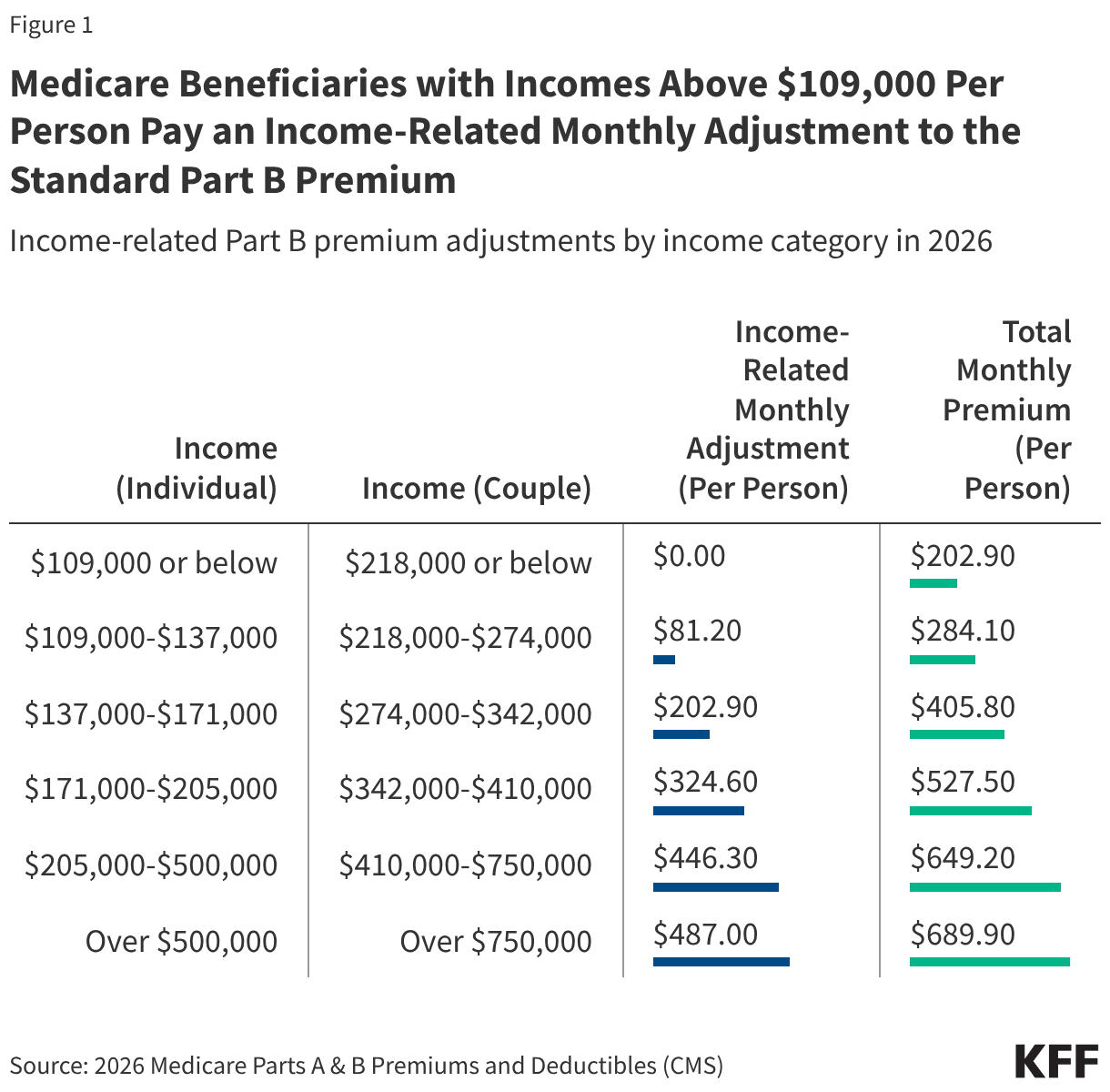
Late enrollment penalty. As with Part A, Medicare-eligible people who delay enrolling in Part B beyond their initial enrollment period and who lack other qualifying group coverage in the interim are subject to a late enrollment penalty when they enroll in Part B. The Part B late enrollment penalty is a lifetime penalty and is calculated as 10% of the monthly standard Part B premium for each 12-month period enrollment was delayed. For example, someone who delayed enrollment in Part B for two years would face a 20% monthly Part B premium penalty and would pay $243.48 per month in 2026 (based on $202.90 times 20%).
Cost-Sharing Requirements in Traditional Medicare
Part A:
- Deductible: $1,736 per inpatient hospital benefit period
- Cost sharing: Daily copayments after day 60 for inpatient hospital care (out of a maximum of 150 covered days); daily copayments after day 20 for skilled nursing facility care (out of a maximum of 100 covered days)
Part B:
- Deductible: $283 annual
- Cost sharing: 20% coinsurance for most Part B-covered services
Cost Sharing for Part A Services
Inpatient hospital services covered under Medicare Part A are subject to a deductible of $1,736 in 2026, which applies per benefit period rather than per year, meaning that some beneficiaries may pay the deductible more than once if they are hospitalized multiple times in a year. Cost sharing only applies after the first 60 days of a hospital stay, at a rate of $434 per day for days 61-90 and $868 for each additional day afterwards in 2026 (up to a lifetime cap of 60 additional days).
For a stay in a skilled nursing facility following a qualifying hospitalization, beneficiaries pay no cost sharing for the first 20 days and $217 per day for days 21-100 in 2026. Medicare covers a maximum of 100 days of skilled nursing facility care per benefit period, after which point beneficiaries are responsible for the full cost of any additional days. Other Part A services, such as hospice care or home health services, are covered with no deductible and no cost sharing (with the exception of certain services, such as pain management medications and respite care, for which modest cost sharing may apply).
Cost Sharing for Part B Services
Services covered under Medicare Part B, such as doctor visits, outpatient hospital services, diagnostic tests and imaging, mental health and substance use disorder services, and durable medical equipment (e.g., prosthetics or mobility devices) are generally subject to an annual deductible of $283 in 2026 and a coinsurance rate of 20%. Many preventive services, such as annual wellness visits, flu shots and certain other vaccines, mammograms, and prostate cancer screenings are covered with no deductible or coinsurance.
Traditional Medicare has No Out-of-Pocket Limit
Traditional Medicare does not include an annual limit on how much beneficiaries pay out-of-pocket for Part A and Part B services. For this reason, many beneficiaries choose to purchase a Medigap policy, which helps cover Part A and B cost-sharing requirements in traditional Medicare, offering beneficiaries protection against unforeseen or catastrophic out-of-pocket expenses. Beneficiaries who choose to purchase a Medigap policy must pay a separate monthly premium to their Medigap insurer (in addition to the Part B premium). The average premium among current Medigap policyholders was $217 per month in 2023 (or $2,604 for the year), though Medigap premiums may rise with age and other factors, with considerable variation by state and policy type.
In addition to Medigap, some beneficiaries have access to other types of supplemental coverage, such as employer- or union-sponsored coverage or Medicaid coverage, which may also assist with out-of-pocket expenses, as well as coverage of services not included in traditional Medicare. Beneficiaries with low incomes and modest assets who do not qualify for full Medicaid coverage may still qualify for help from their state Medicaid program to cover Medicare Part A and Part B deductibles and cost-sharing requirements (as well as premium costs, as noted above).
Costs Under Medicare Advantage
Plan Premium: Varies by plan; 75% pay no additional premium
Deductible: Varies by plan; many plans do not include a deductible
Cost Sharing: Varies by plan, subject to a maximum out-of-pocket cap of $9,250 for in-network services or $13,900 for all covered services
Medicare Advantage plans are private health plans that contract with Medicare to provide Part A and Part B benefits, and serve as an alternative to traditional Medicare. Most Medicare Advantage plans also include prescription drug coverage and offer supplemental benefits not covered in traditional Medicare, such as dental, vision, and hearing services. Medicare Advantage plans often have lower cost-sharing requirements for many services than what beneficiaries would face in traditional Medicare. At the same time, Medicare Advantage plans frequently use provider networks, prior authorization, and referral requirements to manage enrollees’ use of services, in contrast to traditional Medicare where these types of restrictions are rarely used.
Premiums
People in Medicare Advantage plans are required to pay the standard monthly Part B premium, plus the income-related surcharge as applicable, and the Part A premium if they do not qualify for premium-free Part A, as well as any additional premium charged by their Medicare Advantage plan. However, most Medicare Advantage enrollees are in plans with no additional plan premium. Among Medicare Advantage plans that include prescription drug coverage (known as MA-PDs) available for individual enrollment, the average enrollment-weighted premium is $15 per month in 2026. This amount is heavily weighted by zero-premium plans, as three-quarters (75%) of all MA-PD enrollees are in plans that charge no monthly premium.
Some Medicare Advantage plans use rebate dollars from Medicare payments to buy down a portion of the monthly Part B premium for their enrollees. In 2026, roughly one third (31%) of all MA-PD enrollees are in plans that reduce the Part B premium, most often by less than $10 per month.
Cost Sharing for Part A and Part B Services
Medicare Advantage plans are required to cover all services covered under Medicare Parts A and B. Overall cost sharing in Medicare Advantage cannot exceed what would be paid across Part A and Part B services in traditional Medicare, though specific cost-sharing requirements vary across plans and may be higher or lower for a given service, with some exceptions. Cost-sharing requirements may also vary depending on whether or not a given provider or health care facility is included in the plan’s network. Preferred provider organizations (PPOs) generally offer coverage of out-of-network services but may require higher cost sharing than would be required for in-network services, while health maintenance organizations (HMOs) do not include any coverage of out-of-network services.
Among an illustrative sample of six high-enrollment Medicare Advantage plans available in 2026, representing five of the largest insurers in six different states across the country, none of the six plans required an additional premium or a deductible for medical services covered under Medicare Part A and Part B, but plan costs for Part A and Part B services varied widely (Figure 2).
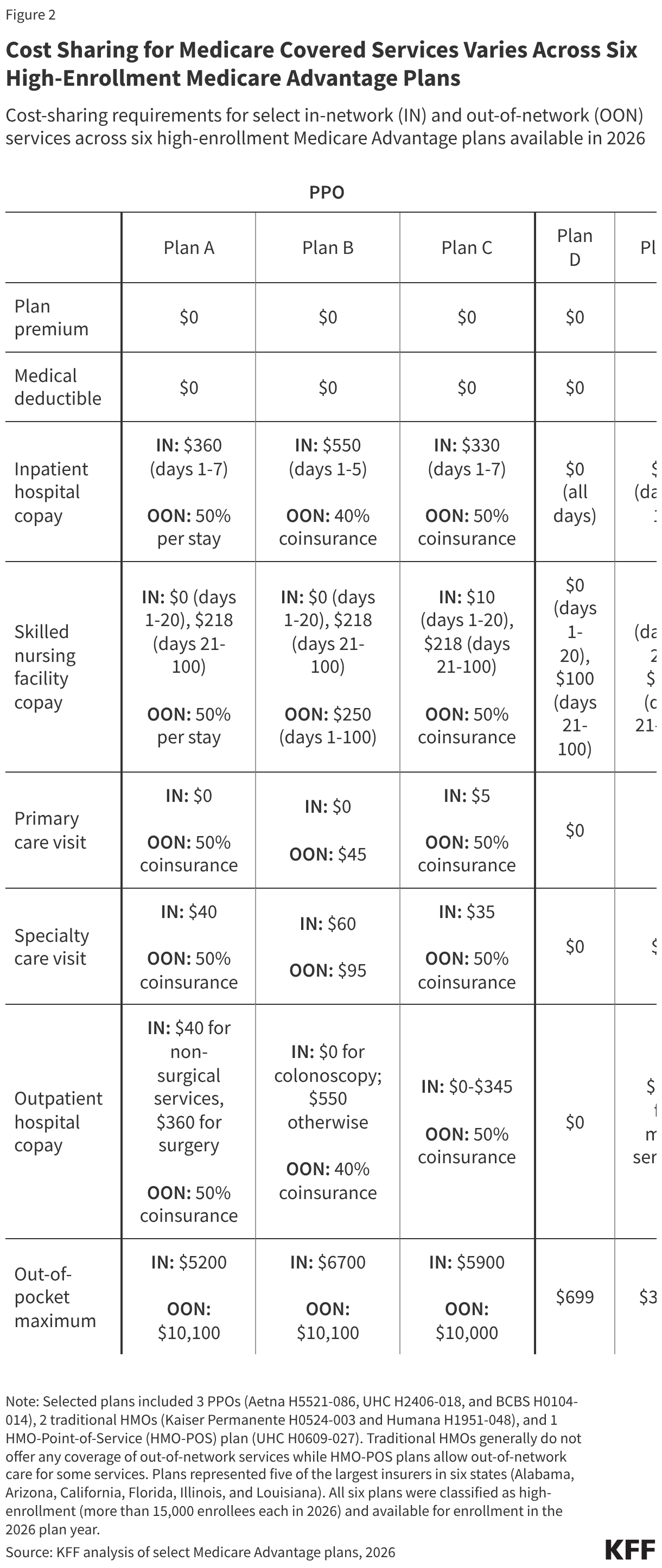
- Inpatient hospitalization: Among the three PPOs examined, daily copays for inpatient services at in-network facilities ranged from $330 per day for days 1-7 to $550 per day for days 1-5, after which no additional cost sharing was required, while coinsurance for inpatient services at out-of-network facilities ranged from 40% to 50% for all covered days. Among the three HMOs examined, daily copays for inpatient services ranged from $0 for all days to $275 for days 1-8, after which no additional cost sharing was required.
- Primary care visits: Among the three PPOs examined, copays for primary care visits ranged from $0 to $5 for in-network providers and from $45 to a 50% coinsurance fee for out-of-network providers. None of the three HMOs examined charged a copay for primary care visits.
- Specialty care visits: Among the three PPOs examined, copays for specialty care visits ranged from $35 to $60 for in-network providers and from $95 to a 50% coinsurance for out-of-network providers. Among the three HMOs examined, copays for specialty care visits ranged from $0 to $30.
- Outpatient hospital services: Among the three PPOs examined, copays for outpatient services at in-network facilities ranged from $0 for select services (such as colonoscopies) to $550 for most covered services, while coinsurance for outpatient services at out-of-network facilities ranged from 40% to 50%. Among the three HMOs examined, copays for outpatient services ranged from $0 to $275 for most services.
Out-of-Pocket Limits are Required in Medicare Advantage
Medicare Advantage plans are required to include a limit on enrollees’ out-of-pocket spending. In 2026, this limit may not exceed $9,250 for in-network services or $13,900 for all covered services, though plans may choose to offer limits below these amounts. The average out-of-pocket limit among Medicare Advantage enrollees in 2026 is $5,421 for in-network services (across HMOs and PPOs) and $9,825 for in- and out-of-network services combined (among PPOs, as HMOs do not include coverage of out-of-network services). Just over one in ten (13%) Medicare Advantage enrollees are in plans with limits of $3,000 or less for in-network services, while one in five (19%) are in plans with limits greater than $7,000. Among PPO enrollees, roughly, one in ten (9%) are in plans with limits of $6,000 or less for in-network and out-of-network services combined, while one in four (25%) are in plans with limits greater than $12,000. Out-of-pocket limits apply to Part A and Part B services only, though out-of-pocket spending for Part D drugs is subject to a separate limit (as discussed below).
Out-of-pocket limits varied among the six illustrative plans described above. Among the three PPOs examined, out-of-pocket limits ranged from $5,200 to $6,700 for in-network services and from $10,000 to $10,100 for in-network and out-of-network services combined. Among the three HMOs examined, out-of-pocket limits ranged from $699 to $3,850 for covered services.
Non-Medicare Covered Services
Most Medicare Advantage plans include some coverage of services not covered in traditional Medicare, such as dental care, glasses and eye exams, and hearing exams or hearing aids. The scope of coverage for these benefits varies widely between plans, with some limited to coverage of basic preventive services (e.g., dental cleanings) while others offer a broader range of covered services (e.g., root canals or dentures). Cost sharing for these benefits also varies between plans, and coverage may be subject to network restrictions, limits on the number of services covered per year, or annual dollar caps on the amount the plan will pay towards covered services.
Costs for Part D Prescription Drug Coverage
Premium: Varies by plan; income-related adjustments apply for people with higher incomes
Deductible: $615 (standard); plans can lower or eliminate the deductible
Cost Sharing: Varies by plan, subject to an annual out-of-pocket cap of $2,100
Medicare Part D is a voluntary outpatient prescription drug benefit for people with Medicare provided through private plans that contract with the federal government. Beneficiaries can choose to enroll in either a stand-alone prescription drug plan (PDP) to supplement traditional Medicare or a Medicare Advantage drug plan (MA-PD) that includes drug coverage and all other Medicare-covered benefits. Monthly premiums, deductibles, cost-sharing requirements for covered drugs, pharmacy networks, and formularies (the list of drugs covered by a plan) all vary across Part D plans.
Part D Premiums
Many, though not all, Part D enrollees pay a monthly premium for Part D coverage, with premiums varying by plan. In 2026, the average Part D premium among stand-alone PDPs is $36 per month. For MA-PD enrollees, the Part D premium is included as a portion of their Medicare Advantage plan premium. In 2026, the Part D portion of the average MA-PD premium is $8 per month, but 75% of Medicare Advantage enrollees in individual plans pay no premium for Part D coverage (because the Medicare Advantage insurer uses payments from the federal government to buy down these costs).
As with the Part B premium, beneficiaries with incomes greater than $109,000 for individuals or $218,000 for married couples in 2026 pay a higher, income-adjusted Part D premium, with monthly adjustment amounts ranging from $14.50 to $91.00 added to their individual Part D plan’s premium. Beneficiaries with low incomes and modest assets can qualify for financial assistance through the Part D Low-Income Subsidy (LIS). People who qualify for the LIS program pay modest copayments for prescription drugs, no drug deductible, and no premium for drug coverage if they are enrolled in premium-free “benchmark” plans.
Late enrollment penalty. Beneficiaries who go without Part D coverage for 63 days or more at any point after their initial enrollment period and lack other qualifying drug coverage in the interim are subject to a late enrollment penalty. The Part D late enrollment penalty is a lifetime penalty equal to 1% of the Part D base beneficiary premium ($38.99 in 2026) for each month of delayed coverage. For example, someone who went without Part D or equivalent coverage for eighteen months would face an 18% monthly Part D premium penalty and would pay $7 per month in 2026 in addition to any premium charged by their Part D plan (based on $38.99 times 18%).
Cost Sharing
The standard Part D deductible is $615 in 2026, but Part D plans can offer an enhanced benefit with a lower or no deductible. In 2026, MA-PD enrollees face an average Part D deductible of $371, while PDP enrollees face an average deductible of $544. Part D plans typically charge different amounts for covered drugs, with lower cost-sharing amounts charged for generic drugs and preferred brands and higher cost-sharing amounts for non-preferred and specialty drugs. Cost sharing typically consists of a mixture of flat dollar copays and coinsurance (based on a percentage of the drug’s list price). Part D plans can also designate certain pharmacies where enrollees will face lower (“preferred”) cost-sharing requirements.
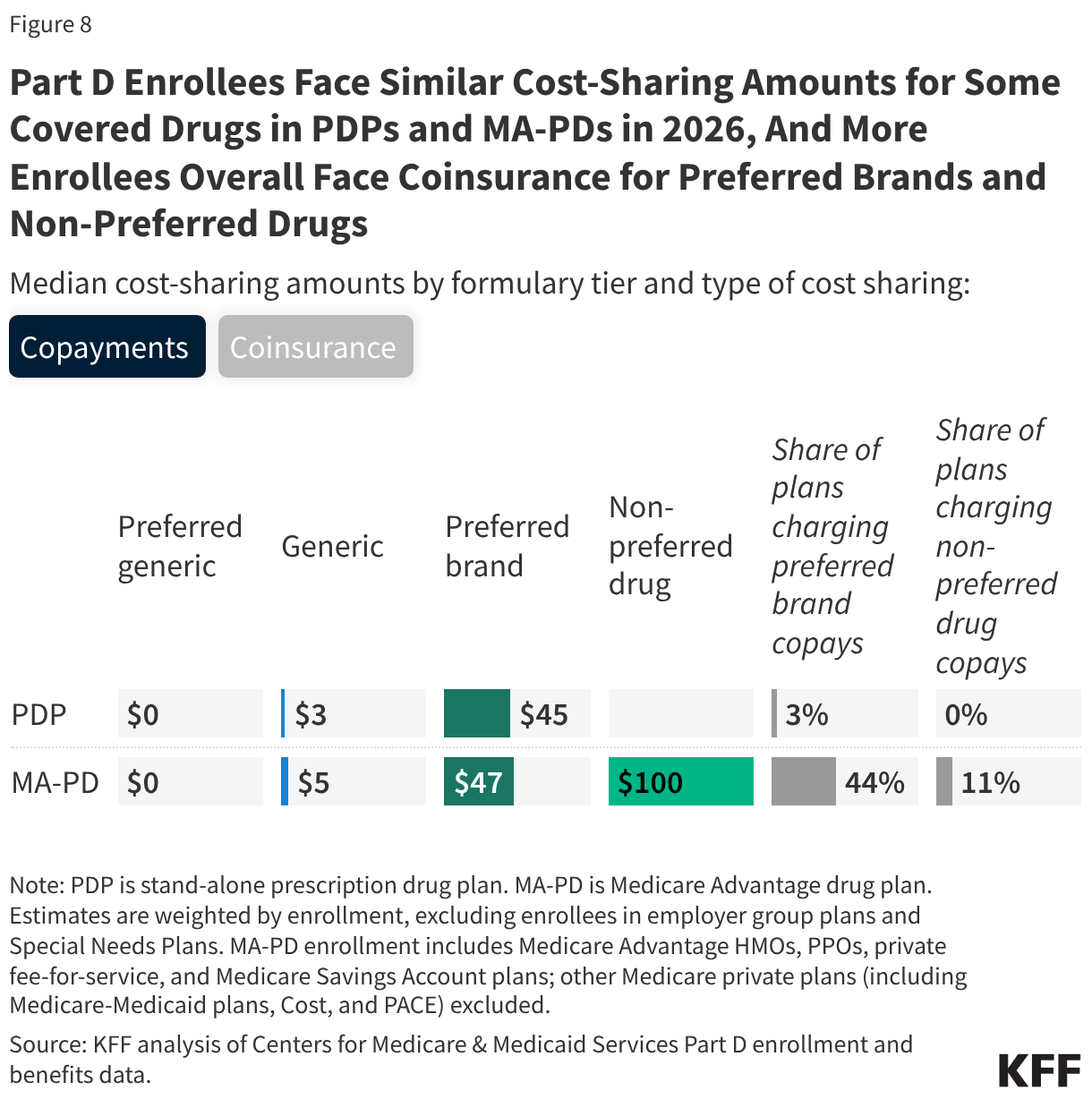
In 2026, the median copay for generic drugs is $3 among PDPs and $5 among MA-PDs. For preferred brand drugs, the median copay is $45 among PDPs and $47 among MA-PDs. Virtually all PDP enrollees pay coinsurance for non-preferred drugs (with a median rate of 34%), while MA-PDs may charge either coinsurance (with a median rate of 38%) or a flat dollar copay (with a median of $100). The median coinsurance rate for specialty drugs is 25% among PDPs and 28% among MA-PDs (Figure 3).
An Out-of-Pocket Limit Applies Under Part D
Out-of-pocket costs for Part D enrollees are capped at $2,100 in 2026. Once this out-of-pocket limit is reached, enrollees pay no additional costs for the remainder of the year for drugs covered by their Part D plan. Part D enrollees in plans that offer enhanced benefits could pay less than $2,100 out of pocket before they qualify for catastrophic coverage. Part D enrollees also have the option of spreading out their out-of-pocket costs over a calendar year to lower their monthly costs.