
Nearly Three-Quarters of Medicare Advantage Enrollees Could be Denied a Medigap Policy Due to a Pre-Existing Condition
People with Medicare can choose to receive their Medicare benefits through either traditional Medicare or Medicare Advantage, and this choice poses tradeoffs. In traditional Medicare, beneficiaries may see any doctor or hospital that accepts Medicare, generally without needing a referral or prior authorization. However, traditional Medicare includes relatively high cost sharing and there is no cap on out-of-pocket spending, potentially exposing beneficiaries to very high costs. Most people who enroll in traditional Medicare have an additional source of coverage to help with these costs, including employer coverage, Medicaid, or Medigap. Alternatively, in Medicare Advantage, beneficiaries have an out-of-pocket cap and often reduced cost sharing, but may face more limited provider networks and greater use of prior authorization. Beneficiaries may prefer to switch between sources of coverage as their medical needs and financial circumstances change over time.
Medigap, which is supplemental insurance sold by private companies, is the most common source of supplemental coverage for people in traditional Medicare. Medigap helps cover Medicare Part A and B cost-sharing requirements, including deductibles, copayments, and coinsurance, with monthly premiums averaging $244 in 2025 among current Medigap policyholders. Federal law provides a one-time, six-month Medigap open enrollment period when beneficiaries age 65 and older first enroll in Part B, during which insurers cannot deny someone a policy or charge them higher premiums due to their to medical history. Additionally, some states provide additional guaranteed issue opportunities for beneficiaries to purchase Medigap without regard to their pre-existing medical conditions (see Box 1).
However, outside of this initial enrollment period and other specified circumstances, including a 12-month Medicare Advantage trial period for new enrollees, Medigap insurers are allowed to use medical underwriting when issuing Medigap policies and can charge higher premiums or deny coverage to applicants with pre-existing conditions. These limitations can make it more costly or even impossible for Medicare Advantage enrollees with pre-existing conditions to switch to traditional Medicare and buy a Medigap policy, constraining Medicare beneficiaries’ coverage choices.
This analysis examines the share of Medicare Advantage enrollees who have a pre-existing condition that could result in a Medigap denial if they seek to switch to traditional Medicare outside their one-time 12-month trial period, including national estimates and estimates by age and by state. The pre-existing conditions included in the analysis are based on a KFF review of Medigap applications, which list conditions subject to medical underwriting. The analysis uses Medicare Advantage encounter data for all Medicare Advantage enrollees, including those in individual plans available for general enrollment, employer plans, and special needs plans. This analysis includes dual-eligible individuals, who do not require Medigap as long as they have Medicaid coverage but would potentially be subject to underwriting for Medigap if they lose their Medicaid eligibility. This analysis also includes Medicare Advantage enrollees under age 65, who do not have federal guaranteed issue rights to purchase Medigap, but can take advantage of the initial Medigap open enrollment period when they turn 65 (see Methods for more detail).
Takeaways
- Nearly three-quarters of Medicare Advantage enrollees (74%) or 20.9 million people in 2023 had a pre-existing medical condition identified from KFF’s review of Medigap applications that could result in a denial for a Medigap policy.
- At least one in five Medicare Advantage enrollees have a diagnosis for peripheral vascular disease (25%), chronic kidney disease (24%), coronary artery disease (21%), or diabetes with related complications (21%) documented in the Medicare Advantage encounter data, all of which could trigger a Medigap denial.
- The share of Medicare Advantage enrollees who have a deniable pre-existing condition rises with age among people 65 and older, with close to 9 in 10 enrollees 85 and older (88%) having a medical condition that could trigger a Medigap denial.
- The share of Medicare Advantage enrollees who have a pre-existing condition that could trigger a denial for Medigap varies by state, from a high of 82% in Florida to a low of 59% in Alaska.
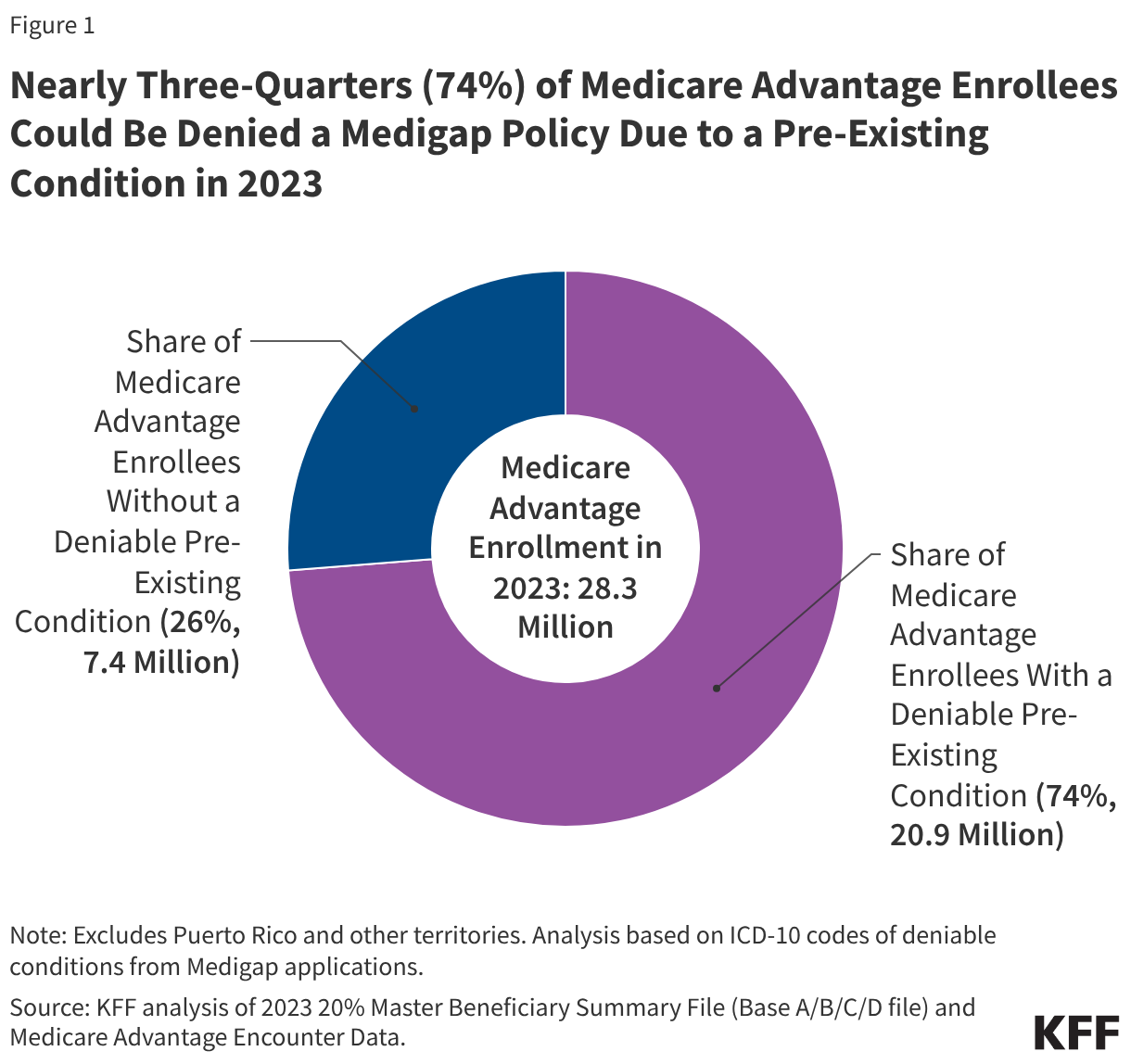
In 2023, 74% of Medicare Advantage enrollees had a pre-existing condition that could result in a denial for a Medigap policy.
Under federal law, insurance companies that sell Medigap policies may refuse to sell a policy to an applicant with certain medical conditions outside guaranteed issue periods. Many Medigap applications state that if an applicant answers “yes” to any health-related screening question, they are not eligible for coverage. This contrasts with other insurance products, like plans sold in the ACA Marketplace or Medicare Advantage, which are not permitted to deny coverage based on pre-existing conditions at any time.
KFF analysis of Medicare Advantage encounter data finds that nearly three-quarters (74%) of people enrolled in Medicare Advantage for the full year in 2023, or about 20.9 million people, had a condition that could trigger a denial for a Medigap policy (Figure 1). Conditions were selected if they appeared in the medical history questions on at least half of Medigap applications in KFF’s review, though this is not an exhaustive list of possible conditions or reasons that could result in a Medigap denial.
The share of Medicare Advantage enrollees who could be denied a Medigap policy may in fact be higher than 74%, because Medigap plans may deny applicants for other reasons that were not captured in this analysis but are commonly asked on Medigap applications, including recent medical service use (e.g., inpatient hospitalizations, use of home health services, or being treated in a nursing facility) or receiving medical advice, such as a recommendation to get further evaluation, diagnostic testing, treatment, or surgery for any condition, but has not yet been performed. However, some of these potential reasons for denial likely overlap with the conditions in this analysis. For example, the condition itself may have led to hospitalization or use of home health services.
Eliminating denials for pre-existing conditions would make Medigap, and by extension traditional Medicare, more accessible for people who want to switch from Medicare Advantage, but it would also increase Medigap premiums. The current one-time, six-month guaranteed issue period is intended to limit adverse selection: beneficiaries who do not buy a policy during this window risk not being able to purchase a Medigap policy later if they choose to wait until they incur health care costs. This incentivizes both healthier and sicker enrollees to join the Medigap risk pool, which holds down average premiums. Without this limit on guaranteed issue, people who initially enroll in Medicare Advantage but develop greater health needs later could more easily switch to Medicare, with its broader provider networks and less frequent use of prior authorization and purchase Medigap coverage.
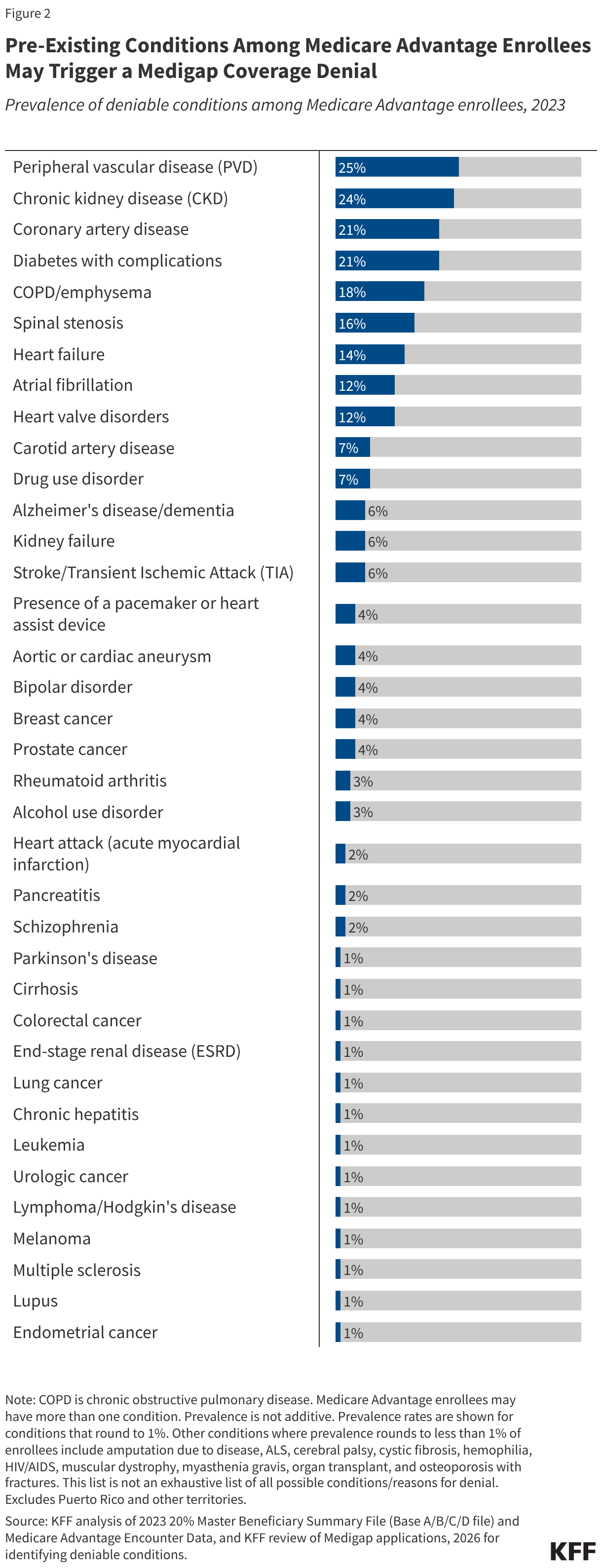
Potentially deniable conditions include several chronic conditions which are prevalent in more than one in five Medicare Advantage enrollees.
At least one in five Medicare Advantage enrollees have a diagnosis for peripheral vascular disease (25%), chronic kidney disease (24%), coronary artery disease (21%), or diabetes with related complications (21%) documented in the Medicare Advantage encounter data, all of which could trigger a Medigap denial. Other deniable conditions include Alzheimer’s disease and dementia, atrial fibrillation, chronic obstructive pulmonary disease (COPD) and emphysema, carotid artery disease, cancers such as breast and prostate, heart failure, heart valve disorders, multiple sclerosis, Parkinson’s disease, spinal stenosis, stroke, among others (Figure 2). Medicare Advantage enrollees may have multiple pre-existing conditions, but one is enough to potentially trigger a Medigap denial.
Because Medicare Advantage payment relies heavily on the diagnosis codes recorded for Medicare Advantage enrollees, there is a strong financial incentive for insurers to capture as many diagnosis codes for each enrollee as possible. Coding practices in Medicare Advantage, in particular higher coding intensity, may have the effect of making more Medicare Advantage enrollees ineligible for Medigap. This is because diagnoses may be recorded for a Medicare Advantage enrollee that might not have been documented in claims if that same beneficiary had been enrolled in traditional Medicare.
The share of Medicare Advantage enrollees who have a pre-existing condition that could trigger a denial for Medigap is higher for beneficiaries under 65 than for Medicare beneficiaries 65 to 74 and rises with age among people 65 and older.
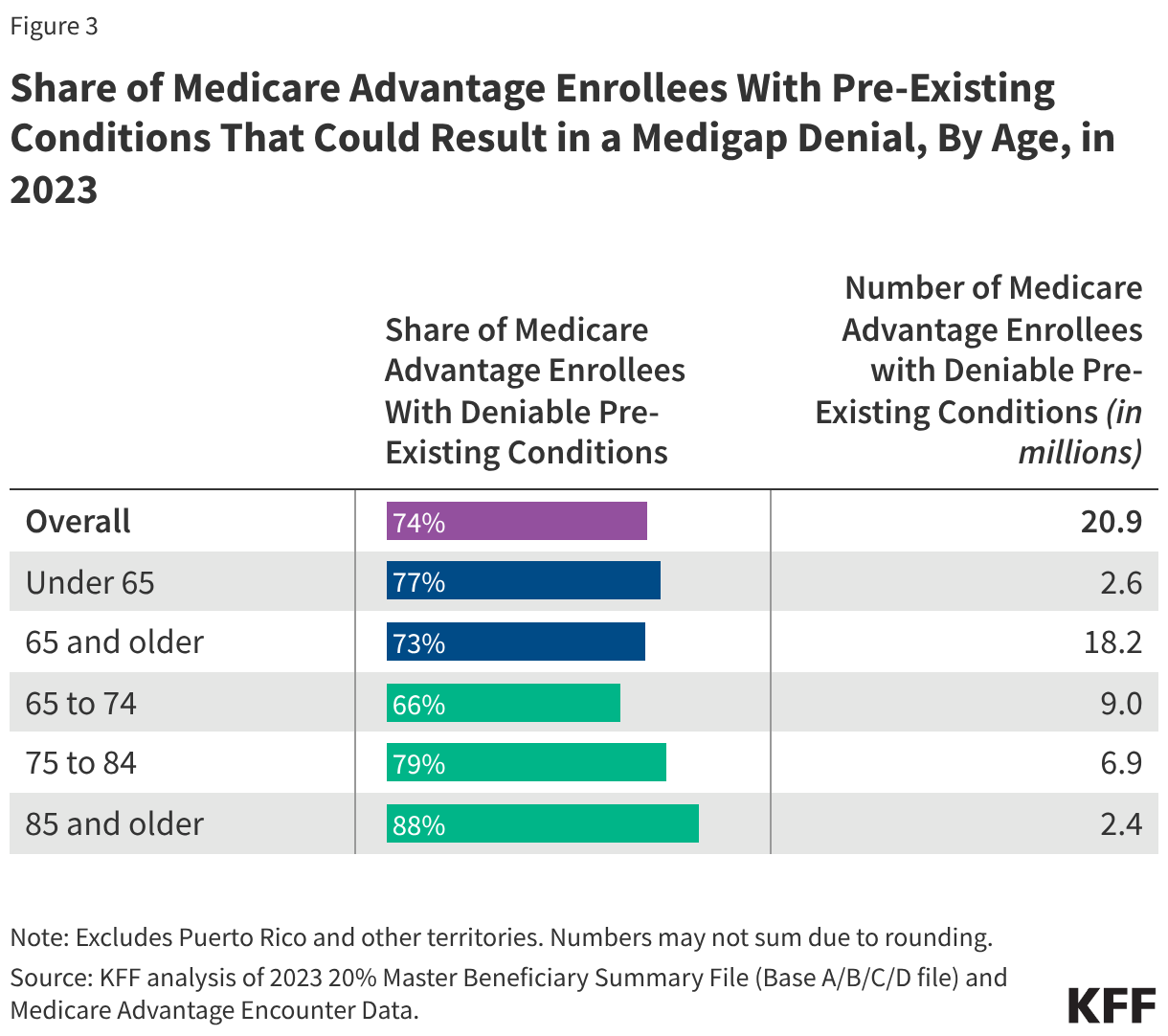
A larger share of beneficiaries under 65 has a deniable pre-existing condition than beneficiaries age 65 to 74 (77% vs. 66%), which may be related to the fact that their eligibility for Medicare is contingent on having a long-term disabling health condition (Figure 3). Beneficiaries under 65 qualify for Medicare after receiving Social Security Disability Benefits (SSDI) for at least two years. While many disabling conditions that qualify beneficiaries for SSDI are asked about on Medigap applications, there are also other disabling conditions that do not generally appear on Medigap applications used for this analysis, including many mental health conditions and intellectual and developmental disabilities.
Because the share of beneficiaries with pre-existing conditions increases by age among those 65 and older, rising to close to 9 in 10 among those age 85 and older (88%), older Medicare Advantage enrollees may have greater difficulty obtaining a Medigap policy at a time when the need for medical services may rise, in the event that they want to switch to traditional Medicare.
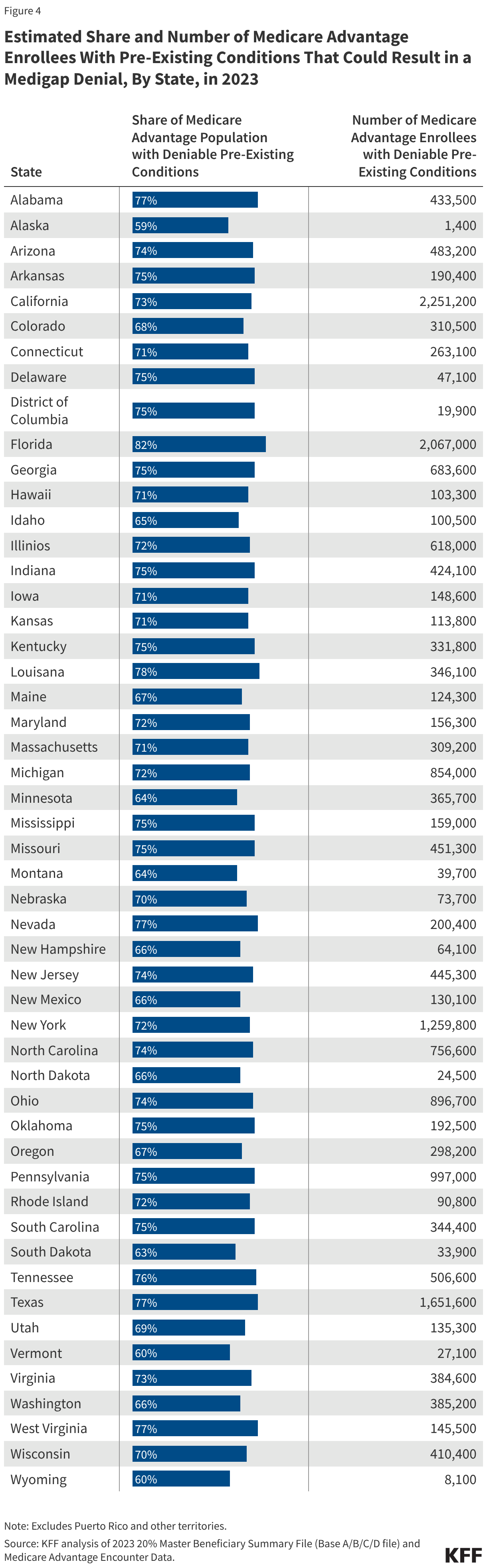
The share of Medicare Advantage enrollees who have a pre-existing condition that could trigger a denial for Medigap varies by state.
On the high end, 82% of Medicare Advantage enrollees in Florida and 78% of Medicare Advantage enrollees in Louisiana have pre-existing conditions that could result in a Medigap denial. On the low end, 59% of Medicare Advantage enrollees in Alaska and 60% of Medicare Advantage enrollees in Vermont and Wyoming have a pre-existing condition that could result in denial of a Medigap policy (Figure 4).
Some states provide additional guaranteed issue opportunities to purchase Medigap without regard to pre-existing conditions.
Even if Medicare Advantage enrollees have a pre-existing condition that might trigger a Medigap denial, some beneficiaries may still be able to purchase Medigap without being subject to underwriting, depending on the state where they live and other coverage they may have. For example, four states – Connecticut, Massachusetts, Maine, and New York – require insurers to offer Medigap policies on a continuous or annual basis to all beneficiaries ages 65 and older regardless of medical history. Additional considerations related to Medigap guaranteed issue opportunities are described in Box 1 and also described in detail in a separate KFF brief, Medigap Guaranteed Issue Requirements: An Overview of Federal and State Rules.
Box 1: Additional Guaranteed Issue Opportunities to Purchase Medigap
Beneficiaries with Medicaid: Medicare beneficiaries who are dual-eligible individuals, meaning they have both Medicare and Medicaid, have premium assistance, and in many cases cost-sharing protections, through Medicaid and typically do not need Medigap. However, under federal law, if dual-eligible individuals lose their Medicaid eligibility, they are not entitled to a guaranteed issue period to purchase Medigap, unless they had Medigap prior to becoming eligible for Medicaid and did not have Medicaid for more than two years. However, there are 13 states that offer guaranteed issue protections to purchase Medigap if individuals no longer qualify for Medicaid.
Beneficiaries with employer coverage: Medicare beneficiaries have a federal guaranteed issue right to purchase Medigap if their employer cancels their retiree coverage, but the federal right does not apply if their retiree benefits change or they voluntarily drop their retiree coverage. However, there are 29 states where Medicare beneficiaries have guaranteed issue protections to purchase Medigap coverage if there are some changes to their retiree coverage, such as a reduction in benefits, or if they leave their retiree plan voluntarily.
Beneficiaries under age 65: Federal law does not require Medigap insurers to sell policies to beneficiaries under 65 when they first become eligible for Medicare, and the Medicare Advantage trial period does not apply to this population. However, 38 states require insurers to issue at least one kind of Medigap policy to beneficiaries under age 65, though premiums vary across states. When people with Medicare who are under age 65 become age-eligible for Medicare at 65, they have the same time-limited federal guaranteed issue protections for Medigap as people age 65 and older, including the six-month Medigap open enrollment period, regardless of whether or not they had a Medigap policy when they were under age 65.
Methods
This analysis uses the Medicare Advantage encounter data and Master Beneficiary Summary File to identify Medicare Advantage enrollees who had a diagnosis for at least one condition that is regularly used in Medigap applications to screen out potential enrollees.
ICD-10 diagnosis codes were mapped to conditions mentioned on Medigap applications and the presence of which could result in a Medigap denial due to medical underwriting. We used the SERFF Filing Access portal to obtain Medigap applications available from the top six carriers by enrollment (UnitedHealthcare, Mutual of Omaha, Health Care Service Corporation (BCBS of Texas), CVS (Aetna), Elevance Health (Wellpoint), and Humana) based on states with the largest Medigap enrollment (CA, TX, and IL; FL has higher Medigap enrollment than IL but does not participate in SERFF). Some applications have different look-back periods of when an applicant is required to have a condition (e.g., last 2 years, last 5 years). For this analysis, we only looked for the presence of diagnoses in one year, 2023.
Conditions were selected if they appeared in the medical history questions on at least half of Medigap applications, though this is not an exhaustive list of possible conditions or reasons that could result in a Medigap denial. For example, many applications ask if an applicant has been diagnosed, treated, or had surgery for cancer. We used the CCW algorithm for common cancers (breast, prostate, colorectal, lung, endometrial, and urologic), but this is not a complete list of cancers that could result in a denial. Some applications were more explicit than others about whether having certain conditions would result in a Medigap denial and indicated that an applicant is not eligible for coverage if they answered “yes” to any health screening question. Other applications may require a medical release authorization or additional information on applicants’ health histories, including the medications they take to determine whether they qualify for coverage.
Medicare Advantage enrollees were included in the analysis if they had coverage under Medicare Parts A, B, and D and were enrolled in Medicare Advantage for all of 2023. Individuals living in territories, including Puerto Rico, were excluded. Individuals received a condition flag if a diagnosis code for one of the conditions appeared on at least one inpatient, outpatient, carrier, home health, or skilled nursing facility encounter record in 2023. Chart review records are excluded.
While this analysis is limited to Medicare Advantage enrollees, 3.5 million beneficiaries in traditional Medicare lacked supplemental coverage in 2023. Some of these beneficiaries may have missed their one-time Medigap open enrollment period or previously dropped Medigap coverage and could face denial based on pre-existing conditions if they later seek a policy. However, because the MBSF does not comprehensively identity supplemental coverage among traditional Medicare beneficiaries, we are unable to estimate how many of these 3.5 million have conditions that could result in a Medigap denial.
This work was supported in part by Arnold Ventures. KFF maintains full editorial control over all of its policy analysis, polling, and journalism activities.