Medicare

Medicare Open Enrollment

Part D Premiums and Cost Sharing in 2027

The average monthly premium for Medicare Part D coverage in stand-alone prescription drug plans (PDPs) will increase to $51 in 2027, up 50% from $34 in 2026, if current enrollees don’t switch into lower-premium plans during the open enrollment period. That is more than five times higher than the drug coverage premium in Medicare Advantage plans that offer Part D coverage, which is projected to average $9 per month in 2027. Most Part D enrollees also will face a deductible of several hundred dollars for drug coverage in 2027.
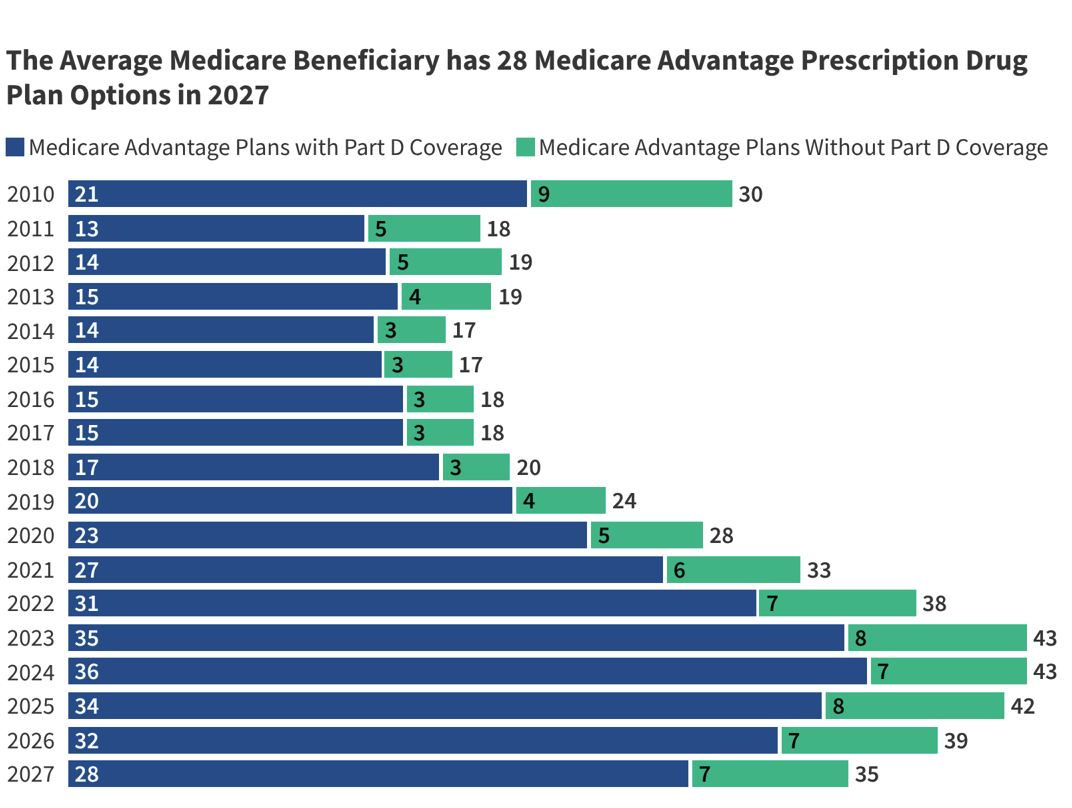
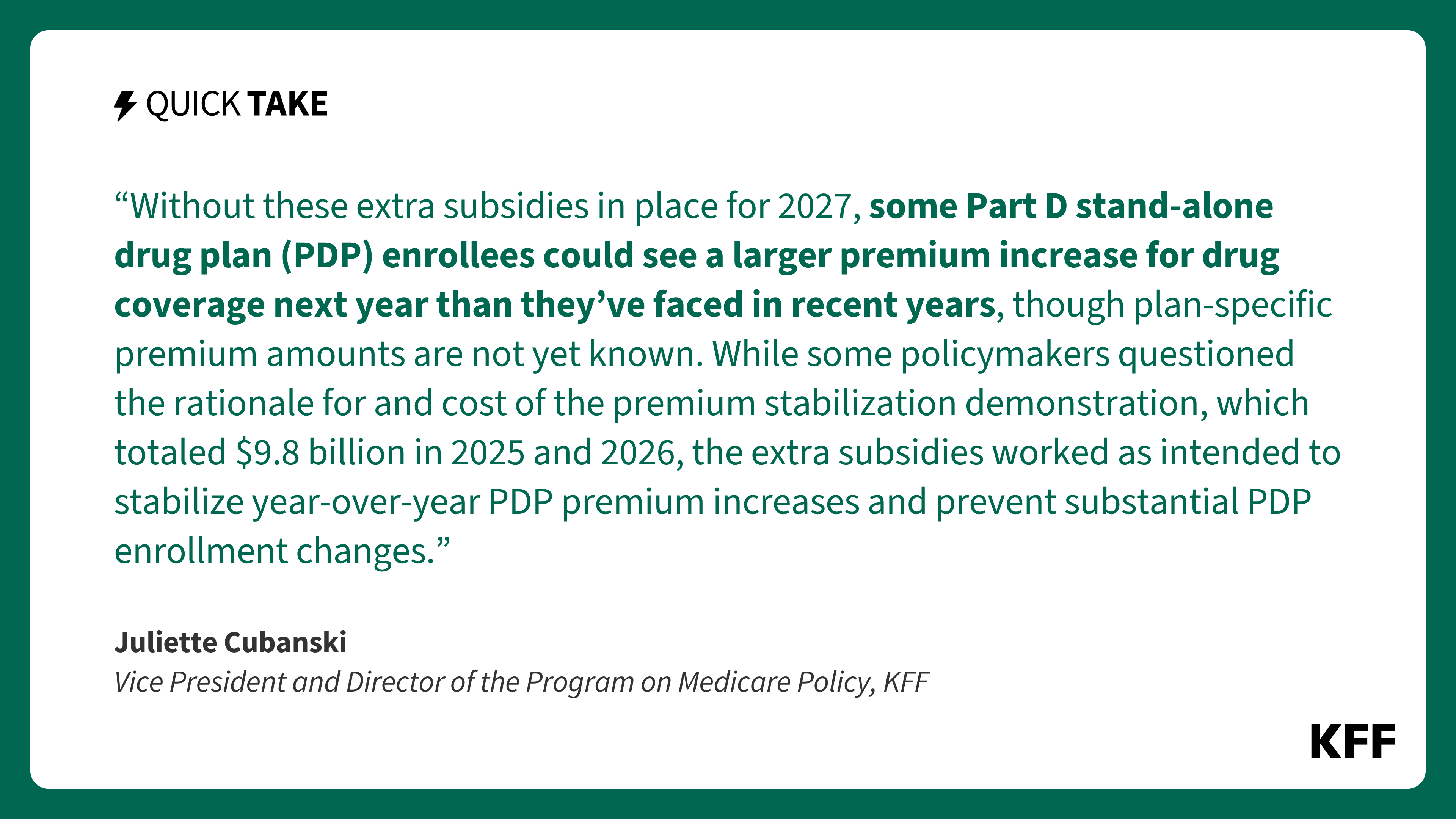
Also: Many Medicare Part D Stand-Alone Drug Plan Enrollees Will See Modest Premium Increases for 2027

Medicare Open Enrollment and Coverage Options: Key Questions and Answers

Each year, Medicare beneficiaries have an opportunity to make changes to how they receive their Medicare coverage during the nearly 8-week annual open enrollment period, which runs from October 15 through December 7. This brief answers key questions about the Medicare open enrollment period and Medicare coverage options.

NEW AND NOTEWORTHY

How Much Do People With Medicare Pay For Coverage?

This brief provides an overview of the costs faced by Medicare beneficiaries in traditional Medicare, Medicare Advantage, and Medicare Part D, including premiums, deductibles, copays, and coinsurance, focusing on costs in 2026.

What’s in a Name? From Today’s Medicare to Medicare for All

KFF’s Larry Levitt explains how proposals to create Medicare-for-All promise more generous benefits than the existing Medicare program, with no premiums or cost-sharing, but could end up looking more like Medicare if it became the subject of a serious national debate about the tradeoffs involved to implement it.

Medigap

Medigap Guaranteed Issue Requirements: An Overview of Federal and State Rules

This issue brief analyzes federal and state rules related to guaranteed issue requirements for Medigap policies and how they impact beneficiaries’ access to Medigap, including the implications for Medicare beneficiaries with pre-existing medical conditions and those under age 65 with long-term disabilities.

Data Visualization

The Facts About Medicare Spending

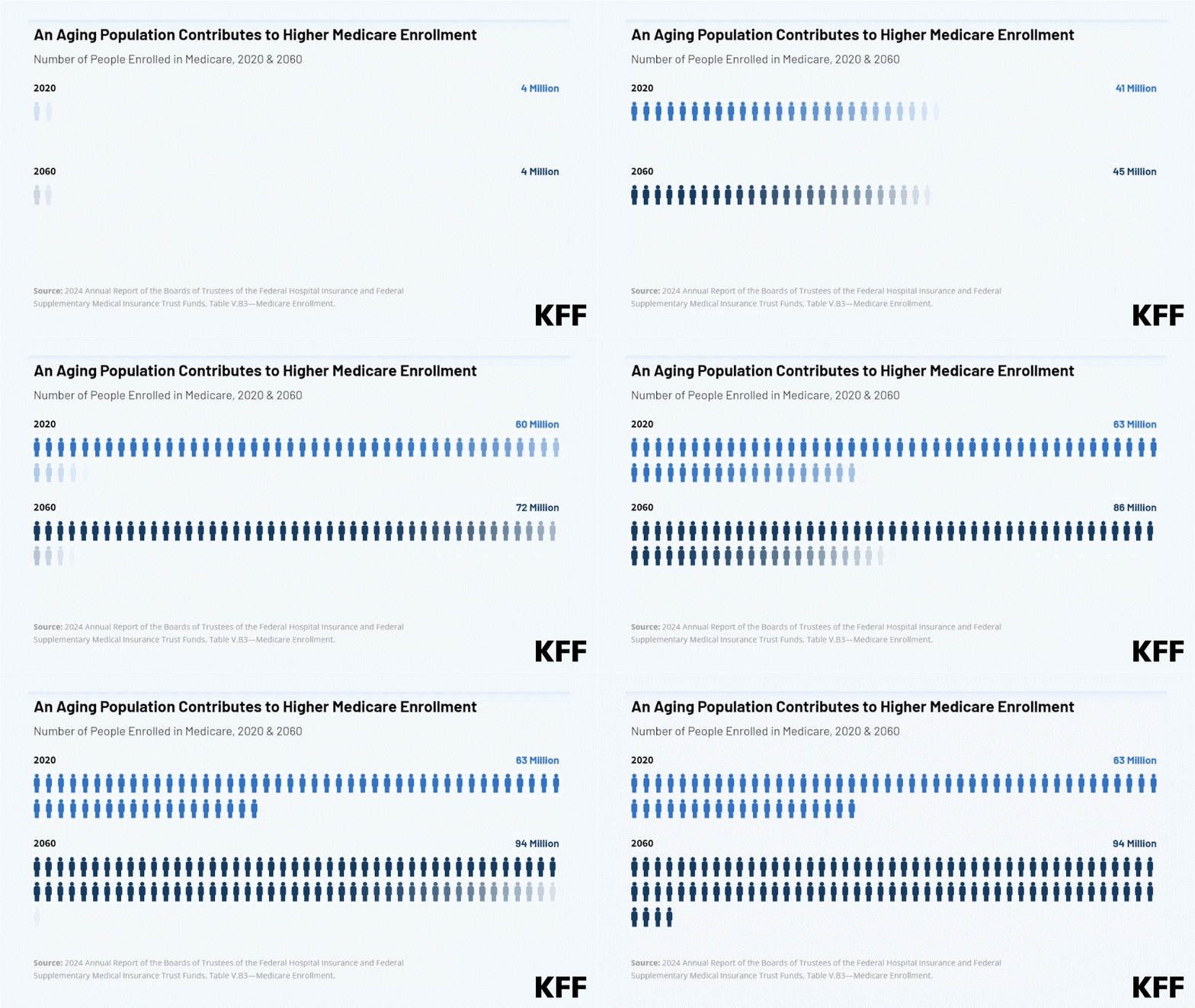
This interactive provides the facts on Medicare spending. Medicare, which serves 67 million people and accounts for 12 percent of the federal budget and 21 percent of national health spending, is often the focus of discussions about health expenditures, health care affordability and the sustainability of federal health programs. Explore data on enrollment growth, Medicare spending trends overall and per person, growth in Medicare spending relative to private insurance, spending on benefits and Medicare Advantage, Part A trust fund solvency challenges, and growth in out-of-pocket spending by beneficiaries.

Read More

Stay informed.

Stay informed.

Filter

1,191-1,200 of 1,627 results

  • Reports Analyze Cost and Coverage of People Eligible for Both Medicaid and Medicare and Options for Reforming Financing of Their Care

    Issue Brief

    These issue briefs examine coverage of the nearly 9 million "dual eligibles," the low-income elderly and persons with disabilities who are enrolled in both Medicare and Medicaid. The reports explore the national and state impacts of shifting the financing of selected services for dual eligibles from Medicaid to Medicare, and provide state-level Medicaid spending and enrollment data related to this population. The policy options studied could collectively provide tens of billions of dollars in annual…

  • Rethinking Medicaid’s Financing Role for Medicare Enrollees

    Issue Brief

    This issue brief examines coverage of the nearly 9 million "dual eligible" beneficiaries, the low-income elderly and persons with disabilities who are enrolled in both Medicare and Medicaid. It explores the national and state impacts of shifting the financing of selected services for dual eligibles from Medicaid to Medicare, including having the federal government pick up the full cost of Medicare premiums, cost-sharing and gaps in Medicare-covered services and long-term care services for this population.…

  • Pulling it Together from Drew Altman: Multiple Agendas for Controlling Health Care Costs

    Perspective

    In what would be a domestic policy trifecta, we may be headed for interconnected big debates about economic recovery, entitlement programs and health reform. A core issue in the entitlement and health reform debates is the problem of rising health care costs. President Obama, now apparently fully briefed on the economic, budget and health reform realities he faces, is talking conspicuously about hard choices that may lie ahead. In a short period of time the…

  • Revisiting ‘Skin in the Game’ Among Medicare Beneficiaries: An Updated Analysis of the Increasing Financial Burden of Health Care Spending From 1997 to 2005

    Issue Brief

    This issue brief presents an analysis of the financial burden of out-of-pocket health care spending for Medicare beneficiaries between 1997 and 2005. The analysis shows median out-of-pocket spending as a share of Medicare beneficiaries' income increased between 1997 and 2005, from 11.9 percent to 16.1 percent. For some beneficiaries, the spending burden was even greater, with 25 percent of people on Medicare spending nearly one-third or more of their income on health care.

  • Medicare 101 Tutorial

    Interactive

    This tutorial was produced for kaiserEDU.org, a Kaiser Family Foundation website that ceased production in September 2013. The kaiserEDU.org tutorials are no longer being updated but have been made available on kff.org due to demand by professors who are using the tutorials in class assignments. You may search for other tutorials to view on kff.org. To download this or other tutorials, visit the tutorials archive page.  Slides are available for download using the “Download Slides” link within the…

  • Chartpack — The Public’s Health Care Agenda for the New President and Congress

    Poll Finding

    Chartpack -- The Public's Health Care Agenda for the New President and Congress This chartpack provides the key findings from the survey of the public's attitudes regarding the health care agenda for President Obama and the new Congress in 2009. It assesses the relative priority placed on health care by the American public as part of addressing the economic recession and as a large scale reform issue. The public's priorities for health care reform and…

  • Toplines — The Public’s Health Care Agenda for the New President and Congress

    Poll Finding

    Toplines -- The Public's Health Care Agenda for the New President and Congress This document contains the detailed toplines from The Public's Health Care Agenda for the New President and Congress poll. The poll involved a nationally representative random sample of 1,628 adults ages 18 and older who were interviewed by telephone between December 4 and 14, 2008. The margin of sampling error for the full sample is plus or minus 3 percentage points. For…

  • Primers on Key Health Care Topics and Programs

    Issue Brief

    The Kaiser Family Foundation maintains a number of primers providing overviews of key health care programs and issues. Written by Foundation staff, each primer provides key data and information that helps illustrate the topic and its relevance for the nation's health care system. Medicaid: A Primer Medicare: A Primer The Uninsured: A Primer Health Care Costs: A Primer How Private Health Coverage Works: A Primer Mental Health Financing in the United States: A Primer The…

  • The Emerging Role of Group Medicare Private Fee-for-Service Plans

    Issue Brief

    This issue brief examines the recent boom in Medicare Advantage enrollment attributable to employers contracting with Private Fee-for-Service (PFFS) plans to cover their Medicare-eligible retirees. Between 2006 and 2008, the number of Medicare beneficiaries enrolled in Medicare Advantage group plans nearly doubled from 900,000 to nearly 1.7 million as of June 2008; most of this growth is attributable to contracts between employers and PFFS plans. The issue brief, prepared for the Foundation by Avalere Health,…

  • President Obama’s Campaign Position on Health Reform and Other Health Care Issues

    Issue Brief

    During the 2008 Presidential campaign now President Barack Obama announced a comprehensive health care reform proposal and laid out his positions on a number of other key health care issues. The two documents below summarize these campaign policies and positions. They were prepared by the Kaiser Family Foundation with the assistance of Health Policy Alternatives, Inc., and are based on information compiled from Obama's campaign Web site, speeches, campaign debates and news reports. They are…