Medicaid

new and noteworthy

Medicaid Midterm Election Update

Midterm Election Update: Medicaid Changes

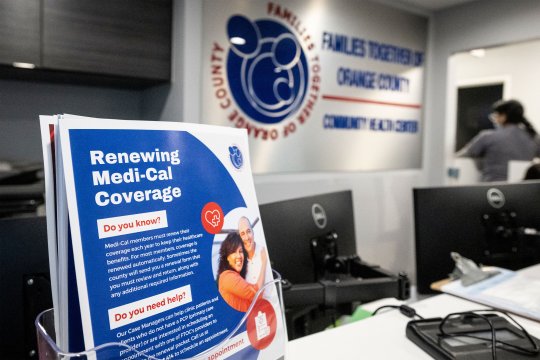
Major federal changes to Medicaid eligibility and financing from the 2025 reconciliation law are coming, including new work requirements that will affect millions of Medicaid enrollees. KFF’s fact sheet provides an overview of what has changed, what is still ahead, and what the public thinks about Medicaid heading into the midterms.
Medicaid State Fact Sheets 2024

Medicaid State Fact Sheets

What share of people in your state are covered by Medicaid? States varywidely in how many and which residents they cover and how much they spend. KFF’s state Medicaid fact sheets offer a snapshot of data and information on coverage, access, financing, and politics for all 50 states and DC. Get data for your state.

Medicaid work requirements

Nebraska Renewal Outcomes Among Individuals Subject to Medicaid Work Requirements

Early Medicaid Work Requirement Insights From Nebraska

This brief describes the verification process for Medicaid work requirements in Nebraska and examines early data on outcomes for individuals subject to work requirements. Among Medicaid enrollees renewing coverage under Nebraska's work requirements, 93% met the requirements or qualified for an exemption —while 7% lost coverage.

Tracking Implementation of the 2025 Reconciliation Law: Medicaid Work Requirements

KFF’s interactive tracks key data and policies that will affect how states implement Medicaid work requirements, which are required under the 2025 budget reconciliation law starting in January 2027. The tracker includes state-level data on Medicaid enrollment and renewal outcomes as well as current state enrollment and renewal policies. The Congressional Budget Office estimates that the 2025 reconciliation law will increase the number of people who are uninsured in 2034 by 10 million. Coverage losses from Medicaid work requirements account for over half, or 5.3 million, of the increase in the number of uninsured.

understanding medicaid

Medicaid Financing: The Basics

Medicaid represents $1 out of every $5 spent on health care in the U.S. This brief examines key questions about Medicaid financing and how it works.

Medicaid and Provider Taxes

This brief explores how rules governing provider taxes are changing because of the 2025 reconciliation law and the regulations implementing that law, and summarizes which changes may affect each state.

5 Key Facts About Medicaid and Hospitals

This brief explains the role of Medicaid for hospitals, including how much spending on hospital care comes from Medicaid and how Medicaid expansion has impacted hospital finances.

Medicaid home Care

Medicaid Home Care/HCBS Survey

Since 2001, KFF has administered regular surveys of states about their Medicaid home- and community-based services (HCBS) programs. The survey is sent to officials administering Medicaid HCBS programs in all 50 states and the District of Columbia.

Stay informed.

Stay informed.

Filter

1,581-1,590 of 2,750 results

  • Health Reform Implementation Timeline

    Interactive

    The health reform implementation timeline is an interactive tool designed to explain how and when the provisions of the Affordable Care Act will be implemented over the next several years.

  • Faces of Dually Eligible Beneficiaries: Profiles of People with Medicare and Medicaid Coverage

    Issue Brief

    This brief examines the role of Medicare and Medicaid in the lives of dually eligible beneficiaries – low-income seniors and younger adults with disabilities who are eligible for both programs – through personal profiles. It includes a glossary of eligibility and service delivery system terms and state-level enrollment and expenditure data for dual eligibles.

  • Transitioning Beneficiaries with Complex Care Needs to Medicaid Managed Care: Insights from California

    Issue Brief

    This brief examines how health service providers, plan administrators, and community-based organizations in Contra Costa, Kern, and Los Angeles Counties experienced the transition of Medi-Cal-only seniors and persons with disabilities (SPDs) to managed care as part of the state’s “Bridge to Reform” Medicaid waiver. Findings presented may inform similar transitions of high-need beneficiaries in other states and coverage expansions in 2014 under the Affordable Care Act.

  • Improving the Financial Accountability of Nursing Facilities

    Report

    This report examines nursing facility expenditures to assess relative spending increases in areas such as nursing services, administrative costs, and profits. Using California as a case study, it explores reimbursement by cost category and a standard medical loss ratio (MLR) as potential policy options to improve nursing facility financial accountability and care quality.

  • Medicaid Managed Care in the Era of Health Reform – Briefing and Panel Discussion

    Event Date:
    Event

    Amid increasing state and national interest in using managed care delivery models for Medicaid beneficiaries, the Kaiser Family Foundation’s Commission on Medicaid and the Uninsured (KCMU) hosted a public briefing on Tuesday, June 25, 2013 to provide information on recent transitions from fee-for-service to managed care, and to discuss their implications for care access and delivery. Moderated by Diane Rowland, Executive Vice President of the Foundation and Executive Director of the KCMU, the briefing began…

  • California’s Health Care Environment and Health Reform Efforts: June 2013 Update

    Issue Brief

    This brief provides and update of the health care and health policy environment in California, discussing the budgetary environment, implementation of the state's "Bridge to Reform" Medicaid waiver, and efforts to prepare for coverage expansions and new coverage options in 2014 under the Affordable Care Act.

  • Quality of Care in Community Health Centers and Factors Associated with Performance

    Issue Brief

    This study examines quality among health centers relative to Medicaid managed care organizations (MCOs). Chronic care quality among health centers is high; gaps in women’s preventive care are a concern. Lower-performing health centers have very high uninsured and homeless rates. The expansion of Medicaid and private insurance under the ACA may foster gains in health center quality performance.