Early Medicaid Work Requirement Insights From Nebraska
On May 1, 2026, Nebraska became the first state to enforce new Medicaid work requirements. The 2025 reconciliation law requires states to condition Medicaid eligibility for adults in the ACA Medicaid expansion group and enrollees in certain waiver programs (such as in Georgia and Wisconsin) on meeting work requirements or exclusion criteria starting January 1, 2027; however, states have the option to implement requirements sooner (as is the case for Nebraska). KFF analysis shows most Medicaid adults under age 65 are working already (without a requirement) or face barriers to work. This brief describes the verification process for Medicaid work requirements in Nebraska and examines early data from Nebraska’s September Medicaid Advisory Committee (MAC) meeting on outcomes for individuals subject to work requirements, including for those newly applying for Medicaid as well as those renewing Medicaid coverage through August 2026. Data show that among those subject to the new work requirements:
- 46% of new applicants and 34% of individuals renewing coverage met qualifying activities (e.g., working at least 80 hours a month, having a monthly household income of at least $580, attending school).
- 39% of new applicants and 57% of individuals renewing coverage qualified for an exclusion from work requirements (e.g., due to being a parent of a child under age 14, being medically frail).
- 14% of new applicants and 7% of individuals renewing coverage had their applications denied or lost coverage due to not meeting work requirements.
- Only a small number of people (2% of new applicants and 2% of individuals renewing coverage) had a short-term hardship exception.
What is the verification process for Medicaid work requirements in Nebraska?
Nebraska is using a combination of available data and self-declaration forms to verify whether individuals meet work requirements or exclusion criteria; the state has also adopted temporary hardship exceptions. In cases where the state can automatically verify that individuals meet work requirements, it sends an approval notice. For individuals where the state does not have enough information, the state sends a notice describing the additional information that is required and a declaration form that must be returned within 30 days. Individuals can use the declaration form to attest that they met qualifying activities or that they meet the criteria for an exclusion from the requirements. The interim rule clarified that while states are allowed to accept self-declaration through 2027, starting in January 2028, except for medical frailty, states must request documentation from individuals when the state does not have data on file. Nebraska has also chosen to adopt optional short-term hardship exceptions for enrollees (or applicants) experiencing certain extenuating circumstances, including residing in counties with high unemployment rates or experiencing natural disasters, individuals admitted to a hospital or nursing facility, or those who must travel outside of their community for an extended period to obtain medical care for themselves or a dependent.
Qualifying Activities and Exclusions from Work Requirements
Adults must meet qualifying activities or exclusion criteria to enroll in Medicaid and maintain coverage. Qualifying activities include:
- Working at least 80 hours a month;
- Having a monthly household income of at least $580;
- If a seasonal worker, having an average monthly income over 6 months of minimum wage multiplied by 80 hours;
- Attending school half time;
- Volunteering or participating in a work program for at least 80 hours a month; or
- Doing a combination of activities for at least 80 hours per month.
Exclusions from the work requirements include:
- Pregnant and postpartum individuals;
- American Indian and Alaska Natives;
- Parents and caretakers of dependent children under age 14 or disabled individuals;
- Veterans with a disability;
- Incarcerated individuals;
- Individuals receiving SNAP and not exempt from SNAP work requirements; and
- People who are medically frail.
States must first determine if an individual is excluded from the Medicaid work requirements before assessing if an individual meets the qualifying activities. Some individuals who meet exclusion criteria may also be working.
What are the initial data on Nebraska Medicaid application and renewal outcomes?
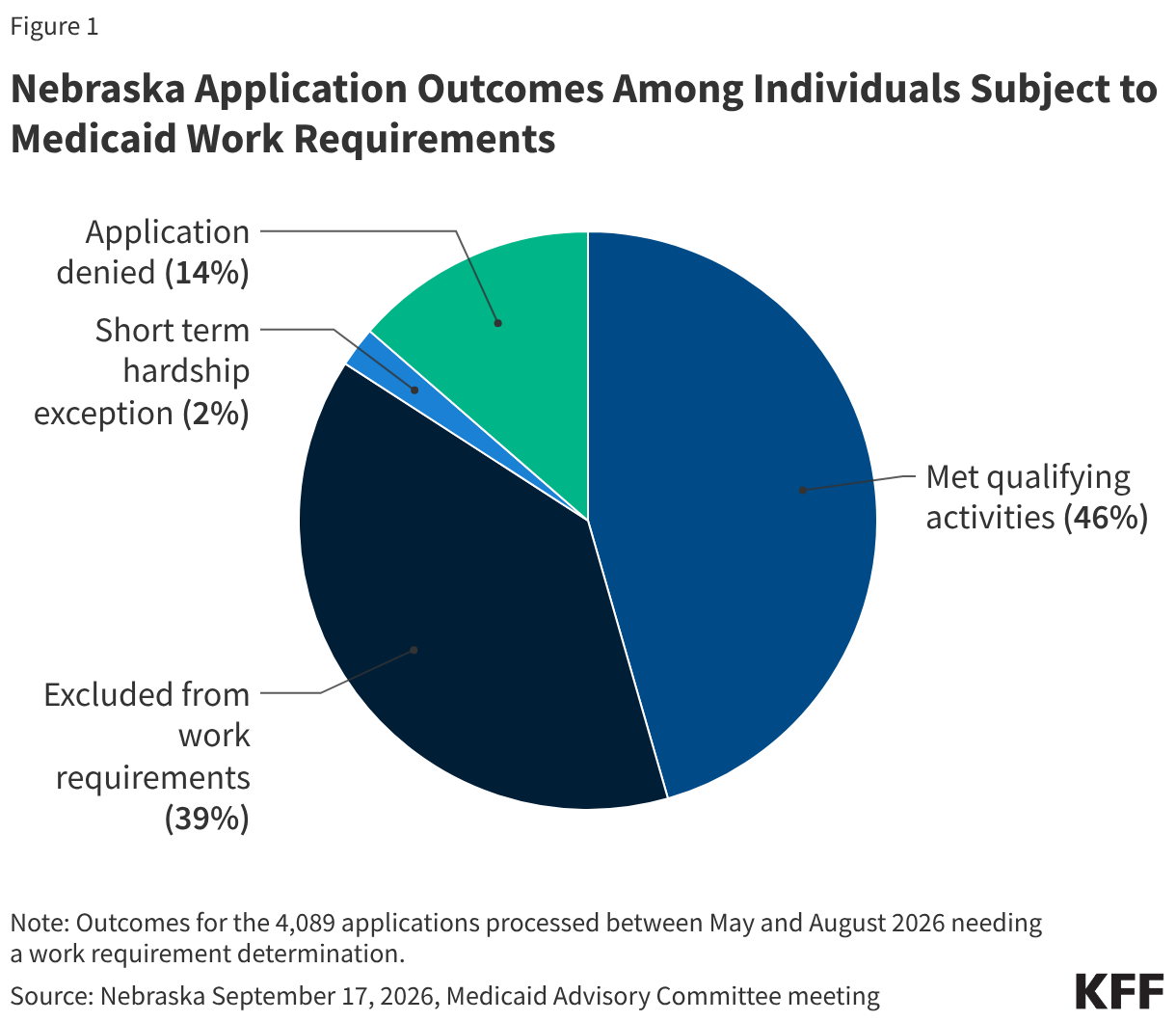
Among those who were newly applying for Medicaid and subject to the new work requirements in Nebraska, 86% of applicants met the work requirements or qualified for an exclusion or short-term hardship exception, while 14% of individuals had their application denied (Figure 1). A total of 9,614 applications were processed between May to August. Of these, some were submitted prior to May and therefore not subject to work requirements, and 4,434 were denied for reasons other than work requirements (e.g., income exceeding Medicaid eligibility thresholds). Among the remaining 4,089 applications subject to work requirements:
- Nearly half of all individuals (46%) met the qualifying activities. Among those who met the requirement, the vast majority of people (92%) worked 80 or more hours in the month prior to their application or had a household income of $580. A much smaller share (8%) were enrolled in an education program or work program, volunteered, or met requirements by combining hours across multiple types of qualifying activities.
- About 4 in 10 individuals (39%) qualified for an exclusion. Of these applicants, one-third were parents or caregivers of a child under the age of 14 or a disabled individual (33%); one quarter were medically frail, and 12% were an American Indian or Alaska Native. The remaining 30% qualified for other exclusions. Because the state is relying on self-attestation, future documentation requirements may lead to a lower share of individuals who qualify for an exclusion.
- Only a small number of individuals had a short-term hardship exception. Only 92 individuals met the criteria for short-term hardship exceptions, with the majority of these being individuals who required temporary use of medical services or living in counties that were exempted due to high unemployment.
- 14% of individuals had their application denied. Most of the 557 denied applications were due to non-response to requests for additional information (84%); only 16% of applicants with denied applications were affirmatively found to be noncompliant.
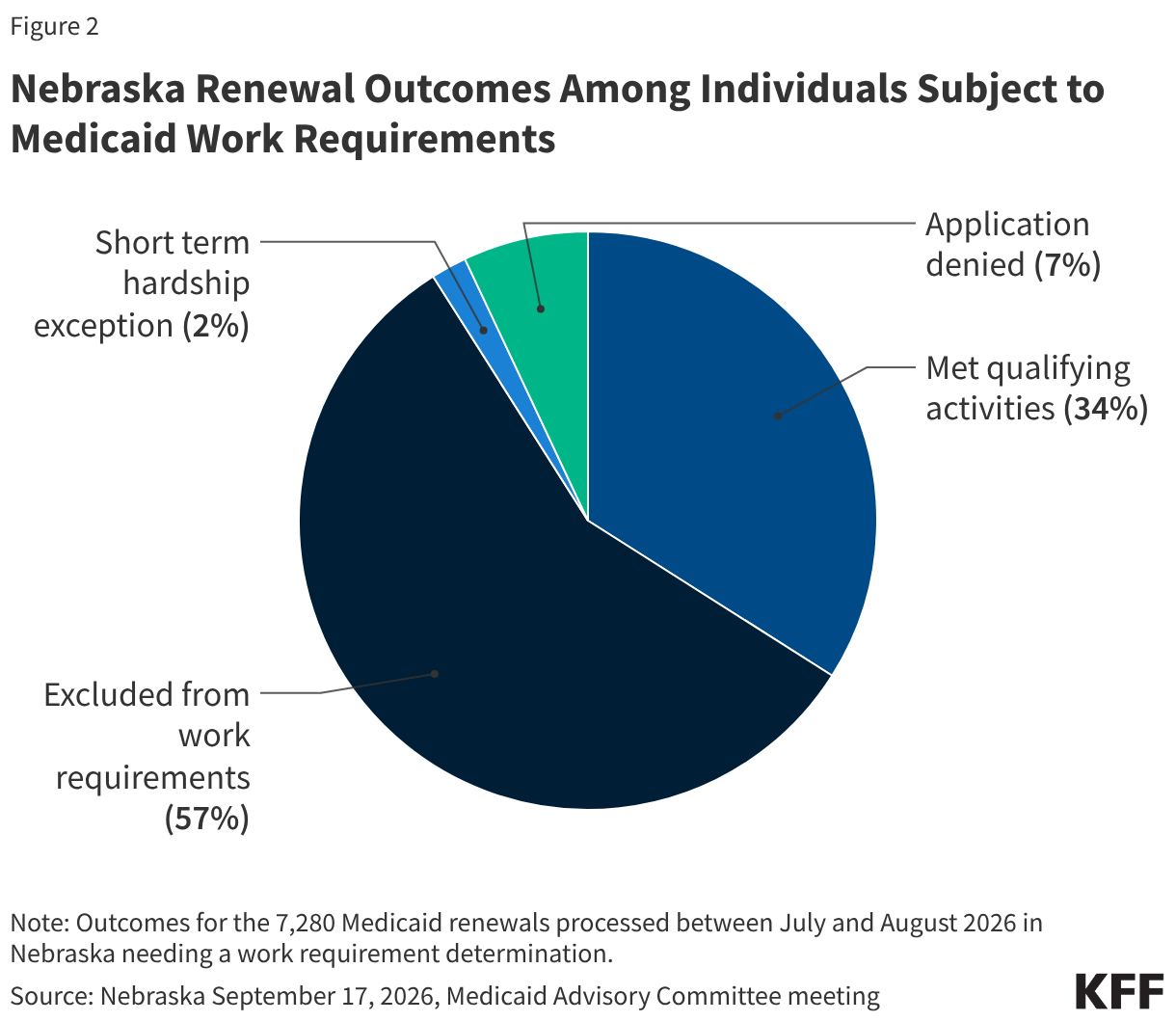
Among those who were renewing their Medicaid coverage and subject to the new work requirements, 93% met work requirements or qualified for an exclusion or short-term hardship exception and had their coverage renewed, while 7% of enrollees lost coverage (Figure 2). A total of 7,280 renewals subject to work requirements were processed between July and mid-August. Other expansion enrollees determined ineligible and disenrolled at renewal for reasons not related to work requirements (e.g., moving out of state or exceeding income eligibility) are not shown in the figure below.
- Over half (57%) of individuals renewing their coverage qualified for an exclusion from the requirements. Medically frail individuals (39%) and parent/caregivers (31%) made up the majority of those who met an exclusion. States are more likely to have medical claims history for individuals renewing coverage than new applicants, meaning Nebraska may have been able to automatically verify medical frailty for a higher share of enrollees compared to applicants. States are also required to verify exclusions status first, and it is likely that some enrollees who were excluded, especially parents, are also working.
- About a third of individuals (34%) met the qualifying activities requirement. Nearly all (97%) of individuals who met the qualifying activities were either working 80 hours a month or had a household income of $580. The remaining 3% met the requirements by attending school, volunteering, or engaging in a combination of activities.
- A small share of individuals qualified for a short-term hardship exception. Of the 127 people who had a short-term hardship exception, 109 lived in counties experiencing natural disasters and 15 lived in a high unemployment county.
- 7% of people lost coverage due to not meeting the work requirements. Of the 533 individuals who lost coverage, 92% did not respond to verification compliance requests. The remaining 8% were affirmatively found to be noncompliant.
What can additional data show?
While these data provide early insights into how coverage may be affected for enrollees subject to the new work requirements, additional data may provide a more comprehensive picture. More granular data on who is losing coverage could shed light on particular barriers certain individuals may be facing in trying to prove they met qualifying activities (e.g., gig workers or those with multiple part-time positions) and may help the state identify additional data to include as part of the verification process. In addition, it remains unclear if individuals who were denied coverage or disenrolled because they did not respond to notices of non-compliance were ineligible for coverage, unaware of the fact they needed to provide additional information, or experienced difficulty providing documentation of their exclusion or work status. Additional data, including whether these individuals reapply for coverage, could provide insight.
Required changes to the state’s medical frailty verification process specifically and limitations on the use of self-attestation starting in 2028 will likely affect disenrollment rates over time. CMS recently notified the state that it will need to make changes to its medical frailty verification process. If the state is required to tighten the verification process, fewer individuals may qualify for the exclusion in the future. More broadly, while the state’s reliance on self-attestation in 2027 will likely mitigate some coverage losses that would have occurred had documentation been required in the first year of implementation, future documentation requirements may impose a barrier that will lead to a decrease in the number of people who are able to verify they meet work requirements or qualify for an exclusion. As the state makes changes to its processes, monitoring the interactive effect of application denials and disenrollments on Medicaid enrollment in the state as well as whether the new rules lead to fewer individuals applying for Medicaid will be important.