
What Could Medicaid Work Requirements Mean for People with Disabilities Waiting for Medicare Coverage?
The Social Security Disability Insurance (SSDI) program provides monthly benefits to people who are unable to work on account of a long-term disability. SSDI beneficiaries qualify for Medicare, but in most cases, must wait 24 months between their entitlement to receive SSDI benefits and Medicare eligibility, referred to as the “Medicare waiting period.” The SSDI application process can take months, if not years. During this time and the subsequent Medicare waiting period, some people may be at risk of going without health insurance because they do not have Medicare but are unable to work due to a disability.
The Affordable Care Act (ACA) Medicaid expansion provides coverage for some SSDI applicants and SSDI beneficiaries waiting to become eligible for Medicare. The 2025 reconciliation law requires 44 states to condition Medicaid eligibility for adults in the ACA Medicaid expansion group and enrollees in certain waiver programs on meeting work requirements starting January 1, 2027, or sooner at state option. While the law specifies mandatory exclusions, including for individuals who are “medically frail,” the approach to determining medical frailty specified in the June 2026 interim final rule could make it difficult for some people, including SSDI applicants and SSDI beneficiaries waiting for Medicare, to qualify for this exclusion.
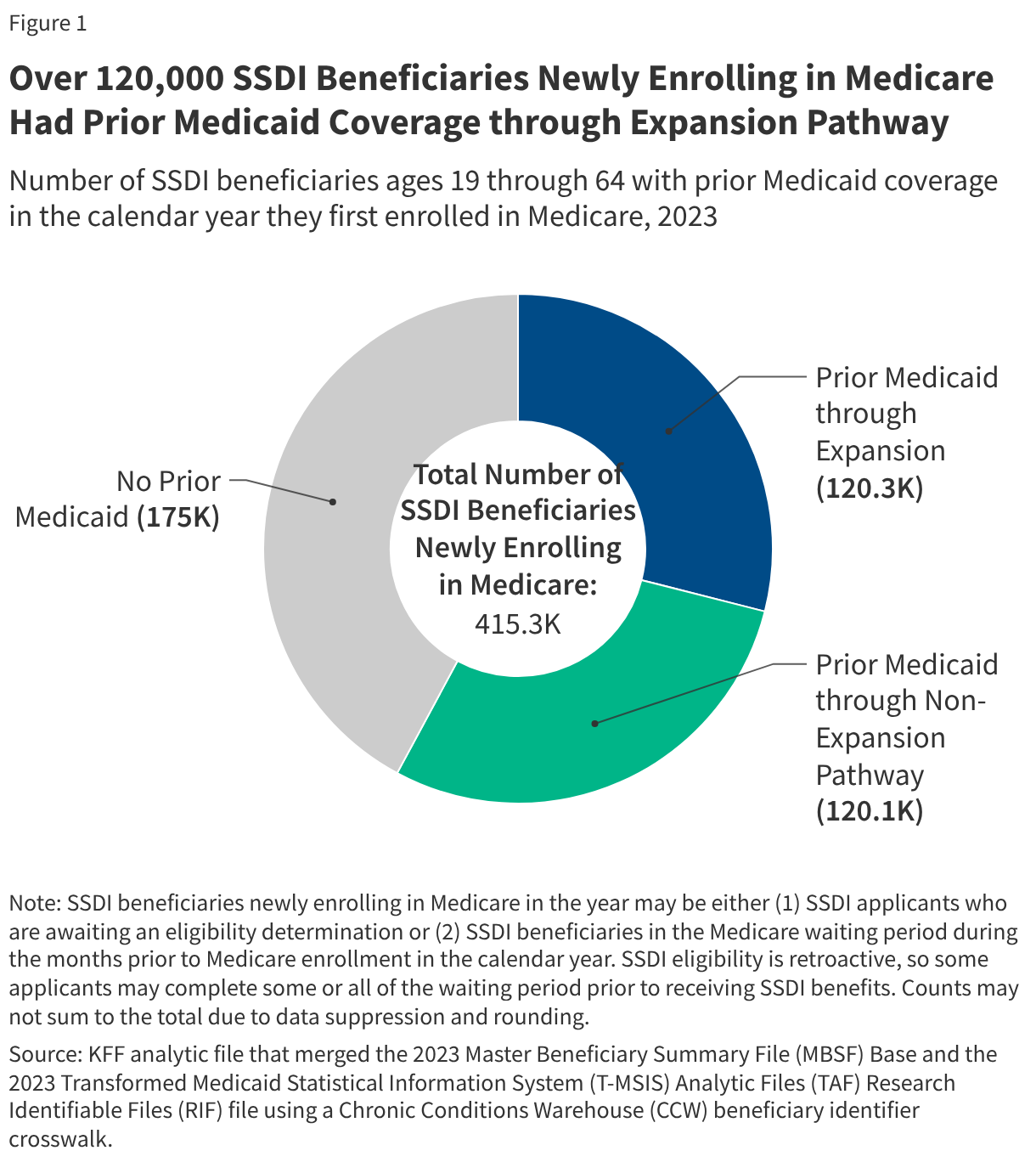
This issue brief explains how Medicaid provides coverage to some SSDI applicants and SSDI beneficiaries waiting for Medicare. KFF used linked Medicare and Medicaid administrative data from 2023 to analyze prior Medicaid coverage for SSDI beneficiaries ages 19 through 64 newly enrolling in Medicare (see Methods). The analysis finds that Medicaid covered over 1 in 4 SSDI applicants and beneficiaries waiting to become eligible for Medicare (120,300 people out of a total 415,300 in 2023). In future years, people applying for and new to SSDI may experience difficulties maintaining Medicaid prior to becoming eligible for Medicare because of the new work requirements. (For analysis on the implications of Medicaid work requirements for people applying for the Supplemental Security Income (SSI) program, see What Could Medicaid Work Requirements Mean for SSI Applicants?)
How does Medicaid provide coverage for people who are applying for and receiving SSDI?
Medicaid provides coverage for many people with disabilities, including some who are applying for SSDI or are receiving SSDI benefits but are not yet eligible for Medicare. One in five Medicaid enrollees have a disability, including 43% of enrollees ages 50-64. One-third of those people receive Supplemental Security Income (SSI). SSI is a separate federal program that provides monthly income to people who are unable to work because of a disability and who have income and financial resources below federal limits. The remaining people with disabilities are covered through different Medicaid eligibility pathways, including the ACA Medicaid expansion. During the SSDI application process, which can take months, if not years, or the Medicare waiting period, people may rely on Medicaid for their health coverage before becoming eligible for Medicare to avoid going uninsured.
In 2023, 240,300 SSDI beneficiaries enrolled in Medicare after having prior Medicaid coverage, including 120,300 who were enrolled through the Medicaid expansion (Figure 1). KFF used linked Medicare and Medicaid data to examine how many SSDI beneficiaries ages 19 through 64 newly enrolling in Medicare had any prior Medicaid coverage in 2023 (see Methods). Among the 415,300 SSDI beneficiaries newly enrolling in Medicare in 2023, 240,300 (58%) had prior Medicaid coverage through any eligibility pathway, with 120,300 of those having coverage through the expansion pathway specifically.
How do people become eligible for Medicare through SSDI?
People must first demonstrate eligibility for SSDI, a process that can take months and often years. To qualify for SSDI, enrollees must have a sufficient work history and a disability that affects their ability to work and is expected to last for at least a year or result in death. A sufficient work history varies by age but generally requires 10 years of employment, at least five of which were within the past decade. Some individuals with a disability can qualify based on a relative’s work history.
The SSDI application process can be a lengthy and complicated process, spanning months, and in some cases years. Demonstrating a disability is often the most complicated part of the SSDI application process. The federal government establishes verification processes that all states must use and utilizes the same five-step process to determine applicants’ disability status for both SSDI and SSI. (For a more detailed description of this process, see What Could Medicaid Work Requirements Mean for SSI Applicants?). As of July 2026, the initial processing time for all disability applications was 186 days, and 885,000 people were waiting for their initial determinations. (This number includes applications for both SSDI and SSI.) Many people receive initially unfavorable decisions and choose to appeal, which can lengthen the process (Figure 2). Because of the process for obtaining an SSDI determination and the fact that people who are applying for SSDI are unable to work, some people applying for SSDI may rely on Medicaid to avoid going uninsured.
SSDI beneficiaries become eligible for Medicare two years after they are entitled to SSDI benefits. Beneficiaries in most cases must wait 5 months for SSDI payments from the disability onset date, followed by a 24-month waiting period between becoming entitled to receive SSDI payments and Medicare eligibility, referred to as the “Medicare waiting period.” Because of the length of the SSDI application process and the fact that SSDI eligibility is retroactive, applicants may complete some or all of the waiting period prior to receiving SSDI benefits.
While many SSDI beneficiaries waiting for Medicare rely on Medicaid to avoid going uninsured, others face health insurance coverage gaps during the Medicare waiting period. SSDI beneficiaries in the Medicare waiting period tend to have low incomes, poor health, and fragile ties to the workforce. SSDI beneficiaries who are uninsured during the Medicare waiting period are more likely to report being in poor health, having more difficulties in activities of daily living, and having higher out-of-pocket medical expenditures than those with insurance. Research predating the ACA Medicaid expansion found that about a quarter of SSDI beneficiaries in the Medicare waiting period were uninsured.
How might Medicaid work requirements affect Medicaid coverage for SSDI beneficiaries before they become eligible for Medicare?
The new work requirements may make it difficult for SSDI applicants and SSDI beneficiaries waiting for Medicare to maintain Medicaid coverage before becoming eligible for Medicare. Starting in January 2027, individuals applying for or enrolled in Medicaid coverage through the ACA expansion and in certain waiver programs will be required to work or engage in qualifying activities, such as community service, for 80 or more hours per month, attend school half-time, or qualify for an exemption or exclusion from the requirements. SSDI applicants and SSDI beneficiaries waiting for Medicare enrolled in the ACA Medicaid expansion will be subject to these new requirements. SSDI applicants and SSDI beneficiaries waiting for Medicare may face challenges proving they meet the requirements or that they are eligible for exemptions or exclusions, although the issues each group will encounter may differ because they are in different stages of the SSDI determination process.
People applying for SSDI are generally unable to work, but current rules could make it challenging for them to qualify for a medical frailty exclusion. Because individuals must have earnings below the level of “substantial gainful activity” (SGA, $1,690 per month in 2026) to be eligible for SSDI, they are unlikely to be able to work 80 or more hours in a month. Additionally, most people with new impairments significant enough to qualify for SSDI will likely also face challenges meeting the Medicaid work requirements through education or volunteering. Instead, to obtain or retain Medicaid, individuals applying for SSDI who are subject to the work requirements will need to qualify for an exclusion from the requirements, most likely through the medical frailty exclusion. The interim final rule implementing Medicaid work requirements issued on June 1, 2026 adopts a definition of medical frailty that requires individuals to have a physical or mental health condition and that the condition must impair their ability to meet work requirements. This two-part test for medical frailty will require navigating a verification process that may lead to some people who would qualify for the exclusion losing coverage because they cannot provide the required documentation.
New guidance from the Centers for Medicare & Medicaid Services (CMS) may help to mitigate but will not eliminate the risk that SSDI applicants may lose Medicaid coverage. The interim final rule requires states to verify medical frailty on an ex parte basis where possible, using reliable information available to the state without requiring the individual to submit additional information. CMS recently released a slide deck that outlined a tiered medical frailty framework that states may follow using data from claims and other sources to identify people who meet the medical frailty exclusion. While states are not required to adopt this approach, the tiered medical frailty framework would enable states to identify individuals as medically frail using claims data alone (tier 1), using claims data in combination with encounter or other data (tier 2), or, in cases where states have no or insufficient data on file, using an individualized manual process that requires additional documentation (tier 3). As they develop processes for verifying medical frailty, states will rely more heavily on provider determinations or other documentation and self-attestation, to the extent permitted by the rule, for individuals who cannot be automatically verified. Self-attestation will be permitted in 2027, but starting in 2028, it will only be permitted once per continuous enrollment period, meaning states will need to collect documentation at renewal for medically frail individuals. Even with increased use of data to verify medical frailty, the documentation requirements could cause some people with disabilities to lose Medicaid coverage or be denied Medicaid while they are waiting on their SSDI determination.
SSDI beneficiaries waiting for Medicare should qualify for the medical frailty exclusion from work requirements but may still be at risk of losing Medicaid coverage depending on how states implement new systems. The medical frailty exclusion includes people who are blind or disabled according to the Social Security Administration (SSA) definition of disability. SSDI beneficiaries waiting for Medicare have already been determined to meet the SSA definition of disability and have a disability that limits their ability to work, meaning that they would likely qualify for the medical frailty exclusion. However, depending on state processes, SSDI beneficiaries waiting for Medicare may not be automatically identified as medically frail and may be required to show documentation of their SSDI determination.
This work was supported in part by Arnold Ventures. KFF maintains full editorial control over all of its policy analysis, polling, and journalism activities.
Appendix: Timelines for Disability Determinations and Medicare Coverage
Disability Determination Process for Applicants Who Appeal
Timeline from Disability Onset to Medicare Coverage
The over 120,000 SSDI beneficiaries newly enrolling in Medicare with prior Medicaid coverage through Medicaid expansion may either be SSDI applicants or SSDI beneficiaries waiting for Medicare in the months in the calendar year prior to Medicare enrollment. Because SSDI eligibility is retroactive, some SSDI applicants may complete some or all of the Medicare waiting period prior to receiving SSDI benefits (Figure 3). This means that some SSDI applicants may become eligible for Medicare as soon as they are determined to qualify for SSDI. Other SSDI beneficiaries newly enrolling in Medicare receive SSDI payments and are in the Medicare waiting period in the months immediately preceding enrollment in Medicare (Figure 4). Using the data available, it is not possible to determine the exact number of SSDI beneficiaries newly enrolling in Medicare who are SSDI applicants or SSDI beneficiaries waiting for Medicare in the months prior to Medicare enrollment in the year.
Methods
Data: Data are from KFF analytic files that merge the Centers for Medicare & Medicaid Services (CMS) Chronic Conditions Data Warehouse (CCW) 2023 research-identifiable Master Beneficiary Summary File (MBSF) Base and the 2023 Transformed Medicaid Statistical Information System (T-MSIS) Analytic Files (TAF) Research Identifiable Files (RIF) using a CCW beneficiary identifier crosswalk.
State inclusion criteria: National estimates include enrollees living in 50 states and DC and exclude residents in the U.S. territories.
Identifying SSDI beneficiaries newly enrolling in Medicare using administrative data: Enrollees are classified as SSDI enrollees newly enrolling in Medicare if they have a coverage start date (COVSTART) February 2023 through December 2023, did not have Medicare Part A or Part B in January 2023 (MDCR_ENTLMT_BUYIN_IND_01 not having value 1, 2, 3, A, B, or C), have a current entitlement reason equal to disability insurance benefits (DIB) or both DIB and end-stage renal disease (ESRD) (ENTLMT_RSN_CURR with value 1 or 3), and are ages 19 through 64 at the end of the calendar year.
Assessing prior Medicaid coverage in the calendar year for SSDI enrollees newly enrolling in Medicare: The Medicare coverage start date (COVSTART) is used to determine the first month of enrollment in Medicare during the year. Then, all Medicaid monthly eligibility group codes in 2023 (ELGBLTY_GRP_CD_01-ELGBLTY_GRP_CD_12) prior to the first month of Medicare enrollment are used to assess prior Medicaid enrollment during the year using the following hierarchy:
- Prior Medicaid coverage through the expansion pathway: having at least one Medicaid monthly eligibility group code indicating enrollment through the ACA expansion group (value of 72, 73, 74, or 75) before the first month of Medicare enrollment.
- Prior Medicaid coverage through other pathway: having at least one non-missing Medicaid monthly eligibility group code and no Medicaid monthly eligibility group codes indicating enrollment through the ACA expansion group (value of 72, 73, 74, or 75) before the first month of Medicare enrollment.
- No prior Medicaid coverage: Medicaid eligibility group codes for all months before the first month of Medicare enrollment are missing or the Medicare beneficiary did not have any records in T-MSIS.