What is a Mini-Med Plan?

Authors: Larry Levitt and Gary Claxton
Published: Jul 5, 2011

One of the early insurance market changes in the Affordable Care Act (ACA) phases out caps that some insurance plans impose on the annual dollar amount of benefits they will cover. Plans issued or renewed after September 23, 2010 cannot have annual limits of less than $750,000, and the threshold goes up to $1.25 million in 2011. Annual dollar limits of any kind are prohibited starting in 2014.

The federal government has issued waivers from these rules for a number of plans — so-called “mini-med” plans — that would face big premium increases if they had to raise their annual limits to comply with the rules, potentially leading some employers to drop coverage altogether. The Office of Consumer Information and Insurance Oversight recently announced that no new waivers will be granted after this year, and that the waivers will only apply until 2014 when the major elements of the ACA take effect.

The federal government has identified the employers, unions, and insurers that have been granted waivers, but has not publicly released the details of the coverage people have under these plans. A little Googling, though, reveals what the coverage looks like for some of these mini-med plans that have been granted waivers.

For example, McDonald’s”McCrew Care” benefits (here’s an example in Montana) requires employees to pay $56 per month for basic coverage that provides up to $2,000 in benefits in a year and $97 per months for a Mid 5 plan that provides up to $5,000 in benefits. Ruby Tuesday charges workers $18.43 per week (going down to $7 after six months of service) for coverage that provides up to $1,250 in outpatient care per year and $3,000 in inpatient hospital care. Denny’s basic plan for hourly employees in 2010 provided no coverage for inpatient hospital care and capped coverage for doctor office visits at $300 per year. (The restaurant offered more comprehensive coverage to salaried employees.)

Annual dollar limits on benefits will not be allowed at all beginning in 2014, so mini-med plans as we know them will probably cease to exist. What this means for low-wage workers in the larger firms that offer these plans now, however, is more of a question. The health reform law calls for an essential health benefits package (with details expected to be provided later this year by the Department of Health and Human Services) to be required in plans for people purchasing on their own or through small employers, but what larger employers must offer their workers is not as clearly laid out. It may be that the tight dollar limits in the mini-med plans with waivers today could be replaced by equally-limited coverage with tight limits on the number of physician visits, prescriptions or hospital days that they will pay for. How these low-wage workers will fare under health reform is one of the many open questions that will be informed by the final regulatory scheme and the decisions of employers and their workers.
Poll Finding

Kaiser Health Tracking Poll — July 2011

Published: Jul 1, 2011

Health care, and particularly Medicare and Medicaid, continue to play a role in the national discussion over the federal budget deficit. In the midst of this debate, the latest Kaiser Health Tracking poll finds that Americans of all political stripes see a role for both spending reductions and tax increases as part of an overall deficit reduction strategy. Still, few are willing to support major spending reductions in Medicare, and a large majority believes the country’s budgetary problems can be addressed without cutting Medicare spending. The ongoing debate about the deficit doesn’t appear to have had much impact on the public’s overall opinion of the health reform law, which remains divided this month. Despite the fact that consumer protections were one of the least controversial and most widely supported provisions of the ACA, just 20 percent of Americans think the law will lead to improvements in consumer protections for the average person with health insurance. On the other hand, half expect access to care for the uninsured to get better under the law.

The July poll is the latest in a series designed and analyzed by the Foundation’s public opinion research team.

Findings (.pdf)

Chartpack (.pdf)

Toplines (.pdf)

Explaining Health Reform: Uses of Express Lane Strategies to Promote Participation in Coverage

Published: Jul 1, 2011

Under the Patient Protection and Affordable Care Act (ACA), millions of uninsured adults and children will gain eligibility for Medicaid or health coverage through new health insurance Exchanges beginning in 2014. The law calls upon states to develop simple and streamlined processes for establishing, verifying, and updating eligibility for Medicaid, the Children’s Health Insurance Program and federal subsidies for Exchange coverage.

This issue brief examines how states can employ “express lane” principles in designing systems that use existing data held by other government agencies to help identify individuals who may be eligible for Medicaid, CHIP or subsidies for other coverage and enroll them or renew their coverage, as appropriate, under the health reform law. To do this, states will need to create linkages between the health subsidy programs and public programs such as the Supplemental Nutrition Assistance Program (SNAP) and Temporary Assistance for Needy Families (TANF), and with databases held by federal agencies such as the Social Security Administration, the Department of Homeland Security and the Internal Revenue Service.

Issue Brief (.pdf)

Poll Finding

A Brief Look at Americans’ Perceptions of the Global HIV/AIDS Epidemic

Published: Jul 1, 2011

This Data Note, using data from a national survey of Americans on HIV/AIDS released in June 2011, examines trends in the public’s perception of HIV/AIDS as a global problem. Overall, survey trends show that Americans view HIV/AIDS as a more pressing health problem for the world than for the U.S., although the perceived sense of urgency has been on the decline for both the global and domestic epidemics. The sense of urgency about the global HIV/AIDS epidemic has declined steeply in the past five years; about one third of Americans ranked it as the world’s most urgent health issue from 2000 through 2006, a share that fell to 21 percent in 2009 and 13 percent today.

The survey report, released in the 30th year of the HIV/AIDS epidemic, and topline are also available.

Data Note (.pdf)

An Overview of Changes in the Federal Medical Assistance Percentages (FMAPs) for Medicaid

Published: Jul 1, 2011

The joint federal-state financing of the Medicaid program works through a matching mechanism known as the Federal Medical Assistance Percentage (FMAP). This mechanism determines the federal and state shares of Medicaid costs based on a state’s per capita personal income relative to the national average. While the FMAP formula has remained unchanged since the enactment of the Medicaid program in 1965, changes in per capita income have resulted in substantial changes in the federal and state shares of Medicaid costs in many states.

This issue brief describes the FMAP formula, analyzes how actual FMAPs have changed since the beginning of Medicaid and discusses the outlook for FMAPs in 2013 and beyond.

Issue Brief (.pdf)

Provider Payment And Access To Medicaid Services: A Summary of CMS’ May 6 Proposed Rule

Published: Jul 1, 2011

This brief summarizes the major provisions of a rule proposed by the Centers for Medicare and Medicaid Services that would set forth state requirements for ensuring access to care in state Medicaid programs. It would apply to fee-for-service Medicaid, but not to Medicaid managed care programs. The public comment period for the regulation closed on July 5, 2011.

Under the proposed rule, state Medicaid agencies would have to review access to a subset of Medicaid-covered services every year, and review access to every Medicaid-covered service at least once every five years. If a state identifies access issues through its reviews or monitoring, it would have to submit a corrective action plan to CMS within 90 days. The proposed rule also would significantly change the process for reducing Medicaid payments to fee-for-service providers. State Medicaid agencies that seek to reduce Medicaid payment rates would have to submit to CMS along with a state plan amendment an access review for the service in question that has been completed within the last 12 months and which demonstrates sufficient access to care. The state Medicaid agency also would have to submit an analysis reflecting its consideration of beneficiary and stakeholder input on the impact of the proposed rate change on access to the affected service.

Issue Brief (.pdf)

News Release

Free HIV Testing On Site at the Essence Music Festival

Published: Jul 1, 2011

NEWS RELEASEJuly 1, 2011

“I CAME TO GET TESTED”Week-Long Greater Than AIDS Statewide Testing Tour Culminates at this Weekend’s Festival in New Orleans, July 1st-3rd

NEW ORLEANS, LA – Friday, 1st July, 2011 – Greater Than AIDS, a national campaign to respond to HIV/AIDS in the United States, has teamed up with the Louisiana Department of Health and Hospitals and other partners to promote HIV testing in conjunction with the annual ESSENCE Music Festival, taking place today through Sunday, July 3rd at the Ernest N. Morial Convention Center in New Orleans. Greater Than AIDS’ presence at this weekend’s ESSENCE Music Festival caps off more than a week of activities across Louisiana to encourage HIV testing and provide free screenings for Louisiana residents.

“We have the tools to end the AIDS epidemic as we know it. We know how to diagnose those who are infected, identify the communities most heavily affected, prevent transmission, and prevent acquisition of the virus. Dramatically expanding HIV testing and linkages to care is a critical step toward that end,” said Phill Wilson, President and CEO of the Black AIDS Institute, a co-founding partner of Greater Than AIDS. The Black AIDS Institute is coordinating the on-site testing with local partners.

Rapid oral HIV tests will be offered free of charge on a first-come, first-served basis throughout the weekend at the Greater Than AIDS booth (#302), where visitors will also receive information about HIV/AIDS and record their “Deciding Moments” as part of a national photo and video promotion with Walgreens to mark the 30th year of AIDS: www.greaterthan.org/moment

Rockmond Dunbar (PRISON BREAK), Regina King (SOUTHLAND, 24), Lamman Rucker (MEET THE BROWNS), among other celebrities at the Festival are planning to pay visit to the Greater Than AIDS booth to reinforce the importance of HIV testing. Prizes and other incentives are also being provided to encourage testing.

Last month, the Black AIDS Institute and the Louisiana Department of Health kicked off the “LOUISIANA > AIDS: Road to ESSENCE Testing Tour” – a six-city testing caravan that provided free HIV testing at events in Shreveport (June 25th), Alexandria (June 26th), Lake Charles (June 27th), Lafayette (June 28th), Baton Rouge (June 29th), and New Orleans (June 30th). In the lead up to National HIV Testing Day (June 27), Greater Than AIDS partner Walgreens, together with the Louisiana Department of Health and the U.S. Centers for Disease Control & Prevention (CDC), provided free screenings for HIV at five Walgreens retail locations in New Orleans on June 22 to 24.

According to the CDC, more than 1.2 million Americans are living with HIV today, yet 20 percent of those who are positive do not know their status. And, one in three people with HIV are diagnosed so late in the course of their infection that they develop AIDS within one year. The CDC encourages all Americans to get tested.

# # #

About Greater Than AIDS

Greater Than AIDS is a collaboration among a broad coalition of public and private sector partners united in response to the HIV/AIDS crisis in the United States, in particular among Black Americans and other disproportionately affected groups. Through a national media campaign and targeted community outreach, Greater Than AIDS aims to increase knowledge and understanding about HIV/AIDS and confront the stigma surrounding the disease. www.greaterthan.org

The Kaiser Family Foundation – a non-profit private operating foundation dedicated to producing and communicating the best possible information, research and analysis on health issues – provides strategic direction and day-to-day management, as well as oversees the production of the media campaign. The Black AIDS Institute – a think tank exclusively focused on AIDS in Black America – provides leadership and expert guidance and directs community engagement. Greater Than AIDS is developed in support of Act Against AIDS, an effort by the U.S. Centers for Disease Control and Prevention (CDC) to refocus attention on the domestic epidemic. Additional, financial and substantive support is provided by the Elton John AIDS Foundation, Ford Foundation and MAC AIDS Fund, among others.

Explaining Health Reform: The New Rules for Determining Income Under Medicaid in 2014

Published: Jun 30, 2011

To provide individuals and families access to affordable, high-quality health care, the Patient Protection and Affordable Care Act (ACA) expands Medicaid to cover low-income adults and children with incomes up to 133 percent of the poverty line. Millions of low-income parents, non-disabled adults who do not have dependent children (and who are generally ineligible for Medicaid today except in a small number of states) and, in some instances, children now covered through the Children’s Health Insurance Program (CHIP) will become newly eligible for health coverage through Medicaid as a result.

In addition, individuals and families who have incomes above the level needed to qualify for Medicaid but below 400 percent of the federal poverty line will receive tax credits to help them purchase coverage in the new health insurance exchanges. People with incomes up to 250 percent of the poverty line receiving premium credits will also get additional assistance with their cost-sharing charges. In total, an estimated 33 million more people who would otherwise be uninsured are expected to have coverage through Medicaid, CHIP and the exchanges by 2021.

To ensure coordination of eligibility and coverage across the different health care programs, the ACA requires states to make major changes in the way that they determine eligibility for Medicaid and CHIP in order to align with the income tax-based rules for premium credits in the exchanges. The biggest change involves how income and household size are defined to determine eligibility for Medicaid and CHIP (as well as the exchange premium credits). This issue brief explains the new rules, and describes the differences between these new rules and the current income counting rules used in Medicaid and CHIP.

Issue Brief (.pdf)

Five Key Questions And Answers About Section 1115 Medicaid Waivers

Published: Jun 30, 2011

This issue brief provides an overview of what Section 1115 Medicaid waivers are, how they are approved and financed, how states have used them, and how they are impacted by health reform. For many years, Section 1115 waivers have been used by states to test new coverage approaches not otherwise allowed under Medicaid program rules. Some waivers have also raised important policy issues. Since the passage of the health reform law, several states, including California, have obtained Section 1115 Medicaid demonstration waivers to expand coverage to low-income adults in preparation for the coverage expansions under reform in 2014, while other states have expressed interest in waivers focused on reducing costs to address budget shortfalls.

Issue Brief (.pdf)

June Kaiser Health Tracking Poll: Americans Still Divided on Health Reform Law

Published: Jun 30, 2011

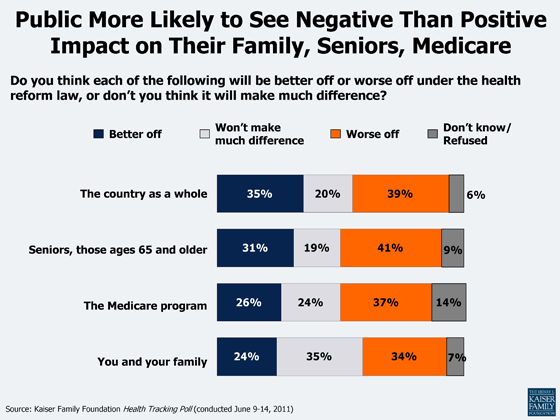
In the latest Kaiser Health Tracking Poll, the public remains divided in their overall assessments of the ACA, with 42 percent holding a favorable view of the law and 46 percent an unfavorable one. This month’s poll finds Americans are somewhat more likely to think their own families, seniors as a group, and the Medicare program will be worse off rather than better off under the law, though large shares say they don’t know or it won’t make much difference. Still, about half want to see the law expanded (31 percent) or kept as is (20 percent), while just under four in ten want it repealed and replaced with a Republican alternative (19 percent) or repealed and not replaced (19 percent). The poll also focused on seniors and the role of Medicare in the deficit reduction talks and took an early look at what voters want to hear from the candidates in the upcoming presidential elections.

Public More Likely to See Negative than Positive Impact on Their Family, Seniors, Medicare