The Budget Trigger and Health Reform

Published: Aug 4, 2011

No doubt it will take some time to sort out how elements of the debt deal (formally “The Budget Control Act of 2011”) will all work. Delving into the details of how it affects subsidies in the Affordable Care Act (ACA) to make insurance more affordable helps to illustrate how complex this business can be.

Let’s start with a short primer on the ACA subsidies. Starting in 2014 people buying insurance on their own in health insurance exchanges will be helped in two ways:

  1. Premium subsidies: Those with incomes between poverty and four times the poverty level ($44,000 for a single person and $89,000 for a family of four in 2011) are eligible for tax credits that reduce the premiums they have to pay. Our subsidy calculator illustrates what those tax credits and premium payments would be for people in different circumstances. The Congressional Budget Office projects that these tax credits would cost about $75 billion in 2016.
  2. Cost-sharing subsidies: Those with incomes between poverty and 2.5 times the poverty level ($27,000 for a single person and $56,000 for a family of four) also are eligible for coverage that provides lower patient cost-sharing than the norm. CBO projects a cost of about $13 billion in 2016.

The cost-sharing subsidies are based on the idea of actuarial value. For example, a plan with an actuarial value of 70% referred to as a “silver” plan in the ACA means that for a standard population, the plan will pay 70% of their health care expenses, while the enrollees themselves will pay 30% through some combination of deductibles, copays, and coinsurance. The higher the actuarial value, the less patient cost-sharing the plan will have on average. Exchange enrollees with incomes up to 1.5 times the poverty level receive coverage with an actuarial value of 94%, those with incomes 1.5 to 2 times the poverty level receive coverage with a value of 87%, and those with incomes 2 to 2.5 times the poverty level can enroll in a plan with a 73% value. To make this tangible, we commissioned three actuarial and benefits consulting firms to estimate the deductibles and coinsurance that would meet these various actuarial value thresholds. The full details are here.

Now, how might the debt deal affect all of this? The so-called “Super Committee” required to report back by November could recommend any number of changes to these subsidies or other elements of the ACA. But if the committee deadlocks, then a series of automatic cuts are triggered. The premium subsidies are provided as refundable tax credits, and as a result are exempt from the automatic cuts (exemptions are based in part on budget legislation that predates the ACA). However, the cost-sharing subsidies are direct spending by the federal government and are thus subject to the budget reductions. (Other types of spending in the ACA could also be affected.)

How these cost-sharing subsidy reductions would actually filter through the system is complex and somewhat unclear. The ACA entitles low-income exchange enrollees to coverage with a higher actuarial value, and it requires participating health insurers to provide that coverage. The federal government then pays insurers directly for the extra costs associated with lower patient cost-sharing.

So, the direct effect of a triggered budget cut would be that low-income enrollees would still get improved coverage, but insurers would be paid less for providing that coverage. Insurers probably would try to recoup these losses by charging higher premiums (which would, in turn, also lead to higher federal tax credits). This might also make private plans reluctant to serve lower-income enrollees, and they could take steps to try to avoid that part of the market.

No budget reductions of the scale included in the debt deal are painless, and that will undoubtedly factor into the tradeoffs considered by the committee charged with developing an alternative deficit reduction plan. But, the ACA presents a particularly complicated case since federal and state policymakers are working out the delicate details of health reform implementation in the midst of this broader budget debate.

– Larry Levitt and Gary Claxton
Poll Finding

Kaiser Health Tracking Poll — August 2011

Published: Aug 1, 2011

The August tracking poll examines the views of Americans without health insurance, with a particular focus on how they think the health reform law will affect them. Findings from the poll include:

  • Although estimates are that 32 million uninsured Americans will gain coverage under the ACA, only about half of non-elderly Americans currently without coverage say they are familiar with the chief components in the law designed to achieve this goal.
  • Perhaps because awareness of these coverage expansions is low, nearly half (47%) of the uninsured do not expect to be affected at all by the health reform law, either positively or negatively. But three in ten (31%) do say it will help them get health care. Fourteen percent expect to be hurt by the law, mainly because they worry they will be required to buy coverage they cannot afford.
  • With health reform somewhat less in the news as the debt ceiling debate took center stage, there has been a decline in public awareness about provisions that advocates have touted as key benefits of health reform.
  • On another health policy issue in the news, two-thirds of Americans (66%) say they support the recent decision by the Department of Health and Human Services to require health insurance plans to pay for the full cost of birth control and other preventive services for women under the new law, and 24 percent of the public oppose the decision.
  • Overall public opinion about the ACA once again remains largely unchanged. Thirty-nine percent of Americans say they have a favorable view of the law, 44 percent have an unfavorable one and another 17 percent don’t know enough to register an opinion.

The August poll is the latest in a series designed and analyzed by the Foundation’s public opinion research team.

Findings (.pdf)

Data Note on views and experiences of those with employer-sponsored health coverage. (.pdf)

Toplines (.pdf)

Related Column: Uninsured But Not Yet Informed, the Latest “Pulling it Together, From Drew Altman.”

Mapping Premium Variation in the Individual Market

Published: Aug 1, 2011

This analysis examines how premiums for individual health insurance differ around the nation, finding that premiums can vary substantially from state to state. The average per-person premium in 2010 ranged in cost from approximately $136 per month in Alabama to more than $400 per month in Vermont and Massachusetts. The average across all states was $215 per member per month.

Given the fragmentation of the market and the lack of public data available about individual insurance premiums across the nation, the analysis provides an important baseline that consumers and policymakers can use to gauge the state of insurance affordability prior to the full implementation of health reform. Some states such as Vermont and Massachusetts already instituted insurance market reforms that enable people with pre-existing conditions to purchase coverage, resulting in higher average premiums. Other states permit insurers to exclude people with expensive illnesses, so average premiums reflect a healthier-than-average population. Starting in 2014, the national health reform law will prohibit insurers in all states from charging more to people with pre-existing conditions.

Issue Brief (.pdf)

Chart: Average Per Person Monthly Premiums in the Individual Market, 2010

Pulling It Together: Are We Headed for a Government Takeover of Health Care?

Published: Jul 29, 2011

Remember the “government takeover of the health care system” argument that critics of the health reform law have used?  Well, last week the Office of the Actuary in the Centers for Medicare and Medicaid Services published the latest projections of health spending in the journal Health Affairs.  Attention focused mainly on the Actuary’s estimate that national health spending would grow to almost 20% of GDP by 2020 and that the Affordable Care Act (ACA) would have a negligible impact on the rate of growth in health spending.  The Actuary said that the ACA will largely pay for itself, producing savings in health care spending that will offset the additional costs as the uninsured gain coverage, have better access to care, and have lower out-of-pocket costs.

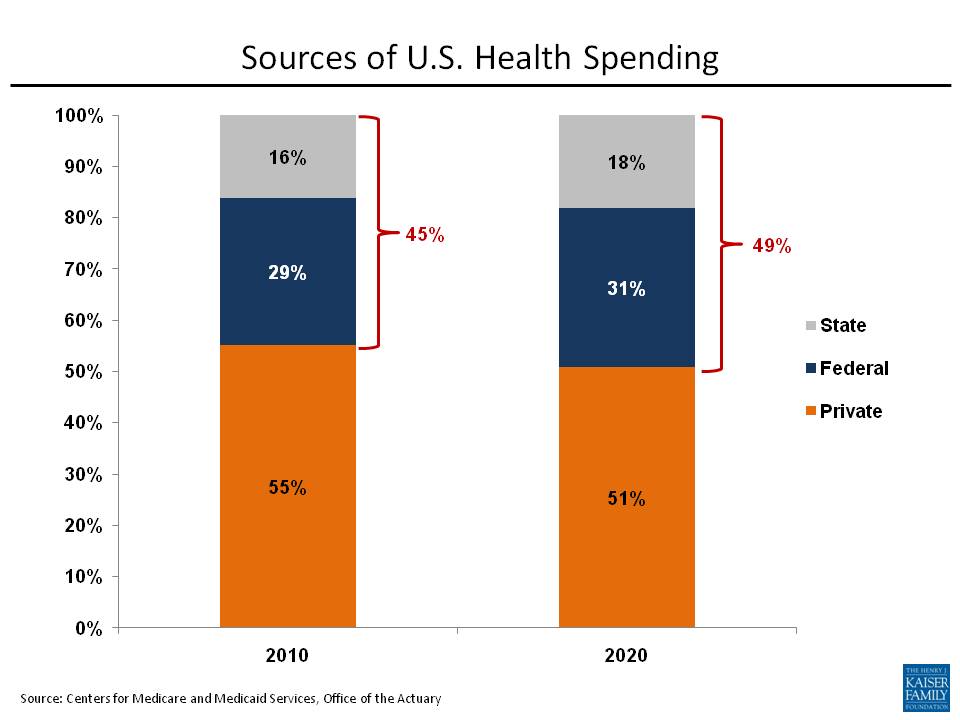
What got almost no attention, however, were some other numbers in the report.  They show the percentage of our national health care bill paid for by government growing from 45% in 2010 to a projected 49% in 2020.  In other words, government’s share of national health spending, while unquestionably large, is not growing much at all, and even in ten years it will be less than half of our country’s total health spending.  Measured by the government’s share of health care spending, there is no sign of a government takeover of the health care system.

Even more interesting, the share of health spending financed by the FEDERAL government will go from 29% in 2010 to 31% in 2020.  Same story – the federal share of health spending is barely increasing; no federal takeover of the health care system.

Put another way, when you follow the dollars, there is no more evidence of a government takeover than there is of a private sector one.

pit_chart_2.jpg

Now, of course, there are other ways to characterize a “government takeover.” Those who see government’s role in health care as expanding would certainly point to what they see as a growing body of government regulations they believe suffocates competition and innovation. There is another side to their view, of course.  One critic’s stifling regulation is another advocate’s vitally needed consumer protection.  It is also true that government health spending is more concentrated than private health spending, primarily in two big public programs, Medicare and Medicaid.  Some see this as a plus, because big public programs can exercise greater bargaining power to hold down costs. Others see it as a minus, believing that their concentrated power inhibits private sector competition.  And, of course, conservatives would say that government’s role in health care is too big at 45% of health spending, even if that does not constitute a “takeover.”But one thing we in the health policy field all know is that “money talks,” and while it is by no means the only factor that drives the health care system, substantial control is gained through financing.  The new report from the CMS Actuary shows that our health care system has been, and will remain, a mixed public-private one.  Rising health care costs are a huge problem for people, the government, and the nation; but neither the government’s share of overall health spending nor the federal government’s share, in particular, will grow much over the next decade under current laws and policy.  Government obviously has a big role in our health system today, and the debate over the ACA has put it in the spotlight, but measured by this most basic standard, the Actuary shows that there is, in fact, no imminent danger of a government takeover.

July Kaiser Health Tracking Poll: Public Still Divided on ACA, Few Believe the Law Will Improve Consumer Protections

Published: Jul 28, 2011

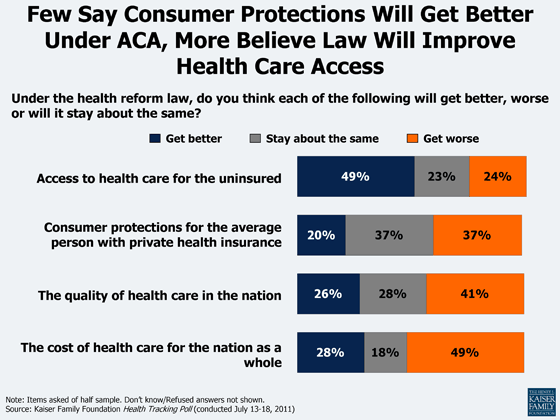
Overall public opinion on the health reform law remains unchanged this month, with 42 percent of Americans holding a favorable view and 43 percent an unfavorable view. Even though previous Health Tracking polls have consistently shown that consumer protections were one of the least controversial and most widely supported provisions of the health reform law, the July poll finds that just one in five Americans think the law will lead to improvements in consumer protections for the average person with health insurance. Higher shares of Americans expect to see the law bring about improvements in access to health care (49 percent), health care costs (28 percent) and quality (26 percent). On the other hand, pluralities expect the cost of care for the nation as a whole (49 percent) and the quality of health care in the nation (41 percent) to get worse.

The July poll also found that more Americans are reporting that their health insurance premiums and cost-sharing are a financial burden. For more on that and additional polling on how Congress should deal with the federal budget deficit, check out the topline, chartpack, and summary of the findings.

Few Say Consumer Protections Will Get Better Under ACA. More Say Law Will Improve Health Care Access

Remember the People Outside of the Exchanges

Published: Jul 22, 2011

There has been a substantial amount of focus on the recently released draft regulations governing state-based health insurance exchanges under the Affordable Care Act (ACA). And that’s appropriate, since the exchanges have the important roles under reform of providing consumers with easier access to insurance and facilitating tax credits and cost-sharing subsidies that make coverage more affordable.

But, as central as exchanges will likely be, it’s important to remember that there are other key provisions that help shape the reformed marketplace. Insurers will still be able to sell insurance to individuals and small businesses outside of the exchanges, and the health reform law applies new consumer protections to plans sold in that outside market, too. Beginning in 2014, insurers will be required to sell coverage to everyone even if they have pre-existing health conditions, insurance will have to cover the essential health benefits, and coverage will be standardized into tiers that vary by the amount of patient cost-sharing. Also, a risk adjustment system which redistributes funds from plans enrolling healthier-than-average people to those covering a sicker-than-average population will operate throughout the individual and small business insurance markets, inside and outside of exchanges.

Exchanges play the role of organizing information and facilitating the decisions about purchasing and qualifying for financial assistance. The more general market reforms have a different function, regulating rating, underwriting and marketing practices to protect consumers and create a fair basis for insurer competition, whether they offer plans inside or outside of exchanges. Indeed, exchanges won’t function effectively if the broader market rules are not well implemented and enforced.

To be sure, most individual purchasers will probably buy coverage through the exchanges. This is because premium tax credits and cost-sharing subsidies will only be available to those purchasing coverage through exchanges, likely providing a substantial enrollment boost. The Congressional Budget Office (CBO) estimates that 22 million individuals will be buying coverage through the exchanges by 2016, and that 18 million of them will be receiving federal tax credits to help them pay for their premiums.

This leaves a substantial market for non-group and small-group coverage outside of the exchanges. CBO projected during the congressional health reform debate that about 9 million people would continue to buy coverage on their own, not through the exchanges. Also, CBO expects that few small businesses will buy insurance through the exchanges, covering about 2.9 million workers out of a total small group market of about 25 million people. This makes sense because the premium tax credits for small businesses available through exchanges are temporary and targeted towards the smallest businesses with low wages. Looking at the non-group and small-group markets combined and extrapolating the CBO projections, more people will likely be getting coverage outside of the exchanges (about 31 million) than inside (about 25 million).

Recognizing that there will be a sizable insurance market outside of the exchanges has important implications for reform implementation. While the same basic ground rules apply inside and outside of the exchanges, federal law applies certain additional provisions (such as those relating to performance standards and choice of some health care providers) only to plans in the exchanges. States also have flexibility in how they review and oversee insurer rates, policies, and practices. If plans offered outside of the exchange are subject to fewer standards or less scrutiny, they may have a price advantage or, perhaps more worrisome, attract healthier enrollees, which would increase exchange premiums and potentially federal subsidy costs as well. Risk adjustment could compensate for this  adverse selection but it’s not likely to do so perfectly.

Exchanges serve an important role under the health reform law in providing a mechanism for people to obtain subsidies to make insurance more affordable, and they may help to bolster competition in the insurance market and improve value for consumers. But their success will depend on a market test the choices that individuals and small businesses make and on the regulatory decisions made at the federal level and in the states as implementation proceeds.

– Larry Levitt and Gary Claxton

Medigap Reforms: Potential Effects of Benefit Restrictions on Medicare Spending and Beneficiary Costs

Published: Jul 20, 2011

As part of several debt-reduction and Medicare-reform proposals, some policymakers propose to prohibit Medicare supplemental insurance policies (known as Medigap) from covering all of enrollees’ out-of-pocket Medicare costs, which some believe leads to higher use of services and higher Medicare spending. Such changes would expose Medigap enrollees – currently about one in six Medicare beneficiaries – to a larger share of Medicare’s cost-sharing requirements.

This analysis commissioned by the Kaiser Family Foundation examines three potential Medigap reforms, including one that is similar to a recommendation of the National Commission on Fiscal Responsibility and Reform (known as the Bowles-Simpson Commission).

The analysis estimates that the three options could save between $1.5 billion and $4.6 billion in Medicare spending in a single year. Under each of the options, enrollees would see an increase in average out-of-pocket spending for Medicare-covered services, as their Medigap policies become less generous. As a result of higher cost-sharing requirements, beneficiaries with Medigap could be expected to use fewer Medicare-covered services, leading to a decrease in average Medigap premiums.

The analysis finds that most Medicare beneficiaries with Medigap policies would be expected to pay less for their health care overall. However, Medigap reforms that prohibit first dollar coverage and charge additional coinsurance for hospital, home health and other services would have a disproportionately negative impact on Medigap enrollees who are in relatively poor health, those who require inpatient hospital care, and those with modest incomes – as these groups are more likely to face higher overall health care costs as a result of the changes.

The analysis does not attempt to estimate how much of this reduction in the use of Medicare services would be attributable to enrollees foregoing needed care or how it would affect enrollees’ health and future medical needs – which potentially could have both health and spending implications over the long term.

The study was authored by Mark Merlis. It is part of a series of Kaiser Family Foundation studies examining the effects of proposed Medicare changes on the program’s beneficiaries, the federal budget and other stakeholders, as part of the Kaiser Project on Medicare’s Future.

Report (.pdf)

News Release

Raising Medicare’s Age of Eligibility to 67 Would Achieve Significant Savings, But Shift Costs To 65- and 66-Year-Olds, Other Individuals, Employers and Medicaid, New Analysis Shows

Published: Jul 18, 2011

Study Estimates Two in Three People Ages 65 and 66 Would Pay $2,200 More On Average For Health Care in 2014 Than They Would If They Remained in Medicare

MENLO PARK, Calif. — Raising Medicare’s eligibility age from 65 to 67 in 2014 would generate an estimated $5.7 billion in net savings to the federal government, but also result in an estimated net increase of $3.7 billion in out-of-pocket costs for 65- and 66-year-olds, and $4.5 billion in employer retiree health-care costs, according to a new Kaiser Family Foundation projection of the potential change suggested by several deficit-reduction plans.

The study also estimates that the change in Medicare eligibility would raise premiums by 3 percent for those who remain on Medicare and for those who obtain coverage through health reform’s new insurance exchanges. The study assumes both full implementation of the health reform law and the higher eligibility age in 2014 in order to estimate the full effect of both the law and the policy proposal.

Among the estimated 5 million affected 65- and 66-year-olds, about two in three would pay an average of $2,200 more for their health care in 2014 than they would have paid if covered under Medicare, the study estimates.

Nearly one in three, however, are expected to have lower out-of-pocket spending, mainly due to the health reform law’s coverage expansions through Medicaid and the premium tax credits available to low- and moderate-income Americans.

“Raising Medicare’s age of eligibility would obviously reduce Medicare spending, but would also shift costs onto seniors and employers, and increase costs elsewhere on the federal ledger,” said Kaiser Family Foundation Vice President Tricia Neuman, who leads the new Kaiser Project on Medicare’s Future. “This analysis drives home the tough policy choices that lie ahead when Washington gets serious about reducing the federal deficit.”

Several major deficit-reduction and entitlement reform proposals include raising Medicare’s age of eligibility to 67 as a way of improving Medicare’s solvency. The new Kaiser study is the first to estimate the expected effects on seniors’ out-of-pocket costs and other stakeholders in light of last year’s health reform law.

In the absence of the health reform law, raising Medicare’s age of eligibility would result in an increase in the uninsured, according to previous studies, as many older Americans would have difficulty finding affordable coverage in the individual market in the absence of Medicare.

With health reform, virtually all 65- and 66-year-olds would be expected to obtain alternative sources of coverage. According to the new analysis, 42 percent are projected to obtain coverage through employer-sponsored plans, 38 percent through plans offered through health reform’s insurance exchanges, and 20 percent through the expansion of Medicaid for low-income adults.

The study projects that raising the age of Medicare eligibility to age 67 in 2014 would result in $31.1 billion in gross Medicare savings in 2014 because Medicare would no longer be covering 65- and 66-year-olds. The gross savings are estimated to be partially offset by increases in federal spending for individuals who would be covered by Medicaid ($8.9 billion) and for individuals receiving premium tax credits and cost-sharing subsidies in the exchanges ($9.4 billion). The gross savings also would be offset by a $7 billion reduction in Medicare premium receipts from 65- and 66-year-olds who would no longer be enrolled in the program.

In addition, the study finds that health-care costs for employers would increase by an estimated $4.5 billion in 2014 as employer plans become the primary payer for 65- and 66-year-olds who would no longer be eligible for Medicare, rather than provide supplemental coverage that wraps around Medicare.

Other key findings from the study include:

  • Premiums for people younger than 65 purchasing coverage through health reform’s insurance exchanges would rise by an estimated 3 percent as a result of adding 65- and 66-year-olds to the exchanges.
  • Similarly, Medicare Part B premiums would rise by an estimated 3 percent, as the youngest seniors are removed from the Medicare risk pool, resulting in higher per-beneficiary costs for those remaining on Medicare.
  • Costs to states would increase by an estimated $0.7 billion overall. This reflects higher state Medicaid costs associated with 65- and 66-year-olds who would otherwise be dual eligibles (covered by both Medicare and Medicaid) and also from higher costs associated with higher Medicare premiums for remaining dual eligible beneficiaries for whom Medicaid pays the Medicare premiums. Those higher costs are offset in part by some affected beneficiaries qualifying for full federal funding under health reform’s Medicaid expansion.

The study, Raising the Age of Medicare Eligibility: A Fresh Look Following Implementation of Health Reform, is the first in a new series of Kaiser Family Foundation studies examining the effects of proposed Medicare changes on the program’s beneficiaries, the federal budget and other stakeholders, as part of the Kaiser Project on Medicare’s Future.

The study is authored by researchers from the Kaiser Family Foundation and the Actuarial Research Corporation and is available online.

Note: Originally released in March 2011, this report and news release were updated in July 2011 to reflect additional provisions of the 2010 health reform law. These adjustments result in lower estimates of net federal savings and aggregate out-of-pocket spending attributable to raising the age of eligibility.

The Kaiser Family Foundation is a non-profit private operating foundation, based in Menlo Park, California, dedicated to producing and communicating the best possible analysis and information on health issues.

Raising the Age of Medicare Eligibility: A Fresh Look Following Implementation of Health Reform

Published: Jul 18, 2011

Several major deficit-reduction and entitlement reform proposals include raising Medicare’s age of eligibility from 65 to 67 as a way of improving Medicare’s solvency. This Kaiser Family Foundation report estimates the expected effects of such a change on the federal budget, as well as on affected seniors’ out-of-pocket costs, employers, Medicaid and others in light of the major changes in coverage enacted under the 2010 health reform law.

The study estimates that raising Medicare’s eligibility to 67 in 2014 would generate an estimated $5.7 billion in net savings to the federal government, but also result in an estimated net increase of $3.7 billion in out-of-pocket costs for 65- and 66-year-olds, and $4.5 billion in employer retiree health-care costs. In addition, the study projects that the change would raise premiums by about 3 percent both for those who remain on Medicare and for those who obtain coverage through health reform’s new insurance exchanges. The study assumes both full implementation of the health reform law and the higher eligibility age in 2014 in order to estimate the full effect of both the law and the policy proposal.

In the absence of the health reform law, raising Medicare’s age of eligibility would result in an increase in the uninsured, according to other studies, as many older Americans would have difficulty finding affordable coverage in the individual market in the absence of Medicare. With health reform, virtually all 65- and 66-year-olds would be expected to obtain alternative sources of coverage.

The study is authored by researchers from the Kaiser Family Foundation and the Actuarial Research Corporation and is available online. It is the first in a new series of Kaiser Family Foundation studies examining the effects of proposed Medicare changes on the program’s beneficiaries, the federal budget and other stakeholders.

NOTE: Originally released in March 2011, this report and news release were updated in July 2011 to reflect additional provisions of the 2010 health reform law. These adjustments result in lower estimates of net federal savings and aggregate out-of-pocket spending attributable to raising the age of eligibility.

News Release

Report (.pdf)

Related Resource:

Data Note: Public Opinion Polling on Raising the Age of Medicare Eligibility: Historic Trends and Current Nuances

Pulling It Together: Writing Regulations

Published: Jul 18, 2011

Not since Geraldo Rivera revealed the secret contents of Al Capone’s vault on national TV in the mid-80s, or more recently, sports fans awaited the LeBron James “decision” about where he would play next, have we so anxiously awaited anything as much as the draft health exchange regulations just published by HHS. Well, okay, I exaggerate for effect, but the regulations on health insurance exchanges were anxiously awaited by the health policy community. The hallmark of this NPRM (Notice of Proposed Rulemaking) is state flexibility. In this column I examine the importance of exchanges and the broader issue of state flexibility in implementing major legislation.

The draft regulations were highly-anticipated for a couple of reasons: First, exchanges are a key element of the Affordable Care Act (ACA). Second, the “exchange reg” is the first formal statement from the Federal Government about how a reformed private health insurance system may look after January 1, 2014, when major pieces of the ACA go into effect.

The regulations give states substantial flexibility in structuring exchanges, should they choose to set them up. (If a state doesn’t establish an exchange, then the Federal Government will operate one in the state.) In crafting the draft regulations, federal policymakers had to weigh how prescriptive to be. For example, they had to decide whether to prohibit insurance company representatives from serving on the boards of exchanges, or require exchanges to aggressively negotiate with insurers. In general, they erred on the side of less, rather than more, requirements.

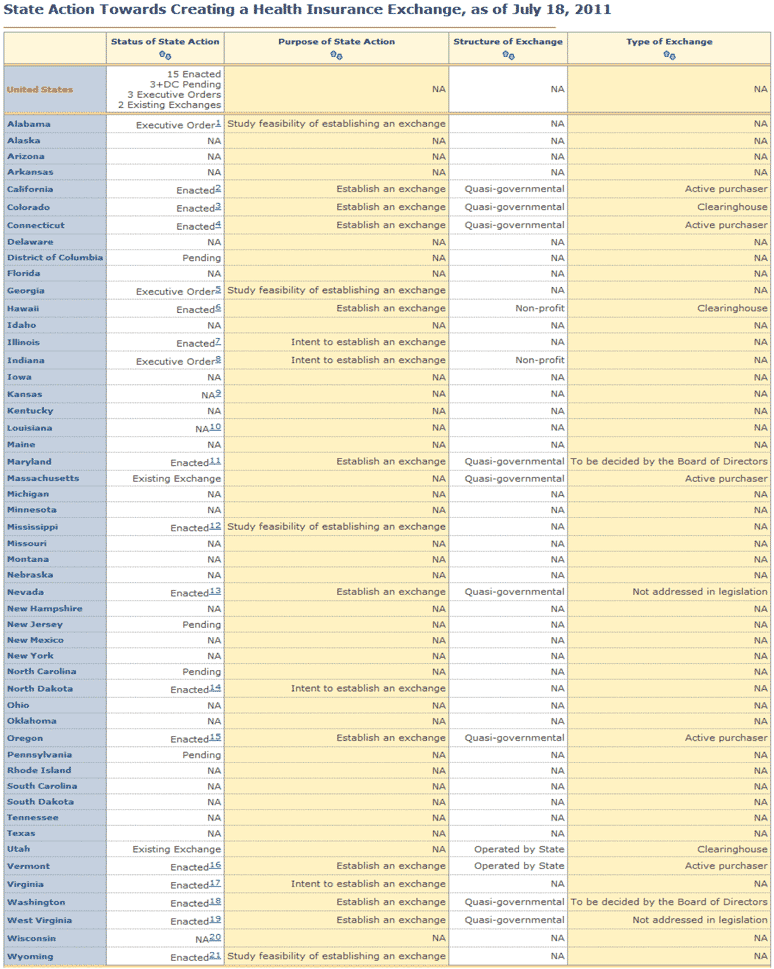
This means, for example, that states will have a high degree of discretion in deciding whether to take a more free market or more regulatory approach in moderating the growth in health insurance premiums. Under any scenario, plans offered in exchanges will be run by private insurers. But, a state can choose to create a more powerful, highly-regulated exchange, one that is part of state government and has the authority to negotiate premiums and selectively-contract with insurers. Or, a state could build a less-constrained marketplace, operated by a non-profit exchange that acts as an Amazon.com-like clearinghouse for any insurer that meets minimum requirements. States looking to take a more regulatory approach with exchanges can also give their insurance departments the authority to disapprove unjustified premium increases. The health reform law requires the review and public disclosure of large rate increases, but it’s up to states whether to go further. The Administration also gave states and employers wide latitude in recent guidance on the rights of consumers to appeal denials of coverage for medical services. At the end of this column is a chart showing where each of the states stand with regard to the implementation of their exchanges and whether they are tilting towards a more proactive exchange or more of a clearinghouse model.

Politically, being less prescriptive on issues like this is generally a plus with well-funded interest groups, and placating them can lower the temperature of their criticism of the law. But for voters themselves, there’s rarely a downside to strengthening consumer protections, which polls show are very popular and can be real selling points for a law that needs them.

The dynamics of how all this will play out in the states, though, is not so simple.

It is an iron law of federalism that any time you give states wide discretion in carrying out a law, you get wide variation in performance. Some states will do exceptional things and, as pacesetters, point the way for future policy; some states will perform poorly, or in this case, potentially refuse to implement at all (they will require the most attention from the Federal Government and will get the most press attention); and most states will fall somewhere in the middle.

States almost always say they want greater flexibility, and more often than not they do (even more, they want more federal money). But if you have been a state official, as I have, you know that inside a state attitudes about federal rules are often more nuanced and complex. Sometimes states want flexibility and sometimes they want clear and even binding federal rules, depending on the circumstances and the viewpoint of different players at the state level. For example, a Democratic state executive branch that is friendly towards the health reform law and desires a robust exchange might welcome very detailed federal rules if it is faced with a conservative legislature. A governor or cabinet officer can then turn to that legislature and say: “we have no choice; our hands are tied by the federal regulations.” By contrast, a state with Republican control of both the executive and legislative branches might want as much flexibility as possible to implement the kind of exchange they prefer. Differences within branches of state government are also possible. Insurance commissioners or other cabinet officers might benefit from detailed regs that support the direction they want to go, in either Republican or Democratic states. I often did when I was in state government.

In Washington and in the national press, governors typically represent the public face of states on issues such as these. Inside a state, there are multiple players with different points of view on substantive issues and on how much flexibility the Federal Government should provide. Today twenty states have Republican governors and legislatures. No doubt most of those states prefer flexible rules.  Eighteen states are divided and eleven states have Democratic control of both the executive and legislative branches of government (Nebraska has a Republican governor and a technically nonpartisan, but mostly Republican, legislature). Thus, in as many as twenty nine states, and possibly more, there may be a constituency of some kind for more prescriptive federal rules that ensure a more assertive approach to consumer protection and cost containment by state government.

One reason to build flexibility into a regulation like this one is simply to be practical about implementation. Timetables, such as the requirement that all states have clear plans for their exchanges by 2013, often slip in the real world and it can be wise, as in soccer, to build in some extra stoppage time rather than sacrifice the successful implementation of a program. Another reason to delay or water down regulations is classic pressure from interest groups like insurers or the business community. The degree to which that played a role in this case is not known. We do know that virtually all of these consumer-oriented provisions in the law are popular with the public. To oversimplify the essential tradeoff: The more you strengthen the regulatory aspects of the law the more vulnerable you may be to interest group criticism, but the more tangible benefits and protections you will have to sell to a public looking at the ACA and trying to answer the question, “how will this help me.” It is important to remember that these are draft regulations, and changes can be made as the process moves along.

Many years ago I published a study of the regulation writing process in health. It was at a time when congress began drafting longer and more detailed statutes in order to limit administrative discretion in writing regulations. Among other things, the study documented the perfectly obvious: Writing regulations is not a technical process; and politics, interest group bargaining and policymaking continues after the passage of a statute throughout the process of promulgating implementing regulations. The bottom line in cases like these is always that there is inherent tension between writing regulations that preserve the intent of a law to the letter — or sometimes even try to use administrative powers to go beyond it — and managing the intricate interplay of partisan politics, interest group lobbying, public opinion, and state capacity to actually carry out the law. Where the tradeoffs between these competing pressures are made is the art of implementation and in many cases not everybody can be satisfied.

Click on the table for more information about exchanges on Kaiser’s statehealthfacts.org

PIT071911_2_1.gif

Source: Statehealthfacts.org