Living Close to the Edge: Financial Challenges and Tradeoffs for People on Medicare

Published: Jun 28, 2011

As Congress and other policymakers weigh potentially major changes to the Medicare program as part of the deficit-reduction debate, this Kaiser Family Foundation report highlights the role Medicare now plays in the lives of beneficiaries and the challenges many face in paying for their health care and other living expenses on a fixed budget.

Based on detailed profiles of 16 Medicare families, the report examines beneficiaries’ incomes, retirement savings and routine expenses, including health care and insurance premiums, housing, transportation, food, gas and utilities. Half of the families profiled in the report have incomes below twice the federal poverty level – under $22,000 for an individual – the same share as in the total Medicare population.

A companion documentary video, “Making Ends Meet: The Medicare Generation,” highlights the experiences of three of the profiled families.

The report and video were released at a June 28, 2011, briefing focused on how Medicare reform options now under consideration might work and their implications for beneficiaries and taxpayers.

Report (.pdf)

Documentary: Making Ends Meet: The Medicare Generation

Webcast of June 28, 2011, briefing

Pulling It Together: Changing the HIV Testing Message

Published: Jun 27, 2011

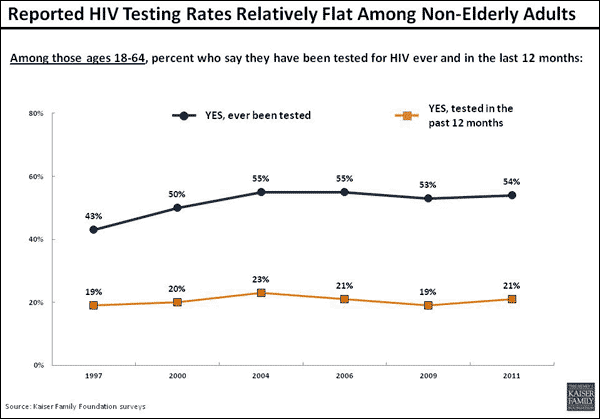
In 2006 the CDC began recommending routine HIV testing in health care settings for everyone between the ages of 13 and 64. Annual  testing is recommended for people at highest risk. Our 2011 survey of Americans and HIV released last week — our eighth comprehensive survey of its kind —  shows that more people are talking with their doctors about being tested for HIV, but that reported rates of actually getting tested have remained virtually flat for many years.

pit062711_1_2.gif

As a result, the CDC says that 21% of the more than 1.1 million Americans with HIV do not know their status. This means they are not getting ever more effective treatments that can forestall the onset of AIDS and delay or stop the progression of the disease. They are potentially unknowingly passing the virus on to their partners.

People in higher risk groups are a special concern (we could not survey all of the highest risk groups).  Forty-three percent of non-elderly African Americans report being tested in the last year (and 77% ever); 47% of African Americans ages 18-29 (71% ever); and 26% of all adults ages 18-29 (48% ever). In addition, 45% of African Americans 30-49 report being tested in the last year.  These rates are generally somewhat higher than for the public as a whole, but they have also remained stubbornly flat in recent years. It is reasonable to ask what the achievable testing rate is for any population group given barriers to testing such as stigma, denial of personal risk and obstacles to access to care, but now there are new reasons to do better.

Just last month, researchers found that HIV-positive people who take combination antiretroviral therapy (ART) can reduce the risk of transmitting the virus to their HIV-negative partners by 96 percent. We have known for a while that getting HIV-positive people into treatment can save their own lives. Now there is a broader public health benefit to getting people at-risk tested and into treatment. Doing so would not only help those individuals and their partners, but potentially change the course of the epidemic throughout a community.

So, what can be done to get HIV testing rates moving up?CHANGE THE MESSAGE. Great emphasis has been placed for many years on making testing a routine part of people’s interaction with the medical system. This was originally part of a strategy to counteract stigma by making it easier and more routine to get an HIV test. The approach helped push testing rates up initially (the fact that 48% of young adults have been tested at some point in their lives is a public health success), but now years of flat testing rates suggest that something new is needed.

The research we now have on early detection and treatment offers a powerful new public health imperative for increasing the number of at-risk people who get tested. It also presents an opportunity to turn the HIV testing message on its head: from a “routine” part of a medical visit, to a proactive, even urgent message that gives people at risk a reason to want to be tested despite the barriers they sometimes face. The fact now is (and the message can be), that “HIV NEED NOT BECOME AIDS ANYMORE IF IT IS DETECTED EARLY”.  People at risk, and their partners, now have a real incentive to overcome stigmatizing attitudes and denial of risk, but only if they know clearly what early detection and treatment can do.

EXPAND THE MEDIUM FOR THE MESSAGE. A more assertive testing message should work equally well for all testing “messengers” – physicians, family, friends and partners, community-based services providers, and the media. Providers are important messengers and medical settings are a key part of a multipronged strategy, but despite the emphasis on testing in medical settings they may not be the most important part.

Many of the most at risk groups avoid institutional settings (who can blame them?), and do not have medical encounters in any given year. In 2008, the last year for which there are national data, 42% of 18-29 year olds and 52% of African American 18-29 year olds did not visit a medical office, clinic or outpatient department during the year.  A third of African American 18-29 year olds did not have a visit in the previous two years.

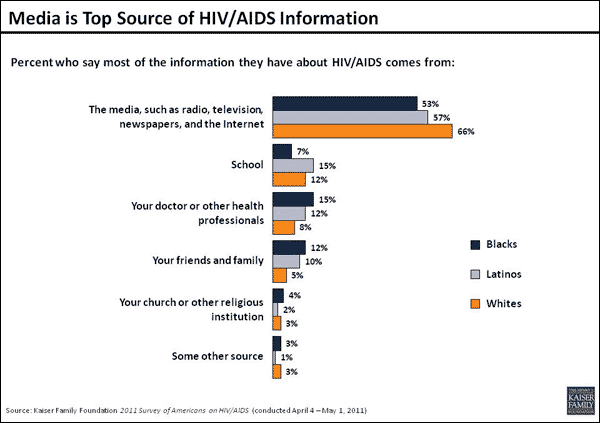
First and foremost, and I suppose for better and worse, people get their information primarily from media. In our new national survey people of all ages said the media was their number one source of information about HIV/AIDS, far ahead of schools, family and friends, and notably, physicians. They also said they wanted more information about HIV, including about testing. Medical settings and medical providers are a vital part of any testing strategy, but the data suggest that the media is our single most important messenger when it comes to promoting HIV testing. And based on my experience developing and operating prevention programs over thirty years, I personally believe that community based programs are most effective when it comes to reaching highest risk groups.

PIT-2_2.gif

TARGET,TARGET,TARGET. Everybody involved in HIV/AIDS knows that a key to slowing the epidemic is to more effectively reach the highest risk groups and communities. So too, there is a need to target testing messages to the most at risk groups and communities.  The new national HIV strategy developed by the Obama Administration, for the first time, recognizes this by calling for focusing HIV/AIDS resources overall on populations and areas of greatest need as a matter of national policy. Recently, the CDC mounted a focused effort to intensify testing in areas with higher infection rates, producing good results.  It was noteworthy that inthe CDC initiative the chance of finding someone positive was about twice ashigh in nonmedical sites as in medical ones.

It was not good news to see in our new survey that HIV testing rates remain flat, even for higher-risk groups. But there is now a new imperative to change the testing message, potentially saving the lives of individuals at risk while at the same time changing the course of the epidemic in the most hard hit communities. I cannot, of course, be sure how effective a more proactive testing message will be unless we try it. But we know that testing rates for the higher risk groups have not moved in years and the research on early detection and treatment has now reached a stage where a new message that gives people a reason to want to be tested makes sense. It should be one that reaches out to people and communities at greatest risk and is less dependent on finding them in medical settings.

AIDS At 30: The U.S. Epidemic

Published: Jun 21, 2011

“AIDS at 30: The U.S. Epidemic” chronicles the thirty years since the first cases of a rare pneumonia found in young gay men were reported by the U.S. Centers for Disease Control. This four minute video highlights landmarks in the history of AIDS from the discovery of the AIDS virus and the banning of Ryan White from attending school to the early twenty-first century when the CDC recommends HIV testing for virtually every American.

News Release

Walgreens, Ebony Encourage Americans to “Be Greater Than AIDS”

Published: Jun 21, 2011

NEWS RELEASEJune 21, 2011

Free HIV Testing, Targeted HIV/AIDS Resources at Walgreens Stores in Heavily Affected Areas

Walgreens is teaming up with Greater Than AIDS, a national campaign in response to HIV/AIDS in the United States, to distribute informational resources and specialized HIV-related services at more than 300 Walgreens pharmacies in heavily affected communities. At these specialized pharmacy locations, Walgreens has pharmacists on hand to offer one-on-one medication counseling and other support services that provide customers living with HIV/AIDS — and their families — with compassionate, confidential care. Free rapid oral HIV testing will also be available at select Walgreens locations from June 22 to 24, 2011, with technical support and guidance from the U.S. Centers for Disease Control & Prevention (CDC) and test kits from OraSure Technologies. State and local health departments and community-based organizations in the local markets are conducting the tests and providing pre- and post-test counseling.

According to the CDC, more than one million Americans are living with HIV today, yet 1 in 5 of those infected doesn’t know their status. And, one-third are diagnosed so late in the course of their infection that they develop AIDS within one year. The CDC encourages all Americans to get tested.

“Despite overwhelming evidence that early diagnosis and treatment play an important role both in the health of those who are positive and in reducing the spread of HIV, many Americans at highest risk for infection still have not been tested,” said Tina Hoff, Senior Vice President and Director of Health Communication and Media Partnerships at the Kaiser Family Foundation, a co-founding partner of Greater Than AIDS. “The commitment by Walgreens to bring HIV information and testing into the pharmacy setting helps to reduce the stigma associated with HIV and make testing more accessible for those who may not have access to traditional healthcare settings.”

“Access to testing, education and care are critical when it comes to the treatment and prevention of this complex condition,” said Walgreens manager of specialized disease state programs Glen Pietrandoni. “This month marks 30 years since the first case of AIDS and ever since, Walgreens has been a trusted resource. As a pharmacy focused on meeting our customers’ health and daily living needs, Walgreens is committed to providing services and support in communities highly impacted by HIV.”

Additionally, EBONY, a publication of Johnson Publishing Company, Inc., has partnered with Greater Than AIDS and Walgreens to produce a special Be Greater Than AIDS informational guide to be distributed in 1.6 million copies of the July issue of the magazine, reaching an estimated 11 million readers. One million additional copies of the guide, which includes information about HIV testing and tips for talking with partners and health care providers, will be distributed free in select Walgreens stores and by AIDS service organizations and other community groups. EBONY also supports Greater Than AIDS with ongoing PSA placements and special editorial content on HIV/AIDS.

“We are determined to increase awareness and reduce the spread of HIV in the black community,” said Amy DuBois Barnett, Editor-in-Chief, EBONY magazine. “As the magazine with the furthest reach in black America, we at EBONY believe it is our responsibility to address the fact that more than half of the approximately 1.1 million people living with HIV in the United States today are black Americans by empowering our community with the information and tools necessary to protect their health. We hope the ‘Being Greater than AIDS’ guide will help to achieve that goal.”

“We have the tools to end the AIDS epidemic as we know it. We know how to diagnose those who are infected, identify the communities most heavily affected, prevent transmission, and prevent acquisition of the virus. Dramatically expanding HIV testing and linkages to care is a critical step toward that end,” said Phill Wilson, President and CEO of the Black AIDS Institute, a co-founding partner of Greater Than AIDS. “The Black AIDS Institute is proud to partner with Walgreens, Johnson Publishing Company, and the Kaiser Family Foundation to raise awareness and expand access to HIV testing in our communities.”

A new national survey released today by the Kaiser Family Foundation indicates Americans, and especially black Americans who are among those at highest risk for HIV, want to know more about HIV testing, including who should get tested (42% overall, 63% black Americans) and where to go to get tested (38% overall, 58% black Americans).

The Walgreens/Greater Than AIDS partnership includes:

  • WALGREENS “TAKE ACTION” CAMPAIGN: Starting this month, more than 300 specialized Walgreens locations in highly impacted neighborhoods will place co-branded Greater Than AIDS signage and other informational products to open up the dialogue about HIV/AIDS and encourage customers to get tested. In addition to the in-store messages and materials, Walgreens has placed targeted ads featuring a Greater Than AIDS message in OUT, The Advocate, MetroSource, and LOGO TV.
  • FREE HIV TESTING: In the lead-up to National HIV Testing Day (June 27), select Walgreens locations in major markets will offer free testing as part of the partnership with Greater Than AIDS and in coordination with the U.S. Centers for Disease Control & Prevention (CDC), OraSure Technologies, the National Association of People with AIDS (NAPWA), state and local health departments, and AIDS service organizations. Testing events will take place Wednesday, June 22 to Friday, June 24 from 3 p.m. to 7 p.m. local time inside select Walgreens retail locations in Atlanta, Chicago, Dallas, Houston, Ft. Lauderdale, Miami, New Orleans, Oakland and San Francisco. For a complete list of participating stores, visit: www.greaterthan.org/walgreens.
  • EXPANDED ONLINE CONTENT: Together with Greater Than AIDS, Walgreens has expanded its online informational content related to HIV and AIDS. The expanded site (www.greaterthan.org/walgreens) also offers a testing center locator, tools and resources for community groups to get involved in response to the HIV/AIDS epidemic, and other content for people who are seeking basic information about the disease.

About Greater Than AIDS

Greater Than AIDS is a collaboration among a broad coalition of public and private sector partners united in response to the HIV/AIDS crisis in the United States, in particular among Black Americans and other disproportionately affected groups. Through a national media campaign and targeted community outreach, Greater Than AIDS aims to increase knowledge and understanding about HIV/AIDS and confront the stigma surrounding the disease. www.greaterthan.org

The Kaiser Family Foundation — a non-profit private operating foundation dedicated to producing and communicating the best possible information, research and analysis on health issues — provides strategic direction and day-to-day management, as well as oversees the production of the media campaign. The Black AIDS Institute — a think tank exclusively focused on AIDS in Black America — provides leadership and expert guidance and directs community engagement. Greater Than AIDS is developed in support of Act Against AIDS, an effort by the U.S. Centers for Disease Control and Prevention (CDC) to refocus attention on the domestic epidemic. Additional, financial and substantive support is provided by the Elton John AIDS Foundation, Ford Foundation and MAC AIDS Fund, among others.

About Walgreens

Walgreens (www.walgreens.com) is the nation’s largest drugstore chain with fiscal 2010 sales of $67 billion. The company operates 7,714 drugstores in all 50 states, the District of Columbia and Puerto Rico. Each day, Walgreens provides nearly 6 million customers the most convenient, multichannel access to consumer goods and services and trusted, cost-effective pharmacy, health and wellness services and advice in communities across America. Walgreens scope of pharmacy services includes retail, specialty, infusion, medical facility and mail service, along with respiratory services. These services improve health outcomes and lower costs for payers including employers, managed care organizations, health systems, pharmacy benefit managers and the public sector. Take Care Health Systems is a Walgreens subsidiary that is the largest and most comprehensive manager of worksite health centers and in-store convenient care clinics, with more than 700 locations throughout the country.
An Employer Health Benefits Balance Sheet

Published: Jun 17, 2011

There seems to be growing interest in the question of how many employers will keep offering coverage to their full-time employees once the Affordable Care Act (ACA) is fully implemented in 2014, or instead will choose to stop offering coverage and pay a penalty.

While there is some good analysis and plenty of conjecture, it is impossible to predict with any certainty how employers will react at this moment because some of the key rules that will inform their decisions have yet to be issued, including:

  • What benefits larger employers would need to offer to meet the employer requirement
  • How nondiscrimination rules will work, which dictate whether and how employers can structure different benefit plans and different contribution levels for different types of workers within the firm
  • What the structure and scope of benefits will be for coverage offered through new insurance exchanges, which is where employees and their families would seek coverage if their employer stopped offering it.

It’s useful to remember that employers offer health benefits to attract and retain workers, so how employers will react will depend at least in part on what their workers want them to do, which in turn will depend on how workers will weigh the cost and quality of the different options. And these options are not entirely clear at this point. In addition, there are lots of other changes employers may make short of not offering insurance, such as increasing or decreasing benefits or cost sharing, changing how much they contribute, changing who is eligible for coverage, changing some jobs to part-time status, etc.

Given all of these uncertainties, precisely estimating how many employers will respond one way or another is difficult. But it’s helpful to look at some of the key factors that an offering employer might consider in deciding whether to continue to offer health benefits, almost as a sort of balance sheet from the perspective of employers and their workers:

FactorContinue Offering BenefitsDrop Benefits
Employer and Employee CostsToday, employers that offer coverage generally contribute most of the cost for employees but less for their families. Employees pay the rest.Employees would still have to buy insurance, but without the employer contribution.Employers would save money as a result of no longer contributing towards the cost of insurance. What would happen to those savings is an open question. Economic theory suggests that the savings would largely get returned over time to employees as higher salaries (though maybe not equally to higher and lower wage workers). This could vary from employer to employer depending on how competitive the market is for skilled workers.
Tax Subsidies and CreditsThe employer contribution to health benefits is tax-free to workers. Employees can also pay their shares on a pre-tax basis through a so-called section 125 account. The tax-preferred status of employer-provided health coverage is a particular benefit for higher-income employees in high tax brackets, with the government in effect paying for a substantial portion of the cost.There would be no way for workers to buy health insurance on a tax-free basis, but low- and moderate-income workers would be eligible for tax credits if they bought insurance in an exchange. Workers and family member would face a financial penalty if they did not buy coverage (if it’s affordable to them).
PenaltiesLarger companies with at least 50 employees offering coverage face a penalty of $3,000 per work in cases where coverage is unaffordable and the worker buys insurance in an exchange with the benefit of a tax credit. Employers can avoid the penalty by offering coverage meeting certain requirements.Larger companies not offering coverage would face a penalty equal to $2,000 per year times the number of full-time employees minus 30. This flowchart illustrates how it works.
MedicaidEmployees and their families eligible for Medicaid — which is expanded under the health reform law — can choose to enroll in Medicaid whether the employer offers health benefits or not.
Predictability of CostsEmployer costs for health insurance are highly unpredictable.Costs for non-offering employers would be more predictable. But companies in markets where they are competing for skilled workers may be cautious about dropping benefits until they see how the exchanges are working.
Benefits PackageSmaller employers providing coverage must offer the essential benefit package (regulations not yet issued); minimum benefit requirements for larger employers and all employers that self-fund are not clear in the law and may be addressed by regulation.Workers receive the essential benefit package (regulations not yet issued) if they buy coverage themselves; may be eligible for cost-sharing subsidies if family income is below 250% of the poverty level and they buy coverage in an exchange.

The dollars and cents part of a decision like this is fairly easy to quantify, particularly after some of the regulatory issues described above are resolved. For larger employers with reasonably-paid employees, it’s likely that it will still make financial sense for them to offer coverage. The existing tax subsidy their workers get for employer-provided health insurance will likely outweigh the combination of the tax credits that would be available for workers in the exchanges and the penalty the employer would have to pay for not offering coverage. These types of companies tend to offer good benefits already, so the outstanding regulatory decisions will probably not have a big impact on their choices. On the other hand, for employers with many lower-wage employees — including such places as restaurants and retail stores — the picture is cloudier. Some of these companies provide pretty limited coverage to their lower-skilled employees, while in some cases providing better benefits to managers and other office employees. It’s unclear whether they will be able to continue this in the future. Even if firms are permitted to maintain limited coverage for their employees, some will find that the balance sheet tilts towards not offering coverage because the new sliding scale tax credits available to their predominantly lower-wage employees in exchanges will far exceed the current tax subsidy for employer-based insurance.

The idea of an employer dropping health benefits sounds like a bad outcome. And under the status quo, it is workers lose the ability to get health insurance on a tax-free basis and they can be denied coverage in the individual market if they have pre-existing health conditions. After 2014, though, things change quite a bit. The coverage in the individual market will offer the same protections as in the group market, and tax credits will be available in exchanges for people with incomes up to four times the poverty level (now about $89,000 a year for a family of four). Really what happens is that the employees move from being covered by a private employer-based plan subsidized through a federal (and often state) tax subsidy to a private plan subsidized through a federal tax credit. The company and its workers are making a decision about which form of tax subsidy provides the best value, something that employers and others do every day. The penalty for non-offering large employers tilts the playing field somewhat towards employer-based coverage.

Beyond the dollars and cents, the intangibles around employer decisions to keep offering health benefits are tougher to assess. We don’t yet know exactly what exchange coverage will look like and whether employees with employer-based insurance will view it as a reasonable or even desirable alternative. Will employees be willing to give up something they know for something new? Or, will a good job mean one that still comes with health benefits? For the answers to these questions, we’ll likely have to wait until 2014 and beyond, as employers consider their options — probably very cautiously — while looking behind their backs at competitors doing the same thing.

– Gary Claxton and Larry Levitt

Pulling It Together: Medicare, Medicaid, and The Multiplier Effect

Published: Jun 9, 2011

We are witnessing a battle in Washington right now about the future of health care’s two big public programs, Medicare and Medicaid. It’s a budget battle, it’s an ideological battle, it’s a partisan political battle, and while it might not always be obvious following the debate, it’s a high stakes battle for people. In 2011, over a hundred million low-income, disabled, and elderly beneficiaries will be served by the two programs.

Many of the proposals being discussed are not entirely new. Premium supports and vouchers for Medicare have been proposed many times in the past dating back to the Reagan years, and the idea of converting Medicaid to a block grant has been around in one form or another for decades. Each debate in each era has unique attributes (the rise of the tea party, the size of the deficit and the game of chicken surrounding the debt ceiling seem to be big factors now), but over time we have learned a few things about proposals to make large scale changes in health care’s two big public programs. Big public programs that distribute benefits to lots of people are hard to cut. They are even harder to restructure in fundamental ways. They are somewhat easier to expand because people welcome new benefits, although paying for new benefits is often a real challenge.

There are varying reasons why these big health programs have such staying power. They serve a lot of people (48 million on Medicare this year and an estimated 69 million on Medicaid during 2011, including 9 million people covered by both programs, known as dual eligibles).  They deliver benefits people greatly value. Their beneficiaries often have political clout, especially Medicare beneficiaries because seniors are much more likely to vote than the rest of us are. They can have influential constituencies, especially the providers, pharmaceutical companies and other suppliers who depend on both programs. There are elected officials and advocacy groups in Washington who are deeply committed to the purposes of both programs (just as there are elected officials who would like to dismantle them).

But there is another source of the staying power the two programs have which has not received much attention. Their base of support is much broader than we realize.  I call it the “multiplier effect.”

In thinking about how much the public values a program, you have to consider not just the people on the program itself, but also the experiences of their family members and friends. And, you have to look at experiences over time, because you or a family member or close friend may have had a positive (or negative) experience on a program ten years ago or more that shapes your view of it today.

Think about how you would assess the value of a program or evaluate a proposed policy change such as premium support or a block grant. You might not be a program beneficiary yourself, but if it benefited your kids or a parent or a close friend, or if you believed it threatened benefits critical to their health, that would shape your view of the program and what policy changes might or might not be acceptable to you whether or not you were personally affected. Alternatively, if a family member or close friend had a bad experience on a program that could influence your view as well.

Now, with the multiplier effect in mind, let’s do some math.  Among the nonelderly in 2006, at least 57% have participated in Medicaid sometime during the previous two decades or lived with someone who participated in Medicaid during that period. (We use 2006 and go back two decades because these are the only available data). When you look at a program like Medicaid this way, you discover that more than half of the American people have been touched directly by the program or indirectly through someone they have lived with and care about. These numbers don’t count relatives outside of the household or friends because we do not have data on that. The 57% number, which comes from our analysis of the University of Michigan Panel Survey of Income Dynamics, paints a similar picture to a recent finding from our tracking poll. We found that 51% of the adults reported that they or a family member or friend had at some time received help from the Medicaid program, with most reporting a positive experience (not surprisingly, the biggest problem reported was finding a doctor).

The multiplier effect for Medicare should be obvious, but it also helps explain why the program is nearly sacrosanct. Because Medicare is a universal program for people over age 65 (and people who are disabled), nearly everyone will eventually be on Medicare.  In 2008 (the most recent year we have data about the family status of Medicare beneficiaries), there were about 75 million children of Medicare beneficiaries, plus about 4 million spouses who were not themselves on the program. That is in addition to the 48 million current beneficiaries. So counting the multiplier effect for family members (and excluding friends), Medicare touched the lives of more than 125 million Americans that year, not the 48 million we normally think about. And this definitely understates the effect.  For example, many Medicare beneficiaries have grandchildren who are involved in their lives. The multiplier effect can also apply to parts of programs. For example, the 8 million people under age 65 who are covered by Medicare because they are disabled may have children and parents who are concerned about Medicare.  We know that Medicare beneficiaries are resoundingly positive about the program and protective of it. The reach of the program and its base of support is much broader than we think.

Many factors influence public reactions to policy proposals, including ideology, partisan affiliation and media coverage. But personal experiences – and those of people you care about and trust – can powerfully affect how people view a major change in a public program like Medicare or Medicaid. So, when you think about the reaction to a big policy proposal like premium support for Medicare or a Medicaid block grant (or other big programs like Social Security), remember to look beyond the narrow constituencies and voting blocs and multiply, because that’s what voters will be doing.

The Nuts and Bolts of Medicare Premium Support Proposals

Published: Jun 8, 2011

In April 2011, as part of its 2012 budget resolution, the U.S. House included a proposal to reduce Medicare spending by transforming the program into a system sometimes called “premium support” or vouchers. Such an approach also has been a central element of other proposals by national leaders seeking to reduce the federal deficit and national debt.

This Kaiser Family Foundation brief reviews the evolution of the premium support concept, examines key policy decisions and issues that would affect its impact, and considers the implications for both Medicare and beneficiaries’ out-of-pocket spending. It looks at several key issues, including how the government’s contributions would be set and adjusted over time; whether and how those payments would vary based on beneficiaries’ age, income, health status and geographic location, and the extent to which enrollees’ costs could vary accordingly; the role of the current traditional Medicare program, if any; and the core requirements for plans, such as whether they would be required to provide a defined set of benefits or whether they would be permitted to vary premiums based on age.

The brief was authored by researchers at the Health Policy Alternatives Inc. It is a product of the Kaiser Project on Medicare’s Future, which focuses on producing timely analysis of leading reforms affecting people on Medicare.

Issue Brief (.pdf)

Health Reform and the Art of Federalism

Published: Jun 8, 2011

The U.S. Department of Health and Human Services (HHS) recently announced significant changes to the premiums charged in the Pre-existing Condition Insurance Plan (PCIP), aka the “high risk pool” created by the Affordable Care Act. Premiums will now be up to 40% lower depending on the state (in some states the cost to enrollees is unchanged), and application procedures will be eased.

The PCIP plans provide coverage for people who cannot buy coverage in the non-group market because they have pre-existing health conditions. Most states allow insurers to deny coverage or charge higher premiums based on health status, a practice that will change in 2014 when the main elements of the ACA take effect. Under the PCIP, people who are uninsured and have pre-existing health conditions are able to buy coverage at premiums that match the standard rates for non-group coverage where they live. The federal government pays any costs that exceed the amount collected through premiums.

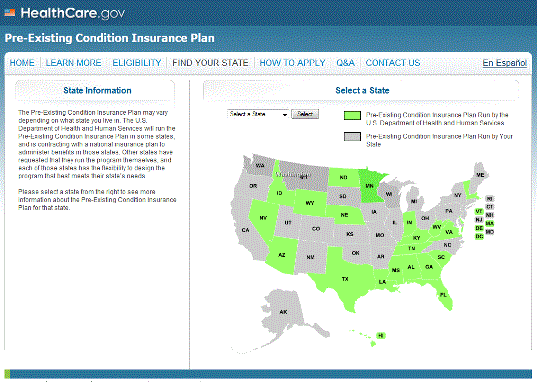
There’s a small catch, though. The premium reductions in the PCIP only apply in 23 states and the District of Columbia, where states chose not to operate the high risk pool and left it up to the federal government. For the other 27 states (see the map below from the federal government’s healthcare.gov web site), the news release announcing the changes said that HHS sent letters to the states running their own programs to inform them of the opportunity to modify their current PCIP premiums.

Pre-existing Condition Insurance Plan

This is an early sign of the tension inherent in the basic structure of the health reform law: in many cases, there’s an expectation and hope that states will take the lead on implementation, but the fallback is that the federal government will do so if not. One key factor in how this will all play out is whether the federal  government judges state plans strictly or give them lots of wiggle room.

In the case of this latest announcement on the PCIP, the federal government seems not to be requiring states that operate their own programs to reduce (or at least review) the premiums that are charged, instead giving them the opportunity to do so. As a result, it is possible that consumers in states where the federal government operates the high risk pool will be better off than consumers where states have assumed that task, even though the federal government is paying all of the subsidies in both cases.

This federal-state tension permeates the health reform structure, where states are given the opportunity to implement (and sometimes exceed) federal standards and where the federal government will have to make judgments about how strict or flexible to be with the states. Next up may be the prior review of unreasonable premium increases in the non-group and small business insurance markets. Also on the horizon are programs that allow enrollees in insured health plans to appeal a denied claim to an external reviewer. And, of course, what states decide to do in creating health insurance exchanges.

In all these cases, the federal government will have to judge whether state programs meet the applicable federal laws and regulations, and to step in with a federal program if not.

States all have their own policy preferences and politics. There are likely to be cases where states decide to implement the federal rules almost to a tee and others where they decide just to take a pass and let the federal government implement certain provisions. But there may also be cases in between where states mostly follow the federal framework, but then diverge somewhat, maybe in minor ways or maybe in major ways that have significant consequences for consumer protection or federal costs (the federal government pays all of the premium and cost sharing subsidies authorized by the ACA). What will the federal government do? Let the state slide? Or, declare the state out of compliance and put in place a federally-operated program?

Larry Levitt

Peering Into the Black Box of Insurance Rating

Published: Jun 7, 2011

Recently, the New York Times reported that private health insurers continue to seek large premium increases despite seeing lower than expected use of medical care and booking record profits. The story highlights a significant problem for health policy: the lack of good, public information about how health insurers manage health care use and what they pay for medical services. As a nation, we rely on competition among largely private health plans to ensure that health care dollars are used efficiently and wisely, but truth be told, we do not know very much about how well they are doing.

Finding ways to meaningfully reduce the growth of public and private health care costs continues to be a vitally important issue for public policy. The growth of public health spending has dominated the recent debate about ways to reduce federal and state budget deficits, and critics of the newly adopted health reform act complain that it does not sufficiently address growth rates for private health care costs.

But it is difficult to develop public policies that might affect private health care costs without a good understanding of where the money goes and what the cost drivers really are. Unlike public programs, where cost and service use can be analyzed in some detail to inform policy decisions, public information about private health spending is mostly based on aggregate measures such as premiums or gross provider receipts. Details of private health transactions are largely held inside private insurers and away from public view. Public confusion and consternation over recent large rate increases in the nongroup market are a good example of this problem: despite intense public and political interest, there still is no answer to the question of why some nongroup carriers have repeatedly requested double-digit rate increases while other measures of health care costs, such as average premium changes for employer-based coverage or overall trends from the national health accounts, show much lower rates of growth.

This lack of information is not just a problem for policy, but it also limits the ability of policyholders to understand their insurance arrangements. This can be a particular problem today for people with nongroup insurance, who have the right to renew their policies but who may not be able to switch insurers if they have developed health problems. While insurers often point to underlying medical costs as the reason rates are going up, there are many decisions that insurers make that affect the premium increases that these individual consumers see. For example, insurers decide which policies are grouped together for rating purposes and when to stop selling a policy and begin selling new ones (which affects the quality of risk pools). Some insurers vary premium increases for nongroup policies based on how long a person has held the policy (called durational rating) or even on the policyholder’s claims in the prior year. Details about these practices often are not clearly explained to policyholders, leaving them confused about their premiums and how they may change in the future.

While not a complete answer, the rate review provision in the Patient Protection and Affordable Care Act (ACA) could provide a way for consumers and the public to see beyond premiums and to learn something about underlying health care cost trends for different services and about insurer practices and performance. The ACA requires that proposed premium rate increases that are unreasonable be reviewed and justified before they become effective. A thorough rate review involves assessing the level of use and per service cost for the major types of health care services and analyzing the impacts of insurer practices and other important factors that affect the premiums charged under a policy or group or policies. Having this type of detailed information from different insurers across different markets would assist analysts and policymakers trying to better understand what is driving the use and cost of medical care services, while the detailed explanation of rating factors and rating practices would help consumers understand whether the increases they are seeing reflect cost trends affecting all policies or particular decisions made by their insurer.

Final rules just released by the Centers for Medicare and Medicaid Services (CMS) require that a proposed rate increase in a state that exceeds a threshold amount (initially 10%) be reviewed before it takes effect to determine if the proposed rate is unreasonable. The review will be conducted by the state if it has an effective rate review process (as defined in the rule) or otherwise by CMS. Insurers are required to submit a preliminary justification providing summary information and a basic explanation of the reasons for the increase. This information will be made available to the public. In cases where CMS, rather than a state, is reviewing the increase, the insurer will also need to provide more detailed information and data to support the proposed increase. This additional information will also be provided to the public, subject to provisions in the Freedom of Information Act limiting the release of trade secrets. States conducting reviews could, but are not required to, make available to the public the more-detailed information that they receive in the course of their reviews.

The ACA and the final rule start down the road of making insurer experience and operations more transparent, but they stop short in many instances of providing the type of detailed information needed to support informed analyses of cost trends and market practices. One issue is the ACA itself, which limits review to unreasonable rate increases (CMS estimates that only about 14% of rate filings in the nongroup and small group market would be be subject to review and require submission of a justification). A second issue is that the information that must be disclosed under the rule is fairly simplistic in cases where states perform the review instead of CMS. For example, the consumer disclosure form developed by CMS requires insurers to disclose the expected cost trend for specific types of medical services (e.g., hospital inpatient, professional), but for rate increases that are reviewed by states, the list is not broken down by expected change in use and expected change in price for each type of service. This is pretty basic information for trying to understand how costs are changing and how insurers are reacting: changes in price raise issues about how much providers are charging for their services and how much insurers are willing to pay, while changes in use raise questions about the number and kinds of services that providers are ordering and insurers’ abilities to manage them. And while the disclosure form does require a brief, non-technical description of the proposed increase in these cases, including how changes in cost and use are contributing to the increase, the description appears to be intended for a consumer audience and is unlikely to be sufficiently detailed to support more detailed analyses by service type. Other important elements of the rate increase, such as the financial history of the product, are also addressed in this “brief, non-technical” way. CMS does require much more detailed information and explanation to be filed and potentially disclosed in cases where they will be performing the review, but they estimate that they will perform reviews for only 28% to 36% of rate filings requiring review.

The final CMS rule directs the policy focus back on the states. In the past, getting information on rate actions has been difficult in many states, but this has been changing. A few states have increased public access rate filings since passage of the ACA, and grant funds from CMS may assist more states in doing so. The release of the final rate review rule may encourage more states to open up their rate review processes to shed more light into the black box of how health insurers set premium increases.

– Gary Claxton

Who Will be the H&R Block and TurboTax for Health Insurance?

Published: Jun 3, 2011

There’s been quite a bit of focus lately insofar as these issues go, anyway on health insurance agents and brokers (sometimes known in the industry as “producers”). They are pushing legislation that has been introduced in Congress and is now being studied by the National Association of Insurance Commissioners that would exempt agent and broker commissions for health insurance from minimum medical loss ratio (MLR) thresholds established in the health reform law. (The MLR is the percentage of an insurer’s premium revenues that goes to pay medical claims as opposed to administrative costs and profits.)

The brokers don’t want their commissions to count as administrative costs, fearing that insurers will then have an incentive to cut them. In fact, this seems to have already started to happen. Opponents of the legislation argue that exempting agent and broker commissions from the MLR calculation will make the thresholds easier for insurers to meet, and therefore reduce pressure to cut costs and the premiums that individuals and small businesses pay.

Interestingly, what’s been largely absent from this discussion so far is what kind of help consumers may need with the financial aspects of buying coverage in a newly configured insurance market, where starting in 2014 small businesses and individuals will be able to purchase insurance through new state-based purchasing exchanges. A key way in which the Patient Protection and Affordable Care Act (ACA) makes insurance more affordable for people is by providing tax credits to those with incomes up to four times the poverty level (now about $89,000 for a family of four) who buy coverage on their own through the exchanges. For example, a family of four with 40-year old parents and income of $50,000 in 2014 might face an insurance premium of $12,130, but the tax credit would reduce the family’s annual cost to $3,385. (We have a subsidy calculator that illustrates how much these tax credits would be.) Low-income families are also eligible for help with their deductibles and copays, since the patient cost-sharing in the standard plans is likely to be quite high. And, the exchanges will also refer eligible low-income families to Medicaid and the Children’s Health Insurance Program. People who have employer health coverage available to them aren’t eligible for the tax credits, though there are exceptions if the employer-provided coverage isn’t affordable.

The details of how this will all work are still unclear. Hopefully the process will be as streamlined as possible, though people are inevitably going to need help, much like they do with their tax returns. They are going to have questions about whether they are eligible for tax credits. And, because people’s lives change throughout the year they get married, they get divorced, they have kids, they lose jobs, they get new jobs, they get raises, etc.  the tax credits and programs they qualify for could change in complicated ways. Subsidies in the exchanges are provided in advance so people can afford their health insurance premiums, but then reconciled at the end of the year based on actual income through income tax returns. This means that people may have to pay back some or all of their premium subsidies if their income changes. Given the complexity and uncertainty for families seeking assistance, and the fairly large amounts involved, people will want someone to talk with who can take the time to explain all of this in a clear way.

For all the talk about the role of insurance agents, this is not an area where they necessarily have expertise. They’ll also provide grants to so-called “Navigator” agencies, who will distribute information to consumers about health plans and facilitate enrollment. Private companies may step in, much like they have in providing in-person and computer-aided tax preparation assistance. But there is also a tremendous opportunity for state exchanges to innovate in providing help to consumers to make sure they get their tax credits. And, states have no financial disincentive to do so, since the federal government pays for 100% of the subsidies provided to Exchange enrollees. So, the more people who qualify for tax credits and cost-sharing subsidies, the greater the amount of federal dollars flowing into the state.

– Larry Levitt