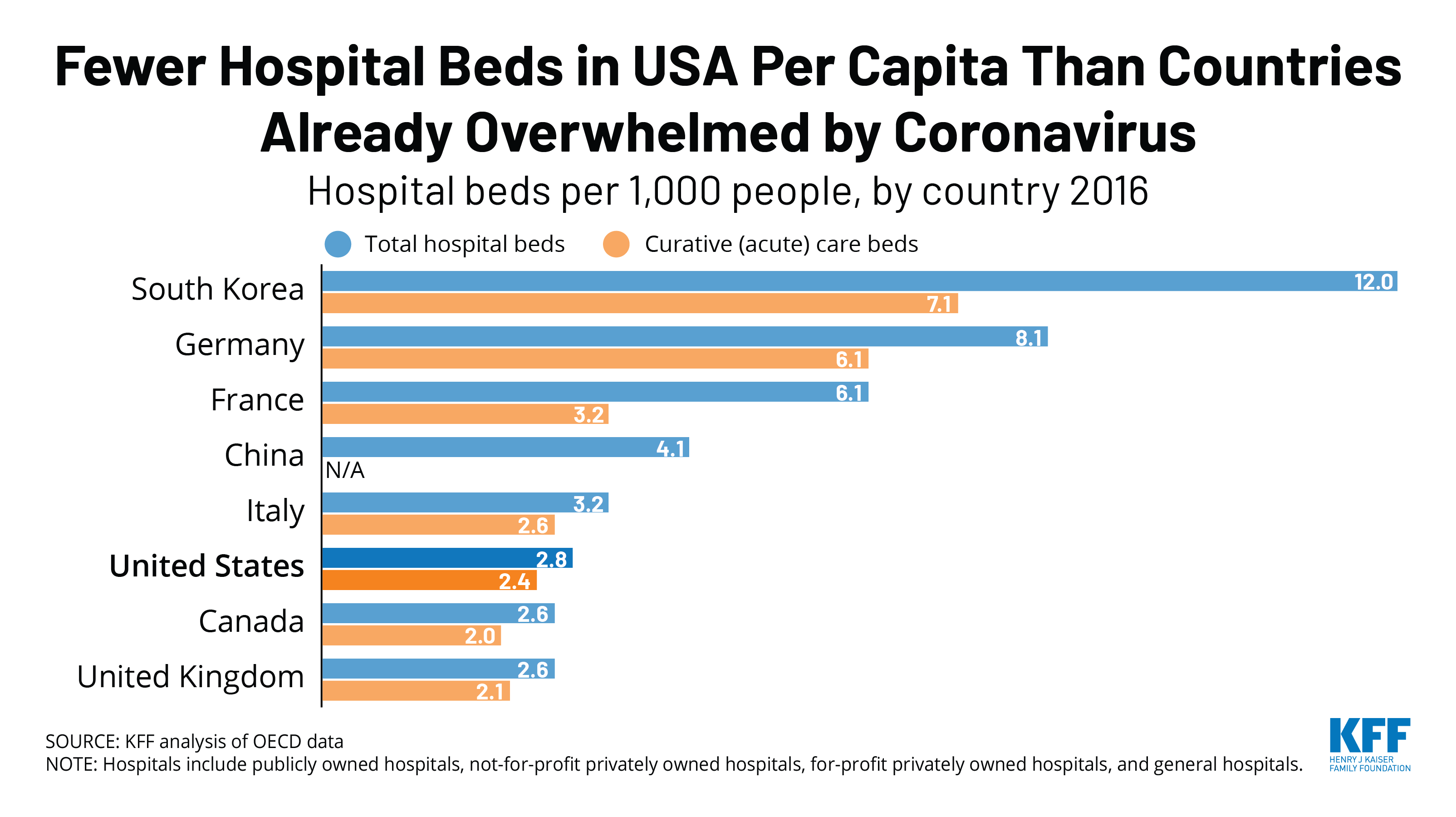
Fewer Hospital Beds in USA Per Capita Than Countries Already Overwhelmed by Coronavirus
Source
How Prepared is the US to Respond to COVID-19 Relative to Other Countries?
The independent source for health policy research, polling, and news.
By now, it’s well known that there have been multiple challenges to and failures in rolling out testing for coronavirus in the United States, including:
As a result, the U.S. missed a critical early window to test, contact trace, isolate, and contain the outbreak early on, leaving social distancing measures as the main tool to interrupt the spread of the virus, including stay-at-home orders, closures of non-essential businesses and schools, and bans on large gatherings throughout much of the country. (more…)
By now, it’s well known that there have been multiple challenges to and failures in rolling out testing for coronavirus in the United States, including:
As a result, the U.S. missed a critical early window to test, contact trace, isolate, and contain the outbreak early on, leaving social distancing measures as the main tool to interrupt the spread of the virus, including stay-at-home orders, closures of non-essential businesses and schools, and bans on large gatherings throughout much of the country. (more…)
By now, it’s well known that there have been multiple challenges to and failures in rolling out testing for coronavirus in the United States, including:
As a result, the U.S. missed a critical early window to test, contact trace, isolate, and contain the outbreak early on, leaving social distancing measures as the main tool to interrupt the spread of the virus, including stay-at-home orders, closures of non-essential businesses and schools, and bans on large gatherings throughout much of the country. (more…)
How Prepared is the US to Respond to COVID-19 Relative to Other Countries?
KFF’s Jen Kates and Josh Michaud on March 30 were the featured guests in The Commonwealth Club of California’s continuing virtual series on the coronavirus outbreak.
Among the topics discussed were:
The $2 trillion Coronavirus Aid, Relief, and Economic Security (CARES) Act contains a vast array of spending provisions, including an additional $100 billion for the Public Health and Social Services Emergency Fund. This new funding is designed to provide an influx of money to hospitals and other health care entities responding to the coronavirus pandemic. This $100 billion averages out to about $108,000 per hospital bed in the United States.
Hospitals across the country clearly need additional resources as they struggle to treat the surge of COVID-19 patients and prepare for a spike in patient load. The $100 billion fund was established to help hospitals ramp up quickly, in response to new demands, giving the Secretary of Health and Human Services broad discretion over how the $100 billion fund will be distributed, although it is not yet clear how these funds will be allocated. (more…)
The $2 trillion Coronavirus Aid, Relief, and Economic Security (CARES) Act contains a vast array of spending provisions, including an additional $100 billion for the Public Health and Social Services Emergency Fund. This new funding is designed to provide an influx of money to hospitals and other health care entities responding to the coronavirus pandemic. This $100 billion averages out to about $108,000 per hospital bed in the United States.
Hospitals across the country clearly need additional resources as they struggle to treat the surge of COVID-19 patients and prepare for a spike in patient load. The $100 billion fund was established to help hospitals ramp up quickly, in response to new demands, giving the Secretary of Health and Human Services broad discretion over how the $100 billion fund will be distributed, although it is not yet clear how these funds will be allocated. (more…)
The $2 trillion Coronavirus Aid, Relief, and Economic Security (CARES) Act contains a vast array of spending provisions, including an additional $100 billion for the Public Health and Social Services Emergency Fund. This new funding is designed to provide an influx of money to hospitals and other health care entities responding to the coronavirus pandemic. This $100 billion averages out to about $108,000 per hospital bed in the United States.
Hospitals across the country clearly need additional resources as they struggle to treat the surge of COVID-19 patients and prepare for a spike in patient load. The $100 billion fund was established to help hospitals ramp up quickly, in response to new demands, giving the Secretary of Health and Human Services broad discretion over how the $100 billion fund will be distributed, although it is not yet clear how these funds will be allocated. (more…)
KFF’s Kaiser Health News (KHN), an editorially independent news service focusing on health care and policy, has won five “Best in Business” awards from the Society for Advancing Business Editing and Writing (SABEW). The awards, announced today, recognize outstanding business journalism in 2019.
The five awards, all of which came in the division for medium size news organizations, include:
America’s Broken Health Care System, by Elisabeth Rosenthal, KHN Editor-in-Chief, winner in the Commentary/Opinion category. The judges wrote that Rosenthal “deftly uses the medical bills she received to guide readers through the maze of medical bureaucracy and deliver a clear exposition of how and why the nation’s health care system has become so beleaguered, unfair and inefficient.”
Hidden Harm, by Christina Jewett, winner in the government category and co-winner in the investigative reporting category. The judges wrote that, “Jewett’s stories unearthed a Dr. Evil-scale cover-up of hidden FDA data on millions of medical device malfunctions, injuries and deaths. Her coverage forced the administration to open this vital data to both doctors who perform procedures as well as public scrutiny, and in the process, no doubt saved countless lives.”
University of Virginia Health System lawsuits, by Jay Hancock and Elizabeth Lucas, winner in the Health/Science category. The judges wrote that KHN “exposed how the center’s overly aggressive billing and collection policies were ruining people’s lives.”
In India’s burgeoning pain market, U.S. drugmakers stand to gain, by Sarah Varney, winner in the international reporting category. The judges wrote that “Varney uncovered a trend in India of sweeping importance: the relatively new cultural acceptance of pain medication and the pharmaceutical companies, largely chased away from places like the United States, that are looking to capitalize on the trend.”
KHN also earned two honorable mentions, including one in the economics category for No Mercy, a series by Sarah Jane Tribble that looks at what happens when the closure of a rural hospital disrupts a community, and another in the feature category, for Varney’s story about India’s market for pain medication.
For more on the awards, visit SABEW’s website.
KHN content is always available to news organizations to republish free of charge.
About The Henry J. Kaiser Family Foundation and Kaiser Health News:
Filling the need for trusted information on national health issues, KFF (the Henry J. Kaiser Family Foundation) is a nonprofit organization based in San Francisco, California. KHN is an editorially independent program of KFF and is the nation’s leading and largest health and health policy newsroom, producing stories that run on kffhealthnews.org and are published by hundreds of news organizations across the country.
On March 26, we posted our 18th annual 50-state survey of Medicaid and CHIP eligibility, enrollment, renewal, and cost sharing policies. It continues to serve as the only comprehensive resource for information on these policies across states and provides information that has enabled tracking of state implementation of the Medicaid expansion and streamlined enrollment and renewal procedures under the ACA.
This year’s survey, which provides data on policies in place as of January 2020, now serves a new purpose by providing a benchmark against which we can measure state actions to respond to COVID-19 and the economic crisis. The survey findings document policies states must maintain in order to access temporary enhanced federal Medicaid funding as part of COVID-19 response efforts. The Families First Coronavirus Response Act provides states a temporary 6.2 percentage point increase in the federal Medicaid matching rate. To receive those enhanced funds, states cannot implement more restrictive eligibility policies than those in place as of January 1, 2020 and must provide continuous coverage to Medicaid enrollees through the emergency period. For example, states cannot reduce income eligibility limits or increase requirements to verify eligibility criteria.
The survey findings show that, as of January 2020, there is wide variation in state policies that affect individuals’ ability to access coverage and care. For example, more individuals can access Medicaid coverage in states that have implemented the ACA Medicaid expansion to low-income adults than in states that have not expanded, where poor adults continue to face a coverage gap. Largely because of the ACA, individuals can apply for Medicaid and CHIP online or via phone, and states can connect individuals to coverage quickly through real-time eligibility determinations and renewals using electronic data matches. Moreover, some states have taken up options that expedite access to coverage and facilitate continuity of coverage, such as presumptive eligibility and 12-month continuous eligibility for children. However, certain policies and processes may by contributing to coverage losses among eligible individuals. For example, some states conduct periodic data checks between renewal periods to identify potential changes that might affect eligibility, provide enrollees limited time (e.g., ten days) to respond to requests to verify ongoing eligibility, and only contact enrollees once by mail to request information before terminating coverage. Changes the federal government was pursuing as part of program integrity efforts prior to COVID-19 may have further increased coverage barriers for eligible individuals, but the Centers for Medicare and Medicaid Services (CMS) recently withdrew its planned regulatory changes that would have tightened eligibility requirements.
States can take a range of actions through Medicaid under current rules and waivers to enhance their response to COVID-19. They can take some of these actions quickly without federal approval. For example, they can allow self-attestation of eligibility criteria other than citizenship and immigration status and verify income post enrollment, which would make signup easier and faster. They also can provide greater flexibility to enroll individuals who have small differences between self-reported income and income available through data matches. Further, they can suspend or delay renewals and periodic data checks between renewals (as noted above, states must provide continuous coverage to Medicaid enrollees through the emergency period to receive enhanced federal funding). States can take other actions allowed under existing rules by submitting a state plan amendment (SPA). For example, states could expand eligibility, including implementing the ACA Medicaid expansion to low-income adults in states that have not yet expanded; adopt presumptive eligibility; or modify cost sharing requirements. Beyond these options, states can seek additional flexibility through Section 1135 and Section 1115 waivers. CMS has provided states SPA and waiver templates and checklists to facilitate implementation of changes to respond to COVID-19, and state Medicaid policies and processes already are evolving as states implement changes to expedite enrollment in coverage, keep enrollees covered, and facilitate access to services as part of COVID-19 response efforts.
State Medicaid and CHIP eligibility and enrollment policies will remain an important indicator to watch looking forward. As evidenced by previous recessions, states will likely see growing demand for Medicaid and CHIP as individuals lose jobs and incomes decrease amid the declining economy. The ability to connect these individuals to coverage quickly and to keep them connected to coverage over time will help ensure they can access care for COVID-19 and more broadly.
KFF analysis of data from the Office of Management and Budget, Agency Congressional Budget Justifications, Congressional Appropriations Bills, and U.S. Foreign Assistance Dashboard [website], available at: www.foreignassistance.gov.
A new analysis and chart collection highlights the available cross-national data on healthcare workforces and hospital resources to assess U.S. preparedness to respond to the COVID-19 pandemic relative to other large and wealthy countries. Additional charts explore coverage and affordability barriers that may limit access to care or cause serious financial burden for those needing COVID-19 treatment, and the prevalence of health conditions like heart disease, chronic respiratory disease, and diabetes that are linked to more serious outcomes for COVID-19 patients.The chart collection and analysis is part of the Peterson-KFF Health System Tracker, an online information hub dedicated to monitoring and assessing the performance of the U.S. health system.For more data, analysis, polling and journalism on the COVID-19 pandemic, visit our special resource page on kff.org.
In mid-March, a record 3.3 million Americans filed new claims for unemployment benefits. Job loss can trigger loss of health insurance. There are options for keeping or getting new coverage, but transitions can result in coverage gaps or changes in covered benefits and affordability. Actions by policymakers could make transitions easier.
Medicaid
Medicaid offers free or low-cost comprehensive coverage for people when they have a spell of low income. People used to having job based coverage and higher income may not realize Medicaid could be an option for them. It’s time to take another look.
For consumers: In 37 states (including D.C.) that adopted the Affordable Care Act (ACA) Medicaid expansion, adults can qualify if their current income is up to 138% of the federal poverty level (FPL), or $1,467/month for individual, $3,013/month for a family of four. Unemployment compensation counts, but not the federal supplement just approved by Congress. Savings and other assets are not taken into account. In some of these states, adults with higher incomes qualify, and in all states eligibility levels are higher for children and pregnant women. People can apply year-round, and services provided up to 3 months prior to application can be covered retroactively if you would have been eligible then. Nearly all hospitals and many doctors take Medicaid, though doctor participation rates vary by state. In most states, Medicaid coverage is delivered by managed care plans.
For policymakers: More than 2 million poor uninsured adults don’t qualify for Medicaid because they live in one of 14 states that have not yet adopted the ACA expansion. Even more poor adults will fall into this coverage gap during the economic downturn. Another estimated 6.7 million uninsured adults and children are eligible for Medicaid or CHIP, but not enrolled. States have options to make it easier for people to enroll and maintain coverage over time.
Also, during the emergency, States can offer free Medicaid coverage for COVID-19 testing to all uninsured residents. States will also receive a temporary increase in the federal match for Medicaid as long as they do not enact more stringent enrollment criteria and provide continuous coverage for those on Medicaid during the emergency period.
A recent proposal would let states add coverage of COVID-19 treatment under this option. The same bill would also increase federal matching rates during this and future economic downturns, when Medicaid enrollment typically spikes.
Marketplace
The ACA established Marketplaces where people not eligible for job-based benefits or Medicaid can buy private coverage with financial assistance. Citizens and documented immigrants can buy health insurance through the Marketplace.
For consumers: In most states, the Marketplace website is www.healthcare.gov. Anyone can buy coverage during Open Enrollment. During the COVID-19 outbreak, 12 states have created a special open enrollment period when anyone can buy Marketplace plans.
People who lose other coverage are eligible for a special enrollment period (SEP) in the Marketplace. If you anticipate coverage loss, you can apply for an SEP up to 60 days in advance. Otherwise you have 60 days following loss of coverage to apply. Healthcare.gov will ask for documentation of coverage loss before you can apply. If you applied in advance, coverage can start under your new plan as the old coverage ends; otherwise it starts the first day of the month after you complete your application.
The Marketplace offers premium subsidies to those who expect 2020 income will be 100%-400% FPL: $12,490-$49,960/individual and $25,750-$103,000/family of 4. This subsidy calculator can give you an idea of what you might have to pay. You will have to provide your best estimate of your 2020 income when you apply (don’t forget unemployment benefits), and if your income changed substantially in the last year, you may be asked to submit additional documentation. You can lose subsidies if you don’t submit that documentation on time.
Marketplace plans have high deductibles, though cost sharing subsidies are available to people with income 100%-250% FPL. Most plans use narrow provider networks, so you may need to change doctors.
For policymakers: An estimated 9.2 million uninsured Americans were eligible for Marketplace subsidies in 2018 but not enrolled. Even with subsidies, the average person paid $87/month after tax credits and some paid much more. Various bills have been proposed to enhance Marketplace subsidies and make more people eligible. Meanwhile, the Administration has authority to relax up-front documentation required of applicants whose income has changed substantially. Everyone is still required to reconcile subsidy eligibility at year end on their federal tax return.
The federal government also has authority to offer another open enrollment period when anyone could sign up for coverage. And it has authority to streamline the SEP process. During previous disasters, healthcare.gov waived documentation for SEPs and accepted people’s attestation they were eligible.
COBRA
People losing job-based plans have the option of continuing enrollment for up to 18 months, sometimes longer. A law known as COBRA requires firms with at least 20 employees to offer this option. Most people don’t end up taking COBRA due to cost. On average, the cost of job-based plans in 2019 was $7,188/$20,576 for family coverage, and employers don’t have to contribute toward COBRA premiums.
For consumers: Your employer must notify you about your right to elect COBRA continuation. Each covered family member has an independent right to elect COBRA. Though the premium cost is high, some people take COBRA because it offers other advantages, especially for ongoing health needs. COBRA coverage is seamless with no gaps, you keep access to the same network of doctors and hospitals, and don’t have to restart your deductible mid-year.
You have 60 days to elect COBRA and another 45 days to pay the first premium (covering the period dating back to your coverage loss). Eligibility for COBRA does not affect eligibility for other subsidized coverage; so compare costs, covered benefits, and provider networks of other options and then choose.
For policymakers: In the past, the federal government partially subsidized COBRA for certain people. The Health Coverage Tax Credit, enacted in 2003, provided 65% COBRA premium subsidies for trade-dislocated workers. In 2009, Congress expanded eligibility for HCTC and increased the subsidy to 80%. That helped more people, though take up was still limited because most unemployed people couldn’t afford the unsubsidized portion of the premium.
Subsidizing COBRA premiums 100% during the emergency period would make this option more affordable to those out of work. In addition, a full subsidy could reduce adverse selection. The people most likely to elect unsubsidized COBRA tend to have costly health care needs; one survey estimated 4.8 million COBRA beneficiaries in 2008 cost their former employers more than $10 billion that year.
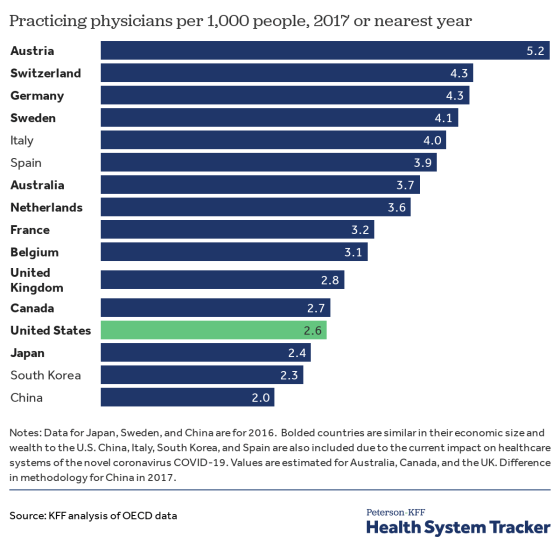
A new analysis and chart collection finds that the U.S. has fewer hospital beds and practicing physicians per capita than many similarly large and wealthy countries with health care systems already strained by the ongoing COVID-19 pandemic.
Compared to Italy and Spain, two countries in which hospitals have already been overwhelmed by an influx of COVID-19 patients, the U.S. has fewer practicing physicians per capita – 2.6 per 1,000 people, compared to 4.0 in Italy and 3.9 in Spain – but more licensed nurses. While the U.S. has a higher number of total hospital employees than most comparable countries, nearly half of that workforce is comprised of non-clinical staff who are not directly involved in delivering care.
The U.S. also lags behind comparable countries in hospital beds per capita, with 2.8 hospital beds for every 1,000 people, a capacity similar to that of Canada and the United Kingdom, but less than other similarly wealthy countries. Italy, the country with the highest number of COVID-19-related deaths to date, has 3.2 hospital beds per 1,000 people – only slightly more than the U.S. South Korea, which has reportedly slowed the rate of new infection, has 12 beds per 1,000 people. Some data suggest, however, that the U.S. may have more ICU beds per person than many comparable countries.
The analysis also includes charts on coverage and affordability barriers that may limit access to care, as well as the health of at-risk groups. Compared to other large, wealthy countries, the U.S. has a higher disease burden, attributable to cardiovascular disease, chronic respiratory disease, and diabetes, all conditions associated with more serious outcomes for COVID-19 patients.
The chart collection and analysis is part of the Peterson-KFF Health System Tracker, an online information hub dedicated to monitoring and assessing the performance of the U.S. health system. For more data, analysis, polling and journalism on the COVID-19 pandemic, visit our special resource page on kff.org.