Medicare

Medicare Open Enrollment

More Than 4 Million Medicare Beneficiaries Will Have Their Medicare Advantage or Stand-Alone Rx Drug Plan Terminated at the End of 2026

Data from the Centers for Medicare & Medicaid Services (CMS) shows that 4.3 million Medicare beneficiaries, including 3.1 million Medicare Advantage drug plan enrollees and 1.2 million PDP enrollees, will have their plan terminated at the end of 2026. An additional 1.4 million Medicare Advantage enrollees are in a plan that is consolidating with another plan offered by the same insurer.

Medicare Open Enrollment and Coverage Options: Key Questions and Answers

Each year, Medicare beneficiaries have an opportunity to make changes to how they receive their Medicare coverage during the nearly 8-week annual open enrollment period, which runs from October 15 through December 7. This brief answers key questions about the Medicare open enrollment period and Medicare coverage options.

NEW AND NOTEWORTHY

How Much Do People With Medicare Pay For Coverage?

This brief provides an overview of the costs faced by Medicare beneficiaries in traditional Medicare, Medicare Advantage, and Medicare Part D, including premiums, deductibles, copays, and coinsurance, focusing on costs in 2026.

What’s in a Name? From Today’s Medicare to Medicare for All

KFF’s Larry Levitt explains how proposals to create Medicare-for-All promise more generous benefits than the existing Medicare program, with no premiums or cost-sharing, but could end up looking more like Medicare if it became the subject of a serious national debate about the tradeoffs involved to implement it.

Medigap

Medigap Guaranteed Issue Requirements: An Overview of Federal and State Rules

This issue brief analyzes federal and state rules related to guaranteed issue requirements for Medigap policies and how they impact beneficiaries’ access to Medigap, including the implications for Medicare beneficiaries with pre-existing medical conditions and those under age 65 with long-term disabilities.

Data Visualization

The Facts About Medicare Spending

This interactive provides the facts on Medicare spending. Medicare, which serves 67 million people and accounts for 12 percent of the federal budget and 21 percent of national health spending, is often the focus of discussions about health expenditures, health care affordability and the sustainability of federal health programs. Explore data on enrollment growth, Medicare spending trends overall and per person, growth in Medicare spending relative to private insurance, spending on benefits and Medicare Advantage, Part A trust fund solvency challenges, and growth in out-of-pocket spending by beneficiaries.

Read More

Stay informed.

Stay informed.

Filter

1-10 of 1,627 results

  • The Average Monthly Premium for Medicare Part D Stand-Alone Plans Is Projected to Increase by 50% From $34 to $51 in 2027 Unless Enrollees Switch to Lower-Cost Plans 

    News Release

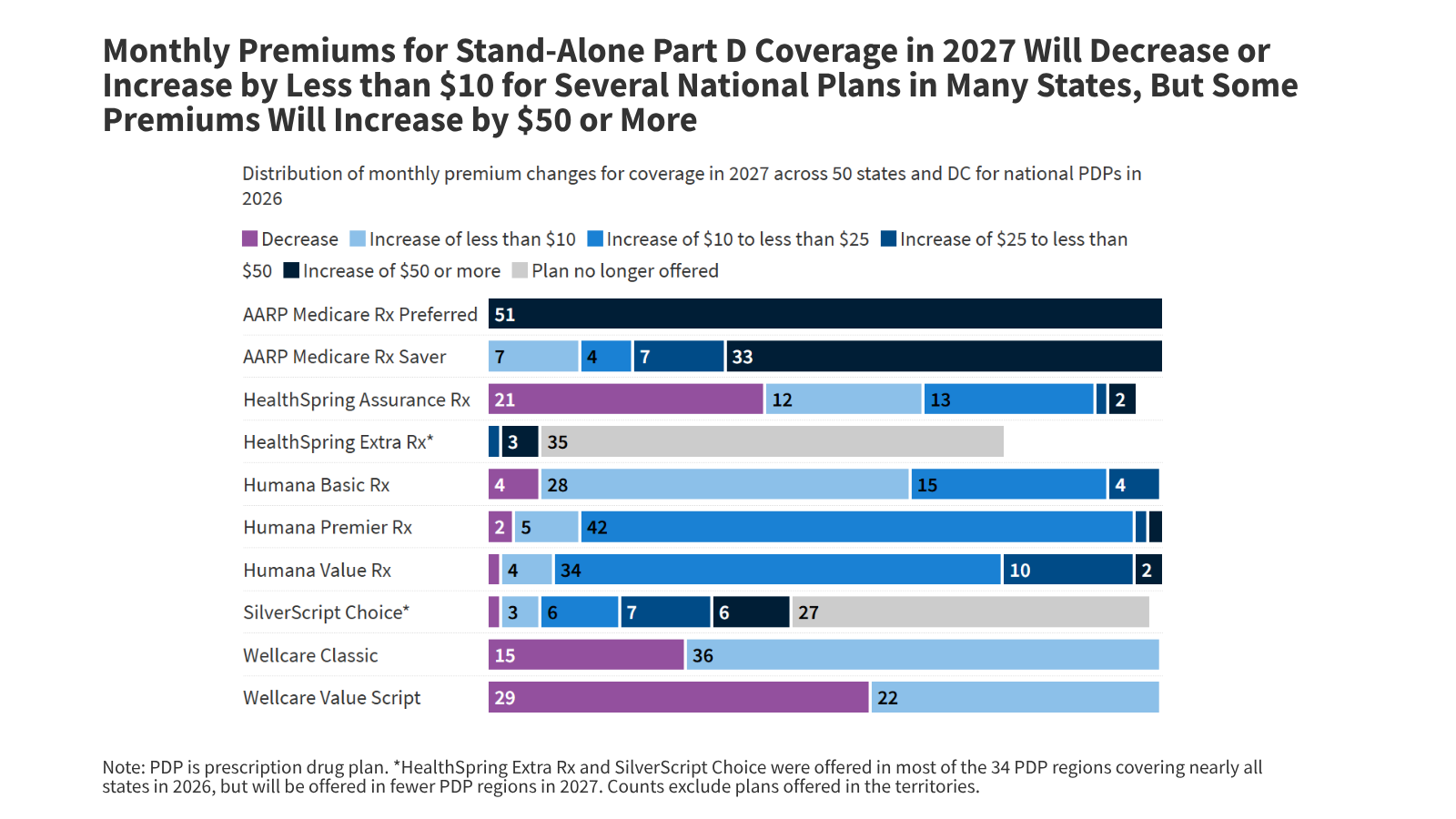
    A new KFF analysis finds that the average monthly premium for Medicare Part D coverage in stand-alone prescription drug plans (PDPs) will increase to $51 in 2027, up 50% from $34 in 2026, if current enrollees don’t switch into lower-premium plans during open enrollment, which runs through December 7.  

  • Medicare Part D Premiums and Cost Sharing in 2027

    Issue Brief

    Medicare Part D is a voluntary outpatient prescription drug benefit for people with Medicare provided through private plans, including stand-alone prescription drug plans and Medicare Advantage plans that offer drug coverage. This analysis provides an overview of Medicare Part D premiums and cost sharing in 2027 and key trends over time.

  • What’s in a Name? From Today’s Medicare to Medicare for All

    Perspective

    In this JAMA Health Forum post, KFF's Larry Levitt explains how proposals to create Medicare-for-All promise more generous benefits than the existing Medicare program, with no premiums or cost-sharing, but could end up looking more like Medicare if it became the subject of a serious national debate about the tradeoffs involved to implement it.

  • More Than 4 Million Medicare Beneficiaries Will Have Their Medicare Advantage or Stand-Alone Prescription Drug Plan Terminated at the End of 2026

    Issue Brief

    Data from the Centers for Medicare & Medicaid Services (CMS) shows that 4.3 million Medicare beneficiaries, including 3.1 million Medicare Advantage drug plan enrollees and 1.2 million PDP enrollees, will have their plan terminated at the end of 2026. An additional 1.4 million Medicare Advantage enrollees are in a plan that is consolidating with another plan offered by the same insurer.

  • What Could Medicaid Work Requirements Mean for People with Disabilities Waiting for Medicare Coverage?

    Issue Brief

    This analysis finds that Medicaid through the expansion pathway covered over 1 in 4 SSDI applicants and beneficiaries waiting to become eligible for Medicare (120,300 people out of a total 415,300 in 2023). In future years, people applying for and new to SSDI may experience difficulties maintaining Medicaid prior to becoming eligible for Medicare because of the new work requirements.

  • Nearly Three-Quarters of Medicare Advantage Enrollees Could be Denied a Medigap Policy Due to a Pre-Existing Condition

    Issue Brief

    This analysis examines the share of Medicare Advantage enrollees who have a pre-existing condition that could result in a Medigap denial if they seek to switch to traditional Medicare outside their one-time 12-month trial period, including national estimates and estimates by age and by state. KFF finds that nearly three-quarters of Medicare Advantage enrollees (74%) or 20.9 million people in 2023 had a pre-existing medical condition identified from KFF’s review of Medigap applications that could…

  • Medigap Guaranteed Issue Requirements: An Overview of Federal and State Rules

    Issue Brief

    This issue brief analyzes federal and state rules related to guaranteed issue requirements for Medigap policies and how they impact beneficiaries’ access to Medigap, including the implications for Medicare beneficiaries with pre-existing medical conditions and those under age 65 with long-term disabilities.

  • When Is the Open Enrollment period for Medicare? What changes can I make to my Medicare coverage during this time?

    FAQs

    The Medicare Open Enrollment period runs from October 15 through December 7 each year. During this period, you can make many changes to your Medicare coverage, depending on the coverage you already have. You can change from traditional Medicare to a Medicare Advantage plan (or vice versa). If you prefer Medicare Advantage, you can choose among the Medicare Advantage plans offered in your area during this period. If you are in traditional Medicare, and want…

  • How can I compare my Medicare coverage options?

    FAQs

    You can compare your Medicare coverage options using an online searchable tool on the Medicare.gov website that allows users to compare Medicare coverage options, including Medicare Advantage plans, Medicare Part D plans, and Medigap supplemental policies. You can get information about the coverage, costs, and benefits of different plan options in your area using the Medicare coverage comparison website. You can also enroll in a Medicare Advantage plan or a Medicare Part D plan on…