
The Trump Administration Continues to Advance Incremental Site-Neutral Payment Reforms

The Centers for Medicare & Medicaid Services (CMS) recently released the 2027 proposed rule for Medicare’s hospital outpatient prospective payment system (OPPS), including new site-neutral payment reforms for certain imaging services. Site-neutral payment reforms seek to align reimbursement for a given service across care settings, subject to safety and quality safeguards. To that end, the proposed rule includes a 60 percent reduction in reimbursement for imaging services (like X-rays and MRIs) without contrast when provided in off-campus hospital outpatient departments (HOPDs) beginning in 2027, a change intended to better align reimbursement with that of other settings. The reform would not apply to most rural hospitals (79%), as critical access hospitals are not reimbursed under the OPPS and the proposed change carves out rural sole community hospitals. The Administration’s proposed changes for certain imaging services would further advance site-neutral payment reform but, like prior changes, are modest relative to more expansive options raised by MedPAC and others.
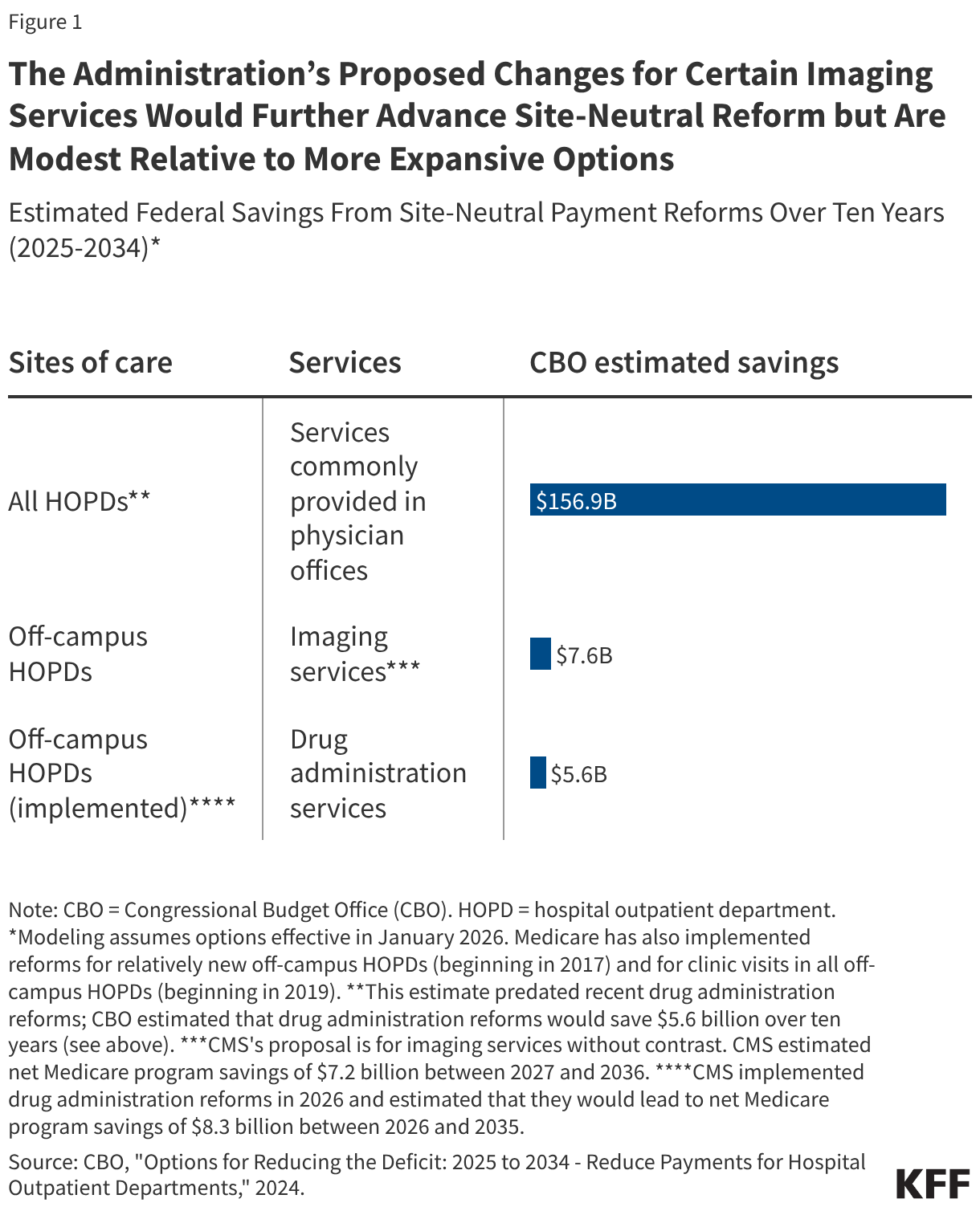
The Congressional Budget Office (CBO) has projected that site-neutral reforms for imaging services in off-campus HOPDs would generate $7.6 billion in federal savings over ten years, while reforms for services commonly provided in physician offices for both on- and off-campus HOPDs would save $156.9 billion (see Figure 1) (this estimate predated recent drug administration reforms; CBO estimated that drug administration reforms would save $5.6 billion over ten years). The former is broader than CMS’s proposed change, as it also includes imaging services with contrast. The latter is similar in spirit to options raised by MedPAC and others, which in at least some cases would also apply to services commonly provided in ambulatory surgical centers. Another relatively expansive option would extend reforms broadly to services at all off-campus HOPDs (not shown). CMS estimates that proposed changes for imaging services without contrast would reduce net Medicare program spending by $7.2 billion over ten years and beneficiary cost sharing and premiums by a total of $4.9 billion over ten years.
CMS’s current proposal follows other incremental site-neutral payment reforms that Medicare has implemented over time. This includes site-neutral payment reforms introduced through legislation (for all services provided in relatively new off-campus HOPDs, beginning in 2017) and through rulemaking (for clinic visits in off-campus HOPDs, beginning in 2019, and for drug administration services, beginning in 2026). Given this history, it is likely that CMS will consider making additional site-neutral payment reforms through future rulemaking. For example, CMS signaled interest in the past in potentially applying reforms to on-campus clinic visits, an option MedPAC has also raised. It is not yet clear whether the hospital industry will, as it has done in the past, bring legal challenges to CMS’s efforts to introduce reforms through the rulemaking process.
Medicare site-neutral payment reforms to date have focused on off-campus HOPDs. Reforms would generate much larger savings if extended to on-campus HOPDs. For example, one study estimated that site-neutral payment reforms for all services at off-campus HOPDs would reduce federal spending by $28.3 billion over ten years (an estimate that predated CMS’s implementation of this policy for drug administration services), while reforms for services in on-campus HOPDs more commonly provided in physician offices or ambulatory surgical centers would save $119.3 billion over ten years.
When exploring additional reforms, policymakers and regulators will likely weigh potential savings against the impact on hospital finances and access to care, among other considerations. While there has been bipartisan support for site-neutral reforms, it’s unclear how much momentum remains following the enactment of large reductions to federal health care spending as part of the 2025 budget reconciliation package, once known as the “One Big Beautiful Bill.” As a result of these changes, there may be greater interest in limiting or offsetting the impact of site-neutral payment reforms on certain providers, such as rural hospitals that are not already exempt or urban safety-net hospitals.