Public Opinion

Caregivers in the U.S.

Experiences of Unpaid Caregivers in the U.S.

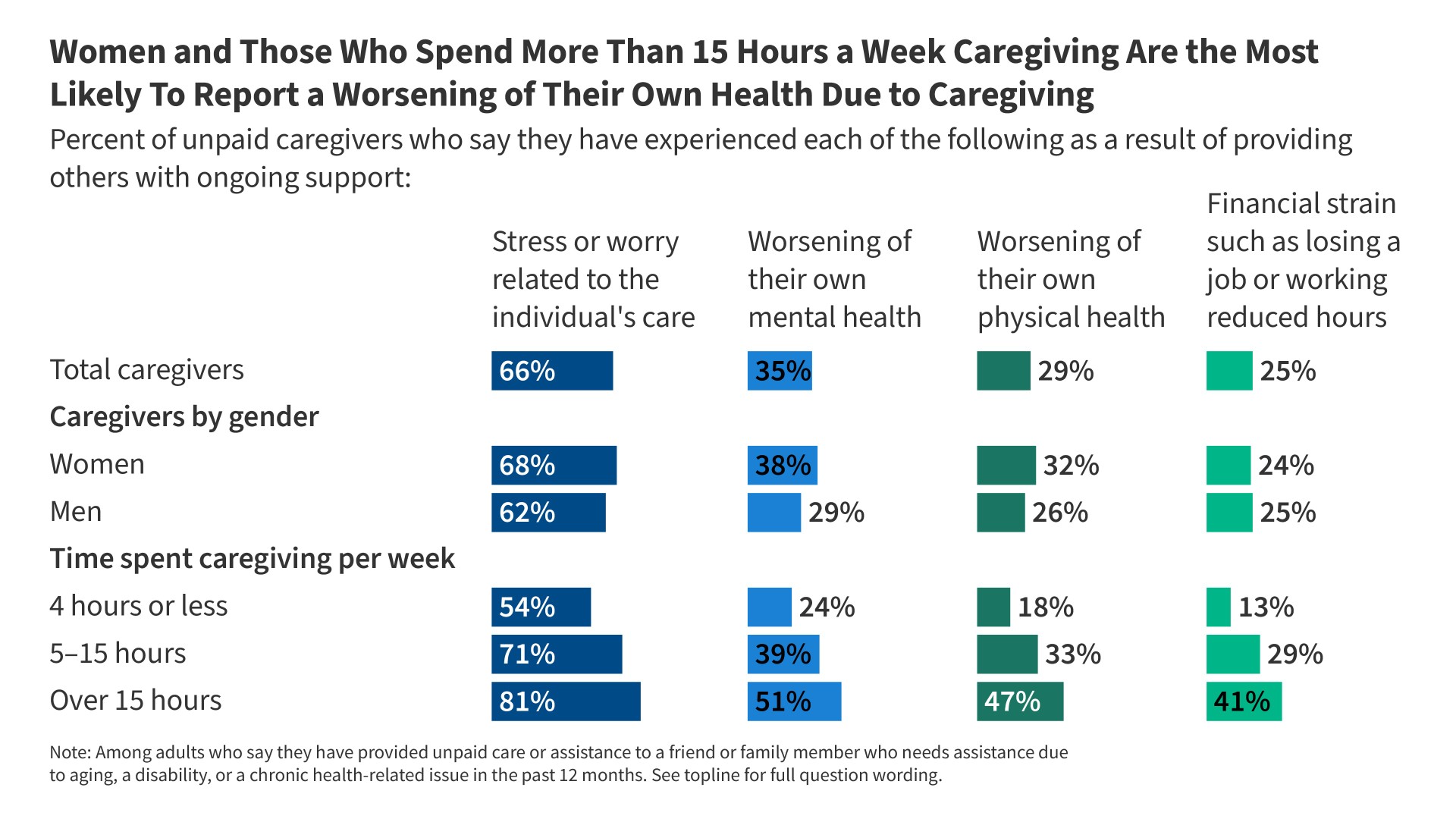
About 3 in 10 adults in the U.S. say they have provided unpaid care to a friend or family member who needs assistance due to aging, disability, or a chronic condition in the past 12 months. The median amount of time that such caregivers provide unpaid assistance is five hours per week, though the number of hours varies widely. Unpaid caregivers are disproportionately women. Read the news release.

HeaLTH in the Midterms

Health Care in the 2026 Midterm Election

This dashboard focuses on KFF’s analysis of the role health care costs and other health policy issues played in voters’ decisions in the 2026 midterm elections, including in key Senate races. It examines the role of rising health costs on voters’ decisions, views on the Trump administration’s health care policies, and opinions on the government’s role in health care amid discussions of Medicare for All.

Abortion on the Ballot in 2026: Polling Insights from Voters in Four States

This dashboard provides KFF’s analysis of the role abortion played in voters’ decisions in the 2026 midterm elections, with a focus on four states with abortion-related ballot measures: Idaho, Missouri, Nevada, and Virginia. It examines support for each of the measures across groups, including additional questions in Missouri.

What Do the Midterm Election Results Mean for Health Care? 

Event Date:

On November 5 at Noon ET, join KFF for a special post-election discussion and live “What the Health” podcast taping. Part of the discussion will focus on public opinion survey data on how voters weighed health care as they went to the polls nationally and in the four states with abortion-related ballot initiatives. 

Midterm Voters Give Democrats a Big Advantage to Handle Health Care

Quick Insights

KFF’s analysis of the 2026 Voter Poll by SSRS shows midterm voters gave Democrats a 19-percentage-point advantage on which party is better able to handle health care. Voters also gave Democrats a narrow edge on handling the economy (43% vs. 37%), a reversal from 2024, when Trump had a 10-point advantage over Harris. "In an election focused on affordability, Democrats’ messaging on health care costs appears to have resonated with voters and may have contributed to the party’s gains."

Health Information and Trust

About Half of Parents Mistakenly Believe Spacing Out Vaccines Is Healthier for Children; Half Say No Strong Evidence to Support Such a Claim

KFF Tracking Poll on Health Information and Trust: Fall 2026 Update on Vaccine Views

The latest KFF Tracking Poll on Health Information and Trust finds about half of parents mistakenly believe spacing out vaccines is healthier for children, while confidence in many long-standing childhood vaccines is high across partisans. These findings take on new relevance following President Trump’s recent executive order calling for changes in U.S. childhood vaccine recommendations, including splitting the measles, mumps, and rubella (MMR) vaccine—currently given as a single combined shot—into three separate vaccines across multiple visits.

Dashboard: Polling on Health Information and Trust

Drawing on KFF’s poll findings, this interactive dashboard tracks the public’s trusted sources for health information, attitudes toward vaccines, and use of news, social media, and AI for health-related information.

Health Tracking PollS

Democrats Hold a Nearly 2-to-1 Advantage Over Republicans on Handling the Cost of Health Care

Health Care Issues in the Lead-Up to the 2026 Midterm Election 

In the lead up to the midterms, health care costs remained tied with gas as voters’ top midterm concerns. Two-thirds of U.S. adults also favored Medicare-for-all, a new high in KFF Polling, but support shifts when competing claims from critics and proponents are heard.

Most Democratic Voters Want To Hear Candidates Discuss Health Costs and Future of Health Programs; More Republicans Focused on Fraud

Public Views on Fraud in Health Programs

As the 2026 midterms approach, health care costs remain voters’ top health priority, but fraud in government health programs, including Medicaid and Medicare, is resonating with Republican voters, 55% of whom say it’s extremely important for candidates to address.

Mifepristone and the Midterms

Amid an ongoing FDA re-review of mifepristone, awareness of the safety and prevalence of the abortion pill remains limited. This KFF poll also finds that the voters who say abortion policy is an important issue for 2026 midterm candidates to discuss are disproportionately Democrats.

MAHA and the Midterms

This KFF Health Tracking Poll finds that the cost of health care is a more prominent focus for Make America Healthy Again (MAHA) voters than issues like food and vaccine policy. Four in ten MAHA voters (42%) choose lowering health costs as the most important health priority, outranking other MAHA priorities.

the essentials

Health Tracking Poll

Our signature survey project provides up-to-date data on the public’s health care views, knowledge, and experiences.

Tracking the Public’s Views on the ACA

Tracking the Public’s Views on the ACA

This interactive tool tracks public opinion on the Affordable Care Act, from the inception of the law to the present, including trends based on party identification, income, age, gender, and race/ethnicity.

Health Information and Trust Tracking Poll

The Health Information and Trust Tracking Poll is part of KFF’s Health Information and Trust Initiative, which tracks health misinformation and analyzes its impact on the public.

Stay informed.

Stay informed.

Filter

1,281-1,290 of 1,871 results

  • 2008 Update on Consumers’ Views of Patient Safety and Quality Information Summary & Chartpack

    Poll Finding

    2008 Update on Consumers' Views of Patient Safety and Quality Information - Summary & Chartpack This summary and chartpack provides an updated examination of consumers' views on health care quality information reveals major challenges remain in providing the public with comparative quality information and encouraging its use. The 2008 Update on Consumers' Views of Patient Safety and Quality Information is based on polling conducted in August among a randomly selected nationally representative sample of 1,517…

  • 2008 Update on Consumers’ Views of Patient Safety and Quality Information – Toplines

    Poll Finding

    2008 Update on Consumers' Views of Patient Safety and Quality Information - Toplines These toplines provide complete survey questions and findings on the updated examination of consumers’ views on health care quality information reveals major challenges remain in providing the public with comparative quality information and encouraging its use. The 2008 Update on Consumers’ Views of Patient Safety and Quality Information is based on polling conducted in August among a randomly selected nationally representative sample…

  • 2008 Update on Consumers’ Views of Patient Safety and Quality Information

    Poll Finding

    2008 Update on Consumers' Views of Patient Safety and Quality Information An updated examination of consumers' views on health care quality information reveals major challenges remain in providing the public with comparative quality information and encouraging its use. The 2008 Update on Consumers' Views of Patient Safety and Quality Information finds that three in 10 (30%) Americans say they have seen health care quality comparisons of health insurance plans, hospitals, or doctors in the past…

  • Preparedness for A Major Hurricane or Other Emergency

    Poll Finding

    As part of the September Kaiser Health Tracking Poll: Election 2008, the Foundation asked the public what their view was of the recent evacuation process when Hurricane Gustav hit the Louisiana coast on September 1. New Orleans residents and the government bodies that aided them in their evacuation receive high marks for that effort from the American public. Asked to compare what they saw with the response to Hurricane Katrina, two thirds of Americans say…

  • Toplines: Kaiser Health Tracking Poll: Election 2008 – September 2008

    Poll Finding

    This document contains the topline from the September Kaiser Health Tracking Poll: Election 2008 poll. The poll involved a nationally representative random sample of 1,207 adults (including 1,081 who say they were registered to vote), who were interviewed by telephone between September 8 and 13, 2008. The margin of sampling error for the full sample is plus or minus 3 percentage points and plus or minus 4 percentage points for the sample of all registered…

  • Key Findings: Kaiser Health Tracking Poll: Election 2008 – September 2008

    Poll Finding

    This document contains the key findings from the September Kaiser Health Tracking Poll: Election 2008 poll. The poll involved a nationally representative random sample of 1,207 adults (including 1,081 who say they were registered to vote), who were interviewed by telephone between September 8 and 13, 2008. The margin of sampling error for the full sample is plus or minus 3 percentage points and plus or minus 4 percentage points for the sample of all…

  • Kaiser Health Tracking Poll: Election 2008 — September 2008

    Poll Finding

    The latest Kaiser Health Tracking Poll: Election 2008 finds that health care has crept up in importance as an election issue in recent months among a key voting group: political independents, who ranked it as highly as Democrats did in this poll.  Roughly one in four (26%) independents rank health care as one of the top issues they would "most like to hear the presidential candidates talk about." Health care's importance has risen among independents by…

  • Pulling It Together: What Do We Want Health Insurance To Be?

    Perspective

    Trends in the health insurance marketplace show substantial growth in high deductible health plans, especially among smaller firms, where 35% of workers are now covered by plans with a deductible of $1,000 or more. That's according to our recently released employer health benefits survey, which we have been conducting now for ten years. The majority of these plans are simply high deductible health plans; only a minority are so-called "consumer driven" plans with savings accounts.…

  • Hollywood & Health: Health Content in Entertainment Television

    Event Date:
    Event

    While the American public obtains content in a multimedia environment ranging from so called old media like newspapers to new media like blogs and online social networks, television maintains the ability to reach millions of people with relative ease. Popular primetime television’s primary purpose is to entertain the audience, but it also has the ability to convey messages about serious issues. To understand television's ability to inform the public and to examine the health content…

  • Toplines: Kaiser Health Tracking Poll: Election 2008 – August 2008

    Poll Finding

    This document contains detailed toplines from the August Kaiser Health Tracking Poll: Election 2008 poll. The poll involved a nationally representative random sample of 1,517 adults (including 1,362 who say they were registered to vote), who were interviewed by telephone between July 29 and August 6, 2008. The margin of sampling error for the total sample and for registered voters is plus or minus 3 percentage points. For results based on subgroups, the sampling error…