Medicare

Medicare Open Enrollment

Part D Premiums and Cost Sharing in 2027

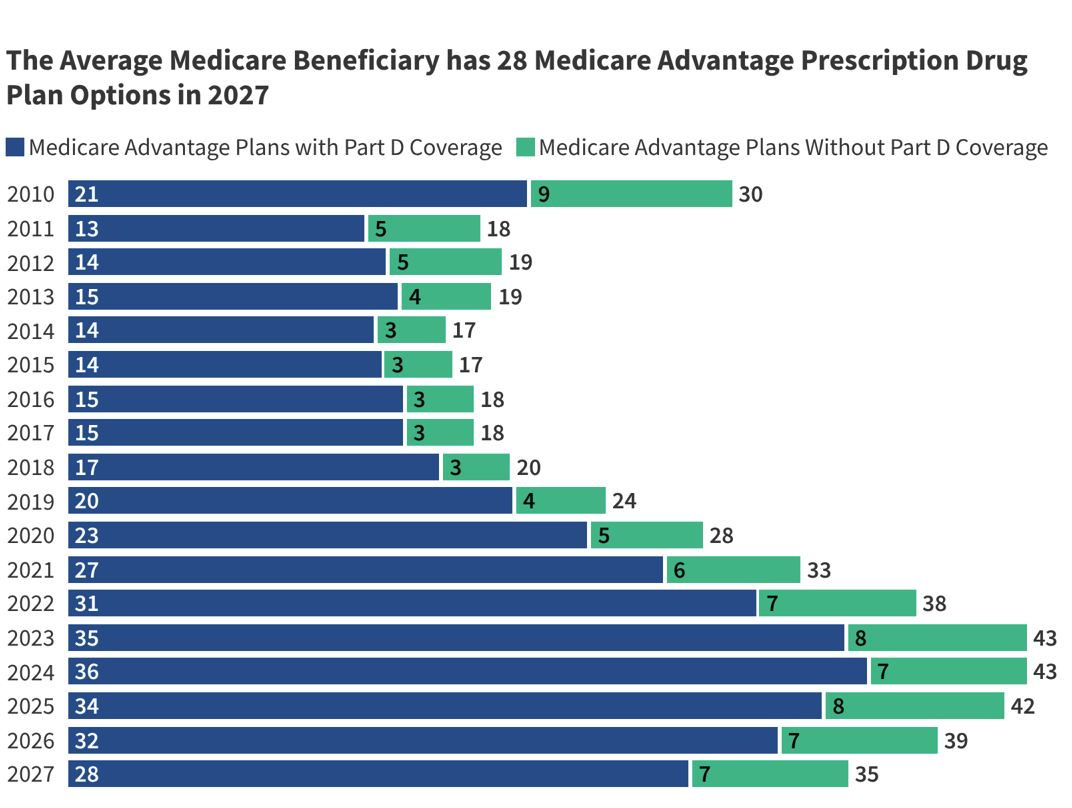
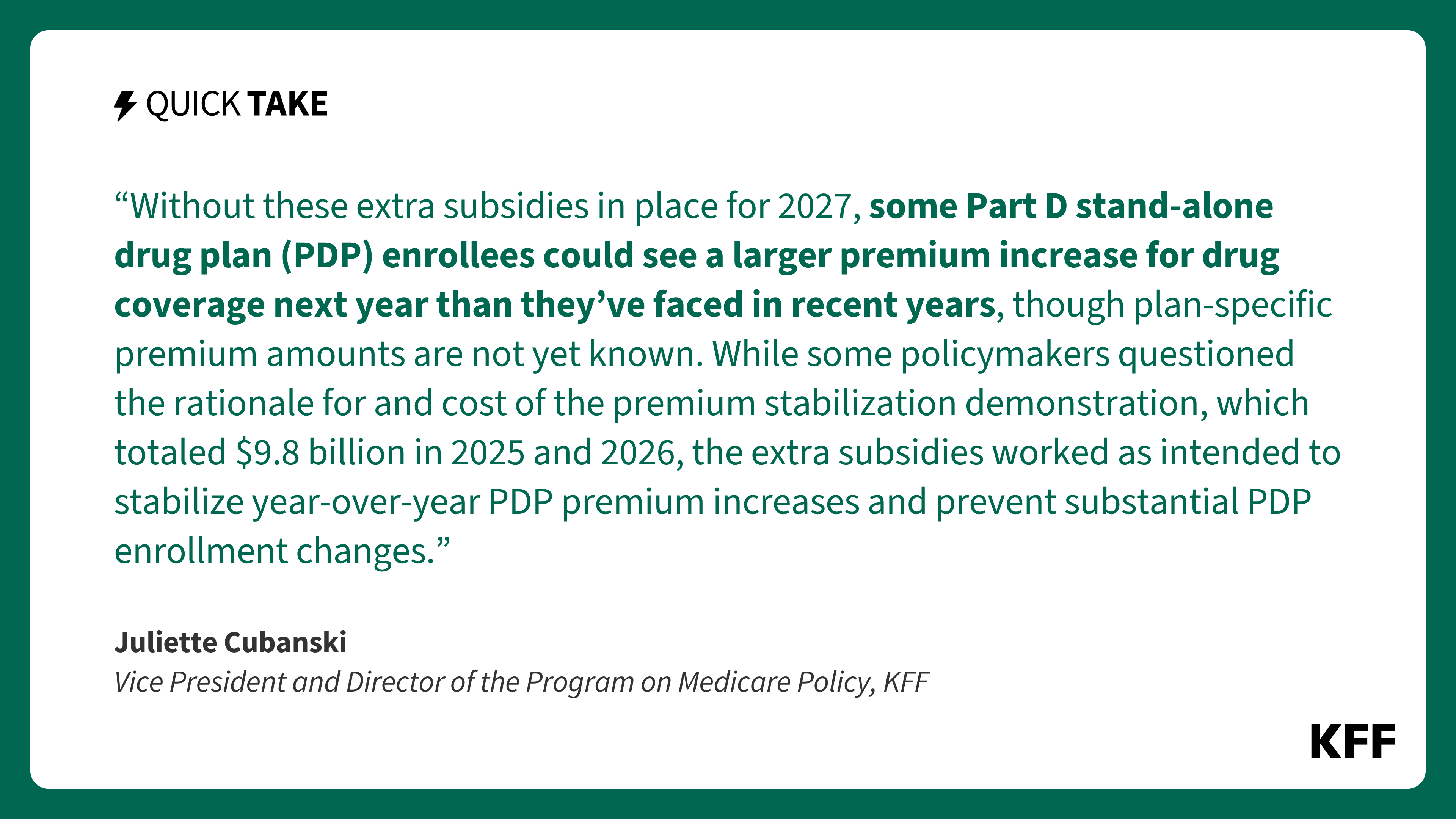
The average monthly premium for Medicare Part D coverage in stand-alone prescription drug plans (PDPs) will increase to $51 in 2027, up 50% from $34 in 2026, if current enrollees don’t switch into lower-premium plans during the open enrollment period. That is more than five times higher than the drug coverage premium in Medicare Advantage plans that offer Part D coverage, which is projected to average $9 per month in 2027. Most Part D enrollees also will face a deductible of several hundred dollars for drug coverage in 2027.
Also: Many Medicare Part D Stand-Alone Drug Plan Enrollees Will See Modest Premium Increases for 2027

Medicare Open Enrollment and Coverage Options: Key Questions and Answers

Each year, Medicare beneficiaries have an opportunity to make changes to how they receive their Medicare coverage during the nearly 8-week annual open enrollment period, which runs from October 15 through December 7. This brief answers key questions about the Medicare open enrollment period and Medicare coverage options.

NEW AND NOTEWORTHY

How Much Do People With Medicare Pay For Coverage?

This brief provides an overview of the costs faced by Medicare beneficiaries in traditional Medicare, Medicare Advantage, and Medicare Part D, including premiums, deductibles, copays, and coinsurance, focusing on costs in 2026.

What’s in a Name? From Today’s Medicare to Medicare for All

KFF’s Larry Levitt explains how proposals to create Medicare-for-All promise more generous benefits than the existing Medicare program, with no premiums or cost-sharing, but could end up looking more like Medicare if it became the subject of a serious national debate about the tradeoffs involved to implement it.

Medigap

Medigap Guaranteed Issue Requirements: An Overview of Federal and State Rules

This issue brief analyzes federal and state rules related to guaranteed issue requirements for Medigap policies and how they impact beneficiaries’ access to Medigap, including the implications for Medicare beneficiaries with pre-existing medical conditions and those under age 65 with long-term disabilities.

Data Visualization

The Facts About Medicare Spending

This interactive provides the facts on Medicare spending. Medicare, which serves 67 million people and accounts for 12 percent of the federal budget and 21 percent of national health spending, is often the focus of discussions about health expenditures, health care affordability and the sustainability of federal health programs. Explore data on enrollment growth, Medicare spending trends overall and per person, growth in Medicare spending relative to private insurance, spending on benefits and Medicare Advantage, Part A trust fund solvency challenges, and growth in out-of-pocket spending by beneficiaries.

Read More

Stay informed.

Stay informed.

Filter

891-900 of 1,627 results

  • What’s Trending in Health Care? Conservative Ideas

    From Drew Altman

    In his latest column for The Wall Street Journal’s Think Tank, Drew Altman cuts through the political debate and reviews how some ideas conservatives like are taking hold in the American health system.

  • The Truth About Those ‘Greedy’ Seniors

    From Drew Altman

    In The Wall Street Journal’s Think Tank, Drew Altman asks, "what’s your image of America’s seniors?" and provides some facts on the income and assets of Medicare enrollees.

  • New Interactive Takes a Look at Income and Assets Among Medicare Beneficiaries, Now and in the Future

    News Release

    A small share of the 52.4 million elderly individuals and people with disabilities on Medicare have relatively high incomes, but most are of modest means -- with half living on incomes of less than $23,500 last year. Although the majority of beneficiaries have some savings, the value of their assets varies dramatically, and is much lower for black and Hispanic than white beneficiaries, for widows than for widowers, and for younger Medicare beneficiaries with disabilities…

  • Visualizing Income and Assets Among Medicare Beneficiaries: Now and in the Future

    Interactive

    This interactive tool describes the income, savings and home equity of people on Medicare in 2013, and in 2030. It allows users to break out the data by age, gender, race/ethnicity, marital status and education level, providing insight into the disparities within and across categories of beneficiaries.

  • Report, Briefing Examine How Seniors Choose Among Their Medicare Plan Options

    News Release

    Report & Briefing Examine How Seniors Choose Among Their Medicare Plan Options Seniors appreciate having a wide range of Medicare private plan choices available to them but often feel unqualified to choose among them, a new Kaiser Family Foundation report concludes. Based on discussions with seniors in four cities around the country, the report captures seniors' experiences and frustrations in making decisions about their Medicare plans. Seniors cite many factors as influencing their initial choice…

  • How are Seniors Choosing and Changing Health Insurance Plans?

    Report

    This report summarizes first-hand accounts of seniors’ Medicare private plan decision making strategies, based on focus groups conducted in four cities. Seniors found the initial plan selection process overwhelming due to the volume of information they received and their inability to organize it. Few used the government's online comparison tool, and those that did cite several shortcomings. Many relied on advice from sources they trust, including insurance agents, plan representatives, friends, family members, doctor's offices…

  • Medicare Advantage: Take Another Look 

    News Release

    In the latest post in the Policy Insights series, Tricia Neuman and Gretchen Jacobson examine the surprising growth in Medicare Advantage enrollment following payment reductions included in the Affordable Care Act. Previous columns in the Policy Insights series are also available on kff.org.

  • Medicare Advantage: Take Another Look

    Perspective

    This Policy Insight explores possible explanations for the continued rise in Medicare Advantage enrollment between 2010 and 2013 in spite of a projected decrease following payment changes in the Affordable Care Act (ACA).

  • May 13 Briefing: How Well Are Seniors Making Choices Among Medicare’s Private Plans And Does It Matter?

    News Release

    The typical Medicare beneficiary this year has 18 private Medicare Advantage plans and 35 stand-alone Part D drug plan options to consider, in addition to traditional Medicare. Medicare encourages seniors to make informed decisions with respect to their health coverage options when they first become eligible for Medicare, and to review these options annually so they select coverage that best meet their needs. Yet research suggests only a small share of Medicare beneficiaries voluntarily switch…