Medicare

Medicare Open Enrollment

Part D Premiums and Cost Sharing in 2027

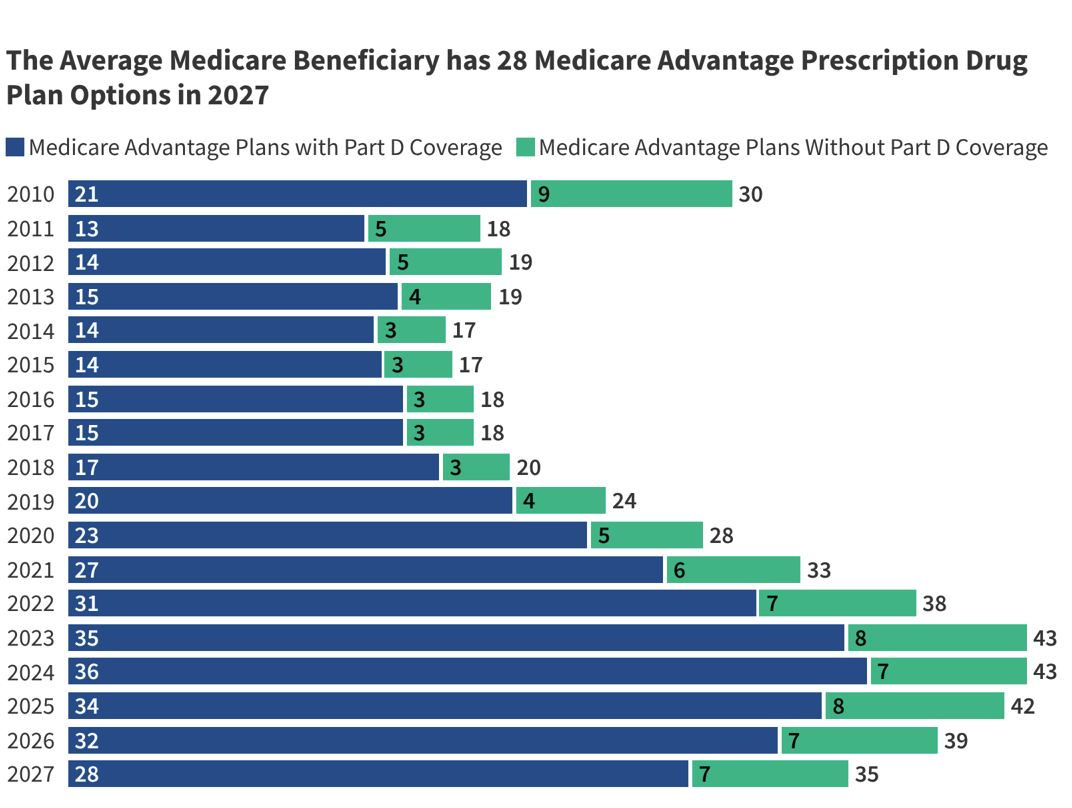
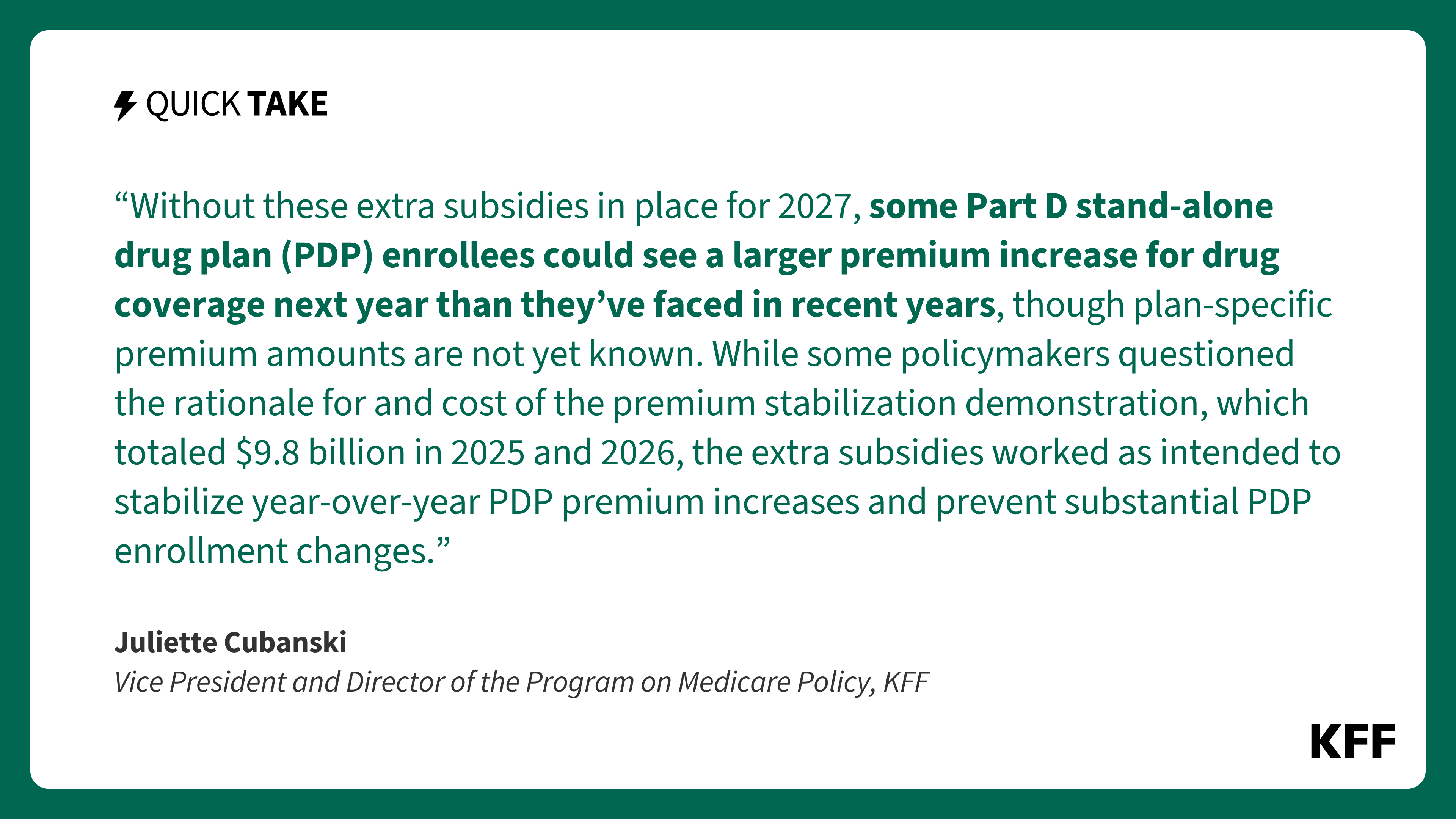
The average monthly premium for Medicare Part D coverage in stand-alone prescription drug plans (PDPs) will increase to $51 in 2027, up 50% from $34 in 2026, if current enrollees don’t switch into lower-premium plans during the open enrollment period. That is more than five times higher than the drug coverage premium in Medicare Advantage plans that offer Part D coverage, which is projected to average $9 per month in 2027. Most Part D enrollees also will face a deductible of several hundred dollars for drug coverage in 2027.
Also: Many Medicare Part D Stand-Alone Drug Plan Enrollees Will See Modest Premium Increases for 2027

Medicare Open Enrollment and Coverage Options: Key Questions and Answers

Each year, Medicare beneficiaries have an opportunity to make changes to how they receive their Medicare coverage during the nearly 8-week annual open enrollment period, which runs from October 15 through December 7. This brief answers key questions about the Medicare open enrollment period and Medicare coverage options.

NEW AND NOTEWORTHY

How Much Do People With Medicare Pay For Coverage?

This brief provides an overview of the costs faced by Medicare beneficiaries in traditional Medicare, Medicare Advantage, and Medicare Part D, including premiums, deductibles, copays, and coinsurance, focusing on costs in 2026.

What’s in a Name? From Today’s Medicare to Medicare for All

KFF’s Larry Levitt explains how proposals to create Medicare-for-All promise more generous benefits than the existing Medicare program, with no premiums or cost-sharing, but could end up looking more like Medicare if it became the subject of a serious national debate about the tradeoffs involved to implement it.

Medigap

Medigap Guaranteed Issue Requirements: An Overview of Federal and State Rules

This issue brief analyzes federal and state rules related to guaranteed issue requirements for Medigap policies and how they impact beneficiaries’ access to Medigap, including the implications for Medicare beneficiaries with pre-existing medical conditions and those under age 65 with long-term disabilities.

Data Visualization

The Facts About Medicare Spending

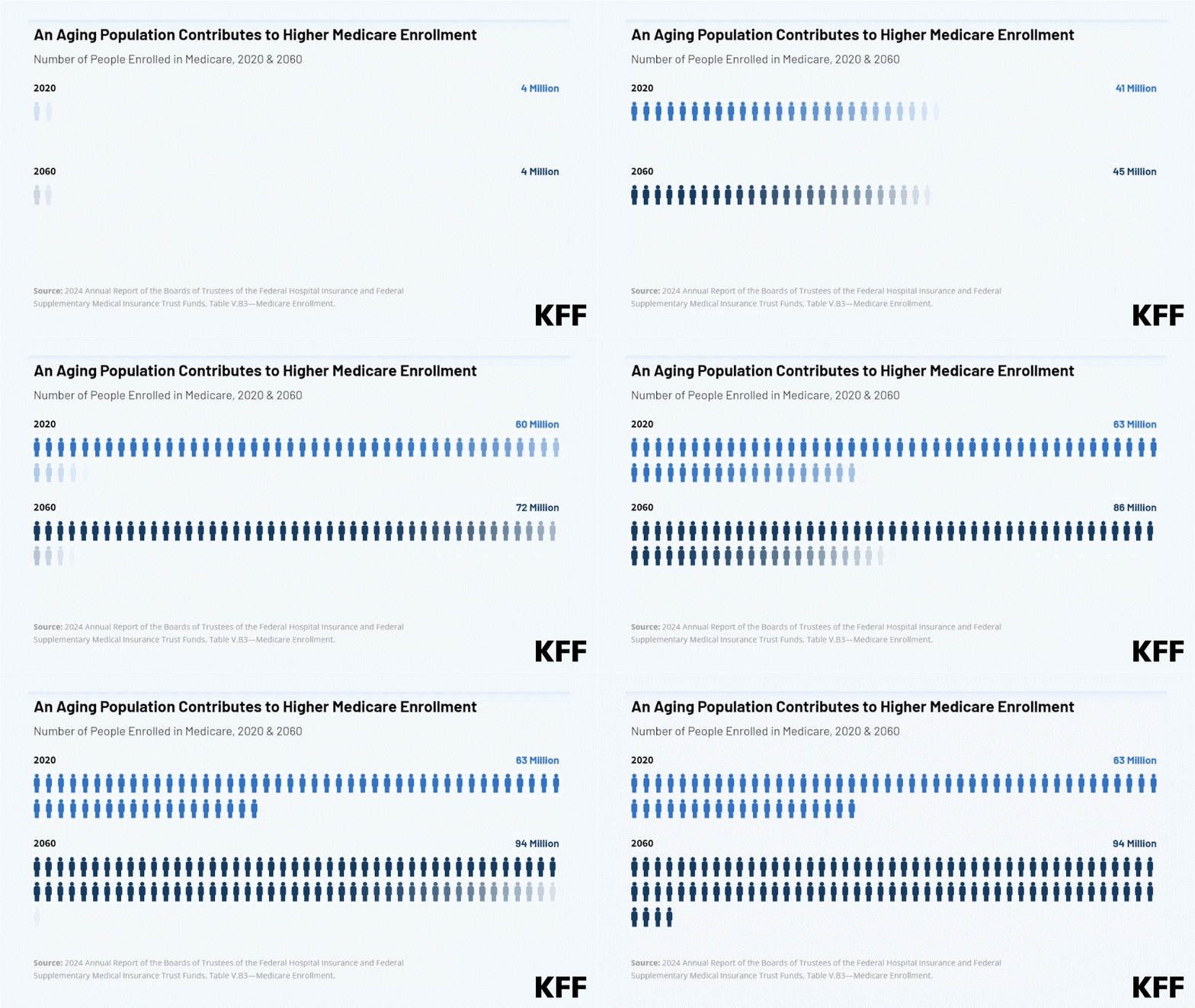
This interactive provides the facts on Medicare spending. Medicare, which serves 67 million people and accounts for 12 percent of the federal budget and 21 percent of national health spending, is often the focus of discussions about health expenditures, health care affordability and the sustainability of federal health programs. Explore data on enrollment growth, Medicare spending trends overall and per person, growth in Medicare spending relative to private insurance, spending on benefits and Medicare Advantage, Part A trust fund solvency challenges, and growth in out-of-pocket spending by beneficiaries.

Read More

Stay informed.

Stay informed.

Filter

801-810 of 1,627 results

  • The Latest on Geographic Variation in Medicare Spending: A Demographic Divide Persists But Variation Has Narrowed

    Report

    This report uses the most current data available to analyze Medicare per beneficiary spending, by county, in 2013; the growth in Medicare per beneficiary spending between 2007 and 2013, by county; and the extent to which geographic variation in Medicare per beneficiary spending has increased or decreased over time. The analysis finds that beneficiaries living in counties with relatively high Medicare per beneficiary spending tend to be sicker and poorer than beneficiaries living in lower-spending…

  • Medicare’s Drug Benefit Is Firmly-Established After Its First Decade, With Flat Premiums in Recent Years but Higher Cost-Sharing Over Time 

    News Release

    With Medicare Part D nearing the end of its tenth year, the program -- which now provides drug coverage to 72 percent of all Medicare beneficiaries -- has experienced no growth in average premiums in recent years but some notable increases in cost-sharing, according to a new report from the Kaiser Family Foundation. At a time of heightened public concern about the cost of prescription drugs, the report, Medicare Part D at Ten Years: The…

  • Medicare Part D at Ten Years: The 2015 Marketplace and Key Trends, 2006-2015

    Report

    Since 2006, Medicare beneficiaries have had access through Medicare Part D to prescription drug coverage offered by private plans, either stand-alone prescription drug plans (PDPs) or Medicare Advantage prescription drug plans (MA-PD plans). Now in its tenth year, Part D has evolved due to changes in the private plan marketplace and the laws and regulations that govern the program. This report presents findings from an analysis of the Medicare Part D marketplace in 2015 and…

  • Kaiser Health Tracking Poll: September 2015

    Feature

    As the Centers for Medicare & Medicaid Services prepares to finalize a plan to pay physicians for discussing end-of-life treatment options with Medicare patients, this month’s Kaiser Health Tracking Poll finds that about 8 in 10 of the public favors Medicare and private insurance covering such discussions and about 9 in 10 say doctors should have these discussions with their patients. However, relatively few (17 percent) say they’ve had such discussions with a doctor or other…

  • Public Strongly Favors End-of-Life Conversations Between Doctors and Patients, With About Eight in 10 Saying Medicare and Other Insurers Should Cover These Visits

    News Release

    Six in 10 Oppose 'Cadillac Plan Tax' on High-Cost Health Plans Set to Take Effect in 2018, But Cost Savings Argument Can Change Some Opinions Views on the Affordable Care Act Remain Divided: 45% Unfavorable, 41% Favorable As the Centers for Medicare & Medicaid Services prepares to finalize a plan to pay physicians for discussing end-of-life treatment options with Medicare patients, the latest Kaiser Health Tracking Poll finds an overwhelming majority supports such coverage. The…

  • Long-Term Care in the United States: A Timeline

    Other Post

    Long-term care (LTC) in the United States has evolved over the course of the last century to better serve the needs of seniors and person with disabilities. This long-term care timeline outlines the major milestones in LTC from the nursing home era, which created an institutional bias in LTC, to the era of home and community based services (HCBS) and integration, and into the era of health reform and beyond.

  • Dual Eligible Demonstrations: The Beneficiary Perspective

    Issue Brief

    This issue brief provides insights about initial implementation of the financial alignment demonstrations from the perspective of dual eligible beneficiaries in Massachusetts, Ohio, and Virginia, based on 12 individual interviews conducted in early 2015. Profiles of six beneficiaries are presented to illustrate representative program experiences, along with key findings from across all of the interviews.

  • Survey Finds Many Primary Care Physicians Have Negative Views of the Use of Quality Metrics and Penalties for Unnecessary Hospital Readmissions 

    News Release

    Primary Care Providers View Health IT as Improving Quality, But Tilt Negatively on ACOs Half of the nation's primary care physicians view the increased use of quality-of-care metrics and financial penalties for unnecessary hospitalizations as potentially troubling for patient care, according to a new survey from The Commonwealth Fund and the Kaiser Family Foundation. Fifty percent of primary care physicians say the increased use of quality metrics to assess provider performance is having a negative…