Medicare

Medicare Open Enrollment

Part D Premiums and Cost Sharing in 2027

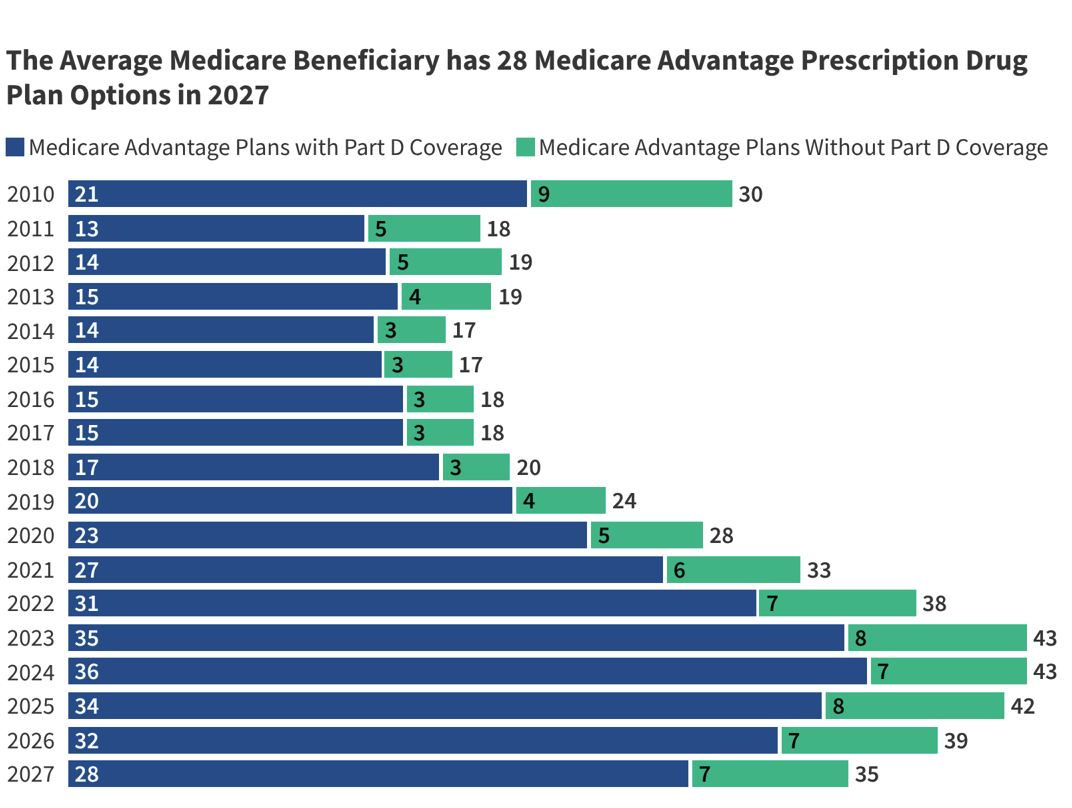
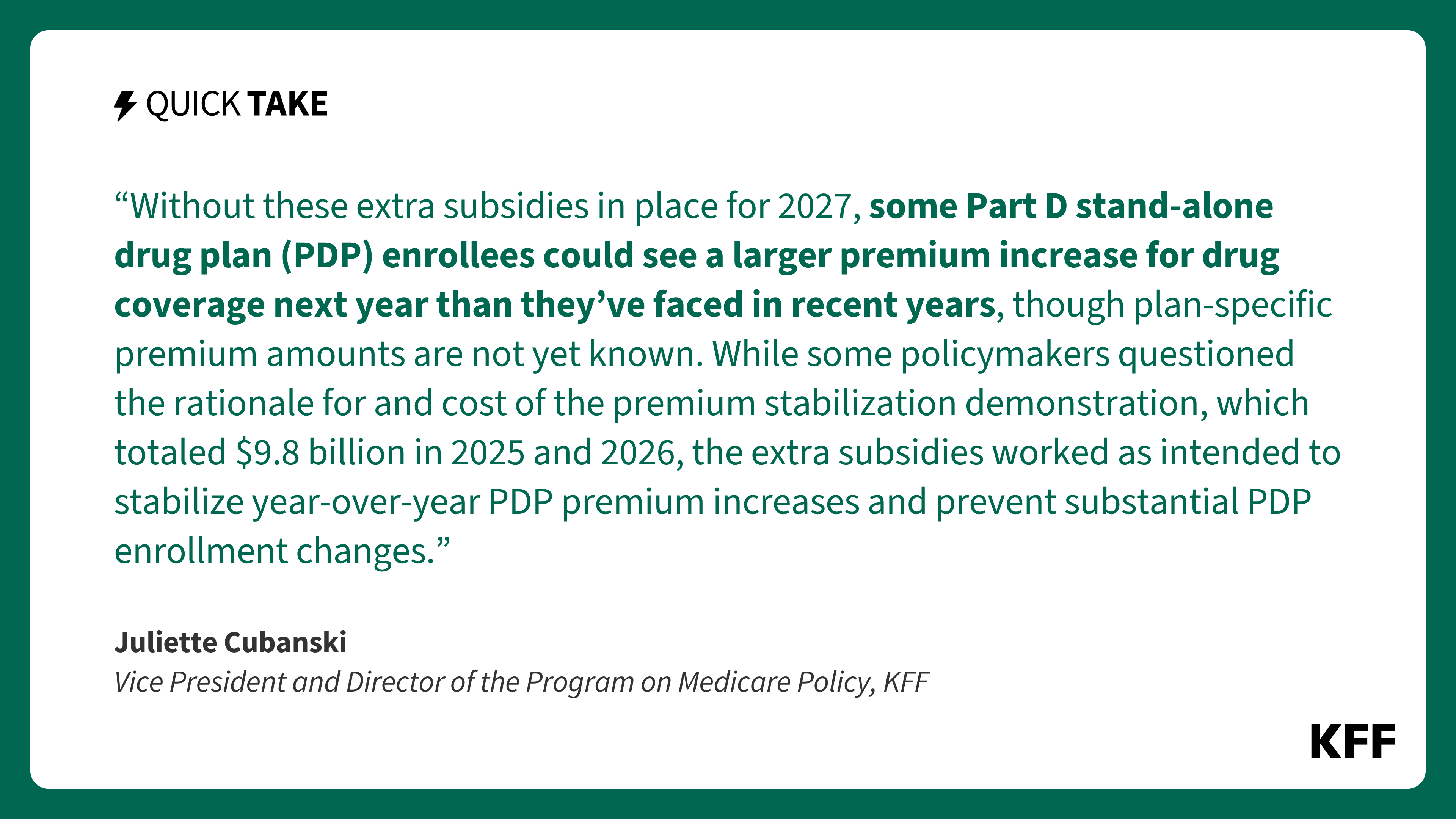
The average monthly premium for Medicare Part D coverage in stand-alone prescription drug plans (PDPs) will increase to $51 in 2027, up 50% from $34 in 2026, if current enrollees don’t switch into lower-premium plans during the open enrollment period. That is more than five times higher than the drug coverage premium in Medicare Advantage plans that offer Part D coverage, which is projected to average $9 per month in 2027. Most Part D enrollees also will face a deductible of several hundred dollars for drug coverage in 2027.
Also: Many Medicare Part D Stand-Alone Drug Plan Enrollees Will See Modest Premium Increases for 2027

Medicare Open Enrollment and Coverage Options: Key Questions and Answers

Each year, Medicare beneficiaries have an opportunity to make changes to how they receive their Medicare coverage during the nearly 8-week annual open enrollment period, which runs from October 15 through December 7. This brief answers key questions about the Medicare open enrollment period and Medicare coverage options.

NEW AND NOTEWORTHY

How Much Do People With Medicare Pay For Coverage?

This brief provides an overview of the costs faced by Medicare beneficiaries in traditional Medicare, Medicare Advantage, and Medicare Part D, including premiums, deductibles, copays, and coinsurance, focusing on costs in 2026.

What’s in a Name? From Today’s Medicare to Medicare for All

KFF’s Larry Levitt explains how proposals to create Medicare-for-All promise more generous benefits than the existing Medicare program, with no premiums or cost-sharing, but could end up looking more like Medicare if it became the subject of a serious national debate about the tradeoffs involved to implement it.

Medigap

Medigap Guaranteed Issue Requirements: An Overview of Federal and State Rules

This issue brief analyzes federal and state rules related to guaranteed issue requirements for Medigap policies and how they impact beneficiaries’ access to Medigap, including the implications for Medicare beneficiaries with pre-existing medical conditions and those under age 65 with long-term disabilities.

Data Visualization

The Facts About Medicare Spending

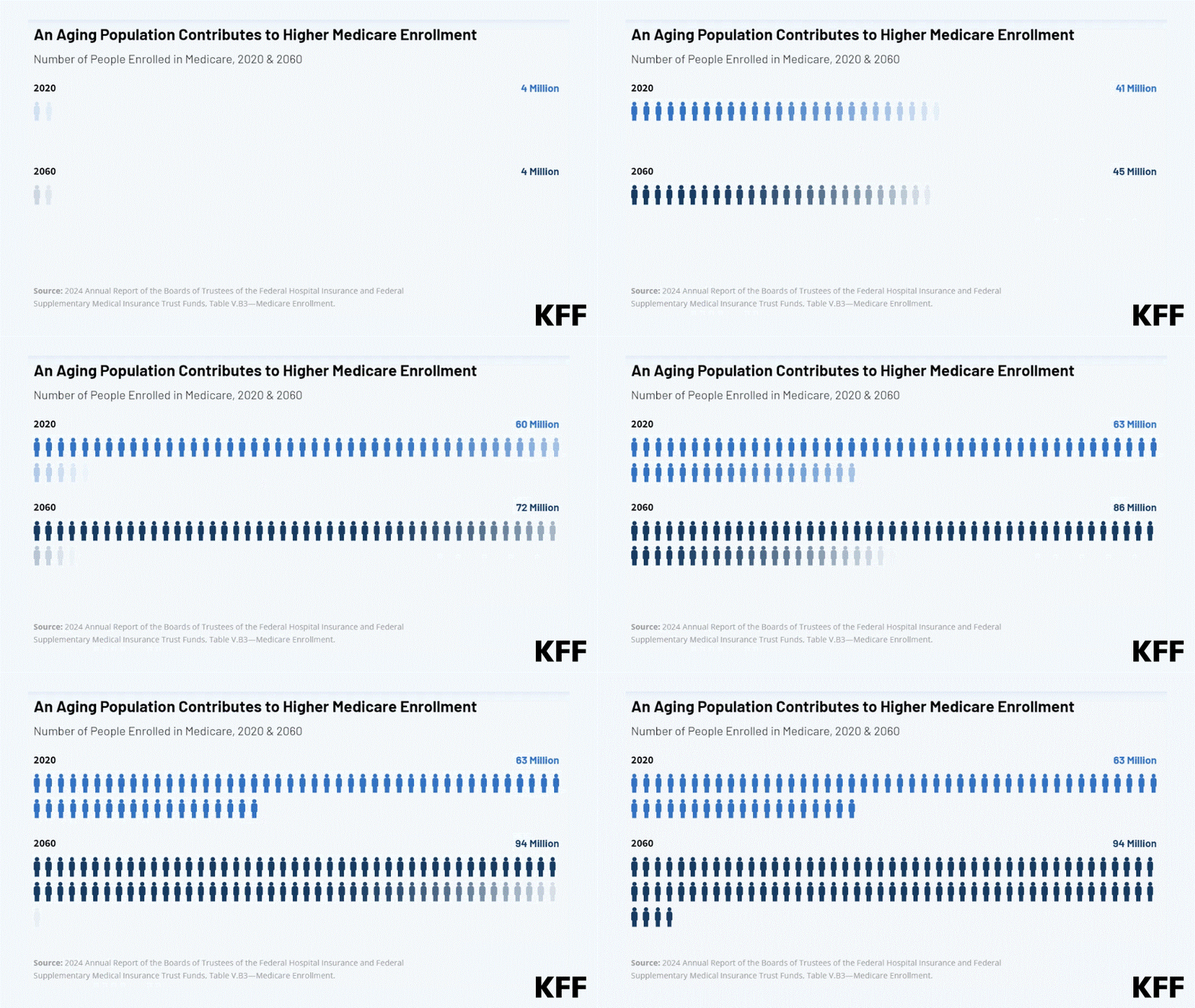
This interactive provides the facts on Medicare spending. Medicare, which serves 67 million people and accounts for 12 percent of the federal budget and 21 percent of national health spending, is often the focus of discussions about health expenditures, health care affordability and the sustainability of federal health programs. Explore data on enrollment growth, Medicare spending trends overall and per person, growth in Medicare spending relative to private insurance, spending on benefits and Medicare Advantage, Part A trust fund solvency challenges, and growth in out-of-pocket spending by beneficiaries.

Read More

Stay informed.

Stay informed.

Filter

1,591-1,600 of 1,627 results

  • Medicare: Options for Reform, A Public Dialogue on Health Care: The Future of Medicare

    Report

    A public education brochure describing Medicare reform options that are being considered by Congress. This fact sheet is also a part of a packet of information as part of a joint public information project between Kaiser Family Foundation and League of Women Voters of public meetings held across the United States in October 1998 (#1427, available in print). Report Report

  • Medicare: The Basics, A Public Dialogue on Health Care: The Future of Medicare

    Report

    A public education brochure describing basic facts about the current Medicare program and how it works. This fact sheet is included in a full packet of information as part of a joint public information project between Kaiser Family Foundation and League of Women Voters of public meetings held across the United States in October 1998 (#1427 - available in print). Report Report

  • Protection For Consumers In Managed Care Plans: A Comparison Of Medicare, Medicaid and the Private Insurance Market

    Report

    This policy paper describes key requirements of consumer protection regulation under Medicare, Medicaid and federal and state laws as they apply to private health insurance. These include choice and availability of plans, disclosure of information, marketing, access, quality, and the grievance and appeals process. The discussion highlights differences and similarities across public programs and private insurance and compares public and private insurance protection with provisions of the Consumer Bill of Rights (CBRR) developed by the…

  • Medicare Beneficiaries and HMOs: A Case Study of the Tampa-St. Petersburg Market

    Report

    This case study of the evolution of Medicare managed care in Tampa-St. Petersburg, Florida, is one of four in a series being prepared by Mathematica Policy Research, Inc., for the Kaiser Family Foundation to examine the growth and impact of Medicare managed care. The Medicare risk (HMO) program has developed at different rates and with different degrees of success across the country. The four unique market areas selected for the project include two with high…

  • The Medicare Program: Panorama General De Medicare

    Fact Sheet

    Que Es El Medicare Y Como Se Financia? Medicare es un programa de seguro medico nacional que atiende a 39 millones de ancianos y discapacitados. Antes de la existencia del Medicare, menos de la mitad de todos los norteamericanos de edad avanzada contaban con un seguro medico. Hoy en dia, practicamente todos los adultos de 65 anos de edad mayores se encuentran asegurados bajo Medicare. Medicare cubre a 34 millones de beneficiarios ancianos y a…

  • Medicare Managed Care (Spanish)

    Fact Sheet

    Medicare Managed Care (Spanish) Fact Sheet: The Medicare Program: Funcion de Medicare Para Latinos

  • Medicare Beneficiaries & HMO’s:  A Case Study of the Portland, OR Market

    Other Post

    Medicare Beneficiaries & HMO's: A Case Study of the Portland, OR Market Note: This publication is no longer in circulation. However, a few copies may still exist in the Foundation's internal library that could be xeroxed. Please email order@kff.org if you would like to pursue this option

  • Medicare Beneficiaries and HMOs: A Case Study of the Portland Market

    Report

    This case study of the evolution of Medicare managed care in Portland, Oregon, is part of a series of four case studies being prepared for the Kaiser Family Foundation to learn more about the factors influencing, and consequences of, the growth of Medicare managed care. Portland was one of the first markets to implement a Medicare managed care program, with the Kaiser Foundation Health Plan beginning its Medicare HMO in 1978 and all four of…

  • Welfare Reform and Elderly Legal Immigrants

    Other Post

    Economic Status of the Elderly Legal Immigrant conomic status, especially in old age, is often dependent on a lifetime of choices and opportunities. Retirement income is directly dependent on previous labor force experiences, savings, and thehealth and insurance coverage of family members. Good health and high educational attainment tend toresult in better employment opportunities, a greater likelihood of a pension, and increased prospects forsaving. Poor health, the death of a spouse, lack of education, or…