Medicare

Medicare Open Enrollment

Part D Premiums and Cost Sharing in 2027

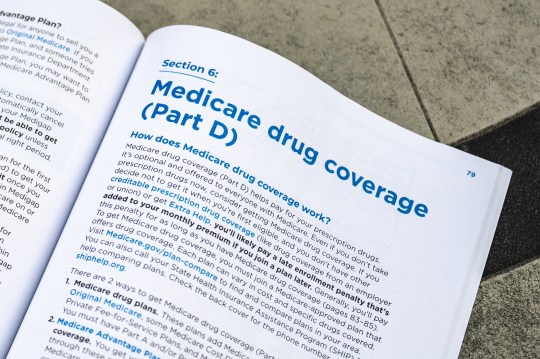
The average monthly premium for Medicare Part D coverage in stand-alone prescription drug plans (PDPs) will increase to $51 in 2027, up 50% from $34 in 2026, if current enrollees don’t switch into lower-premium plans during the open enrollment period. That is more than five times higher than the drug coverage premium in Medicare Advantage plans that offer Part D coverage, which is projected to average $9 per month in 2027. Most Part D enrollees also will face a deductible of several hundred dollars for drug coverage in 2027.


Also: Many Medicare Part D Stand-Alone Drug Plan Enrollees Will See Modest Premium Increases for 2027

Medicare Open Enrollment and Coverage Options: Key Questions and Answers

Each year, Medicare beneficiaries have an opportunity to make changes to how they receive their Medicare coverage during the nearly 8-week annual open enrollment period, which runs from October 15 through December 7. This brief answers key questions about the Medicare open enrollment period and Medicare coverage options.

NEW AND NOTEWORTHY

How Much Do People With Medicare Pay For Coverage?

This brief provides an overview of the costs faced by Medicare beneficiaries in traditional Medicare, Medicare Advantage, and Medicare Part D, including premiums, deductibles, copays, and coinsurance, focusing on costs in 2026.

What’s in a Name? From Today’s Medicare to Medicare for All

KFF’s Larry Levitt explains how proposals to create Medicare-for-All promise more generous benefits than the existing Medicare program, with no premiums or cost-sharing, but could end up looking more like Medicare if it became the subject of a serious national debate about the tradeoffs involved to implement it.

Medigap

Medigap Guaranteed Issue Requirements: An Overview of Federal and State Rules

This issue brief analyzes federal and state rules related to guaranteed issue requirements for Medigap policies and how they impact beneficiaries’ access to Medigap, including the implications for Medicare beneficiaries with pre-existing medical conditions and those under age 65 with long-term disabilities.

Data Visualization

The Facts About Medicare Spending

This interactive provides the facts on Medicare spending. Medicare, which serves 67 million people and accounts for 12 percent of the federal budget and 21 percent of national health spending, is often the focus of discussions about health expenditures, health care affordability and the sustainability of federal health programs. Explore data on enrollment growth, Medicare spending trends overall and per person, growth in Medicare spending relative to private insurance, spending on benefits and Medicare Advantage, Part A trust fund solvency challenges, and growth in out-of-pocket spending by beneficiaries.

Read More

Stay informed.

Stay informed.

Filter

1,541-1,550 of 1,627 results

  • The Distributional Consequences of  Medicare Premium Support Proposal

    Other Post

    The Distributional Consequences of a Medicare Premium Support Proposal This article analyzes the expected distributional impact of enacting a premium support proposal for Medicare based on legislation introduced by Sen. Breaux and Sen. Frist in 1999. This legislation suggested that the Federal Employees Health Benefits plan be used as a model for Medicare. The article simulates impacts in three areas: among beneficiaries who choose to retain fee-for-service coverage, between different geographic areas, and according to…

  • Low-Income Subsidies for the Medicare Prescription Drug Benefit: The Impact of the Asset Test

    Report

    This study assesses the impact of the requirement that low-income people with Medicare meet an asset test in order to receive additional help paying premiums and cost-sharing under the new Medicare drug benefit. Report (.pdf) American Journal of Managed Care Article: Who Will Be Denied Medicare Prescription Drug Subsidies Because of the Asset Test? (January 2006) (.pdf)

  • Prescription Drug Coverage and Seniors: Findings from a 2003 National Survey

    Other Post

    This national survey of 17,685 seniors captures detailed information about their prescription drug use, coverage and experiences. It also includes state-specific comparative data for seniors in 12 states -- California, Colorado, Florida, Illinois, Louisiana, Michigan, New York, Ohio, Pennsylvania, Texas, Tennessee and Washington. This 2003 survey was conducted by the Kaiser Family Foundation, the Commonwealth Fund and Tufts-New England Medical Center. An article presenting its findings was published by Health Affairs as a web exclusive…

  • Dual Eligibles: Medicaid Enrollment and Spending for Medicare Beneficiaries in 2003

    Issue Brief

    Dual Eligibles: Medicaid Enrollment and Spending for Medicare Beneficiaries in 2003 This report provides the latest national and state data on Medicaid enrollment and spending for individuals enrolled in both Medicaid and Medicare, also knows as dual eligibles. Nationally, there are 7.5 million dual eligibles and while they comprise 14 percent of the Medicaid population, they account for 40 percent of Medicaid spending. Issue Paper (.pdf)

  • Medicare Part D: Issues for Dual Eligibles on the Eve of Implementation

    Issue Brief

    Medicare Part D: Issues for Dual Eligibles on the Eve of Implementation This issue brief describes how dual eligibles are treated under the Medicare drug benefit and the issues raised by their transition from Medicaid to Medicare drug coverage. The brief also explores key differences in the Medicare drug benefit compared to Medicaid drug coverage (formularies, copayments, and appeals policies) which could make the shift especially challenging for dual eligibles. Issue Brief (.pdf)

  • The Medicare Drug Benefit: Beneficiary Perspectives Just Before Implementation- Chartpack

    Poll Finding

    This chartpack highlights key results and trends from a comprehensive survey of seniors on their understanding of and views toward the Medicare drug benefit. The survey of 802 seniors was conducted in late October 2005, prior to the start of the benefit's open enrollment period, which runs from Nov. 15, 2005 to May 15, 2006. This survey is part of an ongoing effort to track seniors’ views on the Medicare prescription drug benefit, which has…

  • African Americans and the New Medicare Drug Benefit

    Poll Finding

    In a few short weeks, Medicare will undergo big changes that will have a major impact on nearly 4 million African American seniors and younger people with permanent disabilities who rely on Medicare for their health coverage. More than four in ten African Americans with Medicare lack coverage for their prescription drugs for at least part of the year. Many others will need to make decisions about their existing coverage and the new Medicare benefit.…

  • Tracking Prescription Drug Coverage Under Medicare:  Five Ways to Look at the New Enrollment Numbers

    Issue Brief

    Tracking Prescription Drug Coverage Under Medicare: Five Ways to Look at the New Enrollment Numbers This new analysis, which assesses Medicare drug benefit enrollment statistics released Feb. 22 by the U.S. Department of Health and Human Services, examines five different approaches to understanding the Medicare drug coverage numbers: What share of the total Medicare population has creditable prescription drug coverage? What share of the total Medicare population is enrolled in a Medicare drug plan? How…

  • Medicare Part D 2008 Data Spotlight: Utilization Management

    Issue Brief

    This Medicare Part D data spotlight examines three common techniques used by Medicare stand-alone prescription drug plans in 2008 to manage enrollees’ use of formulary drugs, such as quantity limits, prior authorization, and step therapy rules. This is one in a series analyzing key aspects of the 2008 Medicare Part D prescription drug plan choices. It analyzes data from the 47 stand-alone prescription drug plans available nationwide using a sample of 169 commonly-used and high-cost…

  • Chartpack: Kaiser Health Tracking Poll — November 2009

    Poll Finding

    This document contains the chartpack from the November Health Tracking Poll. The survey was designed and analyzed by public opinion researchers at the Kaiser Family Foundation and was conducted November 5 through November 12, 2009, among a nationally representative random sample of 1,203 adults ages 18 and older. Telephone interviews conducted by landline (802) and cell phone (401, including 112 who had no landline telephone) were carried out in English and Spanish. The margin of…