Medicare

Medicare Open Enrollment

Part D Premiums and Cost Sharing in 2027

The average monthly premium for Medicare Part D coverage in stand-alone prescription drug plans (PDPs) will increase to $51 in 2027, up 50% from $34 in 2026, if current enrollees don’t switch into lower-premium plans during the open enrollment period. That is more than five times higher than the drug coverage premium in Medicare Advantage plans that offer Part D coverage, which is projected to average $9 per month in 2027. Most Part D enrollees also will face a deductible of several hundred dollars for drug coverage in 2027.
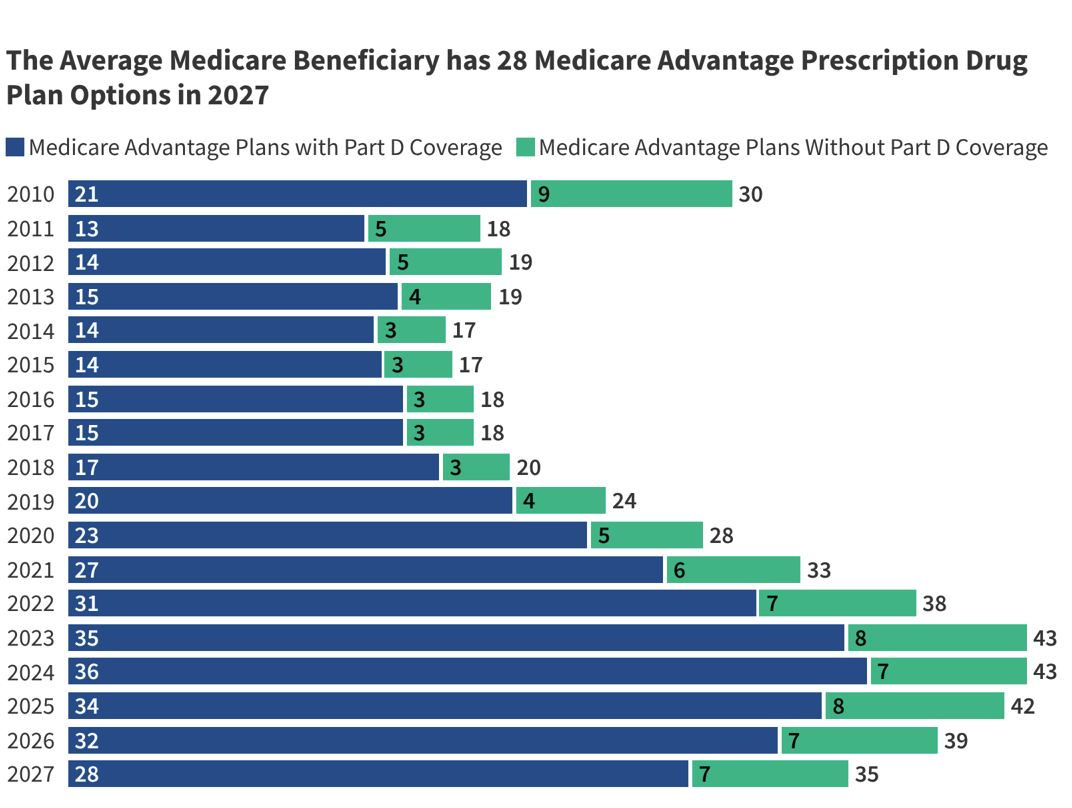
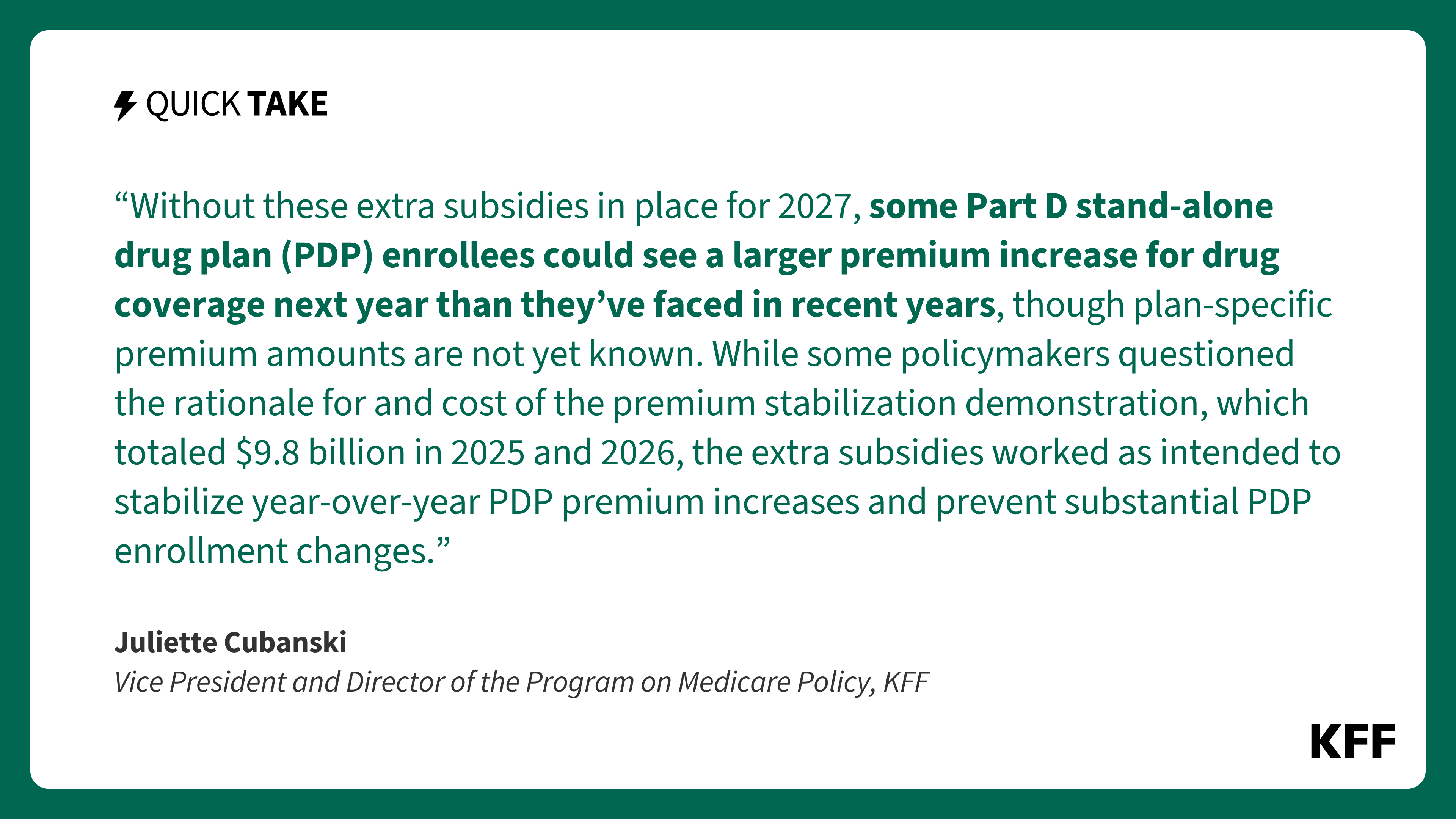
Also: Many Medicare Part D Stand-Alone Drug Plan Enrollees Will See Modest Premium Increases for 2027

Medicare Open Enrollment and Coverage Options: Key Questions and Answers

Each year, Medicare beneficiaries have an opportunity to make changes to how they receive their Medicare coverage during the nearly 8-week annual open enrollment period, which runs from October 15 through December 7. This brief answers key questions about the Medicare open enrollment period and Medicare coverage options.

NEW AND NOTEWORTHY

How Much Do People With Medicare Pay For Coverage?

This brief provides an overview of the costs faced by Medicare beneficiaries in traditional Medicare, Medicare Advantage, and Medicare Part D, including premiums, deductibles, copays, and coinsurance, focusing on costs in 2026.

What’s in a Name? From Today’s Medicare to Medicare for All

KFF’s Larry Levitt explains how proposals to create Medicare-for-All promise more generous benefits than the existing Medicare program, with no premiums or cost-sharing, but could end up looking more like Medicare if it became the subject of a serious national debate about the tradeoffs involved to implement it.

Medigap

Medigap Guaranteed Issue Requirements: An Overview of Federal and State Rules

This issue brief analyzes federal and state rules related to guaranteed issue requirements for Medigap policies and how they impact beneficiaries’ access to Medigap, including the implications for Medicare beneficiaries with pre-existing medical conditions and those under age 65 with long-term disabilities.

Data Visualization

The Facts About Medicare Spending

This interactive provides the facts on Medicare spending. Medicare, which serves 67 million people and accounts for 12 percent of the federal budget and 21 percent of national health spending, is often the focus of discussions about health expenditures, health care affordability and the sustainability of federal health programs. Explore data on enrollment growth, Medicare spending trends overall and per person, growth in Medicare spending relative to private insurance, spending on benefits and Medicare Advantage, Part A trust fund solvency challenges, and growth in out-of-pocket spending by beneficiaries.

Read More

Stay informed.

Stay informed.

Filter

1,531-1,540 of 1,627 results

  • A Side-by-Side Comparison of Selected Medicare Prescription Drug Coverage Proposals

    Report

    This document provides a side-by-side comparison of four major federal proposals under consideration to provide outpatient prescription drug coverage to Medicare beneficiaries. It begins with a summary table comparing key features of each proposal, followed by a detailed comparison of the following major proposals: Clinton/Moynihan (The Medicare Modernization Act), House-Passed Plan (The Medicare Rx 2000 Act), Breaux/Frist (The Medicare Prescription Drug and Modernization Act), and Graham/Bryan/Robb (The Medicare Outpatient Drug Act of 2000). Side-by-side

  • The Implications of Medicare Prescription Drug Proposals for Employers and Retirees

    Report

    This report examines the potential savings for employers who currently represent the largest source of drug coverage for seniors. The study finds substantial savings for large employers under comprehensive Medicare prescription drug proposals ranging from $5-8.5 billion in 2003 to $10-$15 billion in 2009. It also finds that the majority of large employers are likely to retain retiree coverage, as a supplement to a Medicare drug benefit. Report

  • Prescription Drug Trends: A Chartbook

    Report

    Prescription Drug Trends - A Chartbook, an analysis by the Kaiser Family Foundation and the Sonderegger Research Center, University of Wisconsin-Madison, provides information about trends in prescription drug coverage, spending, prices, use, and industry structure. Although overall coverage for prescription drugs has increased over the last decade, about a quarter of the nonelderly and a third of Medicare beneficiaries have no drug coverage. Spending for prescriptions is one of the fastest growing components of health…

  • Health News Index–May/June 2000

    Poll Finding

    Health News Index May/June, 2000 The May/June 2000 edition of the Kaiser Family Foundation/Harvard School of Public Health, Health News Index includes questions about major health stories covered in the news, including questions about the Congressional Democrats' proposal to have the Medicare program cover prescription drug costs for the elderly. The survey is based on a national random sample of 580 Americans and was conducted May 26-June 4, 2000. The survey measures public knowledge of…

  • Medicaid Eligibility for Individuals with Disabilities

    Issue Brief

    This issue paper updates the July 1999 report and provides a general overview of federal Medicaid eligibility policy for the low-income disabled population. This paper focuses on four broad groups of individuals with disabilities: children under 18; adults under 65 who are not living in institutions; adults under 65 who are living in institutions; and adults under 65 who are also eligible for Medicare. In addition, this paper includes the new eligibility options offered under…

  • Medicaid Managed Care for Persons with Disabilities: A Closer Look

    Report

    This report, Medicaid Managed Care for Persons with Disabilities: A Closer Look, presents an overview of the findings and summarizes the results of the case studies of Medicaid managed care programs that enroll persons with disabilities in four states: Florida, Kentucky, Michigan, and New Mexico. This report also draws from the findings of the 1998 national survey of state practices (Publication #2114) and focus groups of low-income disabled individuals (Publication #2152). This report addresses the…

  • Medicaid-Related Provisions in the Ticket to Work and Work Incentives Improvement Act of 1999

    Report

    In December, the President signed into law the Ticket to Work and Work Incentives Improvement Act of 1999, which includes provisions that will give states additional options for extending Medicaid coverage to working disabled individuals. This memo presents an overview of the eligibility options offered under the new legislation (Publication #2187). A related publication, Medicaid Eligiblity for Individuals with Disabilities (Publication #2150), provides a general overview of federal Medicaid eligibility policy for the low-income disabled…

  • The Olmstead Decision: Implications for Medicaid

    Issue Brief

    In June, 1999, the Supreme Court rule in Olmstead v L.C. that states were required to provide services to persons with disabilities in community settings rather than institutions, if certain conditions were met. This Policy Brief provides an overview of the Olmstead case, including the facts, the court ruling, and the disposition of the case. In addition, the brief describes the issues surrounding implementation and the implications this ruling could have for state Medicaid programs.…