Medicare

Medicare Open Enrollment

Part D Premiums and Cost Sharing in 2027

The average monthly premium for Medicare Part D coverage in stand-alone prescription drug plans (PDPs) will increase to $51 in 2027, up 50% from $34 in 2026, if current enrollees don’t switch into lower-premium plans during the open enrollment period. That is more than five times higher than the drug coverage premium in Medicare Advantage plans that offer Part D coverage, which is projected to average $9 per month in 2027. Most Part D enrollees also will face a deductible of several hundred dollars for drug coverage in 2027.
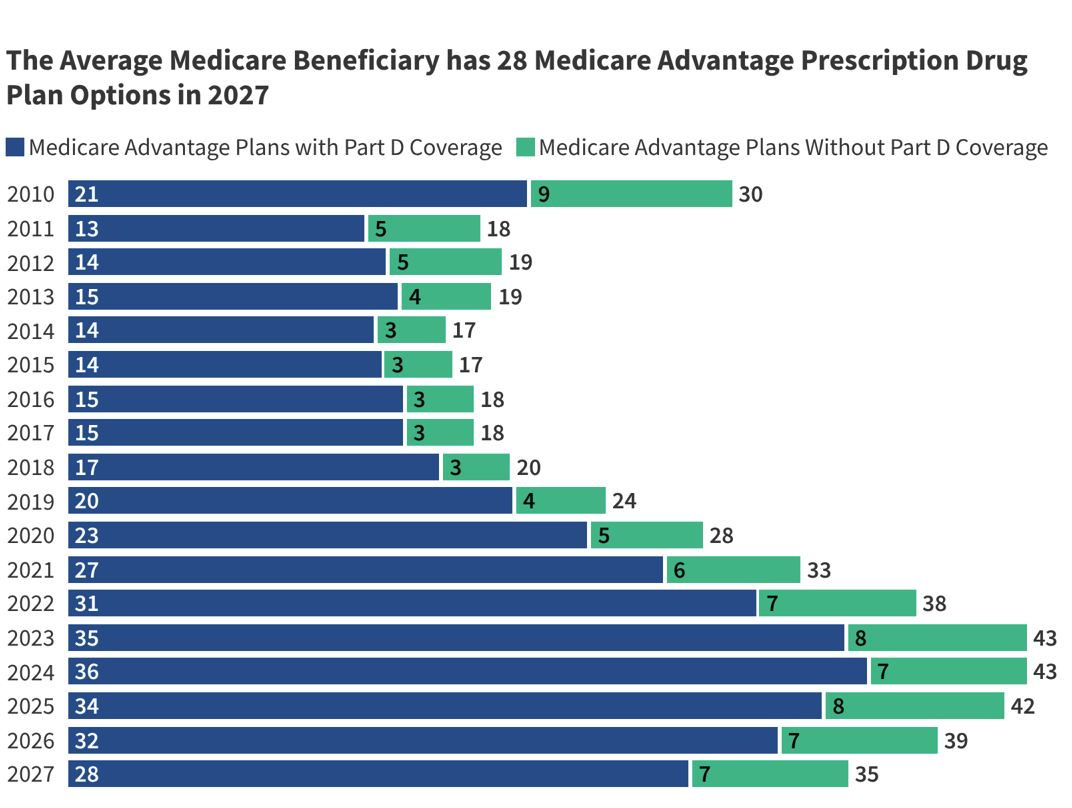
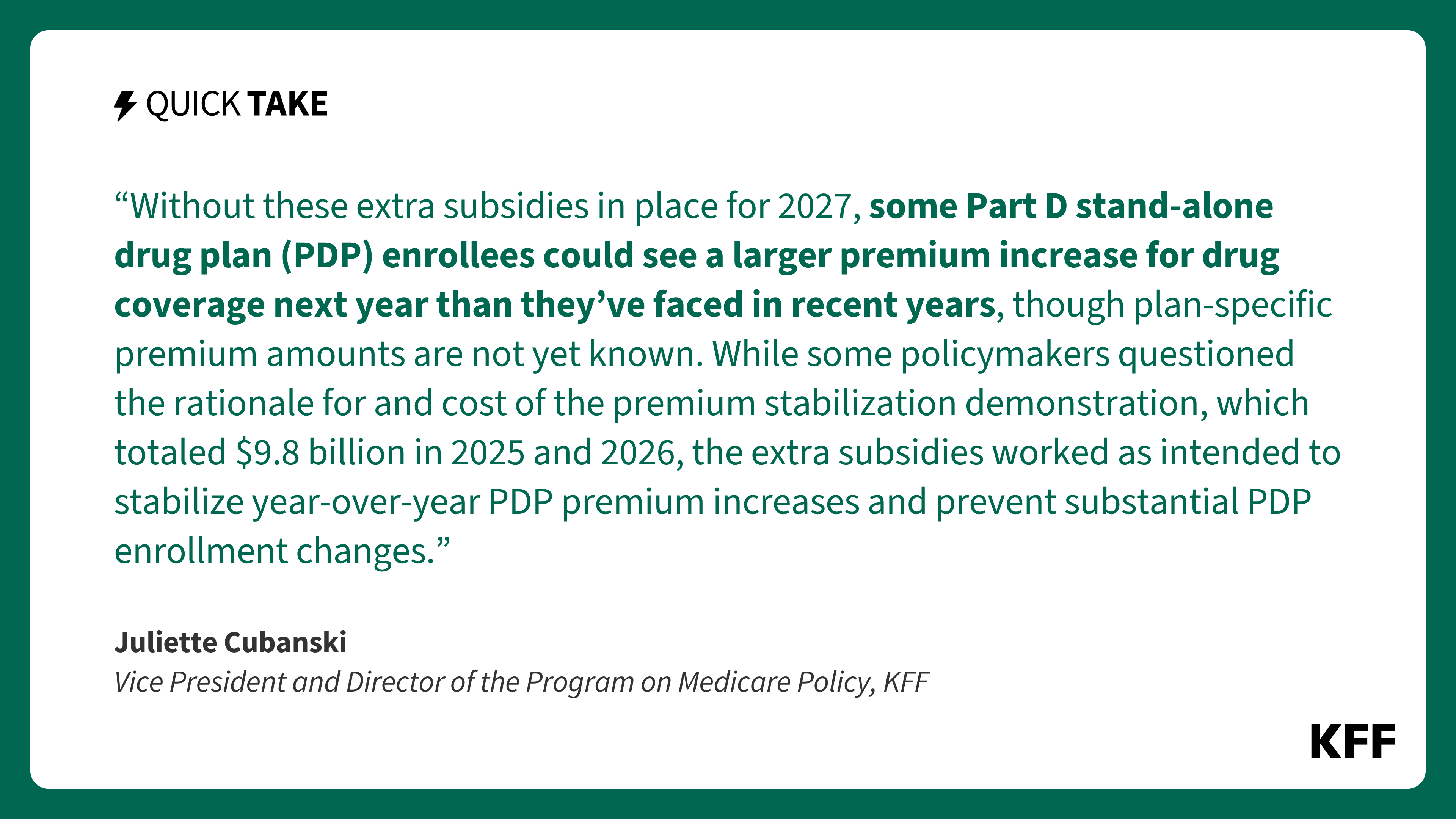
Also: Many Medicare Part D Stand-Alone Drug Plan Enrollees Will See Modest Premium Increases for 2027

Medicare Open Enrollment and Coverage Options: Key Questions and Answers

Each year, Medicare beneficiaries have an opportunity to make changes to how they receive their Medicare coverage during the nearly 8-week annual open enrollment period, which runs from October 15 through December 7. This brief answers key questions about the Medicare open enrollment period and Medicare coverage options.

NEW AND NOTEWORTHY

How Much Do People With Medicare Pay For Coverage?

This brief provides an overview of the costs faced by Medicare beneficiaries in traditional Medicare, Medicare Advantage, and Medicare Part D, including premiums, deductibles, copays, and coinsurance, focusing on costs in 2026.

What’s in a Name? From Today’s Medicare to Medicare for All

KFF’s Larry Levitt explains how proposals to create Medicare-for-All promise more generous benefits than the existing Medicare program, with no premiums or cost-sharing, but could end up looking more like Medicare if it became the subject of a serious national debate about the tradeoffs involved to implement it.

Medigap

Medigap Guaranteed Issue Requirements: An Overview of Federal and State Rules

This issue brief analyzes federal and state rules related to guaranteed issue requirements for Medigap policies and how they impact beneficiaries’ access to Medigap, including the implications for Medicare beneficiaries with pre-existing medical conditions and those under age 65 with long-term disabilities.

Data Visualization

The Facts About Medicare Spending

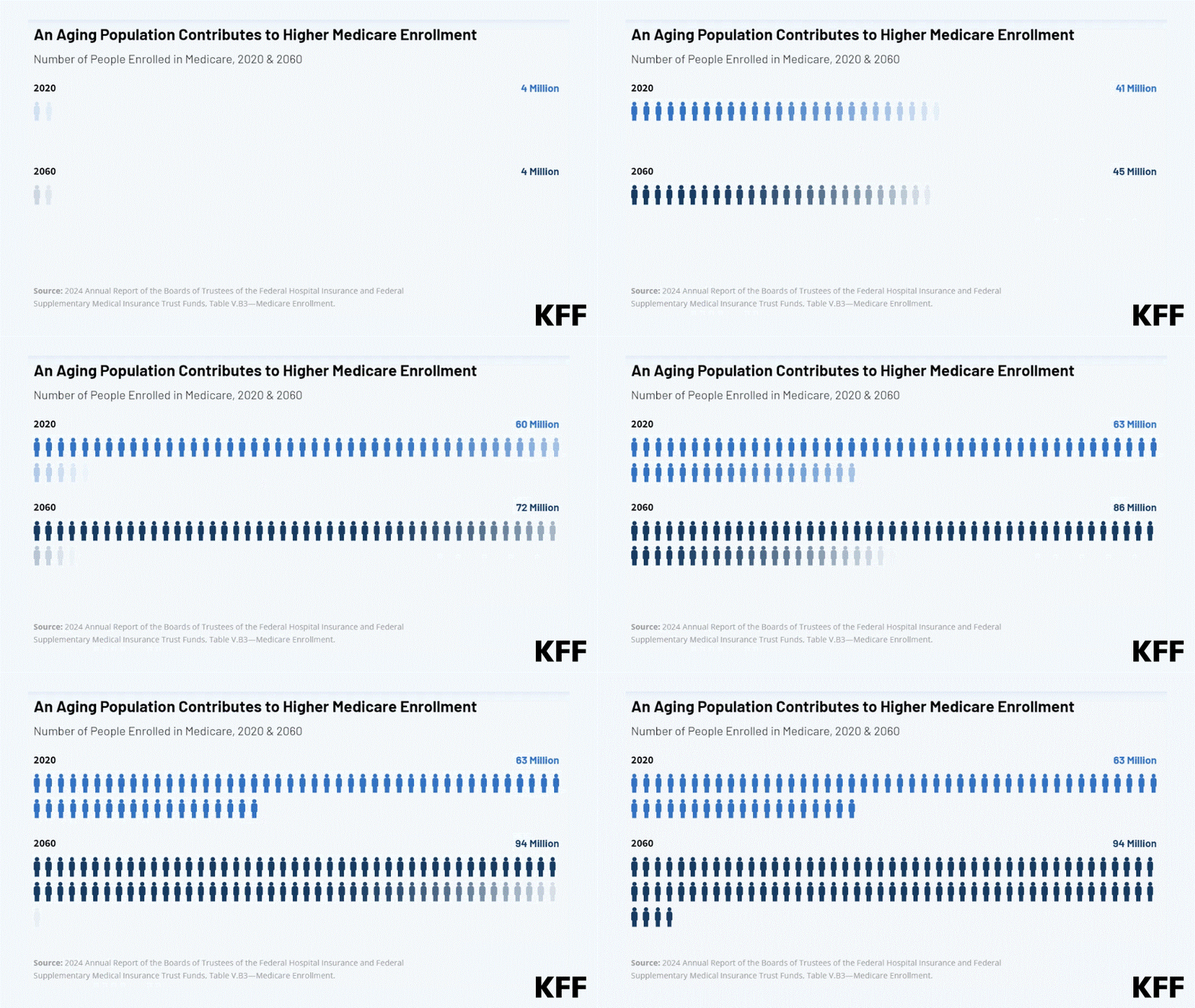
This interactive provides the facts on Medicare spending. Medicare, which serves 67 million people and accounts for 12 percent of the federal budget and 21 percent of national health spending, is often the focus of discussions about health expenditures, health care affordability and the sustainability of federal health programs. Explore data on enrollment growth, Medicare spending trends overall and per person, growth in Medicare spending relative to private insurance, spending on benefits and Medicare Advantage, Part A trust fund solvency challenges, and growth in out-of-pocket spending by beneficiaries.

Read More

Stay informed.

Stay informed.

Filter

1,481-1,490 of 1,627 results

  • e-Health and the Elderly: How Seniors Use the Internet for Health

    Poll Finding

    A national Kaiser Family Foundation survey of older Americans found that as the Internet becomes an increasingly important resource for informing decisions about health and health care options, less than a third (31%) of seniors (age 65 and older) have ever gone online, but that more than two-thirds (70%) of the next generation of seniors (50-64 year-olds) have done so. The differences among seniors and 50-64 year-olds are striking and indicate that online resources for…

  • Policy Workshop on Formularies and Medicare

    Event Date:
    Event

    The Kaiser Family Foundation hosted a March 14, 2005 policy workshop on the use of drug formularies in the private sector and their potential implications for beneficiaries under the new Medicare drug benefit, set to go into effect January 1, 2006. The workshop involved an expert panel, including perspectives from a health plan, a pharmacy benefits manager, a physician, the Centers for Medicare & Medicaid Services and policy experts. Agenda (.pdf) Presentation (.pdf) Speaker Biographies…

  • Medicare Part D Issue Briefs

    Issue Brief

    These issue briefs, prepared by the Centers for Medicare Advocacy, Inc., provide information about how the Medicare drug benefit will affect beneficiaries. The briefs address issues related to dual eligibles, residents of nursing home and assisted living facilities, and the Part D exceptions and appeals processes. Medicare Part D: Issues for Dual Eligibles on the Eve of Implementation Medicare Prescription Drug Coverage for Residents of Nursing Homes and Assisted Living Facilities: Special Problems and Concerns…

  • Explaining Health Care Reform: How Might a Reform Plan Be Financed?

    Issue Brief

    One of the key challenges in enacting a health care reform plan is how to finance it among government, employers, and individuals. Of particular concern to policymakers is what effect a health reform plan would have on government spending and the federal budget. President Obama and Congressional leaders have said that any health reform plan should not add to the budget deficit over a 10 year period. This brief explains the likely sources of added…

  • Health Reform Opportunities: Improving Policy for Dual Eligibles

    Issue Brief

    As the nation considers national health reform, this brief provides an overview of opportunities to realign federal and state policy for the dual eligibles to promote a more rational, cost-efficient system for 9 million of the poorest, sickest and highest-cost people covered by both Medicaid and Medicare. Navigating two programs with different rules and financing incentives is complex for beneficiaries and providers, impedes efforts to improve care coordination and results in cost-shifting between programs that…

  • Medicare Part D 2010 Data Spotlights

    Issue Brief

    The Kaiser Family Foundation has issued a collection of analyses related to the Part D Medicare stand-alone drug plan options available to seniors for calendar year 2010. Each of these spotlights focuses on a key aspect of the drug plans that will be available to Medicare beneficiaries in 2010 and examine relevant trends since the Medicare drug benefit took effect in 2006. They were prepared by a team of researchers at Georgetown University, NORC and…

  • Key Findings: Kaiser Health Tracking Poll — November 2009

    Poll Finding

    This document contains the key findings from the November Health Tracking Poll. The survey was designed and analyzed by public opinion researchers at the Kaiser Family Foundation and was conducted November 5 through November 12, 2009, among a nationally representative random sample of 1,203 adults ages 18 and older. Telephone interviews conducted by landline (802) and cell phone (401, including 112 who had no landline telephone) were carried out in English and Spanish. The margin…

  • Toplines: Kaiser Health Tracking Poll — November 2009

    Poll Finding

    This document contains the toplines from the November Health Tracking Poll. The survey was designed and analyzed by public opinion researchers at the Kaiser Family Foundation and was conducted November 5 through November 12, 2009, among a nationally representative random sample of 1,203 adults ages 18 and older. Telephone interviews conducted by landline (802) and cell phone (401, including 112 who had no landline telephone) were carried out in English and Spanish. The margin of…

  • Key Findings: Kaiser Health Tracking Poll — December 2009

    Poll Finding

    This document contains the key findings from the December Health Tracking Poll. The survey was designed and analyzed by public opinion researchers at the Kaiser Family Foundation and was conducted December 7 through December 13, 2009, among a nationally representative random sample of 1,204 adults ages 18 and older. Telephone interviews conducted by landline (801) and cell phone (403, including 111 who had no landline telephone) were carried out in English and Spanish. The margin…

  • Pulling it Together: Seniors and Health Reform

    Perspective

    It is widely believed that seniors are antsy about the new health reform law. And there is heightened interest in how seniors feel about the law in the political world because they are more likely to vote in midterm elections.  About 48% of the electorate said they voted in the 2006 midterms while about 63% of seniors said the same.  Our June and July tracking polls shed light on seniors’ views on health reform and…