Medicare

Medicare Open Enrollment

Part D Premiums and Cost Sharing in 2027

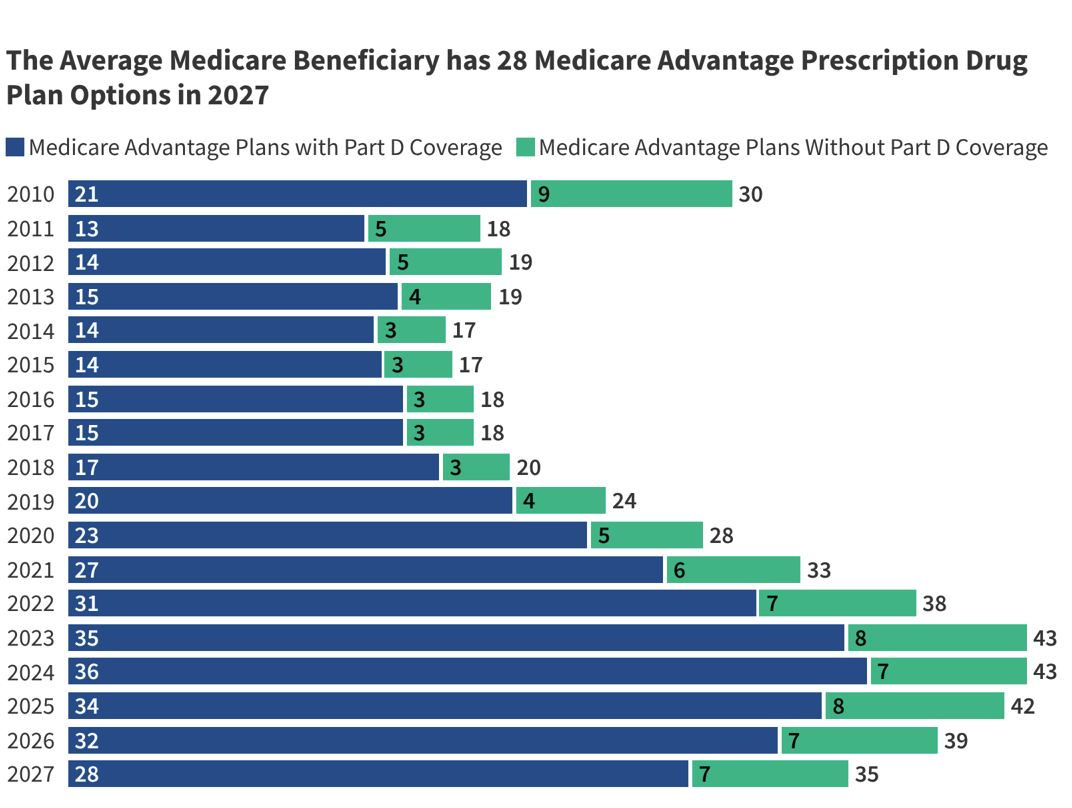
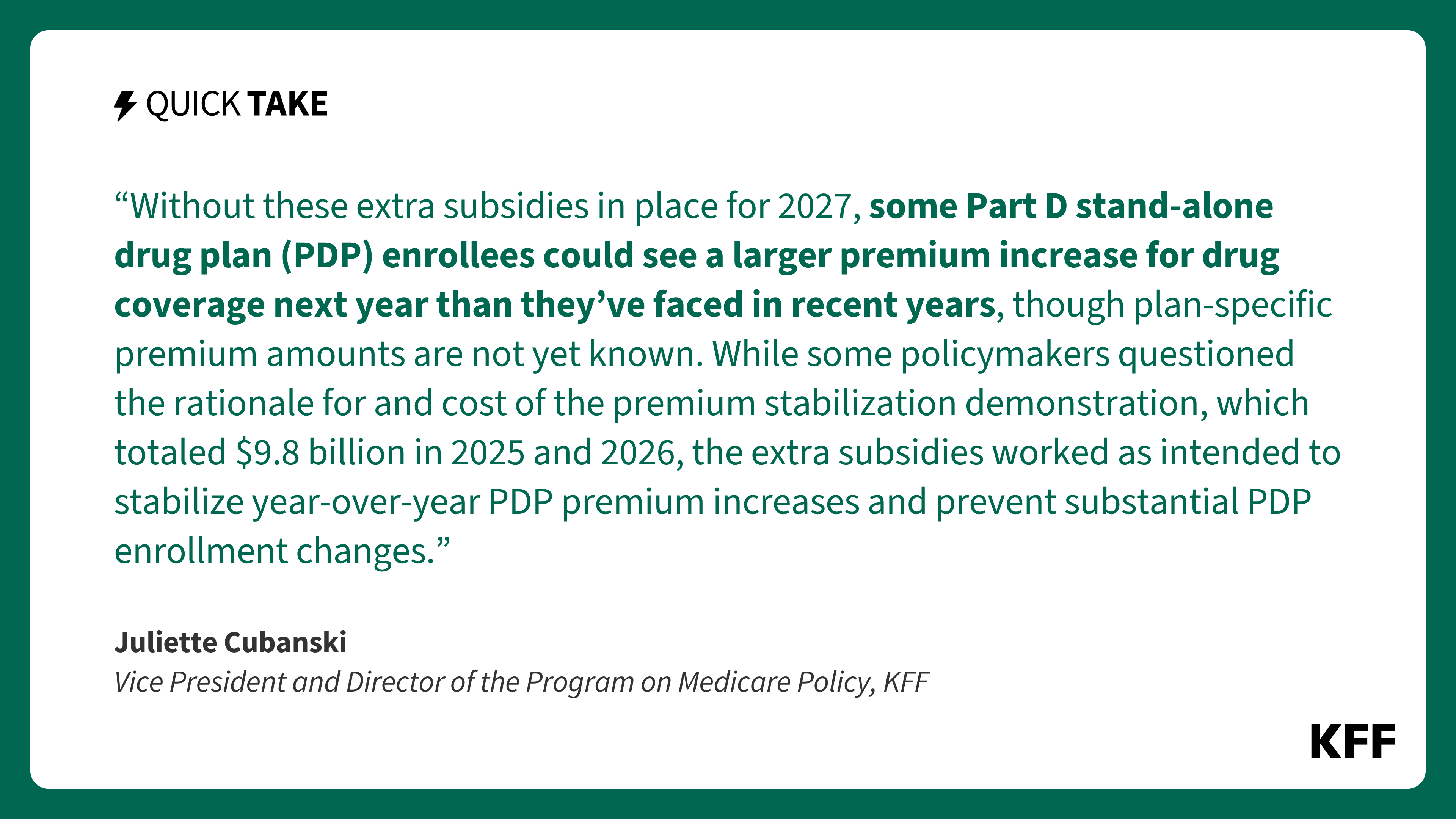
The average monthly premium for Medicare Part D coverage in stand-alone prescription drug plans (PDPs) will increase to $51 in 2027, up 50% from $34 in 2026, if current enrollees don’t switch into lower-premium plans during the open enrollment period. That is more than five times higher than the drug coverage premium in Medicare Advantage plans that offer Part D coverage, which is projected to average $9 per month in 2027. Most Part D enrollees also will face a deductible of several hundred dollars for drug coverage in 2027.
Also: Many Medicare Part D Stand-Alone Drug Plan Enrollees Will See Modest Premium Increases for 2027

Medicare Open Enrollment and Coverage Options: Key Questions and Answers

Each year, Medicare beneficiaries have an opportunity to make changes to how they receive their Medicare coverage during the nearly 8-week annual open enrollment period, which runs from October 15 through December 7. This brief answers key questions about the Medicare open enrollment period and Medicare coverage options.

NEW AND NOTEWORTHY

How Much Do People With Medicare Pay For Coverage?

This brief provides an overview of the costs faced by Medicare beneficiaries in traditional Medicare, Medicare Advantage, and Medicare Part D, including premiums, deductibles, copays, and coinsurance, focusing on costs in 2026.

What’s in a Name? From Today’s Medicare to Medicare for All

KFF’s Larry Levitt explains how proposals to create Medicare-for-All promise more generous benefits than the existing Medicare program, with no premiums or cost-sharing, but could end up looking more like Medicare if it became the subject of a serious national debate about the tradeoffs involved to implement it.

Medigap

Medigap Guaranteed Issue Requirements: An Overview of Federal and State Rules

This issue brief analyzes federal and state rules related to guaranteed issue requirements for Medigap policies and how they impact beneficiaries’ access to Medigap, including the implications for Medicare beneficiaries with pre-existing medical conditions and those under age 65 with long-term disabilities.

Data Visualization

The Facts About Medicare Spending

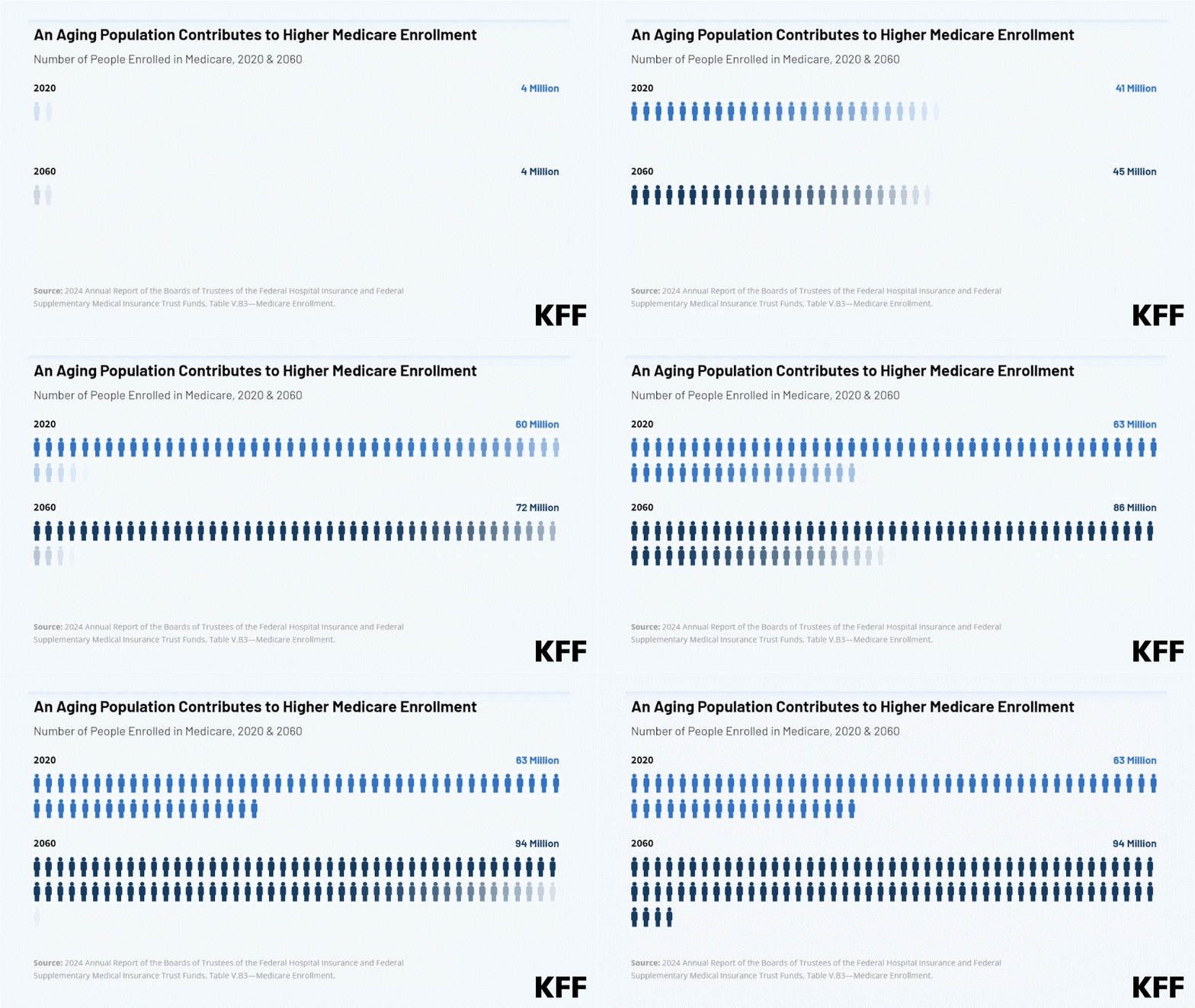
This interactive provides the facts on Medicare spending. Medicare, which serves 67 million people and accounts for 12 percent of the federal budget and 21 percent of national health spending, is often the focus of discussions about health expenditures, health care affordability and the sustainability of federal health programs. Explore data on enrollment growth, Medicare spending trends overall and per person, growth in Medicare spending relative to private insurance, spending on benefits and Medicare Advantage, Part A trust fund solvency challenges, and growth in out-of-pocket spending by beneficiaries.

Read More

Stay informed.

Stay informed.

Filter

1,301-1,310 of 1,627 results

  • Pulling it Together: Duals: The National Health Reform Experiment We Should Be talking More About

    From Drew Altman

    The Center for Medicare & Medicaid Services (CMS) and 26 states are moving to launch a large scale managed care demonstration project potentially involving millions of the poorest, sickest, most expensive Medicare and Medicaid beneficiaries, the so-called dual eligibles. The experiment is getting more and more attention from policy experts, but with controversial issues like the survival of the Affordable Care Act and converting Medicare to a premium support program grabbing the limelight, it has…

  • Oral Health in the U.S.: Key Facts

    Fact Sheet

    This fact sheet provides data on oral health care coverage and access for children, nonelderly adults and Medicaid beneficiaries, including state-by-state data on measures such as the share of adults who have had a dental visit within the past year. Fact Sheet (.pdf)

  • Additional Findings from the National Surveys of Doctors and Pharmacists

    Poll Finding

    Two Kaiser Family Foundation national surveys of doctors and pharmacists examine additional findings on their views and experiences on a wide range of health care issues. The topics covered in the surveys include views and experiences with medical errors and quality issues, use of health care information technology, prescription drug advertisements, views on Medicaid provisions, doctors' willingness to see Medicaid and Medicare patients, and physicians' views of conscience-clause provisions. The Kaiser Family Foundation National Survey…

  • The Impact of Part D on Dual Eligibles Who Spend-Down to Medicaid

    Issue Brief

    Individuals with incomes exceeding thresholds for regular Medicaid eligibility may qualify under state medically needy programs by spending down excess income on healthcare services. For the vulnerable population of Medicare beneficiaries who spend down to Medicaid, the Part D transition has added additional complexities that may result in disruptions in pharmacy coverage and add financial burdens. This paper explores the inter-relationship of Medicare prescription drug coverage and Medicaid spend-down for the medically needy. It describes…

  • Medicare Part D 2010 Data Spotlight: Premiums

    Report

    Medicare Part D helps cover the cost of outpatient prescription drugs for 27 million beneficiaries enrolled in private stand-alone prescription drug plans (PDPs) and Medicare Advantage prescription drug (MA-PD) plans. The majority of Part D enrollees pay a monthly premium for Medicare drug coverage. This data spotlight examines premiums for enrolling in Medicare's PDPs in 2010 and trends since 2006.  The spotlight is one in a series analyzing key aspects of the Medicare Part D…

  • Financial Alignment Models for Dual Eligibles: An Update

    Issue Brief

    The nearly nine million dual eligibles who receive both Medicare and Medicaid benefits are a high cost, high need population, accounting for a disproportionate share of expenditures relative to their enrollment in both programs. In April 2011, the Centers for Medicare and Medicaid Services (CMS) announced the award of design contracts to 15 states to develop service delivery and payment models to integrate care for dual eligibles. CMS and the participating states have recognized that…

  • Raising Medicare Premiums for Higher-Income Beneficiaries: Assessing the Implications

    Issue Brief

    As policymakers consider ways to slow the growth in Medicare spending as part of broader efforts to reduce the federal debt or offset the cost of other spending priorities, some have proposed to increase beneficiary contributions through higher Medicare premiums. This issue brief explains provisions of current law that impose income-related premiums under Medicare Part B and Part D, describes recent proposals to modify these requirements, and analyzes the potential implications for the Medicare population.

  • Explaining the State Integrated Care and Financial Alignment Demonstrations for Dual Eligible Beneficiaries

    Issue Brief

    This paper provides an overview of the joint efforts of states and the Centers for Medicare and Medicaid Services (CMS) to develop more integrated ways of paying for and delivering health care to the 9 million people who are eligible for both the Medicare and Medicaid programs. Dual eligible beneficiaries comprise many of the poorest and sickest people covered by either program, and they account for a disproportionately large share of Medicare and Medicaid spending.…

  • State Demonstrations to Integrate Care and Align Financing for Dual Eligible Beneficiaries: A Review of the 26 Proposals Submitted to CMS

    Report

    The Centers for Medicare and Medicaid Services (CMS) has proposed two models to align Medicare and Medicaid benefits and financing for dual eligible beneficiaries, one capitated model and one managed fee-for-service model. In the spring of 2012, 26 states submitted proposals to CMS seeking to test one or both of these models. CMS is presently reviewing the states' proposals to determine which will be implemented. This background paper examines the contents of the 26 states'…