Medicare

Medicare Open Enrollment

Part D Premiums and Cost Sharing in 2027

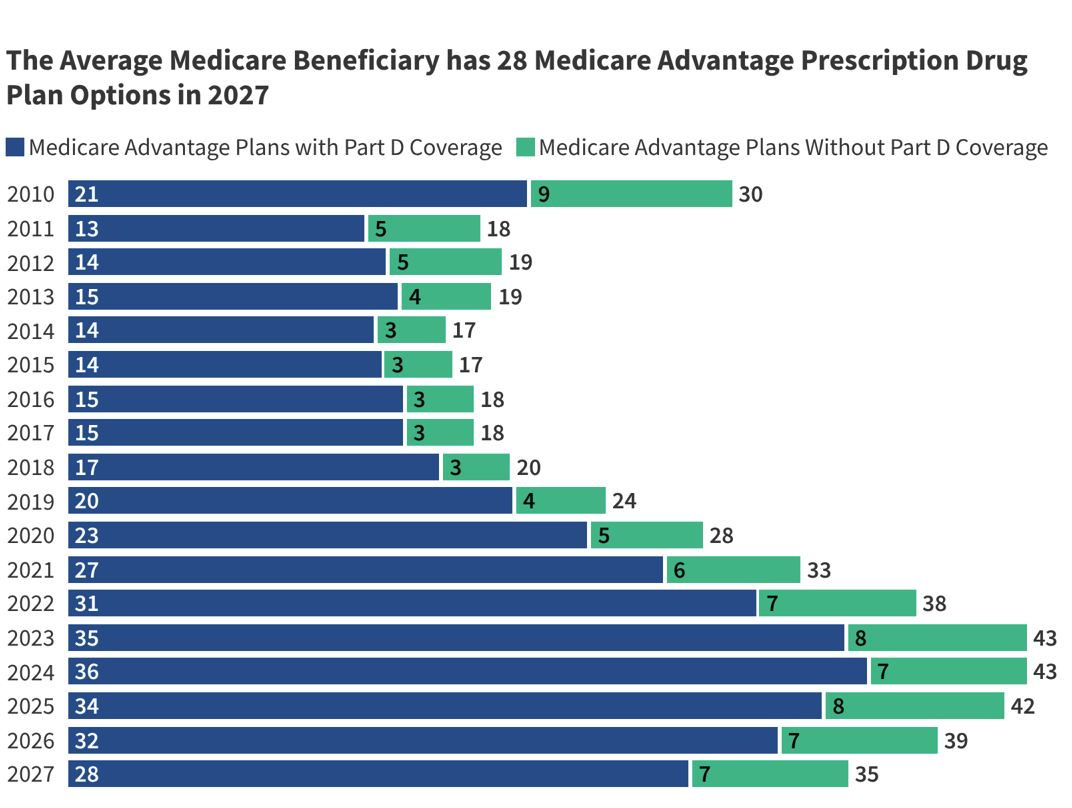
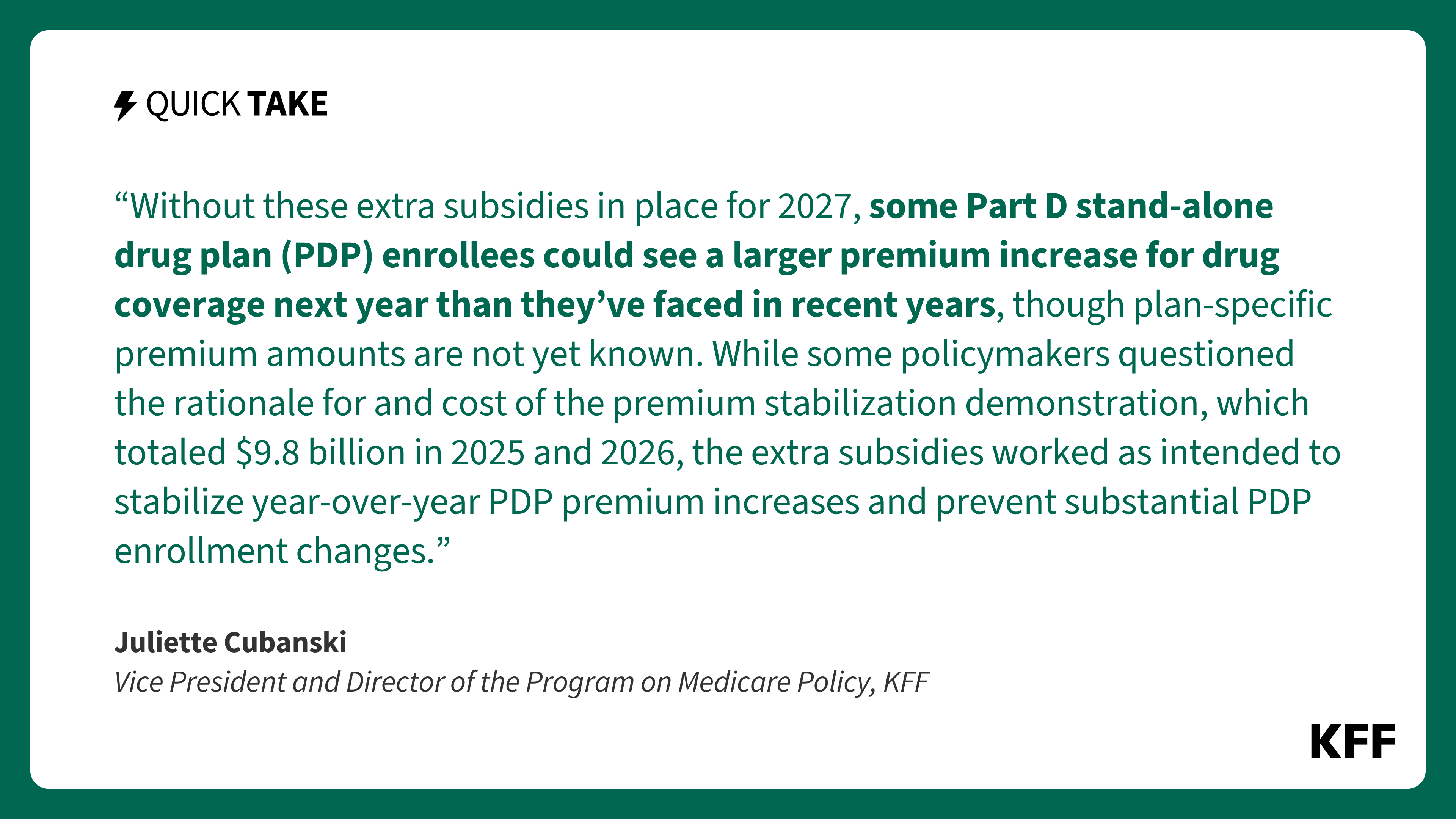
The average monthly premium for Medicare Part D coverage in stand-alone prescription drug plans (PDPs) will increase to $51 in 2027, up 50% from $34 in 2026, if current enrollees don’t switch into lower-premium plans during the open enrollment period. That is more than five times higher than the drug coverage premium in Medicare Advantage plans that offer Part D coverage, which is projected to average $9 per month in 2027. Most Part D enrollees also will face a deductible of several hundred dollars for drug coverage in 2027.
Also: Many Medicare Part D Stand-Alone Drug Plan Enrollees Will See Modest Premium Increases for 2027

Medicare Open Enrollment and Coverage Options: Key Questions and Answers

Each year, Medicare beneficiaries have an opportunity to make changes to how they receive their Medicare coverage during the nearly 8-week annual open enrollment period, which runs from October 15 through December 7. This brief answers key questions about the Medicare open enrollment period and Medicare coverage options.

NEW AND NOTEWORTHY

How Much Do People With Medicare Pay For Coverage?

This brief provides an overview of the costs faced by Medicare beneficiaries in traditional Medicare, Medicare Advantage, and Medicare Part D, including premiums, deductibles, copays, and coinsurance, focusing on costs in 2026.

What’s in a Name? From Today’s Medicare to Medicare for All

KFF’s Larry Levitt explains how proposals to create Medicare-for-All promise more generous benefits than the existing Medicare program, with no premiums or cost-sharing, but could end up looking more like Medicare if it became the subject of a serious national debate about the tradeoffs involved to implement it.

Medigap

Medigap Guaranteed Issue Requirements: An Overview of Federal and State Rules

This issue brief analyzes federal and state rules related to guaranteed issue requirements for Medigap policies and how they impact beneficiaries’ access to Medigap, including the implications for Medicare beneficiaries with pre-existing medical conditions and those under age 65 with long-term disabilities.

Data Visualization

The Facts About Medicare Spending

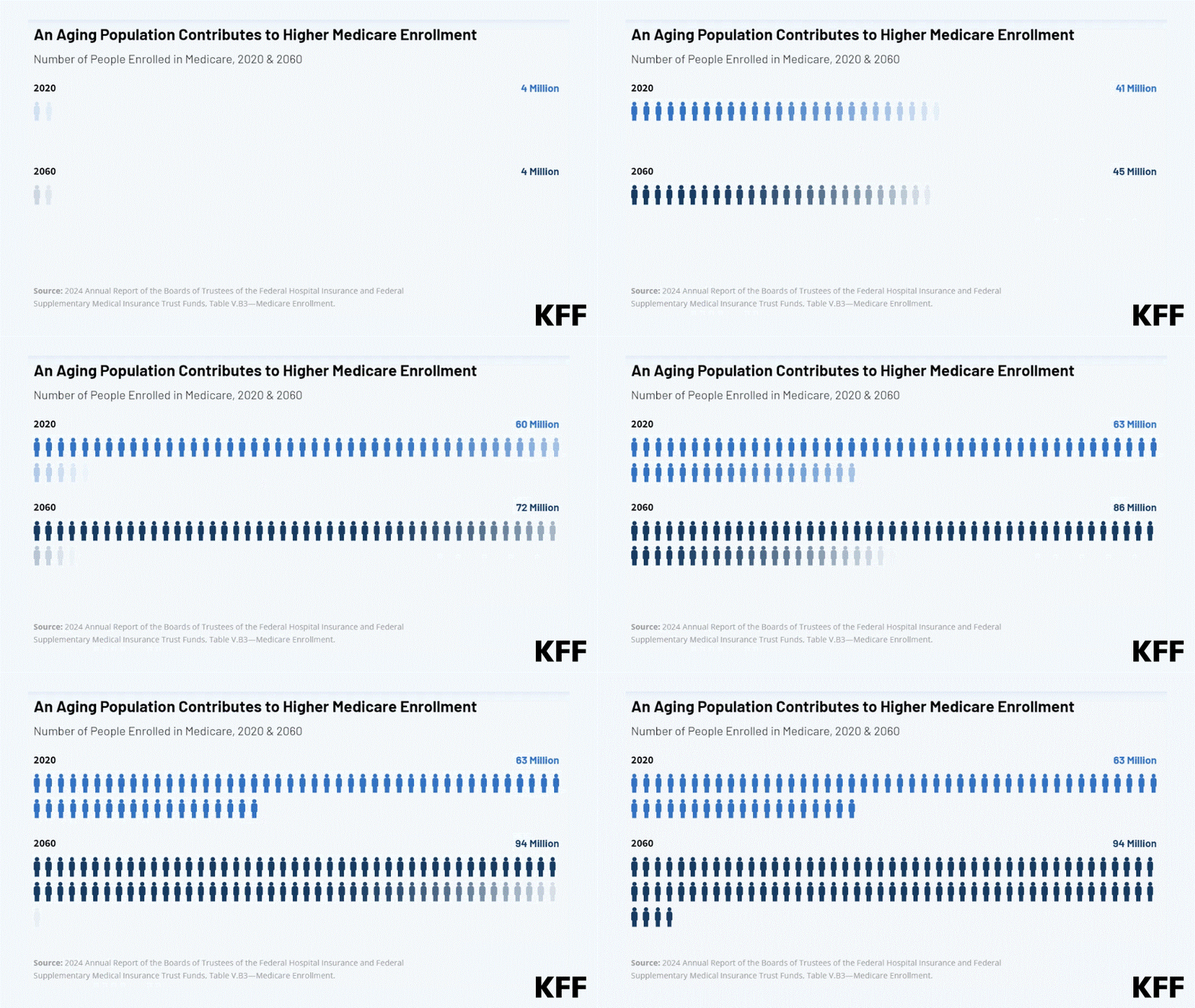
This interactive provides the facts on Medicare spending. Medicare, which serves 67 million people and accounts for 12 percent of the federal budget and 21 percent of national health spending, is often the focus of discussions about health expenditures, health care affordability and the sustainability of federal health programs. Explore data on enrollment growth, Medicare spending trends overall and per person, growth in Medicare spending relative to private insurance, spending on benefits and Medicare Advantage, Part A trust fund solvency challenges, and growth in out-of-pocket spending by beneficiaries.

Read More

Stay informed.

Stay informed.

Filter

1,151-1,160 of 1,627 results

  • Key Findings: Kaiser Health Tracking Poll — December 2009

    Poll Finding

    This document contains the key findings from the December Health Tracking Poll. The survey was designed and analyzed by public opinion researchers at the Kaiser Family Foundation and was conducted December 7 through December 13, 2009, among a nationally representative random sample of 1,204 adults ages 18 and older. Telephone interviews conducted by landline (801) and cell phone (403, including 111 who had no landline telephone) were carried out in English and Spanish. The margin…

  • Toplines: Kaiser Health Tracking Poll — December 2009

    Poll Finding

    This document contains the toplines from the December Health Tracking Poll. The survey was designed and analyzed by public opinion researchers at the Kaiser Family Foundation and was conducted December 7 through December 13, 2009, among a nationally representative random sample of 1,204 adults ages 18 and older. Telephone interviews conducted by landline (801) and cell phone (403, including 111 who had no landline telephone) were carried out in English and Spanish. The margin of…

  • Medicare Part D 2010 Data Spotlight: A Comparison of PDPs Offering Basic and Enhanced Benefits

    Report

    This Part D Data Spotlight examines key differences between basic and enhanced Medicare stand-alone prescription drug plans (PDPs), including monthly premiums, cost sharing, and gap coverage. It also examines plan names to assess whether they convey meaningful differences between basic and enhanced PDPs. Companies that sponsor Medicare Part D prescription drug plans are required to offer a basic benefit, either the standard Part D benefit defined by law or an actuarially equivalent benefit design. Plan…

  • What’s in the Stars? Quality Ratings of Medicare Advantage Plans, 2010

    Issue Brief

    NEW: Foundation brief looks at implications of 2011 quality ratings for Medicare Advantage plans. The Centers for Medicare and Medicaid Services (CMS) rates the relative quality of the private plans that are offered to Medicare beneficiaries through the Medicare Advantage program as a way of aiding beneficiaries who are considering enrolling in such a private plan. CMS rates Medicare Advantage plans on a one to five-star scale, with five stars representing the highest quality. This…

  • Medicare Savings in Perspective: A Comparison of 2009 Health Reform Legislation and Other Laws in the Last 15 Years

    Issue Brief

    Although Medicare is not the main focus of current health reform legislation, the bill recently passed by the House—H.R. 3962, America’s Affordable Health Choices Act of 2009—and the bill before the Senate—H.R. 3590, Patient Protection and Affordable Care Act—include a number of provisions that would affect Medicare program expenditures. This policy brief considers the proposed 10-year Medicare savings and increased spending in the two proposals in the context of other laws enacted during the last…

  • Kaiser Health Tracking Poll — November 2009

    Poll Finding

    The November Kaiser Health Tracking Poll shows little movement in measures of public opinion about health reform from recent months. Among the new findings is a ranking of the public's top priorities from among a list of elements of the legislation. There were both similarities and differences in priorities across partisan groups: while assuring the availability of affordable plans ranked in the top three priorities for Democrats, Republicans and independents, deficit neutrality ranked in the…

  • Key Findings: Kaiser Health Tracking Poll — November 2009

    Poll Finding

    This document contains the key findings from the November Health Tracking Poll. The survey was designed and analyzed by public opinion researchers at the Kaiser Family Foundation and was conducted November 5 through November 12, 2009, among a nationally representative random sample of 1,203 adults ages 18 and older. Telephone interviews conducted by landline (802) and cell phone (401, including 112 who had no landline telephone) were carried out in English and Spanish. The margin…

  • Toplines: Kaiser Health Tracking Poll — November 2009

    Poll Finding

    This document contains the toplines from the November Health Tracking Poll. The survey was designed and analyzed by public opinion researchers at the Kaiser Family Foundation and was conducted November 5 through November 12, 2009, among a nationally representative random sample of 1,203 adults ages 18 and older. Telephone interviews conducted by landline (802) and cell phone (401, including 112 who had no landline telephone) were carried out in English and Spanish. The margin of…

  • Chartpack: Kaiser Health Tracking Poll — November 2009

    Poll Finding

    This document contains the chartpack from the November Health Tracking Poll. The survey was designed and analyzed by public opinion researchers at the Kaiser Family Foundation and was conducted November 5 through November 12, 2009, among a nationally representative random sample of 1,203 adults ages 18 and older. Telephone interviews conducted by landline (802) and cell phone (401, including 112 who had no landline telephone) were carried out in English and Spanish. The margin of…

  • Medicare Part D Spotlight: Part D Plan Availability in 2010 and Key Changes Since 2006

    Issue Brief

    This Medicare Part D data spotlight examines the stand-alone Medicare drug plan options that will be available to beneficiaries in 2010, including the number of available plans, premiums for those plans, and benefit designs. About two-thirds of the nearly 27 million Medicare beneficiaries who are enrolled in Part D plans get their coverage through stand-alone plans. The analysis is based on the 2010 Medicare drug plan information released by the Centers for Medicare & Medicaid Services…